Introduction
Since the 2003 publication of Health Disaster Management: Guidelines for Evaluation and Research in the Utstein Style (hereafter referred as the Guidelines),Reference Birnbaum, Loretti, Daily and O’Rourke 1 risk management and risk reduction have assumed a major role in Disaster Health. Examinations of the Hyogo Framework, 2 Humanitarian Reform, 3 the Transformative Agenda, 4 the Global Platform for Disaster Risk Reduction in 2013, 5 and the Sendai Framework for Disaster Risk Reduction 2015-2013 6 have led to the need to revise the model of risk provided in the Guidelines. In the initial publication of the Guidelines, the term “risk” was defined as “the objective (mathematical) or subjective (inductive) probability that something negative will occur.”Reference Birnbaum, Loretti, Daily and O’Rourke 1 (p158) More generally, risk is defined as the chance or possibility of danger, loss, injury, or other adverse consequences. 7 This latter definition brings forward the concepts of some sort of sequence of events as well as the consequences if the event occurs. The International Organization for Standardization (ISO; Geneva, Switzerland) points out that risk “often is expressed in terms of a combination of the consequences of an event (including changes in circumstances) and the associated likelihood of occurrence.”Reference Thompson 8 Likelihood is the chance of something happening, can be measured objectively or subjectively, and can be expressed qualitatively or quantitatively. However, as likelihood does not have a direct equivalent in some languages, the term probability often is used. The use of “probability” also has some advantages as it infers a mathematical expression. In Disaster Health, expressions of risks include estimations of these probabilities. Estimates of risks are essential components to the selection and prioritization of risk-reduction and capacity-building interventions.
Coppola, in his Introduction to International Disaster Management, proposes that risk is “the result of the likelihood of an event occurring multiplied by the consequence of that event, were it to occur.” 9 Coppola’s definition can be summarized as: 9
 $${\bf Risk}={\bf Event}\;{\rm }{\bf Likelihood}{\times}{\bf Event}\;{\rm }{\bf Consequences}$$
This formulation includes the consequences (ie, the projected number of deaths, the number of associated injuries and/or illness, as well as the physical and economic losses) that may occur in the unraveling of “the event.” Consequences of an event include the structural damages and functional damages (losses of function(s)) that could result from an event. However, any estimation of risk also must include “exposure” to a hazard; if there is no exposure, there is no risk of sustaining damage from an event.
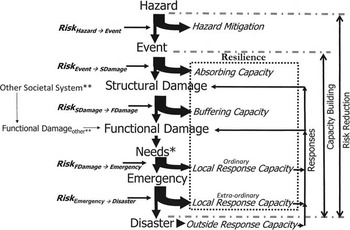
In order to design disaster risk-reduction strategies, the probabilities that a hazard will produce a disaster must be deconstructed so that interventions can be directed at specific parts of the process of a hazard evolving into a disaster, as outlined in the Conceptual Framework.Reference Coppola 10 A series of risks have been incorporated into the revised disaster Conceptual Framework (Figure VIII-1) and comprise a Disaster Risk Cascade.Reference Coppola 10
The Conceptual Framework with the Addition of Associated Risks (FDamage = Functional Damage; SDamage = Structural Damage).

The Disaster Risk Cascade
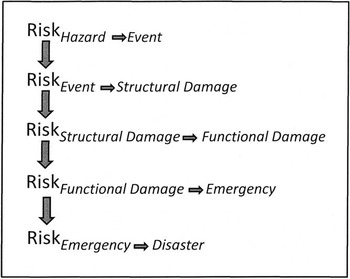
The risk that a hazard will result in a disaster consists of a series of probabilities of occurrence and consequences that are outlined in the Conceptual Framework (Figure VIII-1).Reference Coppola 10 In the initial version of the Guidelines, only two categories of risks associated with the presence of a hazard were proposed: (1) the risk that the hazard will cause an event; and (2) a formula for the probability (risk) that damage will occur.Reference Birnbaum, Loretti, Daily and O’Rourke 1 However, the concept of risk, as used in disaster research and evaluation, can be expanded to include a cascade (series) of risks that go beyond these two related risks, and are part of a continuum of risks that progress from a hazard to a disaster (Figure VIII-2). This proposed continuum of risks (the Risk Cascade) is in agreement with the risk-reduction materials published by the Health Actions in Crisis Department of the World Health Organization (WHO; Geneva, Switzerland), the Global Health Cluster of the WHO, the United Nations (UN) Office for the Coordination of Humanitarian Affairs (UN-OCHA; New York USA/Geneva, Switzerland), and the UN International Strategy for Disaster Reduction (UN-ISDR; Geneva, Switzerland), 2 - 4 and was highlighted during the 2013 Global Platform for Disaster Risk Reduction 5 and 2015 Sendai Framework for Disaster Reduction 2015-2030. 6
The Cascade of Risks in the Progression from a Hazard to a Disaster, includes: the risk that a hazard will cause an event; an event will cause structural damage; structural damage sustained will cause functional damage (changes in function) that produces needs; and that the needs will overwhelm the Local Response Capacity and result in a disaster.

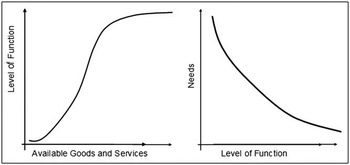
Hypothetical Relationships between Levels of Function and Available Goods and Services and Needs. The shape of these curves depends on the setting, the Societal System.

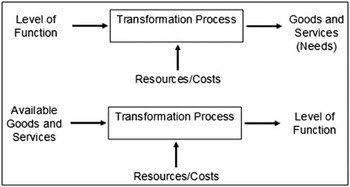
Diagram of the Transformation Process Required to Convert Level of Function into Needed Goods and Services and the Transformation Process Required to Convert the Available Goods and Services into Levels of Function. Each process requires resources including human input.

Each step in the Disaster Risk Cascade relates to the potential consequences of the hazard, and each can be characterized by its probability/likelihood of occurrence, and of the probability of consequences should the event occur. Thus, there are risks that: a hazard may produce an event (Risk Hazard → Event ); and that the consequences of the event will be structural damage(s) (Risk Event → Structural Damage ); and that the consequences of structural damage will be functional damage (Risk Structural Damage → Functional Damage ) that creates needs; and that the needs may require use of the extraordinary goods and services of the local response capacity and create an emergency (Risk Functional damage → Emergency ); and finally, that the needs may be sufficiently great to overwhelm the local response capacity and result in a disaster (Risk Emergency → Disaster ) (Figure VIII-2). These occurrences can be conceived of as resulting from a multi-factoral and incremental set of processes. Some of the intervening factors are independent, but many, if not most, are modulated by external influences,Reference Birnbaum, O’Rourke, Daily and Loretti 11 be they economic, social, cultural, or environmental; others can be influenced by changes in resilience (absorbing, buffering, and/or response capacities).
Given that each of these risks is dependent upon the preceding step in the progression of a hazard to a disaster, and that part of each of the risks is a probability, and that probabilities have a value between zero and one, the probability that a disaster will result from an existing hazard will be much smaller than the probability that a hazard will manifest as an event. Even the probability that the functional damage from an event will produce a disaster is less than the probability that structural damage will result from an event; the probability that an event will result in structural damage is less than the probability that a hazard will manifest as an event.Reference Coppola 10
Although many attempts have been made to quantify the probability for earthquakes in specific geographical areas,Reference Birnbaum, Daily, O’Rourke and Kushner 12 - 14 it has not been possible to derive a mathematical expression for the estimations of the risks embedded in all of the hazards that could result in a disaster. Thus, qualitative expressions, such as “high,” “medium,” “low,” “minimal,” and “remote,” have been used to describe some risks. 15 - 17 However, these qualitative designations of the degree of risk and exposure beg definitions, and their definitions must be standardized; further analysis and research are necessary. 18 Currently, there are no standardized quantitative mechanisms for the inclusion of the probability for consequences in the expressions of risk as used in this discussion.
The elements of the Risk Cascade (Figure VIII-2) are discussed in some detail so that the goals of risk-reduction interventions can be described according to which element in the continuum of risks a given intervention is addressing. Further, the risks in each stage of the continuum are specific to the Societal System being assessed. The collective risk for the community is related to the cumulative risks and vulnerabilities of each of its functional Societal Systems.
Risk-reduction efforts can be directed towards mitigating the probability that a hazard will produce an event, and/or towards capacity building. Capacity-building interventions to achieve increased resilience (part of risk reduction) are directed towards a specific Societal System (or its components) or dependent Societal Systems, but generally are not aimed at risk-reduction for all Systems. Risk-reduction efforts should contribute to decreasing the risk that a hazard will evolve into a disaster for a Societal System of the community-at-risk.
Risk of a Hazard Becoming an Event (RiskHazard → Event)
The “risk” of a hazard progressing to an event was described in the GuidelinesReference Birnbaum, Loretti, Daily and O’Rourke 1 (pp56-68) and is designated as Risk Hazard → Event . An “event” is the materialization of the destructive potential of a hazard (conversion of an amount of potential energy to kinetic energy). If the hazard is eliminated, there is no risk that an event will occur related to the hazard. Thus, de-mined land does not pose a risk for an explosion due to a landmine; spraying insecticides in an endemic area for malaria decreases the risk of a mosquito-borne epidemic since much of the hazard is removed from the environment.
As noted elsewhere, the probability that a hazard will materialize into an event is determined mainly by factors that are intrinsic to the existing hazard, and include: (1) the nature/characteristics of the hazard; and (2) measures taken to contain/control the potential energy inherent in the hazard. Thus, shielding and/or cooling of nuclear devices; educating, training, and licensing the operators of such devices; negotiating treaties; implementing laws that regulate the use of hazards; and designing measures that prevent dam ruptures, as well as inspecting and correcting potential structural failure decrease the probability that an event will result from that specific hazard. Failures of any of the above cited measures increase the risk that the hazard will cause an event that has consequences for the community-at-risk.
The types of hazards to which a population may be at risk for an event are tabulated in Table II-1 of the Conceptual Framework paper in this series.Reference Coppola 10 They may be summarized as: (1) natural; (2) human-made (anthropogenic); or (3) a combination of the two. Each type has characteristic potential energy and predictable mechanisms for producing damage. When the energy contained in some hazards is being used in a controlled manner, either a decrease or an increase in the amount of energy released may constitute an event. For example, a decrease in available electrical energy may cause a power outage or failure (event).
External, environmental factors to be considered in estimating the likelihood (probability) that a hazard will produce an event include: (1) inherent environmental characteristics of the area-at-risk (mountains, flood plain, under water, climate, forest, desert, and/or proximity to faults); and (2) anthropogenic changes in the environment (deforestation, desertification, and urbanization). Societal factors that play a role in estimating the risk of all hazards include issues such as: (1) associated laws and mechanisms for their enforcement; (2) policies/practices of safety/avoidance; (3) prevention/mitigation resources; (4) the economy; and/or (5) education and training of citizens regarding safe management of hazards. Specific human acts of omission or commission often are factors in triggering events caused by anthropogenic hazards.
Thus far, activities to decrease the likelihood (probability) that an event will occur have been possible for only a few natural hazards (eg, preventing deforestation may decrease the likelihood of mudslides or floods, isolating persons with an infectious disease decreases the risk that an epidemic will result, and proactive snow movement may reduce the risk of an avalanche). However, there are no human actions that can reduce the probability that a fault will produce an earthquake or that weather conditions will result in the formation of a tropical cyclone (hurricane).
The probability that an event will occur from a hazard must be expressed in terms of the time period being considered. The probability that a hazard will produce an event may be highly improbable on a daily scale, but becomes greater when considered over the course of a year or longer. For example, the likelihood that an earthquake will occur today is less than if the prediction is extended to one month; and its probability within the next 100 years is greater than its projection for one year. Thus, expressing the probability for a hazard becoming an event must include the period of time for which the probability is being estimated. In some cases, it may be appropriate to refer to the particular season for which the probability of the event is projected. For example, the probability that a tropical storm will occur in the same location in the summer is greater than it is in the winter.
In addition, the probability that an event will occur increases as the area (scale) in which the risk is being estimated increases. The probability that another tsunami will strike Aceh Province, Indonesia is less than the probability that a tsunami will impact Indonesia. Thus, expressions of the risk of a hazard becoming an event must include the area as well as the time period.
Events due to natural hazards are ubiquitous; they are not selective of which Societal Systems are damaged. However, some anthropogenic hazards may intentionally be directed at specific Systems of the community-at-risk (eg, computer virus or an explosion on a train).
Consequences of an Event
An event produces consequences; these consequences are factors in estimating the risks within the Disaster Risk Cascade. The probability of being affected as a consequence of an event is mediated by factors of individual and community vulnerability. Vulnerability is a condition leading to a higher risk for damage due to the combined effect(s) of susceptibility, exposure, and coping ability.Reference Carpenter 19 - Reference Adger 21 Vulnerability includes the characteristics and circumstances of a community, a System, or an asset that renders an individual or a community susceptible to the damaging effects of an event from some hazard. Individual vulnerability is defined by individual conditions (social status, age, gender, health, and/or economic situation), individual choices, behaviors, and so on. The vulnerability of a community-at-risk or any of its component Systems corresponds to the structural damage, the subsequent functional damage, and the ability of the community-at-risk to cope with and respond to the needs related to the consequences of the event.Reference Gallopin 20 Therefore, community vulnerability is a function of the community’s collective absorbing, buffering, and response capacities. It relates to the resilience of a community’s infrastructure and vital systems. As resilience increases, vulnerability decreases.Reference Birnbaum, Loretti, Daily and O’Rourke 1 (pp56-68) The absorbing, buffering, and response capacities, and hence, the levels of vulnerability and resilience, are determined by societal pressures as well as individual choices. Capacity building consists of all interventions that are directed at augmenting the resilience of the community-at-risk or any of its components or combinations of components. The degree of risk for any of the occurrences in the disaster continuum is an essential element in determining the priorities for capacity building. Capacity-building interventions seek to decrease the risks that an event will result in a disaster for the community as a whole, or for any of the Systems that comprise the community.
Risk of Structural Damage from an Event (Risk Event→Structural Damage )
Structural damage to a person, community, or a component of a Societal System is caused by the type and amount of energy released during the event. Structural damage caused by changes in the kinetic energy may be due to the direct contact of the energy on living beings, the natural environment, or the infrastructure of the community damaged, and/or due to damage not directly caused by the changes in the kinetic energy comprising the event (indirect damage).Reference Adger 21 The risk that an event will cause structural damage to a community-at-risk (Risk Event → Structural Damage ) is a product of many factors, including: (1) exposure to the kinetic energy of the event; (2) the characteristics of the event; and (3) the absorbing capacity of the structures exposed to the kinetic energy that comprises the event.
Exposure
Exposure to the kinetic energy of an event is an essential factor of risk and of vulnerability. If there is no exposure to an event, there is no risk for structural damage to occur, and hence, no risk for a disaster. Exposure of humans to an event is essential to define the risk for injuries. Exposure manifests the probability of being in the wrong place at the wrong time; it is mediated by environmental factors (ie, lack of alternatives for settlement, population growth, or terrorism) or individual and societal factors. The risks for structural damage can be decreased by preventing exposure to the event by evacuating or relocating a population-at-risk. This is true particularly in the face of delayed-onset events (ie, tropical cyclone (hurricane), volcanic eruption, tsunami, impending famine, or violence).
Characteristics of an Event
The important characteristics of an event are listed in Table II-2 of the Conceptual Framework paper in this series.Reference Coppola 10 The released kinetic energy of the hazard that impacts on individuals, infrastructures, and Societal Systems may be of sufficient magnitude to disrupt the integrity of the structures it impacts and cause damage to the structures. The type of event and its characteristics (whether the event was single or multiple, its type of onset, its magnitude, amplitude, duration, intensity, frequency, scope, scale, progression, and means of propagation) influence the amount and nature of the structural damage created. Each of these variables contributes to the risk of sustaining structural damage from the event. For many hazards, the timing of the event is critical to the risk of ensuing structural damage — did the earthquake occur at night or during daylight? The greater the deviation from the steady state control of the energy released, the greater the possible damage. Too much rain or too little rain may cause damage. These factors and characteristics are discussed in detail in the Conceptual Framework paper in this series.Reference Coppola 10
Absorbing Capacity
Not all events will result in structural damage; every structure has a specific absorbing capacity for the amount and the rate of energy released during an event. The risk of a structure sustaining structural damage from an event (Risk Event → Structural Damage ) may be reduced by augmenting the absorbing capacity of the structure for the event. The greater the absorbing capacity of a structure for the type of energy released (or not released), the less will be the risk that the structure will be damaged by the event. If the absorbing capacity of a structure is sufficient to absorb all of the energy that impacts the structure, no structural damage to that object from the event will occur. This applies to individual structures as well as to the individual Societal Systems of the community. Factors that change the absorbing capacity impact the estimation of the Risk Event → Structural Damage . Modifications of the absorbing capacities for an event may occur serendipitously, or as a result of: (1) deliberate human actions; or (2) structural damage(s) created by a previous event. For example, the absorbing capacity for a flood may be increased by building a dyke, or it might be decreased by deforestation.Reference Gallopin 20 Modification of the absorbing capacity for the energy released during an event is a component of resilience: the greater the absorbing capacity, the greater will be the resilience for the event (decrease risk), and vice versa.
The structural damage caused by an event can be direct or indirect. Direct damage entails injuries, illnesses, and deaths from the kinetic energy of the event, and is determined by individual/community vulnerability (ie, susceptibility and exposure) and the nature of the hazard. This also applies to the community’s infrastructures (Societal Systems). Examples of indirect structural damage to humans include violence, starvation, suicide, and exposure to secondary events. Some people estimate that the number of indirect casualties may outweigh those from injuries directly related to the kinetic energy of the event.Reference Adger 21 Generally, indirect structural damages have not been included in the estimations of the risks that an event will cause structural damage.Reference Burkle 22
An important consideration in the estimation of the risk for structural damage is the possibility that the initiating event will lead to the development of secondary or tertiary events (eg, mud/land/snow slides, flooding, or tsunamis). Each of the secondary events (caused by the kinetic energy of the primary or other events) must be considered as a separate event resulting from the primary/precipitating event. The probabilities of secondary and tertiary events, as well as the anticipated indirect damages associated with the event, must be included in predicting the potential consequences to the community-at-risk.
Risk of Functional Damage from Structural Damage (Risk Structural Damage → Functional Damage and Needs )
Functional damages (changes in functions) result from structural damage; however, structural damage may or may not cause changes in function(s). The risk that damaged structures will result in losses of function is dependent upon: (1) the structures of the Societal System damaged, their role in the community, and their respective pre-event level of functioning; (2) the type and severity of structural damage sustained; and (3) the buffering capacity of the Societal System or its components for the structural damage. Also important in the estimation of risks are the dependencies of the damaged Societal Systems upon the functions of other Societal Systems.Reference Burkle 22 For example, if the pharmacy of a hospital is damaged, the ability to provide needed pharmaceuticals may be compromised. However, if only its refrigeration unit is damaged and rendered inoperative, and an alternative refrigeration unit is available in another area, it could be possible to store the drugs requiring refrigeration in another undamaged facility in the hospital allowing the pharmacy, and thereby the hospital, to continue its functions (buffering capacity).
Predicting the functional damages that may result from an event is complex and specific to the affected Societal System or its components that are vulnerable to structural damage from the event. Estimating the risks for the losses of functions has major implications in the design, selection, and implementation of capacity-building interventions. Estimated risks for losses of function generally are determined from knowledge of the existence of a hazard in the particular setting and the experience and knowledge of those estimating the risk. Risk estimations of functional damages include the likelihoods of the occurrences and the consequences of a given hazard creating disturbances in the functioning of a System(s) of a community-at-risk. Therefore, the probability that changes in the amount and rate of the release of energy contained within a hazard will result in disturbances in the functioning of a component of the community is lower than the probability that the hazard will generate an event and that the event will cause structural damage. Increasing the buffering capacity (ie, the ability to continue to function despite the structural damage sustained) should decrease the risks for functional damage. Increasing the buffering capacity of any System is part of capacity building and results in increased resilience. Actions may be directed at decreasing the risks for changes in function for all events (all-hazard) or for a specific event due to a specific hazard.
Needs
Needs are consequences of functional damage. Compromises in functional levels of essential functions due to damage always result in needs. Needs are the goods, services, and other resources required to prevent/mitigate further deterioration in functions, to return levels of functions to their respective pre-event status, or to augment the absorbing, buffering, or response capacities. Needs are synthesized from assessments of the functional damage sustained. Needs are assumptions based on these assessments and the experiences and knowledge of those transforming the functional damage into needed goods, services, and other resources (Figures VIII-3 and VIII-4). Generally, as the level of function decreases, the needs for goods and services increase. Identifying the needs associated with functional damage is a transformation process and involves a risk that the identified needs may not accurately reflect the true needs of the community; the consequences of acting on the erroneous needs may be counterproductive or of little value to the affected community. Errors may result from inaccurate or inappropriate assessments of the functional status or in the transformation of the results of the assessments into goods and services. The needs identified may be inappropriate for the setting/culture/politics of the community. Errors in defining needs lead to inappropriate and unnecessary interventions and costs.
Risk of Emergency from Functional Damage (Risk Functional Damage → Emergency )
Functional damage always results in needs. All human actions/interventions/responses must be based on identified needs and use the goods, services, and/or other resources (eg, funds) that are part of the community’s response capacity. An emergency exists when the needs created by functional damage(s) require the use of extra-ordinary goods, services, and other resources that are contained within or managed by the Local Response Capacity. When the needs of the community or its Systems cannot be met by the ordinary response capacity of the community, an emergency exists and extra-ordinary responses are required to meet these needs.
Thus, there is a risk that functional damage will create an emergency. The risk that functional damage will result in an emergency can be mitigated by augmenting the Local Response Capacity by increasing the locally available resources to cope with the event (extra-ordinary responses). Extra-ordinary responses include providing not only the goods but also the education and training of the personnel, the Systems required for the conversion of the goods and services into functions, and the delivery of the goods and services to where they are required to meet the needs. Risks for an emergency as a consequence of the functional damage vary by the response capacities of the respective Societal Systems.
Risk of a Disaster from Emergency (Risk Emergency → Disaster )
A disaster occurs when the Local Response Capacity is unable to meet the needs created by the functional damage to one or more Societal Systems, and thus, it becomes necessary to obtain the required goods/services/resources from outside of the area directly impacted by the event. The risk that the needs created by the functional damage will cause a disaster is dependent upon the Local Response Capacity’s ability to meet those needs. Therefore, the Risk Emergencys → Disaster depends upon the response capacities of the Systems of the affected community—the greater the response capacities of the “local” community, the lower the risk that an emergency will morph into a disaster for that community or a Societal System that serves the community. For example, a health disaster (ie, a disaster for the Medical Care System) occurred in Aceh Province of Indonesia following the earthquake and tsunami, not only as a result of structural damage to the health care facilities, but also because many of the local health care providers were injured/killed; assistance from outside health care providers was required to meet the daily health care requirement of the area, plus the new, additional needs (conditional needs) of the victims of the earthquake and tsunami. Recall that a disaster can occur for any of the Systems that serve the affected community. The greater the number of Systems that become functionally damaged, the greater the scope of the disaster.
Risk of a Disaster from a Hazard (Risk Hazard → Disaster )
Augmenting any of the components of resilience (absorbing, buffering, or response capacities) will decrease the probability that a hazard may produce a disaster for any given Societal System. A relatively high risk for any of the progressive occurrences (ie, the steps from hazard to disaster) likely will increase the likelihood that the hazard will produce a disaster for a System or part of a System. Some capacity-building interventions may be hazard-specific, while others may be directed at all hazards. The likelihood that a disaster will occur from a specific hazard, in part, is the product of all of the component probabilities associated with the hazard.
The likelihood that a disaster will occur can be decreased by utilizing the available goods, services, and other resources in accordance with the local disaster response plan. For example, in an event due to the release of a hazardous material, the deployment and activities of a local hazardous material response team (Local Response Capacity) may decrease the likelihood that outside help will be required, and hence, prevent a disaster from occurring. Likewise, the use of local buses in accordance with a plan for the evacuation of a population-at-risk for being isolated in a forthcoming flood may decrease the need for outside rescue requiring the use of helicopters and/or boats. 23 , Reference Daily, Birnbaum and O’Rourke 24
Interventions that increase the absorbing, buffering, and/or response capacities comprise capacity building and are discussed in greater detail in the Risk-Reduction Framework paper in this series.Reference Dyson 25 Together, the combination of the absorbing, buffering, and response capacities constitute the resilience of a System(s) to an event related to a specific hazard or to all of the hazards that threaten the local community.
Risks Associated with Inappropriately Identified Interventions
An intervention is selected because it is assumed that its implementation will contribute to attaining an overall goal. This infers that all interventions selected for implementation must have clearly defined objectives. A principal factor in selecting a proposed intervention is whether its implementation actually will meet its stated objectives and whether attaining these objectives will contribute to achieving the goal. In other words, what is the likelihood that the intervention will meet the objectives for which it is designed, and what will be the consequences if it is implemented? Likewise, what is the relative risk that the intervention will not achieve the objectives and/or will not contribute to meeting the goal, and what would be the consequences? The risk of an intervention not meeting its objective is a negative way of estimating the success of a project. Every intervention directed at capacity building has an associated risk that must be included in decisions of whether or not to implement it. Interventions that carry a high risk for failure, or if failure has particularly negative consequences, should not be implemented or should be implemented with caution. Is the risk worth the effort and investment of resources? Is it an “acceptable” risk given the setting?
Risks and Damages
Damages related to an event may increase the risks associated with hazards other than the one responsible for the primary event. Some interventions that are directed at decreasing risks associated with one hazard may change the risks that a disaster will result from another hazard. For example, the damages associated with the 2010 earthquake that devastated parts of Haiti rendered the affected population more susceptible to cholera, which may have contributed to the epidemic nine months after the earthquake.Reference Birnbaum, O’Rourke and Daily 26 , Reference Miller and Birnbaum 27 Structural damage to a building may increase the risk that the building will collapse from other factors for which it previously was resistant. For example, the earthquake that was responsible for the Indian Ocean tsunami weakened the structural integrity of many bridges, which subsequently collapsed during the tsunami.Reference Martins and Luz 28 Multiple events may increase the risks for a disaster by changing the risks associated with any of the stages of the Risk Cascade. The damage to the electrical grid caused by the earthquake and tsunami in Japan caused the failure of the water pumps that ultimately led to the meltdown of the nuclear reactors. Risk-reduction interventions can be directed at any of the stages in the Risk Cascade.
Assessments of Risks
To assess is a verb meaning to estimate the size or quality of; 29 to determine the value, significance, or extent of.Reference Thompson 30 An assessment is the collection of relevant information that may be relied on for making decisions.Reference Pickett 31
Risk assessment is a process commonly used by the business sector as part of management. It has been adopted by the Disaster Health community as an important element of risk reduction/risk management. 5 , 6 In disaster management, risk assessment is a process used to identify hazards that potentially could cause harm to a population/community and to analyze what could happen if the identified hazard produced an event.Reference Fenton 32 Thus, in the process of assessing risks, it is essential to consider not only the probability that the specific hazard may produce an event, but also the possible consequences of the event should the event occur.Reference Thompson 8 , 9 Each of the steps along the continuum between the event and a disaster may be considered as part of the potential consequences of the event. Assessments of risk consist of: (1) risk identification; (2) risk analysis; and (3) risk evaluation.Reference Thompson 8
Risk Identification
In relation to disasters, the sources of risk are the hazards to which a population/community is exposed. Thus, risk identification is the process of finding/identifying hazards and recognizing and describing the risks that the identified hazard will produce an event, and that it may cause damage and dysfunction in that area. According to the ISO, risk identification includes identifying the “sources of risk, areas of impacts, and events (including changes in circumstances) and their causes, and their potential consequences.”Reference Thompson 8 (p 17 ) The aim of risk identification is “to generate a comprehensive list of risks based on those events that might create, enhance, prevent, degrade, accelerate, or delay the achievement of objectives.”Reference Thompson 8 (p17) Examples include the identification of a seismic fault with the consequence of an earthquake and the destruction that is likely to result; the presence of hazardous chemicals and the damage to the environment and persons if a release would occur; and/or a source of radiation that may leak into the environment causing damage to the environment and exposed persons:
Comprehensive identification is critical because a hazard that is not identified at this stage will not be included in further analysis…Risk identification should include examination of the knock-on effects of particular consequences, including cascade and cumulative effects…it is necessary to consider possible causes and scenarios that show what consequences can occur.Reference Thompson 8 (p17)
In the aforementioned example of a radiation leak, some of the cascade and cumulative effects that might be included in planning are the need for evacuation and temporary housing, food insecurity, and medical and mental health emergencies.
In Disaster Health, risk assessment has been referred to as “Hazard-Vulnerability Analysis” or “Hazard-Vulnerability Assessment” (HVA). According to the California Hospital Association (Sacramento, California USA):
[An] HVA provides a systematic approach to recognizing hazards that may affect the demand for the hospital’s services or its ability to provide those services. The risks associated with each hazard are analyzed to prioritize planning, mitigation [capacity building], response [relief] and recovery activities.…This process should involve community partners and be communicated to community emergency response agencies. 33
Tools are available from different organizations (California Hospital, US Federal Emergency Management Agency [FEMA; Washington, DC USA], UN-OSHA, and the Kaiser Foundation [Menlo Park, California USA]) to assist in conducting an assessment/analysis that can be scaled to a single hospital or an entire health care community (Appendix; available online only). 33 - 35
An HVA comprises the first step in the emergency/disaster management planning process; it allows programs to be based on actual threats and capabilities. The benefits that may be associated with HVAs include their ability to: (1) serve as a basis for developing strategic plans; (2) drive local and state emergency relief and/or recovery activities using the same assessment format and data categories; (3) clarify local and state preparedness activities; and (4) maximize training and exercising efforts that are based on accurate local and/or state/province HVA data for the analysis. 33 , 34
Risk Analysis
Risk analysis is the process used to gain an understanding of the nature of an identified hazard and to estimate the respective levels of the risks inherent in the hazard, and for each of the elements in the cascade, of the risks from the hazard to a disaster for the Societal System(s) being considered: “Risk analysis involves consideration of the causes and sources of the risk, their positive and negative consequences, and the likelihood that those consequences can occur. Factors that affect the consequences and likelihood should be identified.”Reference Thompson 8 (p18)
The analysis must establish criteria/indicators against which the relative risks can be weighed. These criteria/indicators must be based on needs, goals, objectives, and context. The analysis involves the synthesis of historical information, properties of the hazard and the nature of the energy that could be released from the hazard (or is being released from a controlled hazard), the setting, the estimated resilience of the community to an event related to the hazard, anticipated damage to structures, identification of the potential needs of stakeholders (population-at-risk/potential responders), current levels of function, theoretical analyses, and the opinions of experts. This analysis requires a synthesis of all of this information by persons knowledgeable and experienced in the assessment and estimations of risks: “The way in which consequences and likelihood are expressed and the way in which they are combined should be considered in the analysis, and communicated effectively to decision-makers, and, as appropriate, to stakeholders.”Reference Thompson 8 The probability that an event will occur in a given time interval must be estimated. Following this initial estimate, additional approximations of the likelihood of the consequences of the event, such as the likelihood that an event will create structural damage or that structural damage will lead to change(s) in one or more functions, should be determined. The indicators (quantitative and/or qualitative) that specify the consequences may vary given the setting (times, places, groups, or situations).Reference Thompson 8 (p 2 ) For example, the identification of a seismic fault is combined with its projected, estimated probability for producing an earthquake during a specified time interval, the damages that likely would result when the anticipated earthquake occurs, and the current abilities of the community-at-risk to cope with the consequences of the earthquake.
Risk Evaluation
Risk evaluation is the process by which the levels of risk are judged to be acceptable or tolerable. Does living with exposure to the hazard constitute an acceptable risk given the alternatives? Generally, this judgment is accomplished by comparing the results of the risk analysis with the risk criteria defined above. This process often requires the weighting of many hazards and risks to which a population/community may be exposed, as well as the perceived severity of the consequences. The probability that the amount and type of potential energy that will be released from a hazard, and the magnitude of the event, as well as its likely consequences help to determine the acceptance of an estimated risk (risk evaluation) by the community-at-risk. Thus, a hazard that has a high likelihood for producing an event but has minimal consequences may be deemed an “acceptable” risk for the community, while a hazard that has a relative low risk of manifesting as an event, but is capable of producing profound consequences would require attention.
Risk perception is a subjective judgment about the acceptableness of risk.Reference Thompson 8 (p18) At times, there is disagreement between professionals and the lay population about the characteristics and degree of risk. There have been numerous incidents of citizens refusing to comply with evacuation orders issued by the government. The theories about why people perceive risk in vastly different ways are beyond the scope of this work. However, as mentioned previously, the consequences and likelihoods must be clearly and effectively communicated to stakeholders, including the lay population.
Risk Management, Risk Reduction, and Capacity Building
Much emphasis has been given to the use of the terms, “risk management” and “risk reduction.” 2 - 6 These terms are used by multiple agencies involved with disaster planning and capacity building, and hence, are included here so as to be in-line with current concepts, including those of the business sector.
Risk management is the coordination of activities to direct and control risks.Reference Thompson 8 Risk management contributes to the “demonstrable achievement of objectives and improvement in performance in human health, safety, security, legal and regulatory compliance, public acceptance, environmental protection, product quality, project management, efficiency in operations, governance, and reputation.”Reference Thompson 8 (pp7-8) Risk management is part of decision making and explicitly addresses uncertainty: it is systematic, structured, and timely; is based on available information; and is dynamic, iterative, and responsive to change.Reference Thompson 8 (p18) Risk management includes interventions provided before, during, and/or following the materialization of a hazard into an event.
Throughout this set of papers, risk reduction has referred to all efforts to reduce the risk that a hazard ultimately will produce a disaster. Mitigation of the hazard and augmentation of the resilience (absorbing capacity and/or buffering capacity and/or response capacity) for the event all are part of risk reduction. Risk reduction includes efforts to modify, contain, and/or limit exposure to the hazard in order to decrease the risk(s) that a disaster may occur. Disaster risk reduction can be achieved by decreasing the likelihood of occurrence, and/or by decreasing the likely consequences of an event. Therefore, risk-reduction measures are implemented to: (1) decrease the probability that a hazard will manifest as an event; (2) decrease the amounts of structural and functional damages that will result from the event; and/or (3) increase the ability to respond to the needs that result from an event. Capacity building increases the level of resilience by augmenting the absorbing and/or buffering and/or response capacities. These changes require human actions (interventions). The failure of hazard mitigation measures following the 2011 earthquake and tsunami that struck northeastern Japan generated a tertiary event. Specifically, hazard containment measures failed due to loss of electrical power, and hence, the failure of the water pumps used for cooling the reactors resulted in the melt-down of the reactors and the release of radiation into the area surrounding the crippled reactors. Fortunately, the exposure of the population was minimal due to the evacuations related directly to the earthquake and tsunami.
In the business sector, risk reduction is called risk treatment. Risk treatment involves the selection and implementation of one or more options for modifying the risks. Risk treatment may leave remaining risks that must be analyzed in terms of whether they will be tolerated by the community. This retained risk is called residual risk.Reference Thompson 8 (pp7-8) Risk-reduction efforts may result in the creation of new risks or even new hazards.
Control of a risk or set of risks is attained by modifying the probabilities and/or their consequences. Therefore, control of the risks is accomplished through changes in processes, practices, policies, infrastructure, equipment, supplies, and/or education and training.
There are several issues associated with applying disaster risk management strategies to a community/health care facility (health facilities are mini communities and operate with the same Societal Systems as the community as a whole). The Risk Cascade applies to each Societal System. Hazards may be selective as to which of the Systems are affected by the changes in rate and amount of energy released—one, multiple, or all Systems may be impacted. But, for analysis and decision-making purposes, most risks are specific to one Societal System and to its functions and sub-functions. However, due to the dependencies between the Systems, modifications or reductions of the risks in one System may affect the risks in other Systems. In fact, decreasing a risk in one System may increase or decrease the risks in other Systems. Recognition of these inter-relationships is an essential function of Coordination and Control.
Interventions that have been shown to be effective in risk reduction must be shared and incorporated into risk-reduction actions in other settings. Many risk-reduction measures may be effective for many hazards/events. This possibility must be considered in the selection of risk-reduction interventions.
Implications of the Risk Cascade
Changing the level of risk for any of the elements in the Risk Cascade results in changes of the risk for each of the successive levels of risk in the cascade. If a given hazard is eliminated, the probability that the hazard will produce an event is zero, and there will be no consequences; the risks at any of the subsequent levels of the Risk Cascade for an event caused by that hazard also will become zero.
Given this, theoretically, an increase in the absorbing capacity of any Societal System for the kinetic energy of a given event will decrease the likelihood of that Societal System being damaged, and if that System sustains little or no damage from a given event, the probability that functional damage will occur within that Societal System and/or the consequences of the damage will be less than what was predicted; if the functional damage is lessened, the needs will be decreased and the Local Response Capacity may be able to meet the needs without outside help. Thus, a disaster for the Societal System would be averted. Furthermore, if the functional damage is modified by adequate buffering capacity, the needs will be less than if there was poor buffering capacity, and the risk that a disaster would occur for the Societal System would be decreased.
The probabilities (likelihood) for the occurrence component of the risk equation for each level of risk within a Societal System, or for the community as a whole, can be estimated by knowledgeable persons, but currently there are no mechanisms for scaling the probabilities of the consequences should an event occur. This is a complex, interdependent process. The major variable that determines the risk at any level consists of the projected consequence(s) should an event occur. The greater the resilience, the less the risk that a disaster will occur for the Societal System. Capacity building decreases the risk at some level within the Risk Cascade.
Consequences always must be expressed in terms of levels of function. Eventually, a risk grid could be developed for each Societal System whereby the assessed risk could be adjusted as capacity-building interventions are implemented. This may require scaling of the consequences and the development and testing of a Risk Scoring System for each level in the cascade for an event caused by a hazard.
Lastly, estimations of risks should be based on evidence. Risk-reduction interventions should be based on available science. Society’s task is to build the science.
Summary
Risk management and risk reduction have assumed increasing importance in the disaster community. Risk is the combination of the likelihood of an event occurring and the probable consequences should the event occur. The relative risks are summarized in the Risk Cascade. The risk that a hazard will produce a disaster consists of a cascade of risks that: (1) the hazard will produce an event; (2) the event will produce structural damage; (3) the structural damage will cause functional damage within one or more of the Societal Systems; and in turn, (4) the needs that result from the changes in function(s) will overwhelm the Local Response Capacity and result in a disaster. The greater the resilience of the community or its component Systems to the event, the less will be the risk that the hazard will produce a disaster for the community. Capacity-building interventions aim to increase the absorbing, buffering, and/or response capacities of Systems within the community-at-risk. Risk-reduction interventions may be directed at capacity building and/or at mitigating the risk that a hazard will produce an event. Assessments of the levels of risks include: (1) risk identification; (2) risk analysis; and (3) risk evaluation. Risk management is part of development in that it should decrease the likelihood that a future disaster will occur and/or decrease the severity of the impact of an event on a community-at-risk.
Supplementary Material
To view supplementary material for this article, please visit http://dx.doi.org/10.1017/S1049023X16000285