I. THE IMPERATIVE FOR FOREIGN LAW EXPOSURE DURING UNIVERSITY LIFE
There is ample evidence to support the argument popular among comparatists that exposure to laws other than those produced domestically is immensely valuable for law students.Footnote 1 Such exposure expands the argumentative and the analytical terrain, and encourages flexibility in legal thinking: for any legal problem there is likely to be more than one solution, and comparative law facilitates thinking out of the legal-tradition box. More pragmatically, the increasingly globalized character of cross-border transactions, capital flows, and migration necessitates at least a basic awareness of how other legal systems operate if one is to ply her legal skills to the benefit of her clients.Footnote 2 In a related vein, legal systems are said to engage in a form of regulatory competition, with laws cast in a manner that ought to attract investors and highly skilled labour to domestic shores, and for a country to succeed in this competition, intimate knowledge of the competing options on the menu is imperative.Footnote 3 Taking the need for injecting comparative elements into the (undergraduate)Footnote 4 law school curricula as a given, we investigate the educational strategy Asian law schools should ideally adopt in response. In so doing, we build on earlier workFootnote 5 that examined the choice made by Singapore's law schools to have a foundational course in comparative law and evaluated the design thereof. Our main argument there was that such courses can only achieve their intended objectives if these take their local (Asian) context seriously and embed themselves within that logic and legal setting.
The importance of keeping pace with and attuned to the reality of regional legal development means, or so we suggest in this article, that Asian law schools ought systematically to integrate foreign law elements across the components that make up their undergraduate programmes. To situate this claim within its contemporary context, Part II surveys how a range of Asian law schools presently approach the instruction of foreign law. The available empirical data is a serious case for concern: in many cases, foreign rules and judgments are hardly featured or featured in a relatively haphazard manner which belies their actual significance for the legal profession across the region. Against that backdrop, Part III explains why the typical approach of having separate, generic courses on foreign law is not sustainable in the medium term, using the experience of European law schools in preparing their students for a legal career in an environment that consists of interlocking national and European legal orders. The overwhelming majority of European law schools have been very slow to recognize that the integration of foreign law in their curricula, along the lines set out, is imperative to adequately prepare students for the needs and expectations of the local legal sector, which has caused significant problems for all parties concerned. Asian law schools should learn from the mistakes made in Europe and adopt a proactive rather than a reactive attitude to the teaching of non-national law. Part IV sketches the implications of that position for the actual design of undergraduate curricula. Law schools ideally ought to integrate non-national elements into traditional subject area courses like contract, tort, criminal law, and public law. As an interim solution, law schools ought at least to offer dedicated foreign law courses, either as electives or – preferably – as part of their core curricula. At the same time, Asian law schools could beneficially recast existing generic comparative law courses along sophisticated methodological and theoretical lines. In advocating such mainstreaming of foreign law, we further suggest a broad understanding of this notion as encompassing all rules that do not have their origins in the municipal legal order. This covers, obviously, the law in place in other jurisdictions as well as international rules, notably those produced by regional organizations (for this region, think in particular of the Association of Southeast Asian Nations (ASEAN) and the South Asian Association for Regional Cooperation (SAARC)).
II. A BIRD'S EYE VIEW OF CURRENT PRACTICE AMONG ASIAN LAW SCHOOLS
This Part reviews current attitudes to instruction in Asian law qua foreign law in a representative sample of the region's law schools. Before presenting the data, some methodological clarifications are in order. Geographically, the tables below cover law schools located in Northeast, Southeast, South, and Central Asia. Australia and Hawaii, which conform to Western patterns of legal education, have been excluded on the ground that, as we have argued elsewhere, Asia's law schools have moved from imitation of these patterns towards innovations based on their own evolving environmental requirements.Footnote 6 These schools are all independent law schools offering a full undergraduate programme in law, as opposed to schools that teach law incidentally in programmes devoted to, for example, business, or law departments in such schools. Our focus is on uncovering the extent to which curricula envisages instruction in the law of Asian jurisdictions other than that in which the respective law school is located: for simplicity's sake, we will refer to Asian law taught as foreign law throughout simply as ‘Asian law’.
The criterion used to select the law schools whose curricula will be examined is their membership of the Asian Law Institute (ASLI), which commenced operations in 2003.Footnote 7 ASLI currently has 105 member schools. Sixteen of these are designated as ‘founding members’, with the remaining eighty-nine having the status of ordinary members. For each school, we looked at the form that it had to submit as part of its membership application, one portion of which requires the school to indicate the courses on Asian law, if any, on offer. The accuracy of these data is buttressed by the fact that the majority of ASLI members have joined in the past five years. In some cases, however, incomplete forms were submitted or the information available is very outdated (notably for founding members). In those cases, we have looked at the relevant school's webpages; the information obtained there in general supplemented that derived from the application forms, but was uneven in coverage, with some webpages providing detailed course information, while others providing none at all. When neither form nor website revealed any courses with Asian law elements, we have assumed that no such courses are presently available, all the more so bearing in mind the specific requirement on the ASLI membership form to mention the existence of Asian law teaching. To further reduce the risk of unwarranted under-inclusiveness, we consulted with authors who contributed to our previously mentioned publication on legal education in Asia.Footnote 8
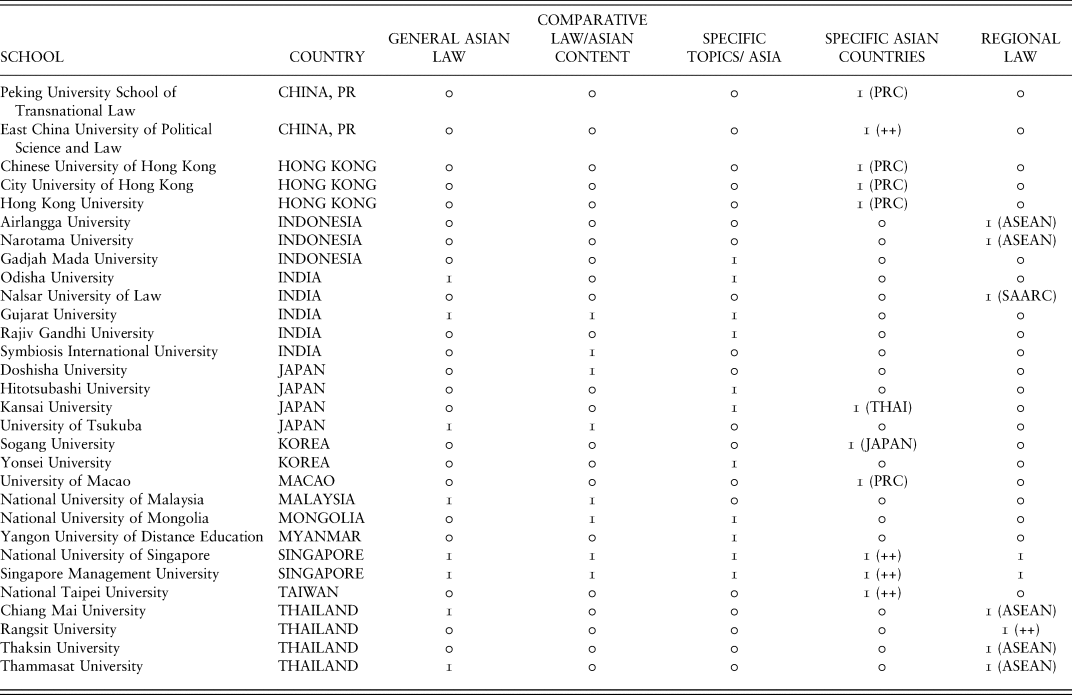
Of the ninety-two ASLI-affiliated law schools, sixty-six are in the geographic area delineated above and slightly less than half – thirty-one – offer modules on Asian law (Table 1).
Asian Law Teaching in ASLI-Affiliated Asian Law Schools
Legend: 1 = Offered; 0 = Not offered; (++) = More than one course of the relevant kind is offered.

When looking at Table 1, some qualifications and explanations ought to be borne in mind. In general terms, only schools that teach at least one Asian law course are included. At the same time, it cannot be definitively concluded that the schools mentioned in Table 1 are the only ones that instruct their students in Asian law, for a variety of reasons.
To start with, some ASLI membership forms revealed mistakes or ambiguities in answering the questions. For example, some mistook ‘course’ for ‘programme’ and did not therefore list any individual modules, making it difficult to ascertain precise course titles or content. Others presented inherently unreliable or unhelpful information, along the lines of ‘all Asian law courses are offered’, ‘various’, ‘comparative law’, ‘comparative corporate governance’, and so on; or mentioned that subjects like international trade law included Asian content (whatever that might mean in practice) or listed their own national law courses as ‘Asian law’ courses (these were of course discounted as the aim is to uncover engagement with foreign not domestic law). This point was especially pertinent for Hong Kong's law schools, where Chinese law could be treated either as domestic law or as Asian law. In our view, it should be treated as Asian law, given Hong Kong's common law system;Footnote 9 for this reason we have indicated these schools as teaching Asian law and added ‘PRC’. This consideration may also be relevant to, for example, schools that offer courses on Islamic law which is an integral part of the domestic legal system – think for instance of Malaysia and Indonesia – such courses too, qualify as genuinely domestic law and were accordingly discounted for the purpose of compiling the data in Table 1.
Second, prospective ASLI applicants were asked to identify their Asian law courses, with the assumption being that Asian law is taught through discrete modules rather than as part of existing doctrinal or other courses like contract or business law. Such an integrated approach, along the lines advocated in this article, might accordingly not be captured. While it cannot be stated with absolute certainty that there have been no developments in this direction among the ASLI member schools, we deem this to be unlikely in view of the additional information gathered from websites and through discussions with colleagues.
Third, in light of the aim to compile an inventory of Asian law offerings for all law graduates (even if these are not compulsory elements within the curricula), the data does not reflect postgraduate modules with such content. It is clear, however, that quite a number of ASLI-affiliated schools do provide foreign law courses as part of their Master of Laws (LLM) degrees, including but not limited to Shanghai Jiao Tong University, East China University of Politics and Law, and the National University of Singapore. In a related vein, ASLI also counts non-teaching institutions among its members, which accordingly cannot be featured in Table 1 either, even though these may have a strong research interest and reputation in areas of Asian law or other foreign law (Academia Sinica in Taiwan being a classic example). Finally, the data does not include the availability of non-Asian foreign law subjects, such as Anglo-American law, which is often taught in Japanese and Korean law schools.
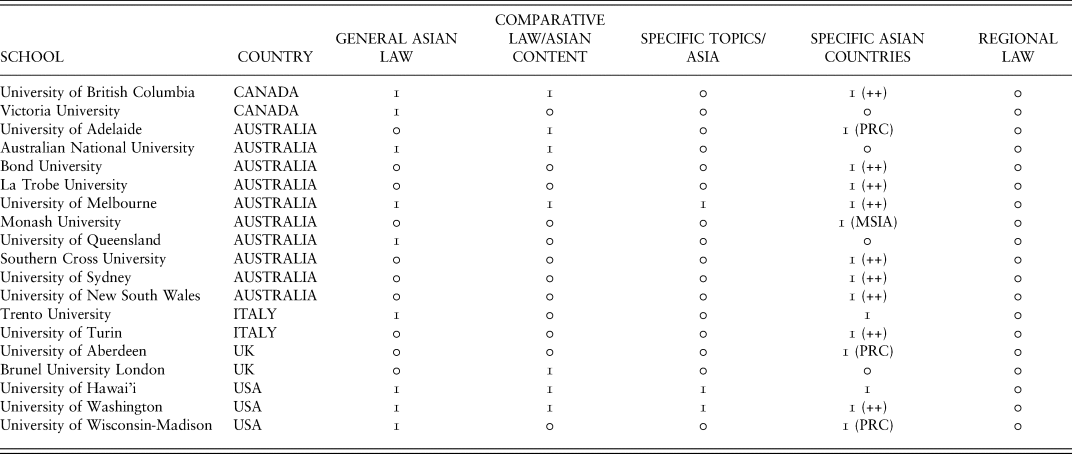
As mentioned earlier, ASLI also boasts a number of law schools located outside the geographic definition of the region used here among its members – twenty-six to be exact. The vast majority have a keen interest in Asian law, which of course explains their decision to join ASLI in the first place, with about 70 per cent offering undergraduate modules in Asian law.
Several observations are warranted in light of the findings in Tables 1 and 2. A five-fold categorization has been applied to differentiate between the categories of Asian law courses that may be offered: (1) general courses on Asian law or legal systems (eg Legal Systems of Asia). These courses are introductory and generally cover the sources of law and basic legal history in a comparative frame; (2) general comparative law courses that will include references to selected topics within Asian law in the context of several, though typically not all, seminars (eg Comparative Law); (3) courses on specific topics taught comparatively across a range of Asian national legal systems (eg Comparative Corporate Governance in Asia); (4) courses dedicated to a specific Asian country or set of countries (eg Japanese Law) or a specific part of a foreign legal system (eg Chinese Contract Law); and (5) courses on the law pertaining to and produced by regional organizations (eg ASEAN Law). Category (4) courses are richer and more comprehensive than type (1) courses as they will also feature the organization of state institutions as well as substantive and related procedural rules. Category (5) courses differ from categories (1) to (4) courses in that their focus is on non-domestic rules whose drafting may have been shaped by the jurisdiction in which the law school is located.Footnote 10
Asian Law Teaching in ASLI-Affiliated Non-Asian Law Schools
Legend: 1 = Offered; 0 = Not offered; ++ = More than one course of the relevant kind is offered.

A number of the schools teaching Asian law offer multiple courses within the same category, but very few adopt more than one of the five approaches. The corollary is that exposure, if any, to foreign legal systems across the region is uneven and, crucially, this includes the framework to adopt when becoming acquainted with a jurisdiction other than the home legal system: should one begin at a general level, with a country's (legal) history and institutional infrastructure – along the lines of categories (1) or (4) – or rather take an issue-based approach and use a substantive problem or (set of) rule(s) as the entry point – along the lines of categories (2) or (3)? Singapore is the exception here: the National University of Singapore (NUS) and Singapore Management University (SMU) are the only law schools that presently include courses across all five categories in their undergraduate curricula. What is more, the courses that these universities offer that fit into categories (1) and (2) are compulsory. This means that students who, if left to their own devices, would not have chosen to take general Asian or comparative law modules, will be exposed to non-domestic ideas and experiences.
While law schools located outside Asia exhibit a strong preference for courses covering a specific Asian jurisdiction, none of the five possible approaches has emerged as the most logical or popular choice among law schools within the region. Less than one-third of these schools offer courses across categories (1) to (3) and (5). While category (4) at first blush appears dominant, once Chinese law modules are excluded – and recall the special considerations relevant to Hong Kong and Macao (text to n 9) – few cases are left. This suggests that there is, as yet, no clearly articulated pedagogical theory on how to translate the assumed importance of Asian law into a law school curriculum. It looks as though law schools may have been motivated by different objectives, for instance teaching Chinese law in view of that jurisdiction's economic dominance in the region or offering a module on ASEAN law due to a country's membership of that organization. We, moreover, cannot discount teaching resources as an explanatory factor. The number and seniority of faculty members with Asian law expertise will shape the number and kind of Asian law as foreign law modules included in the curriculum, all the more so if those faculty members concurrently hold a position on the school's administration that enables them to steer the direction of the curriculum. This, coupled with a country's stage of economic development and (state) budget made available for university education, arguably explains why the only law schools to implement a policy of offering a specialization in Asian law are located in Singapore (NUS and SMU), Australia (Melbourne and Sydney) and the US (Washington and Hawaii). The absence of an entrenched or clear default approach may however be a boon: it ought to make it easier to convince law schools to embrace the integrated approach advanced here if the pedagogical case to do so is made out.
A special point of note concerns the relative dearth of category (5) courses. This is surprising given the obvious and growing practical relevance of regional integration in Southeast Asia and South Asia as well as Northeast Asia. At present, though, ASEAN modules are taught only in some Indonesian, Thai, and Singapore law schools (all countries that are members of this regional association), while SAARC law is part of the curricula in a mere handful of Indian schools. As a precursor to the discussion of the failure among European law schools to teach regional law in a sufficiently comprehensive and thorough fashion, the lack of emphasis on regional integration in Asia is a worrying sign.
Finally, one may observe that there has been relatively little development in featuring Asian law as foreign law in the undergraduate curriculum. Among the schools in Table 1, slightly fewer than half offer Asian law modules. Almost embarrassingly, the track record among the Table 2 schools, located outside the region with arguably less of an urgency to instruct their students on such law, is better. One should moreover bear in mind that there are many law schools in the Asian region that have not (yet) opted to join ASLI – which we would put at around 600 (counting only countries that already have ASLI members) – and are accordingly not featured in Table 1. To be sure, some among this cohort may offer modules that include Asian law elements. However, this number will likely be very small, when we recall that interest in Asian law is the principal motivation for schools to join ASLI, which has moreover actively engaged in outreach activities. The inevitable, and disappointing, conclusion is that despite a number of ASLI-affiliated schools recognizing the importance of Asian law, an overwhelming majority of schools has not followed their lead, even within the ASLI community. When combined with the vast number of schools that are not affiliated, the total number of law schools in the region that teach Asian law shrinks, in all likelihood, to a tiny percentage.
III. EUROPE AS AN AVERSIVE STIMULUS
Having charted the exposure to Asian (foreign) law that existing and incoming students in this region can currently expect, this Part adopts a comparative approach and analyzes Europe's approach to foreign law instruction. The European experience was selected given that region's relatively long and largely successful history of integration to achieve economic and social prosperity, with law used as a primary tool to achieve these objectives.Footnote 11 This suggests that judges, professors of law, and other legally-trained professionals have been, and continue to be, instrumental in taking the European project forward. Shapiro explains that the ideology of ‘integration through law’ is a:
juristic idea; [with the Treaties] as a sacred text, the professional commentary as a legal truth; the case law as the inevitable working out of the correct implications of the constitutional text; and the [European Court of Justice of the European Union] as the disembodied voice of right reason and constitutional theology.Footnote 12
As such, practical imperatives for engaging with non-nationally-produced legal rules are comparable between the two regions, albeit with the important caveat that integration endeavours in Asia are still in a more embryonic stage.Footnote 13 In recent years there has, however been a discernible shift towards rule-of-law thinking in terms of furthering regional integration.Footnote 14 This, it will be argued, should be seen as an advantage on which the region's law schools may wish to capitalize.
The unrelenting pace and sheer scope of European integration would, or so one might readily assume, have resulted in that region's law schools eagerly and actively adapting their curricula to that reality in two related ways. First, by incorporating the study of substantive and procedural rules in place in other European Union (EU) Member States into their undergraduate law teaching. The logic for doing this relates to the principle of mutual recognition,Footnote 15 which pervades both classic free-movement rulesFootnote 16 and newer domains for European cooperation, such as the area of freedom, security and justice (AFSJ).Footnote 17 As for free movement, this should be particularly prevalent in so-called Euroregions, which consist of two or more neighbouring territories on different sides of the respective national borders in which the competent national authorities seek to cultivate cross-border cooperation for the common benefit of the border populations. In addition, the EU contemplates mutual recognition of the qualifications obtained by professionals, and this includes legal professionals. Lawyers may provide cross-border services on a temporary basisFootnote 18 and can further decide to establish themselves permanently in another Member State than that in which they were admitted to the bar.Footnote 19 The Professional Qualifications Directive even allows lawyers to obtain a host state title, typically after an aptitude test.Footnote 20 Making optimal use of such possibilities is facilitated when students are already exposed to the law of other EU countries during their legal studies, and the resultant mobility in lawyers should lead to an increase in the range and quality of legal services being offered to businesses and individuals in need of expert advice. Turning to the AFSJ, this amongst others covers judicial cooperation in civil and criminal matters, such as insolvency proceedings, matrimonial disputes, and succession matters. Crucially, the applicable substantive law is typically not only or primarily found in EU legislative instruments: national lawyers and judges (and other public authorities involved in such cases) need to apply the domestic law of another Member State and mutually recognize decisions adopted by the authorities of such other member states. This, of course, presumes that the competent officials and practitioners are familiar with, or at the very least able to identify, understand, and give effect to, those foreign national rules.Footnote 21
Second, the corpus of European rules is huge and their coverage wide, meaning that there are very few areas of domestic law that are completely unaffected by EU law.Footnote 22 Added to this is the status of EU law. As the Court of Justice of the EU famously pronounced in its early case law: EU law is an integral part of the domestic legal orders of the Member States and enjoys (subject to some conditions) direct effect,Footnote 23 while also being hierarchically superior to conflicting national law.Footnote 24 With European and national law intimately intertwined, students ought to systematically study the rules and rulings emanating from the EU institutions, even if they intend to practise law in their home jurisdiction. To add to this, European regulations on equal treatment and consumer protection also apply in cases without a cross-border dimension.Footnote 25
This, however, is not what has happened in practice. Law schools in Europe today generally include foundational courses on EU law in their curricula, and these are increasingly part of the compulsory core that each student must complete before being eligible to continue the path towards qualification as a practising lawyer. In many universities, students further have the option of taking more advanced courses that feature EU law in specialized areas like competition or migration. However, and quite different from the logic propounded by the European institutions, EU law is still not always considered in the standard substantive law courses on contract, tort, property, and public law. Turning to the laws of other Member States, the general approach remains firmly domestic law-centric. There may be ad hoc comparisons or references to the rules in place in (neighbouring) countries, but one cannot speak of a general trend or a systematic approach: much still depends on the interests and abilities of the professor in this regard.
The main driver for change has arguably been the Bologna ProcessFootnote 26 and the establishment of the European Higher Education Area (EHEA),Footnote 27 which aims to ensure comparability in the standard and quality of tertiary education. This should foster the employability and mobility of EU citizens, while simultaneously enhancing the international competitiveness and attraction of European universities. Of particular interest for present purposes, the Bologna Process has facilitated undergraduate exchanges among the Member States, providing students with opportunities to acquire at least some basic knowledge about the design and operation of the legal systems in other countries – and crucially, to do so from inside the foreign system. The extent to which students are able to actually do so is however dependent on the host university offering courses that are pitched at a level accessible and interesting to upper year undergraduate students who have until then had limited exposure to the legal regime of the host country. Note, further, that the Bologna Process was only launched in 1999, more than four decades after the inception of the European integration process and twenty years after the Court of Justice judicially endorsed the principle of mutual recognition as a cornerstone of integration efforts.Footnote 28
In sum, we see that European law schools have, for the most part, been quite slow in recognizing the need to teach foreign or comparative law. To the extent that such law is taught, the preferred strategy of most law schools is to ‘isolate’ it in special modules, typically available as electives to upper year undergraduate or postgraduate students. For the majority of law schools, ensuring exposure to foreign national law and EU law, in other words, is not a leading objective when it comes to the design of the curricula. The corollary of this state of affairs is that graduates are not as well prepared as they ought to be when they enter the local legal sector. More seriously, this original knowledge deficit does not seem to be adequately corrected during the course of a practitioner's professional life, be it as a lawyer, prosecutor, or judge.
This is clear when considering several reports, communications, and resolutions emanating from the various European institutions in the mid-2000s. Thus, in a 2006 Communication, the European Commission affirmed that that there was a serious need to improve familiarity with EU legal instruments as well as with the legal and judicial systems of the other Member States, to ensure the success of cross-border judicial cooperation in civil and criminal matters.Footnote 29 The leading 2008 report by the European Parliament on this matter found, based on extensive empirical information, that national judges had a keen sense of responsibility vis-à-vis European law, but found their tasks either difficult (52 per cent) or very difficult (32 per cent).Footnote 30 There appeared to be substantial differences in national judges’ awareness and knowledge of European law. Relatedly, six out of every ten judges indicated that they had never taken part in a training programme concerning European law. National ministers acting within the Council concurred, noting that same year that:
[t]he relevance of the further development of a European judicial culture has not yet sufficiently permeated judges, prosecutors and judicial staff in the Member States, and the sense of belonging and contributing to a common judicial area needs to be further enhanced.Footnote 31
Clearly, the realization of such a culture is at least in part dependent on knowledge about the functioning of other legal systems, helping to build trust, and a sense of joint responsibility. The later study ‘Judicial Training in the European Union Member States’ of the European Parliament of 2011 showed some improvement, although slightly over 50 per cent of judges and prosecutors still indicated that they had never participated in training in EU law or the national law of another Member State.Footnote 32 Among those who had received such training, only one-third had done so since the entry into force of the Lisbon Treaty in late 2009, which significantly changed EU law and extended the reach of mutual recognition to a host of new areas.Footnote 33
Bearing in mind that the majority of EU Member States belong to the civil law tradition and accordingly have professional judiciaries, with graduates who are able to choose a judicial career almost immediately after completing their university studies, the following picture for national judges emerges. Realization has dawned – rather late in the integration process – that national judges, who are conceived as the front-line enforcers of EU rules,Footnote 34 are often ill-equipped to do so. This obviously has detrimental consequences for the effectiveness of European rules and the realization of the benefits these ought to bring to businesses and individuals. In addressing this state of affairs, judicial training is singled out as a quasi-panacea, which is envisaged to include exchanges of judges across countries and boosting foreign language skills.
There are, however, several practical disadvantages to relying on post-graduation efforts to ensure familiarity with non-national law that are relevant not just for judges, but also for lawyers, prosecutors, or civil servants working on legal issues. Most glaring are resource constraints: participating in training activities or exchanges means time away from one's desk, while the work will continue to pile on and may not always be able to wait until one returns to the office; trainers need to be found and paid; and so too must one cater for the costs of accommodation and the like when travelling abroad for training activities. Instead of aiming to correct or at least ameliorate knowledge deficits during a legal professional's working life, it would accordingly seem more advantageous to provide students with a solid foundation in non-national law during law school, in other words, by embracing an ex ante and preventive approach. Some law schools have done so and their efforts are worth recounting here in some detail as these may be a useful source of inspiration for their Asian counterparts.
The first mention ought to go to Maastricht University's Faculty of Law, which has been very much ahead of its time. In 1995, some thirteen years after its founding, it started a new Bachelor's programme called ‘European Law School’ (ELS).Footnote 35 Taught mainly in English, its students are continuously exposed to relevant EU rules as well as those in force in some of the leading national legal systems (typically France, Germany, and the UK/England and Wales). In its current guise, students take introductory foundational courses in international and EU law as well as comparative law in their first year. For the rest, the major substantive areas of the law are taught in an integrated fashion: for the different issues – for example, what remedies are available for breach of contract or when does one acquire ownership – the solutions under Dutch, French, German, and English law are explored side-by-side, with reference to any impact that EU law or the European Convention on Human Rights (ECHR) may have. Consider by way of example the course description for the first-year course ‘Comparative Government’:
The course Comparative Government provides an introduction to the constitutional and political systems of the United States, the United Kingdom, France, Germany, the Netherlands and the EU, and to the European Convention on Fundamental Rights. The aim of the course is for students to become acquainted with the basic features of the systems discussed and, at the same time, with overarching concepts of constitutional law. The course devotes attention to the functions of a state, different systems of government, separation of powers, democracy and electoral systems, government-parliament relations, federalism, bicameralism, constitutional review, as well as the issue of fundamental rights and their protection within the above mentioned constitutional systems. The inclusion of the EU also facilitates to focus on the impact the EU has had on the constitutional systems and balances of power within its member states.Footnote 36
The relevance of mutual recognition for substantive law is duly recognized as well. This includes domains in which this principle has more recently made inroads, such as criminal law. Consider for instance the description of the course objectives for the undergraduate module ‘Concepts of Criminal Procedure’, which exposes students to the approach taken in leading foreign jurisdictions – the UK and Germany – alongside the domestic Dutch approach, while simultaneously considering the impact of European instruments on the various subtopics covered:Footnote 37
At the end of the course students will be able to:
• Identify the characteristics of inquisitorial and adversarial traditions.
• Assess their differences and similarities.
• Illustrate the main features of German, English and Dutch criminal procedure.
• Understand how crime control and due process influence coercive measures.
• Comprehend the conditions for applying the major investigative measures, for conducting lawful interrogations, and arrest and detain suspects in the three jurisdictions.
• Comprehend the increasing importance of procedural rights at the pre-trial stage.
• Identify the conditions under which prosecution takes place and the challenges with plea bargain.
• Gain insight into the conditions and exceptions of the right to confrontation.
• Understand the conditions for the use of illegally obtained evidence in trial.
• Assess the legal standards found in the ECHR for all the above topics and become acquainted with the leading jurisprudence of the ECtHR in those issues.
• Develop important skills, i.e. learn how to read case law and solve practical case studies.
Other law schools are beginning to follow suit, having realized the success of Maastricht's ELS programme, which has attracted students from across the Netherlands who have snubbed the opportunity to study law in a city closer to their hometown, as well as from (much) further afield. Its cohorts these days virtually always include German, Belgian, French, Italian, and Spanish students and the programme has even proven popular for students from outside of Europe. A comparable programme has been set up at Nijmegen's Radboud University (the Netherlands),Footnote 38 which in addition offers the option of a ‘dual bachelor’ with Nottingham Trent University. Students who are on track to complete Nijmegen's ELS programme within the official period of three years can apply to transfer to Nottingham for an additional year of study of English, opening up the prospect of qualifying as a barrister or solicitor in the UK.
An even more radical approach has been adopted by Tilburg University, which has launched a Bachelor of Laws (LLB) in Global Law in 2013.Footnote 39 The course design of this degree is premised on classic functional comparativism:Footnote 40 each legal field is taught from a global perspective, with different solutions in place in national jurisdictions used to illustrate how the underlying core legal issue can be addressed or regulated. The aims set out for the second-year (again, mandatory) course on Tort Law, for instance, include: (1) obtaining a thorough knowledge of the general principles of tort law, and the various choices that are made in specific national systems of tort law; (2) understanding different national approaches to tort law; (3) having a good grasp of the main issues within tort law, and the diverse national solutions to these issues; and (4) being able to reflect on the application of tort law in the context of globalization of markets and risks and from the perspective of law and economics and socio-legal studies. The detailed course syllabus outlines how this will be achieved:Footnote 41
The course provides a thorough introduction to tort law from a global perspective. The notion of torts and its elements are presented from a general theoretical perspective, and subsequently developed in a comparative manner by studying the way in which specific jurisdictions handle various torts. Particular emphasis is put on the differences between common law and civil law, while different approaches between civil law systems are also discussed. The following topics are covered:
• Concept of tort and tort law
• Scope of protection
• Liability for one's own conduct
• Liability for other persons
• Liability for objects
• Violation of statutory rules
• Defences and grounds of justification
• Causation
• Damage and damages (sic)
• State liability
While there are law schools in Europe that take the integrative forces that shape the working environment of lawyers, in-house counsel, civil servants, and judges in Europe seriously, they remain far and few between. We have seen earlier how empirical research has shown the implications for the manner in which national judges are able to exercise their European mandate. While similar studies have – to the best of our knowledge – not been conducted for some of these other groups of legal professionals, we believe that those would similarly reveal considerable knowledge and comparative skills gaps. To be sure, notably for lawyers working in international law firms that advise international clients on a daily basis (be it on contract negotiating and drafting, or competition law and mergers and acquisitions (M&A)) and in-house counsel in large multinationals, the very nature of their work means that they will be forced to learn about relevant foreign legal rules. Even so, there will be a period – even if relatively short – in which there is a mismatch between what law firms or corporations need in terms of legal acumen on the one hand, and the skills and expertise that law graduates actually possess on the other hand.
This is clearly undesirable, for two related reasons. First, it is economically wasteful: from the organization's perspective, time and other resources need to be spent on relatively basic training in non-national law that could have easily been taken care of in law school, and for the law graduate, he or she is unable to optimally contribute to the work and success of his or her organization from the outset. On a related note, there is a growing realization that law firms, like other enterprises, benefit from the pursuit of an internationalization strategy. In Singapore, the government has rolled out a new ‘Lawyers Go Global’ programme to allow the country's practitioners to ‘get a share of the legal services pie’ that is projected to grow rapidly in the coming years.Footnote 42 Reminiscent of the approach adopted by the European institutions for judges, training is identified as an important pillar of this programme and Singapore lawyers, amongst others, will be able to take workshops on the legal regimes and business norms of specific countries. Lawyers who have not been exposed to foreign systems during their law school days may either fail to realize the opportunities for growth and profit attendant on an uptick in cross-border trade in goods and services or underestimate their scale, either generally or in relation to their firm. Even when they realize that there are economic rewards to be reaped, legal professionals may lack the foundation to effectively and efficiently forge ahead. While the government in Singapore is now extending a helping hand, other countries may not want or be able to mirror its paternalistic approach. In any event, and going back to the point made earlier, ex post intervention results in an unnecessary adaptation lag.
Second, the mismatch between graduates’ abilities and the imperatives of legal practice could be damaging for the standing of law schools. They may be blamed for not delivering truly ‘practice-ready’ graduates (despite what many will claim on their websites and in brochures) and for shifting responsibility in this regard to the profession writ large. It could perhaps even hamper law schools’ efforts to establish enduring alumni relations with their graduates for the (financial) benefit of the school and its current students, to the extent that law graduates would agree that the transition from law school to practice has been needlessly challenging or that they do not feel properly equipped to deliver legal advice whenever cases have a non-national dimension. Against that background, Asian law schools ought to take their cue from the defects that the European experience has revealed. Instead of being laggards, they ought to proactively embrace comparative (Asian) law in law school curricula, in anticipation rather than on the back of integration in this region reaching its tipping point.
IV. TOWARDS THE INTEGRATION OF FOREIGN LAW TEACHING IN THE CURRICULA: SOME IMMODEST PROPOSALS
Having presented the practical case in favour of Asian law schools systematically integrating foreign legal elements into their curricula, this section suggests a four-pronged approach for doing so.
First, and most importantly, exposure to the law in force and its underlying logic in other Asian jurisdictions should be systematic and continuous. That is to say, the traditional subject area courses like contract, criminal, corporate, tort, or public law should feature not only the relevant local rules and principles, but also those in place in other countries in the region. This can be done in two ways: either by referencing such non-national approaches for each subtopic (ie during each seminar or lecture) or by having an explicit comparison towards the end of the course, at the point at which students are familiar with the domestic regime and the policy considerations that undergird it. We appreciate that this will be a major change with considerable resource implications, making it challenging for many law schools to do this in the short term. In the interim, law schools should continue efforts to expand or introduce specific foreign law courses (dealing with substantive or procedural law), either as electives or – preferably – as part of the compulsory law school curricula. These can be used to build the relevant expertise, both in allowing professors to become well-versed in foreign law and hence competent to guide students in their journey beyond the local system as well as in collating appropriate reading materials – which may require translation of foreign primary and relevant secondary sourcesFootnote 43 – and assignments. To be clear, it is not necessary for law schools to develop comprehensive in-house expertise for this purpose, assuming such would even be financially feasible. They ought to tap into the natural home for knowledge about foreign legal systems by co-opting expertise from within those systems, either in the form of regularized faculty exchanges that can operate alongside student exchanges or by going the blended learning route and having foreign legal academics deliver guest lectures through IT-based facilities.
Law schools obviously cannot be overly ambitious when it comes to selecting the number of foreign countries to be studied: there needs to be sufficient time to cover local law so that students obtain the knowledge necessary to be admitted to the bar. Think also of diminishing marginal utility: there is little point in adding to the mix countries that have a regime that is very similar in significant respects to that in place elsewhere. Students should further be able to process the foreign materials – avoiding information overload – and these should be covered in sufficient depth at the risk of the comparative exercise becoming so shallow as to render its practical benefit nugatory. Against this backdrop, a three (foreign) + one (local) rule seems attractive. Which three? The response, we suggest, should not be fixed for all Asian law schools: this region does not have ‘parental’ systems in the way Europe does, where France and Germany would be obvious candidates as templates of the civil law tradition, and England as the birthplace of the common law tradition. It would, as a rule, be helpful to include at least one jurisdiction that follows a tradition different from that in the country where the law school is located to cultivate flexibility in the mindset of students as to the range of solutions and institutional designs that can be pursued in response to socio-economic problems. It would moreover be good to adopt a practical perspective and feature countries that the home jurisdiction often interacts with – be it due to trade ties, or personal or religious contacts – as these are the kind of regimes that students are likely to regularly encounter once they enter legal practice. For ASEAN and SAARC Member States, this could include other ASEAN and SAARC countries respectively. It should be emphasized here that the choice of jurisdictions should be made for the curricula in its entirety: in other words, the jurisdictions should be the same across courses to allow students to understand and appreciate the internal genius of those foreign systems.
Second, when mainstreaming comparative Asian law in law-school curricula, the range of materials to be studied alongside domestic statutes and cases should extend beyond those emanating from other national jurisdictions to transnational and international norms. It is apposite to embrace a broad understanding of the notion of ‘foreign law’ that would for instance cover ASEAN rules and policies, and other international instruments such as the United Nations Convention on Contracts for the International Sale of Goods (CISG).Footnote 44 Such norms are typically the product of comparative endeavours and may accordingly incorporate concepts, structures, or vernacular derived from national legal systems.Footnote 45 In Asia, these kinds of transnational rules are becoming more relevant and greater in number.Footnote 46 Students should be equipped with the necessary legal skills to understand such rules as well as contribute to their future development, be it as part of governmental delegations, lobby groups, or as lawyers and judges confronted with questions about the correct interpretation of such transnational rules in specific cases. Much like the manner in which EU and ECHR rules are taught alongside (foreign) national law in the ELS programmes canvassed earlier, so too should ASEAN and other rules pertinent to the practice of law in this region be integrated in the teaching of substantive law courses.
We acknowledge that the implementation of the two suggestions just set out may have ramifications for course titles and descriptions, and perhaps even for the nomenclature of professorial chairs or departments in law schools. These have an important signalling function to prospective and current students as well as the legal fraternity more generally. As such, it would be useful if the presentation of undergraduate programmes is done in a way whereby reference is made to foreign law broadly understood and, importantly, comparative and Asian law are presented as solidly embedded within – rather than clearly distinguished from or even in contrast to – the study of national law.
Third, in addition to courses that expose students to foreign law – which can be considered ‘comparative law in action’ – law schools should also offer, or if already in existence, retain, self-standing comparative law courses. Their aim should be to provide students with a solid foundation in comparative methodology and theory, now that comparative research is becoming ubiquitous in legal practice, including for law reform reasons. For that reason, such courses ought to be part of the earlier years of a student's legal university education. More particularly, comparative law courses should teach students how to design comparative studies and acquire comparative literacy, enabling them to correctly interpret the results yielded by comparative studies reported in secondary sources, government reports, and the like. They should, to put it differently, be taught how to become discerning consumers of comparative research. This will necessitate exposure to other disciplines. While the traditional approach of functionalismFootnote 47 remains a common choice, it is no longer the only or most obvious option on the table. Rather, with the rise of ‘big data’ and the rapidly growing popularity of quantitative or numerical comparative law,Footnote 48 the legal profession (law firms, governments, and courts) should be entitled to expect that law graduates are comfortable with statistical analysis and able to give advice on its use and the legal implications of findings.
In a similar vein, students should be familiar with basic notions in sociology, history, political science, and anthropology so that they can deal with studies that use or call for a version of ‘deep-level’ comparative methodology.Footnote 49 Such foundational comparative methodology courses should also equip students with basic skills in how one might guide legal transplants and how one can measure ‘success’. To be sure, there is no (nor is there likely to be a) definitive check-list in this regard, if only because there is disagreement in the theoretical comparative discourse on what exactly qualifies as a ‘transplant’, which in turn influences when such a transplant can be said to have taken place.Footnote 50 Yet, if students are made aware of this discourse and how the aftermath of domestic transplantation efforts has been ‘sold’ or ‘pitched’ – by the lawyers, businesses, or civil servants involved in the initial choice to transplantFootnote 51 – to the wider legal community, this should at least open their eyes as to the various strategies that are available. This should serve students well once they themselves join the legal fraternity and are in a position to suggest why the state may (not) wish to embark upon domestic law reforms with reference to legal experiences elsewhere. In sum, law students ought to be taught the vocabulary to participate in, and steer, such discussions.
Fourth, the issue of language looms large, notably in this region with its immense degree of linguistic diversity. To be sure, students will inevitably pick up some foreign words and phrases when studying the law in force in neighbouring jurisdictions, either during modules at their own university designed along the lines sketched earlier or when partaking in exchanges.Footnote 52 As an aside, scholars and practitioners writing on Asian law for non-domestic audiences should follow the good practice embraced by leading comparative legal journals of not translating key legal terms, but using the original and adding a short description in the language they are writing in. As Siems explains, ‘if, in a paper published in English, terms such as ‘equity’ or ‘trust’ are used for related concepts in French or German law, this may mislead someone who is not familiar with the conceptual differences between common and civil law countries.’Footnote 53 While inclusion of foreign legal terms and phrases in the materials to be studied is helpful, this amounts to passive exposure, the effectiveness of which will strongly depend on a student's interest and willingness to make the foreign terms her own. A more concerted effort should be made to allow students to become more conversant with other languages, or, more particularly, with the legal vernacular used in foreign jurisdictions. This is because, as Husa has remarked, the language of the law is a subset of ordinary language that is system-specific:
On a more profound level, it is a question of the legal-ideological climate and the different ways of perceiving legal institutions and concepts that are reflected by legal language … [T]he language and concepts used in medicine, chemistry, and economics are not system specific in the same way. Moreover, a language does not necessarily constitute one legal language only: … there are versions of legal English in, for example, England, Ireland, Scotland, the United States, Canada, Australia, South-Africa, India and the European Union.Footnote 54
It is hence not very helpful for say Singapore's English-speaking students to know basic Bahasa Indonesia or Mandarin. Such knowledge will not really be sufficient to enable them to read Indonesian, Malaysian, or Chinese statutes, case law or partake of the foreign academic legal discourse. Instead, students need to be inducted in foreign legal patois. Efforts to do so can range from offering students ‘legal [insert language of choice]’ modules to designing fully-fledged law-cum-language degrees, which would see law undergraduates progressively learning about the home and a foreign jurisdiction side by side, with more and more primary and secondary materials being studied in the original language as they move from the early to the later years of their programme.
V. CONCLUSION
It is today axiomatic that undergraduate law programmes must include instruction on foreign systems, structures, and sources. The practical imperative points to ensuring that freshly minted legal professionals are ready to get to work in a globalizing world and rapidly integrating region, what with the establishment of the ASEAN Economic Community in 2015 and the proliferation of intra-regional FTAs. Exposure to foreign legal approaches further nurtures agile legal thinking, which is important in a region that encompasses a great many developing and relatively immature legal systems that have been used to looking across borders for both piecemeal and wholesale legal reforms.Footnote 55
Looking at the prevailing state of affairs in curricula across the region, we find however that the vast majority of Asia's law schools have refrained from integrating foreign law into the courses taught to undergraduates. Their approaches have, akin to that adopted by their European counterparts for most of the twentieth century, been pragmatic and characterized by a certain inertia. This is perhaps unsurprising. Curricula changes to increase the proportion of courses with foreign law elements often happen once law schools perceive that there is a demand for (more) foreign knowledge from the bar, government, or the business sector. While this is understandable, we have advocated for a more proactive approach. This is in keeping with the perception of law schools as not purely or mainly ‘vocational institutions’, but as institutions of academic learning. This means that market demand should not always be leading when it comes to curriculum design.
In addition, if law schools were to wait for demand to reach the tipping point, the legal sector will for several years be deprived of graduates that are truly practice-ready and overcoming the status quo bias among legal professionals may unnecessarily be made more difficult. To avoid such undesirable outcomes, law schools should re-position themselves at the vanguard of comparative law in action and aim to anticipate the growing use of foreign (Asian) law and equip students accordingly. This article has outlined several strategies in which this can be done. While implementation may face resistance, Asia's law schools ought to give this serious thought to ensure that they too, like their students, continue to be perceived as enlightened in their outlook and germane to the legal industry and society at large.