For over 150 years, social scientists have explored the connections between social networks and economic development. One point of debate has been whether social networks were structured differently in preindustrial societies. John Stuart Mill argued that industrialization reduced the importance of family connections and class in employment patterns. According to Mill, different jobs prior to industrialization were “almost equivalent to a hereditary distinction of caste,” with “each employment being chiefly recruited from the children of those already employed in it.” By the 1840s, however, “the habits or disabilities which chained people to their hereditary condition are fast wearing away.”Footnote 1 Karl Marx, on the other hand, believed that the ruling classes had always used “recruitment from below” as a means of absorbing the energy and intelligence of lower social strata.Footnote 2
Mill's expectation that industrialization would weaken the effect of social position on opportunity sits uneasily with the conclusions of modern economic sociologists, who emphasize the persistent importance of social networks in influencing economic outcomes in modern industrial societies. Research by Mark Granovetter, James Montgomery, and others finds that networks of strong ties formed between friends and relatives connect many employees to future employers in the job finding process today.Footnote 3 While family and friends are an important source of strong ties, these studies also find additional links between individuals from a common neighborhood or region.Footnote 4 Due to the limited base of evidence that scholars have had to work with, economic historians have previously been unable to investigate the ideas from the modern literature in historical settings.
This article examines the significance of personal ties in the market for apprenticeships in early modern London. We focus on apprenticeship for three reasons. First, historians studying apprenticeship have emphasized the importance of social capital, which in this context we proxy by membership in networks relevant for the recruitment and training of apprentices. The common emphasis on social capital reflects the characteristics of the labor contracts used in apprenticeship and the benefits of completion. Indentures were long, weakly specified, vulnerable to opportunism by master and apprentice, and often involved youths moving long distances from their families to live with masters; when completed, former apprentices obtained valuable privileges.Footnote 5 Second, while scholars have explored embeddedness in premodern societies using evidence from community stability and credit markets, much less is known about labor market structures.Footnote 6 The conclusions from recent work in this matter, however, bear more than a passing resemblance to Mill's views. Sir Keith Thomas argues that in early modern England, “an individual's ends in life were predetermined by his or her own position in the overall scheme;” adding that “in the middling ranks there was more scope for personal choice, but options were normally restricted by parents' resources and their network of acquaintances.”Footnote 7 Third, the role of social networks in securing apprenticeships has important implications for understanding English economic development prior to industrialization, as well as the economy's potential for growth during the Industrial Revolution. If strong ties of kin, profession, or social origin were crucial for placement, the ability of apprentices to match aptitude to opportunity would be limited. Narrow information networks would inhibit the diffusion of craft skill across the English population, with implications for innovation and the ability to adopt and adapt new technologies.Footnote 8
Existing studies of English and European apprenticeship suggest that several kinds of social connections mattered for recruitment. The most direct, but relatively uncommon, connections identified are close family ties between apprentices and their masters, who in the extreme case could restrict training to their sons. This autarkic world of closed workshops was never dominant in early modern European apprenticeship; even masters' sons often trained in a different workshop.Footnote 9 Where reliance on the nuclear family for training was limited, studies emphasize different kinds of connection. Extended family networks are often highlighted as facilitating entry to apprenticeship. A broader set of connections come from institutional ties through common guild membership between the apprentices' father (or mother) and their master, or geographical ties between apprentices and their masters based on common origin or residential propinquity.Footnote 10 Such networks often overlapped: guild members will generally live in the same town, for example. The balance between different forms of ties varied. Late-eighteenth-century Parisian apprenticeship was dominated by local apprentices, though guild connections between those presenting youths (typically fathers or a surrogate) and masters do not seem especially common.Footnote 11 In contrast, Sheilagh Ogilvie's analysis of continental European apprenticeship suggests that geographical ties were a by-product of guild membership, with the vast majority of new masters in Wildberg (Württemberg) being existing masters' sons.Footnote 12 Ties between apprentices' places of origin and their destination for training are also thought to have mattered. For example, Steve Rappaport highlights the importance of “trade routes between London and other towns” in the placement of apprentices.Footnote 13
These three types of ties identified above share several characteristics. The families of apprentices, if not the prospective apprentices themselves, will probably be known to their master in advance of entry into training, and prospective apprentices and their families would also have information about masters' businesses. Preexisting connections between masters and the apprentices' family can provide additional sources of contract enforcement and monitoring and help to resolve problems during the indenture. Networks based on close personal contact would seem to offer considerable potential to reduce the risks of investing in an apprenticeship.
While numerous studies suggest that close ties through direct contacts dominated weak ties, indirect contacts, and contracting between anonymous parties, none have delivered systematic quantitative evidence on the extent to which masters and apprentices were actually bound by the narrow ties of kin, place of origin, or parental guild or occupation. We use extensive new evidence from London's City Livery Company records (as London's guilds were known) to evaluate the importance of kin, occupational, and geographical networks in apprentice recruitment between 1600 and 1749. By the end of this period, London was the largest city in Europe, with extensive connections to provincial towns and the rural hinterland in England. While the ways in which masters and apprentices found each other in London may not be representative of the broader European landscape, recruitment patterns in the city has significant implications for the diffusion of craft skills within what was becoming Europe's leading economy. Our focus on London is also practical: the volume of information and detail on masters and apprentices provided in the Livery Company records are unavailable for alternative centers in England and Europe. We find that matching between apprentices and their masters was not “random.” On the other hand, the majority of apprentices had no identifiable link to their master: the strong ties that we observe did not dominate recruitment. There is little evidence that membership of narrow networks based on direct ties were more important in London's premodern apprenticeship market than they are today.
PREMODERN APPRENTICESHIP
Premodern corporate apprenticeship operated in a well-documented legal and institutional framework. In England, apprenticeship in this period largely operated under national rules established by the Statute of Artificers (1562) and based on London's existing customs.Footnote 14 Apprenticeships were for at least seven years; apprentices could not marry while in service, and they had to be at least 24 years old on completion. Completion was the main method by which apprentices became citizens of the towns in which they trained, if incorporated; citizenship allowed them to settle and work independently and train their own apprentices.Footnote 15 Apprenticeship was monitored by local guilds and civic authorities. The extent to which the apprenticeship regulations were enforced is debated.Footnote 16 However, the large numbers of apprentice contracts that survive make clear the importance of formal apprenticeship.
Some characteristics of premodern apprentices are well-established: they typically entered indentures by the age of seventeen, were almost all male, migrated further than subsistence migrants, and came from relatively affluent backgrounds, perhaps increasingly so.Footnote 17 As well as city and company charges, by the seventeenth century, apprentices increasingly paid fees to their masters. Apprenticeship premiums varied between and within trades, but could easily exceed a year's agricultural wages for a moderately prosperous trade. For example, limited evidence for early-eighteenth-century London suggests an average training premium in the vintners company of 16 pounds, roughly double the annual earnings of agricultural laborers; by contrast, the majority of apprentice plasters paid no premium, while premiums in the grocers company averaged over 80 pounds.Footnote 18 Apprentices resided with their master while training, but received little or no wage, and their board and clothing might be subsidized by parents or sponsors. Apprentices were mainly the sons of families with the means to finance the investment in training. By and large, apprenticeship did not allow poor families to improve their economic status, but rather provided middling and upper class families' sons with human capital and economic opportunities.Footnote 19
The strict terms of apprenticeship indentures and statute law imply a rigid training system. At least two pieces of evidence suggest greater flexibility. First, trial periods were common. Before sealing his indentures, an apprentice might spend several months with his master “on liking.” Second, turnover and early departure were common: masters and apprentices appear to have accepted terms different to those prescribed by law.Footnote 20 One effect of making early termination of indentures possible would be to reduce the costs to either party in the event of a bad match between the master and apprentice. This flexibility would make it easier for apprentices and masters to sign indenture contracts with parties with whom they had little prior contact.
LIVERY COMPANY DATA
Data limitations have constrained previous studies of apprenticeship, with most work concentrating on a particular period or guild.Footnote 21 Our data set of indentures in London Companies is much larger than that available to previous authors. The size and breadth of our sample allow us to provide a comprehensive portrait of recruitment patterns in one of Europe's largest urban centers. Unlike scholars restricted to smaller samples, we are able to observe the relative stability of recruitment patterns over time and space. As we will explain below, working with the Livery Company lists allows us generate more information about the characteristics of masters and apprentices than has previously been the case.
The sample consists of most surviving records of apprentices registered in 65 London Companies in the early modern period.Footnote 22 Selection into our sample is determined largely by record survival, legibility, and the extent to which company records have been digitized to date. Some large, prominent companies are not included, for example, the goldsmiths and merchant tailors. However, our data cover a wide range of companies, from large, well-established ones such as the stationers and vintners, to smaller, more specialized companies that came into existence in this period, such as the apothecaries and spectacle makers (for a full description of the occupations, see the Appendix). Our data include around a third of all London apprentices in this era.Footnote 23 London apprenticeships covered a significant share of England's youth, perhaps 9 percent of English males of relevant age.Footnote 24
We focus on 1600 to 1749, for which we have records for 118,000 apprentices and 42,000 masters with the full range of necessary personal and geographic information. The data usually include the apprentice's name and place of origin, the father's name and occupation or status, and the master's name, company, and date of binding. The records indicate if the apprentice's father was deceased; in these cases, the name of another relative (usually the mother) or guardian is sometimes recorded. In themselves, apprenticeship records provide few details on masters, but most London masters were themselves originally London apprentices. We recovered the details of 12,320 unique masters from their own apprenticeship records in the Livery Company lists.Footnote 25 These masters trained 35,838 apprentices for whom we therefore know both the apprentices' and masters' place of origin.Footnote 26 While we are only able to link about 30 percent of masters to their own apprenticeship record, there is no obvious systematic bias in the linked sample, as the primary reason for our inability to trace a particular master's apprentice records is that their name occurs more than once in the relevant time frame.
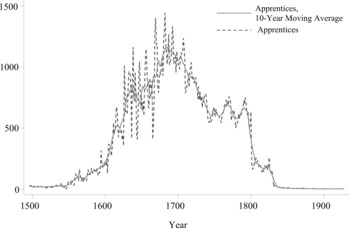
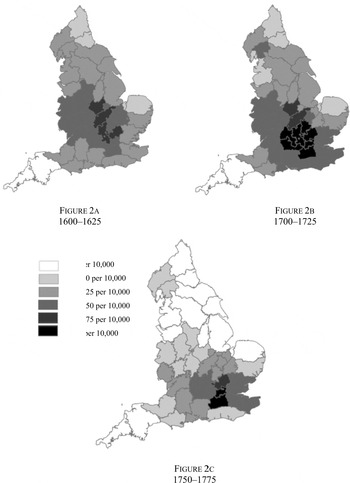
The importance and organization of London apprenticeship changed over this period, as did the city and its economy more generally. Two points must be noted. First, the numbers becoming London apprentices changed over time: an absolute expansion (and per capita decline) as the city grew in the seventeenth century, followed by a slow decline in both the absolute and per capita number over the eighteenth century, as the City Companies' control of occupations weakened and the variety of trades expanded.Footnote 27 This is partly visible in our data (Figure 1) although better survival of records also explains the pre-1700 rise.Footnote 28 Second, the size of London's recruitment field shrank dramatically. Footnote 29 In the early seventeenth century, apprentices were drawn from a wide area across England, with only Cornwall and Devon sending minimal numbers of apprentices to London (Figure 2A). By the late eighteenth century, London, Middlesex, and Surrey youths dominated apprentice recruitment, accounting for more than half the total after 1700 (Figure 2C). Very few apprentices came from Northern England after 1750 (Figure 2B versus Figure 2C) as local opportunities expanded with the growth of trade and manufacturing in areas that would soon become the heartland of the Industrial Revolution.
COMPLETE LONDON LIVERY COMPANY RECORDS

THE ROLE OF NETWORKS IN APPRENTICE RECRUITMENT
Standard economic theory assumes that markets are efficient and anonymous—personal ties are not required for trade or contracting to take place. The operation of markets in the real world is more complex. Information networks underlie virtually all economic activity, and understanding the nature of these networks is essential to understand whether or not the “anonymous markets” paradigm is a reasonable approximation to the real world. As we have described above, the literature on apprentice recruitment in premodern London suggests a world that is some distance from the textbook ideal, with ties based on shared kinship, institutional membership, occupation, and geographical origin providing the basis for matches between prospective apprentices and their masters.
The Livery Company data allow us to identify the presence or absence of a number of kinds of personal tie between apprentices and masters. This evidence speaks directly to the question of whether apprentice recruitment was constrained by narrow personal information networks, or dominated by broader, and perhaps less personal, information flows. Below we focus in turn on three types of ties identified in the literature: kinship, institutional ties (including occupational connections), and geographical ties to explore the hypotheses that masters tended to take on apprentices who were members of common networks rooted in family, guild, occupation, and place. The Livery Company data do not allow us to observe the utilization of indirect connections (ties or contacts with several degrees of separation) between apprentice and master, or the contracting between agents without ties as would take place in the anonymous market of the economics textbook. We will, however, consider some qualitative evidence on the use of indirect ties in the final part of our analysis.
APPRENTICESHIP RATES OVER TIME PER HEAD OF POPULATION: 1600–1625, 1700–1725, AND 1750–1775

Kinship Ties
Kinship ties are often seen as crucial elements of early modern social networks. Few—mainly father-son relationships—are recorded explicitly in company records.Footnote 30 However, masters may also have taken on other relatives not listed as kin in the records. These links are arguably more important for understanding the role of kinship in recruitment. One proxy for a potentially unobserved family relationship is sharing a surname.Footnote 31 A shared common surname such as Smith may not indicate kinship, but kinship is likely if master and apprentice share an unusual surname.
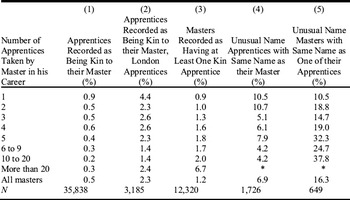
As Table 1 shows, on average only 0.5 percent of apprentices were bound to a declared relative (column 1). The figure is higher for London-born apprentices at 2.3 percent (column 2).Footnote 32 Fewer than 7 percent of apprentices with unusual surnames had their master's surname (column 4).Footnote 33 Similarly, masters did not appear seek out kin apprentices. Even among those who took more than ten apprentices, almost 2 in 3 never trained an apprentice with the same name (column 5). Among masters who took on family, it was rare to train more than one: only 13 of the 147 masters with an explicitly recorded kin apprentice had more than one identified family member. Nor did significant numbers of masters who did not usually take on apprentices make an exception for kin: just 1 in 10 of those who took only one apprentice shared a surname with that apprentice (columns 4 and 5).
WAS A KINSHIP RELATION BETWEEN MASTER AND APPRENTICE COMMON, 1600–1749?

* No observations.
Notes:
From matched sample where apprentice and master origins are known. Column 3 includes some apprentices who do not share a name with their master.
Inevitably, these measures miss links with maternal relatives, and with those paternal relatives not sharing the same surname as the apprentice (for example, paternal brother-in-laws), as well as capturing an unquantifiable number of non-kin surname matches. It is unclear what multiplier would apply to the figures in Table 1 to adjust for these missing links.Footnote 34 Under the simple assumption that “kin” consists of parents, uncles and aunts, and their spouses, around one-quarter of kin links would be included, implying that about 28 percent of apprentices had such ties.Footnote 35 On this measure, the share of apprentices resident with a master who was kin is similar to that of single women in early modern London, 22 percent of whom lived with kin.Footnote 36 It is unclear, however, that a multiplier of four is correct, as it relies on assumptions about the distance and strength of kinship ties for which we have little evidence. Whether kinship rates are 7 percent or 28 percent, these rough approximations indicate that kinship was an important mechanism joining masters and apprentices, but it did not dominate recruitment channels to the extent suggested in the qualitative literature.Footnote 37
Professional Ties
Even if kinship ties were not necessary for would-be apprentices, their family background may have been influential in other ways. The occupation of relatives may have shaped their access to particular apprenticeships. For example, the children of members of the Vintners' Company may have had better access to apprenticeships with other vintners. In London, we find that guild endogamy was low: between 1600 and 1749 less than half a percent of apprentices were the children of other guild members. As guild-based ties did not constrain access to training in London, we focus on wider measures of occupational endogamy. There are several reasons to expect that master artisans may have been inclined to view other artisans' sons as better prospects, including inheritance of skill of greater experience prior to indenture. Parents in relevant occupations may have used professional networks to place their sons in apprenticeships that were relatively closed to “outsiders.” We use information about apprentices' fathers' occupations, which were recorded when the apprentice was bound, to explore some aspects of these links.
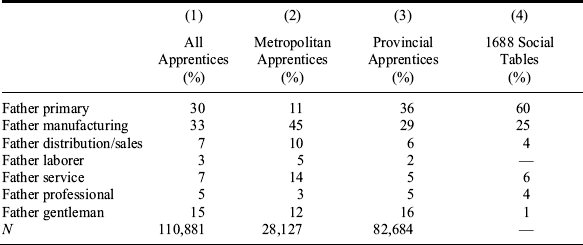
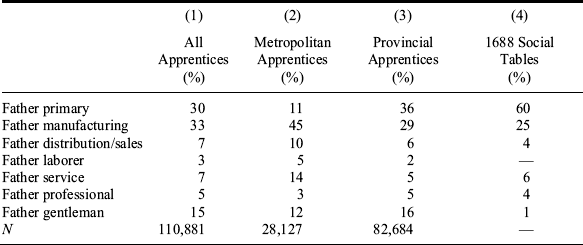
The Statute of Artificers established some limits on who could be apprenticed in nonagricultural occupations in England—primarily targeting the exclusion of children from poorer rural families—but in practice, these barriers seem to have had little effect. Table 2 uses E. A. Wrigley's matching of specific occupations to occupational categories. It shows that only about 40 percent of apprentices had fathers in manufacturing, distribution, or sales occupations: sectors where apprentices might seek training in London.Footnote 38 A larger share (45 percent) were sons of gentlemen or men in the primary, predominantly agricultural, sector. Almost half of apprentices were not, by definition, following in their father's footsteps since they came from an agricultural background. Manufacturing backgrounds became increasingly common over time for both metropolitan and provincial apprentices. For example, 62 percent of provincial apprentices indentured between 1600 and 1649 had gentlemen or primary sector fathers, with 24 percent having a manufacturing background. By 1700 to 1749 these figures were 38 percent and 36 percent respectively.Footnote 39
FATHER'S OCCUPATION CATEGORIES, 1600–1749
Notes:
Social Tables distribution is based on a revised version of King's tables, using Wrigley's suggestions for the allocation for King's cottagers and laborers to sectors: Wrigley, People, Cities, and Wealth, p. 171, n. 19. King's category of laborers are divided between primary (78 percent) and manufacturing (22 percent).
The final column of Table 2 provides a rough breakdown of occupational groups based on King's 1688 Social Tables. Comparison with other columns confirms that gentlemen fathers were strongly overrepresented among apprentice' fathers. Primary sector fathers are underrepresented as a whole, but many apprentices (close to 18 percent) were the sons of well-off yeomen, rather than husbandmen (8 percent).
Summarizing a wide set of studies for seventeenth- and eighteenth-century Europe, J. Farr concludes that “the sons of masters were not categorically staying in their father's trade, but many, and in some place most, new masters were sons of masters of other guilds within the same locality.”Footnote 40 We observe quite different patterns for London. Fewer than 4 percent of apprentices entered a company whose trade matched their father's occupation. When we limit ourselves to apprentices with fathers in distribution, sales, and manufacturing—and who could, therefore, enter the same trade as their fathers—this figure remains less than 10 percent, with London-born apprentices only slightly more likely to enter their father's trade. Even when we ask whether apprentices were entering the same broad category—primary, secondary, tertiary—as their fathers, we find that only a quarter did so, a testimony above all to the numbers with agricultural backgrounds.Footnote 41 Networks based on common institutional membership or derived from occupational relationships played only a minor role in the London apprenticeship market.
Distance and Networks
Economic theories of migration emphasize the role of costs in shaping migration decisions.Footnote 42 Distance affects costs, directly, through travel costs, and indirectly by altering access to information. We have already seen that apprentices came from across England, particularly early on in the period. But did distance alter their choices? Distant apprentices may have relied more on personal connections, if other information was more limited.
We first analyze the importance of distance by examining the distribution of different counties' apprentices across companies over time. If distance-related migration costs were large, provincial apprentices would be likely to cluster in companies where information was available in their locality, perhaps through ties to previous migrants to London. Apprentices from near the capital with lower search costs would be found in a larger range of companies.Footnote 43 We compare the distribution of apprentices from each county across companies with those of apprentices from London, using Duncan Dissimilarity Indices.Footnote 44 A low DDI score (minimum zero) means that apprentices from the two places in question entered the various companies in similar proportions, while a high DDI score (maximum 100) means that apprentices from the two places entered the various companies in very different proportions. A DDI of zero is an unrealistic benchmark, given that there will be variation in company distribution within subsets of the population of any group. Middlesex, which included the City of Westminster and several large suburban parishes, and the City of London formed an integrated and unified urban market. The DDI between London and Middlesex is a reasonable approximation for the expected variation in company choice between subsets of the same population.Footnote 45
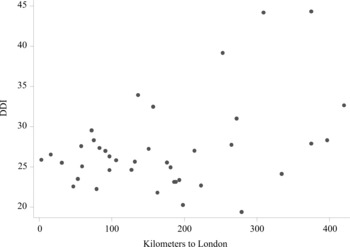
DDI SCORES BY DISTANCE FROM LONDON, 1600–1749

Figure 3 plots county DDI scores against distance to London, using data for 1600 to 1749.Footnote 46 There is no obvious correlation between distance and dissimilarity of company choice. An OLS regression of DDI against the log of distance yields a positive coefficient (1.45), but one that is not statistically significant at conventional levels (t-statistic of 1.64); weighting by county population yields a much smaller coefficient (0.11), and a t-statistic of less than 0.5. Strikingly, Middlesex has a DDI score of about 25, near the middle of the 39 counties. Information flows about opportunities in London appear remarkable fluid, with little evidence that the distance apprentices migrated to London constrained training choices.
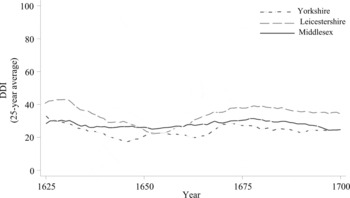
Aggregating over a 150-year period may conceal important trends. This may be compounded by the decline in recruitment from distant counties which occurred in parallel to the rising importance of particular companies. We explore this possibility in Figure 4 by calculating DDI scores over rolling 25-year windows. Given the large number of companies under consideration, and the declining numbers of apprentices after 1700, we limit ourselves to 1625 to 1700, and to the data abundant counties of Middlesex, Leicestershire, and Yorkshire, which are respectively adjacent to, 100 and 200 miles from London.Footnote 47
DDI SCORES FOR LEICESTERSHIRE, MIDDLESEX, AND YORKSHIRE, 1625–1700

Figure 4 shows some variance over time, with a pronounced dip in dissimilarity for Leicestershire apprentices in the middle of the period. That said, for most of the 75 years a clear ranking emerges: compared with the choices of apprentices from London, apprentices from Yorkshire were most similar, apprentices from Leicestershire least similar, and those from Middlesex in between.Footnote 48 This result reinforces the message from Figure 3, with average DDI scores for Yorkshire, Middlesex, and Leicestershire of 24, 27, and 33 respectively. Would-be apprentices from Yorkshire were able to make choices approximating those of London-born apprentices to at least the same degree as those originally residing much closer to the city, demonstrating that good quality information was available far from the metropolis.
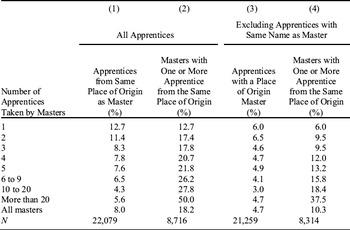
DID MASTERS AND APPRENTICES COME FROM THE SAME PLACE?

Notes:
From matched sample where apprentice and master origins are known. Masters from London and Middlesex are excluded. Data apply to 1600–1749.
Geographical Ties
Most masters were themselves migrants to London, and their links to their places of origin could affect who they recruited. Masters might, for example, acquire information easily about a youth from their own birthplace, while taking such apprentices would meet expectations about helping friends and former neighbors. Regional specialization could also affect apprentices' opportunities, as Ad Knotter and J. L. van Zanden have argued for Amsterdam.Footnote 49
If local ties affected apprentice recruitment, we will find masters disproportionately hiring apprentices from their place of origin, be that defined as their county or a particular community. A strand of the literature has emphasized the importance of local connections in various trades and cities.Footnote 50 In Table 3, we examine whether geographical ties were common by comparing place of origin of masters and apprentices for the matched sample.Footnote 51 To remove possible confounding effects of kinship ties with place of origin, we also report the results excluding masters and apprentices who share a surname, however common it may be (columns 3 and 4). The failure to exclude apprentices indentured to kin with different surnames means that these figures are an upper bound on non-kin town ties. The results suggest that ties through common place of origin mattered, but not that much. Fewer than 5 percent of apprentices were trained by a master from their place of origin with a different name. Including those with a shared name raises this to 8 percent (columns 1 and 3).
There is little indication that geographical ties were more important among masters who took few apprentices: 6 percent of masters who took only one apprentice recruited a youth with a different name from their place of origin, suggesting few masters who did not take apprentices made an exception for someone from their place of origin (column 4). Footnote 52 There is also little sign that masters who took many apprentices favored apprentices from their own place of origin. Just over one-third of masters who recruited over 20 apprentices had trained someone from their home town who didn't share their name (column 4). In other words, even the largest recruiters rarely used provincial connections to find apprentices. Some masters with large numbers of apprentices had several from their home place, but barely 10 percent of all masters ever trained a nonrelative from their place of origin (column 4). Of those training at least one, only 12 percent took on more than two.Footnote 53
Many apprentices came from places too small to have produced London masters in the previous generation, either in general or in a particular trade. Apprentices from such places could not have had a master from their place of origin. In this case, our “same place test” is too severe and the county is a better unit of analysis. Again, a disproportionate number of youths apprenticed to someone from their own county would be evidence of the importance of geographical networks.Footnote 54
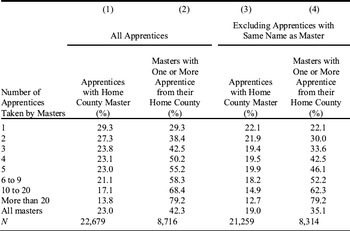
DID MASTERS AND APPRENTICES COME FROM THE SAME COUNTY?

Notes:
From 1600–1749 matched sample where apprentice and master origins are known. London and Middlesex masters excluded.
Inevitably, the figures for apprentices joining masters from the same county shown in Table 4 are larger than the “same place” shares in Table 3, with 19 percent of apprentices having masters with a different name from the same county (column 3). This is significantly higher than the 4 percent rate that would occur with random matching.Footnote 55 As before, the figures in Table 4 are an upper bound on the importance of geographical ties, as they include kinship ties where surnames are different. Notwithstanding the revealed degree of home bias, over 80 percent of migrant apprentices were indentured to masters from a different county, suggesting again that geographic networks had only a limited role. These figures indicate that possibilities for migrant apprentices were not limited by the absence of masters from their region in particular trades.
The importance of geographical ties may have changed over time. If this was the case, we would expect to see a change in home county recruitment. In fact, we find this remained fairly constant, remaining below 20 percent throughout the period.Footnote 56 This suggests that geographical ties between masters and apprentices were uncommon throughout the premodern period; there is no evidence that weaknesses in the market in the earlier period led to greater use of local networks.
If distance and information are inversely correlated, then the home county share would be greater for more remote counties. Regression analysis demonstrates no such relationship.Footnote 57 Taken as a whole, there is no compelling evidence that apprentices arriving from more distant parts of England were constrained in their choice of company or master.
The Role Indirect Ties
If apprenticeship in London largely operated outside narrow networks of kin, guild, occupation, and geography, how were apprentices and masters matched? Given the costs of apprenticeship, one would expect that families investigated possibilities thoroughly. Families needed to know the quality of training, while masters needed a sense of their prospective apprentices. Little is known about how individuals and masters came together. Only a tiny proportion of apprenticeships were advertised. On a few occasions, the organization of training was partially integrated into the company system. In the mid-seventeenth century, the Goldsmiths' and Carpenters' Companies' clerks bound large numbers of apprentices themselves before quickly turning them over to new masters.Footnote 58 However, such systems stand out because they were unusual.Footnote 59 Most knowledge presumably spread via informal channels. Parents' personal knowledge of London may have helped: Sir Tony Wrigley showed that around one in six English people spent part of their life in London.Footnote 60
The fragmentary evidence that survives suggests that the identification of opportunities for apprenticeships was made through a search effort that utilized third parties: provincial apprentices relied on their parents' connections in London to locate masters. From scattered accounts of the lives of former apprentices, it appears that most would-be apprentices and family used friends, acquaintances, and kin in London to find a master.Footnote 61 For example, Bartholomew Adsworth's 1688 apprenticeship to a cooper was arranged by Adsworth's cousin, George Fox, a citizen and vintner of London.Footnote 62 Graves Baker's brother, Thomas, placed him with his master, a gold and silver wiredrawer.Footnote 63 Daniel Clarke of Tring, Hertfordshire arranged his son Francis' apprenticeship with the help of “friends,” probably including Francis's uncle, who together sought a “freeman & one that dealt considerably in his way of trade & was a fair dealing man.”Footnote 64 Unfortunately, the master they found proved abusive.Footnote 65 George Long of Ludlow also arranged for friends to make a “diligent enquiry” for a “fit person” for his son.Footnote 66
These cases suggest that networks based on indirect ties might matter in finding apprenticeships. The relevant personal ties in these examples were between the apprentice and their London connection: we do not know if there was a prior relationship between the London contact and the master selected, but it is clear that the London contact did not become the master. Indeed, the Clarke and Long cases emphasize the match was to be determined by the prospective master's professional attributes, while there is no mention of his connections to the apprentice or his London contact. These examples may be exceptional—we generally know of them because the indenture broke down, and they may therefore reflect unusually weak apprenticeship arrangements. They do suggest, however, that the primary role of aspirant apprentices' contacts in the city was to use their network to identify placements and provide information about prospective masters in London, rather than to take on the apprentice themselves.
CONCLUSION
Geographical, occupational, and social mobility—and the matching of ability to opportunity—have obvious implications for economic development. Where barriers exist that prevent people exploiting their talents, societies as well as individuals will suffer. Apprenticeship was a major avenue for skill formation in premodern England. Although its potential for migration has been recognized, the recruitment of apprentices has been characterized as constrained, with reliance on narrow kin and communal networks, and poor information flows between towns and their hinterlands.
Our analysis shows little evidence of “immutable order.” Apprentices to London came from all parts of England. The typical London apprentice between 1600 and 1749 does not appear to have used the social networks emphasized in the qualitative literature. Fewer than 10 percent of apprentices were indentured to a master who was kin or from their place of origin, and under 20 percent to one from their home county. Parental connections to the London trades do not appear critical: remarkably few apprentices were training in a company linked to their father's occupation—perhaps 10 percent of metropolitan apprentices, and 5 percent of migrants. Some apprentices possess more than one of these ties, so we have calculated the share of apprentices who possessed at least one discernible link to their master. Only 15 percent of migrant apprentices shared an observable family tie with their master, were from the same place, or had a father in the same occupation. If we widen the definition of geographical ties to the county level, the share with an observable tie rises to 28 percent. A final adjustment is to account for the extent to which we understate family ties with our methodology. If we quadruple the rate of family ties to account for kin with different names, and assume the same degree of kin overlap with geographical and occupational links as observed for known ties, the estimated share of apprentices with observable ties rises to 46 percent.Footnote 67
Even with the most generous assumptions regarding ties, personal connections based on kin, geography, and profession seem to have played only a limited role in shaping the opportunities of prospective apprentices. Jane Humphries finds few apprentices training with kin in early industrial Britain.Footnote 68 Our findings suggest that this pattern extends back to the seventeenth century, if not further. Social, geographical, and occupational mobility appears more open than is often assumed for premodern societies.
Our findings also suggest that apprentices' choices were not constrained by poor information about opportunities in London. We find no evidence that apprentices from distant counties were more likely to sign indentures with masters from their home county, or that apprentices from distant counties were more concentrated in particular London companies. The company profiles of apprentices from distant counties were typically as similar to those of Londoners as apprentices hailing from Middlesex. Whether this flexibility came from information gained prior to moving, or from the ability to respond to opportunities on arrival, it is clear that this market was fluid and relatively unconstrained by segmented information and social barriers as early as 1600.
This pattern has implications for our understanding of the premodern economy. First, it implies larger spillovers and greater social returns to skill formation than would be the case for dynastic occupational transmission. Craft skills could diffuse widely through the English economy, with families and communities far from the main training and trading centers establishing connections to the London trades. This may explain the persistently low English skill premium identified by Van Zanden.Footnote 69 Second, it demonstrates that as early as 1600, if not before, individuals could enter into long-term training contracts with parties separated by significant distance and travel costs, with whom they had no direct prior connection. Credit provision may have been embedded locally, but training was much more open, despite the risks of opportunism and the sums involved.Footnote 70
The preponderance of relatively open apprentice recruitment suggests an ability to match aptitude to opportunity to a greater degree than had personal connections been necessary. One limitation of our analysis is that our sources do not record indirect contacts through friends or colleagues of the kind that are quantitatively important in today's economy. To some extent, these would involve shared place and county of origin, and would be captured indirectly in our analysis. Qualitative accounts of how apprentices found their masters sometimes report the use of intermediaries in London. The presence of these agents would make it possible for apprentices to acquire placements with London masters with whom they were connected through several degrees of separation. Further information is needed on the role of distant connections in London. However, it seems unlikely that prospective apprentices in London were constrained to matches made through indirect ties, or that any use they made of such connections seriously limited their opportunities.Footnote 71 Even where apprentices did use indirect ties, one important characteristic of such extended networks is that information about apprenticeship opportunities in the city would reach a large numbers of potential recruits, approximating to a stylized anonymous recruitment market.
Overall, the openness of London's trades to sons whose parents were in different occupations suggests that returns to parent-specific human capital were relatively low prior to industrialization. This has ramifications for theoretical economic growth models that link levels of economic mobility to technological change and industrial transformation.Footnote 72 The openness of London's trades also has implications for debates on the role of urban guilds in economic development.Footnote 73 In London at least, the Livery Company records show that guild members' children did not have preferential access to training. London apprenticeships were by no means a closed shop at the point of entry. Kinship mattered at the next stage in the corporate lifecycle, with company members' children able to claim membership by birthright (patrimony), but this privilege was of minor importance until the later eighteenth century.Footnote 74 It seems likely therefore that the openness we observe persisted into later points in individuals' careers.Footnote 75
Finally, it is worth considering whether London was unique within Britain or within Europe. We do not have comparable data for other English towns, although we note that some “new” towns and cities had no companies or formal apprenticeships, so that training opportunities were unlikely to be constrained by custom. Even were London to be the only “open” training market in England, it was large enough on its own to be important for England as a whole. If it was distinctive within Europe in its ability to be both open to outsiders and to offer a structured vocational training system, then there is scope for a previously unidentified contribution to England's precocious economic development. Existing studies of cities such as Milan, Württemberg, Antwerp, and Nordlingen identify exclusive behavior by early modern corporate communities in continental Europe.Footnote 76 That said, exclusive behavior was often associated with economic downturns, while London in contrast was undergoing unprecedented, if not always unproblematic, economic and spatial growth.Footnote 77 Was London (and perhaps by extension, England) fundamentally different from the continent, or was London different simply because it was growing? Future comparative research is needed for this distinction to be made.
Appendix
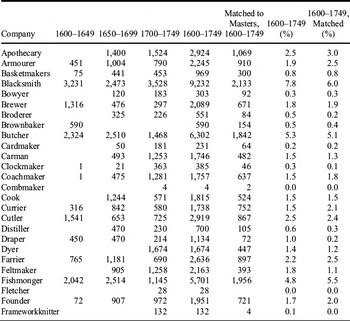
Appendix Table 1 lists the company distribution of observations in the Livery Company data. We do not know the exact occupation of the master, as most companies included masters in a range of occupations. The sixth column of Appendix Table 1 shows the company distribution of apprentices with masters for whom we were able to trace their indenture. The company distribution of this linked subsample is broadly similar to the full set of masters for whom we have information. The same is true for the distribution of place and county of origin.
APPRENTICE COMPANY DISTRIBUTION, 1600–1749

Notes:
See the text for source details.
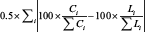 , where Ci and Li are the number of apprentices in company i in county C and London respectively.