In the ambulatory care setting, as many as 40% of all antibiotics are prescribed inappropriately for acute respiratory tract infections (RTIs) for which antibiotics are not indicated.Reference Roumie, Halasa and Grijalva 1 – Reference Snow, Mottur-Pilson and Gonzales 3 In a recent analysis, physicians prescribed antibiotics for 73% of visits for acute bronchitis and 60% of visits for pharyngitis.Reference Barnett and Linder 4 Excessive antimicrobial use increases healthcare costs 5 and promotes the emergence, persistence, and transmission of antibiotic-resistant bacteria.Reference Fridkin, Steward and Edwards 6 , Reference Hicks, Chien, Taylor, Haber and Klugman 7 Therefore, it is an urgent public health priority to improve physician antibiotic prescribing.
Despite the implementation of different antibiotic stewardship interventions,Reference Charani, Edwards and Sevdalis 8 – 10 only modest improvements in prescribing practices have resulted,Reference Smeets, Kuyvenhoven and Akkerman 11 , Reference Butler, Simpson and Dunstan 12 and sustained changes in practice have not been demonstrated. Few studies link physician prescribing behaviors to visit-specific factors and patient characteristics, but this information could provide insight into the influences that shape antibiotic prescribing among physicians.Reference Wood, Simpson and Butler 13 Instituting aggressive interventions in training or practice at the right time and to the right population of physicians could improve the efficacy of antibiotic stewardship.
The primary goal of our study was to examine patient and provider factors associated with inappropriate antibiotic prescribing for RTI visits at hospital-associated ambulatory practices to help determine where stewardship efforts could be effectively focused. We compared the prescribing practices of physicians with the highest and lowest levels of inappropriate antibiotic use to identify determinants of RTI prescribing at the extremes of practice.
METHODS
Design, Setting, and Participants
We conducted a retrospective analysis of outpatient visits for patients older than 18 years of age at the Boston Medical Center (BMC) general internal medicine (GIM) practice and the family medicine (FM) practice from January 1, 2008, through December 31, 2010. Visits that received an ICD-9-CM code for an RTI (for which antibiotics are not typically indicated) were eligible. BMC is an inner-city academic medical center and the largest safety net hospital in New England. The Boston University Medical Campus (BUMC) Institutional Review Board approved this study.
Main Outcomes and Measures
De-identified data regarding RTI visits and prescribing practices were extracted from electronic medical records through the BUMC Clinical Data Warehouse (CDW). Patient variables included age, self-reported race or ethnicity, gender, source of payment (insurance), primary language spoken, specific comorbidities (diabetes mellitus, human immunodeficiency virus infection, chronic renal failure, chronic obstructive pulmonary disease, asthma, cancer, congestive heart failure, history of psychiatric illness and/or substance use), and the Charlson comorbidity index, a validated measure that predicts 10-year mortality based on comorbid conditions. Antimicrobial agents (oral preparations only) prescribed to treat RTIs included penicillins, cephalosporins, macrolides, fluoroquinolones, tetracyclines, lincosamides, and trimethoprim-sulfamethoxazole.
Physician data obtained from the CDW included the number of RTI visits and the total number of outpatient visits for each physician, the physician’s practice location or ‘pod,’ the physician's gender, age, residency location, length of affiliation with the BMC practice, specialty (GIM, FM), and degree (MD, DO). The names of physicians providing care for RTI patients were provided to investigators who compiled data regarding sites of medical education and length of time in practice by reviewing publicly available physician profiles, such as those through state boards of registration in medicine. Medical education was grouped by region (Northeast, Southeast, Midwest, and West), whether it was within the United States or international, and whether the institution was publicly or privately funded. Residency training was grouped by geographic region and whether it took place at a university or community (including university-affiliated) hospital. Those data were then linked to the physician’s RTI visit data by the CDW, and the full dataset was provided to the investigators in a de-identified manner.
Prescription of an antibiotic was labeled inappropriate for RTI visits for which an ICD-9-CM code was recorded for viral RTI (460, 462–465), viral bronchitis (466, 490), viral pneumonia and influenza (480, 487), or pleurisy (511). Treatment of sinusitis and bacterial pneumonia, for which antibiotics are often appropriate, was not included in the analyses, but these data were examined to evaluate whether a physician used those diagnostic codes more often.
Analysis
Of 5,156 RTI visits during the study period, 4,942 visits were conducted by an attending staff physician with at least 10 RTI visits (79 physicians) and were included in the analyses. We analyzed our sample to determine the frequency of inappropriate antibiotic prescribing for different RTI diagnoses. By comparison, we ensured that our data were congruent with those of other published studies. We then conducted bivariate analyses between each factor and outcome using Pearson’s χ2 tests to identify factors predictive of an inappropriate antibiotic prescription. Factors that correlated at the α=0.1 level were further investigated for their predictive power through multivariable hierarchical logistic regression techniques. Provider random effects were included in the multivariable model to account for multiple visits per physician and to correct for any unobserved provider heterogeneity. We measured the extent of multicollinearity in the estimations using a variance inflation factor (VIF) analysis and found no significant multicollinearity problems in the model. The exclusion of diagnostic codes for pharyngitis/tonsillitis did not alter associations or significance of our results, and those visits were retained in the final models.
To analyze the physician characteristics and test differences between GIM and FM doctors in the physician cohort, we used a χ2 test or Fisher’s exact test when the expected cell size was less than 5. To categorize physicians as either “high prescribers” or “low prescribers,” we calculated the % RTI visits that ended with an antibiotic prescription; physicians in the upper quartile were classified as high prescribers and those in the lowest quartile were classified as low prescribers (20 physicians in each group). We performed χ2 analysis using visit-level data to detect patient population differences, and we used physician-level data to analyze differences between high and low prescribers.
RESULTS
The distribution of diagnoses resulting from RTI patient visits and the antibiotic use per diagnosis are listed in Table 1. Acute upper respiratory infection (URI) of unspecified site (ICD-9-CM 465) and other nonspecific URIs were the most commonly diagnosed RTIs, but acute bronchitis was associated with the most inappropriate antibiotic use. Of visits resulting in bronchitis diagnoses, 71% included an antibiotic prescription. When patients with chronic lung disease or asthma were excluded, the antibiotics prescription rate was still high (67%, data not shown).
Prescribing by Respiratory Tract Infection (RTI) DiagnosisFootnote *

* Includes all prescribers in the cohort (79 physicians).
† Includes tonsillitis, acute laryngitis or tracheitis, viral pneumonia, influenza, and pleurisy.
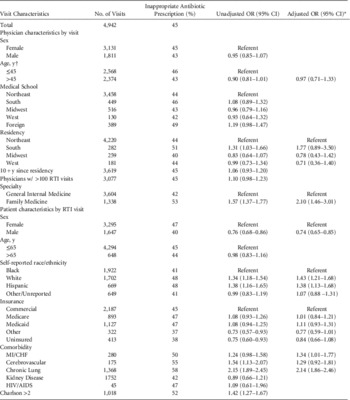
Overall, physicians prescribed antibiotics inappropriately with 45% of RTI visits. Patient and physician factors associated with inappropriate prescribing are listed in Table 2. Physician factors significantly associated with inappropriate prescribing in the unadjusted analysis included residency training in the South and specializing in family medicine. The actual number of clinicians who completed residency in the southern United States was small (4 physicians) although they had a high volume of RTI visits. Physician age >45 years, male gender, and residency training in the Midwest trended toward less inappropriate antibiotic prescribing for RTIs, but no factor attained significance. Patient characteristics significantly associated with inappropriate prescribing in the unadjusted analysis were white and Hispanic race/ethnicity, comorbidities (cerebrovascular disease, chronic lung disease, and asthma), and overall Charlson morbidity score >2. Male gender and being uninsured (or having insurance other than commercial, Medicare, or Medicaid coverage) was associated with less inappropriate prescribing.
Factors Associated with Inappropriate Antibiotic Prescribing with Respiratory Tract Infection (RTI) Visits

NOTE. OR, odds ratio; CI, confidence interval.
* Variables with P>.1 were not included in the adjusted model.
† Median physician age in the cohort was 45 y.
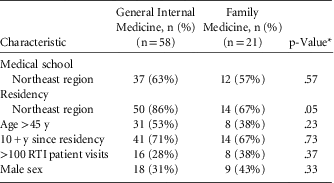
In adjusted analyses, antibiotic prescribing was significantly associated with visits with FM physicians and with patient gender, race, and the presence of certain comorbidities (Table 2). Antibiotic prescribing was less appropriate with female patients and with white and Hispanic patients. In Table 3, FM physicians were more likely to have completed residency outside the Northeast compared with GIM physicians, but the two groups were otherwise similar.
Descriptive Statistics for General Internal Medicine and Family Medicine Physicians

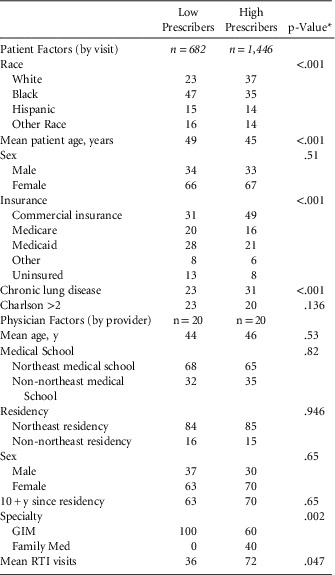
When comparing high and low prescribers, the lowest quartile prescribed antibiotics for 5%–28% (mean, 21%) of patients at RTI visits, while the highest quartile prescribed antibiotics for 54%–85% (mean, 65%)of patients at RTI visits. There were notable differences between RTI diagnoses coded by high and low prescribers (Table 4). High-provider RTI visits were coded “acute URIs of unspecified site” less often and were coded pharyngitis and acute bronchitis more often than were visits to low prescribers. Between high and low prescribers, there was a>60% difference in inappropriate antibiotic prescribing for bronchitis and a>40% difference for acute pharyngitis. The percentages of sinusitis or pneumonia diagnoses among all RTI visits between low (7.4% sinusitis, 9.3% pneumonia) and high (9.3% sinusitis, 7.9% pneumonia) prescribers were similar (P=.5 and .6, respectively).
Respiratory Tract Infection (RTI) Diagnoses by Low and High Prescribers

NOTE. URI, upper respiratory infection.
The only significant physician factor differentiating high and low prescribers was medical specialty (Table 5). No FM physicians were identified in the lowest quartile of prescribers, but they comprised 40% of the highest quartile prescribers. Higher prescribers had a mean of 72 RTI visits, while low providers had only 36 visits. The mean number of overall outpatient visits for high prescribers (6,929 visits) and low prescribers (6,136 visits) did not differ significantly (P=.7); for high prescribers, on average, 3.9% of their total patient visits were RTI visits, and low prescribers, 1.1% of their total patient visits were for RTIs (P=.03). When analyzing patient factors, high prescribers were less likely to have African-American patients and more likely to have patients who were younger and privately insured. Patients of high prescribers had more chronic lung disease than patients of low prescribers, but overall, Charlson scores were similar between patients of high and low prescribers. Within GIM practice pods, a pod with a high-prescribing physician was 1.3 times more likely to have a second high prescriber, whereas a pod with a low prescriber was 3.0 times more likely to have a second low prescriber, compared with other practice pods.
Descriptive Statistics of Low and High Prescribers

* Fisher's exact test was used when cell size was <5, student’s t-test was used for continuous variables.
DISCUSSION
Antibiotic prescribing practices for RTIs remain poor despite the availability of evidence-based guidelines and multiple initiatives to improve practice.Reference Davis, O’Brien, Freemantle, Wolf, Mazmanian and Taylor-Vaisey 9 , 10 , Reference Gonzales, Bartlett and Besser 14 In our study, bronchitis was the most problematic diagnosis, with most patients receiving an antibiotic; this finding is consistent with prior studies. 5 , Reference Kroening-Roche, Soroudi, Castillo and Vilke 16 Bronchitis is commonly used by clinicians as a reason for prescribing antibioticsReference Grover, Mookadam and Rutkowski 17 despite multiple randomized trials showing that antibiotics are not indicated for healthy adults with bronchitis.Reference Williamson 18 , Reference Evans, Husain, Durairaj, Sadowski, Charles-Damte and Wang 19 We could not determine from our data whether the patient had purulent sputum, which often inappropriately drives a bronchitis prescription.Reference Fischer, Fischer, Kochen and Hummers-Pradier 20 , Reference Dosh, Hickner, Mainous and Ebell 21
Physician factors linked to inappropriate antibiotic prescribing for RTIs in the literature include male gender, older age, and more years in practice,Reference Wang, Seed, Schofield, Ibrahim and Ashworth 22 , Reference Aspinall, Good, Metlay, Mor and Fine 23 but these were not significant in our study.Reference Cadieux, Tamblyn, Dauphinee and Libman 24 Family medicine practitioners were more likely to prescribe inappropriately than were general internists; this finding is consistent with other published data.Reference Aspinall, Good, Metlay, Mor and Fine 23 , Reference Steinman, Landefeld and Gonzales 25 Further study to identify differences in knowledge and attitudes on antibiotic prescribing of medical school students entering internal medicine compared with family medicine would be of interest. Medical students’ knowledge regarding antibiotics in general and stewardship specifically is currently poor.Reference Abbo, Cosgrove and Pottinger 26 Comprehensive education about antimicrobials and stewardship in medical school could be an effective means of improving RTI prescribing and preventing the establishment of poor prescribing practices.
In contrast to physician factors, several patient factors were associated with inappropriate antibiotic prescribing, including patient gender and race; this finding is consistent with other studies. Women were prescribed antibiotics more often than men,Reference Sun, Jew and Dasta 27 , Reference Gonzales, Steiner and Sande 28 and blacks were less likely to be overprescribed antibiotics than whites.Reference Steinman, Landefeld and Gonzales 25 , Reference Gonzales, Steiner and Sande 28 , Reference Gerber, Prasad and Localio 29 However, we cannot know whether this was due to cultural preferences or different expectations for an antibiotic based on the race and gender of the patient or bias on the part of the physician. A physician’s perception that a patient wants a prescription has been a driver of prescribing, according to other studies.Reference Scott, Cohen, DiCicco-Bloom, Orzano, Jaen and Crabtree 30 , Reference Coenen, Michiels, Renard, Denekens and Van Royen 31 Nevertheless, it is concerning that there may be a different approach to patients depending on race or gender, as it may suggest inequities in care.
Our analysis of high and low prescribers demonstrated the wide range of prescribing practices among clinicians. The distributions of diagnoses for RTI visits between high and low prescribers were notably different. Although it is feasible that high prescribers saw vastly different types of RTIs, it is more likely that the disparity was attributable to physician choice of diagnostic codes, perhaps to support antibiotic prescribing decisions. However, there was no difference in the percentage of visits receiving diagnostic codes for sinusitis or pneumonia between high and low prescribers, which refutes the possibility that low providers might have been coding for RTIs that were not included in our analysis.
On average, low prescribers and high prescribers in our study did not have significantly different numbers of overall outpatient visits, but high prescribers had >3 times as many RTI visits. This finding is consistent with the possibility that high prescribers encourage or attract RTI visits by their prescribing practices. Studies have demonstrated that improved RTI antibiotic use generally has been due to fewer patient visits, rather than better prescribing,Reference Gulliford, Latinovic, Charlton, Little, van Staa and Ashworth 32 , Reference McCaig, Besser and Hughes 33 and practices that prescribe fewer antibiotics for RTIs have fewer visits.Reference Cadieux, Tamblyn, Dauphinee and Libman 24 , Reference Ashworth, Charlton, Ballard, Latinovic and Gulliford 34
The highest prescribers had, in general, a population of patients who were younger, although the incidence of chronic lung disease was higher among this population. These patients were more likely to be white and privately insured. Again, these findings may suggest a disparity in care that should be evaluated further.
We also examined clustering at the level of the GIM practice location or pod. GIM pods with a high prescriber were 30% more likely to have another high prescriber, and pods with low prescribers were three times more likely to have another low prescriber. Studies have demonstrated that providing feedback about antibiotic prescribing to the individual physician can be as effective as feedback provided to an entire practice.Reference Gerber, Prasad and Localio 29 , Reference Doyne, Alfaro and Siegel 35 Therefore, interventions could focus on bronchitis and pharyngitis RTI visits seen by the highest quartile prescribers or could concentrate on developing physician leaders within the lowest quartile. These strategies could lead to a better use of resources for antibiotic stewardship interventions than targeting an entire practice.
Our study has several limitations. Due to the high volume of visits, we did not perform chart reviews to verify that patients were prescribed the antibiotic for an RTI or that the ICD-9-CM code chosen accurately reflected the reason for the visit. In addition, we could not examine the record of patient symptoms or physical examination, which prior studies indicate influences antibiotic prescribing. However, despite those limitations, the use of diagnostic claims data for RTI research has been shown to be reliable.Reference Maselli and Gonzales 36 Another limitation is the use of one hospital and one geographic area, which reduces the generalizability of the results. Our analysis of highest and lowest prescribers had a limited sample size, and we might have missed significant differences because of lack of power. Finally, in this study we were unable to survey the patient population, whose expectations of the medical visit may impact prescribing. This information might have clarified, for example, whether racial and gender differences in prescribing were due to patient cultural bias and preferences and/or physician bias.
In conclusion, prescribing an antibiotic for an RTI remains inappropriate in >40% of cases and in >70% of cases of acute bronchitis at our hospital. We found disparities regarding antibiotic prescribing based on race/ethnicity and gender that might suggest inequities in care that need to be studied further. Medical specialty was the most significant physician factor associated with inappropriate prescribing. Because specialty choice and preliminary training begins in medical school, it seems appropriate to examine medical school curricula to explore interventions that could improve prescribing at earlier stages in training and could prevent the development of poor prescribing practices. Finally, interventions targeted by diagnosis to the highest prescribers of antibiotics and enlisting low prescribers as physician leaders within a practice could have a stronger impact and be a more efficient use of resources than interventions targeted to the entire practice.
Acknowledgments
We would like to thank Linda Rosen, MSEE, for supplying the study data from the Clinical Data Warehouse, Boston Medical Center.
Financial support. The authors have no financial disclosures to report.
Conflict of Interest. All authors report no conflicts of interest relevant to this article.