Feeding rumen buffers containing strong ions has had positive effects on the production efficiency and health of dairy cows (Erdman, Reference Erdman1988; Sanchez et al., Reference Sanchez, Beede and Cornell1994; Zali et al., Reference Zali, Nasrollahi and Khodabandelo2019). It has been well documented that increasing cation concentration with addition of potassium (K) or sodium (Na) improved milk fat production (Iwaniuk and Erdman, Reference Iwaniuk and Erdman2015). Particularly, K is known to have some biologic effects on increasing milk fat yield and feed efficiency, which might be mediated by improving electrolyte balance, decreasing bioactive intermediates of ruminal fatty acid biohydrogenation and minimizing reactions to environmental stressors (West et al., Reference West, Coppock, Nave and Schelling1986; Alfonso-Avila et al., Reference Alfonso-Avila, Charbonneau, Chouinard, Tremblay and Gervais2017; Zali et al., Reference Zali, Nasrollahi and Khodabandelo2019). Recently, it was documented that K supplemented diets improved milk fat percentage by 10% and milk/feed ratio by 2% compared with Na supplemented diets (Zali et al., Reference Zali, Nasrollahi and Khodabandelo2019). Although feeding K supplements benefits milk fat production and feed efficiency, there are also some disadvantages. Supplementation of K rather than Na may decrease feed intake in dairy cows (Schneider et al., Reference Schneider, Beede, Wilcox and Collier1984) or goats (Dion et al., Reference Dion, Brassard, Lévesque, Rico, Tremblay, Gervais and Chouinard2021), and possible negative effects of K supplementation on milk protein percentage have been reported (West et al., Reference West, Coppock, Nave and Schelling1986).
Some feed additives have the potential to increase feed intake or milk protein synthesis, including yeast (Cattaneo et al., Reference Cattaneo, Lopreiato, Piccioli-Cappelli, Trevisi and Minuti2023), essential oils (Morrill and Dayton, Reference Morrill and Dayton1978) and peptides (Shabanzadeh et al., Reference Shabanzadeh, Azizi, Fadayifar and Azarfar2021). Improving gut health and digestion, increasing microbial protein synthesis and improving body health by introducing anti-oxidative and anti-stressors agents are some of the suggested mechanisms (Morrill and Dayton, Reference Morrill and Dayton1978; Mishra et al., Reference Mishra, Khalid, Fatima, Singh, Tripathi, Waseem and Mahdi2019; Shabanzadeh et al., Reference Shabanzadeh, Azizi, Fadayifar and Azarfar2021; Cattaneo et al., Reference Cattaneo, Lopreiato, Piccioli-Cappelli, Trevisi and Minuti2023). Recently, Verdier-Metz et al. (Reference Verdier-Metz, Delbès, Bouchon, Rifa, Theil, Chaucheyras-Durand, Chevaux, Dunière and Chassard2023) supplemented yeast to the diet of dairy cows and reported improvements in feed conversion ratio, milk yield and microbial balance in bedding material and on the teat skin without a deleterious effect on the composition of milk microbiota. In another experiment, a more pronounced effect of yeast supplementation at a higher dose on the production of energy-corrected milk was reported (Kumprechtová et al., Reference Kumprechtová, Legendre, Kadek, Nenov, Briche, Salah and Illek2024). Recent experiments have also indicated improved milk yield and feed efficiency (Silva et al., Reference Silva, Cortinhas, Acedo, Lopes, Arrigoni, Tomich, Pereira, Ferreira, Jaguaribe and Weber2023), and raw milk safety (Castelani et al., Reference Castelani, Pfrimer, Giglioti, van Cleef, Salles and Júnior2023) by feeding essential oils. Our study was conducted to determine the possible advantages of yeast, essential oils and peptides as supplements for diets containing K2CO3 as a rumen buffer when fed to high producing dairy cows. We hypothesized that feed additives would improve feed intake and milk protein production of dairy cows.
Material and methods
Cows, diets, and treatments
The experiment was conducted from January 2021 to April 2021. All animal procedures were approved by the Animal Care Committee of the Research Institute according to the Veterinary Medicine and Science agency. Eight Holstein cows (88 ± 7 DIM; milk yield = 48 ± 5.0 kg/d; BW = 647 ± 30 kg; all mean ± sd) in second parity were used in a replicated 4 × 4 Latin square design with 4 periods of 21 d (14 d for diet adaptation and 7 d for sampling and data collection). Cows were randomly assigned to 1 of 4 treatments. The treatments were (1) control, a diet containing rumen buffer with the active component of K2CO3 (1.6% of diet DM and contained 10% K; rumen optimizer, Pishgam Damparvar Sepahan Co., Isfahan, Iran); (2) yeast, the control diet supplemented with live Saccharomyces cerevisiae yeast (0.06% of diet DM; Actisaf Sc 47, Phileo Lesaffre Animal Care, France); (3) essential oils (EO), the control diet supplemented with essential oils (0.02% of diet DM; Menofru; Shanghai Menon Animal Nutrition Technology Co., Ltd, China) and (4) peptides, the control diet supplemented with biogenic peptides from cottonseed protein hydrolysates (0.16% of diet DM; Fortide C, Mytech Biotech Co., Ltd, China). Inclusion of the additives was in accordance with the manufacturers' recommendations. The composition of the additives, according to manufacturer's information, was as follows: rumen optimizer contained 10% K, 26% Na, 3% Mg and negligible amounts of Ca, P, Cl and crude protein (CP). The active component of Actisaf Sc47 was a pure culture of the strain Saccharomyces cerevisiae NCYC Sc47, with a minimum concentration of 5 × 10⁹ CFU/g; no information was available on non-active components or carriers. Menofru contained ≥0.5% citrate and ≥0.5% ethyl butyrate as active components, with silicon dioxide and sodium sulfate as carriers. Fortide C contained 97.5% DM, 93.9% organic matter, 48.6% CP (82.5% of CP as true protein and 17.5% of CP as non-protein nitrogen), 1.18% neutral detergent fiber (NDF), and 0.05% ether extract (Shabanzadeh et al., Reference Shabanzadeh, Azizi, Fadayifar and Azarfar2021). Diets were formulated using the Cornell net carbohydrate and protein system (version 5.0) for cows producing 45 kg/d of milk with 3.2% fat and 3.0% crude protein. Ingredients and chemical composition of the diets are shown in online Supplementary Table S1. The ratio of forage to concentrates in all diets was 29 to 71 on a DM basis. During the experiment, cows were housed in individual 6 m × 4 m pens bedded with sand. All animals had free access to water. Cows were fed 110% of the amount of feed consumed the previous day, and were fed twice daily at 0900 and 1630 h.
Feed intake, nutrient digestibility, and chemical analysis
The total mixed ration (TMR) amounts delivered and refused were weighed and sampled daily for each cow during d 16–21 of each period and daily dry matter intake (DMI) for each cow was calculated. Representative samples of TMR (pooled by diet within period), and individual refusals (pooled by cow within period) were taken immediately before the morning feeding during the 6-d collection period. All samples were immediately frozen at −20°C until they were analyzed. After thawing, the DM concentration of the samples was determined by drying in a forced-air oven at 60°C for 48 h. All samples were ground using a Wiley mill with a 1-mm screen (Arthur H. Thomas, Philadelphia, PA) and were analyzed for CP (AOAC (2006) method 955.04) and NDF) using heat-stable α-amylase and sodium sulfite (Van Soest et al., Reference Van Soest, Robertson and Lewis1991).
Fecal grab samples were obtained from each cow over 4 consecutive days at 12-h intervals (Cooke et al., Reference Cooke, Bernard and West2008). Sampling time was advanced by 2 h each day so that samples were collected at 0500, 0700, 0900, 1100, 1700, 1900, 2100, and 2300 h. Fecal samples were dried in a forced-air oven at 60°C for 72 h, composited by cow within period and ground to pass through a 1-mm screen. The samples were analyzed for DM, ash, acid detergent fiber (ADF), NDF and CP by procedures described previously (AOAC, 2006). Apparent total tract digestibility of nutrients was determined using indigestible NDF (iNDF) after 240 h of in vitro ruminal incubation as an internal marker of digesta flow. The starch concentration in feed and fecal samples was determined using the modified glucoamylase procedure described by Zhu et al. (Reference Zhu, Jones, Guo, Lewis, Stark and Alavi2016). Briefly, samples were gelatinized by boiling in a water bath for 20 min and then were cooled to ambient temperature. After the addition of an acetate buffer, starch was hydrolyzed with a glucoamylase enzyme and the glucose concentration was measured using the glucose oxidase method (Pars azmoon, Iran). Net energy for lactation (NEL) was calculated according to a standard equation (NRC, 2001).
Milk yield and components, BW and BCS
Milk yield for all cows was recorded and sampled at each milking during d 16–21 of each period. Cows were milked three times daily at 0800, 1600, and 2400 h in a herringbone milking parlor. Milk samples were preserved with potassium dichromate, stored at 4°C and analyzed using mid-FTIR (Lactoscope FTA, Delta Instruments, The Netherlands) for fat, true protein and lactose. The yield of 3.5% fat corrected milk (FCM; kg/d) and energy corrected milk (ECM; kg/d) was calculated using the following equations: 3.5% FCM = 16.23 fat yield, kg + 0.432 milk yield, kg (Tyrrell and Reid, Reference Tyrrell and Reid1965); and ECM = 0.3246 milk yield, kg + 12.96 fat yield, kg + 7.04 protein yield, kg (Jenkins et al., Reference Jenkins, Bertrand and Bridges1998). Feed conversion efficiency (FCE) was calculated as the amount of ECM produced per DMI on a kg/d per kg/d basis. Cows were weighed at the start of the experiment and end of each experimental period. Body condition score (BCS) was determined on the same occasions using a five-point scale where 1 = emaciated and 5 = obese (Ferguson et al., Reference Ferguson, Galligan and Thomsen1994).
Calculation and statistical analysis
Data were analyzed using the mixed model procedure (Proc Mixed) of SAS (2002) to account for the effects of square, cow within square, period, and treatment. Treatment, square, and period were considered fixed effects, whereas cow within square was a random effect. The MIXED model used for data analysis was:
 $$Y_{{\rm ijkm}} = {\rm \mu } + S_{\rm m} + P_{\rm i} + A( S ) _{{\rm jm}} + B_{\rm k} + e_{{\rm ijkm}}{\rm , \;}$$
Where Y ijklm = each observation, μ = overall mean, S m = fixed effect of square, P i = fixed effect of period, A(S)jm = random effect of cow within square, B k = fixed effect of treatment, and e ijkm = random residual error. Data are reported as least squares means. The differences among the treatments were evaluated using a multiple comparison test following the Tukey–Kramer method. Statistical significance was declared at P ≤ 0.05.
Results
The DMI of cows fed the yeast treatment was greater than cows fed the control or peptides treatments, but was comparable to cows fed the EO treatment (P < 0.01; Table 1). Intake of cows fed the yeast treatment was 2.3 kg/d greater than the control treatment. Apparent total tract DM and starch digestibilities were not significantly different among treatments (Table 1).
Intake and digestibility for dairy cows fed diets differing in feed additives

a,bLeast squares means within a row with different superscripts differ significantly (P < 0.05).
Treatments were: control, a diet contained rumen optimizer (Pishgam Damparvar Sepahan Co., Isfahan, Iran) as rumen buffer [1.6 % of diet dry matter (DM) contained 10 % K]; (2) yeast, the control diet supplemented with live Saccharomyces cerevisiae yeast (0.06 % of diet DM); (3) Essential oils (EO), the control diet supplemented with essential oils (0.02 % of diet DM); and (4) Peptides, the control diet supplemented with biogenic peptides (0.16 % of diet DM).
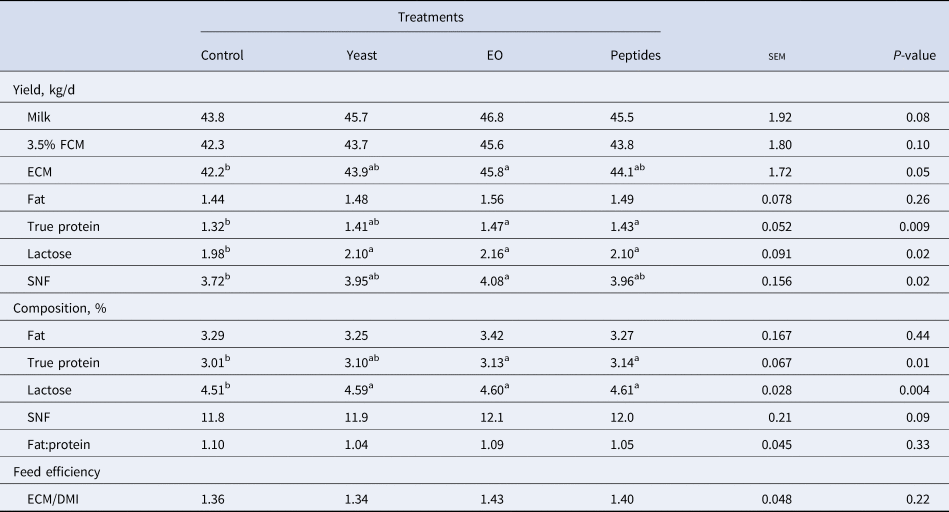
Compared to the control, cows fed EO had a numerically greater ECM production (P = 0.05, Table 2). The production of ECM was 3.6 kg/d greater for the EO treatment than the control treatment. Both cows fed with EO and cows fed with peptides had greater milk protein production than control cows, while the proportion of lactose in milk (P < 0.01) and lactose yield (P = 0.02) were greater in all three feed additive treatments compared to the control (Table 2). Milk fat production, FCM production, and milk fat to protein ratio were similar among the treatments (P > 0.05, Table 2).
Milk production and composition, feed efficiency, and body weight change in dairy cows fed diets differing in feed additives

a,bLeast squares means within a row with different superscripts differ significantly (P < 0.05).
Treatments were: control, a diet containing rumen optimizer (Pishgam Damparvar Sepahan Co., Isfahan, Iran) as a rumen buffer [1.6 % of diet dry matter (DM) and contained 10 % K]; (2) yeast, the control diet supplemented with live Saccharomyces cerevisiae yeast (0.06 % of diet DM); (3) Essential oils (EO), the control diet supplemented with essential oils (0.02 % of diet DM); and (4) Peptides, the control diet supplemented with biogenic peptides (0.16 % of diet DM).
3.5% FCM = 16.23 fat yield, kg + 0.432 milk yield, kg (Tyrrell and Reid, Reference Tyrrell and Reid1965).
ECM = 0.3246 milk yield, kg + 12.96 fat yield, kg + 7.04 protein yield, kg (Jenkins et al., Reference Jenkins, Bertrand and Bridges1998).
The efficiency of milk production expressed as kg of ECM/kg of DMI did not differ significantly among treatments (P > 0.05, Table 2). Similarly, body weight and BCS were not significantly different among the dietary treatments (P > 0.05, Supplementary Table S2).
Discussion
Feeding high concentrate diets induces a metabolic stress that may affect health and production efficiency of dairy cows (Nasrollahi et al., Reference Nasrollahi, Zali, Ghorbani, Shahrbabak and Abadi2017; Memon et al., Reference Memon, Wang, Xu, Ma, Zhang, Roy, Aabdin and Shen2019; Kumar et al., Reference Kumar, Hasan, Choyal, Tomar, Gupta, Sasi, Changan, Lorenzo, Singh, Sampathrajan, Dhumal, Pandiselvam, Sharma, Satankar, Waghmare, Senapathy, Sayed, Radha, Dey, Amarowicz and Kennedy2022). Supplementing a K-containing buffer (usually K2CO3) aids in improving ion, electrolyte and acid–base balances that may have been changed during periods of stress (Erdman, Reference Erdman1988; Sanchez et al., Reference Sanchez, Beede and Cornell1994), thereby improving milk fat production and feed efficiency in these cows (West et al., Reference West, Coppock, Nave and Schelling1986; Zali et al., Reference Zali, Nasrollahi and Khodabandelo2019). However, the known disadvantage of K-supplemented diets is the negative effect on DMI (Zali et al., Reference Zali, Nasrollahi and Khodabandelo2019) and milk protein percentage (West et al., Reference West, Coppock, Nave and Schelling1986). Our experiment investigated potential roles of supplementing yeast, peptides or essential oils to a K2CO3 containing diet on feed intake and milk protein production of high concentrate-fed dairy cows.
Among the additives used, essential oils (EO) resulted in greater milk production. These findings could indicate an important role of such bio-medicals in nutrition of dairy cows. Citral and ethyl butyrate were the two bio-active components of the EO treatment. A previous study suggested that a mixture containing ethyl butyrate stimulated feed intake in dairy calves (Morrill and Dayton, Reference Morrill and Dayton1978). However, there are no previous reports for effects on milk or milk protein production. Feeding butyrate in the salt form (Na-butyrate) increased insulin concentration in the blood of dairy cows (Herrick et al., Reference Herrick, Hippen, Kalscheur, Schingoethe, Casper, Moreland and van Eys2017) and effects of insulin on milk protein synthesis and milk production are well known (Griinari et al., Reference Griinari, McGuire, Dwyer, Bauman, Barbano and House1997; Mackle et al., Reference Mackle, Dwyer, Ingvartsen, Chouinard, Lynch, Barbano and Bauman1999; Menzies et al., Reference Menzies, Lefèvre, Macmillan and Nicholas2009). However, future experiments would be required to determine such a mechanism because the ability of cow to release butyrate from ethyl butyrate and the concentration of insulin in plasma were not measured in the present study. Additionally, citral also has antimicrobial activity (Gayathri and ta Usha, Reference Gayathri and ta Usha2020) and oxidative modulating effects (Mishra et al., Reference Mishra, Khalid, Fatima, Singh, Tripathi, Waseem and Mahdi2019), which might be beneficial during periods of metabolic stress (Nasrollahi et al., Reference Nasrollahi, Zali, Ghorbani, Shahrbabak and Abadi2017; Memon et al., Reference Memon, Wang, Xu, Ma, Zhang, Roy, Aabdin and Shen2019) in high producing cows fed high concentrate diets.
We also report the potential role of peptides to increase milk protein production. The peptides used were produced by the hydrolysis of cottonseed protein, and are known to be bio-active peptides (Kumar et al., Reference Kumar, Hasan, Choyal, Tomar, Gupta, Sasi, Changan, Lorenzo, Singh, Sampathrajan, Dhumal, Pandiselvam, Sharma, Satankar, Waghmare, Senapathy, Sayed, Radha, Dey, Amarowicz and Kennedy2022). Few studies have evaluated the effect of feeding peptides from hydrolyzed protein. We observed some suggestive effects from feeding the peptides. The hydrolyzed protein used here might improve milk protein synthesis by supplying essential amino acids (arginine, histidine and lysine: Kumar et al., Reference Kumar, Hasan, Choyal, Tomar, Gupta, Sasi, Changan, Lorenzo, Singh, Sampathrajan, Dhumal, Pandiselvam, Sharma, Satankar, Waghmare, Senapathy, Sayed, Radha, Dey, Amarowicz and Kennedy2022) to the dairy cows. Hydrolyzed proteins are also known to have antioxidant and antimicrobial effects (Kumar et al., Reference Kumar, Hasan, Choyal, Tomar, Gupta, Sasi, Changan, Lorenzo, Singh, Sampathrajan, Dhumal, Pandiselvam, Sharma, Satankar, Waghmare, Senapathy, Sayed, Radha, Dey, Amarowicz and Kennedy2022), which might modulate the upregulation of protein synthesis (Harding et al., Reference Harding, Zhang, Zeng, Novoa, Lu, Calfon, Sadri, Yun, Popko, Paules, Stojdl, Bell, Hettmann, Leiden and Ron2003) that may occur during possible oxidative stress conditions (high concentrate feeding). One study reported a 6.6% improvement in milk protein percentage by feeding hydrolyzed protein to cows in the form of fermented soybean meal (Zhe et al., Reference Zhe, Ying, Hong-bao and Xue-jun2014).
The third additive used in this study was live yeast and it improved DMI, but was without significant effects on milk, FCM or ECM production. Contrary to the other feed additives (EO and peptides), there are a vast number of publications on feeding yeast to dairy cows. Supplementing live yeast to high concentrate diets is known to improve rumen fermentation, promote a fibrolytic microbiota (Uyeno et al., Reference Uyeno, Akiyama, Hasunuma, Yamamoto, Yokokawa, Yamaguchi, Kawashima, Itoh, Kushibiki and Hirako2017) and help to stablise rumen pH by preventing lactate accumulation (Marden et al., Reference Marden, Bayourthe, Auclair and Moncoulon2013). Live yeast resulted in greater DMI in high producing dairy cows (Cattaneo et al., Reference Cattaneo, Lopreiato, Piccioli-Cappelli, Trevisi and Minuti2023). However, in our study, milk production of cows fed the yeast treatment was similar to the control group. It is unclear why the higher feed intake in cows fed the yeast additive did not increase milk production. It can perhaps be partly explained by milk lactose yield, which was 6% higher in yeast-fed cows than in control cows (2.10 vs. 1.98 kg/d).
To have a more mechanistic insight into the findings of the present study, it would require further measurements of oxidative and inflammatory parameters in both digestive and metabolic pools of cows, in addition to measurement of N balance. We suggest that future experiments conduct such measurements.
In conclusion, the addition of EO tpo a high-concentrate diet containing K2CO3 improved energy-corrected milk production and marginally improved milk protein production of high-producing dairy cows. Supplementing peptides also marginally improved milk protein production, whereas live yeast improved the DMI.
Supplementary material
The supplementary material for this article can be found at https://doi.org/10.1017/S0022029925000111
Acknowledgments
The research was funded by Pishgam Damparvar Sepahan Co., Isfahan, Iran. The company (Pishgam Damparvar Sepahan Co.) had no scientific conflict of interest regarding publication. None of the authors had a personal or financial conflict of interest.