Introduction
In the coming decades, Hong Kong will experience an unprecedented demographic shift. A large number of baby boomers will begin to enter old age (Census and Statistics Department 2015) but due to the under-developed retirement income protection system in Hong Kong, many older persons may face financial insecurity (Chou Reference Chou2010) or even live in poverty (Chan and Chou Reference Chan and Chou2016; Lee and Chou Reference Lee and Chou2016). On the other hand, it is important to preserve and even enhance life satisfaction in old age by adding years of high-quality life (West et al. Reference West, Cole, Goodkind and He2014) and life satisfaction is perceived as one potential indicator of successful ageing and efficacy in old age (Baltes and Baltes Reference Baltes, Baltes, Baltes and Baltes1990). In any ageing society, life satisfaction among older persons is the top priority of the public policy agenda because it is an important alternative assessment of group inequalities and public policy outcomes (Debnath and Shankar Reference Debnath and Shankar2014). Consequently, it is important for policy makers to determine which circumstances are associated with life satisfaction among older persons. In this context, understanding how poverty status is associated with life satisfaction in older adults takes on increased importance. Similar concerns have arisen in European countries and the United States of America (USA) due to the financial crises in recent years even though their retirement protection systems are well-developed (Hershey, Henkens and van Dalen Reference Hershey, Henkens and van Dalen2010).
In the past decade, investigation of the link between socio-economic status and life satisfaction among aged populations has drawn a great deal of attention in the literature (for a review, see Read, Grundy and Foverskov Reference Read, Grundy and Foverskov2016). Life satisfaction is conceptualised as a cognitive component of subjective wellbeing and represents how well the current quality of life compares with the ideal (Angner Reference Angner2010), and it is particularly pertinent to older people because it demonstrates how capable they are of maintaining their quality of life even as they face diminishing social resources and declining cognitive and physical abilities due to ageing (Rejeski and Mihalko Reference Rejeski and Mihalko2001). Even more importantly, life satisfaction is found to be associated with health (Hsu and Jones Reference Hsu and Jones2012) and mortality (St John, Mackenzie and Menec Reference St John, Mackenzie and Menec2015) among older adults. Despite the growth of research on life satisfaction, few studies have explored the impact of living in poverty on satisfaction with life in old age. Due to the limited data available, in this article, we argue that one of the key elements for understanding life satisfaction in old age is poverty, which is measured based on income, expenditure, assets and material deprivation.
Measures of poverty in old age
Surprisingly, the relationship between income and life satisfaction is found to be significant but weak at most (Pinquart and Sörensen Reference Pinquart and Sörensen2000) and the association disappears after controlling for other covariates like marital status, health and social support (Cramm, van Dijk and Nieboer Reference Cramm, van Dijk and Nieboer2013). A recent review found that the significant relationships between socio-economic disparities in subjective wellbeing in old age are only found in about half of studies examining this association (Read, Grundy and Foverskov Reference Read, Grundy and Foverskov2016). Nevertheless, in the poverty literature, household income has been widely used to measure poverty in older people because it is widely available in administrative and survey data, easily understood, internationally comparable and typically reflects families’ most important financial sources for their living standards (Fisher et al. Reference Fisher, Johnson, Marchand, Smeeding and Torrey2009).
However, measures of poverty based on household income have some major shortcomings (Ringen Reference Ringen1988). First of all, they are not capable of capturing the multi-dimensional nature of poverty (Townsend Reference Townsend1979). There are also a number of methodological complications involved in the measure of income, including its sensitive nature and subsequent missing values, and how to control for household size appropriately. Applying household income as a measurement of poverty among older people is particularly problematic (Breheny et al. Reference Breheny, Stephens, Henricksen, Stevenson, Carter and Alpass2016) because some older adults are ‘asset-rich but cash-poor’, which means that they might report inadequate income because they are retired, but have nevertheless accumulated assets due to savings from their working lives, from which they can draw to maintain their living standards (Sullivan, Turner and Danziger Reference Sullivan, Turner and Danziger2008).
To overcome limitations of income-based measurements, the poverty line for older persons can be measured in terms of consumption by setting the poverty threshold to half the median of household expenditure. Studies show that some older persons who are considered poor if income is used as the standard may not be considered poor if consumption is used, and vice versa (Meyer and Sullivan Reference Meyer and Sullivan2003). However, consumption can be a matter of personal preference, which may lead to bias in the measurement of poverty. Secondly, asset-based measures of poverty are also proposed to tackle the limitation of income-based poverty, because they are important for measuring economic wellbeing (Marlier and Atkinson Reference Marlier and Atkinson2010; Sullivan, Turner and Danziger Reference Sullivan, Turner and Danziger2008). Surprisingly, most studies of asset poverty have been conducted in general populations (Brandolini, Magri and Smeeding Reference Brandolini, Magri and Smeeding2010). Assets and wealth are associated with current financial wellbeing because they can smooth out consumption when income is volatile. An older person is asset-poor if her or his wealth holdings are not adequate to support the socially determined minimum standard of living for a given period of time, or are less than the asset limit for eligibility for welfare programmes (Gornick, Sierminska and Smeeding Reference Gornick, Sierminska and Smeeding2009).
Lastly, another measure of poverty, namely the material deprivation index, was developed to assess a family's or a person's living standard in a direct way (Cancian and Meyer Reference Cancian and Meyer2004; Nelson Reference Nelson2012). It directly captures financial situations by examining the material status of older persons. Using the material deprivation index, we define poverty as an unacceptably low standard of living (Ringen Reference Ringen1988). The index was developed from the socially perceived necessities approach and builds upon relativity and consensus theories (Saunders Reference Saunders2011), which are used to measure poverty in the general population (Townsend Reference Townsend1979), though it has recently been used among aged populations (Berthoud, Blekesaune and Hancock Reference Berthoud, Blekesaune and Hancock2009; Saunders and Sun Reference Saunders and Sun2006), including in Hong Kong (Chou and Lee Reference Chou and Lee2017).
Although an overlap of poor families or persons is identified by different methods of measuring poverty based on income, expenditure, assets and material deprivation, the overlap is very often not as great as expected (Fisher et al. Reference Fisher, Johnson, Marchand, Smeeding and Torrey2009). For instance, there is a significant group of people who are identified as living in poverty by the material deprivation index but not by household income proxy, and vice versa (Cancian and Meyer Reference Cancian and Meyer2004; Notten Reference Notten2013; Sullivan, Turner and Danziger Reference Sullivan, Turner and Danziger2008). Different measures of poverty also provide different assessments of the effectiveness of a programme; the effectiveness of a cash-transfer programme is significantly greater if measured by an income poverty proxy than by the material deprivation index (Cancian and Meyer Reference Cancian and Meyer2004; Notten Reference Notten2013). Consequently, there is still controversy over which is the best measure of poverty, while some argue that different approaches to assessing poverty are generally perceived as complementary (Marlier et al. Reference Marlier, Atkinson, Cantillon and Nolan2007).
Empirical studies have shown that income poverty has negative effects on life satisfaction in the general population of Chile and Turkey (Bayram et al. Reference Bayram, Aytac, Aytac, Sam and Bilgel2012; Samman and Santos Reference Samman and Santos2013). Assets have been found to be associated with life satisfaction among retirees in the USA and United Kingdom (Jivraj and Nazroo Reference Jivraj and Nazroo2014), as well as among older persons in rural India (Banjare, Dwivedi and Pradhan Reference Banjare, Dwivedi and Pradhan2015). Few studies have analysed the impact of other measures of poverty, like expenditure-based poverty and material deprivation, on life satisfaction. One exception is the significant bivariate relationship between material deprivation and life satisfaction found among older people in London (Scharf et al. Reference Scharf, Phillipson, Smith and Kingston2002), and to our knowledge, no study has been conducted to examine the relative contribution of different poverty measures to life satisfaction among older adults. This is indeed a design weakness of such studies, as they failed to compare the contribution of these different measures of poverty to life satisfaction.
This paper adds to the literature on life satisfaction and poverty in old age in three ways. First, this study is the first of its kind to attempt to link the four measures of poverty to older people's global assessment of subjective wellbeing, namely life satisfaction in older persons. Second, it is the first to examine the interaction effect of different measures of poverty on life satisfaction. Finally, we will examine whether the impact of different measures of poverty on life satisfaction is mediated through financial strain, health status, and social and community resources.
Poverty among older persons in Hong Kong
Hong Kong's population will age rapidly in the next three decades and the aged already form a disproportionately large share of the poor. In 2015, 15 per cent of Hong Kong's population was aged 65 and over, and this segment of the population is predicted to represent about one-third of the population by 2041 (Census and Statistics Department 2015). The growing proportion of the elderly in Hong Kong calls attention to the issue of poverty in old age. During the period 1991–2011, the poverty rate among older people increased from 27.7 to 41.4 per cent, using half of median income as a poverty line (Lee and Chou Reference Lee and Chou2016), which is the official poverty line implemented in 2013 (Commission on Poverty 2014).
Need-gratification theory
In the conceptual development of this project, we relied heavily on need-gratification theory (Maslow Reference Maslow1970; Oishi et al. Reference Oishi, Diener, Suh and Lucas1999). According to this theory, life satisfaction is driven by the fulfilment of human needs, including basic physiological needs, and the need for safety, love and belonging, esteem and personal growth (Maslow Reference Maslow1970; Oishi et al. Reference Oishi, Diener, Suh and Lucas1999). Due to differences between older people living in poverty and those who are not, in terms of financial strain, health status, and economic, social and community resources, the former are less likely to attain need-gratification, which in turn leads to low levels of life satisfaction.
Financial strain, perceived financial security, has a stronger relation with life satisfaction than income itself among older Hong Kong Chinese persons (Chou and Chi Reference Chou and Chi1999) and it is likely that the impact of living in poverty on life satisfaction is mediated through financial strain. Health status is associated with life satisfaction in old age. Self-rated health is found to be the strongest predictor of life satisfaction in older people (Borg, Hallberg and Blomqvist Reference Borg, Hallberg and Blomqvist2006). Besides self-perceived health, medical condition also has a detrimental effect on life satisfaction (Meléndez et al. Reference Meléndez, Tomás, Oliver and Navarro2009) while functional health and the capacity to engage in autonomous activities are linked positively with life satisfaction (Jivraj and Nazroo Reference Jivraj and Nazroo2014; Meléndez, Tomás and Navarro Reference Meléndez, Tomás and Navarro2008). It is possible that the impact of living in poverty on life satisfaction is mediated through health status.
Social resources, including social network and social support, are strongly associated with life satisfaction in old age (Okabayashi et al. Reference Okabayashi, Liang, Krause, Akiyama and Sugisawa2004; Steverink and Lindenberg Reference Steverink and Lindenberg2006). Older adults who are living in poverty very often have fewer social resources than those who are not at an economic disadvantage. Therefore, social resources can provide an additional explanation of the differences in life satisfaction between the poor and the rich. Besides social resources, certain characteristics of older people living in the community are also associated with their life satisfaction. First, neighbourhood social capital and social cohesion may have a beneficial impact on life satisfaction among older residents (Cramm, van Dijk and Nieboer Reference Cramm, van Dijk and Nieboer2013) and participation in cultural and leisure activities is also related to a higher level of life satisfaction (Pinquart and Sörensen Reference Pinquart and Sörensen2001). Some researchers argue that the direct impact of socio-economic status on life satisfaction may be mediated by community resources (Pratschke, Haase and McKeown Reference Pratschke, Haase and McKeown2016).
The significance of socio-demographic factors, including age, gender, educational level and marital status, to life satisfaction among older persons has also been investigated. Although mixed findings are reported regarding the association between age and life satisfaction, most researchers recognise the stability of life satisfaction over time in old age (Gwozdz and Sousa-Poza Reference Gwozdz and Sousa-Poza2010; Von dem Knesebeck et al. Reference Von dem Knesebeck, Wahrendorf, Hyde and Siegrist2007), known as the ‘satisfaction paradox’ (Walker Reference Walker2005). Being married has a beneficial impact on life satisfaction (Pinquart and Sörensen Reference Pinquart and Sörensen2001). On the other hand, the associations of life satisfaction with gender and education are still controversial (Rentfrow, Mellander and Florida Reference Rentfrow, Mellander and Florida2009; Waddell and Jacobs-Lawson Reference Waddell and Jacobs-Lawson2010).
Based on the literature review above, we hypothesise that consumption-based and material deprivation will have a stronger effect on life satisfaction, particularly when compared with income-based poverty, because the former two measures of poverty directly assess the individual's standard of living, which may have a strong link with life satisfaction. Second, interaction of measures of poverty might have a significant impact on satisfaction with life. According to need-gratification theory, financial strain, health indicators, and social and community resources might also be anticipated to have an effect on satisfaction with life; and the differences in life satisfaction between those who are living in poverty and whose who are not may disappear after we have controlled for the variables related to these four constructs. Lastly, we expect that the variability in life satisfaction scores found by the measures of poverty can be distinguished from those attributable to the socio-demographic factors, financial strain, health status, and social and community resources.
Methods
Participants and design
The data for this investigation were taken from a panel investigation of older persons in Hong Kong conducted by The Education University of Hong Kong in 2014. The data were collected through a face-to-face household survey using a structured questionnaire administered by well-trained and experienced interviewers. A sampling frame was drawn from the General Household Survey database local census list provided by the Census and Statistics Department of the Hong Kong Special Administration Region Government. This sampling frame is the most up-to-date, complete and authoritative sampling frame available in Hong Kong. In total, 2,200 older persons aged 65 and over were invited to participate in this study and 1,382 of them completed the survey, giving a response rate of 63 per cent. Item non-responses were low (<2.0%) and missing values were imputed using mean substitution. Our study protocol was approved by the Human Research Ethics Committee at The Education University of Hong Kong.
Measures
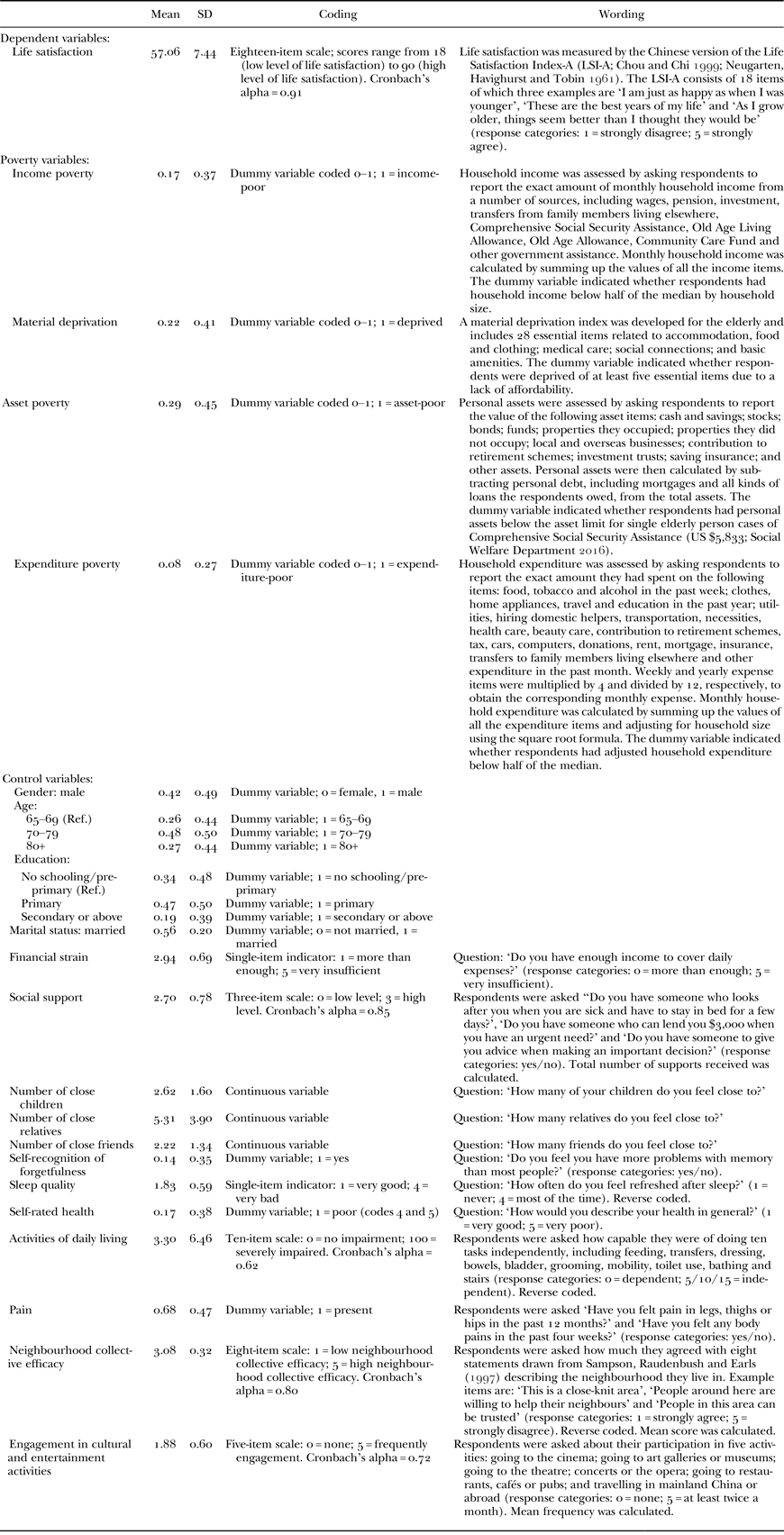
Table 1 presents the measurement and coding of variables, the wording of survey items, and descriptive statistics for the independent and dependent variables. We have developed and validated the material deprivation index for Hong Kong aged population based on the material deprivation questionnaire developed and validated in the Hong Kong general population (Saunders, Wong and Wong Reference Saunders, Wong and Wong2014). All 28 items included in the index have been examined to ensure that they are applicable to the local context (Chou and Lee Reference Chou and Lee2017).
Means, standard deviations (SD), coding of variables and wording of survey questions

Notes: N = 1,410. Ref.: reference category.
Analysis plan
We calculated the conditional change hierarchical regression model in which life satisfaction serves as the criterion (Aickin Reference Aickin2009) while there are six sets of correlates. At the first level, socio-demographic variables, including gender, age, education and marital status, were regressed on life satisfaction scores. The second set included one variable, namely financial strain, which was found to be a strong predictor of life satisfaction among older people in Hong Kong, and it is likely that the impact of different measures of poverty on life satisfaction is mediated by financial strain. The third, fourth and fifth sets of correlates were variables related to health status and social and community resources, and they were entered into the regression model following need-gratification theory in order to provide a more clear-cut test of measures of poverty. The inclusion of these five sets of variables was intended to demonstrate the unique contribution of poverty to life satisfaction in old age.
Once these five sets of variables have been accounted for, a sixth set of four correlates indicative of poverty status were entered into the model. These four variables were designed to capture different aspects of the financial situation of older persons, while poverty was measured based on household income, household expenditure, personal assets and material deprivation. The relative contribution of these four variables to life satisfaction was examined in this final regression model. Two-way interactions of the four measures of poverty were entered into the final model but none were found to be significant. The multicollinearity problems within and cross-level have been examined and the measure of multicollinearity, namely tolerances, are well above the acceptable level.
Results
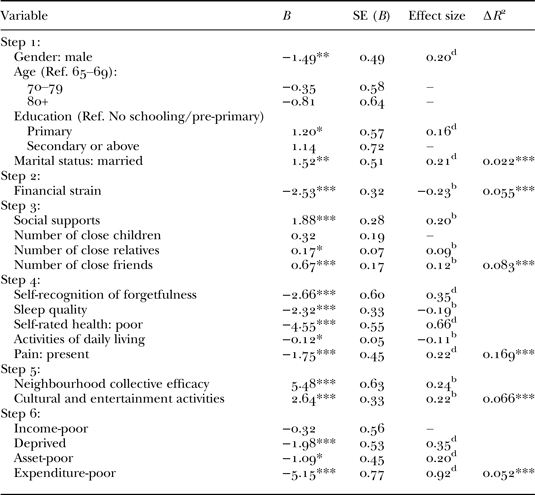
The overall six-level conditional change model accounted for nearly 43 per cent of the variance in life satisfaction scores (R 2 = 0.425). The first level of the model indicated a significant effect for four socio-demographic variables, namely age, gender, education and marital status: F(6, 1,403) = 4.24, p < 0.01, R 2 = 0.022 (see Table 2). Gender and educational level were found to be significantly related to life satisfaction.
Hierarchical multiple regression analysis predicting life satisfaction

Notes: B values are unstandardised regression coefficients and SE (B) values are standard errors for those coefficients. Effect sizes are shown for each statistically significant predictor – these are standardised beta weights for continuous variables (with superscript b) and Cohen's d values for categorical variables (with superscript d). Ref.: reference category.
Significance levels: * p < 0.05, ** p < 0.01, *** p < 0.001.
The second hierarchical level, which contained one variable, financial strain, was also statistically significant: F(7, 1,402) = 12.97, p < 0.01, R 2 = 0.077. As can be seen in Table 2, financial strain had a significant and detrimental effect on life satisfaction. The incremental R 2 at this level (5.5%) was statistically significant: F(1, 1,402) = 6.63, p < 0.01).
As a set, the variables entered in the third, fourth and fifth hierarchical levels also contributed significantly to the overall model (F(11, 1,398) = 21.46, p < 0.01; F(16, 1,393) = 41.82, p < 0.01; and F(18, 1,391) = 49.30, p < 0.01, respectively) and those three sets of variables accounted for additional 8.3, 16.9 and 6.6 per cent of variance in life satisfaction scores, respectively. The incremental R 2 at these three levels was statistically significant: F(4, 1,398) = 29.56, p < 0.01; F(5, 1,393) = 50.86, p < 0.01; F(2, 1,391) = 52.25, p < 0.01. Among variables related to social resources, social support, the number of close relatives and the number of close friends were positively associated with life satisfaction. All five health indicators we examined in this study, namely poor self-rated health, activities of daily living, pain, self-recognition of forgetfulness and poor sleep quality, were negatively linked to life satisfaction scores. Lastly, both community resources, namely neighbourhood collective efficacy and engagement in cultural and entertainment activities, had a beneficial impact on life satisfaction.
The final hierarchical level, which contained four measures of poverty, was found to be statistically significant as a set: F(22, 1,387) = 49.32, p < 0.01, ∆ R 2 = 0.052. Asset poverty, expenditure poverty and material deprivation were found to be statistically significant at either the 0.05 or 0.01 level. Expenditure poverty, asset poverty and deprivation were negatively associated with life satisfaction scores. We calculated Cohen d values (Cohen Reference Cohen1988), effect sizes for all variables which are statistically significantly associated with life satisfaction. Table 2 shows that both asset poverty (d = 0.20) and material deprivation (d = 0.35) had a moderate negative effect on life satisfaction scores, while consumption poverty had a substantial impact on life satisfaction (d = 0.92) even greater than the impact of self-rated health (d = 0.66) and financial strain (d = 0.23).
Discussion
Understanding the impact of living in poverty on the life satisfaction of older persons is important for the promotion of subjective wellbeing in old age as well as for monitoring the poverty situation and the development of anti-poverty initiatives for older adults. To our knowledge, we are the first to examine whether different measures of poverty have differential impact on how people rate their overall satisfaction with their lives in old age. Our findings in this regard are indisputable. Older persons who are asset-poor, deprived and expenditure-poor showed lower satisfaction with their lives but the association between income poverty and life satisfaction disappeared after controlling for financial strain, health indicators, and social and community resources. Therefore, it would appear that the first three of these measures of poverty are persistently linked with perceptions of satisfaction. To our knowledge, this is the first time that the relative contributions of these four measures of poverty to life satisfaction in old age have been compared.
The obvious explanation is that income does not always reflect the standard of living in old age directly. According to the personal resource model proposed by Hendricks and Hatch (Reference Hendricks, Hatch, Binstock and George2006, Reference Hendricks, Hatch, Bengston, Gans, Pulney and Silverstein2009), perception of one's life satisfaction is determined by monetary resources. With regard to older persons, expenditure poverty, asset poverty and material deprivation may be better indicators of the standard of living or financial resources enjoyed by older persons. Our findings further indicate that expenditure poverty has a stronger impact on how older persons evaluate their satisfaction with their lives than asset poverty and material deprivation. The magnitude of the impact on perception of life satisfaction is even greater for consumption poverty than for self-rated health or financial strain.
In addition to the significant impact of measures of poverty on life satisfaction, other factors like health indicators and social and community resources demonstrate a substantial impact. In terms of health indicators, poor self-rated health, functional impairment, pain, poor perceived memory and poor sleep quality had a profound harmful impact on life satisfaction. These findings are largely consistent with previous studies (Borg, Hallberg and Blomqvist Reference Borg, Hallberg and Blomqvist2006; Jivraj and Nazroo Reference Jivraj and Nazroo2014; Meléndez, Tomás and Navarro Reference Meléndez, Tomás and Navarro2008; Smith et al. Reference Smith, Borchelt, Maier and Jopp2002). The effect size in Table 2 reveals that self-rated health had the greatest impact on life satisfaction among these five health indicators, followed by self-recognition of forgetfulness.
Some major findings of this study are consistent with the tenets of need-gratification theory (Maslow Reference Maslow1970; Oishi et al. Reference Oishi, Diener, Suh and Lucas1999). It is clear that social and community resources play an important role in the determination of life satisfaction in old age. Among the four social resource-related variables we examined, social support, the number of close relatives and the number of close friends had moderate impacts on life satisfaction. These findings also are consistent with earlier work (Okabayashi et al. Reference Okabayashi, Liang, Krause, Akiyama and Sugisawa2004; Steverink and Lindenberg Reference Steverink and Lindenberg2006). The finding that both variables related to community resources, namely neighbourhood collective efficacy and participation in cultural and entertainment activities, had a positive effect on life satisfaction is also consistent with previous studies (Cramm, van Dijk and Nieboer Reference Cramm, van Dijk and Nieboer2013; Pinquart and Sörensen Reference Pinquart and Sörensen2001).
As noted in the introduction, need-gratification theory also argues that differences in life satisfaction between the poor and the non-poor may be explained by differences in financial strain, health status, and social and community resources. The data from this investigation show that this prediction is only true for income poverty and the inclusion of financial strain, health indicators, and social and community resources does not make the association of asset poverty, expenditure poverty and material deprivation with life satisfaction disappear. Therefore, future studies must be undertaken to explore other possible mechanisms underlying the impact of living in poverty on life satisfaction.
Limitations
Although the findings of this investigation are illuminating, caution must be used in interpreting them because there are several limitations here. First of all, our findings are based on cross-sectional data, which hampers our capacity to draw causal inferences, but our results nevertheless establish a significant association, which is an important step that calls for further longitudinal study to identify causal relationships. Moreover, poverty is dynamic rather than static, which is particularly true for older persons who are living with their adult children who may have lost their job temporarily. The duration and persistence of poverty must be examined in future studies investigating the association of poverty status with life satisfaction. Consistent with this suggestion, previous studies have shown that psychological wellbeing is neither stable nor linear in old age (Gwozdz and Sousa-Poza Reference Gwozdz and Sousa-Poza2010; Kunzmann, Little and Smith Reference Kunzmann, Little and Smith2000). Consequently, future studies that examine life satisfaction over a longer period of time would be useful to clarify the relationship between poverty status and life satisfaction. Future investigation might profitably examine why expenditure poverty has a stronger impact on life satisfaction than material deprivation because the latter directly evaluates the standard of living. Lastly, it is possible that a third individual difference factor not included in our regression model had an impact on both measures of poverty and life satisfaction.
Conclusion
In the coming decades, the number of older persons will increase quickly and a substantial portion of them will not be adequately prepared in terms of income security. In other words, some will experience financial hardship or a variety of financial strains. The findings of this study clearly indicate that expenditure poverty, asset poverty and material deprivation adversely affect older people's subjective wellbeing. This is a consequential outcome given the fact that subjective wellbeing certainly is associated with mental health. That being the case, from a policy perspective, at a minimum, the government should consider including these three measures of poverty in the official definition of the poverty line so that the situation can be monitored in a more comprehensive manner. Secondly, anti-poverty measures may have to go beyond the standard topic of financial support in cash and in kind (housing, transportation and food) to address other issues, including psychological wellbeing. Other policy initiatives could involve the development of services and programmes which might strengthen the social support and networks of older persons and increase the community resources in their neighbourhood. All these may benefit the subjective wellbeing of older persons living in poverty because they are associated with life satisfaction in our regression model. After all, the findings of this investigation clearly demonstrate that poverty measured by consumption and material deprivation has a strong impact on older persons’ experience of psychological wellbeing.