Despite an explosive proliferation of field research and its reporting for the far northern Campeche and western Yucatan coastal plain and western Puuc zone over the last two decades (see Braswell Reference Braswell2012), the central coastal plain of Campeche between the Rio Champoton on the south and the offshore Isla Jaina site and Chunchucmil remains sorely underreported in reasonably accessible sources.Footnote 1 This study is a modest effort to address this problem by making available a short but comprehensive local synopsis developed around one season's findings at the central coastal plain center, Acanmul, located some 25 km north of Campeche. Also incorporating germane data from several complementary survey seasons (Williams Beck Reference Williams Beck2001, Reference Williams Beck2003a; Williams Beck and López de la Rosa Reference Williams Beck and de la Rosa1999) and an INAH Centro Regional de Campeche (CRC) restoration program (Ojeda Mas Reference Ojeda Mas, Pacheco and Castillo2007, Reference Ojeda Mas, Castillo and Pacheco2010), the authors hope this article will provide a useful comparative resource for the ever increasing numbers of investigators working in the northernmost Maya lowlands.
In late 2001 the authors were invited by Lorraine Williams Beck of the Universidad Autónoma de Campeche (UAC), Mexico to participate in her ongoing research project, “Proyecto Historia Regional Diacrónica El Cuyo, Acanmul y San Francisco de Campeche,” through a program of excavations at the central western Campeche Gulf Coast site, Acanmul. This eventually resulted in a brief collaboration involving San Diego State University and UAC researchers between early 2003 and late 2005. Here we report on the objectives, results, and tentative interpretations of the major joint season of field investigations in 2004. Additional earlier investigations by Williams Beck will be reported on by her separately.
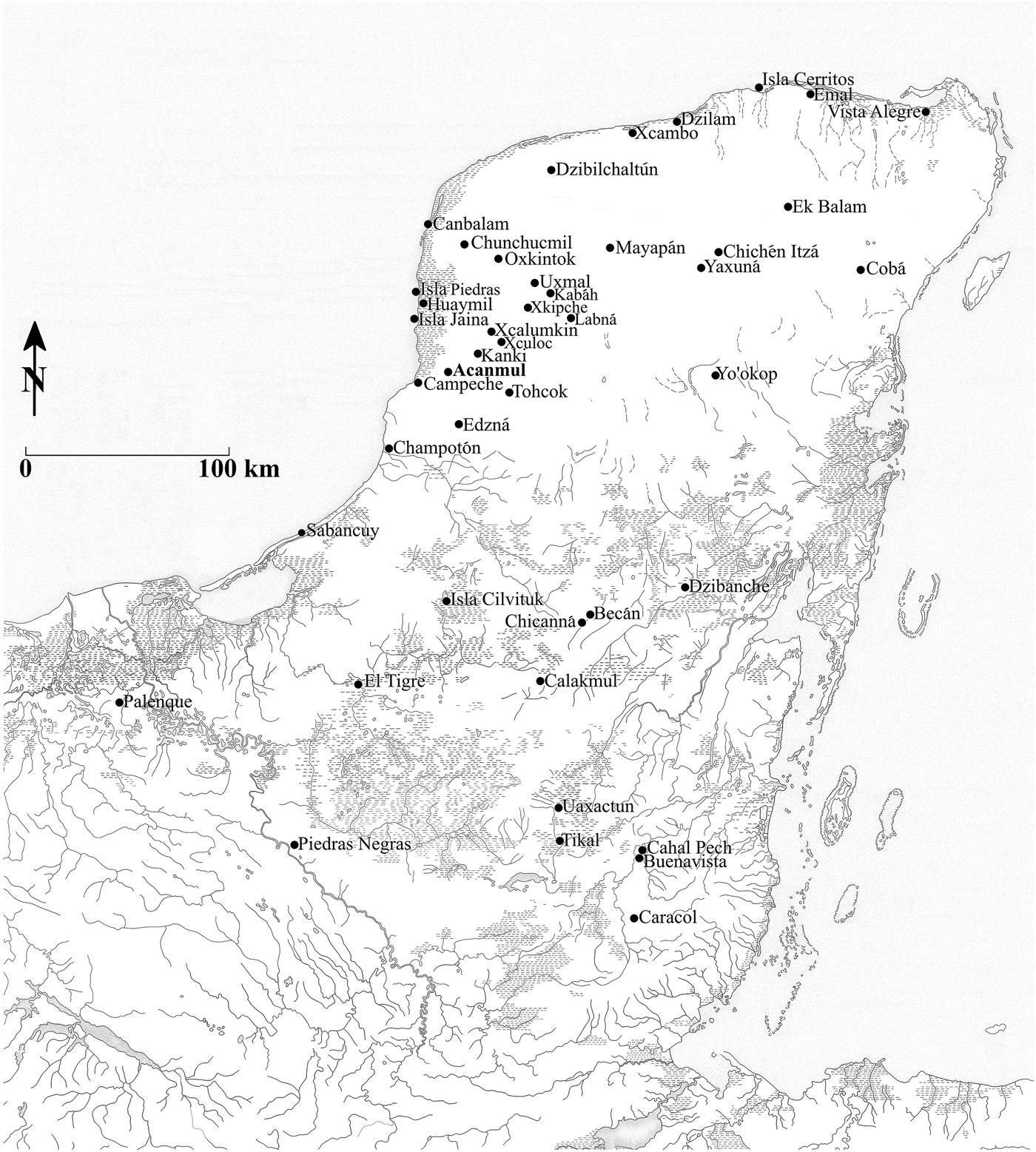
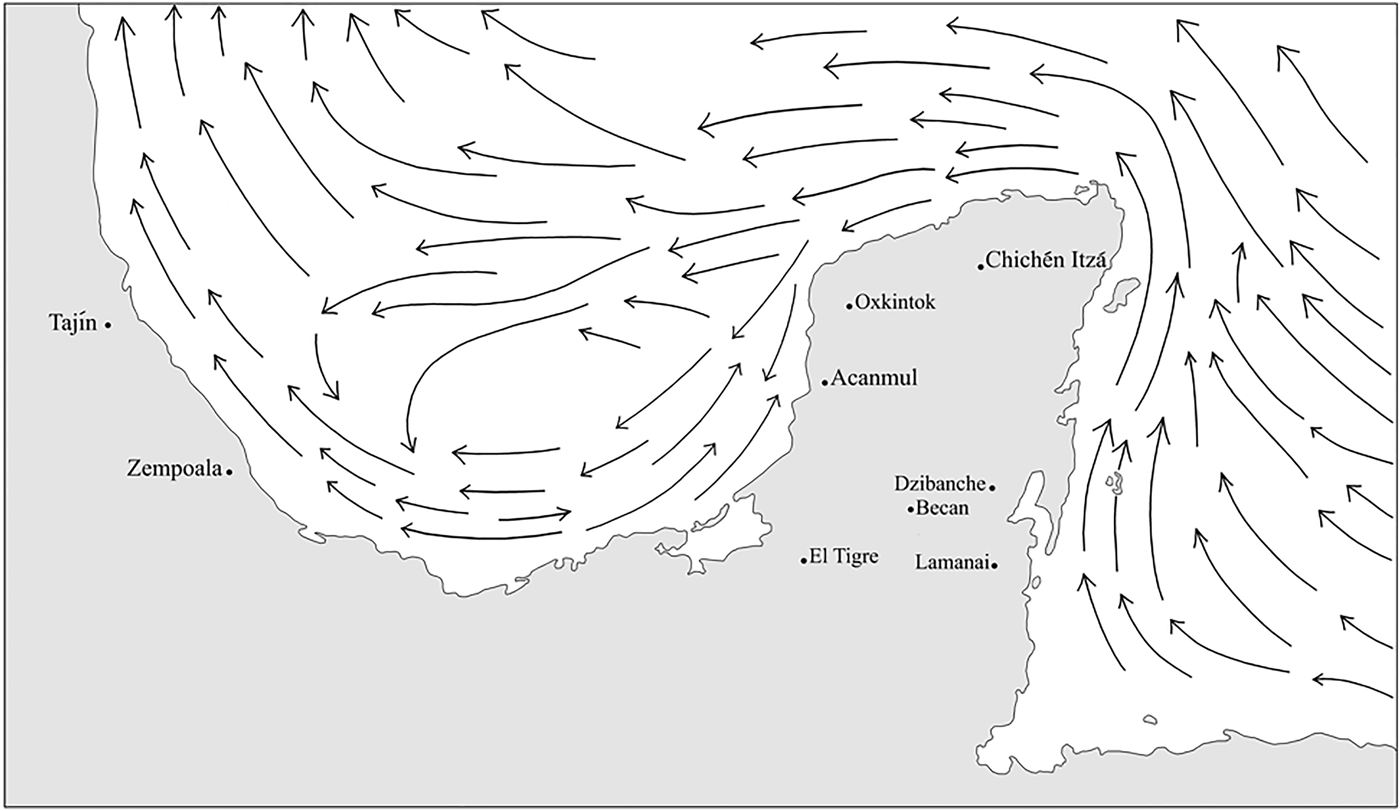
Acanmul is located at 19° 54′ North Latitude; 90° 19′ West Longitude within the lower Rio Verde Valley—historically known as the Rio Hontun (Roys Reference Roys1957: Map 2)—approximately 25 km northeast of Ciudad Campeche and roughly 15 km inland from the current, ever ephemeral Campeche coastline (Figure 1). Edzna lies 36 km to the southeast, and Kanki, another site of major center stature (Benavides Castillo and Novelo Orsorno Reference Benavides Castillo and Osorno2011; Zapata Peraza Reference Zapata Peraza1995), is 15 km to the northeast. Nine kilometers north-northwest are the ruins of Cansacbe, an extensive but severely stone-robbed site.
Areal map identifying sites referenced in text.

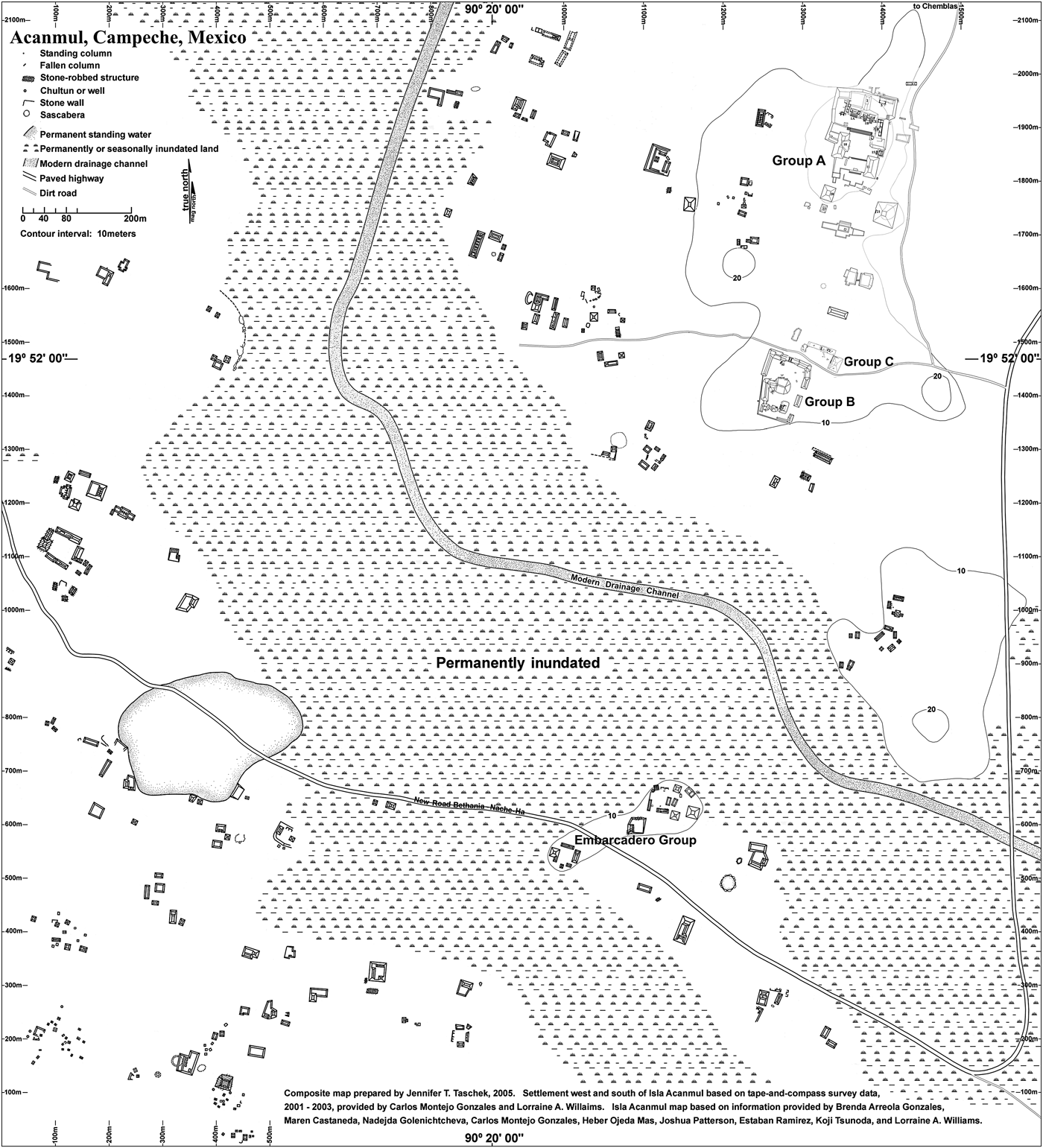
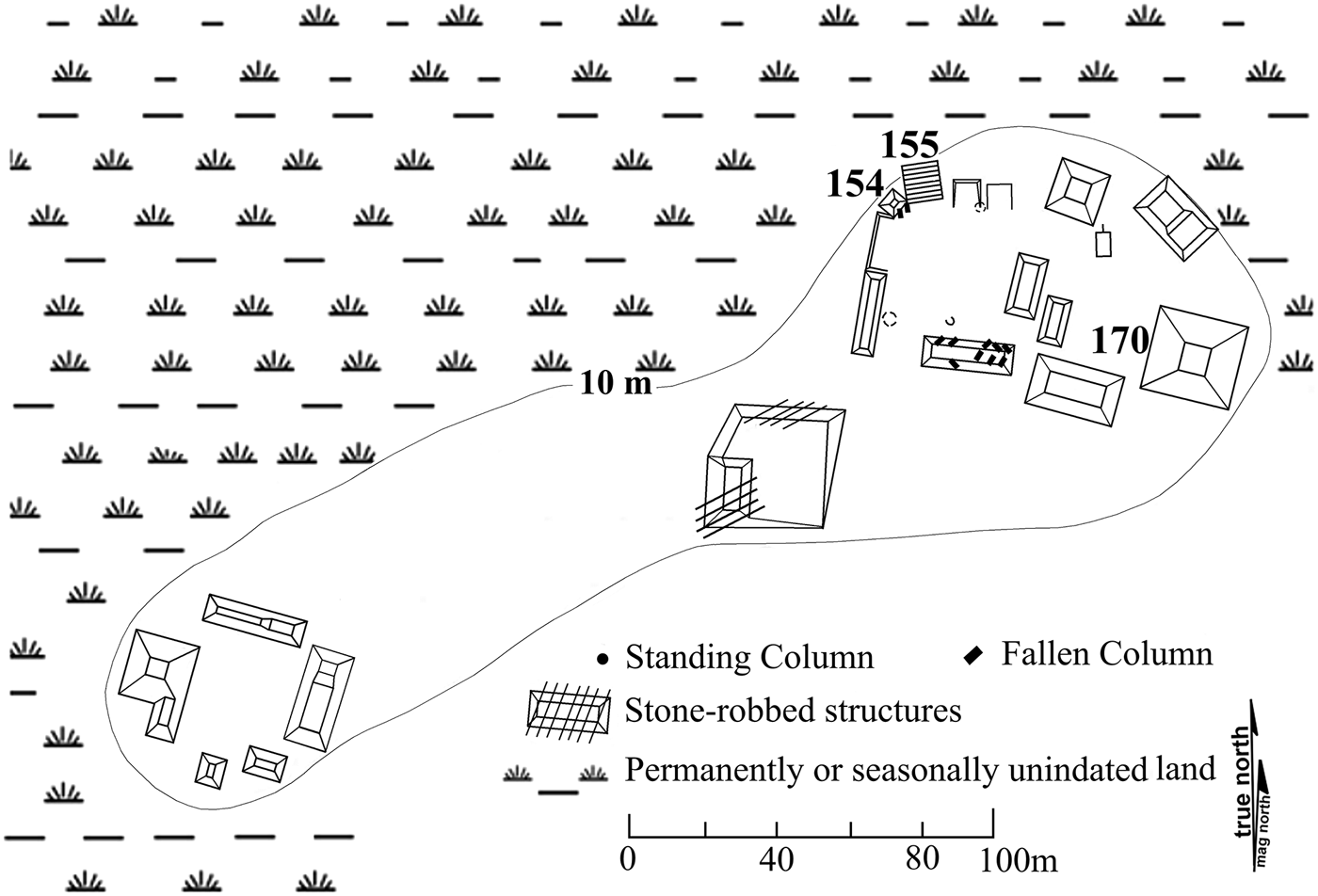
As an archaeological locality, greater Acanmul is both dispersed and diffuse, and so difficult to define easily or satisfactorily in spatio-parametric terms (Figure 2). Physiographically and topographically, however, it is quite clear as to what constituted the center-core, and what lay outside its pale (Figures 2 and 3). As so defined, the actual center occupies a low limestone hillock or knoll that rises at the northern end of the Rio Verde Valley and rolls gradually upward from south to north at overall elevations of about 10 to 16 m above the surrounding sea-level bottomland. In total, the archaeologically defined center sprawls over roughly 19 to 20 ha (about 48 to 50 acres) and averages about 12–13 m above sea level. Satellite residential complexes including numerous patio groups, plazuelas, and larger plaza groups dot the slightly elevated landscape ringing the center and edging the ancient Rio Hontun watercourse and also are present on isolated knolls to the south and throughout most well-drained areas of the relatively flat, broad valley bottom (Figure 2; Williams Beck Reference Williams Beck2001, Reference Williams Beck2003a). Heber Ojeda Mas (Reference Ojeda Mas, Castillo and Pacheco2010) estimates the overall Acanmul sustaining hinterland at around 4 km2.
Map of greater Acanmul locality identifying major architectural groups and other significant features.
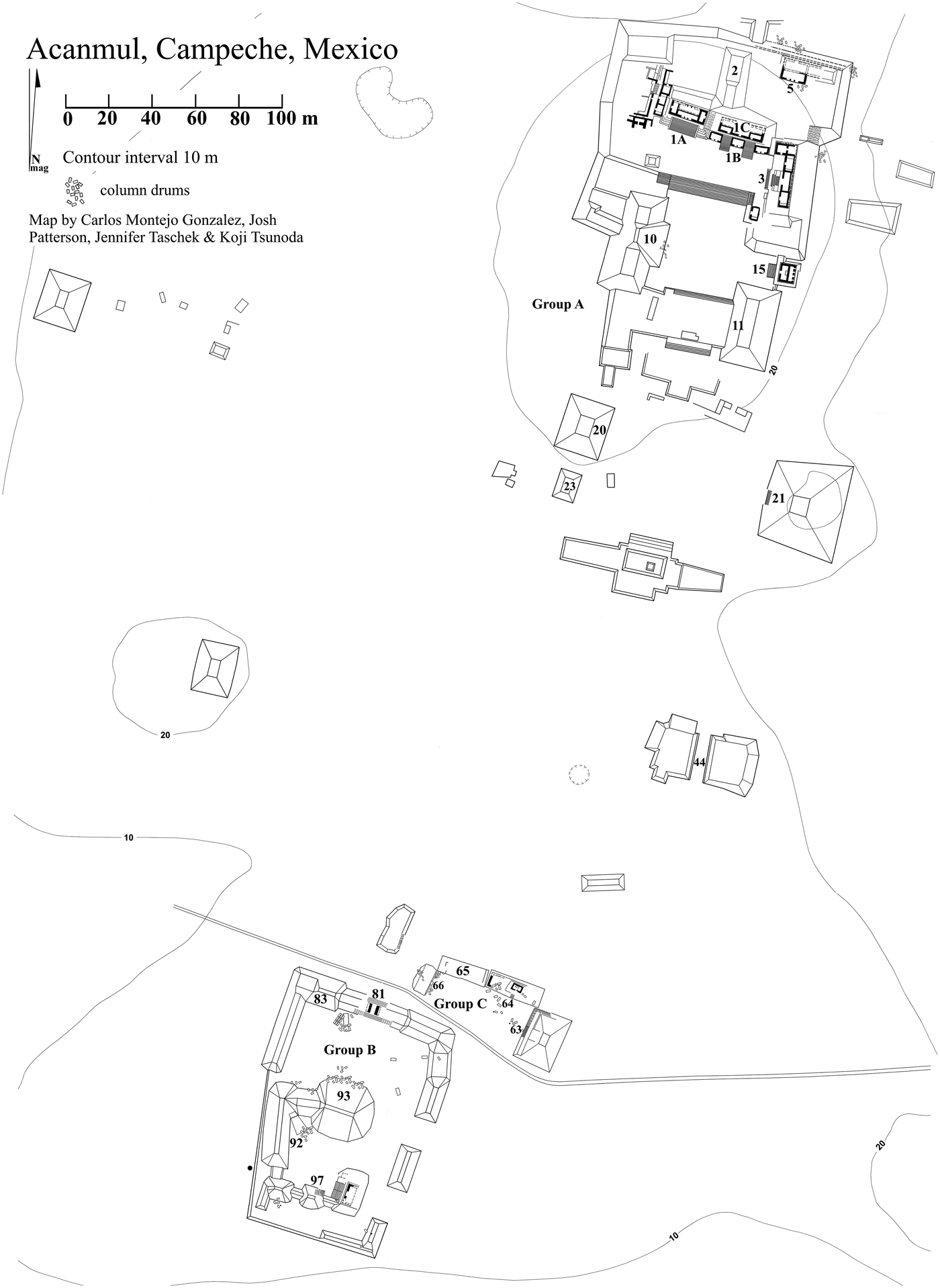
Plan-map of Acanmul center core identifying major structures discussed in text.
Originally a mosaic of swampland, ponds, seasonally inundated forest, and savanna drained by the Rio Verde, the lower valley is today managed by means of a highly efficient drainage channel. Prior to its construction, however, the river reportedly emerged as a sluggish, dry-season stream or substantial, rainy-season watercourse to the southeast of the hillock supporting the Acanmul core (Pollock Reference Pollock1980:537) and drained to the northwest into mangrove and seasonally flooded marshes edging the northern end of the Bay of Campeche. Fresh water is never far beneath the lower valley bottom and with normal rainfall its level rises in hand-dug wells to well above the present ground surface, suggesting that many of the collapsed features identified as chultunes and sascaberas are, in fact, collapsed wells. The site is today frequently waterlogged to boggy, and is subject to frequent flooding and inundation throughout the late spring through winter rainy season. Far from being a natural condition, this is largely due to an ill engineered late twentieth century elevated highway that cuts across the lower end of the Rio Verde Valley, walling it off and causing severe annual backup flooding up valley to the east of the causeway.
The junction of the lower and middle zones of the Rio Verde Valley occurs just above Acanmul, where the increasing elevation and narrowing of the valley bottom create a natural transition from the marsh and seasonally saturated conditions predominating in the lower valley to a middle zone characterized by a broad, level plain with many tributary valleys of reasonably fertile, well drained soils. Gradually rising to the east southeast, the Rio Verde Valley forms one of the most important southern openings through the western escarpment of the Bolonchen Hill System. It provides easy passage from the narrow, western coastal plain with access to coastal transport and communication routes to the Central Hill District (see Dunning Reference Dunning1992:16–18; Figure 2–1) and interior sites in the Chenes and Edzna zones.
Acanmul is a medium-size regional center of the type and magnitude classified as a “Rank 2” site by Nicholas P. Dunning (Reference Dunning1992:88–91, Table 5–3) in his study of the greater Puuc area, or a “Level 9 center” in Norman Hammond's (Reference Hammond and Graham1975) southeastern lowlands site typology.Footnote 2 In addition to relative size and architectural complexity and an absence of other larger or comparable centers in the general vicinity, a suite of attributes identified by both Dunning and Hammond contribute to this categorization. Among the defining attributes present are two functionally distinct architectural groups linked by a major plaza and linear mall (a linkage often formalized by sacbeob at other sites); an elevated acropolis with multiple surmounting monumental buildings (Group A); a recognizable palace-group with multiple interior courtyards (Group B); at least four pyramidal platforms greater than 10 m in height; and at least one ballcourt (Figure 3). There are also multiple sculpted stone monuments (columns, panels, freestanding statuary), painted architectonic glyphs (Staines Cicero Reference Staines Cicero2002), and a substantial circumambient settlement including a number of true plaza groups and plazuelas as well as patio groups and isolates (Figure 2; Williams Beck Reference Williams Beck2001, Reference Williams Beck2003a). Acanmul's architectural styles and construction traditions and its sculptural art all reflect a broad, tight, and long-lived affiliation with the Western Puuc and greater northern lowlands also manifest in all classes of excavated materials.
The site's contiguous architectural core of roughly 12 linear ha (about 30 acres) dominates the supporting knoll with discrete groups of pyramidal structures, platforms, vaulted buildings, and courtyards rising more than 20 m above the surrounding valley bottom on the north, south, and central-west edges of the naturally elevated knoll. In most respects, the site is typical of medium-size centers of the late Early through Terminal Classic era throughout the Maya lowlands, and as such presents few attributes special to itself. That said, Acanmul's brief systematic study has yielded data leading to a number of provocative lines of enquiry and future investigation. In truth, the center deserves far more attention and investigation than it has received, but a late middle ninth century ravagingFootnote 3—very possibly by a force with direct ties to Chichen Itza–have made this less than likely to occur. Sites that have been subjected to deliberate, systematic demolition are poorly suited either for facile, routine field investigations, or to meet the standards required by the Instituto Nacional de Antropología e Historia (INAH) for extensive conservation and restoration, and Acanmul was attacked, taken, and demolished very deliberately and systematically sometime in the mid-ninth century, leaving it questionable as to whether it will ever be restored to practical visitability.
Serious research at Acanmul began only with its middle 1990s “rediscovery” in the course of a regional Universidad Autónoma de Campeche study directed by Lorraine Williams Beck. Williams Beck rerecorded and partially mapped the site and its outlying hinterland, and her work resulted in a series of short reports and map-sets delineating the Acanmul site and its immediate environs (Williams Beck Reference Williams Beck2001, Reference Williams Beck2003a, Reference Williams Beck2003b). Minor “ground-truthing” by SDSU field teams in 2004 added additional detail to these.
The site was first formally reported in a 1927 informe by Nazario Quintana Bello (Reference Quintana Bello1927), Inspector de Monumentos Arqueológicos de la Secretaría de Educación Pública. Its next–and until the late 1990s–most detailed formal study was by Harry E.D. Pollock (Reference Pollock1980), and appears with a preliminary sketch-map and some photos as part of his extensive Carnegie Institution of Washington field-survey of western Yucatan peninsula sites during the 1930s and 1940.
In 1994, Williams Beck and Edmundo de la Rosa “rediscovered” the site and officially re-reported it to INAH. Williams Beck (Reference Williams Beck2003b; Williams Beck and López de la Rosa Reference Vidal Angles, Turriza and Flores1999) on this occasion also suggested that the Acanmul site might actually have been the ancient Maya capital-center, Ah Kin Pech, or Campeche, an hypothesis today still in active and sometimes contentious debate (Benavides Castillo Reference Benavides Castillo2004).
In late 1999, the Centro Regional de Campeche began a series of short, sporadic seasons of consolidation and reconstruction within Group A under the direction of Heber Ojeda Mas (Benavides Castillo Reference Benavides Castillo, Vargas and Benavides2004; Ojeda Mas Reference Ojeda Mas, Angles, Turriza and Flores2003, Reference Ojeda Mas2006, Reference Ojeda Mas, Pacheco and Castillo2007, Reference Ojeda Mas, Castillo and Pacheco2010; Ojeda Mas and Sánchez López Reference Ojeda Mas and López2001). These continued erratically based on funding availability through 2004. Ojeda Mas also carried out selective test-pitting of the northern (Group A) site-core between 1999 and 2004.
The present paper is based on the limited investigations carried out by San Diego State University archaeologists affiliated with the Universidad Autónoma de Campeche during the summers of 2003 and 2004. Contingent follow-up lab studies were conducted during the summers of 2005 and 2007. All recovered materials remain as required with appropriate institutional facilities in Ciudad Campeche. A small, “thumbnail” type collection of the ceramics recovered has also been prepared for the major regional INAH Ceramoteca at Mérida, Yucatán.
ACANMUL SITE-CORE INVESTIGATIONS, 2004
Our 2004 field work at Acanmul extended over some eight weeks from June into August and was unevenly distributed among four major loci—the Group A acropolis complex; the Central Plaza and ballcourt; Group C (Columns Group); and the Group B palace complex. In addition, important surface data were collected at the Uerek Embarcadero Plaza Group both that year and in July, 2005. Conditions of the INAH permit granted to Williams Beck through the UAC authorized specific, limited subfloor testing and both above-floor structural trenching and stripping. It did not allow any deep architectural penetration, however, and so we improvised an approach to dating at least the outermost or final construction phases of platforms and other structures by means of a meticulous field and lab segregation and isolation of core-collapse content from other materials accumulated both beneath and atop this. While not completely satisfactory, this approach at least enabled a tentative dating for a number of structural units in Groups B, C, and A and on the central plaza. Obviously, when possible, direct subfloor samplings and tests of proximate floorings determined to turn up onto or run beneath specific platform faces and stairs are the preferable and more reliable dating method.
Our investigations were intended to build on and complement both the earlier settlement surveys and long-term research goals of Williams Beck (Reference Williams Beck2001, Reference Williams Beck2003a), and the ongoing site development program of the Centro Regional de Campeche (Ojeda Mas Reference Ojeda Mas, Angles, Turriza and Flores2003). The objectives defined were intended to address a number of basic questions about the Acanmul site and help place it within a solid regional and areal archaeological context. Specific goals set for the 2004 season included documenting as complete as possible a basic occupational history for the site based on limited, purposive test-sampling intended to build on and amplify Ojeda Mas's work. We also hoped to establish something of the larger regional cultural (ceramic, artifactual,architectural, artistic) affiliations of the center and its inhabitant population, and to determine what evidence of local, regional, or interregional interactions might be present at the site. Finally, we hoped to acquire sufficient data to establish something concrete concerning the actual functional role and historical place of the Acanmul center in the broader cultural, historical, economic, and sociopolitical landscapes of the central Campeche Gulf coast.
Surface and excavation sampling efforts were designed explicitly to probe for and sample archaeological contexts and deposits suitable to addressing these questions regarding the center's occupational history and regional cultural associations. As part of our own broader research interests, we also executed two series of off-platform sampling trenches at the Group A acropolis and Group B palace complex intended to recover data relating to the final occupational use histories of these two groups that would be contextually comparable to materials recovered from archaeologically equivalent deposits excavated by us at Buenavista del Cayo and Cahal Pech in western Belize. These efforts were richly successful in accomplishing this goal.
The Central Plaza and Ballcourt
Acanmul's major Classic era administrative and restricted elite ceremonial complex, Group A, and its sprawling regal-residential palace compound, Group B, are separated and linked by a mall-like series of courtyards, platforms, range-groups, and plazas of which the most significant appear to be an expansive, pyramidal platform-defined central plaza and associated ballcourt situated approximately midway between the two groups (Figure 3). The plaza itself measures some 65 × 70 m, and is defined by large, free-standing pyramidal platforms on its east (Structure 21)Footnote 4 and west (Structures 20 and 23) sides. All show evidence of significant demolition or stone robbing, but 21 stands still to nearly 12 m in height. The center's apparent public ceremonial and ideological heart, this plaza is much more open to the surrounding countryside than are any of the enclosed or elevated courtyards of Groups A and B.
Low, flat-topped platforms with wide, shallow stairs on both sides define the plaza on its north and south (Figure 3). That on the south supports the remains of a collapsed portal-entry or range; that on the north carries the rubble footings of what might have been a similar linear range-building or audiencia-type structure. The site's one known ballcourt lies approximately 63 m to the south.
The Acanmul ballcourt is small, but comparable in size and plan to contemporaries at Edzna and Oxkintok to which its overall appearance is most similar. The playing alley is 21.4 m long (Edzna = 23 m; Oxkintok = 16.4 m) by 5.1 m wide (Edzna = 5 m; Oxkintok = 5.5 m), and its sloping banquettes stand 0.75 m high and are 2.1 m deep. At the time of its discovery in 2004, it appeared that it either had been subjected to severe recent (modern or historic) stone-robbing or had never been completed. In an effort to determine which of these possibilities might be correct, we undertook a minimal series of footing trenches and clearing quadrats along the outer bases of the court ranges and in the central playing alley. What we learned was that the monument had been deliberately and systematically dismantled or demolished at the end of its functional use-history.
Our authorized 2004 excavations allowed one basal architectural test to determine construction history within the central plaza proper; the collection of core-collapse samples to verify the results; clearing and transverse trench-sampling of the ballcourt alley; and sondage testing of the ballcourt alley. Further investigations were anticipated in subsequent seasons.
Group A
Group A occupies the north end of the Acanmul knoll. It is divided into a lower, ground-level courtyard on its south, and an elevated acropolis complex, the Great Platform, on the north (Figures 2, 3). The original formal entry to the courtyard and larger group was at its south end and is now defined by a low linear platform staired on both sides and showing vestiges of a demolished range-building or portal entrance. Massive, very poorly preserved multistory apartment structures evincing several complex construction phases flank this platform and close the courtyard on its east and west sides. A steep monumental stairway of 13 steps extends across the entire south face of the acropolis platform.
The platform top is dominated by a monumental construction mass consisting of a T-shape, multistory apartment building (Structures 1 and 2) with multiple vaulted chambers on at least four levels and extant access stairways on its front and west sides (see Figure 3). The principal façade of the structure faces south and even today dominates the entire knoll. The structure divides the platform top into two private rear courtyards at the northeast and northwest, and more accessible and open terrace spaces on its front and west sides. There are a number of subsidiary structures scattered about the platform including a Classic (Colonnette) Puuc style shrine (Structure 3–1st) at the southeast and a C-shape building on the west. Both the massive supporting platform and the array of structures and standing buildings atop it exhibit evidence of complex, lengthy construction histories, and this is borne out by abundant, well-preserved sherds in surface and collapse contexts ranging in age from Late Preclassic to Terminal Classic/Early Postclassic with all periods well-represented.
The north acropolis was the focus of the 1999–2004 CRC architectural restoration program directed by Heber Ojeda Mas (Benavides Castillo Reference Benavides Castillo2004; Ojeda Mas Reference Ojeda Mas, Angles, Turriza and Flores2003, Reference Ojeda Mas2006, Reference Ojeda Mas, Pacheco and Castillo2007, Reference Ojeda Mas, Castillo and Pacheco2010; Ojeda Mas and Sánchez López Reference Ojeda Mas and López2001), and the UAC-SDSU effort within this complex is best seen as ancillary to the INAH project and is so discussed in their light. Our own investigations included a series of seven off-platform refuse sampling trenches; two on-platform, de facto refuse sampling trenches; one on-platform clearing excavation; and one exploratory trench in the lower court. One platform-top architectural sounding was initiated, but immediately halted and backfilled when we learned that its excavation violated the terms of the UAC permit. Herein we will summarize Ojeda Mas's published findings as pertinent with additional observations from our own investigations.Footnote 5
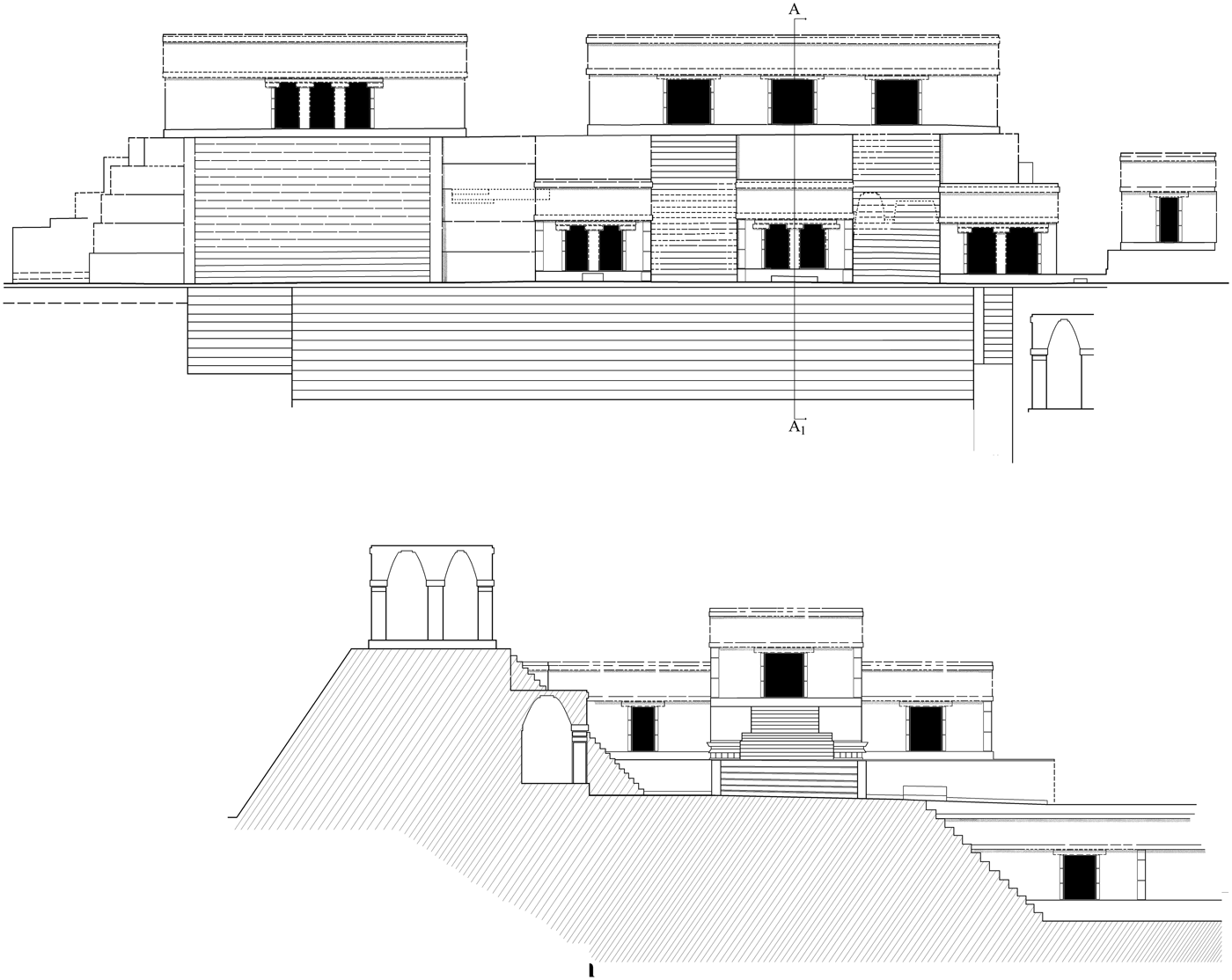
Structure 1 evinces an extremely complex architectural history, the visible edifice alone combining mid/late seventh through early tenth-century elements. The existing configuration is a fusion of at least three separate major building periods into a single composition (Figure 4). The earliest, western component, Structure 1–A, originally consisted of a stand-alone terraced platform with a wide balustraded stair and a four-room, vaulted, Early Puuc style summit building fronted by a double-columned doorway. At ground level, Structure 1–A is abutted on its east by an appended, eighth century Puuc Colonnette Style range building, 1–B, consisting of three tandem rooms with single-column doorways. The chambers are separated and irregularly overbuilt by two narrow, asymmetric, balustraded stairs rising to the superposed supporting platform of a later six-room vaulted summit building, Structure 1–C. Structures 1–A and 1–C are bonded by means of a wide, wedge-shaped rubble and mortar seam originally concealed beneath a thick stucco skin. A third pair of tandem vaulted rooms also was added along the southwest base of the 1–A platform abutting against an earlier chamber at the northwest associated with the north side T-complex of Structure 2.
Structure 1, Group A. South and east elevations, late Terminal Classic construction phase, ca. a.d. 810.
Later ninth- and tenth-century additions along the west base of Structure 1–A involved a complex of one-story buildings including a classic C-plan structure of the type associated with “post-Monumental” late Terminal Classic contexts at Uxmal, Ek Balam, Xkipche, and elsewhere (Huchim Herrera and García Ayala Reference Huchim Herrera, Ayala, Houston, Escobedo and Child2000), and several indeterminate constructions of broad “Postclassic” date. Readers are referred to Ojeda Mas's (Reference Ojeda Mas, Angles, Turriza and Flores2003, Reference Ojeda Mas2006, Reference Ojeda Mas, Pacheco and Castillo2007, Reference Ojeda Mas, Castillo and Pacheco2010) reports for details. A refuse sampling trench excavated off the platform immediately below the C-shape unit yielded a rich deposit of late Terminal Classic Machil phase trash including numerous fragments of Silho (X) Fine Orange vessels, plumbate, and central Mexican green obsidian blades.
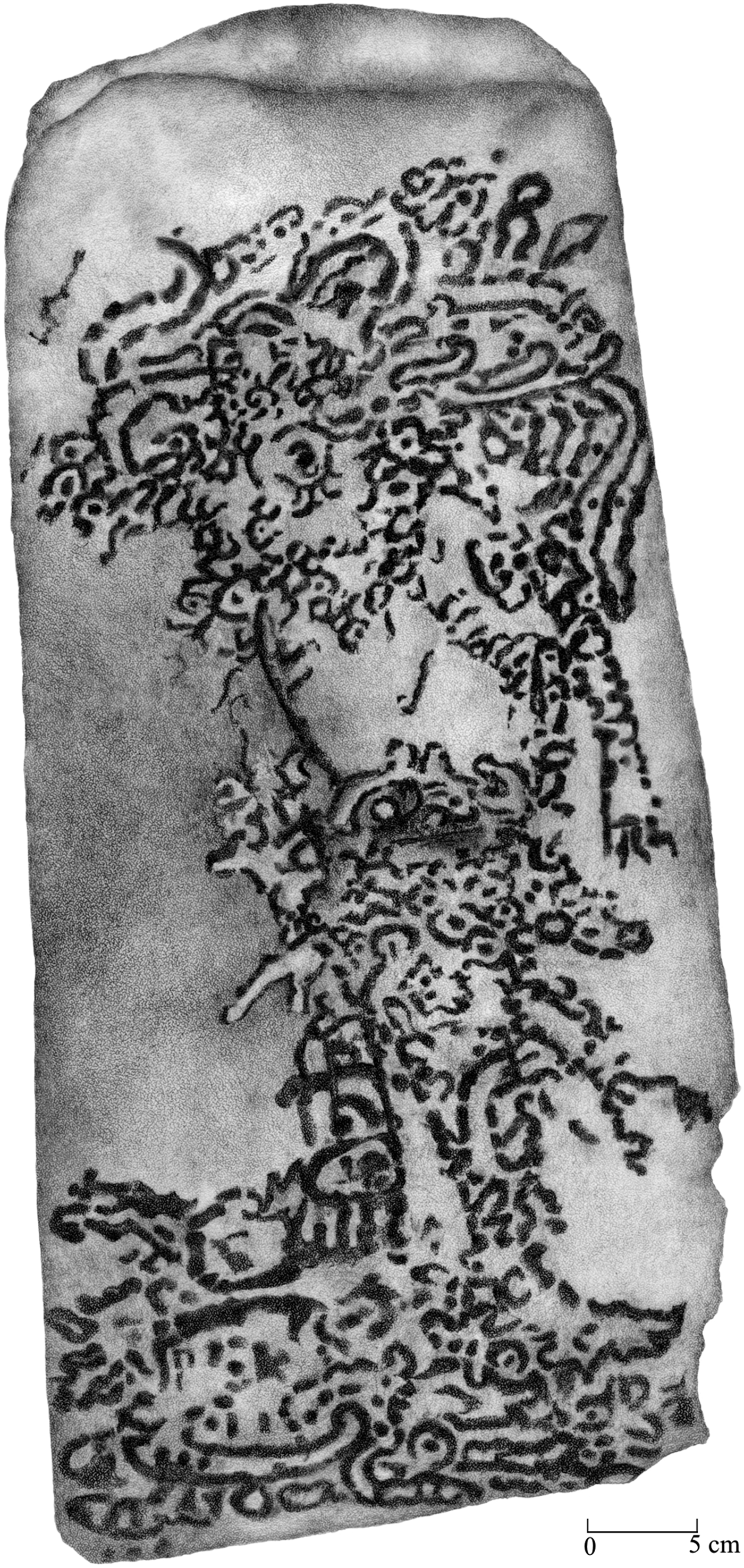
Based on the contents of the frontal collapse and massive restoration backdirt piles examined in 2003 and 2004, at least one of the summit buildings—most likely the earlier west wing—was finished with a roof comb, and the upper wall zones of all three carried heavy stucco decoration and statuary anchored to the masonry façades by limestone armatures, a probability also noted by Ojeda Mas (Reference Ojeda Mas, Angles, Turriza and Flores2003, Reference Ojeda Mas2006). One other feature of the complex deserving special note is the presence in at least three of the vaulted chambers of the 1–B and 1–C construction phases of red painted stuccoed capstones bearing large, well-executed images of K΄awil, a deity intimately associated with royal power and lineage during the Classic period (Figure 5; Ojeda Mas Reference Ojeda Mas, Pacheco and Castillo2007; Staines Cicero Reference Staines Cicero2002).
Painted K΄awil capstone; vault collapse, Structure 1-B.
Deep excavations by Ojeda Mas beneath the collapse-filled chambers of Structure 1–B, and of the outer platform south and southeast of the Structure 1 block revealed the existence of at least four earlier vaulted buildings and platforms. Observable features were sufficient to suggest probable late sixth/early seventh to full seventh century (Chel ceramic phase) datings for these structures, and place them architecturally in the Proto-Puuc style (Ojeda Mas Reference Ojeda Mas, Angles, Turriza and Flores2003, Reference Ojeda Mas2006, Reference Ojeda Mas, Castillo and Pacheco2010). A fifth, contemporary platform (Structure 3–2nd) of three superposed talud-tablero terraces was partially exposed in the course of stabilizing Structure 3–1st, a beautifully detailed Classic Puuc Style shrine to the immediate southeast of Structure 1 (Ojeda Reference Ojeda Mas, Pacheco and Castillo2007:Fotos 5, 6; Reference Ojeda Mas, Castillo and Pacheco2010:224–226, Foto 4).
Our own investigations indicated that the substantial body of the Great Platform was completed to the north and east by the early Chel ceramic phase, but that major enlargements and modifications took place to the west and south (front) sides of the platform during the late eighth/ninth century Pa΄xil phase. Much of the platform to the south of Structure 1 including the great frontal monumental stairway was in fact added during Pa΄xil. Continuous enlargements, resurfacings, and additions also reconfigured the Structure 2 north side of the platform throughout Chel and Pa΄xil. In its final form, the platform's north side provided a screened, secluded compound backing onto and directly interconnecting with the center's principal formal public ceremonial performance complex of the Late and Terminal Classic periods.
Group B
Group B lies some 330 m away at the south end of the Acanmul knoll (Figures 2, 3). It consists of three interconnecting north-to-south courtyards raised atop a low, two-tier platform and delimited by a discontinuous series of low platforms along its perimeter, some topped by modest pyramidal platforms or the rubble of collapsed range buildings. The three courtyards are defined by two somewhat higher east-west platform rows topped by pyramidal collapse-mounds suggesting either multistory apartment ranges or temple-like buildings. There is likely a combination of both, as exposed cross sections of vaulted rooms—in some cases deliberately filled with rubble—are visible at two and three different levels in some places, but fallen temple-like structures are detectable in others, such as topping the central platform backing and facing onto the first, northernmost entry court. The open mouth of a large chultun—not investigated by us—is present in the lower supporting platform surface at the southwest side of the complex. This is also the location of a relatively informal “back door” access for the group.
Group B's contiguous, linear courtyard arrangement is one of several recognized palace plans that are found from major Southern centers like Tikal and Palenque to medium-scale ones like Becan and Buenavista del Cayo. The formal approach to the complex was originally along its north side and consisted of what now appears to be a low open platform with broad, shallow stairs on both sides. Stripping excavation of this revealed it to have been the base for a substantial freestanding architectural portal-archway comparable to well-known examples at Oxkintok, Ek Balam, Kabah, and Labna. The razed structure had been ornately and richly decorated with polychromed high relief stucco statuary and background decoration including at least some glyphic elements combined with the geometric stone mosaic friezes indicative of Pollock's (Reference Pollock1980:586) full Classic Puuc Style (see also Andrews Reference Andrews1986, Reference Andrews1995), a configuration highly reminiscent of the Labna example. The building had been ferociously demolished, and several broken bifacial limestone sledge bitts were recovered in the debris.
Group C
Group C lies immediately off the northeast corner of Group B (Figures 3, 8). It is a small but important group with complex occupational, construction, and use histories. The group is dominated by Structure 63, a large terraced platform defining its east side. Structure 63 lies at the south end of a north-south centerline alignment passing through the formal entry to Group A and the earlier west wing of its acropolis summit complex.
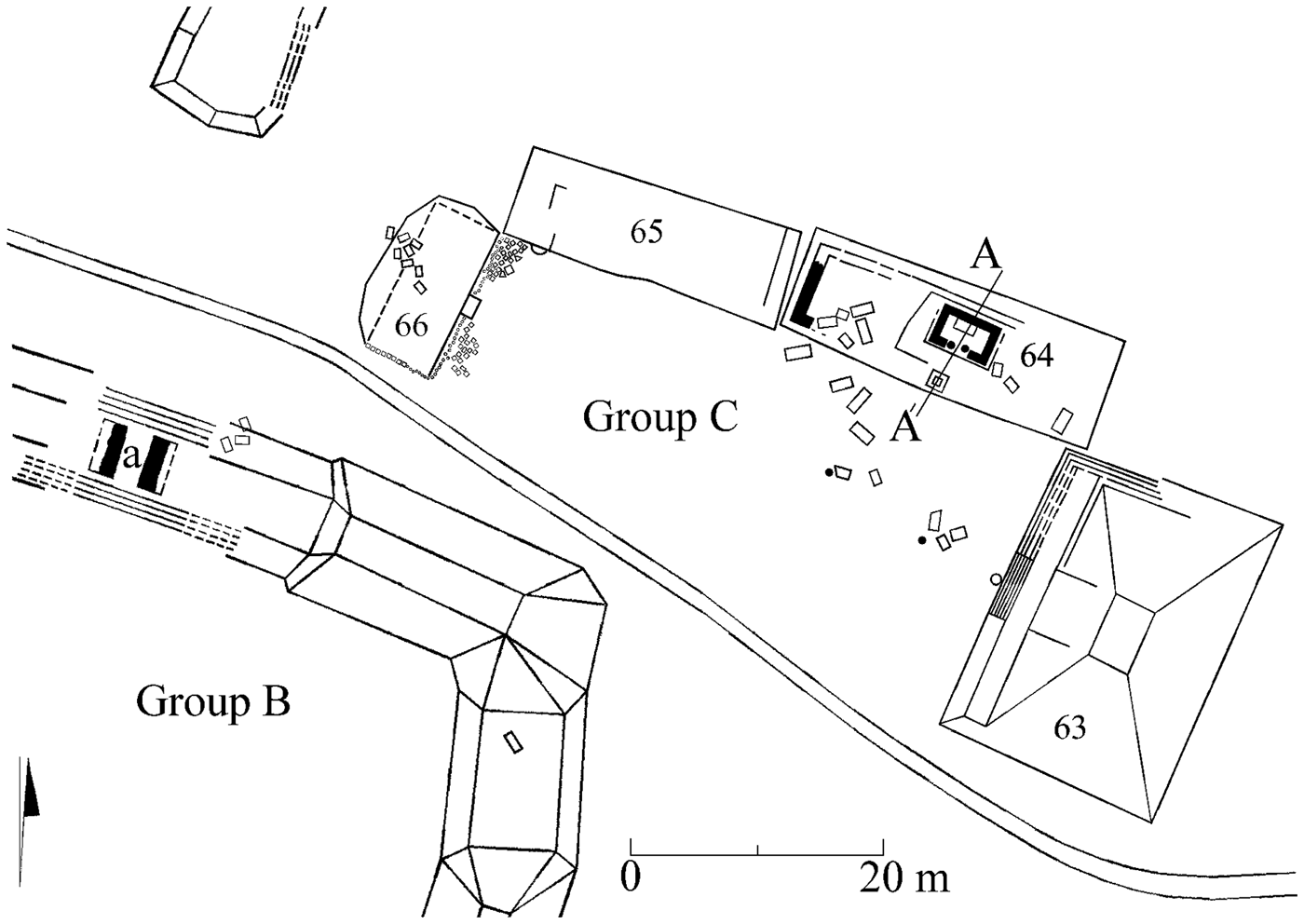
Closing the north side of Group C are Structures 64 and 65, two low linear platforms carrying the collapse of simple masonry halls or ranges that at least in the case of Structure 64 incorporated multiple large, cylindrical columns. A third low platform, Structure 66, delimits the group on the west. Multiple stone drums from several fallen columns litter its upper surface and slopes.
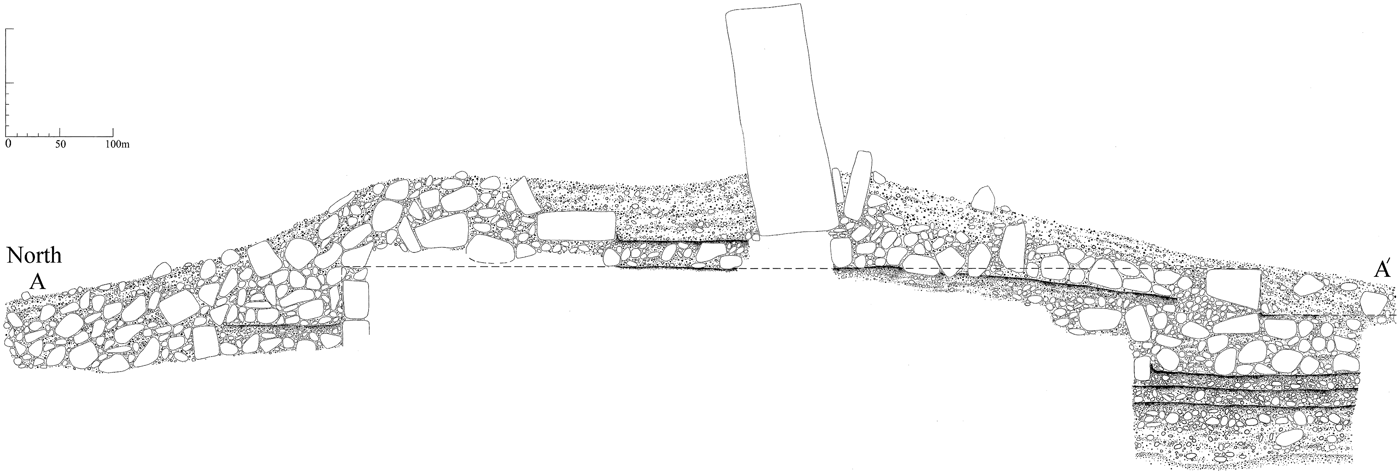
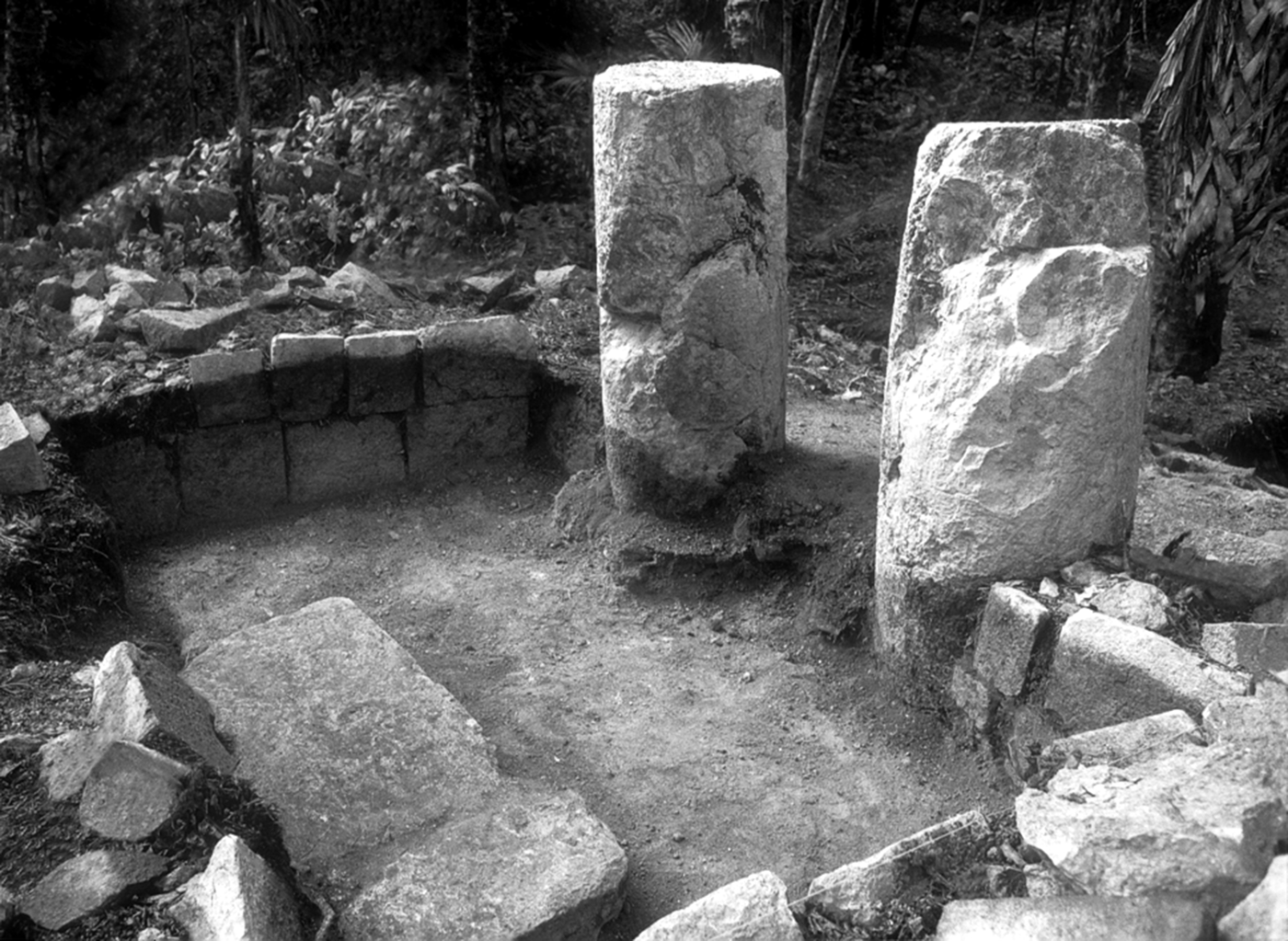
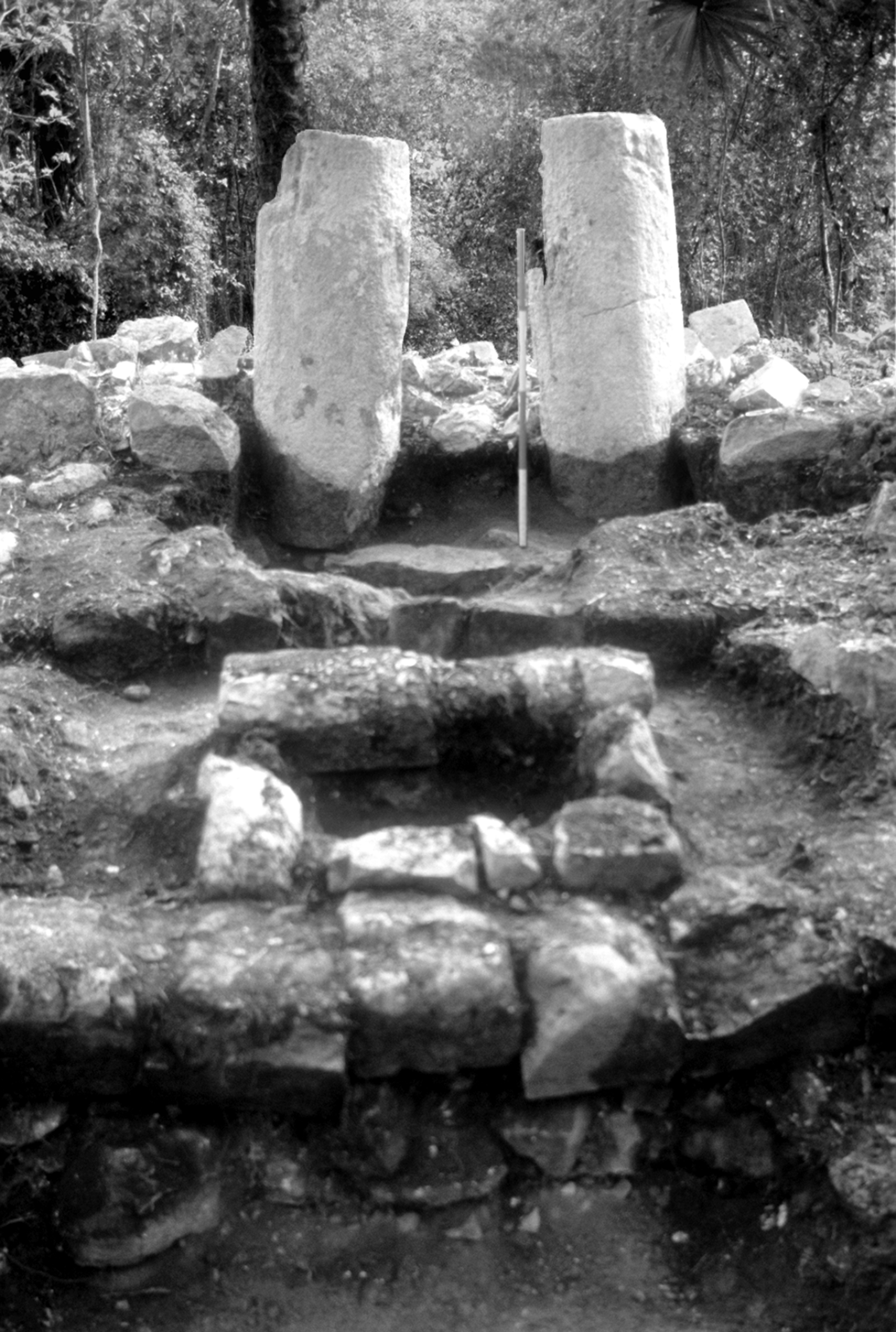
Rolled helter-skelter into the patio defined by these structures are a jumble of downed barrel-columns and fragments, many showing finely sculpted figures but severely eroded. Two standing columns framed an entryway for Structure 64, but on investigation, they were found to have been reset sometime in the Late Postclassic. Fragments of a shattered Chen Mul Modeled-style effigy censer littered the mound slope in front of these. Our investigations in this group were extensive, and included multiple footing trenches and off-mound platform tests and significant stripping of Structure 64.
Given the generally noncomparable characters of the excavations and recovered data resulting from the exploratory nature of the 2004 investigations, and the complexities of the findings, we have opted to present them within the context of a general ceramics-based chronological phase framework rather than as individual spatial or structural units or field operations. When logically appropriate, an entire structure or group history is presented within the ceramic phase of its first or most significant occurrence. We believe this will make the recovered data available in a more useful and intelligible manner than would an excavation unit or structure-based report such as we have previously submitted to INAH (Williams Beck et al. Reference Williams Beck, Taschek and Ball2005).
GENERAL OCCUPATIONAL HISTORY AND CERAMIC SEQUENCE
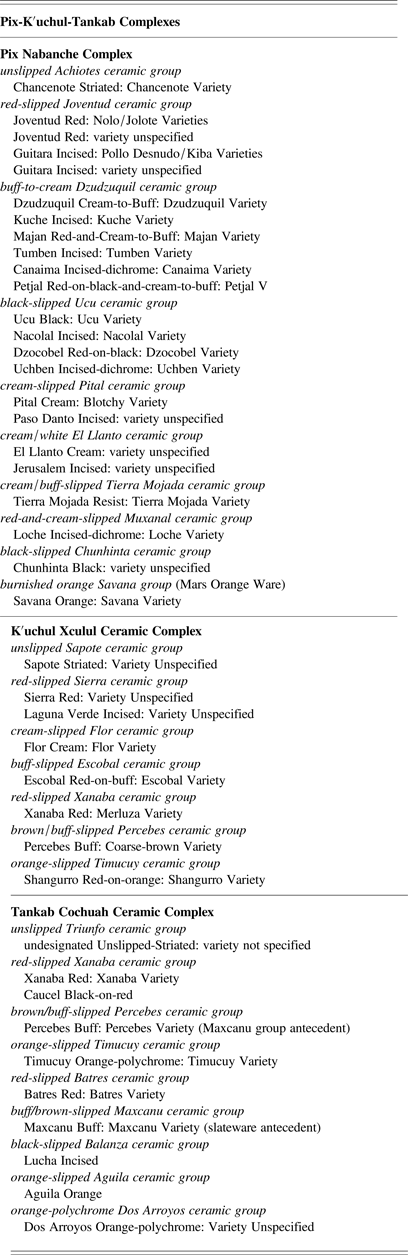
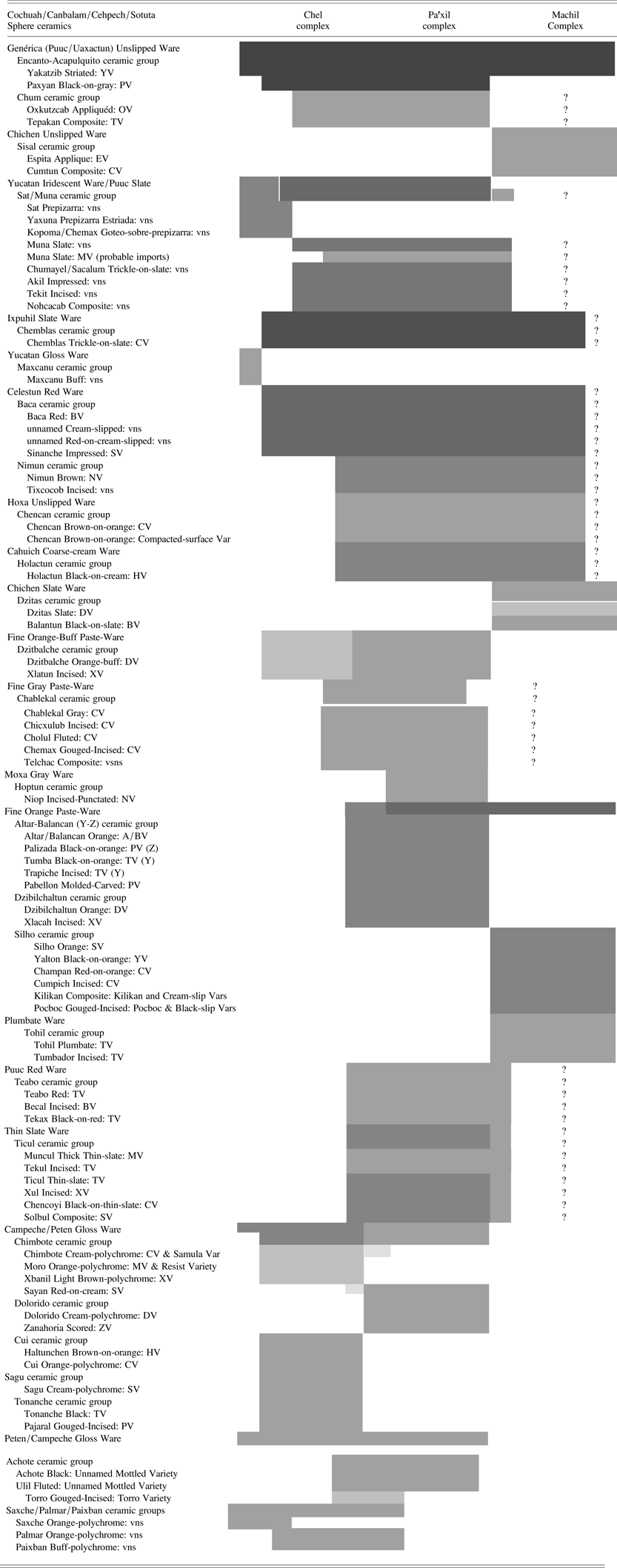
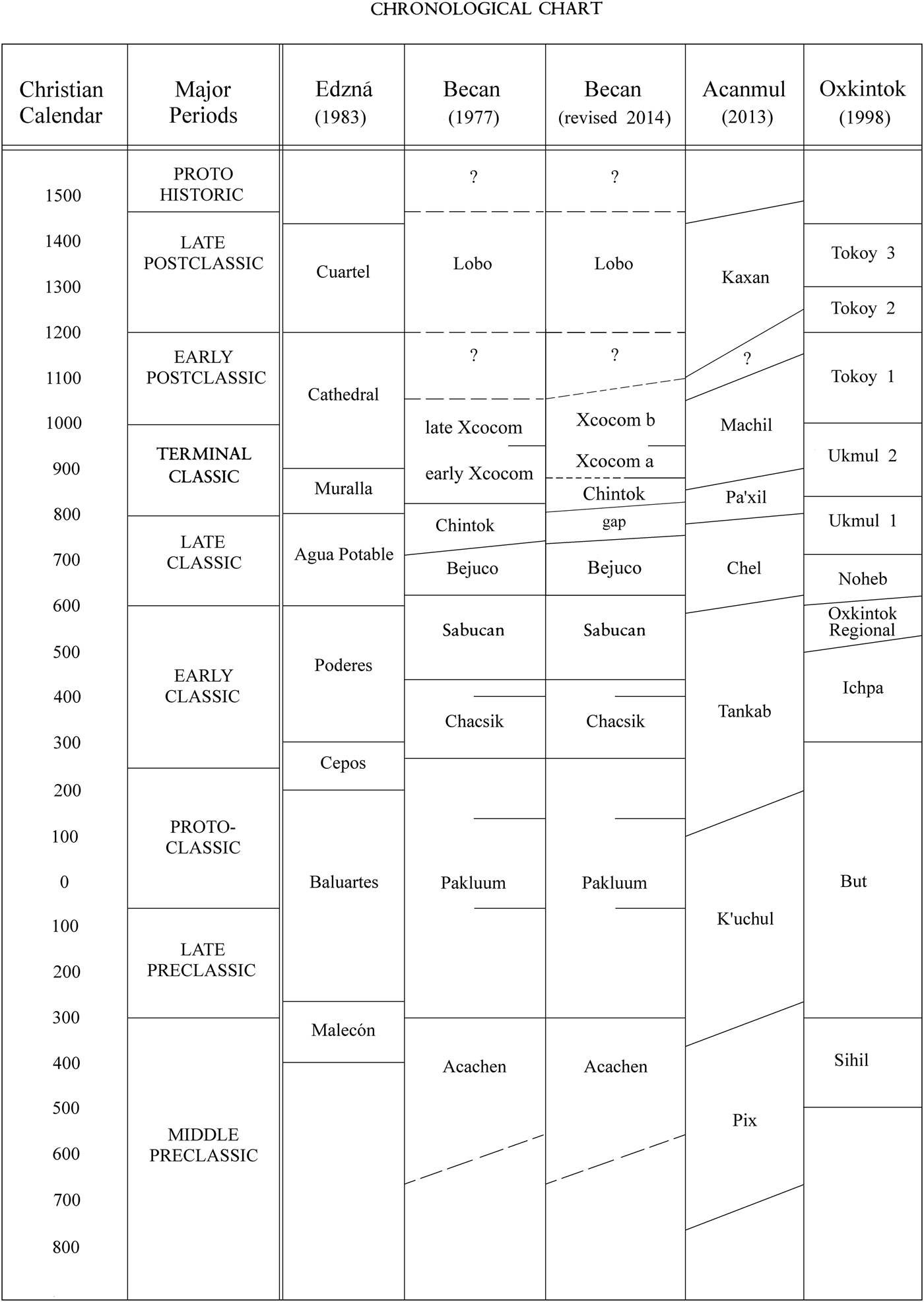
Ceramic sherds made up the overwhelming majority of materials recovered from both surface refuse deposits and structural fill, handfuls of chipped silicates, obsidian blade segments, artifactual and comestible shell and bone, and much smashed architectonic stucco sculpture and elements also being present. To facilitate both on-site dating of individual contexts and construction, and to enable tentative comparisons with other sites, a type-variety analysis and classification of these was undertaken, and the depositionally defined assemblages that could be recognized were assigned to provisional named complexes or ceramic phases. These have been dated by typological comparisons and applicable radiocarbon determinations as possible. The result is a provisional site ceramic phase history and chronology as here outlined (see Figure 24). All identified ceramic units are reported in Tables 1 and 2.
Literature-Established Preclassic-Middle Classic Ceramic Groups and Types
Impressionistic representation of relative ware, group, and type:variety importance and persistence across the Late and Terminal Classic Acanmul assemblages. All recorded varieties are indicated; however, to maintain clarity and avoid an undue impression of precision, ware and group frequency values are extended to all encompassed content other than in cases of exceptionally overabundant or underrepresented units. Based on a composite sample of 11 intergrading Chel-Pa΄xil-Machil refuse deposits from Groups A (seven) and B (four) together comprising 18,468 sherds (748 kg). Of these, 408 kg (10,872 sherds) could be confidently (stratigraphically) identified as pure Chel; 58 kg (1,441 sherds) as pure Machil; but only 42 kg (1,216 sherds) as certainly pure Pa΄xil. The remaining material (240 kg; 4,939 sherds) derived from depositional situations indeterminably combining both chronologically interdigitating types and likely depositional mixing such as to preclude reliable assignment
Pix Nabanche Complex, Nabanche Ceramic Sphere (ca. 650 b.c.–450/400 b.c.)
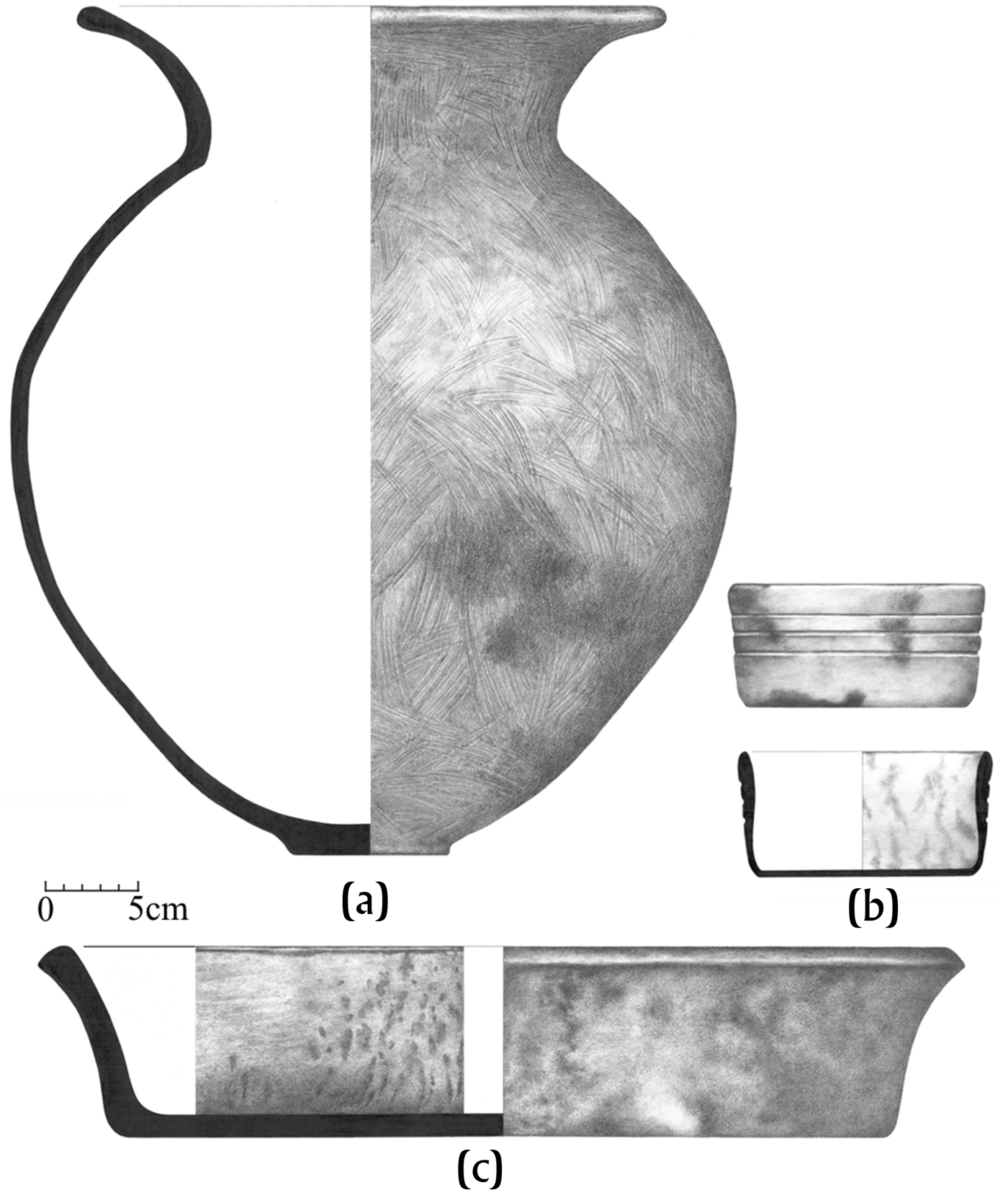
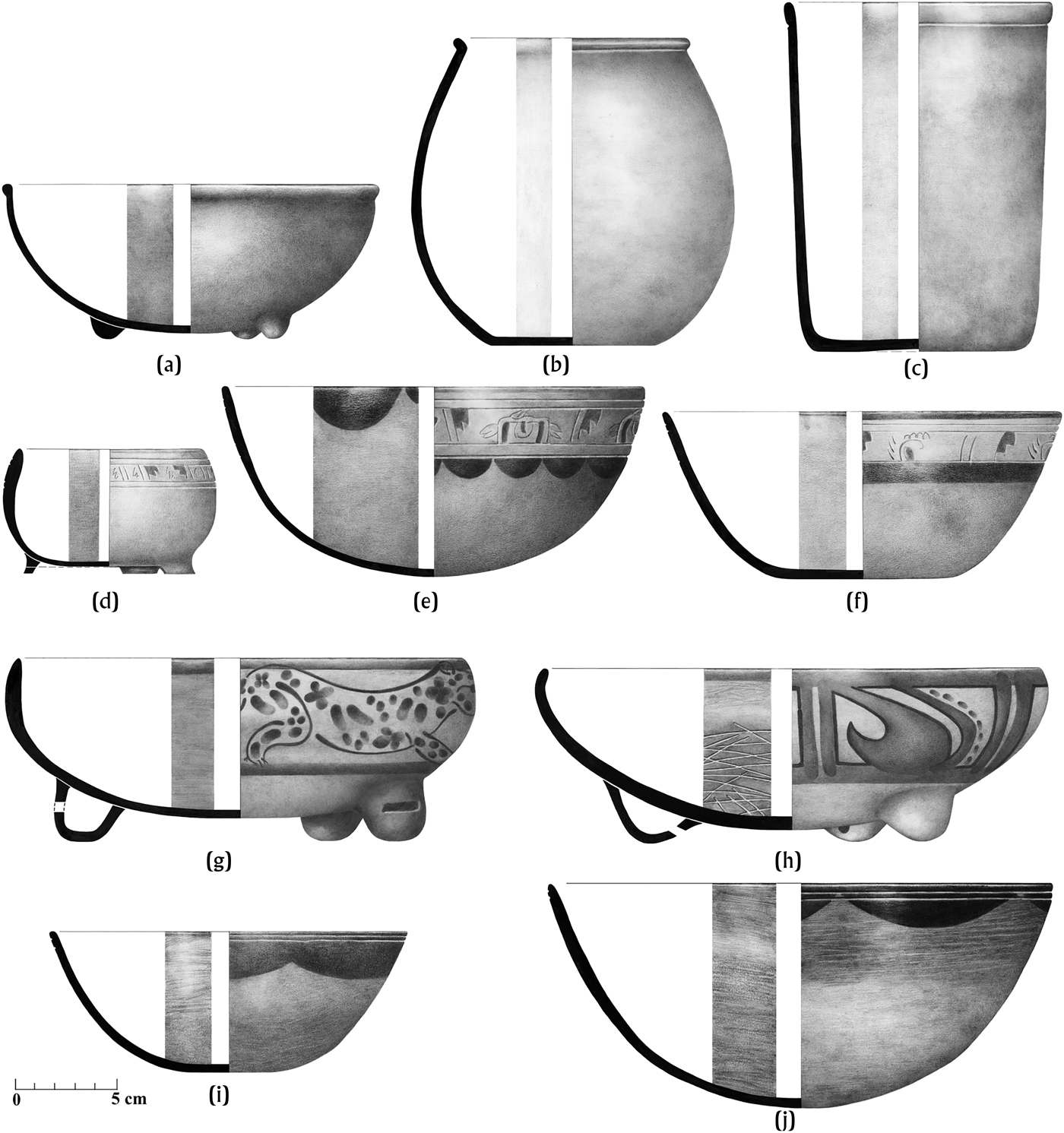
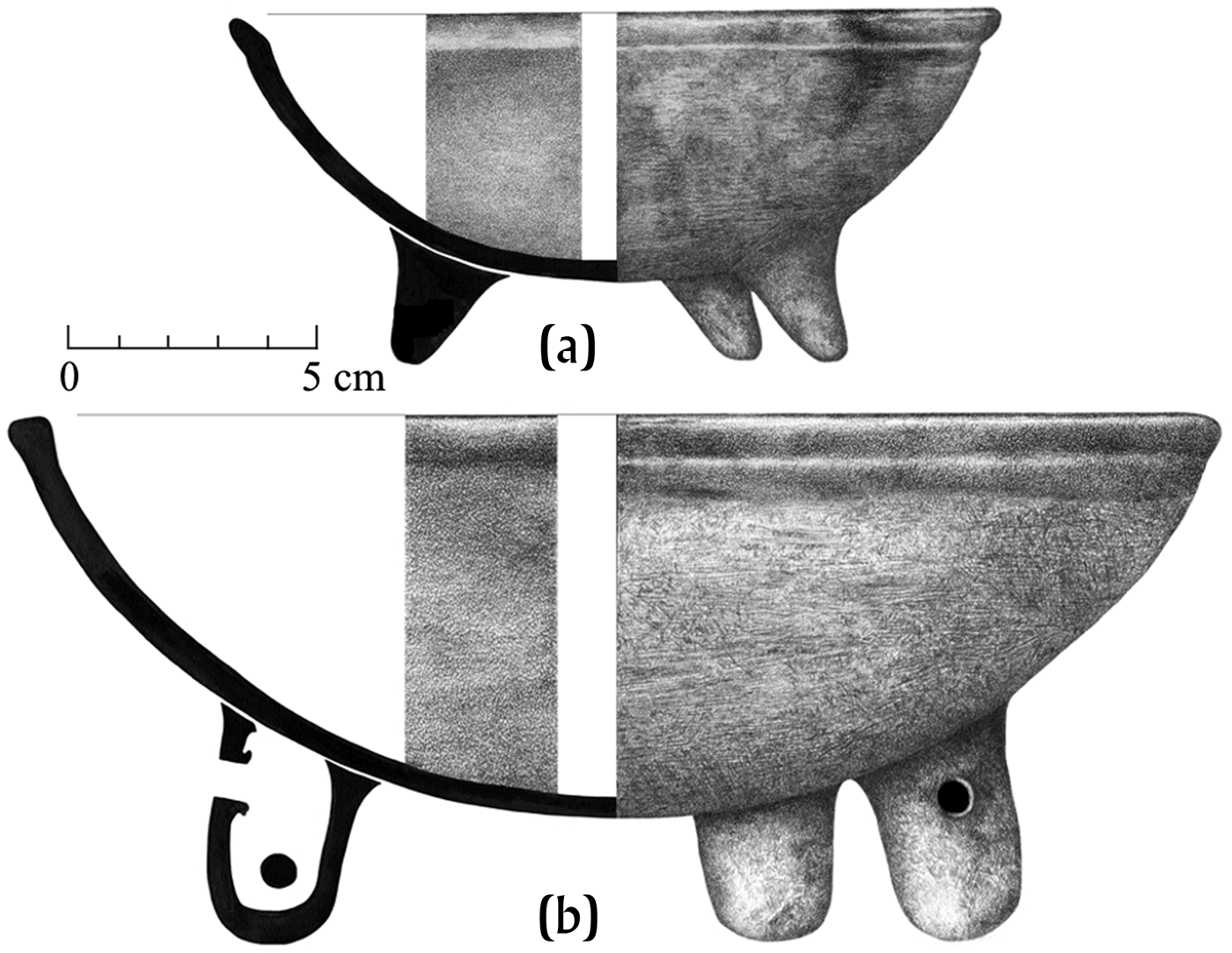
Associated with the earliest occupation of Acanmul is a hybrid Nabanche sphere/Mamom sphere complex that we have designated Pix Nabanche. As its labeling indicates, the locally produced assemblage is essentially a Northern or Northwestern coastal plain entity (Boucher and Yoly Reference Boucher, Palomo, Castillo and Pacheco2010), but its content includes significant quantities of central-southern lowland Mamom exotics believed to be intrusive on the basis of paste, temper, and other technological attributes (see Ball and Taschek Reference Ball, Taschek, Pye and Lowe2007). Principal diagnostics include Joventud Red, Dzudzuquil Buff, Ucu Black, Tierra Mojada Resist, and Muxanal Red-on-cream, however a full functional assemblage of types and forms is represented beyond these, and there is even a trace occurrence of true Mars Orange Ware (see Table 1). The complex was encountered in buried soils and in four discrete cultural deposits from Group B north to within the Central Plaza, and also occurs as inclusions in core from the Columns Group to Group A. One subfloor structural cache of indeterminate purpose also was recovered (Figure 6).
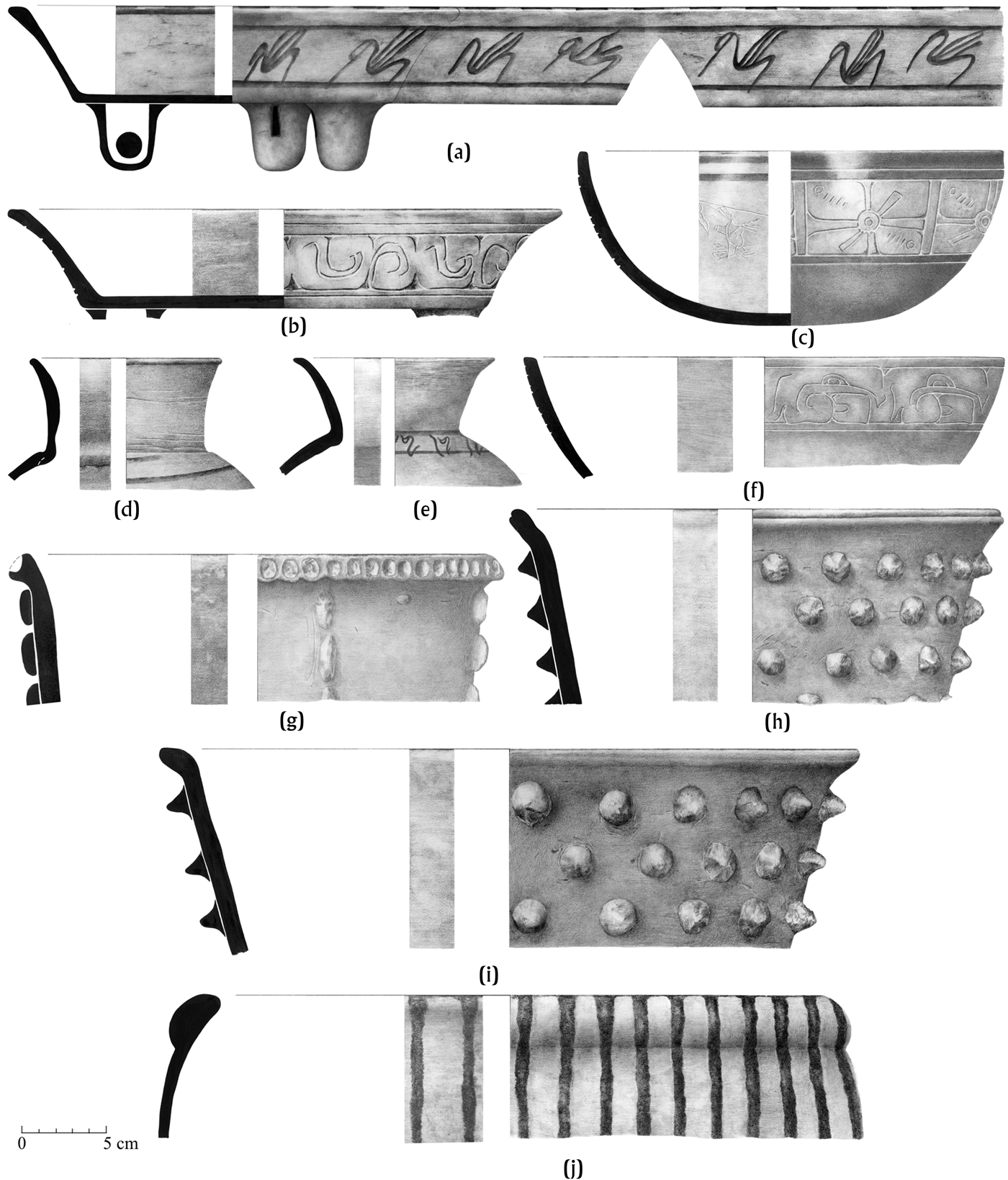
Pix complex vessels from Special Deposit SDAC04–4, Group C. (a) Chancenote Striated jar; (b) Kuche Incised bowl; (c) Petjal Red-on-black-and-cream-to-buff dish.
Evidence indicates a substantial Pix settlement underlying the entire C Group and extending well beyond its visible surface remains. There is another such hotspot underlying the northeast quarter of the Central Plaza, and Pix sherds are common in Group B core-collapse. Despite the extent of Middle Preclassic occupation, however, we found no indications of any direct developmental continuity between the Pix and Late Preclassic K′uchul aspects of the site, and these very likely represent two or more discrete, discontinuous occupational episodes.
K′uchul Xculul Complex, Xculul Ceramic Sphere (ca. 450/250 b.c.–a.d. 100/200)
While conventional wisdom and lowlands-wide experiences portend the probable existence of extensive Late Preclassic occupation and site development, both we and Ojeda Mas encountered sherds of this era only as contaminant inclusions in later mixed core and collapse deposits, and in the core and buried soil beneath the lowest and earliest of three major floorings in the south courtyard of Group A. We believe this is far more likely an artifact of sampling than of any cultural or historical reality. The limited scope and number of our own excavations precluded other than purely fortuitous findings, and for the present all that we can say about the phase is that it is sprinkled across the site core from Group B to Group A, is fully within the Dzibilchaltun-defined Xculul ceramic tradition of the northwestern coastal plain, and is most frequently represented by form-defined varieties of red Sierra and Xanaba, brown Percebes, cream Flor, and unslipped-striated Sapote group types (Table 1).
Tankab Cochuah Complex, Cochuah Ceramic Sphere (a.d. 100/200–580/620)
The principal and most readily recognizable diagnostics of Tankab include unmistakable varieties of Batres Red, Caucel Black-on-red, Maxcanu Buff, Timucuy Polychrome, Dos Arroyos Polychrome, Lucha Incised, and Aguila Orange. Early Tankab is marked by the persistence of some K′uchul types alongside their eventual replacements with both present in modally varying dish, basin, and jar forms. These included Xanaba–but not Sierra–Red, and Percebes Buff. The local fine-striated unslipped jar tradition of the Preclassic also continues on into a ware readily subsumed within the Triunfo group of the Central and Southern lowlands. Overall, this is an assemblage firmly rooted in the Cochuah ceramic sphere of the northern plains with only minimal, minority-type linkages to the sprawling, multifaceted Tzakol sphere of the south (Table 1).
It was in the Tankab ceramic phase of ca. a.d. 200 to 580/620 that Acanmul definitively emerged as a significant local if not regional center. We base this on evidence of major construction activities involving the massive Group A acropolis platform and the extensive basal building platforms of the Group B palace complex, and the construction and formal dedication of a mid-site ballcourt (Structure 44) early in this phase. Any detailed study of the Acanmul ballcourt was precluded by its savage ninth century demolition; however, comparison of its remaining footprint with those of the contemporary Early Classic Oxkintok and Edzna courts clearly indicates its importance as a local statement of sociopolitical autonomy and power and a stage for ceremonial performances.
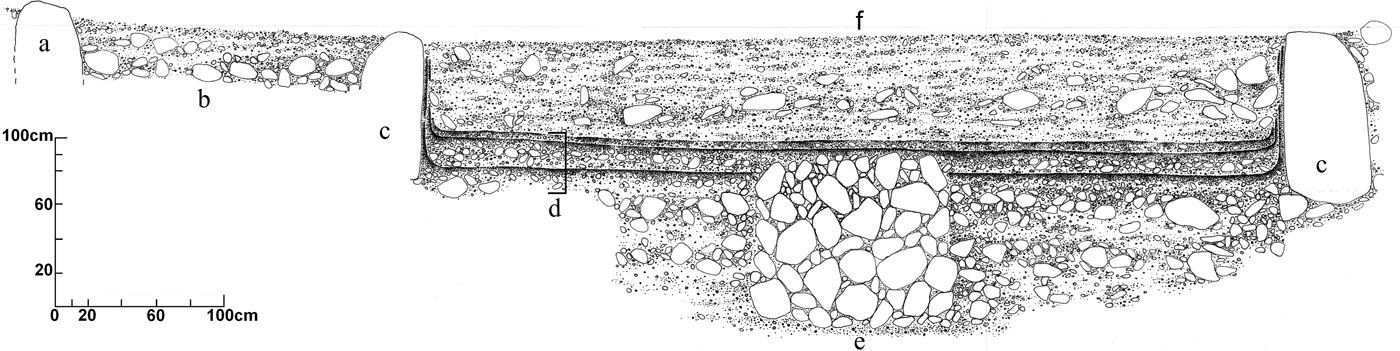
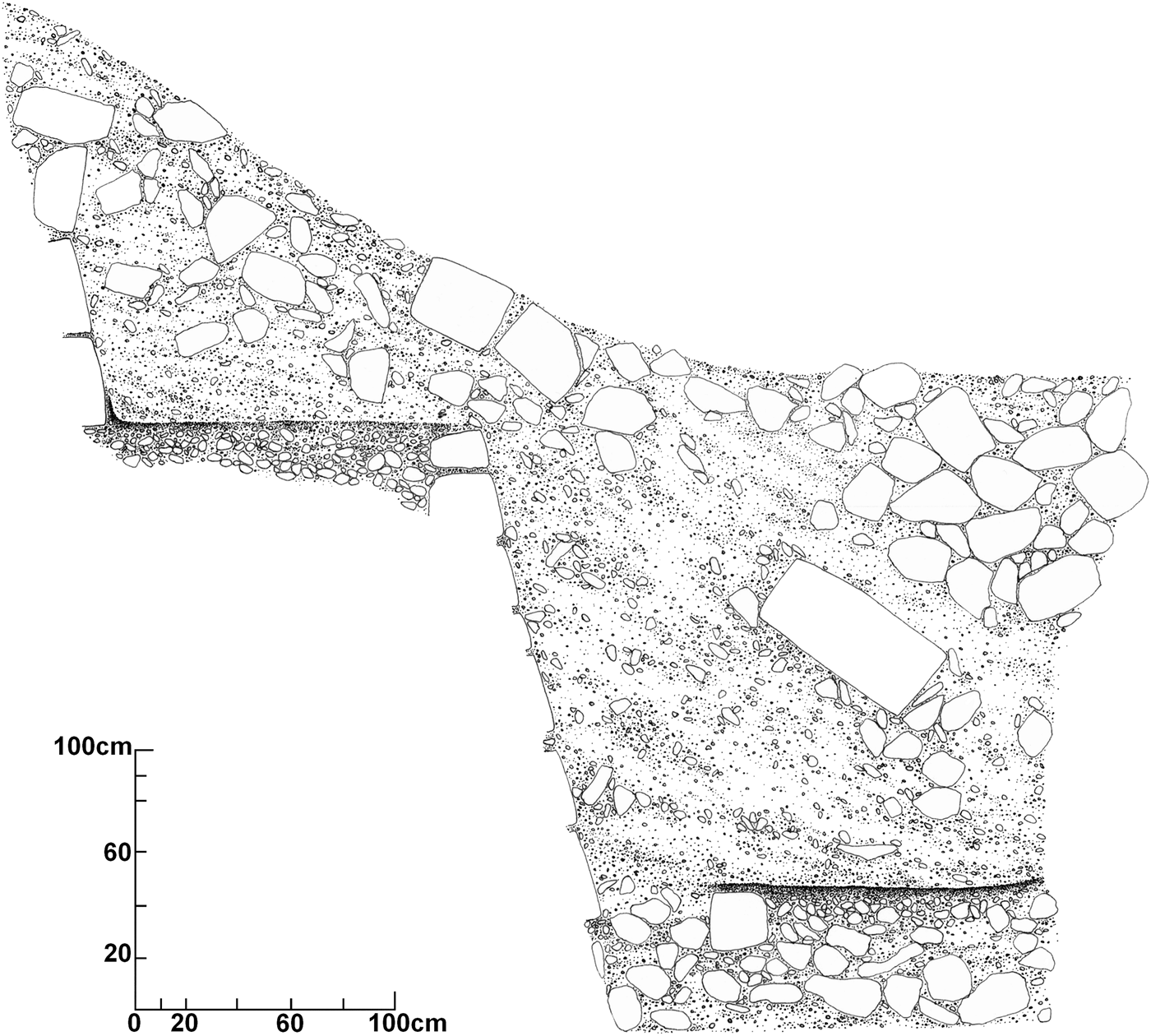
Excavation revealed that the court was constructed originally during the initial Early Classic period. The still-standing basal facing courses of its banquettes are in the so-called “Megalithic” architectural “Style” or construction tradition characteristic of coastal plain sites of this period from at least as far south as Champoton around the sweep of the peninsula to northeastern Quintana Roo (Mathews Reference Mathews1998, Reference Mathews2001; Mathews and Maldonado Cárdenas Reference Mathews, Cárdenas, Mathews and Morrison2006; also see Ball and Taschek Reference Ball, Taschek, Pye and Lowe2007:Figures 8.5–8.7, 8.10). The earliest construction (ca. a.d. 250–400) was preceded by excavation of a pit approximately 1.2 m in diameter and 30 cm in depth at the center of the playing alley (Figure 7). We presume that a dedicatory cache was placed in this pit, but if so, it was subsequently removed. The bedrock surface was leveled and raised about 40 cm with horizontal beds of well-graded cobbles and rock, and this was capped with a subfloor of tamped marl. Vertical banquette facings consisting of erect, well-shaped monoliths with smooth flat faces and convex backs were set upright directly on the sub-floor in two parallel rows flanking the playing alley. Finally, a plaster floor was laid atop 10 cm of compact pebble ballast and painted bright red. Except where chopped through at its center, the floor was well preserved and turned up onto the faces of the banquettes for some 70 cm.
Ballcourt (Structure 44). East-west section through court midpoint showing Early through Terminal Classic construction features and layered marl termination infilling. a. basal facing course of cornice; b. bench; c. Megalithic facing of bench; d. three successive floorings of playing alley; e. infilled centerline cache pit; f. layered and tamped marl termination fill of playing alley.
Ceramic evidence suggests that the court underwent a major refurbishment and reflooring sometime in the early to middle seventh century a.d. (ca. 620–660), and a third reflooring sometime late in the eighth to early in the ninth century (ca. a.d. 780–840). At some time–probably immediately prior to construction of the second alley floor—a large hole was chopped through the midpoint of the original Tankab floor, through the underlying core body, and into the bedrock pit. We assume that any offering associated with the original construction was removed from the pit at this time. The hole was filled with large rocks and boulders mounding above the level of the original floor. A new floor then was laid over a small rock ballast some 16–18 cm above the earlier floor (Figure 7). It too was painted red and turned up onto both bench faces.
While we have no good explanation for this activity, the authors encountered a virtually identical scenario at the upper Belize Valley center of Buenavista del Cayo in which the dedicatory offering-cache from a Late Preclassic ballcourt “decommissioned” and architecturally blocked off in the middle seventh century a.d. was redeposited as the centerpoint cache in a new, early eighth-century court constructed some 180 meters to its north (Ball and Taschek Reference Ball, Taschek, Inomata and Houston2001:182–184). One implication is that a second as yet unidentified court may also lie hidden elsewhere in the dense secondary bush today covering most of the Acanmul core. What we believe may be a large segment of the original centerpoint marker-disk was recovered from a Late Postclassic shrine altar located some 150 m south of the demolished ballcourt. Ceramic evidence suggests a fourteenth to early fifteenth century date for the shrine's construction, and associated twig charcoal yielded a calibrated radiocarbon date (Beta 355306) of 560 ± 30 BP, or cal a.d. 1310–1360 and 1390–1410 (2σ).
Sometime following the third resurfacing (ca. a.d. 780–840), both ballcourt ranges were demolished to the level of the court banquettes—which were left intact—and the resulting debris was moved some several score yards back behind each of the two ranges into two back-flanking rubble piles. At the same time, the playing alley was filled to a depth of roughly 55 cm with a coarse marl banded with lenses of angular pebbles and a few randomly occurring rocks. Our data revealed no subsequent repair or “reactivation” of the court, but the formation of an immediate, continuous, undisturbed humus with well developed A and B horizons across the marl-filled alley up onto the banquets and the exposed core-heartings of the east and west ranges.
Groups A and B
Tankab sherds occur as unmixed subfloor construction fill and scattered depositional inclusions across the site from Group A to Group B. They are particularly common in the Late and Terminal Classic palace refuse deposits off the rear and sides of the Group A acropolis, and their exceptionally heavy and concentrated abundance in the collapse off the north rear side of the latter as well as well-preserved, pure subfloor core deposits extending northward away from it suggest a significant construction episode very early in or even just immediately preceding this period—ca. a.d. 200–300.
A 2 × 5 m exploratory trench at the east foot of the multistory apartment building (Structure 10) forming the west side of the Group A south courtyard exposed evidence of a staired platform (Structure 10–2nd) built very early in the phase. This was covered over by a massive enlargement (Structure 10–1st) early—ca. a.d. 620–660—in the subsequent Chel phase, which itself saw two further refurbishments and substantial raisings of the abutting courtyard floor, one at some time well within Chel and another toward the start of Pa΄xil, ca. a.d. 780–800. The multistory apartment complex remained in heavy residential use well into the terminal occupational Machil phase (ca. a.d. 860/880–1100).
Fragmentary traces of a severely deteriorated early Tankab surfacing were found in two of five tests in the north courtyard of the Group B palace complex immediately overlying soil peppered with K′uchul sherds. Of three plaza floorings exposed by a 2 × 5.6 m trench in the south court of Group B, the lowermost was also found to be of very early Tankab age. This floor was laid over a carefully prepared bedding consisting of thin lenses of rounded, water-worn cobbles and limestone gravel alternating with compact white marl deposited directly over sascab. Twenty centimeters above this was a second, later flooring also dating to the Early Classic Tankab phase. The conditions of our permit did not allow following these floors to determine their architectural associations.
Group C ( Figures 3, 8)
Tankab phase floorings were found underlying Group C in every place tested, and Tankab sherds were common in the cores of all structures sampled. A single early Tankab flooring was found extending from east of Structure 66 out beyond its west rear, and a trench in front (south) of Structure 64 encountered two sequent floors of this age, the lower dating to very early in the phase. The lower floor was associated with construction of Structure 63—which it turned up onto—the huge terraced platform closing the east side of the group. As far as could be determined based on a combination of extensive terrace collapse and three small tests of the supporting platform, this important structure—it forms the southern terminus of a north-south line passing through the center of the formal entry to Group A and its principal Late Classic acropolis summit building—is of entirely early Early Classic construction date. The squarish, two-tier platform has a single, 6 m wide, inset stairway on its west side that rises to a broad landing at the top of the basal tier. A second stair continues to the summit.
The actual stonework of the Structure 63 stairway and basal tier is in the same Megalithic Construction Tradition as the contemporary ballcourt, but the basal platform itself is far more elegant consisting of at least two and possibly three now collapsed terraces. The preserved lowermost of these consisted of an inset lower panel with basal molding topped by a nearly vertical, slightly battered outset member. Also in the Megalithic Tradition, the basal course of the outset consists of a single line of huge, flat slabs with very long cantilevering tails supporting a second course of huge, carefully shaped stones with long tails and battered faces. Above this, the preserved terrace faces are constructed of very large, square to subrectangular blocks with long tails that are so uniform in size and shape that the vertical joints are generally aligned.
Preservation was too poor to determine whether Structure 63's exterior had been resurfaced over time, but its front and north sides were littered with fragments of spiked basket, bowl, and pedestal censers dating from throughout the full Classic and Terminal Classic periods, and very possibly the early “Postclassic” as well. Quantities of decorated Silho (X) Fine Orange and true Chichen Slate sherds indicated its continued utilization in some role full into the latter period. On his visit in 1940, Harry E.D. Pollock (Reference Pollock1980:540) noted the existence of a since- collapsed summit building with moderately well-cut and faced wall stones. All remaining of it in 2004 were two column drums and some fragmented facing stones. Misreading part of Pollock's (Reference Pollock1980:538) text, and personally never having visited Acanmul himself, George Andrews (Reference Andrews1986; Reference Andrews1995:9, Figure 4, 226), assigned Structure 63 (Pollock's Structure 8) to the Early Oxkintok Architectural Style, and others have followed Andrews in this assessment. We would place the basal pyramidal platform firmly in the Megalithic Construction Tradition, and note its marked stylistic affinities to a generic Peten-like architectural style (also see Benavides Castillo Reference Benavides Castillo and Prem2003:185), present also at Edzna and other Campeche sites. The now collapsed summit building likely dated to the full Late or Terminal Classic, but its stylistic affinities were not determinable.
In addition to the brief persistences of Xanaba Red and Percebes Buff, Tankab ceramics manifest a number of important, direct continuities with the pottery of both the antecedent Preclassic K′uchul and sequent Chel assemblages. This is especially so in the case of the consequential buff-to-brown (Percebes-Maxcanu) tradition in which slips progress from polished streaky to lustrous flaky early in Tankab and then to more adherent, well-smoothed low glosses over the phase. There is a tendency to occasional “soapiness” toward the very end of Tankab that is noteworthy as it becomes increasingly more pronounced in Chel and reflects the developing surface technology and tactile/visual character of the emerging Puuc slateware tradition.
In sharp contrast to the buff-brown tradition, there are clear-cut differences separating K′uchul-Tankab redwares from those of Chel, and from the important new Celestun Red Ware series that emerges in the Late Classic. It merits repeating, however, that true, clear, direct continuities link the Early Classic buff-brown wares of the Maxcanu series and the northern peninsula's omnipresent Late Classic hallmark, Puuc or Florescent Medium Slateware. These continuities are clearly preserved and observable in the ceramic stratigraphy of Tankab through Chel phase Acanmul, and Varela Torrecilla (Reference Varela Torrecilla1998) has described a comparable developmental persistence of Maxcanu Buff pottery from the Early Classic well into the seventh or even early eighth century at Oxkintok.
Chel Canbalam Complex, Canbalam Ceramic Sphere (c a.d. 580/620–780/800)
The Chel complex corresponds to the Late Classic florescence of the Acanmul center. Much of the visible architecture and architectural rubble at the site dates from this period, and its ruined, exposed-core state is due as much to its deliberate ninth century ravaging as to the effects of time and environment. Significant construction activities including platform refurbishments and enlargements and the addition of new buildings took place within Groups A, B, and C, the central plaza, and the ballcourt.
Limited testing in the Central Plaza indicated its single, well-finished plaster flooring to be of Chel age. Structures 21 and 20—respectively defining the east and northwest edges of the plaza (see Figure 3)—also date to Chel. Numerous Tankab and Pix sherds in the cores and collapse of their basal stairways and terraces suggest the possibility of buried earlier architecture dating to one or both of these as well, and the underlying soil horizon was heavily peppered with Pix sherds.
Our UAC permit authorized excavation of only a single 2 × 6 m long slot off the front centerline base of Structure 21 to ascertain its latest construction history and that of the adjacent east edge of the plaza. The excavation determined that at least this area of the plaza was laid down as a single construction episode in conjunction with the platform construction. The basal riser of the front stair was laid directly on the plaza floor ballast. Both the earliest plaza floor and two subsequent resurfacings turn up onto the basal riser. Stair risers and facings are semi-veneer, typical of Proto-Puuc and Early Puuc Style construction throughout the northern lowlands (Andrews Reference Andrews1986, Reference Andrews1995). Associated ceramic debris and core/collapse inclusions indicated a use-history spanning the Chel and subsequent Pa΄xil phases. Fragments of Sacalum Black-on-slate drums were notably common in the debris.
The ballcourt saw a major refurbishment during Chel including a complete reflooring of the playing alley raising its surface 16-18 cm above the earlier Tankab one (see Figure 7). As noted, the original dedicatory offering may have been dug up and removed at this time.
Groups C and B
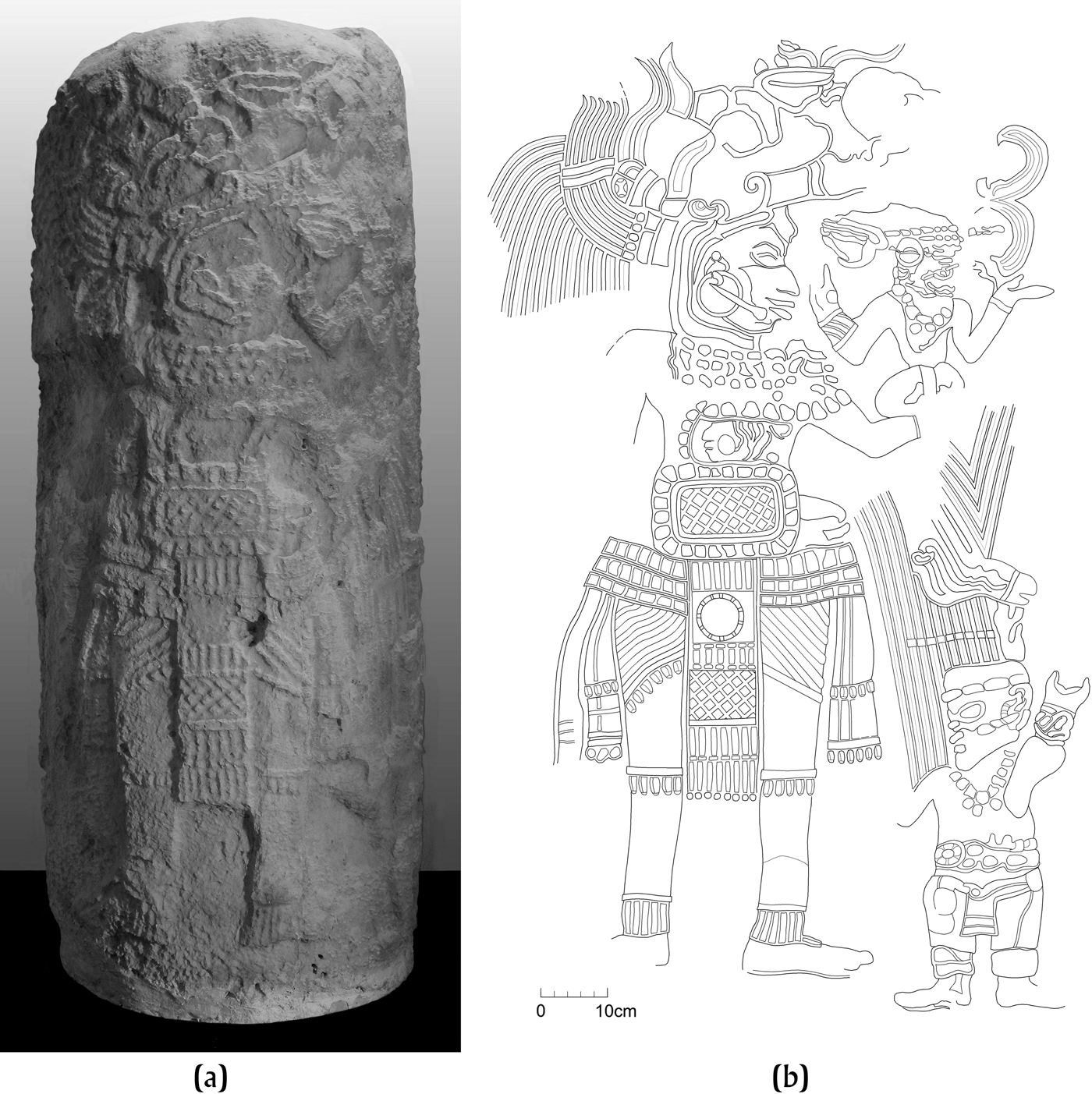
Five separate test units across Group C (Figure 8) identified a single, thick (12 cm), well-preserved Chel phase plaster pavement that ran under the east side of Structure 66 and out beyond it to the west, and also abutted and turned up onto the inset basal terrace member of (Early Classic) Structure 63 and a south terrace face or stair riser of what had been Structure 64–3rd (Figure 9). The last consisted of a single remaining masonry course of almost square, slightly convex to flat-faced semi-veneer stones. Everything above this basal course had been chopped out during the subsequent Machil construction phase, however, both subfloor ceramics and the sculptural style of at least three of the felled columns originally associated with the demolished 64–3rd building (Figure 10)Footnote 6 place construction late in Chel (ca. 750–780; Proskouriakoff Reference Proskouriakoff1952).
Group C plan-map showing structure numbers and distribution of fallen columns. a. portal arch entranceway to Group B. A-A'. north-south section through Structure 64.
Structure 64, Group C. North-south section A-A' through platform showing Early through Terminal Classic construction foundations and major Late Postclassic architectonic modifications including resetting of columns.
Sculpted column from courtyard surface south of Structure 64, Group C. Ciudad Campeche Stelae Museum. (a) photo; (b) rollout drawing.
Structure 66 has been so severely ravaged by collapse and post-abandonment deterioration including possible mechanical grading and stone-robbing that its rubble and core were inextricable jumbles of mixed Early Classic through Postclassic construction, occupational, and haphazard surface debris. A date for the platform sometime very late in Chel (ca. 760–780/800) to early in Pa΄xil (ca. 780/800–800/820) is most likely based on its construction stratigraphy and architectonic features, and from what remains it must have been a building of some importance. Architecturally, it appears to have been a very early member of Andrews’ (Reference Andrews1986, Reference Andrews1995) Colonnette Style with two north-south vaulted rooms and a triple eastside entryway defined by two drum columns. There may also have been a similar entry on the west side based on the number and distribution of column drums in the collapse rubble.
The avalanched collapse from the Structure 66 building did serve to protect and preserve the underlying basal platform. This carried an elegant façade decoration consisting of a continuous row of stone colonnettes set directly atop 10 cm of mortar laid directly on the plaster courtyard pavement. There is no basal molding, but an upper molding of 15 cm high, flat-faced, vertical stones with long tails is present immediately above the attached colonnettes. This is a construction scheme common in platforms of Early Puuc Style (ca. 670–780), although Andrews is emphatic that colonnettes are not an element of this. The scarcity and simplicity of associated mosaic decoration is also typical of Early Puuc. Tumbled mosaic elements included numerous finely carved guilloches, Xs, and diamond-shaped stones. The guilloche-stones are from the upper wall zone below what might have been a “broken” medial molding, another Early Puuc diagnostic. The other elements occur in such manners as to suggest linear decorative bands from the upper façade. The colonnettes decorating the east (front) face of the supporting platform continued around the sides, but fallen mosaic elements were confined to the front of the mound, the sides and rear littered only with nicely dressed, plain, flat-faced semi-veneer masonry. The latter is, again, most typical of Early Puuc.
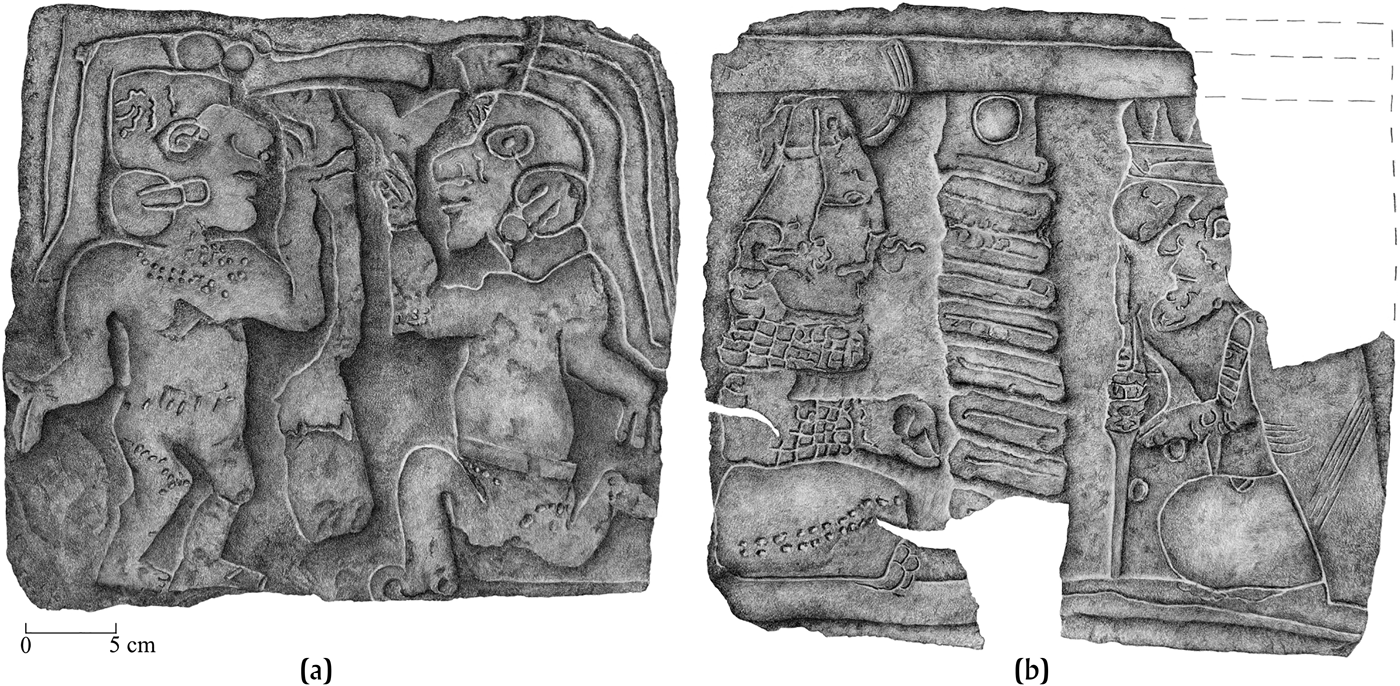
Two fallen sculpted panels (Figure 11) were recovered from alongside the east entryway and appear to have been mounted originally in the façade to either side of it. This arrangement is similar to one found on the South Building of the Hieroglyphic Group at Xcalumkin (Pollock Reference Pollock1980:Figure 748, 750), although the styles of the Acanmul panels differ radically from anything at the latter site. Andrews assigns the South Building to the Colonnette Style, but does so erroneously based on associated epigraphic data that would place it well within the Early Puuc temporal range (M. Charlotte Arnauld, personal communication 2012; Graña-Behrens Reference Graña-Behrens2002; Grube Reference Grube and Prem1994).
Bas-relief panels from east side of Structure 66, Group C. (a) north panel; (b) south panel.
The combination of Early Puuc and Colonnette Style elements and the basal construction history together suggest a late eighth to very early ninth century date for Structure 66. All occupational debris collected–including green obsidian blade fragments, Chichen Slate basins, much decorated Silho Fine Orange, and two on-floor metates immediately in front of the ruined building–pertain to the later Machil phase occupation.
Several discontinuous small sections of terrace facing served to indicate that a second low, rectangular platform similar to Structure 64–3rd had stood to its immediate west separated by a narrow passage. Demolition and collapse obscured all but its actual existence and rectangularity, but the remaining two and three-course sections of well-fitted square veneer and semi-veneer masonry suggest a dating more in line with that of Structure 66 (terminal Chel-early Pa΄xil) than with 64–3rd (late Chel). As with all other structures in Group C, any Chel or Pa΄xil occupational debris was absent or obscured by mixture with extensive Machil phase refuse.
At Group B, subfloor testing immediately behind the south range of the central interior courtyard exposed a single plaza flooring of Chel date overlying two Tankab phase floors. Substantial off-terrace primary refuse deposits both in front of and behind Structures 92, 93, and 97 were of very late/terminal Chel to early full Pa΄xil date, as were the Group's north courtyard flooring and portal entry platform (Williams Beck's Structures 80–81–82). The Chel refuse is especially interesting in that it lacks most of the exotic ceramic types from the peninsula's interior present in the comparable deposits from off the Group A acropolis platform (see below). The authors have found an almost exactly analogous dichotomy in the contemporary Late Classic dumps associated with the upper Belize Valley private royal residential palace at Cahal Pech (“impoverished”) and the public affairs palace at its valley bottom counterpart, Buenavista del Cayo (“enriched”) (Ball and Taschek Reference Ball, Taschek, Inomata and Houston2001; Reents et al. Reference Reents-Budet, Bishop, Taschek and Ball2000). In contrast, fineware exotics of Pa΄xil date (primarily Balancan and Altar Fine Orange types) were equally well represented in the deposits at both locales.
The Group B façades had been heavily surfaced with plaster and had carried ornately sculpted and painted stucco statuary and imagery (Figure 12), but this had been savagely brought down and smashed in the course of the Group's violent destruction and effective abandonment during the subsequent Pa΄xil phase. Large numbers of limestone armatures and chunks of still richly colored stucco ornamentation peppered collapse and upper midden zones throughout the group. These combined with the observed architectural elements still standing–terrace faces, wall bases, grand stairways–to identify the Group B architecture as a composite of Pollock's (Reference Pollock1980) “Peten” and Andrews’ (Reference Andrews1986, Reference Andrews1995) Proto-Puuc and Early Puuc Styles of architecture. Close similarities to Xcalumkin where the sequence of architectonic and sculptural development has been particularly well documented (Becquelin and Michelet Reference Becquelin, Michelet and Prem2003, Reference Becquelin, Michelet, Castillo and Pacheco2010) support a Proto-Puuc-Early Puuc stylistic identity and an early seventh to middle eighth century chronology for most of the visible Group B architecture.
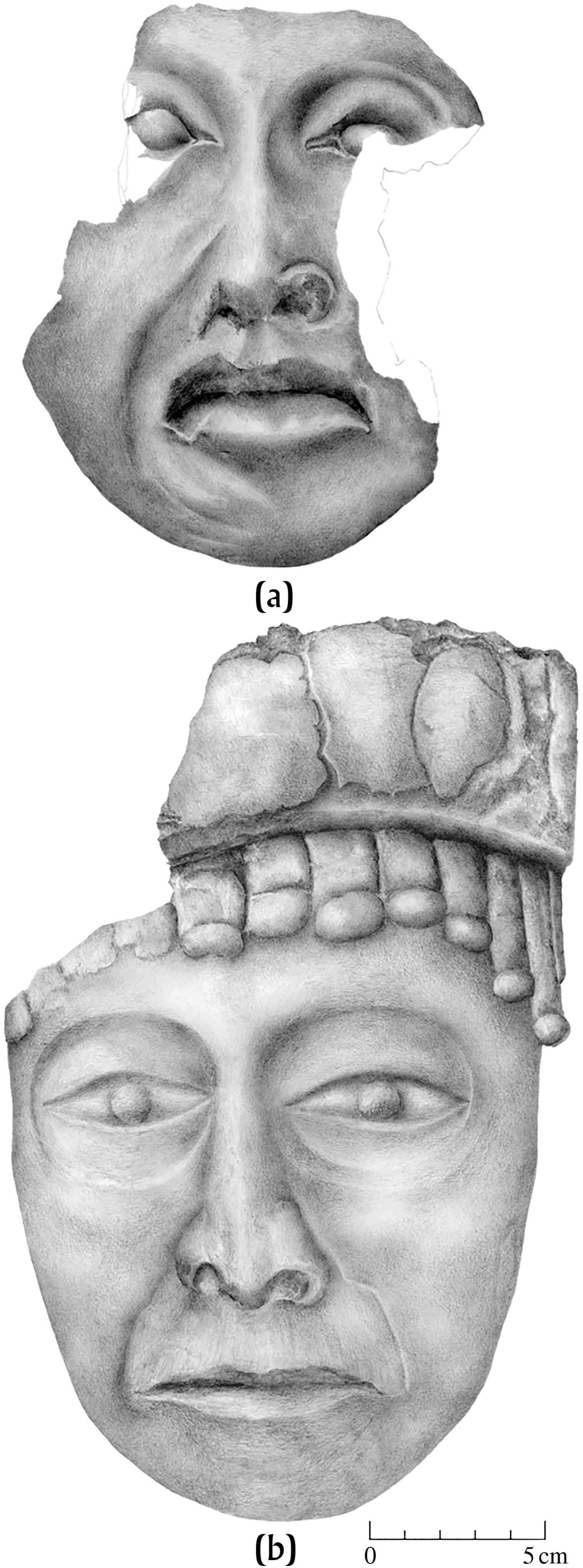
Architectonic stucco portrait fragments from south side façade collapse, Structure 93, Group B.
Group A
Chel phase ceramics are associated with major construction throughout Group A. As noted, an informational trench at the base of Structure 10 on the west side of the south courtyard produced evidence of a buried Early Classic platform covered over by a massive enlargement early in the Chel phase. The superposed Late Classic construction itself saw two later refurbishments and raisings of the abutting courtyard floor, one well within Chel and another toward the start of Pa΄xil, ca. a.d. 780/800–800/820. The structure remained in use well into the terminal Machil phase occupation, and is heavily strewn with Machil-diagnostic green obsidian blade segments, Silho group fine orange, Tohil plumbate, and Chichen slateware sherds as well as such habitational debris as manos, mano fragments and shell ornaments.
Analysis of core-collapse from the east and north (rear) sides of the Great Platform identified the unmixed occurrence of large, crisp, well-preserved (that is,“fresh”) Chel sherds only, and middle to late Chel refuse formed the lowermost depositional strata in all six trenches dug off the east and north sides of the platform (Figure 13; Williams Beck et al. Reference Williams Beck, Taschek and Ball2005). A trench placed off the northwest side of the platform, in variance, found stratified Machil and Pa΄xil trash directly overlying a plaster flooring of Terminal Classic Pa΄xil date. This deposit had formed directly in front of and below an outward facing C-shape structure on the west side of the platform.
Refuse Sampling Trench 8 section, Group A, Great Platform, north side. Note column drums and drum fragments from platform-top buildings in overlying collapse.
Atop the platform, at least Structures 1–A (Early Puuc Style), 1–B (Colonnette Style), and four sub-1 buried structures (all proto-Puuc stylistically) can be associated with the Chel ceramic phase, and core-collapse samples strongly suggest that much of the intersecting north side multistory apartment range, Structure 2, also was constructed during Chel. At least one and possibly two of the painted Ka΄wil images mentioned earlier also date to this time.
Exploratory stripping of the northeast patio “living area” of the Great Platform also uncovered the pancaked sprawl of what had been a beautiful small Early Puuc Style building, Structure 5. Associated debris and the simple, intrusive bundle-burial of a young adult female indicated that the building had continued in use as a residence into the late Terminal Classic Machil occupation, and had finally either collapsed or been pulled down sometime during the Postclassic Kaxan phase. Both the structural debris field pattern and the apparently sudden and catastrophic collapse of the building tend to suggest its deliberate demolition rather than structural failure, but we are at a loss to explain this as the occupational refuse and grave associations (a Yalton Black-on-orange [Silho Fine Orange] tripod dish and a bone weaving or hair pick) indicate occupational use into or through rather than up to the Machil episode.
The Chel ceramic complex
In light of its pivotal cultural historical prominence as the full Late Classic ceramic complex at Acanmul, and its rich representation in our collections, we believe it worthwhile to discuss the documented Chel assemblage in some detail. Based on six isolated trash deposits from Groups A (4) and B (2) consisting of over 408 kg of well-preserved, large sherds (>10,800), the full known Chel inventory–including Tankab persistences and Pa΄xil precursors–is itemized in Table 2.
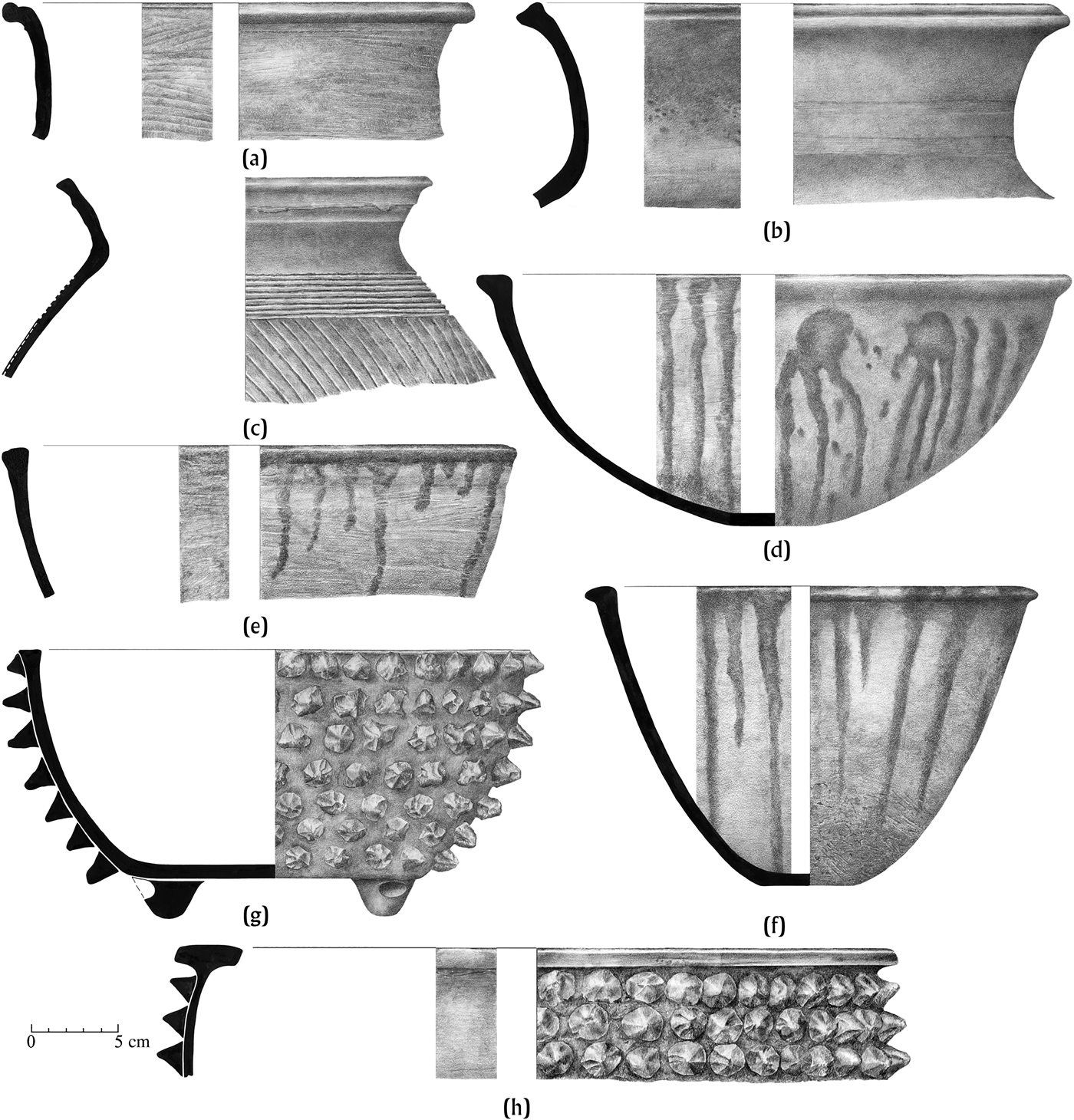
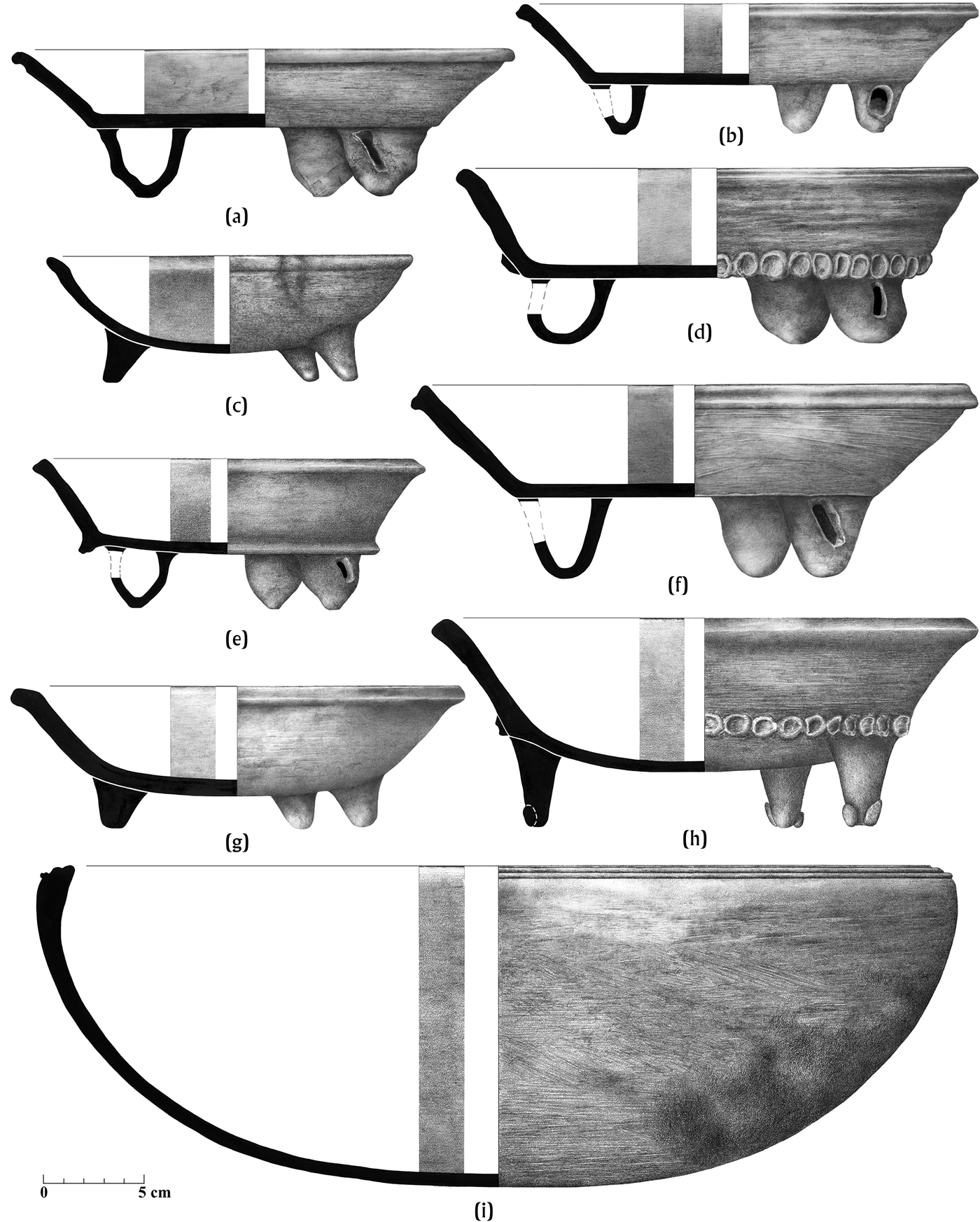
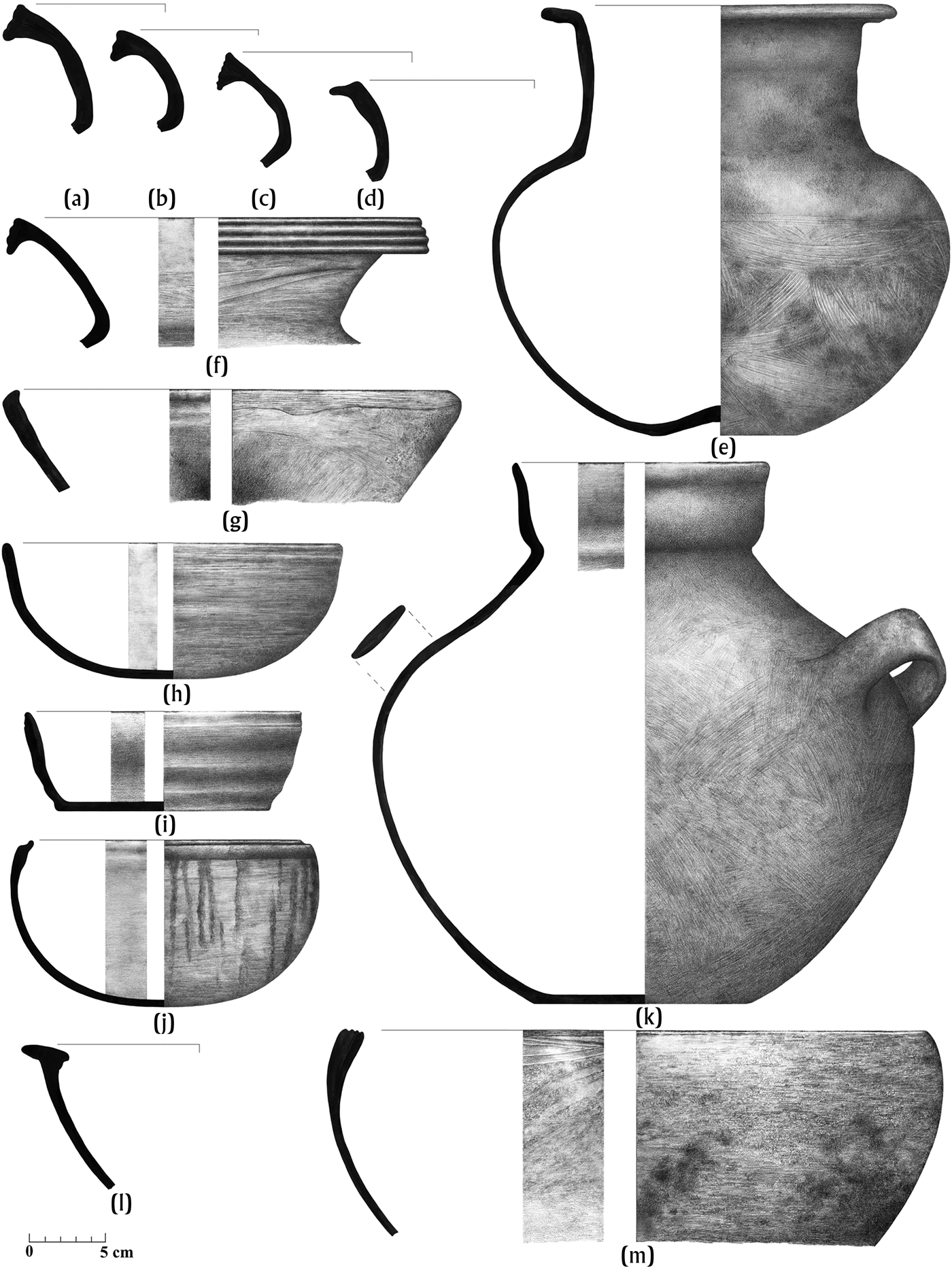
Chel is dominated by a blend of three different but related and intergrading wares, Ixpuhil Slate (established in Ball Reference Ball1977:37), Yucatan Iridescent (Sat group; established in Varela Torecilla Reference Varela Torrecilla1998), and Puuc Slate (Muna group; established in Smith Reference Smith1971). Together these comprise 48% of the total assemblage, despite its early dating in traditional Northern terms (ca. a.d. 580/620–780/800). They are followed in frequency by unslipped striated jars and unslipped black-trickled buckets and T-rim basins (generic Encanto-Acapulquito group [26%]; Figure 14), and then by tripod dishes and basin-bowls of Celestun Red Ware (12%) in its broadly ranging manifestations (plain; cream-slipped; oxidized to tan [Nimun Brown]). Together, these three potteries make up over 86% of the ceramics in use at Acanmul during the full Late Classic period.
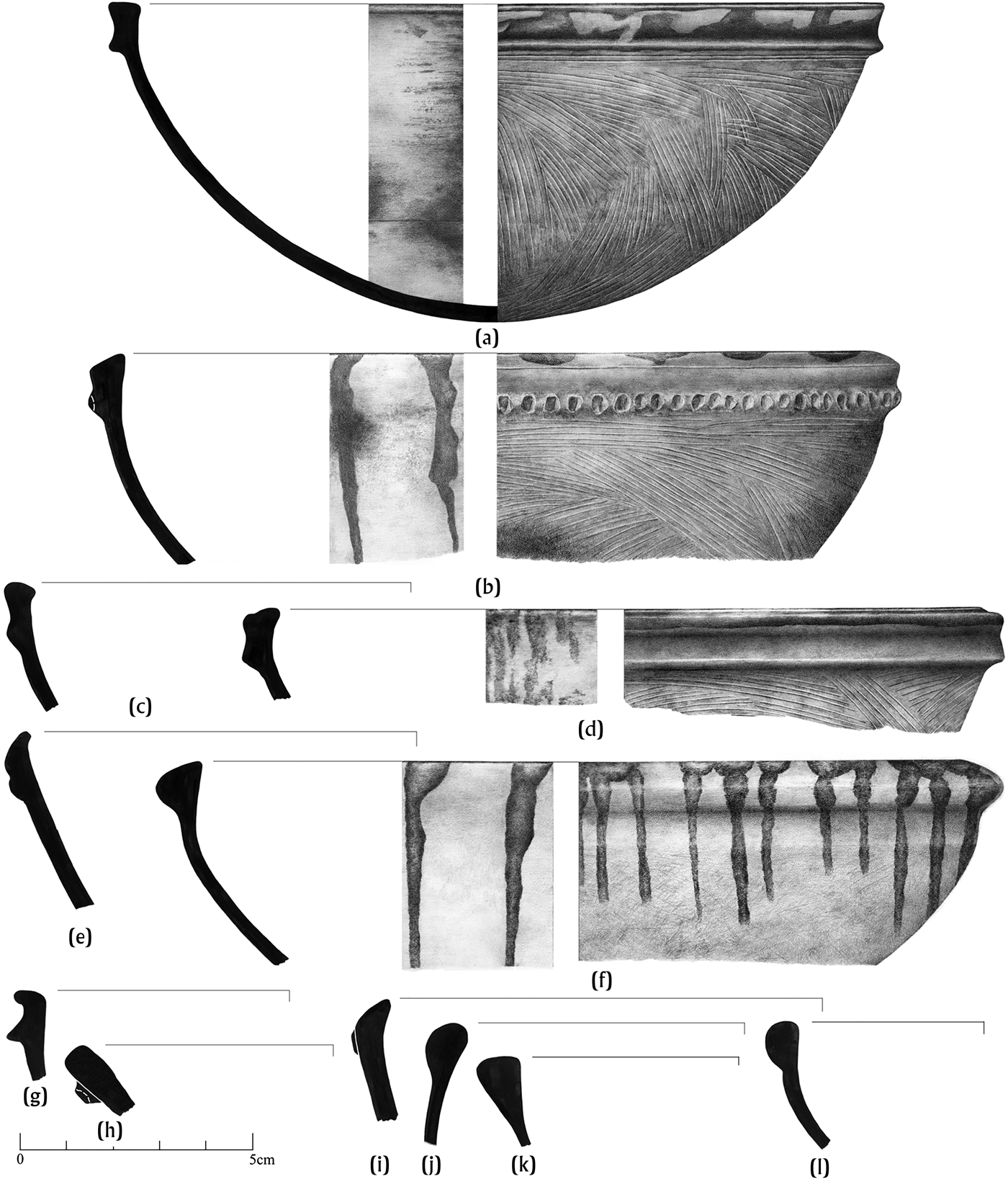
Chel-Pa΄xil unslipped wares. (a)-(c) Yakatzib Striated jars; (d)-(f) Paxyan Black-on-gray buckets; (g)-(h) Oxkutzcab Appliquéd censers.
Complementing the majority wares are smaller but still significant quantities of a thin-slip, soapy orange red precursor variety of Puuc Redware (2%); a broad range of Chablekal Fine Gray types (0.4–0.8% depending on functional context); and a number of exotics from both inland and littoral zones. Contextually late Chel collections also contain a highly variegated, mottled expression of the black glossware Achote group found also at Becan (Ball Reference Ball1977:34–36), and smallish amounts of true Thin-slate, Holactun “Slate” (see Brainerd Reference Brainerd1958:32; Smith Reference Smith1971:15), Hoxa Unslipped Ware (established in Forsyth Reference Forsyth1983:121–123), and Balancan/Altar (Z/Y) Fine Orange traces that are not believed to be later contaminants.
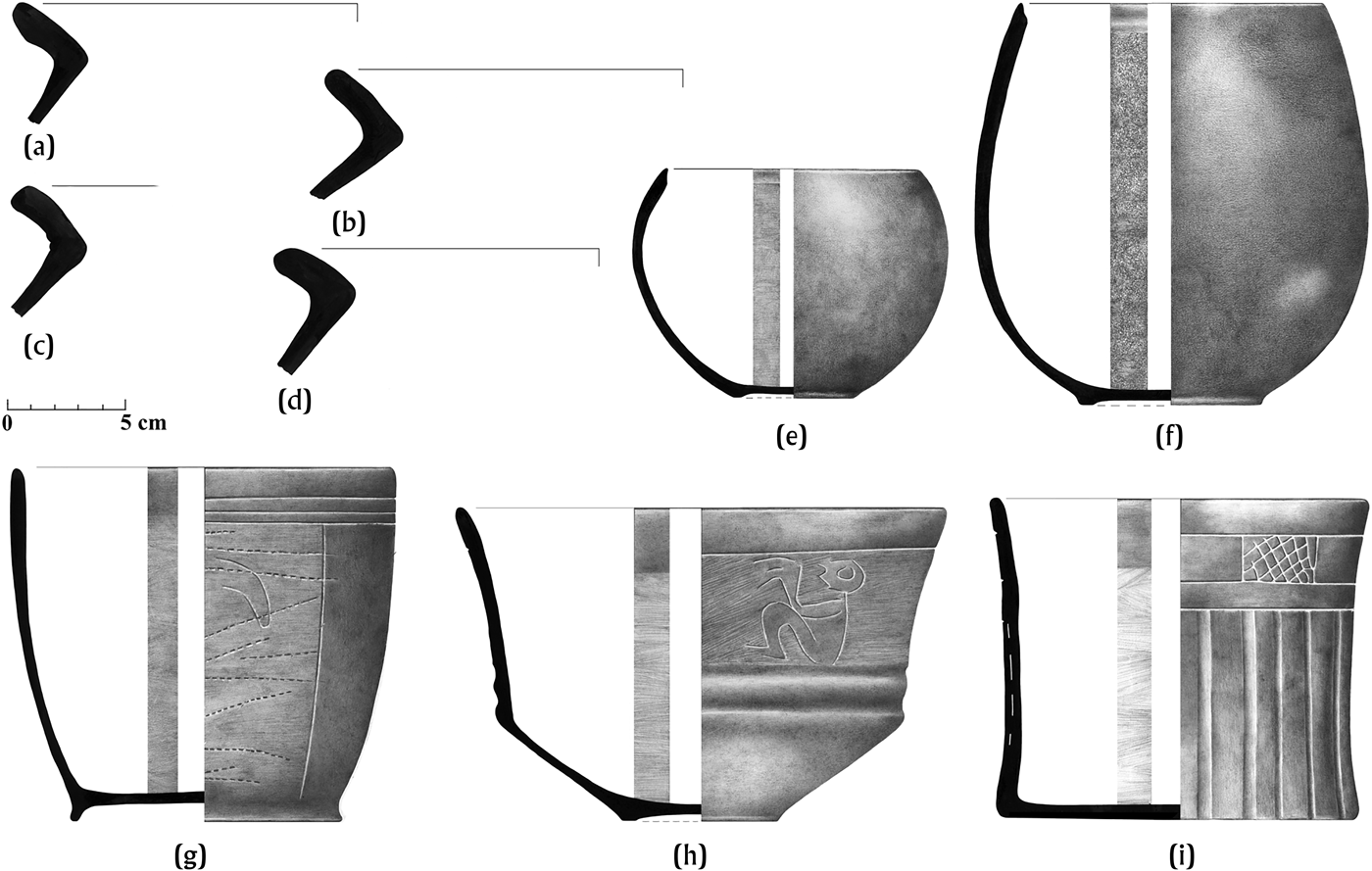
The combined total assemblage–which our collections did not allow temporal faceting of beyond the broad recognition of loose early, middle, and late configurations–is overall a rather unremarkable version of a Western Puuc/Puuc or general Canbalam ceramic sphere member. That said, a number of important techno-stylistic developments took place over the course of Chel. One was the progressive evolution of the low luster, brown-slipped Maxcanu group of Yucatan Gloss Ware into both true slateware (Muna group of Puuc or Medium Florescent Slateware) (Figures 15, 16a–d), and a parallel local ware, Ixpuhil Slate, characterized by a thinner, flakier, and less translucent very pale tannish grey to pale grey slip, opaque black trickle, and a paste fabric shared with the local unslipped ware tradition.
Chel complex buff/brown glossware to medium slateware basin developmental sequence: (a)-(c) Maxcanu Buff/Zi Black-on-buff (Yucatan Gloss); (d)-(h) Sat Prepizarra/Chemax Negro-sobre-prepizarra (Yucatan Iridescent); (i)-(k) trickled Sat Prepizarra/Muna Slate; (l) Muna Slate.
Chel complex buff/brown glossware to medium slateware jar developmental sequence, (a)-(d): (a) Maxcanu Buff (Yucatan Gloss); (b)-(c) Sat Prepizarra (Yucatan Iridescent); (d) Muna Slate (Puuc Slate); (e)-(f) Muncul Thick Thin-slate; (g)-(h) Chicxulub Incised (Fine Gray); (i) Telchac Composite (Fine Gray).
A second occurrence of note involved the late appearance of a somewhat finer and thinner variant of Muna Slate, “Muncul Thick Thin-slate,” that we suspect to be the transitional antecedent to the fineware Ticul (group) Thin-slate. A third was the advent of Celestun Red Ware, and its possible developmental trajectories into Nimun Brown and Hoxa Unslipped Ware.
We do not see these processes as occurring specifically at Acanmul or even in its immediate neighborhood, but rather perceive the center and its associated producer/consumer communities to have been participating in the greater potting traditions within which they were taking place. Varela Torrecilla (Reference Varela Torrecilla, Braswell and Braswell1998) has recognized a parallel developmental sequence for slateware pottery at Oxkintok, where she was able to isolate the emerging traditions as the Sat (Muna) and Sabero (Ticul) predecessor-groups in her early Late Classic Noheb complex (a.d. 600/630–715), a resolution that the small number and depositional characters of our own collections do not permit. We have followed Varela's lead and applied her typology to our own material, but our inability to stratigraphically facet Chel required that we combine her early Yucatan Iridescent and traditional Puuc Slate Surface-Wares in our tabulations of the complex as a whole. Nonetheless, the same developmental continua are evidenced at both Oxkintok and Acanmul, and a seemingly identical third iteration also occurs at Xcalumkin (Becquelin and Michelet Reference Becquelin, Michelet and Prem2003).Footnote 7 Scott Johnson (Reference Johnson2012, Reference Johnson2015) has documented an important parallel trajectory leading to the contemporaneous emergence of Chichen Slate Surface-Ware at Popola, Yucatan.
The sequence of changes from a low luster, opaque slip glossware into a moderate luster, soapy translucent to opaque slip slateware and a technologically somewhat less sophisticated local parallel is nicely documented in the depositionally stratified off-terrace acropolis trash tapped by four of our sampling trenches (2, 6, 8, 9). With more extensive samples, this might be formalized into a series of physically and temporally intergrading varieties and even types, but this is not realistically accomplished based on the available collections. To do so also seems like an all but unnecessary exercise in artificially and arbitrarily segmenting an observably “natural” continuum. Instead, we outline the fluid process as a simple narrative, parenthetically noting its stratigraphically documented modal beginnings and the nature of the transformations visible through the depositional stratigraphy.
From the ground level base of each deposit upward to the Pa΄xil phase surface layers, a series of continuous, progressive, albeit interlaced changes in slip thickness (thinner to thicker), adherence (flaky to well bonded), color range (yellowish brown and true brown to pale brown, grayish brown, and brownish gray-gray), optical/refractive character (low luster/flat gloss to moderate soapy luster), and opacity (opaque to semi-translucent/translucent and opaque) took place in a form inventory of narrow-mouthed jars (abundant), strap-handled basins (abundant), tripod dishes (common), and annular-base bowls (uncommon-rare). Some formal attributes (rim bolster size and section, base-form, jar neck orientation, support-form, handle orientation) also manifest slight but potentially significant variability, but generally there appears to be more temporal modal continuity than change in evidence (Figures 15, 16a–d).
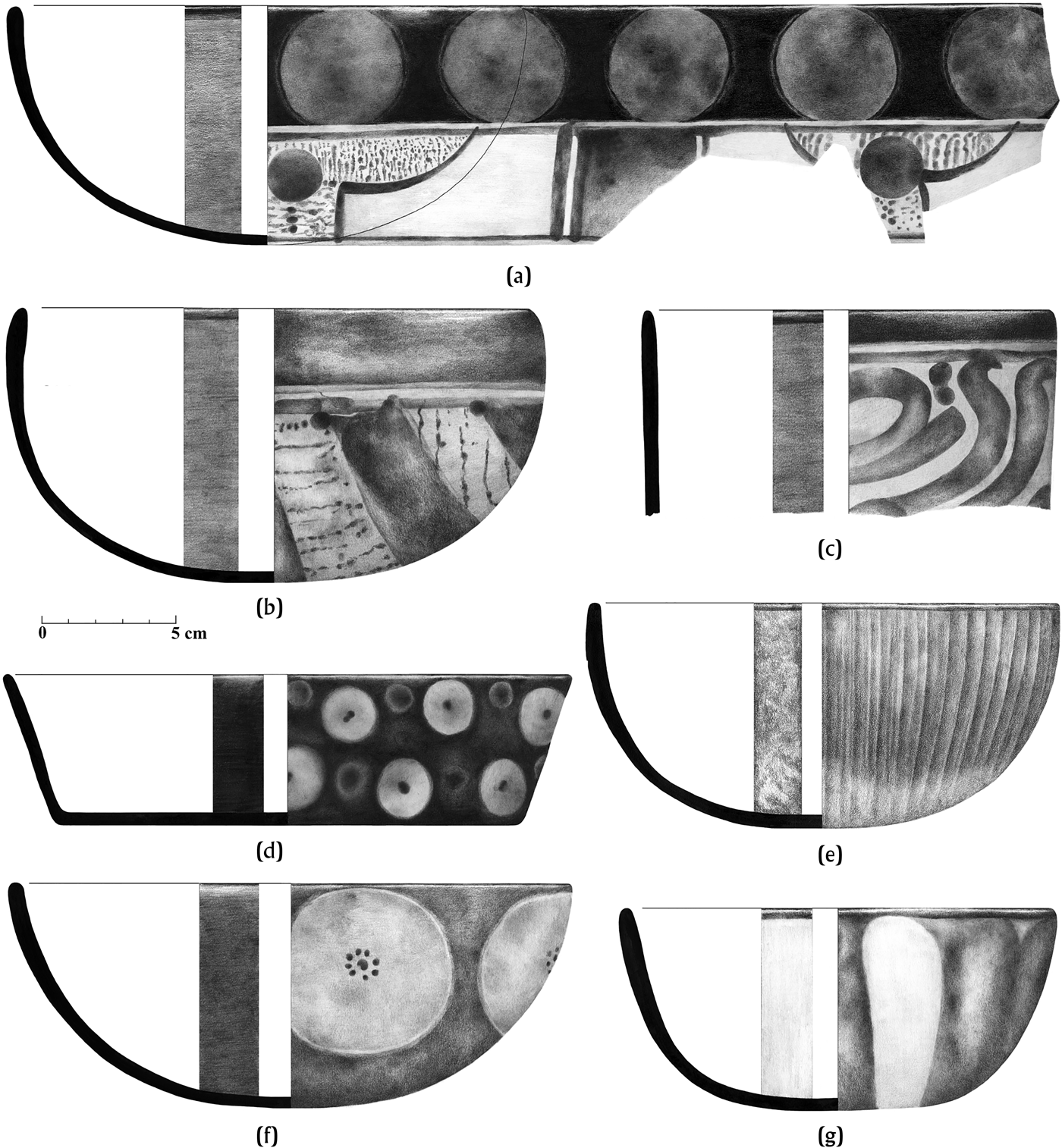
Chel complex polychromes. (a)-(c) Chimbote Cream-polychrome; (d) Moro Orange-polychrome; (e) Sagu Cream-polychrome; (f)-(g) Sayan Red-on-cream.
A second, visually and tactilely less dramatic parallel progression involving basins and jars only culminated in the appearance of Chemblas Black-on-slate (Ixpuhil Slate Ware), a very pale tannish grey to pale yellowish cream ware with a thin, streaky, low sheen finish. Based on the same paste fabric as the local unslipped wares, Ixpuhil Slate is closely related to the historically important, heretofore unallied Chintok-Xcocom Tancachacal, Pixtun, and Torote ceramic groups at Becan (Ball Reference Ball1977), as well as to the widespread Holactun Black-on-cream—Brainerd's (Reference Brainerd1958:32) “Holactun Slateware”— of the early Terminal Classic period.
How rapidly and by when these transformations took place, we are unable say, but they were certainly underway by early in the seventh century, and are easily likely to have resulted in the presence of true slateware by the early eighth century. Lorraine Williams Beck (personal communication 2004) deems the prevalence of brownish slip hues among the Acanmul slatewares to more closely relate to the Chenes regional ceramic tradition than the Western Puuc, but the authors’ own familiarities with Puuc, Western Puuc, and Chenes ceramics incline us to the former rather than the latter for affinities and affiliations.
Late Chel lots (ca. a.d. 750/760–780/800) are characterized by a small but constant occurrence of a diagnostically thinned, finer variant of Muna Slate which we have established as a distinct type, “Muncul Thick Thin-slate,” and assigned to the Ticul group and ware. We believe it to be the direct progenitor of true Ticul Thin-slate which itself appears in minute quantities toward the very end of Chel (Figure 16e–f).
Chel includes a number of fineware exotics that reflect extralocal contacts and interactions over the Late Classic period. Of the non-fine paste exotics recovered, most came from the Group A acropolis trash indicating their possession and use by local elites in formal or “official” activities. What their larger sitewide distributions and so availability might have been we have no data concerning. Even for Group B, our non-collapse/core deposits date largely from the very late Chel and subsequent Pa΄xil phases.
By far the most common and widespread exotics consisted of a varied repertoire of Chablekal group Fine Gray types (Figure 16 g–i, Table 2). These occurred exclusively as service ware–vases, bowls, tripod plates, miniatures–and were well represented in all excavations at both Groups A and B and in the Central Plaza. Whether originating from the lower Usumacinta or greater Palenque production zone (see Bishop Reference Bishop and van Zelst2003) remains to be determined, but typological attributes suggest the former rather than latter. Far less common but still better represented than most non-fine paste types were tripod dishes and miniature condiment saucers of Dzitbalche Orange-buff (established in Ball Reference Ball1977), a group known inland from Becan and El Tigre (Vargas Pacheco and Delgado Salgado Reference Vargas Pacheco and Salgado2003) and present at sites along the Campeche and Yucatan coasts from Sabancuy to Bocas de Dzilam and Vista Alegre, Quintana Roo (Ball Reference Ball1978:94–96; Ball et al. Reference Ball, Glover, Rissolo and Berdugo2010; Jiménez Alvarez et al. Reference Jiménez Alvarez, Gallareta, Sosa, Carrión and Cook2006; Piña Chan Reference Piña Chan1968; Ruz Lhuillier Reference Ruz Lhuillier1969). Rich collections of the Dzitbalche group from Jaina and Xcambo have enabled documentation of close stylistic and other modal ties to Late Classic Tres Zapotes, Cerros de las Mesas, and several sites in the Rio Blanco-Papaloapan basin (Jiménez Alvarez et al. Reference Jiménez Alvarez, Gallareta, Sosa, Carrión and Cook2006), and recent INAA analyses indicate the semi-fine paste group to in fact derive from the far western Tabasco-southern Veracruz area (Ronald Bishop, personal communication 2007).
Most common among non- fine paste exotics (these totaling 1.3 to 1.75% of recorded ceramics by weight depending on functional context) with variety-level identities to sites in other regions and paste variants indicating a non-local origin were Chimbote Cream-polychrome (Figure 17a–c; established in Ball Reference Ball1977) and Sagu Cream-polychrome (Figure 17e; Boucher Reference Boucher1989:490–495; established in Forsyth Reference Forsyth1983). The latter originally was lumped by Ball and Andrews (Reference Ball, Andrews V, Harrison and Wauchope1975) as “Hool Orange-polychrome” along with several other poorly known types present at many northern plains sites and common in early 1970s Merida collections resulting from extensive looting in northeastern and central Campeche (see Boucher Reference Boucher1989 for a definitive untangling of these). Both types enjoy widespread western and northern lowlands distributions with known occurrences extending from Becan and Edzna through the Chenes and Puuc zones to Dzibilchaltun and Coba (see Ball Reference Ball, Sabloff and Henderson1993:Figure 6 for a schematic of the Chimbote system). Domínguez Carrasco and Espinosa Pesqueria (Reference Domínguez Carrasco, Pesqueria, Pacheco and Castillo2007) recently have proposed Calakmul to have been the center of production for the Chimbote series, which seems reasonable in light of its Northern area distribution. Ball (Reference Ball, Sabloff and Henderson1993) has previously suggested this group to represent a less than regal status fineware, so its apparent absence from major Calakmul political partners to the far south and east such as Caracol in no way weakens this ascription. A somewhat rarer related pottery, Xbanil Beige-polychrome, (established in Ball Reference Ball1977) previously reported from Edzna, Becan, and Coba also occurs in Chel.
Slightly less well represented but still important were Cui Orange-polychrome (established in Ball Reference Ball1975; Forsyth Reference Forsyth1983:86–90) and Sayan Red-on-cream (Figure 17f–g; established in Ball Reference Ball1977). Cui is particularly common at Edzna and throughout the Chenes region, and also occurs at many sites in western Yucatan and on the littoral islets–Jaina, Piedras, and Uaymil. It does not appear farther east or south of this zone, however. Sayan enjoys a distribution that parallels but is more extensive than that of the visually similar but technologically superior and stylistically more complex Chimbote group stretching from at least as far south as Uaxactun (Ball Reference Ball1977) northeastward to the Yóokop and Coba area (Johnstone Reference Johnstone, Shaw and Mathews2005).
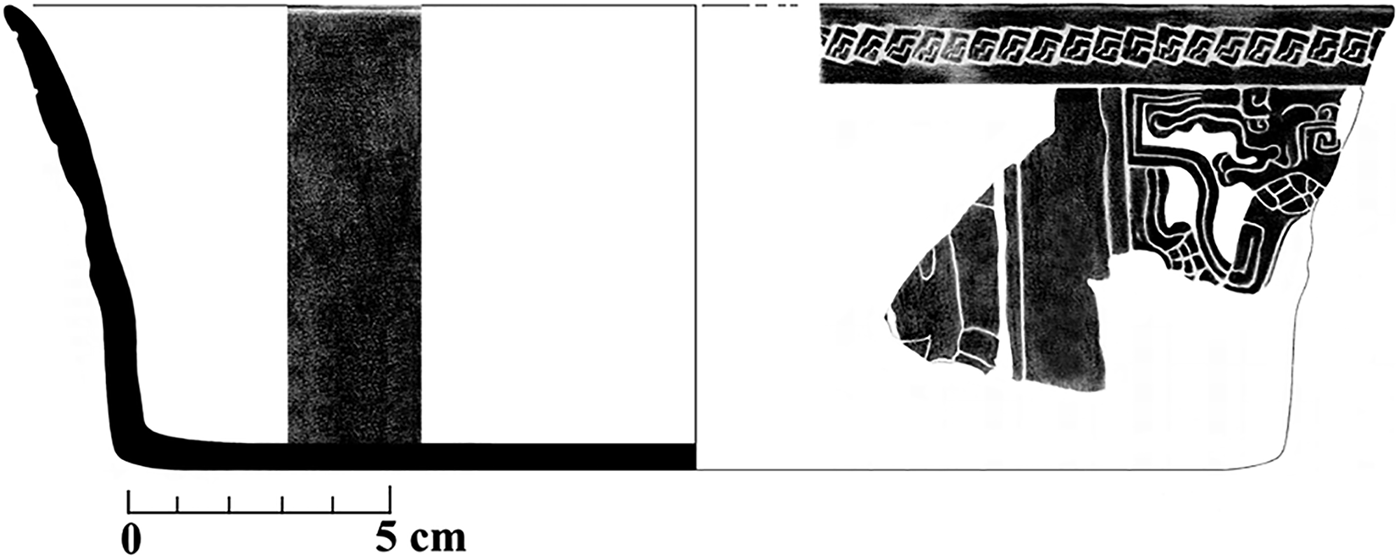
Closely following Cui and Sayan in frequency is Moro Orange-polychrome (Figure 17d; established in Ball Reference Ball1977), a beautiful and technologically complex double resist type abundant at Piedras Negras, common at Becan and other southeastern Campeche sites, and present at multiple Northern area sites throughout Campeche and Yucatan from Calakmul and Edzna to Dzibilchaltun and sites along the north coast. The type also occurs at Uaxactun (Smith Reference Smith1955:Figures 17, 20, 35b), but appears to be absent from the eastern peninsula and Belize with the possible exception of Coba (Robles Castellanos Reference Robles Castellanos1990:168–169). There is a trace occurrence of the exquisite late Tepeu 2 Achote group presentation and funerary ware, Torro Gouged-Incised (Figure 18).
Torro Gouged-Incised. Presentation/Gifting-quality vessel.
Both Saxche and Palmar Orange-polychrome are present but extremely rare, the latter being represented by only three sherds from all our excavations. It merits calling attention to the rarity to apparent absence of the many popular Peten-Belize and southern Quintana Roo gifting and exchange finewares such as Saxche, Juleki, Palmar, Zacatel, Petkanche, Azcorra, Benque Viejo, and Cabrito polychromes and Egoista Resist in contrast to the rich representation of western peninsula and lower Usumacinta ceramics. This suggests a strong western peninsula and Gulf coastal plain orientation for Acanmul with little inland or transpeninsular engagement or interest beyond the immediately proximate Chenes region, Edzna, and the Becan entrepôt (Ball and Taschek:Reference Ball, Taschek, Diehl and Berlo1989). The latter connections were to prove critical in the subsequent Terminal Classic Pa΄xil phase.
Strongly reinforcing a western littoral orientation is Acanmul's third most abundant Late Classic ware, Celestun Red (Figure 19; [established in Simmons Reference Simmons1979]). The developmental history of this pottery remains far from clear. First described from Ciudad Campeche by Ruz Lhuillier (Reference Ruz Lhuillier1969:143–145), the “ware” and several of its constituent groups and types were established formally by Michael Simmons (Reference Simmons1979) based on collections from Dzibilchaltun. It is heavily represented at Acanmul, but as elsewhere, there are no obvious indications as to its origins although its overall paste and unslipped surface characters are somewhat suggestive of Batres Red and Maxcanu Buff, and its limited form repertoire does very much suggest an attempt to mimic Dzitbalche Orange-buff.
Celestun Red Ware. (a)-(h) tripod dishes, plain (a)-(e), (g) and appliquéd (f, h); (i) basin.
A service ware occurring primarily in the form of tripod dishes and basin-bowls and only very rarely as wide-mouthed/high-necked jars, Celestun Red is well represented at coastal sites from Ciudad Campeche (Ruz Lhuillier Reference Simmons1969) and Isla Jaina (Piña Chan Reference Piña Chan1968) up the Campeche coast and around the Yucatan littoral (Ball Reference Ball1978; Jiménez Alvarez et al. Reference Jiménez Alvarez, Gallareta, Sosa, Carrión and Cook2006) to Emal on the Rio Lagartos (Kepecs Reference Kepecs1998) and Vista Alegre on Laguna Yalahau (Ball et al. Reference Ball, Glover, Rissolo and Berdugo2010). Its only confirmed “inland” occurrence other than Acanmul is at Dzibilchaltun. Not even Edzna (Forsyth Reference Forsyth1983), Xculoc (Arnauld Reference Arnauld, Michelet, Becquelin and Arnauld2000), or Oxkintok (Varela Torrecilla Reference Varela Torrecilla1998) with which Acanmul shares so much Late Classic pottery have produced any traces of this ware Its weak reddish brown to dirty cream slipped variants (recognized but not separately established by Simmons) do approximate a technologically inferior version of Puuc Slate or Dzitbalche Orange-buff (Jiménez Alvarez et al. Reference Jiménez Alvarez, Gallareta, Sosa, Carrión and Cook2006), and it has been suggested that it might have been a forerunner of the Terminal Classic Holactun “Slate” (Lorraine Williams Beck, personal communication 2004) or even Chichen Slate (see Kepecs Reference Kepecs1998:125). The divergence in form inventories of the latter two from the almost exclusively service-oriented vessels that make up the Celestun repertoire, however, as well as significant differences in the physical characteristics and colorations of the cream to white slips involved and the decorative emphasis on black trickle in the Holactun and Chichen series contrasted with its absence from Celestun Red types makes this unlikely in our opinion. The ware's principal Chel expression, the red Baca group, does closely resemble and frequently overlaps completely in tripod dish form and smutty brownish cream surface finish with Dzitbalche Orange-buff, and to a lesser extent with Puuc Slate. More compact, finer paste examples of cream-slipped Baca/Celestun Red are macroscopically actually sometimes difficult to distinguish from sherds of the semi-fine paste Dzitbalche group suggesting a deliberate local mimicking of the latter. There is a definite trend toward finer, more compact, less heavily tempered pastes in later Chel levels, and two developmental trajectories that do seem fairly certain resulted in the eventual divergence of a distinct Nimun Brown group (Simmons Reference Simmons1979; [see also Jiménez Alvarez et al. Reference Jiménez Alvarez, Gallareta, Sosa, Carrión and Cook2006.]) and the Edzna Muralla complex Chencan group (established Forsyth Reference Forsyth1983:121–123). The latter also is present on Isla Jaina and in the Acanmul Pa΄xil complex.
All in all, while it shares much of its general content with Western Puuc/northwestern coastal plain sites, and important specific minority wares and exotics with Edzna, Becan, and the broader central Campeche Chenes region, Chel is clearly and conspicuously a solid member of the newly defined Canbalam ceramic sphere of the Campeche-Yucatan littoral (Jiménez Alvarez et al. Reference Johnson2006; see also Ball Reference Ball1978:131–137). Based on the overall configuration of its ties and relationships, it is difficult not to see Acanmul as an important Late Classic coastal gateway between the Gulf and the central peninsula interior via both Edzna and the southern Puuc/Chenes corridor.
One important aspect of Chel phase Acanmul now essentially invisible is the extraordinary architectonic stucco sculptural art that originally graced its now ruined and collapsing buildings. Richly polychromed and exquisitely modeled/sculpted, the facades of buildings in both Groups A and B originally carried extensive ornate high relief programs as attested to by thousands of still vividly colored fragments peppering the upper levels of our excavations, and literally hundreds of limestone armature tenons from the collapse in front of Structure1, Group A and throughout Group B. Among the smashed and shattered fragments were volutes and mask elements as well as pieces of glyphic texts, zoomorphs, and finely sculpted life-size and larger than life portrait sculptures (Figure 12). No reconstruction of the programs represented was attempted due both to the very limited extent of our recovery and the fact that the facades had not simply collapsed and fallen but had been methodically torn down and smashed during the ninth century ravaging of the center and its elite public and private architecture. All the same, it is difficult not to see strong hints of stylistic ties to a broad southern Campeche-northern Chiapas-eastern Tabasco stucco sculptural tradition amidst the shattered debris.
Pa΄xil Cehpech Ceramic Complex, Cehpech Ceramic Sphere (ca. a.d. 780/800–860/900)
The late eighth/early ninth century saw a vigorous continuation of Acanmul's Classic florescence. There is considerable continuity in the local ceramic tradition, but enough significant additions and modifications to the existing assemblage took place during this time to incline us to take the somewhat unorthodox heuristic step of distinguishing a new ceramic complex and phase rather than merely recognizing a separate late facet for Chel (see Table 2).
Puuc Slateware, Ixpuhil Slate, Celestun Red, and the generic local unslipped ware all remain important, but they are joined by significant representations of true Puuc Redware (Teabo group), Ticul Thin-slate, Holactun Black-on-cream and several minor “competitors” that rapidly increase in popularity to the cost of the persisting majority Chel wares (Figure 20). Holactun Black-on-cream basins and jars rapidly displace similar forms of the long-lived local black-trickled brownish grey slateware (Chemblas Black-on-slate), for example, although Puuc Slate service wares–small ring-base bowls and rounded dishes–continue to be important. Celestun Red similarly is joined by and loses some popularity to technologically superior—thinner, harder, finer paste—and more consistent in appearance Nimun Brown jars and basin-bowls (Figure 21) and actual Dzitbalche Orange-buff tripod dishes which themselves increase markedly in frequency. Jars and basin-bowls of Chencan Brown-on-orange, popular at Terminal Classic Edzna (Forsyth Reference Forsyth1983), also claim some ground from Celestun Red percentages.
Pa΄xil complex finewares. (a) Teabo Red; (b)-(c) Ticul Thin-slate; (d)-(f) Provincia Plano-relief; (g) Dolorido Cream-polychrome; (h) Zanahoria Scored; (i)-(j) Tumba Black-on-orange.
Nimun Brown Ware. (j) undesignated trickled type; (a)-(f) jars; (g)-(j) bowls; (k) strap-handled jar; (l)-(m) basins.
Important inland connections to the north and northeast are indicated by paste variant-verified imports of clear translucent pink to translucent pearl gray slipped Muna Slate basins and bowls and some Ticul Thin-slate and Teabo Red vases, bowls, and tripod dishes. However, there is a varietal level identity between local Ticul group types and forms from Acanmul and those from Becan that is closer than anything we have ever before seen between two geographically distant sites (ca. 180 km). Similarly remarkable identities also extend to the distinctive variegated Achote group blackwares common to both sites (Ball Reference Ball1977:34–36, Figure 13d–h), and to the Ixpuhil Slate series and related tannish grey/grey wares present at each. Even the unslipped striated jars of Acanmul and Chintok/Xcocom Becan manifest varietal level modal identities in rim forms and striation handling. We believe the relationship to have been sequential as well as or even rather than contemporary with several specific classes of Xcocom ceramics at Becan deriving directly from Pa΄xil via either Edzna and the western Campeche lagunas zone or Tohcok and a central peninsula Chenes corridor (Ball and Taschek Reference Ball, Taschek and Aimers2013). We discuss this further below.
Continuing ties with Edzna, Becan, and other inland centers also are reflected in low frequencies of some possibly persisting Chimbote group types and the Sayan Red-on-cream group along with traces of Dolorido Cream-polychrome and Zanahoria Scored (Figure 20g–h; [established in Ball Reference Ball1977; Forsyth Reference Forsyth1983]), but it is Acanmul's earlier Gulf coastal orientation that becomes even more evident and pronounced over the late eighth-early ninth century Chel/Pa΄xil interface. In addition to the increased importance of Dzitbalche Orange-buff from southern Veracruz, Fine Orange Balancan-Altar group types–particularly Provincia Plano-relief, Tumba Black-on-orange, and Palizada Black-on-orange–from the lower Usumacinta and Tabasco coastal plain occur consistently and often “heavily” (regularly averaging 0.4–0.65% by weight) in all sampled deposits (Figure 20d–f, i–j). The still poorly defined Dzibilchaltun Fine Orange group is also well represented as continues to be Chablekal Fine Gray Paste-Ware. In sum, the Pa΄xil assemblage represents local ceramic continuity with change and an even more strongly marked emphasis on Gulf coastal interactions and connections together with a small suite of decided typological and modal ties to the central eastern Campeche Becan region.
There is a comparable progressive continuity in the contemporary Acanmul architectural tradition, with much new construction and refurbishment of existing buildings and courtyard pavements, and the appearance of some new stylistic elements as well (Ojeda Mas Reference Ojeda Mas, Castillo and Pacheco2010). Both stylistic attributes and construction techniques indicate continuing similarities and ties with the western and southern Puuc and place Acanmul fully within the southwestern margin of that architectural sphere.
At Group B, the south and central courtyards were resurfaced, and the north court either was added and enclosed at this time, or its flooring was extended northward to its now discernible architectural perimeter. Five test units excavated to bedrock within the courtyard indicated its northern two-thirds, at least, to be of full Pa΄xil date, and three slot excavations into the north side portal archway platform (Structure 81) and the higher terraced platform adjoining it on the west (Structure 83) identified both to be Pa΄xil phase constructions. Identifiable elements from the demolished portal indicated that it had been built and decorated in the full Classic Puuc Style (Andrews Reference Andrews1986, Reference Andrews1995; Pollock Reference Pollock1980).
Heavy occupational use of the southern central range buildings is evinced by deep primary refuse deposits off their front and rear terraces. On-floor trash in three of five refuse sampling trenches was of late Chel date, with all five accumulations terminating fully within the Pa΄xil timespan.
Continuing northward, other than the numerous ceramic and architectural traces strewn throughout its jumbled collapse debris, all evidence of the Pa΄xil phase use and construction histories of Group C was completely obliterated by the subsequent Machil occupation and overhauling of the group. The ballcourt playing field was resurfaced and repainted, and a fresh plaster skin was applied to its flanking ranges. On the great Central Plaza, the frontal stairway of the major eastside ancestor mountain, Structure 21, was refurbished and resurfaced, as was the plaza flooring itself, at least in the immediate vicinity of Structure 21.
Group A saw extensive refurbishments to the north acropolis including a major enlargement and elaboration of Structure 3 and the addition of the Structure 1–C second story building (Ojeda Mas Reference Ojeda Mas, Angles, Turriza and Flores2003, Reference Ojeda Mas, Pacheco and Castillo2007, Reference Ojeda Mas, Castillo and Pacheco2010). The north side surface of the Great Platform was substantially raised and resurfaced, and the platform was extended outward to the west and southward in front of Structure 1. The great monumental stairway was added at this time. Other modifications have been obscured by later Machil renovations and additions, but in many respects, the early Pa΄xil/Puuc Colonnette Style interval represented something of a developmental climax at Acanmul. Of the three painted K΄awil capstones encountered, at least one and possibly two can be assigned to this time.
Roughly one kilometer south of the hillock supporting the Acanmul center core on the south bank of the ancient Rio Hontun channel sits the Uerek Plaza Group (Figures 2 and 22). Measuring roughly 90 × 60 m, the group includes another Western Puuc-style columned building, a Chichen/Mayapan-like “castillo” (Structure 170), several range platforms, one apparent shrine (Structure 154), and a masonry escalade or stairway descending to and into the present, silted over surface of the Rio Verde flood channel (Structure 155). Williams Beck (Reference Williams Beck2001, Reference Williams Beck2003a) has suggested and we too believe the complex to have been an embarcadero or docking facility for maritime canoe traffic that would have had easy access to this point throughout the rainy summer through early winter months. Its physical separation from the Acanmul regal-residential/ritual center is exactly in line with a role in the general or quotidian as opposed to the prestige economy (Ball and Taschek Reference Ball and Taschek1992), but this remains to be determined by future investigation.
Uerek “Embarcadero” Plaza Group plan identifying structures discussed in text.
Both the visible architecture and surface ceramics suggest an occupational use history spanning both the Pa΄xil and subsequent Machil phases. It is noteworthy that the group did not experience the savage ravaging and razing found throughout the main center, suggesting that its preservation and continued use were as important a part of the events involved as was the seizure and deactivation of the administrative center itself. Indeed, we believe it likely to have been the embarcadero's existence and functionality and its forceful appropriation that may well have been a determining factor behind the attack on Acanmul. Control of the Rio Hontun transshipment gateway to the Gulf ensured dependable, safe, year-round access to the surface current based maritime Mexican trade (Figure 23) irrespective of any potential otherwise seasonally unfavorable conditions—an important prize for the international commercial interests of Chichen Itza or any other northern lowland capital. An important task still remaining to be completed is an in depth mustering of information on the hydrology and historical navigability of the lower Rio Verde drainage zone. In its absence, the proposed model must remain more hypothesis than inference as Charlotte Arnauld very correctly observed in her review of this article.
Chart of oceanic surface currents affecting the Yucatan peninsula showing highly advantageous nexus-position occupied by Acanmul.
In the absence of excavation, neither the actual construction date nor use history of the Uerek embarcadero group can be stated with certainty, and it is possible that it was built as early as the Chel phase—if not earlier. Of particular importance is verification of the actual physical form and dating of Structure 170, the “castillo”-like pyramid that dominates the ruined group. All that we can say surely at this point is that surface remains do document occupational use during both the Pa΄xil and Machil phases, and at least some of the visible architecture would support a Chel date. No evidence of the Late Postclassic Kaxan phase was observed, but this too is not definitive.
If Acanmul did function as a fluvial littoral entrepôt for Gulf coast maritime canoe traffic, it would not have done so in isolation, but as part of a larger network of similar related facilities. Investigations along the Campeche-Yucatan littoral have identified a string of just such probable port facilities at Champoton (Ek Reference Ek and Braswell2012; Folan et al. Reference Folan, López, Heredia, Hernández Trujeque, Florey, Bolles, Gunn, Domínguez Carrasco, Pacheco and Castillo2007), Isla Jaina (Benavides Castillo Reference Benavides Castillo, Castillo and Pacheco2010; Reference Benavides Castillo2012), Isla Piedras (Inurreta Díaz Reference Inurreta Díaz2006), Uaymil (Inurreta Díaz Reference Inurreta Díaz2004; Inurreta Díaz and Cobos Palma Reference Inurreta Díaz, Cobos, Laporte, Arroyo, Escobedo and Mejía2003a, Reference Inurreta Díaz and Cobos2003b), and Punta Canbalam (Dahlin et al. Reference Dahlin, Andrews, Beach, Bezanilla, Farrell, Luzzadder-Beach and McCormick1998; Dahlin and Ardren Reference Dahlin, Ardren, Masson and Freidel2002), and documented the existence of a wide-ranging coastal maritime interaction network and associated market centers (Dahlin and Ardren Reference Dahlin, Jensen, Terry, Wright and Beach2002; Dahlin et al. Reference Dahlin, Jensen, Terry, Wright and Beach2007; Varela Torrecilla and Braswell Reference Varela Torrecilla, Braswell and Braswell2003) operating from late Early Classic times on through at least the Terminal Classic era. The presence of classic talud-tablero architecture of possible sixth to early seventh century date in the form of a west-facing platform buried deep within the Group A acropolis (Ojeda Mas Reference Ojeda Mas, Castillo and Pacheco2010:223–226, Foto 4) lends credible support to Acanmul's possible involvement in such far-reaching interactions from at least that early.
Pa΄xil and the Terminal Classic Florescence at Becan
One other matter pertaining to Pa΄xil's transformation and the concomitant Acanmul sacking that requires discussion is the well documented sudden appearance and subsequent developmental persistence of a substantial suite of Pa΄xil types and modes at Becan and in its immediate environs coevally with the apparent displacement of this assemblage at Acanmul (Ball and Taschek Reference Ball, Taschek and Aimers2013). This involved not merely the continuation of already shared elements at Becan, but a large-scale appearance of types, forms, finishing technologies, and decorative modes previously occurring only at Acanmul and extending to actual imported vessels in some instances while in others even initiating new production technologies (Ball Reference Ball1977; Ball and Taschek Reference Ball, Taschek and Aimers2013). It is difficult not to see some connection between these occurrences, both loosely datable to the early to middle ninth or early tenth century, and both feasibly associated with actual ambulatory populations rather than pottery vessels and ideas alone.
While there is yet precious little data to document an expulsion or flight of Pa΄xil elites and attendants from Acanmul, there is credible ceramic evidence suggesting their contemporaneous appearance at Becan and identity with that site's long ago recognized Xcocom intrusion (Ball Reference Ball and Andrews IV1974, Reference Ball1977; Rovner Reference Rovner1975; Rovner and Lewenstein Reference Rovner and Lewenstein1997). The supporting data and arguments are complex, and have been presented in a separate study (Ball and Taschek Reference Ball, Taschek and Aimers2013). A number of alternative scenarios are possible based on the available data, and we do not intend to attempt anything here beyond stimulating future investigators to reexamine chronologically relevant contexts at both Becan and Acanmul so as to effectively address this historically important and very solvable archaeological mystery.
All alternatives fundamentally involve a real population movement into a then largely vacant (Chintok phase) Becan locality from a generic western Puuc ceramic tradition zone sometime in the early to middle or late ninth century.Footnote 8 Such a scenario is at first glance seemingly at odds with all generally accepted, conventional constructions of Becan-Rio Bec cultural history (for example, Ball Reference Ball and Andrews IV1974, Reference Ball1977; Bueno Cano Reference Bueno Cano1999; Nondédéo Reference Philippe2003; Nondédéo et al. Reference Nondédéo, Patrois, Lacadena, Arnauld, Taladoire and Michelet2011; Taladoire et al. Reference Taladoire, Dzul, Nondédéo and Forne2013), but it is very much in sync with available data as newly reexamined and reassessed (Ball Reference Ball2014; Ball and Taschek Reference Ball, Taschek and Aimers2013), and as has long since been hinted at by a number of seemingly “anomalous” findings identifying major architectural activity at Becan and Chicanna during the Terminal Classic Xcocom ceramic phase and dating well into the eleventh or even twelfth centuries (Bueno Cano Reference Bueno Cano1987, Reference Bueno Cano1999; Carrasco Vargas Reference Carrasco Vargas1989; Nondédéo et al. Reference Nondédéo, Patrois, Lacadena, Arnauld, Taladoire and Michelet2011).
Judicious review of the Becan hinterland settlement data indicates only a light, scattered Chintok or Xcocom presence outside the great ditch-and-parapet system in contrast to heavy, dense Bejuco and earlier population (Thomas Reference Thomas1981). There is a concentration of Xcocom occupation in standing structures on platforms, both in close proximity to the center and elsewhere, but only an ephemeral Xcocom or Chintok presence farther afield. In an exhaustive synthesis of occupational and architectural data for the overall Rio Bec zone and Becan, Nondédéo et al. (Reference Nondédéo, Patrois, Lacadena, Arnauld, Taladoire and Michelet2011:50; also Nondédéo Reference Philippe2003) too remark on the significant depopulation of the Becan hinterland and a simultaneous or subsequent population surge or concentration within the center core and in its immediate environs coincident with the Chintok/early Xcocom ceramic phase. They go on to describe an apogee of architectural activity associated with the full Terminal Classic Xcocom phase, with major emblematic architectonic undertakings at Becan, Chicanna, Xpuhil, and other zonal sites (Campaña Valenzuela Reference Campaña Valenzuela2005, Campaña Valenzuela and Boucher Reference Campaña Valenzuela and Boucher2002; Nondédéo et al. Reference Nondédéo, Patrois, Lacadena, Arnauld, Taladoire and Michelet2011:50–54; [also Bueno Cano Reference Bueno Cano1987, Reference Bueno Cano1999; Carrasco Vargas Reference Carrasco Vargas1989, Reference Carrasco Vargas1994]).Footnote 9 Importantly, these and other researchers (Arnauld et al. Reference Arnauld, Gongóra, Déodat, Castillo and Pacheco2010; Dzul Gongóra and Taladoire Reference Dzul, Taladoire, Castillo and Pacheco2010:127, Cuadro 2; Nondédéo and Dzul Gongóra Reference Nondédéo, Gongóra, Castillo and Pacheco2010:120, Grafica 4; Taladoire et al. Reference Taladoire, Dzul, Nondédéo and Forne2013) have continued to employ the now forty years old Becan ceramic study (Figure 24; Ball Reference Ball1977) for the relative and absolute chronologies and relationships of the late ceramic phases involved, whereas a close scrutiny and reassessment of these coupled with later pertinent architectural data and radiocarbon determinations from Chicanna suggest that a radical revision of them is in order (Figure 24; Ball Reference Ball2014; Ball and Taschek Reference Ball, Taschek and Aimers2013; Bueno CanoReference Bueno Cano1987; Carrasco Vargas Reference Carrasco Vargas1989).
Comparative Ceramic Chronologies Chart including original (1977) and revised (2014) Becan columns.
Much of the problem stems from the weak original definition and establishment basis of the late late Classic/early Terminal Classic ceramic complex, Chintok, a circumstance that four decades of extensive subsequent field and lab work have failed to improve on (Campaña Valenzuela et al. Reference Campaña Valenzuela, Diego, Solís, Vierna, Vega, Alonso and Valverde2000, Reference Campaña Valenzuela, Torres, Góngora and Solís2001, Reference Campaña Valenzuela, Torres, Tsukamoto and Benavides2004; Dzul Gongóra and Taladoire Reference Dzul, Taladoire, Castillo and Pacheco2010; Nondédéo and Dzul Gongóra Reference Nondédéo, Gongóra, Castillo and Pacheco2010). In particular, the factored distinction of Chintok from Xcocom may well be more arbitrary than real (see Ball Reference Ball2014; Ball and Taschek Reference Ball, Taschek and Aimers2013), and may more likely reflect differential access circumstances among the overall Terminal Classic (Xcocom) population than it does purely temporal factors. Noteworthy also is a complete and total disjunction between full Late Classic Bejuco complex ceramics and the diagnostic groups and types that make up the Chintok-Xcocom continuum, a fact recognized by the senior author 40 years ago (Ball Reference Ball1977), but not appreciated as to its likely significance. Combined with now available construction history and settlement data (Campaña Valenzuela et al. Reference Campaña Valenzuela, Diego, Solís, Vierna, Vega, Alonso and Valverde2000, Reference Campaña Valenzuela, Torres, Góngora and Solís2001, Reference Campaña Valenzuela, Torres, Tsukamoto and Benavides2004; Dzul Gongóra and Taladoire Reference Dzul, Taladoire, Castillo and Pacheco2010; Nondédéo Reference Philippe2003; Nondédéo and Dzul Gongóra Reference Nondédéo, Gongóra, Castillo and Pacheco2010; Thomas Reference Thomas1981), this very much suggests a real occupational discontinuity or break between the two assemblages. The authors now believe it probable that the Becan Late Classic “collapse” actually corresponded with the end of Bejuco, and that the center lay abandoned for some indeterminate length of time before its revitalization and refurbishment by regional hinterland and more exotic populations represented by the appearance of Chintok-Xcocom ceramics. Following an intensive reassessment of the Chintok and Bejuco assemblages and their chronologies (Ball Reference Ball2014; Ball and Taschek Reference Ball, Taschek and Aimers2013), we have reevaluated the most likely date for the end of Bejuco to be ca. a.d. 745/755, and have revised the probable inception of Chintok from ca. a.d. 730/750 to around 800/820, or even later. The revisionist Becan chronology proposed (Figure 24) holds significant ramifications for the dating of the dependent areal occupational, architectural, and general cultural histories that are far beyond the scope of this article to explore (see Ball Reference Ball2014).
Machil Sotuta Complex, Peripheral Sotuta Sphere (ca. a.d. 860/900–1050/1150)
As the ninth century progressed, Pa΄xil neither evolved perceptibly nor was it replaced by another distinct, new assemblage. Instead, the complex was transformed by the addition of a constellation of intrusive new minority ceramics and associated modes coincident with the sacking and occupation of the Acanmul center by a “foreign” northern force that may have emanated ultimately from Chichen Itza.Footnote 10 Far from marking an end to the center's active history, however, this cataclysmic event heralded the beginning of a new occupational episode, and the appearance of a new ceramic assemblage, the Machil complex. As in the case of Pa΄xil, the Machil complex is most accurately characterized as a subset or subcomplex of exotic pottery added to a continuing body of locally manufactured domestic utilitarian wares minus most to all of the minority exotics associated with Pa΄xil (Table 2 and below). It includes substantial quantities of Silho (X) Fine Orange (multiple types and forms; Figure 25a–f), grayish green trending Tohil Plumbate (groove-incised pedestal snifters and tripod dishes), true Chichen Redware, true Chichen Slateware (Balantun Black-on-slate; Figure 25j), and Chichen Unslipped incensarios (Espita Appliqued and Cumtun Composite; Figure 25g–i). It is also accompanied by central Mexican green obsidian and chert dart points (Figure 26a). The subcomplex appears conjointly and in significant quantities strewn heavily wherever it is represented. It succeeds the savage ravaging and demolition of much of the Acanmul center, especially in areas of elite residence and sociopolitical importance. Areas and individual structures that were spared were made use of by those associated with the intrusive Machil ceramics, not only for habitation—for example, Structures 1, 10, 64, 65—but also for presumed economic activities—the Uerek embarcadero—and even ritual devotions–Structure 63.
Machil complex diagnostic wares. (a)-(f) Silho Fine Orange: (a), (d)-(e) Yalton Black-on-orange; (b) Pocboc Gouged-Incised; (c) Kilikan Composite; (f) Cumpich Incised; (g)-(i) Chichen Unslipped censers from Group C, Structure 63: (g) Cumtun Composite; (h)-(i) Espita Appliquéd; (j) Balantun Black-on-slate (Chichen Slate).
Machil phase lithic artifacts. (a) chert dart point, Group B, south court floor; (b) limestone sledge bit from demolished entry portal (Structure 81), Group B, north side.
All examined sherds of the aforenoted Machil diagnostics represented actual imports based on paste character and varietal-level identities to central northern plains types. In a sense, the introduced ceramics might be thought of as socioculturally recognizable insignia or symbols of the invaders or their homeland. Most are lighter, more portable service and consumption vessels or censers with the noteworthy exception of a good number of Chichen Slate basins (Figure 25j). Whether representing a foreign “elite” or just a foreign subcomplex, they combined with a continuing base of local wares for quotidian purposes. Given the overall basic form/function repertoire shared generally throughout the Maya lowlands, the adoption of available local pottery as opposed to the large-scale transport of homeland wares–or potters–for quotidian purposes was a viable and logical strategy.
Continuing ware-traditions included unslipped plainware jars and buckets, Holactun Black-on-cream basins and jars, and Nimun Brown jars; but neither the fine nor coarse paste variants of the Celestun Red series. It is unclear from the recovered collections whether Ticul Thin-slate vessels occur as components of Machil or not. This will have to be resolved by more extensive sampling of pure Machil deposits in the future.
The defining non-ceramic cultural feature and event demarcating the Machil phase was the savage ravaging and demolition of much of the center. In Group B, all examined buildings had had their façades ripped off, and the fallen stucco sculptures showed clear evidence of having been smashed after hitting the ground. The north side portal archway was torn down literally to the supporting building platform, and its decorative stucco and stone mosaic friezes were battered so savagely that several of the cherty limestone sledges used themselves shattered and were tossed among the debris (Figure 26b).
Five dispersed 1 × 2 m test units excavated in the north courtyard of Group B uncovered a consistent thin scatter of unslipped plainware, Chichen Slate, Silho Fine Orange, Tohil Plumbate, green obsidian, and one atlatl dart point that we believe suggest its use as a short-term bivouac area for the invading force. The scatter is directly on floor, and the forest-floor humus formed directly over it suggesting a brief but significant occupation. Group B thereafter was abandoned, and we saw no evidence of subsequent repairs or reoccupation.
A similar scenario was played out at the sociopolitically significant ballcourt that was leveled to a point of virtual unrecognizability before its playing alley was filled with marl and rock nearly to the level of the banquette slopes. Several Silho group sherds were recovered from within the marl fill along with more expectable thin slates and blackwares. The limestone rings were shattered, and a large section of one was buried in a conical pit in Group C along with a fistful of green obsidian blade segments. This came to light purely through the serendipitous fortunes of our purposive sampling procedure. While visiting our ongoing excavations in 2004, David Johnstone (personal communication) pointed out that an identical process of marl-capping and burial characterized the Itza sacking and destruction of Yaxuna, and appears to have formed a significant aspect of Itza conquest ideology and practices. A similar but even thicker (1.2 m+) deposit of layered marl was recorded in two open trenches previously excavated by Ojeda Mas at the southeast corner entry to the Group A courtyard where falling debris from the ruined Structure 11 would have settled (David Johnstone and Jennifer Taschek, personal observation 2004). Whether related or not is not known, but the culturally ceremonial location and the stratigraphically indicated temporal placement of this deposit would seem to identify it as similar in nature and origin to that in the ballcourt.
In Group C, Structures 66 and 65 both produced evidence of Machil phase occupation and prolonged residential use in the form of associated primary and secondary refuse concentrations. In contrast, the Structure 64–3rd columns were pulled down and rolled into the courtyard and several were smashed. The associated building was torn down and much of its supporting platform chopped away, and a new structure, 64–2nd, was built over the remaining stump. Subsequent demolition of 64–2nd in the Late Postclassic and the concurrent reconstitution of the platform as an apparent shrine, Structure 64–1st, meant that the onetime existence of the Machil phase platform and a likely associated superstructure was all that could be established.
The courtyard patio was raised some 48 cm and refloored, the new pavement turning up on all four platforms comprising the group. Structure 63, the squarish Early Classic platform, was maintained and possibly even refurbished for activities involving the front-side use and depositional smashing of Espita Appliqued spiked bowl-censers (Fig 25h–i). Immediately in front of and intersecting the basal riser on the centerline of Structure 63, a conical pit 166 cm in diameter was dug down 115 cm through all earlier floors and the underlying soil horizon into sascab. The pit mouth from the new patio flooring down to the Late Classic Chel pavement was lined with reused facing stones seated in a shallow trench cut into the earlier floor. When excavated, this stone lining projected slightly above the level of the Machil floor. No evidence of a cap or sealing was identified, so whether the pit sat open or was closed over in some way is uncertain. From within it were recovered a plain limestone ballcourt ring fragment along with a handful of green obsidian blade segments, a large chunk of yellow chert, and half a conch shell. An essentially identical contemporary deposit–also ascribed to an “Itza” intervention–was found within the “Anexo de los Cuchillos” at Edzna where a broken Early Classic ballcourt ring fragment and multiple green obsidian blades were found (Luis Millet, personal communication 2004). A third comparable deposit has been reported from Oxkintok (Rivera Dorado Reference Rivera Dorado and Prem1994:56–57), and yet a fourth is known from Uxmal (Carmean et al. Reference Carmean, Dunning, Kowalski, Demarest, Rice and Rice2004).
The Group A acropolis saw the addition of two new vaulted chambers at the southwest base of Structure 1–A, and a series of smaller but complex construction efforts along the west and north sides of the Great Platform (Ojeda Mas Reference Ojeda Mas, Angles, Turriza and Flores2003, Reference Ojeda Mas2006, Reference Ojeda Mas, Pacheco and Castillo2007, Reference Ojeda Mas, Castillo and Pacheco2010; Ojeda Mas and Sanchez López Reference Ojeda Mas and López2001). At some point, a classic C-shape building was added to the platform immediately west of Structure 1, and a nice Machil refuse deposit accumulated off terrace below this. A maze of footings and fallen wall sections to both the south and north of the C-shape building indicated that it had been part of a complex of smaller constructions along the west side of the Great Platform spanning the late Pa΄xil through Machil phases (Figure 3). Structure 5 on the north edge of the platform's northeast patio also served as a residence during Machil, and we recovered the intrusive flexed bundle burial of a young adult female accompanied by one Yalton Black-on-orange tripod dish (Figure 25a) and a bone weaving/hair pick from beneath its floor.
One Group A structure that did experience deliberate demolition, presumably in conjunction with the Machil occupation, was the upper building platform and shrine of what can still be seen to have been a very fine example of Classic Puuc Colonnette Style architecture, Structure 3–1st (Ojeda Mas Reference Ojeda Mas, Pacheco and Castillo2007:36, Foto 5). We suspect this to have been a ritual building associated with the Chel-Pa΄xil rulership of the center, so its symbolic partial destruction is quite understandable and parallels that of the central ballcourt. Leaving its recognizable stump in place on the platform also made a clear and unmistakable statement of subjugation.
On the lower courtyard, Structure 10 was enlarged and converted into a multistory residential apartment building similar to Structure IV at Becan (Andrews Reference Andrews and Andrews1999:129–155). Directly across the courtyard on the Structure 10 centerline, Ojeda (Reference Ojeda Mas, Pacheco and Castillo2007:42; Foto 7) cleared and restored Structure 15, a small platform-based shrine interposed between the southeast end of the Great Platform and the north side of Structure 11 that effectively served to plug and so close the only existing unrestricted ground level access to the Group A complex. The structure had begun as a Proto-Puuc Style stair-fronted platform contemporaneously with Structure 3-2nd to its immediate north, but unlike the latter talud-tablero unit, it was maintained and refurbished for centuries, undergoing a significant renovation and enlargement during the Terminal Classic Pa΄xil or Machil phase, and showing evidence of continuing ceremonial use even in the Late Postclassic in the form of scattered Chen Mul Modeled-style incensario fragments (Ojeda Mas Reference Ojeda Mas, Pacheco and Castillo2007, Reference Ojeda Mas, Castillo and Pacheco2010).
Structure 3–2nd, in contrast, which had already been chopped back and partially buried by late Chel and Pa΄xil construction, was further dismantled and hidden behind a two chamber, columned entry sweat bath most likely added to the Group A complex during the Machil phase based on dateable floor articulations and a superpositioned relationship to the Pa΄xil-dated grand stairway of the Great Platform.
At the Uerek Embarcadero Group, no obvious demolition or destruction was in evidence. Even the Uerek Columns Building was allowed to stand until eventually claimed by natural collapse. It is conceivable that the mini-castillo (Structure 170) dates to this occupational phase, but that remains to be determined. What was clear from surface remains—sherds of plumbate and Silho Fine Orange; green obsidian—is that the group was occupied and likely utilized during the Machil phase.
How long Machil lasted and when it ended is an open question. If it reflected a lightning raid to sack and destroy Acanmul, its duration might well have been brief with site abandonment not long following the successful attack. The authors are convinced, however, that the attackers’ underlying purpose was not the destruction of the river-based port facilities present at the site, but their seizure and control for the benefit of their own polity's maritime activities. We therefore see the length and fate of the Machil occupation tied directly to that polity's history, i.e. to that of Chichen Itza. Depending on whether the most recent, revisionist chronology (Cobos Palma Reference Cobos Palma, Demarest, Rice and Rice2004; Ringle et al. Reference Ringle, Bey, Freeman, Hanson, Houck, Smith, Demarest, Rice and Rice2004) for that center or the traditional one is employed, abandonment of Acanmul probably followed close on the collapse of Chichen, and this would put it at either shortly after a.d. 1050, or just before a.d. 1200. We, ourselves, favor an earlier dating.
The Late Postclassic: Kaxan Tases Subcomplex, Peripheral Tases Ceramic Sphere (ca. a.d. 1150(?)–1450(?))
Sometime after the Machil abandonment of Acanmul, a final episode of pre-Contact reoccupation took place at the center. This may as likely have involved several small, short, discrete events as a single extended one, but that could not be determined. At least two single household domestic loci were detected, one at Structure 65 (Group C), and one on the northeast corner of the Group A acropolis platform. Their evidence consisted of several broken dishes and bowls of Mayapan-era Panabchen Red and Panaba Unslipped (Figure 27), a few jar fragments of Yacman Striated, and some use-worn chert flakes scattered in the humus and uppermost surface debris of Structures 65 and 5.
Kaxan complex pottery, Structure 65, Group C. (a) Panaba Unslipped tripod dish; (b) Panabchen Red tripod dish.
The most significant Kaxan phase event recorded at Acanmul involved the refurbishment and reactivation of Structure 64 as a shrine. Excavation revealed that the previously remodeled Structure 64–2nd was once again leveled to the upper surface of its building platform, and the front side of this was chopped out resulting in core spillage and floor slump. For some reason, all of the removed platform facing stones were then rotated and replaced so that their convex backs became the new terrace face. The spilled subfloor core was replaced with basket loads of rounded cobbles, and a scavenged mishmash of reused limestone blocks and facing stones was used to raise the platform level into a truncated pyramidal form. Two of the massive, plain, Chel phase columns rolled down into the courtyard during Machil were pulled upright and reset atop the loose core bedding to frame a new entryway (Figures 28–29). Set 56 cm apart, both are tilted due to irregular settlement of the erratically laid and inadequately tamped core beneath. At various times in the past, small flat stones were inserted under the base of each, and flat stone slabs had been wedged between each column and the surrounding core to help straighten and brace them.
Structure 64, Group C from northwest, Late Postclassic shrine-room and reset Classic period columns.
Structure 64 from south, Classic columns reset to frame entry to Postclassic shrine.
Behind the columns two courses of scavenged limestone slabs were set on their edges to define a small summit room. A scavenged lintel was placed against the rough mampostería back wall to serve as a bench or altar suggesting identification of the building as a “shrine” (Figure 28). Fragments of four or more vividly painted, full-figure Chen Mul Modeled-style censers were scattered throughout the room with flecks and chunks of charcoal, a limestone turtle effigy, and a solid, flat, dressed limestone disk 31 cm in diameter and 6.5 cm thick. We believe the disk to be a curated or recovered playing alley marker from the demolished ballcourt.
Directly in front of the columns, a number of flat stone slabs had been set on edge into the top of the unconsolidated rock core to form a crude stone box (Figure 29). The topless box contained sherds of at least one Chen Mul Modeled-style censer in a dirt and charcoal matrix. Although there is no formal frontal stair nor any evidence of the onetime existence of one, a series of irregularly placed flat slab stepping stones balanced in the surface of the structural core lead from the present plaza level to the stone box in front of the columns and on into the small shrine room behind them. The placement of these stones may be fairly recent in that the presence of several early twentieth century medicine bottles in the southside collapse suggests that the shrine may have continued in use to that time. That noted, a single Chen Mul-style censer was found standing on the slope in front of the building.
Immediately alongside Structure 64–1st, the abandoned Structure 65 platform was widened to the north and extended to the west. We found no indications of any superstructure, but the upper mound surface was so severely disturbed as to preclude identifying even a new building platform. A small primary refuse deposit including tripod dishes and jars of Panaba Unslipped and Mama Red was scattered off the north and west sides. Although broadly contemporary, there is nothing necessarily linking this occupational evidence with the renovation of 64–1st as a shrine, an action that we date to the fourteenth century. For the overall phase, we follow the most recent redatings of the northern plains Sotuta, Hocaba, and Tases complexes by Robles Castellanos (Reference Robles Castellanos, Carrión and Cook2006) and Ochoa Rodriguez (Reference Ochoa Rodriguez, Carrión and Cook2007).
CONCLUSION
The independent UAC, UAC-SDSU, and CRC-INAH investigations at Acanmul have provided limited yet in-depth architectural and ceramic information to complement the more extensive but superficial data produced by several regional surveys in central coastal Campeche (Eaton Reference Eaton1978; Ek Reference Ek and Braswell2012; Pollock Reference Pollock1980; Ruz Lhuiller Reference Ruz Lhuillier1969; Williams Beck Reference Williams Beck1998). They thus fill a significant gap in our archaeological knowledge of the area. The site demonstrates a routine developmental history for a second order central or southern lowlands regional center, having first been occupied in the Middle Preclassic by Northern area affiliated populations, and attaining the status and roles of a major organizational center by the third century a.d. From the start, while exhibiting an urban plan far more typical of southern or central lowlands centers, the site's architecture and ceramics tie it clearly and closely to Northern traditions. Architecturally, its earliest identified public architecture conforms to the Northern Megalithic Construction Tradition. By the Late Classic, Acanmul builders were working fully within a provincial version of the Early Puuc-Colonnette Puuc tradition, and while the Late Classic palace architecture of Group B does bear similarities to construction styles of the Tabasco-Chiapas coastal plain and greater Peten, it should be kept in mind that many aspects of these are equally characteristic of the Early Oxkintok (Andrews Reference Andrews1986, 1995) and other pre-Puuc “Early Period” (Andrews IV Reference Andrews IV, Wauchope and Willey1965) northern styles.
Ceramics tell a separate but similar story. From the Middle Preclassic on, Acanmul's pottery is Northern with significant ties to Western Puuc traditions and even more pronounced participation in a western littoral sphere extending roughly from Ciudad Campeche to Dzibilchaltun (Jiménez Alvarez et al. Reference Jiménez Alvarez, Gallareta, Sosa, Carrión and Cook2006). Together, its ceramic and architectural configurations place the site firmly within the Western Puuc-Campeche littoral cultural sphere, albeit on the far southwestern margin thereof (see Benavides Castillo Reference Benavides Castillo and Prem2003).
Acanmul's role as a gateway entrepôt between Mexican mainland maritime commerce and the interior central and northern lowlands is reflected in the exotic ceramics found at the center. These trace direct connections southward along the coastal plain to Tabasco-Chiapas and Veracruz, and also inland to Edzna, Becan, the Chenes region, and the greater Puuc area. The center's chief advantage lay in its strategic geographic situation with respect to the convergence of the bidirectional Gulf Stream currents; the existence of significant local fresh water resources; and the sheltered natural port for coastal canoe traffic represented by the lower Rio Hontun—a circumstance clearly recognized and taken advantage of in the construction of permanent port facilities including all-weather masonry wharves and supporting plaza (embarcadero) groups.
For all the importance of its likely role as a major gateway port for the central peninsula, Acanmul's archaeology might still have presented little out of the ordinary had it not been for one specific historical event—its extensive, systematic razing and apparent occupation by an alien but related Northern peninsula force sometime in the mid to late ninth century. Both the demolition of specific buildings and the selective partial truncation of local material cultural traditions are plainly documented in the site's archaeology. Less certain are the identity and purpose of the intruders, but two aspects of the continued site occupation shed meaningful light on these. The abrupt, conjoined appearances of Silho group orangeware, Tohil plumbate, Chichen Slateware (Balantun Black-on-slate), and Mexican green obsidian combine to suggest a direct link to Chichen Itza, albeit we acknowledge that this also could be seen as reflecting nothing more than reoriented interaction patterns. That said, we are still inclined to see more disruption than continuity in the center's Pa΄xil-Machil phase occupational history, and to emphasize the significant economic advantages that occupation of the site would have represented for the era's dominant economic and political power.
Equally as to purpose, the apparent maintenance and even possible enhancement of the Uerek embarcadero site directly addresses this. Acanmul's importance lay in its economic role as a year-round, all-weather gateway port, and its greatest value as such was in its seizure and continued operation, not its destruction. Its eventual final abandonment as a center came as a secondary consequence of the collapse of the commercial power and system within which it functioned as an important but dependent cog. One or more subsequent episodes of reoccupation that extended beyond mere habitation to the refurbishment and ritual utilization of select structures did take place between ca. a.d. 1300 and 1450, but this Late Postclassic revitalization reflects the traditional continuity and cyclic resilience of Maya culture and ideology rather than any renewed economic importance for the site.
The UAC, UAC-SDSU, and CRC-INAH research programs at Acanmul demonstrated the center's place and importance in the cultural and economic history of the Northern Lowlands, and its changing roles in the political geography of the Yucatan peninsula. The site's potential for further productive research is considerable, notwithstanding its indicated limitations for cost-effective touristic development. It is our hope that this short review of Acanmul's archaeology and cultural history will encourage further pursuit of such research in future years.
RESUMEN
Acanmul es un centro mayor de tamaño medio (hacia 12 ha), ubicado en el extremo norte de la Bahía de Campeche, a escasos 25 km al noreste de Ciudad de Campeche, y a 15 km tierra adentro desde la costa actual. Entre 1999 y 2005, tres conjuntos separados de investigaciones independientes que incluyen el reconocimiento y la cartografía del sitio, excavaciones intensivas estructurales y no estructurales y las consolidaciones importantes de arquitectura y restauración se llevaron a cabo en los alrededores del centro por los arqueólogos del INAH, Centro Regional de Campeche, la Universidad Autónoma de Campeche, y la Universidad del Estado de California en San Diego.
En este artículo, los autores sintetizan los resultados de los tres esfuerzos institucionales en Acanmul y ofrecen un resumen narrativo y gráfico de estos y algunas conclusiones interpretativas basadas en ellos. En conjunto, estos esfuerzos separados produjeron una gran cantidad de información importante sobre la historia cultural de la zona central costera de Campeche, esto incluye nuevos conocimientos sobre el surgimiento y la evolución de la tradición cerámica pizarra de las tierras bajas del norte entre finales del siglo VI y mediados del siglo VIII y la historia arquitectónica de la zona desde finales del preclásico medio hasta el posclásico tardío.
Nuevos datos acerca de las relaciones cambiantes a través del tiempo entre los mayas de la costa central con el interior central (Chenes-Rio Bec) y el suroeste (Tabasco-Chiapas) de las tierras bajas y las planicies norteñas yucatecas fueron recobradas, además salieron a la luz ciertos eventos específicos en la historia e interacciones que conectan a Acanmul con Chichen Itza y la zona de Becan-Rio Bec durante el clásico terminal. Se documentó un posible saqueo y ocupación del sitio por los itzaes que sucedió a mediados del siglo IX, al igual que un vínculo donante-receptor entre la élite del clásico tardío del sitio y Becan del clásico terminal
Situado en un otero bajo dentro del estero del río Hontun, el centro parece haber servido como un puerto de comercio marítimo de la costa del Golfo, el cual está protegido topográficamente y estuvo en uso al menos desde principios del clásico tardío hasta dentro o durante el período clásico terminal. La importancia de esta actividad es indicada por el hecho de que el centro fue objeto de un exitoso ataque militar y la toma de control del centro en algún momento del siglo noveno por fuerzas asociadas con cerámica y artefactos de Chichen Itza.
Saqueada y ocupada por esta fuerza “extranjera” del norte, el centro continuó sirviendo como un puerto de rio abajo para el tráfico marítimo del Golfo dentro y posiblemente a través del periodo clásico terminal. A principios de esta misma época, y contemporáneo con el saqueo y la ocupación del centro por los intrusos del norte, datos derivados de cerámica y otros artefactos sugieren el desplazamiento de un segmento significativo de la población de élite de Acanmul hacia el sureste donde el entonces abandonado centro de Becan está localizado (Ball y Taschek Reference Ball, Taschek and Aimers2013) y su identificación con la muy probable entrada Xcocom en ese sitio identificado hace unos cuarenta años (Ball Reference Ball1977; Rovner Reference Rovner1975). Una reocupación “revivalista” de Acanmul en el posclásico tardío también se identificó y pudo haber representado una actividad similar a la peregrinación de los descendientes de estos mismos emigrantes.
Una serie de ricas y bien conservadas acumulaciones de basura fuera de los tres lados estratificados de la acrópolis Acanmul (“Gran Plataforma”) proveó una imagen secuencial de la transformación de la cerámica de color marrón brillosa (grupo Maxcanu) de finales del clásico temprano en completa evolución Puuc (grupo Muna) y pizarra Ixpuhil (localizada) entre finales del siglo sexto y mediados del octavo.
Esta trayectoria de desarrollo es paralela a la previamente identificada en Oxkintok por Varela Torrecilla (Reference Varela Torrecilla1998), pero en ninguna otra parte ha sido documentada de una forma tan clara e indiscutible hasta ahora. Secuencias de calderones, cajetes, tazones, y tinajas están representadas entre las muestras recuperadas. Arquitectónicamente, el centro exhibe y documenta una progresión de estilos regionales desde la Tradición Megalítica del norte en el preclásico tardío-clásico temprano a una fase “Petén” a través de finales del clásico temprano y entrando al clásico tardío y varias interacciones regionales del Puuc occidental de Harry E.D Pollock (Reference Pollock1980) y George Andrews (Reference Andrews1986, Reference Andrews1995) durante el clásico tardío y a través del clásico Terminal. Estos están relacionados, en la medida de lo posible, a la secuencia del desarrollo de la tradición cerámica pizarra.
ACKNOWLEDGMENTS
This article incorporates the products of three separate and independent research and conservation programs (UAC; UAC-SDSU; and CRC-INAH) and their participants, as well as of all who assisted or collaborated in the studies reported and all others who contributed to the extensive ceramic and larger architectural data-bases involved. We especially thank Lorraine Williams Beck for inviting us to participate as Associate Director (Ball) and Field Director (Taschek) for the 2003–2005 “Proyecto Acanmul” phase of her larger “Proyecto historía regional diacrónica: El Cuyo, Acanmul y San Francisco de Campeche.” The Acanmul research was supported financially and logistically by the Consejo Nacional de Ciencia y Tecnología de Mexico (CONACyT); the Universidad Autónoma de Campeche; the San Diego State University Campanile Foundation; San Diego State University; and several private donors from the greater southern California San Diego region.
In the field and in our Campeche field-lab, UAC staff members Carlos Montejo Gonzalez and Yuri Cruz Roca; SDSU graduate interns Maren Castañeda, Sara Clowery, Nadejda Levine, Bekah Loveless, Joshua Patterson, Esteban Ramirez, Stephanie Sandoval, and Koji Tsunoda, and Universidad Autónoma de Ciudad Juárez, Chihuahua undergraduate intern, Brenda Arreola González, were commendably effective in collecting, processing, analyzing, and recording the relevant collections. We thank SDSU graduate student Marcos Ramos Ponciano for the Spanish language translation of the article's Resumen. As is always the case, none of the work accomplished would have been realized were it not for the efforts of our local labor force, twenty-six Maya ejidatarios from the communities of Chemblas and Bethania. Six others from the town of Hampolol provided much appreciated assistance to our lab operations and camp life.
All illustrations were drafted in the Campeche field lab and later completed in San Diego by Jennifer Taschek based on recovered sherds, vessels, artifacts, and field drawings. The authors acknowledge Antonio Benavides Castillo and an anonymous reviewer for their comments on an earlier version of this manuscript, and are especially grateful to M. Charlotte Arnauld for her exhaustive, insightful critiques and constructive suggestions for significantly improving its content and quality. All remaining deficiencies or errors of fact, presentation, or interpretation, or any other shortcomings from which the final product may suffer are, of course, entirely and solely the responsibility of the authors.