Introduction
Obsessive-compulsive disorder (OCD) is a common chronic psychiatric disorder characterized by distressing intrusive thought or images (obsessions) and by repetitive or ritualistic actions (compulsions) (Karno et al. Reference Karno, Golding, Sorenson and Burnam1988; Weissman et al. Reference Weissman, Bland, Canino, Greenwald, Hwu, Lee, Newman, Oakley-Browne, Rubio-Stipec and Wickramaratne1994). The early finding that the disorder responded to clomipramine, a tricyclic antidepressant that mainly acts as a serotonin reuptake inhibitor, initiated neurobiological research into OCD (Fernandez Cordoba et al. Reference Fernandez Cordoba and Lopez-Ibor Alino1967). The pathogenic role of the serotonergic system in OCD was first proposed on the basis of indirect pharmacological evidence that therapeutic response was specific to selective serotonin reuptake inhibitors (SSRIs) and not seen with norepinephrine reuptake inhibitors or dopamine agonists (Baumgarten et al. Reference Baumgarten and Grozdanovic1998; Vythilingum et al. Reference Vythilingum, Cartwright and Hollander2000). However, despite treatment with SSRIs, treatment resistance and high rates of relapse still remain a major problem (Pallanti et al. Reference Pallanti, Hollander, Bienstock, Koran, Leckman, Marazziti, Pato, Stein and Zohar2002; Bech et al. Reference Bech, Lonn and Overo2010).
Positron emission tomography (PET) and single photon emission computed tomography (SPECT) imaging studies are able to measure the availability of serotonin transporters (SERTs), which represent the pharmacological target of SSRIs, and provide direct evidence for the role of the serotonergic system in OCD. The first study using SPECT performed by Pogarell et al. (Reference Pogarell, Hamann, Popperl, Juckel, Chouker, Zaudig, Riedel, Moller, Hegerl and Tatsch2003) reported elevated SERT availability in the midbrain-pons in patients with OCD compared to healthy controls. However, further studies found either a reduction (Stengler-Wenzke et al. Reference Stengler-Wenzke, Muller, Angermeyer, Sabri and Hesse2004; Hesse et al. Reference Hesse, Muller, Lincke, Barthel, Villmann, Angermeyer, Sabri and Stengler-Wenzke2005), or no alteration of SERT availability in the same region (van der Wee et al. Reference van der Wee, Stevens, Hardeman, Mandl, Denys, van Megen, Kahn and Westenberg2004) in patients with OCD. These inconsistent results might be partly due to the lack of specificity for SERTs over other monoamine transporters shown by the tracer, [123I]β-CIT, used in these studies (Innis et al. Reference Innis, Baldwin, Sybirska, Zea, Laruelle, al-Tikriti, Charney, Zoghbi, Smith, Wisniewski, Hoffer, Wang, Milius and Neumeyer1991; Laruelle et al. Reference Laruelle, Baldwin, Malison, Zea-Ponce, Zoghbi, al-Tikriti, Sybirska, Zimmermann, Wisniewski, Neumeyer, Milius, Wang, Smith, Roth, Charney, Hoffer and Innis1993; Neumeyer et al. Reference Neumeyer, Tamagnan, Wang, Gao, Milius, Kula and Baldessarini1996).
This prompted the use of highly SERT-selective radiotracers such as [11C]DASB to investigate SERT availability in patients with OCD. Indeed, studies using [11C]DASB are consistent in reporting significant reductions in SERT availability in key regions of interest (ROI) including the thalamus, midbrain, insular cortex, striatum, and limbic and paralimbic brain areas in patients with OCD compared to healthy controls (Reimold et al. Reference Reimold, Smolka, Zimmer, Batra, Knobel, Solbach, Mundt, Smoltczyk, Goldman, Mann, Reischl, Machulla, Bares and Heinz2007; Matsumoto et al. Reference Matsumoto, Ichise, Ito, Ando, Takahashi, Ikoma, Kosaka, Arakawa, Fujimura, Ota, Takano, Fukui, Nakayama and Suhara2010; Hesse et al. Reference Hesse, Stengler, Regenthal, Patt, Becker, Franke, Knupfer, Meyer, Luthardt, Jahn, Lobsien, Heinke, Brust, Hegerl and Sabri2011). The regions are mainly involving the prefrontal-basal ganglia-thalamic-prefrontal circuits, the dysfunction of which is thought to be associated with implicit processing deficits and intrusive symptoms (Rauch et al. Reference Rauch and Savage1997; Stein, Reference Stein2000). All the studies were conducted in untreated patients with OCD, since the drug-free binding potentials (BPs) which represent SERT availability cannot be calculated in patients treated with SSRIs. However, it remains unclear what effect SSRI treatment has on SERT levels in OCD. This is important as alterations in SERT levels in patients under treatment could underlie poor response, or relapse during or after treatment.
We have developed and validated a method to derive drug-free BPs in patients currently treated with psychotropic drugs (Kim et al. Reference Kim, Howes, Yu, Jeong, Lee, Jang, Shin, Kapur and Kwon2011). This enables receptor and transporter levels to be investigated during treatment to determine if there is up- or down-regulation during the course of treatment. Based on previous studies showing SERT abnormalities in patients who have discontinued treatment (Reimold et al. Reference Reimold, Smolka, Zimmer, Batra, Knobel, Solbach, Mundt, Smoltczyk, Goldman, Mann, Reischl, Machulla, Bares and Heinz2007; Matsumoto et al. Reference Matsumoto, Ichise, Ito, Ando, Takahashi, Ikoma, Kosaka, Arakawa, Fujimura, Ota, Takano, Fukui, Nakayama and Suhara2010), to test the hypothesis that SSRI treatment would not normalize SERT availability in patients with OCD, we sought to derive drug-free [11C]DASB BPs in OCD patients treated with escitalopram and compare them to those from matched healthy controls. For this, we obtained serial [11C]DASB PET scans in patients with OCD and healthy controls and collected the corresponding blood sample for determination of plasma levels of escitalopram.
Method
This study was approved by the Institutional Review Board of Seoul National University Hospital, Seoul, Korea and was carried out in accordance with the Helsinki Declaration of 1975, as revised in 2008.
Participants
Patients were recruited from the tertiary-care outpatient OCD clinic in the Seoul National University Hospital (http://ocd.snu.ac.kr/index.php). Healthy volunteers were recruited by advertisement from the local community. Participants (aged 19–30 years) received a full explanation of the study including the radiation dose they would be exposed to (3.7 mSv per scan and a total of 14.8 mSv in healthy volunteers and 11.1 mSv in patients) and provided written informed consent to participate. This exposure may limit the translation of this procedure to some research settings.
Twelve male patients who met the DSM-IV criteria for OCD and 12 healthy male volunteers participated in the study. For inclusion, patients had to be stable enough to follow instructions for the study. In addition they had to have received escitalopram for at least 16 weeks with no dose changes for at least 4 weeks so that treatment was at steady state.
The exclusion criteria for all subjects were history or clinical evidence of significant medical disease, or DSM-IV diagnosis (except OCD in patients); clinically significant abnormalities in laboratory tests (haematology, blood chemistry, urinalysis) and the physical examination; clinically relevant ECG abnormalities; or any psychiatric condition requiring concomitant psychotropic medication (except escitalopram in the patients). While we excluded co-morbid conditions, we did not screen for alcohol or drug use prior to participation.
Study design
Healthy volunteers received a single dose of escitalopram (5, 10, 20, and 30 mg). We selected the doses that were expected to give a wide range of BPs based on published data on SERT occupancy by escitalopram (Meyer et al. Reference Meyer, Wilson, Sagrati, Hussey, Carella, Potter, Ginovart, Spencer, Cheok and Houle2004). The dose of escitalopram was randomly assigned to healthy volunteers.
After fasting for at least 4 h, both patients and healthy volunteers received the oral dose of escitalopram, with 240 ml water, at 10:00 hours. The symptomatic severity of OCD was measured by using the Yale–Brown Obsessive Compulsive Scale (YBOCS) in patients (Goodman et al. Reference Goodman, Price, Rasmussen, Mazure, Fleischmann, Hill, Heninger and Charney1989).
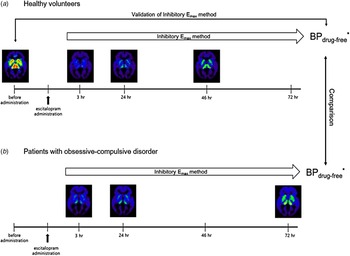
Serial [11C]DASB PET scans for the measurement of SERT BPs were performed before and 3 h, 24 h and 46 h after the single administration of escitalopram in healthy volunteers and 3 h, 24 h and 72 h after the last administration of escitalopram with the dose maintained for at least 4 weeks in patients with OCD (Fig. 1). Blood samples for the measurement of escitalopram plasma concentration were obtained 5 min before each PET scan.
Diagram illustrating the study protocol for healthy volunteers (a) and patients with obsessive-compulsive disorder (b). Parametric images for binding potentials (BPs) were from one representative healthy volunteer and one representative patient for illustrative purposes. * BPdrug-free was derived from the inhibitory E max method.

Subjects were admitted to the Clinical Trial Centre, Seoul National University Hospital for the first 24 h of the study. They returned to the centre for the final measurements. All subjects were required to abstain alcohol and smoking for the duration of study.
PET scanning procedure and calculation of BPs
Subjects underwent 90-min PET imaging after an intravenous bolus injection of 555 ± 37 MBq of [11C]DASB radiotracers on a Biograph 40 Truepoint PET/CT scanner (Siemens, USA). After routine corrections for uniformity, decay corrections and CT-based attenuation, the PET imaging data acquired in a list mode were reconstructed with a filtered back-projection using a Gaussian filter. Images were collected in a three-dimensional mode with 148 axial slices, an image size of 256 × 256, a pixel size of 1.3364 × 1.3364 mm2 and a slice thickness of 3 mm. The dynamic volumetric images were sequenced using the following framing: 1 × 7.5 s, 7 × 15 s, 1 × 22.5 s, 15 × 30 s, 1 × 45 s, 9 × 60 s, 1 × 150 s, 9 × 240 s, 1 × 270 s, 5 × 300 s.
The following preprocessing steps were performed for dynamic [11C]DASB PET images using Statistical Parametric Mapping 8 (SPM8, http://fil.ion.ac.uk/spm) implemented in MATLAB 2009b (http://mathworks.com). The mean of dynamic frames was co-registered to subject's T1-weighted image using normalized mutual information method, and then the dynamic frames were co-registered in alignments to the mean image. The co-registered PET images were spatially normalized to a standard MNI space.
Three ROIs – caudate, putamen and thalamus, were defined using population-based probability maps (Kang et al. Reference Kang, Lee, Cho, Lee, Yeo, Lee, Chung and Lee2001; Lee et al. Reference Lee and Lee2005), and time-activity curves for the ROIs were acquired to calculate BPs of [11C]DASB by multilinear reference tissue model with two parameters (MRTM2) using the cerebellum as a reference region (Ichise et al. Reference Ichise, Liow, Lu, Takano, Model, Toyama, Suhara, Suzuki, Innis and Carson2003). The dorsal raphe nucleus (DRN) was drawn manually on averaged [11C]DASB images across subjects as previously described (Selvaraj et al. Reference Selvaraj, Turkheimer, Rosso, Faulkner, Mouchlianitis, Roiser, McGuire, Cowen and Howes2012), and the investigator who outlined the DRN was blind to the participant diagnostic status. BPs in the DRN were calculated using the same procedures outlined above for the other regions.
Determination of escitalopram plasma concentration
Escitalopram plasma concentrations were determined using liquid chromatography–tandem mass spectrometry (LC-MS/MS; Agilent 1260 series and Agilent 6460 Quadrupole; Agilent Technologies Inc., USA). Sample preparation was performed by liquid-liquid extraction using methyl tertiary-butyl ether. Escitalopram-d6 was used as an internal standard for the quantification of escitalopram. Chromatographic separation was conducted on a Luna C18 (Phenomenex Inc., USA) with a mobile phase consisting of 10 mm ammonium acetate in distilled water and 0.2% formic acid in acetonitrile. The lower limit of quantitation for escitalopram was 0.05 ng/ml, with calibration curves ranging from 0.05 to 50 ng/ml. The intra-day and inter-day accuracies from 96.53% to 103.0%, and the intra-day and inter-day precisions (%CV) were both <5.4%. These results were judged to indicate that the serum concentration analysis was reliable over the given range.
Estimation of BP free of the escitalopram effect
We estimated BPs where escitalopram effects were removed by using an inhibitory E max model with individual serial BP data (Kim et al. Reference Kim, Howes, Yu, Jeong, Lee, Jang, Shin, Kapur and Kwon2011). The SERT occupancy by SSRIs is usually expressed as the percentage reduction of BP as follows:
 $${\rm Occupancy\;} ({\rm \%} ) = \displaystyle{{{\rm BP}_{\hbox {drug-free}} - {\rm BP}_{{\rm drug}}} \over {{\rm BP}_{{\hbox {drug -free}}}}} \times 100,$$
where BPdrug-free is the BP when SERT is not occupied by SSRIs and BPdrug is the BP after administration of SSRIs.
The relationship between plasma concentrations of SSRIs and their SERT occupancies follows the E max model (Meyer et al. Reference Meyer, Wilson, Sagrati, Hussey, Carella, Potter, Ginovart, Spencer, Cheok and Houle2004; Takano et al. Reference Takano, Suzuki, Kosaka, Ota, Nozaki, Ikoma, Tanada and Suhara2006). Thus the occupancy above can be described as follows:
 $$\displaystyle{{{\rm BP}_{{\hbox {drug - free}}} - {\rm BP}_{{\rm drug}}} \over {{\rm BP}_{{\hbox {drug - free}}}}} \times 100 = \displaystyle{{E_{{\rm max}} \times {\rm Conc}} \over {{\rm EC}_{50} + {\rm Conc}}},$$
where E max is the maximum occupancy (100% of SERT occupied by drug), EC50 is the plasma drug concentration associated with 50% occupancy of SERT and Conc is the plasma drug concentration.
From the equation above, we can obtain an inhibitory E max model for the relationship between BP and concentration as follows:
 $${\rm BP} = {\rm BP}_{{\hbox {drug - free}}} - \displaystyle{{I_{{\rm max}} \times {\rm Conc}} \over {{\rm IC}_{50} + {\rm Conc}}},$$
where I max is the maximum inhibitory effect and IC50 is the plasma concentration associated with a 50% decrease in BP. In this model, we assume that SERT will be totally occupied by escitalopram when a supratherapeutic dose is administered and that the BP will therefore be equal to zero. Under this assumption, I max was regarded as BPdrug-free. Individual BPdrug-free values were calculated for each participant using individual serial BP data from nonlinear mixed-effects modelling.
Nonlinear mixed-effects modelling simultaneously estimates fixed effects and random effects in the inhibitory E max model. The fixed effects are parameters such as I max and IC50 which describe the relationship between the plasma drug concentration and BP in the population. The random effects consist of inter-individual variability and residual variability. The inter-individual variability is the between-subject variability of parameters which explains the difference between an individual BP and the population BP predicted from the model. Inter-individual variability of the parameter was estimated using an exponential error model:
 $$P_i = \theta \cdot {\rm exp}\;(\eta_i),$$
where P i is the hypothetical true parameter value for the ith individual, θ is the typical population value of the parameter, and η i is a random inter-individual variability with zero mean and variance ω 2.
The residual variability is the within-subject variability or measurement error of the BP which results in the difference seen between the individual BPs from observation and the prediction from the model. The residual variability is modelled using a combined error model as below.
 $${\rm BP}_{ij}^{{\rm obs}} = {\rm BP}_{ij}^{{\rm pred}} \cdot (1 + \varepsilon _{ij}^{\rm P} ) + \varepsilon _{ij}^{\rm A}, $$
where
 ${\rm BP}_{ij}^{{\rm obs}} $
and
 ${\rm BP}_{ij}^{{\rm pred}} $
represent the ith subject's jth observed and predicted BP, respectively. ε
ij
is a normally distributed random variable with zero mean and variance σ
2, and the superscripts P and A on the ε values represent the proportional and additive errors, respectively.
From the nonlinear mixed-effect modelling, we obtained individual estimates of BPdrug-free as follows:
 $${\rm BP}_{{\hbox {drug - free}}} \; {\rm for\;} \;i{\rm th}\;{\rm individual} = \; I_{{\rm max}} \cdot {\rm exp}\;(\eta _i \;{\rm of}\;I_{{\rm max}} ),$$
where BPdrug-free for the ith individual represents the BP where the escitalopram effects are removed, I max is the typical population value of the maximum inhibitory effect in the inhibitory E max model, and η i of I max is the inter-individual variability of the maximum inhibitory effect for the ith individual.
The calculation was performed using NONMEM v. 7.2.0 software (GloboMax, USA).
Statistical analysis
To determine the reliability of the I max method for estimating BPdrug-free and to test the correlation between BPdrug-free and YBOCS scores, Pearson correlation analysis was applied. For normally distributed variables, Student's t tests were used to check for significant differences in demographic data. Differences in BPdrug-free between healthy volunteers and patients with OCD were tested using mixed-effects models with the group (modelled as a dummy variable: 1 = patient with OCD, 2 = healthy volunteers) and the ROIs (modelled as a dummy variable: 1 = caudate, 2 = putamen, 3 = thalamus, 4 = DRN) as fixed effects and subjects as random effects. Post-hoc analysis for the group effect on BPdrug-free in each ROI was conducted using Student's t test.
Results
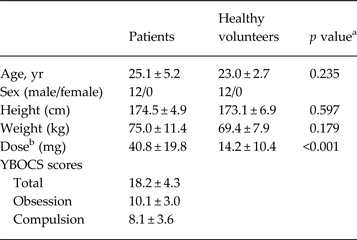
All subjects who participated in the study were male Koreans. Mean age (±s.d.), height and body weight of healthy volunteers was 23.0 ± 2.7 years, 173.1 ± 6.9 cm and 69.4 ± 7.9 kg, respectively. The average age (±s.d.), body weight and height of patients were 25.1 ± 5.2 years, 75.0 ± 11.4 kg and 174.5 ± 4.9 cm, respectively.
The single dose of escitalopram was 5 mg for four healthy volunteers, 10 mg for four healthy volunteers, 20 mg for one healthy volunteers and 30 mg for three healthy volunteers. The average maintenance dose (±s.d.) of escitalopram for patients with OCD was 40.8 ± 19.8 mg and the mean corresponding period for the maintenance dose was 60.6 ± 52.3 days. The mean total YBOCS score (±s.d.) in patients was 18.2 ± 4.3 (Table 1).
Demographic data (±s.d. )

YBOCS, Yale–Brown Obsessive Compulsive Scale.
a Student's t test.
b Single dose of escitalopram for healthy volunteers and maintenance dose for patients.
The plasma concentrations (±s.d.) of escitalopram in healthy volunteers were 10.8 ± 6.8 ng/ml, 5.2 ± 3.2 ng/ml and 2.3 ± 1.1 ng/ml at 3 h, 24 h and 46 h after drug administration, respectively. The concentrations in patients were 71.3 ± 38.0 ng/ml, 47.6 ± 27.8 ng/ml and 20.9 ± 15.2 ng/ml at 3 h, 24 h and 72 h after drug administration, respectively.
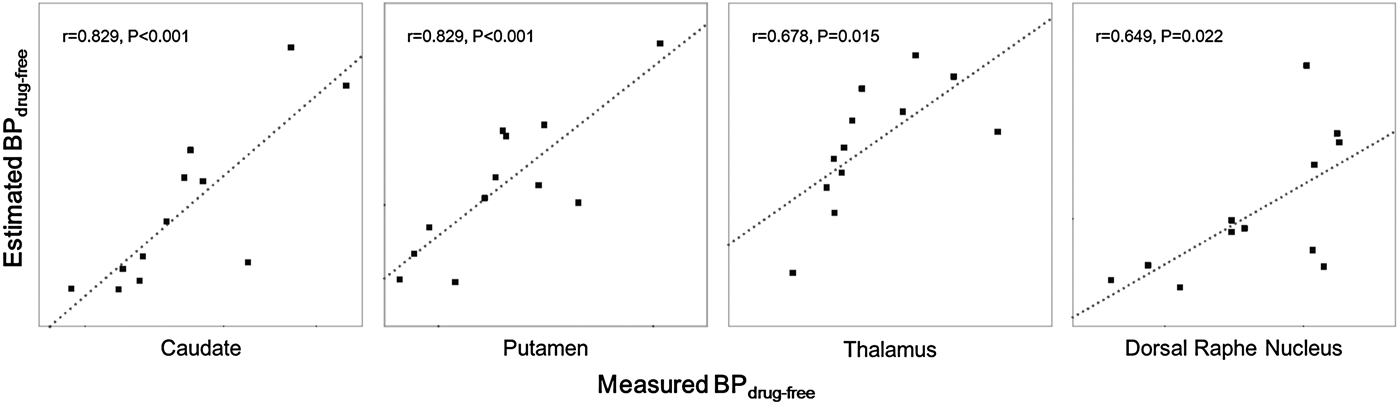
The individual BPdrug-free estimated by the inhibitory E max model in healthy volunteers were significantly correlated with the measured BPdrug-free in all ROIs [caudate: Pearson's correlation coefficient (r) = 0.829, p < 0.001; putamen: r = 0.829, p < 0.001; thalamus: r = 0.678, p = 0.015; DRN: r = 0.649, p = 0.022; Fig. 2].
The correlations between drug-free binding potentials (BPs) estimated by using the inhibitory E max model (estimated BPdrug-free) and truly measured in healthy volunteers (measured BPdrug-free).

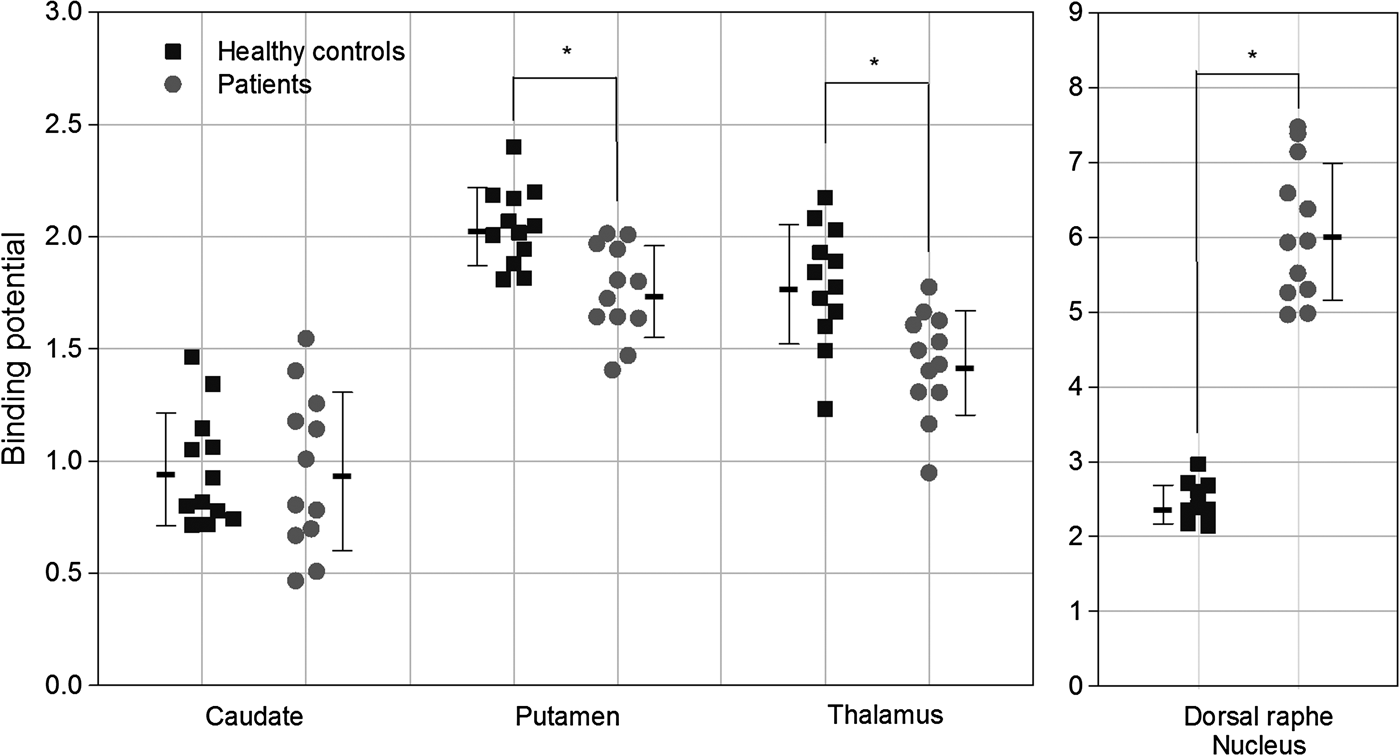
There was a significant effect of group and ROI on BPdrug-free and a significant interaction between group and ROI [group: degrees of freedom (df) = 1,41.879, F = 83.714, p < 0.001; ROI: df = 3,46.527, F = 171.453, p < 0.001; group × ROI: df = 3,46.527, F = 66.409, p < 0.001; Fig. 3]. Post-hoc analysis revealed significantly lower BPdrug-free in the putamen and the thalamus but higher in the DRN in patients with OCD than in healthy volunteers (caudate: df = 22, t = 0.0729, p = 0.943; putamen: df = 22, t = 3.750, p = 0.001; thalamus: df = 22, t = 3.433, p = 0.002; DRN: df = 22, t = −13.297, p < 0.001; Fig. 3) [Cohen's d = 0.03 (caudate), 1.16 (putamen), 1.46 (thalamus), −5.67 (DRN)] [percentage difference = 0.95% (caudate), 15.31% (putamen), 21.69% (thalamus), 85.79% (DRN)].
Drug-free binding potentials estimated from the inhibitory E max model in healthy controls and patients with obsessive-compulsive disorder. Each dot represents an individual binding potential and each vertical bar indicates the mean and the standard deviation for the corresponding group. * Statistically significant in post-hoc analysis using Student's t test (p < 0.005).

The BPdrug-free in each ROI was not significantly correlated with YBOCS scores (caudate: r = 0.231, p = 0.470; putamen: r = 0.096, p = 0.764; thalamus: r = 0.375, p = 0.229; DRN: r = 0.098, p = 0.761).
Discussion
Our main finding in the healthy volunteer study is that the inhibitory E max approach is able to accurately predict SERT BPdrug-free in people taking drug treatment. This approach may thus be used to index baseline SERT levels in patients during treatment without the ethical and clinical challenges of drug withdrawal. This approach enables longitudinal studies of SERT availability in patients on treatment, and the evaluation of SERT density as a predictor of relapse, for example. Even if it were possible to discontinue drug treatment in patients to determine SERT density it would still not be possible to know if changes were due to treatment, or were caused by discontinuation (e.g. serotonergic rebound). The inhibitory E max model was developed using healthy volunteers. While there are no reasons to think that the model would be different in patients, an important next step is to test this in patients. This would require withholding treatment from patients but we believe that this is justified by our findings here.
Our main finding applying this approach in patients with OCD is that the BPdrug-free in key brain regions in patients during treatment are significantly different from those in healthy volunteers. This result extends previous findings showing SERT abnormalities in drug-free patients with OCD by indicating that altered SERT availability in OCD is seen despite treatment.
Clinical implications
Our finding that patients with OCD exhibited significantly lower BPdrug-free than healthy volunteers in the putamen and the thalamus is consistent with previous findings in drug-free patients in the striatum and thalamus (Stengler-Wenzke et al. Reference Stengler-Wenzke, Muller, Angermeyer, Sabri and Hesse2004; Reimold et al. Reference Reimold, Smolka, Zimmer, Batra, Knobel, Solbach, Mundt, Smoltczyk, Goldman, Mann, Reischl, Machulla, Bares and Heinz2007; Hesse et al. Reference Hesse, Stengler, Regenthal, Patt, Becker, Franke, Knupfer, Meyer, Luthardt, Jahn, Lobsien, Heinke, Brust, Hegerl and Sabri2011) [the magnitude of the difference in SERT availability was larger than the previous studies, e.g. effect size in thalamus: Cohen's d (d) = 1.46 (our result), d = 1.03 (Reimold et al. Reference Reimold, Smolka, Zimmer, Batra, Knobel, Solbach, Mundt, Smoltczyk, Goldman, Mann, Reischl, Machulla, Bares and Heinz2007), d = 0.72 (Stengler-Wenzke et al. Reference Stengler-Wenzke, Muller, Angermeyer, Sabri and Hesse2004)]. However, in contrast to the previous studies performed in drug-naive or drug-free patients, our study was conducted in patients currently treated with escitalopram. Thus our finding indicates that altered SERT availability in the putamen and the thalamus is still seen in OCD despite long-term treatment with escitalopram. This may explain the high risk of relapse seen in OCD when SSRI treatment is stopped (Bech et al. Reference Bech, Lonn and Overo2010) because the underlying SERT abnormalities are unmasked when patients stop treatment. For example, Fineberg et al. (Reference Fineberg, Tonnoir, Lemming and Stein2007) reported that the relapse rate of OCD for patients stopping escitalopram was 52%, significantly higher than the 23% relapse rate seen in patients who continued escitalopram treatment for the same period. However, an alternative implication is that SERT dysfunction is not intrinsic to the pathoaetiology of OCD. Furthermore, the lack of correlation between the clinical scale of OC severity and SERT availability (Pogarell et al. Reference Pogarell, Hamann, Popperl, Juckel, Chouker, Zaudig, Riedel, Moller, Hegerl and Tatsch2003; Matsumoto et al. Reference Matsumoto, Ichise, Ito, Ando, Takahashi, Ikoma, Kosaka, Arakawa, Fujimura, Ota, Takano, Fukui, Nakayama and Suhara2010; Hesse et al. Reference Hesse, Stengler, Regenthal, Patt, Becker, Franke, Knupfer, Meyer, Luthardt, Jahn, Lobsien, Heinke, Brust, Hegerl and Sabri2011), which is similar to our result, raises the question about a singular role of the serotonergic system in OCD. Growing evidence indicates that dopaminergic augmentation of SSRIs is useful in the treatment of refractory patients with OCD (McDougle et al. Reference McDougle, Goodman, Leckman, Lee, Heninger and Price1994). Furthermore, there is evidence that SSRIs like paroxetine, fluoxetine and citalopram (which is a racemic mixture containing escitalopram and whose pharmacodynamic effect is primarily due to the S enantiomer, escitalopram) modulate other neurochemical systems in the brain including noradrenaline and dopamine (Collu et al. Reference Collu, Poggiu, Devoto and Serra1997; Hajos-Korcsok et al. Reference Hajos-Korcsok, McTavish and Sharp2000; Dziedzicka-Wasylewska et al. Reference Dziedzicka-Wasylewska, Rogoz, Skuza, Dlaboga and Maj2002; Cadeddu et al. Reference Cadeddu, Ibba, Sadile and Carboni2014). This suggests that investigation into the role of other neurochemical systems than serotonin may be warranted in OCD.
Although there is theoretical support (Kwon et al. Reference Kwon, Jang, Choi and Kang2009) for structural or functional abnormalities of the caudate having a role in OCD, we did not find any BPdrug-free difference in the caudate. A meta-analysis of neuroimaging literature also did not demonstrate a consistent abnormality of the caudate (Aylward et al. Reference Aylward, Harris, Hoehn-Saric, Barta, Machlin and Pearlson1996). This could be due to the heterogeneous nature of this disorder (Pauls et al. Reference Pauls, Alsobrook, Goodman, Rasmussen and Leckman1995) and the degree of caudate nucleus abnormality might differ between subgroups. For example, reduced caudate volume and activity were evident in patients with involuntary tic behaviours (Aylward et al. Reference Aylward, Harris, Hoehn-Saric, Barta, Machlin and Pearlson1996; Wang et al. Reference Wang, Maia, Marsh, Colibazzi, Gerber and Peterson2011) while patients in the current study were free from the neurological symptoms.
Contrary to the putamen and the thalamus, the DRN exhibited significantly higher BPdrug-free in patients with OCD than in healthy controls (Fig. 3). Pogarell et al. (Reference Pogarell, Hamann, Popperl, Juckel, Chouker, Zaudig, Riedel, Moller, Hegerl and Tatsch2003) also reported a 25% increase in SERT availability in the midbrain which is consistent with our findings. The study conducted by Pogarell et al. (Reference Pogarell, Hamann, Popperl, Juckel, Chouker, Zaudig, Riedel, Moller, Hegerl and Tatsch2003) used [123I]β-CIT for measuring SERT availability. Thus our study is the first to report higher SERT availability in patients with OCD using a high selective SERT tracer, [11C]DASB. However, Hesse et al. (Reference Hesse, Stengler, Regenthal, Patt, Becker, Franke, Knupfer, Meyer, Luthardt, Jahn, Lobsien, Heinke, Brust, Hegerl and Sabri2011) and Matsumoto et al. (Reference Matsumoto, Ichise, Ito, Ando, Takahashi, Ikoma, Kosaka, Arakawa, Fujimura, Ota, Takano, Fukui, Nakayama and Suhara2010) observed no significant difference in raphe nucleus in patients with OCD relative to controls, and Reimold et al. (Reference Reimold, Smolka, Zimmer, Batra, Knobel, Solbach, Mundt, Smoltczyk, Goldman, Mann, Reischl, Machulla, Bares and Heinz2007) reported reduced SERT in the midbrain. The inconsistency may relate to the lack of specificity for SERT shown by the radiotracers used in the studies (Innis et al. Reference Innis, Baldwin, Sybirska, Zea, Laruelle, al-Tikriti, Charney, Zoghbi, Smith, Wisniewski, Hoffer, Wang, Milius and Neumeyer1991; Laruelle et al. Reference Laruelle, Baldwin, Malison, Zea-Ponce, Zoghbi, al-Tikriti, Sybirska, Zimmermann, Wisniewski, Neumeyer, Milius, Wang, Smith, Roth, Charney, Hoffer and Innis1993; Neumeyer et al. Reference Neumeyer, Tamagnan, Wang, Gao, Milius, Kula and Baldessarini1996). The raphe nucleus is the origin of serotonin neurons where SSRIs are primarily acting on (Bel et al. Reference Bel and Artigas1992; Gartside et al. Reference Gartside, Umbers, Hajos and Sharp1995; Malagie et al. Reference Malagie, Trillat, Jacquot and Gardier1995) and altering serotonergic function in the raphe influences of serotonin neurotransmission across the brain (Giovacchini et al. Reference Giovacchini, Lang, Ma, Herscovitch, Eckelman and Carson2005; Selvaraj et al. Reference Selvaraj, Turkheimer, Rosso, Faulkner, Mouchlianitis, Roiser, McGuire, Cowen and Howes2012). Thus, the higher BPdrug-free in patients could reflect an adaptation to long-term exposure to escitalopram, which, by blocking available SERT binding sites, may induce SERT expression in the raphe to compensate, or may be intrinsic to the pathophysiology of OCD.
Another explanation for the higher BPdrug-free in the putamen and the thalamus and lower BPdrug-free in the raphe nucleus observed in healthy volunteers could come from the differences in the dosing between the healthy volunteers (i.e. single administration) and the patients with OCD (i.e. chronic administration) and the mechanism of action of escitalopram. The measurement of BP is primarily based on the ligand displacement and the BP of radiotracers could theoretically be affected by the concentration of the endogenous neurotransmitter (Egerton et al. Reference Egerton, Mehta, Montgomery, Lappin, Howes, Reeves, Cunningham and Grasby2009); serotonin in this case. Although the effect of medication was removed in determining the BPdrug-free by using the inhibitory E max model, endogenous serotonin might have affected the determination of BPdrug-free. SSRIs are generally assumed to increase endogenous serotonin concentrations in serotonergic nerve terminals. However, acute administration of SSRIs can influence the concentration of endogenous serotonin in a different way depending on the brain regions. The increases in extracellular serotonin after acute administration of SSRI are largest in the raphe nucleus (Bel & Artigas, Reference Bel and Artigas1992; Gartside et al. Reference Gartside, Umbers, Hajos and Sharp1995; Malagie et al. Reference Malagie, Trillat, Jacquot and Gardier1995) and the stimulation of inhibitory serotonergic autoreceptors by increased endogenous serotonin in the raphe nucleus, where inhibitory serotonergic autoreceptors are presynaptically located on cell bodies, may reduce neuronal cell firing leading to a decrease of endogenous serotonin in the serotonergic projection areas like the cortex where the autoreceptors are post-synaptically located (Barnes et al. Reference Barnes and Sharp1999). Indeed, recent molecular imaging studies showed decreased BP in the raphe nucleus and increased BP in the serotonergic projection areas after a single administration of escitalopram (Nord et al. Reference Nord, Finnema, Halldin and Farde2013) and intravenous injection of citalopram (Selvaraj et al. Reference Selvaraj, Turkheimer, Rosso, Faulkner, Mouchlianitis, Roiser, McGuire, Cowen and Howes2012). The acute effect of escitalopram on the endogenous serotonin might lead to different comparison results across the brain regions between healthy volunteers with a single administration and patients with chronic administration of escitalopram. However, [11C]DASB seems insensitive to change in endogenous serotonin concentrations in human subjects. Two studies, conducted in human subjects, did not show any effect of serotonin manipulation such as tryptophan depletion on [11C]DASB BP (Praschak-Rieder et al. Reference Praschak-Rieder, Wilson, Hussey, Carella, Wei, Ginovart, Schwarz, Zach, Houle and Meyer2005; Talbot et al. Reference Talbot, Frankle, Hwang, Huang, Suckow, Slifstein, Abi-Dargham and Laruelle2005). It is indicated that [11C]DASB can determine regional SERT densities in which the value of BPs are not affected by confounding effects of endogenous serotonin. For this reason, differences in endogenous serotonin across the brain regions are unlikely to have a major effect on our results.
When interpreting the results, some limitations need to be taken into consideration. First, this is a cross-sectional study and we did not measure BP and symptomatic severity in the drug-naive state in patients. Second, we did not measure anxiety and depressive symptoms. We expected the patients enrolled might not have clinically significant depressive and/or anxiety symptoms, since for inclusion patients had to be stable after long-term administration of escitalopram and we excluded patients with depressive and anxiety disorder. However, It has been reported that anxiety and depressive symptoms are prevalent as co-morbidities in OCD (Overbeek et al. Reference Overbeek, Schruers, Vermetten and Griez2002). Thus, the measurement of the symptoms would have provided more insight into the current results. Last, the dose of escitalopram in patients was higher than in the healthy control study, which resulted in higher plasma concentration of escitalopram in patients. This may lead to an overestimate of BPdrug-free in patients due to extrapolation error in the application of the inhibitory E max model. However, we conducted PET scans at longer time intervals (3 h, 24 h and 72 h after the last administration of escitalopram) in patients relative to controls (3 h, 24 h and 46 h) to obtain reliable trajectories for BPdrug-free (Fig. 1). Furthermore, we found BPdrug-free was lower in the putamen and the thalamus but higher in the DRN in patients than in controls. It is unlikely that a systematic bias in the method that resulted in a BPdrug-free overestimate in patients would explain both an increase in one region and a decrease in other regions.
In conclusion, this is the first study to measure SERT availability conducted in OCD patients currently treated with escitalopram. In spite of the long-term treatment with escitalopram, the abnormality in drug-free SERT availability was similar to the abnormality observed in drug-naive patients (Hesse et al. Reference Hesse, Muller, Lincke, Barthel, Villmann, Angermeyer, Sabri and Stengler-Wenzke2005, Reference Hesse, Stengler, Regenthal, Patt, Becker, Franke, Knupfer, Meyer, Luthardt, Jahn, Lobsien, Heinke, Brust, Hegerl and Sabri2011). This could account for the high risk of relapse in OCD when the medication is discontinued.
Acknowledgements
The authors thank Seongho Seo and June Hee Lee for their kind assistance. This study was supported by grant no. 14-2014-007 from the SNUBH Research Fund.
Declaration of Interest
None.