Introduction
Coenogonium Ehrenb. is a large (‘superdiverse’) genus of c. 90 species that is numbered amongst the 45 most species-rich genera of lichenized fungi (Rivas Plata et al. Reference Rivas Plata, Lücking, Aptroot, Sipman, Chaves, Umaña and Lizano2006; Lücking et al. Reference Lücking, Hodkinson and Leavitt2017). It is represented in most regions of the world but with its greatest speciation in the tropics. As currently circumscribed, it includes both filamentous and crustose taxa that were traditionally placed in the genus Dimerella Trevis., with some species forming intermediate morphodemes, combining a crustose basal thallus with upright filaments (Lücking & Kalb Reference Lücking and Kalb2000). Species of Coenogonium occur on a wide range of substrata, including bark, wood, bryophytes and rocks; many species are exclusively foliicolous (Lücking Reference Lücking2008).
In general, Coenogonium is rather easy to recognize as a genus. The photobiont is Trentepohlia. The ascomata are usually yellowish to orange or light orange-brown, biatorine apothecia with a persistent, cupular, paraplectenchymatous proper excipulum and a plane to concave, epruinose disc. The asci are narrowly cylindrical, 8-spored, with a thin, KI+ blue wall and an unthickened apex lacking internal amyloid structures. The paraphyses are unbranched and distinctly septate, with moniliform, capitate, usually unpigmented apices. The ascospores are hyaline, ellipsoid to fusiform, 1-septate or very rarely non-septate and thin-walled. The conidiomata are wart-like or tubular, ±erumpent to superficial, with oblong to ellipsoid, simple or rarely septate conidia. The thallus and ascomata lack secondary substances detectable by TLC.
Although easily recognized at genus rank, Coenogonium is generally regarded as taxonomically challenging, with species delimitation based on often subtle differences in apothecial size and colour, hymenium height, ascospore size and arrangement within the ascus, and conidial size and morphology (Rivas Plata et al. Reference Rivas Plata, Lücking, Aptroot, Sipman, Chaves, Umaña and Lizano2006). There are also some superficially similar genera which, in the Tasmania lichen flora, include: Malcolmiella Vĕzda, which differs mainly by having amyloid asci with a thickened tholus and non-septate, usually longer and broader ascospores with an ornamented perispore; Absconditella Vĕzda, which has a chlorococcoid photobiont and non-amyloid asci; Cryptodiscus Corda (syn. Bryophagus Nitschke ex Arnold), which has Gloeocystis as photobiont, amyloid asci with a thickened apex and non-septate paraphyses.
In cool temperate regions of Australasia, Coenogonium (including Dimerella) received little attention from taxonomists for many years, and authors of most floras and checklists (e.g. Galloway Reference Galloway1985; Filson Reference Filson1996) were content to ascribe all filamentous collections to C. implexum Nyl. and crustose ones to D. lutea (Dicks.) Trevis. Only relatively recently has the extent of diversity in the genus begun to be appreciated, perhaps as a result of the large number of foliicolous, mainly tropical taxa recognized for the area (see, for example, Santesson & Tibell Reference Santesson and Tibell1988; Vĕzda Reference Vĕzda1989; Vĕzda & Hafellner Reference Vĕzda and Hafellner1991; Vĕzda & Kalb Reference Vĕzda and Kalb1991; Malcolm & Vĕzda Reference Malcolm and Vĕzda1995; Kalb & Aptroot Reference Kalb and Aptroot2018). Additional corticolous taxa from cooler latitudes have since been described by Vĕzda & Malcolm (Reference Vĕzda and Malcolm1997), Ludwig (Reference Ludwig2014) and Kalb (Reference Kalb2007). Thirty species of Coenogonium are listed for Australia by McCarthy (Reference McCarthy2017) but relatively few of these are ascribed to the southern, cool temperate states.
In Tasmania, the diversity of the genus has been similarly underestimated. Only three species are listed by McCarthy (Reference McCarthy2017) and an attempt to shoehorn large numbers of collections into these few taxa soon revealed the presence of several overlooked species. In this paper, we deal with seven species for the island. However, several collections remain unresolved pending further collection and study, and additional species may well be present.
Material and Methods
The study is based mainly on the collections of the first author and other Tasmanian collectors held in the Tasmanian Herbarium (HO) and comparison with selected reference exsiccata from other herbaria. Observations and measurements are based on hand-cut sections of the thallus and apothecia, mounted in water and Lugol’s Iodine after pretreatment with 10% KOH. Measurements of asci, ascospores and conidia are based exclusively on sections mounted in water. Ascospore measurements are presented in the format: 5th percentile–mean–95th percentile and are based on 50–100+ observations each; outlying values are given in parentheses.
The Species
Coenogonium atherospermatis Kantvilas, Rivas Plata & Lücking sp. nov.
MycoBank No.: MB 827257
Coenogonio luteolo simile sed discis apotheciorum pallide flavescenti-brunneis et ascosporis angustioribus, 6–8·5 µm longis, 2·5–3 µm latis differt.
Typus: Tasmania, Little Fisher River, 41°45'S, 146°20'E, on Atherosperma moschatum in rainforest, 820 m altitude, 17 August 1982, G. Kantvilas 214/82 (HO—holotypus; B, F—isotypi).
(Fig. 1A)
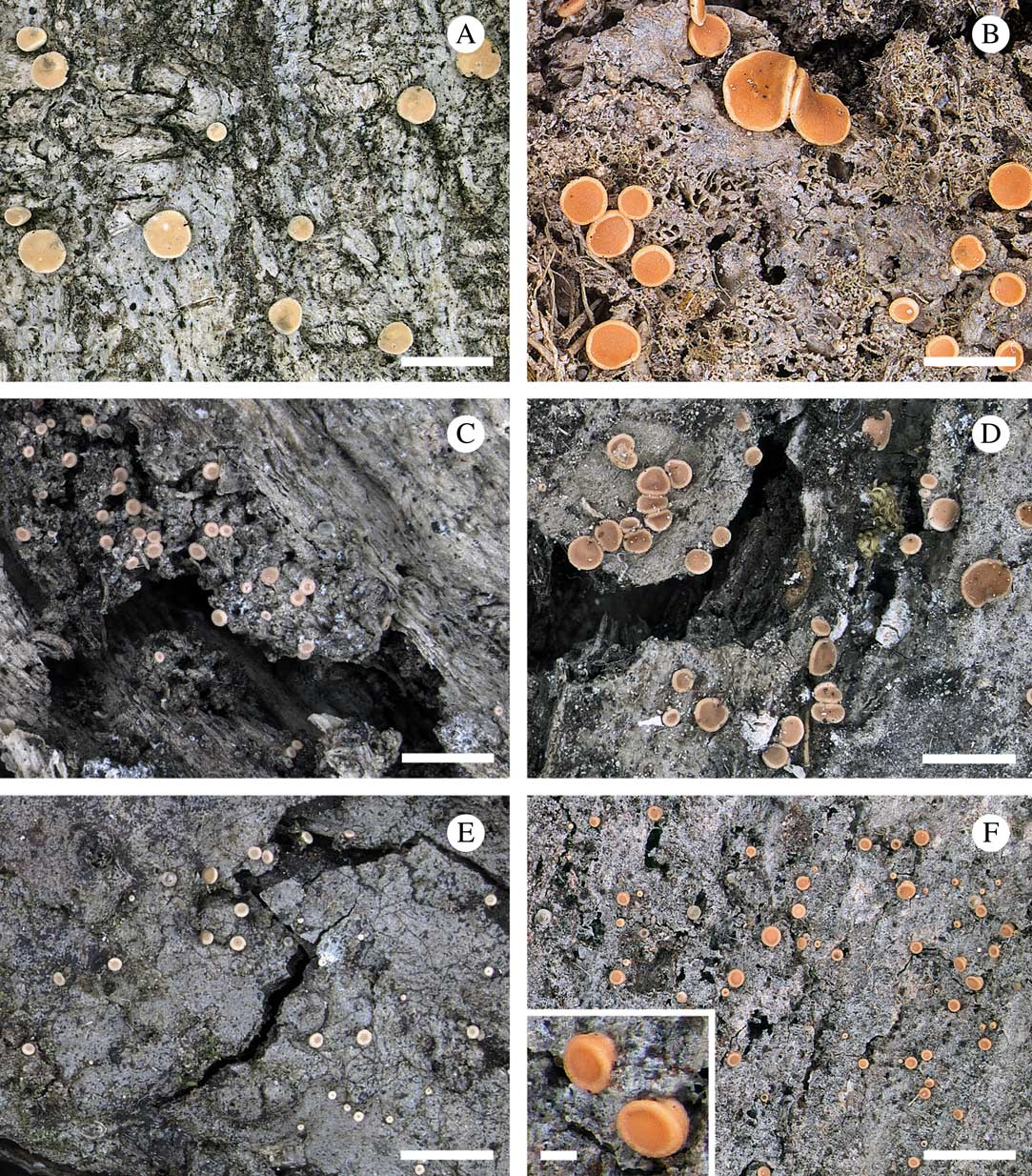
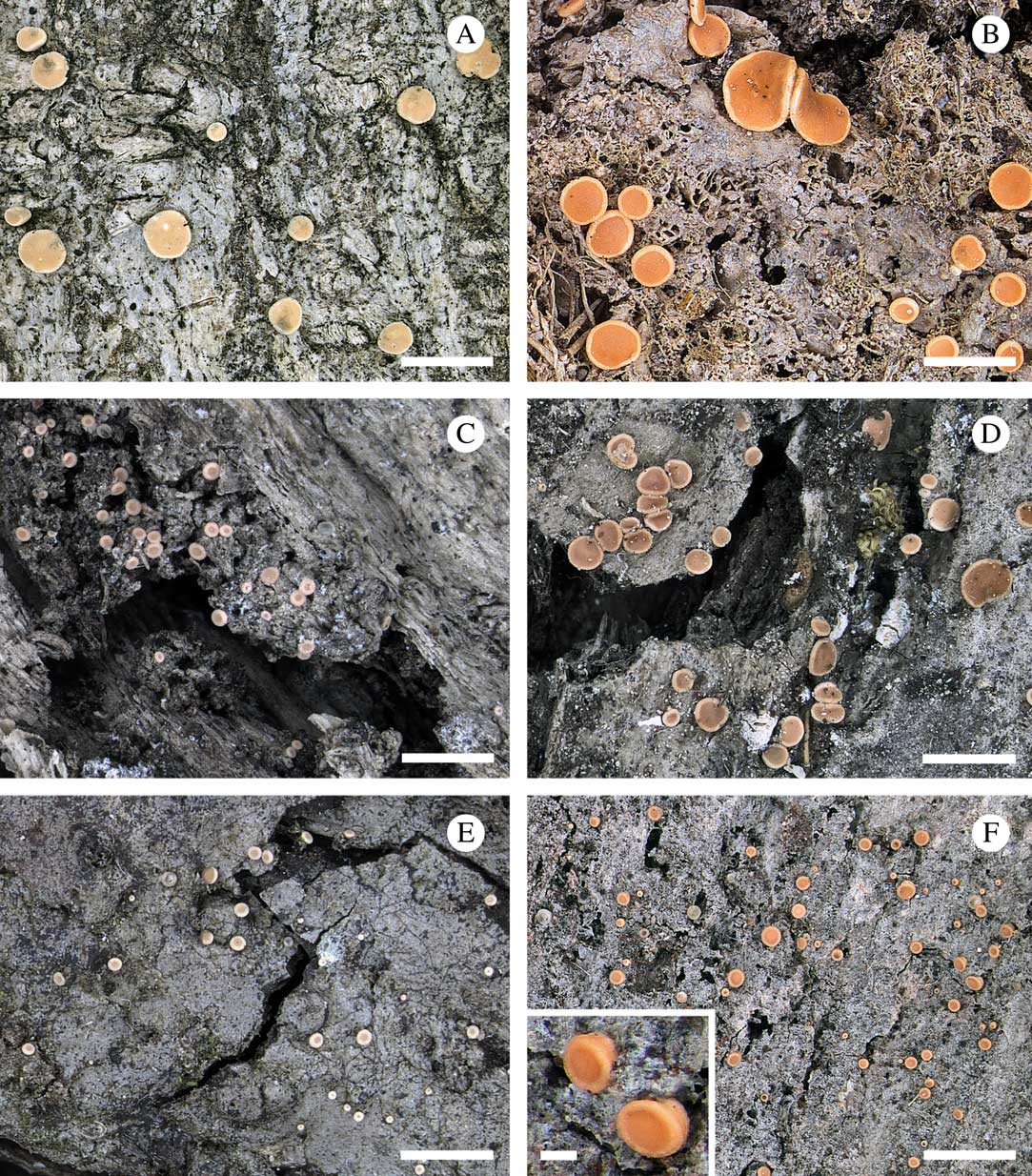
Morphology of Tasmanian Coenogonium species. A, C. atherospermatae (holotype); B, C. australiense (holotype); C, C. lutescens (Kantvilas 366/08); D, C. luteum (Kantvilas 105/97); E, C. pineti (Kantvilas 203/15); F, C. ureceolatum (holotype). Scales: A–F=2 mm; inset (F)=0·2 mm.
Thallus crustose, pale greenish to yellowish grey, rather discontinuous, 10–30 µm thick, forming irregular patches to 30 mm wide; prothallus absent; photobiont cells subglobose, broadly ellipsoid to oblong, 7–20×7–12 µm, occurring in clumps or short chains.
Apothecia sessile, flat, 0·5–1·2(–1·5) mm wide; disc (yellowish) beige, plane, rarely slightly convex when old; margin cream, smooth, glossy. Proper excipulum 50–80 µm thick. Hypothecium colourless to pale yellowish in the upper part, 15–100 µm thick. Hymenium 45–55 µm thick; asci 35–45× 5–7 µm; paraphyses 1·0–1·5 µm thick, with apices 3–4(–5) µm thick. Ascospores irregularly biseriate, 6·0–7·3–8(–8·5)×2·5–2·8–3 µm; length to width ratio 2–2·6–3·2.
Pycnidia not found.
Etymology. The specific epithet is derived from the name of the preferred host tree, Atherosperma moschatum Labill.
Remarks. In the past, material now referred to this new species had been included within a rather broad concept of C. luteum (below), but it differs from that species by the smaller, paler apothecia and the smaller ascospores. Similarly-sized apothecia and ascospores are known in the neotropical C. strigosum Rivas Plata et al., which differs in the bright orange apothecial disc and the formation of conspicuous thallus outgrowths resembling thick setae (Rivas Plata et al. Reference Rivas Plata, Lücking, Aptroot, Sipman, Chaves, Umaña and Lizano2006). A similar species from New Zealand is Coenogonium pallidulum (Müll. Arg.) Vězda, which up until now was considered a synonym of either C. luteum (Galloway Reference Galloway2007) or perhaps C. frederici (Kalb) Kalb & Lücking (Rivas Plata et al. Reference Rivas Plata, Lücking, Aptroot, Sipman, Chaves, Umaña and Lizano2006). However, re-examination of type material in G revealed that it represents a distinct species, differing from C. luteum in its smaller (0·5–0·7 mm diam.), pale yellowish beige apothecia, similar in colour to those of C. atherospermatis but smaller and with thinner margins; furthermore, its ascospores are longer than those of C. atherospermatis (9–11×2·5–3 µm). The new species also displays some affinities with the European-Macaronesian C. luteolum (Kalb) Kalb & Lücking, which has a vividly yellow apothecial disc and somewhat broader (≥3 µm) ascospores (Kalb & Hafellner Reference Kalb and Hafellner1992).
Distribution and ecology. Coenogonium atherospermatis is known only from Tasmania where it is locally abundant in cool temperate rainforest, mostly at elevations above c. 500 m. It occurs on the young, foliage-bearing twigs and small branches of Atherosperma moschatum (sassafras) in the shaded forest understorey. This habitat is typically colonized by a very rich diversity of crustose lichens; indeed, it is not unusual to record as many as 20 different taxa on a twig of only 10 cm in length. Lichens with which the new species is commonly associated include: Arthonia tasmanica Kantvilas & Vězda, Arthothelium interveniens Nyl., Chiodecton colensoi (A. Massal.) Müll. Arg., Coccotrema cucurbitula (Mont.) Müll. Arg., Fissurina insidiosa C. Knight & Mitt., Loxospora solenospora (Müll. Arg.) Kantvilas, Megalaria melaloma (C. Knight) Kantvilas, M. planocarpa Kantvilas, Megalospora pupa (Sipman) Kantvilas & Lumbsch, Pertusaria novaezelandiae Szatala, Psoromaria rosulata (P. M. Jørg. & D. J. Galloway) P. M. Jørg. & H. L. Andersen, Sarrameana albidoplumbea (Hook.f. & Taylor) Farkas, Stirtoniella cf. kelica (Stirt.) D. J. Galloway et al., Thelotrema suecium (H. Magn.) P. James and several species of Porina.
Additional specimens examined. Australia: Tasmania: Pelion Plains, c. 1 km SW of Pelion Hut, 41°50'S, 146°02'E, 900 m, 1992, G. Kantvilas 212/92 (B, F, HO); Anthony Road, 41°50'30''S, 145°37'30''E, 550 m, 1992, G. Kantvilas 573/92 (HO); track to Chapter Lake, 41°52'S, 146°10'E, 725 m, 1999, G. Kantvilas 101/99 (HO); Savage River Pipeline Road near Rapid River, 41°16'S, 145°20'E, 440 m, 2015, G. Kantvilas 228/15 (HO).
Coenogonium australiense Kantvilas & Lücking sp. nov.
MycoBank No.: MB 827258
Coenogonio luteo simile sed ascosporis longioribus latioribusque, 10–14 µm longis, 3–4·5 µm latis differt.
Typus: Tasmania, Little Fisher River, 41°45'S, 146°20'E, on Nothofagus cunninghamii in rainforest, 880 m altitude, October 1984, G. Kantvilas 691/84 (HO—holotypus; B, F—isotypi).
(Fig. 1B)
Thallus crustose, dull grey to pale grey-green, to 120 µm thick when best developed but frequently very much reduced, smooth to uneven, occasionally ± granular, usually reflecting the texture of the substratum, forming irregular, continuous or interrupted, undelimited patches to c. 10 cm wide; prothallus absent; photobiont cells subglobose to ellipsoid, 7–17×6–14 µm, single or in short chains.
Apothecia sessile, flat, 0·5–2 mm wide; disc orange with a pinkish hue, persistently plane; margin cream or tending towards the colour of the disc but lighter and ±translucent, or concolorous with the disc in older apothecia, smooth. Proper excipulum 60–120 µm thick, colourless, faintly yellow-brown at the outer edge. Hypothecium 40–80 µm thick, colourless or pale yellowish brown, especially in the upper part. Hymenium 60–80 µm thick; asci 55–70×7–9 µm; paraphyses 1–1·5 µm thick, with apices 3–5 µm thick. Ascospores typically uniseriate and arranged obliquely in the ascus, rarely ±biseriate, 10–12·1–14×3–3·6–4(–4·5) µm; length to width ratio (2·5–)3·3–3·4–3·5(–4·6).
Pycnidia immersed, visible as minute, somewhat paler swellings in the upper surface of the thallus; conidia ellipsoid, 3–5×1–3 µm.
Etymology. The specific epithet alludes to the geographical distribution of this species.
Remarks. Superficially, C. australiense is quite similar to C. luteum but it consistently has somewhat longer and wider ascospores. Based on ascospore size, we were initially inclined to call this species C. pyrophthalmum (Mont.) Lücking et al., a taxon based on a type from Chile. However, that species differs chiefly by its markedly paler, pinkish apothecia and appears to be endemic to southern South America. A specimen from Australia (New South Wales) distributed under C. pyrophthalmum by Vĕzda (Reference Vĕzda1989) (see below) represents C. australiense. Another name from austral regions that we considered as potentially fitting our taxon was C. pertenue (Stirt.) Kalb & Lücking, based on a New Zealand type. This name was treated as a synonym of C. luteum by Galloway (Reference Galloway2007) but reinstated by Rivas Plata et al. (Reference Rivas Plata, Lücking, Aptroot, Sipman, Chaves, Umaña and Lizano2006) on account of its reportedly longer and wider ascospores. However, an examination of the isotype of C. pertenue (in BM) revealed uniseriate ascospores, 9–11× 2–3 µm. The anatomy and habitat (on a tree fern trunk) of C. pertenue suggest that it is merely a poorly developed specimen of C. luteum as understood by us.
Distribution and ecology. This species occurs directly on bark or wood or overgrows epiphytic bryophytes. Although overlapping in habitat with the closely similar C. luteum, C. australiense has a broader ecological amplitude. Thus while most Tasmanian collections studied are from cool temperate rainforest, it has also been collected in drier, more sclerophyllous vegetation. For example, one collection is from coastal scrub whereas another, most unusual outlying record, is from a very sheltered crevice on dolerite boulders in dry eucalypt woodland. These occurrences are interpreted as relicts from a past time when fire frequency was lower and rainfall higher. On Kangaroo Island, a relatively low rainfall region, C. australiense occurs in relict, conifer-dominated coastal woodland. It has also been collected in New South Wales. Coenogonium australiense is likely to be present in New Zealand as well because Galloway (Reference Galloway2007), in his concept of C. luteum, gives the ascospores as 10–12(–14)×2–4 µm.
Specimens examined. Australia: Tasmania : Mt. Victoria Track, 41°21'S, 147°50'E, 900 m, 1981, G. Kantvilas s. n. (HO); Mathinna Plains, 41°20'S, 147°45'E, 780 m, 1981, G. Kantvilas (HO); Mt. Albert Road, 41°21'S, 147°50'E, 780 m, G. Kantvilas 1096/81 (HO); Bisdee Tier, 42°26'S, 147°17'E, 640 m, 2009, G. Kantvilas 251/09 (HO); Stony Point, 40°45'S, 144°59'E, 2 m, 2016, G. Kantvilas 272/16 (HO). New South Wales : Katoomba, Mt. Tomak, 900 m, 1985, G. Thor 6180 (distributed as A. Vĕzda: Lich. Sel. Exsicc. 2331) (HO). South Australia : Kangaroo Island, Brown Beach, 35°48'S, 137°50'E, 10 m, 2012, G. Kantvilas 439/12 & B. de Villiers (HO); Pelican Lagoon CP, 35°48'S, 137°48'E, 10 m, 2015, G. Kantvilas 316/15 & B. de Villiers (AD, HO).
Coenogonium implexum Nyl.
Ann. Sci. Nat. Bot., sér. 4, 16: 92 (1862); type: Australia, Victoria, supra cortices et muscos, Dr. Müller (H-NYL 22093!—holotype; S!, MEL!—isotypes)
(Fig. 2)
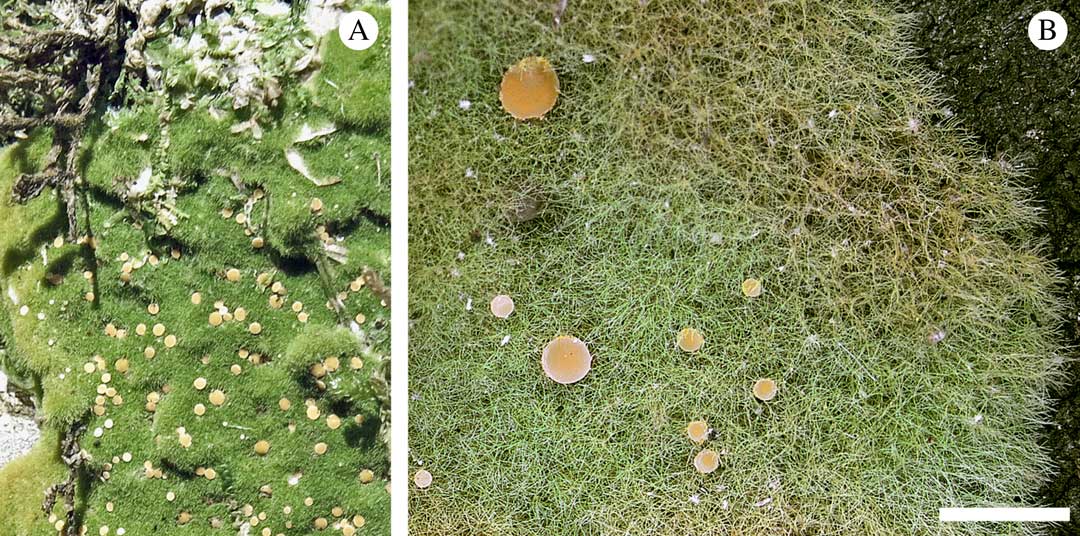
Coenogonium implexum habit. A, felt-like, pannose thallus on the bark of a tree; B, detail, showing thread-like thallus. Scale=2 mm.
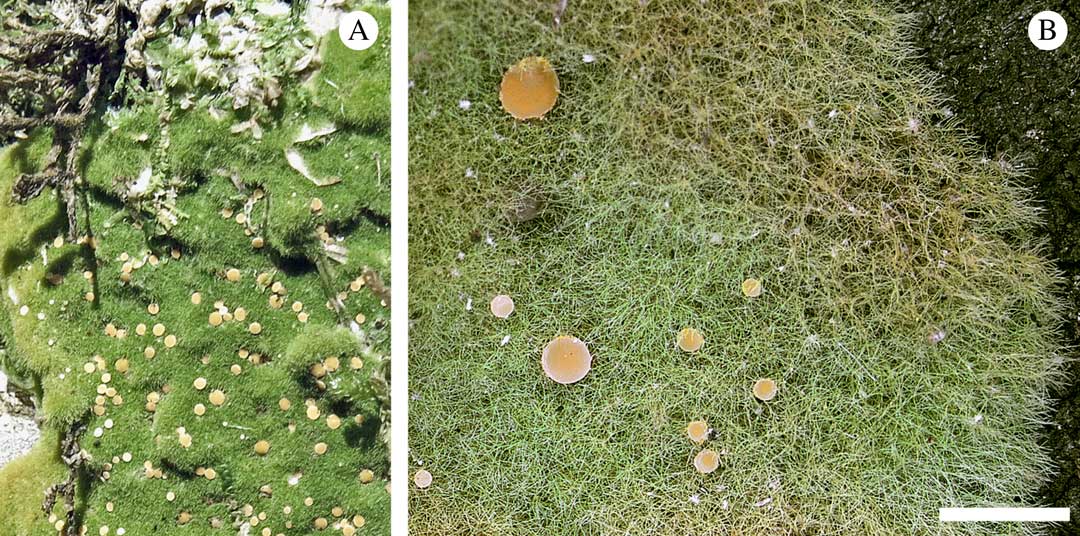
Thallus filamentous, yellowish green to orange-green to green, becoming greyish after storage in the herbarium, forming felt-like, pannose mats to 15 cm wide, closely appressed to the substratum; prothallus absent; photobiont cells oblong, 18–35×8–15 µm, in densely interwoven, discrete filaments.
Apothecia sessile, flat, 0·5–1(–1·6) mm wide; disc pale orange-pink to orange, plane, occasionally becoming convex when old; margin paler than the disc, whitish to whitish pink to pale orange, smooth. Proper excipulum 50–100 µm thick laterally, 150–200 µm thick basally. Hypothecium colourless, 40–100 µm thick. Hymenium 65–80 µm thick; asci 55–75×5–8 µm; paraphyses 1–1·5 µm thick, with apices 3–4 µm thick. Ascospores uniseriate, 8–10·3–12(–13)×3–3·8–4(–4·5) µm; length to width ratio 2–2·7–3·4(–3·7).
Pycnidia not observed.
Remarks. Further descriptions of this species are provided by Uyenco (Reference Uyenco1963) and Galloway (Reference Galloway1985). It is the only filamentous species of Coenogonium recorded for Tasmania and is very easily recognized by the yellowish green, felt-like thallus, usually abundantly beset with orange apothecia. Several non-lichenized trentepohlioid algae also form tufts on bark but these have a looser, less organized thallus that is typically yellowish or orange-red and they lack the characteristic lichen ascomata. Although described by Nylander only in 1862, this eye-catching species had already caught the attention of botanical collectors much earlier. For example, there are abundant collections from Tasmania, made by the explorer-botanist Robert Brown, who encountered especially luxuriant thalli on his ascent of Mt. Wellington in 1804.
Distribution and ecology. This is a widespread Southern Hemisphere species, also recorded from mainland Australia, New Zealand and southern South America. Tropical and Northern Hemisphere reports may represent different species (Rivas Plata et al. Reference Rivas Plata, Lücking, Aptroot, Sipman, Chaves, Umaña and Lizano2006). It is very abundant and locally common in Tasmania in callidendrous rainforest (nomenclature after Jarman et al. Reference Jarman, Kantvilas and Brown1994) and in many mature wet sclerophyll forest types where it occurs on the smooth trunks of understorey trees in deep shade. Pomaderris apetala Labill. (Rhamnaceae) is a particularly favoured host, where this species is part of a rich assemblage of lichens including Megalaria grossa (Pers. ex Nyl.) Hafellner, M. melaloma (C. Knight) Kantvilas, Megaloblastenia marginiflexa (Hook.f. & Taylor) Sipman, Megalospora gompholoma subsp. fuscolineata Sipman and Pyrenula ravenellii (Tuck.) R. C. Harris.
Selected specimens examined (total=50). Australia: Tasmania: Table Mountain [=Mt. Wellington], 1804, R. Brown (BM, HO); near Guy Fawkes Falls, 42°54'S, 147°17'E, 1897, W. A. Weymouth (HO); Holwell Gorge, 200 m, 1980, G. Kantvilas 201/80 (BM, HO); Granville Harbour, 20 m, 1984, G. Kantvilas 228/84 & P. James (BM, HO); Cox Bight, 10 m, 1985, G. Kantvilas 104/85 & J. Jarman (A. Vĕzda: Lich. Sel. Exsicc: 2055) (HO); Murchison Hwy, c. 3·5 km SW of Hellyer Gorge, 41°17'S, 145°35'E, 1992, G. Kantvilas 37/92, J. Jarman & B. Fuhrer (HO); Cape Pillar Track, Tornado Ridge, 43°11'S, 147°57'E, 280 m, 2005, G. Kantvilas 259/05 (HO).
Coenogonium lutescens (Vĕzda & Malcolm) Malcolm
Australas. Lichenol. 54: 19 (2004).—Dimerella lutescens Vĕzda & Malcolm, Australas. Lichenol. 41: 35 (1997); type: New Zealand, South Island, Nelson, Hackett River, north bank, 41°24·0'S, 173°13·5'E, 160 m, on bark of mature Podocarpus totara in mixed beech-podocarp lowland forest, 25 February 1996, W. Malcolm 2710 (CHR!—holotype; hb. Vĕzda, HO!—isotypes).
(Fig. 1C)
Thallus crustose, pale greyish green, very thin and rather patchy, to 20–100 µm thick, forming irregular, undelimited patches to c. 15 cm wide; prothallus absent; photobiont cells oblong, rhomboid to subglobose, 12–20×7–13 µm.
Apothecia sessile, flat, 0·2–0·4(–0·5) mm wide; disc light (yellowish) brown with a pinkish hue, plane; margin cream, sometimes ±translucent, inrolled when young, smooth. Proper excipulum 40–80 µm thick laterally, 25–60 µm thick basally. Hypothecium colourless, 20–30 µm thick. Hymenium 55–80 µm thick; asci (45–)50–55(–65)×4–7 µm; paraphyses 1–2 µm thick, with apices 3–4 µm thick. Ascospores uniseriate to irregularly biseriate, mostly arranged obliquely in the ascus, 7–8·8–10(–12)×2–2·7–3(–3·5) µm; length to width ratio 2·7–3·7–4·5.
Pycnidia immersed, very rare; conidia simple, oblong, slightly constricted centrally, (5·5–)6·0–7·0(–8·0)×2 µm.
Remarks. For a further description see Vĕzda & Malcolm (Reference Vĕzda and Malcolm1997). This species is recognized by its tiny, light brownish apothecia and narrowly ellipsoid to oblong ascospores. It is similar to C. pineti (see below), which has similar apothecia and conidia but broader, ±ellipsoid ascospores that are strictly uniseriate. Moreover, in Tasmania at least, C. pineti is an epiphyte on the bark of old trees, typically Nothofagus cunninghamii (Hook.) Oerst., a habitat quite distinct from that of C. lutescens (see below).
The ascospore size cited above is rather larger than that given by Vĕzda & Malcolm (Reference Vĕzda and Malcolm1997) in their original description but was consistently found not only in Tasmanian specimens but also in the type collection from New Zealand. Likewise, these authors refer to the apothecial disc as yellow, although the primary colour appears to be light brownish with a yellowish hue.
Distribution and ecology. Coenogonium lutescens is locally abundant in Eucalyptus obliqua-dominated wet forests in southern Tasmania where it grows on the papery bark of Melaleuca squarrosa Sm. or, less commonly, over bryophytes or on the decaying bases of the large rosette sedge, Gahnia grandis (Labill.) S. T. Blake. These are generally very species-poor habitats for lichens, although leafy hepatics may be scattered. Further studies in such habitats are likely to reveal that the species is more widespread.
Selected specimens examined (total=12). Australia: Tasmania: Tahune Bridge, 43°06'S, 146°44'E, 50 m, 1999, G. Kantvilas 350/99 (HO); west of Tahune Bridge, 43°06'S, 146°41'E, 120 m , 1999, J. Jarman s. n. (HO, PRA); ibid., 43°06'S, 146°40'E, 90 m, 2003, G. Kantvilas 70/03 (B, F, HO); Scotts Divide, 43°07'S, 146°52'E, 250 m, 2004, G. Kantvilas 118/04 (HO).
Coenogonium luteum (Dicks.) Kalb & Lücking
Bot. Jahrb. Syst. 122: 32 (2000).—Lichen luteus Dicks., Fasc. Plant. Crypt. Brit. 1: 11 (1785).—Dimerella lutea (Dicks.) Trevis., Rend. Reale Inst. Lombardo Sci. 13: 66 (1880); type not seen.
Calloria tasmanica Rodway, Pap. Proc. R. Soc. Tasm. (1917): 107 (1918); type: Tasmania, Trowutta, on trunk of Dicksonia antarctica, L. Rodway 797 (HO 31867—holotype!).
Ombrophila discoidea Rodway, Pap. Proc. R. Soc. Tasm. (1924): 96 (1925); type: Tasmania, slopes of Mt. Wellington, on moss and dead wood, September 1918, L. Rodway s. n. (HO 31875—holotype!).
(Fig. 1D)
Thallus crustose, dull grey to pale grey-green, to 50 µm thick, smooth to rarely unevenly verruculose, usually continuous and forming irregular, undelimited patches to c. 20 cm wide that encrust the substratum and adjacent bryophytes; prothallus absent; photobiont cells subglobose to ellipsoid, 7–16×7–12 µm, single or in short chains.
Apothecia sessile, flat, 0·7–2·5(–3) mm wide; disc mostly orange with a pinkish hue, sometimes brownish, plane, becoming undulate or rarely convex in older apothecia; margin cream or tending towards the colour of the disc but lighter, inrolled when young, smooth, rarely flexuose when old. Proper excipulum 80–110 µm thick, faintly yellow-brown at the outer edge. Hypothecium 50–70 µm thick, colourless but often pale yellowish brown in the upper part. Hymenium 60–70 µm thick; asci 50–65×5–6 µm; paraphyses 1–1·5 µm thick, with apices 3–5 µm thick. Ascospores ± uniseriate, arranged obliquely in the ascus, (7–)8–9·6–11(–12)×(2–)2·5–2·9–3·5 µm; length to width ratio (2·3–)2·7–3·3–4(–5).
Pycnidia not observed in Tasmanian material; conidia reported as simple, ellipsoid, 3–5×1·5–2 µm.
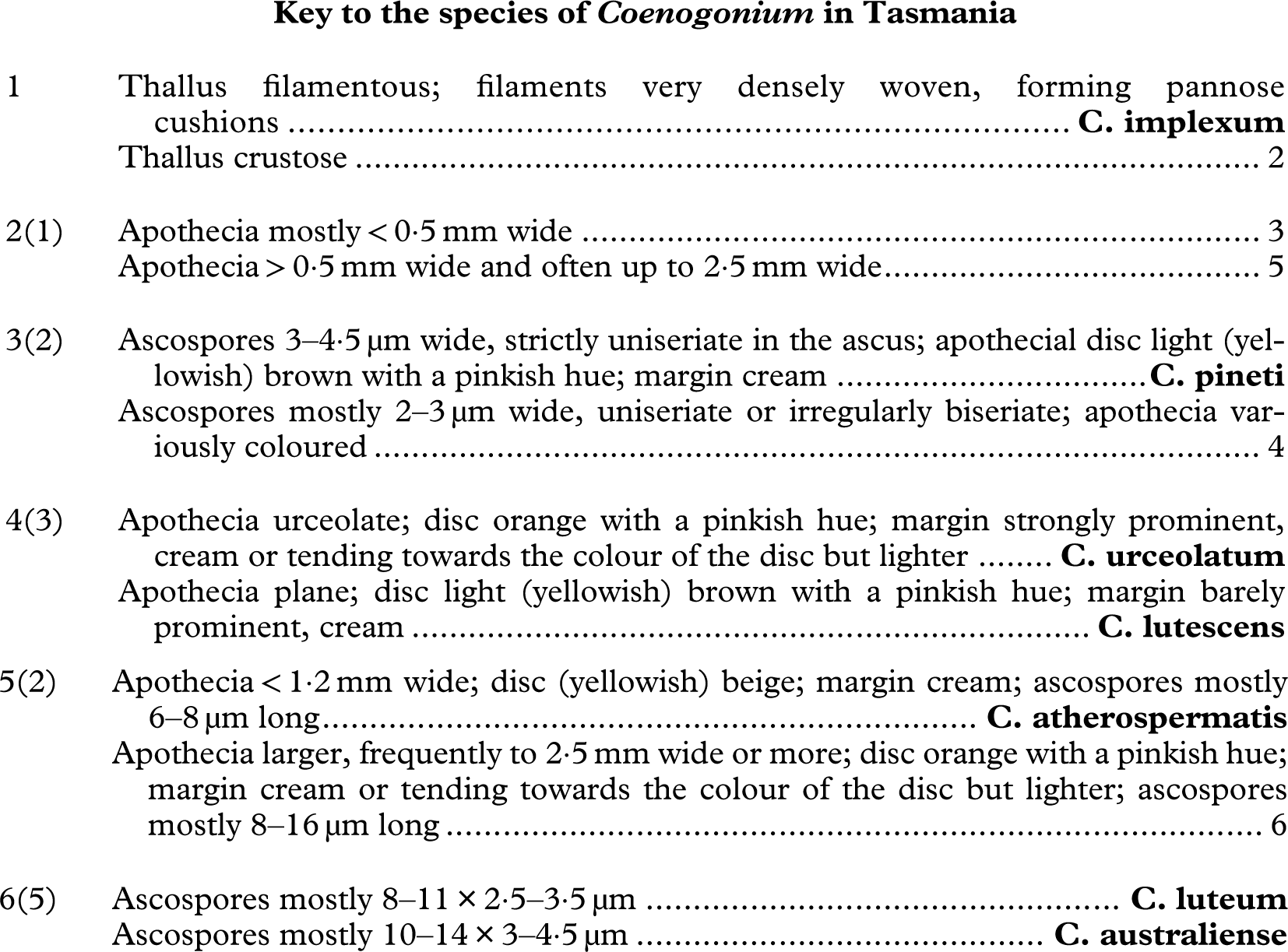
Remarks. This is a very conspicuous lichen, recognized by the large, usually orange apothecia on a grey to grey-green thallus, and by the relatively small, uniseriate ascospores. Further descriptive data are widely available in many regional floras, for example Galloway (Reference Galloway1985), Benfield et al. (Reference Benfield, Purvis and Coppins2009) and Ryan & Nimis (Reference Ryan and Nimis2004) (all as Dimerella). In Australian herbaria, the name Coenogonium (Dimerella) luteum has traditionally been used as place-holder for several entities that have since been recognized as distinct taxa. The distinguishing characters of those segregates that occur in Tasmania are summarized in the identification key above. The most superficially similar species to C. luteum is the newly recognized C. australiense (see above) which mostly occurs in identical habitats and differs chiefly by its larger ascospores.
Owing to its wide geographical distribution, C. luteum has an extensive synonymy. To this are now added two previously overlooked names based on types from Tasmania. Applying a name based on a European type to specimens from the other side of the world is potentially risky. There are numerous instances of taxa once considered identical in both the Northern and Southern Hemispheres that have proved to be distinct. For example, Australasian populations of the seemingly cosmopolitan Lichina confinis (O. F. Müll.) C. Agardh have been found to belong to a separate species, L. intermedia (C. Bab.) M. Schultz (Schultz Reference Schultz2017). Conversely, the widely distributed Calicium salicinum Pers. has numerous synonyms based on Australasian type specimens (Tibell Reference Tibell1987). The name Coenogonium luteum has been applied widely throughout the world and future studies may find this taxon to be polyphyletic, involving regionally-restricted, cryptic taxa. If this proves to be the case in the Australasian region, there are numerous names that could be taken up, including ones based on Tasmanian types. However, at this stage, our Tasmanian specimens do not offer any consistent morphological or anatomical characters that could support their separation from specimens under this name seen from other parts of the world including Europe.
Distribution and ecology. This presumably cosmopolitan species is widespread and abundant in Tasmania in cool temperate rainforest and, to a lesser extent, in wet eucalypt forest and wet scrub where it is typically confined to low elevations (below c. 600 m). There, it is usually found in deeply shaded habitats on the lower parts of trunks of many different tree species, frequently overgrowing bryophytes. The fibrous trunks of tree ferns (Dicksonia antarctica Labill.) or the mossy boles of Nothofagus cunninghamii are a favoured substratum. More rarely the species has been recorded from shaded rocks.
Selected specimens examined. Australia: Tasmania : Mt. Victoria, 41°21'S, 147°48'E, 600 m, 1913, W. A. Weymouth 986 (HO); Trowutta, 41°02'S, 145°05'E, 200 m, 1981, G. Kantvilas 396/81 (BM, HO); Wallaby Bay, Port Davey, 43°17'S, 145°57'E, 2 m, 1987, A. Moscal 13819 (HO); Mt. Sprent, 42°47'S, 145°59'E, 450 m, 1987, G. Kantvilas s. n. (ASU, HO); Davey River, 43°03'S, 145°59'E, 30 m, 1990, G. Kantvilas 167/90 (B, F, HO); W of Savage River Pipeline Road, 41°13'S, 145°19'E, 450 m, 2003, G. Kantvilas 668/03 (HO); end of Bolduan Road, 40°47'S, 145°02'E, 1 m, 2011, G. Kantvilas 475/11 (HO).
Coenogonium pineti (Schrad. ex Ach.) Lücking & Lumbsch
In R. Lücking, B. L. Stuart & H. T. Lumbsch, Mycologia 96: 290 (2004).—Lecidea pineti Schrad. ex Ach., Lichenogr. Univ.: 195 (1810).—Dimerella pineti (Schrad.) Vĕzda, Lich. Sel. Exsicc. 52: 1279 (1975); type not seen.
(Fig. 1E)
Thallus crustose, pale greyish green, to 30 µm thick, sometimes rather patchy; prothallus absent; photobiont cells oblong to subglobose, 10–22×7–12 µm.
Apothecia sessile, flat, 0·2–0·4(–0·5) mm wide; disc light (yellowish) brown with a pinkish hue, plane; margin cream, inrolled when young, smooth. Proper excipulum 50–80 µm thick laterally, 30–40 µm thick basally. Hypothecium colourless, 20–60 µm thick. Hymenium 70–100 µm thick; asci 60–75×5–7 µm; paraphyses 1–1·5 µm thick, with apices 3–5 µm thick. Ascospores strictly uniseriate, arranged obliquely or end-to-end in the ascus, (7·5–)9–10·4–12·5(–14)×3–3·5–4(–4·5) µm; length to width ratio (2·1–)2·4–3·1–3·7(–4·5).
Pycnidia exceedingly rare in Tasmanian specimens, visible as minute, pale swellings in the upper surface of the thallus; conidia simple, oblong, mostly slightly constricted in the centre, 3–5×1–2 µm.
Remarks. This species is similar to C. lutescens and C. urceolatum in having tiny apothecia. It differs from both by its slightly larger, wider ascospores that are strictly uniseriate in the ascus. Coenogonium urceolatum differs further by having orange, distinctly urceolate rather than flattened apothecia. Further descriptive data are provided by Benfield et al. (Reference Benfield, Purvis and Coppins2009) (as Dimerella). Although the upper size limit of the ascospores in this species is cited in the literature as 12 µm, it is not uncommon to find larger ascospores in Tasmanian specimens, especially those that are free of the asci. Tasmanian specimens have been compared extensively with collections from across the Northern Hemisphere and we are confident they belong to this species. However, at least some collections labelled as C. pineti from New Zealand (observed in S) are of another taxon.
As with C. luteum, there is a possibility that Tasmanian populations of C. pineti might, with further study, prove to be distinct. However, we have been unable to find any morphological evidence to support this and the specimens seen fall within the European-global variation of C. pineti as currently understood. However, the observed and reported variation in conidial size deserves further study. Our observations are in accordance with those of Rivas-Plata et al. (Reference Rivas Plata, Lücking, Aptroot, Sipman, Chaves, Umaña and Lizano2006), based on mostly tropical montane collections. However, Benfield et al. (Reference Benfield, Purvis and Coppins2009) and Stenroos et al. (Reference Stenroos, Velmala, Pykälä and Ahti2016) report the conidia of European specimens as considerably longer (6–8×1·8–2·6 µm). The extreme rareness of pycnidia in Tasmanian specimens prevents further exploration of this discrepancy, but if global revision of available material supports such differences, the forms with small conidia possibly represent a distinct taxon.
Distribution and ecology. Coenogonium pineti is widely distributed in the cool temperate Northern Hemisphere and is also recorded from south-eastern mainland Australia. It appears to be rare (or overlooked) in Tasmania, where it has been collected from the trunks of old Nothofagus cunninghamii trees in cool temperate rainforest, mainly in the north-west of the island.
Specimens examined. Australia: Tasmania: Dover to Raminea road, 43°19'S, 146°58'E, 1973, D. H. Norris s. n. (HO); Arthur River near Flannel Road, 360 m, 1982, G. Kantvilas s. n. (HO); Anthony Road, 41°50·5'S, 145°37·5'E, 540 m, 1992, G. Kantvilas 554/92 (F, HO, PRA); Savage River Pipeline Road near Rapid River (N of bridge), 41°16'S, 145°20'E, 450 m, 2015, G. Kantvilas 203/15 (HO).
Coenogonium urceolatum Kantvilas, Rivas Plata & Lücking sp. nov.
MycoBank No.: MB 827259
Coenogonio pineti simile sed apotheciis aurantiacis urceolatisque, 0·3–0·4 mm latis, et ascosporis angustioribus brevioribusque, 8·5–11 µm longis, 2·5–3 µm latis differt.
Typus: Tasmania, near Piney Creek, c. 10 km NW of Zeehan, 41°50'S, 145°14·5'E, on old, dry trunk of Nothofagus cunninghamii in rainforest, 350 m altitude, 7 April 1989, G. Kantvilas 145/89 (HO—holotypus; B, F, PRA—isotypi).
(Fig. 1F)
Thallus crustose, pale greyish green, 15–30 µm thick; prothallus absent; photobiont cells oblong to subglobose, 10–15×6–9 µm.
Apothecia sessile, urceolate, 0·3–0·4 mm wide; disc orange with a pinkish hue, plane to slightly concave; margin tending towards the colour of the disc but a little lighter, smooth. Proper excipulum 40–60 µm thick, pale orange at the outer edge. Hypothecium colourless to pale yellowish brown, 40–60 µm thick. Hymenium 80–90 µm thick; asci 60–75×4–7 µm; paraphyses 1–1·5 µm thick, with apices 2·5–4 µm thick. Ascospores uniseriate, arranged obliquely or end-to-end in the ascus, (8·5–)9–9·9–11×(2–)2·5–2·8–3 µm; length to width ratio 3·0–3·6–4·4.
Pycnidia not observed.
Etymology. The specific epithet is derived from the distinctive urceolate shape of the apothecia.
Remarks. Distinctive features of this new species are the small, urn-shaped, orange apothecia and the small, uniseriate ascospores. It is rather similar to C. pineti (above) which likewise has tiny apothecia, but these are typically pale brownish with a flat disc and barely prominent margins; in addition, the ascospores in C. pineti are somewhat broader. Also similar is C. lutescens, which has ascospores of a very similar size, but these are irregularly biseriate in the ascus; furthermore, the apothecia of this species are paler, with a plane disc and a barely prominent margin (similar to C. pineti but with narrower ascospores). In addition, the habitat ecology of these species is quite different (see above). The new species also shares some characteristics with two Australian endemic taxa, C. minutissimum Kalb and C. platysporum Kalb. Both differ from C. urceolatum by having smaller (<0·25 mm wide) apothecia, which are also flat, as evidenced by their thinner hymenium and shorter asci; C. platysporum differs further by having wider (5 µm) ascospores (see Kalb Reference Kalb2007).
Distribution and ecology. Coenogonium urceolatum is a very rare species, known only from the type collection. It was collected from the dry, deeply shaded face of a very old trunk of Nothofagus cunninghamii in cool temperate rainforest in western Tasmania, a microhabitat generally inhabited by species of Caliciales and the crustose Roccellaceae. The specimen studied contains fragments of thalli of a species of the Micarea prasina Fr. group and of a Lepraria species.
Discussion
Most species of Coenogonium reported from Australia (McCarthy Reference McCarthy2017) are from the tropical areas of Queensland and are not expected to occur in Tasmania. Six foliicolous species have been reported from as far south as New South Wales, namely C. dilucidum (Kremp.) Kalb & Lücking, C. fallaciosum (Müll. Arg.) Kalb & Lücking, C. flavicans (Vězda & Farkas) Kalb & Lücking, C. hypophyllum (Vězda) Kalb & Lücking, C. lisowskii (Vězda) Lücking and C. subluteum (Rehm) Kalb & Lücking. However, no foliicolous species of Coenogonium are known at present from the cool temperate rainforests of Victoria or Tasmania. Four corticolous species of Coenogonium have been reported from Victoria, C. implexum, C. interplexum Nyl., C. luteum and C. pineti, but, except for C. interplexum, all of which are shared with Tasmania. The reports of C. pyrophthalmum from New South Wales represent C. australiense. Thus, five of the seven recognized Tasmanian species of the genus are shared with the cool temperate, southern parts of mainland Australia and the remaining two, the newly described C. atherospermatis and C. urceolatum, might be expected to occur there, given that their habitats (twigs of Atherosperma and trunks of mature Nothofagus, respectively) are available there.
The lichen flora of New Zealand includes a subtropical component in northern regions, which explains the presence of five foliicolous taxa, three of them shared with Australia. In addition, New Zealand has six corticolous species, among which C. implexum, C. lutescens, C. luteum and possibly C. australiense (see above) are shared with Tasmania (and mainland Australia), whereas the aforementioned C. pallidulum and C. rubrofuscum (Vĕzda & Malcolm) Malcolm are not known from Tasmania (or mainland Australia). In addition to two of the species newly described here (C. atherospermatis and C. urceolatum), C. pineti is not included in Galloway’s (Reference Galloway2007) treatment for New Zealand, although GBIF has occurrence records for the taxon on the North Island (https://www.gbif.org/species/8652585). Thus, the corticolous Coenogonium biota of the cool temperate rainforests of the south-eastern Australian mainland, Tasmania and New Zealand appears to be fairly consistent, with a number of common, shared elements and perhaps some endemics, amounting, so far, to ten taxa.
For sharing his knowledge and so kindling our interest in Coenogonium, GK and RL acknowledge the input of the late Dr Antonin Vězda, pioneer researcher on this genus. The photographs that illustrate this paper were skilfully prepared by Jean Jarman. Some of the material studied was collected during field surveys co-funded by the Australian Biological Resources Study (ABRS) and BHP Billiton under the Bush Blitz Programme. The work was further supported by an ABRS Tactical Taxonomy Grant to GK.