Introduction
Crowding during rearing is known to influence insect development, survival and reproduction. Interspecific (Applebaum and Heifetz, Reference Applebaum and Heifetz1999; Gibbs et al., Reference Gibbs, Lace, Jones and Moore2004) and intraspecific competition (Simmonds and Blaney, Reference Simmonds and Blaney1986; Tammaru et al., Reference Tammaru, Ruohomaki and Montola2000; Omkar and Afaq, Reference Omkar and Afaq2009; Omkar and Pathak, Reference Omkar and Pathak2009), including cannibalism and intraguild predation (Tschinkel et al., Reference Tschinkel, Willson and Bern1967; Savridou and Bell, Reference Savridou and Bell1994), and quality and quantity of food available at various stages (Putman, Reference Putman1977; Gibbs et al., Reference Gibbs, Lace, Jones and Moore2004; Fantinou et al., Reference Fantinou, Perdikis and Stamogiannis2008) are influenced by crowding. According to Hodek and Honek (Reference Hodek and Honek1996), crowding decreases growth, development rate and adult weight of coccinellids. Other research workers (Dixon, Reference Dixon and Watson1970; Prout and McChesney, Reference Prout and McChesney1985; Scott, Reference Scott1990) have found slower development with decreased reproductive output resulting from crowding.
However, crowding can have multiple benefits. For instance, it allows for increased body mass due to higher food consumption (Wiklund and Forsberg, Reference Wiklund and Forsberg1991); provides more mating opportunities with increased chances for encounters with genetically diverse mates (Thornhill and Alcock, Reference Thornhill and Alcock1983); reduces the risk of predation; and facilitates co-operative social feeding (Pulliam and Caraco, Reference Pulliam, Caraco, Krebs and Davies1984; Nahrung et al., Reference Nahrung, Dunstan and Allen2001). Social feeding during the first instar facilitates food-finding behaviour and increases chances of survival. Omkar and Pathak (Reference Omkar and Pathak2009) reported a larval density of four to be optimal for development, survival and reproduction of the ladybird Propylea dissecta (Mulsant) (Coleoptera: Coccinellidae).
Research is needed to help identify the optimal diet and population density for the mass multiplication of ladybirds for use as biological control agents.
The three-striped ladybird Brumoides suturalis (Fabricius) (Coleoptera: Coccinellidae) is known to predate on aphids, psyllids and aleyrodids (reviewed by Omkar and Pervez (Reference Omkar and Pervez2004)). In addition, Gautam (Reference Gautam1988, Reference Gautam1990) reported the mealybugs Ferrisia virgata Cockrell and Planococcus pacificus Cox (both Hemiptera: Pseudococcidae) and their mixed populations to be suitable for the mass multiplication of the ladybird.
The present study was designed to explore the influence of crowding (solitary vs. group rearing) and prey species on ladybird development. The three-striped ladybird beetle, B. suturalis, was selected for the study using two aphid species, Aphis gossypii Glover and Acyrthosiphon pisum (Harris) (both Hemiptera: Aphididae), as diet. Our hypothesis was that group rearing should be more suitable for development in this ladybird, owing to its social feeding behaviour (Hemptinne et al., Reference Hemptinne, Gaudin, Dixon and Lognay2000; Omkar and Pathak, Reference Omkar and Pathak2009) and small size.
Materials and methods
Brumoides suturalis stock culture
A laboratory culture of B. suturalis was established by collecting adults from agricultural fields adjoining the University of Lucknow, India. A male and female were placed in Petri dishes (9.0 × 2.0 cm) for mating and provided ad libitum with mixed aphids (A. pisum infested on cowpea twigs and A. gossypii infested on bottle gourd leaves) in an environmental test chamber at 27 ± 1°C, 65 ± 5 % relative humidity and a 14 h light:10 h dark photo-regime. A fresh supply of aphids was provided each day to the mating pair. Eggs deposited were collected daily and their hatching recorded. The resulting larvae were reared in glass beakers (9.5 × 6.5 cm) until adult emergence under conditions similar to those used for the parental generation. The resultant F1 adults were further mated. Eggs from the F1 females were used in experiments.
Experimental design
Brumoides suturalis eggs were kept in separate Petri dishes (14 × 1.5 cm) until they hatched. Emerging first instars were transferred into Petri dishes (14 × 1.5 cm) using a soft camel-hair brush. Ten larvae per Petri dish were used for group rearing (n = 50), and one larva per dish for solitary rearing (n = 50). Larvae were provided with an ad libitum supply of A. pisum as diet. The duration of each larval stage and the number of surviving larvae were recorded. The same experiment was repeated using A. gossypii as prey.
Data analysis
Percentage of larval survival (number of pupae formed × 100/number of first instar hatched), and percentage of pupal survival (number of adults emerged × 100/number of pupae) were calculated. A mortality life table was constructed according to Morris and Miller (Reference Morris and Miller1954), where
x is the developmental stage, i.e. all four larval instars, pre-pupae, pupae and adults;
lx is the number of individuals entering the stage x;
dx is the number of individuals dying within the stage x;
100qx is the apparent mortality, dx as a percentage of lx;
100rx is the real mortality, dx as a percentage of the original cohort size;
k-value is a dimensionless measure of the mortality within the age interval x, calculated as the difference between the log values of the number of surviving individuals in subsequent stages;
Sx is the survival rate of a stage, calculated from the number of individuals surviving the present stage number versus the number in the previous stage;
K (kappa) is the sum of k-values.
The durations of the four larval instars; larval and pupal period; partial developmental period (first instar to adult emergence); percentage of larval survival and percentage of pupal survival of the ladybird reared on the two aphid species under group or solitary conditions were subjected to two-way ANOVA using the statistical software MINITAB 15, with rearing pattern and aphid species considered as row and column factors, respectively.
Results
Influence on survival and development
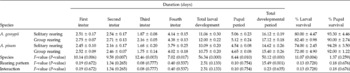
Two-way ANOVA revealed that rearing pattern (group or solitary) had no significant influence on the developmental durations or survival of the immature stages of B. suturalis. However, the species of aphid consumed showed a statistically significant influence on all dependent parameters (Table 1). The interaction between the two dependent factors was insignificant for all the developmental and survival parameters.
Development and survival of Brumoides suturalis under solitary or group rearing on two aphid species, Aphis gossypiiand Acyrthosiphon pisum +

+ Values are means ± SE; F-values are a result of two-way ANOVA.
The ladybird developed faster on a diet of A. pisum. Developmental durations of the first, second, third and fourth instars, total larval development, pupal period and total developmental period were significantly lower in ladybirds fed on A. pisum compared with those on an A. gossypii diet (Table 1). However, percentage of larval survival was significantly higher with the A. gossypii diet than on the A. pisum diet. No significant variations were observed in percentage of pupal survival on the two prey diets (Table 1).
Influence on mortality
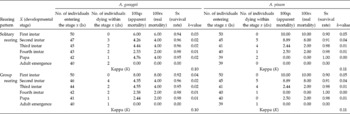
Apparent larval mortality, real mortality and k-values of the first and second instars were lower in ladybirds reared on A. gossypii, and these stages had lower survival rates than those reared on A. pisum (Table 2). The third instars of B. suturalis reared on A. gossypii had higher apparent mortality but lower survival rates than those reared on A. pisum (Table 2). Real mortality and k-value for the fourth instars were similar on both aphid species.
Mortality life table of Brumoides suturalis on two rearing patterns and two aphid species, Aphis gossypii and Acyrthosiphon pisum

Overall mortality was lower in ladybirds reared on A. gossypii than on A. pisum. With A. gossypii as diet, total mortality (K-value) was lower under solitary- than under group-rearing conditions (Table 2).
Discussion
Rearing pattern (group or solitary) influenced neither overall development nor the survival of B. suturalis. Contrary to our findings, previous studies have found an effect of rearing pattern on ladybird development and survival, with group rearing facilitating feeding (Hemptinne et al., Reference Hemptinne, Gaudin, Dixon and Lognay2000). Omkar and Pathak (Reference Omkar and Pathak2009) found solitary-rearing conditions to be unsuitable for P. dissecta rearing.
Prey species had a significant influence, with B. suturalis larvae showing faster development and higher survivability on A. pisum than on A. gossypii. Pupal survival, however, was not influenced by prey species. A number of previous studies have observed differences in the suitability of different prey species to the developmental performance of ladybird beetles (e.g. Hodek, Reference Hodek1956; Blackman, Reference Blackman1967; Sugiura and Takada, Reference Sugiura and Takada1998; Francis et al., Reference Francis, Haubruge and Gasper2000; Omkar et al., Reference Omkar, Kumar and Sahu2009). These have been attributed to differences in the nutritional content of the prey species, which may either be innate to the species, host plant acquired, or arise from a combination of factors (Hodek and Honek, Reference Hodek and Honek1996; Dixon, Reference Dixon2000; Nelson and Rosenheim, Reference Nelson and Rosenheim2006).
The total developmental periods of B. suturalis observed in the present study were shorter than those reported using a diet of mealybugs, such as F. virgata (24.21 days), P. pacificus (28 days), a mixed population of Aphriza virgata and P. pacificus (25 days), and eggs of Phthorimaea operculella (23 days) (Gautam, Reference Gautam1990). This suggests that B. suturalis generally develops faster on aphids than on mealybugs.
The differences in the survival and development of B. suturalis on the two prey species suggest that in addition to nutritional composition, other factors, such as prey size and defence, played a role. The higher overall larval mortality on A. pisum, especially during the first and second instars, was probably the result of the larger size and relatively strong sclerotization of this prey species. Its long legs and large size probably helped it to actively evade capture and even fight off smaller ladybird larvae. Furthermore, aphids may daub large amounts of siphuncular wax onto predator larvae, causing their immobility and eventual starvation (Dixon, Reference Dixon2000).
Higher larval mortality in the smaller and more delicate first instars may also arise from adverse abiotic and biotic factors, including attack by parasitoids and pathogens (Srivastava and Omkar, Reference Srivastava and Omkar2004).
We estimated that a fully grown fourth instar consumed 6–8 A. pisum and 12–15 A. gossypii per day (data not shown). Kapur (Reference Kapur1942) reported that B. suturalis larvae consumed about 10–15 nymphs of the aphid species Hyalopterus atriplicis daily.
Acknowledgements
The first author thanks the UGC, Nepal for financial assistance. The second and third authors thank the Department of Higher Education, Government of Uttar Pradesh for financial assistance under the ‘Centre of Excellence’ programme.