Introduction
Until recently, Commonwealth Bay (the location of Sir Douglas Mawson’s research station during the Australasian Antarctic Expedition (AAE) of 1911–1914) was rarely covered by sea ice. An extensive coastal polynya existed adjacent to the shore, created by strong katabatic winds that travel off the continental ice cap and are funnelled into Cape Denison by local topography (Parish & Walker Reference Parish and Walker2006). Under normal circumstances, these winds transport surface ice offshore with Mawson reporting that during their two year stay there were only two days per year in which sea ice was stable enough to work upon (Mawson Reference Mawson1940). Sea ice conditions changed dramatically in December 2010 when a giant iceberg (c. 100 km2 in area) named B09B became grounded in Commonwealth Bay (Shadwick et al. Reference Shadwick, Rintoul, Tilbrook, Williams, Young, Fraser, Marchant, Smith and Tamura2013) and has remained there since (Lacarra et al. Reference Lacarra, Houssais, Herbaut, Sultan and Beauverger2014).
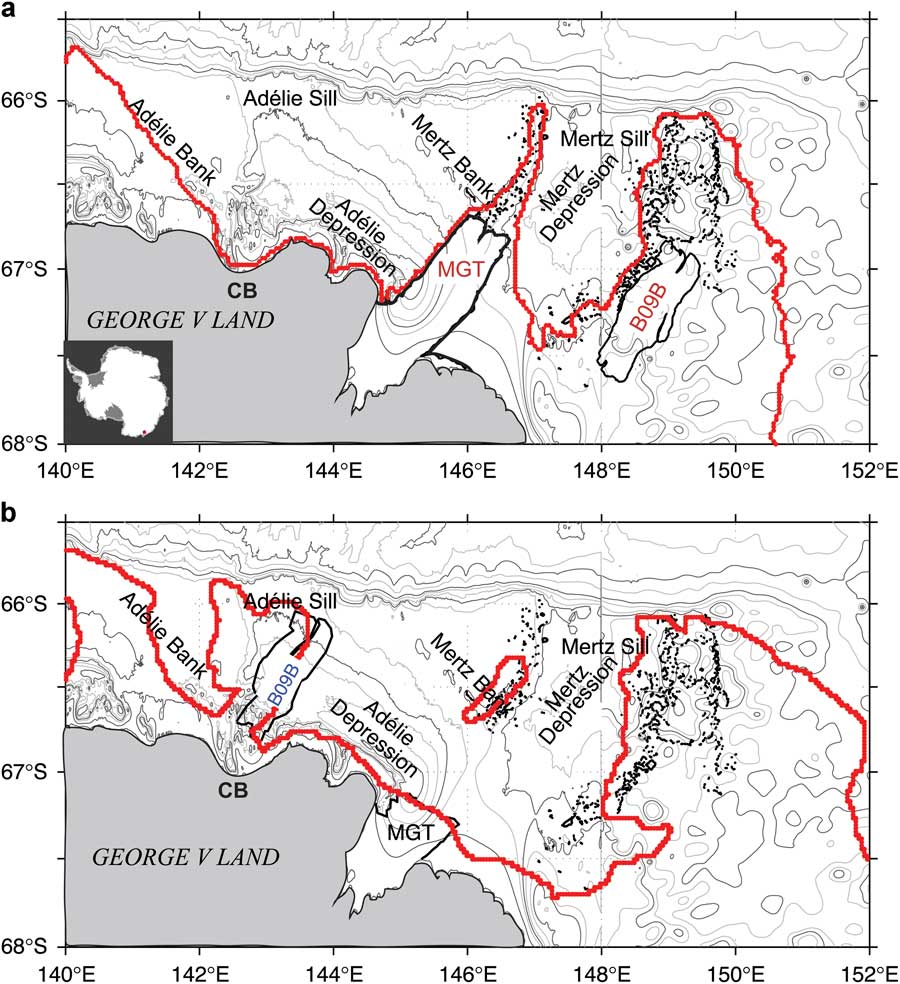
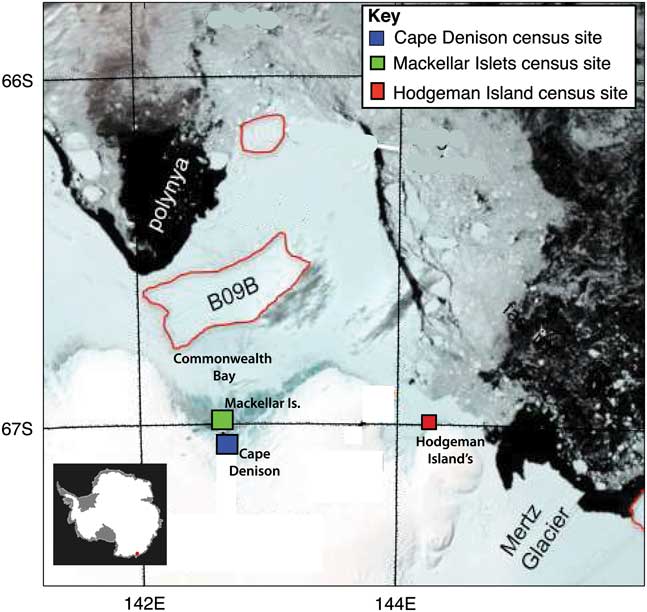
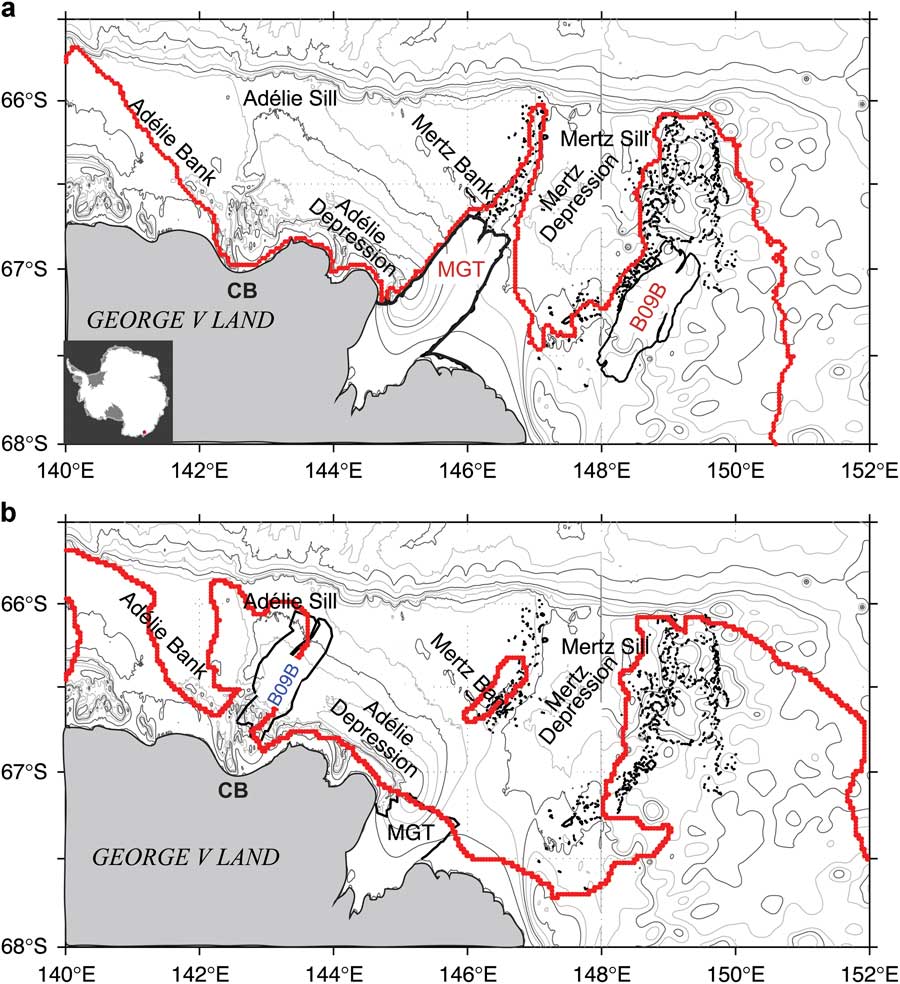
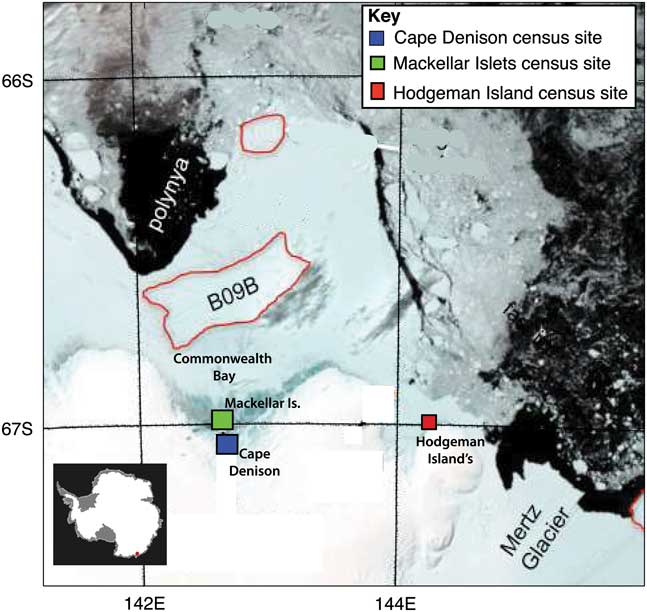
The residence of B09B in Commonwealth Bay has prevented sea ice on the landward side of the iceberg from being transported offshore, creating year-round fast ice cover (Fig. 1). Thus the entire area of ocean between land and iceberg has become covered by unbroken fast ice up to 3 m thick (Fig. 2) (Clark et al. Reference Clark, Marzinelli, Fogwill, Turney and Johnston2015). In normal years, the presence of open water to the shores of Cape Denison allowed nesting Adélie penguins (Pygoscelis adeliae Hombron & Jacquinot) to feed in Commonwealth Bay and on the nearby pack ice. With the arrival of B09B the penguins must now walk more than 60 km (estimated from December 2013 satellite photos) to find food.
Map of the study area depicting maximum fast ice extent (red line) of George V Land from the mean 20 day MODIS imagery over winter (June–August) in a. 2000–09 and b. 2011–12. Inset: Location of Commonwealth Bay region, East Antarctica. B09B is the massive iceberg grounded in Commonwealth Bay since 2010. MGT=Mertz Glacier Tongue, CB=Commonwealth Bay. Adapted from Tamura et al. (Reference Tamura, Williams, Fraser and Ohshima2012).
MODIS image of fast ice extent in the Commonwealth Bay and Mertz Polynya region on 15 December 2013 (credit: Dr Jan Liester, AAD). Locations of the Cape Denison, Mackellar and Hodgeman islands Adélie penguin census sites. Inset: Location of Commonwealth Bay region, East Antarctica.
Adélie penguins are birds of the pack ice, requiring open water or accessible tide cracks within 2–3 km of their colony (Ainley Reference Ainley2002). Therefore, the colony size and breeding success are strongly influenced by sea ice conditions. At least 100 Adélie penguin colonies are associated with polynyas (Ainley Reference Ainley2002); notably the huge Ross Sea Polynya in the southern Ross Sea (8–9% of the global Adélie penguin population) (Ainley Reference Ainley2002, Dugger et al. Reference Dugger, Ballard, Ainley, Lyver and Schine2014). The Mertz Polynya that kept Commonwealth Bay and adjacent areas ice-free was closed when B09B smashed the Metz Ice Tongue and stranded off Commonwealth Bay in 2010 (Shadwick et al. Reference Shadwick, Rintoul, Tilbrook, Williams, Young, Fraser, Marchant, Smith and Tamura2013).
The calving of giant icebergs occurs infrequently and the satellite technology needed to document their tracks has only recently become available. Thus, there have been few studies on the effects of icebergs on local marine ecosystems and biota (Arrigo et al. Reference Arrigo, van Dijken, Ainley, Fahnestock and Markus2002, Arrigo & van Dijken Reference Arrigo and van Dijken2003). Previous studies in the southern Ross Sea have shown that giant icebergs can disrupt the movement of sea ice, leading to temporary cover of the Ross Sea Polynya, reducing primary productivity, altering food chains (Arrigo & van Dijken Reference Arrigo and van Dijken2003) and resulting in dietary changes, foraging effort, breeding failure, population declines and changes in emigration rates of Adélie penguins (Arrigo et al. Reference Arrigo, van Dijken, Ainley, Fahnestock and Markus2002, Shepherd et al. Reference Shepherd, Millar, Ballard, Ainley, Wilson, Haynes, Baroni and Lambert2005, Dugger et al. Reference Dugger, Ballard, Ainley, Lyver and Schine2014).
Projected increases in the calving of giant icebergs from Antarctic ice sheets and associated disruption in sea ice conditions has the potential to impact Adélie penguins (Lescroël et al. Reference Lescroël, Ballard, Grémillet, Authier and Ainley2014). By imposing continuous fast ice cover over an area that was previously ice-free for most of each year, iceberg B09B has established a natural experiment to test the effects of changes in the regional ice scape on local biota (Shadwick et al. Reference Shadwick, Rintoul, Tilbrook, Williams, Young, Fraser, Marchant, Smith and Tamura2013, Clark et al. Reference Clark, Marzinelli, Fogwill, Turney and Johnston2015). Furthermore, it tests the resilience of Adélie penguins to major iceberg stranding events and increases in fast ice extent, complementing previous studies in the southern Ross Sea (Shepherd et al. Reference Shepherd, Millar, Ballard, Ainley, Wilson, Haynes, Baroni and Lambert2005, Dugger et al. Reference Dugger, Ballard, Ainley, Lyver and Schine2014).
Methods
To assess the effects of the newly formed perennial fast ice on the Adélie penguin colonies at Cape Denison and the nearby Hodgeman Islands, a detailed census was undertaken in December 2013 during the AAE 2013–14. At that time the colonies at Cape Denison and the Hodgeman Islands were>60 km and c. 8 km from the fast ice edge, respectively (Fig. 2). Adélie penguins were censused at both locations to investigate the impact of iceberg B09B and associated expansion of fast ice on penguin populations, behaviour and breeding success.
Cape Denison, 67°00'30''S, 142°40'20''E, is an ice-free promontory comprising moraines and rocky ridges at the head of Commonwealth Bay, East Antarctica (Fig. 1). The ice-free area measures c. 1.5 km east–west and 500–750 m north–south. The Adélie penguin colony was first described a century ago (Mawson Reference Mawson1915, Reference Mawson1929, Falla Reference Falla1937). Three kilometres north of Cape Denison are the Mackellar Islets, once home to a large Adélie penguin colony, and to the east and west of Cape Denison, a string of small islands and occasional ice-free cliffs. Adélie penguins breed on most of these islands.
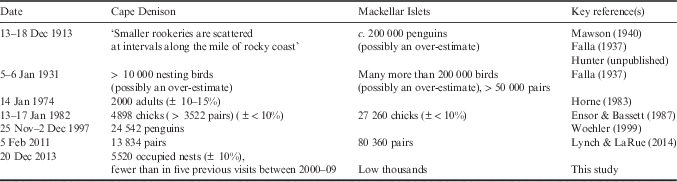
Cape Denison was visited on 20 December 2013, travelling over the fast ice from the expedition ship moored at the ice edge 65 km away (Fig. 2). The count was conducted by two observers working together, each counting sub-colonies as they moved through the areas occupied by penguins (Table I). Each sub-colony was counted by one observer and most sub-colonies were only counted once. Random recounts, some by the same observer, others by the second, showed all counts to be accurate to within 10%; most recounts differing by as little as 5%. Only occupied nests were counted, defined as any nest occupied by a penguin in an incubating pose, a penguin defending the site from other birds, or a penguin (whether on a formed nest or not) that was incubating an egg or brooding a chick. Due to time constraints the penguins east of Petrel Hill were counted using binoculars from a lookout near the summit of Petrel Hill and there was insufficient time to make all desirable ancillary observations.
Estimates of Adélie penguin population size at Cape Denison and the Mackellar Islets, Commonwealth Bay, Antarctica.

On 20 December 2013 the penguins were nearing the end of the incubation phase with the very first chicks recently hatched. The Mackellar Islets, 3 km north of Cape Denison, where c. 200 000 Adélie penguins were estimated to be present in 1912–13 and in 1931 (Falla Reference Falla1937, Mawson Reference Mawson1940), were scanned using binoculars from Cape Denison and visited by AAE members I. Godfrey and J. Tucker on 20 December 2013. To place these results in a wider context, the larger of the Hodgeman Islands (66°59'60.0''S, 144°16'54.0''E), c. 70 km from Cape Denison was visited on 23 December to undertake comparable observations at an Adélie penguin colony just 8 km from open water. South Polar skuas (Catharacta maccormicki Saunders) were also surveyed at both locations (Wilson et al. Reference Wilson, Turney, Fogwill and Hunter2015).
Results
In contrast to the original population estimates in excess of 200000 penguins on the Mackellar Islets and c. 10 000 birds at Cape Denison made during the AAE 1911–14 and BANZARE in 1931, a catastrophic decline in Adélie penguin numbers was observed on the Mackellar Islets and a partial redistribution of birds to Cape Denison (Table I). Whilst the numbers of Adélie penguins have apparently varied markedly over the last century due to unknown factors, the 2013 census remains markedly lower than the last detailed census undertaken in 1997 and estimates based on colony area in February 2011 (Table I).
At Cape Denison, 5520 occupied Adélie penguin nests were counted on 20 December 2013. Of these nests, 4319 were in the part of Cape Denison where birds were counted from observation points adjacent to each sub-colony, with counts accurate to within 5–10% of the true number. Those colonies east of Petrel Hill, totalling 1201 occupied nests, were counted using binoculars; it is possible that some penguins nested out of sight of the observation point, making this a minimum estimate of actual numbers present. Our binocular scan of the Mackellar Islets on 20 December 2013 indicated that few penguins were present. This was confirmed during a visit to one of the islands later that day, when very few penguins were observed: ‘low thousands at most, perhaps less than one thousand’ (I. Godfrey, personal communication 2013).
On 23 December 2013, 922 occupied nests were counted on the larger of the Hodgeman Islands but with limited time ashore it was estimated that there were between 800–950 occupied nests. Based on a binocular scan of the smaller of the Hodgeman Islands it was estimated that there were 100–150 nests.
Discussion
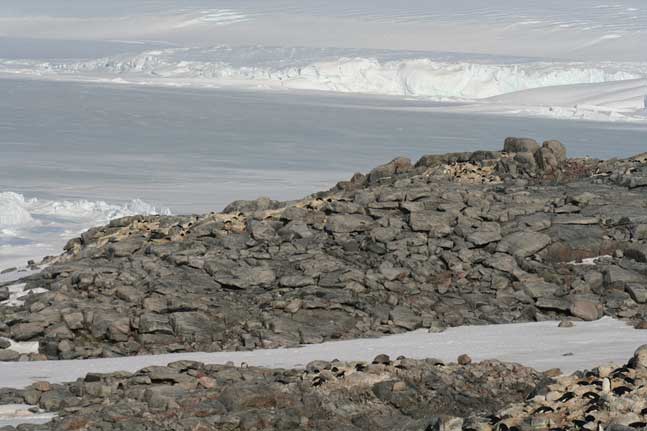
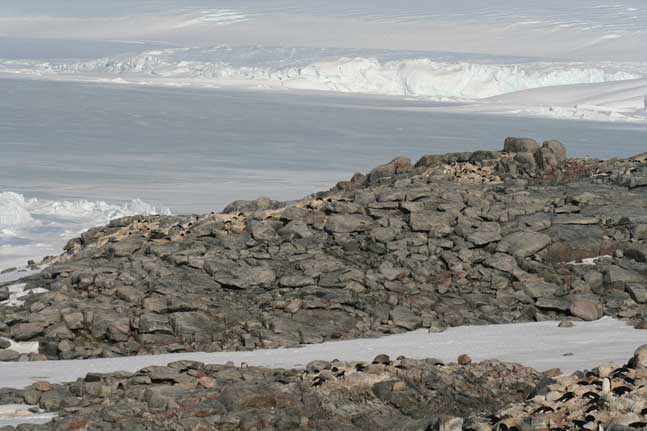
Our recent counts indicate that there has been a major decline in penguin numbers at Cape Denison since the stranding of B09B in 2010. In December 2013, penguins were nesting at low density. Guano covered rocks with no evidence of wind erosion indicated both a higher nest density and a greater area utilized by penguins in recent years (Fig. 3). Although such signs of previous penguin occupation may be much older than appears from observation alone (Emslie & Woehler Reference Emslie and Woehler2005) other evidence supports a post-B09B decline. I. Godfrey (who has visited Cape Denison during five previous summers (December 2000–January 2001, January 2002, October–December 2006, December 2008–January 2009, and 14–16 January 2012)) noted how few birds were present in 2013 compared with previous visits, even 2012, the last visit after the stranding of B09B (I. Godfrey, personal communication 2013). Further evidence for a post-B09B stranding decline comes from the estimates for both Cape Denison and the Mackellar Islets of 13 834 and 80 360 breeding pairs, respectively, based on satellite images taken on 5 February 2011 (the summer that B09B stranded) and calculated from the area of guano stained rocks (Lynch & LaRue Reference Lynch and LaRue2014).
Adélie penguin sub-colonies east of Petrel Hill, Cape Denison, 20 December 2013 showing the low density of nesting penguins and guano covered rocks indicating areas previously used for nesting by the penguins but now abandoned as sub-colonies contract in the area.
In order to assess the theory that it was the stranding of B09B that has impacted the Adélie penguin population, it is important to determine how quickly the fast ice built up in Commonwealth Bay. An aerial view of Cape Denison taken during the 2010–11 summer season (Mawson’s Huts Foundation 2012), one year after B09B caused the calving of the Mertz Glacier Tongue and icing over of the Mertz Polynya began (Shadwick et al. Reference Shadwick, Rintoul, Tilbrook, Williams, Young, Fraser, Marchant, Smith and Tamura2013), shows open water still surrounded Cape Denison at this time (see Fig. 1). Sea conditions at that point were remarkably similar to those seen in photos taken during AAE 1911–14, as described by Falla (Reference Falla1937) during a visit in 1931, Ensor & Bassett (Reference Ensor and Bassett1987) in 1982 and subsequent visits by Mawson’s Huts parties (I. Godfrey, personal communication 2013). However, by January 2012 the fast ice extended c. 12 nautical miles (c. 22 km) offshore from Cape Denison (I. Godfrey, personal communication 2013), and by December 2013, two summers later, the extent had more than doubled, reflecting the recent decline in penguin numbers reported here (Figs 1 & 2).
During the census in December 2013, the impact of B09B on the penguins was considerably more dire than the census numbers alone would suggest. Hundreds of abandoned eggs were noted, and the ground was littered with the freeze-dried carcasses of previous season’s chicks. For example, in one sub-colony with 35 occupied nests there were seven still intact abandoned eggs and seven dead chicks from last season within the colony perimeter alone. Other dead chicks were found close by and eggshell fragments indicated even greater egg loss. It is probable that South Polar skuas had eaten or removed other eggs or chicks from the sub-colony. Observations in other nesting areas indicated a similar attrition rate of chicks and eggs, but due to time constraints no further such data was obtained.
The stranding of giant icebergs in the southern Ross Sea that blocked the Adélie penguin’s approach paths to their colonies, thus increasing the distance birds must travel to feed, had a greater effect on chick mass and breeding success than any other environmental parameter measured (Dugger et al. Reference Dugger, Ballard, Ainley, Lyver and Schine2014). In that study, penguin pairs that utilized cracks in the sea ice successfully fledged chicks while those where one or both members of the pair resorted to the 60 km commute across the fast ice failed (Dugger et al. Reference Dugger, Ballard, Ainley, Lyver and Schine2014). It was not possible to determine if some Cape Denison birds used cracks in the ice. However, on our journey between the ship and Cape Denison we found only one crack in the fast ice and the only penguin seen was a dead Adélie. No Adélie penguins were seen nearby, close to any of the stranded icebergs where tide cracks may have been present.
Although Adélie penguins are able to breed successfully under a range of sea ice conditions, we believe the extensive fast ice at Cape Denison in 2013 was beyond that with which they could cope. Watanuki et al. (Reference Watanuki, Kato, Naito, Robertson and Robinson1997, Reference Watanuki, Kato, Sato, Niizuma, Bost, Le Maho and Naito2002) compared the foraging of Adélie penguins at three East Antarctic colonies. At Hurkuro Cove (30 km south of the Syowa Japanese research station) where the penguins feed through cracks in the fast ice 1–1.2 km from the colony throughout both incubation and chick rearing, at Dumont d’Urville where adults used pools in the fast ice until the ice broke out in late December, and near Davis Station where they forage in open water. In all three situations the penguins maintained their own body mass while successfully raising chicks by adjusting their foraging trip duration, dive depth and duration, and foods taken (Watanuki et al. Reference Watanuki, Kato, Sato, Niizuma, Bost, Le Maho and Naito2002). At Hurkuro Cove breeding success was lower in 1991 than in 1990; in 1991 the adults worked harder to obtain food, their foraging trips were longer in duration and dives were both deeper and longer than in 1990 (Watanuki et al. Reference Watanuki, Kato, Mori and Naito1993). In 1991 chicks were fed less often although the mean mass of food provided to chicks on those less frequent visits was similar to that delivered on more frequent visits in 1990; the adults apparently maintaining their own body condition at the expense of chick growth and survival. While Adélie penguins are able to utilize cracks in the fast ice, the food available within range of each crack may be quickly depleted and slow to recover (Watanuki et al. Reference Watanuki, Kato, Mori and Naito1993, Reference Watanuki, Kato, Naito, Robertson and Robinson1997).
Adélie penguins are birds of the pack ice, and during the chick rearing period the foraging trip duration for the parents, and therefore the amount of food delivered to the chicks, varies with distance to the pack ice, whether this is across fast ice or open water (Ainley et al. Reference Ainley, Wilson, Barton, Ballard, Nur and Karl1998). In a study in the southern Ross Sea, during the first two weeks after chicks hatched most foraging trips were 1–2 days in duration, but as distance to the pack ice increased and trips exceeded two days in duration, the chicks were fed less often and meal size was reduced as the adults required more of the food obtained to meet their commute to and from the colony (Ainley et al. Reference Ainley, Wilson, Barton, Ballard, Nur and Karl1998). At Cape Denison in 2012–13, when large numbers of chicks died, and 2013–14, when extensive Adélie egg abandonment was noted, the closest point of the fast ice edge was c. 60 km from the colony (Fig. 2), considerably worse for penguins than conditions reported by Ainley et al. (Reference Ainley, Wilson, Barton, Ballard, Nur and Karl1998). In that Ross Sea study, the worst case was at Cape Royds in 1994–95 when penguins had to walk across 24 n miles (c. 44 km) of fast ice to reach pack ice during the first few weeks of the chick-provisioning period, although as chicks grew the ice broke up and open water became considerably closer to the colony (Ainley et al. Reference Ainley, Wilson, Barton, Ballard, Nur and Karl1998). That study also recorded times when Cape Crozier was up to 72 n miles (c. 133 km) from the pack ice (Ainley et al. Reference Ainley, Wilson, Barton, Ballard, Nur and Karl1998) but this was across open water, a faster and less energy demanding commute than over fast ice with the opportunity to feed along the way. A subsequent giant iceberg stranding in the same area (Arrigo et al. Reference Arrigo, van Dijken, Ainley, Fahnestock and Markus2002, Shepherd et al. Reference Shepherd, Millar, Ballard, Ainley, Wilson, Haynes, Baroni and Lambert2005, Dugger et al. Reference Dugger, Ballard, Ainley, Lyver and Schine2014) resulted in a situation where the Adélie penguins had to walk 50–70 km to reach open water; resulting in reduced breeding success and lower chick mass during the years that the giant icebergs were present. During the 2013 visit the Cape Denison penguin colony was uncharacteristically silent, more so even than colonies habituated to human visitors. The normally noisy, aggressive penguins were quiet, and incubating birds hardly acknowledged our intrusion into their realm. Importantly, there were few, possibly no, prospecting, pre-breeding birds observed at Cape Denison; virtually all penguins present were associated with a nest. Prospecting birds are critical to the future of the colony; if young birds do not visit Cape Denison, there will probably be few recruits to replace older established breeders, and numbers breeding there are likely to continue to decline even after the ice finally breaks up.
Lack of recruitment occurred at Cape Hallett, northern Victoria Land, in those Adélie penguin sub-colonies subjected to repeated human disturbance between 1956 and 1973 while the USA-NZ base was occupied (Wilson et al. Reference Wilson, Taylor and Barton1990). Numbers in these sub-colonies continued to decline even after the base was abandoned, while sub-colonies subjected to minimal disturbance prior to 1973 remained stable or even increased (Wilson et al. Reference Wilson, Taylor and Barton1990). Emigration from the smaller colonies east and west of Cape Denison may, however, delay local extirpation and could provide a mechanism for eventual recovery when B09B moves from Commonwealth Bay. For example, while habitat was limiting on Beaufort Island, up to 3% of chicks fledged there emigrated to the Ross Island colonies 20–50 km distant (LaRue et al. Reference LaRue, Ainley, Swanson, Dugger, Lyver, Barton and Ballard2013).
On 23 December 2013 the Adélie penguin colony on the larger of the Hodgeman Islands, then just 8 km from the fast ice edge, was censused. In contrast to Cape Denison, penguins were noisy and the birds responded aggressively during the census, which is usual behaviour for Adélie penguins. There were very few abandoned eggs or desiccated chicks, and prospecting birds were numerous. Ensor & Bassett (Reference Ensor and Bassett1987) estimated there were c. 975 chicks on this island in January 1982. Their count is in line with the estimate of c. 900 occupied nests in December 2013.
Despite the extensive fast ice offshore, many Adélie penguins persist in returning to Cape Denison to breed. Unfortunately, the food reserves they need for the initial incubation shifts of 8–15 days for males, 2–16 days for females while incubating their eggs (Ainley Reference Ainley2002), or the food they must bring home for their chicks, normally at 1–2 day intervals (Ainley Reference Ainley2002), is instead used for self-maintenance and the> 60 km commute across the ice. The large number of desiccated chicks indicates that in 2012–13, by which time the fast ice extent was similar to that in 2013–14, many pairs had successfully incubated eggs but then failed to raise their young. By December 2013 the number of penguins returning to breed had declined, there was significant egg abandonment, and the adults appeared in poor condition and high chick mortality appeared inevitable.
Since the formation of fast ice in Commonwealth Bay a very high percentage of breeding attempts at Cape Denison have failed and this will doubtless continue until B09B breaks up or relocates and the fast ice dissipates. Adélie penguins first breed at 3–6 years of age and very few live to be 16 years old, with those first breeding at 3–4 years old having a shorter lifespan than those that delay first breeding (Ainley Reference Ainley2002). If the fast ice remains intact for more than the breeding lifespan of an Adélie penguin, and there is minimal to no recruitment, the local population may become extirpated. Ancient penguin bone deposits and algal flushes in areas suitable for Adélie penguin breeding sites in areas no longer occupied suggest colonization and extirpation events may have occurred in the past, with potentially multiple similar events occurring on centennial timeframes (Campagne et al. Reference Campagne, Crosta, Houssais, Swingedouw, Schmidt, Martin, Devred, Capo, Marieu, Closset and Masse2015). It was impossible for us to age these sites. Abandoned Adélie penguin colony sites are common on the Windmill Islands, East Antarctica (Woehler et al. Reference Woehler, Slip, Robertson, Fullager and Burton1991), where even the uppermost strata may be several thousand years old (Emslie & Woehler Reference Emslie and Woehler2005). Abandonment and subsequent recolonization has occurred at the southern Ross Sea colonies as ice sheets advanced and then retreated during the Holocene (Emslie et al. Reference Emslie, Berkman, Ainley, Coats and Polito2003), and in the longer term recolonization of Cape Denison would be likely.
Mega-iceberg stranding has been shown to result in changes in emigration rates between the southern Ross Sea colonies (Shepherd et al. Reference Shepherd, Millar, Ballard, Ainley, Wilson, Haynes, Baroni and Lambert2005) and the paucity of pre-breeders observed at Cape Denison suggests a similar effect on colonies in the wider Commonwealth Bay region after the stranding of B09B. With the observed rapid population decline since the arrival of B09B, future monitoring of the Cape Denison Adélie penguins is urgently required to better characterize their sensitivity to more extensive sea ice that can be expected around the East Antarctica coastline.
Intriguingly, despite dramatic changes in Adélie penguin numbers in Commonwealth Bay since 1912–13 (Table I), the South Polar skua population has remained stable, with apparently the lowest skua density in Antarctica (Wilson et al. Reference Wilson, Turney, Fogwill and Hunter2015). The reason for the small skua population is unknown but is not apparently related to penguin numbers or sea ice extent.
Acknowledgements
This study was part of the Australasian Antarctic Expedition 2013–14. Thanks to captain and crew of the MV Akademic Shokalskiy, Erik van Sebille, Graeme Clarke, Ziggy Marzinelli, Alok Jha, Greg Mortimer, Ben Maddison and the other science and logistics personnel and other members of the expedition for their interest and support. Special thanks to Eric Woehler for advice on ornithological matters in the Australian Antarctic Territory, and to Ian Godfrey and Jon Tucker of the Mawson’s Hut Foundation for additional information. Thanks to Dr David Ainley and an anonymous reviewer for their insightful critiques of a previous draft of this paper. Our visit to the Specially Protected Area of Cape Denison was approved by the Australian Antarctic Division permit No. ATEP 13-14-AAE 2013. CSMT and CF acknowledge the support of the Australian Research Council (FL100100195, FT120100004 and DP130104156).
Author contribution
Research design: K-JW, CT, CF. Data collection: K-JW and EB. Data analysis and interpretation: K-JW, CT, and CF. All authors contributed to the preparation of the manuscript.