




No CrossRef data available.
Article contents
TaqMan minor groove binder real-time PCR analysis of β-tubulin codon 200 polymorphism in small strongyles (Cyathostomin) indicates that the TAC allele is only moderately selected in benzimidazole-resistant populations
Published online by Cambridge University Press: 17 October 2003
Abstract
TaqMan minor groove binder probes were evaluated as to their suitability for the real-time allelic discrimination of the β-tubulin codon 200 TTC/TAC single nucleotide polymorphism in cyathostomin species. Amplification of titrated cloned full-length β-tubulin cDNA revealed that the TaqMan minor groove binder PCR is capable of specifically detecting as few as 10 copies. Testing of DNA from single adult and larval stages of several different species of cyathostomin allowed reproducible genotyping of individual worms. Using the real-time PCR approach, the throughput of samples was considerably increased compared with conventional post-PCR readout procedure. Only 7·8% homozygous TAC L3 were found among 102 L3 which were genotyped from phenotypically BZ-resistant small strongyle populations. The percentages of the homozygous TTC and heterozygous TTC/TAC were 41·3% and 50·9%, respectively. This resulted in a total TAC-allele percentage of only 33·3%. These findings correspond to data obtained by genotyping of an experimentally selected BZ-resistant cyathostomin population. It is concluded that the β-tubulin codon 200 polymorphism is not the sole mechanism involved in the process of BZ resistance in cyathostomins.
Information
- Type
- Research Article
- Information
- Copyright
- 2003 Cambridge University Press
INTRODUCTION
Inhibitors of microtubule assembly are used in a wide range of diseases for the treatment of microbial infections as well as in cancer therapy. Inhibition of microtubule assembly results in numerous destructive effects within the biochemical processes and structure of cells and organisms (Lacey, 1988). Benzimidazoles (BZ) act by binding to β-tubulin, close to the α-β subunit interface, thus inhibiting the assembly of heterodimers to microtubules (Lacey, 1988). Resistance against anti-microtubule drugs has been reported for fungal pathogens (Hide, Hall & Boorer, 1988; Kendall et al. 1994), tumors (Sangrajrang & Fellous, 2000) and helminth infections (Waller, 1997). In horses, anthelmintic resistance (AR) in small strongyle (cyathostomin) parasites has been described for BZ and less often for pyrantel (PYR) compounds (Chapman et al. 1996; Ihler & Bjørn, 1996; Varady, Konigova & Corba, 2000). For fungal and helminth diseases and for certain cancer cells, as well, resistance of microtubule inhibitor drugs has been found to be linked with mutations within the β-tubulin coding sequences (Kwa et al. 1995; Wheeler et al. 1995; Giannakakou et al. 1997). Conventional methods for the detection of resistance in helminth as well as in fungal pathogens are either tedious (Hide et al. 1988) or insensitive (Elard, Cabaret & Humbert, 1999) and have been shown to be only poorly correlated with each other (Craven et al. 1999). Thus, several molecular PCR-based methods have been described recently which provide quick and highly sensitive means for the detection of BZ resistance (Elard, Comes & Humbert, 1996; McKay & Cooke, 1997; Elard et al. 1999; Silvestre & Humbert, 2000). For the molecular analysis of BZ-resistance related genotype frequencies, β-tubulin codon 200 allele-specific polymerase chain reaction assays have been described for important sheep and horse nematode species (Elard et al. 1999; Silvestre & Humbert, 2000; Samson-Himmelstjerna et al. 2002). These assays discriminate between the TTC(phenylalanine)/TAC(tyrosine) polymorphism at the β-tubulin codon 200, which has been shown to be linked with BZ resistance in trichostrongylid parasites of sheep (Kwa et al. 1995; Elard et al. 1996). Using these methods, the resistance status of parasite populations can be analysed by testing representative numbers of individual nematode larvae or adults. These procedures are based on using conventional agarose gel electrophoresis as the readout system. This final step is relatively time consuming and laborious, thus limiting the throughput of samples in the test.
Most reports have described the application of the real-time PCR approach for the detection of Toxoplasma gondii stages or malaria parasites (Costa et al. 2000, 2001; Lin et al. 2000; Bruna-Romero et al. 2001; Kupferschmidt et al. 2001). These studies were based on the application of either TaqMan (Lin et al. 2000; Bruna-Romero et al. 2001; Kupferschmidt et al. 2001) or fluorescence resonance energy transfer hybridization probes (Costa et al. 2000, 2001). Recently, we reported on the use of a modification of the TaqMan probes, namely the TaqMan minor groove binder (MGB) probes (Afonina et al. 1997; Kutyavin et al. 2000), for the real-time PCR analysis of ribosomal DNA sequences in genomic DNA samples of several trichostrongyle species (Samson-Himmelstjerna, Harder & Schnieder, 2002). In the present study we compared this probe chemistry with another recently described real-time PCR technology, the molecular beacon probes (Tyagi & Kramer, 1996). This technique has been applied successfully in real-time PCR tests (Kostrikis et al. 1998; Tyagi, Bratu & Kramer, 1998), including single nucleotide polymorphism (SNP) detection (Marras, Kramer & Tyagi, 1999). Assays based on molecular beacon probes have been shown to be highly sensitive to mismatches, presumably due to the general destabilizing effect, resulting from the inherent tendency of molecular beacons to adopt the hairpin-loop conformation (Tyagi et al. 1998; Tapp et al. 2000). In the present study, we describe the evaluation of real-time PCR tests, based on fluorogenic molecular beacons and TaqMan MGB probes, for the real-time PCR analysis of β-tubulin codon 200 alleles, of equine cyathostomins.
MATERIALS AND METHODS
DNA preparations
Plasmid DNA preparations containing the complete cDNA sequence of the β-tubulin gene of Cylicocyclus nassatus were used, as described recently (Samson-Himmelstjerna et al. 2002). One plasmid contained the β-tubulin sequence coding for phenylalanine (TTC-plasmid, accession no. AF283765) at codon 200, the other coding for tyrosine (TAC-plasmid, accession no. AY039378). The plasmid DNA was linearized through digestion with BamHI and then gel purified. Ten-fold serial dilutions of the plasmid DNA ranging from calculated copy numbers of 101 to 107 copies per μl were performed.
Genomic DNA was isolated from single adults of Cc. nassatus, Cyathostomum catinatum, Cyathostomum coronatum, Cyathostomum pateratum, Cylicocyclus insigne, Cylicocyclus radiatus and Cylicocyclus elongatus. All worms had been tested previously by the conventional allele-specific PCR (Samson-Himmelstjerna et al. 2002). Following the exsheathment of small strongyle 3rd-stage larvae (L3), genomic DNA was isolated from single and pooled L3, using the NucleoSpin® Tissue kit (Macherey-Nagel, Düren, Germany), as described recently (Samson-Himmelstjerna et al. 2002). The DNA of L3 and adults was eluted in 40 μl and 100 μl of double-distilled water, respectively. The larvae were isolated from the faeces of horses which, according to the results of a faecal egg count reduction test (FECRT) and an egg hatch test (EHT), were diagnosed to harbour highly BZ-resistant small strongyles (Wirtherle, Schnieder & Samson-Himmelstjerna, 2003). In parallel, the DNA from the individual adult worms included in this study was genotyped by conventional allele-specific PCR (Samson-Himmelstjerna et al. 2002).
Furthermore, DNA was also isolated from pools of approximately 1000 cyathostomin L3 using the NucleoSpin® Tissue kit, according to the standard protocol. More than 99% of this latter larval population consisted of cyathostomin larvae with 8 mid-gut cells. DNA was eluted in 100 μl of double distilled water. Two different larval populations were used. Population P was obtained by copro-culture of faeces from an anthelmintic-naïve horse infested with phenotypically BZ-susceptible cyathostomins. BZ susceptibility was documented by the egg hatch test (EHT) with an ED50 value of <0·07 mg thiabendazole per ml of culture medium. Population M was collected from a second horse which shed strongylid eggs in faeces, despite repeated treatment with 7·5 mg/kg fenbendazole (Panacur®, Intervet, Unterschleissheim, Germany). Accordingly, this population showed an ED50 of >0·2 mg thiabendazole/ml in the EHT (unpublished data). Copro-cultures were carried out 14 days post BZ treatment, such that only selected adults could contribute to the larval cultures. All research involving the use of animals was in compliance with the relevant national guidelines.
PCR conditions
Duplicate samples were run with 1 μl of titrated plasmid DNA and DNA of adult worms and triplicate samples with 1 μl of DNA isolated from pools of L3. When DNA isolated from single larvae was used, only 1 sample per primer/probe combination was run with 17 μl of DNA in each reaction. Brilliant core buffer® reagents (Stratagene, LaJolla, CA, USA) were used with 5·5 or 5·0 mM magnesium chloride for the molecular beacon and TaqMan assays, respectively. The primers of the molecular beacon assay and the TaqMan MGB assay flank a region of 128 bp and 83 bp, respectively, derived from the fourth exon sequence of the Cc. nassatus β-tubulin gene (Pape, Samson-Himmelstjerna & Schnieder, 1999). For each type of probe, experiments were performed, on the one hand, by using identical forward or reverse primer concentrations for symmetric PCR and compared, on the other hand, by using differing primer concentrations for asymmetric PCR (Poddar, 2000). For the analysis of the cycle threshold (ct)-values the normalized baseline corrected fluorescence (dRn) was applied. The threshold value was calculated based on the standard deviation of the fluorescence recorded for at least 3 cycles during the first 15 cycles multiplied by 10. The adaptive baseline option was applied. All plasmid DNA, adult and pooled L3 DNA samples were run in at least 2 independent experiments. The real-time PCR experiments were carried out on the Mx4000 Multiplex Quantitative PCR System® (Stratagene).
TaqMan assays
The TaqMan MGB probe and corresponding primer sequences were designed with the ABI PRISM™ Primer Express (PE Biosystems, Weiterstadt, Germany) software. The sequence of the forward primer ‘btub mgb1 forw’ was 5′>AATGCTACCCTATCCGTTCATCA<3′, and the reverse primer ‘btub mgb1 rev’ sequence was 5′>CAAATATCATAGAGAGCTTCATTGTCAAT<3′. Three different TaqMan MGB probes were tested, 2 of which were labelled with 6-carboxyfluorescein (FAM). For the detection of the BZ susceptibility-related TTC codon 200 allele, the probe ‘btub mgb T’ (5′>FAM-AATACAGACGAAACTTTCTG<3′) was used, while ‘btub mgb A’ (5′>FAM-AATACAGACGAAACTTACTG<3′) corresponded to the TAC-allele. The latter sequence was also labelled with the fluorescence dye named VIC™ (PE Biosystems, Weiterstadt, Germany). Following a 10 min activation step at 95 °C, a 2-step temperature profile with 40 cycles of 15 sec at 95 °C and 60 sec annealing at temperatures tested between 60 and 64 °C. Primer concentrations of 5, 10 and 200 nM were tested in all possible combinations for the forward primer, as were concentrations of 200 and 300 nM for the reverse primer. Probes were analysed at 50, 100, 150, 200, 250, 300 and 600 nM. The fluorescent label 6-carboxy-x-rhodamine (ROX) was added at a final concentration of 10 nM.
Molecular beacon assays
Primer sequences for the real-time PCR were designed using the Primerselect program from the Lasergene package (DNASTAR, Madison, WI, USA). The forward primer sequence was 5′-CTACCCTATCCGTTCATCAG-3′, the reverse primer sequence 5′-GATGATTCAGATCTCCATAAGTTG-3′. Two molecular beacons were designed, differing only in the T/A nucleotide within the β-tubulin codon 200. The alternate nucleotide was positioned in the middle of the loop sequence of the beacons. The sequence of the molecular beacon T was fluorescein-5′-CTGCGGACGAAACTTTCTGTATTGCGCAG-DABCYL-3′, that of the molecular beacon A was fluorescein-5′-CTGCGGACGAAACTTACTGTATTGCGCAG-DABCYL-3′. The beacons including the corresponding primers, were supplied by TIBMOLBIOL (Berlin, Germany). Primer concentrations of 5, 10 and 200 nM were tested for the forward primer in all possible combinations, as were concentrations of 200 and 300 nM for the reverse primer. Molecular beacons were added at a final concentration of 600 nM. The reference dye used was 75 nM ROX. The thermal profile started with a single-step cycle at 95 °C for 10 min, followed by 40×3-step cycles at 95 °C for 30 sec, 44 °C for 60 sec and 72 °C for 30 sec.
RESULTS
TaqMan assay results
Optimal primer and probe concentrations were found to be 10 nM for the forward primer, 300 nM for the reverse primer and 200 nM for the probes. Table 1 presents the ct-values, and respective inter-assay standard deviation (S.D.) and coefficient of variation (CV) figures for repeated standard curve experiments using 106 to 101 TTC and TAC plasmid copy numbers (Fig. 1). When the primer concentrations were the same for both primers, the ct increased for the same copy number for ~3 ct-values (data not shown). The calculated mean R2 values for these experiments were 0·99 (S.D.±0·00) and 0·99 (S.D.±0·01) for the A- and T-MGB probes, respectively. The slopes of the A- and T-probe standard curves were 3·23 (S.D.±0·13) and 3·41 (S.D.±0·12), respectively. The inter-assay CVs for the ct-values of the different plasmid copy number samples ranged between 1·93% and 4·29%, with a mean of 2·79% (S.D.±0·75) (Table 1). The specificities of the 2 primer and probe sets were tested using 107 copies of cloned β-tubulin cDNA heterologous for the A- and T-probe, respectively, resulting in no ct-values.

Fig. 1. Amplification plots of samples of a 106–101 titration of homologous TAC plasmid and 107 heterologous TTC plasmid copies with the FAM-labelled btub mgb A-probe. Horizontal line indicates threshold, and marked lines demonstrate the increase in fluorescence during the experiment given as normalized baseline-corrected fluorescence.

DNA samples from single adults and larvae (Fig. 2) of each of 7 cyathostomin species tested could be clearly and reproducibly assigned either to a homozygous or the heterozygous genotype. A total of 53 single adult cyathostomins were tested. For 23 individual homozygous TTC worms, mean ct-values of 33·0 (S.D.±3·6) and 39·6 (S.D.±1·2) were calculated for the T- and A-probe reactions, respectively. The respective ct-values of 27 heterozygous TTC/TAC worms were 29·0 (S.D.±5·0) and 29·1 (S.D.±4·3). The inter-assay reproducibility of the reactions concerning the ct-values for the 23 homozygous worms was demonstrated by a mean CV of 1·6% (S.D.±2·4%) and 7·4% (S.D.±3·5%) for the A- and T-probe samples, respectively. For the inter-assay comparison of the data for the 27 heterozygous worms, mean respective CVs of 11·1% (S.D.±17·4) and 11·2% (S.D.±16·6) were calculated. Finally, 1 homozygous TAC worm showed mean ct-values of 32·58 (S.D.±0·08) and 40·00 (S.D.±0·0) for the A- and T-probe, respectively. The results of the real-time PCR corresponded with those of the conventional PCR. DNA samples from 2 worms did not result in significant increase of fluorescence. Genomic DNA was also isolated from pools of approximately 1000 L3 of a BZ-susceptible population ‘P’ and a BZ-resistant population ‘M’. At least 3 independent preparations of each population were used, and 1 μl of genomic DNA sample tested within the T- and A-probe PCR. The mean ct-values for the P and M population were 30·8 (S.D.±1·4) and 27·6 (S.D.±1·5) for the T-probe reactions, and 32·0 (S.D.±1·1) and 28·1 (S.D.±0·6) for the A-probe reaction, respectively. The ct-value data obtained for the individual larval preparation during these experiments were highly reproducible, as is demonstrated by a mean CV of 2·6% (S.D.±0·7%). The calculated mean TTC-copy numbers for the P and M population samples were 315·5 (S.D.±335·9) and 3072·6 (S.D.±4160·4), whereas the respective TAC-copy numbers were 275·5 (S.D.±184·3) and 3298·6 (S.D.±1728·6). The resultant CV values were all >50%.
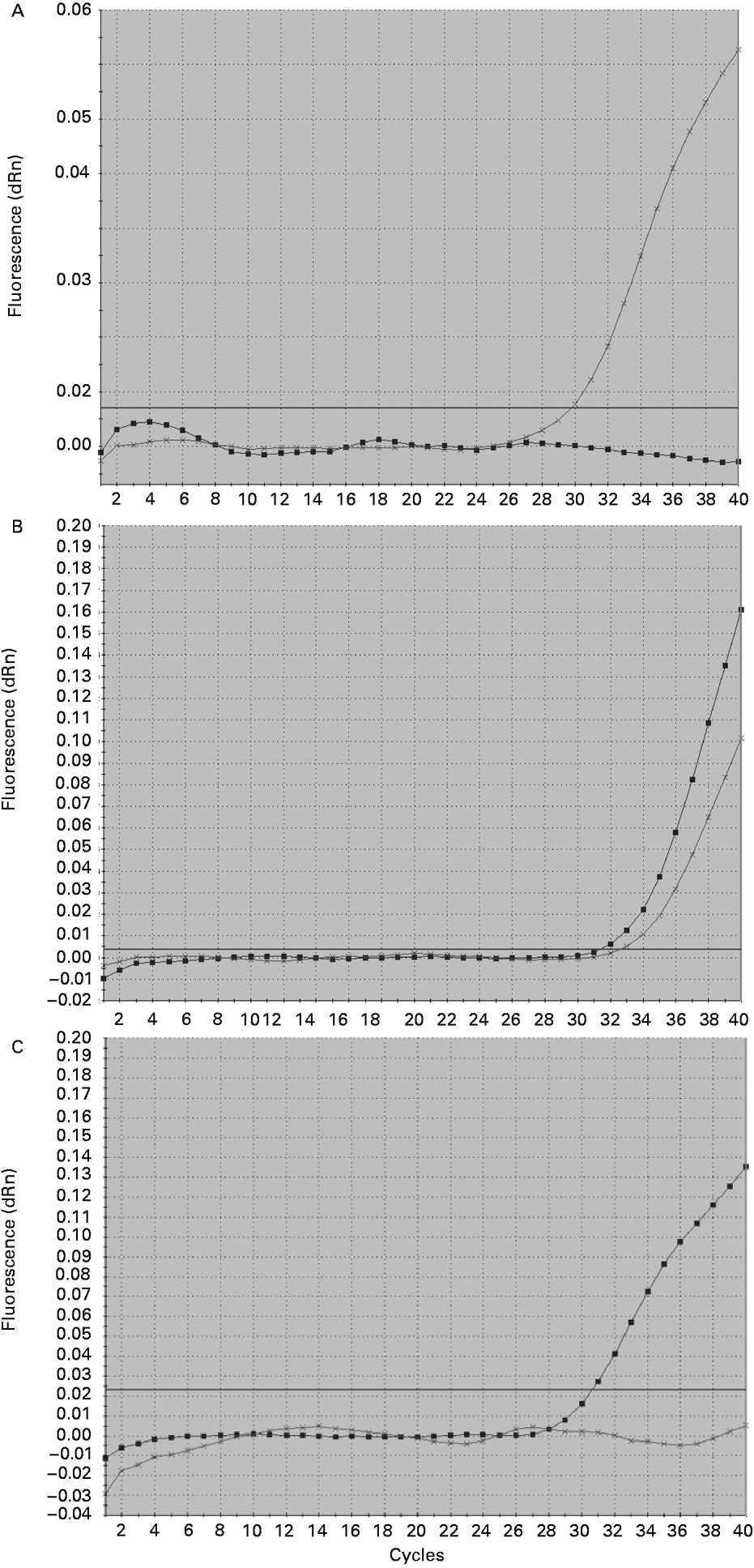
Fig. 2. Amplification plots of allele-specific real-time PCR using the FAM-labelled btub mgb T- (cross-marked line) and A-probe (square-marked line) in separate reactions with DNA of single 3rd-stage larvae. (A) Homozygous TTC; (B) heterozygous TTC/TAC; (C) homozygous TAC. Threshold value is given as unmarked line.
The frequencies of the 3 different genotypes were also analysed for a field population which was identified as being BZ-resistant according to the FECRT and EHT. The FECR for this population was 46·6%, and the EHT ED50 value was 0·16 μg thiabendazole/ml (unpublished data). From 102 L3, 42 (41·3%) were categorized as homozygous TTC, with a mean ct-value of 34·7 (S.D.±2·8). Furthermore, 52 (50·9%) were found to be heterozygous with mean T-probe and A-probe ct-values of 31·5 (S.D.±2·6) and 32·3 (S.D.±3·0), respectively. Eight L3 (7·8%) were characterized as homozygous TAC, with a mean ct-value of 32·0 (S.D.±1·0). The resultant TTC- and TAC-allele-frequencies were 66·7% and 33·3%, respectively.
Results using the molecular beacon assay
The molecular beacon assays using the probes described above allowed the specific detection of the respective homologous target, whereas the heterologous target was not detected. However, for repeated experiments, the reproducibility of results, as expressed by standard deviation (S.D.) and coefficient of variation (CV), was insufficient. For example, the CV obtained by repeated testing of quadruplicate samples of larval genomic DNA was >50% for all 4 probe and template combinations. During the evaluation of the PCR, other dyes were also tested for the same sequence as described above for beacon A. However, probes labelled with VIC™, HEX or 6-carboxy-4,5-dichloro-2,7-dimethoxy-fluoresceine (JOE) gave insufficient fluorescence signals and greatly reduced sensitivities under the experimental conditions described above. Probes with 22 bp loop sequences were also tested, but showed reduced specificities (data not shown).
DISCUSSION
The diagnosis of AR in nematode parasites is a key issue for efforts directed towards a sustained and scientifically sound use of available anthelmintics. Only when AR is detected at an early stage can rotational programs between anthelmintics of different chemical classes provide a successful approach against the further development of AR (Roos, Kwa & Grant, 1995; Elard et al. 1999). A molecular tool for the detection of AR and for the species-specific differentiation of L3 was recently described for the 3 most important gastrointestinal nematode species of small ruminants (Silvestre & Humbert, 2000). Species-specific pathogenicity among the more than 50 small strongyle species in horses has not yet been examined, as is the case for the gastrointestinal nematodes of small ruminants (Schnieder, 2000). Therefore, a molecular test for AR in cyathostomins should aim to detect resistance in as many different species as possible (Samson-Himmelstjerna et al. 2002). The assessment of BZ resistance in any larval population of small strongyles requires the simultaneous testing of a representative number of L3. Two different kinds of fluorogenic DNA probes were compared for their suitability to discriminate the β-tubulin codon 200 TTC/TAC polymorphism in genomic DNA derived from several cyathostomin species.
The reliable discrimination of single-base mismatches represents a highly demanding task for any hybridization assay and requires highly specific binding (Tapp et al. 2000). Recent applications of the TaqMan MGB chemistry have demonstrated its capacity to discriminate between several types of mismatches such as G/C, G/T, G/A or C/A (Kutyavin et al. 2000; de Kok et al. 2002). In the present study we describe an application of TaqMan MGB probe PCR assays for A/T discrimination. We tested the allele-specific TaqMan MGB PCR assays for 7 cyathostomin species and showed the real-time PCRs to be suitable for testing DNA of all these species. Genotyping by the allele-specific real-time PCR assays described in this study was possible with DNA isolated from individual larval and adult small strongyle stages. The real-time PCR based on TaqMan MGB probes described herein showed reproducibility, sensitivity and specificity similar to those of a conventional allele-specific PCR described recently (Samson-Himmelstjerna et al. 2002). However, the results using real-time PCR employing molecular beacon probes were not reproducible. One explanation for this finding could be related to the sequence characteristics of the molecular beacons and adjacent primers. Due to the high A/T content of the β-tubulin sequence flanking the codon 200, it was not possible to select molecular beacon sequences which provided high annealing temperatures. Several nucleotide positions flanking codon 200 differ between the currently known cyathostomin β-tubulin sequences (Pape, Schnieder & Samson-Himmelstjerna, 2002). In order to provide probes suitable for the assessment of the BZ resistance status of a wide spectrum of species, primers and probes need to be delineated only from conserved sequence regions, which restricts possible probe sequence optimization. The CVs calculated from the standard curve samples were found to be <5%, similar to those found during the evaluation of other real-time PCR assays (Bustin, 2000; Leverkoehne et al. 2002; Samson-Himmelstjerna, Harder & Schnieder, 2002). The deviations observed between the standard curve samples cumulated with those found for the replicates of DNA samples isolated from pooled larvae contributing to the range of variation of the calculated TTC- and TAC-copy numbers. The degree of variation calculated allows for a 2 to 10-fold under- or over-estimation of the copy numbers actually present in the individual samples. It was shown that a similar 10-fold excess of the TTC-allele exists in BZ-susceptible cyathostomin populations (Pape et al. 2003). Therefore, the use of the real-time PCR described here for the quantitative analysis of allele frequencies in DNA samples isolated from pooled worms or larvae is not suitable.
The genotype frequencies determinded for the BZ-resistant field population corresponded to those recorded for one population which was experimentally selected for BZ resistance (Pape et al. 2003). Adults of this latter, highly BZ-resistant population were shown to contain 29·8% TAC-alleles, whereas the percentage calculated in the present investigation was 33·3%. These findings indicate that in the cyathostomin populations investigated thus far, the TTC/TAC polymorphism in the β-tubulin codon 200 is only one among other genes under selection during the development of BZ resistance. For the sheep parasite Haemonchus contortus, high frequencies of resistance-associated genotypes have been shown in susceptible populations to have additional sites of polymorphism in the β-tubulin gene and, thus further mechanisms of BZ resistance may operate (Roos, 1990; Beech, Prichard & Scott, 1994; Prichard, 2001). Recently, a second polymorphism at codon 167 was described for several cyathostomin species (Pape et al. 2002). The significance of this polymorphism in the development of BZ resistance is yet to be investigated.
The TaqMan MGB real-time PCR tests described in this publication represent a high throughput PCR test for the evaluation of β-tubulin codon 200 TTC/TAC genotype frequencies in cyathostomin populations, which may also prove to be applicable to other parasitic nematodes.
This work was supported by the German Research Council (Deutsche Forschungs-gemeinschaft grants SCHN 267/13 and SA 973/1-2). The authors wish to thank Dr J. McAlister-Hermann for editorial assistance and Dr William J. Blackhall for helpful comments on the manuscript.
References
REFERENCES
AFONINA, I.,
ZIVARTS, M.,
KUTYAVIN, I.,
LUKHTANOV, E.,
GAMPER, H. &
MEYER, R. B.
(
1997).
Efficient priming of PCR with short oligonucleotides conjugated to a minor groove binder.
Nucleic Acids Research 25, 2657–2660.CrossRefGoogle Scholar
BEECH, R. N.,
PRICHARD, R. K. &
SCOTT, M. E.
(
1994).
Genetic variability of the β-tubulin genes in benzimidazole-susceptible and -resistant strains of Haemonchus contortus.
Genetics 138, 103–110.Google Scholar
BRUNA-ROMERO, O.,
HAFALLA, J. C.,
GONZALEZ-ASEGUINOLAZA, G.,
SANO, G.,
TSUJI, M. &
ZAVALA, F.
(
2001).
Detection of malaria liver-stages in mice infected through the bite of a single Anopheles mosquito using a highly sensitive real-time PCR.
International Journal for Parasitology 31, 1499–1502.CrossRefGoogle Scholar
BUSTIN, S. A.
(
2000).
Absolute quantification of mRNA using real-time reverse transcription polymerase chain reaction assays.
Journal of Molecular Endocrinology 25, 169–193.CrossRefGoogle Scholar
CHAPMAN, M. R.,
FRENCH, D. D.,
MONAHAN, C. M. &
KLEI, T. R.
(
1996).
Identification and characterization of a pyrantel pamoate resistant cyathostome population.
Veterinary Parasitology 66, 205–212.CrossRefGoogle Scholar
COSTA, J. M.,
ERNAULT, P.,
GAUTIER, E. &
BRETAGNE, S.
(
2001).
Prenatal diagnosis of congenital toxoplasmosis by duplex real-time PCR using fluorescence resonance energy transfer hybridization probes.
Prenatal Diagnosis 21, 85–88.3.0.CO;2-1>CrossRefGoogle Scholar
COSTA, J. M.,
PAUTAS, C.,
ERNAULT, P.,
FOULET, F.,
CORDONNIER, C. &
BRETAGNE, S.
(
2000).
Real-time PCR for diagnosis and follow-up of Toxoplasma reactivation after allogeneic stem cell transplantation using fluorescence resonance energy transfer hybridization probes.
Journal of Clinical Microbiology 38, 2929–2932.Google Scholar
CRAVEN, J.,
BJØRN, H.,
BARNES, E. H.,
HENRIKSEN, S. A. &
NANSEN, P.
(
1999).
A comparison of in vitro tests and a faecal egg count reduction test in detecting anthelmintic resistance in horse strongyles.
Veterinary Parasitology 85, 49–59.CrossRefGoogle Scholar
DE KOK, J. B.,
WIEGERINCK, E. T.,
GIESENDORF, B. A. &
SWINKELS, D. W.
(
2002).
Rapid genotyping of single nucleotide polymorphisms using novel minor groove binding DNA oligonucleotides (MGB probes).
Human Mutation 19, 554–559.CrossRefGoogle Scholar
ELARD, L.,
CABARET, J. &
HUMBERT, J. F.
(
1999).
PCR diagnosis of benzimidazole-susceptibity or -resistance in natural populations of the small ruminant parasite, Teladorsagia circumcincta.
Veterinary Parasitology 80, 231–237.CrossRefGoogle Scholar
ELARD, L.,
COMES, A. M. &
HUMBERT, J. F.
(
1996).
Sequences of beta-tubulin cDNA from benzimidazole-susceptible and -resistant strains of Teladorsagia circumcincta, a nematode parasite of small ruminants.
Molecular and Biochemical Parasitology 79, 249–253.CrossRefGoogle Scholar
GIANNAKAKOU, P.,
SACKETT, D. L.,
KANG, Y. K.,
ZHAN, Z.,
BUTERS, J. T.,
FOJO, T. &
PORUCHYNSKY, M. S.
(
1997).
Paclitaxel-resistant human ovarian cancer cells have mutant beta-tubulins that exhibit impaired paclitaxel-driven polymerization.
Journal of Biological Chemistry 272, 17118–17125.CrossRefGoogle Scholar
HIDE, G. A.,
HALL, S. M. &
BOORER, K. J.
(
1988).
Resistance to thiabendazole in isolates of Helminthosporium solani, the cause of silver scurf disease of potatoes.
Plant Pathology 37, 377–380.CrossRefGoogle Scholar
IHLER, C. F. &
BJØRN, H.
(
1996).
Use of two in vitro methods for the detection of benzimidazole resistance in equine small strongyles (Cyathostoma spp.).
Veterinary Parasitology 65, 117–125.CrossRefGoogle Scholar
KENDALL, S.,
HOLLOMON, D. W.,
ISHII, H. &
HEANEY, S. P.
(
1994).
Characterisation of benzimidazole-resistant strains of Rhynchosporium secalis.
Pesticide Science 40, 175–181.CrossRefGoogle Scholar
KOSTRIKIS, L. G.,
TYAGI, S.,
MHLANGA, M. M.,
HO, D. D. &
KRAMER, F. R.
(
1998).
Spectral genotyping of human alleles.
Science 279, 1228–1229.CrossRefGoogle Scholar
KUPFERSCHMIDT, O.,
KRUGER, D.,
HELD, T. K.,
ELLERBROK, H.,
SIEGERT, W. &
JANITSCHKE, K.
(
2001).
Quantitative detection of Toxoplasma gondii DNA in human body fluids by TaqMan polymerase chain reaction.
Clinical Microbiology and Infection 7, 120–124.CrossRefGoogle Scholar
KUTYAVIN, I. V.,
AFONINA, I. A.,
MILLS, A.,
GORN, V. V.,
LUKHTANOV, E. A.,
BELOUSOV, E. S.,
SINGER, M. J.,
WALBURGER, D. K.,
LOKHOV, S. G.,
GALL, A. A.,
DEMPCY, R.,
REED, M. W.,
MEYER, R. B. &
HEDGPETH, J.
(
2000).
3′-Minor groove binder-DNA probes increase sequence specificity at PCR extension temperatures.
Nucleic Acids Research 28, 655–661.CrossRefGoogle Scholar
KWA, M. S. G.,
VEENSTRA, J. G.,
VAN DIJK, M. &
ROOS, M. H.
(
1995).
Beta-tubulin genes from the parasitic nematode Haemonchus contortus modulate drug resistance in Caenorhabditis elegans.
Journal of Molecular Biology 246, 500–510.CrossRefGoogle Scholar
LACEY, E.
(
1988).
The role of the cytoskeletal protein, tubulin, in the mode of action and mechanism of drug resistance to benzimidazoles.
International Journal for Parasitology 18, 885–936.CrossRefGoogle Scholar
LEVERKOEHNE, I.,
HORSTMEIER, B. A.,
SAMSON-HIMMELSTJERNA, G.,
SCHOLTE, B. J. &
GRUBER, A. D.
(
2002).
Real-time RT-PCR quantitation of mCLCA1 and mCLCA2 reveals differentially regulated expression in pre- and postnatal murine tissues.
Histochemistry and Cell Biology 118, 11–17.Google Scholar
LIN, M. H.,
CHEN, T. C.,
KUO, T. T.,
TSENG, C. C. &
TSENG, C. P.
(
2000).
Real-time PCR for quantitative detection of Toxoplasma gondii.
Journal of Clinical Microbiology 38, 4121–4125.Google Scholar
MARRAS, S. A.,
KRAMER, F. R. &
TYAGI, S.
(
1999).
Multiplex detection of single-nucleotide variations using molecular beacons.
Genetic Analysis 14, 151–156.CrossRefGoogle Scholar
McKAY, G. J. &
COOKE, L. R.
(1997).
A PCR-based method to characterise and identify benzimidazole resistance in Helminthosporium solani.
FEMS Microbiology Letters 152, 371–378.CrossRefGoogle Scholar
PAPE, M.,
POSEDI, J.,
FAILING, K.,
SCHNIEDER, T. &
SAMSON-HIMMELSTJERNA, G. VON
(
2003).
Analysis of the beta-tubulin codon 200 genotype distribution in a benzimidazole-susceptible and -resistant cyathostome population.
Parasitology 127, 53–59.CrossRefGoogle Scholar
PAPE, M.,
SAMSON-HIMMELSTJERNA, G. VON &
SCHNIEDER, T.
(
1999).
Characterisation of the beta-tubulin gene of Cylicocyclus nassatus.
International Journal for Parasitology 29, 1941–1947.CrossRefGoogle Scholar
PAPE, M.,
SCHNIEDER, T. &
SAMSON-HIMMELSTJERNA, G. VON
(
2002).
Investigation of diversity and isotypes of the beta-tubulin cDNA in several small strongyle (cyathostominae) species.
Journal for Parasitology 88, 673–677.CrossRefGoogle Scholar
PODDAR, S. K.
(
2000).
Symmetric vs asymmetric PCR and molecular beacon probe in the detection of a target gene of adenovirus.
Molecular and Cellular Probes 14, 25–32.CrossRefGoogle Scholar
PRICHARD, R. K.
(
2001).
Genetic variability following selectin of Haemonchus contortus with anthelmintics.
Trends in Parasitology 17, 445–453.CrossRefGoogle Scholar
ROOS, M. H.
(
1990).
The molecular nature of benzimidazole resistance in helminths.
Parasitology Today 6, 125–126.CrossRefGoogle Scholar
ROOS, M. H.,
KWA, M. S. G. &
GRANT, W. N.
(
1995).
New genetic and practical implications of selection for anthelmintic resistance in parasitic nematodes.
Parasitology Today 11, 148–150.CrossRefGoogle Scholar
SAMSON-HIMMELSTJERNA, G. VON, HARDER, A. &
SCHNIEDER, T.
(
2002).
Quantitative analysis of ITS2 sequences in trichostrongyle parasites.
International Journal for Parasitology 32, 1529–1535.CrossRefGoogle Scholar
SAMSON-HIMMELSTJERNA, G. VON, PAPE, M.,
WITZENDORFF, C. VON &
SCHNIEDER, T.
(
2002).
Allele-specific PCR for the beta-tubulin codon 200 TTC/TAC polymorphism using single adult and larval small strongyle (Cyathostominae) stages.
Journal of Parasitology 88, 254–257.CrossRefGoogle Scholar
SANGRAJRANG, S. &
FELLOUS, A.
(
2000).
Taxol resistance.
Chemotherapy 46, 327–334.CrossRefGoogle Scholar
SCHNIEDER, T.
(
2000).
Helminthosen der Wiederkäuer – Trichostrongylidosen. In
Veterinärmedizinische Parasitologie,
5th Edn (ed. Rommel, M., Eckert, J., Kutzer, E., Körting, W. & Schnieder, T.), pp. 238–267. Parey, Berlin.
SILVESTRE, A. &
HUMBERT, J. F.
(
2000).
A molecular tool for species identification and benzimidazole resistance diagnosis in larval communities of small ruminant parasites.
Experimental Parasitology 95, 271–276.CrossRefGoogle Scholar
TAPP, I.,
MALMBERG, L.,
RENNEL, E.,
WIK, M. &
SYVANEN, A. C.
(
2000).
Homogeneous scoring of single-nucleotide polymorphisms: comparison of the 5′-nuclease TaqMan assay and Molecular Beacon probes.
Biotechniques 28, 732–738.Google Scholar
TYAGI, S.,
BRATU, D. P. &
KRAMER, F. R.
(
1998).
Multicolor molecular beacons for allele discrimination.
Nature Biotechnology 16, 49–53.CrossRefGoogle Scholar
TYAGI, S. &
KRAMER, F. R.
(
1996).
Molecular beacons: probes that fluoresce upon hybridization.
Nature Biotechnology 14, 303–308.CrossRefGoogle Scholar
VARADY, M.,
KONIGOVA, A. &
CORBA, J.
(
2000).
Benzimidazole resistance in equine cyathostomes in slovakia.
Veterinary Parasitology 94, 67–74.CrossRefGoogle Scholar
WALLER, P. J.
(
1997).
Anthelmintic resistance.
Veterinary Parasitology 72, 391–405.CrossRefGoogle Scholar
WHEELER, I. E.,
KENDALL, S. J.,
BUTTERS, J.,
HOLLOMON, D. W. &
HALL, L.
(
1995).
Using allele-specific oligonucleotide probes to characterize benzimidazole resistance in Rhynchosporium secalis.
Pesticide Science 43, 201–209.CrossRefGoogle Scholar
WIRTHERLE, N.,
SCHNIEDER, T. &
SAMSON-HIMMELSTJERNA, G. VON
(
2003).
The prevalence of benzimidazole resistance on German horse farms.
Veterinary Record (in the Press).Google Scholar

Fig. 1. Amplification plots of samples of a 106–101 titration of homologous TAC plasmid and 107 heterologous TTC plasmid copies with the FAM-labelled btub mgb A-probe. Horizontal line indicates threshold, and marked lines demonstrate the increase in fluorescence during the experiment given as normalized baseline-corrected fluorescence.

Table 1. Results of standard curve experiments (n=7) for btub mgb A and T probes, respectively, with the corresponding homologous template titration, standard deviation (S.D.) and coefficient of variance (CV)
Fig. 2. Amplification plots of allele-specific real-time PCR using the FAM-labelled btub mgb T- (cross-marked line) and A-probe (square-marked line) in separate reactions with DNA of single 3rd-stage larvae. (A) Homozygous TTC; (B) heterozygous TTC/TAC; (C) homozygous TAC. Threshold value is given as unmarked line.
 You have
Access
- 27
- Cited by