INTRODUCTION
Air CO2 enrichment has become a serious problem worldwide, such as global warming, desertification and reduced agricultural production (Liu et al., Reference Liu, Liu, Bian, Ma, Lang, Han and Li2014); thus, it is of utmost importance to find a reasonable and economical way to reduce CO2 emissions. Soils as parts of terrestrial ecosystems store about 1500 Pg of organic carbon (Rattan, Reference Rattan2000); therefore soil respiration plays an important role in the increase in global atmospheric CO2 concentrations (ca. 75–80.4 Pg year−1) (Schlesinger and Andrews, Reference Schlesinger and Andrews2000). As observed by Vermeulen et al. (Reference Vermeulen, Campbell and Ingram2012), agricultural production may contribute up to 19–29% to carbon emissions. Therefore, changing soil respiration has a considerable influence on atmospheric CO2 concentrations (Schlesinger and Andrews, Reference Schlesinger and Andrews2000) and it is very important to clarify carbon sequestration mechanisms in soil.
The dynamics of carbon balance in a cropland ecosystem is determined by soil heterotrophic respiration and net primary production of vegetation (Zhang et al., Reference Zhang, Xu, Sun, Wang, Wu, Wang and Li2013). Soil respiration rate is controlled by a variety of factors in different regions. In semi-arid ecosystems, CO2 emissions are controlled by soil temperature and moisture (Eszter et al., Reference Eszter, Edit, Zoltán, Tibor, Bridget and Claus2011); Li et al. (Reference Li, Wang, Li, Gao and Tian2013) and Mancinelli et al. (Reference Mancinelli, Marinari, Brunetti, Radicetti and Campiglia2015) indicated that straw mulching can change both soil temperature and moisture. Soil CO2 emissions were higher in straw mulching conditions than in non-mulching conditions (Bhattacharyya et al., Reference Bhattacharyya, Roy, Neogi, Chakravorti, Behera, Das, Bardhan and Rao2012b; Jacinthe et al., Reference Jacinthe, Lal and Kimble2002). However, Liu et al. (Reference Liu, Liu, Bian, Ma, Lang, Han and Li2014) showed that straw mulching significantly decreased CO2 emission rate in summer maize fields in North China.
Bhattacharyya et al. (Reference Bhattacharyya, Roy, Neogi, Adhya, Rao and Manna2012a) claimed that straw mulching and tillage had a significant linear correlation with seasonal CO2 emissions. Recently, Wang et al. (Reference Wang, Hu, Dong, Li, Zhang, Qin and Oenema2015) found that long-term application of straw and fertilizer can significantly increase soil organic carbon content and soil organic carbon storage at 0–20 cm depth in North China. Ding et al. (Reference Ding, Han, Liang, Qiao, Li and Li2012) also found that soil carbon sequestration can improve agricultural productivity and soil ecosystem carbon storage in the northeast region of China. However, Cai and Qin (Reference Cai and Qin2006) reported that crop yield was limited in a soil organic carbon study, with mulching increasing soil organic carbon storage. Gao et al. (Reference Gao, Li, Zhang, Liu, Dang, Cao and Qiang2009) revealed that after straw mulching, soil temperatures were further reduced and the growth of winter wheat seedlings stopped, negatively affecting germination and growth of tillers. Although straw mulching has certain potential of water saving, it reduces panicle and grain production, eventually resulting in decreases of winter wheat grain yield. Although straw mulching increases yield carbon utilization efficiency of summer maize by increasing yield and reducing CO2 emissions (Liu et al., Reference Liu, Liu, Bian, Ma, Lang, Han and Li2014), there is still a considerable degree of uncertainty whether straw mulching could increase winter wheat grain yields.
In China, the North Plain is the most important area for winter wheat production. In order to increase winter wheat grain yield, a wide-precision planting system is adopted (Bian et al., Reference Bian, Ma, Liu, Gao, Liu, Yan, Ren and Li2016). Under the same seeding rate conditions, winter wheat grain yields were significantly higher under the wide-precision planting system than under the conventional-cultivation planting system, mainly due to a significant increase in spike numbers (Bian et al., Reference Bian, Ma, Liu, Gao, Liu, Yan, Ren and Li2016; Zhao et al., Reference Zhao, Shen, Lang, Liu and Li2013). Therefore, we hypothesized that under straw mulching condition, winter wheat grain yield reduction may be compensated by a wide-precision planting system, while reducing CO2 emission rate. Therefore, the objectives of this study were to determine the effects of straw mulching and planting systems on soil respiration and winter wheat grain yield. Addressing these questions could provide a theoretical basis and practical support for the achievement of stable yields and carbon sequestration planting system in the North China Plain.
MATERIALS AND METHODS
Experimental site
In the 2013–2014 and 2014–2015 winter wheat growing seasons, the experiment was conducted at the Experimental Station of Shandong Agricultural University (36°10″9′N, 117°9″03′E, 134.0 m above sea level), which lies in the North China Plain. The rainfall and air temperature in 2013–2014 and 2014–2015 winter wheat growing seasons are shown in Supplementary figure S1 (available online at https://doi.org/10.1017/S0014479717000217). The most widely adopted cropping system in the area is the winter wheat and summer maize annual double cropping system. Each experimental plot was 3 × 3 m in size with concrete slabs placed around the plots to prevent lateral soil water flow. The soil type in the plots was loam, and the nitrogen, phosphorus and potassium contents at 0–20 cm depth was 108.1, 16.1 and 92.4 mg kg−1, respectively.
Experimental design
The experiment adopted a split-plot design. The whole plot was arranged in two types of planting systems: wide-precision planting (W) and conventional-cultivation planting (C). The subplot consisted of two mulching conditions: straw mulching (m) and non-mulching (n). Line spacing in the two planting systems was the same; however, sowing width in the wide-precision planting system was 6–8 cm, while in the conventional-cultivation planting systems it was 2–3 cm (Zhao et al., Reference Zhao, Shen, Lang, Liu and Li2013). Mulching material was summer maize straw, prepared by harvesting and air-drying of summer maize, after which the straw was cut into 3–5 cm pieces. At the winter wheat seeding stage, straw mulching was applied at 0.6 kg m−2 manually. Each treatment was repeated three times and arranged in a randomized block. Before winter wheat sowing, urea (173.0 g), diammonium phosphate (234.8 g) and potassium (189.0 g) were applied on each plot. At the winter wheat jointing stage, an additional 173.0 g urea was applied with irrigation. Other crop management methods were consistent with those used to obtain high yield. Winter wheat was hand-planted at a density of 222 plants m−2 on October 8, 2013 and October 7, 2014. The crops were harvested on June 6, 2014 and June 9, 2015. The winter wheat (Triticum aestivum) variety used for the experiment was ‘Jimai 22’, which is widely planted in the North China Plain. Jimai 22 is characterized by cold hardiness, strong tillering and multi-spike type. The experiment was irrigated with 60 mm water each at winter wheat jointing and heading stages. In the 2013–2014 growing season, the irrigation at joining and heading stages was on March 30 and April 15, respectively; in the 2014–2015 growing season, irrigation was on April 1 and April 19. A flow meter was used to control the irrigated water amount.
Measurements
CO2 flux was monitored using a GXH-305 Portable Gas Analyzer (ADC Bioscientific Ltd., Hoddesdon, England) with static chambers for gas sampling made of polyvinyl (PVC) pipe. Gas chamber bases measured 15.7 cm in height and 25.0 cm in diameter. The chambers were inserted tightly into the ground without removing any of the surface soil when the measurement started. CO2 was sampled and analysed five times during each growth period. Each measurement was taken for less than 2 min on a sunny day between 9:00 a.m. and 10:00 a.m.
Soil respiration rate was measured by soil surface CO2 flux, which was calculated as follows (Liu et al., Reference Liu, Liu, Bian, Ma, Lang, Han and Li2014):
 $$\begin{equation*}
F = \rho \times \frac{V}{A} \times 100 \times \frac{P}{{{P_0}}} \times \frac{{273}}{{273 + T}} \times \frac{{dC}}{{dt}} \times 60
\end{equation*}$$
where F is the soil surface CO2 flux (μg m−2 h−1); ρ is the density of CO2 under standard atmospheric condition (1.963 mg m−3); V is the volume of static chambers (77 cm3); A is the area of static chambers (76 cm2); P is the atmospheric pressure in static chambers; P 0 is the atmospheric pressure under standard atmospheric condition (1.013 × 10⁵ Pa), and the atmospheric pressure in Tai'an is roughly equal to that under standard atmospheric condition; T is the atmospheric temperature (°C); dC/dt is change in concentration of CO2 (10−6 min−1).
CO2-C cumulative emissions were calculated as follows (Meng et al., Reference Meng, Cai and Ding2005b):
 $$\begin{equation*}
M = \frac{{\sum {({F_{{\rm{i + 1}}}} + {F_i})} }}{2} \times ({t_{i + 1}} - {t_i}) \times 24
\end{equation*}$$
where M is the CO2-C cumulative emission (mg C m−2); F is soil surface CO2 flux (μg m−2 h−1); i is the sampling number; t is the day after sowing.
When the winter wheat had reached maturity stage, 1.5-m stretches of two rows were selected randomly in each experimental plot to measure spike numbers, 1000-kernel weight and grain yield. The plants were harvested manually and air-dried. Other 20 plants were harvested to count kernel numbers per spike. Data reported here is the average of three repeated measurements.
The yield carbon utilization efficiency was calculated as follows (Meng et al., Reference Meng, Ding, Cai and Qin2005a):
 $$\begin{equation*}
R = \frac{Y}{M}
\end{equation*}$$
where Y is the grain yield (g m−2); M is the CO2-C cumulative emissions (g m−2).
Statistical analysis
Microsoft Excel 2007 and DPS (Data Processing System) statistical analysis system were used for data processing and statistical analysis. Factors, degrees of freedom, sum of squares, F value, and p value from DPS are shown in Table S1. The effects of the treatments were evaluated using analysis of variance (ANOVA) performed at a significance level of α = 0.05 to determine whether differences existed among treatment means.
RESULTS
Soil respiration rate
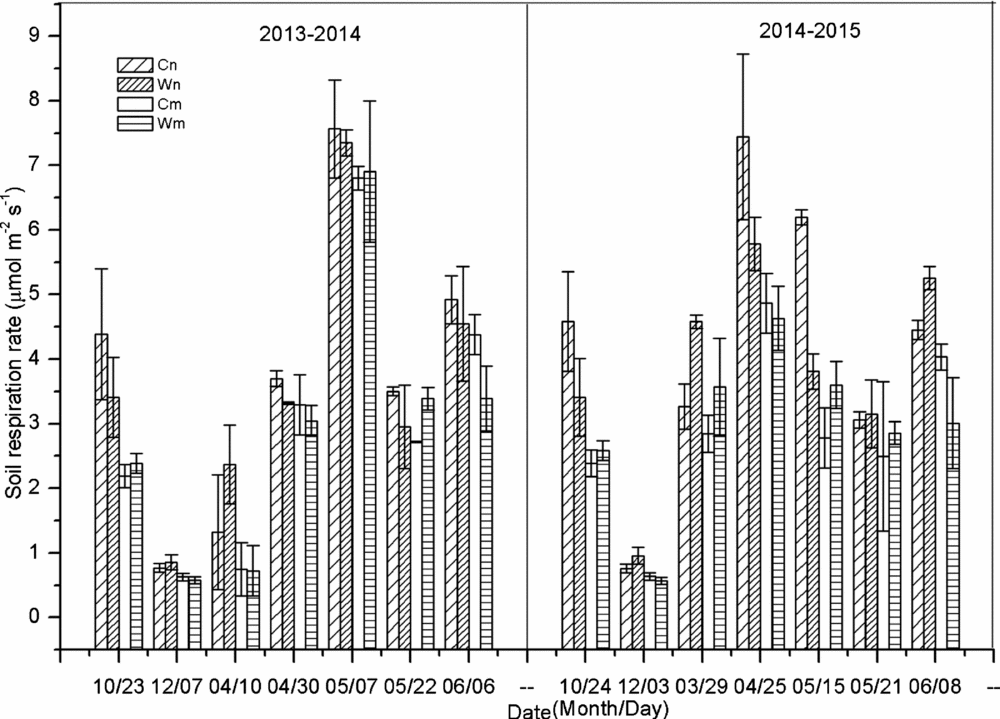
Soil respiration rate varied between 0.6 and 7.6 µmol m−2 s−1 with an average of 3.2 µmol m−2 s−1 in 2013–2014 and varied between 0.6 and 7.4 µmol m−2 s−1 with an average of 3.3 µmol m−2 s−1 in 2014–2015 winter wheat growing season (Figure 1). In both growing seasons, the soil respiration rate was the highest in later April or earlier May. The effect of planting systems on soil respiration rate was not consistent; however, it was significantly lower in straw mulching treatments than in non-mulching treatments. Specifically, the soil respiration rate was significantly lower in the Cm treatment than in the Cn treatment by 27.2% in 2013–2014 and by 32.7% in 2014–2015 growing season. The soil respiration rate was also significantly lower in the Wm treatment than in the Wn treatment by 21.5% in 2013–2014, and by 25.3% in 2014–2015 growing season. In 2013–2014 and 2014–2015 growing seasons, straw mulching treatments significantly decreased the CO2 emission rate by 29.2% and 41.2% when compared with non-mulching treatments (Figure 1).
Soil respiration rate in 2013–2014 and 2014–2015 winter wheat growing seasons. Cn represent conventional-cultivation planting pattern with non-mulching, Wn represent wide-precision planting pattern with non-mulching, Cm represent conventional-cultivation planting pattern with straw mulching and Wm represent wide-precision planting pattern with straw mulching. Vertical bars represent the standard errors.

CO2-C cumulative emissions
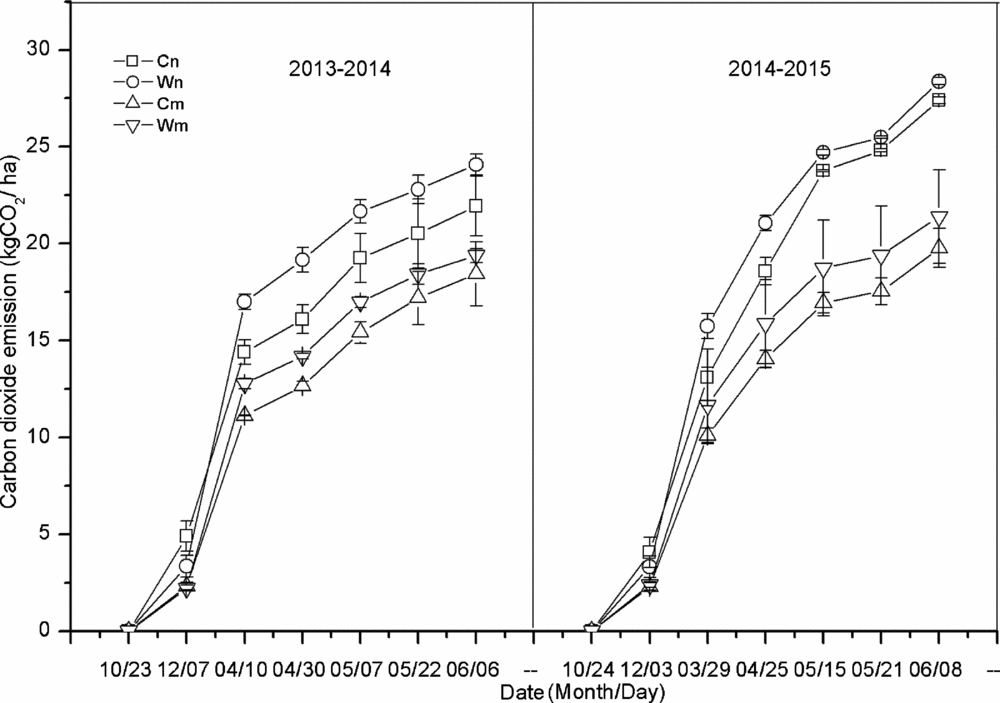
In both growing seasons, the order of CO2-C cumulative emissions was Wn>Cn>Wm>Cm (Figure 2). Regardless mulching, the CO2-C cumulative emissions were much higher in the wide-precision planting system than in the conventional-cultivation planting system. In 2013–2014 growing season, the CO2-C cumulative emissions were significantly lower in mulching treatments than in non-mulching treatments by 21.6%, and they were significantly lower in mulching treatments than in non-mulching treatments by 26.2% in 2014–2015 growing season (Figure 2).
CO2-C cumulative emissions in 2013–2014 and 2014–2015 winter wheat growing seasons. Cn represent conventional-cultivation planting pattern with non-mulching, Wn represent wide-precision planting pattern with non-mulching, Cm represent conventional-cultivation planting pattern with straw mulching and Wm represent wide-precision planting pattern with straw mulching. Vertical bars represent the standard errors.

Grain yield and yield components
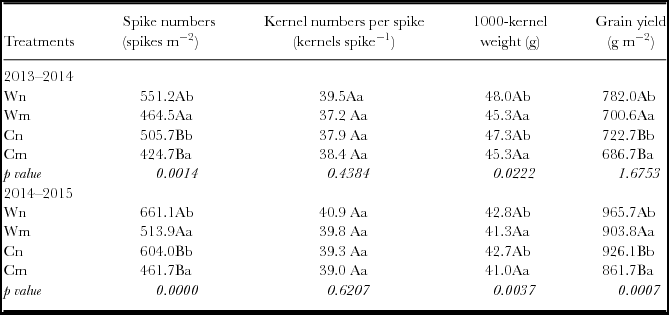
In 2013–2014 growing season, a maximum grain yield of 782 gm−2 was observed for the Wn treatment, while a minimum grain yield of 686.7 g m−2 was observed for the Cm treatment (Table 1). Grain yield was higher (+5.2%) in the wide-precision planting system than in the conventional-cultivation planting system. On average, spike numbers were greater (+9.2%) in the wide-precision planting system than in the conventional-cultivation planting system. Spike numbers and 1000-kernel weight were lower in mulching treatments than in non-mulching treatments, resulting in an overall 7.8% reduction in grain yield in mulching treatments relative to that in non-mulching treatments. In 2014–2015 growing season, a maximum grain yield of 965.7 g m−2 was observed for the Wn treatment, while a minimum grain yield of 861.7 g m−2 was observed for the Cm treatment (Table 1). Grain yield and spike numbers were higher in the wide-precision planting system than in the conventional-cultivation planting system. Spike numbers and 1000-kernel weight were lower in mulching treatments than in non-mulching treatments, resulting in an overall 6.7% grain yield reduction in mulching treatments relative to non-mulching treatments. In both seasons, grain yield with the wide-precision planting system was greater than with the conventional-cultivation planting system and this was primarily due to the fact that spike numbers in the wide-precision planting system were greater than those in the conventional-cultivation planting system.
Grain yield and yield compositions in 2013–2014 and 2014–2015 winter wheat growing seasons.

Wn represent wide-precision planting pattern with non-mulching, Cn represent conventional-cultivation planting pattern with non-mulching, Wm represent wide-precision planting pattern with straw mulching and Cm represent conventional-cultivation planting pattern with straw mulching. In each growing season, values followed by different letters are significantly (p < 0.05) different among treatments, capital letters (A and B) and small letters (a and b) were used to compare W vs. C and n vs. m. The italics are the p value of the significance. When p < 0.05 means ‘significantly different’, and when p > 0.05 means ‘not significantly different’.
Yield carbon utilization efficiency
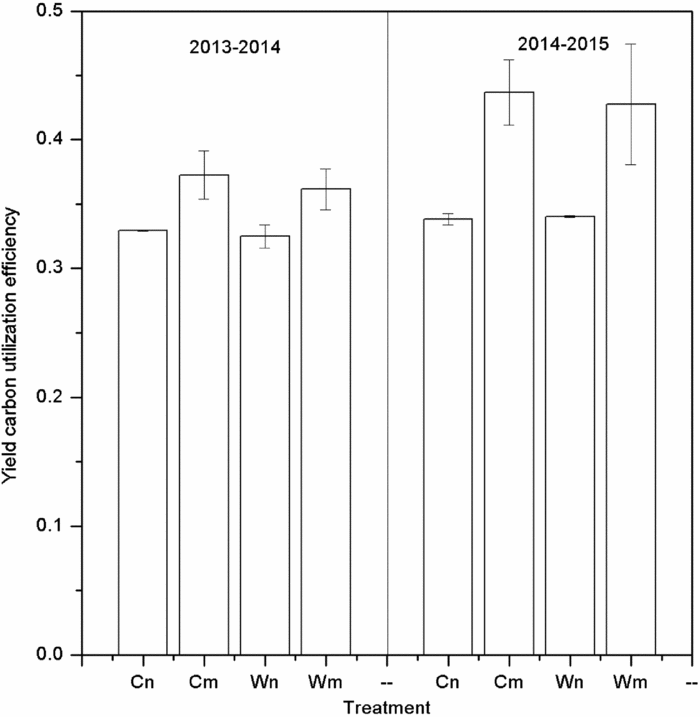
Yield carbon utilization efficiencies in 2013–2014 and 2014–2015 growing seasons are presented in Figure 3. The yield carbon utilization efficiency was significantly higher in the Cm treatment than in the Cn treatment by 13% in 2013–2014 and by 29% in 2014–2015. The yield carbon utilization efficiency was significant higher in the Wm treatment than in the Wn treatment by 11% in 2013–2014 and by 26% in 2014–2015. Under the same mulching conditions, no significant differences in the yield carbon utilization efficiency were found between the planting systems. However, the yield carbon utilization efficiency was significant higher in mulching treatments than in non-mulching treatments by 12% in 2013–2014 and by 27% in 2014–2015. The yield carbon utilization efficiency was much higher in 2015 than in 2014. In summary, straw mulching increased the yield carbon utilization efficiency in both planting systems.
Yield carbon utilization efficiency in 2013–2014 and 2014–2015 winter wheat growing seasons. Cn represent conventional-cultivation planting pattern with non-mulching, Wn represent wide-precision planting pattern with non-mulching, Cm represent conventional-cultivation planting pattern with straw mulching and Wm represent wide-precision planting pattern with straw mulching. Vertical bars represent the standard errors.

DISCUSSION
Measurements of CO2 loss are done usually by eddy covariance or static chamber methods. The turbulence covariance has large deviations as compare to stable turbulence, and the facilities are expensive, which makes it difficult to use in multiple locations (Zou et al., Reference Zou, Huang, Zheng, Wang and Chen2004). In contrast, the static chamber method has the advantages of high adaptability, high sensitivity, simple operation and low cost. This latter is widely used in China to measure CO2 fluxes from terrestrial ecosystems (Wang et al., Reference Wang, Ji, Wang, Zhang, Liu and Du2000). Raich and Schlesinger (Reference Raich and Schlesinger1992) found that 40–60% soil CO2 discharge results from root respiration. Figure 1 shows that soil respiration rate was the highest in later April or earlier May, when plants have the highest growth rate and spikes, leaves, and stems carrying out photosynthesis jointly (Rawson et al., Reference Rawson, Hindmarsh, Fischer and Stockman1983). High photosynthetic rates could lead to increases in root respiration (Amos et al., Reference Amos, Arkebauer and Doran2005) and this may be an important reason why respiration rate in these stages was highest when considering the whole winter wheat growing season.
Previous researches indicated that straw retention would bring about changes in soil microorganism structure and biochemical attributes (Acosta-Martinez et al., Reference Acosta-Martinez, Mikha, Sistani, Stahlman, Benjamin, Vigil and Erickson2011) and would change soil physical and chemical properties (Mancinelli et al., Reference Mancinelli, Marinari, Brunetti, Radicetti and Campiglia2015), which cause CO2 loss in the soil. Data from both growing seasons revealed that straw mulching greatly decreased soil respiration rate and reduced cumulative CO2-C emissions in contrast to non-mulching (Figure 2). Straw mulching may directly influence soil temperature and dampness (Li et al., Reference Li, Wang, Li, Gao and Tian2013; Mancinelli et al., Reference Mancinelli, Marinari, Brunetti, Radicetti and Campiglia2015), which may result from its ability to preserve heat and moisture. In fact, 70–83% CO2 emission flux can be attributed to soil temperature and water content (Zhang et al., Reference Zhang, Xu, Sun, Wang, Wu, Wang and Li2013). On the other hand, Mancinelli et al. (Reference Mancinelli, Campiglia, Tizio and Marinari2010) found that reduced irrigation could reduce CO2 emission flux, revealing that decreased water availability can benefit soil carbon balance. Therefore, further studies into the linear relationship between temperature, water, and CO2, are urgently needed to better understand carbon balance.
Our results showed that the wide-precision planting system significantly increased winter wheat grain yield; however, straw mulching significantly decreased it (Table 1). Zhao et al. (Reference Zhao, Shen, Lang, Liu and Li2013) found that the wide-precision planting system rather than the conventional-cultivation planting system could optimize vertical distribution of photosynthetically active radiation in winter wheat canopy, which is the most significant reason for grain yield increase in the wide-precision planting system. In the North China Plain, Liu et al. (Reference Liu, Liu, Bian, Ma, Lang, Han and Li2014) revealed that straw mulching could enhance summer maize grain yield. Interestingly, Liu et al. (Reference Liu, Liu, Bian, Ma, Lang, Han and Li2014) also showed that straw mulching significantly reduced winter wheat grain yield, i.e., straw mulching reduced winter wheat tillers number, which significantly reduced winter wheat spikes number and 1000-kernel weight, thereby affecting grain yield. Li et al. (Reference Li, Wang, Li, Gao and Tian2013) found that straw mulching reduced solar radiation reaching the ground, reducing soil temperature. From 0 to 40 °C, higher soil temperatures are beneficial for root system expansion of crops, whereas low soil temperatures probably affect the ability of the root system to uptake nutrients and water (Li et al., Reference Li, Chen, Liu, Zhou, Yu and Dong2008). Therefore, to a certain extent, this could have affected winter wheat growth and development in this study, resulting in reduced yield.
Although straw mulching resulted in winter wheat grain yield reduction, the yield carbon utilization efficiency was increased (Figure 3). This suggests that incorporating photosynthesizing atmospheric CO2 into crop dry matter and grains could be a strategy to ensure food security and counteract CO2 emission into the atmosphere. Huang et al. (Reference Huang, Wu, Li, Yao, Zhang, Cai and Jin2009) indicated that straw mulching increased total dry matter accumulation after winter wheat anthesis stage, and enhanced the translocation of dry matter into grains. In this study, we did not collect data regarding the rate of contribution of vegetative organs to grain yield after anthesis stage. Indeed, straw mulching can modify soil environment, improve porosity, deliver plant materials into the soil and thereby affecting crop biomass. Therefore, we hypothesized that there is a large potential for dry matter transport efficiency in mulching treatments, which maybe an important reason why the yield carbon utilization efficiency was much higher in mulching treatments than in non-mulching treatments.
Similar to the positive effects of biomass production in regulating atmospheric CO2, straw mulching offers an opportunity to mitigate the anthropogenic climate change while advancing food security and improving the environment. To address this issue, further research is still needed on the influence of straw mulching on soil respiration through microbial respiration and on photosynthetic rate of crops.
In conclusion, straw mulching significantly reduced soil respiration rate in the North China Plain. Although reductions in winter wheat grain yield have been found under straw mulching, the wide-precision planting system increased the yield of winter wheat in relation to the conventional-cultivation planting system. In the both wide-precision and conventional-cultivation planting systems, straw mulching increased the yield carbon utilization efficiency.
Acknowledgments
This work was financially supported by the National Nature Science Foundation of China (No. 31571603) and by the Science and Technology Development Plan of Shandong Province, China (No. 2014GNC111002).
SUPPLEMENTARY MATERIALS
For supplementary material for this article, please visit https://doi.org/10.1017/S0014479717000217.