INTRODUCTION
Fifty per cent of the 500 000 annual new cases of visceral leishmaniasis (VL) occur in India, Bangladesh and Nepal (Desjeux, Reference Desjeux2004). Since there is no anti-leishmanial vaccine in clinical use, control of VL relies almost exclusively on chemotherapy (Chappuis et al. Reference Chappuis, Sundar, Hailu, Ghalib, Rijal, Peeling, Alvar and Boelaert2007). A few drugs are currently available including pentavalent antimonies (SbV) that have been used for more than half a century as a first-line drug (Frézard et al. Reference Frézard, Demicheli and Ribeiro2009). This drug exhibits several limitations, including toxicity and emergence of drug resistance. This phenomenon is especially well described in the Indian subcontinent, with up to 60% patients in India (Bihar state) and 20% in Nepal (Eastern terai) not responding to SbV treatment (Sundar, Reference Sundar2001; Rijal et al. Reference Rijal, Chappuis, Singh, Bovier, Acharya, Karki, Das, Desjeux, Loutan and Koirala2003). Consequently, this drug was replaced by the new oral drug, Miltefosine, in the frame of the regional VL elimination programme (Thakur et al. Reference Thakur, Meenakshi Thakur and Thakur2009). Understanding the dynamics of drug resistance in a clinical context requires studies on the mechanisms leading to its emergence as well as a comprehension of factors favouring the spread of drug-resistant parasites. Parasite fitness defined as the complex integrated skills that allow the organism to replicate and be successfully transmitted (Natera et al. Reference Natera, Machuca, Padrón-Nieves, Romero, Díaz and Ponte-Sucre2007) is therefore of uppermost importance.
Metacyclogenesis is the process by which trypanosomatids differentiate metabolically from non-infective procyclic promastigotes (flagellated life stage) to infective metacyclic promastigotes (Sacks, Reference Sacks1989). It is one of the most important adaptive processes during the whole life cycle of the parasite and a major contributor to its fitness. This is well illustrated by transcriptomic studies showing that most significant events of gene expression regulation occur during the metacyclogenesis, with a dramatic down-regulation during the transition from metacyclics to intracellular amastigotes, hereby supporting the hypothesis of pre-adaptation of the parasite to the survival in the macrophage (Alcolea et al. Reference Alcolea, Alonso, Gómez, Moreno, Domínguez, Parro and Larraga2010). In Leishmania species, metacyclogenesis occurs naturally in the sand fly vector, but the process can be mimicked by in vitro parasite growth from a logarithmic to a stationary phase and is induced by acidification of the medium (Saraiva et al. Reference Saraiva, Pinto-da-Silva, Wanderley, Bonomo, Barcinski and Moreira2005). Several methods for monitoring metacyclogenesis were reported independently in the literature, mostly for single strain-analysis: morphometry, functional assays and gene expression analyses (Uliana et al. Reference Uliana, Goyal, Freymüller and Smith1999; Knuepfer et al. Reference Knuepfer, Stierhof, McKean and Smith2001; Saraiva et al. Reference Saraiva, Pinto-da-Silva, Wanderley, Bonomo, Barcinski and Moreira2005; Gamboa et al. Reference Gamboa, Torres, De Doncker, Zimic, Arevalo and Dujardin2008). Previous studies on a possible link between drug resistance, metacyclogenesis and infectivity showed contrasting results (Sereno and Lemesre, Reference Sereno and Lemesre1997; Silva et al. Reference Silva, Camacho, Figarella and Ponte-Sucre2004; Samant et al. Reference Samant, Sahasrabuddhe, Singh, Gupta, Sundar and Dube2007), possibly as a consequence of the species, the drug or the experimental set-up.
In the present paper, we aimed to analyse the possible link between SbV-susceptibility and metacyclogenesis in L. donovani clinical lines. We first adapted the different methods reported in the literature to L. donovani and cross-validated them on a model constituted by 2 pairs of reference strains cloned from an SbV-resistant and -sensitive isolate. Secondly, we selected the most adequate parameter and extended the analysis of metacyclogenesis diversity to a sample of 20 clinical lines with different in vitro susceptibilities to the drug.
MATERIALS AND METHODS
Parasites
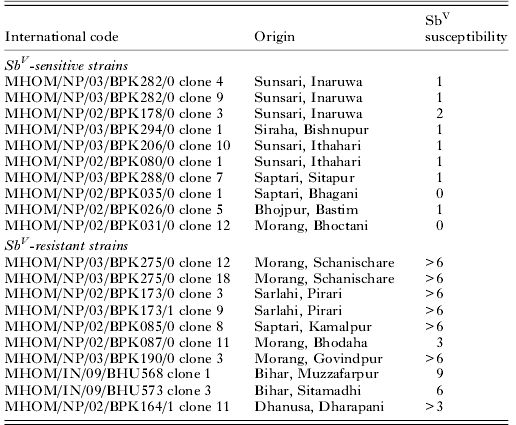
In total, 20 L. donovani cloned strains were used for this study (see Table 1). They were derived from 18 clinical isolates (2 of them providing 2 strains each). Sixteen strains were obtained from Nepalese patients with confirmed visceral leishmaniasis. Those were recruited between 2002 and 2004 at the B.P. Koirala Institute of Health Sciences, Dharan, Nepal, in the frame of a research project on antimony resistance (Rijal et al. Reference Rijal, Yardley, Chappuis, Decuypere, Khanal, Singh, Boelaert, De Doncker, Croft and Dujardin2007). The other 2 strains were obtained from North Indian patients in May 2009 in the frame of the Kaladrug project. Written informed consent was obtained from the patients and in the case of children, from the parents or guardians. Ethical clearance was obtained from the institutional review boards of the Nepal Health Research Council, Kathmandu, Nepal, Banaras Hindu University, Varanasi, India and the Institute of Tropical Medicine, Antwerp, Belgium. All used clones were tested as intracellular amastigotes for their in vitro antimonial susceptibility as described elsewhere (Rijal et al. Reference Rijal, Yardley, Chappuis, Decuypere, Khanal, Singh, Boelaert, De Doncker, Croft and Dujardin2007). The calculation of an activity index (AI) allowed us to classify the clones in SbV-sensitive and SbV-resistant groups. Thus, clones with an AI of 0–2 were considered as sensitive, while those showing an AI of 3 or higher were considered to be resistant. Promastigotes were grown in haemoflagellate-modified minimal essential medium (HOMEM) (Invitrogen) supplemented with 20% (v/v) heat-inactivated foetal calf serum (PAA Laboratories GmbH), pH 7·5, at 26°C over 7–8 days. The cultures were initiated by inoculating day 3–4 stationary phase parasites in 5 ml of culture medium at a final concentration of 5×10⁵ parasites/ml. The parasite density was determined every 24 h using disposable count chambers Uriglass (Menarini diagnostics) to follow up the growth and differentiation profile. Parasites were harvested at different time-points of the growth curves (specific time-points per experiment are specified in the text). During the modelling phase (evaluation of different parameters for assessment of metacyclogenesis), biological duplicates were used.
List of the strains used in this study and their in vitro susceptibility to SbV

RNA isolation and real-time quantitative PCR
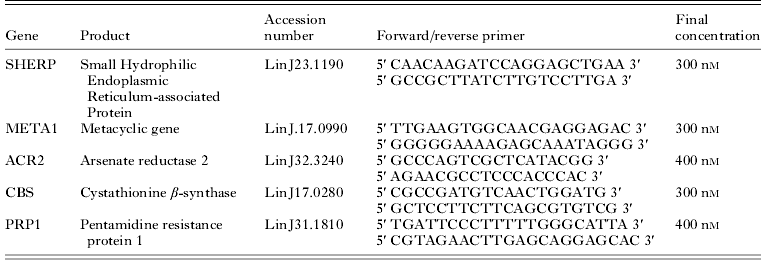
Parasite cultures at logarithmic or stationary phase of SbV-resistant or SbV-sensitive strains, were washed twice in phosphate-buffered saline (PBS) and immediately disrupted in RNAqueous Lysis/ Binding solution (Ambion) and frozen at −80°C until RNA extraction. Total RNA was extracted, treated and analysed as described elsewhere (Decuypere et al. Reference Decuypere, Vanaerschot, Rijal, Yardley, Maes, de Doncker, Chappuis and Dujardin2008). Reverse transcription of total RNA and expression profiling of the 5 genes listed in Table 2 were performed as described elsewhere (Decuypere et al. Reference Decuypere, Vanaerschot, Rijal, Yardley, Maes, de Doncker, Chappuis and Dujardin2008). Normalization of gene expression was done by determining the 3 most stable expressed genes from the set of tested genes, as described elsewhere (Vandesompele et al. Reference Vandesompele, De Preter, Pattyn, Poppe, Van Roy, De Paepe and Speleman2002). The following controls were included in each run for each gene: (i) negative controls of cDNA synthesis (i.e. without reverse transcriptase), and (ii) no-template controls. All reactions were done in triplicate, with their arithmetic average threshold cycle (CT) used for data analysis. The geNorm VBA applet for MS Excel was used to determine the 3 most stable expressed genes from the set of 5 tested genes in a given sample panel. The qbaseplus (Biogazelle) software was used for the determination of the relative (normalized) expression levels of target gene.
List of genes targeted in real-time qPCR analyses

Morphometric analysis
Promastigotes from logarithmic and stationary growth phases were washed in PBS, air-dried on a glass slide, fixed with methanol, stained with 10% (v/v) Giemsa, and analysed by optical microscopy. Cell body length (L), width (W) and flagella length (F) were measured for a minimum of 100 promastigotes in each slide examined using Cell D Imaging Software (Olympus Microscopy). The values of L×W and F/L were then calculated for each promastigote. Parasite populations corresponding to sensitive and resistant clones were clustered in 2 subpopulations (logarithmic and metacylic-like parasites). A cluster analysis was implemented to determine cut-off values for the 2 parameters (L×W and F/L) and for the resistant and sensitive parasites, clustering the total sample in 2 subpopulations (done twice, once for L×W and once for F/L). Based on an adapted version of the methodology described elsewhere (Cardoen et al. Reference Cardoen, Van Huffel, Berkvens, Quoilin, Ducoffre, Saegerman, Speybroeck, Imberechts, Herman, Ducatelle and Dierick2009; Havelaar et al. Reference Havelaar, van Rosse, Bucura, Toetenel, Haagsma, Kurowicka, Heesterbeek, Speybroeck, Langelaar, van der Giessen, Cooke and Braks2010), groups of different importance were identified by Classification and Regression Tree analysis (CART Version 6.0, Salford Systems, San Diego, California, USA). The aim was to obtain 2 subgroups with minimal within group variance (grouping samples with similar L×W and F/L values). Starting with all the samples the method will obtain a binary split into 2 groups (nodes) that are most homogeneous with respect to the L×W and F/L values. The technique is explained in more detail elsewhere (Speybroeck et al. Reference Speybroeck, Berkvens, Mfoukou-Ntsakala, Aerts, Hens, Van Huylenbroeck and Thys2004). A percentage of metacyclic-like parasites was then calculated for parasite populations using the command prop.test implemented in the R software. Statistic analysis was done using a 2-sample test for equality of proportions without continuity correction.
Flow cytometry
Logarithmic and stationary growth-phase parasites were washed and re-suspended in phosphate-buffered saline (PBS) in the presence of 1 μg/ml propidium iodide (Sigma, St Louis, MO, USA) to assess viability. Live parasites were then analysed by flow cytometry using forward scatter (FSC) side scatter (SSC) and fluorescence detection. Dot plots of FSC vs SSC represent the acquisition of 20 000 events. Data were collected in a BD FACSCalibur and list mode files were analysed by FlowJo 7.6.1 software. (Tree Star, Inc. Oregon, USA)
Complement-mediated lysis
Promastigotes in the exponential phase or stationary phase of growth in vitro were tested for their resistance to complement-mediated lysis as described elsewhere (Gamboa et al. Reference Gamboa, Torres, De Doncker, Zimic, Arevalo and Dujardin2008) with modifications. Briefly, promastigotes were tested at a concentration of 5×10⁶ parasites/ml in doubling dilutions of human serum from 1:1 to 1:128 at 26°C for 1 h. The results were expressed as the percentage of living parasites compared to controls that were not exposed to serum. GraphPad Prism 5 software was used to determine EC50 (50% effective concentration) corresponding to each sample tested using a sigmodial dose-response model with variable slope. Each experiment was performed twice. For the second part of the work (validation of the results), a high-throughput complement-mediated lysis test was developed using resazurin to assess the viability of the parasites (Mikus and Steverding, Reference Mikus and Steverding2000). Briefly, promastigotes were diluted in homem 20% FCS to 1×10⁶ parasites /ml and then subjected to the different concentrations of human serum in triplicate in a final volume of 200 μl. After an incubation of 1 h at 26°C, resazurin was added to each well at a final concentration of 0·125 mg/l and plates were further incubated for 24 h at 26°C. The fluorescence at 560 and 590 nm was measured simultaneously using the Victor X3 Multilabel Reader (PerkinElmer). The fluorescence in the absence of serum was set as the 100% control. The percentage survival was exported to GraphPad Prism 5 to calculate the 50% effective concentration (EC50) using a sigmodial dose-response model with variable slope, to visualize results and to statistically analyse the data with a t-test.
In vitro infectivity
The ability of promastigotes to invade and multiply within macrophages in vitro was assessed. Murine peritoneal macrophages were harvested from BALB/c mice, plated out at 2×10⁵ cells per 200 μl per well in RPMI medium supplemented with 10% FCS and 100 U/ml penicillin and streptomycin (=full RPMI) in 16 well Lab-Tek chamber slides (Nunc) incubated at 37°C and 5% CO2 for 24 h. Then, macrophages were infected with stationary phase cultures with a ratio of 10 parasites per 1 macrophage. After 24 h of incubation, free parasites were removed by repeated washings in a serum-free medium and incubated for an additional 3 days in the same conditions. For each strain tested at least 400 macrophages were counted to determine the percentage of infected macrophages and an Infection Index (=% of infected macrophages×average number of amastigotes/ macrophage).
RESULTS
Modelling
At this stage, a series of parameters for the assessment of metacyclogenesis was evaluated on 4 cloned strains: 2 derived from clinical isolate BPK275/0 (SbV- resistant) and 2 others derived from BPK282/0 (SbV-sensitive). Growth curves were shown to be very similar among the 2 strains derived from each clinical isolate, but differences were observed between the 2 pairs of strains, the 2 BPK282/0 strains growing more quickly and reaching earlier the stationary phase (Fig. 1). Therefore, collection of the samples for the next analyses was adapted to each growth curve: (i) logarithmic phase (day 3 for the 4 strains, further called L-samples) and (ii) stationary phase (days 6 and 8, for BPK282/0 and BPK275/0 strains, respectively, further called S-samples).
Cross-validation of methods for assessment of metacyclogenesis in 2 SbV-sensitive (white) and 2 SbV-resistant (grey) strains of Leishmania donovani. Gene expression analysis (META1 and SHERP, panels A and B respectively) was monitored each day during the growth of the parasites (see growth curves above the histograms of relative expression). (C–E) Results obtained with samples from stationary phase: (C) morphometry by optical microscopy, (D) resistance to complement lysis (EC50, Percentage serum causing 50% cell lysis), (E) in vitro infectivity to murine peritoneal macrophages (infection index=% of infected macrophages multiplied by the average number of amastigotes/macrophage). Biological duplicates were used in all experiments.

First, molecular assays were applied to the different samples. The expression level of META1 and SHERP, 2 genes reported to be over-expressed in metacyclics (Uliana et al. Reference Uliana, Goyal, Freymüller and Smith1999; Knuepfer et al. Reference Knuepfer, Stierhof, McKean and Smith2001), was monitored all along the growth curve (Fig. 1A and B). In the 4 lines, the 2 genes showed an increased expression during the progression from logarithmic to stationary phase and this reached a maximum between days 6 and 8. However, over-expression was much higher in the 2 SbV-sensitive lines (twice for META1 and 2·7 times for SHERP).
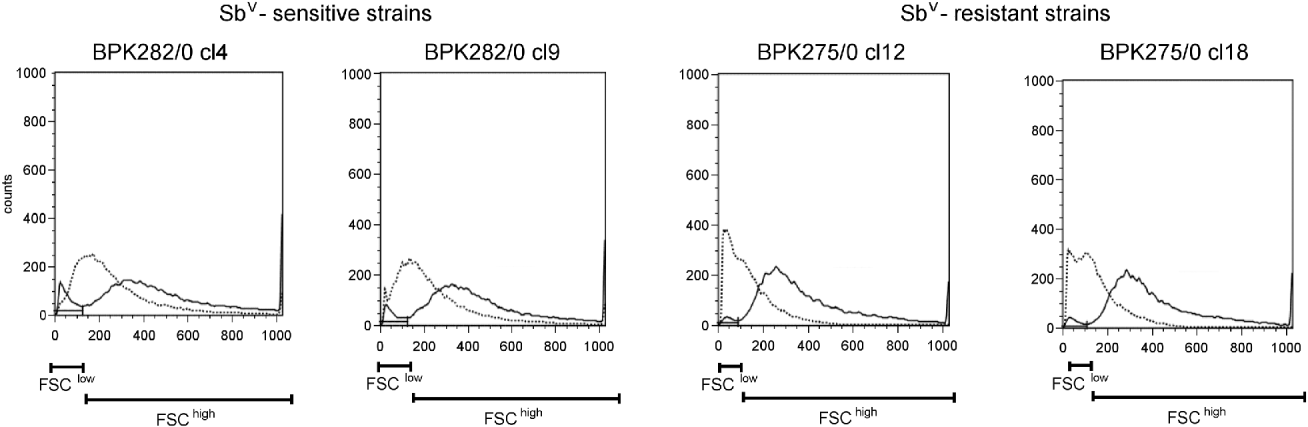
Secondly, morphometry of the parasites was assessed by 2 methods and we focused on samples from stationary phase (S, samples: days 6 and 8 respectively for BPK282/0 and BPK275/0 strains, respectively). On the one hand, optical microscopy was used. Visual inspection of the plates revealed the reported dimorphism of promastigotes: parasites with large cell bodies and a flagellum of similar length (typical of procyclics) and short slender cells with a flagellum measuring at least twice the length of the cell body (typical of metacyclics). For an objective comparison and quantification, a morphometric analysis of L- and S-samples was performed for the 4 strains. A bi-modal distribution was observed for both parameters L*W and F/L and, a cut-off was defined using the classification and regression tree technique. Noteworthy, the cut-off was different for the 2 pairs of strains, likely reflecting intrinsic larger size of BPK282/0 strains. According to the respective cut-offs, the proportion of metacyclic-like promastigotes was estimated in all samples. For each strain, the percentage of metacylic-like promastigotes was found to be significantly higher in S-samples than in L-samples (P<0·05). A significantly higher percentage of metacylic-like promastigotes was observed in the 2 resistant strains (39%) when we compared them to the 2 sensitive strains (27·7%), P=0·004. On the other hand, the same samples were also analysed by flow cytometry (Fig. 2). The populations of parasites were gated in 2 subpopulations displaying clearly different FSC intensities corresponding to different cell sizes as described elsewhere (Saraiva et al. Reference Saraiva, Pinto-da-Silva, Wanderley, Bonomo, Barcinski and Moreira2005). As for the microscopy, the cut-off between the 2 populations was not the same among strains and also indicated an intrinsically larger size of BPK282/0 strains. When comparing sensitive and resistant strains, the percentage of FSClow parasites (metacyclic-like) showed an increase from L-samples to S-samples, however this percentage is higher in S-samples of resistant strains (40·0 and 42·0%) than in sensitive strains (20·6 and 26·9%).
Flow cytometric analysis of 2 Sbv-sensitive strains and 2 Sbv-resistant strains in samples collected in logarithmic (full line) and stationary (dotted line) phases. FSC, forward-angle light scatter. The FSC cut-off between short (FSClow) and large (FSChigh) promastigotes was defined at the minimum of the curve of logarithmic samples.

Thirdly, parasites were submitted to 2 types of functional assays. On the one hand, they were subjected to complement-mediated lysis, a phenomenon to which metacyclics are known to resist more than procyclics (Gamboa et al. Reference Gamboa, Torres, De Doncker, Zimic, Arevalo and Dujardin2008). At this stage, the percentage of viable promastigotes was estimated using movement of the flagellum as a sign of viability (Zakai et al. 1998). S-samples of the 2 resistant strains showed a higher resistance to complement-mediated lysis than those of the 2 sensitive strains (EC50=10·66% and 5·02%, respectively) (Fig. 1D). This indicated a higher proportion of metacyclics in resistant strains than in sensitive strains in stationary-phase cultures. On the other hand, stationary-phase promastigotes of the 4 strains were used to infect peritoneal macrophages in vitro: 72 h after infection, the infection index corresponding to each strain was determined (Fig. 1E). The 2 BPK275/0 strains appeared to be at least 4 times more infective than the 2 BPK282/0 strains.
Diversity of metacyclogenesis among clinical strains of L. donovani
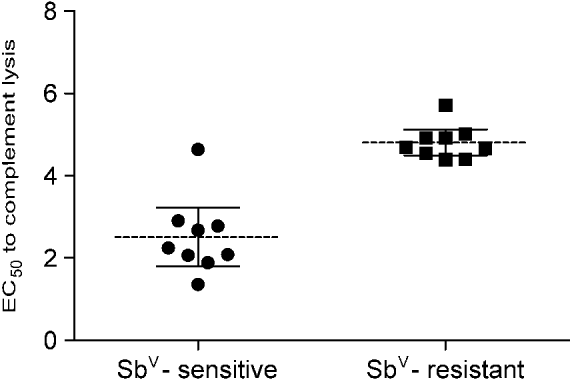
In the second part of the work we extended the analysis of metacyclogenesis diversity to a broader sample of strains. Among the 5 aforementioned parameters evaluated, we selected one, the test of resistance to complement lysis, being a functional test and easier to implement as a high throughput application. In total, 20 lines were analysed, derived from 18 different clinical isolates, 9 SbV-sensitive and 9 SbV-resistant; all measures were done at day 7 of the growth curve (Fig. 3). Accordingly, SbV-resistant parasites showed a significantly higher (P=0·0003) resistance to complement lysis (mean EC50=4·80%±0·41) in stationary phase cultures when compared to SbV-sensitive strains (mean EC50=2·51%±0·93). This showed, thus, the occurrence of a higher metacyclogenesis rate among the SbV-resistant lines of L. donovani here studied.
Resistance to complement-mediated lysis in 9 SbV-sensitive (dots) and 9 SbV-resistant (squares) strains in stationary phase (all harvested at day 7). The Alamar blue was used as parasite viability indicator: EC50, percentage serum causing 50% cell lysis. Each point represents a tested parasite strain. Dashed line represents the mean value observed in the 2 populations.

DISCUSSION
In the present study we first cross-validated on a limited number of strains a series of parameters for the assessment of metacyclogenesis in L. donovani. It was found that all morphological and functional parameters agreed and showed a higher proportion of metacyclics in the 2 SbV-resistant lines. This contrasted with molecular parameters. While META1 and SHERP genes showed a higher expression during metacyclogenesis of each individual strain, inter-strain comparison showed lower levels of expression in stationary forms of SbV-resistant parasites. Our data thus do not validate META1 and SHERP as adequate markers for inter-strain comparison of metacyclogenesis. This could indicate the occurrence of different molecular adaptations in resistant metacyclics, but needs to be interpreted with caution, as post-transcriptional regulation is common in trypanosomatids (Martínez-Calvillo et al. Reference Martínez-Calvillo, Vizuet-de-Rueda, Florencio-Martínez, Manning-Cela and Figueroa-Angulo2010). In a second stage, extending our sample size and focusing on 1 parameter (functional, i.e. complement lysis), we found that the metacyclogenesis rate was about twice as high in clinical lines of L. donovani resistant to SbV than in SbV-sensitive lines.
Mathematical models predict that the future of epidemics of drug-resistant pathogens depends in part on the competitive fitness of drug-resistant strains (Borrell and Gagneux, Reference Borrell and Gagneux2009). Several studies on prokaryotes and eukaryotes have demonstrated that drug resistance generally confers a reduction in fitness expressed as reduced growth, virulence or transmission (Hastings and Donnelly, Reference Hastings and Donnelly2005; Andersson and Hughes, Reference Andersson and Hughes2010). In some cases, compensatory mutations may occur which restore the fitness of mutants to that of sensitive forms (Walliker et al. Reference Walliker, Hunt and Babiker2005). Considering metacyclogenesis as a major adaptive process in the life cycle of the parasite, our results suggest a higher fitness of SbV-resistant L. donovani parasites. Other published data converge to support this concept. Samant et al. (Reference Samant, Sahasrabuddhe, Singh, Gupta, Sundar and Dube2007) showed that SbV-resistant clinical isolates of L. donovani expressed more proteophosphoglycans, which are considered as an important virulence factor in both vector and mammalian hosts. Indeed, a recent report highlighted the inhibition of SbV-induced dendritic cell activation by SbV-resistant L. donovani isolates (Haldar et al. Reference Haldar, Yadav, Singhal, Bisht, Singh, Bhaumik, Basu, Sen and Roy2010). Another study showed that resistant parasites were more virulent in experimental in vivo models (Vanaerschot et al. Reference Vanaerschot, Maes, Ouakad, Adaui, Maes, De Doncker, Rijal, Chappuis, Dujardin and Decuypere2010), in agreement with the clinical observation that patients with treatment failure presented a higher parasite load before treatment compared to responder patients (Thakur et al. Reference Thakur, Mitra and Narayan2003). The exceptional nature of the increased fitness of SbV-resistant L. donovani could be explained by a unique synergy between the survival strategy of the parasite in the macrophage and the mode of action of antimonials. On the one hand, L. donovani is an expert in manipulating macrophages, interfering with cell signalling and inhibiting a series of effectors like reactive oxygen and nitrogen species (ROS/RNS) (Mookerjee et al. Reference Mookerjee Basu, Mookerjee, Sen, Bhaumik, Sen, Banerjee, Naskar, Choudhuri, Saha, Raha and Roy2006). On the other hand, SbV enables host cells to re-activate their ROS/RNS attack on the intracellular amastigotes (Mookerjee et al. Reference Mookerjee Basu, Mookerjee, Sen, Bhaumik, Sen, Banerjee, Naskar, Choudhuri, Saha, Raha and Roy2006). Moreover, several authors reported a cross-resistance of Leishmania to antimonials and nitric oxide (Carter et al. Reference Carter, Hutchison, Boitelle, Murray, Sundar and Mullen2005; Holzmuller et al. Reference Holzmuller, Sereno and Lemesre2005). Metacyclics are intrinsically insensitive to SbV (da Luz et al. Reference da Luz, Vermeersch, Dujardin, Cos and Maes2009), and amastigotes are the only stage naturally submitted to the pressure of the drug or other effectors. The link between the selective pressures exerted on the amastigote stage and the phenotype here measured on promastigotes must be analysed further in the light of the global molecular adaptations of the resistant parasites (t'Kindt et al. Reference t'Kindt, Scheltema, Jankevics, Brunker, Rijal, Dujardin, Breitling, Watson, Coombs and Decuypere2010) and the pre-adaptations that metacyclics develop for their survival in the macrophage (Alcolea et al. Reference Alcolea, Alonso, Gómez, Moreno, Domínguez, Parro and Larraga2010).
The results obtained on L. donovani contrast with findings made on L. mexicana. Sereno and Lemesre (Reference Sereno and Lemesre1997) induced pentamidine resistance in L. mexicana and found no difference in the infectivity for resident mouse macrophages between the wild-type and pentamidine-resistant clones. Another study showed that metacyclogenesis and infectivity were reduced in a L. mexicana strain made resistant to Glibenclamide®, an ATP-binding cassette-transporter blocker (Silva et al. Reference Silva, Camacho, Figarella and Ponte-Sucre2004). Further work would be required to understand if the differences with our findings are related to the species considered, the nature of the drug or the experimental set-up. Indeed, in the L. mexicana studies, drug resistance was induced while we analysed drug-resistant clinical isolates and we previously showed that mechanisms for natural resistance could differ from those revealed during experimental induction (Decuypere et al. Reference Decuypere, Rijal, Yardley, De Doncker, Laurent, Khanal, Chappuis and Dujardin2005). Further work is also needed to further dissect the metacyclogenesis in L. donovani and explore the cooperation between apoptotic and viable metacyclics in SbV-resistant strains, as this was reported to enhance pathogenesis in other Leishmania species (Wanderley et al. Reference Wanderley, Pinto da Silva, Deolindo, Soong, Borges, Prates, de Souza, Barral, Balanco, do Nascimento, Saraiva and Barcinski2009).
Could our results imply that decades of antimonial drug pressure (already used since 1924 with progressively higher drug regimens) on L. donovani contributed to select fitter and more virulent pathogens? One might speculate arguing on (i) the success of this species in ‘re-colonizing’ the Indian subcontinent after a major evolutionary bottleneck in the 60's (associated with DDT spraying) (Alam et al. Reference Alam, Kuhls, Schweynoch, Sundar, Rijal, Shamsuzzaman, Raju, Salotra, Dujardin and Schönian2009) and (ii) the high pathogenicity of that species. Reciprocally, it could also be possible that SbV-resistance emerged among the fittest strains, i.e. the ones that were already best pre-adapted to the macrophage effectors. This alternative hypothesis is supported by the observation of abundant cases of primary SbV-resistance in L. braziliensis (Yardley et al. Reference Yardley, Ortuno, Llanos-Cuentas, Chappuis, Doncker, Ramirez, Croft, Arevalo, Adaui, Bermudez, Decuypere and Dujardin2006), a species endemic in Latin America, for which the main reservoir is constituted by wild animals, on which there is obviously no drug pressure. Surveillance of L. donovani populations in the Indian subcontinent is of uppermost importance to follow the fate of the SbV-resistant parasites in the context of the new selective pressures brought by new drugs like miltefosine (now used in first line in the region). Our unpublished data do not indicate yet the occurrence of cross-resistance between both drugs, but ‘fitter’ parasites might be the first in which new molecular adaptations might emerge. A close monitoring of this process is foreseen in the context of the current VL elimination programme (see www.leishrisk.net/kaladrug).
ACKNOWLEDGEMENTS
We thank Odin Goovaerts for support in the interpretation of FACS data.
FINANCIAL SUPPORT
This research was funded by the EC-INCO-Dev project LeishNatDrug-R (contract ICA4-CT-2001–10076), the FWO Flanders (contract G.0103.06 and 1.5.147.09) and the EC-FP7 project Kaladrug-R (contract 222895). M.V. has a fellowship from the Agency for Innovation by Science and Technology in Flanders (IWT) and S.D. has a grant from the Baillet-Latour Foundation. These funders had no role in study design, data collection and analysis, decision to publish, or preparation of the manuscript.