‘In the case of armed conflict not of an international character … an impartial humanitarian body, such as the International Committee of the Red Cross, may offer its services to the Parties to the conflict.’
Common Article 3 of the Geneva Convention 1949
‘The special position of the International Committee of the Red Cross … shall be recognized and respected at all times.’
Art 125. Geneva Convention (III) relative to the Treatment of Prisoners of War 1949
The Puzzle of Compliance
The International Committee of the Red Cross (ICRC) has experienced a mixed reception from the warring parties in its response to the thirty-year long civil war in Sudan. The resistance group in the South, the Sudan People's Liberation Army/Movement (SPLA/M), allowed ICRC delegates access to their detention centres for all but one year between 1991 and 2006. The Sudanese government, by contrast, denied the ICRC full inspection of their detention centres for twelve out of the sixteen years in this period.
The matter of ICRC access in Sudan raises several interesting questions for the study of international relations, particularly regarding the reasoning behind state and non-state actors’ adherence to international norms. The Sudanese case belies conventional wisdom regarding the regular behaviour of national governments and rebel groups.Footnote 1 We generally expect governments to be more responsive than rebel groups to international norms. Yet this was not the case in Sudan. This apparent anomaly causes us to ask: why would a national government deny visitation by the ICRC? Why would an insurgent group allow an international organization into the zone it controls?
The record shows that some warring parties choose to allow international organizations such as the ICRC access to their facilities at the height of a civil war while others do not. On the face of it, this general pattern of compliance with international law is puzzling. On the government side, the decision to grant access to the ICRC is puzzling, because the reach of international law is limited and because compliance means taking the risk of compromising one's autonomy in heightened security situations. The Geneva Convention quoted at the beginning of this article recommends and encourages warring parties to accept the ICRC in their conflict zones for humanitarian assistance. However, like many other international rules and norms, this clause does not have direct binding power,Footnote 2 nor is it backed by any enforcement mechanisms. Nonetheless, accepting the ICRC has become a norm and common practice for many governments for over a hundred years.Footnote 3
With regard to rebel groups, the phenomenon of granting access is puzzling partially because rebel groups rarely agree to the rule of letting the ICRC in.Footnote 4 Without written agreements or explicit consent, how does compliance with international norms emerge for rebel groups?Footnote 5 Rebels did not have a seat at the negotiating table of the Geneva Convention,Footnote 6 and they generally do not participate, as states do, in formal legal processes – such as signing or ratifying international declarations – to signal their intentions and commitments. Nevertheless, some insurgent groups do accept the ICRC in their controlled zones, adhere to the norm of accepting ICRC visits, and comply with the recommendation set forth in the Geneva Convention.
The act of granting access to detention centres is an important phenomenon to study for both practical and theoretical reasons. On a practical level, access to detention centres has important humanitarian consequences in internal conflicts. ICRC visits to detention centres are associated with improved access for victims of conflicts to basic needs such as water and sanitation; ICRC visits also increase the probability that judicial rights will be respected and that fair trials will occur. Visits by the ICRC to security and civilian detainees in times of conflict can help identify instances of ill-treatment and open up opportunities for the ICRC to take preventive measures and assist victims – opportunities that would otherwise not exist.Footnote 7
After decades of research, we now understand the compliance behaviour of states better. We know less, however, about the compliance behaviour of non-state actors. Scholars of compliance with international institutions understandably tend to focus on the behaviour of states. States are the key negotiators and drafters of public international law and are themselves the signatories and enforcers of the international legal order. However, non-state actors are becoming increasingly important in world politics, and it is imperative to bring these actors into the domain of international institutions. In choosing to study non-state actors, we depart from previous work on compliance with international agreements by juxtaposing the political motivations of national governments and non-state actors and by exploring their similarities and differences in terms of their behaviour in complying with international rules.
In addition to making contributions to the literature on compliance and international institutions, our study also connects the literature on international institutions with scholarship on civil war. The theoretical connections between these topics yield insights into the roles of non-state actors in zones of civil conflict, such as rebel groups and international organizations. Understanding the motivations of these actors in turn helps us understand under what circumstances some aspects of international law can still prevail, even in the largely anarchical context of civil conflict.
By analysing the behaviour of both national governments and rebel groups, we find that warring parties adhere to the international standard of accepting the ICRC in their detention centres when the decision is an incentive compatible with their political motivation to gain or maintain legitimacy. In particular, we find that democratic governments as well as governments that rely heavily on foreign aid are more likely to grant access to the ICRC if they are concerned about restoring political legitimacy that they lost at the outbreak of a civil war. For their part, insurgent groups that strive to appear as legitimate political entities in the eyes of domestic and international supporters are more likely to grant access to the ICRC in their search for eventual political recognition. These legitimacy-seeking incentives are consistent with the military and strategic goals of warring parties in civil conflicts.
This article proceeds as follows. We first develop our argument that the pursuit of political legitimacy is a key motivator behind compliance decisions and introduce empirically testable hypotheses based on the decision calculus of national governments and insurgent groups. We then present our statistical analyses of ICRC visitation records from 1991 to 2006 and discuss the implications of these findings in the context of compliance research.
Legitimacy-Based Theory of Compliance
We argue that the pursuit of political legitimacy explains compliance behaviour for both governments and armed opposition groups.Footnote 8 Political concern for legitimacy can be important for warring parties in their quest to achieve a ‘right to rule’. We define legitimacy as a political attribute of a ruler whose political authority and right to rule are accepted by those under his or her rule.Footnote 9 The concern of states for legitimacy is well documented in the literature;Footnote 10 the parallel concern of non-state actors is less well documented. Armed opposition groups may want to achieve recognition as a viable political entity,Footnote 11 which is a necessary step towards achieving legitimacy. For rebel groups in civil conflicts, legitimacy is something that must be actively earned, whereas for governments, legitimacy is seen as something that must be restored. The achievement of legitimacy requires political constituencies or audiences, as the concept deals with the relationship between rulers and the ruled. Two sources of legitimacy are important for warring parties in civil conflicts: domestic audiences and international audiences. Warring parties typically strive to be regarded as viable actors both by domestic society and by the international community.
Granting access for detainee visits is part of a legitimization strategy that brings material and non-material benefits that enhance a warring party's chances of surviving militarily and politically. Granting access to the ICRC, a prominent international organization, opens the door for other types of international engagement. The ICRC is usually one of the first humanitarian organizations to negotiate accessFootnote 12 and the last one to leave a conflict zone. Engagement with the ICRC and its delegates, therefore, often means that warring parties get to interact with the wider international community and thus potentially obtain political backing and resources.Footnote 13 Access to detention centres is often negotiated as part of a package comprising other forms of humanitarian assistance.
By engaging in access negotiations and by dictating the terms of access, a warring party is able to demonstrate authority as a valid interlocutor, as a negotiator and as a resource allocator. Authority as an interlocutor gives the warring party a foothold on the path to recognition by the international community including other aid agencies. Authority as a negotiator confers bargaining leverage on a warring party. Some rebel groups play international agencies off against each other to get the best bargain, or they negotiate the terms of access to detainees in such a way that aid materials go to areas controlled by their key supporters.Footnote 14 Authority as a resource allocator provides a warring party with control of the resources it gets from external actors. A warring party can use humanitarian resources to appease its civilian supporters, and in some cases, unfortunately, divert materials for purposes of war.Footnote 15 The demonstration of authority, therefore, brings tangible benefits such as war-related resources as well as non-tangible ones such as continuing relationships with outside supporters.
Every aspect of humanitarian compliance involves a tradeoff between military considerations and a motivation to comply.Footnote 16 The decision to grant access is no exception. By itself, the access decision does not alter the military balance overnight. However, access takes place in a broader context of strategic and tactical decisions. In particular, warring parties make decisions about access in connection with other strategic decisions about the treatment of civilians and detainees. The matter of granting access is intertwined with broader questions of military strategy regarding violence – or the risk of violence – toward civilians. In general, rebel groups that kill civilians are less likely to grant access. Running detention centres means that rebel groups have alternative means of controlling the population instead of indiscriminately killing enemy-sympathizers. Detention is often a form of selective violence with the primary aim of achieving better security and obtaining intelligence, as well as establishing civilian allegiance in the context of the type of asymmetric warfare that often characterizes civil conflicts.Footnote 17
Granting humanitarian access may also affect the wartime strategy of treating detainees. The harsh treatment of security and civilian detainees may contribute to military gains.Footnote 18 It is feasible that some warring parties – particularly those unfamiliar with the ICRC's long-standing confidentiality policy, such as rebel groupsFootnote 19 – may believe that allowing ICRC delegates access to their detention centres has significant strategic consequences. They may perceive allowing the ICRC access to their prisons as an action that may compromise security benefits obtained through the harsh treatment of detainees.
In the light of the foregoing political, strategic and military considerations, we now explain the decision calculus of each warring party in accepting ICRC visits in civil conflicts and present our hypotheses regarding access behaviour for governments and opposition groups respectively.
Hypotheses Regarding the Access Decisions of National Governments
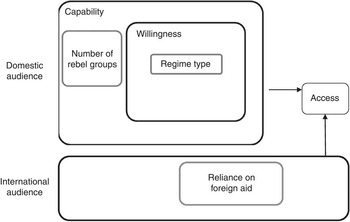
The key sources of legitimacy for national governments in internal conflicts are domestic and international audiences. Governments engaged in armed conflict have varying degrees of motivation to restore legitimacy in the eyes of these audiences. How dependent governments are on support from these domestic and international constituencies will determine how motivated they are to engage in actions that will make them appear more legitimate, such as granting the ICRC access to wartime detainees.
For domestic audiences, we propose that a government's regime type will correlate with legitimacy-seeking behaviour. Democratic regimes are more likely than autocratic ones to comply with international rules for several institutional reasons: democratic regimes are more sensitive than other regimes to electoral opinion,Footnote 20 they have more highly developed institutions of civil society, and they have internal oversight mechanisms.Footnote 21 This theoretical expectation is summarized in Hypothesis 1:
Hypothesis 1 (Government Access Behaviour): National governments are more likely to grant access to the ICRC if they are democratic.
This is not to suggest that democracies are free from human rights or humanitarian violations. As the recent literature on state repression shows, democracies in civil conflicts often violate international human rights or humanitarian rules in the face of severe security threats.Footnote 22 However, democracies have institutional safeguards that ensure that measures to restrict human rights will be hotly debated in civil society and in national/regional courts,Footnote 23 a characteristic lacking in authoritarian regimes. Therefore, we would expect the relationship between political regime type and access-granting behaviour to be positive, as proposed in Hypothesis 1.
International audiences are also important to national governments as sovereignty comes not only from internal political support but also from external recognition. When a government relies strongly on foreign aid to survive, international audiences become even more essential. For governments in civil conflicts, losing external support can be linked to the very real consequence of reductions in foreign aid.Footnote 24 In these cases governments cannot funnel resources to fight rebel forces. Granting access to the ICRC is not by itself a game changer and does not directly affect a government's ability to defeat rebels. However, continued bad practices and the alienation of aid groups can cause a government's situation to deteriorate by undermining its ability to accumulate war revenue. Denying visits can also create humanitarian disasters. This can lead to a decline in support for the government and an increase in support for the rebels. For these reasons, we would expect national governments to be more likely to grant access to the ICRC if they rely heavily on foreign aid. We write this expectation in Hypothesis 2:
Hypothesis 2 (Government Access Behaviour): National governments are more likely to grant access to the ICRC if they rely heavily on foreign aid.
At times, governments engaged in civil conflicts may have the political motivation to grant access to the ICRC, but security and capacity constraints may limit their ability to do so. For instance, when fighting several rebel groups simultaneously, overwhelmed national governments may prioritize specific security gains over legal obligations and may, therefore, be less likely to grant visits.Footnote 25 A government's decision to grant access when there is fighting on multiple fronts usually reflects a situation where significant investments have been made in the training of military and police forces, in improving living conditions in detention centres, as well as in providing a specific justification for each individual being held. The presence of splinter groups is likely to make it difficult for national governments to manage detention centres. Our expectation about the influence of security and capacity constraints is summarized in Hypothesis 3.
Hypothesis 3 (Government Access Behaviour): National governments are less likely to grant access to the ICRC if they face a high number of opposition groups.
Figure 1 provides a summary of our theoretical expectations regarding government access-granting behaviour in times of civil conflict.
Model of access granted by governments

Hypotheses Regarding the Access Decisions of Armed Opposition Groups
Not all armed opposition groups are created equal. Rebel groups come in different political stripes with varying motivations, a variety of organizational structures and an assortment of different relationships with their core constituents. Consequently, some are more concerned with political legitimacy than others, and some have the means to pursue legitimacy while others do not. We argue that whether or not insurgents adhere to international rules depends primarily on two factors: (1) the future-oriented goals that define their motivations, and (2) the degree to which their current organizational characteristics enable them to do so.
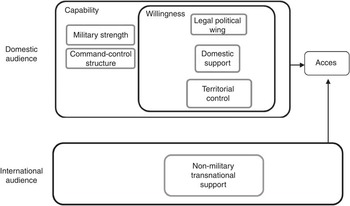
We suggest six empirical correlates of legitimacy-seeking behaviours for rebel groups: (1) the presence of a legal political wing, (2) the extent of domestic support, (3) territorial control, (4) the extent of outside support from international actors, (5) group strength, and (6) the existence of a centralized command structure. Each factor influences the strategic calculations that rebel groups must make in their pursuit of domestic and international legitimacy. The first three are principally related to domestic legitimacy. The fourth relates to efforts to establish international legitimacy. The final two can be considered capacity constraints, as they determine whether rebel groups that are motivated to appear legitimate will have the ability to allow the ICRC access in order to achieve this goal.
The first correlate of legitimacy-seeking behaviour is the existence of a legal political wing. A political wing is the governing body of a rebel organization, often separate from its military wing. Having a political wing is one of the signs of rebel governance and of having a well-defined political agenda. A political wing also indicates that rebels have the propensity to substitute non-violent for violent means to achieve their goals, compared to the groups that are dominated by a military wing.Footnote 26 Rebel groups with a political wing usually are interested in building interactions with other political actors through public relations programmes. One of the foreign policies available to these groups is to negotiate with international humanitarian agencies. A political wing, therefore, facilitates the process of conforming to international rules, usually by articulating a political platform that addresses domestic and international audiences.
In particular, a legally authorized political wing usually indicates a clear and established aspiration to become a legitimate political entity. Groups with legal political wings tend to be those that have participated in local or nationwide elections, or previously have been represented in government. Rebels with political wings that are legally authorized demonstrate a greater motivation to earn legitimacy than those whose political wings remain illegal and whose political activities through normal electoral channels are forbidden by their governments. Although obtaining legal recognition depends to a significant degree on the government the rebels oppose, the pursuit of legal recognition indicates a strong concern for achieving legitimacy and accompanying political experience. Particularly for rebel groups that aspire to be part of power-sharing arrangements or to participate in post-war politics, the pursuit of legal status provides an opportunity to obtain assistance from international donors. The rebel-to-party literature shows that groups with legal political wings often develop into established political entities during post-conflict periods if they successfully evolve and obtain popular support in peacetime.Footnote 27 Examples include the Sandinista National Liberation Front in Nicaragua and the Farabundo Martí National Liberation Front in El Salvador.Footnote 28 We summarize our expectation about the relationship between the existence of a legal political wing and access behaviour in Hypothesis 4:
Hypothesis 4 (Rebel Group Access Behaviour and Legal Political Wings): Armed opposition groups are more likely to grant access if they have a legal political wing.
Another indicator of legitimacy-seeking behaviour is the relationship rebel groups establish with civilians and their capacity to mobilize domestic supporters. On the one hand, some rebel groups with deep ties to the local community provide security and public goods, such as education and administrative functions.Footnote 29 These groups are more likely to grant the ICRC access, as they can profit from the general humanitarian assistance associated with detainee visits. This assistance usually includes food or sanitation services, or other humanitarian packages such as assistance to civilians in need. These resources are particularly welcome to groups that rely on civilian support for waging wars as opposed to relying on natural resources or outside support.Footnote 30 On the other hand, rebel groups with no governing functions and no aspirations to govern are less inclined to grant visits because they are not interested in civilians receiving assistance from international organizations. To win and expand local support, groups that have the capacity to mobilize domestic support are in general more likely to grant visits to the ICRC. This theoretical expectation is summarized in Hypothesis 5:
Hypothesis 5 (Rebel Group Access Behaviour and Domestic Support): Armed opposition groups are more likely to grant access if they have high levels of domestic support.
The third indicator of recognition-seeking behaviour is territorial control. Territorial control is often associated with administrative functions, local support and the provision of public goods. Exercising authority within a certain territory means having sustained control over civilians for some period of time. Groups that control territory are likely to exercise restraint with regard to violent actions against civilians.Footnote 31 In the context of the type of asymmetrical warfare that is typical of civil conflicts, rebels often rely on civilians for information. This means that rebel groups that control territory will be motivated to hold security and civilian detainees in specific locations. In contrast, groups without territorial control that cannot build such facilities are likely to exercise hit-and-run operations resulting in more civilian casualties.Footnote 32 Therefore, we expect rebel groups that control territory to be more likely to grant visits to the ICRC. We state this expectation in Hypothesis 6:
Hypothesis 6 (Rebel Group Access Behaviour and Territorial Control): Armed opposition groups are more likely to grant access if they have control over territory.
The fourth indicator of legitimacy-seeking behaviour is the existence of non-military transnational support. Recent literature shows that civil wars are no longer strictly domestic affairs; they have transnational dimensions.Footnote 33 Consequently, legitimacy-seeking behaviour extends to international audiences.Footnote 34 Furthermore, some insurgent group leaders are politically shrewd about international affairs and sometimes play off aid groups against each other to get a better bargain.Footnote 35
Non-military support can take a number of forms: remittances from diasporas,Footnote 36 backing by religious organizations and resources inadvertently provided by aid agencies and human rights groups. These types of support can improve the financial position and diplomatic standing of rebel groups. We focus on non-military outside support because military support such as arms, fighters and ammunitionFootnote 37 involves different strategic calculations on the part of the rebel leadership with respect to humanitarian or human rights behaviours. Receiving military support from other governments is usually not pursued as a means to achieve political legitimacy, but rather as a means to fuel the violence.
Hypothesis 7 (Rebel Group Access Behaviour and Non-military Transnational Support): Armed opposition groups are more likely to grant access if they receive non-military support from non-state transnational actors.
Some rebel groups will have the political motivation to appear legitimate by granting access, although this does not mean that every group will be able to do so. Insurgents also need the capacity to negotiate. Military strength is one of the characteristics that enable a rebel group to negotiate with external actors. Militarily strong groups will be able to negotiate with external humanitarian actors with relative ease while militarily weak groups may lack the necessary capabilities to do so.
In addition to military strength, the strength of a group's central command-and-control structure plays two key roles in defining a rebel group's capacity to negotiate with external actors. First, it enables the group to engage in negotiations with outside actors such as the ICRC. Secondly, it increases the probability that whatever agreement is reached with the ICRC is actually enforced, as only groups with centralized leadership will have an effective control over far-flung detention centres and lower-ranking soldiers. This observation corresponds to Weinstein's argument that the organizational structure of rebel groups plays a key role in determining their behaviour.Footnote 38 This is also in line with the findings of the importance of centralized command and control in enforcing the laws of war in interstate conflicts.Footnote 39 We sum up the expectations about these organizational structures in Hypotheses 8 and 9:
Hypothesis 8 (Rebel Group Access Behaviour and Military Strength): Armed opposition groups are more likely to grant access if they are militarily strong.
Hypothesis 9 (Rebel Group Access Behaviour and Command and Control Structure): Armed opposition groups are more likely to grant access if they have a centralized command and control structure.
Figure 2 summarizes our theoretical expectations regarding rebel group access behaviour in times of civil conflict. The first four factors we outlined above dealing with insurgent groups’ organizational and political characteristics – legal political wing, high domestic support, territorial control and transnational support – indicate a willingness to pursue legitimacy and political recognition. The last two factors – military strength and centralized control – enable groups to pursue actions to reach these aspirations. Note that these are not perfect indicators of the pursuit of legitimacy but rather ‘correlates’ of motivation and opportunity. If one were to place rebel groups on a scale measuring legitimacy-seeking behaviour, those with all six characteristics are more likely to be on the higher end of the scale than those with fewer of these characteristics.
Model of access granted by armed opposition groups

These legitimacy-seeking indicators are theoretically related to each other. At times the presence of one factor reinforces another; at times one factor may substitute for another. For instance, rebel groups lacking transnational support may want to empower their domestic political wing.Footnote 40 Rebel organizations that have a legal political wing may evolve into successful political parties in post-war politics, garnering electoral support from civilians.Footnote 41 Territorial control also affects rebels’ relationship with civilians, which in turn influences their compliance behaviour. Some groups, such as RENAMO in Mozambique, rely to a greater extent on transnational support than they do on the support of the local civilian population. LTTE in Sri Lanka relied on the support of a far-flung diaspora rather than on the local population, while Maoists in Nepal or GAM in Indonesia relied more on taxes collected from local civilians than on any outside funding.Footnote 42
Research Design
Our dataset contains information about the access-granting behaviour of warring parties in armed conflicts between 1991 and 2006. We build on the UCDP/PRIO Armed Conflict DatasetFootnote 43 of 103 civil conflicts, 92 of which are strictly internal civil wars and 11 of which are internationalized civil wars.Footnote 44 As we are interested in the laws of war or jus in bello, we examine only the years of active armed confrontation in cases where civil war lasted many years.Footnote 45 The unit of observation is a country-rebel group cluster in a conflict-year.Footnote 46 For each year in a particular conflict, the dataset records the access-granting behaviour of two warring parties: a government on one hand, and at least one opposition group on the other.Footnote 47 In cases involving multiple rebel groups, we created high and low estimates for our variablesFootnote 48 and tested with both measures in the analysis to reassure the robustness of our findings.
Dependent Variable
The dependent variable is a visitation record indicating whether each warring party granted the ICRC access to its detainee facilities in each conflict year. Our code contains four categories: (1) full visitation rights were granted, (2) partial visitation rights were granted, (3) no visits were allowed, and (4) information was missing and classification was not possible.
Information on access was extracted from the ICRC's annual reports, in which the organization provides descriptions of its work on the ground. We coded ‘full access’ in cases where a party's agreement to allow ICRC visits actually resulted in an ICRC visit conducted following their standard procedures, including private interviews with detainees. We coded ‘partial access’ when the ICRC could not access a particular class of detainees held for security reasons. For instance, Israel was coded as ‘partial access’ between 1991 and 2006, except for 2005, because it did not grant access to some Lebanese prisoners.Footnote 49 We assigned a ‘no access’ code only when the annual report clearly stated that the ICRC's proposal to conduct visits had been explicitly rejected.Footnote 50 If the issue of visits was not addressed, we conservatively coded as ‘missing data’.
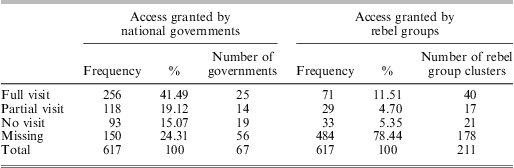
Simple descriptive statistics reveal important information about access behaviour. As Table 1 shows, rebel groups allowed the ICRC to visit prisoners less frequently than governments did. Specifically, rebel groups granted full or partial access in 15 per cent of our total observation points. Governments allowed ICRC delegates full or partial access to their detention facilities in approximately 60 per cent of our total observation points. Of the countries in our sample 98 per cent had ratified the Geneva Convention by 1990, which implies that the ratification of the Geneva Convention does not have any discriminating power in terms of explaining access behaviour. Conventional explanations of treaty compliance rely on the power of ratification,Footnote 51 but in our case, treaty commitment cannot predict adherence to the norm of granting access to the ICRC.
ICRC Access to Detention Centres Granted by Warring Parties in Armed Conflicts, 1991–2006

Note: Frequencies and percentages are calculated from a total of 617 observations. Some warring parties change their behaviour over time and were counted multiple times.
Access records show temporal variation for a good number of governments and rebel groups over the course of a multi-year conflict, which motivates us not to aggregate all the years into one single observation. Examples of governments that varied their access patterns in the time span we analyse include: Algeria, Angola, Cambodia, Chad, Colombia, Eritrea, Peru, Indonesia, Iraq, Mozambique, Rwanda, Senegal and Sri Lanka. On the rebel side, groups that varied their access behaviour include UNITA in Angola, the Serbian Republic of Krajina in Yugoslavia, SPLM/A in Sudan and the LTTE in Sri Lanka. Transition rates – change in behaviour from one year to the next within one dyad – tell us that there is some variation. ‘No visits’ remain as ‘no visits’ in subsequent years 68 per cent of the time, ‘partial visits’ remain as ‘partial visits’ for 51 per cent of our observations, and 79 per cent of the time full visitation rights remain as ‘full visits’. These variations indicate that norm diffusion does not occur in a monotonic fashion.
The dataset includes numerous ‘missing data’ codes due to the fact that for several annual reports the issue of obtaining access to prisoners was not mentioned. On the government side, 24 per cent of data is missing; on the rebel side, 78 per cent. We tackle the problem of missing data for the rebel groups on both substantive and methodological fronts. From a substantive point of view, missing data is not a consequence of a faulty research design. Rather, the source of this fragmentary data reflects the reality of humanitarian access. The missing data in our study resulted from the failure or difficulty of humanitarian negotiations between the ICRC and rebel groups. Therefore, we assume that there was no access in ‘missing’ cases. From a methodological point of view, missing data do not bias the results if they are missing at random.Footnote 52 However, missing data in this case seem to be non-random. A series of difference of means tests (t-tests) and variance comparisons (F-tests) reveal that ‘missing’ cases are systematically different from ‘non-missing’ ones for some covariates.Footnote 53
We proceed in several steps to deal with the missing data problem.Footnote 54 We analyse governments’ access behaviour using the data that are available. For the analysis of rebel group access where the missing data problem is most severe, we count missing cases as ‘no access’ cases. We think the missing-as-no-visit assumption is a tenable one because missing cases are generated when: (1) negotiations for access are ongoing but have deadlocked, (2) negotiations have failed, and access has been denied, or (3) warring parties have not entered negotiations with the ICRC. The ICRC usually attempts to contact all warring parties involved in a conflict due to its goal of impartiality, and we do not expect many missing data cases in the third scenario.Footnote 55 This means that most missing data are generated by warring parties’ decisions, either to refuse negotiating with the ICRC or to deny access. This substantive expectation guides our methodological decision to assume ‘missing’ cases are equivalent to ‘no-visit’ cases in our statistical analyses. We verify whether this assumption that ‘missing cases are no-visit cases’ is innocuous by checking with selection models.Footnote 56 The basic idea is to model the selection process of humanitarian operations that produces the pattern of missing data explicitly, using our substantive knowledge regarding the processes of humanitarian operations. Although so much missing data is far from ideal, the data nonetheless reveal interesting patterns about access-granting behaviours. We revisit this point when presenting the results of our statistical analysis in the next section.
Independent Variables
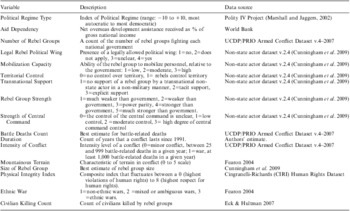
As key explanatory variables, we include the correlates of legitimacy-seeking behaviour. On the government side, we include Political Regime Type. The measure we use is the continuous twenty-point scale from autocracy to democracy from the Polity IV project.Footnote 57 Dependency on foreign aid is measured by the amount of aid as a percentage of gross domestic income. Governments’ capacity constraints are captured by including the Number of Rebel Groups a government is fighting.Footnote 58 Additionally, we control for military balance by including a measure of rebel groups’ Military Strength in the model for governments’ access.
On the rebel side, the key explanatory variables include Legal Political Wing, Mobilization Capacity, Territorial Control and Transnational Support. Legal Political Wing indicates whether the insurgents have a political wing that is recognized as a legal organization.Footnote 59 Mobilization Capacity is an ordinal variable that measures a group's ability to recruit personnel; it is low, moderate or high and indicates an insurgent group's level of reliance on domestic support. Territorial Control is a binary variable indicating whether the group controlled territory. Transnational Support measures the level of non-military support for rebel groups from transnational non-state actors; it ranges from no support, to tacit support, to explicit support. To account for the military characteristics of rebel groups that determine their organizational capacity to comply with international rules, we include two key variables: Military Strength and Strength of Central Command. Military Strength measures the group's military power relative to that of the government.Footnote 60 Strength of Central Command indicates whether a group has established an identifiable central command over the constituent groups that make up the rebel movement.
Informed by our knowledge of humanitarian negotiations, we additionally include several control variables that make or break humanitarian operations. The ICRC is more likely to be present in conflicts of high intensity and longer duration,Footnote 61 and less likely to be present in conflicts over harsh terrain.Footnote 62 For these reasons, we include three control variables: the intensity of a conflict, the duration of a conflict and the presence of mountainous terrain. The Intensity measure is a binary variable from UCDP/PRIO distinguishing minor conflicts from wars. Duration is the count of years that a conflict lasts since 1991, the starting point of our observation window. The geographic constraint for the ICRC is captured by the presence of Mountainous Terrain. Footnote 63 The sources and detailed description of the measurement of variables included in our statistical analyses are compiled in Table 2.
Variables and Data Source

Results
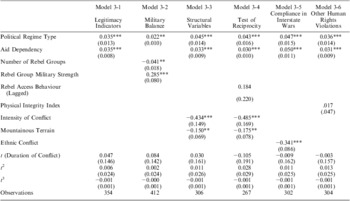
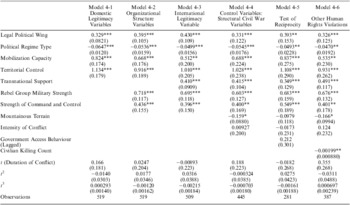
We report a total of twelve models of humanitarian access to detention centres, six for national governments (Table 3) and six for armed opposition groups (Table 4). Given the ordered nature of our dependent variable – no visits, partial visits and full visits – we present an ordered probit analysis.Footnote 64 In all models, we use cubic polynomialsFootnote 65 to account for the potential temporal dependence.Footnote 66 Our goal in the following empirical analyses is to examine the explanatory power of legitimacy-related variables in decisions about granting access to detention centres, controlling for structural factors and alternative explanations.
Ordered Probit Analyses of Access to Detainees Granted by National Governments

Notes: Robust standard errors in parentheses, *** p < 0.01, ** p < 0.05, * p < 0.1. t measures the time since last event and serves as duration of conflict in the model.
Ordered Probit Analyses of Access to Detainees Granted by Armed Opposition Groups

Notes: Robust standard errors in parentheses, *** p<0.01, ** p<0.05, * p<0.1. t measures the time since last event and serves as duration of conflict in the model.
The six models in Table 3 are the results of ordered probit analyses for governments’ access-granting behaviour. Models 3-1 and 3-2 present the effects of key explanatory variables. Model 3-1 tests Hypothesis 1 and Hypothesis 2 pertaining to domestic and international legitimacy-related variables, namely political regime type and aid dependency. The results in Model 3-1 indicate that democratic governments are more likely to grant access than autocracies, thus supporting our expectations set forth in Hypothesis 1 regarding democratic governments’ higher legitimacy concerns.Footnote 67 We also find support for Hypothesis 2: governments that rely more heavily on foreign aid are more likely to grant visits to the ICRC than governments that do not.
Model 3-2 presents the effect of military and strategic variables.Footnote 68 In line with Hypothesis 3 regarding the capacity constraints of governments, access becomes less likely as the number of rebel groups a government is simultaneously fighting increases.Footnote 69 The effect of military strength is positive, indicating that governments facing strong rebel groups are more likely to grant visits.Footnote 70 Model 3-3 controls for structural variables in civil wars such as a conflict's intensity and duration and type of terrain.
Model 3-4 assesses the influence of reciprocity – one of the key compliance mechanisms suggested by previous research.Footnote 71 We test the reciprocity effect by examining whether one party's behaviour at time t will affect another party's behaviour in the subsequent period.Footnote 72 We expect reciprocity to be rather weak in the context of visits to detention centres in civil conflicts. For reciprocity to work, rules should be clear, a shared understanding should be present and violations should be easily identifiable and detectable.Footnote 73 Civil war environments satisfy none of these conditions fully.Footnote 74 Norms regulating detention procedures in internal conflicts, including the status of detainees in civil wars, are generally not clear.Footnote 75 ICRC visits and human rights violations, such as the use of coercive interrogation, are not entirely visible to the other party. Furthermore, rebel groups usually do not have the same control as national governments over lower ranking soldiers. This often leads to severe agency problems as lower ranking soldiers in rebel groups can stray from guidelines set forth by leaders. As the result of Model 3-4 shows, the insignificant influence of an insurgent groups’ behaviour on governments’ visitation decisions indicates a weak effect of reciprocity.
Model 3-5 takes into account an alternative explanation for humanitarian compliance identified in the literature on interstate wars. We control for whether a conflict is classified as one where different ethnicities are fighting each other. The literature has noted that when fighters consider their opponent as being beyond the pale of civilization, human rights are less likely to be respected.Footnote 76 Our results confirm that, in such cases, the ICRC is unlikely to be granted permission to visit detainees.
Model 3-6 investigates the alternative argument that human rights violations may influence governments’ decisions to allow the ICRC into their detention centres. It is plausible to think that governments with bad human rights behaviour may have an incentive to refuse ICRC access. Alternatively, it may be the case that governments with good human rights behaviour would want to signal their good behaviour by granting access. We employ the Physical Integrity Index from the Cingranelli-Richards (CIRI) Human Rights Dataset as our measure for government's human rights violations. This index includes four components: (1) if governments engage in extrajudicial killing, (2) if governments engage in political imprisonment, (3) if governments engage in torture, and (4) if disappearances are frequent. Each component variable takes a value of 0, 1 or 2 for any given year. A score of 2 indicates that no violations took place, a score of 1 implies they occurred occasionally, while a score of 0 indicates that violations were widespread; the composite physical integrity index thus fluctuates between 0 (highest violations of human rights) and 8 (highest respect for human rights). We find weak evidence for this screening/signalling argument. If governments screen ICRC visits based on human rights violations or signal good human rights behaviour by allowing the ICRC in, we would find a significant relationship between Physical Integrity Index and access-granting behaviour. However, we find no such relationship between the two.
Table 4 reports the results of our analyses of access-granting behaviour by armed opposition groups. The first three models assess the effects of legitimacy-seeking correlates on the probability of rebels granting access. Model 4-1 examines the effect of variables associated with groups seeking domestic legitimacy – having a legal political wing, domestic mobilization capacity and territorial control. Model 4-2 adds the military characteristics that determine whether rebel groups with the motivation to seek legitimacy will actually have the organizational capacity to follow through – military strength and command structure. Model 4-3 examines whether receiving non-military transnational support will prompt armed opposition groups to grant access to the ICRC. In line with our expectations regarding rebels’ legitimacy concerns, the models show that rebel groups with legal political wings, domestic support that can be mobilized, territorial control and transnational support are more likely than other groups to grant access to their detention centres.
Models 4-4 through 4-6 examine alternative explanations for access behaviour. Model 4-4 includes three structural variables that have been identified in the literature as being pertinent to analyses of civil conflicts.Footnote 77 The core results for the legitimacy-related indicators do not lose significance. Model 4-5 provides a test of reciprocity as an alternative compliance mechanism. As was the case for government access behaviour, we find weak evidence for reciprocity. Although reciprocity has proven to be a robust predictor of compliance behaviour in interstate relations, we conclude that it does not significantly affect the access-granting behaviour of warring parties in intra-state conflicts. Model 4-6 examines whether access behaviour is influenced by other types of human rights behaviour. Specifically, we assess whether rebel groups that kill more civilians are likely to screen ICRC delegates out of their detention centres so that external witnesses do not see violations that could be used in future international criminal justice cases. We use a count of civilian killing by rebel groups from the One-Sided Violence dataset.Footnote 78 The results show some support of this screening argument, as groups that exterminate civilians are generally less likely than other groups to grant open visits.
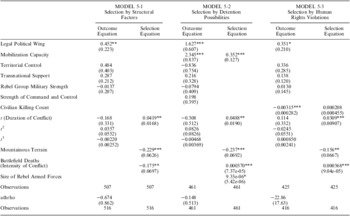
The analyses in Table 4 are based on the assumption that missing visits are equivalent to cases in which no visits took place. We examine whether this assumption is warranted by employing Heckman selection models.Footnote 79 Missing data is akin to a sample selection problem because we are working with a non-random sub-sample – armed groups with non-missing values for humanitarian access – from a larger population of interest, that is, all armed groups. Given the large amount of missing data in our dataset for rebel access behaviour, we want to ensure that missing values do not significantly alter the core results. If a selection model does not alter our key findings, then missing data does not have a systematic effect on the robustness of the results shown from the ordered probit model. Additionally, if the selection process is not necessarily required to explain the access-granting decision outcome, as estimated by the parameter rho in Heckman selection models, then we can state that the missing-as-no-visit assumption does not bias our results.
Table 5 reports the results for the Heckman selection models. The selection equations model the process through which cases are selected into either our sample or into the group of missing values. The dependent variable for the selection equations takes a value of 1 if an observation is selected into the sample of available data and of 0 if access behaviour for an observation is missing. The outcome equations model whether a rebel group granted or denied the ICRC visits to detainees among available data. The dependent variable for the outcome equations is 1 if a partial or full visit took place and 0 if no visits occurred. The selection models and accompanying statistics show that the estimates reported in Table 4 are reliable. Most importantly, an insignificant athrho in the selection models indicates that the pattern of missing data does not bias our estimates and that selection bias should not be a concern.
Heckman Selection Models and Analysis of Missing Data

Notes: Robust standard errors in parentheses, *** p<0.01, ** p<0.05, * p<0.1, constant suppressed. t measures the time since last event and serves as duration of conflict in the model.
Heckman selection models require an identifying variable that influences the selection of cases into the sample without affecting the outcome value of a dependent variable.Footnote 80 This requirement is called an exclusion restriction. Sovey and Green suggest that researchers address two points.Footnote 81 First, they should explain that there is no direct effect of the identifying variable on the dependent variable. Secondly, they should check whether there is a backdoor path through which an identifying variable affects missing values which in turn affect the dependent variable. These two recommendations are closely related, except that the second one adds an extra step.
We think that the duration of a conflict fulfils the exclusion restriction requirements. A conflict's duration fulfils the first requirement of ‘indirect effects’ because there is no direct effect of the duration of a conflict on visitation outcome. The duration of a conflict affects whether visitation data is available for a rebel group, but there is no theoretical reason to suppose that the duration of a conflict affects a rebel group's decision to grant access. A conflict's duration also fulfils the second related requirement of ‘backdoor paths’. The duration of a conflict affects the generation of missing data because of the nature of humanitarian negotiations.Footnote 82 However, once a rebel group has been contacted by the ICRC, and its actions therefore become part of the sample of available data, the probability of granting visits does not depend on a conflict's duration but on other factors such as political aims and security situations. Empirical evidence supports our claims. The statistical insignificance of the Duration variable in the outcome equation indicates that insurgents grant access not because they have been around for a long time, but because of their legitimacy-seeking characteristics.Footnote 83
The selection models include variables that are theoretically expected to contribute to the generation of missing data. We chose the variables based on our knowledge about the realities of humanitarian operations. Model 5-1 reports the effect of structural variables such as terrain and conflict duration. Mountainous terrain reduces the probability of rebel groups entering into the sample because the ICRC would face physical difficulties in visiting prisons. Conflicts of longer duration are more likely to be in the sample of available data because humanitarian actors need time to respond, organize and build connections with rebels.
Model 5-2 gauges the likelihood that detention centres exist since whether rebels have detainees also affects the generation of missing data. We do so by adding variables that measure the size of a group's fighting force and the number of battlefield deaths. Rebel organizations might not have detainees because their size is relatively small or because they are fighting in small-scale conflicts. In those cases, due to lack of organizational capacity or due to the fact the small groups may not be on the ICRC's radar, there may be missing data. Usually, intense conflicts with large battle-death counts are more likely to attract humanitarian actors such as the ICRC. Finally, in Model 5-3, we test whether other human rights violations influence the selection of cases into the sample of available data, taking into account the strategic and screening arguments in the discussion following Table 3.
The results indicate two things. First, the estimates we reported under the assumption that ‘missing data’ cases are equivalent to ‘no visit’ cases are valid. We arrive at this conclusion by observing the Wald test of the rho parameter that measures the correlation between the error terms in the selection and outcome equations. An insignificant rho shows that selection models are not necessary to estimate the unbiased effect of our legitimacy variables and that selection bias does not pose a threat to inference. Secondly, the selection and outcome equations are inherently interrelated partly because of the missing-as-no-visit assumption, and some variables contribute to the selection process while others contribute to the outcome process. For instance, rebel groups’ Military Strength affects the possibility of access being granted via the selection process by which cases get included in the sample, but Rebel Political Wing and Mobilization Capacity primarily affect the outcome equation.
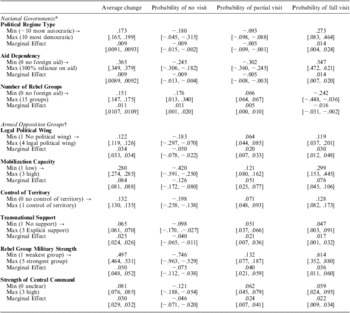
Given that the key legitimacy indicators are closely inter-related both conceptually and empirically,Footnote 84 we would like to provide a sense of the magnitude of the effects of each variable. We report changes in the probabilities of warring parties granting access to the ICRC for certain values of each individual variable in Table 6.Footnote 85 We vary one explanatory variable at a time, from minimum to maximum values, fixing other variables at their means and observe the rate of change in our dependent variable. We also report the average changes – absolute values of the magnitude of changes – each independent variable exerts on our dependent variable across the three categories of no, partial and full visits. Our estimation results indicate that the most democratic governments are 27 per cent more likely than the most autocratic ones to grant the ICRC full visits. Governments that rely heavily on foreign aid are 55 per cent more likely to allow full visits than those which are not reliant on foreign aid. The governments that fight the largest number of rebel groups, fifteen in our sample, are 24 per cent less likely to grant full visits to the ICRC than those governments that fight none.
Marginal Effects and Changes in Predicted Probabilities of Warring Parties’ Granting Access to the ICRC according to Change in Legitimacy Correlates

Notes: Ninety five percent confidence intervals are in square brackets. * The estimates for the first two variables are based on model 3–1. The estimate for number of opposition groups is based on model 3–2. † The estimates for the first three variables are based on model 4–1. The estimate for transnational support is based on model 4–3. The estimates for the last two variables are based on model 4–2.
For armed opposition groups, legitimacy-related variables increase the probability of full visits by 5–61 per cent and decrease the probability of no visits by 11–75 per cent. Controlling territory increases the probability of armed opposition groups granting full access by 13 per cent. Groups that do not receive transnational support are 11 per cent more likely to deny visits than rebel organizations that receive explicit transnational support. Rebel groups that do not have a legal political wing are 18 per cent less likely to grant any kind of visits than groups with such legal representation. Lacking a central command structure decreases the probability of granting visits by 12 per cent. We find that having a high capacity to mobilize supporters and being militarily strong are particularly influential on a rebel group's propensity to grant full visitation rights. In a hypothetical scenario where a formerly weak rebel group becomes one of the strongest in our sample, the likelihood of the group granting ICRC delegates full access increases by 61 per cent. The magnitude of these substantive effects shows that factors related to legitimacy-promotion and negotiating capacity determine the access behaviour of armed opposition groups.
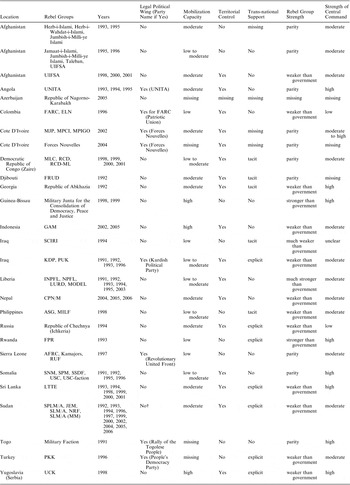
Table 7 takes stock of actual cases in which rebel groups provided ICRC delegates full access to their detention centres. Within the time period we examine, rebel organizations granted the ICRC full access to their wartime prisons for a total of sixty-six conflict-years. For fifty-three out of these sixty-six conflict-years, rebels granting full access did control territory. For sixty out of the sixty-six conflict-years, rebels granting full access exhibited moderately strong or strong central commands. Roughly half of the time that rebels granted full visits, they received at least implicit transnational support, possessed a moderate to high mobilization capacity, and were not militarily weaker than the government they opposed.
Characteristics of Rebel Groups that Granted the ICRC Full Access to Detainees

† Since 1995 the SPLM has an acknowledged political wing.
Several examples of particular rebel groups that granted full visits illustrate the legitimacy-seeking behaviours we have discussed above. For the first example, the Rally for Congolese Democracy (RCD) cultivated international support, sending high-ranking delegations to Europe to garner assistance.Footnote 86 The second example involves the National Union for the Total Independence of Angola (UNITA), which became a legal political party in 2002 and engaged in electoral politics.Footnote 87 The third example is from the Sudanese People's Liberation Movement/Army (SPLM/A). After the independence of Southern Sudan, one of the party platforms of SPLM/A involved claiming to ‘respect all international law and treaty obligations to which New Sudan is a signatory’.Footnote 88 These three examples show that it is plausible to think that the groups’ legitimacy-seeking activities are closely related to their track record in terms of granting access to the ICRC.
In sum, evidence supports our argument that seeking legitimacy is a key explanation for compliance with international law in terms of granting access to the ICRC. Both governments and opposition groups follow the international norm of accepting the ICRC into their detention centres when pursuing legitimacy is important enough for them given their political goals. State and non-state actors face a similar political calculus regarding concerns for legitimacy, although the empirical covariates of compliance and norm adherence are different for each warring party. Specifically, we find that governments that are democratic, that rely on foreign aid and that are not simultaneously fighting many rebel groups demonstrate above-average levels of compliance with international laws of war. We also find that rebel groups that control territory and are militarily strong and have legal political wings, domestic and transnational support, and clear command structures are more likely than other groups to adhere to the norm of granting access.
Conclusion
We conclude by discussing the main implications of our findings and placing them in the broader context of compliance research. Existing compliance research has been developed primarily in the context of inter-state relations. However, given the importance of non-state actors in world politics, we advocate that more research needs to be done to understand the compliance behaviour of non-state actors. Our work suggests that conventional compliance mechanisms developed in the context of interstate relations – such as the power of treaties, reciprocity and norm diffusion – may fail to explain norm adherence by non-state actors.
In this article we hypothesized that the desire and motivation to achieve legitimacy might explain compliance with international law. Without a clear legal obligation and without explicit consent, compliance by non-state actors depends on whether their political motivations are in line with international rules. Our findings suggest that scholars may have to revisit existing theories of compliance in explaining humanitarian and human rights behaviour of state and non-state actors.
We studied the issue of humanitarian access to detention centres, but future research should examine other compliance behaviour such as the use of anti-personnel landmines, the recruitment of child soldiers, or the treatment of civilians. Compliance in one issue area may not carry over to the other areas of humanitarian compliance. For instance, some armed organizations accept ICRC visits but torture or exterminate civilians. We find that legitimacy-seeking rebel groups grant access to the ICRC; knowing this can help policy makers and practitioners conducting humanitarian negotiations understand their motivation. However, given that compliance in one area does not necessarily translate into general compliance, policy implications from our work need to be drawn cautiously. Each issue of humanitarian compliance has already generated a rich literature,Footnote 89 but a broad theoretical framework with which to understand connections among different compliance issues is still lacking. We believe the field needs to consider warring parties’ motivations to comply as well as capacity constraints that may hinder compliance. Over time, these factors and considerations can contribute to deepening our understanding of decision making in times of violence and conflict, and ultimately help to build a general theory of compliance in world politics.