Implications
Our present study demonstrates that multiallelic amplification fragments are more reliable than microsatellites and more cost saving than single nucleotide polymorphisms (SNPs) for pig identification and meat traceability. The methods established by the present study for selecting primers for multiallelic amplification fragments and their optimal SNPs are useful and of value for developing a small panel of common primer pairs for pig identification and meat traceability of two or more pig breeds and their hybrids.
Introduction
In addition to being essential for efficient management of animal populations, animal individual identification plays a key role in assessing animal food safety and veterinary public health (Disney et al., Reference Disney, Green, Forsythe, Wiemers and Weber2001; Fries and Durstewitz, Reference Fries and Durstewitz2001). In the last two decades, the importance of animal food safety and veterinary public health had been highlighted constantly by such food scares as bovine spongiform encephalopathy and avian influenza (Chmielewski and Swayne, Reference Chmielewski and Swayne2011; Hueston, Reference Hueston2013), dioxin contamination (Jacob et al., Reference Jacob, Lok, Morley and Powell2011), and illegal use of melamine and the lean meat agent clenbuterol (Mazzanti et al., Reference Mazzanti, Daniele, Boatto, Manca, Brambilla and Loizzo2003; Dorne et al., Reference Dorne, Doerge, Vandenbroeck, Fink-Gremmels, Mennes, Knutsen, Vernazza, Castle, Edler and Benford2013). Therefore, there is a pressing need to develop more precise and reliable methods for pig identification to contain diseases, monitor the uses of drugs, trace back from pig products to pigs or farms, and even prevent commercial frauds, thus to rebuild consumer’s confidence, which had been declining rapidly after several serious food scandals (Dalvit et al., Reference Dalvit, De Marchi and Cassandro2007).
In pig farms, pigs are often identified by ear tags, ear cuts or skin tattoos (Britt et al., Reference Britt, Bell, Evers and Paskin2013). Two types of ear tags, that is, the traditional plastic tags printed with visually readable numbers (barcodes) and radio-frequency identification tags, are commonly used for pig identification for their low costs and convenience (Britt et al., Reference Britt, Bell, Evers and Paskin2013; Nicoloso et al., Reference Nicoloso, Crepaldi, Mazza, Ajmone-Marsan and Negrini2013). These tags are easily damaged and even detached from pigs. Their numbers are often covered with feces. It is also difficult to maintain the tags on the carcass or pork after slaughter (Dalvit et al., Reference Dalvit, De Marchi and Cassandro2007). To circumvent these disadvantages with the conventional labeling methods, two genetic approaches, that is, microsatellites and SNPs, have been recently explored for pig identification (Dalvit et al., Reference Dalvit, De Marchi and Cassandro2007; Nicoloso et al., Reference Nicoloso, Crepaldi, Mazza, Ajmone-Marsan and Negrini2013). This study is an attempt to use another genetic approach, that is, multiallelic fragments, which incorporates the advantages of both SNPs and microsatellites, for pig identification and meat traceability.
Material and methods
Animals and DNA extraction
All animal studies were conducted in accordance with an animal use protocol approved by the Research Committee of Jiangsu Academy of Agricultural Sciences (reference number, 6309). Hairs each with a follicle from 96 Suzhong pigs born from 12 random sows which had been mated with seven boars, and muscle tissues from 30 random commercial individuals (Duroc×Suzhong) were collected in the Experimental Farm of Jiangsu Academy of Agricultural Sciences (Nanjing, China). Ear tissues were obtained from 68 Duroc pigs of 10 random litters in the Pig Breeding Farm of Daguanshan (Hongzhou, China). Genomic DNA samples were extracted using DNA MiniExtract (Nanjing Super Biotech Co., Ltd, China).
To prepare individual DNA samples, a small piece of ear or muscle tissue, or two to three hair follicles were digested in 17.6 μl DNA MiniExtract and 2.4 μl Proteinase K (10 mg/ml) at 65°C for 30 min, followed by Proteinase K inactivation at 95°C for 5 min. The combined DNA sample for the Suzhong pigs was prepared by digesting 96 hair follicles (one follicle per pig) in 176 μl DNA MiniExtract and 24 μl Proteinase K. The combined DNA sample for the Duroc pigs was prepared by pooling all the Duroc individual DNA samples.
No matter whether individual or combined DNA samples were used, 1 μl supernatant of the digestion solution was used as DNA template for every PCR reaction.
Primer design and selection
A total of 29 primer pairs designed or adopted from a previous publication were first used for identifying multiallelic fragments with multiple SNPs in Suzhong pigs (Goffaux et al., Reference Goffaux, China, Dams, Clinquart and Daube2005). The pairs that had been validated for Suzhong pig identification, along with additional 30 primer pairs, were then tested for identifying multiallelic fragments in Duroc pigs. All the pairs were located in the autosomal regions that were predicted to be enriched with SNPs by screening the genomic DNA sequences (Sus scrofa breed mixed chromosome 1-18, Sscrofa 10.2).
The combined DNA samples were first used to select primer pairs. Pairs that failed to work or worked with poor specificity were first removed. Pairs that amplified fragments with poorly readable sequence or containing no or only one overlapping peak were also removed. Only the pairs producing one single clean band that was easily readable and gave two or more overlapping clean peaks in sequencing (indicative of multiple SNPs), were selected to further amplify individual DNA samples and to see if their target fragments were multiallelic.
To identify a multiallelic fragment, some redundant SNPs within the target fragment were excluded. The SNPs, which were non-biallelic or of low heterozygosity (<0.3, Lindblad-Toh et al., Reference Lindblad-Toh, Winchester, Daly, Wang, Hirschhorn, Laviolette, Ardlie, Reich, Robinson, Sklar, Shah, Thomas, Fan, Gingeras, Warrington, Patil, Hudson and Lander2000; Goffaux et al., Reference Goffaux, China, Dams, Clinquart and Daube2005), were regarded redundant and were excluded. For mutually linked SNPs, which were both biallelic and of high heterozygosity, only one of them was selected as a candidate SNP, while the others were considered redundant and thus excluded because they genotyped the target fragment in the same way with the candidate. If a target fragment still harbored two or more SNPs after the abovementioned redundant SNPs had been excluded, the fragment was considered multiallelic.
To minimize the length of a barcode, another type of redundant SNPs within the target fragment was also excluded because they did not alter the final genotypes of the fragment even though they were biallelic, of high heterozygosity and unlinked with any of the finally used SNPs. This type of redundant SNPs was determined as follows: After the aforementioned three types of the redundant SNPs had been removed, we randomly chose two of the remaining SNPs to genotype the target fragment. We then added one more SNP to see if this addition increased the number of genotypes. If so, we added another SNP. We kept adding SNPs one by one until the number of genotypes stopped to increase, and at this point the last SNP added was regarded redundant and thus removed. We then continued to add more SNPs one by one to find and remove another redundant SNP. This cycle was repeated until all the SNPs were tested.
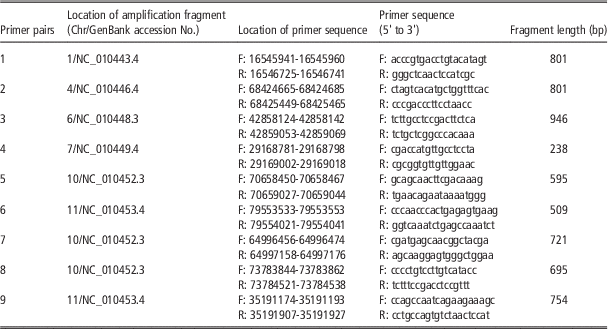
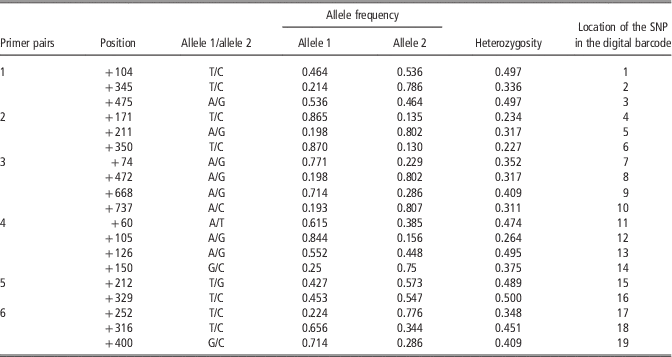
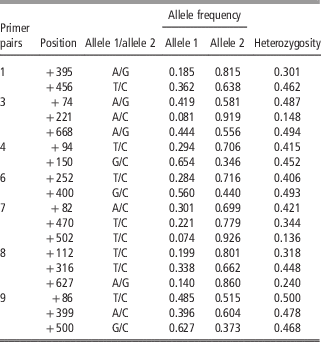
The final primer pairs for Suzhong and/or Duroc pig identification were listed in Table 1; and the optimal SNPs with their amplification fragments were presented in Tables 2 and 3, respectively.
Primers used for Suzhong and/or Duroc pig identification

Chr=chromosome; GenBank accession No.=GenBank accession number; bp=base pairs; F=forward primer; R=reverse primer.
The primers and optimal single nucleotide polymorphisms (SNPs) for Suzhong pig identification

The primers and optimal single nucleotide polymorphisms for Duroc pig identification

Among the 29 primer pairs used for identifying multiallelic fragments in the Suzhong pigs, only six pairs produced multiallelic fragments and thus were used for Suzhong pig identification (pairs 1 to 6, Tables 1 and 2). Out of the 23 unused pairs, three pairs amplified either non-specific or poorly readable fragments, 19 pairs produced no or only one SNP in the fragments amplified from the combined DNA sample, one pair amplified a fragment containing four mutually linked SNPs, thus making this fragment as effective as a fragment with a single SNP locus.
The six pairs selected for Suzhong pig identification were then tested to see if they could be used for identifying multiallelic fragments in Duroc pigs. Four pairs produced multiallelic fragments in the Duroc pigs and thus were used for Duroc pig identification (pairs 1, 3, 4 and 6, Table 3). The other two pairs could not be used for Duroc pig identification as they amplified either a fragment containing only a single SNP, or a poorly readable fragment in the Duroc pigs.
Among the aforementioned 30 primer pairs designed for identifying multiallelic fragments in Duroc pigs, only three produced multiallelic fragments and were used for Duroc pig identification (pairs 7 to 9, Tables 1 and 3). Among the 27 unused pairs, four pairs produced such biallelic fragments as the one with a single SNP because their SNPs were mutually linked. In all, 23 pairs either failed to work, or amplified fragments from the combined DNA sample which were non-specific, poorly readable, or only produced a single SNP or no SNP at all. Together with the four pairs that were initially used for Suzhong identification and subsequently validated for Duroc identification (pairs 1, 3, 4 and 6, Tables 2 and 3), seven pairs were selected for Duroc pig identification (Table 3).
The conditions used for the PCR were 95°C for 2 min; 35 cycles of 95°C for 30 s, 53°C to 66°C for 30 s, and 72°C for 30 to 60 s; and 72°C for 10 min.
Estimation of heterozygosity and identical probability
The heterozygosity of a single SNP was calculated as follows:
 $$H\,{\equals}\,1{\minus}\mathop{\sum}\limits_{i{\equals}1}^n {p_{i}^{2} } $$
where p i is the allele frequency, and n is the number of all alleles. The heterozygosities of SNPs identified from the Suzhong and Duroc pigs are presented in Tables 2 and 3, respectively.
The probability of identity, that is, the identical probability of two random individuals identified by multiallelic fragments in a population was estimated by the following formula which was modified from a reported formula (Peelman et al., Reference Peelman, Mortiaux, Van Zeveren, Dansercoer, Mommens, Coopman, Bouquet, Burny, Renaville and Portetelle1998):
 $$P\,{\equals}\,\prod\limits_{i{\equals}1}^r {\bigg(\mathop{\sum}\limits_{j{\equals}1}^{n_{i} } {p_{{ij}}^{2} } \bigg)} $$
where r is the number of all multiallelic fragments, p ij is the genotypic frequency of the ith multiallelic fragment taking the jthe genotype, and n i is the number of all genotypes of the ith multiallelic fragment.
A multiallelic fragment is more informative than a single SNP. The identical probability of two random individuals determined by one multiallelic fragment can be as high as that by two or more SNPs. If one multiallelic fragment is used, the average probability of identity of two random individuals is calculated as follows:
 $${P}\,{\equals}\,\bigg(\prod\limits_{i{\equals}1}^r {\bigg(\mathop{\sum}\limits_{j{\equals}1}^{n_{i} } {p_{{ij}}^{2} } \bigg)} \bigg)^{{{\textstyle{1 \over r}}}} $$
In our study, the average identical probability determined by one multiallelic fragment approximately equaled the squared identical probability determined by a single biallelic SNP. The allele frequencies of p and 1−p, and the corresponding heterozygosity of such a SNP was deduced by two equations
 $$p^{4} {\plus}4p^{2} (1{\minus}p)^{2} {\plus}(1{\minus}p)^{4} {\equals}\sqrt {{P}} $$
and H=1−p
2−(1−p)2, respectively.
Development of barcodes for pig individual identification
After the primer pairs and their optimal SNPs were determined, both SNP and digital barcodes were developed for pig identification. To develop a SNP barcode, SNPs within a fragment were first combined in tandem by the direction of 5'- to 3'-end, and these independently combined SNPs were then grouped into a SNP barcode. The digital barcode corresponding to a SNP barcode was developed by substituting its AA, GG, TT, CC or heterozygotes for 1, 2, 3, 4 and 0, respectively.
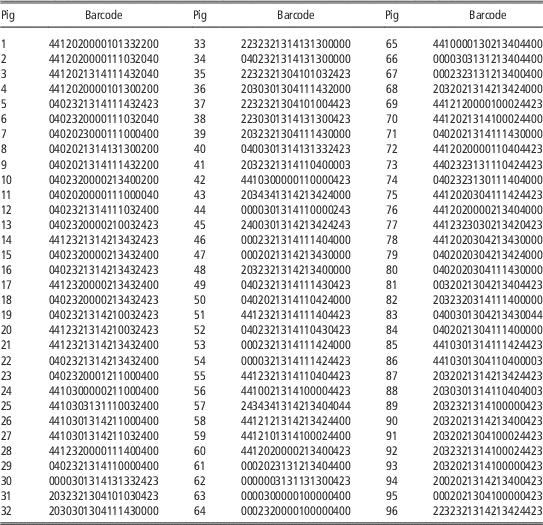
The first to third numbers of digital barcodes for Suzhong pigs were determined by the SNPs at positions +104, +345 and +475 of the fragment amplified by primer pair 1; the fourth to sixth numbers by the SNPs at positions +171, +211 and +350 by pair 2; the seventh to 10th numbers by the SNPs at positions +74, +472, +668 and +737 by pair 3; the 11th to 14th numbers by the SNPs at positions +60, +105, +126 and +150 by pair 4; the 15th to 16th numbers by the SNPs at positions +212 and +329 by pair 5; and the 17th to 19th numbers by the SNPs at positions +252, +316 and +400 by pair 6 (Table 4).
The barcodes for 96 Suzhong pig individuals

Duroc pigs are identified by the SNPs at positions +395 and +456 of the fragment amplified by primer pair 1, +74, +221 and +668 by pair 3; +94 and +150 by pair 4; +252 and +400 by pair 6; +82, +470 and +502 by pair 7, +112, +316 and +627 by pair 8; and +86, +399 and +500 by pair 9. Commercial hybrids (Duroc×Suzhong) are jointly identified by all the aforementioned nine primer pairs and their 32 optimal SNPs for Suzhong or Duroc pig identification.
Results
Individual identification of Suzhong pigs by multiallelic fragments
Out of the 29 primer pairs, six produced multiallelic fragments with multiple SNPs and used for Suzhong pig identification. A total of 48 SNPs were identified from 96 Suzhong pigs using these six pairs. Of these 48 SNPs, 19 were selected (Table 2), and the other 29 SNPs were excluded due to low heterozygosities, linkage with one of the 19 used SNPs for pig identification, or simply being the fourth type of redundant SNPs.
The 96 Suzhong pigs were well distinguished by the SNP/digital barcodes with the 19 SNPs (Table 4), although most of them were full and half sibs and thus their differences were difficult to tell by genetic measurements. With the 19 SNPs, six fragments showed 10, 9, 11, 11, 6 and 8 genotypes, respectively, and the probability of identity was 8.072×10⁻⁵, suggesting that these six pairs together with their 19 SNPs can be applied for identification of pig individuals from medium-sized Suzhong populations.
The identical probability of two random Suzhong pigs identified by one multiallelic fragment in our study averaged 0.208, which was similar to that identified by two independent biallelic SNPs with allele frequencies of 0.256 and 0.744, simultaneously. The heterozygosity of such a biallelic SNP was 0.381, and this was roughly equivalent to the average heterozygosity (0.384) of the 19 SNPs used for Suzhong pig identification.
Individual identification of Duroc pigs by multiallelic fragments
Suzhong pigs, hybrids obtained by crossbreeding of native Taihu sows with alien Landrace boars (Landrace×Taihu), are mainly used as maternal parents to mate with Duroc boars to produce commercial pigs (Duroc×Suzhong). Therefore, identification of Duroc individuals was also studied to see if the abovementioned multiallelic fragments for Suzhong pig identification could be used for Duroc pig identification.
Four of the aforementioned six primer pairs for Suzhong pig identification also successfully amplified multiallelic fragments in Duroc pigs, and thus were used for Duroc pig identification (pairs 1, 3, 4 and 6, Tables 2 and 3). Among the 35 SNPs obtained, 13 were specific to Duroc pigs, whereas 22 SNPs were present in both Duroc and Suzhong pigs. Among these 22 common SNPs, three SNPs each exhibited three alleles in Duroc pigs, but only two alleles in Suzhong pigs. The other 19 common SNPs, identified by pairs 3, 4 and 6, each showed the same alleles between Duroc and Suzhong pigs albeit with different heterozygosities. Among these 19 common SNPs, five were used for both Suzhong and Duroc pig identification; two were only used for Duroc pigs and one was only for Suzhong pigs, because of their low heterozygosities if used in Suzhong or Duroc pigs, respectively.
Only three of the 30 primer pairs designed for Duroc pig identification were able to amplify multiallelic fragments in Duroc pigs and thus used for Duroc pig identification (pairs 7 to 9, Tables 1 and 3). Together with these three pairs, seven primer pairs produced multiallelic fragments with 58 SNPs in Duroc pigs. Of these 58 SNPs, 40 were not used because they were of low heterozygosities, non-biallelic, linked with one of the used SNPs for Duroc pig identification, or the fourth type of redundant SNPs. At the end, 18 of the 58 SNPs were used for Duroc pig identification. With the seven primer pairs together with their 18 SNPs, the 68 Duroc pigs were well distinguished although several SNPs failed to be determined (Table 3). In fact, the 68 Duroc pigs could be even well identified using only 12 SNPs amplified by five of the seven pairs (pairs 1, 3, 4, 6 and 7, Table 3).
Two fragments amplified by primer pairs 7 and 8 are located on the same arm of chromosome 10. They have only a physical distance of 8.7 megabase (Mb) and thus are supposed to be genetically linked together. Consistent with this prediction, only 29 genotypes were identified in this study by the combination of the two pairs although they each identified seven and nine genotypes, respectively. Two fragments amplified by primer pairs 6 and 9 are located on chromosome 11. This chromosome is metacentric and its length is 87.7 Mb. Because of being 44.3 Mb apart and flanking the centromere of chromosome 11, the two fragments are not mutually linked with each other, although they are on the same chromosome. Collectively, the types of genotypes identified by primer pairs 1, 3, 4, 6, a combination of 7 and 8, and 9 were 5, 7, 5, 7, 29 and 7, respectively, and the identical probability of two random Duroc individuals by the seven primer pairs was 2.175×10⁻⁵.
Individual identification for meat traceability
Based on the above results, there were two primer pairs only used for Suzhong pig identification, four for both Suzhong and Duroc pig identification, and three only for Duroc pig identification. Of note, when these nine primers and their 32 optimal SNPs for Suzhong and/or Duroc pig identification were jointly used, all the aforementioned Suzhong and Duroc pigs could be identified. To determine if this combined panel of primer pairs can be used to identify their hybrids (Duroc×Suzhong), 30 muscle samples were randomly collected from the commercial hybrids and found to be well identified as well. These results suggested that common primer pairs together with their SNPs can be developed for identification of pigs from two or more breeds and their commercial hybrid populations.
Discussion
Microsatellites and single nucleotide polymorphisms for pig identification
Microsatellites are multiallelic and provide more rich polymorphic information for genetic testing compared with SNPs, and thus only a relatively fewer primer pairs are needed when used for pig identification (Weller et al., Reference Weller, Seroussi and Ron2006). Compared with microsatellites, SNPs are easier to be unambiguously identified by their unique flanking nucleotide sequences and more compatible with automatic and high-throughput detection, and their genotypes are more suitable to be coded by single Arabia numbers or standardized digital symbols (Fries and Durstewitz, Reference Fries and Durstewitz2001; Goffaux et al., Reference Goffaux, China, Dams, Clinquart and Daube2005; Ramos et al., Reference Ramos, Megens, Crooijmans, Schook and Groenen2011; Rodriguez-Ramirez et al., Reference Rodriguez-Ramirez, Gonzalez-Cordova and Vallejo-Cordoba2011). One disadvantage of SNPs is that SNPs are less informative than microsatellites (Lindblad-Toh et al., Reference Lindblad-Toh, Winchester, Daly, Wang, Hirschhorn, Laviolette, Ardlie, Reich, Robinson, Sklar, Shah, Thomas, Fan, Gingeras, Warrington, Patil, Hudson and Lander2000; Goffaux et al., Reference Goffaux, China, Dams, Clinquart and Daube2005), and thus more primer pairs are needed for pig identification.
Perhaps because introgressive hybridization with other native and/or foreign pigs had been extensively used to improve farm pigs (Giuffra et al., Reference Giuffra, Kijas, Amarger, Carlborg, Jeon and Andersson2000), some SNPs or microsatellites in pig populations are shared with each other, thus it is possible that these common SNPs or microsatellites can be grouped into a common panel of SNPs or satellites for identification of pigs from two or more breeds and their hybrid populations.
Multiallelic fragments for pig identification
Due to accumulation of point mutations over a long period of time, animal genomes actually harbor a large number of SNPs within highly variable regions (Brookes, Reference Brookes1999; Ke et al., Reference Ke, Hunt, Tapper, Lawrence, Stavrides, Ghori, Whittaker, Collins, Morris, Bentley, Cardon and Deloukas2004; Sun et al., Reference Sun, Levin, Boerwinkle, Robertson and Kardia2006), and thus the fragments amplified from these regions often contain two or more SNPs. Although these fragments contain multiple SNPs, majority of these fragments provide no more genotypes than a single SNPs does since their SNPs are mutually linked. However, some fragments are multiallelic and provide rich polymorphic information because some SNPs within these fragments are not completely linked. These multiallelic fragments should be as informative as microsatellites in genotyping and thus only a small panel of primer pairs are needed just like microsatellites when used for pig identification. Meanwhile, the characteristics of SNPs also make multiallelic fragments become a reliable genotyping method for pig identification, which is also suitable for digitalization and high-throughput detection. With the combination of the advantages of SNPs and microsatellites, the multiallelic fragments genotyped by multiple SNPs are more powerful for pig identification or meat traceability than SNPs and microsatellites, respectively.
In most countries, the commercial pigs are mainly produced by hybridization of two or more breeds, thus the method for selecting common primers together with their common SNPs are of value for pig identification and meat traceability in these countries. It is particularly relevant in China to develop universal primers to identify Duroc, Landrace, Yorkshire and their hybrids, because majority of commercial pigs in China are hybrids produced by using these foreign pigs as terminal male parents or grandparents.
Acknowledgments
The authors gratefully acknowledge Dr Y. Xia, School of Biomedical Sciences, the Chinese University of Hong Kong, Dr Q. S. Zhao, Model Animal Research Center, Nanjing University, for their valuable suggestions and editing the paper; and Dr Y. L. Shi, Department of Mathematics, Nanjing University, for part of statistical analysis in this study. This work was supported by the grant CX(13)5040 from Jiangsu Agriculture Science and Technology Innovation Fund (JASTIF), China.