Postoperative management of tetralogy of Fallot on the Paediatric Intensive Care Unit can be difficult and possibly complicated by arrhythmias, ventricular dysfunction, and low cardiac output state.Reference Twite and Ing 1 – Reference Hussain, Malik, Jalal and Rehman 3 The right ventricle often displays restrictive physiology, necessitating a high central venous pressure to ensure adequate right ventricular diastolic filling and therefore adequate cardiac output.Reference Apitx, Latus and Binder 4 , Reference Sachdev, Bhagyavathy, Varghese, Coelho and Kumar 5 High fluid volumes are often needed to maintain this central venous pressure. However, a high volume intake has detrimental consequences, often resulting in a volume-overloaded infant, causing ventilation difficulties and third-space fluid losses.Reference Twite and Ing 1
Fluid overload is often managed with loop diuretics.Reference Sachdev, Bhagyavathy, Varghese, Coelho and Kumar 5 However, in some cases this is not enough, and a well-recognised approach to fluid overload is to provide further support in the form of peritoneal dialysis or (rarely) haemofiltation. In the majority of cases, these measures are used simply to control fluid balance, but are occasionally needed because of renal dysfunction and acute kidney injury.Reference Santos, Branco and Gaspar 6 , Reference Chan, Ip, Chiu and Cheung 7 It is often not possible to predict which children undergoing repair of tetralogy of Fallot are more likely to need renal support.
The aims of this retrospective study were to try to identify possible risk factors for advanced renal support in the immediate postoperative period, and to review the effectiveness of this treatment.
Methods
Setting
All consecutive cases of tetralogy of Fallot undergoing complete repair (either primary or following a palliative procedure) at University Hospital Southampton between 1 January 2009 and 31 October 2012 were retrospectively reviewed.
Ethics
The Southampton University Hospital Clinical Effectiveness Team approved the anonymous data collection and analysis, following discussion and advice from the local research ethics committee.
Selection criteria
All cases coded under “tetralogy of Fallot” were identified using internal cardiac databases (HeartSuite) and PICU admission databases (PICANET). Only those children undergoing complete repair were then included.
All cases admitted to the paediatric intensive care unit following a palliative procedure, repair of pulmonary atresia Fallot type, and double outlet right ventricle Fallot type were excluded from the study, as well as those children undergoing tetralogy of Fallot repair in addition to other major cardiac co-anomalies (such as coarctation of the aorta).
Data collection
All 41 sets of case notes and corresponding electronic laboratory results were reviewed and preoperative data, including age, weight, morphology of the tetralogy of Fallot, associated cardiac and non-cardiac co-morbidities, and renal function; intraoperative data, including cardiopulmonary bypass and aortic cross-clamp times, additional lesions found at surgery, and need for a transannular patch; and postoperative data, including length of stay, need for renal support, peak renal dysfunction, and time to return to baseline renal function; and 14-day mortality were collected.
Data analysis
Data were analysed using SPSS version 15.0 for Windows (SPSS Inc., Chicago, Illinois, United States of America). For all tests, a value of p<0.05 was considered statistically significant. Independent sample t-tests, with corresponding F-tests to analyse variance, χ2, or Pearson’s coefficient were utilised to ascertain whether or not there were significant differences between the groups requiring peritoneal dialysis and those that did not. Mean values for data are displayed when the data were normally distributed, with the range given in the adjacent parentheses.
Results
Patient demographics
The mean age of the patients at the time of the complete repair was 4.3 months (0.25–15 months), with a mean weight of 5.59 kg (2.61–8.40 kg). Of the total number of children, 22 (54%) were male. All the children survived till discharge from intensive care. The mean paediatric intensive care length of stay was 3 days (2–28 days).
Operative details
Of the 41 cases, 5 (12%) had previously undergone a Blalock–Taussig shunt. The remaining cases underwent primary repair. In 19 cases (46%), a transannular patch was needed. The patent foramen ovale or atrial septal defect was closed in all cases.
The mean cardiopulmonary bypass time was 117 minutes (52–187 minutes). Of the total number of cases, four (10%) has a second cardiopulmonary bypass run, all for residual lesions (two residual ventricular septal defects and two with residual right ventricular outflow tract obstruction). All children were successfully weaned from bypass following the surgery. A tiny ventricular septal defect was found as a residual lesion in the postoperative period. A brief period of deep hypothermic circulatory arrest occurred in two children because of very small branch pulmonary arteries, which made patch arterioplasty more difficult.
Postoperative renal support
All 41 children (100%) received a loop diuretic within the first 24 hours following surgery. Of them, 28 (68%) received furosemide infusion, all with a maximum dose of 0.5 mg/kg/hour, before being later being converted to bolus dosing of furosemide, and seven children (17%) had peritoneal dialysis catheters sited in the postoperative period on intensive care, with all peritoneal dialysis catheters sited while the child was in paediatric intensive care. All of these children had oliguria with a urinary output of <0.5 ml/kg/hour, despite furosemide infusion at 0.5 mg/kg/hour. Another additional indication for peritoneal dialysis alongside oliguria included fluid overload, with or without clinical oedema. All children had the catheter sited within 36 hours of leaving the operating room. Of the seven children, six underwent peritoneal dialysis cycling (all starting with 10 ml/kg 1.36% solution concentration of 1 hourly cycles; two children subsequently had the peritoneal dialysis fluid concentration increased to 2.27% concentration) followed by free drainage. One child had free drainage alone. The median duration for peritoneal dialysis was 3 days (2–11 days). No significant complications were experienced relating to the peritoneal dialysis process in any of the children receiving peritoneal dialysis. In one case, the peritoneal dialysis catheter was exchanged owing to a blockage.
It was not possible to analyse the data specifically for the process of undergoing deep hypothermic circulatory arrest as there were only two children in our cohort. Neither of these children received peritoneal dialysis.
No children in our cohort received haemofiltation.
Postoperative arrhythmias
A total of 23 children (56%) developed arrhythmias in the immediate postoperative period. Of these, tachyarrhythmias – 15 junctional ectopic tachycardia, 1 supraventricular tachycardia – accounted for 16 cases (70%), and bradyarrhythmias – 5 sinus bradycardia, 1 second degree heart block, and 1 complete heart block – for the remaining 7 cases (30%).
Changes in renal function
The mean creatinine preoperatively was 25 μmol/L (range 11–71 μmol/L), with the average postoperative creatinine rising to 54 μmol/L (29–154 μmol/L). This increase is significant (p=0.04). The peak creatinine was independent of the cardiopulmonary bypass time (p=0.10) and aortic cross-clamp time (p=0.53).
There was no association between the preoperative creatinine in relation to the requirement for postoperative peritoneal dialysis (p=0.33); however, there was an association between the increase in the incidence of peritoneal dialysis in those children with higher creatinine (p<0.01).
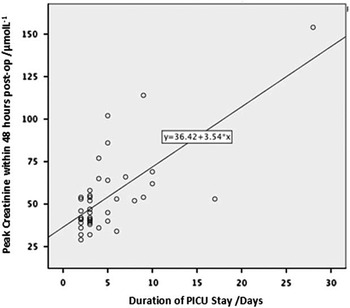
Comparison of the duration of paediatric intensive care unit stay with the peak creatinine demonstrates a positive correlation: the higher the postoperative peak creatinine in the first 48 hours after surgery, the longer the length of PICU stay (p<0.001 with correlation coefficient, r=0.71) (Fig 1).
Relationship to peak postoperative creatinine and PICU length of stay (correlation coefficient, r=0.71 and p<0.01).

Comparison of peritoneal dialysis with non-peritoneal dialysis cohorts
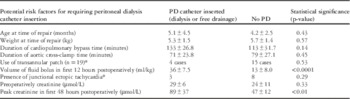
Data were analysed to compare a number of potential risk factors for the requirement for a peritoneal dialysis catheter insertion. The weight at operation, cardiopulmonary bypass time, aortic cross-clamp time, presence of a transannular patch, occurrence of junctional ectopic tachycardia, volume of fluid administered in the first 12 hours postoperatively, and preoperative and postoperative creatinine were stratified with univariate analysis between those undergoing peritoneal dialysis catheter insertion and those not. (Table 1)
Statistical interpretation comparing variables between those children having a PD catheter inserted in PICU in the postoperative period (for dialysis or free drainage), and those children who did not require PD catheter insertion.

PD=peritoneal dialysis
Independent t-test for all analysis except those marked by * when a Crosstab/Rate Difference and χ2 test applied. Data reported as mean±standard deviation
Children requiring the insertion of a peritoneal dialysis catheter had a higher fluid requirement in the first 12 hours postoperatively than those without peritoneal dialysis: the mean additional fluid requirement was 23 ml/kg (29–43 ml/kg versus 5–21 ml/kg in the non-peritoneal dialysis group). The indication for fluid administration was often multi-factorial and did not just target a mean blood pressure. Parameters reported in the documentation for fluid administration included mean blood pressure, pulse-pressure variation, central venous oxygen saturations, lactate, urine output, and clinical perfusion. The children receiving peritoneal dialysis had a significantly higher 48 hour postoperative creatinine with a mean of 89 μmol/L (52–125 μmol/L versus 25–59 μmol/L in the non-peritoneal dialysis cohort); the length of stay on intensive care for those children having a peritoneal dialysis catheter inserted increased by a mean of 6 days (2.7–19.9 days versus 1.6–5.8 days for the non-peritoneal dialysis). The mean duration of PICU stay for those children having a peritoneal dialysis catheter inserted was 11.3 days, compared with 3.7 days, if no peritoneal catheter was inserted.
Discussion
Our data, in this cohort of children with tetralogy of Fallot, add to existing reports and experience that peritoneal dialysis is an effective and well-recognised modality to support fluid balance and renal function in the neonates and infants with postoperative congenital heart disease.
Furthermore, we have gone on to demonstrate that the need for renal support appears to be independent of the cardiopulmonary bypass and aortic cross-clamp times during surgery, the age, and weight at which the defect is repaired, the need for a transannular patch, and the postoperative complication of junctional ectopic tachycardia. Previous studies indicated that higher cardiopulmonary bypass times increase the need for peritoneal dialysis in any congenital heart disease,Reference Santos, Branco and Gaspar 6 , Reference Chan, Ip, Chiu and Cheung 7 and the presence of a transannular patch is a risk factor for a restrictive right ventricle in tetralogy of Fallot repair.Reference Sachdev, Bhagyavathy, Varghese, Coelho and Kumar 5 The need for a transannular patch indicates the presence of a smaller right ventricular outflow tract, which in turn may indicate the presence of restrictive physiology that cannot be easily identified preoperatively because of right ventricular outflow tract obstruction, but becoming clinically and echocardiographically evident after the relief of obstruction. Many of these are important factors to consider, given an increasing tendency to primary neonatal tetralogy of Fallot repairs, often considered a more complex procedure than a repair in infancy. Previous data considering peritoneal dialysis in congenital heart disease in children has not considered an individual morphological defect such as tetralogy of Fallot.Reference Santos, Branco and Gaspar 6 , Reference Chan, Ip, Chiu and Cheung 7
We have found that the need for peritoneal dialysis catheter insertion was significantly higher in the cohort of children needing higher fluid volumes of resuscitation in the first 12 hours postoperatively. It could be argued that the iatrogenic fluid overload is what resulted in the requirement for peritoneal dialysis. However, the restrictive physiology of the right ventricle postoperatively in tetralogy of Fallot often necessitates higher right atrial pressure to ensure adequate right ventricular diastolic filling. It is well recognised that repeated fluid boluses are often needed to maintain a central venous pressure higher than what is typically accepted as normal, to ensure an adequate cardiac output. Intuitively, it could be speculated that the less compliant the right ventricle is, the higher the amount of fluid that will be needed. Closing the atrial septum may also have an impact on cardiac output and renal perfusion. As a result, the restrictive right ventricle will also predispose to fluid accumulation in other sites because of higher venous pressures (for instance, ascites). While peritoneal dialysis will increase fluid removal from these children and act as a form of renal support, these children could benefit from the peritoneal dialysis catheter acting as an intra-abdominal drain, although in our cohort this was only a minor (and secondary) indication. We did not find an associated between the tetralogy of Fallot repair using a transannular patch and the need for peritoneal dialysis. A transannular patch is often associated with at least a moderate degree of pulmonary regurgitation. A restrictive right ventricle may have difficulties in dealing with this additional volume. We found no evidence of this, as manifested by increased need for renal support, in our albeit small sample.
We have demonstrated that after tetralogy of Fallot repair there is an increase in the creatinine compared with baseline within the first 48 hours postoperatively in all our patients. It was not possible to identify which factors led to the increase in the creatinine; in our study, no correlation was found between peak creatinine and the length of cardiopulmonary bypass, aortic cross-clamp, or the type of surgical repair. Those children in our study with higher postoperative creatinine were more likely to need peritoneal dialysis.
Peritoneal dialysis has many associated complications: infection, bowel perforation, catheter blockage, and catheter leak to name a few.Reference Genc, Bicakci and Gunaydin 8 , Reference Goldstein 9 In our cohort, we had no significant complications with peritoneal dialysis. One peritoneal dialysis catheter stopped draining during a cycle. The peritoneal dialysis catheter was replaced without difficulty.
From our data, it is difficult to identify which children coming out of the operation theatre could benefit from a prophylactic peritoneal dialysis catheter inserted at the time of the operation. However, early consideration should be given to inserting a peritoneal dialysis catheter on the paediatric intensive care unit when it is apparent that high fluid volumes are required to maintain central venous pressure (and cardiac output) and urinary output.
Limitations
First, although the total sample size of patients included is of acceptable size, the number of those children with peritoneal dialysis is relatively small. Second, this is a single-centre study that may influence the surgical technique and how postoperative course of these children is managed, which could limit the application of these findings to other centres. Third, this study was retrospective. This meant that some data were not available for us to consider other factors that make peritoneal dialysis a potential likelihood. Finally, with the statistical analysis, we assumed independence of each factor to enable interpretation. In reality, a combination of factors may be significant. To evaluate this further, a much larger sample size is needed to allow for a multivariate analysis to be performed.
Conclusions
Children following repair of tetralogy of Fallot can prove to be a complex cohort of children. We have demonstrated peritoneal dialysis can be a safe and effective way of dealing with fluid balance and renal function in the postoperative period. We were unable to predict which children may benefit from a peritoneal dialysis catheter placed at the time of surgery; however, we have found those with a high fluid requirement in these first 12 postoperative hours who were significantly more likely to receive peritoneal dialysis. The use of peritoneal dialysis is associated with a longer length of stay on the intensive care unit. Identifying children who may benefit from early peritoneal dialysis could reduce the length of intensive care admission. Further larger scale research is recommended to confirm these findings and enable additional analyses of what affects the renal function in this cohort of children. By further understanding these factors, we can aim to improve the postoperative care we deliver to these children.
Acknowledgements
None.
Financial Support
This work received no specific grant from any agency, commercial, or not-for-profit sectors.
Conflicts of Interest
None.