Introduction
Since the end of the Cold War, human rights have come to be seen as central to the promotion of sustainable peace. As the UN Secretary-General put it in a 2004 report, ‘Justice, peace and democracy are not mutually exclusive objectives, but rather mutually reinforcing strategies.’Footnote 1 Or as Myron Weiner more mockingly suggested, ‘all good things go together’.Footnote 2 Human rights are highlighted in key peacebuilding documents, including an Agenda for Peace (1992), the Brahimi Report (2000), and the Responsibility to Protect (2001),Footnote 3 and Christine Bell argues that this normative shift is also reflected in peace agreements.Footnote 4 She suggests that human rights have become ‘the universally recognized chic language’ in which peace agreements are writtenFootnote 5 and identifies a rapidly evolving new Law of Peace, which includes robust individual human rights protection, minority rights protection, and transitional justice.Footnote 6 However, other authors have questioned the centrality of human rights in post-Cold War peace agreements, pointing to the interest of wartime leaders and external powers.Footnote 7 Madhav Joshi, Sung Yong Lee, and Roger Mac Ginty endeavoured to settle this debate and found that more than 90 per cent of peace agreements include provisions related to at least one of the following: human rights, refugees/IDPs, or minority/indigenous rights.Footnote 8 They argue that this ‘suggests a very strong commitment to the human rights aspect of the liberal peace’, but they also note that a significant minority (38 per cent) do not make provision for improved human rights practice.Footnote 9
Existing research on human rights in peace agreements has treated both conflicts and agreements as aggregate categories. However, this article argues that the type of conflict that the settlement is trying to resolve impacts significantly on the inclusion, or exclusion, of human rights provisions. Territorial conflicts, as opposed to conflicts over the nature of the government, are about the status of a particular territory and the dominant group within it. Individual human rights are not central to the claims made. Moreover, the dominant solution to territorial conflicts is territorial autonomy,Footnote 10 which has been criticised for denying the rights of minorities within the autonomous regionFootnote 11 and may leave little space for (individual) human rights protections.
The two main research questions explored in this article are therefore: (1) how are human rights provisions in peace agreements affected by the type of conflict; is there a significant difference between territorial and non-territorial conflicts? (2) how are human rights provisions in peace agreements affected by the ‘core deal’, in particular the inclusion of territorial autonomy? As a secondary research question, the article also examines how these provisions fare during the implementation phase. This matters for two reasons: Firstly, we need to consider if the inclusion of human rights provisions in a peace agreement is actually of importance. Secondly, the type of conflict/agreement could also affect the ease with which human rights provisions are implemented. These research questions will be explored through a comprehensive analysis of human rights provisions in post-Cold War peace agreements. The analysis is based on new and detailed coding of the 29 comprehensive agreements that were signed between 1990 and 2010. These agreements were identified using the Peace Accords Matrix (PAM)Footnote 12 that includes all comprehensive peace agreements, with a few adjustments that are explained below. The basis of the analysis is therefore similar to Joshi, Lee, and Mac Ginty's article, which draws on PAM data.Footnote 13 However, unlike the PAM dataset my analysis distinguishes between overarching rights, rights for ‘others’, human rights institutions, and enforcement. The article thereby provides a much more comprehensive and nuanced analysis of human rights provisions. This medium-N analysis is supplemented with case study evidence and Qualitative Comparative Analysis (QCA) is used to examine the conditions that lead to the inclusion, or exclusion, of human rights in territorial peace agreements.
Below, I first use existing literature on conflict types, territorial autonomy, and human rights to develop three hypotheses: two related to the inclusion of human rights provisions in peace agreements and one to their implementation. These hypotheses are then tested in a comparative analysis of agreements signed in territorial and non-territorial conflicts, and agreements that include and do not include territorial autonomy. The findings confirm the hypotheses that territorial peace agreements are much less likely to include human rights provisions. The different pathways (combinations of conditions) leading to the inclusion or exclusion of such provisions in territorial agreements are then examined. The QCA points to the degree of autonomy, rebel strength, and international involvement as key factors. These conditions also impact on the challenges associated with implementing human rights provisions and the final part of the article finds that implementation is more difficult in territorial conflicts, either because of a lack of commitment and detailed provisions, or since human rights could undermine the ‘core deal’. These findings have important implications, not just for academic debates but also for policymaking. It helps explain when human rights are likely to be prioritised by the conflict parties and when we should expect greater resistance. It also alerts us to important trade-offs between different types of human rights: not all good things go together.
Territorial conflicts and human rights protections
Existing analyses of human rights in peace agreements have not distinguished between different types of conflicts. Yet several studies have argued that we should not treat conflicts as an aggregate category and have found that different types of conflicts vary significantly when it comes to root causes, duration, and outcomes.Footnote 14 Conflict types can be based either on the characteristics of the groups that are fighting them (ethnic or non-ethnic conflicts) or on the claims they make (conflicts over territory or over government). It is the latter distinction that is the focus of this article. Human rights institutions are, as Bell points out, part of the political bargainingFootnote 15 and we would therefore expect their inclusion, or exclusion, from peace agreements to be affected by the maximalist claims made by the conflict parties. This hypothesis does not depend on the predominance of collective grievances, but it does assume that rebel leaders are in some ways constrained by the claims they make. Moreover, as will be shown below, such collective constraints often coincide with the selfish motives of the agreement signatories.
In territorial conflicts, rebels demand a change to the status of a territory. This often involves a demand for independence but can also be a demand for regional self-governance, or indeed for joining another state.Footnote 16 These territorial demands are almost always driven by an ethno-nationalist claim to a separate identity, and group identity and rights are at the heart of these conflicts. Examples of such conflicts include the war in Bosnia, the prolonged armed conflict in Indonesia's Aceh region, and the conflict in Northern Ireland. Territorial control is central to these conflicts, whereas ‘government’ or ‘centre-seeking conflicts’ are focused on control of the central government. For ease of usage, these will be referred to as non-territorial conflicts. Rebels in these conflicts typically make demands relating to the legitimacy of elections, the composition of the government, or regime change.Footnote 17 Although non-territorial conflicts can have an ethnic dimension, such as the conflicts in Burundi and Angola, the main demand is a change in government; usually a transition from a repressive, exclusive regime. Political and civil rights would be expected to play a central role in such transformations, and we can therefore expect human rights to be prioritised by rebel leaders negotiating a settlement. Territorial conflicts, in contrast, focus on the status of a particular territory and the dominant group within it. Group rights – group protections, self-governance, and recognition – are central in these conflicts,Footnote 18 while individual rights typically play a much less important role. These group rights can, if the ethnic group is territorially concentrated, be addressed through territorial autonomy, as will be discussed below. In the context of a territorial conflict, negotiating leaders are therefore not expected to push for human rights in the sense of individual rights.
H1:
Peace agreements signed in territorial conflicts are less likely than agreements signed in non-territorial conflicts to include human rights provisions.
Territorial autonomy and human rights protections
The ‘core deal’ that predominates in territorial conflicts is another reason why these peace agreements are expected to be less likely to include human rights provisions. Bell has argued that ‘individual rights provisions can only be understood in the light of the deal's political arrangements’ and she specifically stresses the importance of how the agreement addresses rights to self-determination or minority rights.Footnote 19 However, her analysis only covers four cases and does not provide a detailed analysis of the effects of the specific institutional design. Bell is primarily interested in whether ‘the deal’ entails the separation of communal groups. But the core institutional design may well limit the space available for human rights, especially in the case of territorial autonomy, which is by far the most common solution to territorial conflicts.Footnote 20
Autonomy is a device to allow ethnic or other identity groups to exercise direct control over affairs of special concern to them.Footnote 21 The form of autonomy I am interested in is territorially defined, as opposed to ‘corporate autonomy’, which grants an identity group collective rights on a non-territorial basis. Territorial autonomy in my usage is a territorial form of, what Arend Lijphart refers to as, ‘segmental autonomy’, that is, the rule of the minority over itself.Footnote 22 This territorial self-governance autonomy is aimed at granting a degree of self-identification to the minority group and provides it with a territorial power-base.Footnote 23 Like Yash Ghai, I conceive of territorial autonomy as a generic term that encompasses different types of legal arrangements, including federalism and regional autonomy.Footnote 24 These different forms are not always easily distinguishable and the choice of label may involve some ‘deliberate fudging’, for example if the constitution prohibits some options or if there is particular sensitivity about sovereignty and state unity.Footnote 25
Territorial autonomy allows for self-determination within the existing state and thereby ensures protections against discrimination and other forms of human rights abuses from the central government, especially if the autonomous region has its own judiciary and police force.Footnote 26 Territorial autonomy provides a clear powerbase for the former rebel leaders, and it also has benefits from the central government's point of view: it preserves the territorial integrity of the state and it limits the need for reforms at the central level.Footnote 27 This is significant since the central government will try to manage the costs imposed on them, ‘while retaining as much authority as possible’.Footnote 28 Territorial autonomy therefore has clear advantages as a conflict resolution device, but it may leave little space for human rights within the autonomous region and could reduce the demands for effective human rights provisions at the central level.
Critics of territorial autonomy primarily focus on what they regard as the risk of renewed secessionist attempts,Footnote 29 but its implications for human rights have also been pointed to. Donald Horowitz, for example, warns against the risk of violence against minorities within federal units,Footnote 30 and Erin Jenne similarly argues that ‘nationalist elites are likely to encourage discrimination against … ethnic minorities who implicitly challenge their claims to territory’.Footnote 31 Territorial autonomy is not necessarily defined in explicitly ethnic terms, but the intention is to empower a specific group within the self-governing region. This is most frequently the local majority group, such as the Acehnese in Indonesia's Aceh region. In the case of India's Bodoland, the settlement promised segmental autonomy for the tribal community through the creation of a Bodoland Autonomous Council. This was to be formed out of villages with a majority tribal population, but also had to include some villages with smaller tribal populations to ensure a contiguous territorial area.Footnote 32 Territorial autonomy is very much about minority rights, but these rights are protected by prioritising the rights of the dominant group within the autonomous region.
Proponents of territorial autonomy argue that abuses of power, in the form of localised tyrannies of the majority, can be avoided by ensuring robust human rights protections and local power-sharing governments.Footnote 33 This has been referred to as ‘complex power-sharing’.Footnote 34 But such provisions could dilute or indeed undermine the autonomous powers and group-based guarantees that form the core deal, and would also constrain the power of the former rebel leaders who usually end up ruling the autonomous region.
H2:
Peace agreements that include territorial autonomy are less likely than agreements without such a ‘core deal’ to include human rights provisions.
It may sound as if the two variables – territorial conflict and territorial autonomy – are coterminous. They are not. Firstly, not all settlements signed in territorial conflicts include territorial autonomy. In some cases the central government refused territorial autonomy due to fears that it would increase the risk of secession, and the separatist group was not strong enough to insist on such an agreement. The peace agreements for Eastern Slavonia (Croatia) and Casamance (Senegal) are examples of this.Footnote 35 The absence of territorial autonomy could lead to greater demands for human rights provisions, as a means of ensuring group protections. Moreover, the extent of devolved powers varies significantly between the agreements that do include territorial autonomy, which impacts on the strength of group protection provided by the settlement. The effect of different degrees of autonomy on the inclusion or exclusion of human rights provisions is examined as part of the QCA analysis below. Secondly, some settlements signed in non-territorial conflicts include elements of territorial autonomy. Conflicts that are not about the status of a territory may acquire a territorial dimension: a rebel group may, for example, primarily recruit from a particular region and could come to control territory there. Following the signing of a negotiated settlement, such control may continue as a form of territorial autonomy. For example, the Lusaka Protocol for Angola promised UNITA governorships in three of their strongholds and devolved significant powers to the provinces.Footnote 36 The General Peace Agreement for Mozambique similarly allowed RENAMO to retain territorial control, although only during the transitional period, that is, until a new government was elected.Footnote 37
The dependent variable, human rights provisions, refers to future-oriented human rights provisions. These are, however, not the only human rights issues of importance in peace talks. Peace settlements may also aim to address past human rights abuses, either through retributive mechanisms, such as war crimes tribunals, or through restorative forms of transitional justice, such as truth commissions.Footnote 38 However, there is little reason to expect that the type of conflict or settlement will impact on such provisions. The need to make deals with ‘unsavoury groups’Footnote 39 and leaders will be found in both these contexts, and will come up against similar international pressures and an emerging international law, which does not permit amnesties that cover serious international crimes.Footnote 40 The focus of the article will therefore be on future-oriented human rights provisions, although the effect on how past abuses are addressed (or not) will be touched on in the section on implementation.
Implementation
The key demands made in a conflict and the ‘core deal’ found in a peace agreement are therefore expected to affect the inclusion of human rights provisions. Agreements with a high number of institutional mechanisms have been found to be more durable,Footnote 41 but this does not mean that all such provisions are necessarily implemented. Human rights provisions in a peace agreement do not automatically translate into postwar human rights protections.Footnote 42 A peace agreement is ‘only one aspect of a transition away from violent conflict’ but it is, as Joshi, Lee, and Mac Ginty point out, a ‘public commitment’ to change.Footnote 43 The absence of such a commitment in the form of human rights provisions will reduce the political space available for reforms.Footnote 44 The likely absence of human rights provisions in territorial agreements will therefore impact on postwar protections.
Moreover, the implementation of human rights provisions – if included in a settlement – is also likely to be affected by the conflict type and by the core deal. As will be shown below in the QCA, human rights provisions in the context of a territorial agreement are likely to have been pushed by international mediators. We would expect such provisions to be less effective than locally rooted ones.Footnote 45 Moreover, if human rights provisions threaten the ‘core deal’ and thereby both the protections secured in the settlement and the position of the leaders, then we would expect greater levels of resistance to their implementation.
H3:
Implementation of human rights provisions will be more difficult in territorial conflicts, especially if the peace agreement includes territorial autonomy.
Case selection and definitions
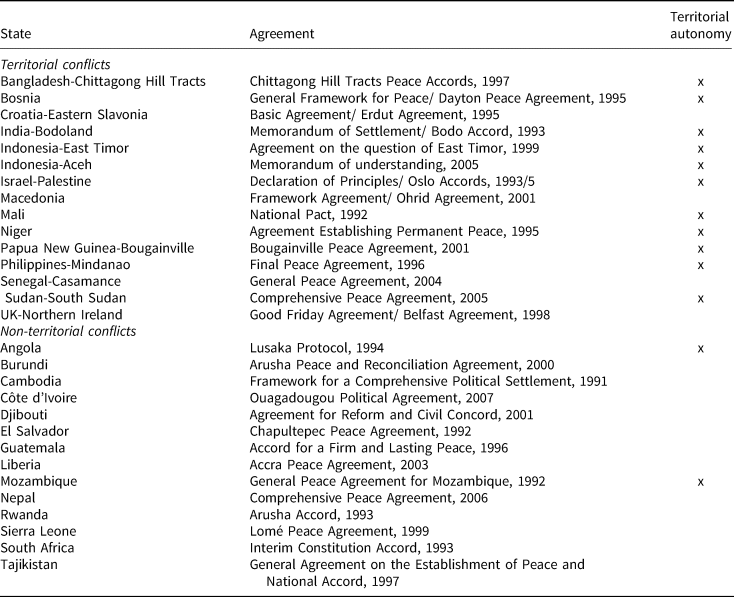
The empirical basis of this article is a medium-N analysis of all comprehensive peace agreements signed in armed conflicts between 1990 and 2010. This includes 15 agreements signed in territorial conflicts and 14 signed in non-territorial conflicts (see Table 1). The 29 agreements are comprehensive agreements, which means that they were signed by major parties in the conflict and aimed to address the underlying causes of the conflict. Most of these settlements were identified using the Peace Accords Matrix (PAM),Footnote 46 which is also used by Joshi, Lee, and Mac Ginty,Footnote 47 and the peace agreements analysed in this article are therefore broadly similar to the 34 agreements they cover.Footnote 48 The few exceptions are explained by two additional criteria for comprehensive agreements. Firstly, I only consider an agreement comprehensive if it includes an institutional framework. Agreements that are solely concerned with the immediate cessation of violence are therefore not included. I have consequently excluded the 1999 Agreement on Ending Hostilities in the Republic of Congo. I have also excluded the 1998 Abuja Peace Agreement for Guinea-Bissau, which is only one page long. I do, however, allow for some substantive issues to be left for later. This can be an important negotiation technique that for example proved successful in the case of the Belfast Agreement for Northern Ireland. I am consequently including the Oslo Accords for Israel-Palestine, which the PAM does not include.Footnote 49 Secondly, if more than one agreement is signed in the same conflict, I include the most recent one, unless it simply constitutes an addendum or adds another rebel faction. I only include one agreement per conflict to avoid giving double weight to any one case and its possible idiosyncrasies. Given the relatively small number of comprehensive peace agreements, this could skew the result.
Comprehensive peace agreements signed between 1990 and 2010.

The grouping of territorial and non-territorial conflicts follows the ‘incompatibility’ variable in the UCDP/PRIO Armed Conflict Dataset,Footnote 50 with one exception: the case of Sudan. Civil wars are, as Stathis Kalyvas argues, ‘complex and ambiguous processes’ and identifying a conflict's ‘master cleavage’ is not always straightforward.Footnote 51 Dynamics may change over time and although the Sudanese People's Liberation Army initially demanded a change in government, it became increasingly focused on the status of South Sudan,Footnote 52 and the 2005 Comprehensive Peace Agreement is predominantly a territorial settlement. Unlike the UCDP/PRIO dataset, I have therefore grouped this case with the territorial conflicts.
Table 1 also indicates if an agreement includes a ‘core deal’ of territorial autonomy. This is found in 73 per cent (11/15) of the agreements signed in territorial conflicts, compared to only 14 per cent (2/14) of the agreements signed in non-territorial conflicts (and in only 7 per cent as a permanent measure). Territorial autonomy is defined by Marc Weller and Stefan Wolff as ‘the legally entrenched power’ of ‘territorial communities to exercise public policy functions (legislative, executive and adjudicative) independently of other sources of authority in the state, but subject to the overall legal order of the state’.Footnote 53 Although it does not need to be defined in explicitly ethnic terms, the purpose is to allow for self-determination for a communal group within the existing state.Footnote 54 Powers are transferred, not merely delegated,Footnote 55 and minorities are granted a territorially defined ‘collective power base’.Footnote 56 Territorial autonomy does not therefore encompass the kind of administrative decentralisation that we find, for example, in the Arusha Peace and Reconciliation Agreement for Burundi.Footnote 57 By this definition, territorial autonomy is also not found in the Erdut Agreement for Eastern Slavonia, which only promised non-territorial cultural autonomy to the Serb community,Footnote 58 or the Ohrid Agreement for Macedonia, which promises a revised Law on Self-Government with increased competencies for municipalities. This administrative decentralisation includes language rights, and was clearly intended to address the grievances of the Albanian minority, but it is more akin to non-territorial communal autonomy than the forms of territorial self-rule found in the other agreements. The Belfast agreement for Northern Ireland has been argued to combine territorial autonomy and regional consociation (power-sharing):Footnote 59 the agreement devolves significant powers to the Northern Irish Assembly, and power-sharing guarantees ensure that the Nationalist community cannot be excluded from the regional government.Footnote 60 Although the settlement therefore provides a collective power base for the minority, this power base is not territorially defined.Footnote 61 As John McGarry and Brendan O'Leary have argued, ‘community autonomy is least strongly represented in the text, but tacitly evident in the maintenance of separate but proportionally funded primary and secondary education’.Footnote 62 What we find in the agreement is therefore a form of non-territorial cultural autonomy. It is not an example of territorially defined communal autonomy, which is what this article is focused on. Territorial autonomy is, on the other hand, included in the ‘Agreement on the Question of East Timor’, even if this option was rejected in favour of independence in the 1999 referendum.
With 29 cases, this is a medium-N analysis, which does not allow for multivariable regression or similar forms of statistical analysis. The comparison of agreements signed in territorial and non-territorial conflicts will therefore rely primarily on descriptive statistics, while the analysis of other context variables will be examined using QCA. The 29 agreements are considered the full population of comprehensive agreements signed between 1990 and 2010, but significance tests (Pearson's Chi-Square) are reported for the sake of robustness.
Coding and analysis
A comprehensive analysis of human rights provisions in peace agreements needs to go beyond the language used. As Jan Selby suggests, liberal commitments in a peace agreement can mask a detailed content that is distinctly illiberal.Footnote 63 In order to examine if agreements provide the basis for effective human rights protections, and to enable an analysis of possible trade-offs, the analysis is divided into: overarching rights, human rights institutions, human rights enforcement, and implementation.
Overarching rights
A minimal criterion for the inclusion of future-oriented human rights provisions is a separate section on human rights, while a more substantive criterion is the inclusion of overarching enforceable rights. This can be in the form of a bill of rights or the incorporation of international instruments such as the European Convention on Human Rights,Footnote 64 or the listing of specific rights that are to be protected by an amended constitution. Both criteria are used in the analysis. For agreements that include territorial autonomy, this part of the analysis also examines rights for minorities within the autonomous unit.
Human rights institutions and enforcement
Listing human rights is not enough for effective human rights protections. The existence of institutions that can assist individuals and groups in making claims, forums where these claims can be heard, and the ability to enforce the decisions are crucial if the protection of human rights is to go beyond rhetoric. The analysis examines if the agreements include human rights institutions, such as constitutional courts and human rights courts, and enforcement institutions, such as human rights commissions or a human rights ombudsman.Footnote 65 The agreements either have to provide for the creation of new institutions or the jurisdiction of existing institutions is specified. The latter criterion recognises that human rights protections are not only based on the content of the agreement; this is likely part of a wider judicial framework.
Implementation
It is beyond the scope of this article to provide an in-depth analysis of the implementation of human rights provisions. However, implementation data from the Peace Accords Matrix are used to compare the degree of implementation of human rights provisions in the two types of conflicts, and case studies are drawn on to discuss the reasons for these findings.
Human rights in territorial peace agreements
The 29 peace agreements are nearly all written in the language of human rights. The agreement for Eastern Slavonia (Croatia) is typical with its promise that ‘the highest levels of internationally recognized human rights and fundamental freedoms shall be respected in the region’.Footnote 66 But a number of these agreements only make fleeting references to human rights and include very little substance.
Overarching rights
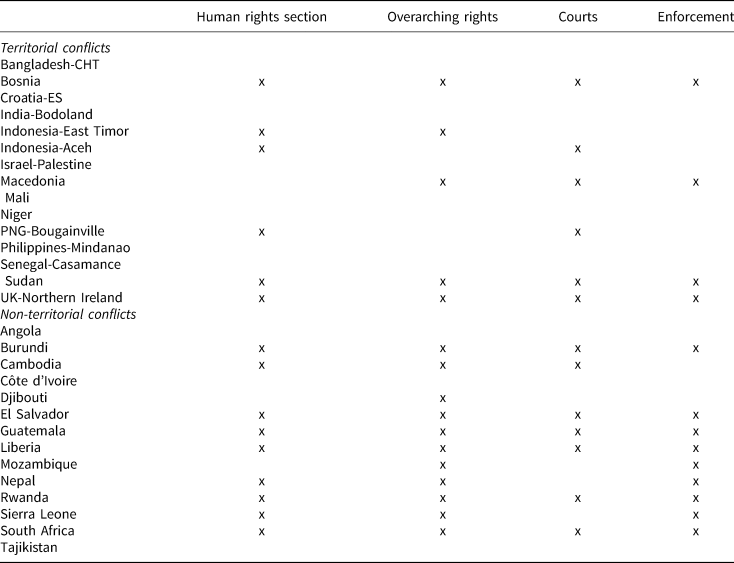
If we first look at the 15 agreements signed in territorial conflicts, then we find a separate section on human rights in only six of them (see Table 2). In comparison, nine out of the fourteen agreements signed in non-territorial conflicts include a separate section on human rights, and an additional three have extensive sections on democratic rights. Human rights feature very prominently in some of these non-territorial agreements. The Chapultepec Peace Agreement for El Salvador and Guatemala's Accord for a Firm and Lasting Peace, for example, both contain separate sub-agreements on human rights,Footnote 67 while South Africa's Interim Constitution Accord devotes a whole chapter to human rights.Footnote 68 Among the territorial agreements, only the Dayton Agreement for Bosnia with its annex on human rights contains anything similar,Footnote 69 which suggests that human rights are not generally prioritised. This conclusion is supported by a more detailed analysis of overarching rights.
Overarching rights and human rights institutions.

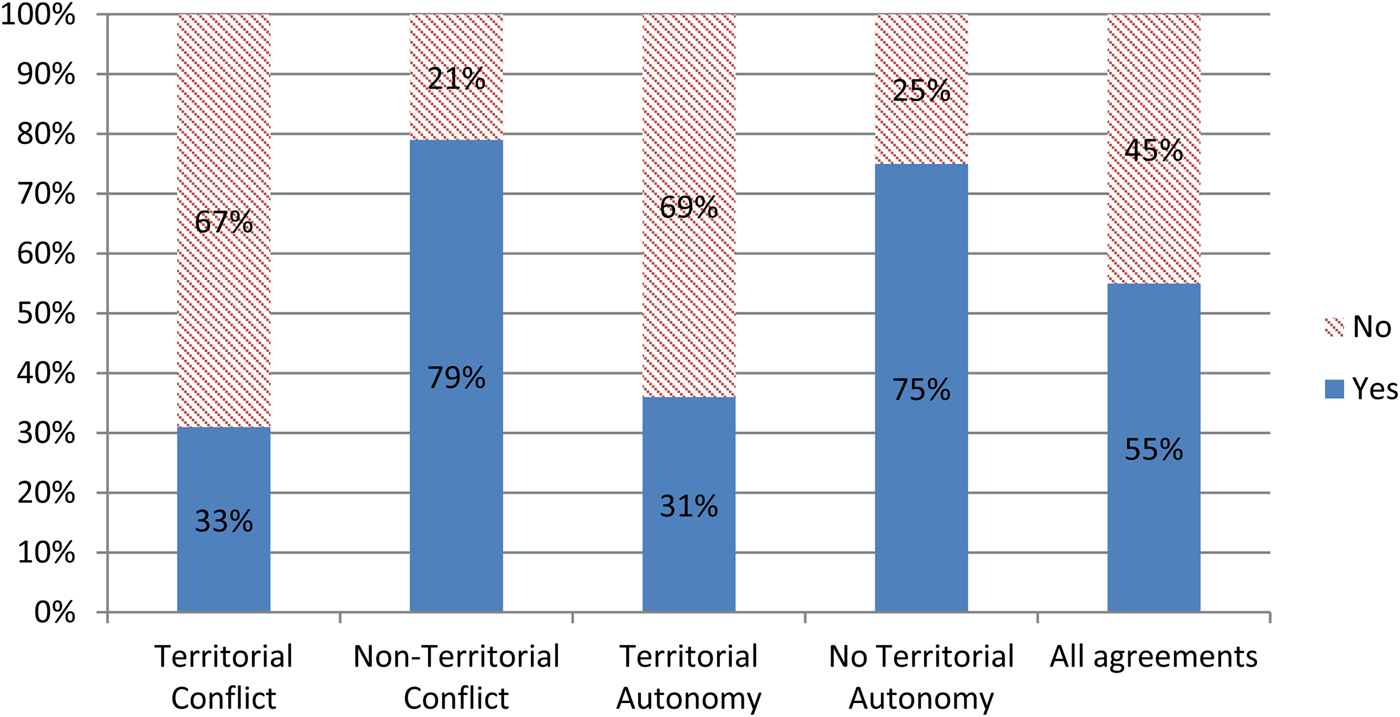
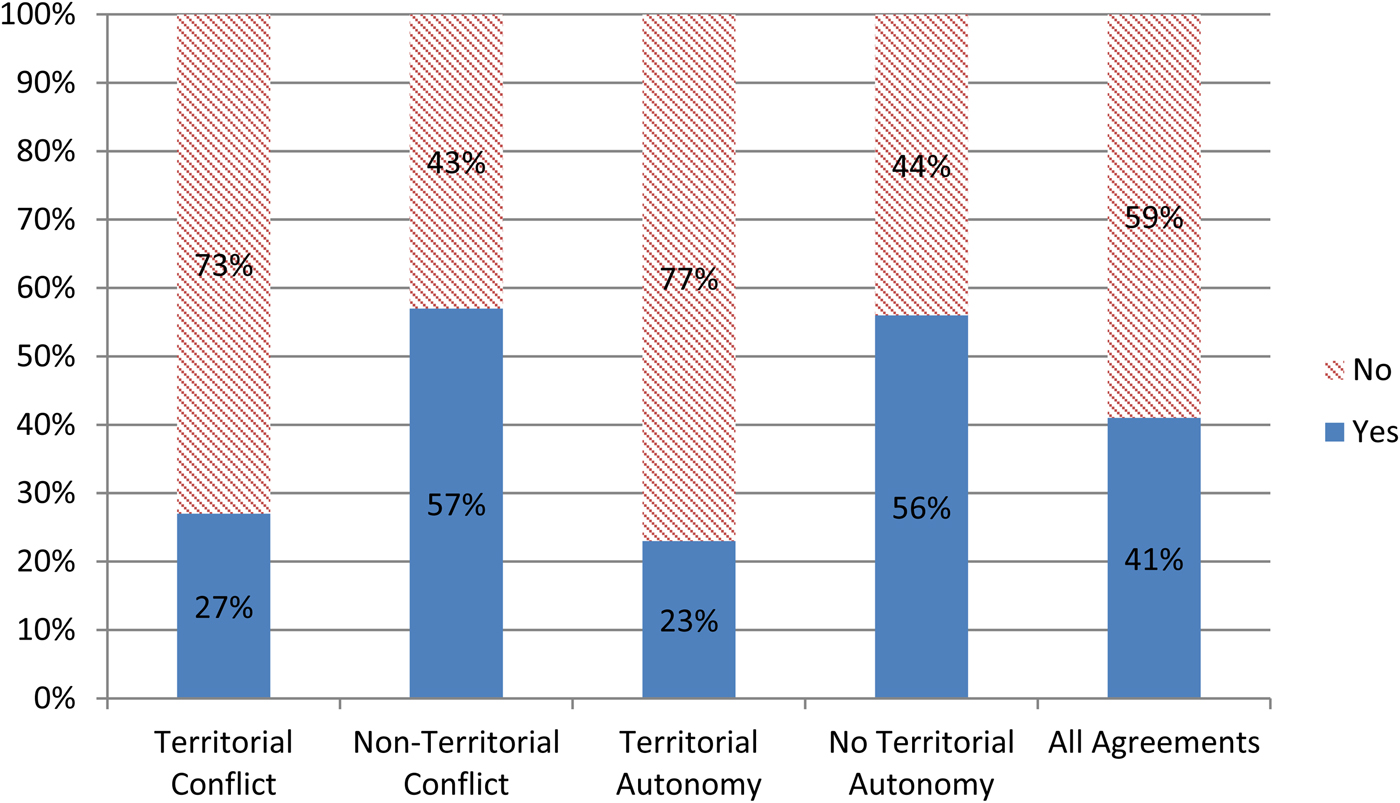
A list of enforceable rights is found in only five of the territorial conflicts (33 per cent), such as in the Comprehensive Peace Agreement for Sudan, which includes a long list of rights protected by the agreement.Footnote 70 The large majority of the agreements do not include overarching rights. A comparison with agreements signed in non-territorial conflicts points to a striking difference: 11 of these agreements (79 per cent) include overarching enforceable rights (see Table 2 and Figure 1). This is statistically significant, despite the small number of cases (Pearson's Chi-Square test gives a two-sided p-value of 0.014). Similarly, if we compare agreements that include territorial autonomy with agreements that do not, we find overarching rights in 75 per cent (12/16) of the agreements without autonomy, compared to 31 per cent (4/13) of agreements with this core deal (p-value 0.017). In fact, if we only look at agreements signed in non-territorial conflicts without territorial autonomy, we find overarching human rights in 83 per cent (10/12) of the cases (p-value 0.010).
Overarching rights in peace agreements (1990–2010).

It could be countered that human rights in the case of territorial autonomy have simply been delegated to the autonomous region and that this actually provides for stronger human rights protections. However, overarching enforceable rights are also not found at the level of the autonomous regions. Moreover, the rights of local minority groups – in the form of groups rights and/or local power-sharing – are included in only five out of thirteen agreements with territorial autonomy (38 per cent), and these provisions tend to lack details. For example, the agreement for Mindanao (Philippinnes) contains references to cultural rights and mentions the possibility for guaranteed representation of minorities in the autonomous region. However, Sharia law is also to be introduced.Footnote 71 Minorities within the autonomous regions may be better protected if they are dominant in the state as a whole. This is most notably the case in Israel-Palestine where Israelis are explicitly exempt from the jurisdiction of the Palestinian authorities.Footnote 72 In the Chittagong Hill Tracts, there are reserved seats for non-tribal representatives, but they are still under-represented.Footnote 73 The Bodoland Accord provides land and language rights for non-tribal communities, and the government can also appoint five (out of 40) members of the autonomous council from groups which ‘could not otherwise be represented’,Footnote 74 but they are not guaranteed a share in power. ‘Complex power-sharing’Footnote 75 does not appear as a dominant model and the rights of those that do not belong to the state's main ethnic groups are particularly limited.
The analysis of overarching rights therefore supports Hypotheses 1 and 2: human rights provisions are less likely in agreements signed in territorial conflicts, especially if these include a core deal of territorial autonomy. This does not mean that human rights are central in all agreements signed in non-territorial conflicts. Tajikistan's General Agreement on the Establishment of Peace and National Accord, for example, refers to the ‘observance of human rights’, promises the establishment of democratic political and legal institutions, but there is not much substance, and the agreement has been criticised for being too focused on security.Footnote 76 But the tendency is very clearly for human rights to be much more prominent in these agreements. This trend repeats itself, albeit not as strongly, when we examine human rights institutions and enforcement mechanisms.
Human rights institutions
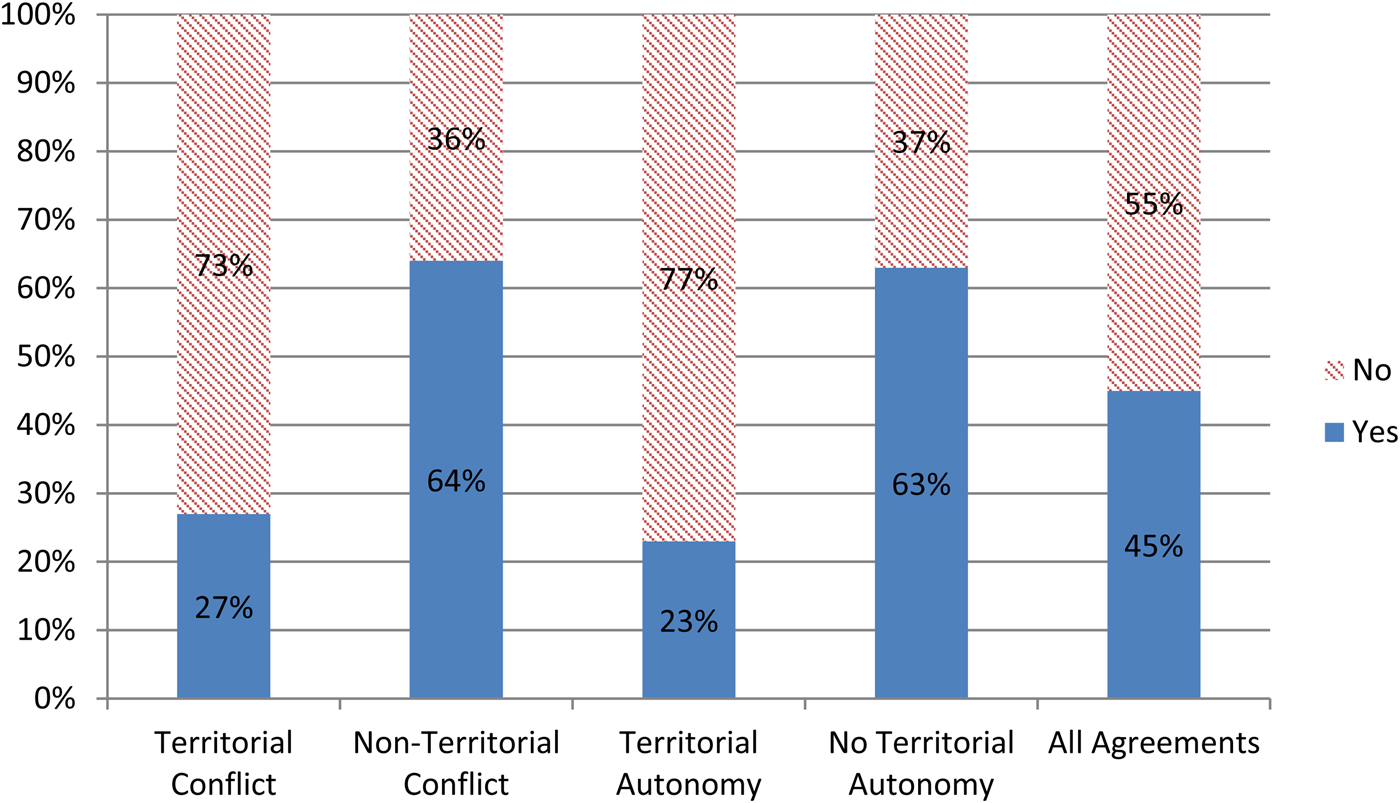
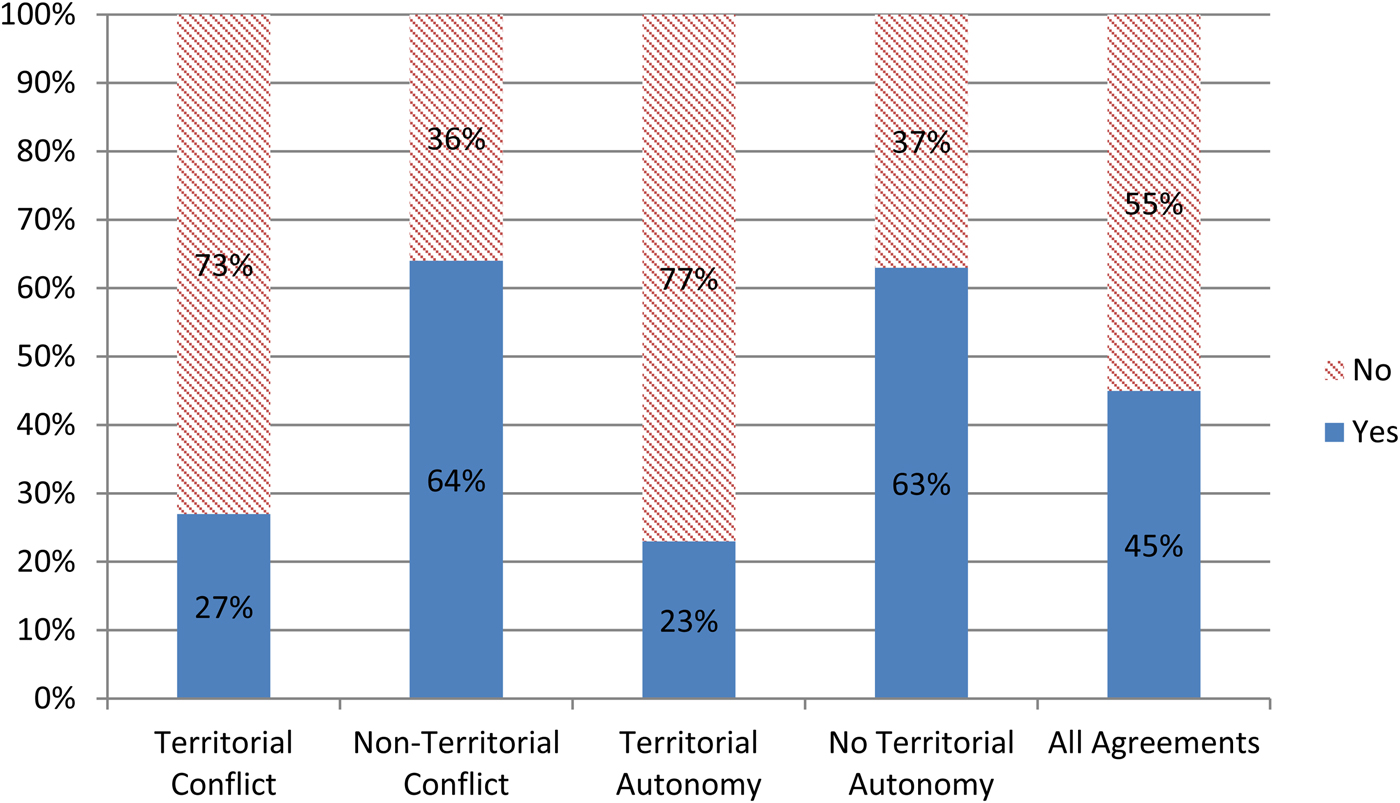
Human rights institutions are also less frequently included in agreements signed in territorial conflicts, although the difference is not so marked when it comes to provisions related to constitutional or human rights courts (see Figure 2). Such courts are included in six (40 per cent) of the agreements signed in territorial conflicts, compared with seven (50 per cent) in territorial conflicts. For agreements with and without territorial autonomy the difference is a little more marked, with 31 per cent (4/13) and 56 per cent (9/16) of the agreements respectively, but neither of these differences is statistically significant (p-values 0.588 and 0.170). The difference is more striking when it comes to human rights enforcement institutions, such as a human rights ombudsman or a national commission of human rights. These are found in nine of the fourteen agreements signed in non-territorial conflicts (64 per cent), compared to only four of fifteen agreements signed in territorial conflicts (27 per cent). This difference is statistically significant (p-value 0.042). We find a similar difference if we look at agreements with and without territorial autonomy: only 23 per cent (3/13) of the former include enforcement mechanisms, compared to 63 per cent (10/16) of the latter (p-value 0.034).
Human rights enforcement institutions in peace agreements (1990–2010).
Human rights institutions are not only included less frequently in territorial agreements, the provisions also tend to lack details. The least detailed provisions are found in the case of Bougainville, where no new human rights institutions are created, and the agreement simply points to the existing Supreme Court as final court of appeal for human rights.Footnote 77 The agreement for Sudan provides for the establishment of both a Constitutional Court and a Human Right Commission,Footnote 78 but details regarding enforcement are lacking. Human rights play a central role in the Belfast Agreement for Northern Ireland, but it still lacks details when it comes to the precise functioning of the Human Rights Commission and the Equality Commission, which are to be established.Footnote 79 Human rights institutions and mechanisms abound in the Dayton Agreement for Bosnia but enforcement mechanism are nevertheless unclear, and no one has an explicit mandate to arrest human rights violators.Footnote 80 This general lack of details is likely to affect the implementation of these provisions, as will be discussed below.
The comparison of territorial and non-territorial conflicts showed a marked difference and supports the hypotheses that a core deal of autonomy and the nature of demands made by the rebel forces significantly affect the extent to which human rights are prioritised. Human rights may be the ‘chic language’ in which to write peace agreements,Footnote 81 but only a minority of territorial peace agreements provide for their effective protection.
Territorial conflicts, autonomy, and human rights
Territorial conflicts involve demands for a change in the status of a territory and the recognition, and realisation, of a group's right to self-determination. For example, in the Bosnian conflict, the demands of the Serb leaders shifted between joining Serbia, independence for their self-proclaimed statelet, and territory and power for a Serb federal entity. These territorial demands were all justified by proclaiming a right to national self-determination and by pointing to the threat allegedly faced by the Serb minority.Footnote 82 While rights and protections often feature prominently in the demands made in territorial conflicts, they take a different form than in non-territorial conflicts where demands for individual human rights are much more central. These conflicts revolve around issues of authority and power at the centre. As Bell has pointed out, in Central America ‘human rights were often included as part-and-parcel of a process which aimed at democratisation as the “solution” to the conflict’.Footnote 83
Territorial autonomy provides a popular solution to territorial conflicts: it addresses the demands for self-determination and promises protections against discrimination and other human rights violations. Effective individual human rights protections are not a priority in this context and could in fact undercut the autonomous powers and protections secured in the settlement. For example, the Bengali settlers in the Chittagong Hill Tracts complain of their second-class status, but the tribal community complain that the tribal autonomy does not go far enough, and have objected to the weakening of their overrepresentation on the District Council.Footnote 84 Human righs are not necessarily a positive-sum game, and more effective individual human rights provisions could reduce hardwon group rights and protections. Moreover, local leaders may be keen for their powers to be as unconstrained as possible. In the case of Israel-Palestine, Bell suggests that the Palestine Liberation Organization was not interested in human rights protections because it would have limited their capacity ‘to control dissident political forces’.Footnote 85 The armed movements typically retain power in the post-settlement period and may not be interested in this kind of scrutiny.
However, human rights could become an alternative means for ensuring groups rights, if territorial autonomy is not practically possible or not acceptable to the central government. For example, in the case of Northern Ireland, where territorially defined communal autonomy was not included in the settlement, individual rights were seen as protection against future domination and discrimination.Footnote 86 This helps to explain the inclusion of human rights provisions in this settlement. However, such demands are not necessarily successful. Context matters and although territorial agreements are less likely to include human rights provisions than non-territorial agreements, we find significant variation within this broad category.
QCA analysis: Degree of autonomy, rebel strength, and international involvement
This section uses Qualitative Comparative Analysis (QCA) to examine how the wider conflict context and the degree of autonomy affects the inclusion (or exclusion) of human rights provisions in territorial peace agreements. QCA is suitable for a medium-N analysis and allows for analysis of combinations of conditions and different causal paths leading to the same outcome.Footnote 87 QCA does not estimate the net causal effect of discrete variables, but instead specifies the combinational logic of conditions that lead to a specific outcome. By using this form of analysis, individual cases are aggregated into a manageable number of typical ‘scenarios’.Footnote 88
Several context variables could be expected to affect the inclusion of human rights in territorial peace agreements. In addition to the degree of autonomy contained in the agreement, this section will examine the effects of the relative strength of the rebel position, regime type, and international involvement. This analysis will be used to identify possible pathways or scenarios.
Degree of autonomy
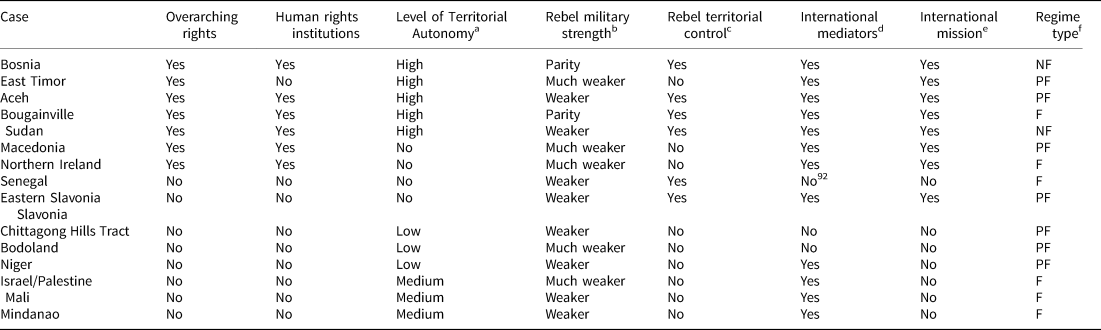
In cases of low levels of autonomy or no autonomy, we could expect a demand for human rights protections at the centre as a supplement to the limited autonomous powers and protections ensured by the core deal. However, as seen in Table 3, while some territorial peace agreements with no or low levels of territorial autonomy do include human rights provisions, such as in Northern Ireland and Macedonia, others do not.Footnote 89 For example, the agreements for Bodoland and the Chittagong Hills Tract offer only limited autonomy but include neither overarching rights nor human rights institutions. Other variables, in particular rebel strength, would appear to be of importance. The central government will often be reluctant to concede to human rights reforms and the rebels may lack the bargaining power to insist on it. Limited autonomy or its complete absence is itself often the result of a weak bargaining position. The significance of relative capacity will be discussed below.
Human rights in territorial peace agreements: Context variables.

Notes:
a, d, and e: Data from Nina Caspersen, Peace Agreements: Finding Solutions to Intra-State Conflicts (Cambridge: Polity, 2017).
b and c: Data from the Non-State Actors in Armed Conflict Dataset (NSA).
f: F=Free, PF=Partly free, NF=Non-Free. Data from Freedom House, ‘Freedom in the World Data and Resources’ (2018).
At the other end of the autonomy spectrum, we find a clearer pattern. All settlements with high levels of autonomy also include human rights provisions (both overarching rights and institutions). This may seem surprising given the overall findings regarding the effects of territorial autonomy on human rights provisions. However, the demand for human rights provisions is in this context likely to come from the centre. Extensive autonomy often raises concerns over secessionist pressures and the future dismantling of the state.Footnote 90 Human rights provisions can in this context act as a counterweight to the settlement's centrifugal dynamics. The agreements for Bougainville (Papua New Guinea) and Sudan both promise the holding of an independence referendum following a period of autonomy,Footnote 91 and the central government therefore has an incentive to emphasise integrative measures. This helps explain the human rights institutions found in these agreements. Similarly, in the case of Bosnia, the aim of the human rights institutions was to ‘claw back the unitary state from the separate entities’: human rights protections were the price to be paid for ethnically defined mini-states.Footnote 93 Extensive autonomy could also lead to fears that minorities in the autonomous region will be discriminated against and therefore lead to pressure from the centre for human rights protections. Significant international involvement was moreover an important factor in these conflicts, which were all either highly protracted and/or violent. This again points to the interaction of several variables.
Minority/rebel relative strength
We could expect demands for human rights reforms at the centre, perhaps as a counterweight to limited autonomy, to be less likely to succeed if the rebels are in a weak position. Several indicators for the relative strength of the rebels, or the minority group they claim to represent, were therefore examined. However, not all were of significance. For example, the size of the minority relative to the country's total population did not show a clear trend: we find very small minorities in both agreements with human rights provisions (for example, Bougainville) and without such provisions (for example, Bodoland). The effect of the relative military strength of the rebels is also less than clear. Data from the Non-State Actors in Armed Conflict Dataset (NSA)Footnote 94 suggests that the agreements that include human rights provisions were negotiated by rebels whose military capacity, relative to the government forces, range from parity to much weaker. Cases without human rights provisions include rebel forces that are either weaker or much weaker than their opponents (see Table 3).
However, one indicator shows a clearer pattern: rebel territorial control (also from NSA data). In the cases where we find human rights provisions and high levels of territorial autonomy, the rebels enjoyed territorial control, to a moderate or high degree. The only exception is East Timor, which is discussed below. This relatively strong position of the rebels helps to explain the high levels of autonomy included in the agreements and has likely added to fears of future secession, thereby strengthening the government's call for human rights provisions. Moreover, this strength could also have enabled the rebel groups to push for reforms at the centre, which less powerful groups will find harder to achieve.
If we look at the agreements without human rights provisions, there are only two cases of rebel territorial control: in Croatia (Eastern Slavonia) and Senegal (Casamance). In both of these cases the rebels were, by the time of the agreement, weakened by other factors. This helps explain the lack of both autonomy and human rights provisions. In Eastern Slavonia, the rebels were effectively defeated by August 1995. The main part of the Serb entity, Republika Srpska Krajina, had been overrun by Croatian forces and the leaders in Eastern Slavonia knew that they were next unless they agreed to a negotiated settlement.Footnote 95 In Casamance, the Movement of Democratic Forces of Casamance (MDFC) never achieved anything more than low territorial control, the rebels were plagued by factionalisation, and many of the leaders were reportedly driven by monetary objectives. These incentives were addressed by the Senegalese Government through offers of aid and money.Footnote 96
The remaining agreements without human rights provisions were negotiated by rebels with limited capacity: they did not control any territory and their military capacity was weaker or much weaker than the government forces. Some of these cases, such as the Bodoland conflict, are highly asymmetrical. This limited capacity is likely to force the rebels to focus the negotiations on their key demands and these are, as argued above, centred on group rights. Group rights will be offered some protection by territorial autonomy, even if relatively few powers are devolved. Effective human rights provisions are therefore less likely to be prioritised and could in fact undermine the limited autonomy that was achieved. In the case of the Chittagong Hills Tract, demands for forms of ‘complex power-sharing’ within the autonomous region have, as noted above, been resisted. Similarly, in the case of Bodoland, the rights of the non-tribal population have also proved explosive. In 2012, the Bodoland Territorial Council was alleged to have removed a signboard from a mosque, which it claimed was an illegal structure occupying forest land.Footnote 97 This dispute over rights sparked extreme violence, which left 42 people dead and 150,000 displaced.
However, agreements with human rights provisions were also negotiated in three conflicts where the rebels did not have territorial control and were militarily much weaker than the government forces. But in these cases, the rebels either represented fairly large minority groups (Northern Ireland and Macedonia) or their right to indepependence had been internationally recognised. The latter applies to East Timor, which was recognised by the UN as a non-self-governing territory. This international recognition was an alternative source of strength for the rebels. Moreover, in all three cases we see a high level of international involvement.
International involvement
International pressure has been argued to be a key factor explaining the inclusion of human rights in peace agreements: it is the price the conflict actors have to pay for international support.Footnote 98 However, as is apparent from Table 3, international mediation on its own is not decisive. Almost all of these peace processes included third-party mediation, but this did not necessarily lead to the inclusion of human rights provisions. For example, the Oslo Accords for Israel/Palestine resulted from Norwegian and US mediation efforts, while Mali's National Pact was mediated and guaranteed by Algeria, and two other international mediators (from France and Mauritania) also played a role in the peace process.Footnote 99 More significant international involvement appears to be needed for the inclusion of human rights. The territorial agreements that included human rights provisions were all negotiated with the help of international mediators and an international mission was deployed to assist the implementation of the agreement.Footnote 100 Some of these missions included armed peacekeepers, others only deployed unarmed observers, while still others set up international commissions to find solutions to outstanding issues.
International involvement led to pressure on both governments and rebels to prioritise human rights and international experts frequently drafted the provisions. Paul Szasz argues that in the case of Bosnia almost none of the human rights provisions originated in Bosnia itself.Footnote 101 International experts also played an important part in the drafting of Sudan's Comprehensive Peace Agreement and John Young argues that this explains what he regards as its inappropriate legalism.Footnote 102 As will be discussed below, this may have consequences for the implementation of human rights provisions. Bell has argued that a lack of domestic roots makes such provisions less effective,Footnote 103 and international mediators may be prepared to accept a lack of detail. In the case of Aceh, the mediator, Martti Ahtisaari insisted on including human rights,Footnote 104 but the provisions lack potentially explosive details: it is, for example, not specified if the Human Rights Court will have retroactive powers.Footnote 105
Although a high degree of international involvement, indicated by the willingness to deploy an international mission, therefore appears to be a necessary condition for the inclusion of human rights provisions in territorial peace agreements, it is not sufficient. One of the agreements without human rights provisions, the Erdut agreement for Eastern Slavonia, did include a high level of international involvement. It was the result of international mediation and a transitional international administration was deployed. This case suggests that the relative capacity of the rebels also matters, and the Serb separatists were, as argued above, virtually defeated.
Regime type
Regime type is another variable that could be assumed to be of importance, with democracies being more willing to accept human rights provisions or at least make reference to existing safeguards. Authoritarian regimes would be much less likely to accept such reforms. The cases were coded according to their Freedom House ranking the year the peace agreement was signed: free, partly free, or non-free.Footnote 106 However, no clear pattern emerges. The agreements with human rights provisions were signed by governments classed as free, partly free, and non-free, while agreements without such provisions were signed in the context of both partly free and free regimes. One difficulty is that the wars impact on the regime systems and few democratic systems are able to withstand the pressures of a full-scale civil war.
Pathways to the inclusion or exclusion of human rights
Based on the discussion above, the variables measuring rebel strength have been combined. Strong rebel movements (STRONG in Table 4) cover rebel movements that enjoyed a high level of territorial control or whose claim to independence was internationally recognised. Weak rebel movements are militarily weaker or much weaker than the central government and do not control territory. Inclusion of human rights is defined widely to denote the inclusion of overarching rights.
Pathways to inclusion or exclusion of human rights.

Notes: STRONG = rebel movement in a strong position; INTMIS = international mission; HIGHAUT – high level of territorial autonomy; NOAUT = no territorial autonomy; LIMAUT = limited territorial autonomy, which includes low and medium levels. Capital letters denote that a condition is present, lower case that it is absent.
Two sets of conditions lead to the inclusion of human rights in territorial peace agreements (see Table 4). The most common scenario combines high levels of autonomy, a strong rebel position, and an international peace mission (Bosnia, Sudan, Bougainville, Aceh, East Timor). The central government either pushed for human rights provisions as a strategy for tying the region to the centre, or accepted reforms at the centre in the face of strong rebel demands and extensive international involvement. The second set of conditions include settlements with no territorial autonomy and an international mission (Macedonia and Northern Ireland). In this scenario, the limited territorial autonomy led to greater rebel demands for human rights provisions, to ensure group protections. These demands were strengthened by international pressures. The rebel movements are not militarily strong in these cases, but their demands do enjoy some external support and they represent a sizeable minority group.
Two sets of conditions were also found to lead to human rights being excluded from territorial peace agreements. The most common pathway included low or medium levels of territorial autonomy, a weak rebel position, and the absence of an international mission (Bodoland, Chittagong Hills Tract, Israel/Palestine, Mali, Mindanao, Niger). In cases of low levels of territorial autonomy, human rights provisions may have been demanded by the rebel side to ensure group protections. However, such provisions at the regional level could have undermined the territorial autonomy that they had achieved, while their weak position and the lack of extensive international involvement made them unable to ensure reforms at the centre. The final pattern includes agreements with no territorial autonomy and rebels that were in such a weak position, either due to imminent defeat (Eastern Slavonia) or due to internal divisions and lack of international involvement (Casamance), that they were unable to push for human rights provisions.
Implementing human rights
The above analysis has found that territorial peace agreements are less likely to include human rights provisions than peace agreements signed in non-territorial conflicts. Moreover, the territorial peace agreements that do include such provisions tend be the result of significant international involvement and often coincide with considerable rebel strength and extensive territorial autonomy. This context is also likely to affect the implementation of such provisions.
Human rights provisions are often difficult to implement,Footnote 107 but many are implemented, even if imperfectly. Data from the Peace Accords Matrix, which tracks implementation of different parts of peace settlements, shows that all 14 agreements that included a section on human rights implemented at least some of these provisions. Human rights were categorised as ‘fully implemented’ in five of the cases, ‘intermediate’ in seven cases, and ‘minimum’ in only two.Footnote 108 Moreover, the PAM data supports the hypothesis that implementation difficulties are more severe in territorial agreements. Among the five territorial conflicts whose settlement includes a human rights section, we only find one case (20 per cent) of ‘full implementation’ (Northern Ireland), and none of the settlements with territorial autonomy have fully implemented their human rights provisions. Among the non-territorial settlements there are four such settlements with fully implemented human rights provisions (44 per cent). This does not simply reflect a lower implementation score overall for territorial settlements. In fact, settlements signed in territorial conflicts have been more successfully implemented than settlements signed in non-territorial conflicts: the average implementation scores for the settlement as a whole are 87 per cent and 81 per cent, respectively.Footnote 109
Although this is clearly an area in need of further research, this data suggests that human rights provisions are particularly difficult to implement in the context of a territorial conflict and especially if the settlement includes territorial autonomy. This could be explained by the lack of detailed provisions and a lack of genuine commitment. In the case of Aceh, Faisal Hadi argues that the articles on human rights were simply ‘too vague to be effective’, given the resistance they faced.Footnote 110 Human rights provisions in territorial peace agreements tend to be the result of international pressure, and this lack of commitment from the conflict parties is likely to make them harder to implement. Moreover, territorial autonomy – especially the high levels found in many of the territorial agreements that include human rights provisions – constitute a potential obstacle to the implementation of these provisions. In the case of Bosnia, only the two federal entities were able to effectively enforce human rights protections, but they refused to take on this task.Footnote 111 This helps explain why the human rights provisions in the Dayton settlement are still not fully implemented,Footnote 112 despite the very high level of international involvement.
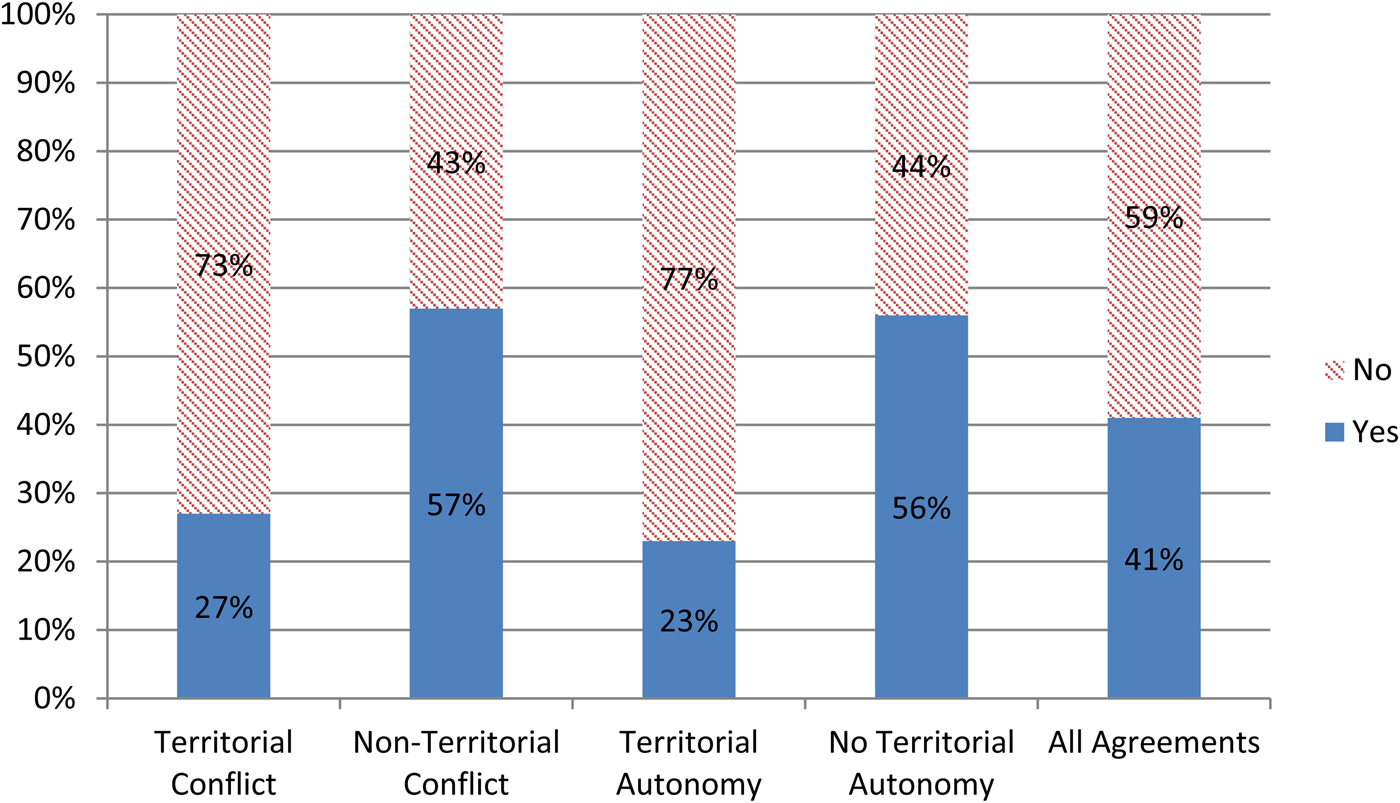
The content of a peace agreement does not, of course, determine future human rights developments. We find several examples of unimplemented human rights provisions, such as Aceh's Human Rights Court.Footnote 113 Moreover, a peace settlement is only one part of the legal framework, and human rights protections may for example already be included in the Constitution. Yet the absence of human rights provisions in peace agreements still suggests that this is not an area that will be prioritised. Moreover, my data also points to a potential spillover between the acceptance of future-oriented provisions and a willingness to address past abuses in a settlement. While there is no difference between territorial and non-territorial conflicts when it comes to retributive measures,Footnote 114 settlements signed in non-territorial conflicts are significantly more likely to include alternative forms of accountability for past abuses, such as truth commissions, compensation for victims, or lustration (see Figure 3). Eight of fourteen agreements (57 per cent) signed in non-territorial conflicts include such measures, compared to only 27 per cent (4/15) of the agreements signed in territorial conflicts. Similarly, 56 per cent (9/16) of agreements without territorial autonomy include alternative accountability measures; compared to only 23 per cent (3/13) of agreements with such a core deal. These differences are, however, not statistically significant (p-values 0.096 and 0.071). The highest proportion of such provisions is again found in agreements without territorial autonomy signed in non-territorial conflicts: 67 per cent (8/12) of these include alternative forms of accountability. This difference is statistically significant (p-value 0.020). As Bell has suggested, the inclusion of human rights helps create a political space for reforms.Footnote 115 It empowers activists to push for human rights to be prioritised.
Alternative accountability in peace agreements (1990–2010).
There is reason to believe that the exclusion of human rights provisions will impact on the durability of the negotiated peace. The content of a peace agreement affects the stability of peace,Footnote 116 and more comprehensive agreements are more likely to succeed. Ramzi Badran finds that every additional mechanism, including human rights protections, reduces the risk of peace failure by one sixth.Footnote 117 There is no study focused on the specific impact of human rights provisions on durability, but Barbara Walter finds that political and legal constraints on government powers significantly reduce the risk of civil war recurrence,Footnote 118 while Desirée Nilsson argues that the inclusion of civil society actors, who are more likely to demand human rights protections, increase the durability of peace.Footnote 119 If human rights are not prioritised in a peace agreement, the obvious risk is that they will never be viewed as a priority. For example, the agreement for the Chittagong Hill Tracts made no reference to the massive human rights violations committed during the conflict, and no accountability measures or provisions for improved human rights protections were included.Footnote 120 This is likely a contributing factor in the continuation of human rights abuses by the army in the post-settlement period and a lack of law and order.Footnote 121 When human rights are excluded, it therefore matters both for the population in the conflict-affected state and for the likely sustainability of a negotiated peace.
Conclusion
Post-Cold War peace agreements are almost all written in the language of human rights, but the degree to which they provide a basis for effective human rights protections depends significantly on the type of conflict the agreement is trying to resolve and the ‘core deal’. Agreements signed in territorial conflicts are considerable less likely to include human rights provisions – in the sense of enforceable rights and human rights institutions – than agreements signed in non-territorial conflicts. This is particularly the case if the agreement includes territorial autonomy. The demands made in territorial conflicts are focused on the rights of groups, not individuals, and territorial autonomy provides for self-determination and protections without necessitating reforms at the centre. Effective human rights protections could undermine such guarantees, as well as the powers of the leaders. The territorial agreements that do include human rights provisions were found to be the result of significant international involvement and most were negotiated by strong rebel forces that had achieved significant territorial autonomy. This context impacted negatively on the implementation of human rights protections.
These findings provide an important contribution to existing debates on human rights in peace agreements.Footnote 122 It suggests that Bell's new Law on PeaceFootnote 123 faces significantly greater obstacles in some conflict context than others. Demands for human rights are much less likely to come from the conflict parties in case of territorial conflicts and may be actively resisted if there is a promise of territorial autonomy. Proponents of territorial autonomy stress the need to incorporate robust human rights protections and local power sharing,Footnote 124 but this article has pointed to the genuine dilemmas this presents, and the resistance it is likely to meet from leaders keen to keep their power as unconstrained as possible. International mediators may push for human rights protections to be included but the problems faced during the implementation phase point to the need for robust mechanisms and possibly continued international involvement.
Finally, these findings also have implications for the wider debates over liberal peacebuilding, which has been described, by its critics, as ‘a peace from IKEA: a flat-pack peace from standardised components’.Footnote 125 This article suggests that in territorial conflicts, the flat-pack ‘liberal peace’ agreement is often missing a screw: effective human rights provisions. Therefore, it may not be quite as liberal as it appears.
Acknowledgments
Earlier drafts of this article were presented at the conference of the Humanitarian and Conflict Response Institute (HCRI) and at the ‘Comparative Peacebuilding in Asia Workshop’ at the LSE. I am grateful to Jacob Eriksson, Jean Grugel, Ignacio Jurado, and Roger Mac Ginty for their extremely helpful feedback and advice. Thanks also to the Editorial Team and the two anonymous reviewers for their very constructive comments. Research for this article was funded by a Mid-Career Fellowship from the British Academy.