Introduction
How objects accrete, exude, embody, or denote value remains of central interest to archaeological enquiry (Graeber Reference Graeber2001; Harris Reference Harris2017; J. Thomas Reference Thomas1996). Biographical approaches to object life-histories focus on how the experiences and world-views of users shape and reshape the valuation of objects within different contexts of exchange and use (Appadurai Reference Appadurai and Appadurai1986; Gosden & Marshall Reference Gosden and Marshall1999; Kopytoff Reference Kopytoff and Appadurai1986; Miller Reference Miller1995; N. Thomas Reference Thomas1991). At the same time, interest in the agency of materials has drawn attention to the ways in which attributes such as colour, patina, touch and smell combine to shape its value and the experience of it to its users (Boivin Reference Boivin2008; Hodder Reference Hodder2012; Knappett Reference Knappett2005). Additional explorations of the valuation of objects also address the inter-artifactual domain (cf. Gosden Reference Gosden2005), where a wider set of interacting object properties further elaborate value. Given this, there is an awareness that the process by which objects are valued in space and time is situational, complex and constructed dialectically within a pool of concepts, beliefs, materials, memories, smells, sounds and actions (Ingold Reference Ingold2007).
The endeavour to assess the value of ‘global commodities’ in the pre-industrial world, such as cloth, marine shells, precious metals, ceramics and glass trade beads, as they travelled through different exchange and use contexts, has received a significant amount of archaeological attention and remains pertinent to debates surrounding the nature and impact of early global trading connections (Brumfiel & Earle Reference Brumfiel and Earle1987; Friedman & Rowlands Reference Friedman, Rowlands, Friedman and Rowlands1977; Graeber Reference Graeber2011; Hayden Reference Hayden1998; Marcus Reference Marcus2008; Prestholdt Reference Prestholdt2008; Price & Feinman Reference Price and Feinman1995; Stein Reference Stein1998). Underscoring many of these discussions is the idea that ‘exotic’ early global commodities were objects of ‘high value’ that functioned as wealth and underscored power (D'Altroy & Earle Reference D'Altroy and Earle1985; Earle Reference Earle and Ensminger2002; Friedman & Rowlands Reference Friedman, Rowlands, Friedman and Rowlands1977; Harris Reference Harris2017; Hayden Reference Hayden1998; Schortman & Urban Reference Schortman and Urban2004; Trubitt Reference Trubitt2003). While fungibility, high investments of labour and the rare physical properties of particular objects are considered important contributors to the high valuation of global commodities, of particular significance is the contribution of ‘distance’. This relates to the incrementally increasing value of an object in proportion to the distance travelled, the economic costs of transport, as well as ‘exotic’ mystique that rarity and a foreign origin and a ‘far-away’ place evoke (see, for example, Earle Reference Earle and Ensminger2002; Helms Reference Helms1993).
The widespread use of these value ascriptions has often resulted in the assumption, rather than demonstration, of the high value of long-distance trade objects in local contexts. As a result, less attention has been paid to exploring the various contributing factors to their valuation, along with the concepts of origin that may be variously activated. Contextual studies of the biographies of these global commodities provide a means to redress this. In this paper we address the valuation of an important yet often overlooked global commodity, the cowrie shell, and assess the potential implications of this for archaeological approaches to the valuation of early global commodities.
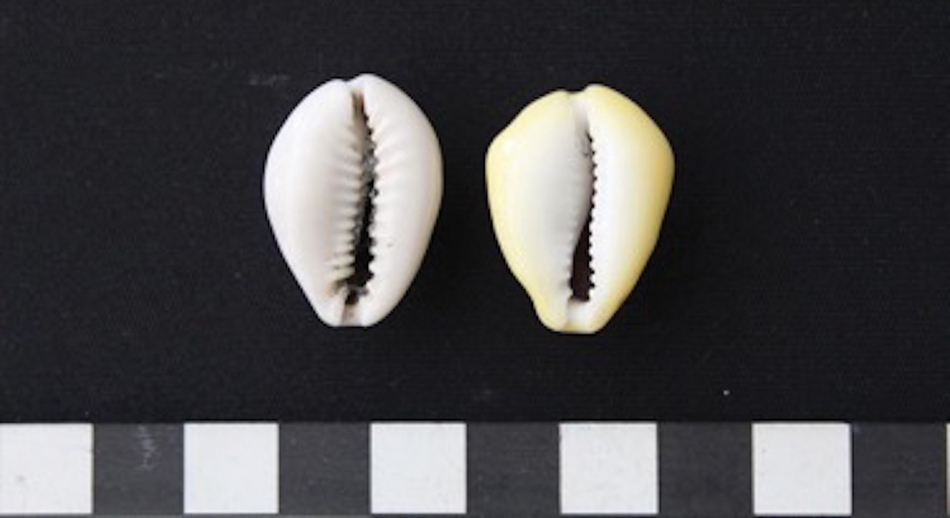
Cowries are small marine molluscs that occur in the wider Indo-Pacific region and have an extremely widespread and long history of trade and consumption. Although there are many closely related species of cowries, the name ‘cowrie’ is a general name that refers in particular to the two gastropod species Monetaria annulus and Monetaria moneta (Fig. 1) (Hogendorn & Johnson Reference Hogendorn and Johnson1986). Both cowrie species were used widely across many regions, from as early as 3000 bc in China (Peng & Zhu Reference Peng and Zhu1995; Yang Reference Yang2011), in the Neolithic of the Levant and Europe (Alarashi Reference Alarashi, Ortiz and Molist2018; Mayer Reference Mayer1997) and for over two millennia in many regions around the Indian Ocean rim (Hogendorn & Johnson Reference Hogendorn and Johnson1986; Kearney Reference Kearney2004).
Cowrie shells; Monetaria annulus (left) and Monetaria moneta (right). Scale in cm.

As a result of their distribution through long-distance trade networks, the ‘commodity phase’ (cf. Appadurai Reference Appadurai and Appadurai1986) in the valuation of cowries has been given significant research attention (Einzig Reference Einzig1966; Hiskett Reference Hiskett1966; Hogendorn & Johnson Reference Hogendorn and Johnson1986; Johnson Reference Johnson1970; Peng & Zhu Reference Peng and Zhu1995; Quiggin Reference Quiggin1949; Yang Reference Yang2011). In particular, the large-scale trade in cowries from the sixteenth century by European merchants, who imported large amounts of moneta cowries into West Africa via oceanic routes for use in the slave trade, made cowries one of the most important global commodities of the modern era (Christie & Haour Reference Christie and Haour2018; Heath Reference Heath, Heath, Breen and Lee2017; Hogendorn & Johnson Reference Hogendorn and Johnson1986; Ogundiran Reference Ogundiran2002). This has resulted in the close association with cowries as currency (Einzig Reference Einzig1966; Hogendorn & Johnson Reference Hogendorn and Johnson1986; Peng & Zhu Reference Peng and Zhu1995; Quiggin Reference Quiggin1949; Yang Reference Yang2011).
Beyond their exchange context, however, a review of the use and archaeological contexts of cowries suggests that they have been prepared, modified, consumed and deposited in a variety of ways from the earliest periods of their use (Hogendorn & Johnson Reference Hogendorn and Johnson1986; Kovács & Radócz Reference Kovács and Radócz2008; Mayer Reference Mayer1997; Yang Reference Yang2011). Ethnographic and historical sources indicate that both moneta and annulus were widely used as items of adornment, in divination and as amulets (Bascom Reference Bascom1980; Golani Reference Golani2014; Hogendorn & Johnson Reference Hogendorn and Johnson1986; Johnson Reference Johnson1970; Kay Reference Kay and Burgess1985; Leslie Reference Leslie2007; Yang Reference Yang2011). Cowries have also been used compositely with other materials to elaborate masks and garments (Arnoldi & Kreamer Reference Arnoldi and Kreamer1995; Pemberton Reference Pemberton2008), and have been widely imitated in other materials, such as bronze, terracotta and carnelian (Golani Reference Golani2014; Yang Reference Yang2011). In their exchange and use contexts, be it as currency, adornment, art and in burials, cowries articulated a range of values to do with personhood, ancestry, rank and status (Boone Reference Boone1990; Insoll Reference Insoll2011; Sciama & Eicher Reference Sciama and Eicher1998). Beyond an emblemic stylistic realm, cowrie use has also activated and enhanced fertility and protection from evil (Golani Reference Golani2014; Hiskett Reference Hiskett1966; Sciama & Eicher Reference Sciama and Eicher1998).
The physical properties of a cowrie shell likely contributed towards their valuation and use. Cowrie shells are hard shells and have a naturally high polish that does not wear easily (Hogendorn & Johnson Reference Hogendorn and Johnson1986). Their hardiness and small size mean that cowries are easy to handle, transport and store, and their ventral aperture makes them easy to turn into pendants (Clark Reference Clark1986). Notable is the sensual attractiveness of the shell, with its elliptical shape and shiny patina. The shape of the ventral aperture is often likened in shape to that of the vulva, which may have facilitated an association between cowries and fertility (Golani Reference Golani2014; Hogendorn & Johnson Reference Hogendorn and Johnson1986; Kovács & Radócz Reference Kovács and Radócz2008; Quiggin Reference Quiggin1949; Sciama & Eicher Reference Sciama and Eicher1998). Similarly, the resemblance of the ventral surface with a human eye may reflect its widespread use as a protective amulet against the evil eye (Golani Reference Golani2014; Hiskett Reference Hiskett1966; Kovács & Radócz Reference Kovács and Radócz2008). Importantly, the marine origin of cowries potentially imbued them with a range of further symbolic associations (Boone Reference Boone1990; Hobbs & Leibhammer Reference Hobbs and Leibhammer2011; Isichei Reference Isichei2002).
In contrast to other regions, research on cowries in southern Africa has been relatively neglected, compounded in part by the erroneous assumption that cowries were of relatively little importance in southern and eastern Africa until the nineteenth century (Hogendorn & Johnson Reference Hogendorn and Johnson1986, 17). This is somewhat surprising, given the evidence for the long and continued use in southern Africa from the seventh century ad until the present (Denbow Reference Denbow1990; Hanisch Reference Hanisch1980; Klehm Reference Klehm2017; Maggs Reference Maggs1980; Moffett Reference Moffett2017; Moffett & Chirikure Reference Moffett and Chirikure2016; Plug Reference Plug2000; Plug & Badenhorst Reference Plug and Badenhorst2006; Raath Antonites Reference Raath Antonites2014; Tiley & Burger Reference Tiley and Burger2002; Voigt Reference Voigt1983; Welbourne Reference Welbourne1975; Whitelaw Reference Whitelaw1994). While recent studies of cowrie use from archaeological contexts have begun to provide insight into the valuation of cowries in the deeper past in southern Africa (Moffett Reference Moffett2017, 238–72; Tiley & Burger Reference Tiley and Burger2002), this paper focuses on cowrie usage in the nineteenth and twentieth centuries, which provide rich, and thus far unexplored material, on how the cowrie was valued in the southern African context.
Through a contextual study of the usages of cowries in southern Africa we attempt to unravel how different domains of influence, from physical properties along with origins and contexts of use, may have intersected in shaping the value of cowries. The focus on the ethnographic context facilitates a unique opportunity to explore the process of cowrie valuation ‘in motion’. These ethnographic observations are pertinent to expanding archaeological approaches to object valuation in a range of ways that extend beyond analogy. Ethnographic observations allow archaeologists to explore a wider range and variability in the ways people interact with the material world (Lyons & Casey Reference Lyons and Casey2016, 610), and facilitate an increased awareness of alternative ontologies in which the value making process may take place (Alberti & Marshall Reference Alberti and Marshall2009; Alberti et al. Reference Alberti, Fowles, Holbraad, Marshall and Witmore2011).
Divining cowries in motion: cowries, ancestors and healing practices in southern Africa
As part of this study we examined cowrie-related ethnographic artifacts in museum collections in South Africa, which were largely collected from the nineteenth to the mid twentieth centuries, as well as historical ethnographies pertaining to cowrie use in this period. This revealed an interesting pattern in cowrie usage in the more recent past. Unlike in other regions of the continent, where cowries were more widely used in a variety of adornments, cowrie usage for much of the nineteenth and twentieth centuries, and indeed until today, appears to have been closely associated with the realm of ‘traditional’ healing practices, where they feature predominantly in divination sets and in the regalia of traditional healers (Garbutt Reference Garbutt1909; Hammond-Tooke Reference Hammond-Tooke1989; Hoernlé Reference Hoernlé and Schapera1937; Junod Reference Junod1927; Plug Reference Plug1987; Roberts Reference Roberts1917; Stayt Reference Stayt1931; Whiting et al. Reference Whiting, Williams, Hibbitts, Alves and Rosa2013). ‘Traditional medicine’ and ‘traditional healers’ are the common nomenclature used in relation to indigenous African healing practices and practitioners in southern Africa (Janzen Reference Janzen1995; Thornton Reference Thornton2009). Healers are commonly referred to today as isangomas in South Africa after the Zulu name, but are also known as igqira in Xhosa, ngaka in North Sotho, selaodi in South Sotho, mungome in Venda and Tsonga (Mozambique and South Africa) and nganga in Shona (Zimbabwe) (Hammond-Tooke Reference Hammond-Tooke1989; Reference Hammond-Tooke1993).
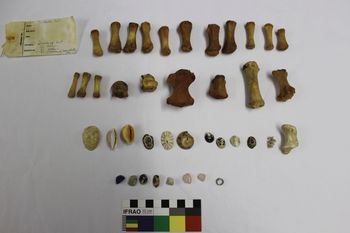
Divination is a central feature of traditional healing (Berglund Reference Berglund1976; Eiselen Reference Eiselen1932; Hammond-Tooke Reference Hammond-Tooke1989; Janzen Reference Janzen1995; Junod Reference Junod1927; Thornton Reference Thornton2009; Tracey Reference Tracey1934). The medium in which divination is conducted ranges between divination through a spirit medium to less direct methods where diviners read cowries and other items as part of a divination set (Hammond-Tooke Reference Hammond-Tooke1993, 187) (Fig. 2). However, all methods require the diviner's ability to access ‘another type of knowledge’ (Peek Reference Peek and Peek1991, 195), which in southern Africa is broadly associated with communication with the ancestral realm (Thornton Reference Thornton2009). The most widely documented and practised method of divination, sometimes referred to as throwing the ‘bones’, refers to the reading of a collection of natural objects in a particular way by a diviner (Janzen Reference Janzen1992, 42). This is a common feature of divination among Shona, Sotho-Tswana, Venda, Tsonga and to a lesser extent Nguni language speakers (Janzen Reference Janzen1992, 42). Historical ethnographies of communities living in southern Mozambique, Zimbabwe and northern South Africa indicate that this divination practice has historical depth from the late nineteenth century (Berglund Reference Berglund1976, 372–3; Bryant Reference Bryant1949; Coertze Reference Coertze1931; Eiselen Reference Eiselen1932; Hoernlé Reference Hoernlé and Schapera1937; Junod Reference Junod1927; Kohler Reference Kohler1941).
A typical divination set. (KwaZulu-Natal Museum Ethnographic collection.)

The number and types of diviner's ‘bones’ which made up a set varied between diviner and also through time (Eiselen Reference Eiselen1932; Plug Reference Plug1987). A common feature of divination sets in certain regions involved the use of a set of four divining dice, ditaola in Sotho or hakata in Shona, made out of wood/ivory/bone (Hammond-Tooke Reference Hammond-Tooke1989, 11; Reference Hammond-Tooke1993, 196; Tracey Reference Tracey1934, 23; Van Binsbergen Reference Van Binsbergen1996). Other prominent objects noted historically in use in divination sets were animal bones, in particular astragalus bones, and to a lesser extent phalanges and fragments of tortoise shells, stones or pebbles, botanical items, including seeds and wooden objects, and seashells (Hammond-Tooke Reference Hammond-Tooke1989; Plug Reference Plug1987; Thornton Reference Thornton2009). Cowries were the most common seashell, and their presence in divination sets has been widely noted historically (Garbutt Reference Garbutt1909; Herbert et al. Reference Herbert, Hamer, Mander, Mkhize and Prins2003; Hoernlé Reference Hoernlé and Schapera1937; Junod Reference Junod1927, vol. II, 547; Mönnig Reference Mönnig1967; Plug Reference Plug1987; Stayt Reference Stayt1931).
The selection and curation of the objects comprising a divination set appear to have been guided by specific principles (Hoernlé Reference Hoernlé and Schapera1937; Junod Reference Junod1927; Mönnig Reference Mönnig1967; Stayt Reference Stayt1931). Conceptually, most of these objects come from the ‘natural or ‘wild’ world of nature rather than the domestic realm and most ethnographers noted the significance of the origin of the object and the context of collection. For example, Hoernlé (Reference Hoernlé and Schapera1937, 238) noted that the bones used in a set must come from the animals killed by the healer themselves. Venda diviners collected and used particular stones that are reported to have been recovered from the stomach of crocodiles (Plug Reference Plug1987, 53). Other collections were inherited paternally, and prized because their age materialized ancestral memory (Eiselen Reference Eiselen1932, 3). Complementary pairs were important in divination sets, particularly pairs of objects representing male and female (Eiselen Reference Eiselen1932; Hoernlé Reference Hoernlé and Schapera1937; Tracey Reference Tracey1934). This is particularly evident with regard to the use of the four dice (hakata in the Shona system), each of which is decorated differently to represent aspects of male and female (Ellert Reference Ellert1984; Tracey Reference Tracey1934). Similarly, with other objects, such as bones and shells, the importance of having a clearly defined and contrasting convex and concave side was noted (Eiselen Reference Eiselen1932; Junod Reference Junod1927; Roberts Reference Roberts1917, 400).
The significance of the choice of objects also appears to be linked to their ability to act as metonyms for different elements of life. Junod (Reference Junod1927, vol. II, 560), for example, in discussing Tsonga divinatory sets, described the meaning of each object in relation to its metonymic potential:
The secret bushpig, which eats bones, is the medicine man; baboons, which are strongly territorial, represent the village; the lion is the chief; the ambiguous hyena, the witch, and the ant bear, nocturnal and living underground, the ancestors. Bones of sheep and goats symbolise the ordinary inhabitants of the village, for whom the bones are thrown. (Junod Reference Junod1927, vol. II, 560)
Similarly,
Sea-shells, (djama, dji-ma) belong to two different genera: the Oliva shells, representing the attributes of the male, assegais, virile courage, etc., the Cypraea shells [cowries], corresponding to the attributes of the female, baskets, pots, pregnancy, births, oxen, lobola, etc (Junod Reference Junod1927, vol. II, 547)
Eiselen (Reference Eiselen1932, 5) described how particular animal bones represented totems among the baMasemola, and that seashells represented Europeans, ‘people who had come from beyond the ocean’.
The process of ‘reading’ a thrown divination set was complex, and the diviner analysed a combination of the orientation of individual objects and their placement in relation to each other (Eiselen Reference Eiselen1932, 5–8; Junod Reference Junod1927, vol. II, 560; Roberts Reference Roberts1917, 400). Junod (Reference Junod1927, vol. II, 560) described how a cowrie falling on its convex side represented ‘the river is full’ or ‘fertility’, while falling on the concave side represented ‘drought’. In Figure 3, Junod (Reference Junod1927 Part II: 560) notes that the interpretation of this configuration, particularly the cowrie lying on its left side, diagnosed that an ill mother was suffering from dysentery.
Depiction of a divining set in the interpretation of ‘the case of a sick mother’. (Taken from Junod Reference Junod1927, vol. II, 557.)

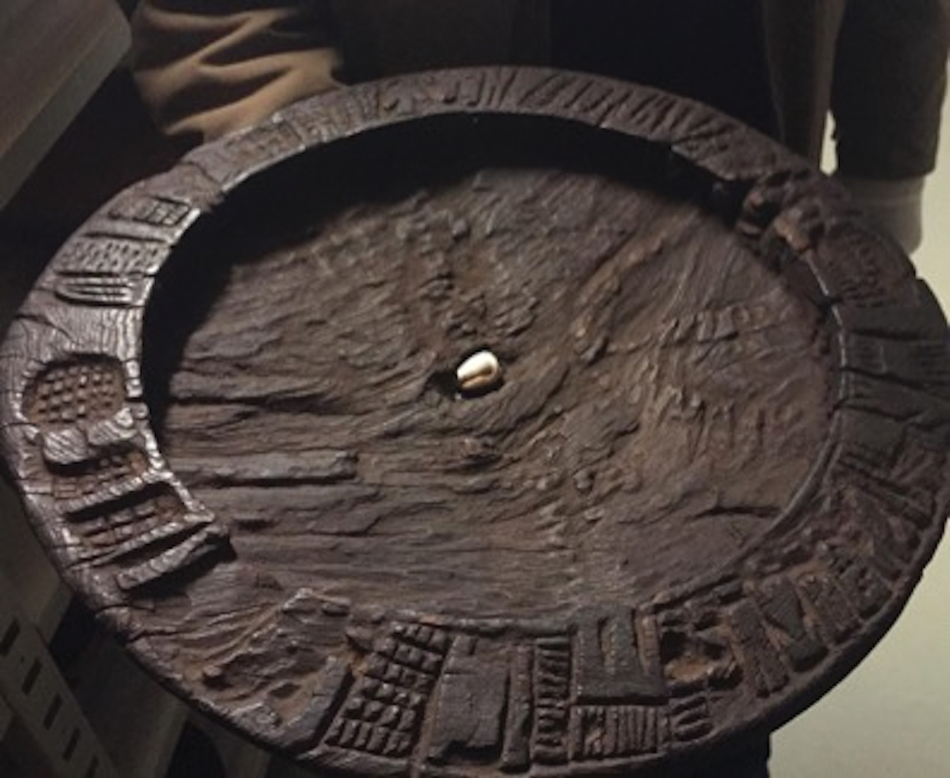
Cowries were also part of other divinatory methods in southern Africa, and feature prominently in divination bowls (Fig. 4). Divinations bowls, which were important in Venda divination and among southern Shona speakers (ndilo in Venda), are wooden bowls, with a wide, flat rim, carved with symbols along the edge and bottom (Ellert Reference Ellert1984, 119; Stayt Reference Stayt1931, 291). Amongst Venda speakers the symbols along the edge represented ‘the various mutupo (totems) found among the Venda, and also other figures of representative persons and objects’ (Hoernlé Reference Hoernlé and Schapera1937, 236), but as Stayt (Reference Stayt1931, 291) noted, their interpretation varied from diviner to diviner. Many divination bowls feature crocodile imagery and geometric patterns on the underside of the bowl, both of which widely represent the ancestral realm, a place conceptually located within ‘pools of water’ (Loubser Reference Loubser, Whitley and Hays-Gilpin2008, 196). A central feature of many divination bowls is the small protuberance in the middle of the bowl, upon which a single cowrie is often placed. This was called the mukhombo [umbilicus] in Venda, and represented the mother's spirits (Stayt Reference Stayt1931, 291–3). When used, the bowls were filled with water and fruit shells placed in the water. The diviner then interpreted the movement and position of the shells in relation to the symbols along the bowl edge and bottom (Stayt Reference Stayt1931, 291; Hammond-Tooke Reference Hammond-Tooke1989, 115).
A wooden divination bowl. This bowl is depicted in Stayt (Reference Stayt1931). (Ditsong Cultural History Museum Ethnographic collection.)

Cowries were not just a part of divination sets, but were also embedded in the wider material repertoire and regalia of diviners. Many healers were differentiated by wearing white clothing, or their use of only white glass beads or shells, and/or smearing their faces with ash or white clay (Berglund Reference Berglund1976, 134; Gelfand Reference Gelfand1956; Hammond-Tooke Reference Hammond-Tooke1981; Reference Hammond-Tooke1989). Among Nguni diviners, headbands or wristbands of cowries were an important ornament (Hammond-Tooke Reference Hammond-Tooke1993, 177). Sometimes other shells, such as mottled black and white Nerita albicilla shells, were worn as an armband (Berglund Reference Berglund1976, 186; Hammond-Tooke Reference Hammond-Tooke1993, 177), and similarly, Shona healers (nganga) in the first part of the twentieth century were often adorned with and identified by insignia that included cowries and or Ndoro (Conus virgo) shells (Gelfand Reference Gelfand1956, 96–111; Tracey Reference Tracey1934).
The materiality of the ancestral realm
The use of cowries described in these historical ethnographies and evident in ethnographic collections in South African museums indicates a close association between cowries and traditional healing. They were a part of composite divination sets, a central focal point on divination bowls, and worn by diviners as insignia of their status. While traditional healing practices were not static, and both materials and methods changed through time (Hammond-Tooke Reference Hammond-Tooke1993; Van Binsbergen Reference Van Binsbergen1996), cowries were clearly able to articulate meaning in the context of healing and divination that was understood by both diviners and the community they served.
Untangling these meanings and values requires understanding of the wider knowledge system within which divination was embedded (Hammond-Tooke Reference Hammond-Tooke1989; Peek Reference Peek and Peek1991). While there is variation in the process of diagnosis and the manner of healing, divination in southern African communities was part of the larger arena of communicative action with the ‘ancestors’ (Hammond-Tooke Reference Hammond-Tooke1989; Janzen Reference Janzen1992), whose social and ritual significance in the lives of southern African communities was widely shared (Berglund Reference Berglund1976, 78; Hammond Tooke Reference Hammond-Tooke1989, 47; Janzen Reference Janzen1992, 2; Stayt Reference Stayt1931, 240). Ancestors were those who are neither living nor dead, but are ‘those who no longer in humanly visible forms are seniors in their lineage’ (Berglund Reference Berglund1976, 30). General descent rules determined which ancestors are recognized. Among Nguni-speaking communities, the emphasis was on patrilineal ancestors from the agnatic cluster; but among Sotho-Tswana, Venda, Tsonga and Shona speakers it may have been both matrilineal or patrilineal (Hammond-Tooke Reference Hammond-Tooke1989, 62). Furthermore, the emphasis may also have changed based on different descent rules due to shifting historical contexts (Janzen Reference Janzen1992, 48).
The ancestors were omnipresent, and took an active and positive interest in the life of their descendants, whom they watched over, but if neglected they could also be negative and cause illness (Hammond-Tooke Reference Hammond-Tooke1989, 71). In this regard, the diviner as ‘the imprimatur of the ancestors … underpins the divination process and lends it the authority of the sacred’ (Hammond-Tooke Reference Hammond-Tooke1989, 104). How one became a diviner varied. Sotho-Tswana diviners were usually male, and the profession hereditary (Eiselen Reference Eiselen1932; Hammond-Tooke Reference Hammond-Tooke1993, 189; Hoernlé Reference Hoernlé and Schapera1937). Among most Nguni-speaking communities, diviners experienced a ‘calling’ from the ancestors (Berglund Reference Berglund1976, 136; Hammond-Tooke Reference Hammond-Tooke1989, 104, 106; Hirst Reference Hirst1997, 229; Hunter Reference Hunter1936, 321; Kohler Reference Kohler1941). This calling manifested in the form of dreams, visions, pain in the neck and shoulders, sleeplessness and belching acid (Hammond-Tooke Reference Hammond-Tooke1993, 187) and if not heeded, physical and mental health deteriorated, often leading to intense psychological distress.
The personal narration of a diviner's experience of entering and emerging from the pool/river was of particular significance in the apprenticeship process among Nguni-speaking diviners (Berglund Reference Berglund1976, 141; Kohler Reference Kohler1941, 17). Novices typically recounted a certain narrative of their experience of being drawn out of their homes at night and into a deep pool, where they had met with the ancestors, so identified because they are covered in white clay, as well as a large snake/python and fish/half human figures (Berglund Reference Berglund1976, 143–5; Hirst Reference Hirst1997, 229; Hammond-Tooke Reference Hammond-Tooke1993, 186; Kohler Reference Kohler1941, 19–21). Often the novice would also retrieve something from the pool, such as stones sitting on the clay, to be included later in the divination set (Hammond-Tooke Reference Hammond-Tooke1993, 186). The narration of this process, and the meeting of the ancestors, widely symbolized the rebirth of the novice as diviner (Berglund Reference Berglund1976, 148).
The significance of the pool/river and the colour white warrants further exploration. In most analyses of Nguni divination practices, it is clear that the pool/river is conceptually the ‘other world’, the realm of the deceased, variously described as a shadowy place underneath the earth, the place where humans came from and where the ancestors reside (Berglund Reference Berglund1976, 144). It is also the place where life is given, and is described as the ‘water of the women when she is pregnant’ (Berglund Reference Berglund1976, 146). This water is critical for the novice diviner because
it is not just water. It is living water (amanzi aphilayo), meaning that something is happening today. If the water was dead, like water in pools, then they (the shades) [the ancestors] would refuse to do their work of making a diviner. That is why the water must be living, so that they can do their work of making a diviner. (Berglund Reference Berglund1976, 167)
Rivers and pools were also symbolically significant in relation to conceptualizations of the ancestral realm among other southern African communities (Hammond-Tooke Reference Hammond-Tooke1993, 106; Stayt Reference Stayt1931, 238–9), and as places of primary creation, such as Ntsunasatsi (Maggs Reference Maggs1976). Among various Sotho-Tswana-speaking communities, rock cisterns at Lowe (Botswana) continue to hold special significance as places from which the first people emerged (Maggs Reference Maggs1976; Morton Reference Morton2011). For this reason, these cisterns are libation portals to the ancestral realm (Van der Ryst et al. Reference Van Der Ryst, Lombard, Biemond and Master2004; Walker Reference Walker1997). Similarly, Stayt (Reference Stayt1931, 238–9) outlines the importance of rivers, pools and lakes, particularly Lake Fundudzi, in Venda creation stories, because the first Venda Singo [king] emerged from a pool within a mountain cave (Aschwanden Reference Aschwanden1982; Loubser Reference Loubser, Whitley and Hays-Gilpin2008). Additionally, ‘The assembly area, or khoro, is also known as a “pool,” or thivha, and it is here that premarital initiates are reborn during the domba (python) dance, very like the apical ancestors during creation’ (Blacking Reference Blacking1969, in Loubser Reference Loubser, Whitley and Hays-Gilpin2008, 195). If a group of people, or a chief, were spoken about in relation to a ‘pool’, it was in reference to the ritual potency of the person (Loubser Reference Loubser, Whitley and Hays-Gilpin2008, 195).
The iconography and symbolism on Venda divination bowls make specific reference to the concept of ‘pool’ and, as noted, the crocodile and geometric shapes referenced the ancestral realm (Duffey Reference Duffey2012, 178; Mack Reference Mack2007, 110). When the bowl was filled with water, the cowrie shell and motifs at the centre of the bowl were submerged in the ‘underwater’ pool of primary creation, the ancestral realm. While various heirlooms, such as hoe-heads and copper malembe (replica hoes), were used by Venda communities to access their own ancestors directly (Moffett et al. Reference Moffett, Maggs and van Schalkwyk2017), there is some indication that the divination bowl was only used by powerful diviners to access the ancestral realm of the ruling lineages (Duffey Reference Duffey2012, 178; Mack Reference Mack2007, 110).
Along with water, the colour white has often been (and remains) closely associated with ancestors. That white is the colour of the ancestors is clearly illustrated in the birth/rebirth of Nguni diviners, who, when entering the pool/water, recognized the ancestors by their appearance as ‘white’, often as white clay. As one healer recounted to Berglund (Reference Berglund1976, 146): ‘As I said, the white clay that is under the snake is the clay of the shades [ancestors]. They have one and the same colour. So they resemble one another. The clay is the clay of the shades’. The significance of white can be understood more broadly across southern African communities in relation to the materialization of pollution concepts (Hammond-Tooke Reference Hammond-Tooke1981; Reference Hammond-Tooke1993; Kuper Reference Kuper1982). Pollution concepts, in particular the binary concepts of ‘hot’ and ‘cool/dark’, were important in many southern African communities, and related to what has been termed the ‘thermodynamic’ philosophy (cf. de Heusch Reference De Heusch1982), in which hot was seen as a dangerous state associated with death, miscarriage and liminality and cool with fertility, healing and health (Hammond-Tooke Reference Hammond-Tooke1981, 123). White, red and black colours are symbolically linked to these states. White is often associated with ancestors and a state of purity, ‘coolness’ and little ‘heat’ and linked to healing and divination and materialized by semen, water, ash and rain (Kuper Reference Kuper1982). This colour schema was often expressed in beadwork, on pottery or in metals.
Discussion
Through an exploration of the wider context of beliefs encompassing the divination process, we begin to see that the value of cowries, used in the adornment of healers and in the divination sets, was shaped by particular concepts of pollution, fertility and ancestry. The use of white adornment and white objects for healers was specifically linked to the connection between the colour white and the ‘colour’ of healing, fertility, ‘coolness’ and the ancestors. This form of adornment, including the use of white shells, beads, ash and cloth, on one level served to demarcate the liminal space a diviner occupied in society.
However, white objects used in the adornment of diviners and in divination practices were not merely metaphors for ‘coolness’ and ancestors. Rather, the colour white was an active property that served in the materialization of certain outcomes. This is illustrated in Berglund's (Reference Berglund1976, 164) description of the coming-out ceremony of Nguni-speaking novices. Following the completion of the initiation, the diviner emerges from their hut wearing a large number of white beads strung in her hair and around her neck and waist, as well as gall bladders tied into her hair and white ash smeared on face and body (Berglund Reference Berglund1976, 164). As Berglund's informant noted, ‘The white says, “Today she is a servant of the shades.” Everybody who sees that person knows something and says, “That is ithwasa”, knowing the colour of the diviners and shades. That is the colour white and its work' (Berglund Reference Berglund1976, 167).
This description of the ‘colour white and its work’ is particularly apt in articulating the way in which ‘white’ objects actively work to produce ‘coolness’. These objects ‘worked’ not only as ornamental representation of ancestral power, but as embodiments of the ancestors (Berglund Reference Berglund1976, 118; Hirst Reference Hirst1997, 236). The ‘work’ of white objects, as well as other objects associated with ancestry and divination, is also noted elsewhere (Hammond-Tooke Reference Hammond-Tooke1981, 135–9). Tumise Maledimo, the diviner interviewed by Eiselen (Reference Eiselen1932, 3), noted this quite aptly when he stated that the bones were an extension of his person and were to be consulted in decisions. Stayt (Reference Stayt1931, 249) recorded the importance of old objects, which were widely prized and curated. These were not merely considered to be heirlooms, but were used and conceived of as the physical spaces in which particular ancestors resided, the word for these objects, tshitungula, likely derived from tungula [to throw the bones], ‘suggesting that the heirlooms are mediums through which the living are able to come into contact with the dead’ (Stayt Reference Stayt1931, 249). In this sense various objects associated with divination, from the adornment of the diviner to the objects used in divination, may be understood as having not only metaphoric potential, but also metonymic potential. One may also go a step further and suggest that these objects, as the physical manifestation of ancestors, not only acted as metaphor or metonymy for ancestry, but were also animate objects (after Brown & Walker Reference Brown and Walker2008). As animate, white objects engendered the qualities that ancestors were able to accord; those of fertility, coolness, health.
Inseparably linked to the valuation of cowries within the ancestral realm was their origin in water. This is expressed in the central and submerged position of cowries in Venda divining bowls, and the ancestral realm of the ‘pool’. While not as explicit, similar associations between white things, water and ancestry can be gleaned in the origin stories of Nguni diviners where rivers/pools are filled with white clay and stones, objects in which the ancestors ‘reside’. In the face of the giant snake/python that is often in their way, diviners must return with these objects for their divination sets. Through understanding the symbolic process associated with the use of cowries, we begin to see that the attributes of origin and distance associated with cowries appear to have been understood and interpolated in relation to an ancestral realm.
The idea that cowries were valued in a particular way because of their origin from the world of ancestors reveals a particular biographical ontology of ‘distance’ that varies from the concept of distance often evoked in studies of global commodities. This has been somewhat explored by Mary Helms (Reference Helms1988) in her seminal review of the ways in which goods from afar are valued in pre-industrial societies. Helms indicated that objects from long-distance trade networks were often imbued with specific values and power related to culturally specific concepts of distance. In Helms’ analyses, she concluded that ‘distance’ is not measured as a constant or a standard, but is relative to a context and is a socially constructed concept. Things traded from ‘afar’ accrue political and ideological value because in the absence of direct knowledge about their actual origin they are given a relevant biography that contextually ‘mystifies’ exotica within local understandings. In the southern African context, the biography associated with cowries was somewhat different. In particular, the ‘distance’ related to the ancestral realm is a place ‘underwater’. However, this ancestral ‘distance’ was ambiguous, both accessible and omnipresent, yet beyond the reach of the ordinary individual and only traversed by the diviner.
The valuation of seashells in relation to the ancestral realm, fertility and ‘coolness’ appears not to have been limited to cowrie shells only. A particular shell that shared a similar symbolic potential to the cowrie was the ndoro shell. The ndoro was used across regions of Zimbabwe and northern South Africa as a symbol of status and spiritual power from at least the seventeenth century until the early twentieth (Ellert Reference Ellert1984; MacGonagle Reference MacGonagle2007; Pwiti Reference Pwiti1996). The ndoro is an ivory-coloured pendant between 4 and 6 cm wide made from the flattened end of a Conus virgo shell, with one end polished smooth while the other is whorled. The shell was perforated in the middle and fastened to the string with a bead on the concave side of the shell (Gelfand Reference Gelfand1956, 111), and its use was noted among Venda- (Stayt Reference Stayt1931, 26), Tsonga- (Junod Reference Junod1927), Valenge- (Earthy Reference Earthy1933) and Shona-speaking groups (Ellert Reference Ellert1984), where they were important symbols of political/ritual power. Cowries and the ndoro were sometimes worn together, and appear to have been valued for sharing similar properties (Gelfand Reference Gelfand1956, 96). Another seashell that appears to have been of importance for healers and in divination was the ndumbi (Nerita albicilla) shell. These black-and-white mottled shells were primarily worn by Nguni-speaking healers, who threaded the shells on to cotton and wore them around their wrists (Bryant Reference Bryant1949, 162).
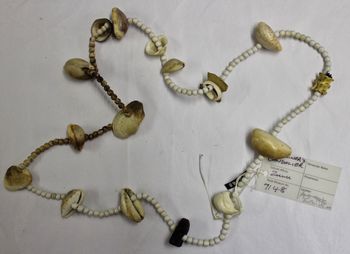
The association between cowries, ndumbi and ndoro shells suggests that, along with the colour white, their origin from water, the ancestral realm, imbued the shells with qualities that were used in contexts of healing and ancestry. However, the uses of the ndoro suggest that it was a more potent object than the ndumbi or cowrie in the realm of fertility, healing and ancestry. In the case of the ndoro, ancestry, healing powers and political power merged, a combination that underpinned political leadership in some southern African communities historically (Hammond-Tooke Reference Hammond-Tooke1993). The potency of the shells may also have been heightened by their use together, either worn alongside each other or as part of composite sets in the adornment of healers. A healer's ‘bandolier’ (Fig. 5) from the ethnographic collections at KwaZulu-Natal Museum further indicates the significance of the inter-artifactual domain and use-context in creating value associations. In this bandolier, annulus cowrie shells are strung alongside Oliva shells and other larger cowrie species, along with fragments of tortoise bone and white glass beads.
A diviner's bandolier. (KwaZulu-Natal Museum Ethnographic collection.)

The different shells in the bandolier may also have individual accumulated biographies, some of which are evident in their material modifications. Certain cowries were clearly collected from the shore and retained their dorsal aperture. Other cowries were modified, with sharp dorsal breaks facilitating their stringing together with other shells, while others, with polished dorsal breaks, suggest they have been previously modified for adornment (Fig. 5). These modifications may reflect a unique part of each individual shell's biography, which may have further shaped the ways in which they articulated particular values within a use context.
Along with these modifications, how the properties of whiteness and the shell's derivation from the sea articulated meaning within healing contexts was activated and shaped by a host of tangible and intangible factors, such as memory, beliefs, smells, sounds, temperature, and of course the performance of the healing practice, itself an essential component to the process. As Peek (Reference Peek and Peek1991, 195) emphasizes, ‘Divination never results in a simple restatement of tradition to be followed blindly. It is a dynamic reassessment of customs and values in the face of an ever-changing world’. Thus, the use of cowries in divination practices was not merely the reflection of a static association between the shell and ancestry, but reflects the use of things that continue to remain meaningful. These associations continued to be configured in changing contexts of use. This sentiment is aptly illustrated by the remarks on cowries by a contemporary South African artist, Nana Ngcobo, whose tapestries illustrate the significance of water and shells in healing today. She remarked, in relation to a necklace of cowrie shells she was wearing, that ‘The shells I am wearing are connected to my ancestors but anyone can wear shells as protection’ (Hobbs & Leibhammer Reference Hobbs and Leibhammer2011, 14).
Conclusion
Recent research into the distribution and consumption of globally traded ‘commodities’ has emphasized the importance of exploring why different objects were taken up by different communities and how their value was recontextualized within changing contexts (Gosden & Marshall Reference Gosden and Marshall1999; Prestholdt Reference Prestholdt2004; Reference Prestholdt2008; Thomas Reference Thomas1991). Yet fewer studies have explored how, within this framework, the properties of objects are materialized in different use contexts, and the ways in which these shape the valuation process. This paper has sought to explore the potential ways in which the properties of cowries, along with their origin, articulated with the material and conceptual universes of its users in southern Africa.
Our review of cowrie use in divination practices indicates how the white colour of the cowrie shell facilitated the ability of the cowrie to articulate fertility, healing and coolness associated with the ‘whiteness’ of the ancestral ream. This property facilitated the use of cowries within the realm of healing and divination, where they were variously used as part of the adornment of healers and as part of objects in divination sets. While observing this process indicated that the ‘agency’ of this material property, the colour white, was central to shaping its valuation, it also brought into relief another dimension to the agency of the colour white in the valuation of cowries, in the form of the agency of the ancestral realm through which certain objects became animate objects. To this end the agency embodied in these white objects arose not from the material properties alone, but rather ‘from sentient qualities possessed by the object, such as consciousness or a life-force’ (Brown & Walker Reference Brown and Walker2008, 298). Similarly, the origin of cowries from water gave the cowrie a particular biographical ontology linked to the ancestral realm. This biography was central in shaping the value and agency of the cowrie within divination contexts.
This study brings to light the importance of a full ontological inquiry into other people's worlds and relations to objects that may extend beyond the framework of cultural biography or materiality (cf. Alberti & Marshall Reference Alberti and Marshall2009). In particular, observations related to the property ‘white’ indicate that although it may be a ‘material’ property with agency to shape its valuation, the full sense of its agency can only be understood through an exploration of the ontological framework in which ‘white’ objects ‘do work’. Similarly, concepts of ‘distance’, ‘afar’ and ‘exotic’ must be carefully interrogated, and the potential of accumulated biographies that extend beyond exchange and use contexts must be considered.
While archaeological contexts vary from ethnographic contexts, archaeology nevertheless remains well positioned to explore alternative ontologies (Holbraad Reference Holbraad2009). In particular, exploring anomalies in the archaeological record can challenge and disrupt our assumptions relating to value (Alberti & Marshall Reference Alberti and Marshall2009). Observations related to distribution, deposition and use-wear patterns provide an opportunity to explore the biographies of cowries and the complex ways in which objects from ‘afar’ accumulate and re-accumulate meanings in new contexts of use. For example, in the southern African ‘middle’ Iron Age (ad 900–1300), conventional arguments have suggested that in their exchange and use contexts cowries, along with other ‘exotica’, functioned as a form of ‘wealth’ (Huffman Reference Huffman1982; Reference Huffman2009; Robertshaw et al. Reference Robertshaw, Wood, Melchiorre, Popelka-Filcoff and Glascock2010). This interpretation is closely linked to their derivation from burial contexts, in which cowries have been recovered along with other items such as glass beads, in burials at the iconic sites of K2 (ad 1000–1220) and Mapungubwe (ad 1220–1300) and in a large hoard at the site of Great Zimbabwe (ad 1000–1700).
This specific cultural classification of exotica inflects the more conventional links in which exotica become prestige items simply because they are traded over long distances. This actual physical passage has been seen as the factor that imparts value in an object that is then used by elites and defined as wealth and power, through, for example, selective redistribution. However, examination the distribution and deposition of these objects in archaeological contexts does not conform to a prestige-goods model, with depositional patterns, and in particular the placement of goods in burials and hoards, suggesting complex underlying cultural processes (Hattingh & Hall Reference Hattingh and Hall2009; Moffett & Chirikure Reference Moffett and Chirikure2016). The above exploration of the ancestral realm, while by no means a direct analogy, provides an alternative ontology from which to explore this archaeological phenomenon, in which burial goods may reflect individual relationships with an ancestral realm. Otherwise put, they may reflect, not a ‘wealth in things’, nor a ‘wealth in people’ (cf. Guyer Reference Guyer1995), but a ‘wealth in ancestors’. The ancestral scale may vary, from burials articulating individual personhood to large burials articulating collective ancestry. Thus, one cowrie in a juvenile burial at K2 may relate to a child's ancestral realm, while a cache of cowries at Great Zimbabwe may reflect an ancestral scale of a different level. Exploring the relationship between burials and the ancestral further in archaeological contexts may provide a deeper understanding of how global trade items were given local meaning, as well as the relationship between the sacred, ancestral scale and power.