




No CrossRef data available.
Article contents
- Abstract
- RIGID DESIGNATORS AS TRANSWORLD IDENTIFICATIONS
- THE NAME OF THE SUN GOD K'INICH IN CLASSIC MAYA ANTHROPONYMICAL USE
- THE DIFFERENT GRAMMATICAL USES OF K'INICH
- THE DIFFERING USAGE OF PREFIXED AND POSTFIXED K'INICH LEXEMES
- ROYAL TITULARY IN ANCIENT EGYPT
- CONCLUSIONS
- RESUMEN
- ACKNOWLEDGMENTS
- References
K'INICH AND KING: Naming self and person among Classic Maya rulers
Published online by Cambridge University Press: 04 March 2004
Article contents
- Abstract
- RIGID DESIGNATORS AS TRANSWORLD IDENTIFICATIONS
- THE NAME OF THE SUN GOD K'INICH IN CLASSIC MAYA ANTHROPONYMICAL USE
- THE DIFFERENT GRAMMATICAL USES OF K'INICH
- THE DIFFERING USAGE OF PREFIXED AND POSTFIXED K'INICH LEXEMES
- ROYAL TITULARY IN ANCIENT EGYPT
- CONCLUSIONS
- RESUMEN
- ACKNOWLEDGMENTS
- References
Abstract
Like other rulers in the ancient world, Classic Maya kings needed to legitimize their power. They did so by adopting the name of the sun deity, K'inich, thus identifying themselves with the celestial authority of a potent supernatural being. However, Classic Maya kings used the name of the sun god in two different ways: to name the individual self of the king, and to identify his socially defined person. The individual self of a king was always linked to a defined aspect of the sun god. The person of the king was always referred to using a simple K'inich prefixed to a rigid designator. These two modes of reference also show differences in usage. Prefixed K'inich name elements are mostly omitted in external references because they refer to a socially defined person who is not perceived as such in antagonistic areas. But the K'inich referring to a king's self is employed in external references.
Information
- Type
- Research Article
- Information
- Copyright
- © 2003 Cambridge University Press
Throughout their long history, Egyptian and Mesopotamian rulers identified themselves with the sun to legitimize their power and authority (Ahn 1992; Assmann 1970:68 ff; Kemp 1982:660). Classic Maya rulers had an identical concept of lending their royal identification to the celestial aspects of the sun. These rulers used so many methods to identify themselves with the sun that they cannot all be enumerated here; the most obvious, however, was to incorporate the name of the sun god into their personal names. Classic Maya rulers used the name of the sun god to refer to both their self and their person. However, they made a subtle distinction between the two. The precise difference lies in the reference to the ruler's individual self and a legitimation of his socially defined person.
I use person following Marcel Mauss, who defined the term as a “category of the human mind” (Mauss 1978). Personhood is a form of public representation whereby an individual is characterized as a “person” or “mask.” Therefore, person will refer to a social identity that rests on interaction with society. The opposite of person is self, a more inwardly oriented category based on the perception of the innate qualities of an individual. Although self and person are difficult to separate, because both in the end are “categories of the human mind,” the difference between them lies in the interaction with the public that a person undertakes; a self, by contrast, is defined less by interaction with the public than by the public's perception of the individual's innate qualities. In medieval Western cultures, the self and person were called the “body natural” and “body politic,” respectively, that a king combined in an indivisible unit (Kantorowicz 1957:9). The body natural constituted the mortal part of a king; the body politic appeared to be a likeness of the “holy sprites and angels” (Kantorowicz 1957:8), yielding a character angelicus for the king's body politic that “reduc[es], or even remove[s] the imperfections of the fragile human nature” (Kantorowicz 1957:9). The term self thus encompasses individual human aspects as perceived by society, whereas person refers to the interactions of the individual with society and thus his social identity.
Both a king's self and his person had to be legitimized in ancient civilizations. This is reflected in most of those civilizations' iconography and epigraphy. Here I define legitimacy as the acceptance of the system of power that manifests itself in authority. Legitimation of the self and person of a king, and thus of his power, theoretically could be achieved via three different modes or types of authority—rational, traditional, and charismatic—described by the sociologist Max Weber (1961:6 ff). For the purpose of this article, I define power as a social relationship between parties that establishes the subordination and obedience of one party to the other. Authority manifests this social relationship both in person and in larger parties and makes the relationship perceptible to the affected people. A king, a term I use to refer to the ruler or head of a polity, depended on an elaborated system of legitimacy to rule. Legitimacy could never be achieved by force alone, however, because there is never enough force to “make the king's will prevail in the long run” (Bendix 1978:219). Thus, kings needed other ways to legitimize their power and thus their person and self.
The vehicle for achieving legitimation of self and person in ancient civilizations was most often religion, on which this article will concentrate. I define religion as the codified practices and beliefs that explain the general order of existence and that relate a present-day world to supernatural beings of potent authority. These codified practices further receive a degree of factuality so that the motivations for those practices ultimately seem realistic to the members of a specific religion (Geertz 1966:35 f). By appealing to a higher authority that sanctioned their power, kings achieved validation from the public and from noble contenders. In many cultures, kings thus associated themselves with divine beings, an association that was perceived by society as given. Nevertheless, the nature of this association differed substantially.
For example, Egyptian kings legitimized their power through a relationship to the sun god Ra (Kemp 1982:658–659). The pharaoh was definitely inferior to the gods, as he is shown from pre-dynastic times on as receiving the gift of life from the gods (Baines 1995a:11). The title to a pharaoh's birth name stated that he was the “Son of Ra.” His throne name always stated that he was the “Beloved of Ra” or “Cared for by Ra” but never that he was Ra himself. However, the pharaoh discharged divine will and thus was the gods' counterpart on earth (Baines 1995a:11), a role that clearly distanced him from other human beings. The main difference between kings and gods thus lay not in their divine nature but in how they received it: “[D]ivinities have their powers intrinsically, kings … receive them from the higher powers” (Silverman 1995:63). Gods also embodied all aspects of divinity in one being, whereas kings could embody only certain divine aspects of different deities. Egyptian kings legitimized themselves via a personal relationship to the gods and by adopting certain parts of a god's identity in specific settings. During special rituals the pharaoh was perceived by society as the sun god (Assmann 1970:65).
The situation in Mesopotamia was somewhat different. As in ancient Egypt, the Achaemedian kings in pre–Islamic Iran achieved legitimation mostly through associating the king with the sun god or the wind god (Ahn 1992:27). However, kings never claimed to be divine entities—not even in specific settings such as ancient Egypt. Nor did they proclaim themselves to be sons of a god, as did the pharaohs in ancient Egypt. They remained recognizably distinct from the gods, albeit emphasizing that they had been chosen by the gods (Ahn 1992:26). Their legitimation rested on an understanding of having been elected to and installed in a divine office by Ahuramazda (Ahn 1992:305). On taking office, they received charisma (farnah) as the gift of their vocation by Ahuramazda. They fulfilled tasks on Earth that were ordered by the gods (Ahn 1992:50). The king was sanctioned by Ahuramazda to rule, but he did not adopt any part of the god's identity (Ahn 1992:305). The sun god legitimized only his person, never his self. Accordingly, Mesopotamian kings achieved even less identification with the gods than did Egyptian pharaohs. They emphasized their special status among human beings as the elect of gods. Their legitimation to rule rested on this election, and the king thus absorbed positive sanction from higher, supernatural authorities.
In these cultural systems, the necessary legitimation for rule over a certain area or population was achieved through a direct or indirect relationship to a god. This legitimation rested on religious concepts. But how could a ruler claim this special relationship to a divine being in such a way that clearly distinguished him from other human beings, as he was observed by his subjects as undergoing the same human processes that commoners underwent? To attain the necessary religiously based legitimation and become a divine entity, as well as the focus or pivot of worship, a ruler theoretically could employ three devices (see Houston and Stuart 1996:290 f).
The foremost method for turning into a divine being was through ritual (Hocart 1970:92 f). Following Roy Rappaport (1999:24), I define ritual as the performance of a sequence of formal acts that are not entirely encoded by the performers. Ritual is a model not only of realities but also for realities (Geertz 1966:7). The ritual itself is regarded as an act constituting reality. During rituals, the ruler changed into a supernatural being with the material assistance of deity masks, clothing, and ornaments. Gods and king became in those moments “a whole without parts” (Hocart 1970:92). Gods and king fused into a single absolute identity. Authority was attained through the ritual itself as a performed act (Geertz 1966:34). The king became the focus of a set of religious ideas or theological precepts that were being projected on him by society. Those beliefs were reinforced by public rituals. The king in the role of god thus molded himself into the repository of society's religious beliefs, a figure that was central yet set apart (Hocart 1970:99).
The second device was to claim divine descent. Hieroglyphic texts of the Classic Maya, such as those at Palenque, Mexico, elaborately connect the ruling king with distant ancestors, establishing a divine ancestry and therefore legitimizing his rule (Schele and Freidel 1990:252).
A third method was rhetorically to use epithets that were appropriate to a deity, thus associating with the divine being. By doing this, the ruler adopted part of the identity of a god while remaining at core both human and recognizably distinct from the god (Houston and Stuart 1996:290). These epithets could pertain to certain statues of godly images that legitimized a king's power, or they might be purely rhetorical epithets—elaborated texts or personal names, for example.
Classic Maya rulers acquired divine status through names, both for their selves and for their persons. A comprehensive study of personal names in Maya hieroglyphic inscriptions has not been conducted. The first to identify personal names in the inscriptions was Tatiana Proskouriakoff (1960). In her studies on Piedras Negras, she showed that personal names of historical individuals existed in the hieroglyphic inscriptions. This discovery led not to an analysis of the personal names in the inscriptions, however, but to an analysis of the historical context of those names. Subsequently, the term name served as a black box for those parts of inscriptions recording any kind of nominal phrase. Names were interesting only as far as genealogy or war accounts were concerned. Partly because of problems in deciphering them, nameswere not an object of study in their own right. For the most part, people named in the inscriptions were given English nicknames, such as “Smoking Frog,” blurring any native conception behind those names.
The first attempts to decipher personal names were still flawed because the deciphering of syllabic signs changed rapidly. An example is the deciphering of the name of Ruler A from Tikal. This name was first read as Ah Cacau Caan Chac (Jones 1987:107) but subsequently had to be corrected to Jasaw Chan K'awiil (Grube 1992:207). This situation has changed over the past twenty years. The first extensive study of names was undertaken by David Stuart and Stephen Houston (1994), who produced the basic monograph for toponyms. Some articles (e.g., Grube 1999, 2001; Houston and Stuart 1996:295 f) point out general grammatical features of personal names. Erica Hewitt (1999) reports on special queens' names and their significance; Alfonso Lacadena (2000) points out different syntactical positions of titles in the northern lowlands as compared with the southern lowlands. However, a comprehensive study of the structure and meaning of anthroponyms is still lacking.
Classic Maya personal names consist of a variety of elements that could refer to both the self and the person of an individual king. I do not aim here to describe all of the features of Classic Mayan anthroponomastics. Instead, I will investigate the function of the theonym (god name) K'inich, the name of the Classic Maya sun god, when it is used in Classic Maya personal names. The name of the sun god played an important role in legitimizing Egyptian and Mesopotamian rulers—naturally, the celestial obtrusiveness of the sun lent itself to royal identification. It seems appropriate, then, to investigate the function of the name of the sun god in Classic Maya anthroponyms. As will be shown later, the theonym of the sun god was used in two modes among the Classic Maya. In one mode, a defined aspect of the sun god served as a rigid designator that enhanced the king's self. In the other, the entire name of the sun god explicitly exalted the ruler's power and divine status, referring to his socially defined person.
RIGID DESIGNATORS AS TRANSWORLD IDENTIFICATIONS
The philosopher Saul Kripke developed the theory that names are “rigid designators” (Kripke 1972:270) that refer rigidly to the same object or person. For example, Kripke distinguishes between Richard Nixon as a rigid designator and “the President of the United States” as a non-rigid designator (Kripke 1972:270). That is, “Nixon” always refers to the person whom we know as Nixon. “President of the United States,” however, could refer to somebody else. Further, according to Kripke, names, or rigid designators, are “transworld identifications” (Kripke 1972:270) that pertain closely to a certain individual, anywhere and at any time. Among these “other worlds” are foreign references identifying individuals from a different society. Yet in onomastic terms, which is the rigid designator that unambiguously refers to the self of an individual in every world. And which parts of a king's name are not designed to specify his individual self? The problem addressed in this article can be distilled into the following query: Under what circumstances does the theonym of the Maya sun god operate as a rigid designator of the ruler's self, and under what circumstances does it relate to his socially defined person?
THE NAME OF THE SUN GOD K'INICH IN CLASSIC MAYA ANTHROPONYMICAL USE
The Classic Maya sun god's name has been identified in its various forms by Peter Mathews (1979) and subsequently been deciphered by David Stuart (1986) as K'inich, “Sun-Eyed,” a reference to the sun god (Figure 1). This etymological explanation interprets k'in as “sun” and ich as “eye,” both well attested lexical values in Mayan languages. However, this interpretation lately has been a subject of debate. Søren Wichman (2000) interprets the etymology of K'ihnich as “hot.” It is also possible to interpret the suffix -ich as an intensifier of the noun K'in, derived from Yucatec -ich ‘abundancia’ (Martínez Hernández 1929:463), yielding the explanation “very sunny.” Stephen Houston (personal communication 2001) has provided yet another interpretation of the -ch suffix as “essence” or “excrecence,” explaining the name K'inich as “the essence of the sun.” These are useful suggestions, but etymology is among the most insecure of all studies, and it is extremely difficult to confirm the origin of a single lexeme. In any case, the lexeme K'inich is in some way connected to the Classic Maya sun god. Of more interest here is its function in Classic Maya hieroglyphs, where there is a fundamental difference between a K'inich when it is prefixed to the rigid designator (as in K'inich K'an Joy Chitam) and a K'inich that always follows other frequent name elements, as in Tum Ohl K'inich and Chelte' Chan K'inich.

Various forms of the Classic Maya sun-god name K'inich. (a) Logographic form of K'INICH (Naranjo, Panel 1). (b) The sun-god name spelled with the logograph for K'IN, followed by the syllable chi, yielding K'inich (Naj Tunich, Drawing 82). (c) The K'IN sign infixed into the chi syllable (Pusilha, Stela P). (d) The logograph for K'INICH, followed by the phonetic complements chi and ni (Cancuen, Hieroglyphic Stairs). (e) The head variant of the sun-god name K'inich, followed by the logograph K'INICH emphasizing the K'inich reading (Palenque, Palace Tablet). Drawn by the author.
I argue that, if a K'inich element is prefixed to obligatory or very frequent name elements of an individual, it is merely a nominal modifier to those other name elements indicating rulership or sacredness. The whole name of the sun god K'inich is prefixed to the rigid designator and refers to the person of a king. His person is thus invested with the entire power of the sun god. Prefixed K'inich elements do not serve to refer rigidly to the individual self but are name elements for enhancing and legitimizing a king's power. As such, they serve as attributes of the name of the individual self (on adjectival use of K'in-chi, see Houston et al. 2001:Table 9).
The K'inich that occurs behind other obligatory or frequent name elements is itself part of the rigid designator and cannot be separated from the other elements. This rigid designator defines a certain aspect of the sun god. This aspect rigidly refers in every context to the individual and thus, obviously, to the self of a king. The difference between the two is that only a part of the sun god is used to refer to a king's self, whereas the person is referred to with the whole sun-god name.
THE DIFFERENT GRAMMATICAL USES OF K'INICH
In the following sections, I will first analyze the different grammatical categories of K'inich lexemes. Then I will point out the different usages of those grammatical patterns.
Names with K'inich in the Post-Position
Much like the ancient Egyptians, the Classic Maya developed a system of different sets of epithets that contained stative, antipassive, and passive sentences. Some of these features have been pointed out by Houston and Stuart (1996:295) and by Nikolai Grube (2001). I will put the emphasis only on those sentence names containing K'inich. The sentence names with K'inich as the main element are possessive and passive constructions. As part of the Ch'olan and Yucatecan language families, these stative and passive constructions behave morphologically like intransitive verbs and form their agent either with a noun phrase or with the third-person absolutive pronoun (MacLeod 1984:233–234).
Possessive constructions
The first set of anthroponyms discussed here are simple possessive constructions that feature the Classic Maya sun god as possessive marker. One of those names showing a clear possessive construction is the birth name of K'inich Janaab' Pakal II from a decorated pier from Temple 19 from Palenque (Martin and Grube 2000:174), a name that further appears on a jade head found in Honduras that is now in the British Museum in London (Mayer 1997:Figure 20; Schele and Miller 1986:81) and on the cave walls of Naj Tunich (Drawing 29). The name can clearly be read as Upakal K'inich (MacLeod and Stone 1995:Figure 7–8; Schele and Miller 1986:81). The morphological structure of the name can be seen in Table 1. The third-person singular ergative pronoun u serves as the possessive pronoun “his.” Therefore, the noun that follows—here, Pakal—is inflected for possession. Pakal is a well-attested word for “shield” in Mayan languages. The compound Upakal thus can be translated as “his shield.” In Mayan languages, a possessive marker designating the possessor can directly follow the possessive construction as a noun phrase (Hofling 2000:255; Laughlin 1988:98; López Ixcoy 1997:105). Because the noun K'inich follows the Upakal compound, K'inich can be interpreted as the noun phrase representing the possessive marker for the possessive construction. The whole name therefore can be translated as “His shield the sun god” and be interpreted as “The shield of the sun god.” The king therefore represents one aspect, the shield, of the sun god.
Possessive constructions with K'inich as possessive marker

A well-known king at the unknown site of Sak Tz'i' is named on the Bonampak Lintels 1 and 2 (Mathews 1980:Figures 5, 6). His name is given as Yet K'inich Sak Tz'i' Ajaw. Apart from his emblem glyph, his name consists of Yet K'inich and can be analyzed as shown in Table 1. The prevocalic ergative pronoun y inflects the lexeme et for possession. The noun phrase K'inich constitutes the possessive marker. The Motul dictionary records the meaning of et as “compuesta con nombres [significa:] el compañero” (Martínez Hernández 1929:350). Therefore, the name might be interpreted as “The companion of the sun god”, describing the king as having companionship with the sun god (for further linguistic discussion of the y-et-(el) construction, see Hofling 2000:279 ff).
A very recent proposal by David Stuart (2002) adds another possessive construction to the known examples that contain the sun god's name (Table 1). Although Stuart remains tentative, he proposes the reading U-Tz'eh-K'ab-K'inich ‘Left Hand of the Sun’ for a name from a “Site Q” inscription. Whether the reading tz'eh ‘left’ proves correct or not, the name surely is a possessive construction beginning with the ergative pronoun u ‘his’ possessing the object written as Tz'eh-Kab. The possessive marker is given with the logograph K'INICH, which I interpret here in contrast to Stuart not as “sun” but as “sun god.” The name can therefore be interpreted as “The left hand of the sun god.” The individual thus named represents the left hand of the sun god, partaking of the god's divinity through a body part.
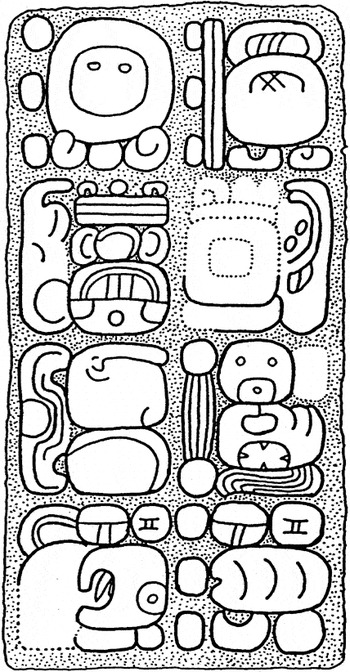
Another king's name bearing a possessive construction of this pattern is written on the Huacutal Stela (Table 1; see also Figure 2). Although somewhat eroded, the name of the ruler can be read as u-T533 K'inich followed by his emblem glyph and a hieroglyph whose exact function remains unknown. The ergative pronoun u functions here in combination with T533 surely as the relational hieroglyph “his son,” even though the phonetic reading of T533 is insecure (years ago, Grube suggested a NIK value for T533). The possessive marker is again K'inich, the sun god. Therefore the name of this king on the Huacutal Stela reads “The son of the sun god.” This name sheds most interesting light on the self-perception of this king: He states a son–father relationship to the sun god and thus implies that he has a very special personal relationship to the sun god.

Huacutal Stela, hieroglyphic caption. The inscription reads 3 Ajaw 13 Zek u waklajuun K'atun tz'apaj u lakamtuun u ??? K'inich K'uhul Ajaw Yok Ox Ajawel (on the date 3 Ajaw and 13 Zek [9.16.0.0.0, 5 May 751] his sixteenth K'atun [A2], is erected [B2], his stela [A3], “Son of the sun god” [B3], holy lord of Yok [A4], the third in the kingship [B4]). Drawn by the author after a photograph by Karl Herbert Mayer (2000:129).
A name that is not yet fully understood is Yajawte K'inich, the name of two Caracol kings (Martin and Grube 2000:330f.). Yajawte K'inich can be analyzed as shown in Table 1. The name at this point can be understood as “The Ajawte of the sun god.” As the meaning of Ajawte is not known in its full significance and recently has come under debate (Nikolai Grube and Simon Martin, personal communication, 2001), I cannot offer any further interpretation of this name at this point.
Possessive constructions with adjunct
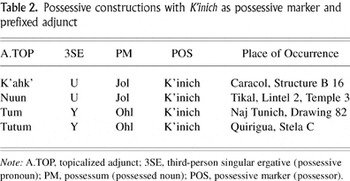
Another set of names involving K'inich lexemes as possessive markers are possessive constructions in which the possessed noun is further modified by an adjunct placed before the possessive pronoun. Examples of these names are taken by the first and sixth ruler of Caracol, who are called K'ahk' Ujol K'inich (Martin and Grube 2000:94). The morphological structure of the name can easily be deduced (Table 2). The lexeme Jol is inflected for possession by the preceding ergative pronoun u. As in the names discussed earlier, this possessive construction is followed by a noun phrase, K'inich, representing the possessive marker. However, there is an additional noun, here represented by the logograph K'AHK' ‘fire’ at the very beginning of the name. This lexeme can be interpreted as an adjunct to the possessed noun Jol (see also Grube 1999). In fact, nouns inflected for possession can bear adjuncts placed before the possessive pronoun (Hofling 2000:259), even though their normal syntactic position is right before the noun they modify (Hofling 2000:131 ff). This unusual syntactic position implies a special semantic feature. The breaking of the normal syntax and the placement of a noun in the initial position implies in Mayan languages a topicalization of the respective lexeme (Hofling 2000:193; López Ixcoy 1997:377). Thus, the noun K'ahk' is here regarded as a topicalized adjunct to the noun Jol. The construction K'ahk' Ujol can therefore be interpreted as “Fiery his head.” The noun K'inich constitutes the possessive marker of this topicalized possessive construction, leading to an interpretation of K'ahk' Ujol K'inich as “Fiery head of the sun god.” This syntagm is used as a personal name for a king and is actually a very fitting description of an aspect of a sun god who represents not only light but also fire and heat (Figure 3). The king is thereby described as the fiery-head aspect of the sun god.
Possessive constructions with K'inich as possessive marker and prefixed adjunct


Name of Caracol Ruler 1 K'ahk' Ujol K'inich, Caracol, Stela 16. The name is spelled K'AHK' u JOL (Block 1) and the head variant K'INICH (Block 2) to provide the reading for the name K'ahk' Ujol K'inich. Drawn by the author.
A very similar name is that of Ruler 30 of Tikal on Lintel 2, Temple 3: Nuun Ujol K'inich (Martin and Grube 2000:52). This name simply substitutes the adjunct Nuun (whose meaning is unknown) for K'ahk', yielding a name “The nuun-like head of the sun god” (Table 2).
Also similar to these names are the names of Rulers 2 and 5 of Caracol (Martin and Grube 2000). Both are called Tum Ohl K'inich (Grube 1999). This name is more difficult to explain morphologically because the grammatical features such as ergative pronouns cannot be detected. However, the cave walls of Naj Tunich feature the same name with a slightly different spelling (MacLeod and Stone 1995:179). There the name is spelled phonetically as tu-mu-yo-OHL k'in-chi, Tum Yohl K'inich, followed by the emblem glyph of Caracol. The name can be analyzed as shown in Table 2. The adjunct Tum is of unknown meaning. Following Tum is the ergative pronoun y, which serves as the possessive pronoun “his.” The possessed object is stated by means of the logograph for OHL, which can be translated in Mayan languages as “heart.” The possessive marker is stated as the sun god K'inich. The name can be understood as “The tum-like heart of the sun god.”
A similar name can be detected on Quirigua Stela C (Looper 1995:Figure 6.10), where it is spelled out as tu-tu-ma-yo-OHL-K'INICH, followed by the emblem glyph for Quirigua. Here Tutum is also followed by the ergative pronoun y functioning as a possessive pronoun (Table 2). The possessed object Ohl is followed by the possessive marker, the sun god K'inich. In these names, the king is described as the tum-like or tutum-like heart of the sun god, an aspect of the sun god that currently escapes understanding.
Passive constructions
A single example shows the lexeme K'inich in a possible passive-sentence name. On Tikal Stela 31, the name Sihyaj Chan K'inich can be detected. (David Stuart has pointed out the substitution patterns that led to the deciphering of the many names containing sihyaj; see Houston and Stuart 1996:295; Stuart 2000:507). The name can be analyzed as shown in Table 3. The “birth frog” logograph represents the logograph SIH, representing the verb “to be born.” It may be followed by a glide y, although this is very far from certain. The suffix -aj could constitute the thematic suffix for intransitive verbs (Lacadena 2002) or the passive marker for the verb “to be born” (Houston 1997). Complicating matters even further is the fact that the -aj suffix may be used here as an absolutizer for “gift.” Lacadena (2001:4) has identified -aj suffixes as derivational abstractivizers that substantivize verbs. Which of these solutions should be chosen remains unclear at the moment. Whichever morphological solution proves correct, the general semantics of this verb are beyond doubt. As Proskouriakoff (1960:460) has proved without phonetic reading, the combination T740:126.181 serves as a verbal compound referring to the birth of the individual named. Therefore, the general translation “to be born” is likely to be correct.
Passive constructions

As “to be born” is an intransitive verb, the agent of this verb is represented in all Mayan languages by either the absolutive pronoun or a following noun phrase. In this case, Sih-y-aj is followed by the noun phrase Chan K'inich. This can be interpreted as the noun compound “Sky Sun God,” yielding an interpretation, “The born sky sun god.” A second possibility is to interpret Chan as a locative object and K'inich as the agent. Because “to be born” is an active verb, no locative indicators are needed in Mayan languages. With this possibility in mind, the name could be translated, “Sun god is born in the sky” (Houston and Stuart 1996:295). In any case, this name describes the individual as the birth aspect of the sun god.
However, there are also names with K'inich in the post position that cannot easily be explained morphologically because they lack any grammatical features that could help to clarify their morphological structure. These include K'awiil Chan K'inich (from Machaquila and Pusilha) and Chelte' Chan K'inich from Yaxchilan. Other poorly understood names are K'ahk' Tzulaj Chan K'inich on vase K 4997 and Taj ch'am-ya K'inich on vase K 2094. Both names might be sentence names containing K'inich as an agent.
The examples given here have shown that post-fixed K'inich lexemes are integrated grammatically into possessive and passive constructions. As possessive markers and agents they are integral parts of those names and cannot be separated from them.
The anthroponyms containing K'inich as possessive marker actually describe their bearer as an aspect of the sun god. The person on Tikal Stela 31 is being described as the birth aspect of the sun god, born in the sky. The first and sixth rulers of Caracol are described as the head aspect of the sun god, which is fire. The king Upakal K'inich from Palenque is described as the shield aspect of the sun god. Of great interest here is the name of the Sak Tz'i ruler Yet K'inich, who might be interpreted as the “Companion of the sun god,” indicating his role as mouthpiece of the sun god. The ruler U-??? K'inich (Son of the sun god) referred to on the Huacutal Stela is even described as having a very personal relationship—that of a son—to the sun god.
All these names describe the king as a certain aspect of the sun god. The king is never described as embodying the whole sun god; he embodies only an aspect of him. I suggest that all of the names described earlier rigidly refer to the self of the king. This partial embodiment of the sun god reflects a partial innate divinity of the ruler's self, his individual partaking of the divine world.
Names with K'inich in the Pre-Position
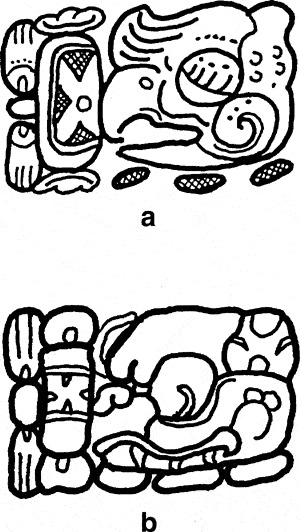
K'inich lexemes that are prefixed to other obligatory or frequent name elements are very different from the grammatical patterns observed earlier. In all of the examples, not a single one of the prefixed K'inich lexemes shows a grammatical connection to the name elements that follow. Examples include K'inich Janaab' Pakal, K'inich Kan B'alam (Figure 4), K'inich K'uk' B'alam, K'inich B'aaknal Chaak, K'inich Hun Pik Tok', K'inich Tobil Yopaat, K'inich Yo'nal Ahk, K'inich Tatab Jol, K'inich Ich'aak Chapat, and K'inich Tuun Chapat. Because one cannot observe a single example of accompanying grammatical features that connect the prefixed K'inich lexemes to the subsequent name elements, one can deduce that the prefixed K'inich elements are always adjuncts to the name elements that follow them. They serve as attributes modifying the following name elements—that is, “K'inich-like” (see also Houston et al. 2001:Table 9). Because adjuncts are a semantic category, they serve to attribute a certain quality to the name elements that follow them.

Names. (a) K'inich K'uk' B'alam (Tablet of 96 Glyphs), written with the K'INICH logograph followed by a quetzal-bird head with a jaguar ear complemented by ma, yielding K'inich K'uk' B'alam. (b) K'inich Kan B'alam (Palenque, Temple of the Cross), written with the K'INICH logograph and a snake head with a jaguar ear, complemented by ma, yielding K'inich Kan B'alam. Drawn by the author.
The hypothesis set up here is that a prefixed K'inich lexeme is a non-rigid designator that refers to the person of a ruler. A king's person is invested with the entire power of the sun, god as represented by his whole name. The postfixed K'inich lexemes that represent only an aspect of the sun god referring to a ruler's self in every context are very different. This hypothesis will be underpinned by the following analysis of the use of K'inich lexemes.
THE DIFFERING USAGE OF PREFIXED AND POSTFIXED K'INICH LEXEMES
As has been shown, there is a grammatical difference between prefixed and postfixed K'inich lexemes in Classic Maya anthroponyms. Postfixed K'inich lexemes are grammatically connected to the other parts of the names, whereas prefixed K'inich lexemes are only semantic modifiers of the other name elements. Apart from their obvious grammatical use, these K'inich lexemes show differences in the way they were used. The actual use of names may be more important to the investigation of a name's significance. Prefixed and postfixed K'inich lexemes show differences of use in internal and external references to kings.
Names with K'inich in the Pre-Position
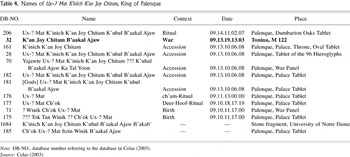
The first name analyzed here is that of K'inich K'an Joy Chitam, king of Palenque, who acceded to the throne on the a.d. 30 May 702. However, his reign did not last, as he is reported to have been taken captive just nine years after his accession. His name consists of K'inich prefixed to the other frequent name elements K'an Joy Chitam, yielding a reading K'inich K'an Joy Chitam (Sun God Yellow ??? Peccary).
As can be seen very clearly in Table 4 the prefixed K'inich lexeme is adopted during the accession. Not a single example of this king's name before his accession bears the prefixed K'inich lexeme. Therefore, it is assumed that the prefixed K'inich epithet is in some way connected with the accession ceremony. The change of names during accession is a well-known and well-documented phenomenon (Eberl and Graña-Behrens 2000; Grube 2001:73).
Names of Ux-? Mat K'inich K'an Joy Chitam, King of Palenque

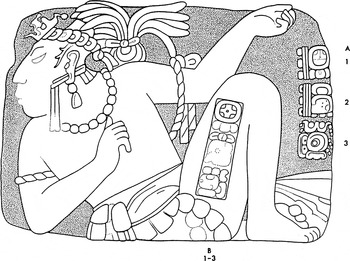
As can be seen in Table 4, K'inich K'an Joy Chitam carries his prefixed K'inich epithet in all cases but one after his accession. The only time he does not carry it after his enthronement is on Tonina Monument 122 (Figure 5). Here K'inich K'an Joy Chitam can be seen as a prisoner having been taken captive on 30 August 711. The Tonina monument does not mention his prefixed K'inich epithet. His name is given simply as K'an Joy Chitam, Lord of Palenque. Tonina Monument 122 presents an external antagonistic reference to K'inich K'an Joy Chitam that does not attribute to him the prefixed K'inich element in nominal initial position.

Tonina Monument 122. The inscription starts with the Calendar Round Date 13 Ak'bal 16 Yax (9.13.19.13.3), corresponding to 30 August 711. The next hieroglyph records a “star-war” event, as pointed out by Berthold Riese (1984), although its phonetic reading is insecure. The text continues on the prisoner's leg with his anthroponymical phrase K'an Joy Chitam B'aakal Ajaw, stating that the Palenque king was the object of the star war. Drawn by Ian Graham (Graham and Mathews 1999:153).

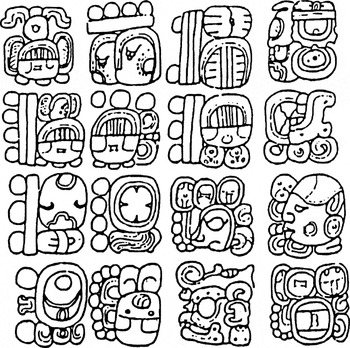
Saint Louis Column, Bonampak. The inscription starts with the Long Count Date 9.14.3.8.4 2 K'an and 12 Sutz', corresponding to 2 May 715 (A1–C1). The next two hieroglyphs record the ending (tzutzaj) of a thirteen Tun period. The actor is a king from Bonampak with an undecipherable name (D2–C3). The next hieroglyph (D3) records an overlord relationship (Yajaw) to the Tonina king B'aaknal Chaak, who is referred to in the last two hieroglyphs. Drawn by Christian Prager (Mayer 1995:Plate 103).

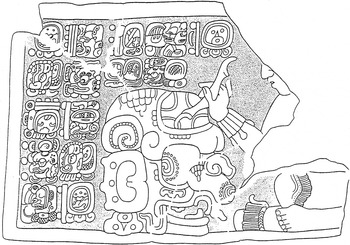
Emiliano Zapata Panel. The inscription starts with a Calendar Round Date 2 Kimi 19 Sutz' (9.10.2.6.6), corresponding to 23 May 635. The verb recorded (A2) is “to be born,” followed by the name Kan B'alam (B2). A distance number (A3–A4) leads to the death (A5) of Kan B'alam on 7 Kimi and 4* Pop (B5–C1). The last hieroglyphs record the carving of the monument (Stuart 1990:11). Drawn by David Stuart (Stuart 1990:10).
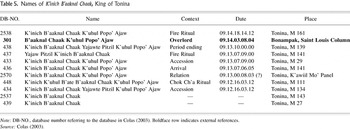
The very same pattern can be observed with the Tonina king K'inich B'aaknal Chaak (Sun God Bone Place? Raingod), who acceded to the throne on 16 June 688. Unfortunately, we have no preaccession name for K'inich B'aaknal Chaak. In all internal references at Tonina, the king carries his prefixed K'inich epithet (Table 5).
Names of K'inich B'aaknal Chaak, King of Tonina

K'inich B'aaknal Chaak is mentioned once at Bonampak. On the Saint Louis Column (Figure 6), the Bonampak king is said to be the vassal of B'aaknal Chaak K'uhul Popo' Ajaw. The foreign reference from Bonampak does not attribute to the Tonina king his prefixed K'inich epithet, even though this external reference does not necessarily have to be antagonistic.
A third example is the Palenque king K'inich Kan B'alam (Sun God Snake Jaguar), who acceded to the throne on 7 January 684. In all his numerous names except one, K'inich Kan B'alam carries his prefixed K'inich epithet. The only occurrence of his name that does not mention his prefixed K'inich epithet is the Emiliano Zapata Panel (Figure 7). This panel says that (K'inich) Kan B'alam was born on 23 May 635 (9.10.2.6.6; a wrong date is given in Stuart 1990:9) and that he died on 21 February 702 (9.13.10.1.6). The text goes on to record the carving of the monument (Stuart 1990:9 f). This panel is believed to have come from the Palenque area (Stuart 1990:9) but probably is not directly from Palenque, as its writing style differs slightly from the core Palenque style (Marc Zender, personal communication, 2001). Therefore, the Emiliano Zapata Panel might reflect a foreign reference that does mention the modifying K'inich element.
The only other possible external occurrence of Kan B'alam's name is the Jonuta monument, which strangely does mention his prefixed K'inich epithet. This occurrence is not entirely clear yet. Further, the Tablet of the Slaves shows two Palenque kings without their modifying K'inich epithet (Stanley Guenter, personal communication, 2001).
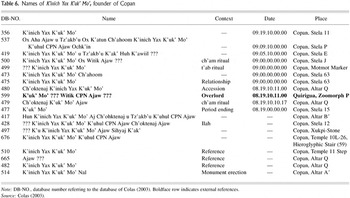
A more complicated example is the anthroponymical phrase of the founder of the Copan dynasty K'inich Yax K'uk' Mo' (Table 6). On Altar Q of Copan, the founder is said to have taken the K'awiil scepter on 6 September 426 (8.19.10.10.17). His name on this occasion is given as K'uk' Mo' Ajaw (Schele and Freidel 1990:310f.). Three days later, on 9 September 426 (8.19.10.11.0), he arrived at the foundation house, this time called K'inich Yax K'uk' Mo'. In the course of the three days, K'inich Yax K'uk' Mo' rose to kingly status (Martin and Grube 2000:192) and adopted a prefixed K'inich name element as well as a Yax element. I will not comment on the adoption of the Yax element here, but the individual obviously attains a prefixed K'inich epithet during his accession ceremony. The prefixed K'inich element seems to be tied to his accession, as was the case with K'inich K'an Joy Chitam of Palenque.
Names of K'inich Yax K'uk' Mo', founder of Copan

An accession ceremony for the king “Tok Casper” is mentioned on Zoomorph P at Quirigua on the same date, 8.19.10.11.0 (Grube et al. 1991:110; Martin and Grube 2000:216). The ruler presiding over this event is the just installed K'inich Yax K'uk' Mo', king of Copan. However, his name does not contain the prefixed K'inich epithet—or the Yax element. The occurence on Quirigua Zoomorph P is the only foreign reference to the founder of the Copan dynasty. Even though the Copan ruler has attained his K'inich epithet through his accession, the only foreign reference does not grant him his epithet, although all internal inscriptions do. It has to be kept in mind that Quirigua Zoomorph P was erected on 15 September 795 (9.18.5.0.0), almost four hundred years after the event described on the monument. It still does not grant the founder of the Copan dynasty his prefixed K'inich epithet.
A more irregular pattern occurs with Rulers 1, 3, and 7 of Piedras Negras. One of the more famous kings of Piedras Negras was Ruler 3, K'inich Yo'nal Ahk II (Sun God ??? Turtle). At birth he was named with a Jaguar-Winik hieroglyph and adopted on his accession, on 2 February 687, the name of his grandfather, K'inich Yo'nal Ahk I (Eberl and Graña-Behrens 2000; Grube 1999). Here one sees the same concept as with K'inich Kan Joy Chitam from Palenque, who adopted the prefixed K'inich epithet on accession. His name appears on Piedras Negras Stela 3 once as K'inich Yo'nal Ahk, but the subsequent occurrence does not feature the prefixed K'inich element in the context of the first K'atun accession anniversary (Maler 1901:Plate XIII). Stela 6 mentions him as K'inich Yo'nal Ahk (Maler 1901:Plate XV), and Stela 8 again makes use of both K'inich Yo'nal Ahk and Yo'nal Ahk (Maler 1901:Plate XVII). Altar 1 of Piedras Negras most likely also features the prefixed K'inich epithet, although the example is very eroded (Maler 1901:Plate VIII). This ruler's foreign references, however, feature him exclusively without the prefixed K'inich epithet. This can be seen on Dumbarton Oaks Relief Panel 1 that mentions the Piedras Negras king three times without ever employing his prefixed K'inich epithet (Coe and Benson 1966:Figure 1). A regular pattern is thus to name Yo'nal Ahk II in foreign references without his prefixed K'inich epithet.
A pattern that is even more irregular occurs at Tonina (including the recently discovered monuments). K'inich Ich'aak Chapat, Ruler 5 of Tonina, mentioned on a miscellaneous cylinder vase (Graham and Mathews 1999:179) occurs only as Ich'aak Chapat on Monument 30 at Tonina (Graham and Mathews 1996:77). However, Ruler 4 of Tonina, K'inich ??? K'ahk' (Sun God ??? Fire), always carries his modifying K'inich lexeme (Colas 2003).
But these examples from Piedras Negras and Tonina do not contradict the examples I have shown so far. Naming systems are highly inconsistent, and no stative patterns that indicate fixed onomastic laws will ever be discovered. Because onomastic systems are part of human behavior, they will remain inconsistent. However, the degree to which prefixed K'inich lexemes were omitted in foreign references indicates a tendency toward suppressing prefixed K'inich elements in antagonistic contexts. In internal contexts. the element may have been optional. In most cases, it was chosen, although sometimes it was not (a topic that will be addressed in the future).
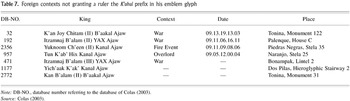
This pattern can be compared to the phenomenon of omitting the K'uhul prefix of emblem glyphs in foreign contexts, a pattern noted by Peter Mathews and John Justeson (1984:217). Emblem glyphs designate a ruler always as a divine lord of a polity, and they most often consist of a main sign, an Ajaw superfix and a K'uhul prefix (Berlin 1958). Foreign contexts, however, often do not grant rulers their K'uhul prefix. Table 7 contains some of the known examples of rulers carrying their emblem glyphs in foreign contexts without the K'uhul prefix. The occurrence of the name of K'an Joy Chitam II from Palenque, who is shown as prisoner on monument 122 at Tonina, is notable; there he does not carry his K'inich prefix. Likewise, the K'uhul prefix is omitted in this context. Both seem to be intimately related and are not mentioned in the foreign context at Tonina.
Foreign contexts not granting a ruler the K'uhul prefix in his emblem glyph

There are many counter-examples to this pattern, a notable one being Ruler 13 from Copan, Waxaklajuun Ub'aah K'awiil, who is mentioned on Stela J at Quirigua as a K'uhul CPN Ajaw, a “Holy Lord of Copan.” Apparently, the pattern of omitting the K'uhul prefix in foreign contexts is not a fixed onomastic law; it is, rather, a tendency. However, this tendency sheds light on the different perception of kings from different societies. Although he was a “holy” lord in his own sphere—probably invested with an ability to communicate and partake of the supernatural world, as reflected by the attribute “holy”—he was not perceived by another society as having those qualities and abilities. The same pattern can be seen with the prefixed K'inich epithet.
Therefore, one can conclude that a prefixed K'inich epithet has a similar reference as the K'uhul prefix of the emblem glyph. It refers to a holy sphere and aura that the ruler is entering as he becomes king. It refers to his holy “person” as king.
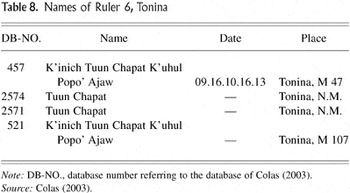
The similar reference of the prefixed K'inich epithet and the K'uhul prefix, together with the emblem glyph, can be seen in the pattern of names of Ruler 6 of Tonina K'inich Tuun Chapat (Sun God Stone Centipede). His name (Table 8) appears twice as K'inich Tuun Chapat and twice on the new monuments recently excavated by Juan Yadeun, only as Tuun Chapat without the prefixed K'inich modifier. Besides the prefixed K'inich epithet, Ruler 6 of Tonina carries his emblem glyph. Tuun Chapat always carries the K'inich epithet simultaneously with his emblem glyph. Either both are present or both are lacking. This implies that the epithet K'inich is intimately connected with the emblem glyph and thus with the concept of a divine rulership. Therefore, the prefixed K'inich epithet designated a divine quality that the king had in his office.
Names of Ruler 6, Tonina

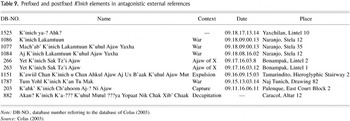
Prefixed and postfixed K'inich elements in antagonistic external references

The K'inich element prefixed to other frequent name elements is a nominal modifier of the rigid designator that follows it. It symbolizes divine kingship and thus legitimizes and strengthens the ruler's person. It serves as an adjective for the rigid designator, describing the person of a ruler as being sun-god–like. Most important, the whole name of the sun god symbolizes divine kingship and refers to a king's person. The entire power—not just an aspect—of the sun god is absorbed by a king's person. Therefore, the prefixed K'inich epithet is not mentioned in most external references because it contradicts the local lord's divine status.
The K'inich Epithet in the Post-Position
A few examples exist of important kings bearing a K'inich lexeme as part of the rigid designator in an antagonistic external reference. Tum Ohl K'inich from Caracol is often mentioned on the Naranjo hieroglyphic stairway bearing the K'inich element, although this is not a true external reference, because the Naranjo hieroglyphic stairway was probably commissioned by Tum Ohl K'inich himself and was erected at Caracol (Martin and Grube 2000:73). A true antagonistic external reference that uses the K'inich element can be found on the painted walls of Naj Tunich cave. Drawing 82 features a war between Caracol and Ixkun (Colas 1998:100 f). The Ixkun king Chak B'alam-? Tok' inflicts war on the Caracol king Tum Yohl K'inich. This reference is surely external but still uses the postfixed K'inich element for the Caracol king (Table 9). As was shown earlier, this element is grammatically connected to the other name elements and could not be omitted. Another name containing a K'inich lexeme in an antagonistic context is Yet K'inich, king of the site Sak Tz'i', who is mentioned twice at Bonampak. In both occurrences, Yet K'inich Sak Tz'i' Ajaw is mentioned as an overlord of somebody who was captured. On lintel 1, the captor is Yajaw Chan Muwaan, King of Bonampak, and on lintel 2 the captor is Chelte' Chan K'inich, King of Yaxchilan, here referred to as U Chanul Tajal Mo' (Mathews 1980). Both of these occurrences are surely antagonistic and external. But in both instances, the king carries his K'inich element. As was shown earlier, grammatically the K'inich is part of a possessive construction and therefore cannot be omitted. It is part of the rigid designator. Other examples of maintaining postfixed K'inich elements in external antagonistic references are the captives K'ahk' K'inich Ch'ahoom ??? at Palenque and K'awiil Chan K'inich at Tamarindito (Table 9).
A notable exception to this rule is K'inich Lakamtuun, who always carries his prefixed modifying K'inich epithet, even in antagonistic external references at Naranjo. According to the earlier examples, this should not be possible. However, if the K'inich epithet were omitted, the name would consist of only a single element. As Grube has noted (Grube 2001:74), anthroponyms never consist of a single element. Therefore, I suggest that in this special case, the prefixed K'inich epithet could not be omitted, because the individual could not be named only Lakamtuun. There might have been considerable confusion about what Lakamtuun would refer to. K'inich in this very special case probably became part of the rigid designator, even though it is prefixed, because it was one of only two elements. The only name that cannot be explained is the name of Ruler 7 of Piedras Negras K'inich Ya-?-Ahk? on Yaxchilan Lintel 10 (Graham and von Euw 1977:31). Here the Piedras Negras king is referred to as the prisoner of K'inich Tatab Jol, King of Yaxchilan (Martin and Grube 2000:137).
This discussion has shown a fundamental distinction between prefixed and postfixed K'inich elements. Many names containing postfixed K'inich elements show that these are grammatically connected to their preceding parts. They are an inherent part of the rigid designator to the individual. These names point to a certain aspect of the sun god that the ruler represents, his individual partaking of the divine world. I believe that these names serve to refer to the ruler's self, which had to remain unaltered in antagonistic external contexts to insure an unambiguous reference. The defined aspect of the sun god pertains rigidly in any reference to the ruler's self.
Prefixed K'inich elements show no sign of grammatical connection to the other parts of the name. Further, prefixed K'inich elements were in all cases—except for the onomastically impossible ones—omitted in antagonistic external references. I believe that this could be done because they were not part of the rigid designator designating the self of the king. Rather, they referred to the socially defined person. Thus, these prefixed K'inich epithets were not needed for an unambiguous reference to the individual.
Therefore, it can be concluded that the whole name of the sun god was used to modify the rigid designator of a king. The entire authority of the sun god thus legitimized the person of a king—his rulership, sacredness, and divine status. In external references, enemies did not grant the ruler such honor, because it probably countered the sacredness and divine status of the local lord's person.
ROYAL TITULARY IN ANCIENT EGYPT
The name of the Classic Maya sun god prefixed to a rigid designator indicated rulership and sacredness. Therefore, it would be of considerable interest to compare this concept of divine kingship with that of other ancient civilizations. Of most interest is a comparison of this concept with ancient Egyptian onomastics. The royal titulary of ancient Egyptian kings consisted of five elements, of which the last two were most frequently used (Beckerath 1984:2). The first of the three elements of the Egyptian royal titulary refers to the pharaoh's partaking of the divinity of the god Horus (Baines 1995b:123). The second name is the nb.ty name associating the king with the tutelary goddesses of the chief places in the outermost areas of the country (Baines 1995b:127). The third name, the so-called Gold Name, is very poorly understood by scientists (Baines 1995b:128) and cannot be commented on in this article. Of interest for my purposes are the last two parts of the ancient Egyptian royal titulary.
The fourth part of the royal titulary was the throne name. Until his accession, the pharaoh was referred to only by his birth name, adopting his throne name on accession (Beckerath 1984:27). Many throne names consist of elements such as “Beloved of Ra” or “Cared for by Ra” (in which Ra was the ancient Egyptian sun god). Throne names therefore described a certain relationship that the pharaoh had with the sun god. However, throne names did not refer only to a relationship to the sun god (Simon Schweitzer, personal communication 2002), although this became usual during and after the Fourth Dynasty on (Beckerath 1984:28). They can refer to Amun-Ra, Horus or Min, and other gods of the ancient Egyptian pantheon. Therefore, the throne name can be called a “biographical element” (Simon Schweitzer, personal communication 2002) that is individually chosen by each pharaoh.
The last part of a pharaoh's royal titulary consisted of his birth name, which was introduced with the title Son of Ra (Son of the Sun God). This element was taken by all pharaohs from the Fourth Dynasty on (Silverman 1995:71). It has been suggested that this element “was presumably more of an abstract compliment to the majesty and power of the living king” (Kemp 1982:660). It constitutes an unchangeable name element and obligatory ideological frame in which each pharaoh is placed on his accession (Simon Schweitzer, personal communication 2002).
Ancient Egyptian onomastics show a close relationship of the pharaoh to the sun god and the use of the sun-god name as a legitimizing factor. The title of the birth name presents an official relationship to the sun god that is shared by all pharaohs who have acceded to the throne. It is designed to legitimate the office that all pharaohs held, and thus their socially defined person. The throne name was chosen individually by each pharaoh and thus presented a closer relationship of the pharaoh's self to the sun god. The name of the sun god therefore was used for both aspects: to refer to the self of the king as well as to legitimize his socially defined person. These are the two ways to accomplish the legitimation of the pharaoh as a whole, including his self and his person.
I suggest the same concept for the Classic Maya. The prefixed name of the sun god K'inich reflects an association of divine kingship and the sun. The postfixed K'inich refers rigidly to the king's self. The name of the sun god in both cultures thus was used to legitimize divine kingship and enhance kingly power.
CONCLUSIONS
In Classic Mayan anthroponyms, a fundamental opposition exists between prefixed K'inich lexemes and K'inich lexemes that occur behind other frequent name elements.
Postfixed K'inich elements were grammatically connected to other preceding name elements. They cannot be analyzed separately from the other name elements to which they are connected. They are part of the rigid designator that describes the king as representing a certain aspect of the sun god. They are always employed in the names, even in external references, because they are an unambiguous reference to the king's self, to his innate qualities as perceived by all societies.
Prefixed K'inich epithets do not show any grammatical connection to the name elements that follow them; rather, they serve as adjuncts to the rigid designator that follows them. The whole name of the sun god is used to refer to the person of a king. A king's person is thus invested with all aspects of the sun god. Further, prefixed K'inich epithets were not mentioned in external references because they countered the local king's divine function. Moreover, prefixed K'inich lexemes first appeared at the accession of the ruler. This implies that they were adopted name elements that did not constitute part of the birth name. They refer to the divine office that the bearer held and to his socially defined person, legitimizing the person before society. A prefixed K'inich epithet, however, was more than a mere title. It did not simply designate an office that the bearer held. As the term person implies, the epithet referred to much more: to the expectations and beliefs of a society toward the person of the ruler.
The Classic Maya demonstrate a use of the sun-god name that is more diverse than that in Mesopotamia. In Mesopotamia, the king clearly distanced himself from the sun god, emphasizing only his election to office by the sun god. That is, the sun god merely sanctioned the office that the bearer held. This is similar to the prefixed sun-god name in the Maya area that refers to the person of a king. In ancient Egypt, the pharaoh showed a closer connection to the sun god and could, in certain moments, also embody specific aspects of the sun god. The pharaoh chose through his throne name a certain special relationship that he shared with the sun god. This is similar to the sun-god name as part of the rigid designator among the Classic Maya referring to the king's self. These names describe the king as embodying a certain aspect of the sun god and his partaking of the divine world.
Thus, the Classic Maya used the name of the sun god in different ways, to refer to the self and to the person of a king, to sanction the divine office and the social role of a ruler and the individual who held that office. The wide geographical distribution of these onomastical concepts of power legitimation and divine sanctioning through the sun-god name in the Maya area (and beyond) does not reflect mere programs of propaganda. The legitimation of the person through the prefixed name of the sun god and the partial innate divinity of a king's self through the grammatically connected name of the sun god is explained much better through underlying notions of divinity and rulership that were shared by all the peoples in the Maya area. Both the king's person and his own partial divine self were regarded as necessary. The king was perceived by society as the legitimate entity that explained social relations and dependency. Using the correct names helped to nurture this perception.
RESUMEN
Los reyes mayas del período clásico usaron el nombre del dios del sol K'inich para legitimarse en dos maneras. Uno de estos métodos era de nombrarse a “si mismo,” el otro era de nombrarse a “persona.” Se referió a “si mismo” por el nombre del dios del sol ligado gramaticamente con otras partes del nombre como sujeto de una frase verbal. El “mismo” del rey representaba un aspecto especial del dios del sol. La “persona” del rey se refirió por el nombre K'inich como prefijo del nombre real del rey, nunca ligado gramaticamente con ninguna parte del nombre personal. Estos dos modos de referencias también muestran differencias en el uso. Nombres del dios del sol como prefijo del nombre real no eran usadas en referencias externas, porque el rey no era respetato como una entidad social y religiosa en otras comunidades. El K'inich ligado gramaticamente con otras partes del nombre era usado tambien en referencias externas, porque se refirió solamente al “mismo” del rey y no a su función social.
ACKNOWLEDGMENTS
Many people helped to shape the ideas and form of this article. Nikolai Grube assisted by discussing with me many issues of Classic Mayan anthroponomastics. Chris Helmke and Terry Powis commented on an earlier version of the article. Bruce Love and Simon Martin commented on a later draft and helped focus the article on central issues. I thank the three reviewers of Ancient Mesoamerica for their useful suggestions. Several refinements were achieved through discussions with Markus Eberl, Daniel Graña-Behrens, Stanley Guenter, Elisabeth Löbel, Christian Prager, Simon Schweitzer, Ortwin Smailus, and Marc Zender. Gordon Whittaker and Joel Skidmore more than once turned into English prose what I had believed to be English. Finally, I thank Stephen Houston for his invaluable help and guidance throughout the writing process.
References
REFERENCES
Ahn, Gregor
1992
Religiöse Herrscherlegitimation im achämendischen Iran.
Die Voraussetzungen und die Struktur ihrer Argumentation.
Acta Iranica, No. 31.
Leiden.
Assmann, Jan
1970
Der König als Sonnenpriester. Ein kosmographischer Begleittext
zur liturgischen Sonnenhymnik in thebanischen Tempeln und Gräbern.
Abhandlugen des Deutshen Archäologischen Instituts Kairo, Vol.
7.
J.J. Augustin,
Glückstadt.
Baines, John
1995a
Kingship, Definition of Culture, and Legitimation. In
Ancient Egyptian Kingship, edited by
David O'Connor and
David Silverman, pp.
3–47.
E.J. Brill,
Leiden.
Baines, John
1995b
Origins of Egyptian Kingship. In
Ancient Egyptian Kingship, edited by
David O'Connor and
David Silverman, pp.
95–156.
E.J. Brill,
Leiden.
Beckerath, Jürgen von
1984
Handbuch der ägyptischen Königsnamen.
Deutscher Kunstverlag,
Munich.
Bendix, Reinhard
1978
Kings or People? Power and the Mandate to Rule.
University of California Press,
Berkeley.
Berlin, Heinrich
1958
El glifo emblema en las incripciones mayas.
Yournal de la Société des Américanistes, n.s.,
47:111–119.Google Scholar
Coe, Michael, and
Elizabeth Benson
1966
Three Maya Relief Panels at Dumbarton Oaks.
Studies in Pre-Columbian Art and Archaeology, No. 2.
Dumbarton Oaks,
Washington, DC.
Colas, Pierre Robert
1998
Ritual and Politics in the Underworld.
Mexicon
20(5):99–104.Google Scholar
Colas, Pierre Robert
2003
Typologische Analyse von Anthroponymphrasen in den
Hieroglypheninschriften der klassischen Maya-Kultur als Beitrag zur
allgemeinen Onomastik.
Ph.D. dissertation,
University of Bonn,
Germany.
Eberl, Markus, and
Daniel Graña-Behrens
2000
Change of Names—Change of Titles: The Accession Ritual of Classic
Maya Rulers.
Paper presented at the 5th European Maya Conference, University of
Bonn.
Geertz, Clifford
1966
Religion as a Cultural System. In
Anthropological Approaches to the Study of Religion, edited by
Michael Banton, pp.
1–46.
Tavistock,
London.
Graham, Ian, and
Eric von Euw
1977
Corpus of Maya Hieroglyphic Inscriptions.
Peabody Museum of Archaeology and Ethnology, Vol. 3, No. 1.
Harvard University,
Cambridge, MA.
Graham, Ian, and
Peter Mathews
1996
Corpus of Maya Hieroglyphic Inscriptions.
Peabody Museum of Archaeology and Ethnology, Vol. 6, No. 2.
Harvard University,
Cambridge, MA.
Graham, Ian, and
Peter Mathews
1999
Corpus of Maya Hieroglyphic Inscriptions.
Peabody Museum of Archaeology and Ethnology, Vol. 6, No. 3.
Harvard University,
Cambridge, MA.
Grube, Nikolai
1992
Classic Maya Dance. Evidence from Hieroglyphs and Iconography.
Ancient Mesoamerica
3:201–218.Google Scholar
Grube, Nikolai
1999
Onomástica de los gobernantes Mayas.
Manuscript on file,
University of Texas,
Austin.
Grube, Nikolai
2001
Los Nombres de los Gobernantes Mayas.
Arqueología Mexicana
9(50):72–77.Google Scholar
Grube, Nikolai,
Linda Schele, and
Frederico Fahsen
1991
Odds and Ends from the Inscriptions of Quirigua.
Mexicon
13(6):106–112.Google Scholar
Hewitt, Erica
1999
What's in a Name: Gender, Power, and Classic Maya Women Rulers.
Ancient Mesoamerica
10:251–262.Google Scholar
Hocart, Arthur Maurice
1970
Kings and Councillors: An Essay in the Comparative Anatomy of Human
Society.
University of Chicago Press,
Chicago.
Hofling, Charles
2000
Itzaj Maya Grammar.
University of Utah Press,
Salt Lake City.
Houston, Stephen
1997
The Shifting Now: Aspect, Deixis, and Narrative in Classic Maya
Texts.
American Anthropologist
99:291–305.Google Scholar
Houston, Stephen, and
David Stuart
1996
Of Gods, Glyphs and Kings: Divinity and Rulership among the Classic
Maya.
Antiquity
70:289–312.Google Scholar
Houston, Stephen,
John Robertson, and
David Stuart
2001
Quality and Quantity in Glyphic Nouns and Adjectives.
Research Reports on Ancient Maya Writing, No. 47.
Center for Maya Research,
Washington, DC.
Jones, Christopher
1987
The Life and Times of Ah Cacaw, Ruler of Tikal. In
Primer Simposio Mundial Sobre Epigraphías Maya, pp.
107–120.
Asociación Tikal,
Guatemala.
Kantorowicz, Ernst
1957
The King's Two Bodies: A Study in Mediaeval Political Theology.
Princeton University Press,
Princeton, NJ.
Kemp, Barry
1982
Old Kingdom, Middle Kingdom and Second Intermediate Period in
Egypt. In
The Cambridge History of Africa, Vol. 1, edited by
J. Desmond Clark, pp.
658–770.
Cambridge University Press,
Cambridge.
Kripke, Saul
1972
Naming and Necessity. In
Semantics of Natural Language, edited by
Donald Davidson and
Gilbert Harman, pp.
253–355.
D. Reidel,
Boston.
Lacadena, Alfonso
2000
Nominal Syntax and the Linguistic Affiliation of Classic Maya
Texts. In
The Sacred and the Profane—Architecture and Identity in the
Southern Maya Lowlands, edited by
Pierre Robert Colas
et al., pp.
111–128.
Acta Mesoamericana, Vol. 10.
Markt Schwaben,
Germany
Lacadena, Alfonso
2001
Gramática Maya Clásica.
III Taller de Epigrafía Maya.
Villahermosa, Mexico.
Lacadena, Alfonso
2002
Passive Voice in Classic Mayan Texts:
-[h]C-ah and
-n-ah Constructions. In
The Linguistics of Maya Writing, edited by
Søren Wichmann.
University of Utah Press,
Salt Lake City,
in press.
Laughlin, Robert M.
1988
The Great Tzotzil Dictionary of Santo Domingo Zinacantán,
Vol. 1. Smithsonian Contributions to Anthropology, No. 31.
Washington, DC.
Looper, Matthew
1995
The Sculpture Programs of Butz'-Tiliw, an Eighth-Century Maya
King of Quirigua, Guatemala.
Ph.D. dissertation,
Department of Art and Art History, University of Texas,
Austin.
López Ixcoy, Calendaria Dominga
1997
Gramática K'ichee'.
Editorial Cholsamaj,
Guatemala City.
Mauss, Marcel
1978
Soziologie und Anthropologie, Vol II.
Ullstein,
Frankfurt
(original: Sociologie e Anthropologie, Paris, 1938).
MacLeod, Barbara
1984
Cholan and Yucatec Verb Morphology and Glyphic Verbal Affixes in
the Inscriptions. In
Phoneticism in Mayan Hieroglyphic Writing, edited by
John Justeson and
Lyle Campbell, pp.
233–263.
Institute for Mesoamerican Studies, State University of New York,
Albany.
MacLeod, Barbara, and
Andrea Stone
1995
The Hieroglyphic Inscriptions of Naj Tunich. In
Images from the Underworld, edited by
Andrea Stone, pp.
155–184.
University of Texas Press,
Austin.
Maler, Teobert
1901
Researches in the Central Portion of the Usumacintla Valley.
Memoirs of the Peabody Museum of American Archaeology and Ethnology,
Vol. 2, No. 2.
Harvard University,
Cambridge, MA.
Martin, Simon, and
Nikolai Grube
2000
Chronicle of the Maya Kings and Queens. Deciphering the Dynasties
of the Ancient Maya.
Thames and Hudson,
London.
Martínez Hernández, Juan
1929
Diccionario de Motul.
Tipografía Yucateca,
Merida.
Mathews, Peter
1979
On the Glyphs “West” and “Mah K'ina.”
Maya Glyph Notes, No. 6.
Manuscript, published in Texas Notes on Precolumbian Art, Writing, and
Culture, No. 61 (1994).
Mathews, Peter
1980
Notes on the Dynastic Sequence of Bonampak, Part 1. In
Third Palenque Round Table, 1978, edited by
Merle Greene Robertson, pp.
60–73.
University of Texas Press,
Austin.
Mathews, Peter, and
John S. Justeson
1984
Patterns of Sign Substitution in Maya Hieroglyphic Writing: “The
Affix Cluster.” In
Phoneticism in Mayan Hieroglyphic Writing, edited by
John Justeson and
Lyle Campbell, pp.
185–231.
Institute for Mesoamerican Studies, State University of New York,
Albany.
Mayer, Karl Herbert
1995
Maya Monuments VII: Sculptures of Unknown Provenance,
Supplement 4.
Graz.
Mayer, Karl Herbert
1997
Maya Miscellaneous Texts, No. 1.
Academic Publishers,
Graz.
Proskouriakoff, Tatiana
1960
Historical Implications of a Pattern of Dates at Piedras Negras,
Guatemala.
American Antiquity
25:454–475.Google Scholar
Rappaport, Roy
1999
Ritual and Religion in the Making of Humanity.
Cambridge University Press,
Cambridge.
Riese, Berthold
1984
Kriegsberichte der klassischen Maya.
Baessler Archiv
30(2):255–321.Google Scholar
Schele, Linda, and
David Freidel
1990
A Forest of Kings: The Untold Story of the Ancient Maya.
William Morrow,
New York.
Schele, Linda, and
Mary Miller
1986
The Blood of Kings: Dynasty and Ritual in Maya Art.
Thames and Hudson,
London.
Silverman, David
1995
The Nature of Egyptian Kingship. In
Ancient Egyptian Kingship, edited by
David O'Connor and
David Silverman, pp.
49–92.
E.J. Brill,
Leiden.
Stuart, David
1986
The Hieroglyphic Name of Altar U.
Copan Note 4.
Copan.
Stuart, David
1990
A New Carved Panel from the Palenque Area.
Research Reports on Ancient Maya Writing, No. 32.
Center for Maya Research,
Washington, DC.
Stuart, David
2000
The Arrival of Strangers: Teotihuacan and Tollan in Classic Maya
History. In
Mesoamerica's Classic Heritage: From Teotihuacan to the
Aztecs, edited by
David Carrasco,
Lindsay Jones, and
Scott Sessions, pp.
465–513.
University Press of Colorado,
Boulder.
Stuart, David
2002
Glyphs for “Right” and “Left”?
Available from:
http://www.mesoweb.com/stuart/notes/rightleft.html.
Stuart, David, and
Stephen Houston
1994
Classic Maya Place Names.
Studies in Pre-Columbian Art and Archaeology, No. 33.
Dumbarton Oaks,
Washington, DC.
Weber, Max
1961
The Three Types of Legitimate Rule. In
A Sociological Reader on Complex Organizations, edited by
Amitai Etzioni, pp.
6–15.
Holt, Reinhart and Winston,
London.
Wichman, Søren
2000
The Names of Some Major Classic Maya Gods.
Paper presented at the 5th European Maya Conference,
University of Bonn.

Various forms of the Classic Maya sun-god name K'inich. (a) Logographic form of K'INICH (Naranjo, Panel 1). (b) The sun-god name spelled with the logograph for K'IN, followed by the syllable chi, yielding K'inich (Naj Tunich, Drawing 82). (c) The K'IN sign infixed into the chi syllable (Pusilha, Stela P). (d) The logograph for K'INICH, followed by the phonetic complements chi and ni (Cancuen, Hieroglyphic Stairs). (e) The head variant of the sun-god name K'inich, followed by the logograph K'INICH emphasizing the K'inich reading (Palenque, Palace Tablet). Drawn by the author.

Possessive constructions with K'inich as possessive marker
Huacutal Stela, hieroglyphic caption. The inscription reads 3 Ajaw 13 Zek u waklajuun K'atun tz'apaj u lakamtuun u ??? K'inich K'uhul Ajaw Yok Ox Ajawel (on the date 3 Ajaw and 13 Zek [9.16.0.0.0, 5 May 751] his sixteenth K'atun [A2], is erected [B2], his stela [A3], “Son of the sun god” [B3], holy lord of Yok [A4], the third in the kingship [B4]). Drawn by the author after a photograph by Karl Herbert Mayer (2000:129).
Possessive constructions with K'inich as possessive marker and prefixed adjunct

Name of Caracol Ruler 1 K'ahk' Ujol K'inich, Caracol, Stela 16. The name is spelled K'AHK' u JOL (Block 1) and the head variant K'INICH (Block 2) to provide the reading for the name K'ahk' Ujol K'inich. Drawn by the author.

Passive constructions
Names. (a) K'inich K'uk' B'alam (Tablet of 96 Glyphs), written with the K'INICH logograph followed by a quetzal-bird head with a jaguar ear complemented by ma, yielding K'inich K'uk' B'alam. (b) K'inich Kan B'alam (Palenque, Temple of the Cross), written with the K'INICH logograph and a snake head with a jaguar ear, complemented by ma, yielding K'inich Kan B'alam. Drawn by the author.
Names of Ux-? Mat K'inich K'an Joy Chitam, King of Palenque
Tonina Monument 122. The inscription starts with the Calendar Round Date 13 Ak'bal 16 Yax (9.13.19.13.3), corresponding to 30 August 711. The next hieroglyph records a “star-war” event, as pointed out by Berthold Riese (1984), although its phonetic reading is insecure. The text continues on the prisoner's leg with his anthroponymical phrase K'an Joy Chitam B'aakal Ajaw, stating that the Palenque king was the object of the star war. Drawn by Ian Graham (Graham and Mathews 1999:153).
Saint Louis Column, Bonampak. The inscription starts with the Long Count Date 9.14.3.8.4 2 K'an and 12 Sutz', corresponding to 2 May 715 (A1–C1). The next two hieroglyphs record the ending (tzutzaj) of a thirteen Tun period. The actor is a king from Bonampak with an undecipherable name (D2–C3). The next hieroglyph (D3) records an overlord relationship (Yajaw) to the Tonina king B'aaknal Chaak, who is referred to in the last two hieroglyphs. Drawn by Christian Prager (Mayer 1995:Plate 103).
Emiliano Zapata Panel. The inscription starts with a Calendar Round Date 2 Kimi 19 Sutz' (9.10.2.6.6), corresponding to 23 May 635. The verb recorded (A2) is “to be born,” followed by the name Kan B'alam (B2). A distance number (A3–A4) leads to the death (A5) of Kan B'alam on 7 Kimi and 4* Pop (B5–C1). The last hieroglyphs record the carving of the monument (Stuart 1990:11). Drawn by David Stuart (Stuart 1990:10).
Names of K'inich B'aaknal Chaak, King of Tonina
Names of K'inich Yax K'uk' Mo', founder of Copan
Foreign contexts not granting a ruler the K'uhul prefix in his emblem glyph
Names of Ruler 6, Tonina
Prefixed and postfixed K'inich elements in antagonistic external references
 You have
Access
- 11
- Cited by