Secundum atrial septal defects are common, with prevalence estimated at 10% of CHD.Reference Hoffman and Kaplan 1 Transcatheter closure of atrial septal defects was first described by King and Mills in 1976,Reference King, Thompson and Steiner 2 paving the way in the design of contemporary double-disc devices. Since the release of the Amplatzer Septal Occluder (AGA Medical Corporation, more recently St Jude Medical) in 1997, transcatheter closure has become the standard of care in treating atrial septal defects. Multiple, large, multi-centre trialsReference Roos-Hesselink, Meijboom and Spitaels 3 – Reference Berger, Vogel and Alexi-Meskishvili 6 have demonstrated that transcatheter closure is comparable with surgical closure with respect to the rates of successful atrial septal defect occlusion achieved, but offering benefits of lower morbidity, shorter hospital stay, and greater cost-effectiveness.
Recent post-marketing surveillance studies of the Amplatzer septal occluder have focussed on its utility in closing larger defectsReference Romanelli, Harper and Mottram 7 , Reference Varma, Benson and Silversides 8 and the emergence of device erosion as a complication.Reference Moore, Hegde and El-Said 9 – 12 The Food and Drug Administration Manufacturer and User facility Device Experience group in 2004 published an incidence of 0.1% of device erosion with transcatheter closure.Reference DiBardino, McElhinney and Kaza 11 An e-mail survey of members of the Congenital Cardiovascular Interventional Study Consortium in 2009 found 14 cases of device erosion from 3010 implants.Reference El-Said and Moore 13 These findings resulted in major changes in the Instructions for Users for the Amplatzer device by AGA Medical. 14
Our team receives referrals for transcatheter closure of atrial septal defects from across New Zealand and the neighbouring Pacific Islands. In New Zealand, transcatheter closure of atrial septal defects was first introduced in 1995 at Green Lane Hospital, Auckland, using the Sideris double button umbrella device. In 1997, the Amplatzer septal occluder became available for use in New Zealand, and remains the most common device implanted for transcatheter atrial septal defect closure. This retrospective review encompasses our entire experience since 1997, with all procedures performed on children and adults included. Our specific focus was on procedural complications.
Materials and methods
Study design
A retrospective review of 581 consecutive patients at our institution who underwent an attempted transcatheter device closure of an atrial septal defect from December 1997 to the end of June 2014 was undertaken. All patients were recorded on our catheterisation database as having had a catheter procedure with a secundum atrial septal defect as the primary cardiac diagnosis and/or an interventional procedure where device closure of an atrial septal defect was recorded. Patients with patent foramen ovale or Fontan fenestration closure were excluded from the review. Patients with secundum atrial septal defect as the primary cardiac diagnosis who underwent a cardiac catheterisation study without intention to attempt transcatheter closure – for example, resistance studies in pulmonary hypertension – and those with additional important CHD – for example, pulmonary atresia intact septum – were also excluded.
Using the catheterisation database, patients selected as having had any complication related to the procedure, or where complication details were not completely recorded in the database (left blank), were identified. Subsequently, the records of patients with confirmed complications were further reviewed. Complications were classified as one of the following: device embolisation, arrhythmia, device erosion, vascular access-related, device malposition, and other/unspecified. For this review, arrhythmia was defined as the new onset of an abnormal rhythm requiring treatment – that is, brief, non-sustained arrhythmia was not reported in the database. Using knowledge of the timing of publications relating to device erosion and new recommendations from 2004, we then compared the incidence of device embolisation before and after the end of 2004, using a two-sample z-test.
Atrial septal defect device closure
Pre-catheterisation assessment
Patients were identified and referred to our institution by medical specialists around New Zealand and neighbouring Pacific Islands for consideration of transcatheter closure of an atrial septal defect. Patients were then assessed by a paediatric or adult congenital cardiologist for suitability of transcatheter atrial septal defect device closure with a detailed transthoracic echocardiogram. All adult patients were also assessed with a transoesophageal echocardiogram. On occasions, particularly in the adult group, a cardiac MRI study was requested. Our indication for intervention was the presence of right ventricular dilatation, indicating a significant left-to-right shunt, in patients where the anatomy of the defect appeared suitable for device closure by its size, location, and adequacy of surrounding rims.
Implantation Procedure
Our standard technique for device closure follows the current manufacturer’s recommendations for transcatheter closure of atrial septal defects. The procedure was performed under general anaesthesia in our cardiac catheter laboratory with two cardiologists – one performing the transcatheter intervention and the second performing a transoesophageal echocardiogram during the procedure. Femoral venous access was obtained, and a right heart study was performed to measure right heart pressures and calculate the pulmonary flow-to-systemic flow ratio. All patients were initially heparinised with 100 U/kg heparin (to a maximum of 5000 U) maintaining an ACT>200. A 0.035-inch or 0.032-inch ‘J’ tip guidewire, guided by an end-hole catheter, was used to cross the atrial septal defect, and positioned in the left or right upper pulmonary vein. An Amplatzer sizing balloon (initial manufacture AGA Medical Corporation, more recently St Jude Medical) was then inflated across the defect to balloon size the defect on both fluoroscopy and transoesophageal echocardiogram. Once concordance was obtained between both techniques, and no residual shunt was confirmed on the transoesophageal echocardiogram, the balloon was deflated and removed. The atrial septal defect device was then selected and deployed via the recommended delivery sheath system and positioned across the defect using fluoroscopy and transoesophageal echocardiogram guidance. Transoesophageal echocardiography was used to confirm adequate device position. Once both cardiologists agreed, the device was released. Transoesophageal echocardiography was used to make a final assessment before the sheaths/catheters were removed.
Device type
The device chosen was at the discretion of the operator; four Cardioseal devices (NMT Medical Corporation) were implanted as part of the early experience, but the great majority of implants were with Amplatzer devices. From mid-2010, we had access to Occlutech devices (Flex-I and later Flex-II, manufactured by Occlutech). Where a complication occurred, the details of the device used were checked and recorded for this analysis. A total of five patients had two Amplatzer devices implanted. For the purposes of the analysis below they have each been counted as a single Amplatzer patient.
Patient follow-up
The day following implantation, a transthoracic echocardiogram and electrocardiogram (ECG) were performed to confirm device position and exclude any complications. Clinical and echocardiography follow-up occurred at a minimum of 1 month and 12 months following device closure. All patients included in the review had a minimum of 12 months of follow-up.
Results
Patient demographics
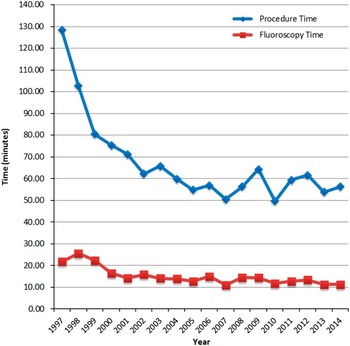
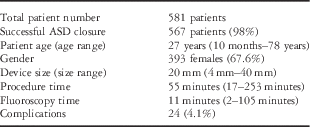
Transcatheter atrial septal defect device closure was performed successfully in 567 of 581 patients (98%). The demographics of patients who underwent attempted atrial septal defect device closure are comparable with other publications and are detailed in Table 1. The device type and the years during which they were implanted are as follows: Amplatzer Septal occluder 1997–2014 (n=517), Occlutech 2010–2014 (n=46), CardioSeal 1998 (n=4). In 14 of 581 (2.0%) patients, a device was deployed but re-captured before release because of potential for complications. Of these, 10 cases involved very large defects requiring devices ⩾30 mm in diameter. The median age of patients was 27 years (with a range from 10 months to 78 years of age), and 361 patients (62.1%) were adults (16 years of age or older). The median device size was 20 mm (with a range from 4 to 40 mm). Large devices over 25 mm accounted for 25.6% (n=149) of all devices implanted. The overall median procedure and fluoroscopy times are as shown in Figure 1. The annual mean procedure and fluoroscopy times have trended down since the initial device closures in 1997/98, as shown in Figure 1.
Procedure time and fluoroscopy time from 1997 to 2014.

Patient demographics (age, device size, procedure time, and fluoroscopy time expressed as medians).

ASD=atrial septal defect
Complications
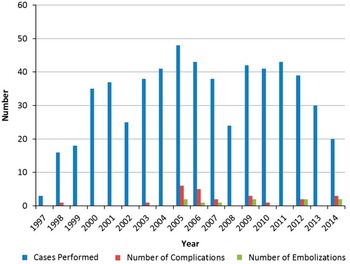
There were a total of 24 complications affecting 23 patients – that is, 4.1% (95% confidence interval 2.5–5.7%). Figure 2 demonstrates the number of complications per year with the number of cases performed for that year. Of the 24 complications, there were 10 device embolisations (1.7%–95% confidence interval 0.65–2.75%), nine arrhythmias (1.5%), two vascular access-related complications (0.3%), one device erosion (0.2%), one malposed device (0.2%), and one probable wire perforation of the eft atrial appendage (0.2%). Among these, three complications occurred >24 hours after device implantation – device erosion 8 days after implantation and two embolised devices detected at 1 month and 8 months after implantation. There was one death in our case series secondary to device embolisation.
Annual number of complications with number of cases performed.

Device embolisation
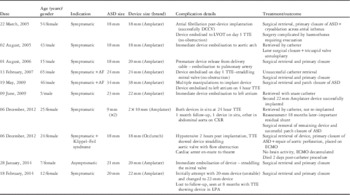
Device embolisation was the most common complication following atrial septal defect device closure (cases summarised in Table 2); nine complications occurred with the Amplatzer device and one with the Occlutech device (p=0.57). The first device embolisation occurred in 2005, just over 7 years into our experience. Of the 10 device embolisations, four occurred at the time of the procedure, two within 4 hours of the procedure, two within 24 hours of the procedure, and two occurred late (described above). Among all, three devices were successfully retrieved in the catheter laboratory. Only one of these patients had successful transcatheter device closure with a second device (of the same size), with two patients referred for later surgical closure. We retrieved seven embolised devices with the defect closure surgically, and one of the device embolisations was preceded by the onset of atrial fibrillation in the catheter laboratory, which required electrical cardioversion after device implantation at the end of the procedure. The device embolisation was detected the following day.
Case summary of device embolisations.

AF=atrial fibrillation; ASD=atrial septal defect; CXR=chest X-ray; DCCV=direct current cardioversion; ECMO=extracorporeal membrane oxygenation; LPA=left pulmonary artery; LVOT=left ventricular outflow tract; TTE=transthoracic echocardiogram
On review of the embolisation data in all cases the device chosen was close to the recorded balloon-sized estimate, with the largest variation being one case where a 38-mm device was implanted for an estimated 34-mm defect. Only two devices were implanted with diameter less than the estimated on balloon sizing and then only by 1 mm, and one embolisation was felt likely secondary to improper loading of the device onto the delivery cable by a trainee operator.
There was one death following device embolisation. The patient was a 24-year-old female with a background of Klippel–Feil syndrome who required particular care around the neck extension and had difficult transoesophageal echocardiogram views. The defect measured 18 mm on transoesophageal echocardiogram, and an 18-mm Occlutech device was placed. The patient was reviewed because of blood pressure instability in the recovery room and a diastolic murmur was noted. An urgent portable chest X-ray showed the device to be within the cardiac silhouette. A transthoracic echocardiogram showed no effusion but the embolised device was seen straddling the aortic valve with significant aortic regurgitation. Surgical retrieval was urgently arranged; however, before transfer, the patient had a witnessed collapse and arrest. Cardiopulmonary resuscitation was performed en-route to theatre with chest opening and cannulation performed. Important findings in theatre included tamponade with erosion of the device into the aortic root, the device still lodged across a bicuspid aortic valve, an intramural course to the origin of the left coronary artery, and a tear in septum primum tissue resulting in an increased inter-atrial defect size. The atrial septal defect and erosion were repaired at the time of surgery with device removal, and the patient was placed on an extracorporeal membrane oxygenation circuit. When evoked potentials were subsequently assessed, unfortunately no brain activity was recorded. A decision was made to withdraw extracorporeal membrane oxygenation, and the patient died 2 days after the original catheter procedure.
Over the review period, there were 10 different operators with varying levels of experience. Among them, five operators performed <20 procedures, and since 2006 these procedures have almost exclusively been performed by four operators. Embolisation events were distributed among operators with no clear relationship to volume or experience.
Before the beginning of 2005, we had performed 213 cases with no cases complicated by device embolisation. All of the 10 device embolisations have occurred from the subsequent 368 cases in our total experience (2.7% of these later implants), with this difference being statistically significant (p-value 0.015).
Arrhythmia
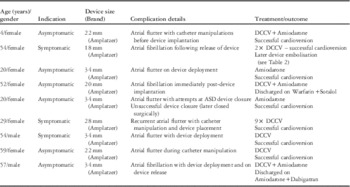
Atrial arrhythmias were the second most common complications seen, with six cases of atrial flutter and three cases of atrial fibrillation (summarised in Table 3). All six episodes of atrial flutter occurred during the procedure with either catheter manipulation or during the process of implanting the atrial septal defect device. Only four patients responded to either electrical or medical cardioversion, and two patients required both electrical and medical cardioversion to achieve sinus rhythm. There was no recurrence of atrial flutter following treatment, and no long-term sequelae/treatment required. Atrial fibrillation occurred during the implantation of an atrial septal defect device in two patients and in one patient was observed immediately after device implantation. Only one patient reverted to sinus rhythm with electrical cardioversion; however, as detailed above, this patient also suffered device embolisation. At the time of surgery, cryoablation was performed across the atrial isthmus. The other two patients with atrial fibrillation received medical therapy following cardioversion, one with sotalol and warfarin and the other with amiodarone and dabigatran. In total, five patients with atrial arrhythmia had implantation of large devices (⩾25 mm) with four of these being 34-mm Amplatzer devices.
Case summary of arrhythmia complications.

ASD=atrial septal defect; DCCV=direct current cardioversion
Vascular access-related complications
There were two patients with significant vascular access-related complications including a retroperitoneal haematoma and an arteriovenous fistula. The retroperitoneal haematoma resulted in temporary foot drop, but resolved with conservative management. The arteriovenous fistula required surgical repair. The records included five cases of superficial haematomas, all of which were managed conservatively and did not require blood transfusion. These were not included in our review, as they did not require intervention. In addition, we feel this likely underestimates the true incidence of superficial haematomas.
Device erosion
There was one case of late device erosion in our series of patients, occurring in an adult patient. The patient had an atrial septal defect sized at 21 mm and underwent implantation of a 22-mm Amplatzer septal occluder. The device was stable before discharge with no pericardial effusion; however the patient re-presented on day 8 with cardiac tamponade requiring urgent pericardiocentesis, transfusion, and surgery for device retrieval, repair of perforation, and closure of atrial septal defect. At operation, it was noted that there was a perforation that included the posterior wall of the aorta and the anterior roof of the left atrium. The recovery was unremarkable with no long-term sequelae.
Other complications
Device malposition was encountered in one patient aged 16 years with a very large defect. The defect measured up to 39 mm in some views on transoesophageal echocardiogram, thought to be an overestimate, and therefore a 34-mm Amplatzer device was selected. Before release, the device appeared stable; however, following release, the device tilted into the left atrium, causing obstruction to the right lower pulmonary vein on transoesophageal echocardiogram. The device was retrieved surgically, and the defect was closed primarily with no other complications.
The other complication in the series was a probable wire perforation before device implantation. On securing a wire position, the wire did not enter the left upper pulmonary vein in the standard fashion. A 24-mm Amplatzer device was successfully implanted; however, 2 hours following the procedure, the patient developed a large pericardial effusion with tamponade. An urgent pericardiocentesis followed by surgical exploration was performed. The latter showed a clot at the base of the left atrial appendage without an identifiable puncture site. There was no suggestion of device erosion, and the device was left in situ with no later complications.
Discussion
Our overall complication rate of 4.1% was comparable with that found in other studies using the Amplatzer device – 7.2% in a large United States multi-centre studyReference Du, Hijazi and Kleinman 4 and 4.8% from the more recent large United States multi-centre Magic registry.Reference Everett, Jennings and Sibinga 15 Types of complication seen were consistent with previous reports. Device embolisation and arrhythmia are most commonly reported, whereas device malposition and device erosion appear to be rare.Reference Du, Hijazi and Kleinman 4 , Reference Berger, Vogel and Alexi-Meskishvili 6 , Reference DiBardino, McElhinney and Kaza 11 Other complications infrequently reported in the post-market surveillance of the Amplatzer septal occluder, including device thrombus and infection, including endocarditis, were not encountered in our series. From the 46 Occlutech implants, we recorded one major complication as described. There was no statistical difference in proportions of complications with the ASO and the Occlutech devices. A recent, large, multi-centre retrospective study has confirmed a low rate of complications with this device type with a 1.5% rate of intraprocedural embolisation, in addition to 5 or 0.4% late embolisation, no erosions seen, and significant arrhythmia during implantation requiring treatment in 16 or 1.2%.Reference Haas, Soetemann and Ates 16
The incidence of device embolisation was observed to be greater in our group, occurring in 1.7% of total cases, with reported device embolisation in other series ranging from 0.5 to 1.1%.Reference Du, Hijazi and Kleinman 4 , Reference DiBardino, McElhinney and Kaza 11 , Reference Chessa, Carminati and Butera 17 , Reference Levi and Moore 18 The explanation for the higher incidence of device embolisation is not entirely clear. Interestingly, the first device embolisation occurred in 2005, with 217 previous device implants, and certainly our embolisation rate after 2004 and the revised Instructions for Users are demonstrably higher. 14 We speculate that the modifications to prevent device erosion may have resulted in a tendency to relative under-sizing of the device, resulting in an increased embolisation risk, although we are unable to support this theory from the recorded balloon sizing data. It is possible that other factors related to implanter confidence or experience may also play a role.
It may be felt that embolisation is a relatively minor complication when compared with device erosion; however, in our series, device embolisation has resulted in seven open-heart surgical procedures for device retrieval and surgical closure of the atrial septal defect, and a further two cases requiring surgical closure of their atrial septal defects following catheter retrieval of the device. In addition to this, device embolisation has also resulted in our only mortality from atrial septal defect device closure.
The incidence of atrial arrhythmia of 1.5% was modest in our patient group when compared with the early, large, multi-centre United States study, which reported an incidence of 3.4%, and the more recent single-centre review of arrhythmias following atrial septal defect device closure by Johnson et al, which reported an incidence of 5.2%.Reference Du, Hijazi and Kleinman 4 , Reference Johnson, Marquardt and Ackerman 19 Arrhythmia is not an uncommon event during a cardiac catheterisation procedure, and in two of our cases atrial flutter occurred with simple catheter manipulation. Most arrhythmic complications were benign with only two patients requiring ongoing treatment for atrial fibrillation following device implantation. This review was undertaken with data from our catheterisation database and we have not included data on late atrial arrhythmia recurrence.
Device erosion is a rare but very serious complication. Detailed analysis of the Manufacturer and User facility Device Experience database by DiBardino et alReference DiBardino, McElhinney and Kaza 11 have estimated the risk of this complication at 0.28%, which was higher than the 0.1% estimate from the earlier registry analysis by Amin et alReference Amin, Hijazi and Bass 20 The importance of aortic rim deficiency has been highlighted in a recent case–control study, which implicated deficiency of any rim, device size >5 mm larger that atrial septal defect diameter, and weight:device size ratio as potential associations in multivariate analysis.Reference McElhinney, Quartermain and Kenny 21 Our experience confirms this is a rare occurrence with only a single case identified. The patient profile fitted somewhat with potential multivariate risk factors identified by McIlhinney et al in that there was a deficient retroaortic rim and patient weight:device size was smaller at 2.4; however, the device size was just 4 mm greater than the static diameter (18-mm defect, 21-mm on balloon sizing by transoesophageal echocardiogram, and 22-mm device). It is clearly not possible, however, to draw additional inference from this single case.
As noted in one additional instance, an embolised device eroded through the aortic root, possibly related to cardiac compressions.
Study limitations
This article describes complete experience over almost 17 years from a single centre. It includes, however, multiple operators and evolving approaches and techniques. As congenital cardiac care in New Zealand is coordinated from a single tertiary centre, from which we have excellent networks for follow-up, it is unlikely any major late complications would have occurred without our knowledge. All operators are encouraged to enter even the most minor complications into our catheterisation database, but we recognise potential for under-reporting.
Conclusion
From our experience, transcatheter closure is an effective and safe method for managing secundum atrial septal defects in paediatric and adult patients. The incidence of device embolisation seen was higher than that anticipated, and we regard this as a potentially serious complication, resulting in both morbidity and the only mortality in our experience. Since the introduction of the early modifications to the Instructions for Users were made to reduce the risk of device erosion, our incidence of device embolisation significantly increased. Ongoing data collection and research into risk factors for device embolisation are needed to further improve safety for this common procedure.
Acknowledgements
The authors acknowledge the collaboration, particularly of referring cardiologists in the care of these patients. The authors thank Karishma Sidhu for her statistical assistance and Charlene Nell for her assistance in manuscript preparation.
Financial Support
This research received no specific grant from any funding agency or from commercial or not-for-profit sectors.
Conflicts of Interest
None.