The National Academy of Medicine (NAM) described emergency medical services (EMS) as fragmented, exhibiting an absence of system-wide coordination, as well as a lack of federal, state, and local accountability. Reference Graham, McCoy and Schultz1 The NAM recommended understanding the roles of federal and state governments, and local communities in EMS systems oversight, and determining how stakeholders and organizations may work together to improve prehospital care. Reference Graham, McCoy and Schultz1
Background
The role of EMS in the United States is multifaceted and includes emergency response, acute medical care, transportation, public health, and community health. EMS plays a critical role in prehospital care during both routine and catastrophic circumstances. EMS systems and providers are a key component of the U.S. mass casualty incident (MCI) and disaster response infrastructure. 2,Reference Catlett, Lee Jenkins and Millin3 During MCIs and disasters, EMS functions include on-scene triage of casualties, stabilization, administering critical life-saving interventions, and patient transport to hospitals for definitive care. Further, through communication with receiving facilities, EMS plays a key role in ensuring that patients are transported to facilities with capabilities to care for patients, depending on the need for specialty care or critical care resources, and that patients are distributed to area hospitals in a way that no single hospital is overwhelmed. EMS’s key role in disaster response was evident during the response to recent MCIs, including the Boston Marathon bombings, the West Texas fertilizer plant explosion, and many mass shootings.
Importance
There is significant variability in EMS performance and oversight across the United States. Reference Taymour, Abir and Chamberlin4,5 The vast majority of prehospital care is dictated by written protocols or standing orders. Reference Graham, McCoy and Schultz1 Some states have statewide protocols. The implementation of these protocols may be mandatory for EMS agencies, or the protocols may be examples for the EMS agencies to adapt as they see fit. Reference Kupas, Schenk and Sholl6 In other states, protocols are developed at a regional or local level with varying levels of input from government entities.
In Michigan, EMS oversight is conducted by 60 Medical Control Authorities (MCAs). MCAs are organizations designated by the Michigan Department of Health and Human Services (MDHHS) as responsible for EMS oversight in defined geographic areas (Figure 1). MCAs serve as a quality assurance oversight body ensuring EMS agency adherence to state policies and protocols. As such, their role is critical in optimizing daily EMS care delivery and care delivered during MCI and disaster response.
Example of Michigan EMS Oversight Structure

Goals of This Investigation
The existing literature on EMS oversight generally outlines the role of oversight (eg, medical direction and quality assurance). How these responsibilities are carried out in practice and what factors facilitate them is less known. Given that EMS oversight involves complex relationships between multiple stakeholders – federal, state and local governments, hospitals, transport agencies, and first responders – we conducted a qualitative study to understand the modifiers (ie, facilitators and barriers) of EMS oversight quality. Such knowledge will be important for improving the quality of prehospital care in both routine and disaster settings where EMS plays a critical response role. The qualitative approach used in this study is highly suited to identifying interactions in complex systems (such as emergency medical systems) and elucidating what happens, how it happens, and why. Reference Hohmann and Shear7,Reference Mendel, Meredith and Schoenbaum8
METHODS
Study Design and Setting
Using the results of a recent systematic review on EMS quality measurement, Reference Taymour, Abir and Chamberlin4 and with input from content experts from MDHHS, we developed a guide for focus groups and key informant interviews to be conducted with EMS stakeholders in Michigan. Those stakeholders included MCA medical directors and administrative/executive directors, hospital administrators, quality improvement (QI) coordinators, paramedics, and emergency medical technicians (Supplementary Appendix 2). We conducted 4, 90-minute focus groups ranging from 5–13 participants, along with 10, 60-minute key informant interviews, as part of a broad evaluation of quality measurement of EMS oversight. Detailed notes taken during interviews and focus groups were analyzed using the rapid analysis technique. Reference Beebe9,Reference Hamilton10 Data were entered into a Microsoft Word document and Microsoft Excel spreadsheet (Microsoft Corporation, Redmond, Washington).
This study was deemed not regulated by our institution’s Institutional Review Board.
Selection of Participants
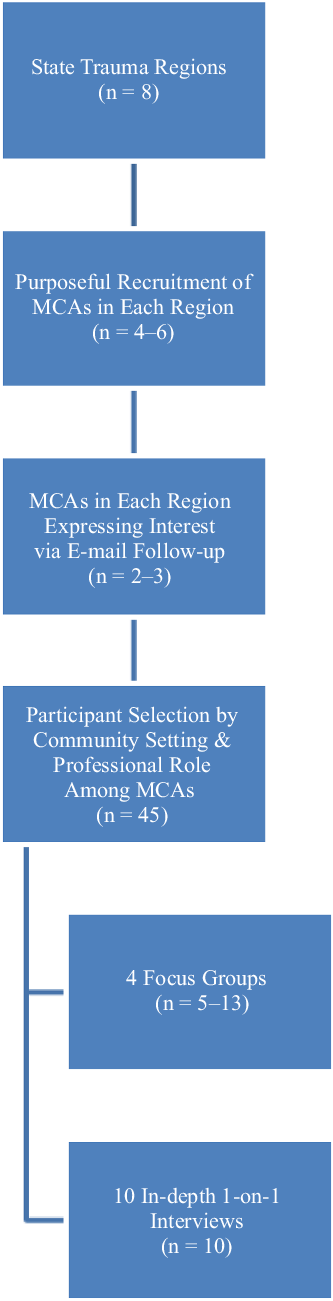
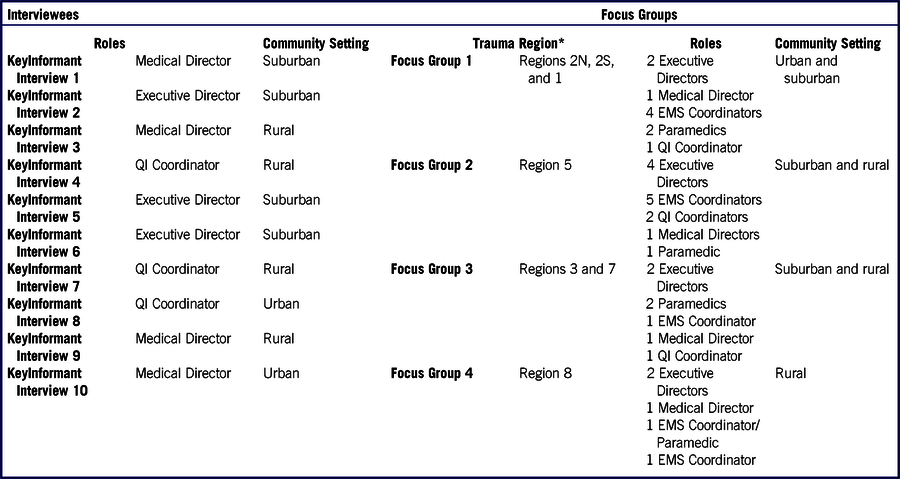
The recruitment strategy for focus group and 1-on-1 interviews with participants was developed with input from MDHHS partners. The state is divided into 8 trauma regions that coordinate as a network to provide oversight for trauma care and regional preparedness. 11 MCA stakeholders were sampled based on trauma regions to guarantee the inclusion of geographically distinct areas (Figure 2). Geographic clustering also facilitated a shared understanding of each region’s practices, needs, and relationships, helping to promote rapport between focus group participants and reduce barriers to discussion. From each region, we sought input from 4–6 MCAs representing urban, rural, and suburban settings. Potential participants from each designated MCA were contacted by e-mail and/or phone using semi-structured recruitment scripts. From those expressing interest, final key-informant and focus group participants were selected in a manner that ensured that the diversity of prehospital professional roles was represented. In the end, 4–6 participants were selected from each of the 8 trauma regions (Table 1).
Purposeful Sampling Strategy for Focus Groups and In-Depth Interviews

Key Informant Interview and Focus Group Participant Characteristics

* MI has 8 trauma regions delineated by geographic proximity and similarity as determined by the Michigan Department of Health and Human Services. These trauma regions are responsible for the coordination of trauma care in their areas and were used in sampling MCAs to assure geographic diversity.
We performed both focus groups and individual interviews in order to leverage the strengths of each strategy. Reference Lambert and Loiselle12 Focus groups allowed for multi-disciplinary discussions among local EMS coordinators, paramedics, and administrative and/or medical directors, while interviews with MCA directors and QI coordinators allowed for in-depth discussions and further exploration of issues raised in the focus groups.
Measurements
One of 3 study members conducted each of the 4 focus groups and the 10 1-on-1 interviews while another member took detailed notes. Interview and focus group guides (Supplementary Appendices 1 and 2) were developed to begin with an open-ended question regarding successful EMS oversight then progress to more specific areas, such as QI efforts and relationships with prehospital EMS providers and hospitals.
Analysis
We used the rapid analysis technique, a team-based method of ethnographic inquiry using triangulation and iterative data analysis to develop actionable information from an insider’s perspective in order to inform state policy. Reference Beebe9,Reference Hamilton10 We developed a template to summarize notes from the interviews and focus groups, structured by questions from our interview guides. After the conclusion of each interview or focus group, 2 members of the study team analyzed notes. This involved taking each set of notes and extracting responses into the structured rapid-analysis template in the form of summary statements and illustrative quotes. When the extraction of notes was completed, the 2 analysts held consensus meetings to compare and group their summaries into emergent themes. Reference Given13 The extracted statements from each consolidated rapid analysis template were then put into a Microsoft Excel matrix, Reference Miles, Huberman and Saldana14 ordered by data collection event and summary template categories. Common themes were condensed by 1 author through the deletion of repeated statements and merging of similar themes. The final condensed matrix of themes was summarized to report results.
RESULTS
Main Results
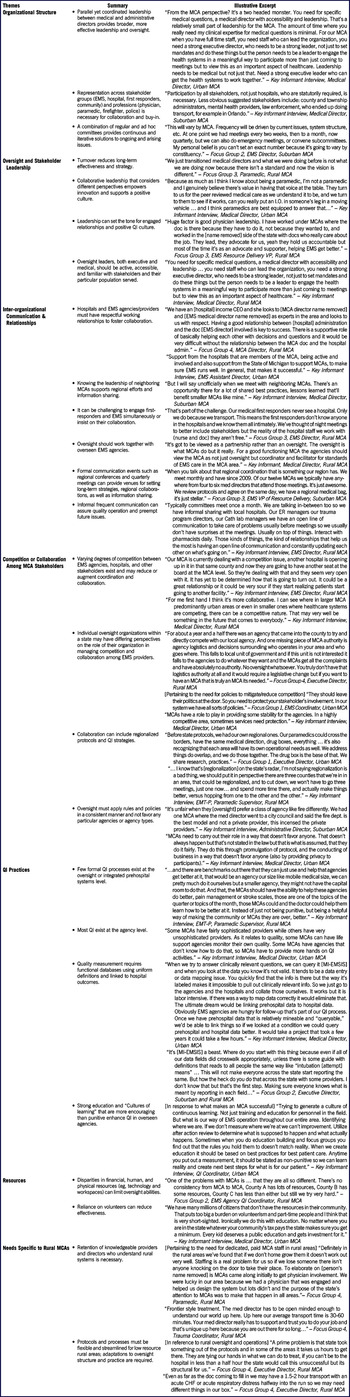
Emergent themes regarding barriers and facilitators to EMS oversight were organizational structure, stakeholder leadership, interorganizational communication and relationships, competition or collaboration among stakeholders, QI practices, resources, and needs specific to rural communities. See Table 2 for summaries and illustrative excerpts regarding these themes.
Themes and Findings

Organizational Structure
Organizational structure refers to the MCA and its subcomponents described previously. Participants repeatedly emphasized that parallel yet coordinated leadership between the medical director and the administrative staff facilitates effective EMS oversight. Functional, independent administrative staff allow medical directors to concentrate on protocol concerns, whereas vested medical directors allow administrative staff to focus on long-term QI and operations. For MCAs in urban areas with high volumes or ample resources, dedicated QI coordinators were described as invaluable in handling daily QI efforts, effectively freeing administrative directors to dedicate time to the execution of the MCAs’ larger strategy.
Representation of all stakeholder groups on MCA committees was felt to correlate strongly with a successful oversight system. The inclusion of field staff, such as paramedics, is important in order to understand barriers to appropriate care or protocol implementation. Inclusion of leaders from the various stakeholder groups gives the committee decision-making capacity and authority to act without seeking approval from the stakeholder. Lack of representation reduces buy-in, collaboration, and engagement.
In addition to the composition of committee membership, meeting frequency and adaptability/flexibility emerged as important aspects of the MCA organizational structure that can promote strong and effective oversight. Participants reported that a combination of regular and ad hoc committees was necessary to provide continuous and iterative solutions to ongoing issues. While many committees, such as QI, were applicable across different regions, participants stated that other committees require adaptations based on locality.
Participants noted that it would be helpful if MDHHS were to clarify the best organizational models for MCAs but stopped short of endorsing specific organizational requirements for all MCAs.
Oversight and Stakeholder Leadership
Oversight and stakeholder leadership referred to MCA medical and administrative directors and the leadership of MCA stakeholders, such as hospitals and EMS agencies. Staff turnover was noted to be a challenge to effective leadership, often resulting in a reduction in daily operational efficiency and long-term MCA effectiveness. Having a long-term, full-time physician medical director with prehospital experience and a strong understanding of EMS systems was repeatedly echoed to be vital to quality oversight. This person should be readily accessible to the prehospital care team for online medical direction in unusual circumstances or for complicated patients. The importance of medical directors being aware of EMS field operations insituations that necessitate deviation from protocol was expressed often.
In addition to consistency, commitment, and accessibility, effective MCA management requires a collaborative leadership style. Participants indicated that a focus on teamwork embraces different perspectives, empowers innovation, and supports positive QI culture. Impartiality and a willingness to learn were also described as essential to effective leadership.
Some participants suggested that MDHHS should consider creating regional medical directorships between several MCAs, especially in areas with few experts.
Interorganizational Communication and Relationships
Communication and relationships refers to interorganizational interactions. It was reported that communication fosters long-lasting relationships. Regular, informal means of communication were felt to ensure quality operations by preempting future conflicts between providers or concerns between providers and the MCA. While less frequent, formal communication events, such as conferences and quarterly meetings, were noted to provide venues for regional networking and strategy development, prompting organic information exchange and diversification of ideas.
Besides communication, other facilitators of healthy relationships mentioned by participants were inclusion and transparency. For example, involving different stakeholders in protocol development supports a positive working relationship between MCAs and provider organizations they oversee. Even if included in a non-voting role, EMS agencies repeatedly conveyed that they felt more comfortable with the MCA decision-making process if they were included on MCA committees.
Some participants recommended that MDHHS promote forming regional MCA councils that meet a few times a year as a way of encouraging cross-MCA communication and relationships.
Competition or Collaboration Among MCA Stakeholders
Competition or collaboration refers to the varying degrees of teamwork between EMS agencies, hospitals, and other stakeholders on shared initiatives, resulting in reduced coordination, or improved cooperation. Although opinions on this differed, the majority of participants reported that there was no role for MCAs in managing competition between agencies or hospitals, and no legal authority for them to do so. Most reiterated that the MCA should focus on what is best for the citizens that it serves and facilitate a culture of cooperation. The MCA should set standards for prehospital care and apply them consistently across agencies, irrespective of agency type, without favor or preference. The unbiased application of rules and policies was declared essential to successful oversight. Interview participants proposed maximizing inter-MCA partnerships with regionalized protocols and QI strategies.
QI Practices
QI refers to efforts to improve EMS agencies and their oversight by the state, MCAs, and EMS agencies. Participants reported that most QI exist at the agency level and that few, if any, formal QI processes exist at the oversight level.
Participants reported that their MCAs had undergone no external evaluations outside of a survey performed by MDHHS, from which they reportedly received no feedback or follow-up information to use for QI. Therefore, resource-tight MCAs have been left to perform self-QI without external guidance, which is somewhat ineffective. Participants discussed a standard QI approach that would evaluate all of the pieces of the MCAs care delivery system, such as the handling of calls, the instruction of first responders, and the evaluation of hospital outcomes. Based on this approach, participants suggested development of a statewide report card to facilitate understanding of areas for improvement. An external review of MCAs was also suggested, and participants believed that the performance of the MCAs should be assessed on fulfilling their oversight duties, improving protocol compliance, and enhancing patient outcomes. Last, participants proposed a statewide accreditation process to ensure that MCAs are meeting the “letter of the law” while allowing variation based on local needs.
Regarding MCA efforts to improve EMS agencies, participants reported that encouraging a non-punitive culture of learning enhances QI in the agencies and is necessary for good oversight. This type of relationship encouraged EMS agencies to report problems to their MCA. EMS agency stakeholders articulated that clear medical practice guidelines issued by the MCA are helpful; however, they felt that operational decisions were better left to the EMS agencies.
Most participants felt that the agencies were able to perform relatively robust internal QI. An identified barrier to improvement is the current lack of access to real-time patient outcomes data from hospitals. EMS agencies reported that they have less time to obtain and review hospital outcomes due to a recent shift in emphasis by MDHHS and MCAs to data repositories and associated time-intensive data reporting requirements. An example of these data repositories is the Michigan EMS Information System (MI-EMSIS), part of the nationwide National EMS Information System, or NEMSIS, a prehospital EMS data repository with the goal of standardizing data reporting and support evidence-based practice in EMS. 15 These are intended to promote QI by allowing agencies to compare themselves to their peers; however, a paucity of uniform variable definitions or dictionary of terms/concepts results in inconsistent and often incorrect data entry, invalidating the dataset. For agencies to be able to conduct high-quality QI, participants articulated a need for a more accurate, less burdensome database with an MDHHS sanctioned dictionary of terms and seamless integration with hospitals to promote flow of outcomes data back to the agencies.
Resources
Resources refer to personnel, infrastructure, money, supplies, funding schemes, and related topics. Participants clearly communicated that the ability of MCA personnel to commit time, effort, and focus to oversight was contingent upon available resources. MCA resources varied depending on rural and urban setting and the general socioeconomic status of the MCAs region. In some MCAs with poor resources, many personnel involved in oversight participated in the MCA on a volunteer or part-time basis, which results in less time investment, thus limiting provider training, hampering QI, weakening medical direction, and depressing response abilities. Because MCA funding predominantly comes from the hospitals that participate in the EMS system, MCAs financial resources are limited in regions that include fewer hospitals, or more resource-scarce hospitals.
Further, many MCA stakeholders reported an underdeveloped infrastructure for adequate oversight, such as up-to-date dispatch technology, reliable communications systems, and modern computer technology, along with a shortage of personnel required to maintain these systems. For example, EMS data reporting to MI-EMSIS require proper information technology infrastructure in order to enter data correctly. Many information systems used by EMS agencies do not upload data to MI-EMSIS in a seamless or timely fashion, and it is difficult for participants to troubleshoot concerns without proper staff and resources.
To help alleviate this barrier to effective prehospital oversight, participants suggested that MDHHS communicate the value of MCAs to the leadership of hospitals to encourage funding or provide a clearer mandate for hospitals to financially support MCAs adequately. Whereas some participants wanted the state to provide funding for MCAs, others argued against this model because there was a concern that governmental funding would come with “strings attached,” curtailing the current flexibility enjoyed by the MCAs to adapt to needs. Participants discussed how a loss of control could result in diminished community connections and degraded relationships. Some participants felt that funding should instead come jointly from all stakeholders, including the state, the hospitals, and the EMS agencies. Possible alternative funding sources for MCAs included Centers for Medicare and Medicaid Services, private industry, and foundations.
It was reported that standard benchmarks for MCA resource utilization are difficult to create due to variations in needs.
Needs Specific to Rural Communities
Participants expressed that any quality assessment of EMS care and the operation of oversight organizations should consider local needs and characteristics. Specifically, many unique barriers to effective EMS oversight were found to be needs specific to rural communities.
Differences in EMS provider types and population density were noted to necessitate tailored oversight practices. Limited resources often lead EMS agencies to employ part-time, temporary, or volunteer providers. Longer distances to rural hospitals result in longer prehospital transport times. With longer transport times, direct access to a vested medical director for online medical control was felt to be more crucial for rural MCAs.
Retaining experienced providers in rural communities was reported to be more difficult, and participants expressed that they often needed to hire people from other regions. Participants indicated that those employees tended to not understand how to deliver care in rural settings nor were they as committed to the community, resulting in high turnover rates. Rural EMS oversight personnel have attempted to address these problems via expanded and more detailed prehospital protocols and drug boxes; however, altering a protocol requires submitting an addendum to the state for approval, which was described as often too burdensome to achieve successfully. Therefore, excessive travel times; a lack of experienced, committed, local providers; and limited state protocols and drug boxes were all believed to contribute to delayed care for rural patients. Participants believed that state protocols should consider these needs and challenges. Participants specifically commented on the need for a local, engaged medical director willing to advocate for the rural areas during regional and state discussions usually dominated by urban MCAs. Effective rural EMS oversight was facilitated by recruitment and development of “homegrown” MCA staff who understand these challenges.
Also, due to the lack of adequate personnel, participants described how prehospital providers serving in a direct patient care role must often perform the oversight function of rural MCAs. This can result in a conflict of interest because MCA staff can theoretically review their own run reports, jeopardizing QI attempts. Last, depending on the nature of local emergency dispatch policies, rural MCAs may be unable to monitor or improve EMS dispatch. To better address rural-specific needs, some stakeholders strongly supported the use of EMS certificate of need programs based on local population demands.
DISCUSSION
We conducted a descriptive qualitative study to develop actionable information from the insider’s perspective to inform policy regarding facilitators and barriers of EMS oversight Reference Beebe9,Reference Hamilton10 – a critical component of quality assurance for prehospital care in routine and disaster settings. Significant themes included organizational structure, oversight and stakeholder leadership, interorganizational communication and relationships, competition or collaboration among MCA stakeholders, QI practices, resources, and needs specific to rural communities. This work informed multiple policy recommendations that were implemented by MDHHS to guide state-level EMS oversight.
Stakeholders reported that separate but synchronous medical and administrative directorship facilitated more effective EMS oversight. Given the pre-existing literature’s emphasis on the importance of dedicating expertise and effort to administrative requirements and QI efforts, Reference Kuehl16-Reference Stone, Seaman and Bissell18 we suggest that it is essential for EMS oversight to involve administrative and medical directors.
Participants suggested that medical directors should be physicians with prehospital care experience who are accessible for online medical control. The importance of knowledgeable, available leadership was felt to be important insituations when protocol deviation is being considered. According to existing literature, protocol deviations generally occur when providers evaluate patients and subjectively feel that the deviation is acceptable. Reference Ebben, Vloet and Verhofstad19-Reference Henderson21 Accessible and engaged medical directors may support or discourage staff discretion, make clear when deviation is appropriate, and allow only for objectively necessary departures from protocol. Reference Henderson21-Reference Ailsby23 Policy should support incentives to retain engaged EMS oversight personnel, particularly experienced physician medical directors, and provide oversight authorities with resources for expedient online medical direction.
Participants encouraged MCAs, hospitals, and EMS agencies to focus on improving communication and building strong relationships. Existing research shows that improving local relationships between EMS agencies and hospitals through regular communication is associated with lower mortality rates for acute myocardial infarction. Reference Landman, Spatz and Cherlin24 Formal communication through quarterly meetings and local conferences can provide venues for developing these relationships. Improved relationships and broader collaboration at the regional level were also recommended. 25,Reference Hormozdyaran26 In prior work, standardized and coordinated regional approaches to ST-segment elevation myocardial infarction care were shown to decrease variation in resource utilization, improve care coordination and access to percutaneous coronary intervention, and improve outcomes. Reference Kingsbury, Natarajan and Forsey27 Participants felt MCAs should promote regional relationships. Our findings support development of policies that promote local and regional relationships among EMS oversight stakeholders.
Existing literature supports that high-quality prehospital oversight requires the inclusion of all stakeholders: educational and professional credentialing programs, regulatory authorities, EMS providers, and hospitals. Reference Kingsbury, Natarajan and Forsey27-33 We recommend a policy that advances an inclusionary oversight model that incorporates input from all key stakeholders.
Despite a recognition of the importance of collaboration, significant competition among EMS agencies and hospitals persists and was cited by stakeholders as a barrier to protocol development and QI initiatives. The unbiased, equal application of protocols, rules, and bylaws was reported as being essential to successful oversight and should be addressed through implementing related policies.
Our results indicated that few formal QI processes at the MCA or state oversight level exist. This finding is corroborated by a systematic review of the existing literature and a NAM report. Reference Graham, McCoy and Schultz1,Reference Taymour, Abir and Chamberlin4 Instead, most EMS QI are performed at the EMS agency level and are hindered by a lack of hospital outcomes data. The literature recognizes that oversight bodies can play a leading role in EMS QI, Reference Hormozdyaran26,34 as our findings also suggested. Potential solutions for this issue include adopting national QI standards, 25 developing strategic plans and coordinated statewide initiatives for continuous QI, 25,Reference Hormozdyaran26 developing self-assessment tools for regional EMS authorities related to performance and oversight, 35 and instituting accreditation, training, and credentialing standards. 32,33,36 Assessing progress toward these goals is a potential measure of the quality of EMS oversight. Policies that address QI at the state and/or oversight level and availability of hospital outcomes data are recommended.
Participants discussed the variability of resources available to the MCAs and how this hampered effective prehospital oversight and care. Methods to promote consistent resource allocation and funding to support oversight should be considered.
Stakeholders commonly reported that staff turnover was a key challenge to continuity in EMS oversight. Existing literature suggests that more experienced staff have greater familiarity with protocols and protocol implementation. Reference Ailsby23,Reference Carriere and Bourque37,Reference Dyson, Bray and Smith38 Strategies to decrease turnover among prehospital providers and oversight staff should be supported.
Last, participants discussed how regional variations affect the delivery and oversight of prehospital care. The literature supports the importance of recognizing the high variability in size and population density of the areas served by EMS agencies, as well as the differing resources available to local EMS agencies, when assessing the quality of EMS oversight. Reference Zachariah and Pepe39 This was most evident in rural areas, which are responsible for larger and less densely populated regions, leading to longer transport distances and response times that may negatively affect patient outcomes if not considered in the system design and protocol. Some participants voiced concerns that standardization of state protocols conflicts with regional specific needs. It has been shown that consolidation of protocols can be done in a way that allows nuance by region. Reference Delbridge, Anderson and Aufderheide40 We recommend policies that allow for regional flexibility within the EMS oversight system.
This work fills a knowledge gap regarding organizational/administrative factors important for EMS system performance that are best measured through qualitative research explaining the “whys” and “hows.” As demonstrated in other disciplines, the ability of a system to perform well may depend on more subjective factors that are best measured qualitatively as opposed to quantitatively. Reference Herman and Renz41,Reference Rojas42
EMS plays a critical role in both routine prehospital care (and disaster) and MCI response, including triage, on-scene treatment and stabilization, transportation, and distribution of casualties to receiving hospitals. Reference Catlett, Jenkins and Millin43 The key role of EMS was apparent in recent responses to large MCIs in the United States. Reference Abir and Nelson44 Hence, the factors important for EMS oversight identified through this work are relevant to improving routine EMS care and EMS function in the context of MCIs and natural and man-made disasters (eg, terrorist events, hurricanes, floods, pandemics, or other disruption in usual care). Future work should explore the role of EMS oversight in ensuring effective emergency medical system surge in response to disasters and public health emergencies.
Limitations
Instead of using qualitative thematic content analysis, this study used a less time intensive yet formal rapid analysis technique. This does not imply a less rigorous approach given the use of the structured templates for data synthesis and analysis. Results of the rapid analysis technique are as reproducible as those of a thematic content analysis and other inductive qualitative methods. Reference Sobo, Simmes and Landsverk45 The rapid analysis technique is intended for informing policy, and recurrent themes are identified and framed in the context of key policy implications, hence the technique’s suitability to this topic. Capturing data through detailed notetaking rather than audio-recording has the potential for error or misinterpretation. However, notetaking is a valid form of data collection in qualitative research, including ethnography and, particularly, in the context of a team-based rapid analysis. Reference Sobo, Simmes and Landsverk45
The number of participants in focus groups was not consistent across groups, which could lead to improper weighting of certain opinions. This was due to proportionately smaller numbers of representatives available in sparsely populated regions, fewer EMS agencies and hospitals, and proportionately smaller oversight bodies.
Last, the study was restricted to 1 state with a particular EMS oversight structure, potentially limiting generalizability of specific findings. However, prehospital oversight occurs (to some extent) in all states, and the factors that are key for effective oversight will likely be applicable to other localities across the United States. Further, the methodology employed in this project can inform similar work in other states in order to fill a critical knowledge gap regarding effective EMS oversight.
CONCLUSION
This study revealed salient themes and modifiers, including facilitators and barriers, of EMS oversight quality. These results of the study have applicability for improving oversight of EMS function for both routine and disaster EMS response. The findings were evaluated in the context of current evidence and informed state policy to improve the quality of EMS oversight and prehospital care. Some were particular to certain regions within Michigan, whereas others were applicable throughout the state and may be applicable to other states.
Financial Support
This study was funded by a grant from the Michigan Department of Health and Human Services.
Conflict of Interest Statement
JF, MA, and RT received funding from the Michigan Department of Health and Human Services grant. Listed authors have no other conflicts of interest to declare.
Author Contributions
MA conceived the study, designed the focus groups and interviews, and obtained research funding. MA supervised the conduct of the focus groups and interviews, and data collection. RT undertook recruitment of participants and managed the data. CB, BKN, JS, and KW provided content expertise on study design, and review. RT and JF analyzed the data. MA, RT, and JF drafted the manuscript, and all authors contributed substantially to its revision. MA takes responsibility for the paper as a whole.
Acknowledgments
The authors would like to thank Ms Margaret Chamberlin, MPAff, MA (RAND Corporation, Santa Monica, CA), for her assistance with conducting interviews and qualitative data analysis; we would also like to thank Ms Sydney Fouche, MPH, for editorial assistance in preparing the manuscript.
Supplementary Material
To view supplementary material for this article, please visit https://doi.org/10.1017/dmp.2020.71.