The study of emergency evacuation from high-rise buildings has focused primarily on 2 aspects: inputs and outputs. Inputs include evacuees’ demographic variables (eg, gender, race, age, education, physical disability, preexisting psychological disorder); context variables (eg, floor, stairwells/elevators); organizational variables (training of occupants, emergency preparedness culture and climate [hereafter referred to as “emergency preparedness safety climate” or EPSC]); structural factors (eg, number, location, and width of stairs; signage; communication system); process variables (eg, environmental cues, pre-evacuation actions, perceived risk, information seeking); and evacuation challenges (degree of risk exposure, debris, blocked exits, dust clouds). Outputs include such things as length of time to decide to evacuate, length of time for full evacuation, and physical and psychological injuries. Information gained from these studies on inputs and outputs can help to improve high-rise emergency preparedness. For instance, both structural and organizational (input) changes were made as the result of research conducted after the 1993 World Trade Center (WTC) bombing. 1
In our earlier analyses of data from the WTC Evacuation Study (WTCES),Reference Gershon, Magda, Riley and Sherman 2 , Reference Sherman, Peyrot and Magda 3 we focused on the factors associated with time to evacuate. Other researchers have also studied evacuation times of WTC occupants as a function of behavioral and structural barriers.Reference Groeger, Stellman and Kravitt 4 We now more closely examined psychological injury outcomes among WTCES participants to identify risk factors for psychological injury that might be amenable to change, thus potentially reducing the likelihood of acute and long-term psychological harm associated with high-rise evacuation during emergencies.
Post-traumatic stress disorder (PTSD) occurs in many individuals exposed to disaster, regardless of the cause (eg, natural or human-made, such as nuclear reactor accidents, oil spills, chemical factory explosions, and terrorism).Reference Neria, Nandi and Galea 5 Two recent reviews of the literature on disaster-related PTSD showed that one of the most consistent findings is the relation between severity or “dose” of exposure to the disaster and PTSD,Reference Neria, Nandi and Galea 5 , Reference Liu, Tarigan and Bromet 6 with the highest rates of distress observed among those most directly exposed.Reference Brackbill, Thorpe and DiGrande 7 , Reference Farfel, DiGrande and Brackbill 8 Other noteworthy predictors of PTSD are degree of physical injury, immediate risk of life, proximity to the disaster site, and severity of property destruction and frequency of fatalities.Reference Sherman, Peyrot and Magda 3 , Reference Liu, Tarigan and Bromet 6 , Reference DiGrande, Neria and Brackbill 9
Researchers have also identified demographic risk factors, such as gender (female), race (non-white), and income (lower).Reference Farfel, DiGrande and Brackbill 8 - Reference Galea, Vlahov and Tracy 10 Explanations for these risk factors include role expectations, marginalization, lack of social support and resources, and powerlessness with respect to coping with negative life events.Reference Dohrenwend 11 , Reference Neria, Gross and Olfson 12
Because our previous work focused on emergency preparedness and its potential effect on time-dependent outcomes,Reference Gershon, Magda, Riley and Sherman 2 , Reference Sherman, Peyrot and Magda 3 we hypothesized that this factor might also affect evacuees’ psychological outcomes. We know from our studies and those conducted by the National Institute of Standards and TechnologyReference Shyam-Sunder 13 that preparedness of WTC occupants was suboptimal. In particular, NIST noted the need to improve occupants’ training on emergency preparedness, along with the creation of a safety-minded culture. Since none of the previous studies on the evacuation of the WTC towers assessed the relation of emergency preparedness with physical and psychological outcomes, it remains an empirical question whether preparedness training within a culture of safety is associated with safe evacuation.
We hypothesized that appropriate training to improve the EPSC could enhance effective evacuation decision-making and improve beliefs about self-efficacy. This might result in quicker evacuation and fewer traumatic experiences during evacuation, thereby reducing the risk of poor physical and psychological health outcomes. Discovering that EPSC is related to important health outcomes would give decision-makers empirical evidence of the value of training and other organizational strategies for improving emergency evacuation from high-rise buildings. Thus, this study’s major aim was to assess the potential role of EPSC on evacuation times and mental health outcomes of an emergency high-rise evacuation while controlling for demographics, preexisting conditions, and evacuation context, processes, and challenges.
METHODS
Data Source
The data for the current study were drawn from the Gershon et al WTCES.Reference Gershon, Magda, Riley and Sherman 2 All procedures had prior review and approval of the Columbia University Medical Center Institutional Review Board of the Office of Human Research Protection (approval number AAAA9667), and informed signed consent was obtained from each participant enrolled in every phase of human research. An additional level of human subjects’ protection was obtained through a Certificate of Confidentiality provided by the US National Institutes of Health. Other study-related information, including design, recruitment methods, and informed consent, is described in detail elsewhere.Reference Gershon, Magda, Riley and Sherman 2 , Reference Sherman, Peyrot and Magda 3 The WTCES was a 3-year, 5-phase study designed to identify the individual, organizational, and environmental factors that may have affected the evacuation of World Trade Center Tower 1 (WTC 1) and World Trade Center Tower 2 (WTC 2) on September 11, 2001. The WTCES sample was constructed from 2 major sources: (1) a large, random sample of WTC employees selected from a security badge list compiled by the Port Authority of New York and New Jersey (PANYNY) and (2) the New York City Department of Health and Mental Hygiene WTC Health Registry. The complete study design and informed consent are described in detail elsewhere.Reference Gershon, Magda, Riley and Sherman 2 , Reference Qureshi, Gershon and Smailes 14
Study Sample
A total of 1767 people who worked in WTC 1 or WTC 2 at the time of the September 11, 2001, terrorist attack completed the anonymous, self-administered study questionnaire available via the Internet or as hard copy via mail. Of this sample, data from 1443 respondents who reported that they actually evacuated WTC 1 or WTC 2 on September 11 (rather than other buildings) were tentatively included in the analysis before the application of any exclusion criteria. Evacuees who reported using elevators at any point during their escape were not included. By use of the above criteria, the final data set (N=789) consisted of 460 (WTC 1) and 329 (WTC 2) evacuees. Of these respondents, 660 completed a paper version of the survey and 129 completed the survey via the Internet. A comparison of the demographic characteristics of these 2 types of participants revealed no statistically significant (P<0.05) differences except that the Internet participants were more likely to report that they had a spouse or domestic partner.
Measures
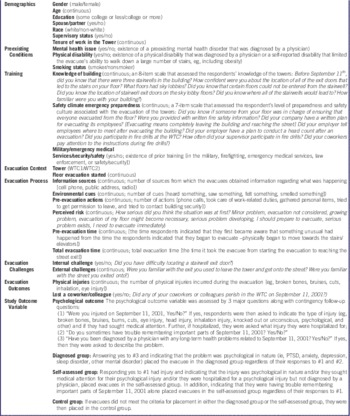
The variables of interest were chosen, in part, on the basis of the theoretical model put forth by Gershon et alReference Gershon, Qureshi and Rubin 15 that incorporated DeJoy’sReference DeJoy 16 behavioral diagnostic safety model, as well as the literature on human behaviors in emergencies.Reference Groeger, Stellman and Kravitt 4 , Reference Gershon, Qureshi and Rubin 15 , Reference Gershon 17 These variables were divided into characteristics within blocks (based upon the above mentioned literature). In addition, these variables were viewed from a time perspective referencing the final psychological outcome. For instance, variables such as gender and age existed prior to preexisting personal conditions such as physical or psychological disabilities, and environmental context existed prior to evacuation context. See Table 1 for a list and description of the study’s variables.
Predictor and Outcomes Variables of the StudyFootnote a

a Abbreviations: PTSD, post-traumatic stress disorder; WTC, World Trade Center.
Evacuees were classified into 3 mutually exclusive groups based on items addressing mental health: (1) physician-diagnosed, long-term psychological problems (diagnosed group); (2) short-term psychological problems or had trouble remembering (memory problems) important parts of September 11, 2001 (self-assessed group); and (3) neither (control group). See Table 1 for a full description of the psychological outcome groups. It was assumed that a physician diagnosis of a psychological disorder reflected a greater degree of psychological injury than self-reported psychological problems or memory problems. Thus, we created an ordinal variable from the least severe psychological injury (control group) to the most severe psychological disorder (diagnosed group).
Statistical Analysis
Prior to conducting statistical analyses, missing data values for predictors were addressed by using the SPSS multiple imputation procedure. 18 The analysis indicated that 55.4% of the cases had complete data and only 1.9% of all data values were missing. The missing values had no systematic patterns. Logistic regression (for nominal variables) and linear regression (for continuous variables) models were used to create 5 imputed data sets and all of the final analyses utilized the pooled data set.
The first phase of the analysis assessed bivariate relationships of all predictor variables with the primary outcome variable using the SPSS ordinal regression module. 18 All statistical tests were assessed at an alpha level of 0.05, two-tailed. The second phase of analysis estimated a hierarchical (by blocks) multivariate ordinal regression model. Variables were entered into the model block-by-block in the following order: demographic variables, preexisting conditions, training variables, evacuation context variables, evacuation process variables, evacuation challenge variables, and evacuation outcome variables. This sequential entry was designed to follow a hypothesized model incorporating a logical order of development from personal characteristics to experiences during the evacuation to outcomes (demographics→ preexisting personal conditions→ training→ evacuation context→ evacuation processes→ evacuation challenges→ evacuation outcomes).
Within each block of variables, the analysis used backward elimination (all variables within a block were simultaneously entered), followed by deleting any variable that improved the model. This process was repeated until no statistical improvement occurred (utilizing the Wald chi-squared test for the maximum likelihood estimates to determine statistical significance) until no additional variables met the entry criterion (P<0.05); this allowed the elimination of confounding among variables within each block. Variables that were significant within their block were retained in the model when subsequent blocks were added to the model, even if they were no longer statistically significant (this facilitated the testing of potential mediation of previously entered variables by subsequently entered variables, ie, indirect relationships). Also, each established model was tested against the null model by comparing the -2 log-likelihood values for the null and the empirical models via a chi-squared test. A statistically significant result indicates that the predictor variables give better predictions of the outcome variable than using the marginal probabilities for the outcome categories. A second test utilized the Pearson chi-squared statistic to determine the model’s goodness of fit (whether the observed data were consistent with the fitted model). This analysis indicates one has a good model when the P value is larger than 0.05.
To facilitate interpretation of the odds ratios (ORs), all measures were recoded so that a higher score was associated with an OR greater than or equal to one. In the regression tables, each variable is labeled in terms of what a higher score represents (eg, yes vs no or more vs less). To facilitate the interpretation of the ORs given the fact that the predictors have different measurement metrics, all continuous variables were converted to proportional scales ranging from 0 (lowest score) to 1 (highest score). The OR for continuous variables therefore reflected the ratio of the odds for the lowest compared to the highest score.
RESULTS
Respondent Characteristics
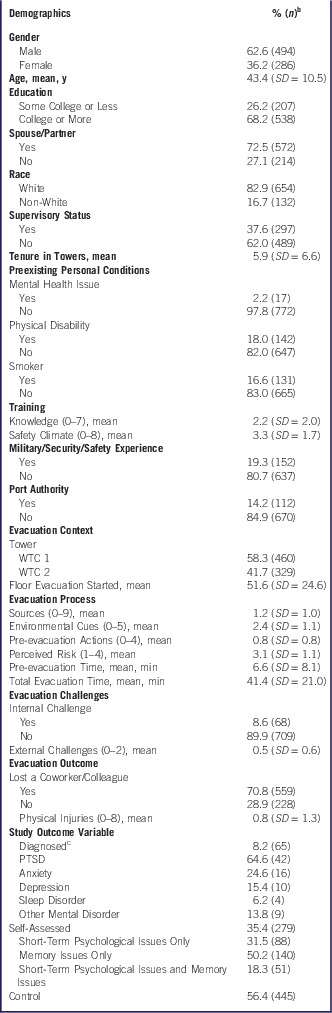
Table 2 presents the descriptive statistics for all of the predictor (nominal and continuous) and outcome variables. Only a small percentage (2.2%) of the participants reported a prior mental health condition. In contrast, a sizeable percentage (18.0%) of the participants reported a physical disability (including transient issues, such as a broken leg, or a more chronic health condition, such as obesity or heart disease), which may have compromised their ability to walk down a large number of stairs. In addition, the average participant reported minimal knowledge of the tower layout (2.2 on a scale of 0–7), a moderate score on safety climate emergency preparedness (3.3 on a scale of 0–8). A sizeable proportion (19.3%) of the participants reported prior military/security/safety experience, and 14.2% reported employment by the Port Authority (the managing director of the WTC on 9/11) and therefore were likely to be familiar with the towers.
Demographic Characteristics of the Sample (N=789)Footnote a

a Abbreviation: PTSD, post-traumatic stress disorder; WTC 1, World Trade Center Tower 1; WTC 2, World Trade Center Tower 2.
b Percentages may not total 100% because of missing values.
c Percentages for specific diagnoses total more than 100% because of multiple diagnoses for 9 evacuees.
With respect to the evacuation process variables, participants reported receiving information from an average of 1.2 (on a scale of 0–9) sources regarding what was happening and, on average, 2.4 environmental cues as to what they were sensing. In general, participants engaged in few pre-evacuation actions (0.8 on a scale of 0–4) and they believed that the situation they were in was serious (3.1 on a scale of 1–4) and thus required evacuation. Respondents took an average of 6.6 minutes to physically begin to move towards the stairs from the moment they first became aware that something unusual had happened, whereas the total length of time to fully evacuate (reach a street exit) averaged 41.4 minutes. A small percentage of participants reported difficulty in locating a stairwell exit (8.6%), whereas a substantial percentage of participants (43.9%) were unfamiliar with the terminal exits from the tower or the street upon which they exited. A very large percentage of participants (70.8%) reported that a coworker or colleague had perished in the WTC on September 11, 2001, and over one-third of the participants (35.4%) reported that they had sustained a physical injury during evacuation.
Psychological Outcomes
A small proportion of the sample (8.2%) reported that since 9/11 they had been diagnosed (by a physician) with a long-term psychological disorder (ie, PTSD, anxiety, depression, sleep disorder, and other mental disorder; diagnosed group, n=65). PTSD was by far the most common diagnosis (64.6%), followed by anxiety (24.6%) and depression (15.4%). A sizeable proportion (35.4%) of the sample reported that they had either sustained a psychological injury or that they had trouble remembering important parts of September 11, but did not indicate any long-term psychological disorder diagnosed by a physician (self-assessed group, n=279). A total of 56.4% of the sample did not report any WTC-related diagnosed or self-reported mental health issue or trouble remembering important parts of September 11, 2001 (control group, n=445).
Factors Associated With Psychological Outcomes
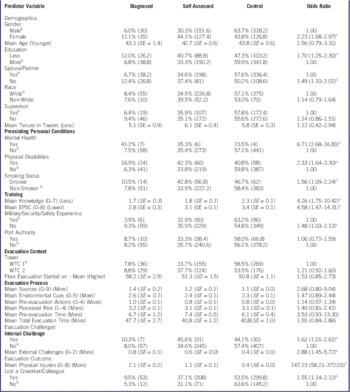
Table 3 presents the percentages (or means) of the predictor variables across the 3 psychological outcome groups along with the OR and 95% confidence interval. Specifically, the univariate results revealed a significant association between reporting a (more severe) psychological disorder and the following: female gender, less education, lack of domestic partner, preexisting mental health issue, preexisting physical disability, current smoker status, low level of knowledge of the towers, lower EPSC scores, lack of prior experience in the military/security/safety services, difficulty locating a stairwell exit, less familiarity with the exit used to leave the tower and the street exited upon, physical injuries, and loss of a coworker or colleague. Moreover, the 3 outcome groups did not differ ordinally on age, race, supervisory status, days from 9/11, tenure in the towers, Port Authority status, tower, floor on which the evacuation started, number of sources of information, environmental cues, pre-evacuation actions, perceived risk, pre-evacuation time, and total evacuation time.
Univariate Assessment of the Ordinal Relation Between the Predictor Variables and the Outcome Variable (N=789)Footnote a

a Abbreviation: EPSC, emergency preparedness safety climate; WTC 1, World Trade Center Tower 1; WTC 2, World Trade Center Tower 2.
b Reference group.
c P≤0.05.
The next phase of the analysis determined the independent contributions of the predictors of psychological outcome. This approach allowed for elimination of confounding among variables and identification of potential mediation among variables. In addition, bivariate correlations among all variables were examined (see the online data supplement for the correlations matrix table). Only 11 of 378 correlations were over 0.30, and none was higher than 0.62, indicating an absence of redundancy among the measures.
In general, the correlations were in the directions one would expect. For instance, the floor from which the evacuees started was strongly correlated with the total time it took to evacuate (r=0.62), physical injuries (r=0.15), and loss of a coworker (r=0.19). Although EPSC was not correlated with either pre-evacuation or total evacuation time, statistically significant correlations did emerge when these associations were broken down by the tower evacuated. In particular, it was found for WTC 1 evacuees that EPSC was positively correlated with total evacuation time (r=0.17, P<0.002) and negatively (although not statistically significant) correlated with pre-evacuation time (r=-0.07, P=0.17). For WTC 2 evacuees, EPSC was negatively correlated (although not statistically significant) with total evacuation time (r=-0.10, P=0.10) and positively correlated with pre-evacuation time (r=0.15, P<0.02).
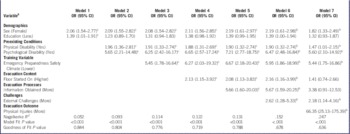
Table 4 presents the results of final model testing where predictor variables were added via blocks (backward elimination of variables within blocks) starting with demographics and ending with evacuation outcome. Several predictor variables significant in the bivariate analysis were not included in the multivariate model, including spouse/partner, smoking status, knowledge of the building, military/security experience, internal challenge, and lost a coworker.
Summary of Hierarchical (Forward Entry Within Blocks) Ordinal Regression Analysis for Variables Predicting Psychological Outcome (N=789)Footnote a

a Abbreviations: CI, confidence interval; OR, odds ratio.
b The parenthesized term represents the targeted group or score direction.
c P≤0.05.
The final model (model 7) identified several independent and indirect associations with psychological outcome. In particular, compared to the control group (ie, having no long-term or short-term psychological condition), a (more serious) psychological disorder was more likely among those who: were female (OR=1.8), had a prior mental health issue (OR=5.6), had a physical disability (OR=1.5), had lower EPSC scores (OR=5.4), had more challenges upon leaving the towers (OR=2.2), and had more physical injuries (OR=66.4). The strongest associations with psychological outcome occurred with physical injuries, prior mental health issue, and with the EPSC variable. In addition, education (which entered model 1) became nonsignificant upon entry of preexisting physical and psychological disorders in model 2, suggesting that the relationship of education with psychological injury was mediated by its relationship with pre-evacuation disability. Two variables (floor evacuation started on and number of sources of information obtained) entered the model, but were no longer significant when physical injuries entered at model 7. Overall, model 7 accounted for appropriately 25% of the variance in psychological outcome.
Discussion
In this study, in addition to examining EPSC as a predictor of evacuation times and mental health, we incorporated a number of previously studied variables that needed to be controlled in order to eliminate potential confounding. In the final multivariate model, the variables associated with a significant increase in poor psychological outcomes were (1) gender (female), (2) preexisting personal conditions: mental health issue (yes) and physical disability (yes), (3) EPSC (lower scores), (4) challenges exiting the towers (more), and (5) physical injuries (more). These findings have implications regarding prevention and intervention.
Psychological disorders were more likely among females and those with a preexisting mental health issue or a physical disability, which is consistent with previous research.Reference DeLisi, Maurizio and Yost 19 This suggests that using preexisting conditions as a potential triage tool might expedite treatment for individuals suffering from evacuation trauma.
Among the various training factors studied (knowledge of building, military/security/safety experience, Port Authority status, and EPSC), only EPSC emerged as statistically significant in the final model. In particular, the diagnosed group had the lowest EPSC scores followed by the self-assessed group, then followed by the control group. Indeed, EPSC was a directly modifiable risk/protective factor that was most strongly associated with psychological outcome. The current findings on EPSC extend previous findingsReference Gershon, Magda, Riley and Sherman 2 to include the more distal outcome of long-term mental health status. The association of EPSC with long-term mental health status suggests one possible strategy for minimizing adverse mental health consequences of emergency evacuations. Based on both qualitative and quantitative analyses of the WTCES, Gershon and colleagues have published recommendations for improvement of high-rise evacuation, including both individual and organizational preparedness.Reference Gershon, Magda, Riley and Sherman 2 , Reference Gershon, Qureshi and Rubin 15 , Reference Gershon, Qureshi and Barocas 20 They concluded, “worksite readiness is essential, not only in reducing morbidity and mortality related to emergency events, but also for creating a culture and climate of emergency preparedness.”Reference Gershon, Magda, Riley and Sherman 2 They further suggested that an emergency preparedness safety culture can potentially support worker resiliency and may help reduce long-term mental health consequences of disaster survivorship.Reference Gershon, Qureshi and Barocas 20
Although not assessed in the current study, we posit that perceived self-efficacy may be the unmeasured link between EPSC and psychological outcomes in hazardous evacuations. Previous research has consistently shown that perceived self-efficacy has the potential to account for a significant amount of outcome variance in psychological and physiological symptoms following disasters.Reference Bandura 21 , Reference Benight and Bandura 22 Individuals who are trained to evacuate and thus are more prepared should be more likely to develop positive self-efficacy beliefs that might act to buffer traumatization during disaster evacuations. People who feel control (to some degree) over an unfolding situation and take initiative to evacuate might be more likely to reconstruct the event in a more favorable light (ie, “I took control and my actions helped me to survive”). This concept is supported by findings in a recent publication by Richardson.Reference Richardson 23 In that study, survivors of the WTC event with the ability to “make sense” of the incident were significantly more likely to have higher scores on a measure of post-traumatic growth. A recent interesting paper by Gargano et alReference Gargano, Caramanica and Sisco 24 found that WTC survivors who reported strong social support had a greater likelihood of household disaster preparedness than did survivors with weaker social support. The authors suggest that strong social support might result in higher levels of self-efficacy and confidence in one’s ability to prepare. We believe that a strong EPSC can similarly create high levels of self-efficacy.
External evacuation challenges and physical injuries during evacuation were both found to be risk factors for psychological disorder. These findings basically replicate and extend DiGrande et al’sReference DiGrande, Neria and Brackbill 9 findings and thus contribute to the robustness of these variables as risk factors for the development of evacuation-related psychopathology. These findings are also consistent with those found among rescue and recovery workers and volunteers, lower Manhattan residents, lower Manhattan office workers, and passersby on September 11, whereas those who had more peri-event exposures were more likely to have reported post-traumatic symptoms.Reference Liu, Tarigan and Bromet 6 , Reference Brackbill, Hadler and DiGrande 25 In a similar vein, Brackbill et alReference Brackbill, Cone and Farfel 26 found in their sample of persons directly exposed to the WTC disaster that there was a dose-response relation between the number of types of injuries and diagnosed chronic conditions.
No evacuation process variables were related to psychological outcome in the final model. However, the number of sources of information and the number of floors evacuated were associated with psychological outcome until physical injury was entered into the model, indicating that physical injury mediated the association of the evacuation context and process factors with psychological outcome. Several other process measures were associated with physical injuries but not psychological outcomes. Psychological outcomes were more directly linked to gender, preexisting conditions (mental and physical), EPSC, external challenges, and (most importantly) physical injuries. Future research should explore the different dynamics and mechanisms impacting both physical injuries and psychological outcomes as a result of emergency evacuations of high-rise buildings. Different types of education programs would seem appropriate, contingent upon the targeted outcome.
Our findings point to the importance of addressing modifiable conditions (such as the challenges the evacuees encountered upon existing the towers) in existing and proposed high-rise structures, since psychological outcome was directly related to the number of external challenges that evacuees encountered. Furthermore, many of these problems are amenable to organizational strategies to improve the infrastructure of high-rise buildings. This is consistent with individual and organizational strategies identified by Gershon et al.Reference Gershon, Rubin and Qureshi 27 Using participatory action research methodology that directly engaged WTC survivors, a number of improvement strategies were identified. These included mandatory compliance with training and drills, enforcement of training and education for evacuation of all employees, enforcement of mandatory drills that involve entry into the staircase and various routes, posting of signage that would indicate where staircases terminate, installing photo-luminescent paint on stairs, instilling in employees the importance of taking ownership of their personal safety, and full participation in emergency preparedness training, among others. Many of these recommendations can easily be implemented with modest cost and effort.
Strengths and Limitations
The strengths of the present study include the relatively large sample size, the measurement of EPSC (a variable that lends itself to training), the assessment and the statistical control of preexisting mental conditions and disabilities, and the assessment of evacuation process and outcome measures. The limitations of the current study include self-selection bias (respondents with the most intense experiences might have been more willing to participate in the survey), the cross-sectional nature of the data (which limits causal inferences), and the retrospective self-report recall of events, behaviors, and experiences roughly 2 years after the evacuation (faulty and/or biased recall).
In addition, another potential limitation of the findings is related to the use of multiple imputation for missing values. Although this method is helpful in addressing the loss of precision and power when there are missing data, it can also lead to biases and the results may not be completely generalizable.Reference McKnight, McKnight and Sidani 28 , Reference Sterne, White and Carlin 29
CONCLUSIONS
The findings from this study point to prevention and treatment strategies that may contribute to the reduction of negative consequences of natural and human-made disasters in high-rise buildings. It seems likely that at least some of these strategies would be similarly effective (especially for management and employees) in other situations, eg, evacuations from complex structures (such as tourist attractions, transit hubs, airports, and sports arenas). Furthermore, our findings are consistent with the rich literature documenting the important role of safety climate on safe work practices and on workplace injuries.Reference Gershon, Karkashian and Grosch 30 Here we see a parallel role for the importance of EPSC, a new construct we developed for the analysis of the WTCES data. Importantly, EPSC was associated with mental health outcomes resulting from the emergency evacuation of the WTC towers on September 11, 2001. The current data do not allow us to conclude that EPSC contributed to an evacuee’s resiliency to resist stressors or contribute to making judicious evacuation decisions, or to facilitating recovery after the exposure to the evacuation stressors. However, our findings suggest a possible strategy for developing resiliency in high-risk evacuation, and we hypothesize that preparedness in any setting, and for any type of disaster, may similarly result in increased resiliency when dealing with disasters (during and after). In other words, EPSC might have the potential to improve performance under crisis, increase resiliency, and decrease adverse outcomes. Furthermore, organizations that are responsible for their employees in high-rise buildings should take note and continue (or start to work on) providing their employees with a safety-minded climate along with training in the evacuation skills necessary for a rapid and safe evacuation.
Acknowledgments
This project was supported under a cooperative agreement from the Centers for Disease Control and Prevention (CDC) through the Association of Schools of Public Health (ASPH). Grant number (S2133-22/22) U36/CCU300430-22.
Author Contributions
RG, MS, and MP conceived and designed the study. RG and LM conducted the survey. LM and QZ managed the data. MS analyzed the data. MS, RG, and MP wrote the paper.
SUPPLEMENTARY MATERIAL
To view supplementary material for this article, please visit http://dx.doi.org/doi:10.1017/dmp.2016.136