INTRODUCTION
Roving herbivorous reef fish (RHs) from families Acanthuridae (surgeonfish) and Scaridae (parrotfish) are abundant and ecologically important members of the reef community. They feed primarily on algae and detritus and generally represent the predominant reef herbivores in terms of algal biomass consumption (Horn, Reference Horn1989; Hay, Reference Hay and Sale1991). Since their intense feeding activity reduces spatial competition between corals and algae, RHs are widely recognized as a critical functional group on coral reefs (Bellwood et al., Reference Bellwood, Hughes, Folke and Nÿstrom2004).
Foraging activity of RHs is strongly related to morphology, with the recognition of three main functional groups: browsers, scrapers and excavators (Bellwood & Choat, Reference Bellwood and Choat1990; Streelman et al., Reference Streelman, Alfaro, Westneat, Bellwood and Karl2002; Francini-Filho et al., Reference Francini-Filho, Moura, Ferreira and Coni2008a). Browsers use their discrete teeth to cut off macroalgae, leaving no scars on the substrate. Scrapers feed at high rates and make shallow bites, leaving only a superficial scrape. Excavators feed at low rates and remove large portions of the substratum using their robust jaws, leaving noticeable scars (Bellwood & Choat, Reference Bellwood and Choat1990; Streelman et al., Reference Streelman, Alfaro, Westneat, Bellwood and Karl2002). The recognition of species within each functional group helps to understand their relative effects in terms of bio-erosion, coral fitness and survival, habitat alteration and ecosystem dynamics (Bellwood & Choat, Reference Bellwood and Choat1990; Bellwood et al., Reference Bellwood, Hughes, Folke and Nÿstrom2004; Francini-Filho et al., Reference Francini-Filho, Moura, Ferreira and Coni2008a).
Foraging activity of RHs, particularly feeding rates, may also vary according to diet (Choat et al., Reference Choat, Clements and Robbins2004). Despite the traditional hypothesis that RHs feed primarily on plant material, many species target organic detritus (e.g. diatoms and dinoflagellates) attached to turf algae rather than the algae themselves (Choat et al., Reference Choat, Clements and Robbins2002; Wilson et al., Reference Wilson, Bellwood, Choat and Furnas2003). Currently four dietary groups of nominally herbivorous reef fish are recognized based primarily on the frequency of consumption of the following food items: macroalgae, turf algae, plankton and detritus (Choat et al., Reference Choat, Clements and Robbins2002). Feeding rates of species ingesting mainly macroalgae and zooplankton are generally lower than that of detritivores, while feeding rates of species feeding primarily on turf algae are more variable. This relationship between diet and feeding rates, in turn, is mostly related to differences in digestive modes and rates of turnover of gut contents (Choat et al., Reference Choat, Clements and Robbins2002, Reference Choat, Clements and Robbins2004; Crossman et al., Reference Crossman, Choat and Clements2005).
Although feeding modes and diet differ interspecifically, many RH species prefer similar and high-quality food resources (Bruggemann et al., Reference Bruggemann, Kuyper and Breeman1994a, Reference Bruggemann, Oppen and Breemanb), resulting in competition for food resources (e.g. Robertson & Gaines, Reference Robertson and Gaines1986; Bruggemann et al., Reference Bruggemann, Kuyper and Breeman1994a). Roving herbivores also frequently compete with territorial herbivores, such as damselfish from genus Stegastes, which are highly aggressive toward conspecifics and heterospecifics with similar diet (Ceccarelli et al., Reference Ceccarelli, Jones and McCook2001; Osório et al., Reference Osório, Rosa and Cabral2006). Although interference competition is expected to intensify with increased density of herbivores, and availability of different food resources may vary considerably in space, the extent to which spatial variation in competitors' abundance and resource availability affect the foraging activity of RHs is still poorly known (but see Bruggemann et al., Reference Bruggemann, Oppen and Breeman1994b).
Most studies on the foraging activity of RHs were done in the Caribbean and Indo-Pacific (Bruggemann et al., Reference Bruggemann, Kuyper and Breeman1994a, Reference Bruggemann, Oppen and Breemanb; Bellwood et al., Reference Bellwood, Hoey and Choat2003; Fox & Bellwood, Reference Fox and Bellwood2007). The availability of detailed information for several species allowed the development of a reef trophic model (Van Rooij et al., Reference Van Rooij, Videler and Bruggemann1998) and an ecosystem level analysis on the impacts of RHs (Mumby, Reference Mumby2006) in the Caribbean, as well as quantitative assessments on the functional roles of RHs along depth and cross-shelf gradients in the Great Barrier Reef (Fox & Bellwood, Reference Fox and Bellwood2007; Hoey & Bellwood, Reference Hoey and Bellwood2008).
In the impoverished tropical south-western Atlantic reefs (Brazil), three surgeonfish (genus Acanthurus) and seven endemic parrotfish species (five Sparisoma and two Scarus) are recognized (Moura et al., Reference Moura, Figueiredo and Sazima2001; Gasparini et al., Reference Gasparini, Floeter and Joyeux2004; Robertson et al., Reference Robertson, Karg, Moura, Victor and Bernardi2006). The diet of all acanthurids is described for a coastal beach-rock reef in north-eastern Brazil (Dias et al., Reference Dias, Rosa and Feitoza2001). In addition, two studies in tropical rocky reefs provide information on the foraging activity (Bonaldo et al., Reference Bonaldo, Krajewski, Sazima and Sazima2005) and diet (Ferreira & Gonçalves, Reference Ferreira and Gonçalves2006) of RHs in Brazil. Finally, a recent study reports on live coral predation by Scarus trispinosus Valenciennes, 1840 and Sparisoma amplum (Ranzani, 1841) in the Abrolhos Bank, eastern Brazil, and comments on the classification of these species into functional groups (Francini-Filho et al., Reference Francini-Filho, Moura, Ferreira and Coni2008a).
The present study investigates the foraging activity (i.e. feeding rates and food selection) of surgeonfish and parrotfish in the Abrolhos Bank, eastern Brazil. The particular hypotheses that spatial variability in interference competition and resource availability may lead to spatial variation in foraging patterns of RHs is tested. This is the first study to characterize the foraging activity of all RH species from families Acanthuridae and Scaridae in the same region, and the first comprehensive study of this type in Brazil. The detailed information for individual taxa provided here is critical for understanding the role of RHs in shaping reef benthic communities, in determining reef resilience, and to guide conservation and management measures (see Fox & Bellwood, Reference Fox and Bellwood2007).
MATERIALS AND METHODS
Study region
The Abrolhos Bank occupies 42,000 km2 of the continental shelf in eastern Brazil (Figure 1). Depths rarely exceed 30 m and reef structures display a characteristic form of mushroom-shaped pinnacles. The region encompasses the largest and richest coral reefs in the South Atlantic (Leão & Kikuchi, Reference Leão, Kikuchi, Seeliger and Kjerfve2001). Three species of Acanthurus (Acanthurus bahianus Castelnau, 1855, Acanthurus chirurgus (Bloch, 1787) and Acanthurus coeruleus Bloch & Schneider, 1801), two of Scarus (Scarus trispinosus and Scarus zelindae Moura, Figueiredo & Sazima, Reference Moura, Figueiredo and Sazima2001) and four of Sparisoma (Sparisoma axillare (Steindachner, 1878), Sparisoma amplum, Sparisoma frondosum (Agassiz, 1831), and Sparisoma radians (Valenciennes, 1840)) occur at the Abrolhos Bank (Moura & Francini-Filho, Reference Moura, Francini-Filho and Dutra2006). All species, except the small-bodied and peri-reefal dweller S. radians, were included in this study.
Map of the Abrolhos Bank showing study sites and marine protected areas. (1) Pedra de Leste (PLES); (2) Timbebas (TIM); (3) Portinho Norte (PNOR; within the Abrolhos Archipelago); (4) Parcel dos Abrolhos (PAB).

Underwater observations were conducted during the summer (January–April) of 2006 and 2007 at four sites (Parcel dos Abrolhos, Pedra de Leste, Portinho Norte and Timbebas). These sites vary greatly according to distance offshore, habitat characteristics and protection from fishing (Francini-Filho & Moura, Reference Francini-Filho and Moura2008). Portinho Norte, within the Abrolhos Archipelago, is a rocky reef bordered by fringing coralline reefs, while the other sites are composed of typical coralline pinnacles. Two sites (Portinho Norte and Parcel dos Abrolhos) are further from the coast and located within the well enforced portion of the National Marine Park of Abrolhos (NMPA). Timbebas is located within a discontinuous portion of the NMPA that is closer to land and poorly enforced. Pedra de Leste is unprotected from fishing, closer to land and shallower than the other sites (Figure 1).
Field procedures
Food availability (i.e. benthic cover) at the study sites was assessed using photo-quadrats (N = 10 per site; see Francini-Filho et al., Reference Francini-Filho, Moura, Ferreira and Coni2008a,Reference Francini-Filho, Moura, Thompson, Reis, Kaufman, Kikuchi and Leãob for a detailed description of the method). Photographs were analysed using the Coral Point Count with Excel Extensions software (Kohler & Gill, Reference Kohler and Gill2006). Organisms were classified in the nine following categories: turf algae (i.e. multispecific stands of small epilithic algae), fleshy algae, crustose calcareous algae, Halimeda spp., live corals, fire-corals (Millepora spp.), octocorals, sand and zoanthids. Fish counts (N = 15 per site) were made using a nested stationary visual census technique (cf. Minte-Vera et al., Reference Minte-Vera, Moura and Francini-Filho2008). Counts for two species of territorial herbivores (Stegastes fuscus (Cuvier, 1830) and Stegastes variabilis (Castelnau, 1855)) were pooled.
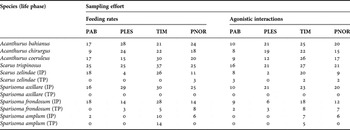
Feeding rates were quantified using replicate 1-minute observation periods (cf. Francini-Filho et al., Reference Francini-Filho, Moura, Ferreira and Coni2008a), in which divers recorded the species identity, total number of bites on different benthic organisms and fish body size (total length, TL) to the nearest centimetre. Separate observations for initial phase (IP) and terminal phase (TP) males (Robertson & Warner, Reference Robertson and Warner1978) were only made for Scarus zelindae, Sparisoma amplum and S. frondosum, as Scarus trispinosus shows no clear colour and morphological changes according to life phase (Moura et al., Reference Moura, Figueiredo and Sazima2001) and no TP Sparisoma axillare individuals were recorded. A total of 641 independent observations were made. Frequency of agonistic interactions (cf. Robertson et al., Reference Robertson, Sweatman, Fletcher and Cleland1976; Risk, Reference Risk1998) among RHs and between RHs and territorial herbivores was quantified in a separate set of 1-minute observation periods (N = 492). Detailed information on the sampling effort is shown in Table 1. Underwater observations were made in the same periods of day (0900–1600 h) for all species in the four sites, with samples distributed as evenly as possible between different hours of the day (cf. Ledlie et al., Reference Ledlie, Graham, Bythell, Wilson, Jennings, Polunin and Hardcastle2007).
Number of samples (1-minute observation periods) obtained for feeding rates and agonistic interactions. Sites: PAB, Parcel dos Abrolhos; PLES, Pedra de Leste; TIM, Timbebas; and PNOR, Portinho Norte.

Data analyses
Student's t-test was used to evaluate significant differences in feeding rates between IP and TP individuals. Comparisons were made for each food item separately considering only the sites in which both IP and TP individuals were recorded (see Table 1). Since few significant differences were registered (see Results) data for IP and TP individuals were pooled in subsequent analyses. Sample size for a few species/sites remained relatively small even after pooling data for IP and TP individuals. Thus results for such particular cases must be interpreted with caution.
Selectivity for different benthic organisms was determined with Ivlev's electivity index (Ivlev, Reference Ivlev1961), as follows:

where E i = electivity measure for benthic organism i, r i = proportion of bites taken on benthic organism i, and ni = relative cover of benthic organism i in the studied habitat. Electivity index (E i) varies from −1 to +1, in which values close to +1 indicate higher preferences and values close to −1 indicate lesser preference or avoidance.
One-way analysis of variance (ANOVA) was used to evaluate differences in fish density, benthic cover and frequency of agonistic interactions between sites, as well as differences in bite rates between species. Analysis of covariance (ANCOVA) was used to evaluate differences in bite rates and feeding selectivity (values of the E i as the dependent variable) according to sites and benthic organisms for each species. Body size was used as covariate owing to neutralize the effect of fish size while evaluating spatial variability in bite rates and feeding selectivity. Normality and homocedasticity were improved by converting fish density and feeding rates to Log10 (x+1), grazing selectivity to Log10 (E i+2) and benthic cover percentages to arcsin √x. Student–Newman–Keuls (SNK) multiple comparisons of means were performed as a post-hoc test (Zar, Reference Zar1999).
Non-metric multidimensional scaling (nMDS) ordinations were used to summarize spatial similarities (Bray–Curtis) in benthic cover, fish assemblages' structure and foraging activity (i.e. number of bites taken by each RH species on different benthic organisms). Two-way analyses of similarities (ANOSIM) were used to evaluate significant differences according to sites and species (Clarke & Warwick, Reference Clarke and Warwick1994).
RESULTS
Benthic cover
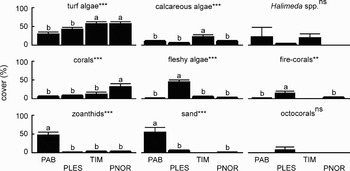
Turf algae was the dominant benthic cover type (44.1%) considering the four sites, followed by live corals (14.9%), zoanthids (12.6%), crustose calcareous algae (12.4%), fleshy algae (10.8%), sand (1.8%), Halimeda spp. (1.4%), fire-corals (0.3%) and octocorals (0.04%). Habitat structure differed significantly between sites (ANOSIM global test: R = 0.719, P = 0.001). Turf algae cover was highest at Timbebas and Portinho Norte; coral cover (mainly Mussismilia braziliensis (Verrill, 1868)) at Portinho Norte; zoanthid (mainly Palythoa caribaeorum (Duchassaing & Michelotti, 1860)) and sand cover at Parcel dos Abrolhos; calcareous algae cover at Timbebas; fleshy algae (mainly Dictyota spp.) and fire-coral (mainly Millepora nitida Verrill, 1868) cover at Pedra de Leste. There were no spatial differences in cover of Halimeda spp. and octocorals (Figure 2).
Cover (mean + SE) of different benthic organisms in the four study sites. Analysis of variance results: *, P < 0.05; **, P < 0.01; ***, P < 0.001; n.s., not significant. Homogeneous groups are identified by equal letters. Site codes as in Figure 1.

Fish assemblages
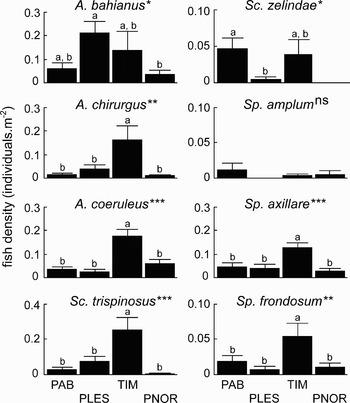
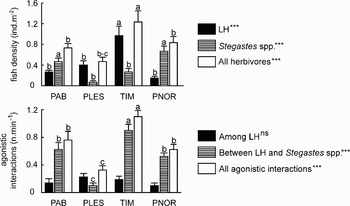
Acanthurus bahianus was the dominant RH species in terms of density (0.11 ind m−2), followed by Scarus trispinosus (0.09 ind m−2), A. coeruleus (0.07 ind m−2), Sparisoma axillare (0.06 ind m−2), A. chirurgus (0.05 ind m−2), S. frondosum (0.23 ind m−2), Scarus zelindae (0.022 ind m−2) and Sparisoma amplum (0.005 ind m−2). The structure of RHs' assemblages differed significantly according to sites (R = 0.218; P = 0.001). Five species (A. chirurgus, A. coeruleus, Scarus trispinosus, Sparisoma axillare and S. frondosum) showed higher densities within the no-take area of Timbebas. Acanthurus bahianus was more abundant at Pedra de Leste and Scarus zelindae at Parcel dos Abrolhos (Figure 3). Territorial herbivores were more abundant at Portinho Norte and Parcel dos Abrolhos, followed by Timbebas and Pedra de Leste respectively (see Figure 8).
Fish density (mean + SE) in the four study sites. Analysis of variance results: *, P < 0.05; **, P < 0.01; ***, P < 0.001; n.s., not significant. Homogeneous groups are identified by equal letters. Site codes as in Figure 1.

Foraging activity and feeding selectivity
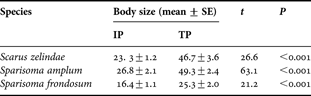
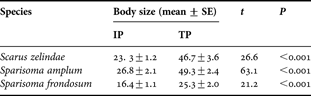
Although body size differed significantly between life phases, with IP individuals attaining smaller sizes than TP ones (Table 2), there were no significant differences in bite rates between IP and TP individuals of S. zelindae, Sparisoma amplum and S. frondosum (t-test, P > 0.05 in all cases), except for relatively higher bite rates of IP S. frondosum on crustose calcareous algae (t = 2.10, P = 0.03). Turf algae was the most frequently grazed item considering all RH species (63.0% of all bites), followed by crustose calcareous algae (17.1%), fleshy algae (7.2%), Halimeda spp. (7.0%), live corals (2.1%), sand (1.3%), fire-corals (0.7%), zoanthids (0.6%) and octocorals (0.03%). Sparisoma amplum, as well as large individuals (>40 cm TL) of Scarus trispinosus and S. zelindae, employed a typical excavating feeding mode, while small S. trispinosus and S. zelindae individuals acted mainly as scrapers. The other five RH species acted mostly as browsers.
Significant differences in body size (total length, in cm) between initial phase (IP) and terminal phase (IP) parrotfish as determined by Student's t-tests.
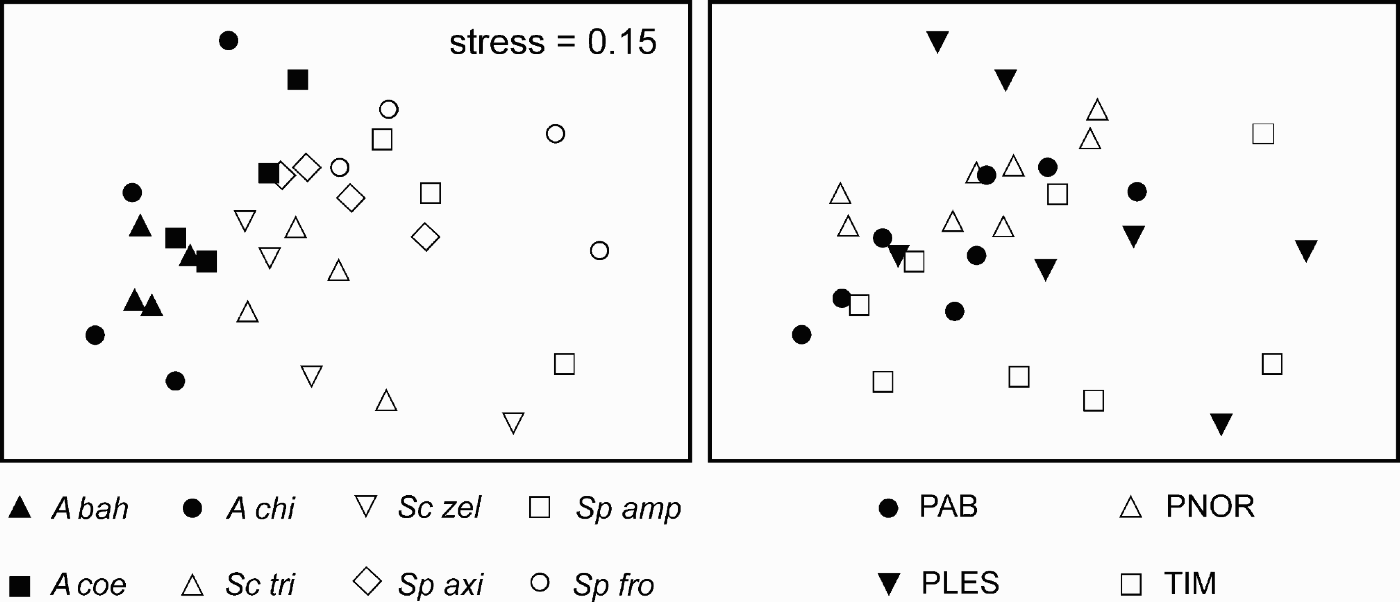
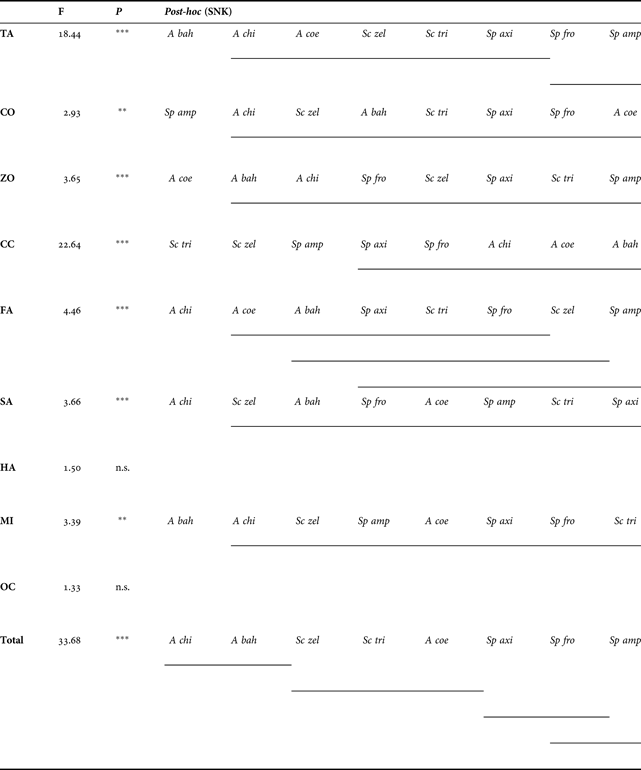
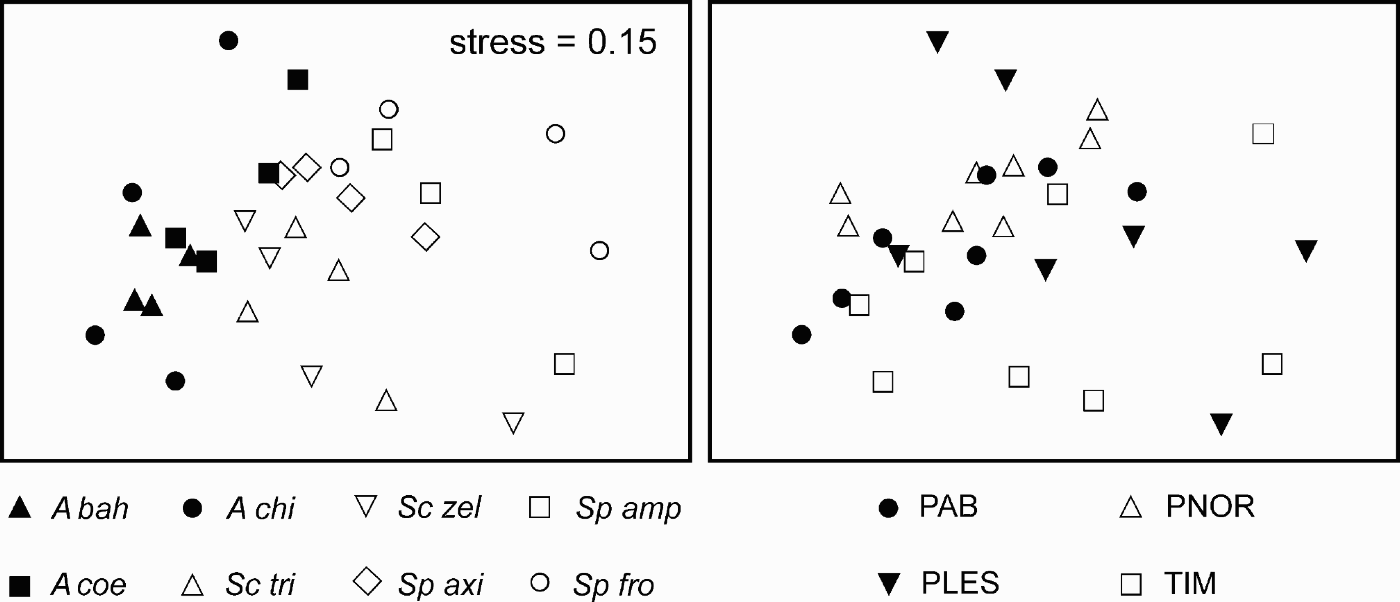
There were significant differences in the foraging activity of RHs according to sites (R = 0.129; P = 0.001) and species (R = 0.191; P = 0.001), with a clear distinction between surgeonfish and parrotfish in the two-dimensional ordination space (Figure 4). Significant (P < 0.05) pairwise between-species differences were obtained in all cases, except between S. trispinosus and S. zelindae. Surgeonfish, particularly A. bahianus and A. chirurgus, had consistently higher total bite rates than the two species of Scarus and the three species of Sparisoma respectively. A similar pattern was observed when analysing the turf algae category separately. Scarus trispinosus, S. zelindae and Sparisoma amplum grazed more frequently on crustose calcareous algae than the other species. Surgeonfish showed slightly higher bite rates on fleshy algae (10% of total bites) than parrotfish (9.4%). Sparisoma amplum showed the highest frequency of bites on live corals, although SNK post-hoc comparisons indicated a high overlap with the other species. Acanthurus chirurgus foraged more frequently over sand bottoms, while A. bahianus, A. chirurgus and Scarus zelindae grazed more frequently over fire-corals. There were no differences between species in frequency of bites in Halimeda spp. and octocorals (Figure 5; Table 3).
Multidimensional scaling (MDS) of foraging activity (i.e. bites/min of each fish species on different benthic organisms) based on Bray–Curtis similarities. Left panel, samples classified according to species; right panel, samples classified according to sites.
Bite rates (mean+SE) of each fish species on different benthic organisms in the four study sites. Homogeneous groups for each species are identified by equal letters (only the first three groups are shown). Benthic organisms: TA, turf algae; CO, live corals; ZO, zoanthids; CC, crustose calcareous algae; FA, fleshy algae; SA, sand; HA, Halimeda spp.; MI, fire-corals (Millepora spp.); OC, octocorals. Site codes as in Figure 1.

Significant interspecific differences in bite rates for different benthic organisms as determined by Student–Newman–Keuls (SNK) post-hoc comparisons. Homogeneous groups are linked by horizontal lines. Benthic organisms: TA, turf algae; CO, live corals; ZO, zoanthids; CC, crustose calcareous algae; FA, fleshy algae; SA, sand; HA, Halimeda spp.; MI, fire-corals (Millepora spp.); OC, octocorals.
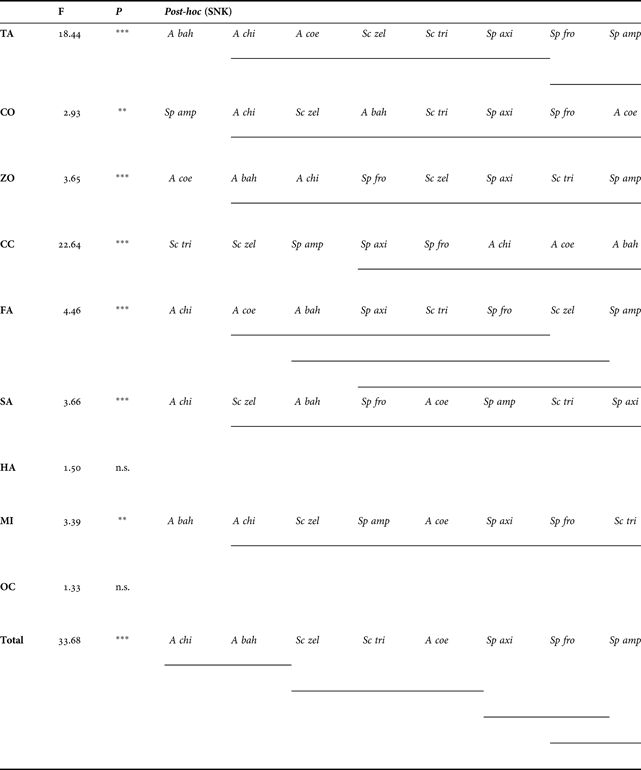
*, P < 0.05; **, P < 0.01; ***, P < 0.001; n.s., not significant.
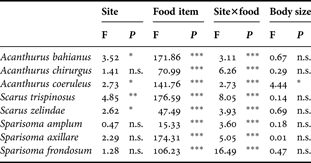
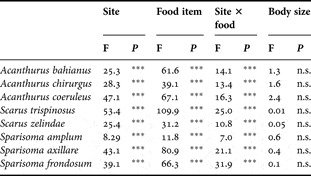
The interaction between site and food type was highly significant (P < 0.001) for all RH species, indicating that the different food items were not equally grazed in all sites (Table 4). In general, bite rates on two heavily grazed items (i.e. crustose calcareous algae and fleshy algae) were disproportionally higher in sites where such items were more available. Crustose calcareous algae showed highest cover and grazing rates at Timbebas, while fleshy algae showed highest cover and grazing rates at Pedra de Leste (see Figures 2 & 5). Turf algae were frequently consumed at Timbebas and Parcel dos Abrolhos; Halimeda spp. and zoanthids at Timbebas; live corals at Pedra de Leste and Timbebas. There was no clear spatial grazing pattern for sand and octocorals (Figure 5).
Analysis of covariance (ANCOVA) testing the effect of site and food item on feeding rates (bites/min). Body size (total length) was used as covariate.
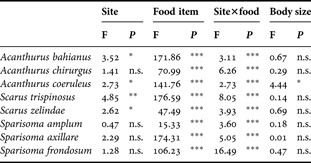
*, P < 0.05; **, P < 0.01; ***, P < 0.001; n.s., not significant.
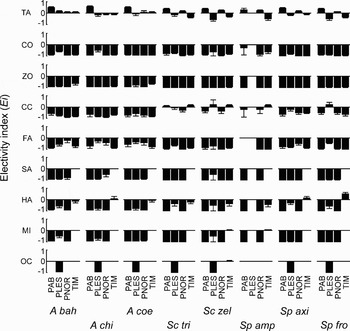
Turf algae were positively selected by most species at Parcel dos Abrolhos and Portinho Norte, but avoided at the other two sites. Crustose calcareous algae were selected by S. trispinosus, S. zelindae, Sparisoma amplum and S. frondosum in at least one out of the three following sites: Parcel dos Abrolhos, Pedra de Leste and Timbebas. Halimeda spp. was positively selected by A. chirurgus, S. axillare and S. frondosum at Timbebas. Slightly positive values of the E i were also obtained for Scarus zelindae and Sparisoma amplum grazing over fire-corals at Timbebas. Negative values of the E i were obtained in all other cases (Figure 6).
Grazing selectivity (mean+SE) of each fish species for different benthic organisms in the four study sites. Benthic organisms: TA, turf algae; CO, live corals; ZO, zoanthids; CC, crustose calcareous algae; FA, fleshy algae; SA, sand; HA, Halimeda spp.; MI, fire-corals (Millepora spp.); OC, octocorals. Site codes as in Figure 1.

Grazing selectivity varied significantly according to food item and site for all species with significant interactions between the two factors recorded in all cases (Figure 6; Table 5).
Analysis of covariance (ANCOVA) testing the effect of site and food item on feeding selectivity (values of the E i). Body size (total length) was used as covariate.

*, P < 0.05; **, P < 0.01; ***, P < 0.001; n.s., not significant.
Agonistic interactions
In total, 281 agonistic interactions were recorded. Both parrotfish and surgeonfish interacted agonistically most frequently with Stegastes spp., followed by interactions with members from the same family (Figure 7). In general, frequency of agonistic interactions was higher in sites with higher densities of herbivorous fish (Figure 8).
Frequency of agonistic interactions (mean+SE) among roving herbivorous reef fish and between roving herbivores and territorial herbivores. Analysis of variance results: ***, P < 0.001. Homogeneous groups are identified by equal letters.

Fish density (upper) and frequency of agonistic interactions (lower) in the four study sites. Values shown are mean+SE. Analysis of variance results (between-sites comparisons): ***, P < 0.001; n.s., not significant. Homogeneous groups are identified by equal letters. Site codes as in Figure 1.

DISCUSSION
Inter-specific variation in the foraging activity of RHs within the same region, is well documented (e.g. Bellwood & Choat, Reference Bellwood and Choat1990; Bruggemann et al., Reference Bruggemann, Kuyper and Breeman1994a; Bonaldo et al., Reference Bonaldo, Krajewski, Sazima and Sazima2005). Likewise, the foraging activity of the eight species of RHs that occur at the Abrolhos Bank differed significantly in many aspects. Some of these differences can be attributed to differences in feeding modes and morphology (Bellwood & Choat, Reference Bellwood and Choat1990) and/or differences in digestive modes and diet (Choat et al., Reference Choat, Clements and Robbins2004), but there are relevant residual differences once these fundamental considerations have been taken into account.
A comparative analysis on parrotfish jaw morphology and feeding behaviour found that excavating species have lower bite rates than scrapers (Bellwood & Choat, Reference Bellwood and Choat1990). This difference is usually explained because excavators remove large pieces of the substratum and consequently more force and time is required to reapply the jaw (Bellwood & Choat, Reference Bellwood and Choat1990). In Brazilian coral reefs, Sparisoma amplum is the main excavating parrotfish species (Bonaldo et al., Reference Bonaldo, Krajewski, Sazima and Sazima2005; Francini-Filho et al., Reference Francini-Filho, Moura, Ferreira and Coni2008a), although large individuals of Scarus trispinosus and S. zelindae may act as excavators as well (Francini-Filho et al., Reference Francini-Filho, Moura, Ferreira and Coni2008a; this study). At the present study, the three Sparisoma species had similar and relatively low total feeding rates (see Figure 5 and Table 3). Thus the pattern of low feeding rates may be related not only to excavating potential, but also to other factors intrinsic to the Sparisomatinae clade (e.g. aspects of digestive physiology and biochemistry). In addition, the pattern of bite rates on turf algae was apparently correlated to the major taxa, as surgeonfish had the highest bite rates, Scarus trispinosus and S. zelindae intermediate values, and the three species of Sparisoma the lowest values.
Species within genus Scarus, as well as Sparisoma viride (Bonnaterre, 1788) and S. amplum, possess a robust jaw with fused teeth forming a dental plate (Bellwood & Choat, Reference Bellwood and Choat1990; Streelman et al., Reference Streelman, Alfaro, Westneat, Bellwood and Karl2002; personal observations). The robust jaw, and consequent greater excavating potential, is consistent with the observation that Scarus trispinosus, S. zelindae and Sparisoma amplum grazed more frequently on crustose calcareous algae than other RH species. In addition, only S. amplum and large Scarus trispinosus individuals left noticeable bite scars while preying upon live corals. Although the other species also grazed over live corals, they left no discernible bite marks. Additional evidence for the relationship between jaw morphology and diet include the greater bite rates of the three species of surgeonfish on fleshy algae. These species have small discrete teeth with denticulated edges (Randall, Reference Randall1955), which are better adapted for cutting off algae (Purcell & Bellwood, Reference Purcell and Bellwood1993), than for scratching the substratum.
Feeding rates of species ingesting mainly macroalgae are relatively lower than those of detritivores due mainly to difference in rates of food processing (Choat et al., Reference Choat, Clements and Robbins2004). Although bites directed primarily to organic detritus could not be visually estimated during behavioural observations, information on the diet of RHs from the Abrolhos Bank is given by Ferreira & Gonçalves (Reference Ferreira and Gonçalves2006). These authors showed that all RH species, except A. coeruleus, ingest large amounts of detritus. They also recognized A. coeruleus, Sparisoma axillare and S. frondosum as the main fleshy algae consumers. Similar findings were obtained by Dias et al. (Reference Dias, Rosa and Feitoza2001), who also found larger amounts of sediment (possibly associated to detritus) in the guts of A. bahianus and A. chirurgus in comparison to A. coeruleus in north-eastern Brazil. In this study, the two surgeonfish recognized as detritivores by Ferreira & Gonçalves (Reference Ferreira and Gonçalves2006) and Dias et al. (Reference Dias, Rosa and Feitoza2001) (i.e. A. bahianus and A. chirurgus) had higher total feeding rates than A. coeruleus. Furthermore, A. chirurgus grazed more frequently over sand bottoms, in areas apparently saturated with detritus (see Dias et al., Reference Dias, Rosa and Feitoza2001 for similar findings). Although these latter results support the hypothesis of a relationship between diet and feeding rates (Choat et al., Reference Choat, Clements and Robbins2002), results supporting the opposite hypothesis were also obtained. For example, the supposedly detritivore A. chirurgus had the highest feeding rates on fleshy algae. In addition, the same species of parrotfish known to ingest large amounts of detritus (i.e. S. axillare, S. amplum and S. frondosum) showed the lowest feeding rates. It is important to note that Ferreira & Gonçalves (Reference Ferreira and Gonçalves2006) pooled material of both organic and inorganic origin in their ‘detritus’ category. Thus the precise amount of organic detritus ingested by each species is actually unknown, particularly for primarily excavating parrotfish such as S. amplum, which ingest large amounts of inorganic material.
The high consumption of turf algae by all RH species in the Abrolhos Bank was expected, since turf algae are more palatable (Hay, Reference Hay and Sale1991, Reference Hay1997) and contain higher protein levels than the other considered food resources (Bruggemann et al., Reference Bruggemann, Kuyper and Breeman1994a, Reference Bruggemann, Oppen and Breemanb). Most importantly, turf algae may trap protein-rich detritus, which is capable of providing a nutritional value twice as high as that of the algae themselves (Choat et al., Reference Choat, Clements and Robbins2002; Crossman et al., Reference Crossman, Choat and Clements2005). Such preference for small turf algae was also recorded for several RH species in Brazil (Bonaldo et al., Reference Bonaldo, Krajewski, Sazima and Sazima2005) the Caribbean (Bruggemann et al., Reference Bruggemann, Kuyper and Breeman1994a,Reference Bruggemann, Oppen and Breemanb; Paddack et al., Reference Paddack, Cowen and Sponaugle2006) and Indo-Pacific regions (Bellwood & Choat, Reference Bellwood and Choat1990; Bonaldo & Bellwood, Reference Bonaldo and Bellwood2008). So, this is probably a general pattern in the feeding ecology of herbivorous reef fish (Wilson et al., Reference Wilson, Bellwood, Choat and Furnas2003; Bellwood et al., Reference Bellwood, Hughes and Hoey2006; Ledlie et al., Reference Ledlie, Graham, Bythell, Wilson, Jennings, Polunin and Hardcastle2007).
Despite the consistent inter-specific differences and similarities described above, feeding rates and food selection differed significantly between sites for most species. Possible explanations for such variability include between-sites differences in resource availability, nutritional quality of resources and intensity of interference competition.
Bite rates on two heavily grazed items (crustose calcareous algae and fleshy algae) were disproportionally higher in sites where these items were more available, leading to significant spatial variation in grazing selectivity (i.e. positive selection of CCA and ‘lower avoidance’ of FA; see Figures 5 & 6). This result indicates that the scarcity of other food may induce RHs to specifically target the dominant resources (see Bruggemann et al., Reference Bruggemann, Oppen and Breeman1994b for similar conclusions). In areas dominated by low-quality food (e.g. fleshy algae), the costs of searching for high-quality items (e.g. turf algae) may be higher than the benefits of ingesting the more available low-quality resources. In extreme situations (i.e. very high dominance of low-quality resources), fish may be forced into a sub-optimal nutritional condition.
Turf algae were selected by most species at Parcel dos Abrolhos and Portinho Norte, but avoided in the other two sites. Possible explanations for this pattern include spatial differences in the nutritional quality of the food and variations in the amount of associated organic detritus. Differences in density of substrata covered by turf algae may also explain this pattern, as higher yields per bite are attained in low-density substrates than in high-density ones (Bruggemann et al., Reference Bruggemann, Oppen and Breeman1994b).
The effects of territorial herbivores on the foraging activity and ecological impacts of RHs are still controversial. The algal gardens created by some territorial damselfish have higher primary productivity than surrounding areas (Klump et al., Reference Klumpp, McKinnon and Daniel1987). This encourages RHs to invade damselfish territories to obtain access to better food resources. Some studies indicate that competition with territorial herbivores may limit the access of RHs to algal resources (Robertson et al., Reference Robertson, Polunin and Leighton1979), causing reduced feeding rates (Robertson et al., Reference Robertson, Sweatman, Fletcher and Cleland1976), lowered grazing pressure (Hixon & Brostoff, Reference Hixon and Brostoff1996), and ingestion of higher proportions of inferior food types (Bruggemann et al., Reference Bruggemann, Oppen and Breeman1994b). On the other hand Ceccarelli et al. (Reference Ceccarelli, Jones and McCook2005), in an orthogonal experiment combining the exclusion of RHs and territorial herbivores in Papua New Guinea, obtained no evidence for an influence of territorial herbivores on the benthic community impacts of RHs. Similar results were obtained on an experiment in which RHs were excluded from areas occupied by two damselfish species in the Great Barrier Reef (Ceccarelli et al., Reference Ceccarelli, Hughes and McCook2006). Although in the Abrolhos Bank, frequency of agonistic interactions was highest at sites where herbivorous fish (both roving and territorial) were abundant, only one example of the possible influence of territorial herbivores on the foraging activity of RHs was observed: the positive selection of Halimeda spp. at Timbebas, where competition between RHs and territorial herbivores was more intense. The preference for Halimeda spp. is noteworthy, as these algae possess several structural and chemical deterrents to herbivory (Hay, Reference Hay and Sale1991).
During the last three decades coral reefs worldwide have experienced dramatic reductions in coral cover due to large-scale disturbances such as pollution, bleaching and disease (Gardner et al., Reference Gardner, Côté and Gill2003; Bruno & Selig, Reference Bruno and Selig2007; Francini-Filho et al., Reference Francini-Filho, Moura, Thompson, Reis, Kaufman, Kikuchi and Leão2008b). Death of corals is often accompanied by a rapid proliferation of turf algae and if regular grazing is not maintained the benthic community is rapidly dominated by late successional stage fleshy algae such as Dictyota and Sargassum (Adey et al., Reference Adey, Adey, Burke and Kaufman1977; Steneck & Dethier, Reference Steneck and Dethier1994; McClanahan, Reference McClanahan1997). Fleshy algae dominance can negatively affect coral recruitment, growth and survivorship, both directly (McCook et al., Reference McCook, Jompa and Diaz-Pulido2001) and indirectly (Nugues et al., Reference Nugues, Smith, Van Hooindonk, Seabra and Bak2004). Although it is widely accepted that RHs are able to interrupt benthic succession, thus avoiding phase shifts from small turf algae to fleshy macroalgae (Paddack et al., Reference Paddack, Cowen and Sponaugle2006; Hughes et al., Reference Hughes, Rodrigues, Bellwood, Ceccarelli, Hoegh-Guldberg, McCook, Moltschaniwskyj, Pratchett, Steneck and Willis2007), there is growing evidence that they are unable to reverse a phase shift once it has occurred (Bellwood et al., Reference Bellwood, Hughes and Hoey2006). In other words, the absence of major macroalgal consumers ‘locks down’ the reef ecosystem as a fleshy algal pavement.
Results from the present study support these latter hypotheses, as in the Abrolhos Bank RHs greatly avoided grazing on fleshy algae. In most cases, bites were small and apparently limited to epiphytic material (see Bellwood et al., Reference Bellwood, Hughes and Hoey2006 for similar results). Even Sparisoma spp., which were recently recognized as possible candidates for a significant role in macroalgae consumption (Bellwood et al., Reference Bellwood, Hughes and Hoey2006), avoided grazing on fleshy algae. Most importantly, some parrotfish species frequently consume live corals (Rotjan & Lewis, Reference Rotjan and Lewis2008; Francini-Filho et al., Reference Francini-Filho, Moura, Ferreira and Coni2008a; this study). Thus their net effect on coral reef resilience has yet to be determined.
Organisms other than RHs may consume large amounts of fleshy algae. For example, sea urchins have the potential to play a major role in phase-shift reversal in the Caribbean (Edmunds & Carpenter, Reference Edmunds and Carpenter2001). Also, a nominal invertivorous fish previously overlooked as a relevant player in determining benthic community structure (the batfish Platax pinnatus (Linnaeus, 1758), family Ephippidae) was recently recognized as a major macroalgal consumer in a simulated phase shift experiment in the Great Barrier Reef (Bellwood et al., Reference Bellwood, Hughes and Hoey2006). This latter example indicates that rules and species roles can both change profoundly during community transitions. Thus species once rare can become abundant and functionally significant in the new regime. Although in the western Atlantic the spadefish Chaetodipterus faber (Broussonet, 1782) (family Ephippidae) may be able to remove significant amounts of fleshy algae (Bellwood et al., Reference Bellwood, Hughes and Hoey2006), this latter species is relatively rare in the Abrolhos Bank. Kyphosus spp. may also be able to remove large amounts of fleshy algae (Ferreira & Gonçalves, Reference Ferreira and Gonçalves2006), but again these species are rare in the Abrolhos region (Francini-Filho & Moura, Reference Francini-Filho and Moura2008).
It is noteworthy that fleshy algae cover in the unprotected site of Pedra de Leste (42.0%) was up to 600 times greater than that in the protected sites (0.1–1.1%), while RHs' biomass was 8 to 15 times lower (unpublished data). Although reduced herbivory due to over-fishing can lead to high fleshy algae abundance (Hughes et al., Reference Hughes, Rodrigues, Bellwood, Ceccarelli, Hoegh-Guldberg, McCook, Moltschaniwskyj, Pratchett, Steneck and Willis2007), the inverse can also occur (Fox & Bellwood, Reference Fox and Bellwood2007). In this latter situation, high macroalgae abundance (determined in the first place by factors such as availability of space, nutrients and luminosity) reduces availability of high-quality food items, thus reducing abundance of herbivores. For example, shallow inshore sites such as Pedra de Leste (see Figure 1) generally have higher fleshy algae abundance than deep offshore sites (e.g. Klumpp & McKinnon, Reference Klumpp and McKinnon1992; McCook & Price, Reference McCook and Price1997). Thus, additional studies are needed in order to better understand the factors leading to fleshy algae dominance on the Abrolhos Bank and elsewhere around the world.
Although simplistic, the phase shift paradigm is useful for devising conservation and management strategies to promote a return to the desired state of diverse, hard coral dominance. Roving herbivores clearly have an important role to play in this story, and the increasing and unsustainable demand for these fish is a worrying global trend (Bellwood et al., Reference Bellwood, Hughes, Folke and Nÿstrom2004). If we hope to understand this role, however, we must inform the next generation of empirical studies with a rich historical perspective, and close attention to the influence of current reef conditions on future trajectories.
ACKNOWLEDGEMENTS
We thank R.M. Bonaldo for valuable comments and for reviewing the manuscript; G.F. Dutra for advice on the research. G. Fiuza-Lima, D. Lima Araújo, E. Marocci, C. Marques, P. Meirelles, R.M. Reis and I. Cruz for field assistance. Parque Nacional Marinho de Abrolhos/ICMBio (through M. Lourenço) for logistical support and research permits. Financial support was provided by the Fundação de Amparo à Pesquisa do Estado de São Paulo (FAPESP), International Society for Reefs Studies (ISRS), the Global Conservation Fund (GCF), CNPq/ProAbrolhos, NOAA Coral Reef Conservation Grants, BP Conservation Programme, and Conservation International. This is contribution no. 8 of the Marine Management Areas Science Programme, Brazil Node.