In 2004, a group of physicians representing the University of South Dakota Sanford School of Medicine (USD SSOM) and the South Dakota State Medical Association (SDSMA) along with representatives from the South Dakota Department of Health (DOH) met to discuss concerns about local and statewide disaster response . The consensus among this group was to train medical students in disaster response. The group saw 2 specific scenarios where training was needed. First, medical students could be used as force extenders in a state- or region-wide disaster response. Second, students could be used as additional help in a local response while on clinical rotations. USD SSOM is a “medical school without walls” that trains students across the state. At any one time, students may be training at 41 rural or frontier designated hospitals or clinics, most of which are critical access care hospitals (CAHs). CAHs no longer require MDs or DOs to be on site for emergency room coverage (CMS 13-38-CAH/EMTALA [Emergency Medical Treatment and Labor Act]). Physician assistants and nurse practitioners are allowed to practice in emergency departments without onsite physician “backup.”
This initial group was key in promoting and lobbying for changes in South Dakota law to allow for malpractice protection and workman’s compensation coverage for volunteers. While the initial number of students was 50 in 2004, the program has now expanded to almost 400 students across multiple disciplines and 4 universities in South Dakota yearly. Currently, training and logistics for this program are coordinated by the National Disaster Life Support Upper Midwest Training Center housed within the Yankton Rural Area Health Education Center (YRAHEC).
According to the National Disaster Life Support Foundation (NDLSF), a disaster is defined as an event in which the needs of a community outweigh resources available in that community. States have been improving disaster preparedness in the wake of 9/11, Hurricane Katrina, and other major, publicized disasters in the last 2 decades.Reference Katz, Staiti and McKenzie 1 Despite the increased preparedness level, a major limitation in disaster response is the human workforce present at the time of the disaster. This response, in and of itself, is what defines a disaster in an area. Therefore, disasters can be considered as much population-dependent, both from the harm caused and the response available.
Most of the responders in rural America are volunteers. In South Dakota, 95% of the registered firefighters and first responders are volunteers. 2 Additionally, legislation passed in South Dakota in 2016 requires that only one emergency medical technician (EMT)-level responder be staffed on an ambulance in addition to the driver, who may or may not be medically trained. 3 Therefore, in the event of a disaster, not all responders will be available or trained appropriately. In addition, the South Dakota DOH designates 46 of South Dakota’s 66 counties as medically underserved. 4 So, the question to be answered is, How can a community increase the number of trained responders, especially when considering rural, underserved areas like South Dakota?
The answer is in the universities. The Association of American Medical Colleges has recommended that all medical schools and residencies increase education for public health emergencies, bioterrorism, and weapons of mass destruction. 5 Multiple schools have begun implementing training programs for medical students and health professions students. The courses range from afternoon seminars to 2-week courses.Reference Parrish, Oliver and Jenkins 6 Due to time constraints of health professions curricula, a shorter course would be ideal. Disaster preparedness training has been shown to be effective in a 1-day course.Reference Scott, Swartzentruber and Davis 7 A review of the literature found no mention of relating student training to deployment.
This article highlights the program that has been in place at the USD SSOM since 2004. Disaster Training Day (DTD) is an annual event held in February each year. In the inaugural year, 2004, a total of 50 medical students were present. The event is an all-day event with a combination of lecture and hands-on, small group activities.
Training
In terms of formal training courses, Core Disaster Life Support (CDLS; National Disaster Life Support Foundation) is an “awareness” level course that introduces clinical and public health concepts and principles for the management of disasters and public health emergencies. The aim of this course is to provide participants from diverse professions, disciplines, and backgrounds with a common knowledge base of disaster-related medicine using the “all hazards” approach. DTD has been utilizing CDLS since 2008. The DTD curricula has evolved to incorporate the core competencies outlined by Walsh et al in 2012.Reference Walsh, Subbarao and Gebbie 8
The South Dakota DOH, subject matter experts, the South Dakota Medical Association, environmental and occupational medicine personnel, emergency medical services (EMS) personnel, and hospital staff from across the state provide lecture-based and small group, hands-on experiences with opportunities to practice leadership, teamwork, and practical skills. In multidisciplinary fashion, small-group breakout session topics include anaphylaxis, mass fatality, points of dispensing deployment training, psychological first aid, triage, and personal protective equipment. Students evaluate their experience at the end of each DTD, and the curriculum is fluid from year to year on the basis of student feedback.
DTD provides mass training for hundreds of potential responders across the state of South Dakota in the event of a public health emergency or disaster. Coordinating all of these responders is the next step. South Dakota has worked to create a mass response that can respond quickly to disasters in the form of the Statewide Emergency Registry of Volunteers in South Dakota (SERV SD). SERV SD is a part of the federal Emergency System for the Advanced Registration of Volunteer Health Professionals (ESAR-VHP), which was created to help eliminate problems encountered in utilizing medical and health care volunteers in complex emergency situations. The Centers for Disease Control and Prevention has awarded each state funding to create local systems for the advanced registration of medical and health care volunteers. Operating under the auspices of the South Dakota DOH, SERV SD coordinates the preregistration of medical professionals, health care professionals, and students who may be willing to volunteer in the event of an emergency. 9
Students
Increasing the workforce available in a community is the first step in preparing for a disaster or public health emergency. DTD at the USD SSOM provides a successful model for integrating disaster training into the curriculum of health professions students. The participation in the program has expanded since its inaugural year in 2004. The most recent DTD, in 2016, provided basic disaster life support training to 347 students from 13 health professions. In addition to USD SSOM medical students, health professions students from Mount Marty College (MMC), South Dakota State University (SDSU), University of Sioux Falls (USF), and USD attended the event. Disciplines from MMC included the bachelor of nursing, anesthesiology, and pre-professional studies programs. From SDSU, the pharmacy program attended but the nurse practitioner program declined to participate. USD had representation from the bachelor of nursing, clinical psychology, dental hygiene, health sciences, master of social work, medical laboratory science, occupational therapy, physical therapy, physician assistant, and school of medicine programs.
METHODS
Prior to 2008, a variety of formats were utilized but lacked “backbone.” CDLS has served as the framework on which to base the small group sessions. To assess the effect of this training program, pre- and post-tests were administered for CDLS. Student perception of the course came from post-course evaluation documentation, and rates of volunteering for SERV SD, as a whole and by discipline, were collected.
Data from 2004 through 2016 were reviewed. In 2008, CDLS was used as the framework for the didactic training portion of DTD. Students completed online pre- and post-tests as part of the training from 2008 to 2016. Student involvement in volunteer sign up for SERV SD was also reviewed. Next, student satisfaction surveys were reviewed. The data were collected from the DTD team as well as the YRAHEC organization. This project was exempt from institutional review board approval.
RESULTS
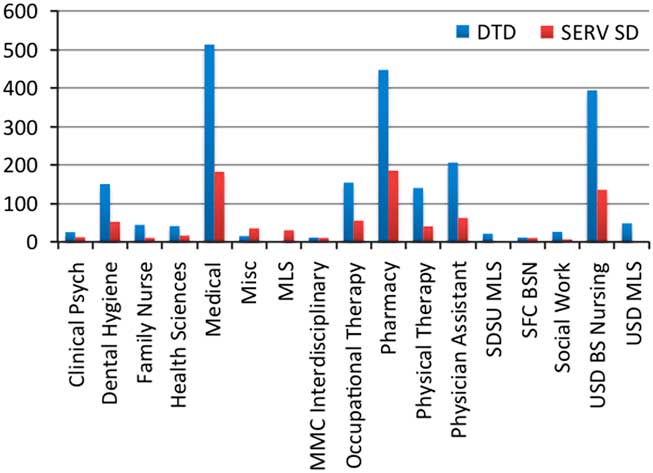
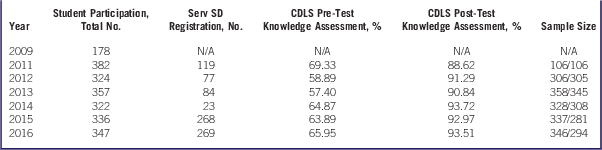
From 2009 to 2016, a total of 2246 students from various health professions programs participated in DTD. Each year saw a different number of students participate and become registered with SERV SD. In 2009, 178 students participated but the SERV SD registration was unavailable. Data showing the number of DTD participants who registered for SERV SD per year compared to the total number of DTD participants for 2011 through 2016 is shown in Table 1. (Note that the data for 2010 were not available for study.) The total number of students per health profession to participate in DTD since 2009 with associated SERV SD registration numbers is shown in Figure 1.
Participation in Disaster Training Day (DTD) and Registration with the South Dakota Statewide Emergency Registry of Volunteers (SERV SD) of Students by Health Profession. A total of 2246 students have participated in DTD since 2009. A total of 840 students have registered for SERV SD since 2011, representing 37.4% SERV SD registration. Abbreviations: BSN, bachelor of nursing; MLS, medical laboratory science; MMC, Mount Marty College; SDSU, South Dakota State University; SFC, Sioux Falls College; USD, University of South Dakota.

Disaster Training Day Participation by Year With SERV SD Registration and Associated CDLS Pre- and Post-Test PerformanceFootnote a

a Abbreviations: CDLS, Core Disaster Life Support (National Disaster Life Support Foundation); N/A, not available for that year; SERV SD, South Dakota Statewide Emergency Registry of Volunteers. Sample size represents pre-test/post-test participant numbers. Two-tailed t-test of -14.24 with associated P-value of <0.00001, indicating significant improvement in post-test performance.
From 2011 to 2016, the CDLS pre- and post-test scores were compared to determine if DTD was effective. The year-by-year breakdown with results on the knowledge assessment portion is shown in Table 1. The pre- and post-test scores were compared with a two-tailed t-test. The t-score was calculated at -14.24. The resulting P value was <0.00001, indicating significant improvement in post-test performance of DTD participants.
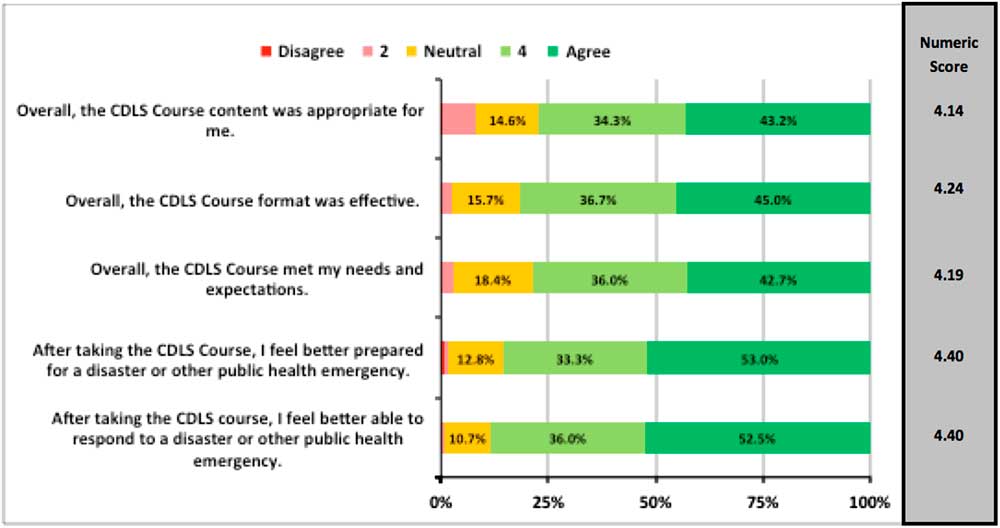
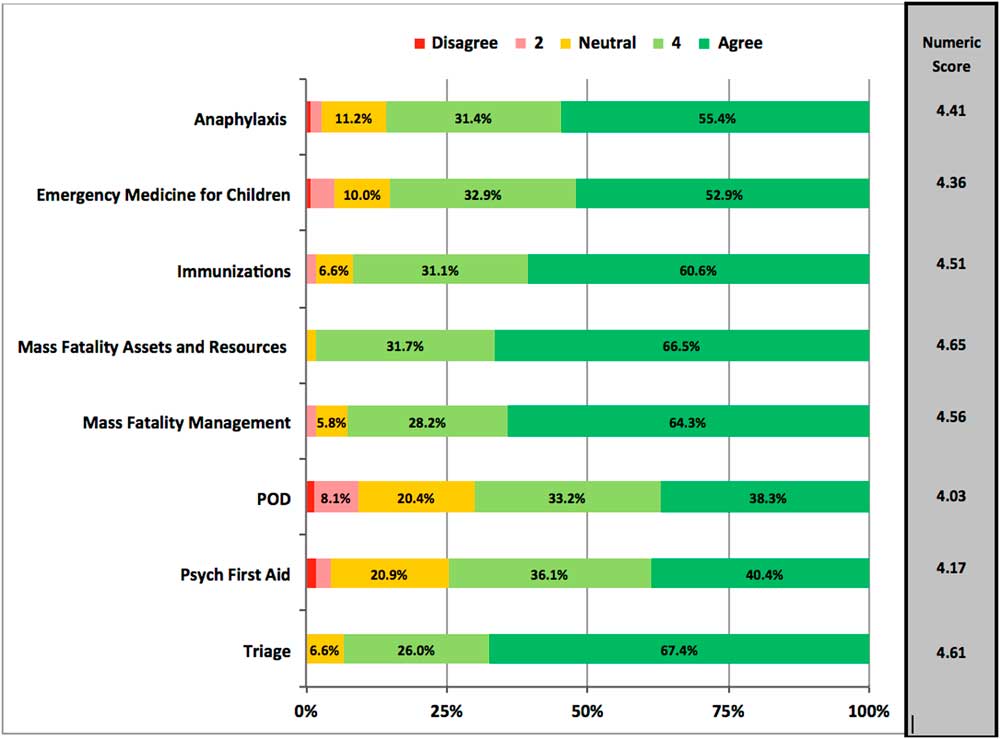
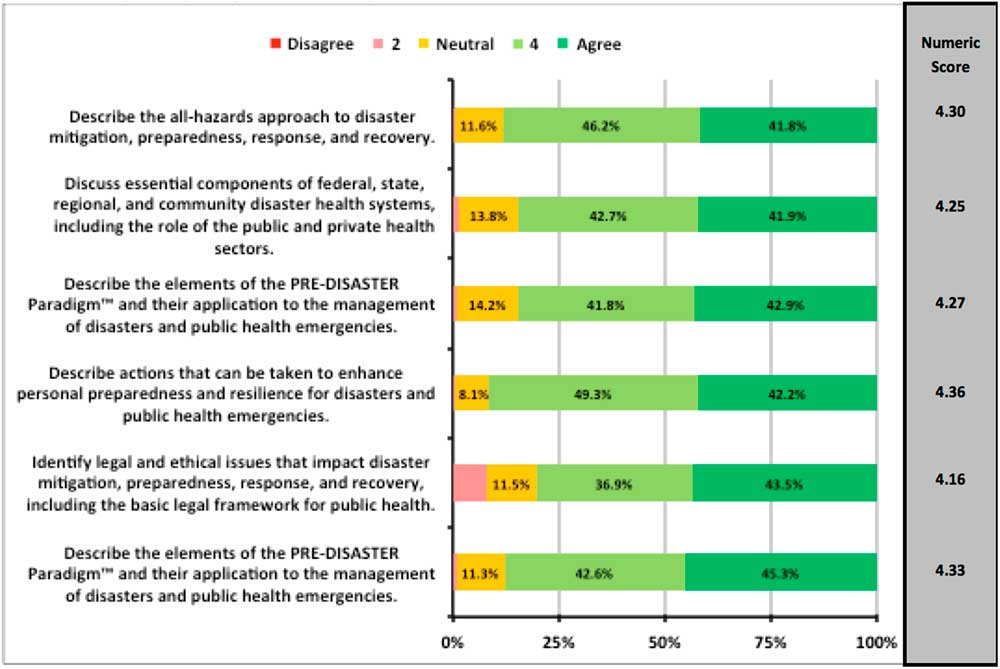
Students were asked to complete a 5-level Likert scale survey regarding their satisfaction with the CDLS training. Figures 2, 3, and 4 illustrate the responses for 2016, which represent the most recent data, and are similar to previous years. Figure 2 illustrates overall satisfaction with the CDLS lecture component of DTD. Scores ranged from 4.14 to 4.40, indicating a high level of satisfaction with disaster preparedness training. Figure 3 illustrates the student satisfaction scores for the individual breakout sessions for hands-on skills practice. Scores ranged from 4.03 to 4.65, indicating a high level of satisfaction for each breakout session. Figure 4 illustrates perceived self-competency of DTD participants per objective after completing DTD. Scores ranged from 4.16 to 4.26, indicating high levels of understanding of the objectives of DTD.
Student Satisfaction Survey Results from the 2016 Disaster Training Day Measured on a 5-Level Likert Scale. Abbreviation: CDLS, Core Disaster Life Support (National Disaster Life Support Foundation).

Student Satisfaction Scores of Small-Group Breakout Sessions From the 2016 Disaster Training Day on a 5-Level Likert Scale. Abbreviation: POD, points of dispensing.

Disaster Training Day Participant After-Action Review Scores on a 5-Level Likert Scale for Perceived Self-Competency Level.

DISCUSSION
Increasing the workforce available in a rural or frontier CAH is the first step in preparing for a disaster or public health emergency. After the recommendation of the Association of American Medical Colleges 5 in 2003 to increase medical student education in disaster preparedness, multiple medical schools have implemented disaster training courses ranging from afternoon seminars to 2-week courses with hands-on skill sessions. A review of the literature indicates that medical student disaster training is still inadequate.Reference Pollard, Bachmann and Greer 10 Additionally, no standardized curriculum has been universally accepted.Reference Jasper, Berg and Reid 11
DTD at the USD SSOM provides a successful model for integrating mass disaster training into the curriculum of not just medical schools but all health professions students. The participation in the program has expanded since its inaugural year in 2004. The most recent DTD, in 2016, provided basic disaster life support training to 347 students from 13 health professions.
Pre- and post-test assessments were given to each class. The mean increase in pre- and post-test assessment scores was 28.44%. There was a significant difference in pre- and post-test scores, indicating that DTD is an effective program for providing disaster training to health science students in a 1-day training session. Figure 4 illustrates the results of the after-action survey upon completion of DTD. These data represent self-perceptions of competency related to all DTD objectives. Student participants perceived high levels of understanding concerning disaster preparedness and response that can be taken with them into their eventual professional practice.
Overall, student participants of DTD are very satisfied with their experience (author’s perception). The student satisfaction scores from 2016 are shown in Figures 2 and 3. Students were very satisfied with their lecture-based experience with CDLS as well as the small group breakout sessions. The curriculum is fluid from year to year on the basis of these satisfaction surveys and current preparedness issues or threats, and small group activities are added or dropped accordingly. Local input from both EMS and hospital staff across the state was used to tailor the curriculum to specific needs identified for a rural state like South Dakota.
Training health professions students in disaster response is essential. However, training without coordination of deployment greatly limits the use of the training. Health professions students are given the opportunity to sign up for SERV SD at the end of DTD. In 2016, 77.5% of participating students signed up. The proportion of participating students to sign up for SERV SD greatly increased in 2015. The lowest percentage of student registration for SERV SD, 7.4%, was in 2014, because of lack of proper advertising (author’s perception). The incentive in volunteerism was multifactorial. A key factor identified was the use of paper applications handed out to every student at the end of DTD in 2015. Previous years relied on students registering online in their own time after DTD was completed.
A major issue encountered with volunteer responders is liability, for both the individual responder as well as the victims they care for. These individuals must be protected from personal injury as well as civil liability. Civil liability immunity has been provided by the volunteer’s inclusion as a statewide emergency registry volunteer. After the advent of DTD, with support from the SDSMA and the SD DOH, the South Dakota Legislature passed South Dakota Codified Law (SDCL) 34-22-44.2 and SDCL 62-1-5.1 in 2009. 12 SDCL 34-22-44.2 states that as long as the volunteer was acting in good faith, within the scope of their official functions, and the resulting damage or injury was not caused by gross negligence by the volunteer, the individual is immune from civil liability. SDCL 62-1-5.1 states that worker’s compensation coverage is provided for volunteers serving state or political subdivision without pay. This would provide some financial protection in the event of a personal injury for volunteers deploying for disasters and disaster training.
CONCLUSION
DTD provides a successful model for preparing health professions students for disaster response. Especially in a rural state like South Dakota, where most EMS personnel are volunteers, increasing the available workforce to respond in the event of a disaster or public health emergency is crucial. DTD is a 1-day event, making it easy to incorporate into any health professions curriculum.
DTD is a coordinated effort by YRAHEC, which does the logistical work supported by previously named entities. The EMS personnel and hospital staff provide the education component. The government backs this training by offering protective legislation, like SDCL 34-22-44.2. The universities coordinate training space and travel for health professions students from across South Dakota. This teamwork improves year to year, making DTD a successful mass training event to benefit the state of South Dakota.
Future Work
Immediate post-test evaluation shows a significant increase in the knowledge base of students after a single day of disaster training. Currently, the Upper Midwest Disaster Training center offers CDLS to 4 campuses, including nursing programs, which brings the total number of students per year to over 700. Each year this program has tried to include additional health professional students. Future planning includes expansion into rural and frontier counties to include EMS, rural fire departments, and hospital staff.