The US War of Independence was a war of many sides. The colonialists fought the British, France fought alongside the rebels, and both sides fought (and allied with) Native Americans. Among the many striking features of this war was its internal variation in how the enemy’s combatants and civilians were treated. At a time when the law of war governing the ways in which belligerents ought to comport themselves during combat was being developed in treatises such as Grotius’ The Laws of War and Peace and Vattel’s The Law of Nations, both the British and the colonists evinced dramatically different treatment of their European versus Native American foes. A shared culture and history led to gentle treatment between the British and colonialists – prisoners were treated kindly, and civilians spared many indignities. This civility in warfare contrasted greatly with both sides’ treatment of Native Americans, who were routinely massacred without warning and even, at times, despite promises of safety. According to Iroquois commenting on the differential treatment of Iroquois and British soldiers taken captive, ‘the Rebels don’t put them to death; but we have no mercy to expect, if taken, as they will put us to death immediately, and will not even spare our Women and Children’.Footnote 1
This disparity in how belligerents of European descent treated each other compared to how they treated Native Americans is consistent with many arguments about the role of culture in shaping violence. Joseph Conrad’s ivory trader Kurtz famously called on European readers to ‘Exterminate all the Brutes!’Footnote 2 And studies of cases such as the 1994 Rwandan genocide have found that racial categories are frequently highly salient in identifying ‘legitimate’ targets.Footnote 3
Yet this – often qualitative and historical – evidence of the role of culture in law of war compliance stands in stark contrast to much of the recent political science work on this topic, which has taken two disparate directions. One strand of research finds strategic military incentives to be the primary determinant of law of war violations, particularly as they relate to civilian targeting.Footnote 4 Another, taking an institutionalist approach,Footnote 5 argues that variables related to treaty ratification, regime type and reciprocity best explain overall compliance with the law of war. These otherwise disparate approaches share a skepticism of the role of identity and culture in explaining compliance, seemingly in contradiction to the qualitative work discussed above.
The gap between those accepting versus dismissing a role for identity is both theoretical and methodological. On the one hand, scholars employing qualitative and interpretivist methods have argued that identity has fundamentally shaped our conception of who is a civilian and, thus, a legitimate target in war.Footnote 6 On the other hand, scholars using quantitative and formal methods have tended to use strategic and institutional variables to predict civilian targeting.Footnote 7 In this article, we seek to bridge the gap between a near-conventional wisdom in qualitative studies of war that attributes great importance to the role of culture and identity, and a similarly robust finding in recent quantitative studies that suggests the opposite.
We argue that our understanding of compliance can be deepened by examining the historical origins of the law of war within the European community of states and the resulting distinction this history has made salient between European and non-European states. This point is commonly accepted among many scholars of the history of international law in generalFootnote 8 and of the law of war in particular,Footnote 9 but has not yet been incorporated into recent quantitative studies of civilian targeting and compliance with jus in bello, nor has it been subjected to systematic testing in prior scholarship. The distinctively European origins of the law lie first in the European Christian tradition, second in aristocratic notions of chivalry and third in the initial codification of the law of war in 1864 by European states.Footnote 10 The law of war was an attempt to institutionalize within the European community of states norms of the limitation of warfare, which had deep roots in the traditions of the continent. From the perspective of the ‘civilized’ members of the European community of states, non-European states were racial, moral and legal outsiders and were thus not deserving of the restraints on warfare, however limited, that one might employ against a fellow European. Thus there are good theoretical reasons to expect that compliance with the law of war should be especially low when European states fight non-European powers.
This article makes several contributions to the existing literature. First and most important, we show that a more nuanced conception of identity helps predict civilian targeting and compliance with jus in bello. Secondly, our study is one of a growing number to test arguments about identity quantitatively.Footnote 11 Thirdly, in addition to finding that European states have been consistently likely to target civilians in non-European states, our results also underline the rareness of full restraint.
The article proceeds as follows. First, we review recent scholarship on civilian targeting and compliance with jus in bello – the canon of international law that governs hostilities once war has begun – and highlight this scholarship’s treatment of identity variables. Secondly, we offer a history of the development of jus in bello that focuses on the role of identity in particular. Thirdly, we present our main hypothesis and underlying mechanisms. Fourthly and fifthly, we justify our coding of our key independent variable and test our claim that European identity is a salient distinction in predicting civilian targeting and compliance with jus in bello. Our empirical analysis focuses primarily on the issue of civilian targeting, which positions us to evaluate recent claims made in the quantitative literature on this topic. Our conclusions follow.
EXISTING ARGUMENTS ABOUT IDENTITY, CIVILIAN TARGETING AND THE LAW OF WAR
Recent scholarship on civilian targeting by Benjamin Valentino et al. and Alexander Downes sets strategic arguments about civilian targeting in stark contrast with identity arguments.Footnote 12 Importantly, these studies measure the identity variable in distinct ways and in a manner that departs significantly from the approach taken in this article. James Morrow, in his work on law of war compliance, does not test this variable at all.
Those who test a version of the identity argument suggest that states fighting against adversaries they deem as ‘barbaric’ or ‘less than human’ will more frequently target their enemy’s civilians than will those battling against enemies deemed to share important cultural, racial or religious attributes. Downes employs Huntington’s conceptionFootnote 13 of the world’s eight civilizations to code whether warring states were members of the same civilizational bloc. Valentino et al. utilize a slightly different measure, coding whether 50 per cent or more of the opposing states’ populations were of different races or religions. The measure of identity used is ultimately not significant in the statistical analyses of either study.
These measures imply an assumption that any difference in identity between warring parties may increase the probability or extent of civilian targeting. This claim is undoubtedly parsimonious and consistent with arguments about in-groups and out-groups.Footnote 14 We argue, however, that within the context of the law of war generally (and civilian targeting specifically) there is good theoretical reason to believe that a particular configuration of identities affects compliance and civilian targeting. We draw on the concrete history of the law of war to explore which categories of identity are likely to affect compliance with these laws. Because the law of war has its roots in customs that developed on the European continent and were never meant to apply to relations with non-European states, the appropriate distinction seems to be between European states and all other states. As Downes and Valentino et al. complicate the statistical analysis by testing additional divisions (between Asians and Africans, for instance) that are less clearly justified by the development of the law of war, their analyses miss the effects of the one identity difference that is most justifiable.
Though we contend that recent scholars of civilian targeting and compliance with the law of war have been remiss to discount the effects of identity, we do not challenge their primary findings. We argue that the European identity variable helps shed additional light on civilian targeting and compliance, but do not contend that it takes the place of either strategic or institutionalist variables. The important point is that, even when controlling for those variables emphasized by Downes, Valentino and Morrow, the variable of mixed European/non-European dyads remains significant. Both military-strategic and institutionalist arguments miss a key part of the compliance story by neglecting the role of identity.
EUROPEAN IDENTITY AND THE ORIGINS OF THE LAW OF WAR
In order to demonstrate that the law of war as it was codified in the nineteenth and twentieth centuries has deep roots in the religious and cultural traditions of the European continent, this section briefly recounts the origins and evolution of what came to be the law of war. Throughout its historical development, the law of war has emphasized the distinction between the European insider and the non-European outsider: those protected by restrictions on warfare and those deemed outside the sphere of such protection. Notably, violations were common even within the European community – but less so compared to European relations with non-Europeans – as the forces of war often militated powerfully against compliance.
Though references to restrictions on warfighting can be found in the Hebrew Bible, classical Greece and Rome provide the earliest examples of codes governing warfare on the European continent. In both cases, expectations about appropriate treatment of those considered part of the cultural community diverged strikingly from the expected conduct toward those considered outsiders. Roman warfare was known for the marked absence of restrictions on the categories of persons who were considered legitimate targets of war, so much so that bellum romanum has become a synonym for total war. Yet bellum romanum was only permitted against non-Roman enemies.Footnote 15 Similarly, the Greeks developed extensive rules governing the conduct of war that were largely respected in intra-Hellenic wars between approximately 700 and 450 BC, but these rules did not apply in battles between Greeks and non-Greeks.Footnote 16 Even this intra-Greek agreement was short-lived, as these rules broke down after 450 BC. Yet during the several centuries in which this arrangement prevailed, it did so only within the intra-Hellenic context. Thus the classical period evidences restrictions on warfare, as well as limitations on the applicability of these restrictions in wars with those classified as outsiders.
During the medieval period, two developments contributed to the strengthening of restrictions on warfighting: (1) ecclesiastical attempts to limit the brutality of war, particularly in wars among Christians; and (2) the emergence of a knightly class of warriors bound by honor to uphold certain rules of warfare. As James Turner Johnson put it, ‘chivalric and churchly interests gradually merged’ on the topic of limitations on warfighting.Footnote 17
By the Middle Ages, the idea that Romans should only prosecute total war in disputes with non-Romans had evolved into the idea that Christians should honor certain restrictions when fighting other Christians. However, this attempt to limit war among Christians occurred simultaneously with a loosening of the criteria necessary to justify wars against non-Christians and a tolerance for the brutal prosecution of such wars.
Alongside the Church’s attempts to temper war among Christians during the Middle Ages, knighthood and the ideal of chivalry associated with it played a pragmatic role in regulating conflict. Among the privileged class of nobles who were deemed knights emerged expectations of honorable behavior both within war and without. Importantly, this code applied only in relation to other knights – neither common soldiers nor noncombatants were granted protections. Beginning in the fifteenth century, a number of dramatic changes challenged the pillars that had supported a code of warfighting in the Middle Ages. Yet the declining relevance of the knight did not, as Stacey notes, lead to the dissolution of the knightly code, but rather resulted in its evolution into a standard of conduct to be observed between officers and, later, soldiers of opposing armies.Footnote 18 Likewise, this period witnessed the first bilateral agreements between states on the subject of wartime conduct. In 1599, Spain and the Dutch Republic agreed in the cuartel general that every captain would offer captured prisoners for ransom within twenty-five days. Spain and France agreed similarly in 1639.Footnote 19 But the bilateral nature of these agreements provides evidence that restrictions on warfare, though extending at this time beyond the knightly class, were never meant to be universally applicable.
The encounter with the ‘new world’, beginning in the fifteenth century, also exerted a dramatic effect on European ideas about behavior in war, as European thinkers wrestled with the moral and legal implications of European conquest. Thinkers like de Vitoria criticized the particular justifications made for Europeans’ dominion over native peoples even as they rationalized the colonial enterprise itself via the discourse of civilization.Footnote 20 It is worth noting, then, that Europe’s encounter with the ‘other’ provided significant impetus for the development of international legal thought, even as this nascent thought provided little in the way of restraint on European action.
If the early modern period represented a relative regression in the ‘bracketing of war’ as compared to the respublica Christiana Footnote 21 of the Middle Ages, the age of revolutionary or nationalist war ushered in by the French Revolution of 1792 is often viewed as even more of a setback for those who sought to civilize the prosecution of wars. Whereas wars in previous eras were fought by a relatively small, professionalized class, the revolutionary era saw the mobilization of large popular armies. Geoffrey Best argues that the mass mobilization of soldiers and the increasing importance of nationalist ideology contributed to the decline in adherence to the code of war during this time.Footnote 22
Yet the excesses of the revolutionary period provided a partial rationale for the turn toward codification of the law of war in the late nineteenth century. One such nationalist war, the Austro-Sardinian War of 1859, inspired Henri Dunant’s A Memory of Solferino. This recount of the unnecessary deaths of the wounded at Solferino became the catalyst for the formation of the International Committee of the Red Cross, which played a crucial role in the conference that led to the first codification of the law of land warfare in 1864.Footnote 23 This 1864 meeting consisted of sixteen states, all from the European continent. The document produced, the Convention for the Amelioration of the Condition of the Wounded in Armies in the Field, focused primarily on the treatment of combatants, much like the early knightly code. It was followed by the 1899 Hague Conventions, which detailed the proper treatment of prisoners of war and outlined policies for armistices, capitulations and legitimate belligerency. Again, the substantive criteria agreed upon had precedent in the earlier restrictions on warfighting on the European continent. The law of war as we know it today was born.
Historical Continuities
This brief history reveals a number of trends that are relevant for forming expectations about compliance with the law of war. First, the laws of war codified in the nineteenth century – and later extended in both substantive content and geographic breadth in the twentieth century – have antecedents hundreds of years earlier in the concrete customary traditions of European political units. Furthermore, these traditions were justified by the religious and political institutions of their eras, particularly in Christianity and the knightly institutions of the ancien régime. When modernity wrought significant changes to these institutions, the code of warfare was not thrown out but was merely adapted, often with very few changes, to the new context.Footnote 24 Common to the rules of warfare in each of these periods, however, was the idea that they applied to some types of enemies but not others. Restrictions applied to fellow Romans and Greeks, respectively, in the classical period, to Christians and particularly fellow knights in the medieval period, to those of one’s own confession in the early modern period, and to other European states in the modern period.
Central to the development of a codified law of war was the recognition among European states that a fellow European state waging war against it was a justi hostes, a lawful enemy one would seek to defeat, but not to annihilate.Footnote 25 However, enemies outside the European community of states were not granted such status and were often classified as savages, barbarians or semi-barbarians by European states: hostis injustus, against whom constraints on warfighting did not apply.Footnote 26 As one historian noted, ‘The rules, objectives, and conduct of war were altogether different once civilization had been left behind’.Footnote 27
An interesting and important coda to this detailing of the Eurocentric development of the law of war is the creation of the 1977 Additional Protocols to the 1949 Geneva Conventions. Unlike previous jus in bello treaties (including the 1949 Geneva Conventions), the Additional Protocols explicitly extend their application to wars of liberation from colonialism as well as, to some degree, civil wars in general (or, in the parlance of international law, ‘non-international armed conflicts’). For the first time, a large proportion of participants in the conference came from the non-European world.Footnote 28 Importantly, Protocol I also contains the most explicit definition of ‘civilian’ in multilateral treaties to date (see Article 50).Footnote 29 The clear extension of the law of war in this way may signal a change in the boundaries of civilization, most critically related to which targets are legitimate and which are not. Thus, as will be detailed further below, this article will seek to demonstrate the relevance of a particular cultural variable and assess its temporal limits.
HYPOTHESES AND MECHANISMS
Given the particular evolution of the law of war from European religious and cultural traditions, and its initial inapplicability to wars between members of the European community of states and non-Europeans, the central hypothesis of this article is as follows.
Hypothesis 1: European compliance with the law of war should be lower in wars between European and non-European states compared to other types of dyads.
At least two different mechanisms might explain the relationship between European identity and compliance with the law of war. One explanation for excluding non-Europeans from the protection of the law of war was the expectation that they would not be able to reciprocate compliance. Morrow has found that compliance tends to correlate with the compliance of one’s foe, though not perfectly, given the difficulty of assessing other states’ actual degree of compliance.Footnote 30 This potential for ‘noise’ might create incentives for states to use cognitive shortcuts to evaluate the likelihood of other states’ compliance. European states might judge that non-European states are less likely to comply, and might thus demonstrate lower levels of compliance during wars against such states, even though such an expectation may not always be warranted.
Why would European states make such an assumption? Recall that the law of war emerged gradually on the European continent as common understandings of the nature of sovereignty and the legitimate means and ends of force evolved. It also emerged in the context of the near-universal ability of European states to project power in their own territories. Because of this shared history and the role of European states in the initial codification of this law, European states know and accept the principles governing the modern law of war and also, importantly, understand that other states know and accept these principles. This common knowledge creates the conditions that make mutual compliance possible.Footnote 31 Though non-European states may comply with the law of war, European states may be less certain whether non-European states share such knowledge and beliefs. Warfare practiced by peoples in Africa and the Americas, having evolved in a different cultural and strategic context, bore little resemblance to the practices of interstate warfare that had emerged in Europe by the seventeenth century. As Colby put it in the language typical of his time, ‘the real crux of the matter of warfare between civilized and uncivilized peoples almost invariably turns out to be a difference in fact as well as a difference in law’.Footnote 32 Because indigenous peoples fought war differently from Europeans, often employing what we consider today to be guerrilla tactics, they could thus not be expected to reciprocate compliance with norms of warfare with which they were wholly unfamiliar.Footnote 33 As a result, Europeans did not view themselves as bound to restrictions vis-à-vis the ‘savage’.
Non-European state ascension to humanitarian law treaties may not be enough to create a common understanding, as states know that other states may have reason to accede insincerelyFootnote 34 or may lack the military control necessary to ensure that subordinates comply. Thus a possible reason for the independent effect of European identity on compliance, even once one has controlled for reciprocity, is that states use European identity to gauge the likelihood of reciprocity, even though it is by no means a perfect device. Thus what may begin as an observation about the likely (non)compliance of a particular enemy becomes a cultural script or cognitive shortcut that drives decision making even if the initial judgement of unlikely reciprocity no longer applies. In this view, then, cultural judgements exert an effect that is independent of (and distinct from) the concrete fact of reciprocity.
Another possible mechanism for low levels of European compliance when fighting non-European states relies on a much simpler logic. Racism might determine both perceptions of non-Europeans’ ability to comply (and, therefore reciprocate compliance) with the law of war as well as their inclination to target civilians and violate jus in bello. There was a real sense, through at least the early twentieth century, that the non-European ‘other’ was not accorded the same moral and legal status as the civilized European. Such peoples, as has been discussed at length by Martha Finnemore, were not viewed as fully human.Footnote 35 Combined with the belief that many non-Europeans were incapable of reciprocating law of war compliance, the perception of such peoples as somehow inferior to civilized Europeans contributed to their construction as those to whom the law did not apply.Footnote 36
For example, during the Italo-Ethiopian War of 1935, Italy partially justified its conquest of Abyssinia by asserting that Italy had reached a higher level of civilization than Abyssinia and could thus play a role in ‘civilizing’ and educating Ethiopians.Footnote 37 The Abyssinian ‘barbarian’, then, was the foil to the civilized Italian, and themes of barbarism frequently accompanied Italian claims of Ethiopian atrocities. Yet it was the Italians who engaged in systematic violation of the law of war via their prolific use of poison gas,Footnote 38 intentional attacks on hospitals under the protection of the Red Cross emblemFootnote 39 and indiscriminate aerial attacks of undefended territories.Footnote 40
The logic of our argument also suggests that compliance levels could be higher when Europeans are fighting other Europeans. The Spanish-American War provides an interesting illustration of this dynamic. Both major belligerents viewed each other as European and observed all the formalities of war, from issuing formal declarations of war to gentle treatment of each other’s wounded.Footnote 41 At the same time, both Spanish and US treatment of Cuban and Filipino insurgents was at best indifferent, and at worst appalling, even though US forces were essentially allied with the Cubans and Filipinos.Footnote 42
Hypothesis 2: European compliance with the law of war should be especially high in wars between European states compared to other types of dyads.
Our theory does not make specific predictions regarding wars between non-European states or the behavior of non-European states toward European states. This discussion of the European origins of the law of war as codified in the nineteenth century does not mean to imply that non-European cultural traditions lacked their own understandings of the moral conduct of war. Indeed, one can find an attempt to address, to various degrees, jus ad bellum and jus in bello issues in Islam, Hinduism and Chinese philosophical traditions, among others.Footnote 43 Our argument is not that notions of morality in warfare are unique to Christian European traditions; rather, the point is that, because of the constellations of political power at the time, an interpretation of wartime ethics rooted in European Christian traditions formed the basis for the codified law of war. As a result, we are silent with regard to the wartime behavior of non-European states both toward each other and toward European states. Though European states seem to have expected low compliance from non-European states, it is not clear that this expectation was warranted, and this claim does not follow from the argument stated here. Our brief survey of the available (and quite limited) literature on non-European law of war traditions did not yield any systematic insights that could generate predictions on behavior.Footnote 44
It is possible that the strength of any mechanism that generates high levels of civilian targeting when European states fight non-European states should decline over time. As the distance from the founding of formal jus in bello increases, the effects could decrease as well. As belligerents meet each other repeatedly on the battlefield, expectations regarding each side’s ability to reciprocate should be updated. And as populations become increasingly intermingled, misperceptions based on racism should also be mitigated. The design and content of the 1977 Additional Protocols suggest precisely this logic. These dynamics generate a corollary hypothesis to our argument.
Hypothesis 3: Over time, European versus non-European wars should be less likely to exhibit a significant difference from other conflicts regarding whether and which civilians are targeted.
CODING ‘EUROPEAN’
Defining which countries should be considered members of the European community of states is contentious. We define Europe in the manner that is most consistent with the theoretical mechanism under investigation here. We argue that Europeans originated the law of war to govern their interactions with other European states. The specific character of the law draws upon these states’ shared histories as successor states to the Roman Empire and, later, as members of the Christian community of states possessing a knightly chivalric code. By this logic, the states that should be considered ‘European’ for the purposes of this article are those that (1) participated in the initial codification of the law of war in the late nineteenth century and (2) were generally perceived by European states as members of the European community at the time of codification. Because the identity argument depends on recognition by the deciding state of a target state’s in-group or out-group status, European states’ perceptions of the target state as European or not is the deciding factor when there is a discrepancy between the two criteria delineated above.Footnote 45 Our definition excludes the Eastern European countries and Turkey, and includes Russia as well as the United States, Australia, Canada and New Zealand. Potentially controversial inclusions and exclusions are considered in more detail below.
Identity is an inherently contentious and fluid concept. Even as we define ‘Europe’ as we do, we are cognizant of how the boundaries of this identification have changed (and continue to change) over time. Therefore the claim is not that the domains of the European cultural community map unambiguously onto to our independent variable, but rather that this variable captures a salient identity distinction at a particular point in time, a distinction that would, to some extent, be ‘locked in’ by the codification of law by the European ‘in states’ at that time.
Eastern Europe and Turkey
Just as the relationship of Eastern Europe to Western Europe continues to be controversial today, there are sound reasons to exclude these states from the European variable explored here. First, the Eastern European states as we know them today were generally not sovereign entities at the time of the initial codification of the law of war in the mid nineteenth-century, and thus did not participate as originators of the law of war. Secondly, there is significant empirical evidence that the Eastern European states were not perceived by their Western European counterparts as members of the European community of states.Footnote 46 For instance, an observer of the customs of warfighting in Europe in the seventeenth and eighteenth centuries notes that constraints on warfighting only held insofar as ‘both sides held the same beliefs and agreed to abide by them. When the Teutonic Knights met the peoples of Eastern Europe […] the customary restraints vanished and the squabbles became bitter and vicious’.Footnote 47 Because Eastern Europe’s exclusion from the Western European perception of the European community of states separates Eastern Europe from the mechanisms expected to result in increased law of war compliance among European states, the states of Eastern Europe are not coded as European.
Turkey likewise presents some challenges to our coding efforts. Though the Ottoman Empire was a consistent participant in early efforts to codify the law of war, it was not perceived by European states as a member of the European community, and thus we do not code Turkey as European. One scholar writes, ‘the Turks represented all that was negated in the European identity; savage, barbarian, despotic, oppressive, violent, and a threat to European civilization’.Footnote 48 Turkey’s Islamic religious traditions undoubtedly contributed to its categorization as ‘Other’ by nineteenth-century Europe; indeed, debates about the extent of Turkey’s ‘Europeanness’ continue to this day.Footnote 49
Russia
There is one notable exception to the exclusion of the states of Eastern Europe from the category of European: Russia. Though it is geographically considered part of Eastern Europe and Asia, its political activities during the time of the initial codification of the law of war, particularly its role in the Concert of Europe, provide strong grounds for including it in our category of European states. Russia is coded as European for the very reasons that the other Eastern European countries are not: it participated in the initial codification of the law of war and was perceived by the other leading European powers as being a member of the European community of states.
Russia emerged as a member of the European great power club during the anti-French coalitions of the late eighteenth and early nineteenth centuries.Footnote 50 After the final defeat of France in the Napoleonic Wars, Russia joined Britain, Austria and Prussia in a series of bilateral agreements that confirmed each country’s commitment to preventing the re-emergence of the French threat and ensuring the general security of the European continent. The specific text of these treaties provides further indication that Russia was considered a European power; for instance, the Treaty of Chaumont, signed by Austria, Prussia and Russia on 9 March 1814, references ‘their respective States in Europe’.Footnote 51
In addition to Russia’s general membership in the European community of states, it played a critical role in the early formation of the law of war. An early signatory of the 1864 Geneva Convention, Russia took the lead in convening the 1868 St. Petersburg Convention, at which states agreed to the general principle that the means of war should not cause unnecessary suffering. It was also Russia’s initiative that led to the 1899 Hague Convention. On 24 August 1898, Nicholas II sent the famous ‘czar’s rescript’ suggesting the formation of an international conference to discuss disarmament.Footnote 52 While the czar’s goals for an armament agreement were not met, the conference did succeed in ratifying a code of warfare that forms the basis of contemporary jus in bello. Note that including Russia as a European state biases the data against our hypothesis, given that the historical record has established the extensive law of war violations that occurred along the Eastern Front in the Second World War.Footnote 53
Australia, Canada, New Zealand and the United States
Another coding question concerns the status of states formed as settler colonies from European states. Australia, Canada, New Zealand and the United States are distinct from the majority of colonial territories in that the European (British) settlers of these territories became the majority populations of these areas. As a result, these states, particularly Canada, New Zealand and Australia, formed as ‘offshoots’ of Great Britain and maintained close cultural and political ties to the colonial homeland. Inclusion of the United States is further warranted because the United States and Europe exercised joint influence in the early development of the law of war. In 1863, the United States issued the Lieber code, an early statement of restraints on war that would prove foundational to the formation of positive law in Europe. Thus, these states strongly influenced (and were strongly influenced by) the European experiences of the early law of war. Likewise, because these states formed so directly from a European population, they were viewed by other European states, and especially by Great Britain, as extensions of the European community. Thus, from both general historical and European perceptions, these states clearly meet the criteria for European classification. However, they do fall short on the positive law criterion – they were not all, for example, initial signatories of the early law of war treaties – but this was because they remained under the sovereignty of the United Kingdom.
EMPIRICAL ANALYSIS
In this section, we replicate and extend three recent analyses of civilian targeting and compliance with the law of war to test our claims about the role of identity in the conduct of interstate war. Our unit of analysis is directed dyads, which allow us to distinguish the behavior of European states fighting non-European states from other types of dyads. Where previous scholars have included a variable meant to approximate cultural or identity differences, we replicate their analyses and then substitute a variable that codes for whether the dyad includes a European state fighting a non-European state. We also include indicator variables for European v. European dyads and non-European v. European dyads; our reference category is non-European v. non-European dyads. For example, in the Anglo-Persian War of 1856, the Britain v. Persia observation takes a value of 1 for the European v. non-European variable, while the Persia v. Britain observation is coded 0 for the same variable. Where previous scholars have not included a variable to approximate cultural or identity differences, we replicate their analyses and then add our variables. We then compare any changes in statistical and substantive significance across different models.
Our findings suggest that, contrary to the most recent claims on the subject, identity does matter in predicting civilian targeting and non-compliance with jus in bello. Previous work that has come to the opposite conclusion has either neglected to include any variable that could capture this effect or fallen prey to measurement error, failing to take into account the international legal history outlined above and its expected effects on civilian targeting and violation of jus in bello. We do not necessarily find that the substantive effects of this variable overwhelm other factors that may induce civilian targeting, such as wars of attrition, regime type or the adoption of insurgency tactics by the target state. But we do find – consistently – that European v. non-European dyads are much more likely to be characterized by civilian targeting and non-compliance than are other types of dyads.
The remainder of this section re-examines three important works on civilian targeting and compliance with jus in bello in light of the historical and theoretical analysis above: Alexander Downes’ Reference Downes2008 book, Targeting Civilians in War; Benjamin Valentino, Paul Huth and Sarah Croco’s Reference Valentino, Huth and Croco2006 article ‘Covenants without the Sword’; and James Morrow’s Reference Morrow2007 article ‘Why Do States Comply With the Law of War?’
Civilizational Differences in Downes’ Targeting Civilians in War
Alexander Downes argues that wars characterized by territorial aims and attrition are especially likely to lead to civilian targeting. The logic of territorial conflicts can lead to civilian targeting when there is a perceived need to ‘cleanse’ a territory that one of the belligerents intends to resettle. Wars of attrition likewise produce civilian targeting as a measure of desperation; leaders may adopt civilian targeting as a calculated last resort, even as they recognize that it is often ineffective.
Downes’ excellent study captures key elements of the puzzle of civilian targeting. He includes an identity variable to test the hypothesis that ‘mistreatment of civilians is more likely to occur in conflicts in which the belligerents view each other as “barbaric”’.Footnote 54 By adopting Huntington’s coding of civilizations to include a variable for whether the two parties at war cross civilizational lines, Downes seems to assume that all belligerents view opponents across civilizational lines as barbaric.
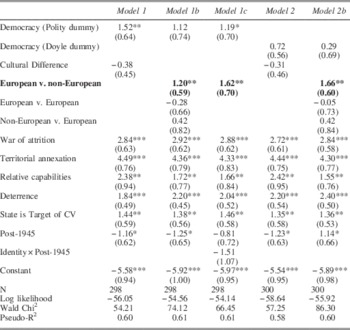
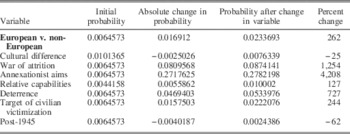
As illustrated by the models that include the variable Cultural Difference in Table 1, Downes consistently finds a negative, statistically insignificant result for this variable. When, however, we substitute our version of this variable – coding for whether a European state is fighting a non-European state (as well as other possible dyad combinations) – we generate the opposite finding. The European v. non-European variable is both positive and statistically significant. The substantive effect of this variable rivals or exceeds that of other key control variables. As shown in Table 2, when a European state fights a non-European state, the probability of civilian targeting increases by over 250 per cent. While the size of this effect remains an order of magnitude lower than Downes’ key explanatory variables of attrition warfare and annexationist war aims, the substantive effect of European v. non-European warfare is greater than, for example, those of reciprocity or relative capabilities. By contrast, Hypothesis 2 receives at best limited support from these results. Although the coefficient on European v. European dyads takes the correct (negative) sign, it is never statistically significant.
Determinants of Civilian Victimization by Participants in Interstate Wars, 1816–2003 (Logit Estimates)

Note: replication and reanalysis of Downes (Reference Downes2008, Table 2.9), Models 1 and 2. ***p<0.001, **p<0.05, *p<0.1. Shaded row contains Downes’ original measure of identity. Bolded row contains our measure of identity.
Change in the Expected Probability of Civilian Victimization Associated with each Independent Variable (Participants in Interstate Wars, 1816–2003)

Note: extension of replication and reanalysis of Downes (Reference Downes2008). Downes holds variables constant at their means. Because most of his variables are binary, we feel it is more appropriate to hold all binary variables at their modal values, and the one continuous variable (capability) at its mean. Compared to Downes’ Table 2.6, the marginal effects for Downes’ key variables appear much higher for this reason. Shaded row contains Downes’ original measure of identity. Bolded row contains our measure of identity.
Alternative specifications generate similar results that largely support our main claim. Including only one dummy variable that measures identity – for European v. non-European dyads – for example, consistently produces a positive and statistically significant coefficient. The analysis is also robust to dropping the world wars, but is not robust to dropping the United States as a belligerent. In the latter case, depending on the specification of the model, variables ranging from attrition to the dummy for European v. non-European dyads perfectly predicted civilian targeting.
Robustness checks employing alternative codings of European yield interesting results. For this data set, restricting the coding of ‘European’ to all states on the European continent,Footnote 55 or to all Western European states, did not generate significant coefficients. But restricting the key independent variable to original signatories of the Second 1899 Hague Convention with Respect to the Laws and Customs of War on LandFootnote 56 generated even stronger results on our key independent variable than our preferred coding of European, suggesting that a historical relationship with jus in bello may indeed be a key component of identity in predicting civilian targeting. We further explored this possibility in our test of Hypothesis 3 by interacting the post-1945 era (which largely lines up with the post-1949 Geneva Conventions era) as well as the post-1977 era (which lines up with the post-Additional Protocols era) with European v. non-European dyads, in the expectation that the effect of identity on civilian targeting would ameliorate over time, especially as more non-European states become party to the laws of war. The results offer only mixed support for this claim: compared to pre-1945 cases that include dyads other than European v. non-European belligerents, there may be a slight (although not statistically significant) negative effect on civilian targeting for European v. non-European dyads after 1945. Yet there are no cases of European states fighting non-European states that also target their opponents’ civilians after 1977. That the European v. non-European variable appears to exert such opposing effects in the pre-1977 and post-1977 periods suggests the possibility of a dramatic transformation in the relationship between European identity and compliance over the last several decades. Thus there is ample evidence here of the effect of this particular cultural variable, as well as evidence of possible temporal limits on this variable’s effects.
Race, Religion and Covenants
Benjamin Valentino, Paul Huth and various co-authors have offered an argument similar to Downes’ in their work on civilian targeting. Here we focus on their results in a 2006 World Politics article, co-authored with Sarah Croco, which contrasts the effects of the ratification of international humanitarian law on compliance with those of wars of attrition, adoption of counterinsurgency tactics and war aims. Like Downes, their analysis generates very strong findings in favor of the hypothesis that wars of attrition, counterinsurgencies and annexationism all increase the probability of civilian targeting. Ratification of international humanitarian laws such as the Geneva Conventions, however, does not seem to have the effect of reducing civilian targeting.
Valentino et al. also include a variable for identity conflicts as a control. The hypothesis they mean to test is that ‘States will intentionally kill greater numbers of enemy combatants during war when the majority of their population comprises different major racial or religious [sic] than does their adversary’s population’.Footnote 57 They then code for whether ‘more than 50 per cent of the populations of each of the opposing combatant states were of different major races or religions’.Footnote 58
In contrast to Downes’ results, Valentino et al.’s identity variable approaches statistical significance.Footnote 59 Nonetheless, we argue that their measure of identity misses the mark. Theoretically speaking, and particularly when testing for compliance with jus in bello, we have stronger reasons to believe that a particular difference – European v. non-European – will have a greater effect than the general difference examined in Valentino et al.’s article.
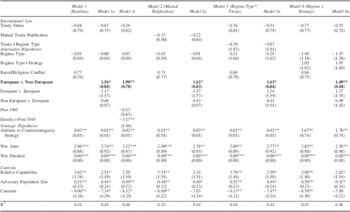
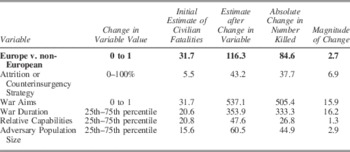
Once again, our findings support Hypothesis 1. When substituting our (European v. non-European) version of the identity variable for that used by Valentino et al., we find a consistently positive and statistically significant effect of this particular configuration of identities on the number of civilians killed during war. As Table 3 illustrates, Valentino et al.’s findings on attrition, counterinsurgency and war aims remain robust. But as displayed in Table 4, European vs. non-European dyads are almost three times as likely to experience civilian targeting as non-European vs. non-European dyads, a substantive effect that is on par with those of relative capabilities and the size of the adversary’s population. Indeed, the number of civilians killed when Europeans fight non-Europeans is significantly higher than when Valentino et al.’s main strategy variable is activated. Also similar to the reanalysis of Downes, however, Hypothesis 2 is not supported by the results; not only is the coefficient on European v. European dyads never statistically significant, it also takes the wrong sign.
Regression Models of Civilian Killings During Interstate Wars (1900–2003)

Note: replication and reanalysis of Valentino, Huth and Croco (Reference Valentino, Huth and Croco2006). N=148 for all models. ***p<0.001, **p<0.05, *p<0.1. Shaded row contains Valentino et al.’s original measure of identity. Bolded row contains our measure of identity.
Marginal Effect of Variables on the Number of Civilians Killed During Interstate Wars (1900–2003)

Note: extension of replication and reanalysis of Valentino, Huth and Croco (Reference Valentino, Huth and Croco2006). Bolded row contains our measure of identity.
As with our reanalysis of Downes’ data, we ran several robustness tests to verify these results. Including only one identity dummy variable that singles out European v. non-European dyads yields a consistently significant and positive coefficient. Dropping the world wars and the cases in which the United States was a belligerent also produced stable results. The finding that European states are particularly likely to target civilians in non-European states is also robust to a number of specifications of European. Recoding European as a measure of whether a belligerent was located on the European continent consistently generated a significant and positive coefficient for European v. non-European dyads; this result was even stronger when the key independent variable was limited to coding only West European states as European. Recoding the variable to focus on original signatories to the second 1899 Hague Convention yielded similarly robust results.
Interestingly, we found stronger results for the possibility of a temporal effect when reanalyzing the Valentino et al. data compared to the Downes data. Consistent with Hypothesis 3, European v. non-European dyads post-1945 and post-1977 are approximately twenty-five times less likely to see civilian targeting compared to other types of dyads in the pre-1945 and pre-1977 eras.
It is also possible that identity indirectly affects compliance through the variables identified as most important by Valentino et al. For example, non-European states could be especially unlikely to ratify jus in bello treaties, and particularly likely to be the targets of counterinsurgency campaigns and territorial conflicts. Pairwise correlations between the identity variables and both legal and strategic variables produced intriguing, but somewhat inconsistent, results. The correlation between Western European states and ratifications of international humanitarian laws is negative and significant, a finding that runs counter to the logic stated above. European v. non-European dyads are also not necessarily more likely to experience wars of attrition or counterinsurgency, but they are significantly correlated with higher levels of attempted territorial annexation. These data do not provide strong support for the possibility of indirect relationships between identity and compliance mediated by international law or strategy.
Compliance with Jus in Bello
James Morrow’s work on compliance with jus in bello affords an opportunity to extend this analysis to issues beyond civilian targeting.Footnote 60 Morrow examines the effects of reciprocal (such as whether the other side has violated jus in bello) and non-reciprocal (such as the regime type of the potentially violating state) variables on compliance with the laws of war regarding aerial bombardment, use of chemical and biological weapons, protection of cultural property, treatment of civilians, observance of armistices, conduct on the high seas, and treatment of prisoners of war and the wounded. He finds that joint ratification of relevant treaties and ratification by democracies are significant predictors of compliance. Including Morrow’s analysis in this article allows us to expand our empirical scope; in one model we restrict the analysis to civilian targeting, but the breadth of his data set invites theoretical and empirical consideration of whether our argument extends to other areas of jus in bello. In particular, we would expect that our argument about the role of identity could apply to the laws of war regarding the use of chemical and biological weapons as well as the treatment of cultural property and prisoners of war.
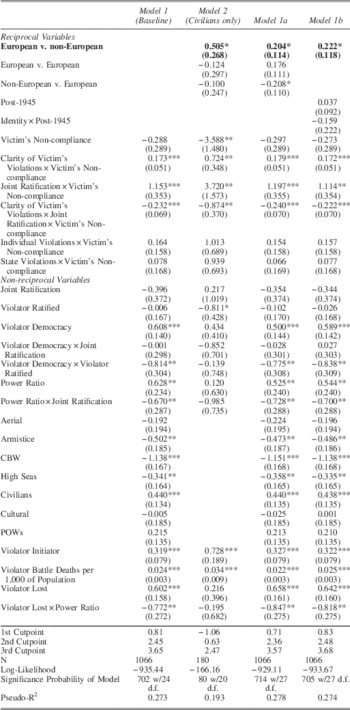
Unlike Valentino et al. and Downes, Morrow never considers a role for identity in predicting compliance with the laws of war. We suggest that including a variable noting whether the violator was a European state and the victim was a non-European state will also generate a significant effect on the probability of compliance.
The results presented in Tables 5 and 6 are consistent with our predictions. In Model 2, which replicates Morrow’s results but adds our variable for European v. non-European conflict (as well as other dyad configurations) and restricts the analysis to civilian targeting, we find that this particular configuration of identities generates a statistically significant increase in the probability of non-compliance with the laws of war regarding the treatment of civilians on the part of the European state in the dyad.
Ordered Probit Analysis of Non-compliance with the Laws of War

Note: replication and reanalysis of Morrow (Reference Morrow2007, Table 1). ***p<0.001, **p<0.05, *p<0.1. Bolded row contains our measure of identity.
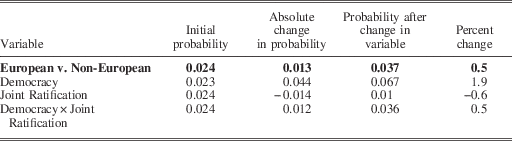
Change in the Expected Probability of Non-compliance Associated with Each Independent Variable (Participants in Interstate Wars, 1900–2000)

Note: extension of replication and reanalysis of Morrow (Reference Morrow2007). Morrow reports marginal effects graphically. To ease comparison across studies, we instead ran simulations to estimate the effect of changes in the independent variables (all of which are binary) on the probability of reaching the greatest level of non-compliance. All binary variables were held to their modes. These results are based on Model 1a, but in addition to manipulating the variable of interest, we set Civilians to 1 to gauge the effect of changes in values when the issue area was civilian targeting. It is particularly interesting to note that the results on the European variable are the same as the results on Morrow’s key variable of Democracy×Joint Ratification. Bolded row contains our measure of identity.
When we expand our empirical scope to include all jus in bello issue areas as coded by Morrow,Footnote 61 we find that European states fighting non-European states are 50 per cent more likely to engage in major violations of jus in bello than are non-European states fighting each other. By contrast, we do not find support for Hypothesis 2; the coefficients are neither stable nor significant.
Various additional specifications of these models yielded stable results. Including only one identity variable – a binary variable for whether a European state was fighting a non-European state – produced positive and statistically significant coefficients on this variable. Results with respect to the identity variables were also stable when the world wars were dropped and when US wars were dropped (although in the latter case, the coefficient on identity only approached statistical significance). Robustness checks that used different codings of European are consistent with the findings using other data sets. Although the sign of the coefficient is stable when we alter the coding to include all states that are geographically part of Europe, the coefficient is no longer statistically significant, although it is close. Limiting the variable to all Western European states, or to original signatories of the second 1899 Hague Convention, generates significantly positive coefficients.
Interacting the European v. non-European identity variable with the post-1945 and post-1977 eras produced results that are only weakly consistent with the claim that the effects of identity may be mitigated over time. The interaction terms took the correct (negative) sign, but were not statistically significant. Interestingly, here the correlation between the ratification of international humanitarian law treaties and identity was positive and statistically significant, which contrasts with the analysis of the Valentino et al. data. This result is more consistent with the intuition that ratification itself could signify identity, thus opening up another pathway for identity to influence compliance with the law of war.
As stated above, we would expect our argument about the relationship between identity and compliance with jus in bello to apply beyond the issue area of civilian targeting, but with varying effects. More specifically, the same logic underlying the decision on the part of European states to target civilians in non-European states should also apply in their decision making with respect to the use of chemical and biological weapons as well as their treatment of cultural property and prisoners of war. When we restrict our analysis to these specific issue areas, we find that European v. non-European dyads behave as predicted.Footnote 62 This result lends breadth to our findings and suggests additional avenues for research.
Reconsidering Intra-European Compliance
The lack of support for Hypothesis 2 demonstrates the limits of identity in predicting civilian targeting and compliance with jus in bello, especially when compared with the strong support for the claim that European states are especially likely to target civilians and violate the law of war when fighting non-European states. Violation is common. Because compliance with the law of war is not typical of state behavior, we are not surprised that we do not observe strong compliance when European states fight each other. Of the scholars whose work we revisit in this article, only Morrow finds any significant predictors of restraint, and the conditions under which he expects to observe compliance are highly circumscribed. Moreover, it is important to note that many of the deadliest conflicts of the past two centuries took place within European dyads. Germany in particular was wont to target other European civilians in these conflicts, due to a logic that exported its colonial practices back to the continent.Footnote 63 This points to a certain paradox of European identity. For most of Europe’s history, notions of community have coexisted alongside significant and regular bloodshed. For example, although there were strict codes of conduct during the Hundred Years War, these codes allowed for pillage, rape and the treatment of prisoners as property.Footnote 64 Because wars between European dyads have historically been both frequent and bloody, to find that European dyads comply more than other dyads would come close to an assertion of greater baseline state compliance than is tenable given what we know about states’ wartime incentives. In other words, because we know state compliance with the law of war is not the norm, and because European dyads have historically engaged in particularly bloody wars, it is not particularly surprising that European dyads do not exhibit more restraint in their ‘internal’ wars. Indeed, the law of war was born of intra-European brutality and designed to regulate it. Instead, it appears that a major effect of these laws was to draw a line between European and non-European states across which egregious violations would be tolerated. That said, it would have been troubling to find that Europeans were significantly more likely to target civilians and violate jus in bello when fighting each other as compared to other dyad types, but this is not the case. Given that European states tend not to be particularly gentle with one another, it is highly significant that they are even more prone to violate the law of war when battling those outside the European community.
CONCLUSION
A deeper understanding of the history of the law of war encourages us to refine a key predictor of civilian targeting: the identity of the belligerent states. What matters is not whether the two states are from different cultures, races, civilizations or religions, but whether one state is European and the other is not. European states have been particularly likely to target civilians and violate the law of war when fighting non-European states, because non-European foes were not to be accorded the same respect on the battlefield as Europeans, nor were they necessarily expected to reciprocate any such respect.
Whether racism or expectations regarding reciprocity are the primary drivers of this effect is difficult to disentangle. For example, we find that the original signatories of the 1899 Hague Conventions were especially unlikely to comply with the laws of war when fighting opponents that were not signatories. This finding might suggest support for the reciprocity argument, but it could also mask a logic of racism if identity and ratification are themselves correlated, as our analysis of Morrow’s data suggests they may be. Either way, this finding underlines the fact that a more nuanced examination of the historical record can help us understand subsequent behavior. A related question is whether the effects of identity can be tempered by time. Here, our results are mixed. In some analyses it appears that European states may be decreasingly likely to target non-European civilians, but in other analyses the results are less clear-cut. Recent reports on US drone strikes on Pakistan and Yemen reflect this ambiguous result.Footnote 65 While Western states are increasingly condemned for causing civilian casualties in non-Western states, the casualties continue.
Our findings rehabilitate the use of identity variables in analyses of civilian targeting and compliance with the law of war. One of the strengths of our analysis is its breadth. Across a range of data sets, and contrary to previous research, we show that, when measured in terms of whether a European state is fighting a non-European state, identity has a consistently statistically and substantively significant effect on the probability of targeting civilians, as well as on the violation of other laws of war. These results should remind scholars of the law of war of the subject’s context. Jus in bello has a long and storied history. Attention to this history is necessary to understand past, present and future compliance with – and development of – the law of war.