INTRODUCTION
Recent studies and consensus statements have expressed the need to involve palliative care services in the care of children with progressive neuromuscular diseases (Parker et al., Reference Parker, Maddocks and Stern1999; Ho & Straatman, Reference Ho and Straatman2013; Fraser et al., Reference Fraser, Childs and Miller2011). Spinal muscular atrophy (SMA) is the most common childhood neurodegenerative disease, and SMA type I is the most severe form of SMA (Chang & Gieron-Korthals, Reference Chang and Gieron-Korthals2011).
We must consider integration of a pediatric palliative care in children affected with SMA, even more so in those with SMA type I disease (Mitchell, Reference Mitchell2006). Achieving proper home care and avoiding hospital admission should be one of the main objectives in these children (Wang et al., Reference Wang, Finkel and Bertini2007).
There are no extant reviews about utilization of palliative care services by children with SMA type I, and so their requirements or clinical problems once admitted in palliative care units are unknown (Ho & Straatman, Reference Ho and Straatman2013; Chang & Gieron-Korthals, Reference Chang and Gieron-Korthals2011).
The present paper offers the results of retrospective chart review we conducted of nine children with SMA type I who were treated by our pediatric palliative care team (PPCT) in Madrid, Spain. Our main objective was to describe their demographic and clinical profile in order to establish common problems and requirements.
MATERIAL AND METHODS
We performed a retrospective chart review of nine consecutive patients with SMA type I. All were attended by the Hospital Infantil Universitario Niño Jesús PPCT from January 2010 to December 2012.
The data collected were related to: respiratory care, nutritional care, transition services, pain and symptom management, hospital admissions during PPCT treatment, and end-of-life care. A descriptive analysis of the results was executed employing SPSS 16.0 software for Windows.
RESULTS
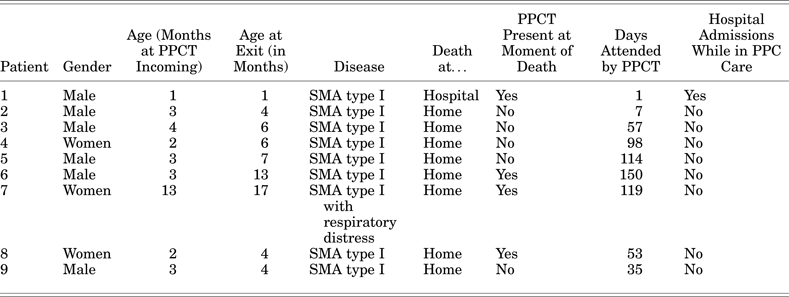
Six males and three females with SMA type I were attended. All were admitted to the PPCT program before age six months, except one, a patient who had SMA type I with respiratory distress. The median duration of attention was 57 days (range 1–150 days). One patient was treated for just one day; he was integrally managed at the hospital. The other eight patients received domiciliary attention. The demographic, clinical characteristics, and evolution are described in Table 1.
Demographic characteristic, PPCT attendance and place of death

PPCT = pediatric palliative care team; SMA = spinal muscular atrophy.
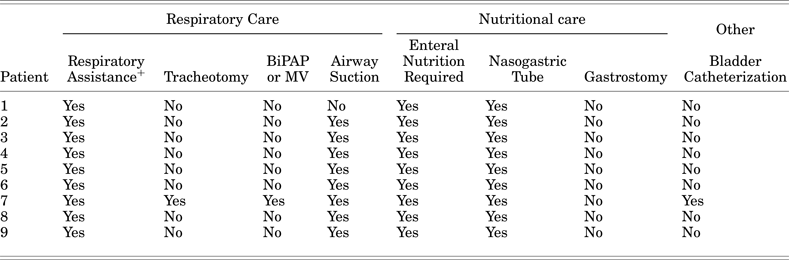
The patients were attended at home by the PPCT, and none of them required hospital admission. The global management basically consisted of respiratory care (see Table 2). One patient required domiciliary mechanical ventilation by tracheotomy (SMA type I with respiratory distress); this patient was the only one who also required bladder catheterization. In all cases, a nasogastric tube (NT) was indicated because of swallowing difficulties.
Global management
+ Respiratory assistance constituted by: oxigenotherapy by nasal cannulas and/or mask with reservoir bag, aerosol therapy, and antibiotics because of respiratory infection. BiPAP = bilevel positive assistance pressure; MV = mechanical ventilation.
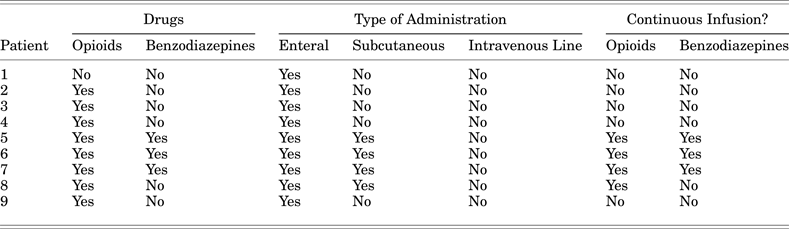
As end-of-life care, eight required morphine to manage their dyspnea. Four patients received morphine only by enteral administration (oral or NT) on a fractioned schedule. The other four received it first by enteral administration and then by continuous subcutaneous infusion (CSI). Three of the four patients who required CSI also received benzodiazepines (midazolam) to achieve sedation. It was not necessary to acquire an intravenous line in any of the patients (Table 3).
End-of-life care
All the patients died at home except for one. The palliative care team accompanied the patient at the moment of death in four cases.
DISCUSSION
The palliative domiciliary care of children with SMA type I is a novel and unknown focus (Fraser et al., Reference Fraser, Childs and Miller2011). The patients treated by our PPCT at home did not require hospital admission, as it was possible to achieve adequate medical care at home. In our experience, respiratory and nutritional care were their main requirements. As end-of-life care, the use of morphine by enteral or subcutaneous administration allowed for minimization of symptoms; it was also not always necessary to achieve palliative sedation by benzodiazepines (Robinson, Reference Robinson2012; Ullrich & Mayer, Reference Ullrich and Mayer2007; Vissers et al., Reference Vissers, Engels and Verhagen2008).
Due to the usually fast and predictable evolution of SMA type I, it is important to develop domiciliary care as an adjunct to PPCT care (Chang & Gieron-Korthals, Reference Chang and Gieron-Korthals2011; Wang et al., Reference Wang, Finkel and Bertini2007; Ho & Straatman, Reference Ho and Straatman2013). Only one of our patients was attended at the hospital, and this patient demonstrated fast evolution, which prevented earlier assignment to our PPCT.
As described earlier, an SMA type I diagnosis usually occurs during the very first months of life (Chang & Gieron-Korthals, Reference Chang and Gieron-Korthals2011; Wang et al., Reference Wang, Finkel and Bertini2007). This scenario should prompt early assignment of the PPCT (before age sixth months). The median time of assistance was usually short (57 days). This time should be optimized by the PPCT to achieve adequate domiciliary management. It is critical to have enough time to provide for optimal training of those who are going to be the main home caregivers (Wang et al., Reference Wang, Finkel and Bertini2007). In our case, after caregiver education, the medical and nurse visit was scheduled on a weekly basis. We also offered phone consultation available 24 hours a day, along with domiciliary attendance if needed. The firsts visits included delivery of all the medical equipment the patient would probably require.
Respiratory assistance was the initial and most important aspect for domiciliary care for our patients (Kalra & Amin, Reference Kalra and Amin2005). Oxygen by nasal cannulas and/or mask reservoir bags, airway suction, and nebulizer equipment was always indicated at home. The use of aerosol therapy and aspiration allowed for better management of secretions, probably minimizing respiratory morbidity (Benditt, Reference Benditt2009; Danov & Schroth, Reference Danov and Schroth2010; Ho & Straatman, Reference Ho and Straatman2013). This respiratory assistance was progressively increased because of new symptoms associated with disease evolution (Ho & Straatman, Reference Ho and Straatman2013; Chang & Gieron-Korthals, Reference Chang and Gieron-Korthals2011). The patient with SMA type I with respiratory distress had a tracheotomy and did not require supplemental oxygen until her last days of life (Dreher et al., Reference Dreher, Rauter and Storre2007; Bush, Reference Bush2006; Rudnik-Schoneborn et al., Reference Rudnik-Schoneborn, Stolz and Varon2004). The use of mechanical ventilation and positive pressure was also important (Benditt, Reference Benditt2009; Danov & Schroth, Reference Danov and Schroth2010; Chatwin et al., Reference Chatwin, Bush and Simonds2010; Hamada et al., Reference Hamada, Ishikawa and Aoyagi2011). This patient showed late onset of respiratory symptoms (Table 1). The tracheotomy and mechanical ventilation were established by the critical care team at the time of diagnosis.
The use of a nasogastric tube (NT) allowed maintaining an adequate nutritional balance and solved the swallowing problems. At the beginning of respiratory impairment, it also allowed for initiation of enteral morphine to treat the dyspnea (Parker et al., Reference Parker, Maddocks and Stern1999; Mitchell, Reference Mitchell2006; Ho & Straatman, Reference Ho and Straatman2013; Fraser et al., Reference Fraser, Childs and Miller2011). In addition, the NT facilitated maintenance of nutrition and hydration until the end of life.
All the health problems were globally managed by the PPCT (Chang & Gieron-Korthals, Reference Chang and Gieron-Korthals2011), and there were no hospital admissions. The children maintained their scheduled visits to specialists—mainly neurology and pneumology (Wang et al., Reference Wang, Finkel and Bertini2007; Ho & Straatman, Reference Ho and Straatman2013; Kalra & Amin, Reference Kalra and Amin2005; Mellies et al., Reference Mellies, Ragette and Dohna Schwake2003)—until their clinical situation determined that these were no longer recommended. They received the preventive care and vaccines normally given to healthy children (according to the guidelines of our national health system). Physiotherapy was also maintained (Simonds, Reference Simonds2006; Reference Simonds2007; Chang & Gieron-Korthals, Reference Chang and Gieron-Korthals2011).
The use of palliative sedation was not always necessary in our patients. Almost all of them required morphine to treat the dyspnea, which was administered exclusively by NT in three patients with good results (starting with 0,1 mg/kg); in addition, they did not require benzodiazepines to achieve adequate comfort. In those cases where oral or NT morphine was not effective, subcutaneous infusion was employed (starting with 5 mcg/kg/hr) (Parker et al., Reference Parker, Maddocks and Stern1999; Mitchell, Reference Mitchell2006; Ho & Straatman, Reference Ho and Straatman2013; Robinson, Reference Robinson2012; Ullrich & Mayer, Reference Ullrich and Mayer2007; Vissers et al., Reference Vissers, Engels and Verhagen2008). Three of our patients also required administration of benzodiazepines by subcutaneous infusion to provide an anxiolytic effect or palliative sedation (starting at 0,5 mg/kg/hr). The combination of low-dose morphine and benzodiazepines by subcutaneous infusion was enough to control symptoms in those where oral or NT administration had failed (Ho & Straatman, Reference Ho and Straatman2013).
Almost all patients received two months of PPCT followup and died before their first birthday (see Table 1) (Parker et al., Reference Parker, Maddocks and Stern1999; Mitchell, Reference Mitchell2006; Ho & Straatman, 2012). Eight of the nine died at home, and three were accompanied by the PPCT (medical doctor and advance practice nurse). In all cases, patients were accompanied by their caregivers at the moment of death.
LIMITATIONS TO THE STUDY
There are several limitations to our study. It was done retrospectively, and the material did not allow for statistical testing of results. Our sample size was small, which limits generalizability of our findings. The information we sought may not be explicitly documented in the medical record. The quality of any chart review depends on the quality and consistency of the records. It is still possible to have inconsistent or incomplete notes. We thus cannot rule out that other medical conditions and/or therapeutic interventions could have had an independent impact on disease evolution. Finally, our review only examined children referred to pediatric palliative care and did not consider children who received other management, so no comparisons could be made as to baseline characteristics, needs, and evolution. Future studies should examine larger samples to address these issues directly.
CONCLUSIONS
Despite these limitations, and based on our experience, we consider it possible to provide proper multidisciplinary care at home for these patients. Respiratory management was their main issue (Mellies et al., Reference Mellies, Ragette and Dohna Schwake2003; Ho & Straatman, Reference Ho and Straatman2013; Kalra & Amin, Reference Kalra and Amin2005; Wang et al., Reference Wang, Finkel and Bertini2007). We also believe that training of caregivers is fundamental to delivery of adequate domiciliary care. Application of a nasogastric tube appears to be useful in maintaining nutritional balance. As end-of-life care, we find that the use of morphine (via enteral or CSI administration) is crucial in the management of dyspnea. The use of palliative sedation is not always required, since it is possible to achieve complete patient comfort without it.
FINANCIAL DISCLOSURE
There are no financial or commercial involvements or other conflicts of interest that involve any of our authors.
ACKNOWLEDGMENTS
We offer thanks to our patients and their families, and to Manuel Ramírez-Orellana, M.D., Ph.D.