The widespread adoption of telework—accelerated by the COVID-19 pandemic—has profoundly transformed how work is structured and performed (Nilles, Reference Nilles1997). Telework refers to the execution of work tasks remotely, often from home, through the use of digital and communication technologies. In response to this evolving work landscape, many organizations have implemented hybrid working models (HWM), which combine remote and on-site work arrangements (Beno, Reference Beno2021; Wontorczyk & Rożnowski, Reference Wontorczyk and Rożnowski2022). These models, characterized by flexibility and autonomy, enable employees to alternate between different work locations based on predefined agreements (Grant et al., Reference Grant, Wallace, Spurgeon, Tramontano and Charalampous2019; Junça-Silva & Caetano, Reference Junça-Silva, Neves and Caetano2024).
Research on telework and HWM has yielded mixed findings. While several studies report benefits such as enhanced well-being and productivity (Adamovic, Reference Adamovic2022), others underscore potential challenges, including increased distractions and stress (Andrade & Lousã, Reference Andrade and Lousã2021). Recent literature suggests that the outcomes of telework are contingent on a range of individual and contextual factors, such as the availability of digital tools, the quality of home workspaces, and family dynamics (Almeida et al., Reference Almeida, Rodrigues and Freitas2024; Gohoungodji et al., Reference Gohoungodji, N’Dri and Matos2023). However, there remains a limited understanding of how employees perceive HWM and how such perceptions influence work-related outcomes.
Employees’ perceptions of HWM—defined as their cognitive and affective evaluations of hybrid work arrangements (Charalampous et al., Reference Charalampous, Grant and Tramontano2023)—play a pivotal role in shaping their experiences and adaptation to this work model (Junça-Silva & Caetano, Reference Junça-Silva and Caetano2024). According to the e-work life model (Grant et al., Reference Grant, Wallace, Spurgeon, Tramontano and Charalampous2019), favorable perceptions of HWM, particularly regarding trust, flexibility, work–life balance, and effectiveness, can function as personal resources that promote well-being and enhance job performance (Charalampous et al., Reference Charalampous, Grant and Tramontano2023). Positive perceptions may reduce occupational stress—understood as the perceived imbalance between job demands and personal coping resources (Demerouti & Bakker, Reference Demerouti and Bakker2023)—and foster improved job performance, which refers to the extent to which employees effectively carry out tasks that contribute to the organization’s core functions (Griffin et al., Reference Griffin, Neal and Parker2007). These outcomes can further support adaptability and openness to change (Ameen et al., Reference Ameen, Papagiannidis, Hosany and Gentina2023).
Aligned with the Job Demands-Resources (JD-R) model (Demerouti et al., Reference Demerouti, Bakker, Nachreiner and Schaufeli2001), individual-level personal resources such as emotional intelligence (EI) may moderate the relationships between perceptions of HWM, stress, and performance (Bakker et al., Reference Bakker, Demerouti and Sanz-Vergel2023). EI refers to the ability to perceive, understand, and regulate one’s own and others’ emotions (Mayer et al., Reference Mayer, Salovey and Caruso2004). High levels of EI have been linked to better emotional regulation and focus, especially under stress (Sadovyy et al., Reference Sadovyy, Sánchez-Gómez and Bresó2021), and may amplify the positive effects of HWM on performance by mitigating stress (Junça-Silva et al., Reference Junça-Silva, Violante and Brito2023). Specifically, individuals with high EI are better equipped to manage emotional reactions to job demands, leading to reduced stress and greater task focus, ultimately enhancing performance.
Despite the theoretical relevance of these frameworks, limited research has examined how and when employees’ perceptions of HWM influence occupational stress and job performance. The moderating role of EI in this context remains particularly underexplored (Parent-Lamarche & Saade, Reference Parent-Lamarche and Saade2024. Addressing these gaps, the present study investigates how perceptions of HWM affect job performance, considering occupational stress as a mediating variable and EI as a moderator. By focusing on employees’ evaluations of HWM and integrating EI into the model, this research aims to provide a more nuanced understanding of the psychological mechanisms and boundary conditions associated with HWM.
This study enriches the literature on HWM by advancing our understanding of employees’ perceptions of this work arrangement. Moreover, it elucidates the circumstances under which maintaining a favorable outlook toward HWM can enhance employees’ affective and behavioral experiences in the workplace. By establishing that stress levels decrease with a positive attitude toward hybrid work, this study suggests that employees may allocate more time and resources to their tasks, leading to heightened performance levels.
The findings of this study have also implications for organizations considering or refining HWM. First, by demonstrating the dual benefits of HWM for employee well-being and job performance, the results can inform strategic decisions about the design and implementation of flexible work policies. Tailoring hybrid models to align with employees’ preferences and expectations can foster a more supportive and effective work environment.
Second, the inclusion of EI as a moderating variable adds depth to managerial practices. Understanding that EI enhances individuals’ ability to cope with the demands of hybrid work highlights the importance of promoting EI within the workforce. Organizations can invest in targeted training programs to develop emotional competencies, which may strengthen other personal resources needed to HWM.
Theoretical Framework
From Telework to Hybrid Working Models
The COVID-19 pandemic triggered a fundamental transformation in how work is structured, leading to a widespread adoption of telework and, more recently, HWM. These flexible arrangements offer advantages such as autonomy, reduced commuting time, and improved work–life balance (Almeida et al., Reference Almeida, Rodrigues and Freitas2024; Figueiredo et al., Reference Figueiredo, Ribeiro, Pereira and Passos2021), but they also raise questions about their psychological and behavioral consequences. To understand these outcomes, the JD-R (Demerouti et al., Reference Demerouti, Bakker, Nachreiner and Schaufeli2001) provides a robust framework. According to the JD-R, employee well-being and performance are shaped by the balance between job demands (e.g., workload, time pressure) and job resources (e.g., autonomy, support). HWM, by increasing flexibility and autonomy, may enhance job resources and reduce the strain of demands, thereby decreasing stress and promoting job performance (Bakker et al., Reference Bakker, Demerouti and Sanz-Vergel2023; Junça-Silva, Reference Junça-Silva2023a).
One way to conceptualize employees’ perceptions of HWM is through the E-Work Life Model, which emphasizes trust, flexibility, interference between work and life, and productivity (Grant et al., Reference Grant, Wallace, Spurgeon, Tramontano and Charalampous2019). These dimensions reflect how employees evaluate the quality and feasibility of telework or HWM (Charalampous et al., Reference Charalampous, Grant and Tramontano2023). Positive perceptions on these dimensions are associated with lower levels of stress and higher job satisfaction (Junça-Silva, Almeida, & Gomes, Reference Junça-Silva, Almeida and Gomes2022; Taser et al., Reference Taser, Aydin, Torgaloz and Rofcanin2022). Despite the benefits, HWM may also introduce new stressors (e.g., isolation, blurred boundaries), making it essential to explore how these perceptions affect employee stress and performance. Moreover, individual differences, such as EI, may buffer or amplify these effects.
The Relationship Between Perceptions of HWM and Job Performance Through Occupational Stress
Grounded in the JD-R framework (Demerouti et al., Reference Demerouti, Bakker, Nachreiner and Schaufeli2001), we argue that HWM can enhance job resources—such as autonomy and flexibility—thereby reducing occupational stress and improving job performance. The increase in essential resources contributes to more favorable perceptions of HWM (Charalampous et al., Reference Charalampous, Grant and Tramontano2023), as employees experience greater control over their work schedules and environments, as well as enhanced capacity to manage job demands (Lopes et al., Reference Lopes, Couto, Rodrigues, Sabino, Oliveira, Dias, Leite and Carvalho2024). These positive perceptions—such as feeling trusted by management, being able to manage one’s own time, and maintaining productivity without excessive work-life interference (Charalampous et al., Reference Charalampous, Grant and Tramontano2023)—may be particularly influential in reducing stress levels (the imbalance between job demands and job resources). In turn, this reduction in occupational stress can foster improved job performance, defined as behaviors directly related to task execution and formal work responsibilities, which vary depending on roles and tasks (Borman & Motowidlo, Reference Borman, Motowidlo, Schmitt and Borman1993).
Empirical evidence supports this rationale. For instance, Parent-Lamarche and Boulet (Reference Parent-Lamarche and Boulet2021) found that employees’ positive perceptions of telework were associated with enhanced job performance via reduced stress. Similarly, Goñi-Legaz et al. (Reference Goñi-Legaz, Núñez and Ollo-López2024) demonstrated that favorable telework experiences predicted improved affective and behavioral outcomes. Perceptions of managerial trust and support also play a critical role in fostering autonomy and flexibility (Andrade & Lousã, Reference Andrade and Lousã2021), mitigating feelings of isolation (De Vries et al., Reference De Vries, Tummers and Bekkers2018), and ultimately reducing stress and enhancing performance (Kim et al., Reference Kim, Mullins and Yoon2021).
These findings are consistent with Grant et al.’s (Reference Grant, Wallace, Spurgeon, Tramontano and Charalampous2019) E-Work Life Model, which emphasizes that positive telework experiences are linked to improved well-being through greater flexibility, organizational trust, and productivity, along with reduced interference between work and personal life. Taken together, this body of evidence highlights the importance of viewing HWM not merely as a structural arrangement but as a subjective experience with tangible psychological and behavioral consequences (Charalampous et al., Reference Charalampous, Grant and Tramontano2023). Accordingly, and in line with the JD-R framework, we hypothesize that favorable perceptions of HWM function as a job resource that can mitigate occupational stress, enabling employees to more effectively manage their energy and focus on task execution. This process ultimately promotes optimal job performance. Thus, the following hypothesis was proposed:
Hypothesis 1: Occupational stress mediates the positive relationship between perceptions of HWM and job performance.
The Moderating Role of Emotional Intelligence
While HWM offer increased flexibility, they also introduce novel challenges—such as blurred boundaries between work and personal life and heightened self-management demands—that may contribute to occupational stress. Stress, particularly when chronic and poorly regulated, is widely recognized as a major inhibitor of job performance (Hobfoll et al., Reference Hobfoll, Halbesleben, Neveu and Westman2018; Sonnentag et al., Reference Sonnentag, Binnewies and Mojza2010). However, individuals differ in their susceptibility to stress and its adverse effects. A key personal resource that may buffer these effects is emotional intelligence (EI).
EI refers to the capacity to perceive, understand, regulate, and use emotions in adaptive ways (Salovey & Mayer, Reference Salovey and Mayer1990; Goleman, Reference Goleman1995). It comprises several core dimensions, including emotional self-awareness, regulation, empathy, and interpersonal competence. Evidence indicates that individuals with high EI are better equipped to manage stress, maintain psychological resilience, and perform effectively under pressure (Miao et al., Reference Miao, Humphrey and Qian2017; Schutte et al., Reference Schutte, Malouff, Thorsteinsson, Bhullar and Rooke2007).
Within the context of HWM—characterized by reduced in-person support, increased autonomy, and potential social isolation—EI may function as a key personal resource, as outlined by the JD-R model (Demerouti et al., Reference Demerouti, Bakker, Nachreiner and Schaufeli2001). Specifically, EI can buffer the negative effects of stress on job performance by (a) facilitating emotional regulation in response to the demands of hybrid work, (b) diminishing the intensity of negative emotions triggered by unfavorable perceptions of HWM, and (c) promoting more constructive behavioral responses. Moreover, individuals with higher levels of EI are likely to be more attuned to their emotional reactions to hybrid work and more adept at identifying potential stressors. This emotional insight allows them to proactively manage these stressors, which may, in turn, preserve or even enhance job performance (Rezvani et al., Reference Rezvani, Barrett and Khosravi2019; Sánchez-Gómez & Bréso, Reference Sánchez-Gómez and Bréso2020).
Empirical research supports this moderating role of EI. For example, Hodzic et al. (Reference Hodzic, Scharfen, Ripoll, Holling and Zenasni2018) found that EI attenuated the negative relationship between job stress and task performance. Similarly, Barros et al. (Reference Barros, Fernandes and Baylina2025) demonstrated that EI acted as a protective factor in telework contexts, reducing burnout and enhancing engagement. In addition, Doberstein and Charbonneau (Reference Doberstein and Charbonneau2022) showed that the benefits of telework were more strongly perceived by employees with high EI and a propensity for autonomy, while individuals with lower EI and a greater need for social interaction reported increased feelings of isolation.
Drawing on the JD-R framework (Bakker & Demerouti, Reference Bakker and Demerouti2017), we propose that EI serves as a personal resource that shapes the relationship between perceptions of hybrid work, occupational stress, and perceived job performance. Specifically, we hypothesize that EI moderates the indirect relationship between hybrid work perceptions and perceived job performance through stress. That is, employees with high EI and a positive view of hybrid work are expected to report lower stress and, consequently, higher perceived job performance, compared to those with low EI and less favorable perceptions (see Figure 1).
The proposed moderated mediation model.

Hypothesis 2: EI moderates the indirect relationship between the perceptions of HWM on perceived job performance through occupational stress in such a way that this relationship becomes stronger for those who score higher on EI (versus lower EI).
Method
Research Setting
The Ethics Committee of the first author’s university approved the study before it started. Aligned with our research goals, we gathered data from employees engaged in hybrid work. The data were sourced from various sectors within the Portugal financial industry, including banking (44%), finance (30.5%), and stock market (25%). Participants were situated in prominent cities across Portugal, encompassing Lisbon (52%), Coimbra (37%), and Porto (8%).
Participants and Procedure
For this study, data were collected online using purposive sampling, a method chosen to align the sample with the research goals. Purposive sampling, also known as judgment sampling, is utilized to select respondents who are deemed most likely to offer pertinent and valuable insights based on the study’s goals (Kelly, Reference Kelly2010). It serves as a means to efficiently identify and select cases when research resources are limited. For instance, (1) when researchers do not have unrestricted access to a database of potential respondents or (2) when logistical issues harm the ability to reach potential respondents (Shagirbasha et al., Reference Shagirbasha, Iqbal, Madhan, Chaudhary and Dhall2024; Wijayati et al., Reference Wijayati, Rahman, Rahman, Arifah and Kautsar2022). Purposive sampling aims to carefully choose a sample that can be considered representative of the entire population, based on the researcher’s discretion (Lavrakas, Reference Lavrakas2008). Thus, purposive sampling enhances the rigor of the study and increases the trustworthiness of the data and subsequent results (Campbell et al., Reference Campbell, Greenwood, Prior, Shearer, Walkem, Young, Bywaters and Walker2020). In addition to considering the nature of the problem, the simplicity, straightforward rules, and lower costs associated with the use of a purposive sample over a probability sampling technique position it as the preferable choice (Bagozzi & Yi, Reference Bagozzi and Yi2012).
For this study, inclusion criteria stipulated that participants should have, at least, a minimum of one year of experience in the financial industry and should be working in hybrid working models. Those outside the financial industry, new hires (with less than a year of tenure), and trainees were excluded. Efforts were made to select respondents who were engaged in a hybrid work arrangement to meet the objectives of this study.
Data were collected between March and June 2023. Three waves of data (T1, T2, and T3) were collected each with a one-week gap in between. Including a time-lagged method was essential to mitigate the potential impact of common method bias (CMB). Podsakoff et al. (Reference Podsakoff, MacKenzie, Lee and Podsakoff2003) proposed that introducing a time delay between the measurement of the predictor and the criterion variables could effectively control CMB. Furthermore, MacKenzie and Podsakoff (Reference MacKenzie and Podsakoff2012) recommended that, beyond merely addressing CMB, collecting data at multiple time points serves to diminish respondent fatigue and monotony while enhancing response rates.
First, 1611 potential respondents were contacted via telephone and briefed about the research’s goals, focusing on how their perception of hybrid work could impact their occupational stress and performance while working on the hybrid regime. Confidentiality and anonymity of responses were assured during the briefing. At this stage, a total of 1345 hybrid workers agreed to participate (response rate: 83.4%). At Time 1 (T1), we sent questionnaires assessing perceptions toward hybrid work to the 1345 respondents who consented to participate via telephone. Out of the 1298 responses received at T1, 1254 completed the survey. Subsequently, 1167 of these respondents (dropout rate of 10.09%) completed the online survey measuring occupational stress at Time 2 (T2). At Time 3 (T3), 1112 respondents (dropout rate of 14.32%) completed the online survey assessing job performance and EI. However, only 1055 valid responses were considered after excluding invalid surveys (completed in less than 2 min or perfunctory answers; dropout rate of 18.72%). This meticulous approach was undertaken to minimize common method variance (Podsakoff et al., Reference Podsakoff, MacKenzie, Lee and Podsakoff2003).
To assess the potential risk of selective attrition, Little’s missing completely at random (MCAR) test (Little et al., Reference Little, Jorgensen, Lang and Moore2014) was conducted, confirming that data were missing completely at random (χ2 = 7.47, df = 3, p = .06). Additionally, independent samples t-tests were performed to compare participants who discontinued after T1 with those who completed all three waves. The results revealed no significant differences in the key study variables at T1, including perceptions of HWM (t = −0.78, p = .21), stress (t = 1.22, p = .11), job performance (t = −0.91, p = .18), and EI (t = −0.02, p = .49). These findings indicate that attrition was not systematically associated with the focal variables. A priori power analysis (effect size = 0.2, α = .05) confirmed that this final sample size was adequate for the intended statistical analyses.
The participants included hybrid workers from the financial sector. Of the overall sample, 68% were female. The mean age was 46.17 years (SD = 9.47), and the mean organizational tenure was 24.08 years (SD = 10.28). Participants reported working on average 35.44 hours per week (SD = 11.91). About 67% were married, 19% were single, and 14% were divorced or widowed.
Measures
All the scales used have shown high reliability and validity in previous research. Following Brislin’s (Reference Brislin, Lonner and Berry1986) cross-cultural translation procedure, two bilingual academic researchers conducted the back-translation process to translate the English items into Portuguese. Moreover, we invited two experts in performance studies to review the initial draft of the Portuguese surveys and to make some revisions to the item wording and instructions for respondents to increase the content validity (Wang et al., Reference Wang, Kim and Mokhtarian2023). A pilot study with 74 employees in Portuguese organizations (not part of the final sample) was initially conducted to assure content validity.
Perceptions of HWM (T1)
The E-Work Life Scale (Grant et al., Reference Grant, Wallace, Spurgeon, Tramontano and Charalampous2019) was utilized. It included 17 items subdivided into the following dimensions: work–life interference (seven items; e.g., “Having constant access to work through e-working is very tiring”); effectiveness/productivity (four items; e.g., “My overall productivity has increased due to my ability to e-work remotely/from home.”); organizational trust (three items; e.g., “My organization provides training in e-working skills and behaviours.”); and flexibility (three items; e.g., “My work is so flexible I could easily take time off e-working remotely, if and when I want to.”). Participants responded using a five-point Likert scale ranging from (1) Strongly Disagree to (5) Strongly Agree. The Cronbach’s Alpha in this study was .72 and the McDonald’s was .75.
Occupational Stress (T2)
To measure stress, the 10-item Perceived Stress Scale (PSS; Cohen et al., Reference Cohen, Kamarck and Mermelstein1983) was used. An item example is “In the last week, how often have you felt nervous and ‘stressed’?”). The items were answered on a five-point Likert scale ranging from (1) never to (5) very often; (α = .70; ω = .71).
Emotional Intelligence (T3)
EI was measured using Wong and Law’s EI Scale (WLEIS; Wong & Law, Reference Wong and Law2002), which comprises 16 items divided into four dimensions of four items each: self-emotion appraisal (e.g., “I have good understanding of my own emotions.”; others-emotions appraisal (e.g., “I am a good observer of others’ emotions.”); use of emotion (e.g., “I am a self-motivating person.”); and regulation of emotion (e.g., “I have a good control of my own emotions.”). The items were answered on a five-point Likert scale, ranging from (1) strongly disagree to (5) strongly agree. The Cronbach’s alpha in this study was .92 and the McDonald’s was .93.
Job Performance (T3)
Job performance was measured using the Individual Work Performance Questionnaire (Koopmans et al., Reference Koopmans, Bernaards, Hildebrandt, Buuren, Beek and Vet2013). We used the five items that measure task performance). All items had a recall period of 1 week and a 5-point rating scale (“seldom” to “always”) was used. An item example is “I managed to plan my work so that it was done on time‥” The Cronbach’s Alpha and the McDonald’s were .73.
Control Variables
We controlled the gender and age as both measures could influence the mediator (occupational stress) and the criterion variable (performance) (Griffin et al., Reference Griffin, Neal and Parker2007).
Data Analyses
First, internal consistencies and descriptive analyses of the study variables, along with their correlations, were examined. To test Hypothesis 1, we used model 4 of the PROCESS macro in SPSS (Hayes, Reference Hayes2018), which is suitable for estimating indirect effects through the bootstrapping method with 5000 iterations to calculate confidence intervals (CI). For Hypothesis 2, which involved a moderated mediation analysis, model 58 of the PROCESS macro (Hayes, Reference Hayes2018) was applied. In this model, product terms representing moderations were centered at their mean values, and the bootstrapping method (5000 iterations) was again used to obtain CI, ensuring reliable estimates of the moderated mediation effect.
Results
Reliability and Validity Issues
First, the validity of the measures was shown because more than 50% of the total variance in each latent variable (55–97%) was explained by the indicators (Carmines & Zeller, Reference Carmines and Zeller1979). Second, the construct reliability (0.70–0.93) of all variables provided the internal consistency of the measures (Fornell & Larcker, Reference Fornell and Larcker1981). This together with the average variance extracted (AVE) (0.50–0.80) suggested acceptable convergent validity (Fornell & Larcker, Reference Fornell and Larcker1981). Third, the results of confirmatory factor analyses (CFA) revealed that the hypothesized four-factor model (perception of hybrid work, stress, EI, and task performance) had better-fit indices (χ2/df = 2.21, p < .01, RMSEA = 0.09, CFI = 0.96, TLI = 0.95, SRMR = 0.08) compared with alternative models, such as the three-factor model grouping stress and EI (χ2/df = 3.73, p < .01, RMSEA = 0.17, CFI = 0.92, TLI = 0.91, SRMR = 0.13), which initially supported the discriminant validity (Xu et al., Reference Xu, Chen, Wang, Feng, Zhou, Li, Zhong and Hao2020). The square roots of the AVE of variables were larger than the correlations between the focal variable and other variables (see Table 1), which also evidenced acceptable discriminant validity (Fornell & Larcker, Reference Fornell and Larcker1981).
Descriptive statistics and correlations

Note. The Average Variance Extracted (AVE) square roots are in brackets. M = Mean; SD = Standard deviation; AVE = Average Variance Extracted; MSV = Maximum Shared Variance. CR = Composite Reliability. EI = Emotional Intelligence.
a Scale ranging from 1 to 5.
b Sex codes: 1—male; 2—female.
N = 1055.
* p < .05.
** p < .001.
Common Method Bias Examinations
Several statistical measures were taken to examine CMB. First, the unrotated factor results of Harman’s one-factor test show that the first factor accounted for 19.54% of the total variance (<50%), revealing that there was no unique factor playing a major role in explaining the variance of the criterion variables (Podsakoff et al., Reference Podsakoff, MacKenzie, Lee and Podsakoff2003). Moreover, when conducting the CFA, the unmeasured latent method construct (ULMC) technique was adopted (Williams, Reference Williams2003) by including an extra latent variable named “CMB” on which all items of the four variables were loaded. The results showed that the four-factor model with CMB (χ2/df = 3.07, p < .01, RMSEA = 0.14, CFI = 0.93, TLI = 0.93, SRMR = 0.11) was significantly worse than the four-factor model. Hence, there were no severe biasing effects due to CMB (Williams, Reference Williams2003).
Descriptive Statistics and Correlations
The descriptive statistics and correlations of all variables are shown in Table 1; the relatively close correlations provided preliminary support for the hypotheses under study. As expected, EI was positively and significantly correlated with perceptions of HWM (r = .323, p < .01) and job performance (r = .442, p < .01), and negatively associated with stress (r = −.327, p < .01). Perceptions of HWM were positively related to job performance (r = .22, p < .01) and negatively related to stress (r = −.153, p < .01). Furthermore, stress showed a strong negative correlation with job performance (r = −.454, p < .01).
Hypotheses Testing
Hypothesis 1
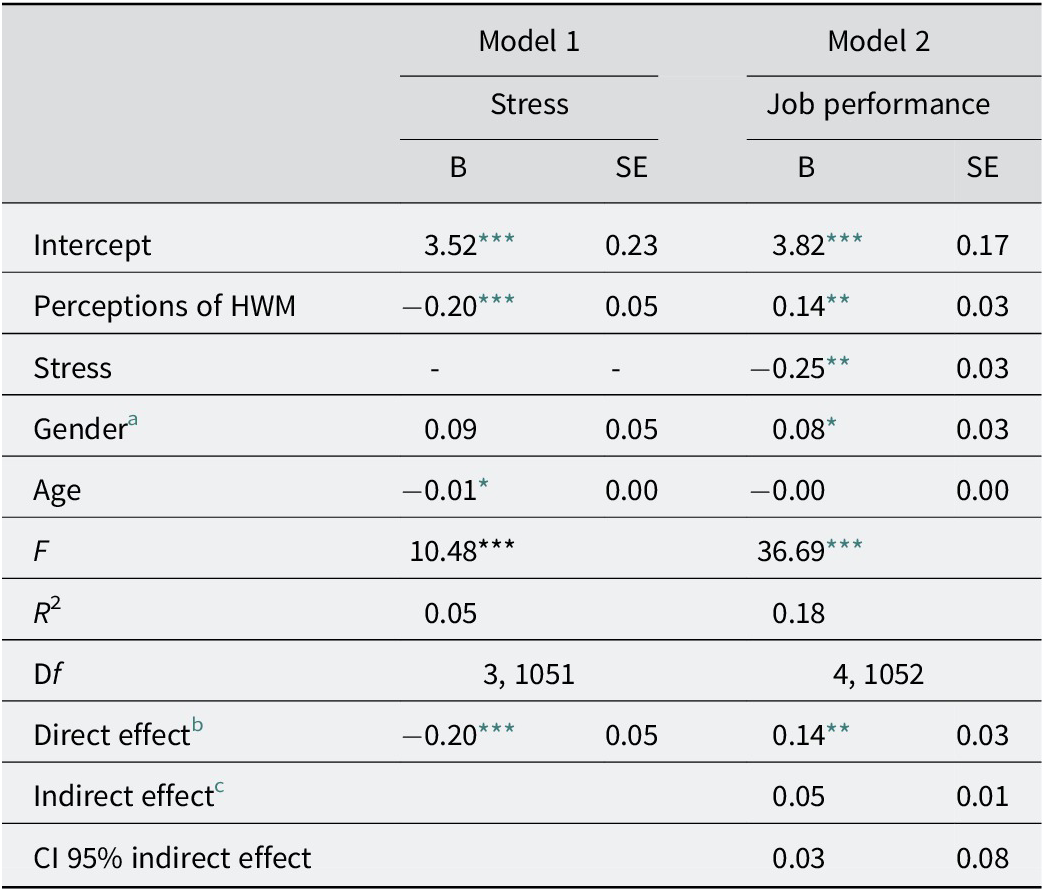
To test hypothesis 1, a mediation analysis (model 4) was conducted using the PROCESS macro in SPSS (Hayes, Reference Hayes2018). Hypothesis 1 predicted that the relationship between how employees perceive HWM and job performance would be mediated by occupational stress. The indirect effect of perceptions of HWM on job performance through occupational stress was significant (B = 0.05, 95% CI [0.03, 0.08]). The model explained 18% (R 2 = .18, p < .01) of the variance in job performance.
The relationships between perceptions of HWM and occupational stress (B = −0.20, p < .001) and between occupational stress and job performance (B = −0.25, p < .001) were significant. The total effect (B = 0.19, p < .01) between perceptions of HWM and job performance was also significant. After the introduction of occupational stress, the effect of perceptions of HWM on job performance was still significant (B = 0.14, p < .01), revealing a partial mediation (see Table 2). Therefore, a positive perception of HWM tends to decrease stress levels which, in turn, appears to enhance job performance levels. Thus, hypothesis 1 was supported by the data.
Hypothesis testing: indirect effect results

Note. N = 1055. Unstandardized Regression Coefficients. CI = Confidence Interval.
a 1 = male, 2 = female.
b Direct effect of perceptions of HWM on occupational stress and job performance.
c Indirect Effect of perceptions of HWM on job performance through occupational stress.
* p < .05.
** p < .01.
*** p < .001.
Hypothesis 2
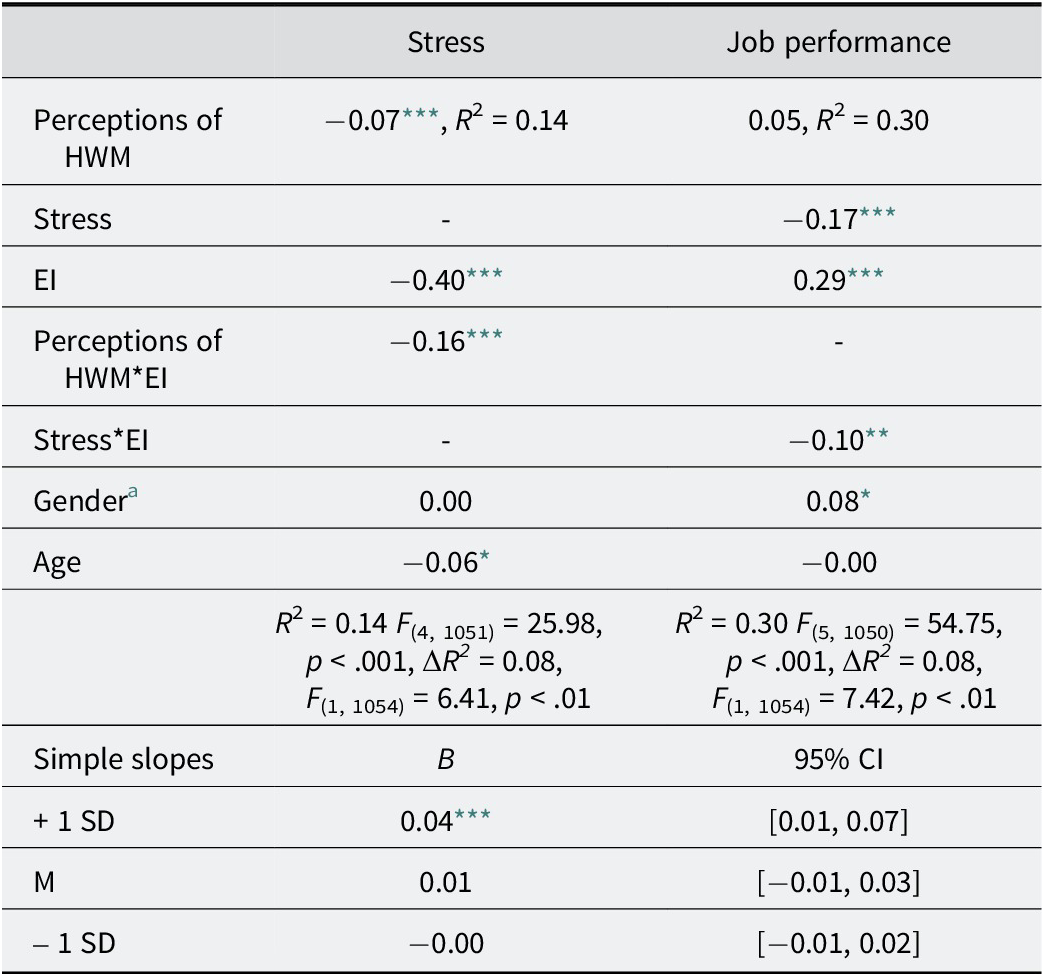
Hypothesis 2 expected that the indirect effect of perceptions of HWM on job performance through occupational stress would be dependent on the moderation of EI, such that this effect would be stronger for individuals with higher levels of EI. To test this hypothesis, the moderation of the mediation model, model 58 from PROCESS was used (see Table 3).
Hypothesis testing: moderated mediation results

Note. N = 1055. Unstandardized Regression Coefficients.
a 1 = male, 2 = female.
* p < .05.
** p < .01.
*** p < .001.
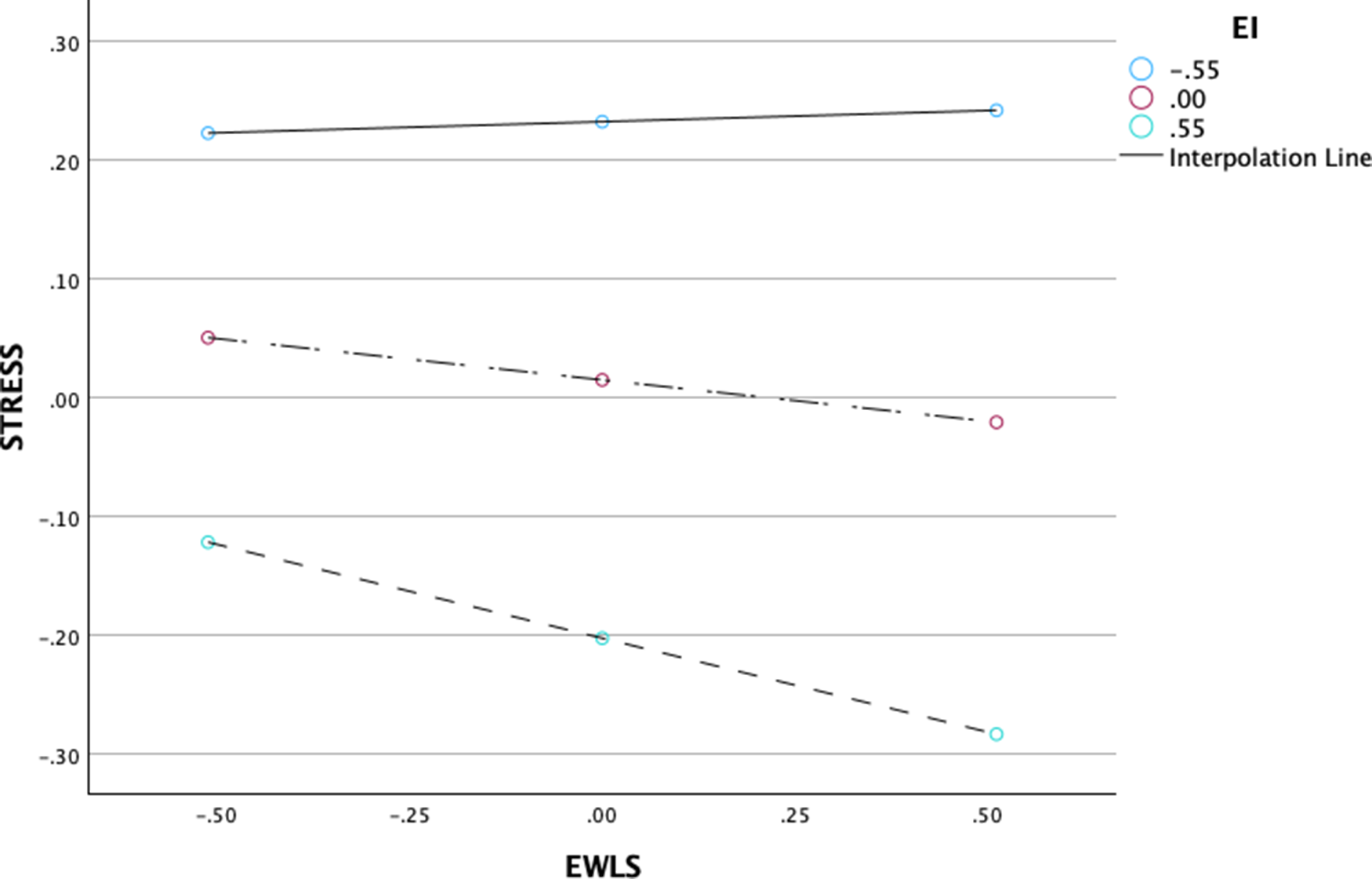
The significant interactions between perceptions of HWM and EI (B = −0.16, p < .01) and between occupational stress and EI (B = −0.10, p < .001) indicated that the indirect effect varied according to different levels of the moderating variable (EI). Analyzing the simple slopes, as suggested by Dawson and Richter (Reference Dawson and Richter2006), it was concluded that the indirect effect was significant and stronger when EI was at higher levels (+1 SD: B = 0.04, SE = 0.02, p < .01, 95% CI [0.01, 0.07]) and became non-significant as EI decreased (M: B = 0.01, SE = 0.01, p > .05, 95% CI [−0.01, 0.03]; −1 SD: B = −0.00, SE = 0.01, p > .05, 95% CI [−0.01, 0.02]) (see Figures 2 and 3). Thus, Hypothesis 2 was supported by the data.
The interaction effect between hybrid work perceptions and EI.

The interaction effect between occupational stress and EI.

Discussion
This study draws upon the JD-R model to investigate whether a favorable perception of HWM facilitates the conservation and development of resources necessary to reduce occupational stress and enhance job performance. Additionally, it explores the moderating role of EI, a key personal resource, in this relationship. The results indicate that positive perceptions of HWM are associated with improved job performance, mediated by reduced levels of occupational stress.
This suggests that when employees perceive hybrid work as providing valuable job resources—such as flexibility, trust, and support for work-life balance—they are less likely to experience stress during working hours (Grant et al., Reference Grant, Wallace, Spurgeon, Tramontano and Charalampous2019). The resulting conservation of cognitive and emotional resources enables employees to concentrate more effectively on their tasks (Hobfoll et al., Reference Hobfoll, Halbesleben, Neveu and Westman2018) and better manage daily work demands, ultimately enhancing their perceived performance (Junça-Silva & Martins, Reference Junça-Silva and Martins2023; eng-Calleja et al., Reference Teng-Calleja, Mactal and Caringal-Go2024). These findings are consistent with the JD-R model’s core proposition that job demands—such as negative or rigid perceptions of HWM—can exceed employees’ available coping resources, leading to heightened stress and detrimental outcomes, including fatigue and burnout (Bakker et al., Reference Bakker, Demerouti and Sanz-Vergel2023). When resources are depleted under such conditions, employees’ motivation and capacity to engage in effective task performance are compromised (Bakker & Demerouti, Reference Bakker and Demerouti2017).
Importantly, the study also demonstrates that EI moderates the indirect relationship between perceptions of HWM and perceived job performance via stress. Specifically, this mediated relationship is significantly stronger for individuals with higher levels of EI. That is, as perceptions of HWM become more favorable, stress levels decline and perceived performance improves—particularly among employees high in EI. In contrast, those with lower EI experience persistently higher stress and diminished performance, even when hybrid work is perceived positively.
These insights underscore the importance of EI in contemporary work contexts. As Cherniss and Goleman (Reference Cherniss and Goleman2001, p. 45) emphasize, “EI plays a critical role in an individual’s ability to navigate the demands and challenges of the workplace, particularly in remote work scenarios.” Employees high in EI are better equipped to manage emotional demands, reduce the impact of isolation, and adapt to the reduced structure and increased autonomy characteristic of HWM (Murmu & Neelam, Reference Murmu and Neelam2022. Their ability to regulate their own emotions, interpret others’ emotional cues, and maintain interpersonal balance enables them to make more effective use of hybrid work’s flexibility and mitigate stress-related impairments (Parent-Lamarche & Saade, Reference Parent-Lamarche and Saade2024). Thus, EI strengthens the relationship between positive HWM perceptions and job performance by reducing the burden of occupational stress (Junça-Silva et al., Reference Junça-Silva, Violante and Brito2023), highlighting its role as a crucial buffer in the hybrid work context.
Theoretical Implications
Overall, these findings underscore the significance of perceptions toward HWM, particularly for employees with high levels of EI, and point to several theoretical implications. First, this study contributes to the extension of the JD-R model by demonstrating that positive perceptions of HWM serve as important job resources, capable of alleviating occupational stress and enhancing perceived job performance (Freire & Alves, Reference Freire and Alves2023). Specifically, employees who view hybrid work positively—recognizing its benefits such as flexibility, autonomy, and improved work-life integration—tend to experience lower levels of stress during work hours. This reduced stress allows for the conservation of emotional and cognitive resources (Hobfoll et al., Reference Hobfoll, Halbesleben, Neveu and Westman2018), which can then be directed toward managing work demands and achieving higher levels of task performance (Teng-Calleja et al., Reference Teng-Calleja, Mactal and Caringal-Go2024).
This interpretation aligns with the JD-R framework, which posits that when job demands—such as negative perceptions of hybrid work—exceed an individual’s available coping resources, it can result in strain and adverse outcomes, including fatigue and health issues (Bakker et al., Reference Bakker, Demerouti and Sanz-Vergel2023). The depletion of resources under such conditions may diminish employees’ motivation and engagement, ultimately impairing job performance (Bakker & Demerouti, Reference Bakker and Demerouti2017).
Although research examining perceptions of HWM remains relatively scarce (Junça-Silva et al., Reference Junça-Silva, Almeida and Rebelo2024), emerging evidence suggests that positive attitudes toward telework and hybrid work can foster the preservation and development of personal resources (Hamouche & Parent-Lamarche, Reference Hamouche and Parent-Lamarche2023). For example, Grant et al. (Reference Grant, Wallace, Spurgeon, Tramontano and Charalampous2019) highlighted that positive attitudes toward telework are largely shaped by the valuable resources it offers. A favorable perception of HWM—particularly regarding autonomy over location and schedule—can help employees better manage stress arising from work demands (Junça-Silva Reference Junça-Silva2023b; Reference Junça-Silva2024; Junça-Silva, Almeida, & Gomes, Reference Junça-Silva, Almeida and Gomes2022; Junça-Silva, Silva, & Caetano, Reference Junça-Silva, Silva and Caetano2022) and promote work-life balance by allowing alignment with personal productivity rhythms (Beauregard et al., Reference Beauregard, Basile, Canónico and Landers2019; Delanoeije & Verbruggen, Reference Delanoeije and Verbruggen2020). In turn, this positive orientation may encourage adaptive behaviors that support enhanced performance (Adamovic, Reference Adamovic2022; Demerouti & Bakker, Reference Demerouti and Bakker2023; Junça-Silva et al., Reference Junça-Silva, Almeida and Gomes2022; Junça-Silva & Coelho, Reference Junça-Silva and Coelho2023; Kwon & Jeon, Reference Kwon and Jeon2020).
Second, the moderating role of EI reinforces the need to integrate personal resources into the JD-R model, especially in the context of HWM. By highlighting how EI shapes the indirect relationship between perceptions of HWM and performance through stress, the present study offers a nuanced understanding of the mechanisms and conditions underlying employee adaptation in modern work settings. Specifically, EI strengthens this indirect effect, such that employees with higher levels of EI are more capable of reducing stress and improving performance when they hold positive perceptions of HWM. In contrast, those with lower EI experience persistently higher stress and reduced performance, regardless of their perception of HWM.
This suggests that EI enhances employees’ capacity to make use of job resources—such as flexibility and work-life balance—more effectively. Theoretical frameworks that examine resource dynamics in organizations may therefore benefit from considering EI as a critical personal facilitator in the link between job resources and both stress and performance outcomes (Pirsoul et al., Reference Pirsoul, Parmentier, Sovet and Nils2023). This extension of the JD-R model implies that the effectiveness of HWM is shaped not only by structural resources (Charalampous et al., Reference Charalampous, Grant and Tramontano2023) but also by individual characteristics that influence how such resources are perceived, utilized, and translated into performance (Bakker et al., Reference Bakker, Demerouti and Sanz-Vergel2023; Hobfoll et al., Reference Hobfoll, Halbesleben, Neveu and Westman2018). Ultimately, these findings underscore the importance of EI as a buffer that mitigates the emotional challenges of hybrid work, thereby fostering well-being and performance (Junça-Silva et al., Reference Junça-Silva, Violante and Brito2023).
Practical Implications
The findings of this study offer actionable insights for organizations, HR managers, and employees operating in HWM. By identifying the indirect effects of hybrid work perceptions on performance via stress—and highlighting the moderating role of EI—this research provides a foundation for several practical recommendations.
Recruitment and Selection
Given that emotionally intelligent individuals experience less stress and perform better under hybrid work conditions, organizations should consider integrating EI assessments into recruitment and selection processes. This may involve structured interviews or validated psychometric tools that measure emotion regulation, adaptability, and resilience. While larger organizations may find it easier to implement such structured evaluations, smaller firms can still benefit by integrating basic EI indicators into behavioral interviews or probationary evaluations.
Managerial Practices and Leadership Development
This study underscores the crucial role of perceived support and trust in hybrid work settings. Managers should therefore prioritize clarity of communication, regular performance feedback, and the cultivation of psychological safety to reduce employee stress. Moreover, providing managers with EI development programs can strengthen their capacity to lead hybrid teams empathetically and effectively. These practices are especially important in mitigating stress during remote workdays, as revealed in our findings.
Employee Well-being and Stress Management
Since stress mediates the relationship between HWM perceptions and job performance, organizations should actively promote employee well-being. This includes access to mental health resources, such as online counseling, stress management workshops, and EI-based training. Flexible scheduling and proactive workload management can further support emotional regulation and work–life balance. Importantly, smaller organizations can adopt cost-effective approaches, such as peer support groups, wellness check-ins, or partnerships with external well-being providers.
Inclusivity, Accessibility, and Hybrid Culture
Creating an inclusive hybrid work environment requires attention to both technological and interpersonal aspects. Organizations should ensure equal access to digital tools, adaptable policies for different employee needs, and inclusive communication practices. For example, not all employees may have optimal home working conditions; providing resources or subsidies for home office equipment can reduce disparities. Additionally, fostering virtual cohesion through team-building activities, inclusive feedback mechanisms, and transparent decision-making processes supports employee engagement and belonging.
Limitations and Future Directions
Despite the promising outcomes of this study, several limitations must be acknowledged to contextualize its findings and guide future research. First, the sample was drawn exclusively from financial firms in Portugal, which may limit the generalizability of the results. Organizational culture, sector-specific demands, and national labor norms could influence how HWM are implemented and experienced. Therefore, future studies should replicate this research across different industries and cultural contexts to enhance external validity and explore potential sector-specific dynamics.
Second, the study relied solely on self-reported measures, which may have introduced CMB, despite procedural remedies implemented during data collection. While self-reports are valuable for capturing perceptions and internal states such as stress and emotional intelligence, they are also subject to biases including social desirability and consistency motifs. Future research would benefit from incorporating multi-source data—such as supervisor ratings of performance or physiological stress indicators—to mitigate such biases and strengthen the robustness of findings.
Third, although a time-lagged design was employed to reduce simultaneity bias and allow for temporal separation between predictors, mediators, and outcomes, the design does not permit strong causal inferences. A fully longitudinal or experimental design would provide a more rigorous examination of the causal pathways between HWM perceptions, stress, and performance over time. Longitudinal studies could also capture how these relationships evolve as employees adapt to HWM.
Fourth, another limitation is the temporal ordering of EI, which was assessed at a later time point (T3). Although our model proposes a moderating role of EI in the relationship between HWM perceptions, stress, and performance, the measurement of EI after the mediator and outcome variables may limit the strength of causal inferences. EI is generally considered a relatively stable personal resource (Petrides & Furnham, Reference Petrides and Furnham2001; Schutte et al., 2007); however, assessing it at baseline (i.e., prior to the measurement of stress and job performance) would offer a more robust test of its temporal and moderating effects. Future studies should measure EI prospectively to better establish the directionality and causal nature of its role within the model.
Fifth, while this study focused on the mediating role of stress and the moderating role of EI, it did not account for other relevant contextual variables, such as leadership behaviors or team-level dynamics, which may shape employees’ perceptions HWM. Future research should explore how leadership styles (e.g., empowering leadership) interact with individual characteristics like EI to influence outcomes in hybrid teams. Moreover, the study did not directly address the experience of social isolation, which has emerged as a salient challenge in remote and HWM. Investigating how EI and organizational practices can buffer against isolation-related stress would be a valuable extension of this work.
Finally, future research should conduct within-person or comparative analyses contrasting telework and on-site workdays. Understanding how the relationships among EI, stress, and performance differ depending on the work setting can offer nuanced insights into the conditions under which HWM are most effective. Such evidence can inform the strategic design of hybrid schedules to align with individual and organizational needs.
Conclusions
In line with the JD-R model and empirical findings, it can be concluded that positive perceptions of HWM are key job resources that help employees manage the demands of daily work. These resources can alleviate stress and potentially improve job performance, particularly among individuals with higher levels of EI. In essence, this research illustrates that EI is a cornerstone for unlocking the full potential of HWM while simultaneously safeguarding employee performance.
Data availability statement
Data will be made available upon reasonable request on the first author due to privacy restrictions.
Author contribution
AJS was responsible for the research conceptualization, data analyses, resources, funding, supervision, writing original draft and the final manuscript. HD was responsible for the research data collection, visualization, and revision.
Funding statement
This work was supported by Fundação para a Ciência e a Tecnologia, grant UIDB/00315/2020.
Competing interests
The authors declare none.