INTRODUCTION
The evolutionary relationship between hosts and their parasites has long been considered particularly intimate, often to the point of host and parasite speciating in tandem. This view was strongly influenced, however, by research exploring parasite/host relationships between groups of organisms where a tight relationship would be expected, e.g. seabirds and their feather lice (Paterson et al. Reference Paterson, Gray and Wallis1993; Paterson et al. Reference Paterson, Wallis, Wallis and Gray2000). Seabirds live in monospecific colonies and their parasitic lice do not survive for long away from their host: opportunities for host switching are low and, as a consequence, co-speciation is likely. More recent work, performed on host/parasite groups in intertidal ecosystems where parasites play an integral role in the community (Sousa, Reference Sousa1991), has found less obvious co-dependent relationships. In these cases, the parasite may have a life cycle with eggs released into the water column and/or free-swimming larvae, providing access to multiple hosts at each stage. Such studies reveal that host/parasite associations allowing ample opportunity for host switching lead to more complex outcomes than the traditional ‘evolution-in-tandem’ view (Jousson et al. Reference Jousson, Bartoli and Pawlowski2000; Donald et al. Reference Donald, Kennedy, Poulin and Spencer2004; Leung et al. Reference Leung, Keeney and Poulin2009a , Reference Leung, Donald, Keeney, Koehler, Peoples and Poulin b ; Martinů et al. Reference Martinů, Sychra, Literák, Čapek, Gustafsson and Štefka2015).
Complicating the issue of highly variable, yet poorly understood, levels of host specificity is a lack of basic taxonomic information about many marine parasites, with species descriptions often restricted to adult stages. This deficiency hampers our understanding of host/parasite interactions in the intertidal environment, particularly as parasitic larvae are commonly collected and are clearly important components of these ecosystems. The advent of molecular identification techniques (such as barcoding) has provided a partial solution to this problem: morphologically cryptic species can be differentiated, some larvae can be matched to adult forms (which may be formally described) and almost all parasites can be assigned to families. In the Otago region of Southern New Zealand, for example, many recent studies (e.g. Martorelli et al. Reference Martorelli, Fredensborg, Mouritsen and Poulin2004, Reference Martorelli, Poulin and Mouritsen2006; Leung et al. Reference Leung, Keeney and Poulin2009a ) have documented the presence of trematode parasites in soft-sediment intertidal ecosystems especially. Most of these species were previously unknown, and are likely widespread throughout New Zealand. Leung et al. (Reference Leung, Donald, Keeney, Koehler, Peoples and Poulin2009b ) summarized the known biology and life cycles of trematode species from Otago Harbour, and of their ecological importance. These workers reported several previously unrecorded host–parasite species combinations, several of which, particularly echinostomes and their multiple hosts, have broad effects on the intertidal community. For example, echinostomes may use cockles as the second-intermediate host in their multi-host life cycles. Parasitized cockles are more susceptible to predation as their burrowing is impaired, which in turn alters sedimentation patterns, with the end result being increased biomass and diversity of the benthic community. Critically, Leung et al. (Reference Leung, Donald, Keeney, Koehler, Peoples and Poulin2009b ) also provided DNA barcodes for all species identified to date.
Having a sound knowledge of digenean groups in the intertidal zone is key to understanding host/parasite dynamics. During the parasite larval stage, where many digenean species are morphologically indistinct, molecular techniques are necessary to definitively identify parasite species. Only once parasite species have been reliably identified can we move on to study host/parasite population dynamics. Here we have used molecular techniques to identify a group of digenean parasites, which infect Cominella whelks. We have then gone on to study the relationships between these digenean parasites and their intertidal predatory buccinid whelk hosts collected from around New Zealand.
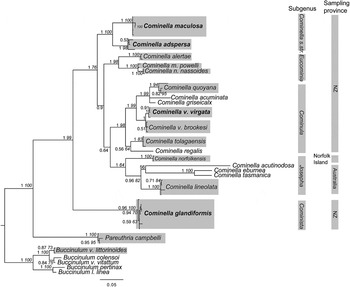
The whelk/trematode association is, for two reasons, ideally suited to study host/parasite interactions where a tight co-evolutionary scenario is not necessarily expected. First, we have good evidence, derived from a molecular study, that a range of trematode species infect Cominella glandiformis from Otago Harbour (Leung et al. Reference Leung, Donald, Keeney, Koehler, Peoples and Poulin2009b ). Populations of this abundant intertidal carnivore play host to five trematode species belonging to four evolutionarily distant families: Echinostomatidae [two species: the morphologically cryptic – in the sense that there are no obvious differences – but genetically distinct Curtuteria australis Allison, 1979 and Curtuteria sp. A (Leung et al. Reference Leung, Keeney and Poulin2009a )], Opecoelidae (1), Microphallidae (1) and Strigeidae (1). The life cycle of all five species of parasites is shown in Table 1 (data taken from Leung et al. Reference Leung, Donald, Keeney, Koehler, Peoples and Poulin2009b ). Second, we now have a robust molecular phylogeny of New Zealand Cominella species (see Fig. 1 taken from Donald et al. Reference Donald, Winter, Ashcroft and Spencer2015). Now that a sound knowledge of Cominella host phylogeny is available and pilot studies on the presence of Cominella parasites have been performed, the time is ripe to further the study of whelk digeneans to include a larger range of host species collected over a larger geographic scale. Studying parasites in a larger number of host species and over a larger sampling area will provide more information on host specificity (or lack thereof) and their geographic range.
Host Cominella phylogeny (taken from Donald et al. Reference Donald, Winter, Ashcroft and Spencer2015) estimated by Bayesian inference from the combined 16S, COI and 18S datasets. The topologies recovered by Bayesian and ML analyses were generally congruent, and so the Bayesian tree is presented with posterior probabilities at each node. ML bootstraps values are also shown. Nodes receiving less than 0·50 posterior probabilities were not labelled. Nodes with no ML bootstrap support values represent cases where analyses did not recover the particular relationship or the relationship received less than 50% bootstrap support. Shaded areas on tree encompass multiple individuals of a single species. Cominella species in bold are those which were examined for parasites.

Digenean species isolated from their first-intermediate host Cominella glandiformis collected in Otago Harbour and the secondary and intermediate hosts utilized in their life cycles (from Leung et al. Reference Leung, Donald, Keeney, Koehler, Peoples and Poulin2009b )

This research focuses on a number of questions: (1) What are the parasitic infection levels in New Zealand's intertidal Cominella species? (2) What are the evolutionary relationships between parasite families infecting different host Cominella spp.? More specifically, does parasite phylogeny match host phylogeny? In summary, we address fundamental questions concerning digeneans, a group that, despite playing a major role in community structure of intertidal fauna, has traditionally been overlooked by marine ecologists (Marcogliese and Cone, Reference Marcogliese and Cone1997; Raffaelli, Reference Raffaelli2000).
MATERIALS AND METHODS
Sample collection
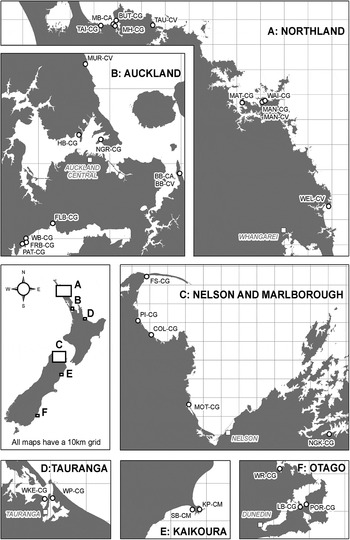
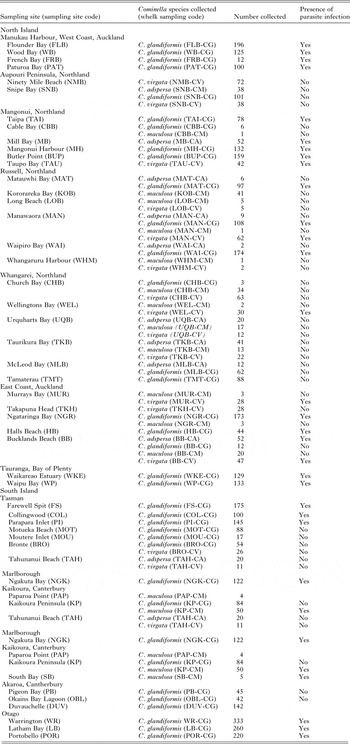
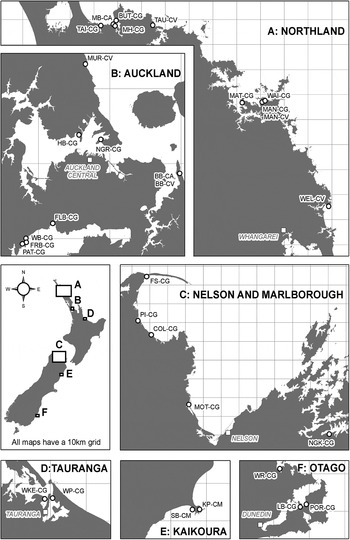
Up to 333 Cominella individuals were collected from several populations of four regularly intertidal New Zealand whelk species: Cominella glandiformis, C. adspersa, C. maculosa and C. virgata (see Table 2 and Fig. 2 for sampling locations and numbers). Donald et al. (Reference Donald, Winter, Ashcroft and Spencer2015) have shown that C. adspersa and C. maculosa are sister species, C. virgata is more distantly related and C. glandiformis is the most divergent (see Fig. 1). Sample size was determined by the abundance of whelks at each sampling site. As the distribution of parasitized animals in the intertidal zone may be patchy both within and between geographically close shores (Leung et al. Reference Leung, Keeney and Poulin2009a ), whelks were collected over a large area of each site and whelk populations from several localities within a close geographic area were sampled, to try to maximize the chances of collecting infected animals. Live whelks were placed in seawater and within 48 h of collection were crushed and their soft tissue examined under a binocular microscope for evidence of parasitic infections. Parasites were carefully separated from host tissue, preserved in 70% ethanol and stored at 4 °C
Locations of digenean infected whelk populations. New Zealand maps depict sampling areas, boxes A–F show exact sampling points. See Table 1 for key to sampling site codes.
Sampling sites and numbers of Cominella

DNA extraction and PCR amplification
Between one and five sporocysts or rediae, were dissected from each infected host. Digeneans were then placed in a 5% Chelex 100 solution (Walsh et al. Reference Walsh, Metzger and Higuchi1991), containing proteinase K, which was incubated overnight at 65 °C. Following brief vortexing, the solution was boiled for 10 min and then centrifuged at 15 000 g. The DNA in the supernatant was used in subsequent PCR amplifications.
Regions of the nuclear rDNA internal transcriber space region 1 (ITS1) and the mitochondrial genes 16S and cytochrome oxidase 1 (COI) were PCR-amplified from the parasite DNA. For each set of amplifications, parasite-specific primers were used to ensure that no whelk DNA was amplified in error. The platyhelminth-specific primers BD1 (5′-GTCGTAACAAGGTTTCCGTA-3′) and 4S (5′-TCTAGATGCGTTCGAARTGTCGA-3′), described by Bowles and McManus (Reference Bowles and McManus1993), were used to amplify ITS1. The optimum cycling parameters for these ITS1 primers consisted of an initial denaturation step of 95 °C (2 min), followed by 40 cycles of 95 °C (30 s), 52 °C (1 min) and 72 °C (1 min) and finally a final extension phase at 72 °C (10 min).
The parasite-specific primers platy16Sar (5′-ATCTGTTTMTYAAAAACAT-3′) and platy16Sbr (5′-CCAATCTTAACTCAACTCATAT-3′) (Donald et al. Reference Donald, Kennedy, Poulin and Spencer2004) were used to amplify the 16S gene, while the primers JB3 (5′-TTTTTTGGGCATCCTGAGGTTTAT-3′) (Bowles & McManus, Reference Bowles and McManus1993) and trem.cox1.rrnl (5′AATCATGATGCAAAAGGTA-3′) (Králová-Hromadová et al. Reference Králová-Hromadová, Špakulová, Horácková, Turceková, Novobilsky, Beck, Koudela, Marinculic, Rajsky and Pybus2001) were used to amplify the CO1 gene. Optimal cycling parameters for both 16S and COI included an initial denaturation step of 95 °C (2 min), followed by 40 cycles of 95 °C (30 s), 48 °C (40 s) and 72 °C (1 min), and a final extension phase at 72 °C (10 min). To confirm that amplifications were successful, 3 µL aliquots of PCR amplifications were visualized by the agarose gel electrophoresis.
The PCR products were separated from excess primers and oligonucleotides using an Ultra-Sep® gel extraction kit (Omega). Purified DNA was then quantified by nanodrop spectrophotometry and subsequently analysed in an ABI3730 automated sequencer. Blast searches (Altschul et al. Reference Altschul, Gish, Miller, Myers and Lipman1990) were performed on the sequences generated to check that only parasite DNA had been amplified.
Phylogenetic analyses
Sequences generated in this study were aligned using Sequencher™ (Gene Codes Corporation, Version 4.9) with default parameters applied, and imported into PAUP* 4·0b10 (Swofford, Reference Swofford2002) for phylogenetic analyses. Phylogenetic analyses were carried out on sequences derived on the nuclear gene ITS1 and the mitochondrial genes 16S and COI. The partition-homogeneity test (PHT) (Swofford, Reference Swofford2002; the incongruence length difference test of Farris et al. Reference Farris, Källersjö, Kluge and Bult1995) was performed to test for significant incongruence between the mitochondrial 16S and COI datasets, to determine whether they could also be analysed as a single dataset.
The models of nucleotide substitution for the Bayesian analysis were selected through the hierarchical likelihood ratio tests and the Akaike Information Criterion (AIC) using Modeltest 3·7 (Posada and Crandall, Reference Posada and Crandall1998). The model selected for the ITS1 was TVM + G. Consequently; a four-parameter model (nst = 6 in MrBayes) was used for Bayesian analyses of this gene, with rate variation across sites modelled using a gamma distribution (Huelsenbeck and Ronquist, Reference Huelsenbeck and Ronquist2001). When Modeltest 3·7 was run on the combined 16S and COI datasets, the GTR + G model, where nst = 6 and rates = gamma, was selected. For all the Bayesian analyses, the Markov-chain Monte-Carlo Bayesian posterior probabilities search was run with four chains for 5 000 000 generations, with trees being sampled every 100 generations; the first 10 000 trees (1 000 000 generations) were discarded as ‘burnin’.
We also carried out maximum-likelihood (ML) analyses on all datasets (Felsenstein, Reference Felsenstein1985). The ML model employed six substitution types (‘nst = 6’). Rate variation across sites was modelled using a gamma distance (rates = ‘gamma’). For all the maximum = likelihood analyses the Markov-chain Monte-Carlo Bayesian posterior probabilities search was run with four chains for 5 000 000 generations, with trees being sampled every 100 generations; the first 10 000 trees (1 000 000 generations) were discarded as ‘burnin’. The resultant ML trees were compared with those estimated through Bayesian inference. We also estimated ML and Bayesian trees from a concatenated alignment, including ITS1 and mitochondrial sequences, using the same settings described above. In each case, the mitochondrial and ITS1 sequences were treated as separate partitions, with unlinked substitution models. For all ML and Bayesian trees constructed, for visualization purposes, we defined the Microphallidae as the outgroup; based on COI sequence, they displayed the most extreme divergence (>60%) from all other parasite families (see Table 5).
Cominella host and their parasite associations were visualized using the jungles algorithm (Charleston, Reference Charleston1998; Charleston and Perkins, Reference Charleston, Perkins and Page2002a ) implemented in TreeMap 3 (Charleston and Robertson, Reference Charleston and Robertson2002b ), using the consensus of the Bayesian COI trees for both hosts and parasites. A detailed co-speciation study is beyond the scope of this paper, rather the purpose of this analysis was to produce a simple figure, in which host–parasite associations could be easily determined at a glance. Therefore, to produce a simple, yet meaningful co-speciation tree, only one representative of the infected host species and parasite family were used in this analysis.
RESULTS
Occurrence of trematode-infected whelks
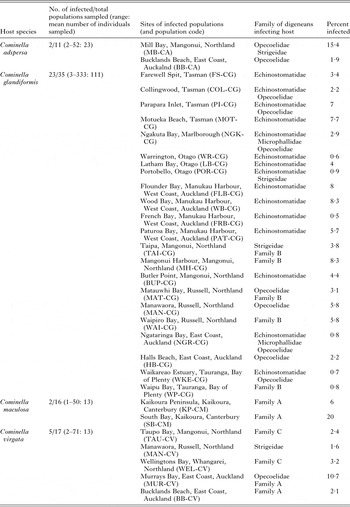
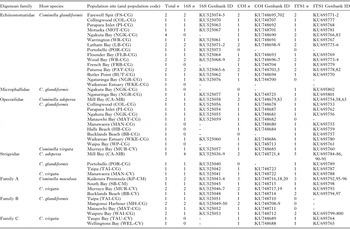
During this study, 4808 whelks (representing four species, Cominella adspersa, C. glandiformis, C. maculosa and C. virgata, belonging to three subgenera) were collected and analysed for parasites. We observed a large range of infection prevalence of between 0 and 20%. However, most whelk populations were either uninfected (57% of populations sampled) or were infected at low prevalence (28% of populations sampled displayed infection prevalence <5%). Indeed only six populations out of a total of 75 populations sampled had an infection prevalence above 10%. The vast majority of whelks collected (>80%) were C. glandiformis as this species is often the most numerous Cominella species in the intertidal environment. Indeed, the average sample size collected from each C. glandiformis population was 111, much higher than average sample sizes collected for C. adspersa (25), C. maculosa (13) or C. virgata (33). Nevertheless, all four whelk species collected were capable of hosting digenean parasitic infections. Populations of C. glandiformis were most consistently infected by parasites, with 66% of populations sampled exhibiting some level of infection (compared with 20, 13 and 33% of C. adspersa, C. maculosa and C. virgata populations, respectively). When taking variable sample size into account and calculating number of infected individuals as a percentage of total number of individuals sampled these figures reveal that the high level of C. glandiformis populations exhibiting infection is an artefact of variable sample size. Among infected populations, average infection prevalence was low, ranging from 1·4 to 3·6% [2·6% (C. glandiformis), 3·6% (C. adspersa), 2·0% (C. maculosa) and 1·4% (C. virgata)]. The highest levels of infection were observed in C. adspersa from Mill Bay, near Mangonui (15·4%) and C. maculosa from South Bay, Kaikoura (20%). At two locations, parasitic infections occurred in more than one whelk host species (C. adspersa and C. virgata at Bucklands Beach, Auckland and C. glandiformis and C. virgata at Manawaora, Northland). At many of the sampling locations only C. glandiformis was present. At 19 sampling sites several species were available for collection, but in most of these cases only very low numbers of one or more species could be collected. With an average infection rate of <4% there was a very low chance of finding infected individuals amongst these samples and populations could be mistakenly classified as uninfected. For example, at Paparoa Point, Kaikoura we were only able to collect four Cominella maculosa individuals, all of which were uninfected; if more individuals had been analysed we may have encountered parasites. However, on the Kaikoura Peninsula reasonably large samples of both C. maculosa and C. glandiformis could be collected. In this instance, despite C. maculosa exhibiting an infection rate of 6%, parasites were not detected in any of the 84 C. glandiformis sampled (Table 2).
Prevalence of digenean parasites in New Zealand intertidal Cominella populations

PCR amplification and DNA sequencing
Polymerase chain reaction amplification of 16S, COI and ITS1 and subsequent sequencing of these products routinely yielded approximately 430, 920 and 719 base pairs of readable sequence, respectively. The mitochondrial data exhibited high sequence diversity; of the 430 and 920 bps of 16S and COI sequences analysed, 200 (46·5%) and 638 (69·3%) sites respectively were parsimoniously informative. The nuclear gene ITS1 also displayed a high proportion of informative sites with 521 of 719 (72·4%) sites being parsimony-informative. The number of samples from each population for which good quality, usable sequences were obtained is presented in Table 4. Despite up to five individual digeneans being used in a single DNA extraction, we did not observe any instances of presence of more than one digenean species in an individual host.
Digenean collection details; including the total number of infected whelks inspected for parasites (Total n), and the number of samples for which good quality 16S, COI and ITS1 digenean DNA sequences were attained (16S n, COI n and ITS1 n, respectively)

Phylogenetic analysis
Combined dataset
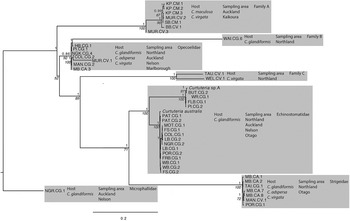
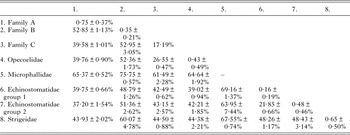
The Bayesian and ML phylogenies produced from analyses of the mitochondrial and nuclear datasets were consistent and displayed good resolution in both deep and shallow nodes (Fig. 3). Both datasets implied seven well-supported clades, four of which match or are close to previously reported taxa from the families Opecoelidae, Echinostomatidae, Strigeidae and Microphallidae; hence, we consider these taxa identified to the family level. Three of our clades, however, reflect novel genetic data: there is no highly similar genetic data for any of our three sequenced genes available in GenBank. The highest level of similarity in the BLAST database for our digenean COI sequences belonged to an Australian digenean, which displayed only 78% identity over 62% of the sequence. This low value, along with their position in the phylogeny, suggests that species in these three clades belong to parasite families, as yet, unidentified at the molecular level. The high level of genetic variation between the three unidentified groups of parasites [COI genetic distances of 39·58–52·95% (Table 5)] suggests that they probably represent different but hitherto unreported (at the molecular level) families of digeneans, which we label as Families A, B and C. Indisputably, our COI genetic distances show that we have several diverse families of trematode parasites infecting several Cominella species.
Phylogeny estimated by Bayesian inference from the combined digenean mitochondrial 16S and COI and nuclear ITS1 sequences. The topologies recovered by Bayesian and ML analyses were generally congruent, and so the Bayesian tree is presented with posterior probabilities at each node. ML bootstraps values are also shown. Nodes receiving <0·50 posterior probabilities were not labelled. Nodes with no ML bootstrap support values represent cases where analyses did not recover the particular relationship or the relationship received <50% bootstrap support. Shaded areas on tree encompass multiple individuals of a single species. Bar: 10% sequence divergence. Host organisms, sampling area and parasite family are depicted for each parasite clade. Curtuteria sequences are taken from Leung et al. (Reference Leung, Keeney and Poulin2009a ).

Mean uncorrected COI distances within and between digenean families

Five of the seven families show very low levels of within-family COI genetic diversity (<0·75%) and we assume they comprise just a single species. The 17 echinostomatid sequences, however, form two genetically distinct groups. Each group is genetically uniform (0·16 and 0·48% COI sequence divergence), but there is 21·85% COI genetic distance between the two groups, which can be identified as the two Curtuteria species previously identified by Leung et al. (Reference Leung, Keeney and Poulin2009a ). Similarly, we clearly have two different species in Family C, given their COI genetic distance (17·15%).
Individual gene analyses
The PHT confirmed that there was no significant difference in phylogenetic signal among the mitochondrial sequences (100 replicates, P = 0·30); and so the mitochondrial genes could be concatenated and analysed as a single dataset. Phylogenies estimated from the sequences of mitochondrial and nuclear genes are shown in the supplementary material (Supplementary Figures 1 and 2). All seven clades, which we treat here as families, that were observed in the combined phylogeny were present and well supported in both the mitochondrial and nuclear gene phylogenies. However, in both trees there were several instances of weaker support for relationships between clades. And in several instances the relationships between clade positions in each phylogeny varied. For example, in the nuclear gene tree the positions of families B and C were not well supported. Both the mitochondrial and nuclear gene trees showed the Echinostomatidae sequences separating into two separate groups.
Cospeciation analysis
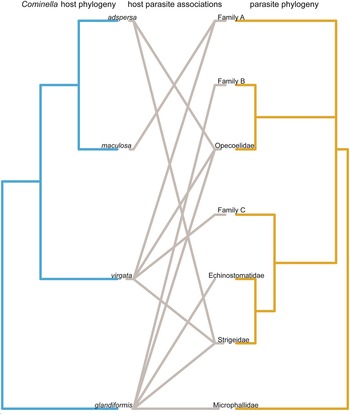
A tanglegram for Cominella host and their parasite COI mitochondrial data are shown in Fig. 4. It is immediately obvious that there is a large range of host specificity between representatives of different parasite families. Three families (Echinostomatidae, Microphallidae and Family B) were specific to C. glandiformis. Family C was specific to C. virgata. All other families (Strigeidae, Opecoelidae and Family C) were capable of infecting at least two different host Cominella species.
Tanglegram for Cominella hosts and their parasites. Parasites are connected to their hosts by grey lines. Parasite species that occur on more than one host species are shown in green. Trees for both hosts and parasites constructed from Bayesian analysis of COI data.

DISCUSSION
This study, in which intertidal Cominella whelks were analysed for trematode parasites, demonstrated both the diverse array of parasite species that are capable of infecting Cominella species and also the large range of infection rates, host specificity and geographic distributions among different parasites species. In brief, some trematode species infected just a single species of whelk, whereas others infected two or three; none was found in all four whelk species. Notably, in no case did the host species infected by a single species of trematode form a monophyletic group, a finding that implies that co-speciation is not the dominant process in generating diversity in this host-parasite relationship. Some trematodes were widespread, occurring from Northland to Otago (a distance of at least 1500 km), whereas others were found at just specific sites.
The traditional parasitological paradigm of high first-intermediate-host specificity (especially in digeneans infecting molluscs) dominated by co-speciation of parasites and hosts (Hafner and Nadler, Reference Hafner and Nadler1988) has been challenged by a number of molecular studies (e.g. Johnson et al. Reference Johnson, Adams and Clayton2002; Donald et al. Reference Donald, Kennedy, Poulin and Spencer2004; Gustafsson and Olsson, Reference Gustafsson and Olsson2012; Martinů et al. Reference Martinů, Sychra, Literák, Čapek, Gustafsson and Štefka2015). Even the archetypal bird–louse relationship need not follow the expected tight host–parasite relationship. For example, in their study on the chewing louse genus Menacanthus, Martinů et al. Reference Martinů, Sychra, Literák, Čapek, Gustafsson and Štefka2015, found that species within this genus displayed a broad range of host-specificity: some species were confined to a single host species whereas others were generalists, infecting as many as 13 host species. Our phylogenies also demonstrated that the parasites infecting Cominella whelks from New Zealand displayed a range of host specificity; some parasites, such as the two echinostome species, appeared to be host specific, while others, such as the opecoelids and strigeids, were capable of infecting several host Cominella species.
A second finding from this study was the highly variable geographic range of different parasite groups. For example, echinostomes and Family B parasites were both host-specific, infecting only C. glandiformis, but while Family B parasites were restricted to the Northland and Tauranga regions in the Northern North Island, the echinostomatids ranged from Northland in the north of the North Island, to Otago in the south of the South Island.
Infection rate and host specificity
The patchy nature and the low mean prevalence (1·8%) of the whelk infections are typical of intertidal first-intermediate molluscan hosts (Irwin, Reference Irwin1983; Mouritsen and Poulin, Reference Mouritsen and Poulin2002; Poulin and Mouritsen, Reference Poulin and Mouritsen2003; Donald et al. Reference Donald, Kennedy, Poulin and Spencer2004). For example, Donald et al. (Reference Donald, Kennedy, Poulin and Spencer2004) observed that among Australasian trochid gastropods the overall infection prevalence of opecoelids was 1%, but populations exhibited prevalences ranging from 0 to 17·5%. Moreover, 62% of New Zealand and 93% of Australian populations were uninfected. Highly variable prevalence of infection has also been observed in 24 species of Canadian freshwater fish which were definitive hosts for 77 metazoan parasite species, representing 42 genera, where parasite prevalence was correlated with host abundance, which determined the likelihood of a host/parasite encounter (Poulin, Reference Poulin2006). This explanation may also extend to this study: if local environmental conditions make the definitive host scarce, then the first-intermediate hosts are less likely to encounter parasites and become infected.
Our finding of individual Cominella hosts only harbouring a single parasite species may simply have been an artefact of small sampling size: digenean infection rates amongst Cominella whelks were generally very low (typically less than 5%) and, due to available host sample size, typically only 1 or 2 infected hosts were collected from each population sampled. This sampling resulted in an extremely low probability of encountering a parasite infected by multiple digenean species. All the same, our observation of localized patterns of distribution amongst first-intermediate host parasites is not new. Previous research around the Otago Peninsula (Leung et al. Reference Leung, Keeney and Poulin2009a ) found that two genera of Echinostomatids, Curtuteria (two species) and Acanthoparyphium (four species), display localized patterns of distribution, with certain cryptic species within a single genus inhabiting sheltered inlets, while others occurred in more open waters. The fact that these digeneans have a complex, multi-host life cycle, with a highly mobile definitive host might suggest that such localized patterns of distribution amongst the first intermediate host are not to be expected. Nevertheless, as this pattern has been repeatedly recorded amongst first-intermediate hosts, it cannot simply be dismissed as an artefact of small sampling size. Perhaps the whelk hosts, which are direct developers with limited dispersal capacity (Anderson, Reference Anderson1960; Carrasco et al. Reference Carrasco, Phillips and Perez-Matus2012), represent isolated populations that vary in their susceptibility to infection (Leung et al. Reference Leung, Keeney and Poulin2009a ). Indeed, different susceptibility to a single parasite species has been observed among snails along a depth gradient in a freshwater lake (Lively and Jokela, Reference Lively and Jokela1996). Alternatively, certain environmental conditions may be advantageous to particular parasite species (Koprivnikar et al. Reference Koprivnikar, Baker and Forbes2007); perhaps conditions in sheltered inlets favour Curtuteria sp. A over C. australis, for example.
During the fieldwork, it became apparent that sites where whelk populations harbour a high prevalence of parasites tended to be sheltered. For example Mill Bay, where a heavily infected C. adspersa population was found, is a small sheltered inlet in Mangonui Harbour. Sheltered, soft-sediment environments possess a more diverse range of potential hosts than exposed rocky shores (Clayton, Reference Clayton, Halwagy, Clayton and Behbehani1986), which in turn results in greater numbers and species of parasites (Hechinger and Lafferty, Reference Hechinger and Lafferty2005). We hypothesize that these sheltered sites are favourable environments for the definitive hosts in the digeneans’ life cycle; when the hosts favour these sheltered sites, the chances of the first-intermediate hosts encountering parasites, and subsequently becoming infected, increases. The observation that organisms living on sheltered soft-sediment beaches tend to more heavily parasitized than those living on rocky shores is ubiquitous (e.g. Abdul-Salam and Al-Khedery, Reference Abdul-Salam and Al-Khedery1992; Poulin and Mouritsen, Reference Poulin and Mouritsen2003; Donald et al. Reference Donald, Kennedy, Poulin and Spencer2004). Nevertheless, broad-scale ecology can only be part of the explanation, since we observed several instances of sites where an infected whelk species and another uninfected whelk species co-existed side by side. In some cases, this discrepancy is further evidence for some degree of host specificity of the trematodes: at Kaikoura Peninsula, for example, the Family A digenean found in three C. maculosa whelks did not infect the commoner co-occuring C. glandiformis, which we never found to be infected with a Family A species. In other cases, however, the discrepancy is surprising: this same digenean was present in one individual of the Bucklands Beach population of C. virgata but not in any of 20 individuals of C. maculosa.
The echinostome parasites that were detected in many C. glandiformis populations were specific to this host species. The two echinostomes species detected in this study have been previously identified as C. australis and Curtuteria sp. A (Leung et al. Reference Leung, Keeney and Poulin2009a ). Interestingly, in our study infected C. glandiformis populations only ever hosted one Curtuteria species. A broadly similar pattern, of whelks populations being mainly infected by a single Curtuteria species, was also observed by Leung et al. (Reference Leung, Keeney and Poulin2009a ), who found that around the Otago Peninsula Curtuteria sp. A commonly infected C. glandiformis living in sheltered inlets, whereas in the more open waters of Otago Harbour C. glandiformis populations were predominately infected by C. australis. The two Curtuteria species appear morphologically identical (Leung et al. Reference Leung, Donald, Keeney, Koehler, Peoples and Poulin2009b ), yet displayed complete clade concordance in two independent markers (mtDNA and rDNA), providing definitive evidence of two genetically distinct species. Indeed, the COI genetic distances are high enough to consider placing them in separate genera. This observation reinforces the point of how difficult it is to identify parasitic larvae based on morphology alone, particularly as many morphologically distinctive traits are not apparent at this early stage in the life cycle. The advent of molecular techniques has led to many morphologically cryptic species being identified as separate species (e.g. Donald et al. Reference Donald, Kennedy, Poulin and Spencer2004) and in this case, most likely separate species belonging to separate genera.
Our finding of morphologically cryptic but genetically distinct digenean species has also been observed in many other cases. For example, clades within the salmon parasite known as Deropegus aspina, although morphologically cryptic, display distinct COI and ITS1 sequences and comprise two genetically distinct species (Criscione and Blouin, Reference Criscione and Blouin2004). Such recognition of cryptic morphology masking genetic differentiation has in turn has led to the suggestion that multi-host parasite species may be artefacts of cryptic speciation (Refrégier et al. Reference Refrégier, Le Gac, Jabbour, Widner, Shykoff, Yockteng, Hood and Giraud2008). This possibility cannot always be the case, however, as we show quite clearly that one strigeid species infects three of our Cominella hosts. In a more extreme example, molecular techniques were used to identify a single Menacanthus louse species capable of infecting thirteen bird families from four continents (Martinů et al. Reference Martinů, Sychra, Literák, Čapek, Gustafsson and Štefka2015).
Concluding remarks
While there are instances in this study of digenean parasites of Cominella whelks showing a degree of host specificity, it would appear that ecology plays a greater role in determining infection: parasites are more abundant and more whelks are infected in sheltered locations, for example. A lack of host specificity may also be advantageous: as intertidal parasites usually possess stages where they are free-living in the intertidal environment, their life cycles have a better chance of being successfully completed if they are able to infect a range of potential host species. The three less abundant whelk species (C. adspersa, C.maculosa and C. virgata) could only be sampled in relatively small numbers from a lesser number of sampling sites. Despite the fact that this sampling regime may mean that some populations have been erroneously classified as uninfected, we still detected parasites from four separate parasite families infecting these whelks.
SUPPLEMENTARY MATERIAL
To view supplementary material for this article, please visit http://dx.doi.org/10.1017/S0031182016000494
ACKNOWLEDGEMENTS
Cally Hammond-Tooke and Emily Wallis collected the whelks used in this study and examined them for parasites. Romana Salis assisted with collection of the South Island whelks. Antoni Moore provided the map (Fig. 2).
FINANCIAL SUPPORT
Funding from the Allan Wilson Centre (to K.M.D and H.G.S.) was greatly appreciated.