Introduction
Heritage speakers are early bilingual individuals who have grown up acquiring a minority language alongside the dominant language spoken in a country (Benmamoun, Montrul & Polinsky, Reference Benmamoun, Montrul and Polinsky2013). Heritage speakers typically acquire their first language (L1) from birth in family settings while they are either exposed to the majority language simultaneously or shortly after the onset to L1 (i.e., at school). However, exposure to L1 tends to be more limited during heritage speakers’ childhood and L2 gradually gains dominance as compared to monolingual acquisition. Hence, in adulthood, it is assumed that heritage speakers have not reached the ‘ultimate attainment’ of their L1 as compared to their monolingual peers (Montrul, Reference Montrul2002, Reference Montrul2008; Polinsky, Reference Polinsky2006). That is, heritage speakers’ knowledge of their L1 grammar is thought to be incomplete due either to ‘inadequate input conditions’ during early childhood (Montrul, Reference Montrul2008) or to effects of attrition after full acquisition of the L1 (Polinsky, Reference Polinsky2011).Footnote 1
Not all areas of heritage speakers’ L1 structures are equally affected by incomplete acquisition or attrition, however. Inflectional morphology has shown to be particularly vulnerable across different languages (Albirini, Benmamoun & Chakrani, Reference Albirini, Benmamoun and Chakrani2013; Albirini, Benmamoun & Saadah, Reference Albirini, Benmamoun and Saadah2011; Anderson, Reference Anderson1999, Reference Aarssen, Verhoeven and Stromqvist2001; Bolonyai, Reference Bolonyai2002, Reference Bolonyai2007; Montrul, Reference Montrul2002, Reference Montrul2008, Reference Montrul2009; Montrul, Bhatt & Bhatia, Reference Montrul, Bhatt and Bhatia2012; Polinsky, Reference Polinsky2006, Reference Polinsky, Brinton, Kagan and Bauckus2008; Rothman, Reference Rothman2007; Silva-Corvalán, Reference Silva-Corvalán1994). Other properties (e.g., word order, verb agreement) have been shown to be virtually unaffected (Albirini et al., Reference Albirini, Benmamoun and Chakrani2013; Albirini et al., Reference Albirini, Benmamoun and Saadah2011; Bolonyai, Reference Bolonyai2007). However, heritage speakers’ knowledge of their L1 inflectional morphology is rather asymmetrically affected and there is not a unified explanation for these ‘asymmetries’. For the purpose of the current study, we will consider the following two accounts: ‘interface vulnerability’ and ‘maturational constraints’.
The interface vulnerability account states that heritage speakers’ incomplete knowledge of their L1 structures is correlated with a difficulty of integrating information from different linguistic levels (Bolonyai, Reference Bolonyai2007; Montrul, Reference Montrul2002, Reference Montrul2009; Montrul et al., Reference Montrul, Bhatt and Bhatia2012; Rothman, Reference Rothman2007). This is captured by the Interface HypothesisFootnote 2 (Sorace, Reference Sorace2000; Sorace & Filiaci, Reference Sorace and Filiaci2006; Sorace & Serratrice, Reference Sorace and Serratrice2009). According to this hypothesis, structures at the interface of two linguistic domains, in particular the syntax-pragmatics interface, are more problematic for heritage speakers than structures that can be processed at one single level. To illustrate, Bolonyai (Reference Bolonyai2007) showed that possessive agreement in Hungarian, which corresponds to the syntax–semantics interface, is more prone to errors than verb agreement in the production of young heritage-speakers’ production. Similarly, Montrul et al. (Reference Montrul, Bhatt and Bhatia2012) showed that adult heritage speakers of Hindi are less sensitive to case morphemes that signal semantic content (e.g., specificity) than to morphemes that do not, on both oral production and grammaticality judgment tasks. Rothman (Reference Rothman2007) reported that adult heritage-speakers of Brazilian Portuguese perform poorer when verifying uninflected infinitives compared to inflected verbs on a grammaticality judgment-task. As an explanation, Sorace and Serratrice (Reference Sorace and Serratrice2009, pp. 199–200) propose that bilingual individuals may have access to “fewer processing resources and may therefore be less efficient at integrating multiple types of information efficiently”. Hence, bilingual speakers are assumed to rely on ‘default’ forms during online processing or production to reduce processing costs.
A second theory attributes heritage speakers’ incomplete knowledge of the L1 verbal inflections to maturational constraints. Within this perspective, the Regression Hypothesis holds that language attrition exhibits the reversed pattern of language acquisitionFootnote 3 (Jakobson, Reference Jakobson1941). According to this hypothesis, structures acquired later in life are more likely to attrite first in bilingual speakers (Keijzer, Reference Keijzer2010). Heritage speakers’ asymmetrical incomplete acquisition patterns have been shown to be partly governed by maturational constraints (Montrul, Reference Montrul2008). Using an elicitation and a grammaticality judgment task, Montrul (Reference Montrul2009) showed that adult heritage speakers of Spanish retained their sensitivity to Aspect (Preterite–Imperfect) but not to Mood (Subjunctive–Indicative) distinctions. Mood is acquired later than Aspect in Spanish, and, thus, the author argues that her findings are reconcilable with the Regression Hypothesis.
The present study aims to contribute to the understanding of whether and how inflectional morphology in adult heritage speakers of Turkish living in the Netherlands (i.e., early bilinguals of Turkish–Dutch) is affected during online sentence processing. As most of the studies presented above concentrated on heritage speakers living in the United States, incomplete acquisition and attrition patterns in heritage speakers speaking L2 languages other than English is less well known. Turkish is one of the most widely spoken minority languages in Western Europe. It has a rich inflectional paradigm, like so-far-studied languages, but also presents grammatical features yet to be investigated in heritage speakers. First, in Turkish, finite verbs referring to the past are inflected for evidentiality, which encodes how the speaker obtained information about an event. Second, reference to past or future time frames is not only expressed on the finite verb, but also on non-finite participles. In the next section, features of evidentiality and time reference through non-finite participles in Turkish are described.
Expression of evidentiality and time reference in Turkish
Evidentiality expresses information sources that the speaker has for his or her statement, such as witnessing, report and inference (see Aikhenvald, Reference Aikhenvald2004). In Dutch, evidentiality is not marked on the verb. In Turkish, however, speakers have two options to choose from, depending on whether a past event is known on the basis of ‘direct’ or ‘indirect’ informationFootnote 4 (Aksu-Koç & Slobin, Reference Aksu-Koç, Slobin, Wallace and Nichols1986; Slobin & Aksu, Reference Slobin, Aksu and Hopper1982). Both direct and indirect information source perspectives are exclusively marked by inflectional morphemes, as given in (1)–(2), respectively.
-
(1)

-
(2)


The use of the direct evidential inflection –DI, in (1), indicates that the speaker witnessed all stages of that event –from beginning to end. The use of the indirect evidential –(I)mIş, in (2) conveys that the speaker has either inferred the event or heard about it from another speakers. Footnote 6
Within the evidential paradigm, the indirect evidential is the ‘marked’ form, as it conveys a spectrum of indirect information sources depending on contexts, whereas the direct evidential is taken to be a default or less marked form (Johanson, Reference Johanson, Aikhenvald and Dixon2003). Furthermore, the indirect evidential harbours rather complex semantics, as it is assumed to have epistemically modal connotations (Aksu-Koç, Reference Aksu-Koç1988, Reference Aksu-Koç, Johanson and Utas2000). That is, the use of an indirect evidential is often correlated with the speaker's attitude towards the ‘certainty’ or ‘reliability’ of information in his/her proposition (see also Palmer, Reference Palmer1986).
Arguably, an indirect evidential is the preferred form in non-first-person contexts, since its use presupposes that the speaker is not the first-hand source. According to Aikhenvald (Reference Aikhenvald2004), uses of indirect evidentials in first-person contexts often expose counter-intuitive semantic effects. For instance, in Turkish, the indirect evidential indicates ‘lack of control of the speaker’ when used in first-person contexts, if verb semantics allow (Aksu-Koç & Slobin, Reference Aksu-Koç, Slobin, Wallace and Nichols1986). Nonetheless, when the action requires intentionality, the use of an indirect evidential in first-person contexts results in rather unreasonable readings as shown in (3).
-
(3)

Turkish participles embedded in object-relative clauses do not convey evidential content. These participles are inflected, but they are non-finite. Albeit not formally marked for Tense, these non-finite participles undertake the role of referring to past and future events (Erguvanlı-Taylan, Reference Erguvanlı-Taylan1993; Underhill, Reference Underhill1972). Examples for past (4) and future (5) participles are given below.
-
(4)
-
(5)


The past participle morpheme –DIK conveys past events and non-future states. For instance, in (4), the use of –DIK signals that the action of writing the letter occurred before the time of speech. The future participle morpheme –EcEk, by contrast, expresses situations that are yet to come. For example, –EcEk in (5) encodes that the action of writing the letter has not yet happened at the time of speech.
Acquisition of evidentiality and participles in monolingual Turkish children
Aksu-Koç (Reference Aksu-Koç1988) studied the production and comprehension of evidential verb forms in monolingual Turkish children (aged 3–6). Her data showed that evidential morphology emerge shortly before the age of 4, and that the direct evidential emerges earlier than the indirect evidential by a few months. However, successful comprehension of evidential morphemes does not stabilize before the age 6. Öztürk and Papafragou (Reference Öztürk and Papafragou2007) found that monolingual children (aged 3–6) produced evidential morphemes virtually faultlessly, but had difficulties recognizing the semantic and pragmatic information expressed by the different evidential forms. Öztürk and Papafragou (Reference Öztürk and Papafragou2008) showed that children (aged 5–7) use the direct evidential form more often correctly than the indirect evidential form and that the latter form was hardly used in younger age groups. The study also indicated that the children at the age of 7 had more problems discriminating information obtained from indirect sources than from visually witnessed events.
Slobin (Reference Slobin, Slobin and Zimmer1986) investigated the development of participles in relative clauses in 3–4;8 year-olds performing a narrative task. He found that the use of participles is limited in all age groups. Similarly, Aksu-Koç (Reference Aksu-Koç, Berman and Slobin1994) showed that the past participle (–DIK) does not emerge before the age of 5 in monolingual children's narratives. Ekmekçi (Reference Ekmekçi1990) compared Turkish children's (aged 3–6) interpretation of sentences with relative clauses containing participles and simple sentences without relative clauses, using a sentence-imitation and a production task. The author showed that, by the age of 6, children tend to understand both the relative clauses and the simple sentences equally well. Nonetheless, Özge, Marinis, and Zeyrek (Reference Özge, Marinis and Zeyrek2010) showed that Turkish children's (aged 5–8) production of object relatives (containing –DIK participle form) are prone to errors even in the oldest group.
Studies on evidentiality in Turkish heritage speakers
Evidentiality and time reference, as signalled by inflectional morphology, have been scarcely studied in Turkish heritage-speakers. What is known about the possible erosion of evidential forms is restricted to a handful of narrative studies. Aarssen (Reference Aarssen, Verhoeven and Stromqvist2001) showed that Turkish heritage speakers (aged 4–10) born in the Netherlands tend to overuse the present progressive over the evidential forms in their retellings of frog stories. Akıncı (Reference Akıncı, Özsoy, Akar, Nakipoglu-Demiralp, Erguvanlı-Taylan and Aksu-Koç2003) reported similar findings for heritage speakers (aged 12–17) born in France. Specifically, Aarssen (Reference Aarssen, Verhoeven and Stromqvist2001) observed a high number of inappropriate choices of evidentialityFootnote 7 where speakers shift from one evidential form to the other without a clear pragmatic reason. Since evidential morphemes indicate how the speaker knows an event, the use is expected to remain consistent during a story. Aarssen's (Reference Aarssen, Verhoeven and Stromqvist2001) findings imply that the heritage speakers’ control over semantic and pragmatic content signaled by the evidential forms is not yet consolidated by the age of 10.
Karakoç (2007) investigated narrative production in heritage speakers born in Germany (aged 5–8) using a fairy tale retelling-task. Her data pointed to similar directions as the previously mentioned studies: the evidential forms are inconsistently used. Notably, the heritage speakers did not produce any narratives with the indirect evidential as the dominant form, Footnote 8 although the indirect evidential is the appropriate form for (re)telling a fairytale in Turkish. Aksu-Koç (Reference Aksu-Koç, Berman and Slobin1994) found that monolingual Turkish children are able to use the indirect evidential as a narrative convention, and that by the age of 9, monolingual children tend to pattern with adults in their ability to narrate events using a consistent inflection-form.
Arslan and Bastiaanse (Reference Arslan and Bastiaanse2014) analyzed narratives produced by heritage speakers in the Netherlands (aged 16–18) using a spontaneous-speech interview, a picture description, and a storytelling task. Compatible with the aforementioned studies, the heritage speakers made a large number of substitution errors by using the direct evidential in contexts where the indirect evidential was more appropriate. The data indicated that the heritage speakers used the evidential forms to refer to past events, ignoring information source distinctions.
To summarize, previous studies have shown that Turkish monolingual children acquire the direct evidential earlier than both the indirect evidential and participle forms (Aksu-Koç, Reference Aksu-Koç1988; Ekmekçi, Reference Ekmekçi1990; Öztürk & Papafragou, Reference Öztürk and Papafragou2007, Reference Öztürk and Papafragou2008). The evidential forms tend to be problematic in both child and adult heritage-speakers’ narratives (e.g., Aarssen, Reference Aarssen, Verhoeven and Stromqvist2001; Arslan & Bastiaanse, Reference Arslan and Bastiaanse2014). Nevertheless, there are still some questions to be answered. For instance, it is unclear whether Turkish heritage speakers are aware of the semantic and pragmatic content carried by the evidential morphemes; this is the topic of the current study.
The current study
We administered a sentence-verification task to adult Turkish heritage speakers living in the Netherlands and to a reference group of Turkish monolingual speakers living in Turkey. The objective was to study participants’ sensitivity to sentences with evidentiality and time reference violations, as measured by accuracy and response times (RTs). This allowed us to explore heritage speakers’ sensitivity to violations of the semantic and pragmatic contents of differential verb inflection morphemes. The question was to what extent incomplete acquisition or attrition of inflectional morphology in Turkish heritage speakers affects their sentence processing. To address this, we posed two research questions:
-
(Q1) Do Turkish heritage speakers differ from monolingual Turkish speakers in processing evidentiality violations in finite verbs and time-reference violations in non-finite participles?
-
(Q2) Do Turkish heritage speakers differ in processing evidentiality violations in finite verb inflections from that of time-reference violations in non-finite participles?
Considering the studies on heritage speakers in the United States, verb inflections are susceptible to incomplete acquisition. This was confirmed by the narrative studies on Turkish heritage speakers. Therefore, it is expected that the adult heritage speakers will encounter more problems than monolingual Turkish speakers while processing both evidentiality and time reference violations. Nevertheless, the hypotheses introduced above predict an asymmetry in the heritage speakers’ responses. The Interface Hypothesis predicts that integrating differential information from multiple linguistic domains is effortful, and that marked forms are more prone to processing limitations than default forms. Hence, the Interface Hypothesis anticipates that the heritage speakers will make more errors when responding to evidentiality violations than to time-reference violations, and that detecting indirect evidential violations will be more difficult than detecting direct evidential violations. The Regression Hypothesis predicts that heritage speakers will experience less difficulty processing violations by a direct evidential than both indirect evidential and time reference violations, as the latter two are acquired later by Turkish children. In sum, the heritage speakers’ performances are predicted as follows:

Methods
Participants
Twenty-one heritage speakers of Turkish living in The Netherlands (8 females, age = 19.6, range = 16–26), raised by native Turkish-speaking parents, were tested. As a reference group, 24 monolingual speakers of Turkish living in Turkey (10 females, age = 28.2, range = 18–48) participated. The monolingual participants were college students or graduates who never had an extended stay in a foreign country nor spoke a second language at a proficient level. The heritage speakers’ first exposure to both Turkish and Dutch was before the age of 4. None of the heritage speakers were involved in employment or education in Turkey that they only visited for summer holidays.
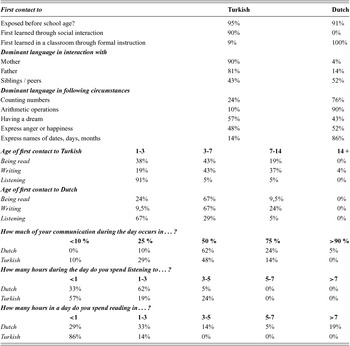
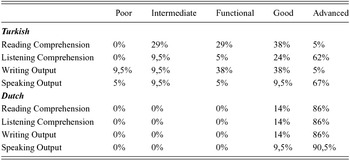
To further understand the nature of their bilingualism, the heritage speakers were given a ‘bilingualism history questionnaire’, adapted from Li, Sepanski, and Zhao (Reference Li, Sepanski and Zhao2006). The responses, as shown in Appendix 1, indicated that the heritage speakers typically use Turkish to communicate with their parents, and either Turkish or Dutch to interact with their siblings and peers. Proportions of daily language use, as shown by the responses to the questionnaire, were balanced between Turkish and Dutch. The heritage speakers were asked to rate their language abilities in both languages. As shown in Appendix 2, all of the heritage speakers rated their language abilities in Dutch as ‘advanced’, whereas 61% of them did so for Turkish. The participants were paid €10 for their participation in the experiment.
Materials
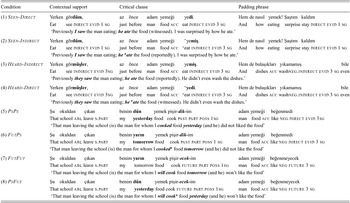
The sentence-verification task included two parts: the first part tested the participants’ sensitivity to the evidentiality distinctions (i.e., direct vs. indirect information) while the second part tested their sensitivity to the time reference distinctions (i.e., past vs. future time frames). For these purposes, 200 Turkish sentences were constructed across eight conditions, as illustrated in Table 1.
Examples for the evidentiality (1-4) and time reference (5-8) sentences used in the during-listening RTs task, sentences that contain the evidentiality violations violation are shown in conditions 2 & 4, the time reference violations are given in conditions 6 & 8.

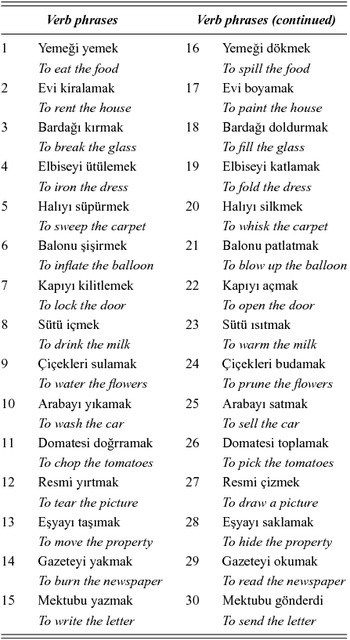
Evidentiality through finite verb inflections
To test evidentiality processing, 30 volition verbs, each conveying the intentionality of an action, were selected to construct 120 sentences across four conditions. The same verbs appeared in all four conditions. Each verb was matched with an inanimate object (e.g., portakal soymak “to peel an orange”); see Appendix 3 for the list of verb phrases. The sentences consisted of a two-word contextual support clause followed by a critical clause. The target verbs were situated in clause-final position of the critical clause, which was followed by a padding phrase so that the trials did not end with the target verbs. To establish the past time-reference, all of the evidential sentences contained a temporal adverb az önce “just before” previous to the critical verbs, as given in Table 1.
The sentences in the first two conditions (1 & 2: Seen-direct and Seen-indirect) included a contextual support clause signaling ‘seen’ information observed by the first person (e.g., yerken gördüm “I saw him while he was eating”). To form the correct baseline, in the Seen-direct condition, the target verbs were inflected with a direct evidential. In the Seen-indirect condition, by contrast, the indirect evidential forms were used on the target verb, resulting in a violation of seen information source (see Table 1 for examples).
The sentences in the other two conditions (3 & 4: Heard-indirect and Heard-direct) started with a contextual support clause denoting ‘heard’ information reported in third-person (e.g., yerken görmüşler, “they saw him while he was eating”). This signals that the information came from a non-firsthand source and that the speaker himself did not witness the event. To create the correct baseline in the condition Heard-indirect, the target verbs in the critical clause were inflected with an indirect evidential. However, in the condition Heard-direct, the direct evidential forms were used on the target verbs leading to a violation of heard information source (see Table 1 for examples).
Time reference through non-finite participles
To test participants’ sensitivity to time reference violations, 20 verbs were selected to form 80 sentences across four conditions (see Appendix 4 for the list of verbs). Each sentence comprised two relative clauses followed by a matrix clause. Verb tenses of the matrix clauses were compatible with the time reference made by the past and future participles (see Table 1 for examples). The first relative clause served as contextual support while the second formed the critical clause in which the target verbs (i.e., the past/future participle) appeared. The target verbs used in the time reference sentences were different from those used in the evidentiality sentences.
In the fifth condition (5: PsPs), a lexical adverb referring to the past (dün “yesterday”) was paired with a past participle leading to a correct sentence. In the sixth condition (6: Futps), the lexical adverb for the future was followed by a past participle resulting in a time-reference violation. In the seventh condition (7: Futfut), a lexical adverb for the future (yarın “tomorrow”) was matched with a future participle, resulting in a correct sentence. In the eighth condition (8: Psfut), the lexical adverb for the past was paired with a future participle resulting in a time-reference violation.
Material evaluation through offline-ratings
The sentences constructed to test participants’ processing of evidentiality and time-reference distinctions were rated in two separate offline questionnaires. Forty-one Turkish monolingual speakers (19 females, age = 29.0, ranges = 22–52) rated the evidentiality sentences and thirty-seven Turkish monolingual speakers (22 females, age = 26.8, ranges = 20–35) rated the time-reference sentences. Each of the participants responded to one questionnaire only and none of them took part in the main RTs task. The participants were instructed to read the sentences at their own pace and to rate the acceptability of the sentences on a four-point scale (1 highly acceptable, 4 highly unacceptable).
With respect to the evidentiality violations, paired t-tests showed that the non-violated seen information source contexts in the condition Seen-direct were more acceptable than the seen information contexts violated by an indirect evidential in the condition Seen-indirect (1.22 vs. 3.66, t(40) = −33.03, p < .001). The non-violated heard information contexts in the condition Heard-indirect were more acceptable than the heard information contexts violated by a direct evidential in the condition Heard-direct (1.24 vs. 3.65, t(40) = −31.2, p < .001). The ratings did not differ between the sentences containing a violation by direct or indirect evidentials (3.66 vs. 3.65, t(40) = .86, p > 05) or between the non-violated seen and heard information source contexts containing a direct versus indirect evidential (1.22 vs. 1.24, t(40) = −.41, p > .05).
Regarding the time-reference violations, the non-violated past participles in the condition PsPs were more acceptable than the past time contexts violated by a future participle in the condition Psfut (1.88 vs. 3.84, t(36) = −15.75, p < .001). Similarly, the non-violated future participles in the condition Futfut were more acceptable than the future time contexts violated by a past participle in the condition Futps (1.98 vs. 3.92, t(36) = −15.62, p < .001). The sentences containing a violation by either a past or future participle did not differ from each other (3.92 vs. 3.84, t(36) = 1.51, p > .05), nor was there a difference between the non-violated sentences with past and future participles (1.88 vs. 1.98, t(36) = −1.58, p > .05).
Procedure
The sentences were read aloud and recorded by a female Turkish speaker. The stimuli were programmed in E-prime 2.0 (Psychology Software Tools, Pittsburgh, PA) and were presented in two lists counterbalanced across the participants. A participant was presented with either a violated or a non-violated version of the evidentiality sentences. For instance, while one list contained a verb in the violated, seen-information context, the other list contained the correct baseline for that verb. The violated and non-violated sentences were equally distributed over the lists. The non-violated sentences served as the baseline so that participants could differentiate between violated and grammatically correct sentences. Each list accommodated all of the time reference sentences. If a verb had to appear in different conditions in the same list, these items were programmed in distant positions from each other (i.e., in different blocks). During the experiment, there was a pause after each 25% of all sentences in a list (n = 35).
Each participant listened to 140 sentences in total. The sentences were presented in pseudo-randomized order. Data collection was done in a quiet room using a computer equipped with headphones. The paradigm was similar to a speeded grammaticality-judgment task used in Blackwell, Bates, and Fisher (Reference Blackwell, Bates and Fisher1996). The participants were instructed in Turkish in the following way:
Now you will begin a language experiment in Turkish, in which you will hear several types of sentences through your headphones. When you see a hash tag on the screen, please be ready. It means that a sentence is coming soon. Some of the sentences are grammatically well-formed, but some are not. Please listen to the sentences very carefully and press the space bar as soon as you notice a part of the sentence mismatching the rest of the sentence. When you press the space bar, the sentence will not stop. If the sentence sounds good, do not do anything and wait for the next sentence.
Analysis
In the task, RTs and response-accuracies were measured. The data were analyzed in R version 3.1.1. (R-Core-Team, 2012) using the ‘lme4’ package. Response-accuracies were analyzed with generalized linear mixed-effects regression models, as the dependent variable was binomial (accurate vs. non-accurate). For the RTs, linear mixed-effects regression models were used. We excluded the RTs exceeding 2.5 standard deviations above the group means. Note that the analyses on the RTs were performed for accurate responses only. In both evidentiality and time-reference violations, RTs from ‘false alarms’ (i.e., where a participant mistook a correct sentence to be ungrammatical) were quite long and were not further analyzed. Responses to one item in the evidentiality sentences were excluded due to a technical error (i.e., incorrectly programmed sentence). In the analyses, both the items and participants were introduced as random intercepts and random slopes where applicable (Baayen, Davidson & Bates, Reference Baayen, Davidson and Bates2008). First, a full model was built, and then the model was repeated with the omission of intercepts, slopes, and fixed-effects. By using the Akaike Information Criterion, the model that fit the data best was reported. Post-hoc comparisons were computed with the ‘multcomp’ package in R using ‘Tukey’ tests. The sentences with evidentiality and non-finite participles were first modeled separately and then compared to each other in one model.
Results
Processing evidentiality through finite verb inflections
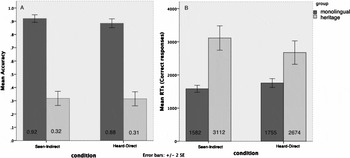
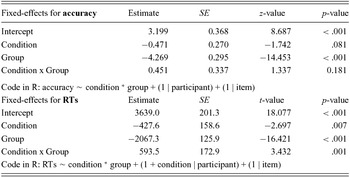
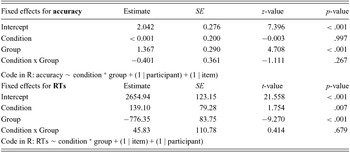
Mean response-accuracies and RTs are illustrated in Figure 1; outputs from the mixed-effects regression models performed on the accuracy and RTs data are provided in Table 2. In the models, group (monolingual vs. heritage speakers) and condition (Seen-indirect vs. Heard-direct) were added as fixed-effects.
Mean accuracies (A) and RTs (B) of monolingual and heritage speakers’ responses to the evidentiality violations by the direct- and indirect-evidential forms. Conditions: Seen-indirect = seen information contexts violated by indirect evidential; Heard-direct = heard information contexts violated by direct evidential.

Fixed-effects from the generalized linear mixed-effects model performed on response-accuracies and fixed-effects from the linear mixed-effects model performed on RTs to the evidentiality violations (Group = monolingual vs. heritage speakers; Condition = Seen-Indirect vs. Heard-Direct)

Regarding the response-accuracies, the model output showed significant effects of group with negative estimate-values. That is, the heritage speakers proved to be less accurate than the monolinguals. While the heritage speakers were 32% accurate in their responses to the violations by both evidential forms, the monolinguals were 92% accurate in the Seen-indirect and 88% in the Heard-direct conditions. However, no effects of condition or of interactions between the two factors were significant.
An error analysis was performed on the inaccurate responses to the non-violated sentences (i.e., where participants should not have responded). Outputs from a mixed-effects regression model showed significant effects of group (ß = 2.496, SE = 0.485, z = 5.142, p < .001) but not of condition (ß = −0.080, SE = 0.388, z = −0.207, p = .83). The effect of group confirmed that the monolinguals judged the non-violated sentences to be ungrammatical less often than the heritage speakers did. Since interactions between group and condition were significant (ß = −1.596, SE = 0.563, z = −2.834, p = .004), post-hoc comparisons were performed. The heritage speakers inaccurately responded to the non-violated sentences for both types of evidential forms with an equal likelihood (ß = 0.369, SE = 0.252, z = 1.467, p = .14). The monolinguals, however, responded incorrectly to the non-violated sentences with the indirect evidential more often than to those with the direct-evidential forms (ß = −1.075, SE = 0.481, z = −2.235, p = .025).
For RTs, the model outputs, as given in Table 2, showed significant effects of group, condition, and an interaction between the two factors. Negative estimate-values of group effects affirmed that the heritage speakers were slower in responding to the evidentiality violations than the monolinguals. As the effects of condition and interaction between group and condition were significant, post-hoc tests were performed. The heritage speakers did not differ in their RTs to the violations by either evidential form (ß = −208.2, SE = 231.1, z = −0.901, p = .36). However, the monolinguals had longer RTs to violations by direct evidentials, the Heard-direct condition, than to violations by indirect evidentials, the Seen-indirect condition (ß = 177.13, SE = 75.81, z = 2.336, p = .019).
Processing time reference through non-finite participles
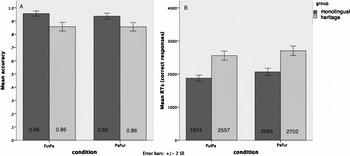
Mean response-accuracies and RTs are shown in Figure 2; outputs from the mixed-effects regression models performed on the accuracy and RTs data are given in Table 3. In the models, the fixed-effects were group (monolingual vs. heritage speakers) and condition (Futps vs. Psfut).
Mean accuracies (A) and RTs (B) of monolingual and heritage speakers’ responses to the time-reference violations by the past and future participles. Conditions: Futps = future time contexts violated by a past verb form; Psfut = past time contexts violated by future verb forms.

Fixed-effects from the generalized linear mixed-effects model performed on response-accuracies and the linear mixed-effects model performed on RTs to the time reference violations (Condition = monolingual vs. heritage speakers; Group = FutPs vs. PsFut)

With regard to response-accuracies, the model outputs indicated significant effects of group but not of condition or of interactions between these two factors. This demonstrates that the heritage speakers were less accurate in their responses to the time reference violations than the monolinguals regardless of condition; see Figure 2. Both the heritage and monolingual speakers made errors by judging the non-violated sentences to be ungrammatical. An error analysis did not show significant effects of condition or group; therefore, these errors were not further analyzed.
With regard to RTs, outputs from the model, as shown in Table 3, indicated significant effects of group and condition without an interaction between these two factors. The heritage speakers were slower in their responses to the time-reference violations than the monolinguals. In both groups, RTs to the condition Psfut (i.e., violations by a future participle) were longer than to the condition Futps (i.e., violations by a past participle). However, the between- and within-group differences did not interact.
Evidentiality and Time reference violations compared
We ran new models on the response-accuracies and RTs for both the evidentiality and time reference violations to compare the participants’ sensitivity to these violation types. Sentence type (evidentiality vs. non-finite participles) and group (monolingual vs. heritage speakers) were programmed as the fixed-effects in the models.
With respect to the accuracy of responses, the model outputs showed significant effects of sentence type (ß = 2.878, SE = 0.147, z = 19.532, p < .001), of group (ß = 3.481, SE = 0.175, z = 19.867, p < .001), and an interaction between these two factors (ß = −2.244, SE = 0.246, z = −9.116, p < .001). The heritage speakers were less accurate than the monolinguals. Given the interaction between sentence type and group, post-hoc comparisons were performed. Despite the different sizes of difference across groups, both the heritage speakers (ß = 3.010, SE = 0.156, z = 19.3, p < .001) and the monolinguals (ß = 1.119, SE = 0.222, z = 5.024, p < .001) were more accurate in their responses to the time-reference violations than to the evidentiality violations. Further output from post-hoc testing for all comparisons confirmed that the heritage speakers performed worse in responding to the evidentiality violations than to the time-reference violations: Seen-indirect vs. Futps, ß = 3.006, p < .001; Seen-indirect vs. Psfut, ß = 2.995, p < .001; Heard-direct vs. Futps, ß = 3.025, p < .001; Heard-direct vs. Futps, ß = 3.014, p < .001.
With regard to RTs, the model outputs revealed significant effects of sentence type (ß = −421.7, SE = 99.1, t = −4.256, p < .001), of group (ß = −1379.2, SE = 100.9, t = −13.665, p < .001), and of interactions between the two factors (ß = 662.4, SE = 117.0, t = 5.663, p < .001). Overall, the heritage speakers had longer RTs to both the evidentiality and time-reference violations compared to the monolinguals. Post-hoc comparisons showed that the heritage speakers were slower in their responses to the evidentiality violations than to the time-reference violations (ß = −519.6, SE = 101.0, z = −5.145, p < .001). The monolinguals, however, showed the opposite pattern: longer RTs to the time-reference violations than to the evidentiality violations (ß = 84.67, SE = 51.53, z = 1.643, p < .001).
Summary of results
The Turkish heritage speakers investigated in the current study were less accurate and slower in their responses to both the evidentiality and time-reference violations than Turkish monolinguals. The heritage speakers did not differ in their responses to the violations of the direct- and indirect-evidential verb forms. However, the monolinguals responded with longer RTs to the violations by a direct evidential than to the violations by an indirect evidential. Furthermore, the heritage speakers frequently judged the non-violated sentences with evidentiality to be ungrammatical more often than monolinguals did. The heritage speakers performed both less accurately and more slowly on the evidentiality violations than on the time-reference violations. The monolinguals showed the opposite pattern: They had longer RTs but more accurate responses to the time-reference violations than to the evidentiality violations.
Discussion and conclusions
Results from this study provide us with further insights into online processing of evidentiality and time reference in Turkish heritage speakers. We sought to answer two main questions. The first was whether the heritage speakers differ in their processing of the evidentiality and time-reference violations from the monolinguals. The second question was whether there are differences in the heritage speakers’ sensitivity to the evidentiality and time-reference violations.
With regard to the first question, our findings confirmed that the heritage speakers were at a disadvantage compared to the monolinguals when processing both evidentiality and time-reference violations. The heritage speakers demonstrated a reduced sensitivity to both the evidentiality and time-reference violations, which was shown by their lower accuracy and longer RTs than the monolinguals. Regarding the second question, an asymmetry was found in the heritage speakers’ online processing of the evidentiality and time-reference violations. The heritage speakers were less sensitive to evidentiality violations than to time-reference violations, as evidenced by both their response-accuracies and RTs. The monolinguals had longer RTs (but more accurate responses) to the time-reference violations than to the evidentiality violations.
Previous studies have attributed heritage speakers’ difficulties in their L1 inflectional morphology to incomplete acquisition and / or to attrition (Montrul, Reference Montrul2002, Reference Montrul2008; Polinsky, Reference Polinsky2006, Reference Polinsky2011). Given the lack of longitudinal investigations on Turkish heritage speakers’ acquisition of evidentials and past/future participles, we consider the effects of incomplete acquisition and attrition to be equally likely. The interesting point is, however, that the heritage speakers’ online processing of inflectional forms in Turkish was selectively affected. They responded more slowly and less accurately to the evidentiality violations than to the time-reference violations. The findings reported here are compatible with those of previous studies that showed asymmetrical erosion of inflectional morphology in heritage speakers of other languages (e.g., Bolonyai, Reference Bolonyai2007; Montrul, Reference Montrul2002, Reference Montrul2009; Montrul et al., Reference Montrul, Bhatt and Bhatia2012; Rothman, Reference Rothman2007). In the Introduction, two accounts for the asymmetries were discussed: interface vulnerability (i.e., the Interface Hypothesis) and maturational constraints (i.e., the Regression Hypothesis).
Interface vulnerability
According to the Interface Hypothesis, integrating information from different linguistic levels into an interface (e.g., syntax–pragmatic) is vulnerable to language attrition (see Sorace, Reference Sorace2000; Sorace & Filiaci, Reference Sorace and Filiaci2006; Sorace & Serratrice, Reference Sorace and Serratrice2009). Therefore, the Interface Hypothesis predicts that the evidentiality violations pose greater difficulties to heritage speakers than the time-reference violations. This is what we have found. Hence, our findings can be explained by the vulnerability of the syntax–pragmatic interface. In evidential morphology, morphosyntactic knowledge has to be integrated with the knowledge from domains of semantics and pragmatics, thus the evidential forms easily erode under attrition or incomplete acquisition. The past and future participles, by contrast, are non-finite verb forms used in object-relative clauses, and thus, their semantic and pragmatic content (i.e., time reference) are bound by the arguments of matrix clause verbs (see Enç, Reference Enç1987; Underhill, Reference Underhill1972). In principle, the use of these participle forms can be licensed by syntactic knowledge. In accordance with the Interface Hypothesis, the heritage speakers’ sensitivity to time reference-violations by participle forms was relatively spared.
The Interface Hypothesis makes another prediction. According to Sorace and Serratrice (Reference Sorace and Serratrice2009), bilinguals are likely to encounter more difficulty processing ‘marked’ forms compared to default forms. In Turkish, the indirect evidential is the marked form, as it is used in differential information source contexts (i.e., inference and report). The direct evidential, that is linked to direct experience, is the default form within the evidential paradigm (see Johanson, Reference Johanson, Aikhenvald and Dixon2003). Therefore, it is expected that the heritage speakers encounter more difficulties with the violations by an indirect evidential as compared to those by a direct evidential. Our data do not support such an interpretation. Instead, the heritage speakers performed equally poorly in responding to the violations by a direct evidential (less marked form) and by an indirect evidential (more marked form). Therefore, our data do not support the idea that marked forms are more vulnerable to processing limitations than the unmarked forms.
Maturational constraints
A specific claim about the compatibility of heritage speakers’ incomplete knowledge of inflectional morphology and the age of acquisition has been made in Montrul (Reference Montrul2009). Her data indicated that incomplete acquisition and attrition might affect heritage speakers as a mirror image of acquisition, compatible with the Regression Hypothesis. According to this hypothesis, the first acquired-language structure is least affected by language attrition. In monolingual children's acquisition, the direct evidential is mastered before the indirect evidential and participle forms (e.g., Aksu-Koç, Reference Aksu-Koç1988; Ekmekçi, Reference Ekmekçi1990; Özge et al., Reference Özge, Marinis and Zeyrek2010). Therefore, the Regression Hypothesis predicts that heritage speakers perform better in responding to violations by a direct-evidential form as compared to the violations by indirect-evidential and participle forms. This is not what we found. The heritage speakers were equally poorly in responding to the violations by both evidential forms, whereas processing of participles was relatively good. The heritage speakers’ relatively better performance on time-reference violations by the participles is not what the Regression Hypothesis predicts.
Data on Turkish children's acquisition of evidential and participle inflectional morphology are limited. The available studies indicate that the conceptual development of the direct-evidential form precedes that of the indirect evidential. This is reasonable, since the indirect evidential form requires higher cognitive functions (e.g., inferential reasoning), which may not be fully developed in younger children when the direct evidential is already mastered. Moreover, the indirect evidential is more complex in its semantics as it may also mark epistemic modality. Given the acquisition data, at the age of 6–7, the conceptual development of the indirect evidential form is not yet complete (e.g., Aksu-Koç, Reference Aksu-Koç1988; Öztürk & Papafragou, Reference Öztürk and Papafragou2007, Reference Öztürk and Papafragou2008). At this point, lack of acquisition studies on evidential morphology in older age groups (e.g., 7–12)Footnote 9 prevents us from further contemplating the exact relationship of incomplete acquisition patterns found in heritage speakers with maturational constraints.
Evidentiality: A vulnerable grammar domain
The current study has shown that Turkish heritage speakers’ sensitivity to semantic and pragmatic content signaled by the evidential morphemes is considerably eroded under attrition and/or incomplete acquisition. Recall that heritage speakers under investigation performed equally poorly in responding to violations in both evidential forms. This can be explained by problems in discriminating between different information sources carried by the evidential morphemes. That is, when they are given a sentence in which the information source context mismatches the evidential verb form, the heritage speakers encounter difficulties. However, our data suggest that heritage speakers are aware of the fact that the evidential forms indicate past events. Recall that all the evidential test sentences contained past temporal adverbs. Therefore, the heritage speakers must have processed the evidentiality violations as acceptable, as both evidential forms are taken to refer to the past. The error analysis supports this claim. The heritage speakers judged the non-violated evidential sentences to be ungrammatical more often than the non-violated time-reference sentences.
Possibly, erosions in the heritage speakers’ sensitivity to the evidentiality violations are due to transfer effects from L2 (Dutch), which lacks evidential verb forms. Our data suggest that the heritage speakers are not fully aware of the information source distinctions carried by the evidential morphology, although they seem to understand that both evidential forms indicate past events. That is, in Turkish heritage grammar, the semantic content of the evidential morphemes may be simplified, especially when the dominant language lacks these forms. This is in line with what Montrul (Reference Montrul2010) reported for the object-marking paradigm in Spanish; Polinsky (Reference Polinsky2006) for Aspect distinctions in Russian; Kim, Montrul, and Yoon (Reference Kim, Montrul and Yoon2009) and Gürel and Yilmaz (Reference Gürel and Yilmaz2011) for the pronominal systems in Korean and Turkish heritage grammars. However, given the lack of a reference group of bilingual speakers of two languages that both have grammatical markers for evidentiality, it is impossible to be sure about the extent to which the evidential system is prone to effects of language transfer.
Finally, two interesting processing asymmetries emerged from our monolingual group that were absent in the heritage speakers. The first was that monolinguals reacted more quickly to seen information sources violated by an indirect evidential than to heard information sources violated by a direct evidential. Recall that speaking about one's personally perceived information as though it had been heard from another speaker is counter-intuitive (Aikhenvald, Reference Aikhenvald2004). The monolingual Turkish speakers rejected such mismatches immediately, as shown by shorter RTs to violations by indirect evidentials than to violations by direct evidentials. However, this counter-intuitive semantic effect, reflected in the monolingual data, is not present in the heritage speakers who demonstrated no differences in their responses to the evidentiality violations. The second processing asymmetry was a speed-accuracy trade-off pattern as shown by the monolinguals’ more accurate but longer responses in detecting the time-reference violations compared to the evidentiality violations. The time reference violations were constructed by mismatches between time-contexts and the participle verb forms in the embedded relative-clauses. Therefore, it is conceivable that the speed-accuracy trade-off pattern was due to the monolinguals’ increased ‘attention’, as the relative clauses are rather complex forms. The heritage speakers were both less accurate and slower in their RTs to the evidentiality violations than the time-reference violations.
In conclusion, the findings from the current study indicate that heritage speakers performed more poorly than monolinguals in processing both evidentiality and time reference violations. Additionally, processing evidentiality violations proved more effortful for heritage speakers than processing time-reference violations by non-finite participle forms positioned in relative clauses. The data documented in this study do not support the Regression Hypothesis. We have argued that the heritage speakers’ poorer performance on evidentiality violations can be explained by the fact that these verb forms require integration of information from different linguistic levels, in this case at the syntax-pragmatics interface. This is in line with the Interface Hypothesis. It looks as though evidentiality is ‘simplified’ in Turkish heritage grammar, and, thus, heritage speakers are less likely to be aware of the semantic and pragmatic requirements of evidential morphology.
Summary of Turkish heritage speakers’ responses to the bilingualism history questionnaire.

Turkish heritage sparkers’ self-ratings of language abilities in Turkish and Dutch = percent participants per language proficiency level.

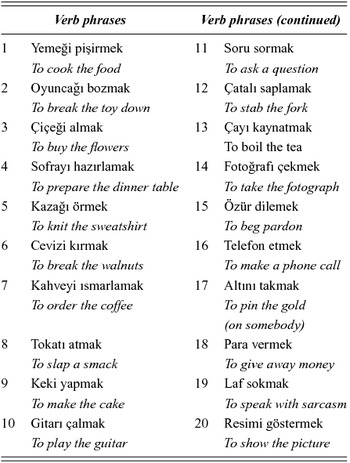
List of verb phrases used to construct the evidentiality sentences. English translations are given below each verb phrase in italics.

List of verb phrases used to construct the time reference sentence. English translations are given below each verb phrase in italics.