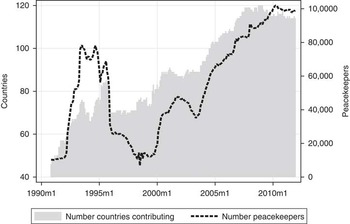
The 1990s and 2000s were marked by two opposite, but hardly unrelated, trends: a sharp decline in most deadly civil conflicts and an increase in external interventions, particularly those sponsored by the UN. These opposite trends have sparked an ongoing debate on the impact of peacekeeping.Footnote 1 Although most studies focus on violence between the military forces of two parties, civilians have increasingly become the victims of armed conflict, and the UN has expanded the scope of peacekeeping to include the protection of civilians. Since 1990, the UN has launched close to fifty missions, while the number of peacekeepers worldwide has grown sevenfold to 100,000. A recent contribution by Hultman, Kathman, and ShannonFootnote 2 finds that the sheer size of UN missions can substantially diminish civilian casualties in domestic conflicts. Yet the very composition of UN peacekeeping operations (PKOs) in recent years bears little resemblance to what it looked like in the aftermath of the Cold War. In 1990 the UN relied on a pool of forty-six donor countries, but in 2010 some 120 countries effectively contributed to peace operations around the world (see Figure 1). The total size of UN contingents (solid trend line) and the total number of donor countries (bars) convey two related (yet different) pieces of information, on the capacity of UN PKOs to reduce the level of violence between belligerents and to protect civilians, and they do not always move together, as in the period 1995–2001. The unabated growth in the pool of donors has introduced new organizational challenges and co-ordination problems. At the same time, diversity has also produced a new mix of complementary perspectives, skills and solutions.
Countries contributing and number of blue helmets

Yet no attention has been paid to the composition of those missions. Auerswald and SaidemanFootnote 3 provide a recent and very interesting examination of NATO’s performance in Afghanistan and the issue of military adaptation. They claim that the domestic politics of NATO members (that is, their form of government and political leadership) are critical determinants of the conduct of national task forces. They find that presidential or single-party governments are less likely to impose caveats than coalitions. Yet, their study only focuses on NATO and the issue of members’ governmental form. The lack of attention to the composition of peacekeeping forces is all the more remarkable, given that the implications of diversity (that is, the degree of homogeneity within a group) is one of the fastest-growing fields of research in social science. For any given number of troops in an operation, is it advisable to have all soldiers from a single country, or should the UN attempt to recruit peacekeepers from a variety of countries? Using comprehensive and disaggregated data on personnel commitments to UN PKOs, collected by KathmanFootnote 4 for the period 1990–2011, we investigate whether diversity is ‘good’ or ‘bad’ for the performance of the missions in terms of civilian protection, a core purpose of PKOs in the last twenty years.Footnote 5
This article shifts the focus of the recent debate on peacekeeping away from whether the presence and size of a mission influence violence dynamicsFootnote 6 to how the characteristics of a UN mission can affect the conflict-resolution process. If peacekeeping works, how does the composition of a mission affect its performance? Moreover, while the number of donor countries can be put forward as evidence of the international community’s commitment to tackling one-sided violence,Footnote 7 we expand the range of perspectives on diversity beyond questions of political legitimacy at the international level to operational outcomes in the field.Footnote 8
Horwitz and HorwitzFootnote 9 recall how diversity is often portrayed as a ‘double-edged sword’. Although heterogeneity can potentially create a positive organizational synergy, and hence positive outcomes, the same idiosyncratic expertise and experience can result in co-ordination problems and intergroup conflict. Diversity within a mission may improve the performance of the operations, as soldiers from different backgrounds contribute their various skills, experiences and abilities to day-to-day interactions. Yet heterogeneous work environments may give rise to co-ordination problems (for example, due to language diversity) and thus raise transaction costs and create incompatible expectations, while cultural barriers and a lack of trust may reduce the capabilities of a mission. Whether the gains from diversity outweigh its costs should be considered as an empirical question.
We use two alternative indices to measure diversity, fractionalization and polarization, using the countries of origin of peacekeepers as the identifying characteristic, and develop theoretical arguments to anticipate negative and positive effects. We first compute fractionalization and polarization as functions of the relative share of each country’s contribution to an operation. Our empirical results reveal that diversity tends to improve the performance (conceptualized as the capacity to protect civilians) of an operation. We then take into account the degree of distinctiveness between different countries by incorporating linguistic and geographic distances. After distances between donor countries are accounted for, the effect of diversity on civilian casualties is substantially stronger.
We proceed as follows. We first provide a short overview of the possible effects of diversity on peacekeeping outcomes. Then we address the degree of diversity within a mission before describing the dataset and discussing the empirical strategy. After presenting our empirical results, we provide concluding remarks.
Civilian Protection and Mission Composition
Civilians are often the main victims of civil wars, and a number of studies have explored how and why governments and rebel groups decide to directly target civilians.Footnote 10 Understanding why powerful actors kill defenseless civilians cannot be isolated from a clear analysis of how the international community can organize PKOs in a way that reduces civilian fatalities. We fill a notable gap in the quantitative literature on peacekeeping effectiveness, which has rarely considered organizational issues within an operation, but has mostly looked at whether the very presence of peacekeepers affects a number of outcomes, in particular the duration of peace.Footnote 11 The UN has in recent years expanded the aims and scope of peacekeeping missions to include the protection of civilians. We believe this outcome is among the most sensible and important, and one that deserves further investigation.
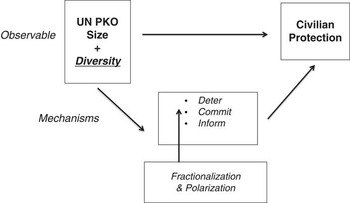
In what follows we claim that the composition of a mission, in particular its degree of heterogeneity, has an indirect impact on the mission’s capacity to limit violence against civilians by affecting three crucial functions that relate peacekeeping to violence at the local level: deterrence, commitment and information.Footnote 12 First, peacekeeping deterrence helps prevent conflict from spilling over into non-combatant areas, thus reducing the violence against civilians. Secondly, as a ceasefire may provide opportunities for government and rebel authorities to increase their bargaining power, the local presence of peacekeepers matters because it commits leaders to follow previously agreed rules, including the combatants’ interdiction from civilian areas. Thirdly, information flows can be crucial, as government and rebel leaders often lack information about their relative strength. By providing information, peacekeepers can assist the peace process. Furthermore, peacekeepers get vital information through their frequent interactions with civilians, which allows them to more proactively protect them. Figure 2 summarizes our theoretical framework.
The relationship between mission diversity and civilian protection

In the following paragraphs we explore how internal diversity in UN peacekeeping missions can positively or negatively influence the effectiveness of multinational operations through the mechanisms we have briefly discussed. Identifying the effect of diversity on performance remains a challenging research problem, and contemporary organizational theory gives little guidance on the direction of the impact. Therefore our inventory of possible mechanisms is not meant to be exhaustive.
Positive Effects of Diversity
A number of recent studies have investigated whether the overall performance of a team of workers is improved by the heterogeneity of its members’ cultural or national backgrounds. The vast majority of recent studies find that diversity has a positive effect on a number of outcomes, suggesting that a more diverse pool of workers increases the portfolio of skills, talents and interests on which to draw and facilitates mutual learning.Footnote 13 Following this literature, we start with this positive assumption and claim that diversity in UN peacekeeping missions may facilitate effective work and the appropriate management of difficult situations through two mechanisms: complementarity and monitoring.
Complementarity
In a seminal work on multicultural firms, Lazear argues that whether teams that span cultures carry costs or benefits hinges crucially on the degree of homogeneity of the workers. In fact, advantages may be obtained from ‘using complementary factors that are more easily or cheaply obtained by hiring from a different culture’.Footnote 14 A diverse mix of complementary perspectives and skills, and the appropriate combination of these skills, can produce new solutions and positively affect the outcome. Put differently, if peacekeepers from Country A have good communication and negotiating skills, while troops from Country B are relatively more combat capable, there are important gains to an operation of deploying troops from both countries rather than just one. We believe that complementarity can be a crucial added value in the context of PKOs. According to the UNA-CANADA:Footnote 15
[th]e ideal peacekeeper not only needed to be combat capable and multi-purpose, but also required additional skills in the areas of negotiation and mediation, general knowledge of the UN system and mandates, a thorough understanding of rules of engagement, understanding of civil-military cooperation and humanitarian assistance, as well as mission-specific knowledge such as local customs, culture and language.
As those characteristics are unlikely to belong to a single contingent, and since some skills, knowledge or even ability to fulfill certain aspects of the mandate might be country specific, operations with troops from a diverse range of countries will have greater collective knowledge and skills.
Complementarity can positively influence the capacity of peacekeepers to commit the belligerents and deter uncooperative and violent behavior, as it makes a range of skills and instruments available to the operation. The under-secretary general for UN PKO, interviewed by Crook,Footnote 16 laments that ‘[w]hen we have a mandate to protect civilians over huge territories where there is no real infrastructure such as eastern DRC or Darfur, the mobility and agility of the force and the mission as a whole is a key factor. So helicopters, and in particular tactical helicopters, are key’. As SpearinFootnote 17 points out, ‘the increased proportion of troops from developing countries increased the likelihood that peacekeepers would arrive in theatre lacking necessary equipment’.Footnote 18 Given the complexity faced by missions, contributors from developed countries may at times make important equipment available for specific missions, such as tactical helicopters or surveillance technology, including airborne forward-looking infrared cameras and ground radars to enable early warning.Footnote 19
Moreover, the increased use of intelligence and advanced technologies on the battlefield in recent years involves the requirement for more information technology equipment and appropriately trained personnel from more advanced countries. According to Bensahel,Footnote 20 Operation Desert Storm highlighted a technology gap between coalition partners (many of them rich economies), and many participating countries were required to use US satellite communications equipment down to the battalion level to ensure connectivity.
This is not to say that a mission staffed exclusively by a mix of developed countries is necessarily more efficient. Some of the most disastrous peacekeeping failures, such as Somalia or Rwanda, have been popularly explained by invoking the evidence that some countries are reluctant to provide troops that might be placed at risk.Footnote 21 A mix of contributors with different degrees of risk aversion can improve mission effectiveness by allocating the contingents to different tasks. In a detailed account of the UN mission in Somalia in 1994, PolmanFootnote 22 describes how the blue helmet contingents were camped ‘according to country of origin on their own plots of ground. The poorer the country, the closer to the beset outer wall of the base its contingent is placed’. In the words of the officer in charge of the Pakistani contingent, ‘Western countries are selective in what they are prepared to do for the U.N. We are not […] We are ready to die for the U.N. if need be. Here too, when we lost 24 men in one go during a disarming operation, it did not occur to us to say No to any more off-base service’.Footnote 23
To sum up, a higher degree of diversity increases the chances of having more technical capabilities and more recent campaigning experience within the operation that can be passed on to other militaries.Footnote 24 The presence of a more capable and skilled mix of peacekeepers can discourage local actors from using violence, and can resolve commitment problems that emerge between belligerents by manipulating their incentives to use force.
Furthermore, complementarity improves peacekeepers’ capacity to get the necessary information. Most of the conflict countries are culturally diverse environments, which are very demanding as cultural fragmentation within the host population adds significantly to the challenges of establishing trust and a professional relationship between peacekeepers and the local communities. According to Rubinstein, Keller and Scherger,Footnote 25 the success of a mission hinges crucially on the ability of peacekeepers to correctly interpret what they encounter and to interact in a culturally positive manner. Peacekeepers from different nationalities have their own hidden cultural approaches and competencies in intercultural communication and in the management of multicultural contexts. Consequently, the deployment of a mix of peacekeepers who are capable of working and communicating effectively within a dynamic, multifaceted and multicultural environment may have an important impact on the success of the operation.Footnote 26
Monitoring misconduct
UN peacekeeping missions have been the subject of allegations of corruption and misconduct in recent years. A recent report argues that ‘peacekeeping and other conflict-related missions […] are seriously affected by corruption’ and ‘endemic corruption is an issue that directly affects the success of the mission, and that failure to act allows it to be more deeply embedded’.Footnote 27 Similarly, sexual abuse and exploitation committed by peacekeepers were first documented in Bosnia and Herzegovina and Kosovo in the early 1990s, and later in Mozambique, Cambodia, East Timor and Liberia.Footnote 28 Misconduct in any form has a number of unfortunate consequences. As we stressed above, a constant information flow is crucial for the effectiveness of a UN mission.Footnote 29 However, if the bond of trust between the locals and peacekeepers is damaged by the blue helmets’ misconduct, the UN mission can be denied the relevant and substantial information about local dynamics, thus damaging the mission’s effectiveness in protecting civilians.
Recent research by Beber et al.Footnote 30 shows that, if not monitored, peacekeepers are liable to commit serious sexual misconduct. Exposure of misconduct or alleged dishonest or illegal activity is essential to limit and punish behavior that can endanger the legitimacy and effectiveness of a mission. When perceived as legitimate, monitoring can prevent certain behaviors and can be a positive incentive for co-ordination and productivity.Footnote 31
When multiple nationalities comprise a PKO, the chances that peacekeeping forces are complicit in misconduct should be reduced by the mutual monitoring among contingents. In fact, according to the United Nations, individual peacekeepers are above all accountable to their national field commander, and troop-contributing countries bear the primary responsibility for maintaining discipline among their contingents deployed in peacekeeping missions.Footnote 32 Therefore, peacekeepers are more likely to monitor each other’s (mis)behavior in diverse missions. Additionally, an elaboration of this mechanism based on the role of the media and public opinionFootnote 33 suggests that a diverse mission brings media attention from different countries and, therefore, a higher probability of reporting misconduct.
Negative Effects of Diversity
Diversity in multinational units may increase effectiveness, but it can also present potential friction. An international and heterogeneous mix of peacekeepers can be difficult to turn into a cohesive team given the presence of different cultures, languages and legal systems. As the number of actors increases, the co-ordination among them – and the implementation of the correct strategies – becomes more difficult. Moreover, when co-ordination is based on communication and sharing similar preferences or norms, the internal diversity of the group can impede communication efforts.
The International Peace Operations Association asserts that UN peacekeeping depends upon a ‘hodgepodge of militaries and [m]ilitary coordination is the exception not the rule. And, as among NATO contributors in Afghanistan, mandate interpretation varies dramatically between different nationalities’.Footnote 34 We identify one broad mechanism that serves as an obstacle to the task of protecting civilians: co-ordination problems that limit what troops can do.Footnote 35
Co-ordination problems
Countries have different cultures, languages, norms and institutions. All of these potential barriers between countries can create considerable misunderstanding and miscommunication. According to Luft,Footnote 36 the active participation of women in the US Army during Operation Desert Storm caused friction between Saudi Arabia and the United States due to their different views on the role of women. Keller and TomfordFootnote 37 examine the German-Italian co-operation in Kosovo and find that while the working language of the operation was English, language deficiencies on both sides caused barriers in the communication process during meetings and that produced difficulties in decision making.Footnote 38
Furthermore, given that individual countries may have different rules of engagement, programming approaches and caveats, they may not be inclined to follow a common modus operandi.Footnote 39 Even a basic task, such as policing the streets, may become a challenge, as lamented by Dziedzic and BairFootnote 40 in their account of the UN mission in Bosnia Herzegovina, where some contributing nations showed a lack of familiarization with ‘democratic’ ways of policing. The PKO in Lebanon in 2006 was staffed by European and Arab countries, each with its own set of motivations and national goals. At the tactical level these differences were mirrored by the divergent interpretations of the rules of engagement and the level of national caveats imposed on units, such as the unwillingness to move beyond specific areas, engage in combat or come to the aid of other nations’ troops.Footnote 41 These different approaches can affect the cohesion among contingents and in turn hamper the mission’s overall goals, such as civilian protection. In the Democratic Republic of Congo (DRC), many troop contributors seldom agreed to use force to protect civilians, despite orders from the UN Force Command in Kinshasa to do so.Footnote 42 This was not just due to the difference in military cultures, but ‘national caveats of troop contributors often stand in the way of a consistent robust approach, although Security Council Resolution 1925 authorizes the mission to use all necessary means to carry out its tasks’.Footnote 43
Another hurdle to co-ordination, and therefore to the accomplishment of the PKO’s crucial functions, is the so-called veto players scenario,Footnote 44 in which veto players (individuals or collective actors whose agreement is required for a change in policy) can make significant policy changes difficult or impossible. When two or more donor countries both contribute substantial numbers of troops, they can easily become veto players and hold, prevent or procrastinate decision making and the implementation of important actions.Footnote 45
We claim that co-ordination problems can negatively affect the protection of civilians since rapid decisions and proactive strategies are essential to this objective.Footnote 46 In fact, co-ordination issues can affect peacekeepers’ capacity to deter belligerents from defecting, as they make peacekeepers more likely to disagree on tactics to control spoilers and to limit the belligerents’ ability to target civilians. At the same time, divergence on goals and rules of engagement undermines peacekeepers’ ability to commit belligerents to act in line with agreed principles by, for example, facilitating the demobilization of rebel groups and spoilers. All of these hurdles to co-ordination are intensified by the complex environment in which the operation takes place. Whether operations try to achieve coherent tasks, such as carrying out effective humanitarian relief efforts or implementing a cease-fire, the task is usually extremely complex. Thus co-ordinated activities among peacekeepers most often take place in difficult, challenging environments, with great uncertainty as to the correct course of action. A lack of co-ordination severely undermines the peacekeepers’ ability to deter and contain violence against civilians and to commit parties to the peace process at the local level. Before turning to the data, we operationalize the concept of diversity.
Measuring Diversity: What Index?
To capture the degree of diversity within a mission, we use two indices: fractionalization and polarization. Most empirical economic studies of diversity use the Ethnolinguistic Fractionalization Index, which measures the probability that two randomly selected individuals in society will belong to different groups.Footnote 47 This index is a variation of the Herfindahl-Hirschman concentration index. In general, any index of fractionalization can be written as:
 $$FRAC=1{\minus}\mathop{\sum}\limits_{i=1}^N \pi _{i}^{2} =\mathop{\sum}\limits_{i=1}^N \pi _{i} (1{\minus}\pi _{i} ),$$
where
 $$\pi _{i} $$
is the proportion of people that belongs to group i, and N is the number of groups. In our case,
 $$\pi _{i} $$
is the proportion of peacekeepers from country
 $$i$$
, and N is the total number of countries contributing to the mission.
While this measure of heterogeneity has attracted a fair amount of attention, a number of scholars have suggested an alternative index of diversity, called polarization, originally introduced by Reynal-Querol (RQ)Footnote 48 as:
 $$RQ=4\mathop{\sum}\limits_{i=1}^N \pi _{i}^{2} (1{\minus}\pi _{i} ).$$
The original purpose of this index was to capture how far the distribution of the groups is from a bipolar distribution, for example,
 $$1/2,0,0,...\, 0,1/2$$
, which is the highest level of polarization – that is, the RQ index attains its maximum value when there are two groups of equal size. The RQ index is multiplied by 4 so that it ranges between 0 and 1. While in the case of two groups the fractionalization and polarization take up the same value,Footnote
49
when we move from two to three groups, the relationship between those indexes breaks down.Footnote
50
To illustrate, we compare the UN Mission in Liberia (UNMIL) and the UN Assistance Mission for Rwanda (UNAMIR). UNMIL is a peacekeeping force established in 2003 to monitor a ceasefire agreement following the resignation of President Charles Taylor and the conclusion of the Second Liberian Civil War. The mission had a very high level of fractionalization (0.90) and a low degree of polarization (0.38).Footnote 51 UNAMIR was meant to end the Rwandan Civil War. As of July 1994, out of 926 troops, there were only two donor countries, Canada and Ghana, contributing 40 per cent and 60 per cent of the total number, respectively. The mission was highly polarized (0.95), while the level of fractionalization was much lower (0.48). The decomposition of the standard deviation of our diversity indices into between and within variation in our dataset shows that the sizes of the two standard deviations are similar, which means that diversity varies between missions as well as over time within them.
Weighting for Distances
The indices explored above are based on the binary criteria of ‘belonging’ or ‘not belonging’ to a particular nation. As soon as two nationalities are different, they are assigned a distance of 1, or 0 otherwise. However, differences between countries fit more easily along a continuum than within clearly distinct boxes. Treating different nations as having the same distance is problematic. For example, when assessing co-ordination problems, should we consider Argentinian and Brazilian soldiers as members of different linguistic groups in the same way as peacekeepers of Argentina and China? And when examining the complementarity mechanism, we implicitly claim that the higher the degree of overlap between the ability and knowledge sets of Countries A and B, the lower the gains of deploying a diverse force. Therefore, shall we consider the degree of overlap between the knowledge sets of Argentinian and Brazilian troops in the same way as the degree of overlap between the skills and cultural approaches of Argentinian and Chinese troops? These two pairs are culturally different.
When using Equations 1 and 2, we deliberately assign the same distance to both pairs. Thus as Desmet, Weber and Ortuño-OrtínFootnote 52 point out, when data are highly detailed, like in our case, the problem of correctly identifying groups arises. Indices 1 and 2 can be generalizable, whereby continuous measures of distances between different groups are taken into account. In particular, the index of fractionalization (1) can be generalized as:
 $$G=\mathop{\sum}\limits_{i=1}^N \mathop{\sum}\limits_{j=1}^N \pi _{i} \pi _{j} d_{{ij}} ,$$
where d is the positive distance from nation i to nation j. This index was first introduced by Greenberg.Footnote 53 Similarly, the index of polarization (2) becomes:
 $$ER=\mathop{\sum}\limits_{i=1}^N \mathop{\sum}\limits_{j=1}^N \pi _{i} \pi _{j}^{2} d_{{ij}} .$$
This is a special case of the polarization index in Esteban and RayFootnote 54 and includes the distances between groups. If the distances between all groups are the same, it is perfectly correlated with 2.
In practical terms, without accurate information on distances between groups (for example, linguistic or geographical distance), one has to assign a distance of either 0 or 1 between Argentina and Brazil. The introduction of 3 and 4 may resolve the group identification problem, as we do not need to make choices about whether Argentinians and Brazilians belong to different groups. By using detailed dyadic distances, we keep Argentinians and Brazilians as two distinct groups, but assign a small distance between the two, smaller than the distance between the Argentina–China dyad. We compute the dyadic distance (linguistic and geographic) between every contributor to a mission and all other contributors, and use these distances as weights in Equations 3 and 4.Footnote 55
Data and Empirical Strategy
To explore whether peacekeepers’ diversity has any effect on the level of one-sided violence, we use the general model below:
 $$OSV_{{it}} =f(OSV_{{it{\minus}1}} ;Conflict_{{it}} ;PKO_{{it}} ;Diversity_{{it}} ),$$
where the subscripts i and t refer to operation i and month t, respectively. The outcome variable is the number of civilians killed each month. In essence, the performance of an operation in any given month is a function of the lagged dependent variable (to account for temporal dependence), the characteristics of the conflict, those of the operation and the level of diversity, our variable of interest. The conflict variable includes the monthly number of battle-related deaths, the conflict duration (in months), whether the war is fought over territorial or government control, and the host country population. The PKO’s features include the number of armed troops, police units and observers deployed and the total number of countries contributing to the mission. The first three factors are control variables that allow us to isolate the impact of our focus variable, the degree of peacekeeper diversity. Moreover, the inclusion of this set of conflict variables mitigates the endogeneity from omitted variable bias. Table A2 in the online appendix contains the summary statistics.
To take into account the cultural distance between countries, we use an index of linguistic proximity taken from Melitz and ToubalFootnote 56 (lp1BR), who calculate it on the basis of the Ethnologue classification of language trees between trees, branches and sub-branches. As robustness checks, we use two alternative indices. We take from Melitz and Toubal a measure of the lexical similarity between 200 words in a list that was first compiled by SwadeshFootnote 57 and subsequently refined (lp2BR). We normalize the values so that they range from 0 to 1. Moreover, as the series indicates proximity rather than distance, we take the reciprocal of the original data. As a second alternative weight for distance between contributors, we also take dyadic data on geographic distances provided by Gleditsch and WardFootnote 58 and normalize it.
We build our econometric specification on Hultman, Kathman, and Shannon.Footnote 59 Accordingly, as the dependent variable is a count of civilians killed, we use a count model, given the possibility of inefficient, inconsistent and biased estimates of counts when standard linear regression is employed.Footnote 60 Moreover, to deal with the possibility of heterogeneity and contagion in the data, we use a negative binomial model.Footnote 61 Finally, as our coefficient of diversity is likely to be contaminated by endogeneity due to uncontrolled confounding variables, we estimate a panel with mission fixed effects. We use robust standard errors clustered by conflict.
Note that our main explanatory variables, fractionalization and polarization, are unlikely to suffer from the issue of reverse causality – that is, they are affected by the severity of the conflict, for two reasons. First, when the Security Council approves the creation of a mission, the Department of Peacekeeping Operations seeks contributions from member nations, as the UN has no standing army of its own, and member states are invited to contribute military personnel to each operation. Therefore the composition of the mission is not centrally planned by the UN.Footnote 62 While some countries may be more or less likely to contribute to certain missions, and therefore the nationality of the contributors may depend on characteristics of the operation, the degree of diversity should be considered an exogenous variable, since it does not depend on the particular nationality of the peacekeepers.Footnote 63
Secondly, it is the number of contributing countries, rather than the diversity in the composition of the mission, which may be affected by the number of civilian casualties. By duly controlling for the number of donor countries in our models, we are explicitly taking care of this source of endogeneity. This cannot, however, completely rule out the possibility that other time-varying unobservable co-determinants of diversity and violence are still in place. Note finally that while our measure of fractionalization increases with the number of groups, our polarization is maximized when two groups are of equal size.
Results
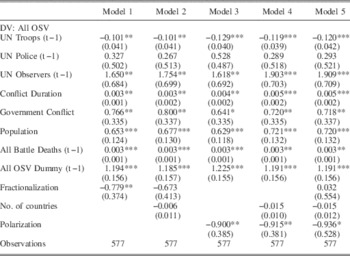
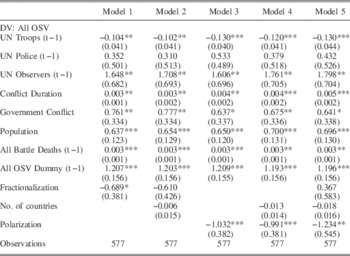
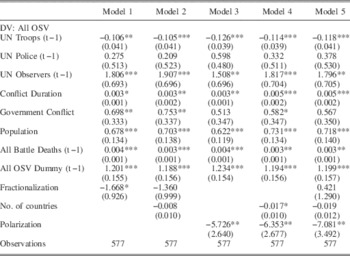
Our empirical results are reported in Tables 1–3. These tables include our measures of UN mission diversity and replicate the main model in Hultman, Kathman, and Shannon,Footnote 64 in which the dependent variable is the monthly count of civilians killed. We also use alternative measures of diversity, the results of which are shown in the Appendix. Table 1 contains the baseline fixed-effects negative binomial models in which diversity is calculated as in Equations 1 and 2. Table 2 aggregates the troop contribution of NATO members and considers NATO a single entity, given the degree of homogeneity in military procedures (for example, rules of engagement, communication) of its members. Table 3 incorporates the linguistic distance between different countries when measuring diversity.
Panel with Fixed Effects (Unweighted Distances between Countries)

Note: robust standard errors are given in parentheses clustered by conflict.
Panel with Fixed Effects (NATO vs. Non-NATO)

Note: robust standard errors are given in parentheses clustered by conflict.
Panel with Fixed Effects (Weighted Linguistic Distances between Countries – lp1BR)

Note: robust standard errors are given in parentheses clustered by conflict.
Before discussing our main explanatory variables, we briefly summarize the results with regard to the control variables. Even though we only include observations for which a PKO is deployed, which means that we are using a much smaller sample, our results do not differ from the main and most important findings reported in Hultman, Kathman, and Shannon.Footnote 65 In particular, military troops and police reduce civilian killings, though only the number of troops is within conventional levels of statistical significance, while the presence of UN observers has the opposite effect, increasing the level of victimization. The number of months since the beginning of the conflict (conflict duration) is also positive and reaches conventional levels of statistical significance. Wars fought over government control (government conflict) seem to generate more civilian killing than those fought over territorial secession. A high population is associated with a higher level of violence. As one would expect, the number of casualties on the battlefield is positive and significant, and so is the lagged dependent variable, given the inertia in the use of one-sided violence.Footnote 66
Our contribution lies in identifying the impact of a mission’s diversity on its effectiveness in protecting civilians. Since the indexes are correlated for extreme levels of fractionalization and polarization, we follow a number of previous economic studiesFootnote 67 and include them first separately and then jointly. In fact, as Ager and BrucknerFootnote 68 point out, including fractionalization or polarization individually implies that the estimates do not capture independent effects and suffer from an omitted variables bias. Table 1 shows that the index of fractionalization is negative and significant at conventional levels only in Model 1. This result is not robust to the inclusion of the total number of donor countries (Model 2)Footnote 69 or the index of polarization (Model 3). On the contrary, the level of polarization is consistently negative and statistically significant, even when we control for the number of countries participating in the operation (Model 4) and the corresponding level of fractionalization (Model 5). This means that, even when conditional on a given degree of fractionalization and a given number of donor countries, more polarization decreases the level of one-sided violence.
This first round of results suggests that diversity has a positive impact on the performance of an operation by reducing the number of civilians killed. Table 2 replicates Table 1 but considers NATO members as a single entity. If our previous findings are correct, then we should find the same pattern when we aggregate the troops of homogeneous countries according to the military organization they belong to. As we can see, the results for our main explanatory variables do not change substantively, and both the size and significance are virtually identical. Similarly, in the online appendix, Table A3 considers NATO and the Economic Community of West African States (ECOWAS) as separate individual donors, as ECOWAS is the second-largest regional contributor to peacekeeping operations. Thus we have NATO, ECOWAS and the remaining N – 2 donor countries. We find virtually the same results.Footnote 70
Whether including the distances between countries is relevant for our understanding of the mission’s impact is an empirical question. Table 2 includes the same regressions as Table 1, but uses the indices in Equations 3 and 4, which take into account distances between languages. We use two different measures of linguistic distance (see the Data and Empirical Strategy section) and find that linguistic distance provides a more robust and consistent picture when we look at the degree of fractionalization. In fact, fractionalization appears to decrease the level of civilian victimization, although (consistently with the previous tables) it is insignificant when we control for the number of donor countries. The effect of polarization is always negative and significant across different model specifications. Overall, this last table increases the confidence in our findings on the positive impact of both indices on the operation’s capacity to reduce one-sided violence.
Given the ongoing debate about the optimal measure of linguistic distance, we also use our second measure of linguistic distance in Table A4 in the online appendix, and the results are very similar to those in Table 2. Another important question is whether linguistic distance is correctly picking up cultural distances, broadly defined. In Table A5 in the online appendix, we provide another weighted index of diversity using the geographical distance between capitals. The results are weaker and less stable, as fractionalization reaches conventional levels of statistical significance only when we do not control for the number of contributing countries or the corresponding level of polarization. Moreover, our measures of diversity fail to achieve significance when we include both of them in the same model. This suggests the importance of including polarization and fractionalization jointly in the regression model as a robustness check. While cultural distance increases the communication costs, the positive effect of linguistic and geographic distance outweighs these costs, and may reflect differences in the way countries delegate to commanders on the ground. More heterogeneous missions may therefore have a higher number of far-flung commanders who are able to ‘implement policy in ways that they, rather than their superiors back home, believe is best, given the absence of oversight’.Footnote 71
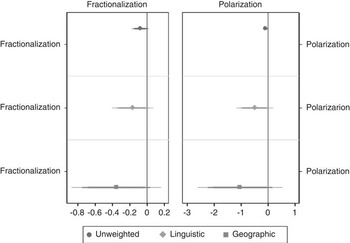
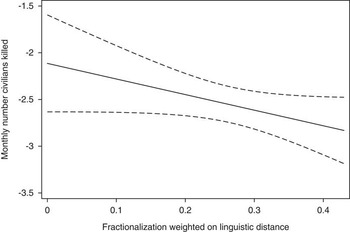
Beyond statistical significance, Figure 3 illustrates the implied substantive effects of fractionalization and polarization, Models 1 and 3 in Tables 1, 3 and A5. We compare the average marginal effect of fractionalization and polarization over their different operationalizations. This represents the marginal effect on the monthly number of civilian deaths of a change in fractionalization or polarization of 0.10 in a normalized scale from 0 to 1. We report confidence intervals at three standard levels (99 per cent, 95 per cent, 90 per cent). The thicker the line, the lower the statistically significant threshold. Unweighted fractionalization has a weaker marginal effect, and the indices weighted on geographic and linguistic distances are statistically significant at the 90 per cent level. In Figure 4, we show how different levels of fractionalization weighted on linguistic distance affect the number of civilian killings, holding the other variables at their means. We have simulated the effects using only real values of our sample (from 0 to 0.43), which shows that the higher the fractionalization, the lower the number of civilians killed in a month. At the average level of fractionalization (0.22), a UN mission could save 10 per cent more civilians per month.
Marginal impact

Effects of linguistic fractionalization on civilian killings

Finally, we submit our results to a further series of robustness checks: (1) we ask whether there exists a different functional relationship between diversity and civilian casualties (that is, whether diversity has a non-linear effect on violence); (2) we control for the nature of the mandate; (3) we run a jackknife estimation; (4) having identified two crucial outliers in the distribution of civilians killed by the government, (Rwanda and DRC), we run models without these two countries. Overall, our findings are robust, and neither the size nor the significance of our variables of interest is substantially changed. Due to space limitations these results are not presented here, but are available upon request from the authors.
Conclusions
Anecdotal evidence suggests that the internal composition of a peacekeeping mission can affect its capacity to protect civilians. Yet there are no quantitative studies that evaluate whether peacekeeping missions’ diversity can influence their capabilities and performance; our article aims to fill this important gap in the scientific study of peacekeeping. We investigate and disentangle several mechanisms through which diversity can positively or negatively influence UN peacekeeping outcomes. We argue that fractionalization could improve the information flow, and therefore mission performance, through a bottom-up monitoring that gives peacekeepers incentives to behave appropriately. In fact, peacekeepers’ misconduct can jeopardize the communication between civilians and blue helmets, and in turn degrade their capacity to protect civilians. Furthermore, the complementarity between donor countries, which is a function of a mission’s internal diversity, can bring a broad portfolio of skills that are crucial to the mission. In fact, a richer pool of skills, experiences and equipment enables the mission to assure the commitment of and deter local actors. Yet, high fractionalization can have negative effects as it increases co-ordination costs among the different national contingents. With regard to polarization, we argue that there could be positive effects of strategic consistency within the UN mission, but also negative effects due to the presence of veto players.
Three novel results emerge. First, the level of diversity in the composition of a peacekeeping operation has a substantial effect on the protection of civilian lives, and reduces the number of civilian casualties. Secondly, both indices of diversity, fractionalization and polarization, have similar negative effects, although the size of the effect of polarization is substantially larger than the marginal impact of fractionalization. Thirdly, accounting for distances seems to be a sensible choice. We find that weighted indices perform well and give similar results in terms of the statistical significance of the diversity measure. The explicit introduction of linguistic distances into the measure of diversity shows that the effect of diversity on civilian protection becomes highly significant, both statistically and substantially. Moreover, we find that empirically, polarization plays an important role in civilian protection, although its causal mechanisms need further exploration. Overall, diversity matters: the higher the UN mission’s internal diversity, the lower the number of civilian victims.
Previous work has provided evidence on the crucial role of peacekeepers in the protection of civilians and in enhancing co-operative dynamics during a mission. Yet there are no quantitative studies on how the characteristics of a UN mission, in particular its composition, can affect the conflict-resolution process. This is the first large-N study that goes beyond examining the mere presence and size of a mission to analyze how the degree of diversity within a mission, and therefore its organization, can affect its effectiveness in protecting civilians. Moreover, we expand the range of perspectives on diversity beyond questions of political legitimacy at the international level to operational outcomes in the field.
We acknowledge that our proposed mechanisms need further study. The monitoring mechanism assumes relevant interactions between different national contingents, and we cannot, with the available data, disentangle this effect from the role of military leadership within each contingent. Another key issue is the presence of principal-agent dynamics. Auerswald and SaidemanFootnote 72 suggest that national military commanders have to deal with two principals, the international chain of command and their own governments. As their career depends on the latter, they usually give priority to orders received by their own government. Future large-N studies should analyze new data and evidence to tease out the mechanisms at play, in particular by including other possible distances and differences between national contingents in UN missions (for example, in terms of military training, regime type and economic wealth). Moreover, the use of qualitative evidence will help unpack the casual paths underpinning the findings of our large-N analysis. This is undoubtedly a promising avenue for future research.