Introduction
Blueberries contain abundant amounts of anthocyanins, and their extracts are efficient inhibitors of α-glucosidase activity (McDougall and Stewart, Reference McDougall and Stewart2005; McDougall et al., Reference McDougall, Shpiro, Dobson, Smith, Blake and Stewart2005). Inhibition of carbohydrate-hydrolysing enzymes, such as α-glucosidase, is one of the therapeutic approaches to decrease postprandial hyperglycaemia (Rabasa-Lhoret and Chiasson, Reference Rabasa-Lhoret, Chiasson, DeFronzo, Ferrannini, Keen and Zimmet2004; Bhandari et al., Reference Bhandari, Nilubon, Gao and Kawabata2008), and is considered an effective measure for regulating diabetes by controlling glucose uptake (Puls et al., Reference Puls, Keup, Krause, Thomas and Hoffmeister1977).
We previously reported on the levels of α-glucosidase inhibitory activity and antioxidant activity in rabbiteye and highbush blueberry cultivars (Wang et al., Reference Wang, Camp and Ehlenfeldt2012) and extend herein that work by evaluating the peel and pulp of 16 mixed-species hexaploid rabbiteye hybrids (Vaccinium ashei Reade × Vaccinium spp.) in comparison with rabbiteye (V. ashei) and highbush (Vaccinium corymbosum L.) genotypes, and also evaluating phenolic and anthocyanin levels, and their antioxidant activity.
Experimental methods
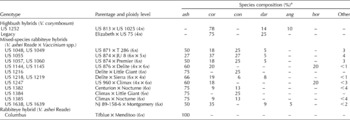
Fruit were grown at the Marucci Center for Blueberry and Cranberry Research and Extension (Rutgers University), Chatsworth, NJ, USA. Fully ripe (100% blue) berries were harvested at an overall bush ripeness of 45–100%, with the most typical value being about 60%. Fruit (500–900 g) were sampled from 19 genotypes with various species composition (Table 1). They were selected for uniform size and colour, and frozen to − 80°C until processed.
Evaluation of blueberry genotypes for α-glucosidase inhibitory activity and antioxidant capacity [two highbush hybrids (Vaccinium corymbosum L.), 16 mixed-species rabbiteye hybrids (Vaccinium ashei Reade×Vaccinium spp.) and one rabbiteye hybrid (V. ashei)]

ang= V. angustifolium; ash = V. ashei; bor= V. boreale; con= V. constablaei; cor= V. corymbosum; dar= V. darrowii.
a Species composition was calculated from pedigree diagrams; fractions were rounded to the nearest whole percent.
Each berry was separated into peel and pulp prior to the analysis. For dry weight (dw) measurements, tissues were dessicated at 70°C for 72 h. Antioxidant activity from fresh weight was converted to dw based on weight loss upon drying. Triplicate samples were made from 4 g of the peel or 10 g of the pulp (25–35 fruit per genotype). These samples were homogenized and extracted four times with acetone–formic acid (1:1). The extracts were centrifuged at 14,000 g for 20 min at 4°C. The supernatants were combined to a final volume of 50 ml and stored at − 80°C until assayed.
Experimental procedures have been reported previously (Wang et al., Reference Wang, Camp and Ehlenfeldt2012) and included assays for α-glucosidase inhibition (α-Gluc-i; Babu et al., Reference Babu, Tiwari, Srinivas, Ali, Raju and Rao2004; Zhang et al., Reference Zhang, Li, Hogan, Chung, Welbaum and Zhou2010), total phenolic (TP; Slinkard and Singleton, Reference Slinkard and Singleton1997) and total anthocyanin (TA) levels (Cheng and Breen, Reference Cheng and Breen1991), and scavenging capacity for peroxyl radicals (ROO∙; Huang et al., Reference Huang, Ou, Hampsch-Woodill, Flanagan and Prior2002), hydroxyl radicals (∙OH; Moore et al., Reference Moore, Yin and Yu2006; Wang et al., Reference Wang, Camp and Ehlenfeldt2012), singlet oxygen radicals (1O2; Chakraborty and Tripathy, Reference Chakraborty and Tripathy1992) and hydrogen peroxide radicals (H2O2; Patterson et al., Reference Patterson, MacRae and Ferguson1984).
Variables were statistically analysed by tissue type using a one-factor linear model in PROC MIXED (SAS/STAT, 2011) with genotype as the factor. The variables TApeel, α-glucosidasepeel and α-glucosidasepulp met all model variance assumptions. For other variables, a variance grouping technique was used to correct for heterogeneous variances. Mean values of individual genotypes were analysed as simple comparisons against the standard cultivar Legacy, using Šidák-adjusted P values. Correlation coefficients were calculated using SPSS (SPSS Statistics, 2008).
Results and discussion
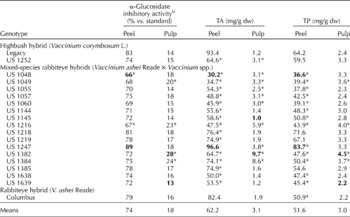
There were significant differences in the levels of α-Gluc-i activity exhibited between the peel and the pulp (P≤ 0.0001). The peel showed higher levels of inhibitory activity, with a mean value 4.3 times that of the pulp (range 2.6–5.8 × Table 2). In peel tissue, the mean level of α-Gluc-i activity was found to be 74.4% of the control (20 μl α-glucosidase, 1 U/ml, range 65.7–89.3%). Higher levels of inhibitory activity observed in peel tissue did not consistently correlate with those in pulp tissue. The three clones with highest inhibitory activities (US 1247, ‘Legacy’ and US 1218; >80% of inhibitory activity) in peel tissue did not rank highest in pulp tissue (Table 2).
α-Glucosidase inhibitory activity, total anthocyanin (TA) and total phenolic (TP) levels from the peel and pulp extracts of blueberries compared with ‘Legacy'a

dw, dry weight.
a Values given in boldface represent the minimum and maximum values in each category. Values with asterisks are significantly different (P≤ 0.05) from those of the standard highbush cultivar Legacy.
b α-Glucosidase inhibitory activity level was determined by measuring the area under the curve for each sample compared with that of the control. The results are expressed as a percentage of α-glucosidase inhibitory activity.
The range of the genotypes evaluated was limited; however, overall, the levels of α-Gluc-i activity in the hybrids with mixed-species components did not appear to be demonstrably different from that in either the pure rabbiteye or highbush genotypes. Nonetheless, some selections containing specific combinations of germplasm expressed higher levels of α-Gluc-i in peel tissue. The clone that expressed the highest level of inhibition (US 1247) was comprised of about 20% Vaccinium boreale Hall & Aalders ancestry (a low-growing, cold-hardy, diploid species). However, two selections with equivalent percentages of V. boreale ancestry (US 1144 and US 1145) were not unusual in their inhibition levels. Similarly, in pulp tissue, three selections with Vaccinium constablaei Gray ancestry (a cold-hardy, high-altitude, hexaploid species) had elevated levels of α-Gluc-i (US 1216, US 1382, US 1384); however, again, the levels of α-Gluc-i activity in similarly comprised selections were not different from those in the overall group. Nonetheless, these data mildly suggest that if one were looking for enhanced levels of α-Gluc-i in the peel, a broader range of clones particularly with V. boreale ancestry could be a useful place to begin.
For the levels TA, TP and antioxidant activity, significant differences were observed between the peel and pulp (P≤ 0.0001). On a dry-weight basis, an average of 30.2 times higher levels for TA (range 6.7–76.6 × ) and 17.7 times those for TP (range 10.5–26.5 × ) were observed between the peel and pulp. Significant differences were also observed among the genotypes (Table 2).
The blueberry genotypes exhibited high levels of antioxidant activity against the ROO∙, ∙OH and 1O2 radicals and against the oxidant H2O2, and significant differences were found between the peel and pulp tissue for each of these parameters (P≤ 0.0001). Significant differences were also observed between several genotypes compared with ‘Legacy’ (Table S1, available online). All the extracts from peel tissue exhibited stronger antioxidant activities (Table S1, available online). The mean ratios and ranges between the peel and pulp for radical-scavenging capacity were as follows: ROO∙ (4.6 × , range 1.4–6.6 × ); ∙OH (9.2 × , range 3.9–12.6 × ); 1O2 (4.0 × , range 1.6–9.4 × ); H2O2 (4.8 × , range 2.2–7.0 × ). For the parameters evaluated, overall, the hybrids with mixed-species components did not appear demonstrably different from either the pure rabbiteye or highbush genotypes.
The correlations (r) among the levels of α-Gluc-i activity, TA, TP and scavenging activity against ROO∙, ∙OH, 1O2 and H2O2 radicals in the extracts from the peel and pulp were found to be positive and significant (P≤ 0.05; Table S2, available online). For peel extracts, the correlation coefficients ranged from 0.84 to 0.97. For pulp extracts, similar correlations existed, with most (but not all) of the correlation values being slightly less than those observed in peel extracts (Table S2, available online). The highest correlations were observed between the levels of α-Gluc-i activity and radical-scavenging activity against ROO∙ in both peel and pulp (0.95 and 0.93, respectively). However, particularly important were the correlations between the levels of α-Gluc-i activity and TA (r= 0.93 and 0.92 for the peel and pulp, respectively). The ease of assaying for TA levels suggests that it would be the best proxy for α-Gluc-i activity if a broader genotypic evaluation of blueberry genotypes is desired.
Supplementary material
To view supplementary material for this article, please visit http://dx.doi.org/10.1017/S1479262114000690
Acknowledgements
The authors thank Dr K. Zhou for suggestions on the α-glucosidase assay. They also thank D. Rossoni, S. Chen and R. Martin for technical assistance.