


INTRODUCTION
At least since Stouffer et al.’s (Reference Stouffer, Lumsdaine, Lumsdaine, Williams, Smith, Janis, Star and Cottrell1949) relative deprivation theory and Festinger’s (Reference Festinger1954) social comparison theory, it has been known that people form opinions about themselves and their communities at least partly by making comparisons with others. The so-called Easterlin paradox indicates that raising the income of all members of a society will not lead to a long term increase of happiness for all, since individuals’ feelings of happiness are not just based on their objective well-being, but are also influenced by social comparisons (Easterlin Reference Easterlin1995). The yardstick competition literature shows that politicians compete by looking at each other’s actions because voters judge the performance of their local officials by comparing outcomes with other jurisdictions (Besley and Case Reference Besley and Case1995). More recently, it has been shown that in national elections voters also base their judgments of the incumbents on the performance of their national economy relative to the global situation rather than in isolation (Duch and Stevenson Reference Duch and Stevenson2008; Kayser and Peress Reference Kayser and Peress2012).
Although these studies have demonstrated that relative performance figures prominently in citizens’ evaluation of themselves and their governments, one underlying assumption of the literature is that people have correct information to make comparisons. To make international comparisons, for example, one needs to know what other countries are like. But people often have vastly incorrect beliefs about basic policy and socioeconomic facts of their own countries (Gilens Reference Gilens2001; Kuklinski et al. Reference Kuklinski, Quirk, Jerit, Schwieder and Rich2000); misinformation about foreign countries is likely more prevalent and serious. Gallup’s annual World Affairs polls since 2011 have consistently shown a majority of the American respondents naming China rather than the U.S. as the world’s leading economic power, with the percentages being 52% for China versus 31% for the U.S. in 2014 (Dugan Reference Dugan2014).Footnote 1 Similar results appear in Pew Research Center’s Global Attitudes surveys, which show pluralities or even majorities in the U.S., Canada, and most European countries having the same misperception in 2013 (Pew Research Center 2013). Clearly a large proportion of the American public, as well as many people in other countries, overestimate China’s economic prowess.
If citizens in advanced democracies such as the U.S., where the information environment is open and the average level of education is relatively high, can be so misinformed about a foreign country, citizens in a developing and authoritarian country such as China, where the average education level is lower, people’s personal exposure to foreign countries (e.g., overseas travel) is more limited, and the media and information flow are less reliable, can also be seriously misinformed about the outside world. Such misinformation can take various forms. People in a developing and authoritarian country may not see clearly the gap in socioeconomic development and political freedom between their own country and foreign countries, especially advanced democracies; in other words, they may underestimate foreign countries. At the beginning of China’s reform in the late 1970s, for example, Deng Xiaoping encouraged other officials to travel abroad to see how much China had lagged behind foreign countries, so as to solicit support for his reform program (Vogel Reference Vogel2011). At the same time, without sufficient and accurate information, citizens in such countries can also have overly romanticized views about the outside world, not realizing that foreign countries have their own problems too, or that living standards in other countries may not be as high as they have imagined; in other words, they may overestimate foreign countries. China’s social media such as the popular microblogging platform Weibo, for example, is full of unduly rosy but factually faulty or misleading tales about foreign countries (Want China Times 2013; Yung Reference Yung2011).
What are the effects of citizens’ knowledge and information of foreign countries on their evaluation of domestic situations? Can correcting socioeconomic misperceptions about foreign countries lead to changes in people’s view of their own country? To answer these questions I conducted two studies about the relationship between one’s international political knowledge and socioeconomic informationFootnote 2 on the one hand, and their domestic evaluations on the other: first a survey of students in a mid-upper tier Chinese university, and then an online survey experiment with Chinese Internet users from diverse sociodemographic backgrounds.
Study 1 shows that Chinese citizens with more positive perceptions and especially overestimation of foreign socioeconomic conditions have more negative evaluations of China and the country’s government and political system. On the other hand, international political knowledge, as measured by familiarity with political affairs and figures in foreign countries, does not have a significant relationship with one’s domestic opinion. Besides confirming the results of study 1, study 2 shows that the causal direction between more positive perceptions of foreign socioeconomic conditions and lower domestic evaluations is at least partly from the former to the latter, since correcting the respondents’ misinformation about foreign socioeconomic conditions improved their evaluations of China. In addition, study 2 shows that people who are more familiar with political instability and social unrest abroad have more positive domestic evaluations.
Besides contributing substantively and conceptually to the study of politically relevant knowledge, the results of the article shed new light on the nuances of public opinion and anti-status-quo sentiments in an authoritarian and developing country. First, conventional wisdom about and journalistic accounts of authoritarian societies including China tend to focus on citizens’ political plights, whereas this research shows that, at least in terms of the effects of knowledge and information about foreign countries, people’s socioeconomic aspirations generally prevail over political grievances. The implicit result from the survey that Chinese citizens attach considerable importance to political stability corroborates this finding since preference for stability is more closely related to the desire for socioeconomic advancement than political empowerment.
Second, this research reveals a new source of mass opinion that affects political support and regime legitimacy in the authoritarian setting. Scholarship on political trust and public support in authoritarian states have focused on such factors as the government’s economic and social performance (Duch Reference Duch1993; Rose, Mishler, and Munro Reference Rose, Mishler and Munro2011; Zhao Reference Zhao2009), political propaganda and ideological indoctrination (Geddes and Zaller Reference Geddes and Zaller1989; Kenez Reference Kenez1985), distribution of rent and patronage (Blaydes Reference Blaydes2010; Magaloni Reference Magaloni2006), and cultural and political values such as nationalism, democratic orientation, and respect for authority (Chen Reference Chen2004; Shi Reference Shi2001; Tang Reference Tang2005). Except for direct provision of material benefits in exchange for citizen support, most of these factors are related to a country/government’s perceived accomplishments and hence citizen knowledge of relevant situations in other countries. Such knowledge and information, however, have rarely been analyzed in the literature. As already discussed, evaluations of government performance are subject to international comparison. Nationalism and other political sentiments will also be influenced by perceptions of what one’s own country has achieved relative to foreign countries. While the previous literature has discussed the role of relative performance in affecting public opinion on the incumbent regime, such relativity is between the previous and current regimes in the same country (Rose, Mishler, and Haerpfer Reference Rose, Mishler and Haerpfer1998; Rose, Mishler, and Munro Reference Rose, Mishler and Munro2011), not international comparisons.
Last, with regard to propaganda and information control, it is often assumed that citizens in an authoritarian and developing country lack knowledge of the outside world, in large part due to the government’s control of information flow from foreign sources and political propaganda glorifying domestic situations. Therefore, as the conventional wisdom goes, if citizens in such countries can acquire more information about foreign countries, particularly advanced democracies, they will be more dissatisfied with the status quo and perhaps take actions against the government. The conventional wisdom certainly has a great deal of merit, as citizens indoctrinated by government propaganda or simply unaware of world development can indeed underestimate foreign countries. But the current research has also shown that, in a country undergoing rapid social transformation such as China, the opposite can be true: a sizable population may have a view of foreign countries that is too romantic rather than too negative; more accurate information may actually lead citizens to be less dissatisfied with their current situations. Government censorship of information from foreign sources, on the other hand, can backfire (Huang and Yeh Reference Huang and Yeh2015). Alexis de Tocqueville’s dictum that “the most perilous moment for a bad government is one when it seeks to mend its ways” (Tocqueville Reference Tocqueville1955, 177) may have an informational aspect in contemporary times. When a formerly closed society opens itself, citizens start to acquire some limited information about the outside world. But a little knowledge is a dangerous thing (for the government), since it can lead to citizens’ overly romantic imaginations and unrealistic comparisons of their current lives with what they could have in a different setting or country. Such “false consciousness,” instead of stabilizing the status quo, may in fact lead to more discontent. Put differently, the flow of more ample and accurate information may prolong rather than undermine authoritarianism under such circumstances.
INTERNATIONAL POLITICAL KNOWLEDGE, SOCIOECONOMIC INFORMATION, AND DOMESTIC EVALUATIONS
Information is essential for political participation and decision marking, hence the large literature in political science on citizens’ knowledge and information (e.g., Delli Carpini and Keeter Reference Delli Carpini and Keeter1996; Lupia and McCubbins Reference Lupia and McCubbins1998; Nicholson Reference Nicholson2003; Prior Reference Prior2007; Zaller Reference Zaller1992). With a small number of notable exceptions (e.g., Gilens Reference Gilens2001; Kuklinski et al. Reference Kuklinski, Quirk, Jerit, Schwieder and Rich2000; see also Hetherington Reference Hetherington1996), however, this literature is mostly concerned with knowledge of political matters (and typically domestic political matters), such as political institutions, processes, players, and issues, rather than socioeconomic knowledge. In addition, it focuses on citizen knowledge in democratic countries, especially the U.S., leading to such comments as “[t]he political ignorance of the American voter is one of the best-documented features of contemporary politics” (Bartels Reference Bartels1996).
Knowledge about political matters in foreign countries is an important component of citizens’ international knowledge. Being informed about foreign politics can make people more aware of the political institutions and processes in other countries and then compare them with those in their home country. But information and perceptions about socioeconomic conditions in foreign countries is also a critical component of international knowledge and may factor into citizens’ evaluation of their own country’s situations. In fact, anecdotal evidence suggests that citizens in communist and postcommunist countries ranging from Vietnam (Lam Reference Lam2006) to Russia (Barry Reference Barry2012) are intensely interested in the socioeconomic life of the West, often more so than in political matters. For citizens in a country that is both authoritarian and developing, both types of knowledge are potentially useful for judging domestic situations.
Socioeconomic information must be distinguished from political knowledge and studied separately not just because they cover different subject areas, but also because informational errors in the two have important differences. The literature on political knowledge has focused on the distinction between possession and lack of information, i.e., a person is either informed or uninformed about an issue. Being misinformed is usually lumped together with being uninformed. This makes sense for knowledge of political matters. For example, although there may be some theoretical difference between having no idea who the current British Prime Minister is and mistakenly believing a wrong person to be holding the position, practically speaking it is difficult to tell how to precisely differentiate the ramifications of the two errors as well as how to score them differently in political knowledge.
With regard to socioeconomic issues, however, holding incorrect information and having no precise information have entirely different implications (Kuklinski et al. Reference Kuklinski, Quirk, Jerit, Schwieder and Rich2000), and the different kinds of errors can be both conceptually and practically distinguished. For example, people may mistakenly believe the per-capita personal income in the U.S. to be substantially higher or lower than the actual level, and the direction of the misinformation may matter considerably for their opinion. In addition, when people do not have a clear idea about the personal income level in the U.S., they will nevertheless have implicit (even if vague) and meaningful estimates about it, unlike the situation about the name of the British Prime Minister. Therefore, in terms of socioeconomic knowledge the most pertinent categorization is not being informed versus being uninformed, but rather how positive or negative one’s perception of a situation is.
Research on citizen knowledge and opinion formation in authoritarian countries is scant,Footnote 3 let alone studies of knowledge and information about foreign countries. This is surprising, given that the value of living under an alternative regime or setting is a crucial factor in citizens’ decisions about participating in collective action (Meirowitz and Tucker Reference Meirowitz and Tucker2013; Shadmehr and Bernhardt Reference Shadmehr and Bernhardt2011). In particular, Meirowitz and Tucker (Reference Meirowitz and Tucker2013) argue that increased information and attenuating expectation about the universe of potential governments may lead citizens to accept an unsatisfactory government. Conditions in foreign countries, particularly advanced democracies, can serve as an important benchmark for what their own country can live up to for aspiring citizens in a changing society, particularly when the world is becoming increasingly interconnected.
Being the first political science study on the relationship between international knowledge and perceptions on the one hand and evaluations of one’s own country on the other, this research focuses on the empirical effects of knowledge and perceptions, rather than the exact social or psychological mechanism that leads different individuals to be exposed to different information and to form different views, an approach that is similar to the study of Kayser and Peress (Reference Kayser and Peress2012) on electoral benchmarking. It should be noted, however, that China’s rapid social transformation in recent decades has led to “public sphere praetorianism” (Lynch Reference Lynch1999), with an abundance of diverse information and misinformation flowing from a multitude of official, unofficial, and global sources including the country’s vibrant and clamorous Internet (Huang Reference Huangforthcoming). Even in state-controlled media, where one would expect to see all pro-regime information, the messages actually delivered can sometimes be rather surprising. For example, a widely watched report from the China Central Television network once touted the affordability of housing properties in Detroit (where a house is “as cheap as a pair of shoes”), while glossing over the city’s economic difficulties and the complexities of its real estate market. The report generated broad fascination with Detroit on China’s Internet and yearnings for emigration (Bildner Reference Bildner2013; Want China Times 2013).Footnote 4 As a result, in the college and online surveys reported below respectively 57.2% and 61.1% of the respondents said that the various information they obtained in their daily lives about foreign countries was at least somewhat mutually contradictory. Therefore, what kind of (mis)information Chinese citizens are exposed to contains a considerable degree of randomness, and the bits and pieces of information they happen to pick up will form their perceptions about foreign countries and then help form their domestic evaluations.
This research measured socioeconomic information and perceptions by asking respondents to estimate the performance of Organization for Economic Co-operation and Development (OECD) countries (hereafter referred to as the West), particularly the U.S., on various important indicators of socioeconomic development and quality of life, such as personal income, life expectancy, education, and public safety (see the next section for details). This measure captures in an important way the perceptions of ordinary citizens in a developing country about what life in the West is like. To measure political knowledge about foreign countries, one potential method is to mimic the measurement for socioeconomic perceptions and ask the respondents to estimate the level of democracy, media freedom, and protection of human rights, etc., in OECD countries. But unlike socioeconomic indicators such as per capita personal income, these political concepts inevitably involve subjective judgment and hence have no universally accepted measures or even definitions (see, e.g., Coppedge and Gerring Reference Coppedge and Gerring2011). It will be hard, then, to evaluate the respondents’ answers to such political questions in a clear and objective manner. Therefore for political knowledge this research followed the standard practice and asked respondents a series of factual questions about political figures and recent events around the world. This method is easily operationalizable, and to the extent that people are information generalists (Delli Carpini and Keeter Reference Delli Carpini and Keeter1996), those with more general knowledge of foreign political matters should also be more aware of the situations of political rights and civil liberties in foreign countries, or China’s gap with advanced democracies on these dimensions.
Since the theoretical premise of this research is that individuals’ evaluation of their own country and government is at least partly influenced by their knowledge and perceptions of the discrepancy between their own country and foreign countries, some simple but hitherto rarely examined hypotheses can be derived from relative deprivation theory (Stouffer et al. Reference Stouffer, Lumsdaine, Lumsdaine, Williams, Smith, Janis, Star and Cottrell1949) and social comparison theory (Festinger Reference Festinger1954), which hold that people’s reactions to objective conditions depend on their subjective comparisons with others. In particular, upward contrasts with those who are in a better position than oneself often result in negative self-evaluations and emotions (Smith Reference Smith, Suls and Wheeler2000; Wheeler and Miyake Reference Wheeler and Miyake1992). Citizens in a developing country typically know that, in general, their country is behind advanced democracies, including those who underestimate foreign countries. Even in North Korea, perhaps the most closed society in the world, people often understand that Americans and South Koreans are better off than themselves at least in material life (Myers Reference Myers2010). Therefore the article’s empirical operationalization with regard to socioeconomic perceptions is not to compare the domestic attitudes of individuals who think that Western advanced democracies are better than China with those who think the West is not as good as China, since the size of the latter group is rather small. Instead, the comparison is between people with different estimations of socioeconomic conditions in the West; in other words, they may all agree that in general China lags behind the West in socioeconomic development, yet disagree about the extent of the gap, and this different perception may affect their domestic evaluations.
The article’s first hypothesis (H 1), then, is that individuals with more positive socioeconomic perceptions of foreign countries, in particular those who overestimate foreign socioeconomic conditions, will have lower evaluations of China and the Chinese government. At the same time, it is hypothesized that the relationship between one’s knowledge of normal political matters (as opposed to political instability and social unrest) in foreign countries and domestic evaluations will not be very significant (H 2). This is because, as various studies have shown, Chinese citizens’ fascination with Western countries has been more driven by perceptions about their economic prosperity, science and technology, and popular culture, than politics (Dong, Wang, and Dekker Reference Dong, Wang and Dekker2013; Johnston and Stockmann Reference Johnston, Stockmann, Katzenstein and Keohane2007; Shi, Lu, and Aldrich Reference Shi, Lu and Aldrich2011), which suggest that they prioritize socioeconomic aspirations over political considerations. These two hypotheses will be the focus of Study 1 below.
The third hypothesis, to be tested in Study 2, is that the causal arrow between more positive socioeconomic perceptions of foreign countries and lower domestic evaluations is at least partly from the former to the latter, which means that correcting misinformation about foreign socioeconomic conditions will improve people’s evaluations of their own country and government, especially for those who overestimate foreign socioeconomic conditions (H 3). Finally, because Chinese citizens have a well-known preference for political stability and avoidance of chaos (Chen Reference Chen2004; Dickson, Shen, and Yan Reference Dickson, Shen and Yan2013), it is hypothesized that those more familiar with political instability and social turmoil abroad will have higher evaluations of China and the Chinese government (H 4). This preference for social stability is partly due to China’s turbulent modern history marked by devastating wars, revolutions, and various political and social movements. It is also partly related to the priority that people in a developing country give to socioeconomic well-being, since stability facilitates and is perhaps a precondition of a country’s socioeconomic advancement. Thus the above hypotheses are mutually related.Footnote 5
It is useful to contrast the present article with studies that investigate the power-structural, sociopsychological, and informational determinants of people’s “images” of foreign countries and how such images affect international relations (e.g., Herrmann and Fischerkeller Reference Herrmann and Fischerkeller1995; Herrmann et al. Reference Herrmann, Voss, Schooler and Ciarrochi1997; Manheim and Albritton Reference Manheim and Albritton1984). With regard to China, a recent six-city survey examined the influence of such factors in shaping Chinese urban residents’ attitudes toward the European Union (EU), noting that their attitudes and underlying perceptions are mostly based on second-hand information from the media, Internet, and other sources (Dong, Wang and Dekker Reference Dong, Wang and Dekker2013, particularly the chapter by Dekker and van der Noll). Other scholars in China studies have sought to examine Chinese citizens and intellectuals’ perceptions and opinions of the U.S. (Johnston and Stockmann Reference Johnston, Stockmann, Katzenstein and Keohane2007; Shambaugh Reference Shambaugh1993; Shi, Lu, and Aldrich Reference Shi, Lu and Aldrich2011) as well as their perspectives on international relations and world affairs (Han and Zweig Reference Han and Zweig2010; Johnston Reference Johnston2004; Li Reference Li2010). Conversely, there is also a small literature that analyzes (the determinants of) American citizens’ attitudes towards China and the China policies of the U.S. (Aldrich, Lu, and Liu Reference Aldrich, Lu and Liu2015; Gries, Crowson, and Cai Reference Gries, Crowson and Cai2011; Page and Xie Reference Page and Xie2010).
Though related, the current article is distinct from these studies. Most importantly, the above studies’ dependent variable is attitudes toward foreign countries, whereas in this article the dependent variables are citizens’ evaluations of their own country and government. Second, it is not that the dependent variable from the previous studies is the independent variable in this article. What this article is interested in about people’s perceptions of foreign countries is their factual information, not attitudinal images or evaluations on a feeling thermometer. Therefore the previous studies’ theoretical discussions on determinants of citizen’s attitudes toward and images of other countries cannot be applied here. Moreover, to the extent that those studies have also considered the effect of information and knowledge, they mostly use indirect measures such as education and exposure to media, rather than direct measures of objective knowledge about foreign countries, particularly socioeconomic knowledge. Dong, Wang, and Dekker’s (Reference Dong, Wang and Dekker2013)) study is a rare exception in this regard in that they measured the respondents’ objective knowledge of the EU, but that measurement focused on general and political knowledge such as membership in and the headquarters of EU, rather than perception of European socioeconomic conditions.Footnote 6 Some of the above studies have considered foreign travels, but since the percentage of Chinese citizens with overseas travel experience is still relatively small, it will not capture the variation of information about foreign countries among the majority of Chinese citizens.
STUDY 1: COLLEGE SURVEY
Data and Measurement
Study 1 uses data from a college survey conducted in eastern China in June 2011. The respondents were sophomores attending a universitywide required course, and the anonymous (and voluntary) survey was a class activity conducted in one out of two sections, thus covering all but some small majors in the university. The university is mid-sized and mid-upper ranked, which made the survey participants potentially more representative of average college students in China than students from elite universities. Altogether over 1200 students participated in the formal survey reported below. Many students remarked in pilot surveys with separate samples that the questionnaire was very “interesting” and “refreshing,” which explained the high completion rate in the formal survey. Not all students answered all questions, however, hence the variation in the number of observations reported in the tables below. Since the results from the college survey were replicated by follow-up online survey experiments (in which all questions were required) with very different samples, the relatively small number of missing answers in the college survey is not a concern.
The survey first asked the respondents about their evaluations of domestic situations (the dependent variables) and some other attitudinal questions. Then it asked two sets of questions respectively measuring their knowledge of foreign political matters and perceptions of foreign socioeconomic conditions (the independent variables) and in that order. Domestic situations that were evaluated included China’s overall current situation,Footnote 7 future prospects,Footnote 8 government responsiveness,Footnote 9 political system,Footnote 10 and severity of corruption.Footnote 11 Except for the question on corruption, the respondents’ answers were on a five-point Likert scale, with a higher score indicating a more positive evaluation. Corruption was evaluated on a six-category scale and a higher score indicated an assessment that the corruption problem was more serious.
To measure the respondents’ international political knowledge, the survey asked about major international events from 2010 to early 2011 such as the 2010 midterm election in the U.S., the health care reform of the Obama administration, the death of Bin Laden, the Arab Spring, the European sovereign debt issue, and the identities of several foreign leaders and international figures including the British Prime Minister, the Venezuelan President, and the founder of Wikileaks.Footnote 12 There is no standard way to select a set of most representative questions to measure international political knowledge, but the ten questions in the survey covered diverse issues and regions, and were therefore a reasonable set of questions for the article’s purpose. I followed the standard practice and calculated the respondents’ political knowledge scores as the number of questions they answered correctly. With the exception of the question on the Arab Spring, the questions on recent international events in the college survey were not directly about political instability or social turmoil.
The socioeconomic information and perception questions asked the respondents to estimate levels of per-capita personal income, unemployment, life expectancy, income inequality, years of schooling, home ownership, air and water pollution, and homicide rate in OECD countries, particularly the U.S., the default country against which many Chinese people compare China's performances. Obviously there is no standard formula to choose socioeconomic topics for the questions either. All eight socioeconomic questions in the survey, however, are important components of quality of life and thus issues of great concern to the Chinese public, and hence constitute a useful set of questions that can measure a respondent’s perceptions of foreign socioeconomic conditions. To give the respondents some bases for judgment, relevant statistics for China were provided in many of the socioeconomic questions.Footnote 13 The correct answers were taken from the most up-to-date (2010) United Nations Human Development Report and U.S. official statistics.
The nature of the socioeconomic questions was such that answers to them could be ranked according to how favorably they depicted foreign socioeconomic conditions. For instance, a quintessential foreign socioeconomic question in the survey asked which of the following numbers was closest to the annual per-capita personal income in the U.S. at the time of the survey: (a) $15,000, (b) $40,000, (c) $65,000, and (d) $90,000. The correct answer was (b).Footnote 14 The other answers were all wrong, but they were wrong in different ways. Answer (a) underestimated the income level in the U.S., answer (c) overestimated it, and answer (d) overestimated it even more. Another question asked which of the following numbers was closest to the average life expectancy in OECD countries: (a) 72.3, (b) 76.3, (c) 80.3, and (d) 84.3. The correct answer, according to the Human Development Report, was (c); answers (a) and (b) underestimated life expectancy in OECD countries, while (d) overestimated it.
For each of the socioeconomic questions, the survey provided four choices as possible answers,Footnote 15 with the discrepancies between the neighboring choices reasonably large to represent real differences, while making sure that all choices were at least somewhat plausible. In an attempt to prevent the structure of the answers from inadvertently leading the respondents to overestimate or underestimate the West, the survey put the correct answers for all the socioeconomic questions as either (b) or (c), the two middle choices, thus avoiding the possibility that the respondents could only err in one particular direction. Moreover, half of the questions had the second best number as the correct answer, while the other half had the third best number as the correct answer, therefore the respondents had equal chances for overestimation and underestimation. To construct the respondents’ socioeconomic perception scores, each correct answer was given a score of zero, while the choice next to the correct answer that overestimated (underestimated) the West was given a score of 1 (− 1), and the choice that overestimated (underestimated) the West even more was given a score of 2 (− 2).Footnote 16 A respondent’s total foreign socioeconomic perception score was summed over all eight questions. A score of zero means that the respondent’s perception of foreign socioeconomic conditions was balanced on average, while a positive (negative) score means that overall his or her estimate was better (worse) than the reality.Footnote 17
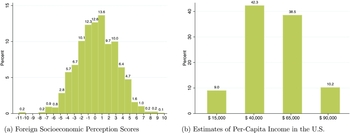
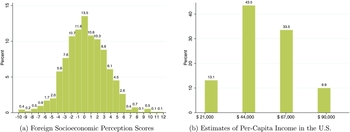
Figure 1a shows the distribution of the respondents’ foreign socioeconomic perception scores, with a higher score indicating a more favorable estimate of the West. The respondents’ socioeconomic perceptions of the West had a roughly normal distribution with the mode at 1. Figure 1b shows the distribution of the respondents’ answers to the quintessential question on foreign socioeconomic conditions: the per-capita personal income in the U.S. While more respondents chose the correct answer ($40,000) than any other answer, almost half of the respondents overestimated the level of U.S. personal income.
The College Respondents’ Foreign Socioeconomic Perceptions

Besides these aggregate socioeconomic perception scores, the respondents were also divided into three categories for the following analysis: (1) those who systematically underestimated the West, (2) those who had a roughly balanced estimate of the West, and (3) those who systematically overestimated the West. There is no standard formula to classify the respondents into these different groups, but a reasonable threshold would be one standard deviation in the distribution of aggregate scores. Therefore in the following I will categorize socioeconomic scores equal to or lower than − 3 as systematic underestimates, scores equal to or higher than 3 as systematic overestimates, and the rest as approximately balanced estimates.
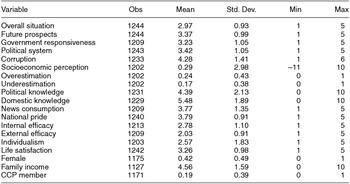
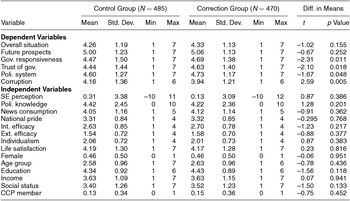
In addition to international knowledge and perceptions, the survey also asked ten questions about China’s recent domestic political and social events, including some major scandals, as a measure of the respondents’ domestic knowledge. The survey did not test their knowledge of China’s socioeconomic conditions, since many of the statistics about China were already provided in questions about foreign socioeconomic situations to give the respondents a reference for judgment. The control variables included news consumption,Footnote 18 national pride,Footnote 19 political efficacy,Footnote 20 individualism (since collectivist orientation has been traditionally regarded as a strong feature of Chinese society),Footnote 21 and general life satisfaction.Footnote 22 Sociodemographic controls included gender, family income, and membership in the Chinese Communist Party (CCP),Footnote 23 but not age or education because the respondents were all college sophomores. Table 1 reports the summary statistics of the variables in the college survey.
Summary Statistics of the College Survey

Results
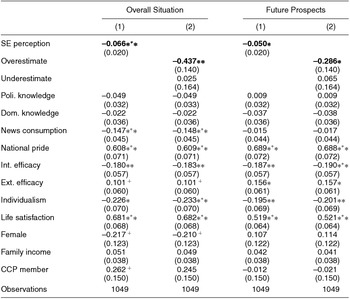
Now we can examine how the respondents’ knowledge and perceptions of foreign countries were associated with their evaluations of China. Given the ordinal nature of the dependent variables, I analyze the data with ordered logit regressions.Footnote 24 Table 2 shows the results when the dependent variables are evaluations of China as a whole: overall current situation and future prospects. The two regression specifications for each dependent variable respectively uses the respondents’ aggregate perception scores and whether they overestimated/underestimated the West to represent their foreign socioeconomic perceptions.
Evaluation of China’s Overall Situation and Future Prospects (Study 1)

Notes: Entries are coefficients from ordered logit regressions; standard errors are in parentheses. Cut points are almost always statistically significant, but omitted here due to space constraint. *** p < 0.001, ** p < 0.01, * p < 0.05, + p < 0.10.
As the first column of Table 2 shows, respondents with more positive socioeconomic perceptions of the West had significantly lower evaluation of China’s overall situation. The second column shows that this was mainly driven by overestimation; the coefficient for underestimation has the expected positive sign but is not significant. Both columns show that knowledge of international political matters and domestic affairs were not significantly correlated with one’s evaluation of China. The last two columns of Table 2 show a very similar picture with regard to the respondents’ evaluation of China’s future prospects: those who had a more positive socioeconomic perception of the West, particularly those who overestimated the West, had a lower evaluation of China’s future prospects; international political knowledge and domestic knowledge again had no effect.
Other variables such as life satisfaction and prior political attitudes including national pride, political efficacy, and individualism worked as expected. Naturally, higher life satisfaction and national pride were associated with more positive domestic evaluations. Individualism and internal efficacy, on the other hand, were both negatively correlated with the respondents’ evaluations of China, which was reasonable given the country’s authoritarian system, while higher external efficacy was associated with higher evaluations.
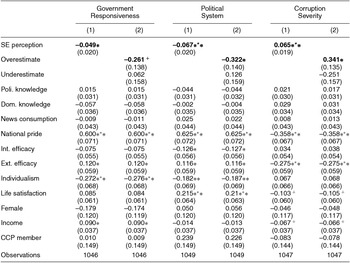
Table 3 shows the relationship between the respondents’ international knowledge and perceptions and their evaluations of China’s government responsiveness, political system, and severity of corruption, each using the two different specifications as in Table 2. The pattern that held for their evaluation of the country as a whole also held for their evaluations in these more specific and political areas: those who had more positive perceptions and overestimation of foreign socioeconomic conditions had significantly lower evaluations of China’s government and political system, and judged China’s corruption to be more severe. International political knowledge and domestic knowledge were not significantly related to domestic evaluations. The effects of control variables were also similar to the previous table.
Evaluation of the Government, Political System, and Corruption Severity (Study 1)

Notes: Entries are coefficients from ordered logit regressions; standard errors are in parentheses. Cut points are almost always statistically significant, but omitted here due to space constraint. *** p < 0.001, ** p < 0.01, * p < 0.05, + p < 0.10.
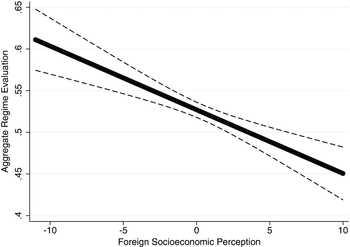
To make the results substantively clearer, Figure 2 shows the respondents’ predicted aggregate regime evaluations based on their foreign socioeconomic perception scores, with the covariates fixed at mean values. The aggregate regime evaluation variable was a combination of the above five separate dependent variables, and for ease of interpretation, was rescaled to range between 0 and 1.Footnote 25 The result was based on OLS regression since the aggregate evaluation variable is continuous. As shown in the figure, the aggregate regime evaluation was 0.61 for a respondent with the lowest foreign socioeconomic perception in the sample, but it decreased to 0.45 for a respondent with the highest foreign socioeconomic perception in the sample, a 26.2% drop.
Predicted Aggregate Regime Evaluations of the College Respondents

The results from the college survey are consistent with H 1 and H 2. Most importantly, respondents with rosier perceptions and especially overestimation of foreign socioeconomic conditions had significantly lower evaluations of their own country and government, confirming H 1. In addition, as H 2 predicted, knowledge of normal political matters abroad did not have a significant relationship with domestic evaluations; in other words, the relationship between international knowledge and perceptions on the one hand and domestic evaluations on the other was more about socioeconomic information than about political knowledge.
STUDY 2: ONLINE SURVEY EXPERIMENT
To further examine the relationship between international knowledge and information on the one hand and domestic evaluations on the other, and to test if correcting misinformation about foreign socioeconomic conditions can change people’s domestic evaluations, I conducted an online survey experiment in April 2014 with a diverse Internet sample.Footnote 26 The survey experiment can be used to see whether the correlations established in the college survey were unique to that sample or are more broadly applicable. More importantly, it can be used to assess whether there is a causal effect from perceptions of foreign socioeconomic conditions to domestic evaluations.
Design and Recruitment
Design
In the online survey experiment the subjects were randomly divided into a control group and a treatment group in a between-subjects design,Footnote 27 with both groups going through a questionnaire similar to the one used in the college survey, and the treatment group in addition receiving corrections for wrong answers to socioeconomic questions (see below). The social economic questions maintained the same topics but updated the choices since some of the world’s socioeconomic conditions had changed since the college survey. The international political knowledge questions were also updated. Domestic political and social knowledge was dropped from the survey since it had been found to be uncorrelated with domestic evaluations. The survey added a question to measure the respondents’ trust of the government,Footnote 28 a question measuring the respondents’ subjective social status (to control one’s personal socioeconomic condition beyond income),Footnote 29 as well as questions about education and age group. The measurement scales for many variables were also updated.Footnote 30
The international political knowledge questions asked the respondents about major events around the world from summer 2013 to early 2014 as well as the identities of some political and religious leaders (i.e., the French president, the Pope, and the recently deceased Nelson Mandela). The politically relevant events included the Egyptian coup of 2013, the U.S. federal government shutdown of 2013, social protests and political crises in Thailand and Ukraine, Edward Snowden’s revelation of NSA surveillance programs, the civil war in Syria, and political purge in North Korea. Similar to the college survey of 2011, these political knowledge questions covered diverse regions and issues. But unlike the time of the previous survey, 2013–2014 turned out to be a particularly turbulent time for many countries in the world, and therefore the new survey inevitably included multiple questions that were related to political crises and social turmoils. In particular, the questions on Egypt, Ukraine, Syria, and Thailand all involved change or survival of the government and significant amount of social unrest and violence, and therefore can be called political instability questions and separated from the others that were about political figures and more or less normal political affairs. In the following the instability and noninstability questions will be analyzed both together and separately.
In terms of the experimental component of the survey, subjects in the treatment group were informed of correct answers to the socioeconomic questions that they answered wrong (after all socioeconomic questions had been answered), while those in the control group did not receive any correction.Footnote 31 All wrong answers were corrected for the treatment group, whether the error was overestimation or underestimation. But because underestimation usually has no significant effect on one’s opinion (as shown in the college survey and again below), the effect of correction would be mostly from correcting overestimations. Since the purpose of the experiment was to see the effect of information correction, the socioeconomic perception questions as well as corrections for the treatment group appeared in the survey before the various domestic evaluation questions (but after the questions on prior political and social attitudes such as national pride, individualism, and political efficacy). Since there were no corrections for political knowledge questions, they were placed after the domestic evaluation questions, as in the college survey. To prevent the respondents from guessing at the purpose of the study and providing answers that cater to their perceived researcher intention, distractor questions irrelevant to the study were placed before the domestic evaluation questions as well as in several other places of the survey.
Recruitment
The subjects were recruited from a popular Chinese crowd-sourcing website for recruiting agents to perform tasks, which is similar to Amazon.com’s Mechanical Turk, and then directed to a U.S.-based website where they took the anonymous survey. To prevent repetitive participation, each unique IP address and each unique account at the recruiting platform was allowed to participate only once in the experiment.
Using crowd-sourcing platforms to recruit research subjects has become increasingly common in social sciences, and experiments done with such subjects have replicated classic as well as recent experiments conducted in other settings (Berinsky, Huber, and Lenz Reference Berinsky, Huber and Lenz2012; Buhrmester, Kwang, and Gosling Reference Buhrmester, Kwang and Gosling2011; Sprouse Reference Sprouse2011). The Chinese crowd-sourcing platform has also been previously employed in studying public opinion in China (Huang Reference Huangforthcoming). As shown in the Online Appendix, participants in the survey experiment came from all walks of life, various age and educational groups, and geographically all over China. In particular, the regional, gender, and occupational distributions of the experiment participants were roughly similar to those of the Chinese Internet users in general. Less than one-third of the subjects were students, and other occupations included corporate employees, government employees, professionals, workers, farmers, self-employed, and unemployed. Although the shares of young and college educated people in the experiment were higher than in the general Internet user population, overall the sociodemographic profiles of the experiment participants were far closer to the general population than college student samples.
A challenge to online surveys is ensuring that respondents pay sufficient attention to questions (Goodman, Cryder, and Cheema Reference Goodman, Cryder and Cheema2012), and therefore I used an instructional manipulation check (Oppenheimer, Meyvis, and Davidenko Reference Oppenheimer, Meyvis and Davidenko2009) to screen out inattentive subjects at the beginning of the survey.Footnote 32 In the end 955 participants completed the survey, among whom 470 were in the correction group.
Results
Figure 3 shows the distribution of the online respondents’ foreign socioeconomic perception scores as well as their estimates of U.S. per-capita personal income. The distributions were similar to those among the college respondents (for example, a significant proportion of the respondents overestimated the U.S. per-capita incomeFootnote 33 ), suggesting that foreign socioeconomic perceptions shown in this article were not unique to a particular sample.
The Online Respondents’ Foreign Socioeconomic Perceptions

Table 4 shows the summary statistics of the control group and the correction group in the online experiment and the result of t tests comparing the means of the two groups. As the panel of dependent variables shows, the correction group had more positive evaluations of China, often in a statistically significant way, which was expected. The panel of the independent variables indicates that the randomization was successful, since there were no significant differences between the control group and the correction group.
Summary Statistics of the Online Experiment

Note: Independent sample t tests with unequal variances. p values for the dependent variables reflect one-sided tests, and those for the independent variables reflect two-sided tests.
Although Table 4 already suggests that correcting the respondents’ misinformation about foreign socioeconomic conditions improved their domestic evaluations, to further examine the effects of international knowledge and perceptions as well as the interaction effects of correction with overestimation/underestimation, in the following I report results of ordered logit regressions, in line with the college survey.Footnote 34
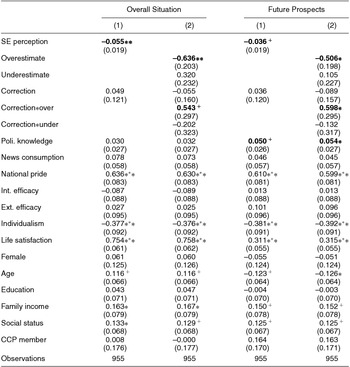
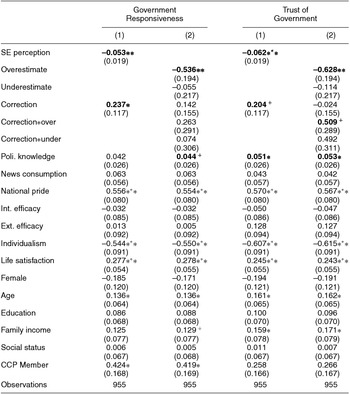
Table 5 shows the ordered logit results when the dependent variables are evaluations of China’s overall situation and future prospects. The two models for each dependent variable respectively uses the respondents’ aggregate perception scores and whether they overestimated/underestimated foreign conditions to represent their perceptions; in Model 2 the correction dummy was also interacted with overestimate/underestimate. The results show that more positive perceptions and particularly overestimation of foreign socioeconomic conditions were again significantly correlated with lower evaluations of China’s overall situation and future prospects. In addition, the coefficients for the interaction of correction and overestimation are positive and significant, indicating that correcting the misinformation of the respondents who overestimated foreign socioeconomic conditions improved their evaluation of China in both overall situation and future prospects. Finally, unlike the college survey, political knowledge was positively correlated with the online respondents’ evaluation of China’s future prospects. This positive relationship between international political knowledge and domestic evaluations will appear in several other cases in the following tables, and will be discussed below. The control variables, particularly national pride, individualism, and life satisfaction, showed expected effects as in the college survey.
Evaluation of China’s Overall Situation and Future Prospects (Study 2)

Notes: Entries are coefficients from ordered logit regressions; standard errors are in parentheses. Cut points are almost always statistically significant, but omitted here due to space constraint. *** p < 0.001, ** p < 0.01, * p < 0.05, + p < 0.10.
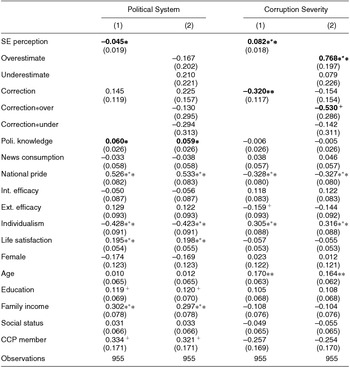
Tables 6 and 7 show the ordered logit results when the dependent variables are government responsiveness, trust of government, political system, and severity of corruption. More positive socioeconomic perceptions of foreign countries were again consistently associated with more negative evaluations of China (in the case of corruption, a judgment that the issue was more severe). This was again mainly driven by overestimation of foreign conditions, which almost always led to more negative evaluations of China. The coefficients for the interaction between correction and overestimation all have the “correct” signs and are significant for trust of government and corruption severity, indicating that correcting the misperception of overestimating respondents often (though not always) improved their domestic political evaluations. In specifications using aggregate scores to indicate socioeconomic perceptions and without the interaction terms, the coefficients for correction are often significant and have the expected signs too.
Evaluation of Government Responsiveness and Trust of Government (Study 2)

Notes: Entries are coefficients from ordered logit regressions; standard errors are in parentheses. Cut points are almost always statistically significant, but omitted here due to space constraint. *** p < 0.001, ** p < 0.01, * p < 0.05, + p < 0.10.
Evaluation of Political System and Corruption Severity (Study 2)

Notes: Entries are coefficients from ordered logit regressions; standard errors are in parentheses. Cut points are almost always statistically significant, but omitted here due to space constraint. *** p < 0.001, ** p < 0.01, * p < 0.05, + p < 0.10.
In Tables 6 and 7 international political knowledge is again positively associated with evaluations of China’s situations, except with regard to the issue of corruption. As discussed earlier, this is most likely because four of the ten political knowledge questions in the 2014 survey were about political crises and social unrest, while the Chinese citizenry has a well-known preference for social stability and avoidance of chaos. To examine this possibility, I replaced political knowledge respectively with the respondents’ scores on the political instability questions and the noninstability questions and reran the above regressions. Table 8 compares the statistical significance of political instability questions and non-instability questions for each dependent variable, using the specification with overestimate/underestimate and the interaction terms.Footnote 35
Political Knowledge: Instability Questions vs. Noninstability Questions

Note: * p < 0.05, + p < 0.10, − not significant.
As shown in Table 8, political instability questions achieved statistical significance with regard to future prospects, government responsiveness, trust of government, and political system, while noninstability questions only achieved statistical significance for political system. Comparing this table with Tables 5–7, it is clear that the significance of political knowledge was mostly driven by political instability questions, confirming H 4. The (marginally) significant and positive relationship between noninstability political knowledge and the respondents’ evaluation of China’s political system, however, is interesting and worthy of future research.
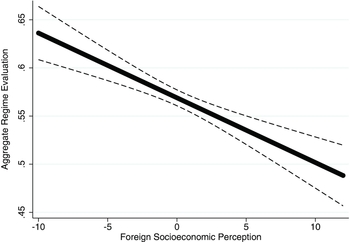
Again to show the substantive effects of socioeconomic perceptions, Figure 4 plots the predicted aggregate regime evaluation of the respondents based on their foreign socioeconomic perceptions, with the covariates fixed at mean values.Footnote 36 The aggregate regime evaluation of a respondent with the lowest foreign socioeconomic perception in the sample was 0.64, and it decreased to 0.49 for a respondent with the highest foreign socioeconomic perception, nearly a quarter drop.
Predicted Aggregate Regime Evaluations of the Online Respondents

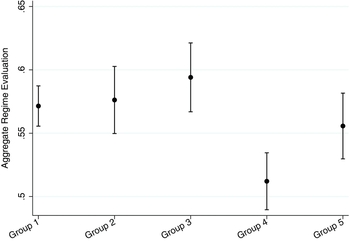
To show the effects of overestimation and especially correction, I compare different groups of respondents according to whether they systematically misestimated foreign socioeconomic conditions and whether they received corrections. In Figure 5, Group 1 were baseline respondents who neither overestimated nor underestimated foreign socioeconomic conditions, and they did not receive any correction. Group 2 were respondents who underestimated foreign conditions but did not receive correction, and Group 3 were respondents who underestimated foreign conditions and received correction. Group 4 were respondents who overestimated foreign conditions but did not receive correction, and Group 5 were respondents who overestimated foreign conditions and received correction. The black dots are predicted values and the brackets are 95% confidence intervals. As shown, the aggregate regime evaluations of Groups 1–3 were similar, but that of Group 4 (the overestimating respondents) was significantly lower than those of the previous three groups. The regime evaluation of Group 5, however, was close to that of the baseline group, meaning correcting the overestimating respondents’ misinformation recovered their regime evaluation back to a more “normal” level.
Effects of Overestimation and Correction

These results from a diverse Internet sample not only show that the negative relationship between perceptions of foreign socioeconomic conditions and domestic evaluations is quite robust, but more importantly reveal that the causal direction is at least partly from more positive perceptions of foreign conditions to lower domestic evaluations, since correcting overestimations improved the respondents’ domestic evaluations. Thus both H 1 and H 3 were confirmed. With regard to political knowledge, familiarity with normal political matters usually did not have a significant relationship with one’s domestic evaluations, while awareness of foreign political and social instability often led to better evaluations of domestic situations, as predicted by H 2 and H 4.
DISCUSSION
This section discusses some concerns about the article’s findings, and relate the findings to some other relevant literature. The most obvious concern about the relationship between overestimation of foreign socioeconomic conditions and lower domestic evaluation is reverse causality: people with more negative domestic evaluations may be motivated to look for or be more attentive to positive stories about the outside world while ignoring negative information (Huang and Yeh Reference Huang and Yeh2015), and this selective learning can lead to perceptions of foreign countries that are overly romantic. Motivated reasoning and selective information exposure are known to exist with regard to social and political issues in some situations (e.g., Iyengar and Hahn Reference Iyengar and Hahn2009; Taber and Lodge Reference Taber and Lodge2006). While it may indeed also play a role in the relationship between perceptions of foreign countries and evaluation of one’s own country, earlier I have discussed how the information environment in China is often very disorderly, with a great deal of misinformation circulating in the society. To a large extent, what kind of information people come across in their daily lives is somewhat random.
More importantly, the survey experiment was designed to address this very causality issue. A necessary and sufficient condition that overly positive perceptions of foreign countries are at least partly responsible for citizens’ lower evaluations of their own country is that correcting the misperception will improve their domestic evaluations. If the causal direction is entirely from domestic evaluations to (mis)perceptions of foreign countries, correcting the misinformation will have little effect on one’s views of domestic situations. In fact, motivated reasoners would hold onto or even strengthen their pre-existing views and beliefs when encountering incongruent information (Redlawsk Reference Redlawsk2002; Taber and Lodge Reference Taber and Lodge2006). The result of the survey experiment was clearly different: correcting the misinformation of the respondents who overestimated foreign socioeconomic conditions often improved (and never reduced) their evaluations of China. Therefore the causal direction is at least partly from more positive perceptions and overestimation of foreign socioeconomic conditions to lower domestic evaluations.
Another concern one may have is about the representativeness of this research’s samples. There were a number of reasons why student and online samples rather than nationally representative samples were used in this research. To begin with, this is the first study of the effects of international knowledge and information on one’s domestic opinion in the literature, and no existing dataset with nationally representative samples contains questions that directly measure the respondents’ international socioeconomic perceptions. Second and perhaps more importantly, given the current institutional and technological constraints in China, a nationally representative survey with stratified sampling would inevitably involve face to face interviews with the respondents, which would be problematic for the politically sensitive questions about the respondents’ evaluations of the government, political system, and corruption in China. Anonymous surveys with student and online samples would make the respondents much more candid and truthful. Third, the university surveyed for the article is a typical university in China, and the sociodemographic profiles of the online sample were quite close to the general Chinese Internet population on multiple key dimensions. Although the respondents in the samples were younger on average than the Chinese population in general, the young and Internet savvy generations are also more politically active and hence merit particular attention.
Last but not least, besides the college survey and online survey experiment reported above, I have also conducted two other online survey experiments, respectively in September 2012 and October 2014. The September 2012 experiment was about half in size as the experiment reported above, and yielded similar results about socioeconomic misperceptions and information correction.Footnote 37 The October 2014 survey removed all references about China’s corresponding statistics from the socioeconomic information questions, which were given in other surveys in order to give the respondents a framework for judgment, as discussed earlier.Footnote 38 While omitting reference information considerably increased random errors in the respondents’ answers,Footnote 39 it is remarkable that the basic relationship between perceptions of foreign socioeconomic conditions and domestic evaluations still held: more positive socioeconomic perceptions and overestimation of foreign countries were generally associated with lower evaluations of China and the Chinese government, and correcting overestimation often led to higher domestic evaluations. The fact that multiple rounds of surveys/experiments across four years (2011–2014) have all produced similar results should increase our confidence about the generalizability of the article’s findings.
One may also be concerned that being corrected may have simply made the respondents less secure about all beliefs, and induced them to seek safer and centrist opinions on domestic situations. Two results can alleviate this concern. First, corrections improved the domestic evaluations of the respondents who overestimated foreign countries in many but not all areas. In particular, while corrections improved their evaluations of China as a whole, whether overall current situation or future prospects, in some political evaluations corrections did not have the effect. This is notable because the standard official narrative in China is that the country had fallen behind the West in modern times, but the current government and political system are most appropriate for China, and are leading the country forward to catch up with the West. If corrections made the subjects unsure of their opinions, their evaluations of the Chinese government should improve more than their evaluation of China as a whole, given the political correctness concern. The results of the experiment, however, were different. Second, corrections did not change the domestic evaluations of the respondents who underestimated foreign countries, contrary to the expectation that being corrected simply made the respondents less secure about all beliefs. Therefore the results of the experiments reflected genuine opinion changes as well as nonchanges.
With regard to political knowledge, one may argue that familiarity with recent events and political figures is not the only kind of political knowledge that matters.Footnote 40 Measuring people’s awareness of civil liberties and political rights in foreign countries, for example, can better match the measurement of socioeconomic perceptions in the article. As discussed earlier, the measurement of political knowledge adopted in this article is for operationalization consideration, and it is fair to assume that knowledge of global political matters is correlated with awareness of political rights and civil liberties abroad as well as how democracy operates in foreign countries. But political knowledge is undoubtedly more than familiarity with political events and leaders, and alternative measures can indeed be explored in future research. The relative importance of political grievances and socioeconomic aspirations may also vary across time and levels of socioeconomic development.Footnote 41 This research, in other words, is primarily intended to draw scholars’ attention to the importance of socioeconomic information and perceptions about foreign countries; the effects of international political knowledge do merit further research.
While the main purpose of this article is to examine the relationship between knowledge and perceptions about foreign countries and evaluations of one’s own country, rather than Chinese citizens’ overall domestic approval ratings, it is worth noting that in the two surveys the respondents’ satisfaction rates with domestic situations were lower than in many well-cited national surveys of the Chinese public, which typically find a high majority of the respondents satisfied with the country’s general situation and the government system. In the 2008 World Value Survey, for example, 92.7% of the Chinese respondents had “a great deal” or “quite a lot” of confidence in the national government. In the 2011 Asian Barometer Mainland China Survey, 76.7% of the respondents were “proud of our system of government.” In the 2012 Pew Global Attitudes Survey, 82% of the Chinese respondents were “satisfied with the way things are going in our country.” In the two surveys reported here, the average evaluations of the respondents (excluding the correction group) were only slightly above the median on the measurement scale. In the college survey, for example, only 29.6%, 41.6%, and 51.0% of the respondents were satisfied (including “somewhat satisfied”) with the country’s overall current situation, government responsiveness, and political system. Besides the anonymity of the current surveys, one likely reason for the difference is that more of this research’s respondents belonged to the younger generation, who are more globally oriented than the general public. Although they typically have better lives than their parents when the latter were young, perceptions about foreign countries also weigh considerably more heavily in the minds of the new generation, hence their lower domestic evaluations.
As already mentioned, there was little previous research examining the influence of international knowledge and perceptions on citizens’ domestic opinions. Studies on the effects of foreign media in authoritarian countries, however, are relevant to the discussion. The dominant school of thought on this topic argues, mostly with qualitative evidence, that Western media have contributed to democratization in formerly authoritarian and communist countries by fostering prodemocratic and pro-Western values and countering government propaganda with outside information (e.g., Nelson Reference Nelson1997; Puddington Reference Puddington2000). Kern and Hainmueller (Reference Kern and Hainmueller2009), on the the hand, examine formally classified public opinion data from East Germany and find that East German citizens in regions that could receive West German television signals actually showed more support for the East German regime. They attribute most of the effect, however, to West German television’s better entertainment programs that provided an opportunity of relaxation to East German citizens, rather than their increased awareness of the “dark side” of the West. In a 2004 national survey of Chinese citizens’ perceptions and attitudes toward income inequality, Whyte (Reference Whyte2010) reports that more access to unofficial information, an index that includes discussions of current events with other people, learning information and news from foreign media and movies, domestic and international travel, and use of the Internet, is correlated with less negative opinions on China’s income inequality. Chu (Reference Chu2013) similarly finds from the 2008 Asian Barometer Survey that Chinese rural residents with higher international exposure, are more supportive of the national government.Footnote 42 In addition, case studies have shown that many young nationalists in China are well educated and familiar with foreign media (Osnos Reference Osnos2008; Yang and Zheng Reference Yang and Zheng2012), contrary to the conventional wisdom that they have simply been brainwashed by domestic propaganda.
One way to address this debate about whether foreign media stabilizes or destabilizes authoritarian rule is to realize that media provides its audiences with a mixture of information, value, and entertainment, and these different components may have different effects. Rather than bundling them together in a black box, this article focuses on information about foreign countries, and thus sheds light on the informational effect that foreign media can potentially have in an authoritarian and developing country. Some of the results discussed in the previous paragraph that were unexpected to the authors of those works can also be well explained by findings of this article.
In addition, studies on cross-national migration have shown that emigration to more advanced countries often increases people’s satisfaction with how democracy works in their home countries (Careja and Emmenegger Reference Careja and Emmenegger2012), decreases their trust of political institutions in the new country (Adman and Stromblad Reference Adman and Stromblad2011), and improves their material income but reduces feelings of happiness (Stillman et al. Reference Stillman, Gibson, McKenzie and Rohorua2015). Although these studies do not directly measure international knowledge, and do not directly inform us about the opinion of the vast majority of citizens in less developed countries that do not have emigration experiences, their results that experiences in advanced democracies often do not live up to the emigrants’ high expectations complement this article’s findings.
CONCLUSION
This article has investigated the relationship between Chinese citizens’ knowledge, information, and perceptions of foreign countries and their domestic evaluations. It finds that those with more positive perceptions and overestimation of foreign socioeconomic conditions have lower evaluations of China’s overall situation and future prospects. They also think the Chinese government is less responsive and less trustworthy, and that the country’s political system is less appropriate. In addition, such citizens think that corruption is more serious in China. This relationship is at least partly causal, since correcting overestimation of foreign socioeconomic conditions can often improve people’s evaluations of their own country and government.
On the other hand, general political knowledge about foreign countries, as measured by knowledge of political affairs and political figures, usually does not have a significant effect on one’s domestic evaluations. This suggests that the effects of knowledge about foreign countries on Chinese citizens’ domestic evaluations are more socioeconomic than political in nature. More awareness of foreign political crises and social unrest, however, is associated with more positive evaluations of China. This reflects Chinese citizens’ well-known preference for social stability as a result of the country’s turbulent modern history, but is also related to our implicit finding that Chinese citizens at the present time prioritize socioeconomic advancement, which is facilitated by social stability, over political empowerment.
Although it seems natural that overestimation of foreign conditions will lead to lower opinion of one’s own country, this is the first time that this (causal) relationship has been explicitly established in the literature. In addition, the article makes a few conceptual contributions. First, while the existing literature on citizen knowledge focuses on domestic knowledge, this article has shown that information and perceptions about foreign countries are also critical in shaping citizen opinion. Second, the existing literature primarily deals with political knowledge, whereas this article shows that socioeconomic information is important in influencing their political evaluations too. In fact, in a developing country socioeconomic information may trump political knowledge in influencing citizens’ opinions. Finally, in the study of citizen information and knowledge scholars must distinguish not only misinformation from lack of information, but also two different types of informational errors: overestimating a situation and underestimating a situation. Bundling the two types of misinformation together as lack of knowledge and/or lack of access to information sources will obfuscate the effects of inaccurate information.
This article aims to motivate further studies on the relationship between international knowledge, information, and perceptions on the one hand and domestic evaluations and political support on the other. One obvious question for future research is how representative the Chinese case is among changing societies. The migration studies discussed in the previous section, as well as common anecdotes that citizens in (post)communist countries are often intensely interested in the socioeconomic life of the West and yearn for things American, indicate that the results of the current article should not be unique to a single country. But of course to answer the above question precisely we need careful studies of other countries. The present article, by studying by far the largest authoritarian country in the world that has also become a model of economic development for some, provides a first step in this line of research.
Studying international knowledge and perceptions in authoritarian countries can also reveal vital and yet subtle aspects of public opinion in such countries that may be difficult to gauge in direct public opinion surveys. For example, conventional wisdom on public opinion in authoritarian societies focus on people’s political plights rather than socioeconomic pursuits. No doubt both socioeconomic and political aspirations are critical components of people’s preferences, and in direct surveys about citizen preferences it may be difficult to assess the relative importance of the two. By studying how people politically and socioeconomically understand foreign countries, and how such understandings implicitly influence their domestic opinion, we can learn something important about citizens’ wishes and desires that are otherwise obscured. In other words, citizens’ knowledge, information, and perceptions about foreign countries is a hitherto unexplored research field that can produce fruitful findings.
SUPPLEMENTARY MATERIALS
To view supplementary material for this article, please visit http://dx.doi.org/10.1017/S000305541500026X





Comments
No Comments have been published for this article.