Appropriate use of perioperative antimicrobial prophylaxis (PAP) is essential to attain optimal patient outcomes; inappropriate dose, timing, and drug choice can increase the risk of surgical site infections (SSIs).Reference Yi, Edwards, Horan, Berrios-Torres and Fridkin1 Although the appropriateness of PAP use in children regarding the selection of antimicrobial agents and duration of PAP has been studied in Greece,Reference Dimopoulou, Kourlaba and Psarris2 no published data regarding the timing and intraoperative redosing of PAP are available. Moreover, to our knowledge, data are limited regarding PAP timing and redosing in pediatric surgical populations worldwide. Reference Ciofi degli Atti, Spila Alegiani and Raschetti3 – Reference Putnam, Chang and Rogers5
In this study, we assessed the timing of administration of PAP and the need for redosing in pediatric patients in Greece, and we sought to determine adherence to published guidelines.
Study design, setting, and population
A 1-year prospective surveillance study of general surgical procedures was undertaken between July 2014 and June 2015 in the Department of Pediatric Surgery of the Aghia Sophia Children’s Hospital, in Athens, Greece. All patients subjected to 1 or more surgical procedures, as defined by the Centers for Disease Control and Prevention (CDC),6 were eligible to be included in our study.
Data collection: Denominator
To capture data on all procedures, we modified the CDC denominator for procedure form to collect preoperative, perioperative, and procedure data. The procedures were grouped into 9 categories, similarly to our previously published study.Reference Dimopoulou, Kourlaba and Psarris2
Data analysis
Appropriateness of PAP timing was assessed as the administration of the first preoperative dose(s) of the antimicrobial agent(s) ≤ 60 minutes before skin incision (fluoroquinolones and vancomycin ≤ 120 minutes prior to incision).Reference Bratzler, Dellinger and Olsen7 Moreover, the intraoperative redosing of prophylactic antimicrobial agents was defined as necessary if the duration of the procedure exceeded 2 half-lives of the drug or there was excessive blood loss during the procedure.Reference Bratzler, Dellinger and Olsen7 Because the quantitative measurement of blood loss remains undefined in children, standard methods were used, including visual assessment of the surgical field for the presence of surgical or excessive microvascular bleeding and checking suction canisters, surgical sponges, and surgical drains.8 The time in exact minutes that the intravenous infusion of antimicrobials ended was recorded by the ward nurse or the anesthesia technician, who was responsible for the administration of first PAP dose. The decision regarding the need for redosing took into account the half-lives of the antimicrobials and was made by the anesthetic nurse.
Categorical variables were summarized as absolute and relative (%) frequencies. Associations between categorical variables were tested using the χ2 test. All reported P values were based on 2-sided hypotheses and were compared to a significance level of 0.05.
Results
Overall, the timing of the preoperative dose of PAP was recorded in 483 children. The timing of PAP was inappropriate in 11.4% of procedures: in 46 cases (9.5%) the first dose was administered later than 60 minutes before incision and in 9 cases (1.9%) the first dose was administered earlier than 60 minutes before incision.
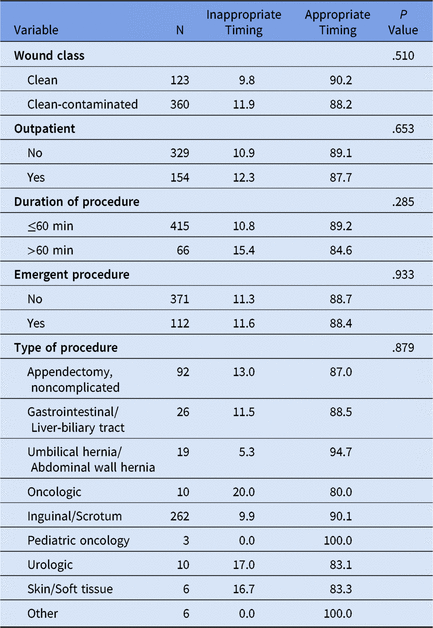
No differences were detected in the percentage of procedures in which PAP was administered in the appropriate timing across the categories of some characteristics of procedures (Table 1). The most commonly used antimicrobial was cefoxitin (67.5%), followed by ceforanide (26.3%).
Compliance With Appropriate Perioperative Antimicrobial Prophylaxis Timing by Surgical Characteristics

Redosing was required in 22 procedures (4.56%). However, a second dose of antimicrobial was administered in 40.9% of these procedures. More specifically, redosing was appropriately performed in 8 noncomplicated appendectomies, 8 gastrointestinal/liver-biliary tract procedures, 4 urologic procedures, and 2 oncologic procedures. The duration of all procedures exceeded 2 half-lives of the administered antimicrobial, and there was no excessive blood loss.
In our study, the timing of preoperative dose of PAP was appropriate according to current guidelines in the vast majority of cases (88.6%), whereas worse results were documented regarding redosing (ie, appropriate in only 40.9% of cases). In our attempt to obtain precise information regarding the implementation of PAP timing guidelines in clinical practice and to identify potential causes for nonadherence to them, we investigated whether guideline compliance was affected by specific characteristics of pediatric surgical procedures. Our results indicate that rates of compliance were unrelated to the characteristics of the procedure.
Despite the controversies regarding the benefits of redosing for the prevention of SSIs and the lack of clinical outcome data in the pediatric population,Reference Berríos-Torres, Umscheid and Bratzler9 most available current guidelines recommend intraoperative redosing if the duration of the procedure exceeds 2 half-lives of the drug or if there is excessive blood loss during the procedure. Reference Bratzler, Dellinger and Olsen7 , Reference Allegranzi, Bischoff and de Jonge10 In this study, the need for repeat doses in all procedures was attributed to their prolonged duration.
The lack of awareness of the guidelines or the lack of education of surgical team and staff nurse seem to be the main barriers to adherence with PAP guidelines regarding the redosing. To improve compliance to PAP redosing, effort should be put into informing pediatric surgeons about the importance of redosing of PAP in prolonged cases.
Our study has a limitation. It was conducted at a single, tertiary-care center, which may limit the generalizability of our findings. However, because the case mix seems to include many procedures that are commonly performed in children, we believe our findings can help inform other hospitals seeking to improve the timing of administration and redosing of PAP.
Our future goals are to further improve the quality of PAP and to share data for benchmarking purposes.
Acknowledgments
The authors thank Dr Spiros Antypas, Konstantinos Nikas, Nikolaos Christopoulos, Emmanouil Iakomidis, and Danai Fraggidi.
Financial support
No financial support was provided relevant to this article.
Conflicts of interest
All authors report no conflicts of interest relevant to this article.