Introduction
Chronic rhinosinusitis is characterised by chronic inflammation of the sinonasal mucosa that persists for at least 12 weeks despite medical therapy.Reference Fokkens, Lund, Mullol, Bachert, Alobid and Baroody1 It is one of the most prevalent chronic diseases, affecting approximately 11 per cent of the European population.Reference Hastan, Fokkens, Bachert, Newson, Bislimovska and Bockelbrink2 Chronic rhinosinusitis is often divided into two clinically and phenotypically distinct subtypes: chronic rhinosinusitis with and without nasal polyps.Reference Fokkens, Lund, Mullol, Bachert, Alobid and Baroody1 Unlike acute bacterial sinusitis, whose pathophysiology is well defined, it is increasingly acknowledged that chronic rhinosinusitis is not a single disease entity. Instead, it is a heterogeneous condition broadly characterised by persistent inflammation of the sinonasal mucosa.Reference Lee and Lane3 The causes of such inflammation are diverse and multifactorial, relating to overlapping host and environmental triggers.Reference Lee and Lane3
Mycoplasma pneumoniae and Chlamydophila pneumoniae are bacteria known to cause respiratory tract infections.Reference Blasi4 Both have been associated with community-acquired pneumonia and acute bronchitis, and with persistent asthma and chronic obstructive pulmonary disease (COPD) infections.Reference Blasi4–Reference Meltzer, Szwarcberg and Pill10 Taking into account the unified airway theory,Reference Meltzer, Szwarcberg and Pill10 which considers allergic rhinitis, rhinosinusitis and COPD as manifestations of the same inflammatory process within a continuous airway, it is also possible that these bacteria may cause persistent infection of the sinus mucosa in patients with chronic rhinosinusitis with nasal polyps.
A few studies have investigated the potential role of M pneumoniae Reference Gurr, Chakraverty, Callanan and Gurr11–Reference Nia, Farhadi, Darestani, Tabatabaei, Shamshiri and Noorbakhsh14 and C pneumoniae Reference Apan, Alpay and Alpay9, Reference Pandak, Pajić-Penavić, Židovec-Lepej, Planinić, Trošelj-Vukić and Perić13, Reference Lee, Kaza, Plano and Casiano15–Reference Shokrollahi, Farhadi, Noorbakhsh, Nia, Ghavidel and Shamshiri17 in chronic rhinosinusitis with nasal polyps using different techniques, although their results are controversial. In our study, we used real-time polymerase chain reaction to evaluate and compare the prevalence of M pneumoniae and C pneumoniae DNA in the nasal tissue samples of patients with chronic rhinosinusitis with nasal polyps and in those from healthy controls. To our knowledge, real-time polymerase chain reaction has not previously been used to assess the prevalence of M pneumoniae and C pneumoniae DNA in nasal tissue samples.
Methods
We conducted a prospective study from May 2010 to May 2014, involving adult patients with chronic rhinosinusitis with nasal polyps undergoing functional endoscopic sinus surgery (FESS). We made a diagnosis of chronic rhinosinusitis with nasal polyps according to the criteria set out in the European Position Paper on Rhinosinusitis and Nasal Polyps.Reference Fokkens, Lund, Mullol, Bachert, Alobid and Baroody1 The control group consisted of healthy adult patients without chronic rhinosinusitis, but with nasal septal deviation undergoing septoplasty as outlined by the criteria.Reference Fokkens, Lund, Mullol, Bachert, Alobid and Baroody1 We excluded from the study pediatric patients, and patients with cystic fibrosis, primary ciliary dyskinesia, allergic fungal sinusitis, inverted papilloma and human immunodeficiency virus seropositivity. We also excluded individuals in both groups who had had an upper respiratory tract infection within two weeks before surgery, and those who had taken any topical or systemic steroids within the last month prior to surgery.
In patients with chronic rhinosinusitis with nasal polyps, we obtained nasal polyp specimens during FESS; in the control group, we obtained tissue biopsies from the inferior turbinate mucosa during septoplasty. We immediately transferred the specimens to sterile, dry containers and shipped them to the laboratory. Using a surgical knife, we cut the tissues into several 2–4-mm-thick pieces (for the superficial to deep areas respectively) and then divided them into two groups: one to be used for the molecular assays and the other to be stored at −80o C.
We chose four pieces of tissue from each patient, two superficial and two deep, for DNA extraction with commercial kits (Life Technologies Ltd, Paisley, Scotland, UK), according to the manufacturer's instructions. The efficiency of DNA extraction and the possible presence of inhibitors in each sample were confirmed by the RS42 (5′-GCTCACTCAGTGTGGCAAAG-3′) and Km (5′-GGTTGGCCAATCTACTCCCAGG-3′) primers having detected the beta 2-globin gene.
We tested the extracted DNA specimens for the presence of M pneumoniae and C pneumoniae DNA with the Applied Biosystems 7500 fast real-time polymerase chain reaction system (Life Technologies Ltd, Paisley, UK), using a quantitative polymerase chain reaction Alert Kit (ELITech Group, Puteaux, France) for M pneumoniae and C pneumoniae, according to the manufacturer's instructions.
We entered all data into a database, including patient demographic information (age, gender, history) and data on comorbidities like allergy, asthma and COPD.
All samples were analysed at the Department of Microbiology, University of Thessaly, Greece. The University of Thessaly institutional review board approved the study. We obtained written informed consent from all patients and controls.
All procedures contributing to this work comply with the ethical standards of the relevant national and institutional guidelines on human experimentation of the University of Thessaly and with the Declaration of Helsinki (1975), as revised in 2008.
Results
The nasal polyps group consisted of 62 individuals (39 men; mean age 51 years; range 21–74 years), while the control group consisted of 24 individuals (13 men; mean age 45 years; range 18–52 years).
DNA extraction, indicated by beta 2-globin gene detection, was successful in all the samples.
All specimens in both nasal polyp and control groups were negative for M pneumoniae and C pneumoniae DNA, so we conducted no further statistical analysis.
Discussion
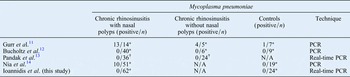
In 1996, Gurr et al.Reference Gurr, Chakraverty, Callanan and Gurr11 were the first to investigate the potential role of M pneumoniae in the aetiology of nasal polyps using molecular techniques (polymerase chain reaction). In a pilot study involving 14 patients with chronic rhinosinusitis with nasal polyps, 5 patients with chronic rhinosinusitis without nasal polyps and 7 controls, they reported that M pneumoniae DNA was detected in 13/14 (93 per cent) of nasal polyp samples and 4/5 (80 per cent) of chronic rhinosinusitis without nasal polyp samples, but only in 1/7 (14 per cent) of the controls (inferior turbinates). They went on to suggest a M pneumoniae causative relationship in the aetiology of nasal polyps. Nevertheless, in a follow-up study, Bucholtz et al.Reference Bucholtz, Salzman, Bersalona, Boyle, Ejercito and Penno12 failed to detect M pneumoniae DNA in nasal tissue from patients and controls. The authors tested 40 patients with chronic rhinosinusitis with nasal polyps, 6 patients with chronic rhinosinusitis without nasal polyps and 9 controls (inferior turbinates) for the presence of bacterial DNA. They used M pneumoniae-specific DNA primers to encode the 16S ribosomal RNA gene in 41 specimens (31 chronic rhinosinusitis with nasal polyps, 4 chronic rhinosinusitis without nasal polyps and 6 controls); in addition, they used the consensus sequence-based polymerase chain reaction with broad-spectrum primers for most eubacterial DNA encoding of the 16S ribosomal RNA gene in 38 specimens (26 chronic rhinosinusitis with nasal polyps, 5 chronic rhinosinusitis without nasal polyps and 7 controls). They found no evidence of M pneumoniae-specific DNA encoding of the 16S ribosomal RNA gene in any of the tissues. Recently, Pandak et al.Reference Pandak, Pajić-Penavić, Židovec-Lepej, Planinić, Trošelj-Vukić and Perić13 used real-time polymerase chain reaction in sinus lavage aspirates but failed to detect any M pneumoniae DNA in 60 chronic rhinosinusitis patients (24 chronic rhinosinusitis without nasal polyps, 36 chronic rhinosinusitis with nasal polyps). Nia et al.,Reference Nia, Farhadi, Darestani, Tabatabaei, Shamshiri and Noorbakhsh14 using a polymerase chain reaction-enzyme-linked immunosorbent assay, reported M pneumoniae DNA positivity in 19.6 per cent of biopsy specimens from chronic rhinosinusitis with nasal polyps patients (10/51 specimens) in comparison to none in 19 controls (patients undergoing surgery for nasal fractures), adding support to the initial findings of Gurr et al.Reference Gurr, Chakraverty, Callanan and Gurr11 In our study, using molecular assays, we tested the presence of M pneumoniae and C pneumoniae in biopsy specimens from patients with chronic rhinosinusitis with nasal polyps and controls. Although the molecular methods we used were characterised by high sensitivity, we did not find any M pneumoniae positivity in either group (Table I). Therefore, our results suggest that M pneumoniae does not play a role in the aetiology of chronic sinusitis with nasal polyps.
English-language studies on the presence of mycoplasma pneumoniae in chronic sinusitis with and without nasal polyps

*Tissue samples.
†Aspirates from sinus lavage.
PCR = polymerase chain reaction; N/A = not applicable
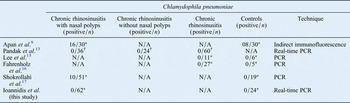
The potential association of C pneumoniae with the pathogenesis of nasal polyposis was initially investigated by Lee et al.Reference Lee, Kaza, Plano and Casiano15 In a pilot study, the researchers used qualitative polymerase chain reaction and demonstrated the absence of C pneumoniae in samples from 11 chronic rhinosinusitis patients and 6 cadaveric controls. In contrast, Apan et al.Reference Apan, Alpay and Alpay9 used indirect immunofluorescence and demonstrated a statistically significant difference (p = 0.034) in C pneumoniae prevalence among patients with chronic rhinosinusitis with nasal polyps (16/30, 53.3 per cent) vs age- and sex-matched controls (8/30, 26.6 per cent). Subsequent studies that used qualitative polymerase chain reaction to analyse biopsy samples reported contradictory findings. While Fahrenholz et al.Reference Fahrenholz, Stratton, Wolf, Duncavage, Tang and Russell16 failed to find evidence of C pneumoniae colonisation with qualitative polymerase chain reaction analysis in 27 patients with medically refractory chronic rhinosinusitis and 5 controls, Shokrollahi et al.Reference Shokrollahi, Farhadi, Noorbakhsh, Nia, Ghavidel and Shamshiri17 reported C pneumoniae DNA positivity in 10/51 (19.6 per cent) samples from chronic rhinosinusitis with nasal polyps patients versus 0/19 (0 per cent) in controls. The major limitation of these studies was the small number of patients included.
A study with a larger sample was performed by Pandak et al.Reference Pandak, Pajić-Penavić, Židovec-Lepej, Planinić, Trošelj-Vukić and Perić13 They used real-time polymerase chain reaction in sinus lavage aspirates, but failed to detect any C pneumoniae DNA in 60 chronic rhinosinusitis patients (24 chronic rhinosinusitis without nasal polyps and 36 chronic rhinosinusitis with nasal polyps). The main limitation of their study, however, was that polymerase chain reaction testing was performed on aspirates obtained during FESS and not on tissue biopsy specimens, as in the other studies. Given the intracellular life cycle of C pneumoniae and the documented increased presence of amplification inhibitors in aspiratesReference Reznikov, Blackmore, Finlay-Jones and Gordon18 compared to tissue specimens, this would have influenced the study findings. Our study confirms the findings of Pandak et al.,Reference Pandak, Pajić-Penavić, Židovec-Lepej, Planinić, Trošelj-Vukić and Perić13 who argued against C pneumoniae involvement in the pathogenesis of chronic rhinosinusitis with nasal polyps (Table II).
English-language studies on the presence of chlamydophila pneumoniae in chronic rhinosinusitis with and without polyps

*Tissue samples.
†Aspirates from sinus lavage.
PCR = polymerase chain reaction; N/A = not applicable
Diagnosis of M pneumoniae and C pneumoniae infection is usually based on detection in the serum of specific antibodies against these microorganisms, while other conventional methods, such as culturing and antigen detection, are not used.Reference Kuoppa, Boman, Scott, Kumlin, Eriksson and Allard19 It should be noted, however, that molecular assay sensitivity has some limitations. Specifically, potential contamination during sample processing may lead to false positive results, while the presence of inhibitory factors in the samplesReference Nilsson, Björkman and Persson20, Reference Gibb and Wong21 may produce false negative results. Moreover, specimen type is crucial for polymerase chain reaction-based diagnosis of atypical pathogens in infected patients; sputum gives superior results than nasopharyngeal specimens and throat swabs in the diagnosis of community-acquired pneumonia caused by atypical bacteria.Reference Cho, Kim, An, Lee, Noh and Kim22
• Chronic rhinosinusitis is a heterogeneous condition broadly characterised by persistent inflammation of the sinonasal mucosa
• Its causes are diverse and multifactorial, relating to overlapping host and environmental triggers
• Only a few studies have investigated the potential role of Mycoplasma pneumoniae and Chlamydophila pneumoniae in chronic rhinosinusitis with nasal polyps
• We used real-time polymerase chain reaction to investigate the role of M pneumoniae and C pneumoniae in the aetiology of chronic rhinosinusitis with nasal polyps
• Our findings demonstrate that it is unlikely that M pneumoniae and C pneumoniae act as an ongoing inflammatory stimulus in chronic rhinosinusitis with nasal polyps
Aspirates are more likely to be rejected in comparison to throat specimens as they may contain inadequate material or excess amplification inhibitors,Reference Reznikov, Blackmore, Finlay-Jones and Gordon18 and thus are more likely to produce false negative results. Additionally, detection of DNA may yield different, time-dependent results during infection, as observed in pneumonia caused by atypical community-acquired pathogens; thus, the timing of sampling in each of the studies may have influenced the results.Reference Cho, Kim, An, Lee, Noh and Kim22Mycoplasma pneumoniae infection has been known to exhibit outbreaks occurring every 4–7 years and is significantly more common during the winter months.Reference Sidal, Kilic, Unuvar, Oguz, Onel and Agacfidan23 Nilsson et al.Reference Nilsson, Björkman and Persson20 assessed the longitudinal follow-up of M pneumoniae infection and established that although most patients have detectable M pneumoniae DNA in throat secretions for seven weeks after the onset of illness, and several continue to be polymerase chain reaction-positive for several months, the M pneumoniae DNA load gradually declines over time, and eventually all patients became polymerase chain reaction-negative. This pattern is in contrast to a transition from active M pneumoniae clinical infection to a state of chronic colonisation, lowering the likelihood that M pneumoniae acts as the ongoing inflammatory stimulus in patients with chronic rhinosinusitis with polyps. With regard to the seasonal and widespread occurrence of M pneumoniae infection, it offers a possible explanation for the variability in prevalence among studies.
The potential limitations of polymerase chain reaction testing, together with differences in study populations and techniques used, could offer a logical explanation for the inter-study variability noted in the studies discussed earlier. In the present study, we took all the necessary precautions to avoid these limitations, by choosing to test a large population of biopsy specimens compared to aspirates with a quantitative-polymerase chain reaction kit employing the TaqMan® minor groove binder probe (iCycler, Bio-Rad Laboratories, Herculus, CA, USA). This technology incorporates minor groove binder molecules to increase specificity, uracil-N-glycosylase to prevent false positive results, together with a passive reference dye to calibrate the basic fluorescence and an internal control to avoid false negative results.
Conclusion
Our findings demonstrated a complete absence of M pneumoniae and C pneumoniae DNA in biopsy specimens obtained from patients with chronic rhinosinusitis with nasal polyps and controls. These findings agree with and add further support to those arguing against atypical bacteria implication in chronic rhinosinusitis with nasal polyps. However, we cannot exclude that the inter-study variability is due to differences in study populations, nor the possibility that M pneumoniae and C pneumoniae may play a role either as potential causes of the initial development of inflammation – as in allergy and asthma – or act as modifiers of the disease process – as an ongoing inflammatory stimulus. Future research should employ a long-term prospective study design to assess the likelihood of chronic rhinosinusitis with nasal polyps prevalence in patients with documented atypical bacterial infection compared to healthy individuals.
Acknowledgements
We thank Timoleon F Terzis and Paraskevi Tsirevelou for the assistance they provided in sample collection, and for their advice and continuous support throughout the entire project.