INTRODUCTION
During the last ten years, China's economic engagement with Africa has witnessed explosive growth. Trade between China and Africa reached $106 billion in 2008, ten times the 2000 figure.Footnote 1 In contrast to trade with partners such as the United States, where imports of African raw materials make up by far the lion's share of trade, Africa's trade with China is relatively balanced, with African countries importing around $50 billion of Chinese goods in 2008. Chinese foreign direct investment (FDI) statistics are notoriously unreliable, but near-weekly announcements of significant commitments to invest suggest that the actual increases in FDI are likely to be far higher than the official annual figures, which record a rise from $74·8 million in 2003 to $5·49 billion in 2008 (MOFCOM 2009). In 2007, at the annual meeting of the African Development Bank, held for the first time in Shanghai, the president of China's Export–Import Bank announced plans to commit at least $20 billion in export-related finance across Africa over the following three years.
The impact of China's economic engagement in Africa is hotly debated. Some argue that it is neo-colonial in nature: almost exclusively about getting access to natural resources. Further, the influx of competitive Chinese products, small-scale Chinese traders, and Chinese labour in infrastructure projects is seen as a serious threat to African manufacturers, market vendors, and workers. In this view, Chinese engagement is unlikely to benefit Africa's long-term development (Marysse & Geenen Reference Marysse and Geenen2009: 392).
On the other hand, the Chinese have regularly announced pledges of state-sponsored ‘economic cooperation’ with Africa. As part of these pledges, China's Ministry of Commerce (MOFCOM) is supporting the development of six (possibly seven) economic and trade cooperation zones in five (possibly six) African countries. Chinese enterprises have also set up a handful of industrial zones outside the MOFCOM programme. Chinese leaders describe these cooperation zones as an important measure to help African countries develop industries and expand local employment (People's Daily 2010). Still, some worry that the zones might be primarily ‘political’ investments, linked to Beijing's long-term geo-strategic ambitions, and unlikely to foster sustainable local development (Gayan Reference Gayan2008). Relatedly, others fear that they may be intended primarily for transshipment of Chinese products, for relabelling and re-export to protected markets as ‘African’ products.
In a similar vein, many development experts are sceptical about the zones' prospects as tools for an industrial revival on the continent. African countries have mixed experiences with industrial or export processing zones. It is true that some African countries do have notable, market-driven, ‘bottom-up’ clusters of industries such as the footwear cluster in Aba and the vehicle parts cluster in Nnewi in Nigeria (Bräutigam Reference Bräutigam1997; Meagher Reference Meagher2010; Zeng Reference Zeng2008). Yet these spontaneous clusters have significant weaknesses, notably poor infrastructure, weak linkages to modern sources of innovation and technology, and a general absence of government support. The first formal export processing zones were established in sub-Saharan Africa in 1971, in Mauritius, and were widely regarded as a success. By 2009, about two dozen African countries had hosted various forms of special economic zone (SEZs), including export processing zones (EPZ), free trade zones (FTZ) and industrial parks. However, for reasons discussed briefly below, the general outcome of SEZs in Africa, especially in sub-Saharan Africa, has been lacklustre. In some countries, zones are only partially functioning; some have even been abandoned.
These two sets of concerns are related. Chinese zones will be successful if they attract significant local and foreign investment, create African employment, promote exports and elevate industrial competitiveness in African countries in an environmentally and socially sustainable manner. Conversely, if these zones end up as isolated Chinese enclaves; do not employ Africans or employ them only at the lowest levels; fail to transfer or diffuse technology and ‘know-how’ (including the knowledge of how to effectively market the zones) to local people; attract industries that are simply more polluting or adopt worker safety standards that are lower than those outside the zones; or serve as uneconomic ‘prestige projects’ offered merely in exchange for other benefits such as access to resources, fears about Chinese exploitation would be confirmed.
Very little research has been done on the Chinese zones.Footnote 2 Some of their most basic aspects are still unclear to many people, even the most obvious question as to which of the many media stories about Chinese zones are about the ‘official’ zones that enjoy Chinese government support. Understanding that they are still at an early stage of development, this article aims to describe how the Sino-African economic cooperation zones were conceived and initiated, and how they are progressing during implementation. Based primarily on field research and interviews in China, Zambia, Egypt, Nigeria, Sierra Leone, Mauritius, Uganda and Ethiopia between 2007 and 2009, we investigate three major sets of questions: (1) How did the official zones come to be located in these particular countries, and what does this tell us about China's strategy for Africa? (2) How are these zones being designed and developed? In particular, what role does the Chinese government play, and what role is played by profit-seeking enterprises? (3) What issues have arisen during implementation that might affect the developmental prospects of these zones? The second section provides an overview of the background and history of the zones. The third section examines the roles and responsibilities of the three main parties to the zones, the fourth section uses a case study in Egypt to illustrate the opportunities and risks, while the fifth section discusses a number of strategic issues related to the zones, and the sixth section concludes. We focus only on the ‘official’ zones, i.e. those pilot zones selected for support from the Chinese government under a programme first announced in 2006. Although Chinese companies have begun to develop other zones outside the pilot programme, these are beyond the scope of our research.
OVERVIEW OF CHINA'S ECONOMIC COOPERATION ZONES IN AFRICA
Although special economic zones first appeared in places like Puerto Rico (1951), Ireland's Shannon Airport (1959) and Taichung, Taiwan (1965), mainland China is the world's foremost success story in using SEZs to build up industrial capacity (FIAS 2008; Graham Reference Graham2004; Knoth Reference Knoth2000). The creation of SEZs played a strategic role in China's early economic reforms. In 1979, four zones – Shenzhen, Zhuhai, Shantou and Xiamen – were set up as experiments in the management of market liberalisation, and as magnets for foreign investment. Despite a slow start, these SEZs proved to be incubators for significant structural transformation. Shenzhen, in particular, grew from a fishing village to an industrialised metropolis within a generation. In 1988, the entire island of Hainan became an SEZ and in 1990, a large part of Shanghai, China's biggest city, was restructured as the Pudong New Area zone. Today China hosts at least a hundred zones in a growing variety: free trade, economic and technological development, and high-tech zones. Chinese officials candidly analyse these zones as being quite positive in fostering growth, employment and an investment-friendly environment, but admit that there are trade-offs, particularly with regard to social and environmental costs (interview, November 2009, Beijing).
In 2006, as part of the implementation of its eleventh five-year plan, and in keeping with the expansion of policies in support of trade and overseas investment (sometimes called ‘Going Global’ or Zou Chuqu), the Chinese government indicated that it would establish up to fifty overseas economic and trade cooperation zones worldwide, without giving a timeframe (Bräutigam Reference Bräutigam2009). The Beijing summit of the Forum on China–Africa Cooperation (FOCAC) held in November 2006 pledged that three to five of these would be located in Africa.
It is clear that these zones were in part intended to fulfil ‘soft power’ political goals, in particular demonstrating the efficacy of some aspects of China's development model and sharing it with friendly countries. Yet this is not the whole picture by any means. The zones were also intended to help China's own restructuring, allowing the labour intensive, less competitive, ‘mature’ industries, such as textiles, leather goods and building materials to move offshore.Footnote 3 Comments by Chinese officials reinforce this interpretation. For example, the Chinese ambassador to Zambia (the location of one of the zones) put it thus:
We also would like to introduce mature Chinese enterprises with comparative advantages to Zambia to help address the country's over-reliance on import of consumer and manufactured goods. Therefore, the establishment of the Cooperation Zone can help both Zambia develop and mature Chinese industries redeploy and win more space of development at home. Southern Weekly 2010
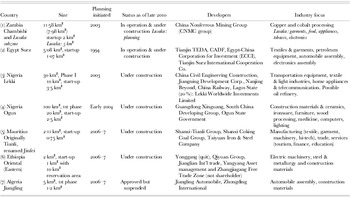
When it became clear in 2006 that China was offering an innovative new programme, more than ten African governments expressed interest in hosting cooperation zones (Bo Reference Xilai2006). However, to make the zones sustainable, the Chinese government decided that China's own companies would take the lead in developing them. To that end, MOFCOM held two rounds of tenders, in 2006 and 2007. More than 120 Chinese companies proposed projects. Judged by a panel of experts who considered their market potential and overall feasibility, host country investment environment and degree of support, and the capacity of the developer, nineteen zones were selected. Among them, seven were in Africa – in Algeria, Egypt, Ethiopia, Mauritius, Nigeria (two), and Zambia (Table 1). Some countries that had expressed strong interest in hosting a zone, such as Tanzania and Cape Verde, did not receive one. This is more evidence that the decision was not political, but depended on the results of the tender.
Overview of China's official African trade and economic cooperation zones

By mid 2010, six zones were under construction in Africa, while the Algerian zone had stalled because of unexpected changes in Algeria's legislation governing foreign investment. MOFCOM stopped holding further tenders after 2007, awaiting the initial results of its pilot projects. However, some individual Chinese enterprises have continued to establish, expand, or propose new industrial parks or free trade zones in Africa on their own, including in Nigeria, Sierra Leone, Uganda, Botswana and South Africa.
As Table 1 suggests, the sectors, developers, and even the size, of these zones vary considerably. There is no single ‘Chinese model’ of overseas cooperation zone. Only one zone will concentrate on mineral processing, while the others will mainly focus on manufacturing. This also provides more evidence for a view that Chinese intentions in Africa range far beyond natural resource extraction. The zones in Ethiopia and Mauritius are 100% Chinese-owned, while the others are joint ventures, usually with African national or state-level governments as minority partners. For example, Nigeria's Ogun State government holds 18% of the shares in the Ogun zone, while the government of Lagos State and Lekki Worldwide Investments Ltd. (an investment company owned by Lagos State) hold 40% of the shares in the Lekki zone. An Egyptian consortium holds about 20% of the shares in the Suez zone.
Some of the zone projects were originally the idea of African governments. For example, as elaborated below, the zone set up by Tianjin Economic-Technological Development Area Investment Holdings (TEDA) in Egypt's Suez region was reportedly initiated at the request of Egypt's President Mubarak, who visited the Tianjin economic development zone in the 1990s and wanted to replicate the model in Egypt.Footnote 4 This is also the case for some of the Chinese zones initiated outside the MOFCOM pilot programme. In Sierra Leone, the Henan provincial firm Henan Guoji originally intended to develop real estate (villas and hotels), but was persuaded by Sierra Leone's government to invest in a joint venture industrial park near the port.Footnote 5
Interestingly, the sub-Saharan African countries where the official zones were to be built have scored relatively well on the World Bank's ‘Doing Business’ surveys. Mauritius, which is hosting one of the zones, ranks first in ease of doing business in sub-Saharan Africa, while Zambia ranks sixth, Ethiopia nineteenth, and Nigeria thirteenth out of forty-six countries. However, in the North Africa and Middle East region, Egypt ranks eleventh and Algeria fourteenth out of nineteen countries (World Bank 2010). It is perhaps telling that the Algeria zone is not going forward, while the Egyptian zone was proposed by a Chinese company with more than a decade of experience of zone development in Egypt.
In the following section, we take a closer look at the roles of the Chinese developers, African governments and the Chinese government in order to illustrate the dynamics of this engagement.
ROLES AND RESPONSIBILITIES: WHO DOES WHAT?
The pilot zones involve three parties: Chinese developers, African governments and the Chinese government. The Chinese enterprises have been the primary actors in the development stage. African governments sometimes partner the Chinese firm, as noted below in Nigeria. Although it does not take a direct role in developing the pilot projects, the Chinese government has provided various forms of assistance to the Chinese companies who initiated these projects and won the official tenders.
Chinese government
China's government provided material and networking support for the zone developers. The winners of the tender competition – the official pilot zones – were eligible for government support through special funds (not through the foreign aid budget). Each zone developer would be able to access RMB 200–300 million ($29·4–44·1 million) in grants, and long-term loans of up to RMB 2 billion ($294 million).Footnote 6 Developers could apply for subsidies to cover up to 30% of the specific costs of zone development for preconstruction (feasibility studies, travel for planning and negotiating, securing land, preparing a bid) and actual implementation (the purchase or rent of land, factory or office space, legal and notary fees, customs, and insurance) through MOFCOM's Trade and Economic Cooperation Zone Development Fund.Footnote 7 Chinese enterprises moving into the zones could be reimbursed for up to half of their moving expenses.Footnote 8 Companies could get export and income tax rebates or reductions on Chinese materials sent for construction, and easier access to foreign exchange in China's strict capital control system. All of these subsidies were performance-based, i.e. the company had to first pay the costs, and only later could it be reimbursed.
In addition, the China Africa Development Fund (CADF), an equity capital instrument set up by one of Beijing's official policy banks, China Development Bank (CDB), decided to invest in at least three of the seven pilot zones (Nigeria Lekki, Mauritius and Egypt) for a total of $100 million (CADF 2009: 14). CDB set up a Zambia team to provide funding support for the zones and China Nonferrous Metals Corporation (CNMC) activities in Zambia. Some provincial and municipal governments in China provided additional funds for the pilot zones. For example, Jiangsu province and Suzhou municipality announced that they intended to provide a subsidy to the Ethiopian Oriental zone of over RMB 100 million ($14·6 million). The government of Tianjin promised to provide a subsidy of 5% of the actual investment cost for the Egypt zone.Footnote 9 Furthermore, in November 2009, the Chinese government announced a $1 billion fund for African small and medium enterprises (SMEs), which could be used to help some of them invest in the new zones (FOCAC 2009).
The Chinese government has not involved itself in the design or direct operation of the cooperation zones. Yet following in footsteps of other East Asian ‘developmental states’ (Japan, Korea, Taiwan), Beijing (and the provinces) have used their control over subsidies as a carrot (see Woo-Cummings Reference Woo-Cummings1999). MOFCOM and its provincial branches have organised marketing events in China to promote investment in the zones. Chinese embassies in Africa recommend the zones to companies planning to invest in Africa. On at least two occasions, the central government intervened to help sort out problems that arose with the Chinese developers. Though the Chinese firms building zones that failed to win official support in the pilot programme have not received as much attention from Beijing, they too have often been supported by their provincial and municipal governments under the call for Chinese firms to ‘go global’. According to the promoters, the CADF planned to invest in the Henan Guoji project in Sierra Leone (Henan Guoji Group 2009).
From all accounts, the Chinese government has taken a ‘hands off’ attitude towards African policies on these zones. We could find no evidence or even rumours of conditionalities or quid-pro-quos imposed on host governments by the Chinese government in return for the development of the zones. While the Chinese government played a role at the diplomatic level and in visits by Chinese leaders to some (but not all) of the countries hosting zones, our interviews make it clear that Chinese companies, with the support of their local embassy, took the lead in negotiations with host governments over particular incentives and responsibilities, particularly for infrastructure construction. As some of the companies developing the zones are state-owned, this might appear to be ‘government to government’. However, our interviews and those of other researchers suggest that the company is the main actor. For example, as noted by Haglund (Reference Haglund2009: 88, emphasis added) in his discussion of the Chambishi zone, an interviewee in Zambia remarked: ‘Usually you have representation coming through the Chinese government, through the CNMC then they will have chats with the government [of Zambia], just like when they were signing in this Chambishi SEZ.’
Finally, in at least one and possibly several instances, Beijing has played a more direct role, stepping in to assist in solving a problem facing a zone developer. After Hu Jintao's visit to Mauritius in February 2009, the Chinese government set up a special committee to push the delayed project forward, and arranged for two new investors to join the original developer, the Tianli Group. This exception was in response to an explicit appeal from the Mauritian prime minister for assistance in speeding up the implementation of a project regarded as strategic by his government (China Daily 2009). In Nigeria, when the Lagos government contacted the Chinese government with concerns about delays in the project, the Chinese government worked with the enterprises to find a solution: a restructuring to shift the shareholdings and responsibilities away from the junior partner, a provincial firm, to the more experienced China Civil Engineering and Construction Corporation (CCECC).Footnote 10 In contrast, there was no equivalent move by the Chinese government to solve problems in the zone in Ethiopia, where financial difficulties led the major Chinese partner to pull out of the consortium, leaving the smaller partners struggling to develop the zone on their own.
Chinese developers
The developers of the seven pilot zones in Africa include both state-owned and private enterprises from China. Two of the zone projects were originally led by national-level, state-owned enterprises: CNMC and CCECC. Others were companies owned by provincial or municipal governments in Jiangling, Shanxi, Jiangsu, Guangdong or Tianjin. Tianli Group and Qiyuan Group, the original developers of the Mauritius and Ethiopia zones, respectively, were private companies.
The business models for these ventures varied. Some developers were utilising existing natural resources to expand processing capacity. For example, the large state-owned CNMC group set up thirteen subsidiary companies in the Zambia Chambishi zone, all related either to mining or to processing of the minerals that are the focus of the mine. Other developers planned to use their zone as a beachhead to enter new markets. For example, Jiangling Automobile Group, China's fourth largest, planned to build an automobile assembly industrial park in Algeria. Qiyuan Group, a private steel manufacturer, proposed the Oriental zone in Ethiopia as a site for factories producing steel and other construction materials for Ethiopia's booming construction industry. The developers of the Mauritius Jinfei zone expected to use their zone's convenient location to become a hub of Sino-Africa trade and services, including hotels, a convention centre, a Chinese language boarding school, a business school, warehouses and casinos. Developers of the zones in Nigeria and Egypt planned to attract a variety of industries with an eye to the large domestic markets in these countries as well as their preferential access to Europe. Chinese investment in both of these countries had been growing rapidly, and the developers also expected to benefit from renting out attractive industrial space. As the enticing promotional brochure developed to attract Chinese enterprises to the Suez Economic and Trade Cooperation Zone promised:
All the jet lag will be erased off instantly when you open the door of the lobby… The 126 guest rooms of the hotel are full of home-like feelings. From the first sip of fragrant Chinese red wine in the fantastic bar saloon, a kind of long lost warmth is flowing in your heart. TEDA Tianjin n.d.
African governments
The zones are embedded in the larger political economy of their African hosts. African host governments regulate the zones' activities and provide (or fail to provide) incentives for their development. Most of the pilot zones are governed by standard packages of incentives offered by host governments, without special additions. These usually include tax holidays, and waivers on import tariffs for raw materials and inputs, along with restrictions on strike activity. Companies locating into the new Egyptian SEZ, where a Chinese company is constructing an overseas zone, enjoy a new incentive package of lower taxes, but perhaps more importantly, they can also obtain Egyptian certificates of origin for their products, and thus take advantage of Egypt's various international trade agreements (GAFI 2009: 13). This regime was put in place before the Chinese company won a contract to develop the zone, however. In Mauritius, although the Jinfei Zone received the same incentives as other firms in the Free Port (tariff-free import of inputs, exemption from value-added tax on the initial investment, and so forth), the government of Mauritius reportedly offered additional incentives to attract the Chinese investors, in part to compensate for its refusal to give a holiday on the standard 15% corporate tax.
Host governments are expected to provide infrastructure outside the zones (guaranteed supplies of electricity, water and gas, as well as roads leading up to the zones, and, often, an expanded port). The Chinese developers or the joint venture companies construct the infrastructure inside. In Mauritius, the host government and the Jinfei consortium shared some of the costs for external infrastructure investments.Footnote 11 The Egyptian government provided power lines and other infrastructure up to the border of the Suez zone. The Ethiopian government reportedly promised to reimburse 30% of the consortium's investment in the zone infrastructure after the construction was finished.Footnote 12
Because these pilot zones are also important politically for the Chinese government and for the African hosts, some of them, as in Ethiopia, have bilateral coordination committees that include official representatives of both governments and operate at the strategic policy level. Most African governments also have investment agencies which promote the zones as part of their general mandate.
Despite the fact that several zones have African shareholders, the African partners are not expected to play a direct role, usually because their stake is relatively small, 20% or less. However, the Lekki zone is an exception. Nigerian partners have 40% of the shares, a Nigerian is deputy president of the board, and senior managers for legal affairs and local promotion are Nigerian.
Some host governments, like Egypt and Zambia, consider the Chinese SEZs as an essential parts of their countries' new economic strategies. In each case, new regimes for special economic zones or multi-facility economic zones were developed separately from the Chinese investments, and the Chinese developers were among the first to take advantage of the new incentives. Others, like Nigeria and Mauritius, have zone regimes of longer standing, and the Chinese zones are among many other parallel initiatives, even if the scale of the Mauritius zone is so far considerably larger than the others. By contrast, Ethiopia appears to be treating the Chinese zone as an ordinary industrial estate, and has no national strategy to replicate some of the Chinese special zone dynamism.
In the following section, we present a case study of Chinese zone(s) in Egypt. This involvement has a long history: initial discussions began in 1994, and the implementation of the early plans has undergone several rounds of rethinking. This experience thus enables us to observe zone development over a relatively extended timeframe. While we cannot yet tell if Egypt's experience will be reflected in the other zones, this history provides insights into the problems and opportunities in this form of Sino-African cooperation.
EGYPT'S SUEZ COOPERATION ZONE
Egypt, with forty-seven industrial zones and nine free zones, has been an enthusiastic proponent of economic zones as a strategy to attract foreign investment, promote exports, and expand employment (GAFI 2009). These zones have helped boost Egypt's manufactured exports from $5·3 billion in 2000 to $25·5 billion in 2008 (World Bank 2009).
In 1994, Egypt initiated discussions with the Chinese government with the hope of learning from China's experience of SEZ development. In 1998, the two governments signed a memorandum of understanding (MOU) to construct a joint industrial zone in one of the thirteen blocks of the North-West Suez Economic Area (NWSEA), located just below the southern entrance of the Suez Canal. After the MOU was signed, the Chinese government appointed TEDA Investment Holdings, the developer of one of China's top-performing SEZs, to carry out the task. TEDA and four Egyptian partners, Arab Contractors Co., National Bank of Egypt, National Investment Bank and the Suez Canal Authority, formed a joint venture, Egypt-China Corporation for Investment (ECCI), in which TEDA held 10% of the shares.
The initial period of zone development was hampered by slow progress and rocky relations between the Egyptian and Chinese partners. The remote location and lack of infrastructure were at first major obstacles. The planned Ain Al-Sukhna Port adjacent to the plot had not yet been constructed (the first phase was completed only in 2002). TEDA found that its minority share did not give it the clout to see its ideas and proposals implemented. Reportedly, some of the funds slated for zone construction were embezzled by Egyptian partners in the venture.Footnote 13 Frustrated by the joint venture, TEDA decided to experiment by starting a new and ultimately more successful zone focused on small and medium Chinese firms, and without Egyptian partners.
Thus in 2000, TEDA set up a new corporation, Suez International Cooperation Company, which bought one square kilometre of the land held by ECCI to develop an industrial park for small and medium enterprises, focusing on Chinese clients. This also took time, but a service centre of about twenty staff members began to operate in 2004, and by 2006 the completion of housing and factory space allowed Chinese manufacturing firms to begin moving in. By late 2009, this zone was fully developed and the spaces were almost completely rented out.Footnote 14
TEDA's original investment in the SME industrial park was modest and there were no plans for expansion. When the first MOFCOM tender for overseas cooperation zones took place in 2006, TEDA did not participate. However, when MOFCOM announced the second round of tenders for 2007, TEDA decided to submit a proposal. They subsequently won support for their proposal to expand the SME park into the Egypt Suez Cooperation Zone (ESCZ). In July 2008, TEDA established a joint venture with Egyptian interests (Egypt TEDA) to develop the zone, but this time TEDA held the majority of the shares. In October 2008, the China Africa Development Fund also agreed to invest in the ESCZ.Footnote 15
The ESCZ planned to foster four clusters: textiles and garments; petroleum equipment; automobile assembly; and electrical equipment. Electronics and heavy industries may be added at a later stage.Footnote 16 Part of the zone will be developed for worker and staff residential use, a standard feature of Chinese SEZs, and particularly important in this case as the zone is some way from any urban area, with transport a problem for the Egyptian workforce in the initial period.
In November 2009, Chinese premier Wen Jiaobao and his Egyptian counterpart Ahmed Nazif presided over the formal launch of the ESCZ. Because of the earlier development, eighteen Chinese companies were already present in the zone, with a total registered capital of $180 million, producing in a number of sectors, including textiles, luggage, drilling equipment, steel tableware and women's sanitary products.Footnote 17 Some were exporting to European, Chinese and American markets, while others had targeted Egypt's domestic market. The zone also hosted Egyptian banking, catering and customs facilities. Workers in the ESCZ were overwhelmingly Egyptian, and the factories appeared to be in compliance with Egyptian work permit rules.
Meanwhile, the Egyptian government had completed preparations, including new legislation, a novel incentive framework and a master plan (assisted by consultants from Ireland who were familiar with what is believed by many to be the world's first export processing zone, at Shannon Airport) for an experimental SEZ to be developed in the Suez area. In late 2008, Egypt organised an international tender to choose a developer for its proposed North-West Suez Special Economic Zone (NSSEZ). Egypt TEDA, one of twenty-nine global firms to submit proposals, won the tender in March 2009.Footnote 18
The history of the Suez zone reveals several things. First, in spite of the assistance from both governments, TEDA has approached the zone mainly as a profit-seeking venture. After the unsuccessful first project, which was arranged by the Egyptian government, the SME park and the bidding to build the cooperation zone were both initiated by TEDA according to its vision of where the market was heading. Support from the Chinese and Egyptian governments and the participation of CADF facilitated TEDA's operation, but TEDA moved forward even when there was little sign of these, as in 2000.
Second, it shows the long timeframe that should be expected as the zones are developed. Chinese developers experienced with zone construction in China note that even in situations where local governments were actively facilitating the zone, it usually took ten to fifteen years before a zone reached maturity or ‘took off’.Footnote 19 The primary reason for this is that in addition to the immense work involved in construction, the developers need to convince investors to set up factories in what is at first an empty area. Cost-efficiency also dictates some of the pace. For example, only when the number of enterprises in the zone reaches a certain density will related services be added, such as an on-site housing complex for Egyptian workers.
At this point, Chinese developers in Egypt and elsewhere have a large advantage over many other attempts to create zones: a direct link to interested clients. Because of the ‘Going Global’ policies, increased local competition and higher costs, and efforts to promote domestic restructuring in China, a large number of Chinese enterprises, especially small and medium enterprises, are expected to continue expanding their business offshore, some in the relatively undeveloped African market. TEDA expects that these trends will nurture the growth of the Suez zone and its long-term prospects.
It also suggests some challenges that may have shaped the attitude of subsequent Chinese zone projects towards joint ventures. In the first stage, the major partners were Egyptian, but the joint venture failed to thrive. From the Chinese point of view, the partnership hindered the development of the zone. Not only was TEDA unable to implement its ideas due to different perceptions of the business model and inefficiency in communication, but the local partners were even said to have embezzled funds from the zone. Similar difficulties were also reported, although not embezzlement, in the Sino-Nigerian co-managed Lekki zone. Stories of frustrating experiences like this circulate among zone developers and those interested in following in their footsteps, leading to a reluctance to embark on joint ventures with local partners. Further, as an Egyptian official commented, at first the Chinese needed a local partner to help them figure out local customs and practices, particularly how to get the best prices locally. But once they had learned Egyptian Arabic, and how to bargain, they were able to dispense with local partners who in any case had been less helpful than expected.Footnote 20
Reflecting this assessment, the second zone project, namely the SME park, was 100% owned by Chinese interests. However, the third zone project, the larger ESCZ, brought Egyptian interests back, but as minority partners who simply held shares, and were not part of the management. In this instance, local partners were again seen as useful for their higher-level contacts with Egyptian ministers and officials.
At the same time, the Egyptian case study confirms yet again that African governments themselves play a critical role in shaping the way zones are administered and promoted. Through its evolving policy reforms, its own experiments with a variety of zone forms, and its active efforts to engage and learn from the experience of countries like Ireland and China, Egypt's government has actively directed the cooperation zone as a strategic and integrated part of national development. Egyptian officials conducted an international search for a company to develop their North-West Suez Special Economic Zone, and ended up selecting a Chinese developer, TEDA, because this company had already proven its capacity through its existing operation. But the case study also shows that the Chinese government's promised support for the SECZ, which TEDA won in 2007, was clearly seen as an extra bonus in TEDA's 2008 bid to develop the adjacent NSSEZ.Footnote 21 The strategic goals of China's government aligned smoothly with those of Egypt's government. At the same time, problems are likely to arise in the future if the Chinese partners dominate the management of the zone and it remains an enclave. Hence, in order to ensure the benefits for the host countries, the Chinese and African partners may need to alter their roles appropriately at various stages of the zone development. We return to this issue below.
STRATEGIC ISSUES IN ZONE DESIGN AND DEVELOPMENT
Researchers have identified the major reasons for the poor outcomes in previous attempts to establish special zones in Africa, including problems with infrastructure, local management, policies and incentives, location, design and maintenance, and promotion (Cling & Letilly Reference Cling and Letilly2001; FIAS 2008). Some have argued that unless SEZs are integrated into an overall trade and economic reform agenda, they will have limited impact and little chance to succeed as transformative catalysts (FIAS 2008; Madani Reference Madani1999). However, others contend that if well-designed and well-located (near universities, technology centres and ports, for example), special economic zones can create dynamic clusters even in very poor countries where the overall policies may not be optimum (UNIDO 2009). In this section we consider more specific strategic issues in order to shed light on these debates and on broader concerns regarding Chinese investment in Africa – the use of Chinese workers, for example.
Will these zones be limited to Chinese companies?
To be successful, zones need to bring in investment, and foreign investment is particularly important, both for the additional capital, and for the new ideas and technologies it is assumed to bring. The Chinese government is clearly supporting the zones in part to help Chinese companies move offshore. Ideally, a variety of investors from overseas will be represented. But at the same time, local investors also need access to the zones, so that these new ideas and technologies can diffuse through local economies. What kinds of firms are being sought for these zones?
African governments have set a variety of conditions on investment. The Mauritian government restricted local investors from moving into the zone, at least in the first phase, because they wanted the special incentives for the zone to be used solely to attract additional new investors from overseas, not given to local investors who, it was believed, would have invested in Mauritius anyway.Footnote 22 Non-Chinese foreign investors are specifically welcome. Zambia's minister of commerce, trade and industry was quoted as saying that the Zambian government initially wished the zone to be solely Chinese, but the Chinese wanted the zone to remain open to other investors.Footnote 23 Now, the minister explained, ‘we are looking for a cocktail of companies that will add value to our raw materials to use the Chambishi zone. China is helping to attract other foreign companies on our behalf’ (Lusaka Times 2008). The master plan of the Chambishi zone specifies that the promoters will ‘bring in Zambian strategic investors with good performance and reputation’ (CNMC 2007). Although its own subsidiary companies would be major investors in the zone, the CNMC aimed to have forty Chinese companies and at least ten from other countries (including Zambia) by 2011. All companies must comply with Zambia's requirement of an initial investment of $500,000 in order to access the MFEZ benefits. In Nigeria's Lekki zone, by early 2008, some forty-two companies had signed preliminary agreements to invest, of which only six were Chinese.Footnote 24
These cases suggest that although both African governments and the Chinese government were particularly keen to attract investment from Chinese firms, the Chinese developers may have welcomed diversity in the zones. Because they were being subsidised by the Chinese government as part of the ‘Going Global’ policies, they were expected to devote relatively more effort to the recruitment of Chinese companies. It is well understood in China that enterprises within a value chain enhance each other's competitiveness by grouping together. Most of the zones planned to foster clusters, usually textiles, home appliances, and other light industries. Chinese companies, especially those new to Africa, appreciated the fact that developers could offer convenient services, a well-established information network, and ease of communication through the Chinese language.
Though there was no explicit target, MOFCOM officials told one of the authors that they hoped Chinese companies would make up 70 to 80% of the enterprises in the zones.Footnote 25 At the same time, non-Chinese companies were indispensable for certain services, such as banking and customs clearance, and local supplies. Furthermore, to be profitable, the developers needed to rent out all of the plots in the zone. The Chinese developers have dealt with these tensions in different ways. In Egypt, they planned to offer special incentives to Chinese companies such as discounts on their rents.Footnote 26 Nigeria's Lekki zone has adopted a ‘park within a park’ model, where a section exclusively for Chinese investment will be developed first, and later be surrounded by predominantly non-Chinese sections.Footnote 27 Finally, the FOCAC action plan, negotiated between the Chinese government and African governments, and released just after the Sharm el-Sheik summit meeting in November 2009, included a reference to African investment in the zones: ‘The two sides will continue to do a good job in establishing overseas business cooperation zones in Africa, intensify efforts to attract investment, actively encourage more Chinese companies to make investment in the cooperation zones, and provide facilitation to African small and medium-sized enterprises (SMEs) to develop their business in the zones’ (FOCAC 2009). As noted above, some of the $1 billion fund for African SMEs could be used for this.
Use of Chinese labour
There were no standard requirements allowing Chinese companies to use Chinese labour, and policies and practices varied widely. For example, Egypt had a clear regime for foreign labour: one work permit was allowed for every nine Egyptians employed.Footnote 28 The first stage of the Chinese zone in Egypt's Suez region had more than 1,800 local workers and about eighty Chinese staff.Footnote 29 Some of the construction in the zone was implemented by Egyptian construction companies. In Ethiopia, only two expatriate residential permits are granted for registered enterprises (additional permits can be approved by the Department of Labour, with difficulty). Early in the construction phase, the Ethiopia Oriental Industrial Park had about thirty Chinese staff with shifting numbers of local workers. In the Zambian MFEZ, the proportion of Chinese to Zambians was about 400 Chinese and 500 Zambians during the early phase of construction, machinery installation, and training. In NCFA's investments in the Chambishi area as a whole (including the mines), there were approximately 700 Chinese and 3,300 Zambians in late 2009. NCFA's factories already open in the zone had an average of two Chinese to every eight Zambians.Footnote 30 The first phase of construction of the Lekki zone in Nigeria used between 50 and 200 engineers and technical workers from China;Footnote 31 Chinese partners said that the development phase of the project had a ratio of twenty Chinese to eighty Nigerians.Footnote 32Mthembu-Salter (Reference Mthembu-Salter2009: 3) reported that an agreement negotiated in 2009 between the two sides called for at least 40% of the workforce to be Nigerian. This suggests that the proportion of Chinese could be higher and remained contentious.
Mauritius had the most open approach to Chinese workers. The zone was at first expected to use 5,000 workers at full development, half Mauritian and half Chinese.Footnote 33 Later revisions of the plan predicted the creation of 34,000 direct jobs, although it was unclear how many would be local and how many imported. Foreign workers have long been a factor in Mauritius. In March 2008, for example, nearly 23,000 foreign workers were legally employed in Mauritius, most from India, Bangladesh and China.Footnote 34 Mauritians have raised concerns about the number of Chinese expected in connection with the zone. In the first phase of construction, however, the developers, whether out of sensitivity to these concerns or not, employed 190 Mauritian workers and 30 skilled workers from China (Koolomuth Reference Koolomuth2010).
These findings are in contrast to popular accounts that assume Chinese projects bring in all their own workforce. During construction, the ratio of Chinese to local employees varies considerably, as these cases suggest. Yet so far, Chinese factories in Africa have employed predominantly African workers. The tragedy at the Chambishi mine described below is an example of this: all of the workers in the explosives factory were Zambian.
Environmental and labour standards
There is little information on environment and labour standards or problems in these zones, as most zones have not yet started operation, exception for Egypt. In Zambia, the zone developer CNMC was criticised by Zambians for the low wages and labour standards in its mines and its resistance to organised labour in its mines and factories (Lee Reference Lee, Strauss and Saavedra2009). In 2005, poor safety procedures precipitated an explosion in a dynamite factory partly owned by CNMC which led to the deaths of more than fifty Zambian factory workers. The issue of Chinese investment in Zambia became hotly politicised during the 2006 presidential election in Zambia. Afterwards CNMC established a social responsibility programme to improve the mines, and Zambian unions were allowed to organise in the CNMC mines.
By 2010, Zambian workers in the CNMC mines had managed to increase their salaries on average by 12–15% and had won other benefits through their unions. Roy Mwaba, General Secretary of the Zambian Congress of Trade Unions, acknowledged that the larger Chinese enterprises were abiding by local labour law, while outside researchers such as Haglund (Reference Haglund2009: 92) confirm that there had been ‘significant improvements in compliance’ with safety regulations by CNMC, and that industrial relations ‘have also improved’ although they still had far to go.Footnote 35 As for the environment, the master plan of the zone at Chambishi calls for the zone to have an environmental appraisal, and to be certified at the International Standards Organisation (ISO) 14,000 environmental standards (CNMC 2007). If carried out (and there is no information on this yet), the ISO would provide an independent quality control.
In Mauritius, one of the reasons cited for the delay in construction of the zone was the requirement that each sub-project in the zone have its own environmental impact assessment and certification from the Mauritius authorities.Footnote 36 Environment, labour and safety concerns have not yet become an issue in the other zone locations, although this could change.
Infrastructure, design and location
Location, design and appropriate infrastructure are all critical for the success of special zones. The zones in Egypt, Mauritius and Nigeria will all be located close to major ports rather than used to try to channel investment to a neglected hinterland. The Zambian zone is located close to the raw materials it will process. The Ethiopian zone appears the most problematic. Located some 30 km outside Addis Ababa, it is also not near a major port, as Ethiopia is land-locked. If leather processing becomes important for this zone, the location may turn out to have advantages, given the chemicals used in leather processing. In contrast to trends in China, none of the African zones appear to have been specifically designed with attention to synergies with local universities or technology institutes. Local institutional weaknesses are a major impediment.
Several zones were designed by companies from China's own successful zones: in particular Tianjin TEDA (Egypt), Nanjing Jiangning Development Zone (Lekki, Nigeria) and Suzhou Zhangjiagang Free Trade Zone (Ethiopia). The China Association of Development Zones assisted the Zambian zone master plan. The architecture and designs of most of the zones are in the public record, with developers using drawings and plans as part of their promotional materials. In Nigeria, after local officials apparently expressed concerns about the quality of the infrastructure being constructed by one of the junior Chinese partners, Nigerian consultants were brought in to provide third-party oversight.Footnote 37
Local communities
As with any land development, the zones need to have strong channels of communication with local communities, who need to be adequately compensated for the loss of their land, resettled in equivalent circumstances if necessary, and involved in ways that demonstrate the benefits of the zones for them. So far, the Chinese developers have relied on their African host governments to arrange the delivery of unencumbered land. This has not always gone smoothly. The Egyptian zones were built in vacant desert land, and in Zambia the Chambishi zone is on land that has long been part of the mining concession, now held by CNMC. However, in Nigeria's Lekki zone there were protests from villagers who were reluctant to agree to the building of the zone. The zone developers then hired local residents as security guards, and according to some reports, local communities have been given a share (5%) of the equity on the Nigerian side.Footnote 38 In Mauritius, where 250 farming families lost their leases on the government-owned land, resentments continued to simmer for years after the initial resettlement negotiations and compensation, and these were periodically picked up and promoted by opposition parties, particularly around election time.
Technology and knowledge transfer
In China, the contributions and role of special zones evolved over time, with different goals and priorities in different periods. At first, simply attracting foreign investment was an overriding goal. Over time, upgrading technology and enhancing its transfer to Chinese firms became more important. Chinese partnerships with outside zone developers also show a strategic evolution. In the early 1990s, for example, China partnered with Singapore to develop two industrial zones in the cities of Suzhou and Wuxi. The Singaporean partners held majority shares, and took the lead in developing and marketing the zones until about 2001–2. Then, the capital and management were restructured and Chinese interests became the major shareholders and decision-makers in both zones (Gong Reference Gong2008).
Such evolution and strategic thinking will also be needed in Africa. For example, there is no evidence that any of the host governments have made efforts to develop supplier programmes and other close links between the domestic private sector and the zones. Without this, the zones are likely to remain enclaves and the opportunities for technology and skills transfers will be lost. At a minimum, having local investors in the zones is critical in order for them to take advantage of learning opportunities. Building linkages to African research and development institutes is critical for the same reasons. In the long run, if the zones in Africa are to be sustainable showcases of economic progress, as they have been in many parts of China, the role of African partners has to be enhanced.
Furthermore, the zones are for the most part based on concessions running from fifty to ninety-nine years. African governments will need to plan well before that time for a smooth transition to local management. How will this happen? Who will have the knowledge and skills to manage the zones? In Nigeria, where state governments are joint-venture partners, these problems might be expected to be less constraining. The Egyptian case showed that the host government knew the importance of local participation, but met a paradox: too much local involvement too early hindered the ability of the first zone project to be successfully launched. The second project proceeded more successfully, but without any direct Egyptian role. In the third attempt, the Egypt Suez Economic Cooperation Zone, Egyptian partners were again present, but at a non-managerial level. This appears to be working, but it is not yet clear whether or how Egyptian interests will themselves learn how to develop special economic zones.
Over time, China's national and provincial governments, and its zone developers, have acquired considerable expertise in planning, developing and operating various kinds of industrial parks. At least three of these experienced Chinese developers are themselves actively involved in the African zones and provide a learning resource. By inviting African officials to attend twenty-day workshops in China on China's own experience of supporting and managing SEZs, Chinese officials provided indirect capacity building and knowledge transfer. Some sixty officials from Zambia, Nigeria and Ethiopia attended these workshops, including ministers, parliament members, local administrators and high-ranking officials in customs, tax, finance, port authority and inspection departments.Footnote 39 Through the study of the Chinese model of zone development and visits to the most successful SEZs in Shenzhen, Tianjin and Suzhou, African administrators were introduced to China's practices regarding investment-friendly regulations and incentives, rather than having these imposed as conditions. Yet these training programmes are far too short to enable African officials to acquire the skills needed to operate the zones. Without direct development and operational experience, Africans will also find it difficult to expand the zone model to other parts of their country, as the Chinese have done at home. A systematic plan to train local managers and gradually increase local stakes could be a solution for the management transition, since it can promote on-going learning, while maintaining operational efficiency.
The East Asian developmental state
The zones combine the support of a powerful state with an incentive structure that focuses primarily on Chinese companies. They are developed by profit-oriented Chinese businesses as entrepreneurial ventures. This bodes well for their sustainability as zones. The fact that Chinese businesses are also opening zones outside MOFCOM's programme of official support suggests that they also see the potential in attracting Chinese companies to cluster in areas with better infrastructure, services, and a ‘feels like home’ atmosphere. Although subsidies and political support are part of the portfolio of tools used by Beijing to foster the zones, business sustainability is slated to depend on performance, through profits and losses.
Thus, what we see in Africa is an extension of the economic and political model of the East Asian developmental state with its performance-based rewards and incentives (Bräutigam Reference Bräutigam2009: 25). If the zones are successful, the Chinese state will harvest a number of strategic benefits from the entrepreneurial activities. These include increased exports of machinery; a reduction of trade frictions (both through import substitution, as in Nigeria and Egypt, and through the fact that some exports to Europe and America formerly coming from China will now be produced in Africa); accelerated industrial restructuring in China; the growth of overseas markets; and an increase in ‘soft power’ from successful transfer of a key aspect of China's development model.
* * *
Over the past decade, an economic renaissance has occurred across much of Africa. Demand from emerging markets such as China, India and Brazil for African commodities has pushed up prices, filling government coffers and boosting foreign exchange reserves. For this demand to translate into sustainable economic development and much-needed employment for urban youth, most African countries need to upgrade their infrastructure, and their industrial and service sectors. At the same time, China's own economic development is reaching a transition point. With labour costs rising along the coast, and a government intent on leaving behind the entry-level industries, entire industrial sectors in China are poised to move. Most will go elsewhere in Asia, and even to China's vast western region. But some will come to Africa, many to the overseas zones now being established by Chinese companies which anticipated this move.
Much remains to be learned about the extent to which these zones will promote ‘mutual benefit’ as promised by the Chinese. At the time of writing, the zones were in the initial stage of development, some (Ogun, Nigeria; Mauritius) had only just begun to clear the land. They offer promise for attracting China's mature industries to venture offshore to Africa to be closer to sources of raw materials and to an important $50 billion market for Chinese products. They may yet serve to transfer technology and generate local employment. Yet as critics note, the zones could turn out to be primarily tools to advance Chinese interests, without many links to African development objectives. They also face the challenge that many similar attempts to construct special zones in African countries have failed.
Because the officially supported zones are part of the framework of pledges made at the Beijing FOCAC Summit in November 2006, it is politically important that at least three of the initial seven zones thrive. Which will thrive is not preordained. China's national and provincial governments do support the ventures, as noted above, but this support has limits. In the Mauritius case and, to a lesser extent, the Lekki zone in Nigeria, the Chinese government intervened at the request of concerned African governments but has apparently not itself proposed any conditions for zone restructuring. In keeping with its general principle of ‘non-interference’, Beijing has not put pressure on the governments where development has lagged (Ethiopia) or been suspended (Algeria), and where policies have not been as supportive of zone development. The state-owned China Africa Development Fund decided to invest in at least three of the zones. Yet even here the principles of profitability and business sustainability reign. CADF has been selective, carefully choosing the opportunities that look most promising in terms of returns for the Fund. These cases suggest that political interests have not overridden the market principles that are hoped to make the zones both dynamic and sustainable.
These zones are using an unprecedented business model in Africa. Although there are exceptions, most economic zones in Africa, especially sub-Saharan Africa, have historically been developed and operated by governments, and the results have often been disappointing (FIAS 2008: 31). In China's own zones, government agencies were also responsible for their development, with generally good results. However, the new Chinese zones in Africa are not being planned by government bureaucrats and given to Chinese firms to implement. Instead, they are designed and established by Chinese enterprises spontaneously according to their assessment of business feasibility. The Chinese zone developers are expected to bring future-oriented design, high-standard infrastructure and world-class professional management to help industrial investors survive the harsh market environment in Africa and facilitate their growth.
In some parts of Africa, clusters of dynamic industrial development have arisen spontaneously, as private initiatives. If the expectations for the Chinese-run zones are realised (and the jury is still out on this), these cooperation zones could form a synergistic third model, combining the market forces of existing clusters with the systematic organisation of the top-down model. If so, this would help the business sustainability of the zones. The scale and experience of the developers mean that they are less vulnerable, and better connected to networks of capital, ideas and support than Africa's existing clusters.
These developments may yet come to naught, given the obstacles that have beset past efforts to develop economic zones in Africa. They face significant challenges of inclusion, communication, and integration with local economies. Yet the timing is right for some African countries to catch the new wave of investors coming out of China. If even some of these experiments lead to a genuine transfer of knowledge and opportunity from China to Africa, much as happened with Japan and south-east Asia in the 1970s and with Hong Kong and Mauritius in the 1980s, employment could see significant gains and, in some spots, long-delayed industrial transitions may yet be realised.