Introduction
Deficiencies in verbal fluency, that is, the ability to produce words beginning with a certain letter (letter fluency) or words belonging to a certain category (category fluency) within a limited amount of time has in studies of brain injured patients been linked mainly to frontal lobe damage (Lezak, Howieson, & Loring, Reference Lezak, Howieson and Loring2004). The effects seem to be most pronounced when injury has occurred to the left dorsolateral frontal lobe or striatum but some effects may also be seen in patients with right- or left-sided superior medial frontal lesions (Stuss et al., Reference Stuss, Alexander, Hamer, Palumbo, Dempster, Binns and Izukawa1998).
Deep brain stimulation (DBS) of the subthalamic nucleus (STN) has during later years proved to be an efficient treatment modality for Parkinsonian motor symptoms where pharmacotherapy does not provide sufficient relief (e.g., Weaver et al., 2009; Williams et al., Reference Williams, Gill, Varma, Jenkinson, Quinn, Mitchell and Wheatley2010). Although the treatment is generally considered safe and with few side effects, randomized clinical trials as well as uncontrolled case series have relatively consistently reported significant negative effects on measures of verbal fluency (Heo et al., Reference Heo, Lee, Paek, Kim, Lee, Kim and Jeon2008; Parsons, Rogers, Braaten, Woods, & Tröster, Reference Parsons, Rogers, Braaten, Woods and Tröster2006; Weaver et al., Reference Weaver, Follet, Stern, Hur, Harris, Marks and Huang2009; York et al., Reference York, Dulay, Macias, Levin, Grossman, Simpson and Jankovic2008). The facts that parts of the basal ganglia project extensively to the frontal lobes and that the organization of the basal ganglia is believed to be mirrored in the organization of the STN (Alexander, DeLong, & Strick, Reference Alexander, DeLong and Strick1986) may provide a possible explanation for these effects.
From a theoretical point of view it would thus be reasonable to expect that most of the effects on verbal fluency of STN DBS might be caused by stimulation on the left side, although some additional effects might be caused by right-sided stimulation. However, the relative effects of unilateral versus bilateral STN DBS on verbal fluency have as yet not been described in systematic studies.
Consequently the clinical question whether there are clear differences in effects on verbal fluency between patients who have received unilateral STN DBS versus patients who are stimulated bilaterally also remains unresolved (Alberts, Hass, Vitek, & Okun, Reference Alberts, Hass, Vitek and Okun2008; Mikos, et al., Reference Mikos, Bowers, Noecker, McIntyre, Won, Chaturvedi and Okun2011; Taba et al., Reference Taba, Wu, Foote, Hass, Fernandez, Malaty and Okun2010).
Thus, the purpose of the present study was to further elucidate this question by comparing effects on verbal fluency in Parkinson's disease (PD) patients who received bilateral STN DBS and patients who received unilateral stimulation on the left side.
Methods
Participants
Four women and six men, all diagnosed with PD, received stereotactic bilateral electrode implantation in the subthalamic nuclei. Their mean age was 60.6 years (SD = 6.8). One woman and five men who were also diagnosed with PD, received unilateral electrode implantation on the left side. The mean age of these patients was 59.5 years (SD = 11.2). (Student's t test revealed no significant age difference between the groups.)
Patients were assigned to unilateral versus bilateral surgery on clinical grounds. All patients operated unilaterally (on the left side) were considered by the responsible surgeon as having a disease in which right-sided motor symptoms dominated. Two of these patients later received an electrode also in the right STN, due to progression of the disease. These procedures were performed after the testing results reported here had been collected.
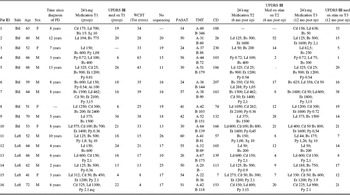
Descriptive data on participants are presented in Table 1. Data on education, medication, and time since PD diagnosis were retrospectively collected from patient files. Data on age and time since PD diagnosis were estimated by subtracting year of birth from year of PD diagnosis and year of surgery, respectively. The data included in this manuscript were obtained in compliance with the regulations of our institution and the guidelines of the Helsinki Declaration.
Descriptive data of participants in the study. PD = Parkinson's Disease. UPDRS = Unified Parkinson's Disease Rating Scale. WCST = Wisconsin Card Sorting Test. PASAT = Paced Auditory Serial Addition Task. TMT = Trail Making Test. CD = Claeson Dahl test of Learning and Memory. Sg = Selegeline. Bk = Bromocriptine. Cd = Carbidopa. Ld = Levodopa. Bs = Benserazid. Pp = Pramipexole. Et = Entacapone. At = Amantadine.

Surgical Procedure
The surgical procedure has previously been described elsewhere (Blomstedt & Hariz, Reference Blomstedt and Hariz2006). Targets, coordinates, and trajectories were identified and calculated on T2-weighted stereotactic MRI using the Frame Link planning station (Medtronic, Minneapolis, MN). The target was chosen at the level of the maximal diameter of the red nucleus, at a line joining the anterior borders of these nuclei, approximately 1.5 mm lateral of the medial border of the STN. The procedure was performed in local anesthesia and the effect of stimulation with intraoperative macrostimulation using the DBS electrode (model 3389, Medtronic) was clinically evaluated. Microelectrode recording was not used. A stereotactic CT was performed during surgery and the images were fused with the preoperative MRI for verification of the electrodes’ positions.
Test of Speech Lateralization
All participants who received unilateral treatment were right handed. These participants were, furthermore, before surgery, tested for speech lateralization by means of a dichotic listening task for ear preference (Hugdahl & Asbjörnsen, Reference Hugdahl and Asbjornsen1994). In all patients but one, results showed a right ear advantage, consistent with speech lateralization to the left hemisphere (>10% right ear advantage on nonforced attention and on total ear advantage score). For the last patient, results were inconclusive (<10% left ear advantage on nonforced attention and <10% right ear advantage on total score).
Clinical Follow-up
Patients were followed up clinically at 6 and 12 months. At these times as well as preoperatively ratings of motor behaviour according to the Unified Parkinson's Disease Rating Scale (UPDRS-III) were performed by the same research nurse. Scores for each patient, with stimulation and medication on, is presented in Table 1.
Psychological Tests
A first set of neuropsychological tests was administered to the participants by one clinical psychologist (B.H.) before surgery. New tests were administered approximately half a year after surgery and finally between 1 and 1.5 years after surgery. (The last of these occasions will below be referred to as the “1.5-year follow-up”.) The tests were administered with the stimulation activated and no tests were performed off stimulation. However, we were unable to test one female, 40-year-old patient operated bilaterally at the 6-month follow-up, which means that only nine bilaterally operated patients were tested at this time. This patient did, however, participate in the 1.5-year follow-up. Furthermore, for the sake of brevity and since effects of DBS STN on verbal fluency was the focus of this study results from both the 6-month and the 1.5-year follow-up will be described below with regard to this variable only, whereas only preoperative results are described for some of the other tests (Table 1).
Verbal Fluency
Participants were tested for letter fluency by being asked to say as many words as possible beginning with the same letters during 1 minute. Every other patient was tested with the letters F, A, and S, respectively, and every other patient with K, F, and L, respectively. These tests were switched for each patient at the 6-month follow-up and then switched back at the 1.5-year follow-up to avoid learning effects (c.f., Troyer, Reference Troyer2000). They were tested for category fluency by being asked to name either animals or fruits during similar conditions and according to similar principles (Gladsjo, Miller, & Heaton, Reference Gladsjo, Miller and Heaton1999).
Wisconsin Card Sorting Test (WCST)
This test exists in several versions. Since the patients tested all suffered from more or less severe motor problems due to PD we chose a computerized form of the relatively brief 64 test card version (Kongs et al., 2000).
Attention and Working Memory Tests
Number sequencing (Lezak et al., Reference Lezak, Howieson and Loring2004), a modified version of the Paced Auditory Serial Addition Task (PASAT) (Gronwall, Reference Gronwall1977) and the Trail-Making Test (TMT) (Corrigan & Hinkeldey, Reference Corrigan and Hinkeldey1987; Reitan, Reference Reitan1958) were administered.
The Claeson-Dahl Test of Learning and Memory (CD)
This is a verbal supraspan list-learning task. A list of 10 words is presented to the patient in an initial learning phase in which the patient is instructed to learn as many words as possible. Thirty minutes after completion of the learning-phase delayed memory is tested by means of free recall. After completion of the delayed free recall phase recognition memory of the words is tested in such a way that the words from the list is presented among distracter words and the patient task is to pick the words that were presented in the original list. Last, incidental memory of the temporal order of the words is tested (Claeson, Esbjörnsson, Tännérus, & Wahlin, Reference Claeson, Esbjörnsson, Tännérus and Wahlin1998).
Statistical Analyses
Changes in measures of verbal fluency relative to baseline data were analyzed for the two groups respectively by means of 2 (unilateral vs. bilateral surgery) × 3 (time of testing) repeated-measures analyses of variance (ANOVAs). In addition, Student's paired t test was used to compare data within groups and unpaired t test was used to compare data between groups. For purposes of post hoc testing an index for deterioration in verbal fluency was constructed so that follow-up fluency scores for each patient was subtracted from the baseline score and these measures of deterioration were compared between groups.
Results
Descriptive Data and Baseline Differences Between Groups
The baseline data on the Wisconsin Card Sorting Test revealed a significant preoperative difference between groups so that those patients who were subsequently unilaterally operated made significantly fewer errors than those subsequently operated bilaterally (t(14) = 4.524; p < .001). Baseline differences between results on other psychological tests were not significant. There was also a tendency for unilaterally stimulated patients to receive surgery earlier after initial PD diagnosis (M = 5.2 years; SD = 2.9) as compared to those receiving bilateral stimulation (M = 8 years; SD = 3.1), although this difference did not quite reach significance (t(13) = 1.7934; p = .096). There were no significant differences in UPDRS-III scores between the groups either preoperatively or at any of the follow-ups.
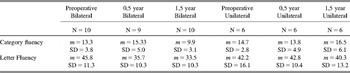
Category Fluency
Data for Category Fluency are presented in Table 2. A 2 × 3 ANOVA revealed no significant main effect of time of testing (baseline, 6 months, or 1.5 years) but a significant interaction between this variable and type of surgery (unilateral or bilateral) (F(2) = 4.852; p = .016).
Mean scores for category and letter fluency for patients operated with bilateral and unilateral STN DBS, preoperatively and at 0,5 and 1,5 year follow up
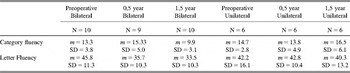
There were no significant changes in Category Fluency scores between baseline and 6-month testing for either the unilaterally or bilaterally operated group. However, at the 1.5-year follow-up, there was a significant deterioration in verbal fluency for the group operated bilaterally (t(9) = 2.940; p = .016) whereas the group operated unilaterally showed no significant changes. Furthermore, the difference in the level of deterioration between the baseline test and the 1.5-year follow-up test between groups was significant (t(14) = 2.609; p = .0206).
Letter Fluency
Data for Letter Fluency are also presented in Table 2. A 2 × 3 ANOVA revealed a significant main effect of time of testing (baseline, 6 months, or 1.5 years) (F(2) = 4.540; p = .02) and a significant interaction between this variable and type of surgery (unilateral or bilateral) (F(2) = 3.462; p = .046). There was a significant tendency for the whole group to deteriorate in verbal fluency between baseline and the 6-month follow-up (t(14) = 2.294; p = .038). But this deterioration was only significant for patients operated bilaterally (t(8) = 3.986; p = .004). The difference between the amount of deterioration occurring in the unilaterally and bilaterally operated groups respectively at this time was significant (t(13) = 2.453; p = .0291). At 1.5 years, the deterioration in verbal fluency for the group as a whole was even stronger (t(15) = 3.633; p = .002). Again, the deterioration was only significant for those operated bilaterally (t(9) = 4.16; p = .002) and the difference between the amount of deterioration that occurred in the different groups between baseline and the 1.5-year follow-up was significant (t(14) = 2.579; p = .0219).
Discussion
In this study, we set out to investigate whether deep brain stimulation (DBS) of the subthalamic nucleus (STN) in the speech dominant hemisphere would have the same effects on verbal fluency as bilateral STN stimulation. The results suggest that this is not the case. That is, the effects of unilateral stimulation of the STN on verbal fluency are marginal as compared to the effects of bilateral stimulation at least when followed-up after 1.5 years.
That is, the six patients who were stimulated in what appears to have been the speech dominant hemisphere had less deleterious effects on both letter and category verbal fluency than patients who were stimulated bilaterally, when followed up approximately 1.5 years after surgery.
Some limitations of this study should be taken into account when interpreting these data. The most important one is that allocation to either the unilateral or the bilateral group respectively was not random. Instead participants were selected for left-sided unilateral surgery on the basis of the fact that their motor symptoms were primarily perceived as confined to the right side. The fact that the left basal ganglia may thus be assumed to be more affected than the right may have attenuated effects of DBS on the dominant side, including effects on verbal fluency. The group stimulated unilaterally also had significantly better baseline results on one of the neuropsychological tests (WCST) and they tended to be operated earlier after receiving their initial PD diagnosis. One reasonable explanation for these finding is that the group operated unilaterally may represent patients who were at an earlier stage of the disease. Provided that this could have differentially influenced the neurophysiological organization underlying verbal fluency this may possibly have influenced our results and future studies should examine this further.
Another limitation is the relatively small number of participants. Even if the number of participants was apparently large enough to find effects using a repeated measures design, the sample may possibly have been sensitive to single atypical cases/outliers or imbalances in the distribution. Although this may be a minor problem considering the relative robust characteristics of the ANOVA method (Howell, Reference Howell1992) the issue does highlight the need for further replications of our findings.
In summary the results of the present study lead to two important main conclusions. First, from a neuropsychological point of view our observations seem to suggest that STN involvement in verbal fluency is not necessarily confined to the speech dominant hemisphere.
Second, from a clinical point of view the results suggest unilateral, or if needed, staged bilateral STN DBS procedures in PD patients may be associated with less negative side effects on verbal fluency than initial bilateral procedures.
Acknowledgments
The information in this manuscript and the manuscript itself has never been previously published neither electronically nor in print. This work was supported by grants from the University of Umeå and from the Foundation for Clinical Neuroscience at the University Hospital of Umeå. Marwan Hariz is supported by the Parkinson Appeal U.K. He has occasionally received honoraria from Medtronic for speaking at meetings. Dr. Linder served on the scientific advisory board for Glaxo Smith Kline, H Lundbeck, and Boehringer Ingelheim and received lecture honoraria from Medtronic Inc., Solvay, Orion Pharma, UCB Pharma and Nordic Infu Care. The authors have nothing further to acknowledge.