The politics of quality over quantity
At present, the harvest is in and our cellars are full. The concern of production is over, it's now a matter of figuring out what we are going to do to turn this wine into money.
Claude Chatelus, ‘Après les Vendanges’ (1934)The French wine industry surmounted a dizzying variety of challenges between 1871 and 1940.Footnote 1 Burgundians needed to look no further than their own cellars to gauge the effects of stiff competition and glutted markets. They responded by developing cultural marketing practices that addressed all aspects of wine production and consumption. An important aspect of this project was to articulate a rustic ‘fable of identity’ that provided an enchanted ‘sense of place’ and a restorative economic agenda.Footnote 2 To this end, Burgundians developed the concept of terroir to identify the qualities of their wines in terms of geo-climatic origin and authenticated methods of production. This allowed uniquely regional products to be marketed through a novel repertoire of wine festivals and gastronomic fairs. The result united natural resources, historical memory, marketing strategies, and cultural performance into an imaginative and enduring form of commercial regionalism that other French regions have since emulated.
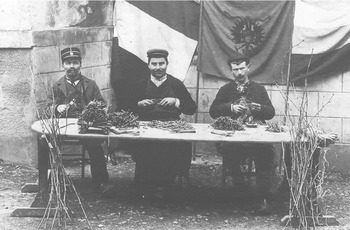
The challenges confronting French wine-producing regions during the late nineteenth and early twentieth centuries were collectively known as ‘the wine crisis’ (la crise du vin). Lasting nearly three quarters of a century, the wine crisis haunted the industry's biological, legal, sociological and economic vectors. Three biological blights of American provenance (imported with infected vines) – phylloxera (particularly between 1863 and 1900), mildew plasmopora viticola (1884), and black-rot uncinula necator (1898) – directly attacked the leaves, fruit and roots of French vines. The blights were partially controlled by the application of sulphur and copper fungicides (by les sulfureurs) but were finally eliminated only after cultural resistance to grafting French vines on to American roots was overcome (by les américanistes). This massive process allowed for new vineyards to be planted in neat rows amenable to tractor cultivation. A gradual recovery was also aided by oenological improvements in the industrial fermentation, stabilisation and preservation of wines. Despite, and in part because of, these advances, the period immediately after the First World War was characterised by general overproduction, increasing production costs compounded by lowered profits, growing competition from Australia and Algeria (the latter officially a département of France), innovatively fraudulent practices and the ever-present threat of union activism and labour radicalisation – as had happened in the Midi region (1907) and in Champagne (1911). Gains made during early 1920s were again offset by US and Scandinavian prohibition(ism), high foreign import taxes, continued foreign competition and a general slump in demand caused by the economic depression of the 1930s.Footnote 3
The early 1930s witnessed the introduction of new measures, collectively known as the Statut de la viticulture, and intended to reduce wine production and maintain prices.Footnote 4 The Statut de la viticulture (Viticulture Regulations) limited production by imposing a ten-year ban on the planting of new vines by any growers already cultivating 10 hectares or producing more than 500 hectoliters of wine. A prime d'arrachage (a subsidy for tearing down vines approved in 1934 and implemented in 1936) required all vineyards whose overall acreage had expanded more than 5 per cent since 1924 to destroy 10 per cent of their vines. To discourage overproduction, subsidies were offered on wine not produced in excess of 100 hectolitre per hectare. Another measure required wines produced in excess of allowable limits and, by definition, in excess of what the market could absorb. This had the unintended consequences of bolstering the spirits and ‘cooked wine’ industry that competed against the vintners’ wines. Most drastic, and not without following substantial debate, was the introduction of a minimum pricing index (prix social) to support small producers. Another law, with arguably the longest-lasting impact, sought to regulate quality by prohibiting the use of hybrid varietals for commercial purposes. Far short of resolving the wine crisis (crise du vin), if not entirely ineffective, the Statut de la viticulture regulations angered vintners, who perceived themselves attacked rather than supported by the new policies. Conditions in early 1937 remained so difficult that Burgundian vintners wondered whether or not to tear out their vineyards and turn to farming instead.Footnote 5
Grafting instructors during the phylloxera epidemic (postcard c. 1895), courtesy Jean-François Bazin.

In fact, Burgundians were not ready to concede defeat. They have aggressively and successfully marketed the reputation of their wines since harvesting their first Pinots in the 1370s. The Ordinance of Duke Philip the Bold (Philippe le Hardi) of 1395 asserted that Burgundy produced the ‘best and most precious wines imaginable for the nourishment and sustenance of human creatures’.Footnote 6 Considering their wines to be worthy of the popes and kings they entertained, the dukes and bishops of Burgundy inaugurated a politics of taste. Their strategy proved viable (especially in a day when the chemical properties of fermentation remained more mysterious than understood or controlled), and continues to market and sell regional vintages into the twenty-first century. Gaston Roupnel, president of the Syndicat de Gevrey-Chambertin, reminded contemporaries how ‘It must be recognised that it is to an incessant miracle of human labour that the wine owes its character and preservation. Our premier Burgundian wines are as much the children of human effort as the products of the soil.’Footnote 7 This legacy would require the development of new cultural and marketing strategies during the inter-war period.Footnote 8
Promoting an agenda of quality over quantity in 1924, Claude Chauveau (1861–1940) reminded vintners and merchants that they were ‘too modest in their dreams and demands’.Footnote 9 As the senator for the Côte-d'Or (1910–40) and briefly, in 1932, minister of agriculture, Chauveau knew that it was in the region's interest to produce quality wines that could attain high prices. Even Joseph Marie Capus (1876–1947), first a deputy (1919–28) and then a senator (1930–41) for the Gironde and one-time minister of agriculture in 1924 under Poincaré, who famously opposed AOC (appellation d'origine contrôlée) strategies based on terroir rather than domaine, as the former threatened to undermine Bordelais labelling practices based on the reputation of estates, argued that successful marketing depended on quality originating at the level of ‘disciplined production’.Footnote 10 He was rewarded for his efforts by being nominated president of the Institut national des appellations d'origine contrôlée from 1941 to 1947.Footnote 11 Simultaneously in Burgundy, Claude Chatelus reminded readers of the regional agricultural weekly, Terre de Bourgogne, that they could only compete with new competitors benefiting from equally good bio-physical milieux provided that producers focused on transforming the uniqueness of their terroir – rather than producing “fantasy labels” into quality wines.Footnote 12 After his initial reluctance (motivated by important connections with Bordelais estates and merchants throughout France) Raymond Badouin, the editor of the prestigious and very influential Revue du vin de France, joined in favouring AOC legislation in 1931 when he asserted that ‘[w]e are defending French vintners against “fabricators”. We enlighten consumers about the qualities of our country's different varieties, on the methods practised in the vineyards, and the quality of the vintages.’Footnote 13
Despite regular good and exceptional vintages (notably in 1911, 1915, 1923 and 1929), poor sales remained a pressing problem for Burgundy's overstocked cellars.Footnote 14 Dr Foveau de Courmelles, an advocate of ‘fermented grape juice in its multiple forms’ and a member of the Congrès des Médecins amis du Vin, lamented that ‘wine, far from respected, was . . . hated and blamed for all of our problems’.Footnote 15 Even the economic recovery of 1925 provided little relief. Richard Bichet, the secretary-general of the Confederation of Vintners Associations of Burgundy, still believed that ‘ordinary Burgundian wines’ suffered from a ‘grave crisis’, with sales and profits so low that vignerons (vigneron in the Burgundian context designates both a winegrower and a winemaker who may or may not market his own wine) continued to lose money.Footnote 16 A local anecdote humorously alleged that desperate and cunning wine merchants read obituaries in order to fill fraudulent orders.Footnote 17 ‘More than ever’, the vintner Gaston Roupnel wrote during the subsequent economic downturn of the 1930s, ‘discomfort and misery in the vintners’ modest homes results from poor wine sales’.Footnote 18
The vinification of terroir
More than an occupation, the cultivation of the vine is an art . . .. The vintner's knowledge of drawing a good wine from his harvest entails pain and perseverance.
Arnold Van Gennep, Le Folklore francais (1949)The formation of a commercially viable Burgundian folk identity revolving around the celebration of wine necessitated the (re)territorialisation of a broad range of existing and new practices in terms of terroir. As identity and place are mutually constituted, historically contingent, socio-spatial constructs, not since nineteenth-century neo-Romantics first identified patrimoine as a shared national resource have emotional responses to landscape and its products been so adroitly harnessed to a project of identity formation. Endowed with symbolic power and emotional appeal, wine serves as a powerful cultural tool.Footnote 19 Gilbert Garrier reminds us of wine's religious, honorific, alimentary, medical and tonic uses throughout French history.Footnote 20 Exuding the confidence of nineteenth-century social positivists, provincial notables and regional leaders made careers during the inter-war period by reducing Burgundy's history, culture and geography (past, present and future) to the seductive operations and necessary determinants of terroir. By the early twentieth-century both the consumption of wine and the geography of terroir had become ‘fundamental references’ to French cultural identity.Footnote 21
The relation between French society and its bio-physical environment was systematically examined through the works of Paul Vidal de la Blache.Footnote 22 Vidal examined the liaisons between social activities and bio-physical milieu to focus on the functional integration of place, livelihood and social organisation into both unified patterns of daily life and localised cultural landscapes.Footnote 23 His ‘Introduction’ to the Principles of Human Geography offered an enhanced ecological understanding of a historical geography that emphasised the interactions and complex bonds between society and terroir.
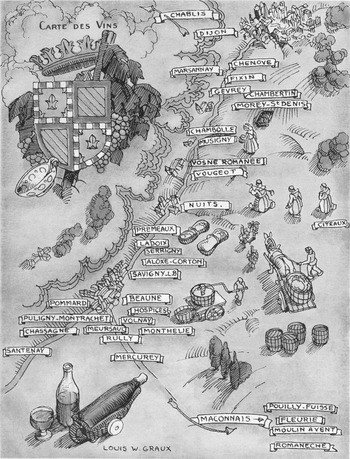
A folklorised map of the terroirs associated with viti- and viniculture of the Burgundian Côte-d'Or: ‘As the signs succeed one another – Meursault, Volnay, Beaune, Aloxe-Corton, Nuits-Saint-Georges, Vosne-Romanée, Gevrey-Chambertin – you are pursued by the illusion, like Alice, magically reduced in size so that you are able to crawl like a minute insect along a magnified wine card’. Waverly Root, The Food of France (New York: Vintage, 1992), 173–4. Woodcut by Louis William Graux (1936), rights reserved.

Discussed since the seventeenth century, the polymorphous concept of terroir found its greatest practical expression and cultural resonance in twentieth-century Burgundy. ‘Burgundians’, notes James Wilson, ‘are very nearly Freudian about the influence of the soil in shaping the character and the quality of their wine.’ Acknowledging that the ‘true concept is not easily grasped’, he defines terroir as ‘the totality of the elements of the vineyard habitat’. In addition to the ‘physical elements of the vineyard habitat, the vine, subsoil, site, drainage and microclimate’, Wilson includes a spiritual component: ‘beyond the measurable ecosystem, there is an additional dimension – the spiritual aspect that recognises the joys, the heartbreaks, the pride, the sweat and the frustrations of its history’.Footnote 24 Convinced that ‘one cannot make sense of Burgundy without investigating the notion of terroir’, Matt Kramer asserts that ‘the mentality of terroir [although not uniquely Burgundian] . . . reaches its fullest expression there’.Footnote 25 Indeed, to a review of previous scholarship analysing the micro-climactic and geological influences that contribute to the production of Burgundian wines, Jean-Robert Pitte reflects on the region's unique cultural history:
Would the burgundies enjoy such prestige if the coast they came from were not situated close to the ancient capital for the dukes [of Burgundy] and a major travel route for medieval Europe, leading both to the Parisian basin and toward the northern plains? Would the Cîteaux monks, vowed to asceticism, have perfected the viticulture of their Vougeot vineyard to such an extent if they hadn't received all Europe's mighty and powerful at their abbey?Footnote 26
Burgundians consciously (re)produced this mytho-historical discourse to market their wines during the inter-war period. The Burgundian novelist Colette insisted that wine provided the most direct expression of terroir: ‘In the vegetal realm, only the vine renders intelligibly the true essence of the soil. What faithful translation. The secrets of the soil are expressed through the grape.’Footnote 27 They employed the système d'appellation d'origine controlée to ontologise links between regional folkways and the characteristics associated with distinct geographical terroirs.Footnote 28 By mid-century, this project was enthusiastically if uncritically absorbed and ideologically elevated to the level of analytic explanation, such as, for example, in Waverly Root's comparison of burgundies and Bordeaux:
from the region of the swashbuckling Grand Dukes of the West, the lusty sons of inland soil, grown where men lived close to the land, remained rustic in richness, and exerted their own influence outward more readily than they welcomed other influences directed inward, is full-bodied, strong, earthy . . . A great Burgundy is like a country gentleman grown wise in the skillful cultivation of his lands.Footnote 29
‘Even in a nation with a rich democratic tradition’, Kolleen Guy observes, ‘all wines were not . . . equal’.Footnote 30 The marketing of Burgundian wines in terms of terroir was successful where it sustained existing cultural interests.Footnote 31 To this end, civic leaders turned to provincial cognoscenti to articulate regionally anchored cultural agendas that could embrace both modern industrial practices and conservative social values through the mechanism of ‘applied folklore’.Footnote 32 Eschewing the politics of Jean Charles-Brun's reconciliatory, Christian regionalism or the atavistic, nationalist monarchism of Charles Maurras, the Burgundian cultural agenda turned, instead, to regional folklorists.Footnote 33 These men provided a core of valuable ethnographic observations that sought to ‘(re)cover’ an essentialised, rustic and traditional cultural identity that could provide an alternative to the generic model of ‘modern’, anonymous, urban and bureaucratic national French identity. Gaston Roupnel studied the folkways of the vignerons of the Dijonnais in La Bourgogne, types et coutumes (1936), and Gabriel Jeanton's research for Le Mâconnais traditionaliste et populaire (1920) rested on an analysis of the Mâconnais vignerons.Footnote 34 They anchored Burgundian cultural identity in the terroir of the region (pays), represented by an ideal folk type – the rustic Burgundian vigneron: ‘To know you . . . one needs only to listen to you and watch you live’, claimed Roupnel.Footnote 35
Roupnel expanded the concept of terroir beyond its geo-climatic dimensions in Burgundy: Characters and Customs, to emphasise folk practices associated with regional viticulture and viniculture. This work fashioned a dynamic and rusticised Burgundian vigneron endowed with ‘a rude and jovial sense of social life; a solid and dedicated intelligence; and a quick and firm mind’ as providing a refreshingly modern and reassuringly rustic model of French labour. Inhabiting idealised villages whose ‘narrow intimacy’ fostered habits of modern sociability, these half-rural/half-urban vignerons refashioned French rural identity in terms of a distinct regional model that promised both change and stability: ‘it is in the vigneron's villages that developed the vigorous and alert Burgundian spirit in which vivaciousness is associated with the calm millennial forces emanating from the earth’.Footnote 36 By virtue of quotidian activities within the Edenic space of their vineyards, Burgundian ‘folk’ enjoyed a privileged relation to terroir's eternal, transcendent and metaphysical properties.
The nostalgic exploitation of terroir's rustic mystique in contemporary marketing practices was evident, for instance, in the commentary that accompanied a promotional film on Burgundian tourism called ‘Vacation’. Roupnel provided the accompanying text that used the vigneron's language (mâche, chaleur, et flamme) to underscore the link between the transcendent and material characteristics of local vintages.
Burgundian wine contains more than the banal voluptuousness of one sense. It is more than the joy of a gourmand or the emotion of a gourmet. While it exalts our physical forces, it also nourishes our spiritual forces with joy and courage. Wine comes brimming with happiness and joie de vivre . . . euphoria, as would say some doctors. It invests you with its magnificent activity. It gives you the great abundance of a happy and moving soul . . . To say it all, this good wine is complete . . . it unites and reconciles the most contradictory qualities: perfumed . . . like a great lady, confident and generous like a gallant.Footnote 37
The ubiquity and popularity of early twentieth-century Burgundian viticultural folklore stands in sharp relief against the paucity of its own traditions.Footnote 38 The eminent folklorist Arnold Van Gennep noted that, despite late nineteenth- and early twentieth-century efforts to link viticultural ceremonies to ancient traditions evidenced in articles alleging links to Bacchic, pre-Celtic, or early Christian traditions, nineteenth-century folkloric traditions related to vini-viticulture remained underdeveloped relative to other agricultural cycles.Footnote 39 Indeed, a decree of 18 August 1792 suppressing corporations had the effect of secularising religious confraternities in France. In the Burgundian Côte-d'Or – a centre of Cistercian influence until the end of the Ancien Régime – the Confrérie de Saint Vincent simply became the Société des Vignerons. Henri Vincenot explained the continuing absence of religious figures as resulting from a combination of nineteenth-century republican hostility and the Catholic Church's own censorship of ‘retrograde and pagan superstitions’.Footnote 40 The contentiousness surrounding the selection of one saint over another sometimes prompted the Second Empire to disband politicised fraternities. Fifteen different saints – including Bernard, Martin, Sebastian and Vincent – were recognised by Burgundian vignerons as patrons only in the mid-nineteenth century.Footnote 41 The church exercised its influence on annual religious processions to honor Saint Vernier, while radical and socialist workers’ associations with more profane interests preferred the benedictions of Saint Martin. Seeking to maintain control of their own affairs and to avoid legal difficulties, vignerons of the 1860s simply and collectively adopted the fourth-century martyr Vincent of Saragossa as their patron saint to protect their labours and wines.Footnote 42 By the 1930s, vintners easily conflated terroir's religious and secular narratives to lyrically promote their regional varietals. The event resembled a Corpus Christi celebration dedicated to secular pursuits. On the occasion of the feast of Saint Vincent on 22 January 1938 in Chambolle-Musigny, the sermon of the abbé Edouard Krau of Vosne-Romanée's sermon, entitled ‘Saint Vincent, Patron des Vignerons’, likened vintners who produced ‘the wine that signified the Lord's sacrificial body’ to the apostles of Jesus. He continued the analogy the following year by likening the vintners' need to market their wines to a spiritual and ennobling crusade.Footnote 43 Since then, writes Jean-Robert Pitte, ‘one or several bishops have come every year for the occasion, marching in procession amid the banners and statues of Saint Vincent, in the cold of January, before celebrating mass, listening to a colorful sermon, and, finally sitting down to a fortifying banquet accompanied by ample quantities of wine’.Footnote 44
The Burgundian campaign for the Système d'appellation d'origine contrôlée
Personal selfishness and general indifference have created the situation in which we find ourselves today . . . I'm not unaware that most if not all would like to see the [AOC] laws applied to their neighbours but not to themselves.
Albert Noirot, ‘Les appellations d'origine contrôlée’, Le Bien Public, 19 February 1936, 7The concept and mechanism of terroir withstood challenges from competing and discordant small proprietor, local co-operative and corporate industrial interests.Footnote 45 Burgundians who supported a concept of terroir that identified the merits of regional wines in terms of geographic origins and their methods of production collaborated successfully to defend the Système d'appellation d'origine contrôlée (AOC) in court.Footnote 46 Jean-François Bazin notes that self-help organisations representing the professional interests of co-operative cellars, growers, merchants and a few agricultural labourers (as in Ladoix-Serrigny in 1930) gradually converged – despite their competing interests – to support the making and marketing of quality wines during this period.Footnote 47 From serving as president of the Syndicat des viticulteurs de Chambertin to authoring essential tracts that anchored the AOC system in the Bugundian notion of terroir, Roupnel figured prominently among Burgundy's key inter-war cultural intermediaries. He contributed considerable rhetorical talents and his national professional academic reputation to promoting Burgundy's wines. Contemporary sources celebrated Roupnel's efforts ‘to serve the cause of wine’.Footnote 48 He wrote an influential article for the Dépêche de Toulouse in 1922 that identified the principle causes of ‘la crise du vin’. Speaking as a respected vintner from Gevrey-Chambertin, Roupnel stressed in his analysis the impact of import and export taxes on wine and the questionable quality of so-called fine wines:
First we have to understand among ourselves: there's wine and then there is wine. Ordinary wine continues to find the outlets it needs in France . . . It is in external markets . . . where fraudulent practices of frightening proportions take place . . .that resides the veritable cause of the wine crisis.
He further argued that ‘the majority of wines sold behind respectable labels are more often the product of the chemist's laboratory rather than the vintner's cellar’. The remedy, he urged, rested with vintners themselves: ‘Follow the example of the young mayor of Dijon [Gaston Gérard] who travels abroad to further the interests of French wines. You must imitate his initiative and counter foreign propaganda [US and Scandinavian prohibitionism] with French propaganda.’Footnote 49
By 1931 the Association viticole de la Côte-d'Or threw its support behind legal measures that would ‘assure the profitable [rénumératrice] sale of agricultural products . . . such as wines needing protection from foreign (and colonial) competition in the métropole’.Footnote 50 The producer of slightly more than 40 per cent of European wines in 1931, France only exported 2.5 per cent (as compared with 17 per cent by Italy, 37 per cent by Greece, and 28 per cent by Portugal).Footnote 51 Given Burgundy's difficulty in selling its wines during the glut conditions of the 1920s and the depression of the 1930s, Roupnel turned to journalism. He crossed swords with Colette over her public support for the mixed and less expensive vin de marque (labels) marketed by unscrupulous négociants (merchants).Footnote 52 Roupnel championed, instead, the regionally delineated vin de cru or vin de vigneron alleged to preserve the links between vintage, folkways and terroir – the specific geographical location and conditions under which it was grown and produced.Footnote 53 This literary intervention gave national prominence to a debate raging throughout Burgundy. A dinner held for concerned parties at the Ramponneau restaurant in Dijon on 24 January 1927, for instance, staged a debate concerning the relative merits of vin de cru and vin de marque provocatively described in a flyer distributed to attendees that included important merchants including Albert Geisweiler, Jean Legrand and Thomas Bassot: ‘we wish to make you judges in a quarrel that divides Burgundy, where the vins de marques are created with an eye to destroy the vins de crus.’Footnote 54 By 1932 Gaston Gérard, the major of Dijon, contributed to this campaign when he told the delegates of the Assemblée générale du Syndicat viticole de la Cote-d'Or, ‘let's not fight over quantity or price but, rather on our own terms – quality’.Footnote 55
Etienne Camuzet (1867–1946), mayor of Vosne-Romanée (1900–29) and a deputy for the Côte-d'Or (1902–32), mobilised regional support for the legal implementation of stricter labelling practices and the regulation of fraud in the wine industry by means of the AOC system.Footnote 56 This association entailed the development of a formidable working relationship between Roupnel and Albert Noirot, the outspoken lobbyist for the protection of the proprétaires-viticulteurs in the southern Côte-d'Or.Footnote 57 They had to contend with an equally strong, well-organised and capitalised lobby of merchants within Burgundy. The influential Albert Rossigneux of Geisweiler and Sons, for instance, argued strongly and persuasively against the implementation of AOC regulations before the Commercial Union of the Commune of Nuits-Saint-Georges on 4 October 1909.Footnote 58 His main points were that territorial delineation did not guarantee quality as wines changed from year to year, that the system of labels associated with a particular merchant or commercial firm did more than anything else to promote honesty, and that very little kept dishonest vintners or merchants from fraudulently identifying their stocks.Footnote 59 As late as 1923, the president of Beaune's chamber of commerce, Charles Bourchard père, still resisted efforts – such as the ministry of agriculture's continued interest in the stamps or labels of authenticity (Rossigneux’ ‘La Vignette de Garantie’) – on the grounds, ostensibly, that they entailed too many administrative and bureaucratic difficulties which in turn would worsen ‘the situation’.Footnote 60
A further wrinkle in garnering support for the AOC system was the fact that the adjudication through civil courts of newly delineated terroirs and their corresponding place names – some phantasmagorical – created suspicious place names and fraudulent trading on the reputation of others.Footnote 61 In addition, some argued that the labelling practice was so widely dispensed that many mediocre wines could now compete with ‘fine’ wines as a result of having gained a new cachet of distinction, while excellent vintages were denied just recognition.Footnote 62 Joseph Capus continued to address these limitations, contradictions and perturbations of the new AOC system through numerous articles.Footnote 63 Others despaired, or pretended to, arguing that practices hitherto ‘traditional’ made one an outlaw and consumers unjustifiably wary:
Until now, when [the consumer] wanted a burgundy, he asked for one under the name of a village or a Burgundian location, and he was served wine that he liked. At bottom, he didn't know and little cared, that what he drank under the name of Chambertin came from the village of Morey, or that which he bought under the name of Pommard came from the commune of Santenay or Chassagne. Today we tell him that such practices are fraudulent and he no longer understands anything nor which saint to pray to.Footnote 64
From 1924 to 1936 the vintner Albert Noirot of Vosne-Romannée, the lawyer Louis Fyot of Dijon, Georges Gouges of the Syndicat générale de la Côte-d'Or, the Marquis Sem-Claude d'Angerville of the Fédération viticole de Beaune, and Gaston Roupnel collaborated in the series of important legal cases collectively know as the ‘Côte-de-Nuits’ trial which finally succeeded in anchoring Burgundian labelling practices in terms of terroir.Footnote 65 Following numerous and contentious hearings, the process culminated in the 30 July 1935 AOC law on labelling practices. Léon Blum's minister of the budget, Charles Marie Spinasse, assured the Revue du vin de France of the government's support for a policy of quality over quantity: ‘The era when we could sell anything to anybody at any price is over. We must produce quality products to retain the loyalty of our foreign customers.’Footnote 66 The Revue's editor, Raymond Badouin, who agreed that the pursuit of high-quality wines should be a collective goal and endeavour, wrote, in a response to Noirot and Roupnel's ‘Open Letter to the Minister of Agriculture’ in 1935, that despite the spate of AOC legislation, he had tasted a 1923 Clos Vougeot with an ‘odour of distant camel caravans’, thereby suggesting it was a north African wine fraudulently parading as one of Burgundy's finest.Footnote 67 Indeed, lingering hostility was such that, even after the new terminology was accepted by the Federation of Viticultural Associations of the Côte-d'Or as AOC legislation requiring on-going and onerous discrimination, definition, delineation, and distinction (such as the prohibition of planting certain varietals in regions delimited otherwise),Footnote 68 Noirot somewhat disingenuously argued that he was merely working to ameliorate the application of laws imposed, however much necessary, by the government: ‘First we want to clarify that these projects are not born of our initiative . . . our role is modest; it is not for us to dictate law. But we can amend it and bring to these reforms an attitude that is consistent with our interests and practices.’Footnote 69
Roupnel's support for the development of the AOC system along with his famous defence of the vignerons’ cru against Colette's vins de marque did more than help the ‘Maison Roupnel père et fils’ sell its Cazetiers and Mazoyères varieties. These interventions benefited growers along the Burgundian Côtes region, were interpreted as confirming his solidarity with the common folkFootnote 70 and positioned Roupnel as a respected authority and spokesperson for Burgundian economic and cultural interests.Footnote 71 Building on his reputation as an eloquent interpreter of Burgundy's historical and cultural traditions, Roupnel served as both a member of the first Commission régionale des appellations contrôlées in 1936–7 and the elected president of the Syndicat de Gevrey-Chambertin in 1936–8. In September 1937, leading vintners, merchants and politicians of the Burgundian Côte-d'Or convened in Nuits-Saint-Georges to listen to Gaston Roupnel's eagerly awaited report on measures necessary to ensure the equitable and successful application of the 1935 AOC laws.Footnote 72 His five major recommendations included the establishment of loans to finance vintners before harvests to ward off the temptation to undersell one another and thereby lower prices; the establishment of minimum prices for wine, with the penalty of jeopardising AOC certification for rogues; the creation of a vignette or seal to guarantee AOC claims; the suppression of false AOC appellations through hybrid or non-existent place names (‘marque de fantaisie’); and the creation of a committee specifically charged with lobbying government ministers in Paris.Footnote 73
Wine festivals and gastronomic fairs
On our arrival we found the annual Gastronomical Fair in full swing . . . A central avenue, leading off the Place Wilson, about a mile in length, is covered over and lined with booths . . . Every one in the Côte-d'Or is represented, and the other regions of France exhibit their wines as well. The great sport at the Fair is going from booth to booth tasting; a small glass is sold for a franc.
Gertrude Clark Powell, The Quiet Side of Europe (1959)Strategies employing the discourse of terroir and enacted through wine festivals and gastronomic fairs greatly benefited Burgundy's wine industry. Addressing the phenomenon of ‘reinvented memory’, Jean-François Bazin observes that Burgundian vineyards had forged wholesale traditions – presented as ancient but in reality born of the twentieth century – that represent a reinvented memory: ‘Burgundian intelligence and skill have made the vineyards the repositories for vintners’ collective memory, thereby allowing it to subsist or be reborn in modern times.’Footnote 74 The inter-war period saw the creation of numerous gastronomic and wine societies.Footnote 75
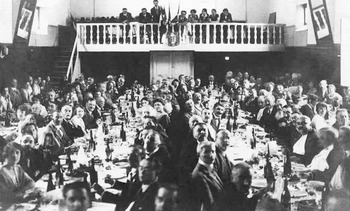
In 1923 the vintners Count Jules Lafon and Jacques Prieur ‘revived’ the traditional post-harvest dinner known as the paulée in order to ‘celebrate the glory of [Burgundy's] harvest and new wines’.Footnote 76 Lafon hoped that ‘everyone could find their place according to their fantasy’ at his ‘unique spectacle’.Footnote 77 Both were informed and prepared to exploit promotional techniques and strategies calculated to create lucrative and popular tourist events, with Prieur serving as general secretary of Meursault's chamber of commerce and Lafon as president of the regional club alpin.Footnote 78 The paulée, traditionally offered by proprietors to their labourers, was scheduled for just before or after the annual wine auction in Beaune. The Meursault paulée was shrouded in the same folkloric revival associated with Burgundian pseudo-historical folk revivalism and offered a long banquet and elaborately staged wine tastings.
A ‘revived’ Burgundian paulée for bourgeois tourists and local notables (postcard c. 1926).

Lafon and Prieur's strategy included the participation of the region's most illustrious personalities. An accompanying annual literary prize for a work best celebrating Burgundian wines was added in 1931 and awarded to Gaston Gérard, Edouard Estaunié and Gaston Roupnel among others. The event drew the attention of national celebrities such as Louis Forest, president of the Club des Cents and writer for Le Matin. In addition to revealing the panegyric heights to which the rhetoric of the ‘Religion of Wine’ could waft, the following speech, given at the Paulée de Meursault in 1931, underscored the event's conscious effort to link Burgundian commerce and tourism through the rhetoric of terroir:
The Gastronomic Fair! The Paulée! Such evocative expressions! Just to hear them, a fresh atmosphere charged with gourmand promises descends. Aromas dance and expand . . . as nostrils flare with pleasure; palates agitate; and taste buds shudder in anticipation of their solemn charge: the wine-tasting session. This is the moment when Nature, in its wild prodigality, spreads its moving splendour and bestows its riches upon us. This is when Wine is King; when Wine is God!Footnote 79
Such speeches illustrate how the participation of the region's cultural elite was instrumental in the cultural construction and literary promotion of consumer, tourist and ‘identity’ practices associated with Burgundian gastronomy. The Paulée's success and popularity were such that the National Committee for Wine Advertising imitated the event, hosting the first Paulée of Paris on 18 March 1932.Footnote 80
The Irish travel writer Stephen Gwynn visited Chenôve in October 1929. He discovered that locals had transformed the annual crushing of the grapes into a harvest festival event open to tourists and visitors. Taking advantage of Chenôve's proximity to Dijon and easy access provided by tram service, Paul Court, a local wine merchant, purchased the ancient stone wine vats and massive wine presses, built in 1238 by Alice of Vergy, the widow of Duke Eudes III, and thereafter belonging to the dukes of Burgundy. Gwynn describes the ‘rude beauty’ and ‘primitive and titanic’ spectacle achieved when ‘powerful carpentry’ crushed tons of freshly harvested grapes: ‘the weight of a block of stone weighing over twenty-tons . . . is raised and lowered by gigantic screws and lever beams. There is counterpoise, so that one falls as the other rises.’Footnote 81
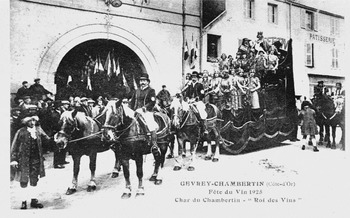
In Gevrey-Chambertin, locals revived the ‘Feast of King Chambertin’, the anthropomorphic composite of local vintages, in 1925 to represent ‘majestically’ that village's grand cru. Appealing to motorists (automobilistes) the regional newspaper – Progrès de la Côte-d'Or – reminded readers that King Chambertin (seen in Figure 4 in his elaborate chariot) would tour the village accompanied by two monks representing the lineage of the monastic Clos de Bèze, and an escort of twelve young maidens whose ‘charms and feminine graces correspond to the local terroir and symbolise the properties of its wines’.Footnote 82
King Chambertin accompanied by wine queens riding a float during the 1925 Fête du Vin in Gevrey-Chambertin (contemporary postcard).

Further south along the Côte-d'Or, the mayor of Beaune, Joseph Pétasse, continued a tradition (since 1859) of auctioning new wines in bulk (a minimum of 228 litres) by officiating at the event in the cellar of the fifteenth-century Hospice de Beaune on the third Sunday in November.Footnote 83 ‘In a long row of bottles all the new wines of Burgundy for the year are set out to be tasted, and visitors come by the thousands to try them and give their opinions. Buyers assemble from all the countries, and the auction goes on à la bougie; a taper is lit as each lot is put up, and the bidding finishes when the little candle has burnt itself out.Footnote 84 This sale measured the wine trade's opinion of the most recent vintages and thereby regulated the current value of burgundies.Footnote 85 Also aware of the ‘economic urgency’ to sell wines during the Great Depression, Mâcon's Georges Rozet further transformed the celebrated annual wine auction of Beaune into a festive two-day, Flemish tableau: ‘We had to create an direct, collective, and – in appearance – a disinterested marketing programme whose colorful nature would capture the imagination without being tedious or banal.’Footnote 86 Like other Burgundian folkloric cultural events, the auction was accompanied by parades, banquets, conferences, and additional dégustations. There, within the Hospice's ancient walls, ‘amateurs and merchants taste, compare and discuss under the dark beams, insofar as the ruby wine seduces them’.Footnote 87
Charles Bouchard recalled the event as a unique opportunity for buyers and amateurs, who hurried for the pleasure of buying a new bottle of good wine while informing themselves about the general quality of the harvest and the most promising wines of the year.Footnote 88 The auction promoted the prestige associated with the idea of purchasing wines directly from vintner-proprietors. The two-day spectacle showcased quality vintages (approximately 2,000 bottles) before an important and knowledgeable audience and provided a practical opportunity for collectively identifying promising wines to invest in.Footnote 89 Beaune's auction and wine festival easily lent themselves to media coverage; observers noted the presence of significant numbers of foreign merchants, regional dignitaries, celebrated restaurateurs and ‘notorious’ journalists.Footnote 90 The all-important Revue du vin de France drew national attention to this animated manifestation by dedicating an entire issue to Beaune's annual auction in 1931.Footnote 91
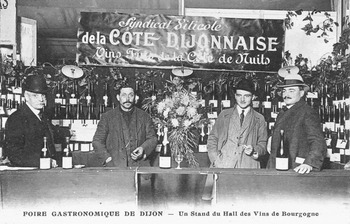
The successful merging of commercial and popular interests through marketing strategies at the regional level was evident in Burgundy throughout the 1920s and 1930s.Footnote 92 Dijon's Gastronomic Fair, notably, was an immediate success. The 1921 fair drew 80,000 visitors to a town of 80,000 and netted, according to the mayor of Dijon's neat formula, 80,000+ francs.Footnote 93 More precisely, Christelle Guilard has calculated that, for example, the 1926 fair grossed 828,977 francs and netted 92,722 francs after expenditures, salaries, free tickets and taxes; this was a considerable success that confirmed Gaston Gérard's recollection.Footnote 94 While the fair would not always generate the profit hoped for, especially during the late 1930s, attendance doubled annually, peaking in 1925 when 600,000 visitors came to see the wares of approximately nine hundred merchants.Footnote 95 Exhibits grew in number from 220 and – with great fluctuations – levelled off at 500, while attendance shrank back to an average of 175,000. While Dijon's Gastronomic Fair also drew exhibitors from around the world, it never ceased promoting Dijon's regional leadership. Nor did the influx of Parisian, national or international vendors threaten the fair's regional character.Footnote 96 Scheduled events and menus continued to reflect preponderantly the Burgundian agenda and provide extended marketing opportunities for local wares and regional products.Footnote 97
A wine-tasting stand at Dijon's gastronomic fair, c. 1930 (contemporary postcard).

Wine amateurs who gathered in the ‘Wine Alley’ at Dijon's 1931 Gastronomic Fair encountered quadruple rows of oilcloth-covered tables laden with artfully displayed wine-tasting glasses. The wine stalls, which, as they filled two contiguous rooms 50 metres long, could easily have constituted a fair of their own, drew the gaze of visitors with ‘coquettish installations’ calculated to impress the names of vintners, growers’ associations and commercial distributors. Memorable stalls included Victor Morot and Co.'s glass spiral staircase made entirely of coloured liqueur flasks and Antoine Rodeo's electrical windmill whose sails were covered in wine bottles.Footnote 98 The most successful innovation from the 1922 fair was the buvette-restaurant where visitors could rest, listen to music and continue to enjoy the regional vintages they sought or had only briefly sampled. ‘On condition that one [did not] linger too long tasting at any one stall’, one could tour ‘all of the best’ wines of Burgundy and France ‘in less than one hour’.Footnote 99 The novelist Marcel Grancher remembered that the wine and food halls offered customers the most:
That is where the word ‘fair’ found its fullest expression. Before the apéritif and especially wine stands . . . human bunches pushed, tasted, ordered . . . For in Dijon, happily, nothing is done like elsewhere, here purchasing samples is permitted, even recommended. Consequently, one doesn't sample, one tastes . . . more than once . . . Consequently there reigned a warm atmosphere, a cordiality, an enthusiasm rarely found elsewhere.Footnote 100
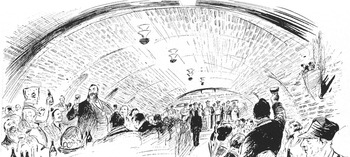
Another successfully orchestrated wine spectacle included the ‘revival’ by Camille Rodier and Georges Faiveley of the ancient Confrérie des Chevaliers du Tastevin (Brotherhood of the Knights of the Wine Taster).Footnote 101 Their cellar (Caveau Nuiton) in Nuits-Saint-Georges first opened on 16–17 November 1934 and remains an important tool in the promotion of Burgundian vintages to this day. Rodier, the author of several books on Burgundian wines, the secretary of the Nuits-St-Georges chamber of commerce and member of a family involved in the local wine trade, sought to ‘defend’ local vintages through a gastronomic event similar to Lafon's Paulée of Meursault. Staged in an atmosphere that invoked Molièresque ribaldry and Rabelaisian gourmandise, the Chevaliers du Tastevin provided the signs of faux-folkloric regional authenticity in the Cistercian cellar of the celebrated Clos Vougeot during the late 1930s.Footnote 102 These included garish garments, bawdy songs (provided by the Cadets of Burgundy choristers), pig roasts, gaudy furnishings and vague memories of obscure antecedents. The menu from the first chapter included four white and twenty-five red wines to accompany an eight-course meal.
The Confrérie des Chevaliers du Tastevin, first convened in Nuits-Saint-Georges in 1934. Drawing by André Galland for L'Illustration (1934), rights reserved.

Through its highly dramatised, pseudo-historical and candle-lit wine-tasting events (‘It's clearly a matter of the invention of public relations!’Footnote 103), the Order became – and remains – one of the most effective promoters of the region's wines.Footnote 104 Within a year, by 1935, the festivities of the Caveau Nuiton had to be replicated, for lack of space, at other venues and across an extended calendar: ‘The success of our cellars grows daily’, noted a journalist. ‘People like to come not only from France but from abroad as well! That is why, despite its size, the vast cellar cannot accommodate all the gastronomes who come.’Footnote 105 The participation in 1937 of the US ambassador, William C. Bullitt, among other foreign dignitaries, assured the annual festivities of an international cachet.Footnote 106
Employing bacchanalian metaphors and the esoteric oenobabble popularised by Camille Rodier's Clos de Vougeot (1931) and Max Cappe's Les chants du terroir, poèmes bourguignons (1932), gastronomic banquets provided an occasion to celebrate the mystique of the vine (la vigne) and terroir.Footnote 107 Banquet speeches loquaciously indulged in paeans that routinely linked the properties of Burgundy's fine wines (nobles crus) to the folkways (genre-de-vie) of regional viticulture:
[F]rom generation to generation, most among you maintain a tradition rooted in the distant past; the torch is passed in perfect condition with intangible commercial probity and a jealous love for the land . . . On this Burgundian soil . . . which for centuries has dispersed its riches through the glory of its wines . . . you represent a benign and serene force . . . the example of your labours, of your fidelity to this familial domain where the reputation of your ancestors precedes you, ranks among the most consoling on which to meditate.Footnote 108
By 1934 these spectacular dégustations had been packaged into a full-scale regional phenomenon. The ‘Nuits de Saint Georges’ was linked to other important wine-tasting festivities associated with the region's most recently bottled vintages. Together these included the wine auction at the Hospice de Beaune, and the Paulée de Meursault – respectively scheduled for the third Saturday, Sunday and Monday of each November – to form an annual cycle called the Trois Glorieuses.Footnote 109 Not to be excluded from the marketing phenomena, the president of the Comité Bourgogne refurbished the ancient abbey of Clairvaux to link modern and historical interests through a revived tradition of municipal festivals. Among these was Dijon's first modern Fête de la Vigne (wine festival). Its September parade snaked from Noël-Jules Gerard's emblematic statue (le Bareuzai) of a man crushing newly harvested grapes underfoot to the cathedral for a solemn mass that merged profane and spiritual preoccupations by ‘glorifying the Lord who gives us such good wines’.Footnote 110 Following its success, Dijon's Gaston Gérard and Macôn's Gabriel Jeanton directed the Association for the Renaissance of Popular Burgundian Festivals to create the first Burgundian Wine Festival in 1930.Footnote 111 They received assistance from Dijon's Committee for City Festivals, whose mission to ‘develop and encourage initiatives aiming to give Dijon festivals susceptible of favouring commerce and industry’, held the organisation of a wine festival as its first priority along the way.Footnote 112
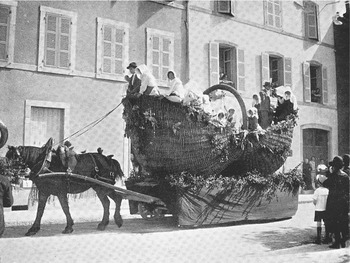
Eager to participate in this flowering of cultural activity, Jacques Copeau, the theatre director and founder of the Théâtre du Vieux-Colombier in Paris, who had helped André Gide to found the Nouvelle Revue Française in 1909, relocated his theatre company in Pernand-Vergelesse, Burgundy, from 1925 to 1931 to develop a ‘rustic’ repertoire.Footnote 113 They performed plays with names that alluded to their adoptive pays, such as ‘Cassis’, ‘The Wash-house’, and ‘The Snails of Burgundy’.Footnote 114 The troupe toured the circuit of annual wine festivals ‘from steeple to steeple’.Footnote 115 Copeau told audiences that they had ‘left the agitation of Paris’ to become Burgundy's ‘adoptive patriots’.Footnote 116 In 1926, the Vieux-Colombier rehearsed an entirely new repertoire in Burgundian patois designed to ‘exalt pride in their works and land, and to animate their traditions and history’.Footnote 117 They performed at the most important wine and gastronomy events staged in Dijon, Meursault, Demigny, Nuits-St.-Georges and Beaune, where on 28 and 29 August ‘an enormous wine bottle made of wood indicated the direction . . . to the first Fête de la Vigne et du Vin [vine and wine festival]’. Beaune's festivities were inaugurated with a parade of historical figures – starting with the Roman emperor Aurelis Valerius Probus, who had planted vineyards in ancient Beaune, through a litany of Valois and Bourbon royals who preferred red wines, to the patriotic poilus (French infantrymen) who courageously held off advancing German armies at Verdun fortified by litres of wine – and were followed by a float on which rode the (beauty) Queen of Beaune ‘who responded to the cheers of her subjects by radiating smiles in all directions’. The Vieux-Colombier troupe concluded the day with an evening ballet of ‘The Red Wine and the White Wine’ in which ‘[g]racious young women, some dressed in the colour of “Meursault gold drop” with an arched garland of flowers held over their heads, and others in “wine red” holding an amphora on the left shoulder and a Burgundian goblet in the right hand, danced with charming grace to a wonderful musical accompaniment.’Footnote 118
A float in Beaune's wine festival in the form of a grape-harvesting basket. Unidentified photograph from the late 1920s in the private collection of Jean-François Bazin.

The strategy of regionally linking cultural and economic agendas through folkloric wine festivals (described as ‘the circuit organised throughout Burgundy, designed to allow tourists to become better acquainted with the region's wines’) was so successful that it was harnessed to national interests through a National Festival of French Wines. Rotating to a different wine-growing region every year (Mâcon in 1933, Bordeaux in 1934, Champagne in 1935, Colmar in 1936, La Baule in 1937, and so on) each festival, touted as ‘surpassing’ the previous, simply replicated the marketing strategies of existing wine festivals and gastronomic fairs on a grander scale.Footnote 119
Mâcon simultaneously hosted the first Fête des Vins de France and Congrès des Caves coopératifs on 13–15 August 1933. The Mâconnais were of the same mind as the organisers of Dijon's 1922 wine parade, who intended their ‘essentially Burgundian’ event to signal ‘an amusing and picturesque reconstruction gaily glorifying [the region's] principal and famous products’.Footnote 120 The Revue du vin de France provides a description of the festivities in Mâcon. The first day opened with a reception of the wine queens of France (mustard, cassis and gingerbread queens were included as well) dressed in red, white and blue dresses to constitute a French flag. Following brief introductions and speeches, the queens – each representing a different wine-growing region within France – collectively posed with ‘ravishing docility’ for a ‘swarm’ of photographers and newsmen’.Footnote 121 A banquet at midday was followed by an elaborate parade, organised by Lucien Boyer, the ‘master of theatrical productions’, which represented ‘The Splendour of Wine across the Ages’ and presented the history of France in terms of its historic relation to wine. Building on the parade techniques and float iconography rehearsed at Dijon's Gastronomic Fair's cortège du vin since 1922, where planners anticipated ‘an amusing, picturesque and happy reconstitution of our most celebrated products’, the floats of Macôn's ‘historical parade’ depicted a Grecian bacchanal, Egypto-Roman wine production, the monks of the abbey of Citeaux, the court of the dukes of Burgundy and wine sustaining French poilus in victory at Verdun.Footnote 122 One observer commented that the parade ‘affirmed the French cult of wine across the ages; for good wine . . . preserves good humour, eternal youth and an impulsive gaiety . . . recognised by the generous and disinterested’.Footnote 123
The next day's agenda included the inauguration of a new agricultural research centre in Mâcon, followed by an afternoon of banqueting and ceremonial speeches. The president of the local touring club greeted the minister of agriculture and invited the assembled three hundred guests to enjoy ‘a particularly copious menu’ that included nine wines and as many speakers.Footnote 124 The Queen of French Wines, Mlle Paulette Martin, concluded the ceremonies by giving her sash to the city of Bordeaux (host of the 1934 Fête des Vins de France) and leading the bands and choirs in the official anthem of the Fêtes des Vins de France – the ‘Burgundian March’. In the evening, less tightly scripted events enabled a more carnivalesque atmosphere. The crowd tasted different wines, endured broadcast drinking songs (to which ‘the general public shouted rather than sang the refrains’) and visited an open-air, village-style renaissance fair (kermesse) festooned with illuminated fountains, electric signs, multicoloured garlands and a battery of lights resembling ‘white clouds dancing overhead’.Footnote 125 By morning, the following morning's paper assured, ‘none noticed the 7a.m. thundershower’.Footnote 126
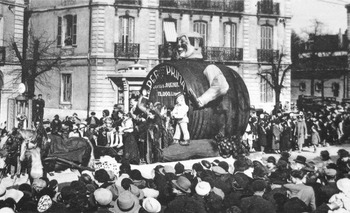
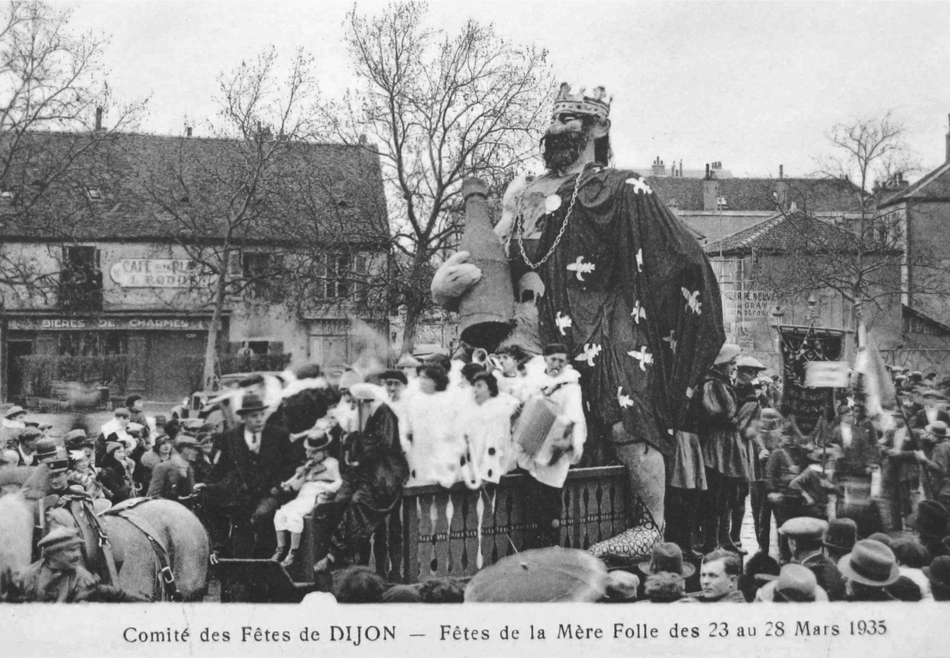
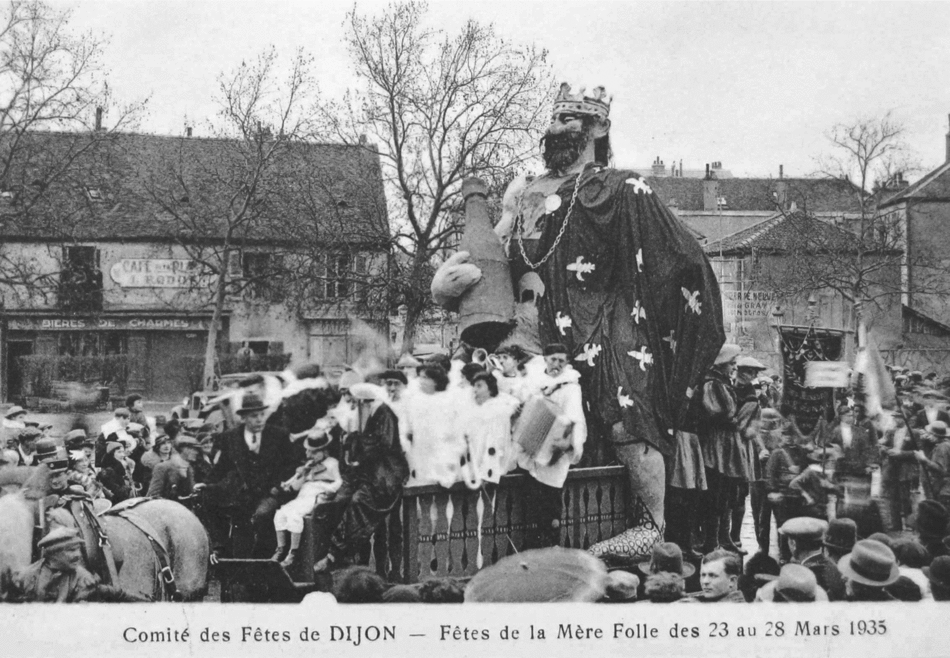
The Terrot Manufacturers' float at the 1935 Mère-Folle carnival in Dijon (photograph courtesy of the Archives Municipales de Dijon, ‘Mère-Folle’, series 6Fi 269).

A float in Dijon's 1935 Mère-Folle carnival. Photograph by F. Perrodin, by permission of the Musée de la vie bourguignonne Perrin de Puycousin, Dijon.
The Burgundian pavilion at the 1937 Paris Exposition
It is almost a cliché to declare wine an integral part of French glory and our national spirit . . . [T]o express the virtues stubbornly necessary to the production of our excellent wines . . . is to reanimate distant traditions born of the dawn of our natal soil; it is to perpetuate the song to the glory of our old nourishing soil. To review the wines of France is to recreate our national history.
Gaston Roupnel, ‘The Wine Pavilion’, in Edmond Labbé, Rapport général: Expositions internationales des Arts et Techniques de Paris 1937, VII, 229–330The popular and commercial success of a Burgundian cultural agenda that gave priority to promoting regional interests through aggressive marketing strategies proved to be a successful formula with both the wine pavilion and the regional centre at the 1937 Paris International Exposition.Footnote 127 The (regional) committee did not hesitate to include participation in the 1937 Exposition: ‘[It] sought to honour the position of French wines . . . through a living tableau of the nation's economic activity’. Marketing (propagande), Gaston Roupnel asserted, ‘was organised in favour of regional wines at the Regional Centres and Food Palaces’.Footnote 128 ‘Can anyone’, asked Ossip Pernikoff, the Exposition's representative for transport and tourism, ‘speak of this region without invoking the wines whose universal reputation has made Burgundy known across the four corners of the world?’Footnote 129 Burgundians needed this boost as the 1935 harvest had been spoiled by cold rain and was consequently of mediocre quality.Footnote 130 Albert Noirot related how vintners from the Franch-Comté were organising ‘to give Burgundy the place it justly deserves’ at the Paris Exposition. He added that it would provided a fine opportunity to demonstrate the merits of Burgundian AOC wines to ‘millions and millions’ of visitors and that it was time to organise a local committee to ensure ‘the success of this colossal work’.Footnote 131
The Exposition provided a showcase for the advantages that regional economic strategies and local labour practices offered the national economy. The administrative director of the Exposition's regional committee, ‘Commander’ Charier, anticipated that ‘with each of its regional pavilions – directly produced by the regions and remaining in regional hands – the Regional Centre will be like a “Little France”’.Footnote 132 The regional centre, he asserted, was a vast laboratory ‘where the smaller regions (pays) illustrate how to reconcile necessary traditions and contemporary techniques within the larger Country . . . like a vast symphony of French provinces . . . it produces the image of . . . a dynamic France and proves that regional life remains a present reality’. Charier hoped that visitors who discovered Burgundian gastronomy in the centre's appropriately rustic setting would take home a powerful memory (souvenir) of the region's artisan, aesthetic and folkloric riches. Mindful of tourist interests, the administrative director also expected that they would leave imbued with a strong desire to visit Burgundy for themselves in order to appreciate better its charms in their original scale and setting. The 1,600 sq-m Burgundian pavilion (Bourgogne–Franche-Comté et Pays de l'Ain Pavillon) provided a ‘picturesque’ composite of ‘traditional styles and modern tendencies’ in a new vernacular style.Footnote 133 It showcased examples of high-quality, regional craftsmanship and design.
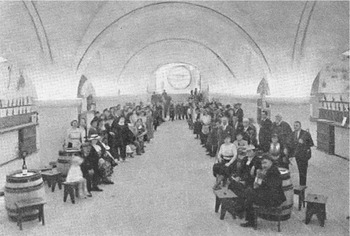
Aware of the economic interests involved, the Exposition's Agriculture committee drew attention to the ‘personal advantages that participation in this manifestation would bring’.Footnote 134 Notable vintages were selected to represent Burgundian varietals at the Exposition's wine-tasting stand (Stand de Dégustations des Vins d'Appellation Controlée). Modelled on Camille Rodier's popular cellar (caveau) in Nuits-Saint-Georges, the Exposition's rural centre featured a 600-sq-m ‘Burgundian cellar’. Any of the cellar's 50,000 bottles of regional vintages could be tasted and purchased at ‘exceptional prices’. The tour of the pavilion was completed by a visit to the restaurant, where ‘high priests of gastronomy officiated with dignity’.
The Burgundian wine cellar at the 1937 Paris Exposition, courtesy of the Hagley Museum and Library.

The Confrérie des Chevaliers du Tastevin, along with its accompanying choir, the Cadets of Burgundy, presided at the Paris Exposition's ‘Burgundian days’ on 25 and 26 October. These ended with a ‘brilliant soirée’ in the Exposition's French wine pavilion. There, in addition to Exposition officials, Dijon's Progrès de la Côte-d'Or reported, celebrated gastronomes such as Gaston Dérys and Curnonsky, leading citizens such as Edmond Chaix, president of the Touring-Club de France, Dr Portmann, Léon Douarche, general secretary of the International Office of Wine, Roland Marcel, high commissioner of tourism, and Prosper Gervais, president of the Society of French Agriculturalists; ranking political technocrats such as M. Monnet, the national minister of agriculture, and Paul Bur, director of France's 13th French Economic District and president of Dijon's chamber of commerce, Eugène Mugniot, president of the P.-L.-M. rail company, Robert Trébor, president of the Union of Parisian Theatres; and a veritable flotilla of syndicated journalists including Pierre Argence, commercial president of Havas; all told, 350 from Paris and the regions attended what was dubbed a ‘magnificent instrument of Burgundian propaganda’.Footnote 135
Noting that the interests of the Burgundian cultural project were not reducible to ephemeral spectacles and interminable banquets, Georges Faiveley, the originator of the Caveau Nuiton in Nuits-Saint-Georges, presented an important dossier on viticulture to the government's inter-ministerial committee (which reported to the General Assembly's regional committee) in the final days of 1937. While deputies discussed whether to end or extend the Exposition, Faiveley remained focused on addressing the problems and challenges confronting the French wine industry. These included fraudulent sales, preferential policies for legitimate AOCs, and the elimination of the appellation ordinaire.Footnote 136 Although contested by Burgundian merchants such as Geisweiler & Fils, who preferred to invest their ‘capital’ in recognisable labels, Faiveley's testimony underscored the ascendancy of the Burgundian economic agenda within an industry hitherto dominated by the interests of Bordeaux's much larger Gironde region.Footnote 137 Although debate over the AOC would continue until the outbreak of the Second World War, Burgundy's centrality to French viticulture was both in the ascendant and incontestably unique. Indeed, one of the French national lottery's themes was the ‘Wines of France’ series. Its September 1938 drawing was held and filmed in Beaune along with a banquet with the Confrérie des Chevaliers du Tastevin at the Caveau Nuiton. The Burgundian poet Max Cappe noted that the event drew national and international attention to ‘the virtues and incessant labours of Burgundy’.Footnote 138
Conclusion
Let the French convince themselves to eat well once again and they will remedy the disease of languor . . . they will salvage their optimism . . . and a great chunk of their economy . . . A supplement to wellbeing is priceless; no one can lose by treating oneself to it.
Jean-Robert Pitte, French Gastronomy (2002), 178.Burgundy's political leaders and cultural intermediaries collaborated to link economic interests, cultural policies, historical memory and popular politics to create a new form of commercial republican regionalism. They orchestrated elaborate spectacles calculated to reclassify existing, invented and remembered traditions into a provisionally stable and heterogeneous rustic modernity. The rustic and polyvalent sign system of terroir was inscribed on regional products and civic events in order to promote patterns of consumption and consumer identification that could help Burgundians compete in prevailing markets.Footnote 139 In particular, gastronomic folkways from multiple socio-economic strata and historical periods were assembled into appealing lifestyle templates (genres-de-vie) that contemporaries might use to fashion new self-identities, script an updated collective heritage and reposition Burgundy's economic importance. The president of the Commercial and Industrial Union for the Côte-d'Or, Albert David, noted this accomplishment when he congratulated Gaston Gérard on the success of Dijon's fifth gastronomic fair in 1925. He thought that it had transformed a once ‘perfectly calm Dijon’ into a thriving centre offering all ‘the advantages of present times’. He especially lingered on the event's wine festival to recall how visitors admired the floats overflowing with young women representing qualities associated with the region's famous wine-producing villages, which could stimulate sales.Footnote 140
The vital role early twentieth-century Burgundians played in the development of cultural formations that supported regional economics and not only voiced their expertise but also contested the authority of Parisian administrators, continues to inform France. The ideological cornerstone of Burgundy's cultural identity project, based on quality and reflected in the notion of terroir, remains paradigmatic within French agricultural policies. The Système d'appellation d'origine contrôlée articulated by Burgundians during the 1920s and 1930s was extended to all eligible French agricultural products in 1990. The French ministry of agriculture and the ministry of culture's Conseil National des Arts Culinaires conducted a joint census of all of France's produits du terroir in 1992. Following the Burgundian model, they created a legal framework that made it possible to delineate geographical terroir and regulate agricultural products produced within those boundaries as produits du terroir. Not least of these were the economic rewards.Footnote 141 The 192 million AOC bottles of Burgundy sold for an average of €6–7 in 2006–7.Footnote 142 These successes suggests the continued viability of Burgundian-style AOC regulations at a time when the Burgundian wine industry struggles anew with increasing international competition; alternative cultivation practices (verte, organic and biologique), oenological developments that enhance vinification (cuvaison); multiplying and expansive definitions of terroir (such as the creation of the 100th appellation, ‘Bourgogne Tonnerre’, on 17 July 2006), labelling practices that variously identify ingredients and/or underscore nutritional and health benefits; evolving consumer tastes and trends; the relative leverage of wine and spirits industries on domestic markets and international trade; and the impact of advertising strategies and campaigns.