-1-
“You mustn't marry more than one person at a time, may you, Peggotty?”
“Certainly not,” says Peggotty, with the promptest decision.
“But if you marry a person, and the person dies, why then you may marry another person, mayn't you, Peggotty?”
“You MAY,” says Peggotty, “if you choose, my dear. That's a matter of opinion.”
—David Copperfield (1849–50)1
Hager emphasizes that “Dickens's most autobiographical novel is concerned in a multiplicity of ways with the institution of marriage and the miseries it causes,” and that “David Copperfield is implicitly obsessed with the dissolution of marriage, whether the severing of this tie takes place in fantasy, reality, or fiction” (990, 994).
THE FIRST TIME I HEARD OF CAPTAIN MURDERER was in the Jerusalem Theater many years ago when the Welsh actor Emlyn Williams (1905–87) gave a reading of scenes from the works of Charles Dickens. Williams's performance was a recreation of the initiative of Dickens himself who, in the late 1850s, took on yet another activity and persona, that of the itinerant player, and began a series of public tours in which he read from his own works.2
For a concise account of Dickens's readings, their impact on his audiences, and their toll on his increasingly fragile health, see Wilson: “The first readings took place in June 1858, almost immediately after the publicity over his broken marriage. Despite the misgivings of some friends, their reception was overwhelmingly favourable. Large audiences acclaimed them everywhere…. After this triumphant progress of 1858, only a doctor's explicit command could eventually wean Dickens, eleven years later, from what had become a sort of orgy of warm personal communication with his great mass of readers” (260–61).
Of all the pieces Williams performed on that occasion, the story of “a certain Captain Murderer” remains most vividly present to memory not only for its eerie atmosphere and plot but especially for its effect on the audience. I can still recall the collective gasp of horror, as well as the outbursts of laughter, that the story's denouement elicited from a captivated company of listeners.
Dickens presents the redoubtable Captain in chapter 18 of The Uncommercial Traveller (1860) through the agency of a young woman introduced as “my nurse before I was six years old.” She soon reveals an alarming predilection for telling ghoulish nocturnal narratives: “Her name was Mercy, although she had none on me” (173, 176).3
A probable model for Mercy is Mary Weller who came to work for the Dickens family in 1817 when Charles Dickens was five and remained until he was almost eleven. For a synopsis of the debate surrounding the identity of Mercy, see the introductory note to “Nurse's Stories” (The Uncommercial Traveller 4: 170–71).
Hence “Nurse's Stories”–the title of the essay in which “the career of Captain Murderer” unfolds–is also a misnomer. The venerable tradition of the bedtime story, a story intended to soothe anxieties and ease young children into sleep, is discarded with gleeful panache. Although possibly drawn from Dickens's childhood memories of his real-life nursemaid, Mercy is cast in a stock role allotted to female servants in Victorian fiction as the transmitters of sensational and potentially pernicious material within the home.
4 See Trodd's chapter, “Nurses' Stories: Servant Interpreters,” for further examples of this fictional stereotype (69–95).
She retells and embellishes one of the most blood-curdling fairy tales in the repertoire. It is a tale meant to keep you awake and perhaps instill in some susceptible hearts a lasting sense of dread. “This wretch,” speculates the adult survivor of Mercy's story, “must have been an offshoot of the Blue Beard family” (173).
In appropriating this offshoot, Dickens transgresses both generic and story-specific boundaries. These boundary crossings may be regarded as further testimony to the fecundity and ingenuity of his extraordinary literary imagination. However, Dickens's treatment of the fairy tale acquires other implications when the odd insistence of the signifier Bluebeard is taken into account. References to the legendary criminal recur throughout his works from The Pickwick Papers (1837) to The Mystery of Edwin Drood (1869–70). In addition to the Captain himself, I have so far traced more than a dozen allusions to Bluebeard, and my chief sources, The Dickens Index and Internet search engines, may not be exhaustive. As the Index mildly puts it, “This story was a favourite of CD's” (Bentley, et al. 26).
In what follows I propose to explore the question of why Bluebeard?–that is, why did this fairy tale in particular take such a tenacious hold of Dickens's imagination?–through the intertextual dynamics and realities that inform his repeated references to it. I therefore begin with the background and boundaries established by various literary precedents, including specific fairy-tale intertexts from which the tale of Captain Murderer departs. I then examine Dickens's highly original adaptation and look at several other allusions in the chronological order of their appearance, so that the Bluebeard motif may be anchored in the biographical trajectory that arguably produces and sustains his practice (or habit) of citation. The premises of my discussion will be twofold: quantitatively, the repetition itself points to an unusual concentration of emotional interest or investment that cannot adequately be explained by the general popularity of the Bluebeard tale in nineteenth-century England;5
On the history of the infiltration of continental fairy tales into England, see Stone: “Soon after they were translated into English [in 1729], Perrault's tales…appeared in chapbook form, and in that guise became immensely popular and made their way into every village and hamlet in the British Isles. When Dickens was a boy, Cinderella, Bluebeard, and Sleeping Beauty were as well known and as ‘English’ as Jack the Giant Killer, Tom Thumb, and Jack and the Beanstalk” (24).
thematically, those references that occur in Dickens's works as part of a comic or parodic (rather than, say, scary) scenario belong to a special category of humor. The “tendentious joke,” as Sigmund Freud explains in his
Jokes and Their Relation to the Unconscious, is never innocent or an aim in itself; rather, it serves satiric, hostile, aggressive, or self-defensive purposes. The target of tendentious jokes, according to Freud, may include “institutions, people in their capacity as vehicles of institutions, dogmas of morality or religion, views of life which enjoy so much respect that objections to them can only be made under the mask of a joke” (8: 108–09).
To adopt these dual premises entails, to a certain extent, undermining, if not dismantling, another critical boundary: the distinction between the work and its “real” author. It is to implement an approach that “would loosen the binding of the book, undo the opposition between the verbal text and the biography of the named subject [‘Charles Dickens’] and see the two as each other's ‘scene of writing’” (Spivak 244).6
In relation to the “cult text of feminism,” Charlotte Brontë's Jane Eyre, that Gayatri Spivak analyzes in her essay, she “honor[s] the suspect binary oppositions–book and author; individual and history” for deliberately incendiary purposes. As Spivak states, her reading of Brontë's novel would “incite a degree of rage against the imperialist narrativization of history, that it should produce so abject a script for her” (244). My critique selects a different track, and tactic, of reading.
This approach patterns itself not only after the dictum “
il n'y pas de hors-texte (there is no outside-text)” but also after the psychoanalytic insight that creative writing, like day-dreaming, bears the unmistakable imprint or signature of the individual artist–of the life that writes or dreams itself (Derrida 158; Freud, “Creative Writing” 9: 143–53).
-2-
THE CLASSICAL VERSION OF BLUEBEARD was first recorded as a literary fairy tale in Charles Perrault's Histoires ou contes du temps passé in 1697 and translated into English in 1729. The main story-line of this version is as follows: the immensely wealthy Bluebeard, before departing on a business journey, gives his bride (who is one of two beautiful sisters) the keys to every room in his house, but forbids her to enter one small closet. “[I]f you happen to open it,” he warns, “there is nothing but what you may expect from my just anger and resentment” (Figure 10). Nevertheless, overcome with curiosity–a most pestilent thing in woman7
See Tatar's fascinating discussion of the ways in which, since the publication of Perrault's “Bluebeard,” retellers of the tale and its commentators have deflected attention away from the serial murders of the husband to the idle curiosity of his wife and traduced her single transgression into a scandalous character flaw: “Nearly every nineteenth-century version…singles out the heroine's curiosity as an especially undesirable trait” (158ff.).
–she disobeys and is horrified to find in the room whose floor was “all covered over with clotted blood” the bodies of several murdered women ranged along the walls (Perrault 107). Dropping the key in her terror, she soon discovers that it has an irremovable tell-tale stain. When Bluebeard returns home, he sees the signs of her indiscretion (“how comes this blood upon the key?” [108]) and orders his tearful bride to prepare to join the other ladies hanging in his closet. However, with her sister Anne serving as faithful lookout, she commutes the fatal sentence long enough for her brave brothers to arrive: “they ran their swords through [Bluebeard's] body and left him dead” (109).
8 An allusion to the look-out sequence in Perrault's fairy tale, in which the bride repeatedly asks her sister Anne (who has gone up to the turret of Bluebeard's castle to look for their brothers) if she sees nothing on the road and is answered “I see nothing but…dust,” appears twice in Dickens's journalism in the 1850s (Perrault 109). First, it occurs in the context of a scathingly critical and, at the same time, humorous reference to oppressive European politics in Household Words (23 August 1851): “‘OJohn Bates, look out towards Austria, look out towards Russia, look out towards Germany…beyond the filthy jails of Naples. Do you see nothing there?’ Says Bates (like the sister in Blue Beard, but much more triumphantly), ‘I see nothing there, but dust’”; second, it is used as a comic refrain for describing the peculiarities of the market-town of Wigton in The Lazy Tour of Two Idle Apprentices, also published in Household Words (10 October 1857): “‘Brother Francis, brother Francis…What do you see from the turret?”’ (‘Gone Astray’ 3: 24, 430–32). As these references suggest, Bluebeard is a central trope in Dickens's delineation of what he perceives as human folly and malaise. I am grateful to John Bowen for drawing my attention to these allusions.
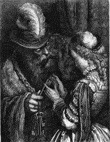
Gustave Doré, “If you were to open the door, I should be very angry.” Engraving, from Les Contes de Perrault, dessins par Gustave Doré. Paris: J. Hetzel,1867. New York: Dover Publications, 1969. 32. Courtesy of Dover Publications.
Even if this story seems bad (or good) enough as is, Dickens evidently did not think so. No less inventive than Mercy herself, he preferred to draw on a cannibalistic variant of the tale-type and garnished it, so to speak, with further grisly flourishes. Moreover, just as Dickens did not spare his audiences, so I too do not intend to omit any of these picturesque details, and having thus been fairly warned, you may forthwith leave off reading, although it is my candid hope that curiosity will overcome prudence once again.
The story of Captain Murderer is based on a folktale known as “Mr. Fox” in England that closely resembles the plot of “The Robber Bridegroom” in Jakob and Wilhelm Grimms' Tales for Young and Old (Kinder- und Hausmärchen). These variants differ from the French version of Bluebeard in two notable respects: there is no secret room full of female corpses and, therefore, no injunction against opening a forbidden door. The reason why there is no bloody chamber in “Mr. Fox” and “The Robber Bridegroom” is alimentary. The groom does not preserve his brides like valuable collectibles inside a locked cabinet. In brief, and not to put too fine a point upon it, he eats them. Roving the countryside with his murderous cohorts, he looks for delectable young women and brings them home for dinner. As the villain's terrified betrothed hides behind a barrel in his cellar, here is what she sees–and hears: “the wicked robbers came home, dragging another young girl. They were drunk and paid no attention to her screams and moans. They gave her wine to drink, three glasses full…and her heart burst in two. Then they tore off her fine clothes, put her on a table, chopped her beautiful body into pieces, and sprinkled them with salt” (J. Grimm and W. Grimm 147).
The Grimms' “Robber Bridegroom” does share one story element with non-cannibal variants of this tale. The last bride is always lucky and/or clever. She escapes the fate of the preceding wives by either outwitting the villain or a timely rescue. The wicked groom traditionally perishes by sword or by fire. In Perrault's well-ordered bourgeois finale, the bride is not merely saved from the sword. More happily still,
The Blue Beard had no heirs, and so his wife became mistress of all his estate. She made use of one part of it to marry her sister Anne to a young gentleman who had loved her a long while, another part to buy captains' commissions for her brothers, and the rest to marry herself to a very honest gentleman, who made her forget the ill time she had pass'd with the Blue Beard. (109)
-3-
IN COMPOSING A NEW VERSION of this old story, Dickens could rely on his readers' familiarity with such popular tales as “Mr. Fox” and “The Robber Bridegroom” to obtain his special effects. His story begins by way of formal introduction: “Captain Murderer's mission was matrimony, and the gratification of a cannibal appetite with tender brides.” Like several other Dickens characters, the Captain finds himself congenitally unable to keep women and meat discrete.9
For a compendium of further examples, see Carey 22–24.
This difficulty is the incentive for a distinctive feature of his courtship procedures: “he always asked if the young lady could make pie-crust; and if she couldn't by nature or education, she was taught” (174). Making pie-crusts could be construed, like playing the piano and needlepoint, among the roll of accomplishments of a young lady with good housekeeping potential.
10 I borrow the phrase “roll of accomplishments” from Edith Granger's summary of the mercantile basis for her marriage in Dombey and Son (1848): “He [Dombey] sees me at the auction, and he thinks it well to buy me. Let him! When he came to view me–perhaps to bid –he required to see the roll of my accomplishments. I gave it to him…I will do no more” (382; ch. 27).
But it is not of course a homemaker that is wanted. After one month of marriage, the Captain would produce a golden rolling-pin, a silver pie-board and, lastly, a “silver pie-dish of immense capacity” and modestly propose that his wife make a crust:
Then said the lovely bride, “Dear Captain Murderer, what pie is this to be?” He replied, “A meat pie.” Then said the lovely bride, “Dear Captain Murderer, I see no meat.” The Captain humorously retorted, “Look in the glass.”…And the bride looked up at the glass, just in time to see the Captain cutting her head off; and he chopped her in pieces, and peppered her, and salted her, and put her in the pie, and sent it to the baker's, and ate it all, and picked the bones. (174)
Thus the Captain proceeds and prospers, weds often and waxes well, until he decides to marry the fair one of twin sisters. The dark sister (being naturally more suspicious and clever than the blonde) steals into his garden on the night before the wedding, climbs the wall, looks in through the window, and sees the bridegroom at his nuptial preparations–“having his teeth filed sharp” (174).
Two beautiful sisters whose fates are intertwined appear in Dickens's tale of domestic terror as they do in Perrault's. As Dickens retells it, however, our readerly expectations are foiled repeatedly. Despite the clever sister's late-night vigil, she neither prevents the marriage to the sharp-toothed groom nor rescues her fair sister from consignment to the baker's. Instead, upon learning that her twin is dead, the dark one “determine[s] to be revenged.” She arrives at the widower's doorstep and makes him an irrefusable offer: “‘Dear Captain Murderer, marry me next, for I always loved you and was jealous of my sister.’ The Captain took it as a compliment, and made a polite answer” (174–75). Needless to say, the gentleman presumes too much. So he makes the first mistake and the last marriage of his career at the same time. I forfeit here any attempt at summary and give way to the author:
Next day they went to church in the coach and twelve, and were married. And that day month, she rolled the pie-crust out, and Captain Murderer cut her head off, and chopped her in pieces, and peppered her, and salted her, and put her in the pie, and sent it to the baker's, and ate it all, and picked the bones.
But before she began to roll out the paste she had taken a deadly poison of a most awful character, distilled from toads' eyes and spiders' knees; and Captain Murderer had hardly picked her last bone, when he began to swell, and to turn blue, and to be all over spots, and to scream. And he went on swelling and turning bluer, and being more all over spots and screaming, until he reached from floor to ceiling and from wall to wall; and then, at one o'clock in the morning, he blew up with a loud explosion. (175)11
One of the favorite crime novels of the mid-nineteenth century, Edward Bulwer Lytton's Lucretia (1846), anticipates the venomous death devised for Captain Murderer. Lucretia finds on the shelves of her husband's study a memoir entitled “Life of a Physician of Padua, in the Sixteenth Century” that describes an epidemic of domestic crime throughout Italy. During that “singular epoch of terror,” men began to die in droves: “some mysterious disease…baffled all remedy, and long defied all conjecture–a disease attacking chiefly the heads of families, father and husband–rarely women. In one city, seven hundred husbands perished, but not one wife! The disease was poison. The hero of the memoir was one of the earlier discoverers of the true cause of this household epidemic.” The “reasoning devil” Dalibard explains the wives' motive for murder to Lucretia in what may be called carnival terms: “It was the Saturnalia of the Weak–a burst of mocking license against the Strong: it was more –it was the innate force of the individual waging war against the many” (168–69; epilogue, pt. 1). Collins shows (though not in reference to Lucretia) that Dickens read and admired Bulwer Lytton's crime novels (257–60).
With this disclosure of the ultimate bride's unprecedented fate, amplified by Captain Murderer's non-spontaneous combustion, the story definitively slips its generic moorings. The final effect is carnivalesque in several respects. Most immediately, the ritual fairy-tale order of “they lived happily ever after,” with the emphasis on
lived, is reversed. Dickens uses the Bluebeard motif to tell a tale of mutual murder. The partners in marriage destroy each other. Nonetheless, since the world may be deemed a better place without this ogre and his wife, a form of happy ending is still preserved.
In thus retelling the story, Dickens also undoes the generic boundaries that typically situate fairy-tale characters in roles as clearly defined as black and white, predator and prey, murderer and martyr. Conventional victim/victor positions are skewed and, in effect, very nearly switched. The criminal action of Bluebeard now extends from the rapacious husband to include the wife as a possessor of lethal passions.12
In the wider cultural context, Dickens's rewriting of the wife's role may have been influenced by the popularity of the contemporary sensation novel that posited a strong connection between crime and femininity. As Trodd observes, the conversation between Gwendolen Harleth and her mother in chapter 6 of Daniel Deronda (1876) presents a hypothesis prevalent in Victorian crime fictions that “women were inherently the more criminal sex.” Mother and daughter take up “opposite sides in a debate which underlies much of the discussion of domestic crime in the period, a debate about which partner in a marriage is most like to introduce crime into the marriage” (96; see Eliot 85).
His violence is more than matched by her vindictiveness. As she concocts her witch's brew, she unfurls “such a terrible laugh…that the Captain's blood curdled, and he said: ‘I hope nothing has disagreed with me’” (175). To recast the condemned man's last words, he articulates what Melanie Klein calls “the primary anxiety of being annihilated by a destructive force within” (180). The inner destructiveness or thanatic drive that was directed outward in the form of oral aggression now rebounds upon himself. Symbolically, then, the death that Dickens devises for the serial killer of his tale is not a surprise. Whereas Bluebeard's adventures traditionally conclude with his destruction by external punitive forces, in this version he succumbs to (
un)
heimlich cooking. It may be instructive to cite
A Dictionary of Literary Terms at this point: “The word
carnival derives, apparently, from the Latin
carnem levare ‘to put away flesh.’ Traditionally, meat was not eaten during the Lenten fast; thus, a carnival would be the last occasion on which meat was permissible” (Cuddon 119). Indeed, having steadily lived off a diet of gargantuan meat-pies, Captain Murderer gives up meat altogether after the last supper prepared by his wife. She was not the consummation he had wished for.
Although it may be suggested that Dickens projectively identifies with the husband in his marital martyrdom (and I shall be returning to this suggestion later), there are also grounds for assuming an identification with the sorceress-bride who assembles “toads' eyes and spiders' knees” into a potent distillation. Dickens too, like that creatively wicked woman, prepares a kind of potion for his audience: a strong mixture of genres. This mixture accounts in part for the carnivalesque atmosphere of the story. On the one hand, it belongs to the genre of the comic tale with socially subversive elements. Dickens thus clarifies the cause for the remarkable success of a man surnamed “Murderer” in acquiring fresh brides to furnish forth his marriage tables: “His warning name would seem to have awakened no general prejudice against him, for he was admitted into the best society and possessed immense wealth” (173). As Barbara Hardy remarks, “the Victorian art of fiction is essentially a moral art”; and, among Victorian writers, Dickens preeminently provides “a powerful anatomy of a corrupting and corrupted society, ruled and moved by greed and ambition” (3, 25). On the other hand, Dickens's “offshoot of the Blue Beard family” is also a tale of gothic terror in which the desired touch is a frisson, a shudder or thrill of fear. A well-bred young girl endangered by a ruthless male predator; mysterious horrors lurking in the corners of his gloomy castle; telltale signs and other warning details disclosing and/or predicting gruesome crimes–all of these gothic paraphernalia are to be found in the story. The surface lightness of tone is articulated contrapuntally against a dark structure of violent and, in this case, reciprocal destruction.
Primarily however, it is the performative aspect that precipitates Dickens's hybrid, comic-macabre story into the mode of carnivalization. Moving beyond the received intimate boundaries of the fireside scene, of a nurse at the hearth telling reassuring tales to her rapt listeners, Dickens presents a fairy tale for social performance. It is a tale made to be shared in a public arena: in a theater or lecture hall. Ritually, even eagerly, you enter into that reading space in anticipation of you know-not-what and find yourself at the mercy of an author, an actor, or some other entertainer who introduces you to, or renews your acquaintance with, Captain Murderer.
To recall the ambivalent reaction of the audience at the Jerusalem Theater: those who exploded in laughter had become part of the joke. They found themselves an object or butt of a Dickensian caper. The tables were suddenly turned not only on the cannibal Captain but also on their own literary competence. Their fall into laughter (from which I was not exempted) coincided with his resounding explosion. To be caught by surprise is a predicament in which delight and discomfort may mingle coequally. Ambivalence, as Mikhail Bakhtin writes, is a fundamental component of carnival humor. It is not to be categorized as “purely negative satire” or as “fanciful, recreational drollery.” Rather: “It asserts and denies, it buries and revives. Such is the laughter of carnival” (12).
In Dickens's recourse to the Bluebeard story, this simultaneity of affirmation and denial or, more ominously, of burial and revival is put into play in heterogeneous contexts; notably, wherever this motif emerges in his writings, and no matter how seemingly humorous or benign the reference, darker atmospheric components are also to be found. That is why, I propose, the insistent evocation of Bluebeard may be glossed by the Freudian insight into tendentious jokes as a form of concealment. It is a means of giving expression to a range of deep-rooted and often hostile feelings that, if more openly vented, would be unacceptable not only to the one who listens but also, perhaps, to the one who tells the joke. More specifically, for Dickens, carnival laughter and the release of aggression accompanying it (as the case of Captain Murderer shows) include among their principal targets or objects the institutional constraints of marriage and the persons–mainly, the women–perceived as vehicles of that institution. For an earlier instance of this dynamics, I want briefly to consider the inaugural appearance of Bluebeard in The Pickwick Papers.
The occasion is a chance reunion between Sam Weller and his father at a tavern, with Mr. Pickwick in amused attendance. Mr. Weller, senior, now unhappily married for a second time–“I've done it once too often, Sammy…once too often” (271; ch. 20)–shares his conjugal grievances, a glass of brandy, and a cure for the gout with Sam and Mr. Pickwick. Gout, according to the elder Weller, is “a complaint as arises from too much ease and comfort.” Hence he imparts this remedy: “jist you marry a widder as has got a good loud woice with a decent notion of usin' it, and you'll never have the gout agin…. I can warrant it to drive away any illness as is caused by too much jollity.” Sighing deeply, Mr. Weller retires from the scene, whereupon Mr. Pickwick smilingly asks Sam what he thinks of his father's cure. “Think, sir!” Sam expostulates, “why, I think he's the wictim o' connubiality, as Blue Beard's domestic chaplain said, with a tear of pity, ven he buried him” (273).
Alec Waugh's observation regarding Pickwick Papers bears repeating at this point, albeit with an inflection unintended by the critic: “Dickens is not a writer concerned with…the ‘eternal verities,’ but he has put his deepest thought into the mouths of Sam Weller and his father” (17). Calling Bluebeard a “wictim o' connubiality” while conferring on him the dignity of Christian burial is the kind of satiric impulse that turns the moral order upside down. Moreover, Dickens redresses this villain in borrowed roles “once too often” for the joke to be ingenuously benign. An inference to be drawn from The Dickens Index's comment that the Bluebeard story was “a favourite of CD's” is that matrimony and, specifically, monogamy were not.
-4-
IN BARNABY RUDGE, BLEAK HOUSE AND HARD TIMES, a curiously discrepant pattern of allusions emerges: the figure of Bluebeard–a confirmed serial monogamist–invariably turns up in a ménage à trois. Moreover, he is not merely rehabilitated (as in the memorable verdict pronounced by Sam Weller) but rewarded in various ways. It appears that what corrects or, at least, offsets the strains and storms of conventional marital coupling is, in Dickens's odd accounting, the introduction of a third.
The idealized paterfamilias of Barnaby Rudge (1841), for example, is a most unlikely addition to the Bluebeard league. But Gabriel Varden–a “chirping, healthy, honest-hearted fellow, who made the best of everything, and felt kindly towards everybody”–is the master of a workshop called the Golden Key; and, even though it seems “impossible that any one of [his] innumerable keys could fit a churlish strong-box or a prison-door,” he is the keeper not only of many keys but also of a “quadruple-locked” secret (307–08; ch. 41). Moreover, he has a lovely daughter, Dolly Varden, who is “all smiles and dimples and pleasant looks,” and yet could not care less “for the fifty or sixty young fellows who…were breaking their hearts to marry her.” However, when his daughter urges the locksmith to disclose the mysterious purpose behind Mr. Hardale's journey, he laconically answers: “on business, Doll.” Warding off all further questions, Mr. Varden issues the following injunction: “Read Blue Beard, and don't be too curious, pet” (310–11).
According to classic Bluebeard tradition, the prohibition against curiosity is always addressed to the wife. That the key-keeper warns his daughter– “don't be too curious”–puts them in an ambiguous relational position. Yet, before Dolly Varden has a chance to prove herself obedient or not, Mrs. Varden loudly intervenes, “protesting she could not find it in her conscience to sit tamely by, and hear her child recommended to peruse the adventures of a Turk and Mussulman” (312). Mrs. Varden, as Katherine Rogers writes in her History of Misogyny in Literature, incarnates “the apparently ideal wife who actually manages to torment her entire household, her good-natured and inoffensive husband in particular, by her whining and perversity” (196). Nevertheless, after a comic quarrel of several pages, dinner is eaten and marital order restored. Mr. Varden finally sits down contentedly with his pipe and other provisions of comfort: “his arm round his pretty daughter's waist, looking lovingly on Mrs. V. from time to time” (315). Sometimes of course a pipe is more than a pipe. It is a dubiously winsome image of domestic bliss that Dickens presents to his readers, with Mr. Varden exuding an aura of uxorious well-being, his nubile teenage daughter ensconced in his lap, and the appeased wife standing by. Happiness, as imagined in this scene, is a triangulated family unity.
The palimpsest that I would provide for the Varden ménage is not that of Charles Dickens with his wife Catherine and one or both of their daughters, Katey and Mamie, but rather one or both of his sisters-in-law, Mary and Georgina Hogarth. To recapitulate the well-known facts: Mary came to live with Charles and Catherine in 1837 toward the end of their first year of marriage. It was a thoroughly conventional Victorian arrangement for a while. As a newly married woman, safely settled (or so it seemed) in her own home, Catherine could be expected to accommodate a younger unmarried sister. Mary died of a sudden illness in May 1837, almost overnight, probably in Dickens's arms when she was only seventeen. To what extent the Victorian cult of death and mourning contributed to the intensity of his grief is difficult to assess; however, the short-term guest became an abiding ghost, always youthful, virginal, and fair. The memory of her presence lingered in Dickens's mind, now cherished in its changeless purity.13
The influence of Dickens's feelings for Mary Hogarth on his personal life and work has elicited extensive commentary. See, for example, E. Johnson 1: 195–204; Rose 153–54; Slater 77–102; and Wilson 110–15.
The marriage seems to have suffered from reminiscences. Five years later, Dickens invited his wife's fifteen-year-old sister, Georgina (Georgy), to stay with them for a visit. That visit, too, turned into a lifetime for as Catherine, who had ten children (and several miscarriages) in sixteen years, sank into exhausted debility and possible depression, Georgina stayed on to ensure the orderly and efficient running of the home. She remained the angel of the Dickens house even after the separation of 1858 when his wife was no longer welcome there.
Georgina was thirty-one years old at the time the marriage broke up. Victorian social mores dictated that she should accompany her sister or dispose herself with other relatives. Nevertheless, she continued to live in the home of the celebrated writer whose domestic life was now in the public eye, to look after his large family of “motherless” children (only the eldest son was allowed to accompany his mother when she left home), and to serve as his housekeeper. Georgina Hogarth, as Grahame Smith observes, “could hardly have done anything more damaging to her prospects of marriage” (10). Rumors of impropriety were rife, and among them the allegation that Dickens and his sister-in-law were having an affair, which he publicly denied in his weekly magazine, Household Words. Given the near impossibility of Dickens's obtaining a divorce under Victorian law, as well as the prohibition against marrying a deceased wife's sister (such relations were deemed incestuous), an affair with Georgina at any time would have been legally and morally reprehensible.
However, although Dickens occasionally expressed concern over the ensuing years that his sister-in-law's unconventional status in his home was damaging to her prospects, he proceeded to benefit from her good company, and labors too, for the duration. As for “lively and intelligent” Georgina, she seems to have welcomed “her proximity to the most famous writer of the day and the excitements that accompanied this position” (Smith 10). The life she had with Dickens was the life she freely chose.14
See the chapter “Georgina” in Slater's Dickens and Women (163–78). Foster gives a general account of why “singleness was in many ways a more attractive proposition than the married state” for a Victorian woman–as Georgina Hogarth seems to have had occasion to notice: “The disabilities suffered by nineteenth-century wives were numerous. They could not act independently in court proceedings; they were legally and economically subject to their husbands and could obtain divorce only with great difficulty and at great expense; if separated, they could gain custody of children under the age of seven, but had right of access to older children only at stated times” (7ff.).
Throughout the many years of their association, both before and after his separation from Catherine, Dickens demonstrated “the very greatest affection for his sister-in-law based upon a gratitude for all the decency and order that she brought to his life, and for her unshakeable loyalty to him.” But, as Angus Wilson discerningly adds, “Georgy's effect upon the
dramatis personae of his fiction was less happy.” To find someone who gave him such devoted service “out of deep emotional attachment and asked (or certainly received) no such depth in return, only added to Dickens's power to deceive himself about women” (Wilson 173).
-5-
IN BLEAK HOUSE (1853), Dickens reconfigures the ideal of a happy triangulated family. The third is no longer a composite figure of daughter-wife as in Barnaby Rudge but, rather, a shadowy younger man. The tension arises from the need to release a beloved young woman from ties that bind her to an older paternal figure. It is in this connection that the Bluebeard motif recurs toward the close of Bleak House. The explicit occasion for the reference is the trigger-word “curiosity,” the feminine flaw par excellence, but the allusion is also embedded within a wider network of analogies. Esther's “guardian,” John Jarndyce, has been “called out of town” on business (749; ch. 64). Bluebeard too, it will be remembered, absents himself from home on a business trip as a ruse to test his prospective or newly-wedded wife. But Mr. Jarndyce of Bleak House, unlike Bluebeard, does not return unexpectedly and surprise a guilty woman; instead, he astonishes Esther by asking her to join him in the country. In other words, he calls her away from home. This is only a preliminary surprise as readers familiar with the joyful outcome of his contrivance already know.
Esther Summerson is redoubtably virtuous but not without curiosity. After travelling all day–and “wondering all day what I could be wanted for at such a distance”–she arrives at the hotel where Mr. Jarndyce awaits her. No greater contrast could be imagined than between the fierce demeanor of Bluebeard and Esther's benevolent custodian. As Esther reports in her next-to-last narrative, “when I saw his genial face again at its brightest and best, I said to myself he has been doing some other great kindness.” Yet, shortly after while they are at supper, Mr. Jarndyce asks: “Full of curiosity, no doubt, little woman, to know why I have brought you here?” “Well, guardian,” Esther says, “without thinking myself a Fatima, or you a Blue Beard, I am a little curious about it” (749; ch. 64). (Fatima is the name frequently given to the lucky bride in many nineteenth-century renditions of the tale and reflects the Victorian passion for the Oriental. In period illustrations, Bluebeard is often portrayed as a Turk, wearing a turban and wielding a scimitar.) Mild denial notwithstanding, Esther's invocation of these two protagonists is highly pertinent under the circumstances. Mr. Jarndyce, like his unlikely counterpart, has kept a secret from his “little woman”–and this secret will turn out to be a test of her virtue in general and loyalty to him in particular.
In the classic variants of Bluebeard, according to Bruno Bettelheim, the bride-test is intended to try her sexual fidelity. The blood-stained key – or, in some versions, the bloodied egg–that the wife cannot cleanse is a symbol of her extramarital activities. “On hearing any of these stories,” Bettelheim writes, “it immediately becomes obvious that the female is strongly tempted to do what is forbidden to her” (301). Hamlet's apostrophe “Frailty thy name is woman!” might be cited as yet another contribution to this apprehension. It is indeed noteworthy that all of Bluebeard's brides succumb to temptation, even though the last one lives beyond the ending. Thus they rise to his expectations through their fall.
Esther passes the bride-test, however; in contrast to Fatima and her less fortunate predecessors, she remains unfailingly true to the “Blue Beard” of her narrative. In effect, there is no tension resolved by this result. Her loyalty and self-abnegation are vaunted from the very outset. When first appointed the housekeeper of Bleak House, young Esther looks at the basket of keys left in her charge, “quite lost in the magnitude of [her] trust” (65; ch. 6). Her employer, however, knows very well with whom he may leave the management of his heart and home. Esther will show herself ready to devote her life to Mr. Jarndyce despite the considerable age difference between them as well as the fact that she loves and is loved by young Mr. Woodcourt. Affirming an unbounded gratitude to her guardian, she will reject an honorable proposal of marriage in terms that prove her all the more worthy of it: “Oh, Mr. Woodcourt…it is a great thing to win love! I am proud of it, and honoured by it; and the hearing of it causes me to shed these tears of mingled joy and sorrow–joy that I have won it, sorrow that I have not deserved it better; but I am not free to think of yours” (731; ch. 61). If the “typical virtuous heroine of the Victorian novel is a softened version of Grisilde – rewarded for exploitation by being venerated as a saint,” Esther Summerson is a leading exemplar of this feminine category of extraordinary (yet imitable) altruism (Rogers 193).
Happily however, her self-sacrifice is no match for her guardian's. Mr. Jarndyce, as R. Brimley Johnson admiringly writes, is “a moral superman” (12). After educating his “Dame Durden” in the good ways of her own true heart (“I knew the good that could never change in her, better far than she did”), he disengages Esther from her commitment to him and, in a gesture of transcendent goodness, transfers her into the keeping of another: “Understand me, my dear girl. I had no doubt of your being contented and happy with me, being so dutiful and so devoted; but I saw with whom you would be happier” (752; ch. 64). Esther (and the reader) is transported into a quite different fairy tale. Mr. Jarndyce is not a Bluebeard but a fairy godmother. He shows Esther the literal key to her future, unlocking “a rustic cottage of doll's rooms” that he has furnished down to the last homey details of her own taste and, soon after, he hands her over to the worthy Mr. Woodcourt: “Allan…take from me a willing gift, the best wife that ever man had” (751, 753). No object of symbolic exchange could be more deserving or gladdened.
In main Bluebeard outlines, then, an older man takes a young woman into his home, gives her the housekeeping keys but keeps a secret from her, and proceeds to test her fidelity to him. Yet the underlying wishful fantasy of the perfectly compliant and chaste bride acquires a more convoluted narrative structure in Bleak House. First, Mr. Jarndyce's “willing gift” of Esther to another may be read as a fulfillment (which is enabled by proxy) of a fantasy of incestuous conjugality. In other words, the “erotic paternalism” that John Carey observes “so appealed to Dickens,” as exemplified in both the closeness of Nell to her grandfather in The Old Curiosity Shop (1840) and the marriage of Dr. and Mrs. Strong in David Copperfield (1850), may also be said to color the father-daughter configuration in Bleak House (158). As Esther weeps tears of gratitude in his arms, Mr. Jarndyce says while “pressing [her] gently to him”: “Lie lightly, confidently here, my child…. I am your guardian and your father now” (752; ch. 64). And what was he before?–we might want to ask. The transgression of generic boundaries in the tale of “Captain Murderer” has its psychosexual counterpart in the blurring of kinship boundaries in this scene and others from Bleak House.
Second, in the novel's last chapter, “The Close of Esther's Narrative,” we learn that some short time after their marriage, Esther and Allan Woodcourt added an annex to their pretty country cottage, “expressly for [her] guardian” when he came to see them (768; ch. 67). Granted that extended families were an integral part of Victorian culture, there still seems to be another transgressive (and guilt-laden) fantasy operative in Dickens's neat resolution of these relations: Mr. Jarndyce both has Esther and lets her go; both incorporates the object of his desire and refrains from consummation; both has his pie, as it were, and does not eat it. The denouement of Bleak House elevates him to the ranks of a satiated sainthood.
The degree of narcissistic identification involved in Dickens's portrayal of John Jarndyce is a matter of inference. Nevertheless, his novel of 1853 may be annotated by the letter, dated 25 October 1853, he wrote to his friend, the wealthy philanthropist Angela Burdett Coutts, concerning Georgina's recent refusal of a marriage proposal from the artist Augustus Egg. Although Dickens conceded that it would have been a good match for her, he felt obliged to note that mentally his sister-in-law outranked the artist by far: “but five out of six men would be,” he thought, quite unequal to Georgina; “for she has one of the most remarkable capacities I have even known. Not to mention her being one of the most amiable and affectionate of girls.” Whether it was better or not, for Georgina, to continue as she was, dedicated to himself and his family “instead of brightening up a good little man's house,” he added, “is a knotty point I never can settle to my satisfaction” (qtd. in E. Johnson 2: 918 and Slater 165). If an imaginary scenario may be added to the infringements of biographical speculation, it is not difficult to construct what Charles Dickens replied to Georgina Hogarth when she came to consult him about her future with the “good little man” in question. The results are reflected with asymmetrical precision in Esther's story.
-6-
IN DICKENS'S TRIANGULATED MANAGEMENT of the Bluebeard theme in Bleak House, his “Fatima” not only proves steadfast and true but, more irregularly still, his “Blue Beard” expansively (and homosocially) shares his purchase on her heart with another man. In the novel published a year later, Hard Times (1854), a structurally analogous pattern emerges–two men and a woman–with less auspicious results. My discussion will focus mainly on chapter fifteen of Book One, entitled “Father and Daughter,” in which Louisa Gradgrind decides to accept a proposal of marriage from Josiah Bounderby.
The chapter begins as follows: “Although Mr. Gradgrind did not take after Blue Beard, his room was quite a blue chamber in its abundance of blue books” (75). This single passing reference to the fairy tale seems straightforwardly triggered by the color-cast of the room. Thomas Gradgrind's is not a bloody chamber but a blue one. There appears to be no further motive for the mention of Bluebeard: no key, no secret, and no prohibition to test a bride. David Craig's annotated edition of Hard Times provides an extensive gloss for “blue books” from which this excerpt is cited:
[H]ere and elsewhere in the novel blue books are made the type of facts amassed for their own sake instead of to show up bad conditions with a determined intention of righting them. Although government reports, at first on diplomatic matters, had been, literally, blue books since 1814, the first reference to the phrase as current comes from 1824; by 1845…Disraeli is assuming that they will be to hand on the study table of a public man. Dickens treats them as he almost always treats governmental machinery–as so much red-tape. (327)
However satirical and critical Dickens's treatment of blue books– “Whatever they could prove (which is usually anything you like), they proved there, in an army constantly strengthened by the arrival of new recruits” (75)–might be, they do represent the symbolic (paternal) order that he would uphold: the dominion of public men. Moreover, if blue books indeed bind Mr. Gradgrind's hands, as it were, like “so much red-tape” then a more lurid light may be cast on the interview between father and daughter that ensues.
“Louisa, my dear,” Mr. Gradgrind announces, “you are the subject of a proposal of marriage that has been made to me” (75). His statement is both clear and extraordinarily equivocal at the same time. Mr. Bounderby has applied to Mr. Gradgrind with all due propriety for permission to marry his daughter. Viewed another way, Louisa has become the subject (and the object) of a homosocial negotiation: “a proposal…made to me.” After the manner of Esther in Bleak House, she will be exchanged between like-minded men. But this is not meant to be a romantic attachment. The prodigality of blue books and hard facts that surround Mr. Gradgrind and his daughter preclude that possibility. Relatedly, there is another crucial departure from the John Jarndyce-Esther Summerson-Allan Woodcourt configuration to take into account: the disparity in ages between Louisa and Mr. Bounderby or, more to the point, the parity in ages between her suitor and her father. In the trio formed by Thomas Gradgrind-Louisa Gradgrind-Josiah Bounderby, the intended couple is a generation apart.
Mr. Gradgrind does not sidestep the issue. He erases it in a caveat that has serious consequences for all concerned:
Now, what are the Facts of this case. You are, we will say in round numbers, twenty years of age; Mr. Bounderby is, we will say in round numbers, fifty. There is some disparity in your respective years, but in your means and positions, there is none; on the contrary, there is great suitability. Then the question arises, Is this one disparity sufficient to operate as a bar to such a marriage? In considering this question, it is not unimportant to take into account the statistics of marriage, so far as they have yet been obtained, in England and Wales. I find, on reference to the figures, that a large proportion of these marriages are contracted between parties of very unequal ages, and that the elder of these contracting parties is, in rather more than three-fourths of these instances, the bridegroom…. The disparity I have mentioned, therefore, almost ceases to be a disparity, and (virtually) all but disappears. (76–77; bk. 1, ch. 15)
It is not only, then, the blue chamber with its blue books that motivates the unexpected appearance of Bluebeard in a Lancashire mill-town. Chapter fifteen in its entirety deals with the promotion of an unequal match between a young woman and an older man of means. Furthermore, as Mr. Gradgrind urges on his sensible daughter a marriage with a man old enough to be her father, a bride-test also takes place in
Hard Times. It is a test of how well Lousia has been trained in the Gradgrind ways. She surpasses her father's expectations and her own. When the Bounderby marriage dissolves after the negligible complication introduced by the intrusion of James Harthouse, a young but caddish gentleman, onto the scene, Louisa returns home to her loving and repentant father. Her return–as opposed to the conditions of her leaving–is not subject to any satire or irony. “‘Louisa,’ said Mr. Gradgrind, shading his face with his hands, ‘has always been my favourite child’” (178; bk. 3, ch. 3). He both gives away the bride, as a good father should, and gets to keep her.
Moreover, during the interval between the marriage contract in Book One and its termination in Book Three, in a chapter entitled “Hearing the Last of It”–a favorite phrase of the perpetually recumbent nitwit “transparency” that is Louisa's mother–Mrs. Gradgrind or “It” finally fades away: “the light that had always been feeble and dim behind the weak transparency went out” (150; bk. 2, ch. 9). As in Bluebeard, a disappointing reality is corrected, and an unsatisfactory wife put away. The counter-marriage plot in Hard Times, however, resolves into the dyadic unit of “Father and Daughter” already presaged in chapter fifteen. Another fantasy of ideal intra-familial union thus plays itself out. In this respect, Mr. Gradgrind may be regarded as an even more fortunate man than Mr. Jarndyce whose story ends on an odd-numbered, or “all three lived happily ever after,” note.
The resolution of Hard Times retroactively reinforces the implication of Mr. Gradgrind in a narcissistic identification with the man who wants to marry his daughter. His eminently factitious promotion of this marriage so that a disparity of some thirty years (virtually) disappears is self-serving in more ways than he–and, possibly, his author–openly concedes. Here is his paternalistic sanction of Louisa's acceptance:
Mr. Gradgrind was quite moved by his success, and by this testimony to it. “My dear Louisa,” said he, You abundantly repay my care. Kiss me, my dear girl.”
So, his daughter kissed him. Detaining her in his embrace, he said, “I may assure you now, my favourite child, that I am made happy by this sound decision at which you have arrived. Mr. Bounderby is a very remarkable man; and what little disparity can be said to exist between you–if any–is more than counterbalanced by the tone your mind has acquired. It has always been my object to educate you, as that you might, while still in your early youth, be…almost any age. Kiss me once more, Louisa.” (79; bk. 1, ch. 15)
Mr. Gradgrind endorses his daughter's “sound decision” in terms both formal and freely sentimental–a sentimentality fulsomely displayed in portraits of Victorian family life
15 See Roberts's discussion of sentimentality in Victorian paintings of middle-class domestic life. Roberts analyzes the tendency toward visual overstatement in a manner that also pertains to Mr. Gradgrind's high-flown response to Louisa: “the same sentiment, exaggerated, or inflated to a pretentiously high moral plane, can undermine the sense of truth and reality that was the aim of these domestic paintings…. It is such expressions of exaggerated sentimentality that lay the Victorians open to charges of hypocrisy” (53).
–and yet carrying an excess emphasis that points to the darker folly behind his praise of reason. To recall the opening statement of chapter fifteen: “Mr. Gradgrind did
not take after Blue Beard.” Just as a joke is like smoke insofar as it screens what cannot easily be given more overt and public expression, so a negation may be a reversal of otherwise inadmissible or boundary breaking impulses.
16 See the famous example in Freud's “On Negation”: “‘You ask who this person in the dream can be. It's not my mother.’ We emend this to: ‘So it is his mother.’ In our interpretation, we take the liberty of disregarding the negation and of picking out the subject-matter alone of the association” (19: 235).
Tellingly, the repudiation of “Blue Beard” turns up here, just as it does in Esther Summerson's narrative, in conjunction with the paternal guardian instead of the prospective groom.
In the years following the 1854 publication of Hard Times, Mr. Gradgrind's “unbending, utilitarian, matter-of-fact” worldview as epitomized by his more than selfish (and less than successful) dismissal of the “little” discrepancy between his daughter and Mr. Bounderby apparently acquired a different resonance for Dickens (77–78; bk. 1, ch. 15). The related facts are hard to pass by. The disparity between Dickens and the young actress whom he met in 1857, while directing and acting in an amateur play production, was, we will say in exact numbers, twenty-seven years.
-7-
THE CORRELATIONS PRESENTED thus far lead me to suggest another exegetic device for tracking the “career of Captain Murderer” in Dickens's writings. In addition to serving as a mask or cover-up, as a tendentious joke that defends against personal disclosure, the eponymous Bluebeard also functions as a kind of barometer. Insofar as his image holds Dickens in thrall, Bluebeard's sporadic appearances over a period spanning more than three decades provide a means to gauge the changing realities and fantasies that his author transposes into works of fiction. As already seen, significant junctures of Dickens's life history are traceable in this fictional barometer. On occasion, the extratextual contexts resonate (however incompletely or distortedly) via an appeal to his favored fairy-tale scenario, as in the demise of the “feeble and dim” Mrs. Gradgrind that allows father and daughter a quietly satisfactory reunion at the close of Hard Times. In other words, the signifier “Bluebeard” has a double function in Dickens's narratives: it both conceals and reveals, both masks and exposes, the pressures weighing upon the writer who introduces the Bluebeard motif into varied textual situations that involve sexual relations and the institution of marriage.
Thus, in some of Dickens's artful revisions of life, proscribed desires are sequentially fulfilled and punished. Transgression summons punishment, violation brings down the law, cause leads to effect. The multiple discordances and discontinuities that mark reality are reordered coherently, diachronically. Good cheer and, for that matter, wish-fulfillment may be found in staging a story in which transgressive desires are enacted and, then, swiftly resolved by the law's penalty. In this view, Captain Murderer's macabre death in the genre-bending story published in 1860–that is, two years after Dickens's legal separation from his wife and three years after meeting Ellen Lawless Ternan–was the very least that Dickens could inflict upon him(self). The Captain, after all, gets his just dessert. He is horrifically punished for the fulfillment of his carnal appetites, and his witch-bride, too, meets an end that befits her dark culinary calling. In fact, nobody escapes punishment in this story: “[T]he milk-white horses in the stables broke their halters…and galloped over everybody in Captain Murderer's house (beginning with the family blacksmith who had filed his teeth [before each matrimonial occasion]) until the whole were dead” (175). The manner of the Captain's death is not only a measure of his guilt but also of the world that he built in his own image.
To illustrate further this barometric function of Bluebeard, I want to examine a different “offshoot” who briefly appears in Dickens's last completed novel, Our Mutual Friend (1865). In this narrative setting, another desire and conflict seem to be at play. Mrs. John Rokesmith, formerly Miss Bella Wilfer, puzzled by her husband's avoidance of Mortimer Lightwood, tries to pry out the reason for this behavior. She meets his resistance to her investigation by first calling him a sphinx: “‘a married sphinx isn't…a nice confidential husband,’ said Bella, in a tone of injury.” Still he resists and, then, Bluebeard is recalled:
“Bella, my life,” said John Rokesmith, touching her cheek…as she cast down her eyes and pouted again; “look at me. I want to speak to you.”
“In earnest, Blue Beard of the secret chamber?” asked Bella….
“In earnest. And I confess to the secret chamber. Don't you remember that you asked me not to declare what I thought of your higher qualities until you had been tried?”
“Yes, John dear. And I fully meant it, and I fully mean it.”
“The time will come, my darling–I am no prophet, but I say so,–when you will be tried. The time will come, I think, when you will undergo a trial through which you will never pass quite triumphantly for me, unless you can put perfect faith in me.”
“Then you may be sure of me, John dear, for I can put perfect faith in you, and I do, and I always, always will….”
He was even better convinced of the truth of what she said than she was, as he felt her loving arms around him. If the Golden Dustman's riches had been his to stake, he would have staked them to the last farthing on the fidelity through good and evil of her affectionate and trusting heart. (745; bk. 4, ch. 11)
John Rokesmith's “secret chamber” is his actual identity as John Harmon, heir to a great fortune–that is, Bella's sphinx is not a Bluebeard, albeit for a time he is a suspected murderer. The reason for secrecy in the “Rokesmith” case involves a well-worn plot component: a bride-test. Throughout their courtship, engagement, and first year of marriage, he tries her unconditional love for him. Can Bella Wilfer be trusted with the key to the heart of John Harmon or not? She passes the test triumphantly as he predicts and, in return, is amply rewarded. Her recompense surpasses even that of Esther Summerson: “a dainty house…tastefully beautiful”; “an ivory casket…[with] jewels the like of which she had never dreamed”; and “a nursery garnished as with rainbows” for the Inexhaustible Baby (778; bk. 4, ch. 13). The letter “y” may now be suffixed to the surname of Mr. and Mrs. John Harmon.
In rendering this resolution, Dickens's sentimentality is unalloyed by any satire; concomitantly, incestuous undertones are also absent. The safe and distancing effect of parody is not required here. Although Noddy Boffin does play the role of fairy godmother to Bella and enables her Cinderella-like transformation from rags to riches, he differs from Mr. Jarndyce of Bleak House in his longstanding attachment to Mrs. Boffin. Breaking with past narrative patterns, Our Mutual Friend presents two young people equally inclined toward each other–a happy company rather than a crowd of three–and so the reason why Bluebeard reappears under these circumstances is elusive. It is arguably the putting of the bride to a prolonged test of character, or the curiosity she pressingly exhibits at the novel's close, or the sheer force of referential habit that accounts for his return.
Nevertheless, it may be more useful to consider the interpolation of Bluebeard into this context in relation to the mechanisms of concealing/revealing already associated with his appearances. On the one hand, Bluebeard enters into Our Mutual Friend under the sign of concealment. The allusion functions as a displacement or surrogate story: just as what Freud calls “screen memories” (which may be inconsequential or trivial in themselves) substitute or stand in for meaningful but repressed memories, so the explicit reference to the one tale, “Blue Beard of the secret chamber,” takes the place of a more highly invested tale.17
Freud explains the processes at work in the formation of screen memories as follows: “another [image] is produced which has been to some degree associatively displaced from the former one. And since the elements of the experience which aroused objection were precisely the important ones, the substituted memory will necessarily lack those important elements and…most probably strike us as trivial” (“Screen Memories” 3: 307).
In its substitutive (metonymic) function, “Blue Beard” masks and protects something felt to be untenable, self-compromising, or too embarrassingly personal to be told. On the other hand, this same reference is an indicator or even a giveaway of that which it would withhold. In the barometric mode, it responds to and registers a change of affective pressure.
The fairy-tale persona that Bluebeard both replaces and represents is “Thrushbeard.”18
The structural analogy that I develop here is indebted to Lacan's elegant equation of displacement with metonymy and condensation with metaphor in his “Agency of the Letter in the Unconscious” and to Grob's analysis of fairy-tale motifs in Our Mutual Friend.
Despite the physical and moral differences between these two protagonists, they similarly engage in putting their young brides to a test. In the Grimms' “King Thrushbeard”: “A king had a daughter who was unequaled for beauty, but she was so proud and thought so much of herself that no suitor was good enough for her.” She not only rejects all of her suitors but also pokes fun at them. Among her many suitors, the princess “made the most fun of a kindly king…whose chin was slightly crooked. ‘Heavens above!’ she cried. ‘He's got a chin like a thrush's bill!’ And from then on he was known as ‘Thrushbeard’” (180). The comparable flaw in Bella's character is her greed for money and not her momentary curiosity. Clearly, both “princesses” need to be made over before they can assume their proper place as happy brides.
The king in the Grimms' tale decides to compel his disdainful daughter to marry the first beggar who arrives at his door. True to his word, he gives his daughter in marriage to a wandering minstrel: “All her pleading was in vain, the priest was called and she was married to the minstrel” (181). Her husband, who is her former rejected suitor “Thrushbeard” in ragged disguise, makes her do all the dirty housework, sell crockery in the marketplace, and even become a kitchen maid in the king's palace. The proud princess is thoroughly reformed: “She thought of her miserable life and cursed the pride and arrogance that had brought her so low.” At this point the humbled is ready to be raised high again. Her beggar-husband rematerializes, “dressed in silk and velvet,” and explains to his astounded–and tearfully grateful–wife that “I disguised myself for love of you…. I did all that to humble your pride and punish you for the insolent way you laughed at me.” For all her mistreatment and deception, she (like Bella Wilfer) is transformed into the luckiest of women. From riches to rags to riches: “The maids came and dressed her magnificently” (183).
As in other fairy tales, more than one daydreamer or fantasist provides the perspectival orientation for this story.19
For an analysis of perspectival dualities in a different fairy-tale context, see my “Reading Snow White.”
From the perspective of the female dreamer, it is the wish that the person she has wedded will turn into a “somebody” whose worth will reflexively enhance her own. In the Lacanian lexicon, she wishes to
be the phallus of someone who
has it.
20 See Lacan's articulation of the signifying structures (“a ‘to be’ and a ‘to have”’) that govern the relations between the sexes (“Signification of the Phallus” 289).
From the perspective of the male dreamer, it is the wish to be loved without the insignia of power and affluence. He would be desired not for his conspicuous status but for himself alone. He wishes to have the phallus and
not to have it at the same time. “Certainly,” as Shirley Grob remarks, “there is a strong element of the incredible in the stratagem devised by Mr. Boffin and John Harmon for curing Bella” (576).
This stratagem of concealment derives from fairy-tale romances of the “King Thrushbeard” type whose fantasy components, in turn, are implied in Our Mutual Friend by the allusion qua camouflage of the Bluebeard type. The one tale is superimposed onto the other, thereby warding off recognition and exposure. Ironically however, such defensive superimposition may serve to disclose (no less than to dissemble) the boundaries between the stories. When the blue beard is removed, as it were, a more kindly chin is exposed as well as a corollary wish to be intrinsically loved. The King or, say, “John Harmon” has no rival or obstacle to contend with, no obdurate transparency, other than his life-position as a rich public man. He would capture the heart of the young woman who has captivated his own. That is the Dickensian fantasy that may be inferred at this point of closure. Bluebeard is again its distinguishing ploy.