Introduction
Climate governance has developed into a complex multilevel game (Bulkeley et al. Reference Bulkeley, Davies, Evans, Gibbs, Kern and Theobald2003; Gupta Reference Gupta2007; Kern and Alber Reference Kern and Alber2008; Schreurs Reference Schreurs2008; Bulkeley Reference Bulkeley2010; Busch and Jörgens Reference Busch, Jörgens, Morata and Sandoval2012a, Reference Busch, Jörgens, Meadowcroft, Langhelle and Ruud2012b; Bouteligier Reference Bouteligier2013; Ohlhorst et al. Reference Ohlhorst, Tews and Schreurs2013; Hakelberg Reference Hakelberg2014; Kern Reference Kern, Weibust and Meadowcroft2014). In Germany in 2008, the federal government started a comprehensive but voluntary scheme to fund the creation of Integrated Climate Protection Concepts (ICPCs) in municipalities. This federal programme aims to produce nationwide local ICPCs to monitor and manage local emissions. In addition, municipalities can apply for up to 30 different programmes within this funding scheme in order to implement specific climate protection measures. The funding scheme provides municipalities with the means and expertise to establish comprehensive climate policy portfolios (Schaffrin et al. Reference Schaffrin, Sewerin and Seubert2014). An evaluation of the programme shows that the performance of municipalities varies strongly. Although several pioneering municipalities implemented ICPCs at an early stage, not all have managed this yet. Similarly, some municipalities created dense and intensive structures of climate mitigation measures, whereas others did not. What are the drivers and hindrances of this development and how did output- and outcome-feedback effects shape the diffusion of the policy?
Interdependence between political entities exists across all stages of the policy cycle. Diffusion processes are not just shaped by the adoption of policies but also by feedback effects between and within units with respect to the scope, severity and effects of policies. A major goal of this article is to disaggregate these multi-layered diffusion effects across different steps within the policy cycle. So far policy diffusion studies have primarily focused on the adoption of policies. The mainstream approach is to distinguish adoption from non-adoption based on a simple binary indicator. In contrast to this perspective, scholars have extended the scope of policy diffusion research by incorporating into the analysis of diffusion patterns the effects of several aspects: policy reinvention (Glick and Hays Reference Glick and Hays1991), policy attributes (Makse and Volden Reference Makse and Volden2011), performance (Ward and John Reference Ward and John2013) or policy ambitiousness (Berry et al. Reference Berry, Laird and Stefes2015). This article adds to the emerging literature by expanding the view of diffusion towards the assessment of cross-unit feedback effects from the entire policy portfolio. Measures of substantial policy output and outcomes will be employed in order to analyse how the scope, severity and effects of local climate policy-making affect diffusion processes in Germany.
The research employs an Event History Analysis (EHA) and spatial autoregressive panel models on a database created by the author for 396 municipalities in North Rhine-Westphalia (NRW) for the period 2008 to 2016. This region – with almost 18 million inhabitants – is the largest Bundesland in Germany, and several major cities, including the Rhine-Ruhr metropolitan region, are located there. Considering the historical and present relevance of coal mining and heavy industries in NRW for the German economy, it provides a major area for studying sustainable transitions. The case study of Germany also extends the geographical scope of the diffusion debate and tests the wider generalisability of previous findings in diffusion research.
The study shows evidence for policy diffusion between municipalities based on geographical proximity, party channels and transnational city networks. Especially small municipalities with fewer capacities turn towards their neighbours for guidance. The adoption of ICPCs was furthermore driven by proximity to environmental pioneers. Substantial policy output, however, was not. These findings indicate that emulation as well as learning influence policy activity. In addition, the Green party is a strong internal driver of climate policy adoption and takes the role as a policy pioneer. With respect to learning from successful policy-making, the results also reveal that increasing deployment of solar photovoltaic systems in neighbouring municipalities triggers an expansion of climate policy in the focal municipality. The absence of similar effects for other renewable energy technologies hints at the “conditional nature” of policy learning processes with respect to the vote- and policy-seeking behaviour of policy-makers.
The next section links the role of cities in climate governance with policy diffusion research and domestic factors in policy innovation and adoption. The subsequent section outlines the research strategy based on EHA and spatial autoregressive panel models and explains the design of the spatial weights matrices. The results are reported and discussed in the analysis section. The conclusion briefly touches on wider policy implications.
Climate governance and policy diffusion
The role of cities in climate governance
The German government adopted the “national climate protection initiative” (Nationale Klimaschutzinitiative, NKI) in 2008 to facilitate local climate action. It offers financial support to local-level programmes in order to reach the national climate protection goals of a 40% reduction of CO2 emissions by 2020 and an 80–95% one by 2050 compared with the baseline of 1990. Between 2008 and 2014 the federal government spent €550 million in subsidies on the national climate protection initiative. This funding was channelled through several individual schemes. One was the “directive for the municipalities” (Kommunalrichtlinie, DftM) which offers financial and technical support for various climate actions and policy instruments. At the centre of this programme stands the creation of ICPCs as a central planning strategy for local-level climate action.Footnote 1 The DftM provides financial and technical assistance for municipalities in setting up these climate protection concepts. Up to 65% funding may be available for the creation of an ICPC or even 90% for financially weak municipalities. Whereas the ICPC represents central planning for local climate action, the DftM provides a comprehensive scheme for specific measures and instruments. Municipalities can apply for up to 30 different programmes within this directive, which makes it the most important frame for local climate policy in Germany (Figure 1 in the online Supplementary material appendix). Since the federal government targets the widespread adoption of climate policies at a local level, extensive funding is available. Nevertheless, municipalities are not mandated to participate, and several municipalities have implemented comprehensive measures independently and early in time. Despite this limitation, the DftM programme represents a suitable case study for assessing local-level climate policy adoption as well as output.Footnote 2
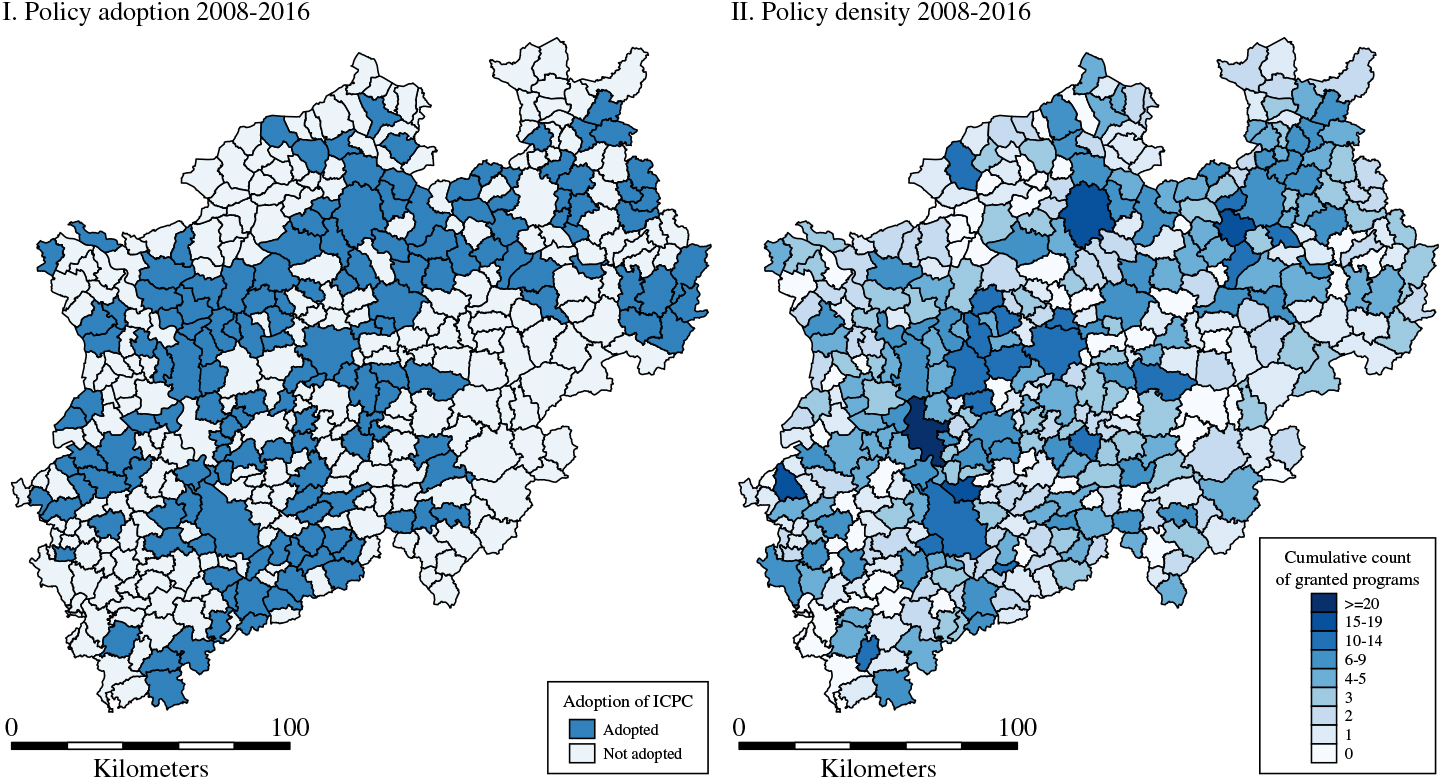
ICPC adoption (I) and climate policy density (II) in NRW.

From a conceptual point of view, the definition of policy output is based on Knill et al. (Reference Knill, Schulze and Tosun2010) who divide its configuration into “policy density” and “intensity”. Whereas density measures the extensiveness or breadth of governmental intervention, intensity refers to level or depth of the intervention. In the case of the DftM, policy density is measured by the number of programmes implemented. Increasing numbers of implemented climate measures indicate a widening of the entire climate policy portfolio. Similarly, the intensity is measured by the size of grants received. Increasing federal grants mean that the municipality can invest more in their climate programmes. In total, the time until ICPC adoption as well as the measures for policy density, intensity and intensity per capita are selected as the four dependent variables in this study.
With respect to substantial policy output and CO2 mitigation efforts, most municipalities target energy efficiency standards and the deployment of renewable energy technologies in private and public facilities. For the most part the municipalities have discretion over the combination of the individual funding blocks. Municipalities can, for example, apply for funding of single measures without setting up an ICPC in the first place.
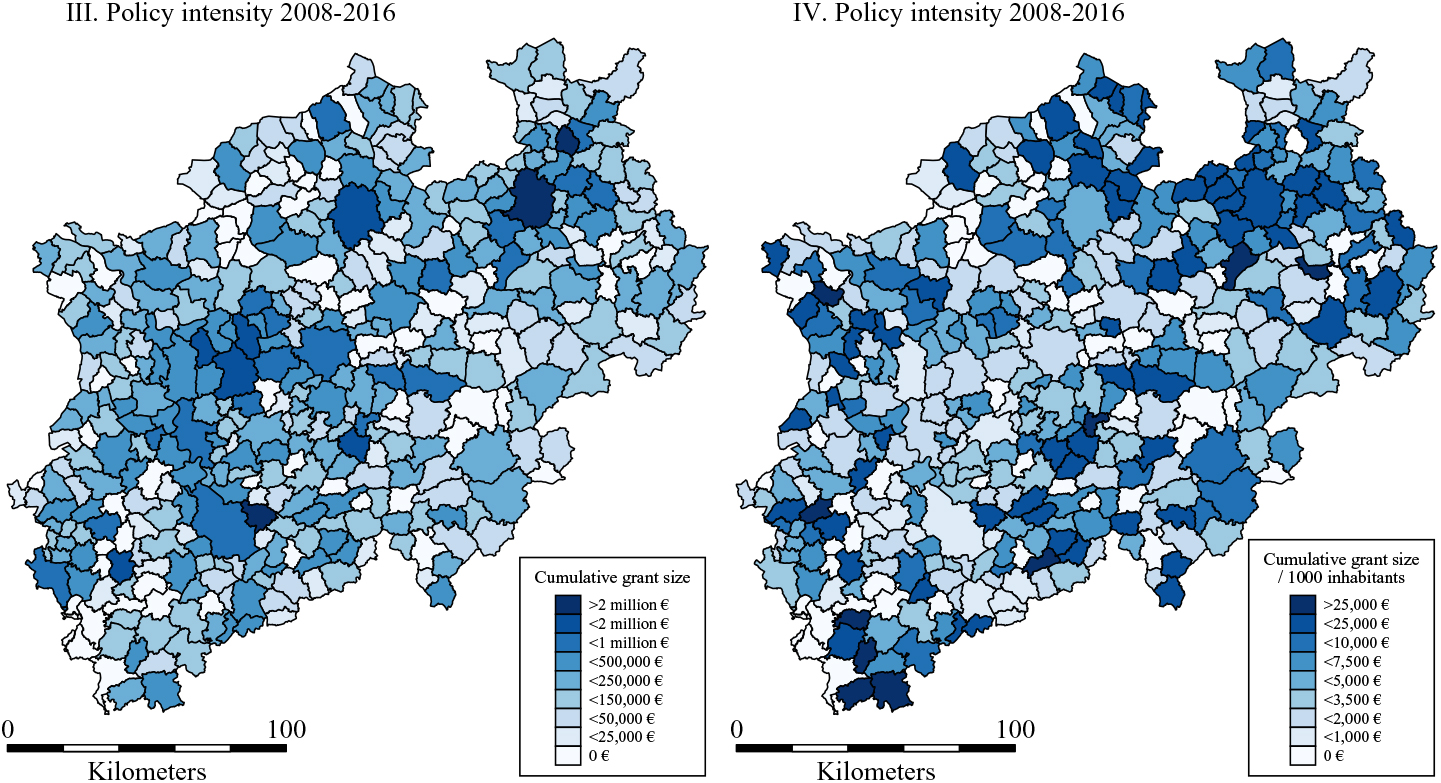
Figures 1 and 2 illustrate the spatial adoption pattern of the ICPC between 2008 and 2016 as well as policy density and intensity maps measured in terms of the total number and size of grant funded programmes. At the end of 2016, 154 out of 396 NRW municipalities (38.9%) had adopted an ICPC based on the federal climate protection initiative. With respect to policy density, we can identify 54 municipalities which had no grant-aided climate measure based on the federal directive until 2016. Policy density seems to increase around certain clusters like Cologne and Dusseldorf, the Ruhr area, Munster and Bielefeld. The policy intensity map (Figure 2, left), based on the absolute value of grants, corresponds to this picture and shows similar clustering effects. If we set these grants into perspective according to population size (Figure 2, right), a different picture emerges. Although we can still see a strong cluster around Bielefeld and Munster in the North of NRW, the cluster around Cologne, Dusseldorf and the Ruhr area disappears.
Policy intensity in absolute (III) and relative (IV) terms in NRW.
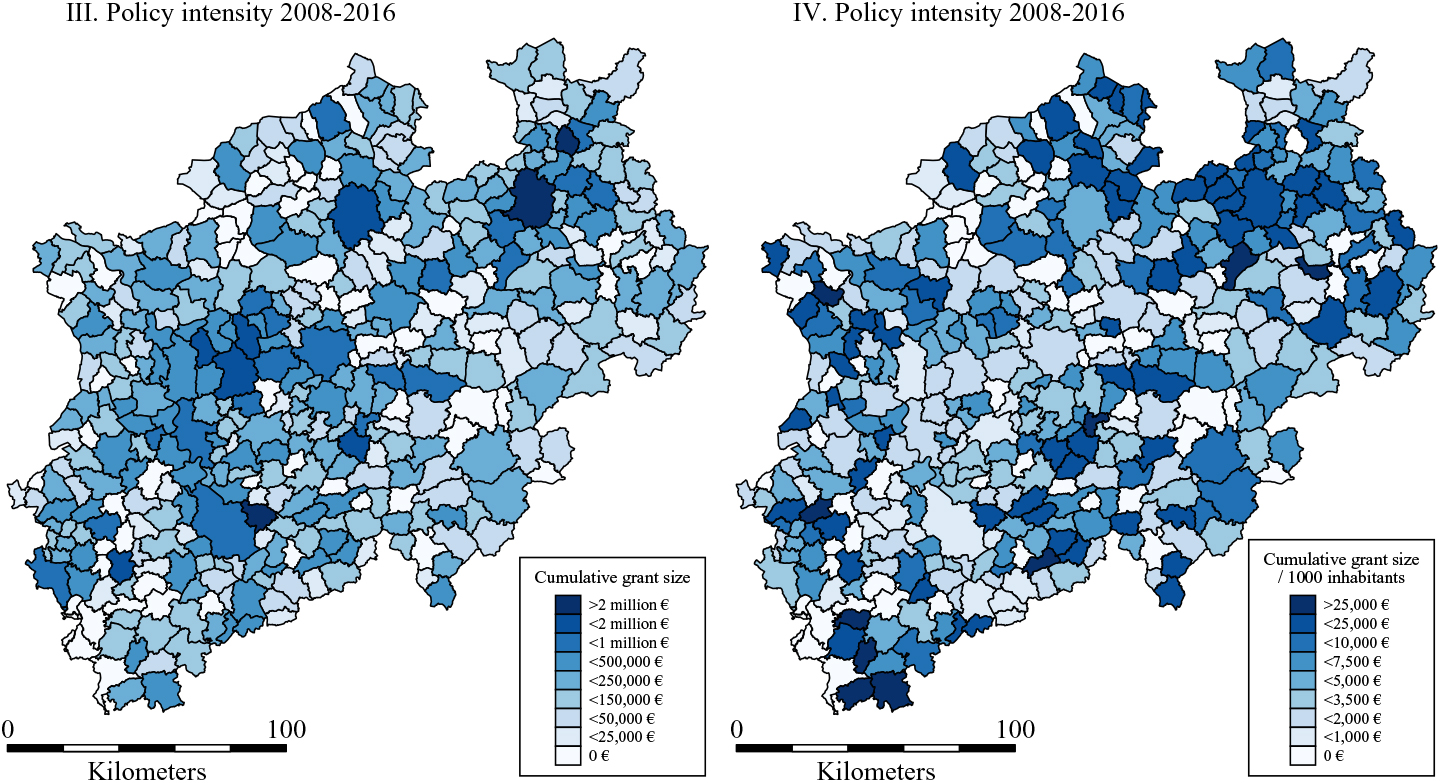
These clustering effects highlight two interesting puzzles: First, are the adoption of an ICPC as well as changes to policy density and intensity subject to the same processes and mechanisms, i.e. are there similar explanatory models for these distinctive steps within local climate policy-making? Second, how are these diffusion patterns affected by successful policy-making, i.e. positive policy outcomes?
The policy process and policy diffusion
Policy diffusion can be described as “one government’s policy choices being influenced by the choices of other governments” (Shipan and Volden Reference Shipan and Volden2012, 788). Two main streams of the policy diffusion literature have emerged over the course of recent decades. The first analyses global policy diffusion among nation states (True and Mintrom Reference True and Mintrom2001; Busch et al. Reference Busch, Jörgens and Tews2005; Levi-Faur Reference Levi-Faur2005; Reiche and Beschberger Reference Reiche, Beschberger, Reiche and Beschberger2006; Elkins et al. Reference Elkins, Guzman and Simmons2006). In the field of environmental policy, this stream is closely linked to the policy convergence literature (Knill Reference Knill2005; Holzinger et al. Reference Holzinger, Knill and Sommerer2008). The second approach focuses on subnational policy diffusion and is strongly influenced by quantitative studies of the states in the USA (Walker Reference Walker1969; Berry and Berry Reference Berry and Berry1990; Berry and Baybeck Reference Berry and Baybeck2005; Carley et al. Reference Carley, Nicholson-Crotty and Miller2017). Studies of diffusion processes at the subnational level in countries other than the USA, like examples on health-care subsidies in Swiss cantons (Gilardi and Füglister Reference Gilardi and Füglister2008) or performance assessments of English local authorities (Ward and John Reference Ward and John2013), are rare. To a much lesser extent scholars have analysed local-level policy diffusion processes among municipalities or cities (Shipan and Volden Reference Shipan and Volden2008; Hakelberg Reference Hakelberg2014).
The classical approach to the study of diffusion processes is to focus on adoption-to-adoption patterns. The explanatory power of these patterns, however, is limited and often restricted to shallow insights into diffusion processes. For the understanding of leader-laggard-dynamics, in particular, the adoption stage is restricted to the description of temporal aspects of policy pioneers but lacks any information on policy leadership, i.e. the quality of the policy.
Including the policy output stage in the analysis of diffusion processes increases our understanding with respect to substantial policy-making. After all, policy leaders are not just pioneers who adopt policies early in time. They also lead because they implement strict and effective policies which provide examples of best practices for other units. Highly visible output in one unit might trigger a general policy change in another, which I call output-to-adoption-diffusion, but it might also lead to change in the configuration of existing policies, namely output-to-output diffusion. This study will incorporate these output-to-output patterns in order to account for the interdependences between substantial policy-making.
It is difficult to distinguish the diffusion mechanisms based on simple adoption-to-adoption patterns. Do policy-makers just emulate what their peers do, or did they learn from them? Including the outcome-stage offers more clarity on this question. Incorporating the spillover of policy effects in one unit on the adoption as well as configuration of policies in another deepens our understanding of the mechanisms behind the diffusion processes. Learning, which is described as the updating of beliefs about the effectiveness of a certain policy based on new information from peers (Meseguer Reference Meseguer2004, 300), inevitably includes aspects of policy outcomes. In an IR context, for example, Elkins et al. (Reference Elkins, Guzman and Simmons2006) show how policy-makers observe the effects of bilateral trade agreements on FDI inflows in other countries and use this as a measure of learning from successful policy-making.
The strongest evidence for substantial learning from successful policies is given within the context of outcome-to-output diffusion. In this case, we can discern that positive policy effects in one unit trigger the broadening and deepening – and not just adoption – of the policy in another. That is why this article will include models to account for outcome-to-output patterns.
The classical approach to identifying policy diffusion is based on spatial proximity. This approach was popularised in political science by Berry and Berry (Reference Berry and Berry1990) and interprets the regional effect in the sense of contiguity. Various studies of policy diffusion among states in the US have chosen this approach (Grossback et al. Reference Grossback, Nicholson-Crotty and Peterson2004; Shipan and Volden Reference Shipan and Volden2008; Baybeck, Berry and Siegel Reference Baybeck, Berry and Siegel2011; Glick and Friedland Reference Glick and Friedland2014; Karch et al. Reference Karch, Nicholson-Crotty, Woods and Bowman2016). Gilardi (Reference Gilardi2016, 12), however, notes the ambiguous operationalisation of this indicator with respect to the three main diffusion mechanisms – learning, competition and emulationFootnote 3 – in the literature. Several scholars agree that although geographical proximity can be used to identify diffusion processes successfully (Baybeck et al. Reference Baybeck, Berry and Siegel2011, 232) the value of this “catch-all” variable for the explanation of the diffusion mechanisms is limited (Maggetti and Gilardi Reference Maggetti and Gilardi2016). Current debates focus much more on context for the diffusion processes concerning preferences and ideology of decision-makers, the institutional structures, the policy design itself or policy expertise and scientific advice (see e.g. Gerlach et al. Reference Gerlach, Williams and Forcina2013). After all, the dimensions of “proximity” between interdependent units are diverse and interactive. Definitions of proximity go beyond mere geospatial ideas including cognitive, social, institutional and organisational facets of proximity (Boschma Reference Boschma2005). This study shows that a qualitative specification of geographical proximity with respect to policy, party and institutional dimensions yields substantial insights into the diffusion process.
In general, I expect a stronger effect of geographical proximity for the diffusion of policies on the local level than on diffusion processes at higher levels. At the national and state levels, the bureaucracy and decision-making processes are much more professional. With increasing expertise and professionalism, politicians can rely on rational decision-making and strategic analysis. Advisors will screen policy successes and failures in all relevant units – not just the proximate ones. In contrast, municipalities have much lower capabilities. As mayors and local bureaucrats must always make decisions under conditions of limited resources and time, the learning process between them is based on bounded rationality (Weyland Reference Weyland2005, Reference Weyland2006). They apply learning heuristics like availability and representativeness (Tversky and Kahneman Reference Tversky and Kahneman1974). In these cases, geography might intensify the other dimensions of proximity. The decision-making process is influenced by readily available options – often provided by pioneers – and these are then communicated through informal and formal networks. Especially small municipalities with even less capability will use experiences from their neighbours as crucial information to decide on their own policy decisions (Ward and John Reference Ward and John2013).
(H1a) Adoption-to-adoption diffusion: Adoption of a climate policy is more likely if neighbouring municipalities have already adopted the policy.
-
(H1b) Output-to-output diffusion: Policy density and intensity increase with increasing density and intensity in neighbouring municipalities.
(H1c) The diffusion of policies is intensified for smaller municipalities with fewer capabilities.
How is the outcome of a policy related to spillover effects in neighbouring municipalities? From a policy-cycle perspective, I would expect a positive between-unit feedback effect of policy outcomes on output. Municipalities learn from successful policies in other municipalities. A major goal of the ICPCs is to increase the proportion of renewable energy in the energy mix. Thus, I consider increasing deployment of renewable energy technologies for electricity production (RES-E) in the municipality as a suitable proxy for successful climate policy-making. If municipalities look to their neighbours and see increasing deployment of renewable energy technologies, they might be induced to follow suit.
(H2) Outcome-to-output diffusion:
Policy density and intensity increase with increasing deployment of renewable energy technologies in neighbouring municipalities.
In addition to these main hypotheses on the diffusion effects throughout the policy process, the article will account for three other aspects of diffusion: 1) general environmental leadership, 2) ideology and party channels and 3) transnational city networks.
Irrespective of the federal funding programme, municipalities engage in various forms of environmental policy. Environmental policy leaders provide examples of best practice. “Green” leaders might push-by-example (Liefferink and Andersen Reference Liefferink and Andersen1998). Thus, municipalities which overall rank very high in environmental policy output and performance may, directly or indirectly, influence neighbouring ones.
In contrast to race-to-the-bottom dynamics with respect to environmental regulation, research on international leader-laggard dynamics among nation states has shown that leaders are able to encourage laggards (Knill et al. Reference Knill, Heichel and Arndt2012). Dynamics of policy learning through communication (Liefferink et al. Reference Liefferink, Arts, Kamstra and Ooijevaar2009) between local leaders and laggards might lead to an overall race-to-the-top in environmental regulation and facilitate policy convergence (Holzinger et al. Reference Holzinger, Knill and Sommerer2008). All in all, the literature clearly argues that environmental pioneers play an important role in diffusion (Jänicke Reference Jänicke2005).
Municipalities are classified as environmental leaders according to the European Energy Award (EEA), which is a certification system for municipalities with respect to sustainable energy and climate policy. The EEA programme offers support to municipalities in setting up environmental targets and policies and introduces a regular auditing, certification and benchmarking system. Municipalities were considered “environmental pioneers” if they had joined the programme in the first three years (2003–2005) of the establishment of the EEA and been awarded the highest standard – the Gold certificate. The twofold criteria ensure that environmental pioneers are both policy pioneers from a temporal perspective and environmental leaders with respect to substantial outcomes.
(H3) Environmental leaders:
Adoption as well as increasing output of a climate policy is more likely if neighbouring municipalities are environmental policy leaders.
Ideology represents a central context factor for diffusion processes. The notion that diffusion is more likely between states with ideologically similar characteristics has been well studied in political science (Grossback et al. Reference Grossback, Nicholson-Crotty and Peterson2004; Berry and Berry Reference Berry, Berry and Sabatier2007). Membership in political parties can give us an indication of the ideological position of mayors.Footnote 4 At the same time, partisanship can influence learning among decisionmakers beyond ideological issues. Research has shown that evidence of policy experimentation by co-partisans can significantly increase the interest in learning about others’ experiences even if they are ideologically predisposed against the policyFootnote 5 (Butler et al. Reference Butler, Volden, Dynes and Shor2017). This information is channelled through party networks. For example, local-level decisionmakers from the same party and region might form affiliation networks at regularly organised party events. Thus, party networks are crucial channels for the dissemination of information on public policies between municipalities (Ward and John Reference Ward and John2013).
(H4a) Partisan channels:
Policy diffusion is more likely among proximate municipalities with mayors of the same party.
Classical party theory suggests that policy-making is dependent on the position of political parties (Schmidt Reference Schmidt1996). Even though this effect might be weaker at the local level than the national one, it seems plausible to argue that parties matter. Although there is a widespread consensus across all parties to address climate change, some parties regard the implementation of climate mitigation policies very favourably while others are more reticent.
With respect to climate policies in German municipalities, authors like Bulkeley and Kern (Reference Bulkeley and Kern2006) link Green party membership to early adopter behaviour. Similarly, Jänicke (Reference Jänicke2005) argues that environmental policy pioneers and trend-setters are characterised by a robust green advocacy coalition. I expect that the Green party will be an important channel for the diffusion of the policy programme. The diffusion process will be weakened in municipalities where the Green party has no access to decision-making – i.e. no members on the local council. In contrast, networks between Green party members will be especially effective in municipalities where the party is represented in the council.
(H4b) Green party channels:
The diffusion process is stronger between proximate municipalities with Green party members in the local council.
Finally, the climate governance literature emphasises the role of transnational city networks for the coordination of effort (Betsill and Bulkeley Reference Betsill and Bulkeley2006; Bulkeley Reference Bulkeley2010). These networks create institutional proximity between their members. All major transnational city networks advocate the adoption of local climate action plans. Hakelberg (Reference Hakelberg2014) shows that these networks were important channels for the diffusion of climate strategies in European cities between 1992 and 2009. Kern and Bulkeley (Reference Kern and Bulkeley2009) note that a primary reason for local authorities joining transnational networks is to learn more about “best practices”.
(H5) Institutional networks:
Adoption as well as increasing climate policy output is more likely in municipalities which are members of transnational sustainability networks.
Domestic factors affecting policy innovation and adoption
Various factors with respect to the political and socio-economic constitution of the municipality as well as the pressure caused by the environmental problem and existing policy landscape will influence the diffusion process (see, e.g. Lenschow et al. Reference Lenschow, Liefferink and Veenman2005). Several variables will be used to control for these domestic factors.
Traditional perspectives on urban–rural links in the diffusion of ideas and innovations in general and climate governance in particular argue that urban areas are pioneers (Fischer Reference Fischer1978; Todd Reference Todd1979; Florida Reference Florida2005; Glaeser Reference Glaeser2011; Lenhart et al. Reference Lenhart, Bouteligier, Mol and Kern2014; Mössner Reference Mössner2016). Therefore, I expect that the adoption of a climate policy is more likely in cities than in towns. As with diffusion studies like that of Baybeck, Berry and Siegel (Reference Baybeck, Berry and Siegel2011), I also assume that the fiscal “strength” of a municipality affects the likelihood of policy adoption. The religious denomination of the population is a typical control variable for cultural factors influencing environmental policy-making (Lenschow et al. Reference Lenschow, Liefferink and Veenman2005; Liefferink et al. Reference Liefferink, Arts, Kamstra and Ooijevaar2009). Here, I use the proportion of Catholics as a control variable for conservatism in the municipality. Environmental problem pressure will be covered by several variables. An approximation of total greenhouse gas emissions is based on CO2 emissions of the transport sector. In addition, the size of the territory and land use indicators for agriculture and industry are added as additional measures for problem pressure. Finally, the policy design and existing policy landscape will affect the diffusion process. The DftM grants the option to adopt the ICPC on the higher rural district level (Landkreise). Although the DftM allows for the adoption on both levels simultaneously, I expect that ICPC adoption on the district level will decrease the likelihood of adoption by individual municipalities. With respect to alternative policies, the government of NRW implemented a similar funding scheme for local climate strategies (KlimaPLUS) in 2008 which will be included as a control as well.
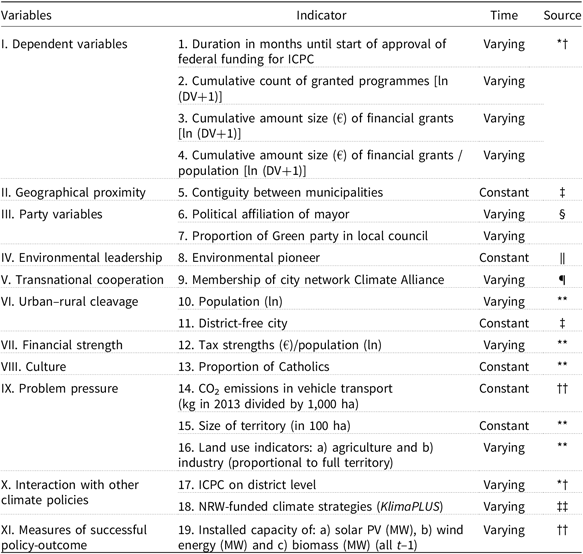
A complete overview of all variables and the respective indicators is given in Table 1, and the codebook in the online Supplementary material appendix describes the entire dataset in detail. Table 1 in the online Supplementary material appendix reports the summary statistics for the continuous variables. The dataset was checked for multicollinearity and only variables with variance inflation factors (VIF) below 4 were included in the final version (see Figure 2 and Table 2 in the online Supplementary material appendix).
Variables and data sources

* Bundesministerium für Bildung und Forschung, Förderportal des Bundes (2017): http://foerderportal.bund.de/.
† Bundesministerium für Umwelt, Naturschutz und nukleare Sicherheit, Nationale Klimaschutzinitiative (2018): http://www.klimaschutz.de/.
‡ Bundesamt für Kartographie und Geodäsie, Dienstleistungszentrum / GeoBasis-DE (2018): http://www.geodatenzentrum.de/.
§ Der Landeswahlleiter des Landes Nordrhein-Westfalen, Wahlergebnisse in NRW (2017): http://www.wahlergebnisse.nrw.de/ and online search for politicians’ websites.
‖ European Energy Award, Liste der eea-Kommunen (2017): http://www.european-energy-award.de/.
¶ Climate Alliance, municipalities network database (2017): http://www.climatealliance.org/.
** Information und Technik Nordrhein-Westfalen, Statistisches Landesamt, Landesdatenbank NRW (2017): https://www.landesdatenbank.nrw.de/.
†† Landesamt für Natur, Umwelt und Verbraucherschutz Nordrhein-Westfalen, Klimaatlas NRW (2017): http://www.klimaatlas.nrw.de/.
‡‡ Ministerium für Umwelt, Landwirtschaft, Natur- und Verbraucherschutz des Landes Nordrhein-Westfalen, Klima plus, (2017): http://www.umwelt.nrw.de/klima-energie/ausgewaehlte-projekte/klimapluskommunen/.
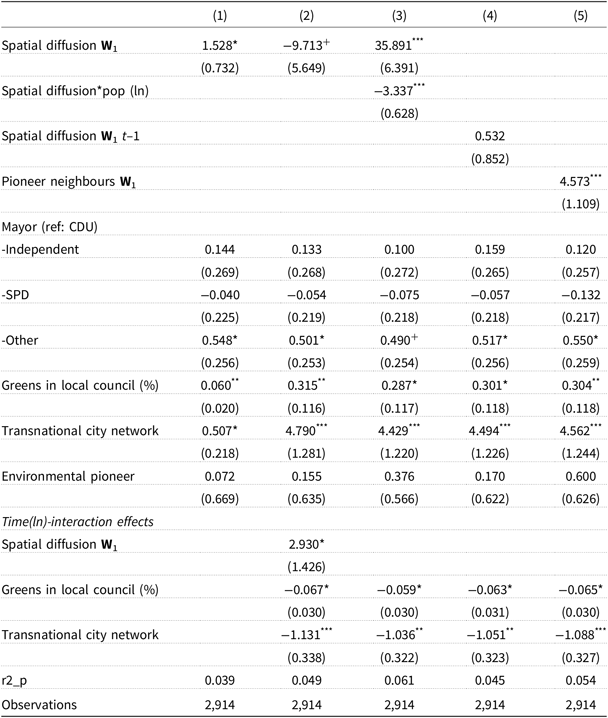
Results for event history analysis on ICPC adoption (models 1–5)
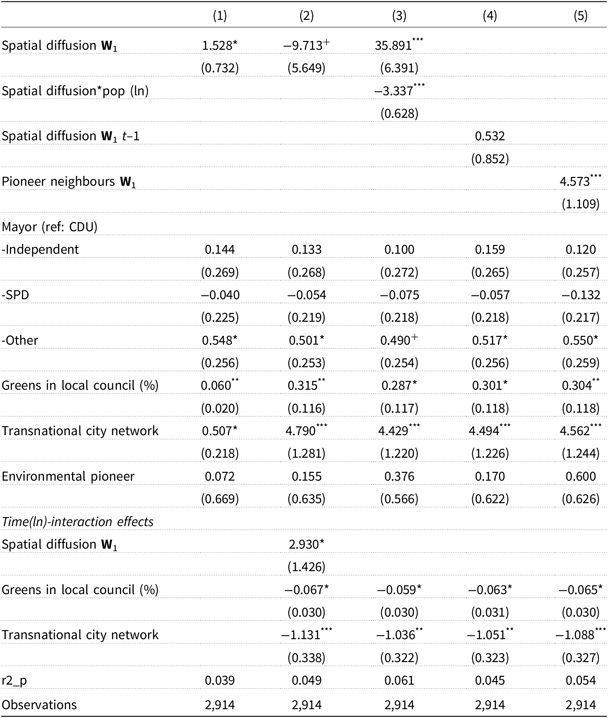
Clustered robust standard errors in parentheses. Control variables included but not displayed: Population (ln), tax strength per capita in euro (ln), percentage Catholic, territory (100 ha), CO2/1,000 ha, proportion land use: agriculture, proportion land use: industry, NRW-funded climate strategies, district-free city.
+p < 0.10, *p < 0.05, **p < 0.01, ***p < 0.001.
Estimation strategy and spatial weights
Estimation strategy
Bringing together policy adoption and output patterns is a methodological challenge due to different data structures of the dependent variables (DVs). The analysis of policy adoption is directed at events whereas policy output relates to changes in levels. Latest versions of statistical software packages offer new spatial econometric techniques for panel data in order to calculate spatial autoregressive models of the DV (SAR), spatial error models (SEM), spatial models of covariates (SLX) and combinations of these (for an overview see Elhorst Reference Elhorst2014). These models allow for the calculation of direct and indirect effects, a gold standard for spatial analysis. Spatial duration models, however, are not readily available. That is why I have to draw on more classical, “naive” forms of spatial analysis for the adoption patterns, where the spatially lagged adoption indicator is exogenously included in the list of covariates. This method entails certain limitations with respect to the substantial interpretation of the effect size as well as potential problems with the simultaneity bias since the dependent variable shows up on both sides of the equation (Franzese and Hays Reference Franzese and Hays2007, Reference Franzese and Hays2008). Time-lagged spatial lags can mitigate this problem. Ward and John (Reference Ward and John2013, 12), however, point out the potential conceptual and methodological fallacies of this approach for short panels. In particular, the approach implies a time-lagged diffusion effect and dismisses within-year effects – a rather unjustified assumption. That is why I report models with both specifications.
The first part of the analysis with respect to the ICPC adoption is based on an EHAFootnote 6 (Box-Steffensmeier and Jones Reference Box-Steffensmeier and Jones2004) and was implemented in STATA 15 (2017a). The Cox proportional hazards model is a standard tool for this endeavour (Elkins et al. Reference Elkins, Guzman and Simmons2006; Shipan and Volden Reference Shipan and Volden2008; Bayer et al. Reference Bayer, Bethke and Lambach2015). The dependent variable in the Cox model is the time until adoption of the ICPC. The hazards model allows for both time-constant and -varying covariates, which account for changes in municipal-level characteristics over the period. Therefore, the likelihood of adopting an ICPC is given as a function of a range of factors using temporal data for the adoption. In the Cox proportional hazards model, the hazard is assumed to be:
 $$h\left( {\bf{t}} \right){\rm{ }} = {h_0}\left( {\bf{t}} \right){\rm{exp}}\{ {\beta _{\rm{1}}}{{\bf{x}}_{\rm{1}}} + {\rm{ }} \ldots {\rm{ }} + {\beta _k}{{\bf{x}}_k} + g\left( {\bf{t}} \right)({\gamma _{\rm{1}}}{{\bf{z}}_{\rm{1}}} + {\rm{ }} \ldots {\rm{ }} + {\gamma _m}{{\bf{z}}_m})\} ,$$
where (x 1,…, x k ) are the time-constant and (z 1,…, z m ) are the time-varying covariates including the exogenously added spatial lags of the DV based on W 1, W 2 and W 3. The hazard function is the conditional probability of a municipality adopting the ICPC within the study period. Clustered robust standard errors are estimated to account for heteroscedasticity and uncorrected serial correlation over time and space.
The Cox regression is based on the assumption of proportional hazards over time. A test of this based on Schoenfeld residuals after fitting the model shows that several variables might violate this assumption. A visual inspection of these covariates supports this impression for the spatial ICPC lag, the Green party indicator and the city network indicator, and that is why I will include time-interaction effects for these covariates in the regression in order to account for time-varying coefficients (Licht Reference Licht2011).
The second part of the analysis with respect to the policy output is based on spatial autoregressive models for panel data and was implemented in STATA 15 (2017b). Fixed effects (FE) and random effects (RE) SAR, SLX and spatial Durbin models with lagged DVs and covariates were fitted with:
 $${{\bf{y}}_{nt}} = \lambda {{\bf{W}}_{\rm{1}}}{{\bf{y}}_{nt}} + \gamma {{\bf{W}}_{\rm{1}}}{{\bf{x}}_{nt}} + {{\bf{X}}_{nt}}\beta + {{\bf{c}}_n} + {{\bf{v}}_{nt}},$$
where y nt is an n × 1 vector of observations on the dependent variables for policy density and intensity for time period t; X nt is an n × k matrix of covariates; c n is a vector of panel-level effects (FE: an n × 1 vector of individual effects; RE: random effects with mean 0 and variance σ c 2); v nt is a vector of disturbances and is independent and identically distributed (i.i.d.) across panels and time with variance σ 2; and W 1 is a spatial weighting matrix. These models and their maximum likelihood estimators are based on Lee and Yu (Reference Lee and Yu2010a, Reference Lee and Yu2010b). The FE models include time-lagged DVs in order to control for common trends (Plümper and Neumayer Reference Plümper and Neumayer2010).Footnote 7
Including spatially weighted variables creates a recursive model. That is the reason why a direct interpretation of the coefficients can be misleading. The calculation of the average direct, indirect and total effects mitigates this problem. Based on this differentiation, we can filter out the direct effect of a covariate on changes in the DV in the focal municipality from spillover-effects of this variable in other municipalities.
Design of the spatial weight matrices
The measurement of unit-interdependence based on spatial weights matrices W requires certain explicit specifications (Plümper and Neumayer Reference Plümper and Neumayer2010). With respect to the functional form, the selected weights matrix W 1 measures 1st order contiguity between municipalities. W 1 describes an N × N matrix, for i ≠ j, entry wij = 1 if both units i and j share a common border and 0 otherwise. The theoretical argument behind this approach is that decisionmakers are strongly influenced by close neighbours and are generally limited in their capabilities of monitoring neighbours.
The dataset contains a second set of weights matrices W 2 and W 3 which are qualitative specifications of W 1 with respect to party networks between mayors and council members. In a first step, matrices M and G were created for each year and measure associations between municipalities with mayors from the same party and between municipalities which have Green party members in the local council.Footnote 8 Following Ward and John (Reference Ward and John2013, 16) M describes an N × N matrix, for i ≠ j, entry wij = 1 if both mayors were from the same party in units i and j and 0 otherwise. Accordingly G describes an N × N matrix, for i ≠ j, entry wij = 1 if there are Green party members represented in the local council in both units i and j and 0 otherwise. In a second step, the Hadamard products were calculated for W 2 = W 1 ○ M and W 3 = W 1 ○ G, i.e. each entry wij in the two association matrices M and G was multiplied with the corresponding entry wij in W 1. The resulting weight matrices W 2 and W 3 measure geographical contiguity conditional on the partisanship of the mayors and the Green party in the local council.
The party association matrices vary over time. This presents a technical challenge for the implementation of spatial autoregressive panel models which do not allow for time-varying spatial weights. That is why these weights can be applied only in the EHA where lagged DVs are exogenously added as covariates.
Plümper and Neumayer (Reference Plümper and Neumayer2010, 430) discuss the effect of standardisation of spatial matrices which adjusts the relative influence of all neighbours according to their total number. Under the assumption that decisionmakers employ availability heuristics due to resource constraints, standardisation makes sense since increasing neighbour size diminishes the relative influence of each individual neighbour. That is why all matrices were standardised based on spectral-normalisation so that the largest eigenvalue is 1.
Analysis
Results for the hazard rate and panel models
Tables 2 and 3 summarise the results for the Cox conditional hazard models. Models 1–4 are specified for the analysis of general spatial diffusion effects. In the most basic form (model 1), the adoption of an ICPC in contiguous municipalities exercises a significant effect on ICPC adoption in the focal municipality. The positive and significant time-interaction effect in model 2 suggests that this effect from spatial proximity intensifies over time. Model 3 includes an interaction effect between the spatial lag and population size. Both coefficients are statistically significant and show a decreasing diffusion effect with increasing population size. Model 4 presents a time-lagged version of the spatial lag. The effect is still positive but smaller and not significant any more.
In addition to pure policy-related diffusion effects, model 5 tests the effects of environmental policy and performance leadership on ICPC adoption. Whereas being an environmental pioneer does not in itself exert a significant influence, closeness to environmental pioneers does.
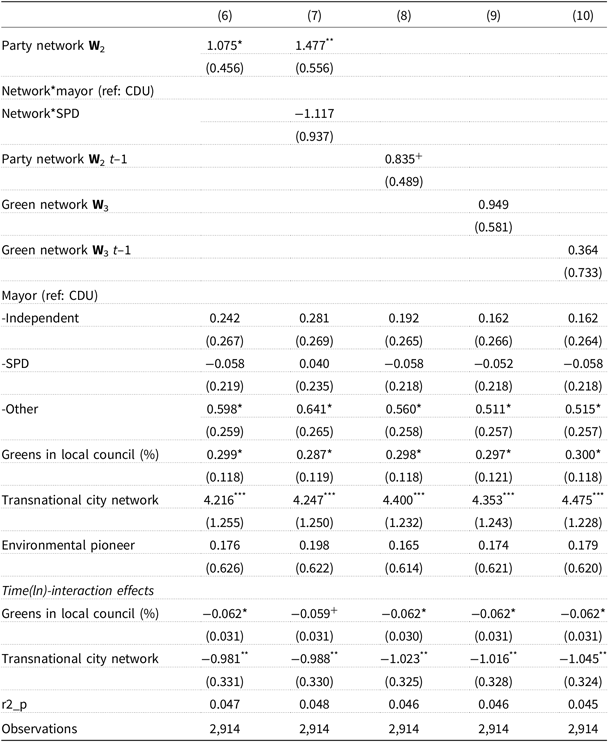
The models 6–10 summarise the results for the party networks. Model 6 shows the effect of general party networks W 2 on adoption. Within the SPD and CDU mayoral networks we find a statistically significant increase in the hazard rate of 174%. This means that mayors are more likely to implement policies if neighbouring mayors from the same party do so. Although there are no clear effects of party affiliation on policy adoption for SPD and CDU itself – i.e. we cannot say that one party is more likely to adopt the policy than another – diffusion within both party networks takes place. This effect is also significant at the 10%-level for a time-lagged version of the party network (model 8). Model 7 includes an interaction effect between the party network variable and party affiliation and allows us to interpret the diffusion within the SPD and CDU networks separately. Although the network diffusion effect is larger for CDU-controlled than SPD-controlled units, this effect is not significant. In total, we can detect policy diffusion across party channels but cannot distinguish substantial differences between the parties.
With respect to the role of the Green party in the local councils, we can identify a significant effect across all model specifications. Increasing numbers of the Green party in a local council increase the likelihood of ICPC adoption. A 1 percentage point increase in the number of seats increases the hazard rate of ICPC adoption by roughly 6% in model 1. This is a strong effect. In contrast, the role of the Green party in the spatial diffusion of the ICPC (models 9 and 10) is not visible.
The regression results further indicate a robust effect on adoption through membership in the transnational city network Climate Alliance. Specifically, this effect is estimated to increase the hazard rate for ICPC adoption by 66% in model 1.Footnote 9
The time-interaction terms are important adjustments to the estimation in order to account for non-proportional effects over time. Beyond that, they also yield interesting results for leader-laggard dynamics. Both interaction terms are negative and statistically significant in all models. This signals a decreasing effect of the strength of the Greens and transnational network membership over time. Figures 5 and 6 in the online Supplementary material appendix show the simulated hazard ratios for both coefficients.Footnote 10 Whereas in the beginning of the federal programme, the Green party was a strong driver of adoption, this effect decreases over time. Approximately 63 months after the initiation of the federal programme, the hazard ratio falls below 1. This is the time when the adopter pattern switches from early adopters to the later majority (on adopter categories, (Rogers Reference Rogers2003) see Table 3 in the online Supplementary material appendix). We can find a similar dynamic for municipalities which are members in the transnational city network.
Results for event history analysis on ICPC adoption (models 6–10)
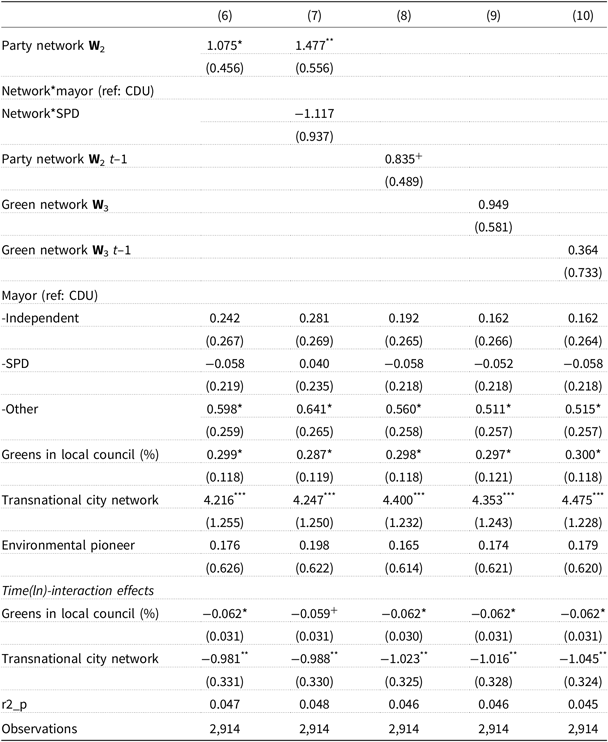
Clustered robust standard errors in parentheses. Control variables included but not displayed: Population (ln), tax strength per capita in euro (ln), percentage Catholic, territory (100 ha), CO2/1,000 ha, proportion land use: agriculture, proportion land use: industry, NRW-funded climate strategies, district-free city.
+p < 0.10, *p < 0.05, **p < 0.01, ***p < 0.001.
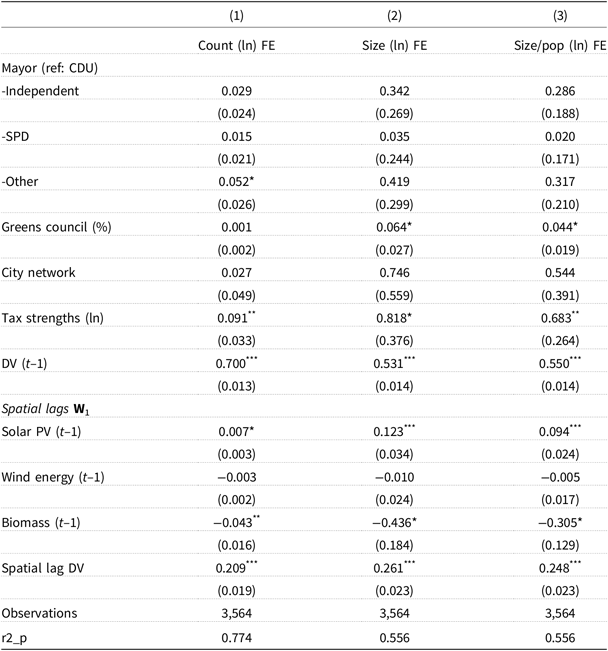
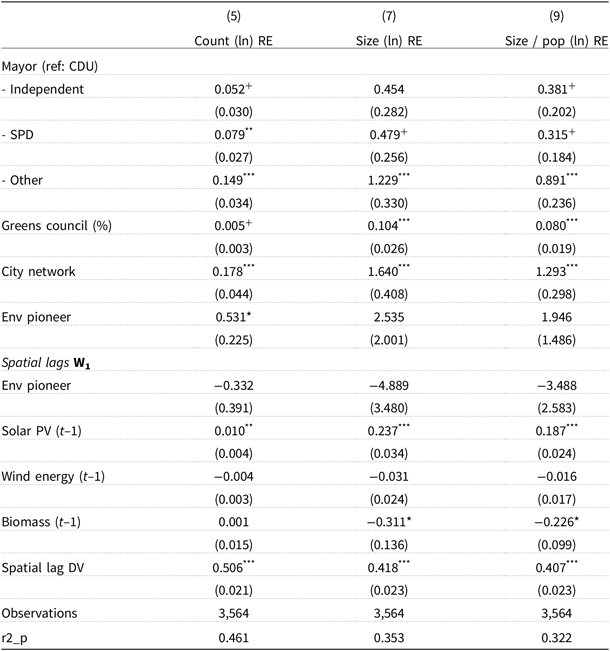
How are the results from the ICPC adoption related to the density and intensity of climate policy-making in NRW? Tables 4 and 5 present the FE and RE spatial autoregressive models including spatial lags of the dependent variables as well as spatial lags of several covariates. Models 1–3 are FE models specified for the natural logarithms (DV+1) of the dependent variables – cumulative grant count, cumulative grant size and cumulative grant size divided by 1,000 inhabitants – respectively.Footnote 11 Models 4–6 are RE models with the same specifications including time-constant variables and district dummies in order to control for unobservables on district level.
Fixed-effects spatial autoregressive models for policy density and intensity
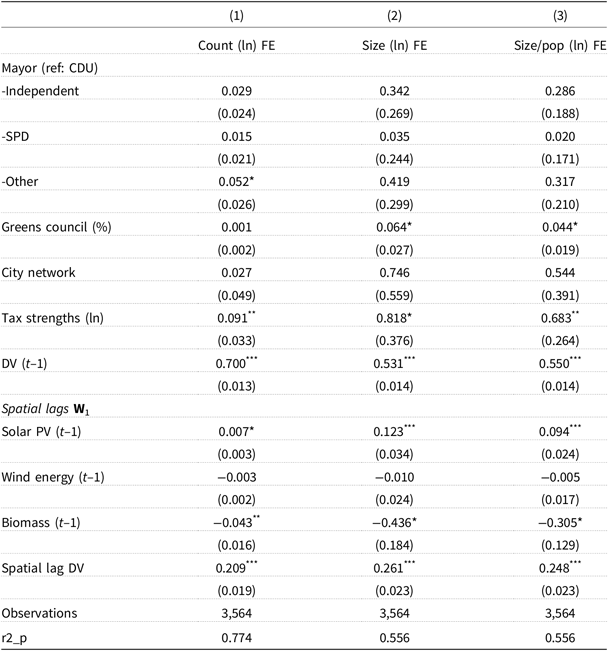
Standard errors in parentheses. Control variables included but not displayed: Proportion land use: agriculture, proportion land use: industry, solar PV (t–1), wind energy (t–1), biomass (t–1).
+p < 0.10, *p < 0.05, **p < 0.01, ***p < 0.001.
Random-effects spatial autoregressive models for policy density and intensity
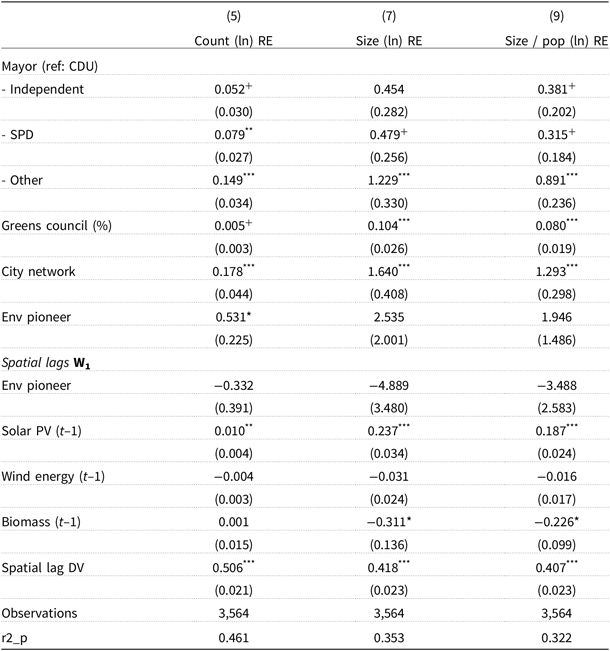
Standard errors in parentheses. Controls included but not displayed: Population (ln), tax strengths (ln), territory (100 ha), percentage Catholic, CO2/1,000 ha, proportion land use: agriculture, proportion land use: industry, solar PV (t–1), wind energy (t–1), biomass (t–1), districts. Constant not displayed.
+p < 0.10, *p < 0.05, **p < 0.01, ***p < 0.001.
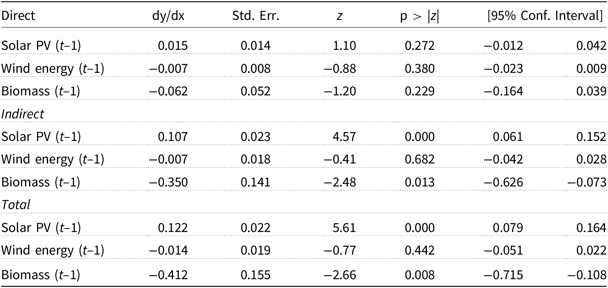
The significantly positive effects of the spatial lags of the DVs across all model specifications confirm the results about geography as a “catch-all” indicator for diffusion. Policy density as well as intensity in the focal municipality rise with increasing values in proximate units. With respect to outcome-to-output effects, learning from successful climate policy-making seems to be induced by increasing quantities of solar PV in the neighbourhood. The spatial lags of this covariate exhibit significant and robust effects across all model specifications. Table 6 reports the average direct and indirect effects of all spatially lagged covariates for model 3. It shows that a 1 percentage point increase of solar PV in the neighbourhood increases policy intensity by 0.11 percentage points. In contrast, wind power does not trigger any diffusion effect. Biomass exerts a significant and negative effect in models 2–6. In model 3, specifically, a 1 percentage-point increase in biomass in the neighbourhood decreases policy intensity by 0.35 percentage points.
Average direct, indirect and total effects for the SLX (FE model 3)

In contrast to ICPC diffusion effects through proximity to environmental policy leaders, density and intensity of climate policy-making seems not to be influenced by this variable (models 4–6). The effect of the Green party in the council, however, gets confirmed for policy intensity across FE and RE models. Though policy density is not necessarily significantly higher in municipalities with a strong Green party in the council, the policy output is more intensive. The fact that RE and FE models both support this finding indicates robust results. First, municipalities with a higher number of Greens in the council have a higher output compared to units with lower ones. Second, policy intensity increases within single municipalities when the Green party increases its number of seats after elections.
With respect to climate city networks, finally, we can see mixed results. The significant effects for the RE models suggest that municipalities which take part in this network have a higher policy output performance. This finding, however, is not confirmed by the FE models. This suggests that institutional membership is a general indicator for higher climate policy output but not a change agent for it within municipalities.Footnote 12
Discussion of the results
In general, we find substantial evidence for the “catch-all” diffusion hypotheses (Hypothesis 1a–Hypothesis 1c) for ICPC adoption as well as policy output. Horizontal diffusion was most certainly intensified through vertical governance interventions. After the implementation of the DftM in 2008, the German Institute for Urban Studies (Difu) – a leading partner of the federal government in administering the DftM – spread the word through several channels. In addition to mainstream approaches like online and social media campaigning and setting up events, the Difu contacted associations in German cities as well as regional energy agencies and ministries on the Länder level which have affected the uptake of measures. These can be understood as mediators between horizontal and vertical governance and facilitators of the diffusion process.
These adoption-to-adoption and output-to-output patterns, however, are not clear-cut evidence that the diffusion is based on actual learning by the decisionmakers about the improvement of environmental performance. It might be that municipalities are just emulating policy-making by their neighbours or trying to gain windfall profits from federal funds for local climate protection strategies which had been implemented anyway. Outcome-to-output patterns (Hypothesis 2), however, suggest that policy learning is driven by increasing shares of RES-E in neighbouring municipalities but that this effect applies only to solar PV and not to wind power or biomass.
Social acceptance of these technologies might offer an explanation for the differences in effects. As Gilardi (Reference Gilardi2010) points out, the vote-seeking decisionmaker is sensitive to the popularity of the proposed policy. The outcome-to-output hypothesis might be conditional on the popularity of the energy technologies. In general, RES-E technologies enjoy a comparatively high acceptance among the German population in contrast to other industrialised countries (AEE 2016). Several surveys indicate that a majority of the population in Germany supports increasing RES-E deployment and strongly prefers RES-E to conventional, fossil-fuel-based technologies when asked about the construction of new plants in its neighbourhood (AEE 2015).
With respect to specific RES-E technologies, however, we can find varying grades of acceptance. Of these three technologies, solar PV enjoys the highest acceptance. In a recent survey, roughly 80% of all participants supported the construction of new facilities in their area of residence. Wind energy scores considerably lower but still receives acceptance rates above 50%. Biomass lies below 50% but still performs better than conventional energy sources like gas, coal or nuclear power plants (AEE 2015).
How can we explain these differences in the acceptance of RES-E technologies? One major factor is the degree of involvement of citizens in the energy production process. Germany has a long history of energy cooperatives organised by local citizens. In contrast to biomass, which is mainly operated by individual farmers or utility companies, solar PV and wind energy are strongly connected to grassroots movements and energy cooperatives. Therefore, they also represent a shift in producer–consumer relations from an “incumbent” regime dominated by a few large producers towards a “democratisation” of energy production.
A second aspect which differentiates solar PV from wind energy and biomass is the perceived impact on the landscape. Small-scale solar PV is mainly restricted to public and private rooftops whereas wind energy is highly debated due to its aesthetic appearance as well as substantive impact on flora and fauna. Germany experienced a rise of natural heritage advocacy groups which have lobbied against the deployment of wind energy as well as biomass in recent decades.
Decisionmakers might be aware of these differences in RES-E approval rates. The spill-over effects from policy outcomes in neighbouring municipalities might be conditional on the technology itself. These striking findings demonstrate that the conceptualisation and measurement of policy success is highly problematic. What do decisionmakers regard as successful policy-making? Since decisionmakers are not just policy-seekers but also vote-seekers, it is a convincing argument that they look not just at the effectiveness of a given policy but also at its popularity among their constituents: it is not just about the policy outcome but also about the political outcome. The “conditional nature” of learning processes (Gilardi Reference Gilardi2010) with respect to policy as well as political consequences is a significant feature of this analysis and should be investigated further.
In addition to these feedback effects across interdependent policy processes, the results shed light on our expectations about the role of environmental leadership, ideology and partisanship and transnational city networks. The results for the environmental-pioneer hypothesis (Hypothesis 3) indicate that the ICPC adoption can be interpreted as a reaction to high environmental policy performance in neighbouring municipalities. Environmental pioneers stimulate late adopters which could support arguments about the race-to-the-top dynamics in environmental policy-making. The results for policy output levels, however, limit this impression. The fact that Hypothesis 3 is confirmed for ICPC adoption but not for policy output but not for policy output, implies emulation behaviour. Municipalities are swayed by their neighbourhood to “act” green by adopting an ICPC and imitate their pioneering neighbours. ICPC adoption potentially functions as a public legitimation of climate policy-making. With respect to substantial policy output, though, similar effects are not clearly visible.
Mixed results were also found for the role of parties as channels of diffusion. Hypothesis 4a is partially confirmed for ICPC adoption patterns, and these results highlight the role of party networks between mayors as channels of diffusion. Networks between Green party members in the local councils (Hypothesis 4b) are not clear, but the Green party itself exerts a fundamental influence on ICPC adoption as well as policy intensity. These robust results for the Greens as “internal” determinants and leaders of policy adoption are also supported by temporal patterns. The Greens were strong drivers of early ICPC adoption. At the beginning of the federal funding programme, information was scarce and risks higher. Primarily pioneers and policy leaders with a strong Green party in the council decided to adopt the policy. Over time, the policy diffused through several other channels and became “mainstream”. At later points in time, the relevance of the Green party for ICPC adoption diminished.
Similar patterns of leadership in ICPC adoption are detectable for the role of climate city networks (Hypothesis 5) which can be explained by better provision of and access to information and coordination. The differences in the results for the FE and RE models, however, indicate that the relationship between institutionalised membership and policy output is spurious rather than truly transformative: Members happen to have higher levels of policy output than non-members, but becoming a member does not exert a significant effect within municipalities. This can be explained by the fact that the Difu did not cooperate with any major sustainability initiative or city network in order to promote its programme. Thus we cannot assume a coordinated diffusion effect through this channel. The connection between Climate Alliance members, however, could have facilitated awareness of climate policies and knowledge transfer.
Conclusions
This article explores the determinants of climate policy adoption as well as density and intensity at local levels. It focuses on horizontal diffusion processes and incorporates measures of policy output and outcome. Based on continuous-time EHA and spatial autoregressive panel models the research has employed various variables on spatial proximity in order to find a policy diffusion effect for German municipalities.
Spatial and party network diffusion results indicate that communication among local authorities is important in order to foster the adoption of climate policies. In particular small municipalities with limited resources and expertise learn from their neighbours and may emulate their climate policies. Pioneering cities with deep network ties and a strong Green party in the local council are important hotspots for the diffusion of climate policies in their neighbourhoods. Similarly, environmental leaders stimulate the diffusion of climate policy. Late adopters turn towards these innovators in order to learn about policy implementation and best practice because the experiences of the pioneers reduce the risks associated with policy failure. This temporal dynamic has been clearly shown by non-proportional hazards which decrease over time for the effect of the Green party in the council and membership in transnational city networks.
The analysis of substantial policy output, however, shows that emulation and learning influence policy activity. Whereas the adoption of ICPCs was driven by proximity to environmental pioneers, policy density and intensity were not. ICPC adopters are influenced by the environmental leadership of their neighbours. With respect to policy output, however, not all of these adopters follow through.
In contrast, policy density and intensity are driven by potential learning from successful policy-making in nearby municipalities. Increasing amounts of solar PV deployed by neighbours might induce increasing climate policy activity. This is an important finding because it shows that successful outcomes of policy-making can have spill-over effects. Particularly interesting is the fact that this positive effect is induced only by solar PV but not by wind energy or biomass, something which could be explained by variations in public awareness and attitudes towards those technologies.
These findings highlight several implications for future research on local climate policy. First, the results raise questions about political agency. The role of the Greens as leaders in the local councils was evident in the beginning but diminished over time. This temporal variation in leadership and “streamlining” of climate policy in other parties is an interesting avenue for further research. Second, the diverging results for the diffusion of the ICPC adoption in contrast to substantial policy output hint at “window dressing” in some municipalities. Linking back to research on policy portfolios, further research is needed on the substance of and compliance with local climate policy. Third, the varying effects of different renewable energy technologies for the diffusion of climate policies and the proposed “conditional nature” of policy learning raise questions about the cogs and wheels of learning between decisionmakers. The dynamics of policy learning as well as political learning in climate governance are in large part a black box and call for more empirical evidence.
Furthermore, three conceptual issues were raised for future diffusion research in general. The results show that a qualitative specification of “proximity” beyond simple geographic distance offers a more detailed description of the diffusion process. In addition, disentangling the diffusion process along different steps within the policy process adds clarity and facilitates the understanding of diffusion mechanisms. Finally, incorporating measures of entire policy portfolios instead of single instruments paints a more comprehensive picture of policy interdependence.
Author ORCIDs
Dennis Abel, 0000-0001-6220-2511
Supplementary material
To view supplementary material for this article, please visit https://doi.org/10.1017/S0143814X19000199
Acknowledgments
The author wishes to thank (in alphabetical order) Felix Bethke, Florian Fastenrath, Fabrizio Gilardi, Jude Hays, Sebastian Juhl, Leon Kanthak, Florian Knobloch, Armin Mertens, Holger Reinermann, Miranda Schreurs, Sebastian Sewerin, Dennis Spies, Christine Trampusch, Stefan Vogel, Laron Williams, Bruno Wüest and the anonymous reviewers and editors for the helpful comments on this article as well as Sylvia Jones for language editing. Earlier versions of this article were presented at a workshop on multilevel governance of the German energy transition at the University of Cologne in December 2016 and at the European Political Science Association (EPSA) Annual Conference in June 2018 in Vienna.
Data Availability Statement
Replication materials are available in the Journal of Public Policy Dataverse at https://doi.org/10.7910/DVN/FW5LNF.