Introduction
Otomycosis is defined as a fungal infection of the external auditory meatus. Symptoms resemble those of bacterial otitis externa and consist of itching, pain, a scanty discharge and aural fullness. It is a common disease of the external ear in both immunocompetent and immunocompromised patients. The organisms most commonly responsible for otomycosis are Aspergillus spp., followed by Candida spp. A niger, A fumigatus and A flavus are notable Aspergillus spp. that cause this infection. When an Aspergillus ear infection spreads from the external auditory canal to adjacent anatomical structures, it is classified as Aspergillus invasive otitis externa.Reference Chandler1Aspergillus invasive otitis externa frequently involves necrosis of the meatal epithelium and subepithelial tissue of the auditory canal, bone erosion and perforation of the tympanic membrane. It can lead to death if not recognised and treated early.Reference Vennewald and Klemm2–Reference Gupta, Koirala, Khardori and Khardori4
Aspergillus otomycosis treatment is initiated by thorough cleaning of the ear canal, accomplished with suction, and drying with cotton swabs. Treatment is directed at debridement and drying the ear with topical antifungal agents. Extensive surgical debridement and systemic antifungal therapy are needed in cases of refractory otomycosis or Aspergillus invasive otitis externa. Despite this management, treatment failure may result from suboptimal therapeutic management caused by antifungal agent toxicity.Reference Bellini, Antonini, Ermanni, Dolina, Passega and Bernasconi5–Reference Shelton, Antonelli and Hackett6
Voriconazole is a broad-spectrum azole exhibiting high anti-Aspergillus activity and good long-term tolerance. Several case reports show favourable outcomes for patients with Aspergillus invasive otitis externa treated with voriconazole.Reference Parize, Chandesris, Lanternier, Poirée, Viard and Bienvenu7–Reference van Tol and van Rijswijk10 However, evidence for the efficacy of voriconazole in treating this kind of infection is derived from only a small number of cases. We report our experience of voriconazole treatment for refractory otomycosis, including five cases of Aspergillus invasive otitis externa.
Materials and methods
Clinical data
Medical records of refractory otomycosis cases treated with voriconazole from January 2008 to June 2012 in Buddhist Dalin Tzu Chi General Hospital were retrospectively reviewed. Demographic data and information regarding underlying diseases, clinical features, treatment and outcome were assessed. When an Aspergillus infection was shown to extend to adjacent anatomical structures, including the tympanic membrane, bone or peripheral soft tissue, by image analysis or direct inspection, it was classified as Aspergillus invasive otitis externa.
Results
Patient characteristics
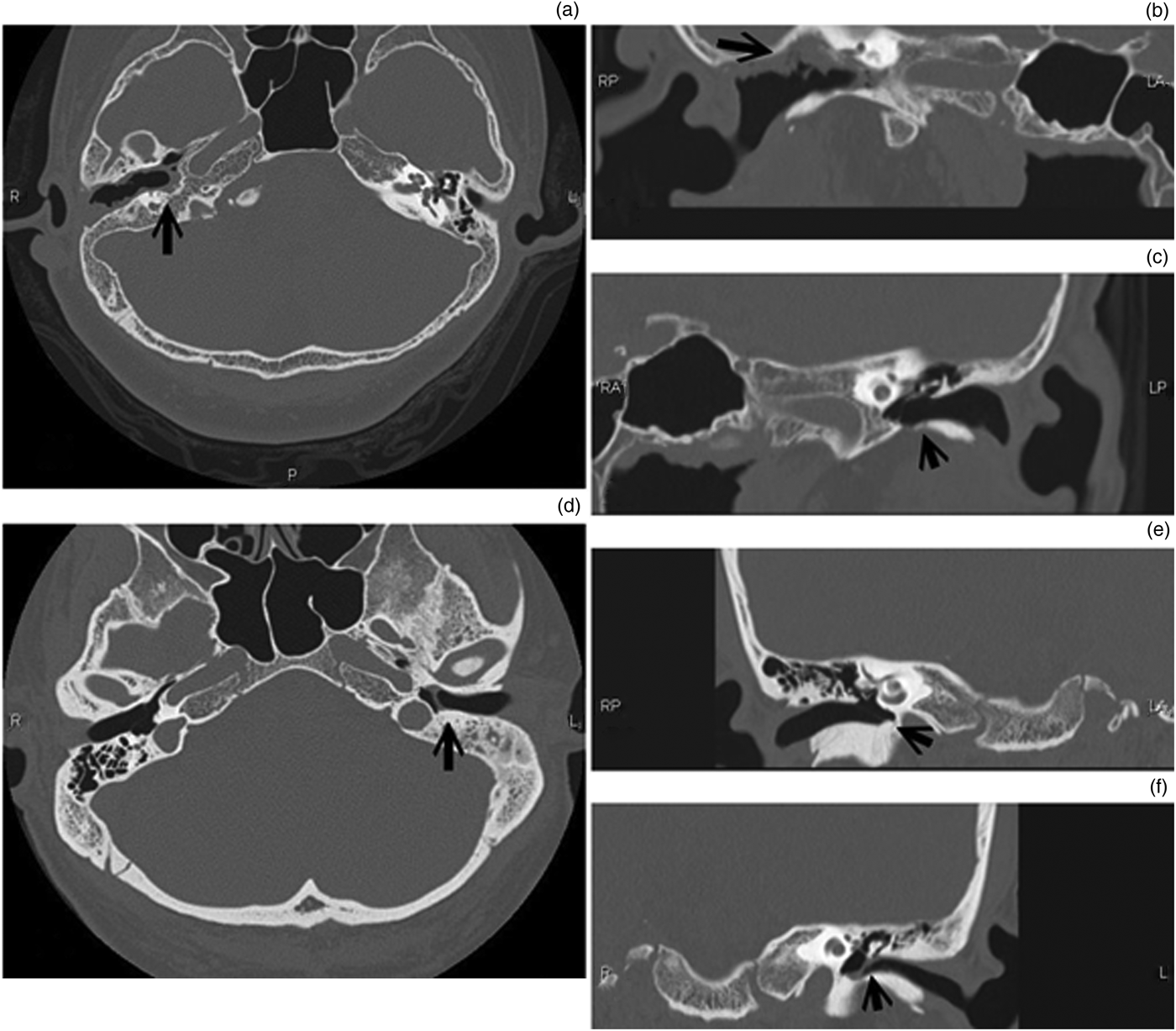
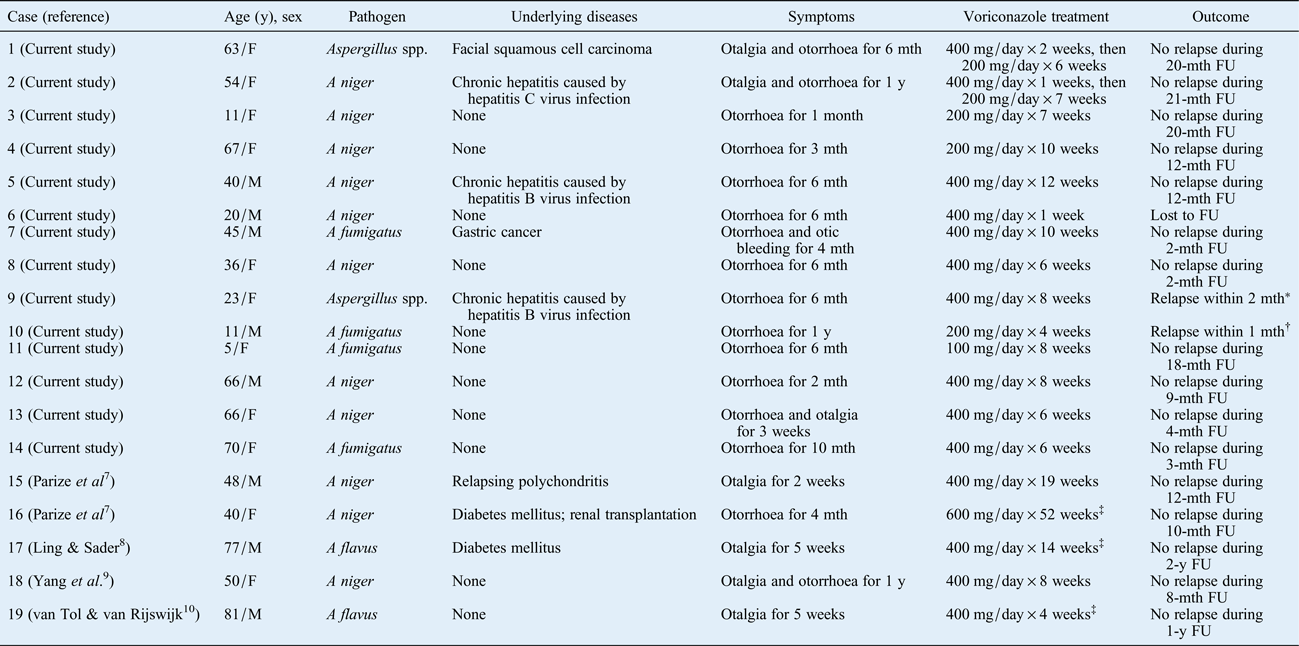
A total of 14 cases (1–14) of refractory Aspergillus otomycosis were treated with voriconazole from January 2008 to June 2012 in Buddhist Dalin Tzu Chi Hospital (shown in Table I): 5 patients were males and 9 were females. Most patients were adults (n = 11), and the median age was 46 years (range 5–70 years). There were five cases of Aspergillus invasive otitis externa (7, 9, 10, 13 and 14): the first three cases had bone involvement and the latter two had perforation of the tympanic membrane. Figure 1 shows images of Aspergillus invasive otitis externa for patients 7 and 9. One patient had a facial squamous cell carcinoma (case 1), three had chronic hepatitis (cases 2, 5, 9), and 1 had gastric cancer (case 7). The remaining patients did not have any underlying disease (cases 3, 4, 6, 8, 10, 11, 12, 13 and 14). All patients presented with prolonged otorrhoea and otalgia, and did not respond to antibiotics and topical treatment. One patient presented with intermittent otic bleeding (case 7).
(a) Axial computed tomography (CT) scan of patient 9 showing soft tissue attenuation of the right external auditory canal and decreased right mastoid air cell pneumatisation. (b) Coronal CT scan showing mild bone erosion on the roof of the right external auditory canal. (c) The left ear was normal. (d) Axial CT scan of patient 7 showing increased soft tissue density around the left external auditory canal close to the tympanic membrane, and fluid in left mastoid air cells. (e,f) Coronal CT scans showing a difference in soft tissue attenuation between the right (e) and left (f) external auditory canals. A = anterior; L = left; P = posterior; R = right

Clinical characteristics and outcomes of Aspergillus invasive otitis externa patients treated with voriconazole
*After relapse, patient 9 received a second 12-week course of voriconazole (400 mg/day), but his symptoms relapsed after 1 month. This patient received surgical debridement and then voriconazole treatment for a further 20 weeks; †After relapse, patient 10 received another 12-week course of voriconazole (200 mg/day), and his symptoms subsided without relapse after the 6-month follow up; ‡In addition to voriconazole, patients 16, 17 and 19 received surgical debridement; y = years; F = female; FU = follow up; mth = month; M = male
Fungal identification
For fungal isolation, specimens were inoculated onto Sabouraud dextrose agar plates (BBL Microbiology System, Cockeysville, Maryland, USA). Aspergillus identification was based on gross colony morphology and microscopy. Lactophenol cotton blue staining (BD Diagnostic Systems, Sparks, MD) of fungal slide cultures was used for fungal identification.
All infections were monomicrobial, and isolated species included A fumigatus (n = 4) and A niger (n = 8). In two cases, the Aspergillus species was not identified.
Tolerance and response at the end of therapy
One patient received a one-week treatment of voriconazole and did not return for the follow-up visit (case 6). One patient relapsed two months after an eight-month treatment with voriconazole (case 9). He received another 12-week course of voriconazole (400 mg/day) but again relapsed after one month. He received surgical debridement and continued taking voriconazole for 20 weeks. Another patient received a four-week treatment with voriconazole, but his symptoms relapsed one month after discontinuation of the drug (case 10). He received another 12-week course of voriconazole, and his symptoms subsided without relapse after the 6-month follow up. The remaining cases had favourable outcomes after voriconazole treatment for 6–12 weeks.
Two patients experienced blurred vision after receiving 400 mg/day voriconazole (cases 1 and 2). After reducing the dosage, their vision improved. Impaired liver function was noted in pretreatment blood chemistry data of three patients with chronic viral hepatitis (cases 2, 5 and 9), but no significant change in liver function was noted during voriconazole treatment. No adverse effects or deterioration in blood biochemistry were observed in the other patients who undertook long-term voriconazole therapy.
Discussion
Unlike Pseudomonas aeruginosa, Aspergillus spp. are very rarely involved in invasive otitis externa. The first such case was described in 1985 in a 68-year-old man with relapsing acute myelogenous leukaemia.Reference Petrak, Pottage and Levin11 In previous reports, the most commonly used antifungal agent was amphotericin B.Reference Parize, Chandesris, Lanternier, Poirée, Viard and Bienvenu7 This drug is effective in the treatment of Aspergillus invasive otitis externa, but side effects, especially renal failure, may require interruption of treatment or a reduction in dosage. In addition, the median total dose of amphotericin B administered was 2 g (range 0.8–2.5 g) for Aspergillus invasive otitis externa, and patients required prolonged hospitalisation.Reference Parize, Chandesris, Lanternier, Poirée, Viard and Bienvenu7 Voriconazole is a broad-spectrum azole which exhibits high anti-Aspergillus activity. It is currently considered the first-line therapeutic option for invasive aspergillosis.Reference Walsh, Anaissie, Denning, Herbrecht, Kontoyiannis and Marr12 Voriconazole is distributed throughout the body, including the soft tissues and bone.Reference Denes, Boumediene, Durox, Oksman, Saint-Marcoux and Darde13 An in vitro study showed that the fungicidal activity of voriconazole towards A fumigatus is better than that of itraconazole.Reference Lewis, Wiederhold and Klepser14 In a large randomised trial, its efficacy against invasive aspergillosis was superior to that of intravenous amphotericin B.Reference Herbrecht, Denning, Patterson, Bennett, Greene and Oestmann15 In addition, the greater than 90 per cent oral bioavailability of the voriconazole meant that patients treated with this drug did not need prolonged hospitalisation.Reference Muijsers, Goa and Scott16
• Aspergillus otitis externa can be invasive and refractory to standard treatment
• We retrospectively analysed 14 refractory cases, 5 of which were invasive
• Voriconazole is an effective treatment for refractory Aspergillus otomycosis
• Early invasive Aspergillus otitis externa can be successfully treated with voriconazole without the need for surgical debridement
We searched the English language Aspergillus invasive otitis externa reports published up to August 2012 using the key words ‘invasive otitis externa’, ‘Aspergillus’, and ‘voriconazole’. Only five cases of Aspergillus invasive otitis externa treated with voriconazole were reported.Reference Parize, Chandesris, Lanternier, Poirée, Viard and Bienvenu7–Reference van Tol and van Rijswijk10 Patient ages ranged from 40 to 81 years. As in the present case series, they all presented with prolonged otalgia and otorrhoea, and did not respond to antibacterial agents and local treatment. Three patients responded well to voriconazole and did not need surgery.Reference Parize, Chandesris, Lanternier, Poirée, Viard and Bienvenu7, Reference Yang, Ho, Lay and Tsai9 In the present study, three out of five cases of Aspergillus invasive otitis externa had a good response to voriconazole. One of the two cases with relapsed symptoms after voriconazole discontinuation needed surgical debridement. These data show that prolonged voriconazole use is an effective treatment for Aspergillus invasive otitis externa. However, surgical debridement is still necessary for refractory Aspergillus invasive otitis externa.
Long-term voriconazole therapy has been demonstrated to be effective and well tolerated in patients with Aspergillus bone infections.Reference Mouas, Lutsar, Dupont, Fain, Herbrecht and Lescure17 In the present study, all patients received oral voriconazole and did not need hospitalisation. Only two patients suffered from blurred vision after voriconazole use. After adjusting the dosage, their vision improved and drug efficacy was unaffected. Pharmacokinetic analysis has demonstrated that voriconazole toxicity is concentration dependent. Visual abnormalities were confirmed in patients with average plasma voriconazole concentrations greater than 3.52 µg/ml, which is above the therapeutic plasma concentration (2.05 µg/ml) for invasive aspergillosis.Reference Tan, Brayshaw, Tomaszewski, Troke and Wood18 Where visual abnormalities occurred, the plasma voriconazole concentration was much higher than that required for a therapeutic effect. Therefore, the therapeutic plasma concentration was still achieved when the voriconazole dosage was reduced to prevent visual side effects. In the present study, two patients relapsed after four- and eight-week treatments with voriconazole. However, drug-resistant Aspergillus species did not emerge, and a second course of voriconazole could be used to treat the infection.
Conclusion
In conclusion, in the present case series, voriconazole proved to be an effective therapeutic agent for refractory Aspergillus otomycosis. Early Aspergillus invasive otitis externa can be successfully treated with voriconazole without surgical debridement.