Introduction
The Mental Capacity Act 2005 (MCA) (Department of Constitutional Affairs, 2005) was fully implemented in October 2007 in England and Wales. Similar legislation related to decision-making capacity (DMC) has been introduced in other countries (Shah and Dickenson, Reference Shah and Dickenson1999; McCullock, Reference McCullock2009). A brief summary of the main components of the MCA is given in Appendix 1 to enable readers outside England and Wales to understand the context of this study and to enable comparison with any existing capacity legislation in other countries.
The MCA, supported by a Code of Practice (Department of Constitutional Affairs, 2007), has been broadly welcomed by stakeholders. A range of supportive training materials has been developed (Stanley et al., Reference Stanley2007a; Reference Stanley2007b; Reference Stanley2007c; Reference Stanley2007d; Reference Stanley2007e). Nevertheless, there are likely to be difficulties in implementing the MCA: some of these were identified initially and others may emerge after implementation. These potential difficulties include: implications for the workload of clinicians and the adequacy of resources to implement the MCA (Jones, Reference Jones2005; Shickle Reference Shickle2006; Shah et al., Reference Shah, Heginbotham, Fulford and Banner2009a); delays in developing training, policy and guidance for clinicians and independent mental capacity advocates (IMCAs) (Jones, Reference Jones2005; Cowan, Reference Cowan2007); availability of local training for health and social care professionals (Myron et al., Reference Myron, Gillespie, Swift and Williamson2008); availability of local policies on the implementation of the MCA and their clarity (Myron et al., Reference Myron, Gillespie, Swift and Williamson2008); variable knowledge of the definition of decision-making capacity (DMC) and factors that may trigger an assessment of DMC among health and social care professionals (Myron et al., Reference Myron, Gillespie, Swift and Williamson2008); potential for erroneous perception by carers that DMC is an “all or nothing phenomenon” and consequent misuse of the MCA (Jones, Reference Jones2005); potential for disagreements between doctors and IMCAs, donees and court-appointed deputies (White and Baldwin, Reference White and Baldwin2006); inability of carers to keep written records (Jones, Reference Jones2005); and, potential difficulties with the “deprivation of liberty” safeguards newly introduced into the MCA (Khan et al., Reference Khan, Bhatkal and Shah2007; Shah et al., Reference Shah, Heginbotham and Kinton2009b; Reference Shah, Heginbotham and Kinton2009c).
The government has estimated that up to 2 million adults in England and Wales may have issues concerning their DMC, including 840,000 people with dementia (Ministry of Justice, 2007). In an English study of acute admissions to general medical wards, 31% of the patients lacked DMC pertaining to their main treatment or investigation, but only a quarter were recognized by clinicians (Raymont et al., Reference Raymont2004). Another recent English study of psychiatric inpatients reported that 60% of inpatients lacked DMC to consent to their treatment (Owen et al., Reference Owen, Richardson, David, Szmukler, Hayward and Hotopf2008). A similar study of psychiatric inpatients revealed that 44% lacked DMC (Cairns et al., Reference Cairns2005). An English study of DMC to consent to geriatric psychiatry inpatient admission revealed 48% lacked DMC and there was poor concordance between the researcher's assessment of DMC and that reported by the consultant psychiatrists (Mukherjee and Shah, Reference Mukherjee and Shah2001). A recent systematic review concluded that up to 50% of psychiatric inpatients lacked DMC to consent to their admission (Okai et al., Reference Okai, Owen, McGuire, Singh, Churchill and Hotopf2007). Rates for identification of American nursing home residents lacking DMC to make choices about their medical treatment by clinical staff were low (Barton et al., Reference Barton, Mallik, Orr and Janofsky1996). In American nursing homes and one psychiatric teaching hospital, consent to medication and competence to give consent were presumed until and unless the patient failed to acquiesce (Gurian et al., Reference Gurian, Baker, Jacobson, Lagerbom and Watts1990). In the state of New South Wales in Australia, guardianship legislation requires proxy consent for patients without DMC for treatment with psychotropic drugs. However, this legislation was only used in 6.5% of nursing home residents lacking DMC for this issue (Rendina et al., Reference Rendina, Brodaty, Draper, Peisah and Brugue2009). These studies suggest that there may be poor practice in the assessment of DMC in these settings. However, a recent study of consultant psychiatrists in a range of specialties other than Old Age Psychiatry reported that they generally used the criteria described in the MCA for the assessment of DMC and the determination of best interests (Shah et al., Reference Shah2008).
The MCA is particularly likely to apply to people with severe and enduring mental illness, especially those with dementia and other neuropsychiatric disorders (Mukherjee and Shah, Reference Mukherjee and Shah2001; Okai et al., Reference Okai, Owen, McGuire, Singh, Churchill and Hotopf2007) who are, in the main, cared for by Old Age Psychiatry services in England and Wales. Therefore, a pilot study to examine the experience of consultants in Old Age Psychiatry in the early implementation of the MCA was undertaken as part of a larger study to examine several other aspects of the MCA. This paper reports on local policy and training in the application of the MCA, the assessment of DMC, the determination of best interests, and the use of the least restrictive option and restraint.
Methods
Timing
This study was undertaken six months after the MCA had become fully operational (in April 2008) to ascertain the early experience of consultants in Old Age Psychiatry in implementing the MCA.
Identification of consultants in Old Age Psychiatry
Consultants in Old Age Psychiatry working in England and Wales were identified from the Royal College of Psychiatrists' database. The accuracy of this source was verified by telephoning the individual consultant's office to check if the consultant was still working there. This check also allowed ascertainment of the details of other consultants in Old Age Psychiatry working in that hospital but not listed on the Royal College list, for inclusion in the study. In England and Wales, consultants in Old Age Psychiatry generally look after elderly patients with both functional illnesses and dementia.
Questionnaire survey
All identified consultants in Old Age Psychiatry with available contact details were sent an explanatory letter and a specially designed detailed questionnaire in the last two weeks of March 2008. A separate postcard was also sent with the questionnaire. The responding consultants in Old Age Psychiatry were asked to post the questionnaire and the postcard separately. The postcards allowed identification of consultants in Old Age Psychiatry who had not been able to respond whilst maintaining anonymity and confidentiality of the respondents' questionnaires. This, in turn, allowed a reminder to be sent to those who had not responded within six weeks. Two such reminders were sent.
The questionnaire was designed to examine several aspects of the early implementation of the MCA (available from the first author) including:
• the availability and utility of local Trust (hospital) policy on capacity to consent;
• the availability and utility of local Trust policy on the implementation of the MCA;
• the availability and utility of local training in the use of the MCA;
• the documentation of the assessment of DMC;
• the issues for which DMC was routinely assessed;
• the criteria used for the assessment of DMC;
• the criteria used in the determination of best interests;
• the criteria used in determining the least restrictive option;
• the criteria used for restraint; and
• identification of professional groups conducting an assessment of DMC.
Data analysis
Descriptive answers for the four questions “What criteria do you use in assessing capacity?”, “What criteria were used to determine best interest?”, “What criteria do you use for the least restrictive option?” and “What criteria do you use for restraint?” were manually examined and coded by the first author (AS), who is also a consultant in Old Age Psychiatry, using qualitative thematic analysis; these were subsequently verified by one of the other authors (NB). This approach is similar to that successfully used in another study of the MCA (Shah et al., Reference Shah, Heginbotham, Fulford and Banner2009a). Descriptive statistics were used to analyze the categorical responses to all other questionnaire items.
Results
Questionnaires were sent to 196 consultants in Old Age Psychiatry with available contact details; there were 57 (29%) responses and 52 (27%) were useable (five were returned blank).
Local training and policy
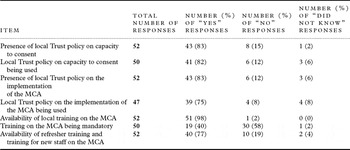
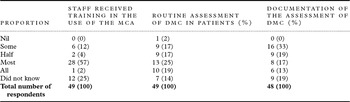
Over 75% of the consultants in Old Age Psychiatry reported that there was a local Trust policy on capacity to consent and that this policy was used; that there was a local Trust policy on the implementation of the MCA and that this policy was used; and that local training on the application of the MCA, including refresher training and training for new staff, was available (Table 1). However, less than 50% reported that the training on the MCA was mandatory. Over 60% reported that half or more of the staff received training in the application of MCA (Table 2).
Local training and policy concerning the MCA

Staff receiving training and routine assessment and documentation of decision-making capacity

Assessment of decision-making capacity
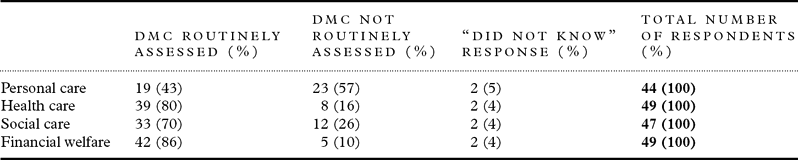
Over 60% of the consultants reported that half or more patients had a routine assessment of DMC, and almost 50% reported that half or more patients had the assessment of DMC routinely documented (Table 2). DMC was assessed separately for each issue and for each treatment decision by 67% of the consultants, but 27% reported that this was not the case. Seventy percent or more reported that DMC was routinely assessed for healthcare, social care and financial welfare decisions, but less than 50% reported that DMC was routinely assessed for personal care (Table 3). Also 60% reported that in at least half the patients having an assessment of DMC both carers and other professionals were consulted.
Broad issues for which decision-making capacity was assessed

The descriptive answers to the question “What criteria do you use in assessing capacity?” were manually coded using qualitative thematic analysis into 10 categories: understanding information (N = 47; 98%); retaining information (N = 47; 98%); weighing up information in the balance (N = 47; 98%); communicating the decision (N = 45; 96%); patient not subject to undue pressure in the assessment (N = 3; 7%); assessment of DMC being time-specific (N = 5; 12%); assessment of DMC being issue-specific (N = 7; 18%); presence of mental impairment (N = 12; 25%); dependent upon risk assessment (N = 3; 6%); and the subject may need help in decision-making (N = 3; 6%).
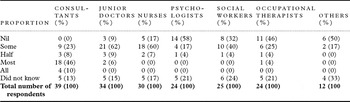
Over 60% of the consultants reported that more than half of the assessments of DMC were conducted by consultants, but over two-thirds reported that fewer than half of the assessments of DMC were conducted by junior doctors, nurses, psychologists, social workers, occupational therapists and others (Table 4).
Professions assessing decision-making capacity

Determination of best interests
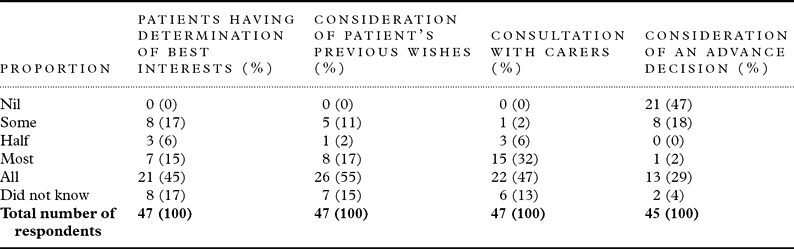
Almost all the consultants (98%) reported using the best interests principles for making decisions on behalf of patients lacking DMC (Table 5). Three-quarters reported that over 50% of patients lacking DMC had their previous wishes considered in the determination of best interests. Over 80% reported that in over 50% of patients lacking DMC their carers were consulted during the determination of best interests. Two-thirds reported that less than half of the patients lacking DMC had advance decisions considered in the determination of best interests.
Determination of best interests and consultation

The descriptive answer to the question “What criteria were used to determine best interest?” were manually coded using qualitative thematic analysis into 14 categories: wait until DMC is regained; consider previous wishes of the patient; consider current wishes of the patient; seek the views of carers and relatives; seek the views of the multidisciplinary team; consider any advance decision; consult donee of a lasting power of attorney; consult an advocate; consult an IMCA; consider the advantages/benefits and disadvantages/risks of the decision; consider that the decision was the least restrictive option; consider that the decision was the least invasive; acknowledge that best interest is not there to make carer's life easy; and not based on the individuals race, religion, culture, appearance or behavior.
Least restrictive option
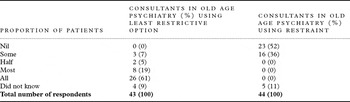
Over four-fifths of the consultants reported that the least restrictive option was used in the decision-making process in over half of the patients lacking DMC (Table 6). The descriptive answers to the question “What criteria do you use for the least restrictive option?” were manually coded using qualitative thematic analysis into nine categories: least invasive; least distressing; the safest; least restriction of human rights; care plan being as close as possible to individual's desire; has to be in the best interests of the individual; used in individuals lacking DMC; avoidance of locked facilities; and support the individual to remain at home.
Least restrictive option and restraint

Restraint
Almost 90% of the consultants reported either not using restraint or using restraint only in some of the patients lacking DMC (Table 6). Ninety-four percent reported that consideration was given to restraint being proportionate to the risk of harm. The descriptive answers to the question “What criteria do you use for restraint?” were manually coded using qualitative thematic analysis into seven categories: restraint used to prevent harm to the patient; restraint used to prevent harm to others; use minimum amount of restraint; use restraint for minimum amount of time; restraint should be proportionate to the risk of harm; use to give personal care; use to give medication for physical illness.
Discussion
Caution should be exercised in interpreting the findings because the response rate of 29% was low, particularly for the quantitative data. The low response rate may be less important when interpreting qualitative data because the number of responses may have been sufficiently large to reach saturation for the qualitative thematic analysis. It is possible that the consultants interested in this field or with expertise in this field were the ones who responded. Moreover, it is also possible that non-responders may rely on other allied health professionals to assess DMC. A further reason for the low response rate may be that the MCA had only been fully operational for six months and the legislation was still “bedding” in. It is possible that only a small group of specialists may be involved in the assessment of DMC. However, consultants in Old Age Psychiatry were specifically selected for study as it was felt that this group of clinicians was likely to have specific expertise in this area as they frequently care for patients lacking DMC. Nevertheless, the response rate was significantly higher than in a comparable study of consultants in other psychiatric specialties (Shah et al., Reference Shah2008) and similar to another questionnaire study of consultant psychiatrists pertaining to DMC (Shah and Mukherjee, Reference Shah and Mukherjee2003).
Given the early concerns about delays in developing training, policy and guidance for a diverse group of clinicians and IMCAs (Jones, Reference Jones2005; Cowan, Reference Cowan2007; Myron et al., Reference Myron, Gillespie, Swift and Williamson2008), it was encouraging that 75% or more of the consultants in Old Age Psychiatry reported that there was a local Trust policy on capacity to consent and that this policy was used, there was a local Trust policy on the implementation of the MCA and that this policy was used, and local training on the application of the MCA was available. These findings were similar to those obtained in a separate study of consultants in other psychiatric specialties (Shah et al., Reference Shah2008). However, less than 50% reported that the training in the application of the MCA was mandatory and this may explain why only 60% reported that half or more of the staff received training in the application of the MCA. Although these findings were observed in a separate study of consultants in other psychiatric specialties (Shah et al., Reference Shah2008), they were of concern because the MCA requires all decision-makers to follow the principles laid down in the MCA. Moreover, professionals working in the area of learning disability were reported to request more training in the application of the MCA (Myron et al., Reference Myron, Gillespie, Swift and Williamson2008). As there is no statutory requirement for healthcare and social care professionals to undertake formal training in the application of the MCA, all healthcare and social care providers should ensure that training in the application of the MCA is readily available to all multidisciplinary staff and this training should be mandatory to ensure all staff who may be required to undertake assessments of DMC are fully trained and competent to do so.
Encouragingly, 80% of the consultants in Old Age Psychiatry reported that DMC was routinely assessed for healthcare decisions, a figure that was consistent with observations in a separate study of consultants in other psychiatric specialties (Shah et al., Reference Shah2008). This was not surprising as psychiatrists are usually likely to be involved in making healthcare decisions. The finding that 86% reported that DMC was routinely assessed for financial issues may reflect recognition of the vulnerability of patients with dementia to financial exploitation and mismanagement, and that the financial affairs of elderly patients have important implications for their long-term management (e.g. funding for social care is subject to “means” testing).
The descriptive answers to the question “What criteria do you use in assessing capacity?” were manually coded using qualitative thematic analysis into 10 criteria, which were similar to those reported in the separate study of consultants in other psychiatric specialties (Shah et al., Reference Shah2008) and in a case-note study of geriatric psychiatry patients (Shah et al., Reference Shah, Heginbotham, Fulford and Banner2009a), and consistent with the criteria for the first and second (the specific four-fold test of DMC) stages of assessment of DMC stipulated in the MCA. The reported criteria that DMC should be decision-specific and time-specific are also consistent with this stipulation in the MCA; also, two-thirds of the consultants in Old Age Psychiatry reported that DMC was assessed for each specific issue.
The majority of assessments of DMC were conducted by consultants in Old Age Psychiatry and this was also observed in the separate study of consultants in other psychiatric specialties (Shah et al., Reference Shah2008) and in the case-note study of geriatric psychiatry patients (Shah et al., Reference Shah, Heginbotham, Fulford and Banner2009a). This was surprising because of the emergence and implementation of “New Ways of Working” (Department of Health, 2005), whereby increasing numbers of psychiatric patients are initially assessed and subsequently managed by a range of multidisciplinary clinicians, and the recommendation in the MCA that the assessment of DMC should be conducted by an appropriate decision-maker from an appropriate discipline. This implies that clinicians from specific disciplines may conduct assessments of DMC for specific issues; for example, doctors may conduct assessments of DMC for medication and social workers for accommodation and financial issues. Although psychologists may have particular expertise in the assessment of DMC, very few assessments of DMC were reported to be conducted by them. However, this finding may reflect the complex circumstances of elderly psychiatric patients requiring a senior and experienced clinician to assess DMC. It may also reflect the traditional culture engendered by requirements under the Mental Health Act 1983 (MHA1983) that DMC should be assessed by the Responsible Medical Officer (usually the consultant psychiatrist) in patients whose treatment is subject to Part 4 of the MHA1983. This may, in part, also explain the anticipated (Jones, Reference Jones2005; Shickle, Reference Shickle2006) and observed (Shah et al., Reference Shah2008; Reference Shah, Heginbotham, Fulford and Banner2009a) increase in the workload of clinicians. Moreover, this workload is likely to increase further when the Deprivation of Liberty safeguards that have been introduced into the MCA are implemented in April 2009 (Shah et al., Reference Shah, Heginbotham and Kinton2009b; Reference Shah, Heginbotham and Kinton2009c). This potential increase in clinicians' workload requires careful ongoing monitoring because the accuracy and effectiveness of implementing the MCA is contingent upon sufficient staffing resources. As recommended in the MCA, if assessments of DMC are conducted by decision-makers from appropriate disciplines (and not just by consultants), then it will reduce the consultants' workload. Thus, there is a need to develop strategies that will encourage professionals from a range of disciplines and not just consultants to undertake assessments of DMC to help reduce the workload.
The first statutory principle of the MCA states that an individual must be assumed to have DMC unless it can be demonstrated to be lacking. Moreover, the Code of Practice for the MCA states that DMC should usually only be assessed if there is reason to believe this to be impaired and lists several circumstances suggesting possible lack of DMC. Potential trigger factors for the assessment of DMC have been well described (Jeste and Saks, Reference Jeste and Saks2006). About 70% of consultants reported routinely assessing DMC for healthcare, social care and financial issues, and such routine assessments will clearly add to the workload of consultants. However, by following the first statutory principle of the MCA and only assessing DMC when there are trigger factors indicating some impairment may help reduce the workload and facilitate preservation of the subject's autonomy and liberty because assessment of DMC can be intrusive.
Encouragingly, almost all consultants in Old Age Psychiatry reported using the best interests principles for making decisions on behalf of patients lacking DMC; three-quarters reported that over half of the patients lacking DMC had their previous wishes considered in the determination of best interests, and 80% reported that in over half of the patients lacking DMC their carers were consulted during the determination of best interests. These findings were similar to those in a separate study of consultants in other psychiatric specialties (Shah et al., Reference Shah2008). The descriptive answer to the question “What criteria were used to determine best interest?” were manually coded using qualitative thematic analysis into 14 criteria, which were similar to those reported in a separate study of consultants in other psychiatric specialties (Shah et al., Reference Shah2008) and a case-note study of geriatric psychiatry patients (Shah et al., Reference Shah, Heginbotham, Fulford and Banner2009a). All but one of these criteria were consistent with those described in the MCA. The MCA allows the appropriate decision-maker to determine the best interests in the absence of a valid and applicable advance decision, Lasting Power of Attorney or a Court-Appointed Deputy with the authority for making the specific decision and a court order. Nevertheless, it was encouraging that consultants consulted advocates and donees of Lasting Powers of Attorney and considered advance decisions.
Over four-fifth of the consultants in Old Age Psychiatry reported that the least restrictive option was used in over half of the patients lacking DMC, which was also observed in the separate study of consultants in other psychiatric specialties (Shah et al., Reference Shah2008), and is consistent with the principles of best interests determination described in the MCA. The descriptive answers to the question “What criteria do you use for the least restrictive option?” were manually coded using qualitative thematic approach into nine categories “least invasive”, “least distressing”, “safest option”, “least restriction of human rights”, “care plan being as close as possible to individual's desire”, “has to be in the best interests of the individual”, “used in individuals lacking DMC”, “avoidance of locked facilities” and “support the individual to remain at home”. Although the MCA does not define the least restrictive option, the above criteria clearly have face validity and were similar to those observed in a case-note study of geriatric psychiatry patients (Shah et al., Reference Shah, Heginbotham, Fulford and Banner2009a).
Almost 90% of the consultants in Old Age Psychiatry reported either not using restraint or using restraint only in some of the patients lacking DMC. This observation is consistent with lower rates of restraint in older patients in psychiatric emergency rooms (Migon et al., Reference Migon, Coutinho, Huf, Adams, Cunha and Allen2008), but inconsistent with higher rates of restraint in older patients in general hospital psychiatric unit (Odawara et al., Reference Odawara, Narita, Yamada, Fujita, Yamada and Hirayasu2005) and restraint rates of 18% among nursing homes residents despite six months of an educational intervention for staff (Evans et al., Reference Evans, Strumpf, Allen-Taylor, Capezuti, Maislin and Jacobsen1997). Encouragingly, 90% of the consultants reported that consideration was given to restraint being proportionate to the risk of harm. The descriptive answer to the question “What criteria do you use for restraint?” were manually coded using qualitative thematic analysis into seven categories: “restraint used to prevent harm to the patient”, “restraint used to prevent harm to others”, “use minimum amount of restraint”, “use restraint for minimum amount of time”, “use to give personal care” and “use to give medication for physical illness”. Although some of the criteria reported are similar to those described in the MCA, the first two criteria described in the MCA (“an individual lacks capacity to consent to the act in question” and “restraint is in the best interest of an individual lacking DMC”) were not specifically reported. The category of “restraint used to prevent harm to others” is of concern as it is not in keeping with the MCA, where it is stipulated that restraint under the MCA can only be used to prevent harm to the individual lacking DMC. Restraint may have been used to prevent harm to others under the MHA1983 in patients detained under this Act.
Caution should be exercised in extrapolating the findings to other psychiatric specialties and professionals. Additionally, the legal definition of DMC may be different in different jurisdictions and the findings in one jurisdiction may not necessarily apply to another. However, many of the issues examined in this study are likely to overlap with legislation on capacity or their use under common law in different jurisdictions nationally and internationally (e.g. McCullock, Reference McCullock2009). Moreover, the criteria for the assessment of DMC used in the MacArthur Competence Assessment Tool (Appelbaum and Grisso, Reference Appelbaum and Grisso1995; Grisso and Appelbaum, Reference Grisso and Appelbaum1995; Grisso et al., Reference Grisso, Appelbaum, Mulvey and Fletcher1995; Reference Grisso, Appelbaum and Hill-Fotouchi1997) are identical to those described in the MCA. Thus, the findings would be of interest to colleagues in other countries. It was encouraging that clinicians generally reported that they were using the criteria for the assessment of DMC, the determination of best interests and restraint described in the MCA, and that clinicians were developing the concepts of least restrictive option with face validity despite the absence of its definition in the MCA. However, these observations should be viewed cautiously as the questionnaire did not test the knowledge base of the consultants pertaining to the MCA and this requires further study. Consideration should be given to statutory provision of training in the application of the MCA by all healthcare and social care providers for all healthcare and social care staff. The findings also highlight concern about the workload of clinicians in implementing the MCA and the need for careful ongoing monitoring because the accuracy and effectiveness of implementing the MCA is contingent upon sufficient staffing resources.
Appendix 1: A summary of the aspects of the MCA relevant to the study
Several specific areas of the MCA relevant to this research project are described below to enable colleagues from other countries to understand the research project more fully. A short summary for international readers is also available elsewhere for interested readers (Banner and Shah, Reference Banner and Shah2007).
1. Statutory principles
Those involved in the assessment of Decision-making capacity (DMC) and the application of the MCA should always follow the five statutory principles:
• An individual must be assumed to have capacity unless lack of DMC has been formally established.
• An individual cannot be treated as unable to make a decision unless all practical steps to help the individual to do so have been undertaken.
• An individual cannot be treated to lack DMC simply because an unwise decision is made.
• Any act done or any decision made, under the MCA, must be in the best interest of the individual lacking DMC.
• Before an act is done, or a decision is made, consideration must be given to whether the purpose for which it is needed can be as effectively achieved in a way that is less restrictive of the individual's rights and freedom of action.
The third statutory principle stipulates that “A person is not to be treated as unable to make a decision merely because he makes an unwise decision”. This applies even if family members, friends or health care and social care staff are unhappy with the decision. The Code of Practice accompanying the MCA states that there may be concern if somebody repeatedly makes unwise decisions that put them at risk of harm or exploitation or makes a particular unwise decision that is obviously irrational or out of character. However, it also states that this does not necessarily mean that the subject lacks capacity, but there may be a need for further investigation. The concept of unwise decision is not defined in the MCA or the accompanying Code of Practice.
2. Assessment of Decision-Making Capacity
The assessment of DMC to make a specific decision requires a two stage process under the MCA. This two stage process is as follows:
• Does the individual have an impairment of the mind or brain, or is there some sort of disturbance affecting the way their mind or brain works?
• If so, does the impairment or disturbance mean that the individual is unable to make a decision in question at the time it needs to be made?
The specific test of DMC is four-fold. An individual is judged to lack DMC to make a decision if s/he is unable to:
• understand the information relevant to the decision;
• retain the information.
• use or weigh that information as part of the process of making the decision; and/or
• communicate his/her decision (whether by talking, using sign language or any other means).
The individual is considered to lack DMC to make a particular decision if any one of the four criteria is present. DMC is decision-specific and time-specific.
3. Best interests
The MCA stipulates that “An act done, or decision made, under the Act for or on behalf of a person who lacks capacity must be done, or made, in his best interests”. This applies to any decision-maker. The MCA does not formally define best interests, but describes a detailed list of factors that must be considered in the determination of the best interests of an individual lacking DMC:
• Determination of best interests cannot be based on an individual's age, appearance (including racial appearance or religious dress), condition or behaviour.
• Careful consideration should be given to all circumstances pertaining to the individual lacking DMC.
• Every effort should be made to enable an individual lacking DMC to participate in making the decision including use of appropriate methods of communication (including professional interpreters) and using other people to facilitate the person to participate in the decision-making process.
• Consideration should be given to the possibility that the DMC may be regained (e.g. after treatment of a mental illness) and whether the decision-making can be postponed until the DMC is regained.
• Consideration should be given to the past and present wishes and feelings, beliefs and values of an individual lacking DMC. This includes any written statements made when the individual had DMC.
• Consideration should be given to the views of other people (close relatives, friends and others who take an interest in the person's welfare) who are close to an individual lacking DMC.
• Special conditions apply to decisions about life sustaining treatment, whereby the decision-maker should not be motivated by a desire to end life.
• Consideration should also be given to least restrictive alternatives that may be in the best interests of an individual lacking DMC. Least restrictive alternatives are not specifically defined in the MCA.
• The above list should be considered as a starting point as many other factors may need consideration in individual cases.
4. Restraint
The MCA states that restraint is used if someone uses force, or threatens to use force, to make an individual do something they are resisting or to restrict an individual's freedom of movement, irrespective of the individual resisting or not. If restraint is used the decision-maker must reasonably believe:
• An individual lacks capacity to consent to the act in question.
• Restraint is in the best interests of an individual lacking DMC.
• Restraint is necessary to prevent harm to an individual lacking DMC.
• The amount, type and duration of restraint are proportionate to the seriousness of the anticipated harm.
Restraint should involve the minimum force necessary and be used for the shortest duration possible.
Conflict of interest declaration
Professor Chris Heginbotham was the chief executive of the Mental Health Act Commission until 31 March 2008.
Description of authors' roles
AS designed the study with support from CH and BF. AS secured ethical approval. AS and NB collected and analysed the data. AS wrote the initial draft of the paper and all authors contributed to improving this draft for submission.
Acknowledgments
We thank the participating consultants in Old Age Psychiatry and our departmental administrator, Marian Lawrenson, for their help with this study, which was funded by the Department of Health. We are also grateful to the two anonymous reviewers for their helpful comments.