Introduction
According to cognitive theories of depression, negative biases affect most cognitive processes including perception (Beck, Reference Beck1976). Such depressive perception may result from negative biases both in cognitive appraisal and at automatic stages of sensory processing (Leppanen, Reference Leppanen2006). Accordingly, patients with major depressive disorder (MDD) show not only impaired recognition of facial emotional expressions (Feinberg et al. Reference Feinberg, Rifkin, Schaffer and Walker1986; Rubinow & Post, Reference Rubinow and Post1992; Persad & Polivy, Reference Persad and Polivy1993; Joormann & Gotlib, Reference Joormann and Gotlib2006) and a bias towards interpreting faces as sad (Gur et al. Reference Gur, Erwin, Gur, Zwil, Heimberg and Kraemer1992; Hale, Reference Hale1998; Hale et al. Reference Hale, Jansen, Bouhuys and van den Hoofdakker1998; Leppanen et al. Reference Leppanen, Milders, Bell, Terriere and Hietanen2004) but also mood-congruent processing biases when cognitive appraisal is minimized (Leppanen, Reference Leppanen2006). For example, attention is guided automatically by mood-congruent information in MDD, as indicated by shortened reaction times in a dot-probe task when dots are preceded by sad faces (Gotlib et al. Reference Gotlib, Kasch, Traill, Joormann, Arnow and Johnson2004a, Reference Gotlib, Krasnoperova, Yue and Joormannb). Individuals with depressive symptoms are also impaired at ignoring the emotional aspects of faces (Gilboa-Schechtman et al. Reference Gilboa-Schechtman, Ben-Artzi, Jeczemien, Marom and Hermesh2004) and at inhibiting attention towards negative emotional distractors (Joormann, Reference Joormann2004). Moreover, subliminally presented mood-congruent words have a priming effect on subsequent lexical decisions in MDD, even showing an unconscious bias in sensory processing (Bradley et al. Reference Bradley, Mogg and Williams1995, Reference Bradley, Mogg and Millar1996). Accordingly, neural responses to sad face stimuli rendered invisible with backward masking evoke stronger amygdala responses than invisible happy faces in patients with MDD, whereas the opposite pattern is observed in healthy individuals (Suslow et al. Reference Suslow, Konrad, Kugel, Rumstadt, Zwitserlood, Schoning, Ohrmann, Bauer, Pyka, Kersting, Arolt, Heindel and Dannlowski2010).
Although there is thus converging evidence for a bias towards mood-congruent information at automatic and even unconscious stages of visual processing, an important question remains unresolved: do such automatic processing biases also guide the access of mood-congruent information to awareness, thus directly influencing an individual's conscious experience? An elegant and widely used method to investigate the access of visual information to awareness is binocular rivalry (Blake & Logothetis, Reference Blake and Logothetis2002; Sterzer et al. Reference Sterzer, Kleinschmidt and Rees2009b). In binocular rivalry, the presentation of two dissimilar images to the two eyes results in a perceptual conflict that gives rise to alternating perception of either one or the other image. The relative dominance of one image over the other has been taken as a measure of preferential processing (Blake & Logothetis, Reference Blake and Logothetis2002). For instance, dominance durations are longer for emotional relative to neutral faces (Alpers & Gerdes, Reference Alpers and Gerdes2007; Amting et al. Reference Amting, Greening and Mitchell2010). Such findings are ambiguous as to whether the relative dominance of a stimulus indicates stronger unconscious processing resulting in preferential access to awareness, or just stronger conscious processing and thus a bias to keep a stimulus longer in awareness. However, a recently introduced variant of binocular rivalry, continuous flash suppression (CFS; Tsuchiya & Koch, Reference Tsuchiya and Koch2005; Sterzer et al. Reference Sterzer, Kleinschmidt and Rees2009b) has been devised to specifically probe the potency of stimuli to overcome unconscious processing and gain access to awareness.
During CFS, high-contrast dynamic patterns are flashed to one eye, rendering stationary stimuli presented to the other eye invisible for prolonged periods of time. The time that it takes a given stimulus to overcome such interocular suppression and become visible can be used to measure the potency of this stimulus to compete for awareness. Thus, shorter suppression times are thought to reflect stronger unconscious processing during interocular suppression and, conversely, longer suppression times weaker unconscious processing (Jiang et al. Reference Jiang, Costello and He2007; Yang et al. Reference Yang, Zald and Blake2007; Tsuchiya et al. Reference Tsuchiya, Moradi, Felsen, Yamazaki and Adolphs2009; Zhou et al. Reference Zhou, Jiang, He and Chen2010). Advantages in overcoming interocular suppression have been shown for upright versus inverted face stimuli and for familiar versus unfamiliar symbols (Jiang et al. Reference Jiang, Costello and He2007), and also for fearful versus neutral and happy faces (Yang et al. Reference Yang, Zald and Blake2007; Tsuchiya et al. Reference Tsuchiya, Moradi, Felsen, Yamazaki and Adolphs2009). It is important to note, however, that advantages for emotional faces, both during CFS (Yang et al. Reference Yang, Zald and Blake2007; Tsuchiya et al. Reference Tsuchiya, Moradi, Felsen, Yamazaki and Adolphs2009) and during conventional binocular rivalry (Alpers & Gerdes, Reference Alpers and Gerdes2007; Amting et al. Reference Amting, Greening and Mitchell2010), could also be due to potential systematic stimulus differences between emotions (local luminance, contrast, etc.), which could per se have an effect on dominance in binocular rivalry (Blake & Logothetis, Reference Blake and Logothetis2002).
Our motivation for the present study was therefore twofold. First, we wanted to determine whether automatic biases in emotion processing would affect conscious vision in MDD; we therefore asked whether CFS could be used to show that unconscious processing influences the access of mood-congruent information to conscious awareness. Second, we sought to gain further insight into the role of emotional factors in binocular rivalry. If the potency of emotional stimuli to gain access to awareness was affected by an endogenous factor relevant for emotion processing (e.g. depressed mood), this would support the notion that emotional factors have influence in the resolution of perceptual conflict independently of physical stimulus properties. In a behavioural experiment, we used CFS to probe differential access to awareness for neutral, fearful, sad, and happy faces in patients with MDD and healthy control participants. We hypothesized that suppression times would be shorter for sad faces in patients with MDD, thus indicating an unconscious processing bias towards mood-congruent stimuli that results in preferential access to awareness.
Method
Participants
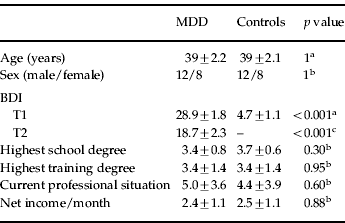
Twenty patients with MDD and 20 healthy control participants matched for age, sex, educational and professional status were tested (see Table 1). MDD patients were hospitalized in the Department of Psychiatry and Psychotherapy, Campus Charité Mitte, and diagnosed by trained psychiatrists as having moderate or severe MDD according to DSM-IV criteria. Patients were tested within 1 week of admission. Controls were recruited from the community through internet advertisements. Exclusion criteria were other Axis-I psychiatric disorders except co-morbid anxiety disorders in the MDD group, history of neurological disorders or brain trauma, current substance abuse, or uncorrected impairment in visual acuity. All participants completed the Beck Depression Inventory (BDI; Beck et al. Reference Beck, Rush, Shaw and Emery1979) on the day of testing. Patients were treated in a tertiary care centre specialized in mood disorders and controlled for adequacy of antidepressive treatment during the study period. To evaluate the treatment response, patients completed the BDI again 4 weeks after testing. As formal test measures of intelligence are likely to be confounded by depression, we used educational status as an approximate estimate of intelligence level. School education was measured using a four-point scale from 0 (no degree) to 3 (high-school degree), where 1, 2 and 3 reflected the three possible school degrees in Germany in ascending order. Professional education was measured with a four-point scale (0=no training completed, 1=assistant craftsman or clerk, 2=master craftsman or professional school, 3=university degree). Current monthly income was measured on a five-point scale (1=below €500, 2=€500–1000, 3=€2000–3000, 4=€3000–5000, 5=above €5000). All patients and control participants gave written informed consent to the study protocol, which was approved by the local ethics committee.
Demographic and clinical sample characteristics

MDD, Major depressive disorder; BDI, Beck Depression Inventory.
Values given as mean±standard error of the mean.
a Two-tailed two-sample t test.
b Mann–Whitney U test.
c Two-tailed paired t test.
Except for two patients, who were tested before antidepressant treatment was started, all patients were on antidepressant medication. Thirteen were receiving selective serotonin reuptake inhibitors, six serotonin–noradrenalin reuptake inhibitors, and four tricyclic antidepressants (five were on a combination of two antidepressants). Three patients were receiving antipsychotic medication (quetiapine) and three were receiving lorazepam, which was paused at least 12 h before testing.
Stimuli and procedure
Stimuli were presented on a 19-in Samsung CRT monitor (resolution 1024×768, frame rate 60 Hz) and viewed through a custom-built mirror stereoscope in a dimly lit room. The participants' heads were stabiliized by a chin-and-head rest at 50 cm effective viewing distance. Visual stimuli were presented with MATLAB (The MathWorks, USA), using the Cogent 2000 toolbox (http://www.vislab.ucl.ac.uk/cogent.php) on a Pentium 4 computer. The stimulus paradigm was based on a previous behavioural study in healthy volunteers (Yang et al. Reference Yang, Zald and Blake2007). Stimuli were displayed on a grey background. During the experiment, two white-line squares (8.5°×8.5°) were presented side by side on the screen and were viewed through the mirror stereoscope such that only one square was visible to each eye. In the centre of each square a white fixation cross (0.5°×0.5°) was displayed. Participants were asked to maintain stable fixation during the experiment. In the CFS condition, high-contrast Mondrian-like pattern masks (Sterzer et al. Reference Sterzer, Haynes and Rees2008b, Reference Sterzer, Jalkanen and Rees2009a) measuring 8.3°×8.3° were flashed to one eye at a frequency of 10 Hz, while a face stimulus (2.5°×3.6°) was presented to the other eye in one of four corners of the white frame (Fig. 1 a). The contrast of the face stimulus was ramped up slowly from 0% to 100% within a period of 2 s to ensure invisibility of the face at the beginning of each trial, and then remained constant until the participant made a response on a computer keyboard (keys F, J, V and N) indicating the face's location. Observers were instructed to respond as fast and as accurately as possible as soon as any part of the face became visible. The face stimuli were grey-scale photographs of eight individuals from the Ekman emotional face series with neutral, fearful, happy or sad expressions (http://face.paulekman.com). In addition to CFS, a control condition was used that did not involve binocular rivalry (Fig. 1 b). Control trials started with the presentation of only a flashing Mondrian pattern to one eye. A face stimulus was then shown in one of the four possible locations as in the CFS condition, but with full contrast and to both eyes at a random time between 2 and 8 s after trial onset. Note that the control condition was not designed to match the CFS condition perceptually, but merely to control for possible systematic between-group differences in reaction times to the appearance of faces with different emotional expressions. Both CFS and control trials ended after the participant's key press. CFS trials were discarded if no key was pressed within 10 s (Jiang et al. Reference Jiang, Costello and He2007). The inter-trial interval was 2 s. The whole experiment comprised 288 trials (192 CFS and 96 control trials) split up into six blocks. CFS and control trials were intermixed randomly within each block.
Schematic illustration of the stimulus paradigm. (a) For continuous flash suppression, high-contrast Mondrian-like pattern masks were flashed to one eye at a frequency of 10 Hz. A face stimulus with neutral, fearful, happy or sad expression was faded-in to the other eye in one of four quadrants of the display. The face was invisible at the beginning of each trial due to interocular suppression by the perceptually dominant Mondrian pattern. Observers were instructed to respond as soon as any part of the face became visible by pressing a key to indicate the location of the face. (b) Control trials started with the presentation of only a Mondrian-pattern stimulus to one eye. A face stimulus was then shown with full contrast and to both eyes at a random time between 2 and 8 s after trial onset in one of the four possible locations. Note that the patterns used in the experiment were not black and white as in the figure, but coloured.

Data analysis
Statistical between-group comparisons of age and BDI score were performed using two-sample t tests and MDD patients' changes in BDI were assessed with paired t tests. For between-group comparisons of sex, educational status and income, Mann–Whitney U tests were performed.
Mean suppression times for CFS trials, that is the time from the beginning of a trial until the button press that indicated visibility of the face, and reaction times for control trials were calculated based on correct trials only. Between-group effects for overall suppression times (CFS) and reaction times (control) across all emotion types were assessed using two-tailed two-sample t tests. For all further analyses, suppression times for each facial expression in the CFS condition were corrected for possible systematic reaction-time differences by subtracting the average reaction time in the corresponding control condition in each individual participant. The term ‘suppression time’ henceforth refers to suppression time corrected for reaction time, unless stated otherwise. The temporal dynamics of binocular rivalry are characterized by a high degree of inter-individual variability (Leopold & Logothetis, Reference Leopold and Logothetis1999), resulting in variable suppression times across participants. To reduce the influence of between-subject differences in overall suppression time and thereby increase sensitivity, we analysed the suppression time for each emotional expression (sad, fearful, happy) relative to the suppression time for neutral stimuli. This approach is only valid in the absence of systematic between-group differences in suppression times for the neutral reference stimuli. This was verified with two-sample t tests comparing suppression times for neutral stimuli. The modulation of suppression time by emotional expression was then determined in each individual participant using the emotion/neutral ratio for each emotion (fearful, happy, sad). A modulation index <1 indicates shorter suppression times, that is a relative advantage in unconscious processing of a given emotional expression over neutral faces. Conversely, an index >1 indicates longer suppression times and hence a relative disadvantage compared to neutral faces. These indices of suppression time modulation were then subjected to a 3×2 factorial analysis of variance (ANOVA) with the within-subject factor emotion (fearful, happy, sad) and the between-subject factor group (MDD versus control). Finally, the relationship between suppression time modulation by sad faces and both depression severity at the time of testing and the clinical response after 4 weeks was assessed using linear correlation analyses. BDI scores and the percentage change in BDI scores after 4 weeks were used as clinical measures. Effects were considered significant at p<0.05.
Results
Sample characteristics
There were no significant between-group differences in age, sex, highest school degree, highest training degree, current professional situation and net income (Table 1). BDI scores were on average significantly higher in patients. There was a significant reduction in BDI scores in the MDD group after 4 weeks.
Suppression time
The proportion [mean±standard error of the mean (s.e.m.)] of incorrect responses was generally low and did not differ between groups, showing that both patients with MDD and healthy participants were able to do the task [controls: 4.8±1.8%; MDD: 4.3±1.6%; t(38)=0.2, p>0.1]. In the control condition, the proportion (mean±s.e.m.) of incorrect responses was 2.7±1.0% in both groups [t(38)=0.01, p>0.1].
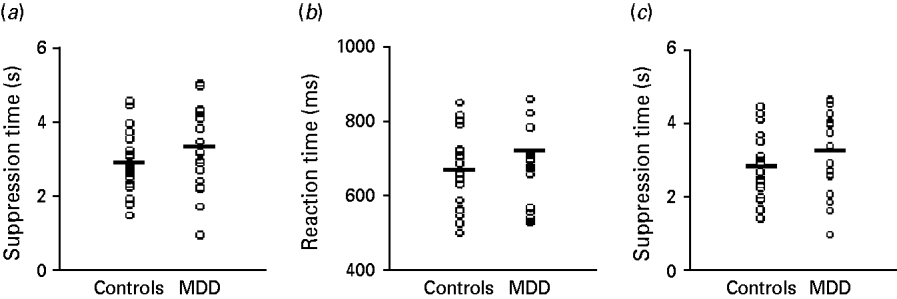
Data for overall suppression time pooled across stimulus types, overall reaction times and suppression times for neutral stimuli are summarized in Fig. 2. Overall suppression time during CFS did not differ significantly between patients and controls [Fig. 2 a; t(38)=1.5, p>0.1]. Similarly, overall reaction times to the presentation of visible faces in the control condition did not differ between groups [Fig. 2 b; t(38)=1.1, p>0.1]. Finally, there were also no suppression time differences for neutral faces [Fig. 2 c; t(38)=1.7, p>0.1].
(a) Overall suppression times (uncorrected for reaction times in the control condition) for face stimuli during continuous flash suppression, pooled across emotional expressions. (b) Overall reaction times to the presentation of visible faces in the control condition, pooled across emotional expressions. (c) Suppression times for neutral faces, corrected for reaction times in the control condition. Empty circles represent individual participants' data points and horizontal bars denote group means. MDD, major depressive disorder.

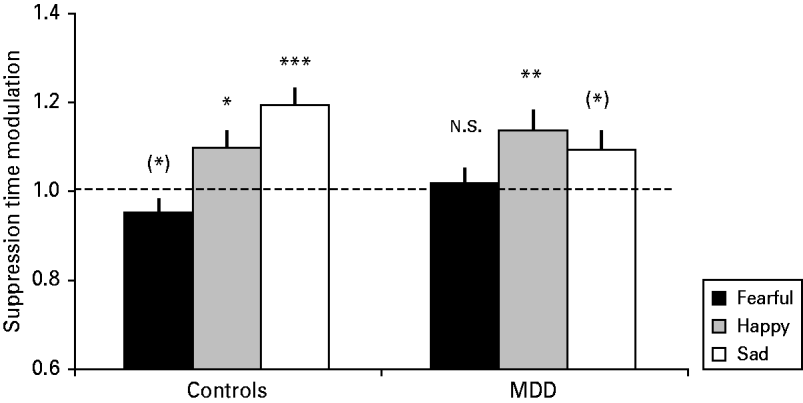
Having established that there were no between-group differences in suppression time for neutral faces, we calculated an index of suppression time modulation for each emotional expression (fear, happy, sad) relative to the average suppression time for neutral faces in each participant. All subsequent analyses assessing effects of emotional expression on suppression time were performed using this index (Fig. 3). A 3×2 ANOVA with the within-subject factor emotion (fear, happy, sad) and the between-subject factor group showed a significant emotion×group interaction [F(1, 38)=4.6, p=0.013]. Breaking this result down using further 2×2 ANOVAs revealed that there were significant interactions of the factor group with both the difference between sad and happy [F(1, 38)=5.6, p=0.024] and between sad and fearful [F(1, 38)=6.1, p=0.018]. By contrast, there was no significant interaction of the factor group with the difference between fearful and happy faces [F(1, 38)<1]. Thus, the 3×2 emotion×group interaction seemed to be due to between-group differences in the effect of sad stimuli compared to the other two emotions. The interaction effect was not driven exclusively by a decreased suppression time for sad faces in the MDD group but seemingly also by slight relative increases in suppression times for fearful and happy faces, as indicated by the absence of significant between-group differences when comparing fearful, happy and sad expressions directly using post-hoc two-sample t tests [fearful: t(38)=1.7, p>0.1; happy: t(38)=0.7, p>0.1; sad: t(38)=1.6, p>0.1]. However, post-hoc one-sample t tests probing the modulation of suppression time for each emotion and both groups separately pointed to sad expression as the strongest contributor to the emotion×group interaction. Sad expression modulated suppression time robustly in the control group [t(19)=4.6, p<0.001] whereas there was only a trend in the MDD patients [t(19)=2.0, p=0.6]. Thus, there was a robust disadvantage for sad faces in gaining access to awareness in the control group but this disadvantage did not reach significance in the MDD group. Happy expression increased suppression time significantly in controls [t(19)=2.5, p=0.02] and even more robustly in MDD [t(19)=3.0, p=0.007]. Fearful faces did not modulate suppression time significantly in either group, although a trend was observed in the healthy control group [MDD: t(19)=0.6, p>0.1; control: t(19)=1.8, p=0.09].
Suppression time modulation by fearful, happy and sad facial expressions relative to neutral expression. The dotted line denotes the reference value 1 (i.e. the relative suppression time for neutral faces). A modulation index <1 indicates shorter suppression times and an index >1 longer suppression times relative to neutral faces. n.s., not significant; (*) p<0.1, * p<0.05, ** p<0.01, *** p<0.001, one-sample t tests against reference value 1.

Correlation with depressive symptoms
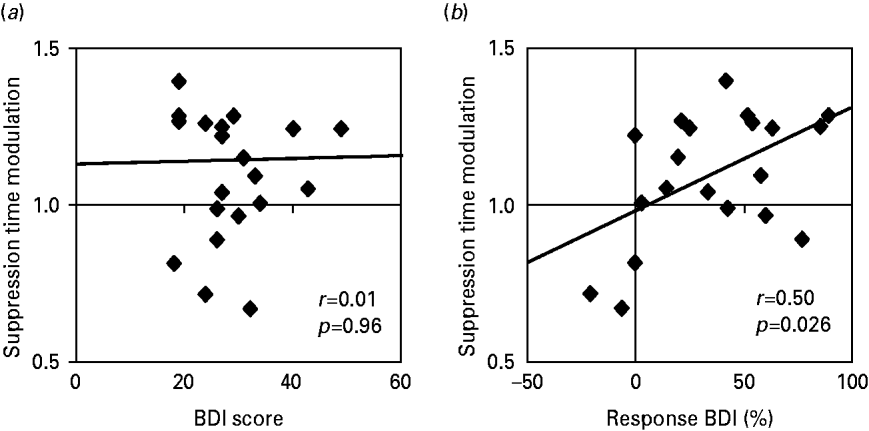
Finally, we asked whether alterations in automatic emotion processing might be related to the subjective severity of depressive symptoms, and whether our behavioural measure of automatic emotion processing might even help to predict the course of the illness. We thus probed the correlation between suppression time modulation and depression severity as measured with the BDI in the patient group, and the correlation between suppression time modulation and the change in depressive symptom severity after 4 weeks of treatment, as indicated by percentage change in BDI scores. Correlation analyses were only performed for the modulation of suppression time by sad expression because the observed emotion×group interaction seemed to be mainly, albeit not exclusively, driven by sad face processing. We found no correlation between suppression time modulation for sad faces and BDI score (r=0.01, p>0.1) at baseline (Fig. 4 a). Strikingly, however, there was a significant positive correlation of suppression time modulation with the change in BDI after 4 weeks of treatment (r=0.50, p=0.026), indicating that shorter suppression times (i.e. relative preference of sad stimuli) were associated with poorer treatment responses (Fig. 4 b). Change in BDI score after 4 weeks did not correlate with initial BDI score (r=–0.024, p>0.1), showing that the self-reported change in symptom severity was not influenced by initial depression severity.
Relationship between suppression time modulation by sad facial expression and self-reported depression severity in patients with major depressive disorder (MDD). (a) There was no correlation between suppression time modulation for sad faces and Beck Depression Inventory (BDI) score at baseline. (b) Suppression time modulation for sad faces correlated significantly with the change in BDI after 4 weeks of treatment.

Discussion
Our key finding is that emotional expressions differentially affect interocular suppression time and thus access to awareness in patients with MDD and controls. This difference is driven by a relative reduction in suppression of sad faces and, to a lesser degree, by an increase in suppression of happy faces in patients with MDD, consistent with an automatic mood-congruent information processing bias in this patient group. Of note, the extent of suppression-time modulation by sad emotional expression correlated with the clinical response after 4 weeks in MDD patients.
Our findings are relevant for the understanding of both the mechanisms of conscious visual perception in general and the perceptual abnormalities in mood disorders in particular. We first discuss how our findings contribute to the understanding of the mechanisms that govern the selection of stimuli for conscious perception. Relative durations of perceptual dominance and suppression during binocular rivalry have been used as indicators of advantages and disadvantages respectively for visual stimuli when competing for awareness (Leopold & Logothetis, Reference Leopold and Logothetis1999; Tong et al. Reference Tong, Meng and Blake2006; Sterzer et al. Reference Sterzer, Kleinschmidt and Rees2009b). CFS has proved to be a particularly useful technique for explicitly assessing the potency of a suppressed stimulus to compete for conscious awareness (Jiang et al. Reference Jiang, Costello and He2007). Relevant to our study, shorter suppression times as an index of an unconscious processing advantage were reported previously for fearful faces versus neutral faces, whereas suppression times were longer for happy faces (Yang et al. Reference Yang, Zald and Blake2007). In general, differences in overcoming suppression can be related to many factors, including physical stimulus differences (Blake & Logothetis, Reference Blake and Logothetis2002), stimulus familiarity (Jiang et al. Reference Jiang, Costello and He2007), cross-modal sensory influences (Zhou et al. Reference Zhou, Jiang, He and Chen2010) and endogenous factors directly related to the task currently at hand, such as endogenous attention or learned expectations (Meng & Tong, Reference Meng and Tong2004; Sterzer et al. Reference Sterzer, Frith and Petrovic2008a). Our new findings now suggest that an endogenous factor (depression) that is entirely task irrelevant but is related to stimulus content (emotion) affects the resolution of binocular rivalry and therefore the selection of stimuli for conscious awareness. The temporal dynamics of binocular rivalry are known to be altered in bipolar disorder (Miller et al. Reference Miller, Gynther, Heslop, Liu, Mitchell, Ngo, Pettigrew and Geffen2003; Nagamine et al. Reference Nagamine, Yoshino, Miyazaki, Takahashi and Nomura2009), but these studies did not investigate the influence of mood-related emotional stimulus information. Anxiety and depressive symptoms in healthy subjects influence binocular rivalry between two face stimuli with different emotional expressions (Gray et al. Reference Gray, Adams and Garner2009; Yoon et al. Reference Yoon, Hong, Joormann and Kang2009), in line with our finding in a clinical population of moderately to severely depressed individuals. Contrary to these previous reports, however, we did not probe rivalry between two facial expressions but rather the potency of emotional stimuli to overcome the strong initial suppression by an abstract mask stimulus. Our paradigm thus (1) targeted unconscious emotion processing directly and (2) was not confounded by possible competitive interactions between different emotional expressions.
Regarding the mechanisms underlying depressive perception, our findings demonstrate that altered processing of emotional information at automatic, unconscious stages affects directly the access of emotional stimuli to awareness in MDD. There is abundant evidence for altered conscious perception of emotional information in depressed individuals in tasks that probe the recognition or interpretation of emotional information (Feinberg et al. Reference Feinberg, Rifkin, Schaffer and Walker1986; Gur et al. Reference Gur, Erwin, Gur, Zwil, Heimberg and Kraemer1992; Rubinow & Post, Reference Rubinow and Post1992; Persad & Polivy, Reference Persad and Polivy1993; Hale, Reference Hale, Jansen, Bouhuys and van den Hoofdakker1998; Hale et al. Reference Hale, Jansen, Bouhuys and van den Hoofdakker1998; Leppanen et al. Reference Leppanen, Milders, Bell, Terriere and Hietanen2004) or attention biases towards mood-congruent stimuli (Gilboa-Schechtman et al. Reference Gilboa-Schechtman, Ben-Artzi, Jeczemien, Marom and Hermesh2004; Gotlib et al. Reference Gotlib, Kasch, Traill, Joormann, Arnow and Johnson2004a, Reference Gotlib, Krasnoperova, Yue and Joormannb; Joormann, Reference Joormann2004). Moreover, evidence for unconscious emotion processing comes from subliminal word-priming (Bradley et al. Reference Bradley, Mogg and Williams1995, Reference Bradley, Mogg and Millar1996) and neuroimaging (Suslow et al. Reference Suslow, Konrad, Kugel, Rumstadt, Zwitserlood, Schoning, Ohrmann, Bauer, Pyka, Kersting, Arolt, Heindel and Dannlowski2010). The latter study showed increased amygdala responses to masked sad face stimuli and decreased responses to masked happy faces in patients with MDD, thus demonstrating automatic mood-congruent emotion processing at the neural level. Our new results complement these recent neural findings by now showing at the behavioural level that altered unconscious processing of emotional facial expressions affects the access of such information to awareness. It is important to note that previous behavioural work has used more indirect measures of automatic emotional information processing, such as attention cueing (Gotlib et al. Reference Gotlib, Kasch, Traill, Joormann, Arnow and Johnson2004a, Reference Gotlib, Krasnoperova, Yue and Joormannb), distractor effects (Gilboa-Schechtman et al. Reference Gilboa-Schechtman, Ben-Artzi, Jeczemien, Marom and Hermesh2004; Joormann, Reference Joormann2004) or priming (Bradley et al. Reference Bradley, Mogg and Williams1995, Reference Bradley, Mogg and Millar1996). CFS, by contrast, can be used to directly probe the transition of emotional information from an unconscious to a conscious processing state. By thus providing a direct link between automatic unconscious sensory processing and conscious perception, the CFS paradigm allowed us to measure directly how the access of emotional stimuli to awareness is influenced by depression.
In contrast to previous work showing altered detection of briefly presented emotional faces among neutral faces (Suslow et al. Reference Suslow, Junghanns and Arolt2001, Reference Suslow, Dannlowski, Lalee-Mentzel, Donges, Arolt and Kersting2004), the emotional expression of the target face stimuli was completely irrelevant in our task; participants were just asked to indicate the location of faces but not their emotion. Thus, our outcome measure, the duration of interocular suppression, could obviously not be influenced by cognitive evaluation of the target stimuli while they were suppressed; nor was it likely to be influenced by cognitive processes related to the evaluation of emotional expression at the time of detection, as such evaluation was not required by the task. Conceivably, emotional expression could have influenced the execution of behavioural reports (Ihssen et al. Reference Ihssen, Heim and Keil2007), but this possibility was ruled out by correcting the suppression times during CFS for reaction times as measured in a control condition where face stimuli were unpredictably shown to both eyes.
Our analyses revealed that the reduction of suppression time for sad faces in MDD patients contributed to the observed emotion×group interaction possibly as the strongest, but not the only, factor. A slight relative increase in suppression time for happy faces also contributed to the effect. This pattern of results is in line with previous behavioural findings showing decreased sensitivity for happy face discrimination and decreased specificity for sad discrimination (Gur et al. Reference Gur, Erwin, Gur, Zwil, Heimberg and Kraemer1992). Similarly, neuroimaging studies have shown altered (conscious) processing of both sad and happy faces (Surguladze et al. Reference Surguladze, Brammer, Keedwell, Giampietro, Young, Travis, Williams and Phillips2005) and also opposite effects of masked sad and happy faces in the amygdala in patients with MDD compared to healthy controls (Suslow et al. Reference Suslow, Konrad, Kugel, Rumstadt, Zwitserlood, Schoning, Ohrmann, Bauer, Pyka, Kersting, Arolt, Heindel and Dannlowski2010). Taken together, the evidence indicates that depressive perception may be characterized by automatic biases towards mood-congruent and away from mood-incongruent information.
Of note, the relative suppression time for sad faces correlated with the self-reported change in depression severity after 4 weeks of treatment. That is, those patients in whom suppression time for sad faces was longest relative to neutral faces (thus reflecting the greatest disadvantage for sad faces) showed the greatest improvement in symptom severity after 4 weeks of treatment. Contrasting with this relationship between mood-congruent unconscious processing bias and symptom change, we found no correlation with symptom severity at the time of testing. Possibly, the relatively small sample size may have lacked the power to detect such a relationship. It is also conceivable, however, that unconscious emotion processing could represent an endophenotype-like marker that is accessible at the behavioural level yet is unconfounded by the patients' subjective report. This raises the intriguing possibility that unconscious emotion processing may be used as a behavioural prognostic marker that is less susceptible to subjective reporting biases than measures relying on cognitive evaluation or self-report.
One limitation of our study is that we cannot decide on the basis of the present data whether the unconscious processing bias reflects the current affective state or rather a trait that predisposes for depression. If the predisposition towards MDD is associated with altered neural responsivity to emotional information, as suggested previously (Beck, Reference Beck2008), then unconscious processing biases towards negative information should be present before the onset of depression and after remission, similar to cognitive and attentional biases in at-risk individuals (Joormann et al. Reference Joormann, Talbot and Gotlib2007; Dearing & Gotlib, Reference Dearing and Gotlib2009) and in patients who have recovered from depression (LeMoult et al. Reference LeMoult, Joormann, Sherdell, Wright and Gotlib2009). However, processing of emotional information is found to be influenced by short-term changes in mood (Wang et al. Reference Wang, LaBar and McCarthy2006), which suggests that perceptual biases in depression may reflect the current mood rather than (or in addition to) a predisposition. Whether unconscious perceptual biases in emotion processing are state or trait markers, or both, is a challenging research question for future longitudinal studies in MDD patients or investigations in at-risk individuals. Another concern related to our present results is that all except two patients were on antidepressant medication at the time of testing. We cannot therefore rule out the possibility that our results are related to medication effects. Importantly, however, there were no between-group differences in overall suppression time irrespective of emotional expression, rendering a general effect of medication on suppression time unlikely. Moreover, antidepressants reduce neural responses to negatively valenced emotional stimuli whereas they enhance processing of positive stimuli (Harmer et al. Reference Harmer, Hill, Taylor, Cowen and Goodwin2003, Reference Harmer, Mackay, Reid, Cowen and Goodwin2006; Browning et al. Reference Browning, Reid, Cowen, Goodwin and Harmer2007; Arce et al. Reference Arce, Simmons, Lovero, Stein and Paulus2008). By contrast, our pattern of results suggests enhanced processing of negative and reduced processing of positive stimuli in MDD, as indicated by shorter and longer suppression times respectively, and is therefore at odds with the well-documented effects of antidepressants on emotion processing. If anything, antidepressant medication may thus have attenuated the group differences observed in our study. Of course, future studies should aim at eliminating the possibility of a medication effects with certainty, for example by retesting patients after remission but before medication is discontinued, or by testing unmedicated patients.
In conclusion, we show that automatic mood-congruent biases affect conscious visual perception in MDD. Our findings support the notion that depressive perception may not only be a consequence of cognitive biases, such as mood-congruent interpretation or selective top-down attention to negative information. Rather, neural functional alterations at automatic processing stages may also contribute to negative perceptual biases, which could in turn reinforce depressed mood. Possibly, altered automatic information processing may also enhance the development of negative cognitive biases in depression. Moreover, the simple and non-invasive method that we used to measure unconscious perceptual processing biases could prove an interesting tool for diagnostic and prognostic assessment at the behavioural level without relying on subjective or self-report data.
Acknowledgements
This work was supported by grants from the German Research Foundation to P.S. (DFG STE-1430/2-1, Emmy-Noether Programme) and from the German Federal Ministry of Education and Research to F.B. (BMBF-01GWSO61). We thank Claudia Höpfner for help with patient recruitment and behavioural testing.
Declaration of Interest
None.