Among the numerous speculative attacks that punctuated the decade of the Great Depression, the sterling crisis of September 1931 occupies a central place. The pound's collapse was an important milestone in the breakdown of finance in the interwar because sterling was a major international currency and its devaluation had far-reaching consequences for the international monetary system. The crisis in Britain was followed by speculative attacks in other European countries and eventually led to the collapse of the gold standard. In the United States, the Federal Reserve reacted to these troubles by tightening its monetary policy, a move which contributed to banking instability and a deepened depression.Footnote 1
The sterling attack also remains of particular interest to economists because it took place in the midst of a more widespread, international financial crisis. The spring and summer of 1931 were marked by a wave of banking panics and exchange difficulties in Central Europe. Austria was the first victim, soon followed by Hungary and Germany. In 1931 observers thought they were witnessing a global crash borne of crisis spreading from country to country.Footnote 2 The sterling attack therefore serves as a case study of international crisis transmission.
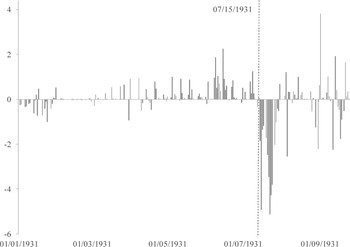
Explanations for the sterling crisis have emphasized the pound's overvaluation,Footnote 3 Britain's fiscal imbalances,Footnote 4 and its dramatic unemployment rate.Footnote 5 Although it is difficult to assess their relative importance, these factors certainly contributed to the collapse, but they are not a complete list. The timing of the speculative attack, indeed, suggests that international transmission might also have been an important cause of the crisis. The run on the pound began just after the peak of the financial crisis in Germany. On 15 July 1931, after a two-day bank holiday, the German government imposed capital controls to prevent a depreciation of the Reichsmark. As daily data indicate, this decision was immediately followed by gold outflows from Britain (Figure 1) and, in the two weeks that followed, the Bank of England lost about 20 percent of its gold reserves.
DAILY CHANGE IN BANK OF ENGLAND'S GOLD RESERVE, 1/01/1931–9/25/1931 (in million pounds)

To what extent was the run on the pound related to the German crisis? Although most scholars recognize the two events were linked, they continue to debate how contagion actually occured. For a number of authors, the British banking system was a channel of crisis propagation.Footnote 6 In their accounts, the German panic directly affected British banks’ balance sheets and therefore impaired the pound's position. Yet, little quantitative evidence has been advanced so far to support this claim. The extent of British banks’ losses in Germany are poorly documented, and the link between the banks’ troubles and currency problems has never been formally specified. Other scholars have taken the position that international banking interdependencies were limited in the 1930s.Footnote 7 Forrest H. Capie, Terence Mills, and Geoffrey E. Wood and Mark Billings and Capie assess the stability of the British banking system during the Depression, using data on large commercial banks.Footnote 8 They find that banking stability was not altered in the 1930s, casting doubt on the hypothesis that the City of London was buffetted by global factors. In contrast to Harold James’ thesis that the crisis in Central Europe had left London banks under fire, the authors assert that “no ‘real financial crisis’” hit Britain in 1931.Footnote 9
In this article, I argue that international transmission through the banking system was an important factor underlying the sterling crisis of 1931. To make this case, I rely on new data documenting British banks’ balance sheets culled from archival records. I show that financial troubles in Central Europe translated into a liquidity crisis in the British banking system. Unlike most scholars who have concentrated on the British joint stock clearing banks, I primarily focus on another type of institution: London merchant banks. These firms were hurt the most by Central European events but their financial position has been neglected so far.Footnote 10 Based on information on the institutional organization of international banking relations, I first specify the precise transmission channel through which the Central European panic endangered these banks’ liquidity. Second, I document the extent of the shock on British banks and track various indicators of the liquidity crisis in their balance sheets. I show that the Central European crisis resulted in a run on a whole segment of the London market which was exposed to the region. I then describe the banks’ reaction to the shock. The crisis was followed by a drastic shrinkage of balance sheets. London merchant banks were forced to liquidate their assets in order to meet their liabilities. They also severely restrained commercial credit over subsequent years. Last, I identify the Bank of England's reaction to the merchant banks’ problems and explore how this situation contributed to the pound's collapse.
The City's illiquidity, I argue, was a by-product of the merchant banks’ role as guarantors of short-term commercial debts on account of German merchants through a specific credit instrument: the bankers’ acceptance. During the credit boom of the late 1920s, the weakly capitalized merchant banks had guaranteed bills for foreign merchants on an extensive basis because this activity did not necessitate them to immobilize resources and therefore allowed them to earn substantial income. At the end of the 1920s, the amounts of bills they had insured largely exceeded the value of their capital. This was not a problem in normal times because defaults on the merchants’ side remained limited. However, just as the burst of the housing bubble affected the liquidity of AIG or all institutions specializing in mortgage credit insurance during the 2008 crisis, a shock provoking substantial defaults among foreign merchants could at any time endanger the position of the merchant banks. In the summer of 1931 exchange controls in Central Europe and the Standstill Agreements, by imposing a freeze on all assets, resulted in the effective default of all borrowers from this region. Since merchants could not honor their sterling debts anymore, the liability for these debts fell upon their guarantors in London. The result was a huge liquidity shock on exposed financial institutions.
THE TRANSMISSION CHANNEL
In a few short months, the 1931 financial crisis brought the whole international monetary system down and led to a global economic collapse remembered as the nadir of the Great Depression. The dramatic concentration of financial crises in 1931 has puzzled many economists.Footnote 11 The global crash began in May with the failure of the Creditanstalt, the largest Austrian bank. In the following two months a wave of financial instability swept through Austria, Hungary, and Germany: banking panics came hand in hand with external pressure on the local currency.Footnote 12 Governments also reacted similarly in the three countries: as their currencies depreciated, they introduced capital controls.Footnote 13 In effect, this implied a ban on all payments abroad and Central European debtors had to find arrangements with their foreign creditors to settle the payment of their debts. At the London Conference in July, the major banking creditors in New York and London agreed to maintain existing short-term credit lines to their Central European customers.Footnote 14 The freeze of all private debts was later formalized in the Standstill Agreements first signed in September and renewed regularly until the end of the 1930s.Footnote 15
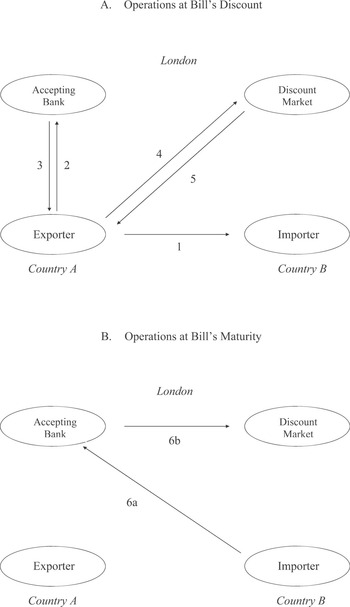
How did these Central European events affect British banks? According to many accounts, London banks had large claims in the crisis region.Footnote 16 However, their balance sheets suggest that the banks’ exposure to Central Europe was not mere portfolio exposure. In fact, direct portfolio holdings of Central European debts only accounted for a sixth of the British financial system's exposure to this region in 1931. However, the banks were exposed through the bankers’ acceptance.Footnote 17 This instrument was a specific type of bill of exchange, which had been used for centuries by international merchants in order to finance their activities.Footnote 18 The principle was very simple: through an acceptance, a bank in London could guarantee a firm's debt, in exchange for a commission, so as to allow this firm to borrow on the market. To make this concrete, let us suppose that an Argentinean exporter had sold goods to a German importer and was to be paid after some delay (for example, on the delivery of the goods). Now, if the exporter wanted to benefit from the proceeds of her sale before receiving payment, she might have wanted to draw a bill of exchange on the importer (the debtor), ordering her to pay the bill holder the amount of the transaction at a certain date in the future.Footnote 19 The Argentinean merchant could then try to discount this bill (representing her claim on the German importer/debtor) on a large capital market such as the London market. However, potential lenders in London would not have discounted a bill drawn on a merchant on which they had no information without a guarantee. The bankers’ acceptance solved this problem, because it allowed the exporter to draw the bill on a London bank (the accepting bank) with whom the importer/debtor had an arrangement rather than directly on this importer/debtor. In order to do this, the exporter needed to provide evidence to the accepting bank that she had shipped the goods to the importer and was to be paid soon.Footnote 20 Upon successful examination of the evidence, the bank “accepted” the bill, which means that it put its signature on it in exchange for a fee. By doing this, the accepting bank committed to pay the bill's holder at maturity. With the signature of a reputable London house on it, the bill was turned into a salable security. The exporter could then easily discount it on the London market at the prevailing interest rate.Footnote 21 Once arrived at maturity, the bill's holder directly asked for payment at the accepting bank which, in the meantime, had received payment from the importer/debtor (see Figure 2).Footnote 22 If the importer/debtor failed to pay—for example, if she had gone bankrupt in the meantime—the accepting bank could seize the goods shipped from Argentina to Germany, which served as collateral.Footnote 23
Like modern Credit Default Swaps, acceptances only represented contingent liabilities (or debt guarantees) for the British banks. Indeed, when accepting a bill, a bank became liable to the bill's holder, but in principle this liability was always exactly matched by a corresponding claim on an importer/debtor. Banks reported the amounts of bills they had accepted on both sides of their balance sheets. Liabilities and claims matured at the same date and were secured by a commercial transaction: they were “self-liquidating.”Footnote 24 The acceptance business therefore did not require banks to immobilize resources and they could accept a large volume of bills relative to their capital.
Acceptance was a very attractive line of business for London merchant banks. These houses were characterized by limited amounts of capital and deposits (relative to the joint stock clearing banks) and their extensive network of foreign correspondents. In the nineteenth century, merchant bankers had had a near monopoly on the acceptance business. In the interwar years however, they faced two adverse trends. First, competition between the London and New York money markets was rising,Footnote 25 and second, local commercial banks (the joint stock clearing banks) were increasingly involved in this field.Footnote 26 Yet, although the New York market grew rapidly after 1914, London seems to have resisted quite well. In the evidence he gave to the Macmillan Committee, Mr. Frederik Hyde (of the Midland Bank) described the City as “a magnet for money” and he declared that, “New York has a long way to go before she catches up to London.”Footnote 27 Similarly, Sir Robert Kindersley, the director of Lazards (and a director of the Bank of England), considered New York as less “conveniently situated” and “its discount market is nothing approaching ours.”Footnote 28 Acceptance houses were also able to meet the competition from the commercial banks and, in 1928 they were still accepting 88 percent more bills in aggregate than the clearing banks.Footnote 29 Although bigger, the joint stock banks had fewer correspondents abroad and the bulk of their activities remained domestic. When accepting bills for merchants abroad, the clearing banks usually relied on foreign banks as intermediaries as they provided credit lines on which these banks’ customers could draw. The customers’ debts, in these cases, were guaranteed by the intermediaries.Footnote 30 By contrast, merchant bankers, because of the wide connections they had maintained abroad since they settled in London in the nineteenth century, could deal directly with foreign merchants. In the interwar period therefore, the London market remained very specialized. The clearing banks’ main activity was to make direct loans to domestic industry. The merchant banks accepted bills, in which other institutions (in particular, the so-called discount houses or bill brokers) invested.Footnote 31 Moreover, in the reconstruction years, the demand for commercial credit from Central European countries, particularly Germany, was huge. The acceptance business therefore remained a substantial source of revenue for the merchant banks.Footnote 32
ACCEPTANCE CREDIT

However, as the recent financial crisis illustrated, insuring credit implies taking on risk, which banks have to manage carefully. Indeed the accepting bank was liable to the bill's holder even if the debtor (the importer) defaulted. In most times, defaults were low and acceptance houses could cover their losses with part of their current commission revenues. The Central European panic, however, could have destabilized part of the British banking system, simply because nearly all debtors/importers from that region went into default at the same time. The introduction of exchange controls in Austria, Hungary, and Germany meant that merchants and banks located in these countries could not convert their local currencies into pounds anymore (the foreign exchange markets were closed). A Central European debtor/importer indebted to a London accepting bank, even solvent, was therefore unable to transfer funds to the United Kingdom and, unless she had other claims in foreign currency, she could not pay her sterling debt to the London bank on due time. Under the Standstill Agreement, Central European debtors/importers were not formally in default but their acceptance debts were frozen on the asset side of the British banks’ balance sheets. However, there was no provision for relief of accepting banks who were still legally bound to reimburse the bill holders at maturity. An immediate consequence of the exchange restrictions was therefore to turn all British banks’ contingent liabilities with respect to Central European acceptance credits into real ones.Footnote 33 Those institutions who had accepted large volumes of Central European bills relative to their capital found themselves suddenly holding illiquid claims of a dubious value.
DATA AND SOURCES
To evaluate the impact of the Standstill on British banks, I collected data on balance sheets and acceptance claims/liabilities in Central Europe for the two main types of financial institution accepting bills on the London market: the ten publicly traded clearing banks, and another 17 private banks, known as “merchant banks” or “acceptance houses.” Balance sheet data for the clearing banks are easy to find. As of 1921, following the Cunliffe Committee's recommendations, these banks started publishing statements showing monthly averages of weekly balance sheets’ items.Footnote 34 The published balance sheets did not show the breakdown by country of the clearing banks’ investments, but the aggregate amounts of outstanding German bills accepted by them can be found in the archival records of the Committee of London Clearing Bankers as of December 1931.Footnote 35
As opposed to the joint stock banks, private banks were not required to publish their balance sheets. Material on their position must be sought out archives. The Bank of England collected detailed information on these houses during the interwar years. All institutions willing to “maintain the status of their acceptance as Prime Bank Paper” were required to report periodically at the Bank's Discount Office.Footnote 36 These statements, which have been preserved, consist of reports made by the various merchant banks and disclose their balance sheets at the end of each year. As of December 1931 the documents also indicate the amounts of the various banks’ acceptance claims frozen in Germany, Austria, and Hungary. The Bank of England's archives contain such reports for 20 merchant banks.Footnote 37 For certain banks, the Discount Office's reports are also lacunary or unusable. Luckily, I could complete these reports with other sources (for more detail see the Appendix). First, although they were not all required to do so, six accepting houses published their balance sheets at the end of each year.Footnote 38 Second, I found missing balance sheet data and/or Standstill investments in the archival records of several merchant banksFootnote 39 as well as in published monographs.Footnote 40 Roger Truptil in 1936 provided a list of the 22 most significant merchant banks in London, ranked according to their importance as acceptors.Footnote 41 The sources described above allowed me to collect balance sheet information for a number of 17 out of these 22 houses. The sample includes the five most significant acceptance houses, according to Truptil, and nine out of the ten largest acceptors.Footnote 42 It also covers 72 percent of all merchant banks in terms of market share at the end of 1928.Footnote 43 This extensive sample therefore allows us to describe the main developments affecting London acceptance houses during the interwar period.
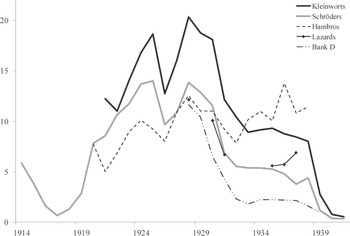
ACCEPTANCES OUTSTANDING, FIVE MERCHANT BANKS, 1914–1941 (in million pounds)

THE LIQUIDITY SHOCK
British Banks’ Exposure to Trade Credit in the 1920s
The balance sheets show that London banks were generally quite exposed to the crisis because of their activities as guarantors of debt. The late 1920s had seen a boom in commercial credit and acceptances had been the main instrument used for trade finance.Footnote 44Figure 3 illustrates the credit boom; it shows the value of the five most significant merchant banks’ outstanding acceptances at the end of each year, from 1914 to 1941.Footnote 45 The volume of trade credit guaranteed by these houses surged in the 1920s and peaked in 1928. The ensuing drop seems to have been the consequence of the decline in commodity prices during the early years of the Great Depression.Footnote 46 Nevertheless, in December 1930, the total amount of trade credits guaranteed by the merchant banks was still at 115 percent of its 1927 level.Footnote 47
Given the characteristics of acceptances, one might expect the credit boom to have been associated with risk-taking behavior by the banks. Indeed, unlike endorsement where the bank would have had to buy each bill before reselling it, acceptance allowed banks to guarantee bills without immobilizing capital and thus banks could increase their position in acceptances without the need for additional resources. As for their general exposure, thus, increasing acceptances formally depended only on internal, self-imposed prudential rules, but there were some constraints. There is evidence that the Bank of England monitored the merchant banks with some care. Most of the data analyzed here were produced as a result of the Bank's monitoring. The Bank discriminated between financial houses when choosing the paper eligible for rediscount or for direct purchases. For instance, bills carrying the signature of London Merchant Bank, Ltd., though eligible for rediscount, were not accepted for direct purchases by the Bank as part of its open market operations.Footnote 48 The reason invoked for putting London Merchant Bank on the index was that it did not have enough capital relative to its overall commitments.Footnote 49 Since acceptances constituted the bulk of the merchant banks’ balance sheets, this item was under close scrutiny of the Bank of England. Moreover, there also existed a market mechanism through which the banks were induced towards prudence; their bills would hardly have found their way on the discount market if bill brokers had come to doubt their solvency. Merchant bankers understood the necessity of managing risks. According to Sir Robert Kindersley, to preserve the quality of their signature acceptance houses had to show they had “considerable means at [their] back” in order to face potential defaults.Footnote 50 In the absence of evidence on long-term default rates, it is difficult to say what level of capitalization was adequate for the London acceptance houses in the late 1920s but we can refer to what contemporaries were saying. An unwritten rule, according to Kindersley, was that a house's acceptances should never exceed three or four times the value of its capital and reserves.Footnote 51 Whether this rule was conservative or not may be subject to discussion. For comparison, in June 2008, the U.S. corporation American International Group Inc. (AIG), whose exposure to credit protection has been described as particularly excessive during the recent crisis, had insured 441 billion U.S. dollars of securities (through credit default swaps), amounting to 4.6 times its total equity.Footnote 52 Kindersley's rule of thumb was also much less restrictive than the U.S. banking legislation of the 1920s, under which member banks of the Federal Reserve System were only allowed to accept bills up to 100 percent of their capital stock and surplus.Footnote 53
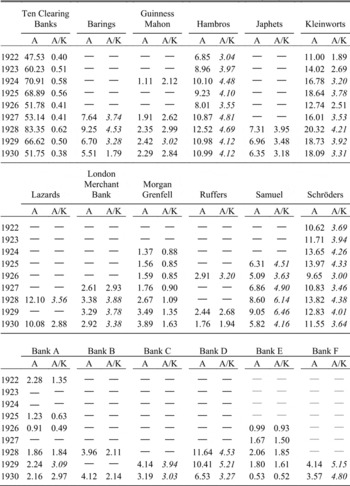
Table 1 reports the year-end ratios of accepted bills to capital and reserves (A/K) for all banks in the sample in the run-up to the crisis (1922–1930). The table also reports the total amount of each bank's outstanding acceptances (A) at the end of each year. During the boom of the 1920s, banks allowed their leverage ratios to increase, indicating that they did not raise the value of their capital as fast as they expanded their acceptance activities. At the end of 1928, six banks in the sample had contingent liabilities exceeding four times their capital, and for three others, the ratio was between three and four. According to standards of the time, these banks were therefore highly exposed.
Acceptance Houses’ Illiquidity
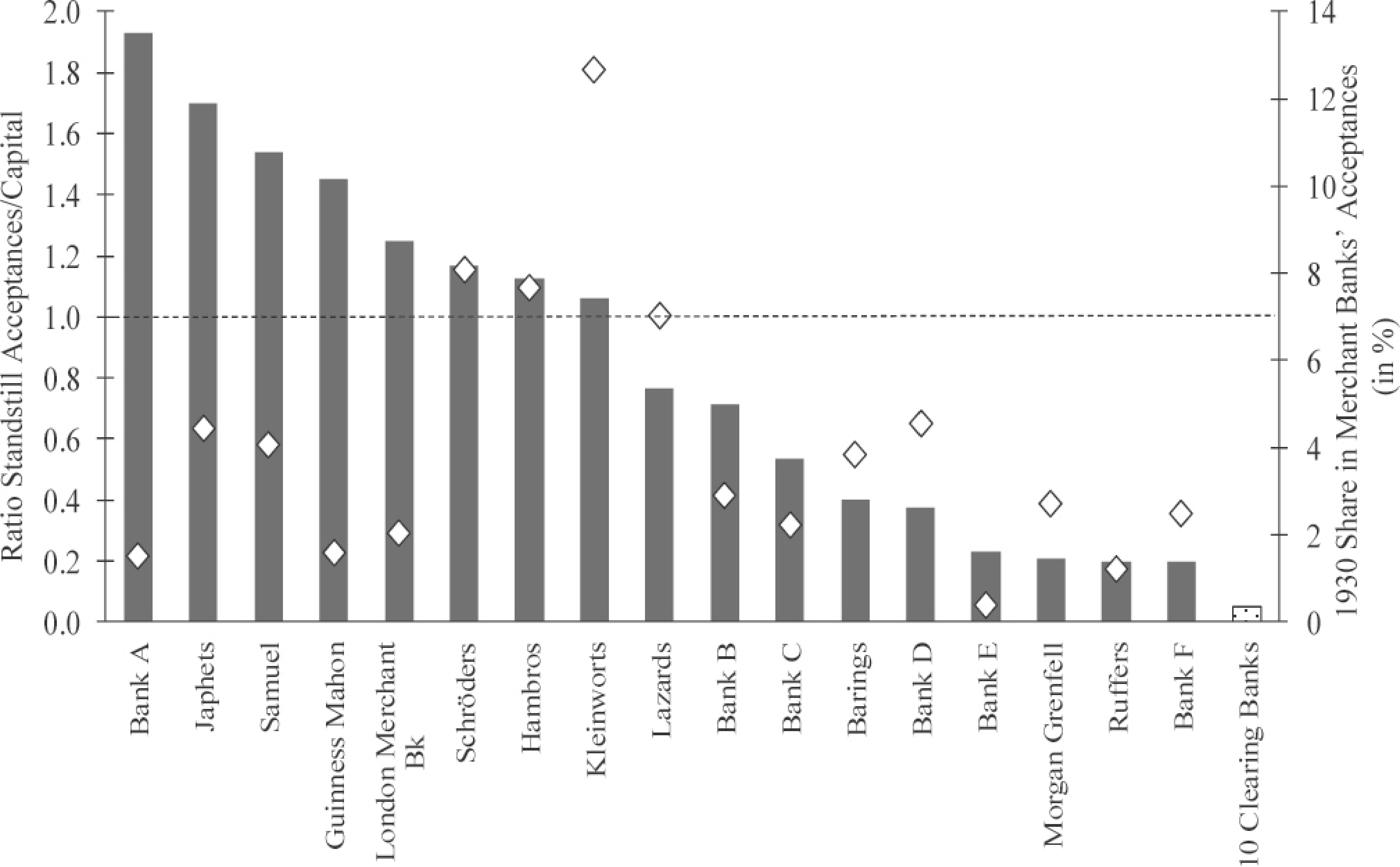
In this context, the Central European crisis could have seriously reduced the merchant banks’ liquidity. Figure 4 shows the ratio of each bank's 1931 Standstill acceptances (or unexpected liabilities) to the 1930 value of its capital and reserves. It also presents the relative size of each acceptance house, measured by its share in the total amount of bills accepted by merchant banks at the end of 1930. The graph reveals that a whole segment of the London market was undermined by the Central European shock. On average, the 17 merchant banks in the sample had 47 percent of their outstanding acceptances frozen in Central Europe. The extent of the troubles varied greatly across banks. The clearing banks were almost unaffected and some acceptance houses also had relatively low exposures. For other institutions, however, the shock was extremely serious. Eight out of my 17 merchant banks including the three largest acceptance houses of the City (Kleinworts, Schröders, and Hambros), had frozen acceptance credits larger than their 1930 capital. By July of 1931 these banks were technically out of liquidity (and possibily insolvent). In addition, three other houses had more than half their capital immobilized. On 18 July The Economist evoked “a situation of difficulty unprecedented, except in the case of war.”Footnote 54
ACCEPTANCES OUTSTANDING (A, in million pounds) AND RATIOS OF ACCEPTANCES TO CAPITAL AND RESERVES (A/K)

Notes:
Ratios higher than three are in italics.
Sources:
See the text and the Appendix.
RATIO OF STANDSTILL ACCEPTANCES TO CAPITAL AND RESERVES, 1931

The great heterogeneity across banks can be explained by both the nature of their business and the geographical distribution of their activities. For instance, clearing banks mostly made direct loans to domestic industry and households, and they only marginally engaged in the acceptance business.Footnote 55 It is therefore not surprising that the ratio of their acceptances to capital remained low through the 1920s (Table 1). Other houses, like Morgan Grenfell, were more engaged in bond underwriting than acceptances.Footnote 56 Barings was quite exposed to commercial credit at the peak of the boom but the firm had cut its acceptances by more than 40 percent and increased its capital by a half between 1928 and 1931. Among the acceptance houses, the geographical distribution of operations also greatly differed. Indeed, the activity of an accepting bank mainly consisted of gathering information about foreign merchants/borrowers and monitoring them. Collecting such information implied high fixed costs and therefore encouraged economies of scale and specialization. As acceptors, the merchant banks were specialized in specific regions where they had accumulated long-term expertise and relationships, dating back to the nineteenth century. Ruffers had particular connections with France (through their partners in Lyon) and Spain.Footnote 57 Morgan Grenfell had strong relationships with the United States, where the firm's partners were located.Footnote 58 Hambros was primarily known for its connections with Scandinavian countries.Footnote 59 For these houses, the share of Central European acceptances was relatively low.Footnote 60 By contrast, since the second half of the nineteenth century, Kleinworts had been engaged in Germany and its activity there expanded considerably in the 1920s, due in particular to connections with the textile industry.Footnote 61 In the postwar years, Schröders had made substantial efforts to reactivate its German operations as well. Relying on its close connections with the firm Schröder Gebrüder in Hamburg, the house expanded its acceptances in response to the high demand for credit from German merchants. Schröders guaranteed substantial amounts of bills for Hamburg industrial firms and developed close relationships with the Deutsche Bank.Footnote 62 Last, London Merchant Bank Ltd. was in close collaboration with the Commerz und Privat Bank. These latter institutions were among the most severely affected by the Central European shock.Footnote 63
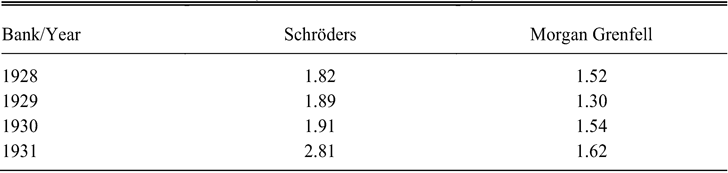
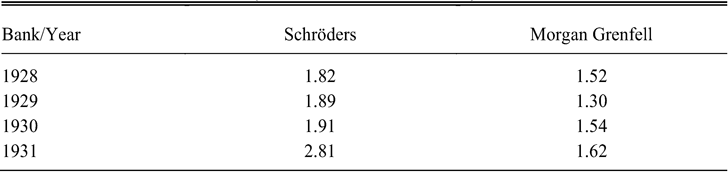
ACCEPTANCE COMMISSIONS (annualized, in %, 1928–1931)
Note:
Ratios higher than three are in italics.
Sources:
See the text and the Appendix.
Did the banks heavily engaged in Germany charge higher fees to their customers in order to compensate for the greater risks involved? According to authors of the time, acceptance commissions usually ranged from 1 to 1.5 percent per annum.Footnote 64 Unfortunately, there is little evidence about how fees were set. The only data we have is the revenue Morgan Grenfell and Schröders reported from acceptance commissions (see Table 2). Dividing a bank's annual acceptance revenue by the total amount of its outstanding acceptances at the end of the year provides an estimate of the average commission rate charged by this bank.Footnote 65 Schröders was heavily involved in Central Europe (particularly, Germany) while Morgan Grenfell had limited exposure to the region. Indeed, Morgan Grenfell's average commission rate is in line with the estimates of contemporary observers. By contrast, the average fee charged by Schröders was higher by 30 basis points at the end of the 1920s, and its premium also increased sharply between 1930 and 1931 to more than 120 basis points. Of course, differences between the two houses could have come from other sources (in particular, they might reflect differences in the quality of their customers), but the higher average fee for a bank more exposed to Germany is nonetheless suggestive that accepting banks charged higher commissions to their German customers in the run-up to the panic.
Run on the Merchant Banks
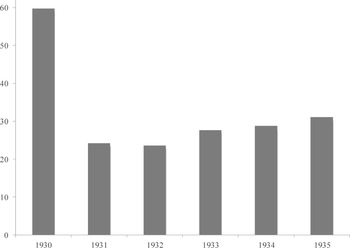
Following the onset of the crisis in Vienna, fears should have arisen that some of the London acceptance houses could fail. Of course, exact data on the various banks’ exposure to Central Europe was not publicly available at the time. However, insiders in the City certainly knew of the different banks’ activity and even outsiders must have had a fair idea of the variation in their exposure to the shock because acceptance houses had long been geographically specialized. The different merchant bankers’ origins and geographical areas of operation were widely known in the City. For example, the Bankers’ Almanac and Year-Book, an international banking directory published annually in London, provided detailed information on the foreign banks’ correspondents in the City. Houses like Kleinworts, Schröders, and Japhets were preeminent among the German banks’ correspondents, revealing the strong links that these institutions had established in that country. Figure 5 looks at the aggregate deposits of the eight most exposed banks (those whose Standstill acceptances amounted to more than 100 percent of their capital and reserves at the time of the crisis) at the end of each year, from 1930 to 1935.Footnote 66 The year 1931 is clearly discernable on the liability side of the balance sheets during which these banks experienced severe deposit losses.
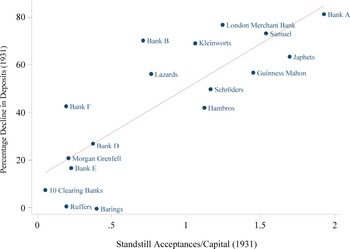
Looking at the variation across banks provides a test that exposure to Central European acceptances caused these withdrawals (rather than concerns over the pound or a broader liquidity run). Indeed, if currency problems were the cause of the run on the merchant banks’ deposits, all houses should have been equally affected because all domestic and foreign depositors holding sterling balances in London should have wanted to exploit the arbitrage opportunities.Footnote 67Figure 6 plots all banks’ deposit losses between 1930 and 1931 as a function of their initial Standstill exposure.Footnote 68 The relationship is clear-cut and statistically important: depositors did not treat all banks on an equal footing.Footnote 69 The ten clearing banks, as well as the merchant banks which were not seriously endangered by the Standstill (Barings, Morgan Grenfell, Ruffers, etc.) faced no withdrawals.Footnote 70 By contrast, deposits declined by 64 percent on average for the group of exposed banks whose frozen assets were larger than half their capital.
AGGREGATE DEPOSITS, EIGHT MOST EXPOSED BANKS, 1930–1935 (in million pounds)

STANDSTILL EXPOSURE AND DEPOSIT WITHDRAWALS, 1931

Moreover, banks exposed to Central Europe were not necessarily the weakest ones according to other metrics. Indeed, regressions confirm that there is no correlation between banks’ deposit losses in 1931 and their 1930 debt-to-equity ratio.Footnote 71 The institutions hardest hit by deposit losses were not the least capitalized in a broad sense (relative to their total liabilities) but the most exposed to Central European acceptances. Depositors made clear distinctions between sound and unsound banks. The Standstill resulted in a run on the latter, and the deposit withdrawals in turn contributed to worsen their position.
BANKS’ REACTION TO THE SHOCK
To understand how banks reacted to the liquidity shock, let us track down the symptoms of the liquidity crisis in their balance sheets starting with liquid assets. The documents recovered in the archives allow documenting each bank's portfolio of bills and securities. This corresponds to all assets which could be sold on an open market. The year 1931 is associated with a drop in this item for many of the merchant banks. Bills and securities declined by 42 percent on average for all merchant banks in the sample between 1930 and 1931. Exposed banks liquidated their securities the most severely. Houses whose Central European acceptances amounted to more than half their capital reduced their liquid assets by 52 percent on average and three of the most exposed banks, Japhets, Lazards, and London Merchant Bank, cut them by more than 70 percent.Footnote 72 These banks needed cash desperately to meet the unexpected liabilities that arose from the Standstill, so they had to get rid of many of their securities. The fire sales confirm that a severe liquidity crisis was at play.
We can also consider the volume of new commercial credit guaranteed by different banks in the wake of the Central European crisis. In their annual reports to the Bank of England's Discount Office, several banks indicated the amounts of Standstill acceptances remaining on their balance sheets after 1931. These amounts correspond to short-term debts granted to Central European customers before the crisis and which were subsequently repeatedly rolled over. The reports, thus, allow us to split outstanding acceptances into newly issued bills and those that corresponded to old credit simply renewed through the Standstill Agreements. The data reveal that the volume of new acceptances granted declined steeply between 1930 and 1933 (by 69 percent on average for the ten banks on which the information is available). This trend has implications for the financing of world trade. Indeed, estimates of sterling acceptances outstanding suggest that, at the end of 1928, around 20 percent of world exports were financed through the London discount market.Footnote 73 Of course, it is difficult to distinguish here between the shock to credit supply versus the shock to demand. However, the balance sheets also show that the banks the most affected by the Standstill (Bank A, Japhets, Samuel, Lazards, London Merchant Bank, and Bank C) cut their acceptances by 82 percent on average, whereas less exposed bank (the ten clearing banks, Bank F, Ruffers, Bank E) reduced them by only 49 percent.Footnote 74 The contrasting fates of sound and unsound houses suggest that the latter cut their granting of new acceptances more severely in the 1930s because of their Standstill exposure. In order to do so, they probably refused to accept the bills of a number of customers in several countries, which may have resulted in credit constraints for these merchants.
The conclusions drawn from balance sheet data are also supported by more qualitative evidence that London acceptance houses were constrained to shrink their balance sheets following the Central European crisis, by liquidating their assets and restricting further credit. These actions were encouraged by the Bank of England itself. London Merchant Bank, Ltd., a small bank, was one of the most seriously affected by the Standstill and it serves as an illustration of the larger problem. In February 1932 an article in The Times mentioned its difficulties.Footnote 75 Documents found at the Bank of England chart London Merchant Bank's problems, how the house reacted, and how it was pressed by monetary authorities to cut its acceptance activity in the months following the Central European panic. On 6 November 1931 a Discount Office note highlighted the extent of the bank's involvement in Central Europe. On 16 December Mr. Harter, a director of London Merchant Bank, explained that the difficulties encountered on the discount market persisted. Moreover, he mentioned, “a further decrease in liquidity, the quick assets being reduced by some 100,000 pounds in order to pay off deposits.” The National Provincial Bank granted 100,000 pounds in discount facilities to the house, but Harter doubted that this would be sufficient at all. In January 1932 the Bank of England noticed that the acceptance house was constrained to carry a substantial part of its own acceptances on its portfolio. In February, the governor met with the directors and urged them to, “reduce commitments where possible with a view to eventual liquidation.” London Merchant Bank eventually survived the liquidity crisis, but it had to restrict credit considerably. The house was encouraged by the monetary authorities themselves to follow this policy. On 4 August 1932 a Bank of England official was, “glad to note that [London Merchant Bank's] structure has been reduced in accordance with our wishes, the acceptances being down by 400,000 pounds of which 150,000 were for German account.”Footnote 76 The evidence from the archives therefore confirms that merchant banks affected by the Standstill were subsequently constrained to sell off their assets and to cut their acceptances.
THE CURRENCY CRISIS
The Merchant Banks: Role and Influence
Having identified how the Central European panic wittled London merchant banks’ assets, we must connect these banking troubles to the sterling crisis. The Central European crisis did not directly cause a balance-of-payment problem in Britain, it weakened the banking system. Nevertheless, in a fixed exchange rate system, banking troubles can lead to speculative attacks on the currency because investors expect authorities to loosen monetary policy in the near future, in order to support the banks.Footnote 77 In 1931 there were several reasons why investors could have expected the Bank of England to come to the support of troubled merchant banks.
British monetary authorities had to be concerned about overall banking stability. To be sure, the run on British banks remained confined to merchant banks who did a lot of business with Central Europe. These houses’ capital was small compared to that of the joint stock clearing banks. However, the stability of the whole British financial system relied upon the merchant banks because they accounted for the majority of acceptances outstanding in London. Many other institutions in the City had invested in bills guaranteed by these houses and were dependent on their solvency. For example, the discount houses (or bill brokers) were among the largest holders of acceptances in London and relied upon deposits and call money from other institutions (in particular, joint stock banks) in order to discount bills. Failures among the merchant banks would have immediately transmitted the troubles to the discount houses and this, in turn, might have led to a generalized banking panic. This risk of a chain reaction had already emerged in the City in 1914, when the outbreak of World War I created a similar disruption in the international payments system. Keynes, at that time, described the interdependence between the various financial institutions in the following terms: “The banks (…) are depending on the Accepting Houses and on the Discount Houses; the Discount Houses are depending on the Accepting Houses; and the Accepting Houses are depending on foreign clients who are unable to remit.”Footnote 78 In 1931 acceptances drawn on account of German customers “unable to remit” represented around 38 percent of all bills accepted by the London clearing banks and accepting houses.Footnote 79 Although the exact amounts are unknown, Pierre-BenjaminVigreux estimates that at the end of 1930 the London discount houses held (or had previously endorsed) around two-thirds of all outstanding sterling acceptances.Footnote 80 These institutions were particularly vulnerable to potential defaults from the acceptance houses because of their highly leveraged position: in 1930 the total acceptance portfolio of the three largest discount houses amounted to more than five times their aggregate capital—they, like the merchant banks, could not bear any significant losses.Footnote 81 Finally, the clearing banks themselves had invested around 88 percent of their capital in acceptances as well as an additional 75 percent in short-term loans to the discount houses.Footnote 82 The Bank of England was very well aware of the interconnectedness of all financial institutions in the City. For instance, when Anglo-South American Bank Ltd., an Anglo-Foreign bank in trouble, asked for support from the authorities in September 1931, the Credit Committee requested an inquiry on the discount market's exposure and finally decided in favor of assistance because: “if such facilities are not given, the position of the bank will be untenable and a major banking crisis will arise.”Footnote 83 The governor felt that the house's failure could affect “the whole of the credit structure of this country.”Footnote 84 Anglo-South American's total amount of acceptances outstanding was, however, only half that of Kleinworts at the end of 1930.
The Bank of England could also not let the merchant banks fail without severely weakening the position of London as an international financial center. Indeed, all the services that the London City was providing to foreign borrowers were intermediated through these banks. The merchant banks’ accumulated information on borrowers and expertise in screening and monitoring them were what had allowed the London market to perform so well since the nineteenth century. From this perspective, the failure of the most important acceptance houses would have been equivalent to a huge loss of human capital in the British financial services. It is rather unlikely that the Bank of England would have allowed this, especially in the context of the interwar years where London was trying to head off New York's challenge to its financial primacy. The development of an active acceptance market in the United States was part of the Federal Reserve's strategy to increase the role of the dollar as an international currency in the 1920s.Footnote 85 Similarly, the Bank of England considered that merchant banks were crucial to preserving the position of the London market. For example, when in February 1931 the governor was informed of the taking over of the acceptance business of H. S. Lefevre & Co. (a small merchant bank) by British Overseas Bank Ltd. (a public bank), he said he supported the arrangement but only reluctantly: “he considered the maintenance of a number of Accepting Houses to be vital to the future of the London market and he viewed with grave concern the absorption of the accepting businesses by banks, which policy, if continued, would ultimately reduce this market to the position of the Paris market.”Footnote 86
Finally, the acceptance houses’ own influence on British monetary policymaking also made a central bank intervention in their favor more likely in times of difficulty. Merchant bankers, in contrast to clearing banks, were very well represented at the Bank of England. The governor was traditionally chosen from among them (Montagu Norman was from Brown Shipley) as were a large number of the Bank's directors. Seven out of the 24 members of the Court of Directors were partners in merchant banking firms in 1931.Footnote 87 The houses of Barings, Hambros, and Morgan Grenfell had been regularly represented since the nineteenth century. Schröders and Lazards had had partners on the Court of Directors since 1912 and 1914, respectively. For this reason, the Bank of England was regularly accused of serving the City's interests.Footnote 88 These close connections might also have led investors to expect an intervention in favor of the merchant banks in the wake of the German crisis. Indeed, in the summer of 1931 there is evidence that the Bank of England was ready to step in. On 14 July in the middle of the German bank holiday, a Discount Office note made it clear that if “a general moratorium for external debts” was enacted, the Bank would consider exceptional measures including “the provision where necessary of funds to enable acceptors to meet at maturity approved bills drawn from Germany.”Footnote 89
The Bank of England's Support of the City in 1931
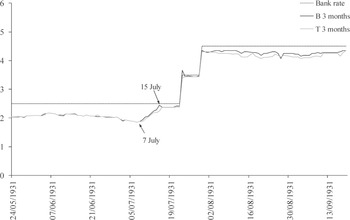
Before examining how the Bank of England reacted to the German moratorium, we must consider developments during the summer of 1931 on the money market. We argued above that London acceptance houses found it difficult to maintain their liquidity after the Standstill. Such difficulties, if severe, should be visible in market interest rates. In particular, one would expect banks to have become reluctant to lend to each other in anticipation of possible failures and to preserve their own liquidity. In order to test this hypothesis, I collected daily data on money market rates in London from June to September 1931. Figure 7 plots the rates on 3-months bankers’ drafts and 3-months T-bills against time, together with the Bank of England's official discount rate. In most times, the Bank was ready to rediscount paper without restriction at the official rate, it was thus an upper bound for the market rate, which was usually about 0.5 percent less. In Figure 7, however, it appears that the spread between the bank and market rates narrowed dramatically from July 7 to 15, the week just preceding the introduction of capital controls in Germany; it was close to zero on the 15th of July when the German moratorium was declared. This situation is indicative of a shortage of money in the banking system. The Economist reported that most dealers were quoting higher rates due to concerns about the German situation.Footnote 90
DAILY MONEY MARKET RATES, 5–9/1931 (in percent)

As of 15 July, however, when the moratorium was declared, market interest rates stabilized just below the bank rate (Figure 7). This might seem surprising as the banks’ liquidity troubles became real as of this date. To understand how this could arise, one needs to have a look at the Bank of England's balance sheet. The amount of bills and securities the Bank purchased on the open market was reported on the balance sheet and the stabilization of market rates exactly coincided with an increase in this amount.Footnote 91 Starting 15 July the Bank engaged in open market operations and it bought 30 million pounds of securities overall between this date and the suspension of gold convertibilty. The interventions were mentioned at several occasions by The Economist and the newspaper related them to the “considerable stringency in the money market” and to the necessity to “widen the margin between market rate and bank rate.”Footnote 92 Since they implied issuing additional notes, the Bank of England had to ask the Treasury to suspend by decree one of the provisions of the monetary law: the maintenance of the amount of the “fiduciary issue” (defined as the difference between the notes issued and the amount of the gold reserve) under 250 million pounds. Therefore, confronted with banking instability, monetary authorities immediately reacted by providing liquidity to the system. These open market operations allowed market rates to stabilize and allowed the Bank not to raise its discount rate. The bank rate was later raised twice on 23 and 30 July, but it remained unchanged at 4.5 percent during August and September. This was a relatively moderate level compared to historical standards. For example, the bank rate went as high as 6 percent during the Baring Crisis of 1890 and the Sterling Attack of 1906 and was raised to 7 percent during the 1907 financial crisis. By mid-July 1931, just after the German moratorium was declared, the Bank of England Governor Montagu Norman himself believed that a discount rate of 7 or 8 percent would be necessary to tackle the pound's difficulties.Footnote 93 However, the official discount rate was eventually maintained at its moderate level and the Bank of England continued intervening until September in order to ensure that market rates remained below the bank rate.
The Bank's open market operations probably helped relieve the pressure on the financial system. Moreover, acceptance houses were helped by another measure; in order to make the Standstill Agreements effective, banks were allowed to borrow at the Bank of England at the official bank rate by discounting German Standstill bills (i.e., bills backed by frozen acceptance debts in Germany).Footnote 94 This was a departure from the Bank's standard practice in that, usually, bills issued by accepting banks in order to prolong a credit not repaid at maturity were considered as bad collateral by the Bank as they were not backed by a genuine commercial transaction.Footnote 95 By making Standstill bills eligible, the Bank of England ensured that the merchant banks could continue circulating their paper and fund themselves on the market. The Bank of England did not undertake to absorb directly the potential losses eventually arising from write-offs of German credits but, by widening the range of securities it accepted as collateral, it in effect loosened the terms of its lending policy so as to accommodate the banks. The issue was also quantitatively important: by mid-July 1931 German bills amounted to approximately 40 percent of the Bank of England's gold reserves.Footnote 96 And, according to Richard Sayers, in the first half of 1932 around half the bills discounted at the Bank were of German origin.Footnote 97 In other words, British monetary authorities departed from the principles of Bagehot's rule in the summer of 1931: the Bank of England did not raise its discount rate to a “very high” level, which might have helped fighting against the external pressure, and it agreed to rediscount paper previously considered as “bad collateral.”
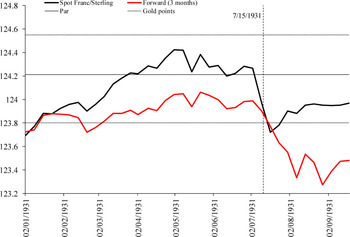
FRANC/STERLING SPOT AND FORWARD EXCHANGE RATES, 1931

Timing of the Speculative Attack
The Bank of England's actions to support the merchant banks also sent a clear signal to the exchange market that monetary authorities were ready to use monetary policy to aleviate the effects of the Central European events. In 1931 the British currency was particularly vulnerable to such adverse signals. The pound had been in regular difficulty since 1929 as investors doubted the credibility of the gold parity.Footnote 98 In this context, the German crisis and the Bank of England's initial reaction likely dealt a fatal blow to investors’ confidence in the pound.
Figure 8 tests this proposition. It displays weekly quotations of the French franc/pound sterling spot and forward exchange rates in Paris during 1931.Footnote 99 The graph reveals that a shift in expectations took place in mid-July 1931. The German moratorium and Bank's interventions coincided with a fall in the spot and forward franc/sterling rates. The spot rate fell below the gold export point towards France in the week following 15 July and stabilized thereafter, even improving in August. The stabilization of the spot rate was probably the consequence of the Bank of England's active exchange market interventions in August, conducted with the support of the Bank of France and Federal Reserve Bank of New York.Footnote 100 However, forward sterling quotations reveal that the pound's rally was pure illusion. Indeed, the forward rate continued to fall indicating strong devaluation expectations.
For investors therefore, the fate of the pound was already sealed by mid-July 1931 and informed observers agreed. On 5 August 1931 John Maynard Keynes wrote that the abandonment of the gold parity was “nearly certain” at that point: “when doubts as to the prospects of a currency, such as now exist about sterling, have come into existence the game is up…”Footnote 101 The famous British economist and financial journalist Paul Einzig also noted that the suspension of the gold standard on September 21 “did not come as a surprise.”Footnote 102 Even at the Bank of England, there was doubt as to its ability to maintain the gold standard. An internal note made the link between the drain on sterling and the suspension of the free flow of capital on the continent. In this context, any policy to support the pound seemed bound to failure: “a point [had to] be reached soon at which the Bank [would have to] ask to be absolved from the obligation to pay gold on demand.”Footnote 103
Sterling Devaluation and German Debtors’ Recovery
On one level, the abandonment of the gold standard allowed the Bank of England to support the banking system. On another level, the pound's devaluation also contributed to relieve the pressure on Central European debtors, whose debts were denominated in sterling. From July 1931 to December 1938 the Reichsmark value of the British banks’ total outstanding credit lines to German customers fell by two-thirds.Footnote 104 This was due to a 40 percent reduction in sterling terms, resulting from write-offs by the British banks of a portion of their German credits and from progressive repayments under the terms of the Standstill Agreements,Footnote 105 as well as a 40 percent depreciation in sterling. By devaluing the pound, Britain thus implicitly bailed out German debtors and in turn their London creditors: the merchant banks.Footnote 106
This perspective therefore casts doubt on the view that the abandonment of the gold standard was favorable to the interests of British industry, but necessarily detrimental to the financial sector.Footnote 107 Of course, by deciding to go off gold, monetary authorities made foreign holders of sterling bear substantial losses. This probably undermined sterling's long-term credibility and may have hurt British banks’ future business. However, in the short term, the reduction of the burden on Central European debtors was also good news for the financial houses of the City. Moreover, the bulk of the British banks’ debts were denominated in sterling so the pound's depreciation did not affect the liability side of their balance sheets. From this perspective, the banks might also have benefitted from the abandonment of the gold standard and the Central European crisis therefore led to a convergence of interests between industry and finance.
CONCLUSION
This article has examined the role of international contagion during the 1931 financial crisis, a topic of long debate in the literature on the Great Depression. Several authors have argued that the banking system played a limited role in transmitting one country's troubles to another, many have instead described the contagion problem as an issue of confidence. The Sterling Crisis of September 1931 forces us to reconsider the issue. The Central European crisis of the spring 1931 did spread to British banks. The Central European panic endangered the liquidity of those London merchant banks that had guaranteed large amounts of short-term commercial debts on account of merchants from this region. Evidence from balance sheet data show that the troubles on the continent resulted in a run on these banks. These banking troubles, together with the Bank of England's attempts to mitigate the crisis seriously reduced investors’ confidence in the pound's peg to gold.
I did not intend to argue here that contagion was the unique cause of the sterling collapse, nor that it can account for all aspects of the crisis. For instance, my emphasis on the Central European events does not offer a fully satisfactory explanation for why the Bank of England did not raise its discount rate much more aggressively in the summer of 1931. A fuller account would have to consider other factors. First, a high bank rate was likely to divert business from the merchant banks, and from the City in general, since merchants always preferred to discount their acceptances in financial centers where low interest rates prevailed. Second, a rise in the bank rate would also have increased the service of Treasury bills for the British government.Footnote 108 This could have worsened an already critical fiscal position and undermined efforts to defend parity. Last, monetary authorities might also have wanted to avoid the repercussions of a restrictive monetary policy on the unemployment rate. Therefore, previous explanations emphasizing the budget deficitFootnote 109 or unemploymentFootnote 110 are not necessarily incompatible with the story presented in this article. How much these various factors contributed to the abandonment of the gold standard is a question which is beyond the scope of this article. However, I emphasize here that international contagion fares better than these other factors in explaining the timing of the speculative attack.Footnote 111 The Central European shock was probably the final trigger behind the sterling crisis.
Finally, this article has interesting implications for the current policy debate surrounding the recent financial crisis. First, it illustrates the role of credit insurance instruments in propagating liquidity problems in troubled times. From this perspective, acceptances then were not very different from Credit Default Swaps that more recently propagated and magnified a crisis that began in a narrow segment of the U.S. mortgage market. Both crises argue that institutions engaging in these insurance activities must be adequately capitalized. Second, at a time when governments and central banks have never been more active in attempting to stabilize the banking system, the sterling crisis allows drawing important lessons for the role of monetary policy in achieving recovery. Over the last twenty years, a substantial body of research has shown that leaving the gold standard was the right thing to do for countries wanting to find the path to economic recovery during the 1930s because it allowed stimulating industrial activity.Footnote 112 But the British episode reveals that the abandonment of the gold peg also had a nice side effect, which was to relieve the pressure on banks. The pound's devaluation in itself supported the banking system in that it allowed authorities to provide liquidity while reducing the burden on Central European debtors. Had Britain been faithful to the gold standard in 1931, the merchant banks’ situation would have been even more critical. Several acceptance houses might have failed and the effect would have been felt in terms of dramatic welfare costs. Therefore, the British economic recovery of the late 1930s might also have been the result of the Bank of England's decision not to let the banking system collapse as a consequence of international contagion.
Appendix: Data and Sources
I. London Banks’ Balance Sheets and Standstill Claims
Ten Clearing Banks
a) Balance sheets
1921–1941: The Economist, “Monthly Return of London Clearing Banks,” various issues.
Monthly averages of weekly balance sheet data (December of each year).
b) Acceptances outstanding
In their published balance sheets, London clearing banks reported an item called, “Liabilities of customers for acceptances, endorsements & c.” This item comprises all contingent liabilities associated with endorsing bills and therefore does not allow distinguishing the amount of acceptances outstanding. The following sources provide the true (aggregate) amount of the ten London clearing banks’ acceptances:
1921–1930: Committee on Finance and Industry, Report of the Committee on Finance and Industry, table 1, pp. 284–89.
1931–1935: Archives, Bank of England, EID4/86.
c) Standstill acceptances (Germany only)
12/1931–12/1935: Guildhall Library, Ms32188, “Monthly Return to the Bank of England.” Assets/Acceptances given by us on a/c on foreigners/Germany.
Baring Bros. & Co. Ltd.
a) Balance sheets
1927–1934: Truptil, British Banks, pp. 336–37.
1935–1938: Published balance sheets (Bankers’ Almanac and Year-Book)
b) Standstill acceptances
7/1931: Orbell, Baring Brothers, p. 78. Outstanding credit lines to German and Hungarian clients.
Guinness Mahon & Co.
a) Balance sheets
1924, 1927–1939: Archives, Bank of England, C47/26. Years ended 12 April (except 1938: 7 September).
b) Standstill acceptances
4/1932: Archives, Bank of England, C47/26.
Hambros Bank, Ltd.
a) Balance sheets
1920–1938: Guildhall Library, Ms19044. Years ended 31 March.
b) Standstill acceptances
10/1931: Archives, Bank of England, C47/301, “Estimate,” October 1931.
S. Japhet & Co. Ltd.
a) Balance sheets
1928–1939: Archives, Bank of England, C48/32.
b) Standstill acceptances
12/1931–12/1938: Archives, Bank of England, C48/32.
Kleinwort, Sons & Co.
a) Balance sheets
1921–1941: Guildhall Library, Ms22117.
(Deposits are available for 1930–1941 only. They are the sum of two balance sheet items: “Creditors on current account” and “Fixed term deposits.” The “Creditors on Current Account” series has been completed by the ledger Ms22133 for December 1930.)
b) Standstill acceptances
7/1931: Diaper, “Merchant Banking,” p. 69.
Lazard, Brothers & Co. Ltd.
a) Balance sheets
1928, 1930/31, 1935–1937: Archives, Bank of England, C48/39.
b) Standstill acceptances
12/1931, 12/1935–12/1937: Archives, Bank of England, C48/39.
London Merchant Bank Ltd.
a) Balance sheets
1927: Truptil, British Banks, pp. 336–37.
1928–1934: Archives, Bank of England, C48/93.
b) Standstill acceptances
12/1931–12/1934: Archives, Bank of England, C48/93.
Morgan Grenfell & Co. Ltd.
a) Balance sheets
1924–1941: Guildhall Library, Ms28190.
b) Standstill acceptances
10/1931: Bank of England's estimate: Archives, Bank of England, C47/301, “Estimate,” October 1931.
c) Acceptance revenue
12/1928–12/1931: Archives, Bank of England, Ms28189.
A. Ruffer & Sons Ltd.
a) Balance sheets
1926, 1929–1935: Archives, Bank of England, C40/951.
b) Standstill acceptances
12/1931–12/1935: Archives, Bank of England, C40/951.
M. Samuel & Co. Ltd.
a) Balance sheets
1925–1940: Archives, Bank of England, C48/404. Years ended 31 March (except 1927–1928: 31 December).
b) Standstill acceptances
3/1932–3/1940: Archives, Bank of England, C48/404.
J. Henry Schröder & Co.
a) Balance sheets
1914–1941: Roberts, Schröders, pp. 527–37.
b) Standstill acceptances
7/1931: Roberts, Schröders, p. 264.
c) Acceptance revenue
12/1928–12/1931: Roberts, Schröders, pp. 527–37.
Bank A
a) Balance sheets
1922, 1925–1926, 1928–1930, 1932–1938: Archives, Bank of England, C48 files (communicated by the archivists).
b) Standstill acceptances
12/1932–12/1938: Archives, Bank of England, C48 files.
Bank B
a) Balance sheets
1928, 1930–1939: Archives, Bank of England, C48 files (communicated by the archivists).
b) Standstill acceptances
12/1931: Archives, Bank of England, C48 files.
Bank C
a) Balance sheets
1929–1933, 1935–1939: Archives, Bank of England, C48 files (communicated by the archivists).
b) Standstill acceptances
12/1931–12/1933, 12/1935–12/1938: Archives, Bank of England, C48 files.
Bank D
a) Balance sheets
1928–1939: Archives, Bank of England, C48 files (communicated by the archivists).
b) Standstill acceptances
12/1931: Archives, Bank of England, C48 files.
Bank E
a) Balance sheets
1926–1933: Truptil, British Banks, pp. 336–37.
1934–1935: Archives, Bank of England, C48 files (communicated by the archivists). Years ended 30 June.
b) Standstill acceptances
6/1932–6/1934: Archives, Bank of England, C48 files.
Bank F
a) Balance sheets
1929–1939: Archives, Bank of England, C48 files (communicated by the archivists).
b) Standstill acceptances (Germany only)
12/1931–12/1934, 12/1936–12/1938: Archives, Bank of England, C48 files.
II. British Banks’ Total German Standstill Claims
Archives, Bank of England:
07/31/1931, 10/31/1931, 11/30/1932: OV34/132; 12/15/1933: OV34/133; 12/31/1934: OV34/135; 12/31/1935: OV34/136; 12/31/1936: OV34/137; 11/01/1937: OV34/138; 08/31/1938: OV34/138.
“Total Credit Lines,” except July 1931: “Total Short-Term Indebtedness.”
III. Bank of England's Balance Sheet
Gold Reserve (Total Bullion), daily
1/1–9/25/1931: Archives, Bank of England, C1/79.
Other items, weekly
4–12/1931: The Economist.
IV. Franc/Sterling Spot and Forward Exchange Rates
Archives, Bank of France, Cours des Changes, 1377200101/9. Weekly data, 1–9/1931 (Paris quotations).