Introduction
The association between alcohol use disorder (AUD) and subsequent psychosocial dysfunction has been long commented upon (Kerr, Reference Kerr1894; Bacon, Reference Bacon1944) and noted empirically since the seminal study of Faris & Dunham (Reference Faris and Dunham1939). These results have been repeatedly replicated as recently as the 2012–2013 National Epidemiologic Survey on Alcohol and Related Conditions III (Grant et al. Reference Grant, Goldstein, Saha, Chou, Jung, Zhang, Pickering, Ruan, Smith, Huang and Hasin2015). Less clear have been the causes of this association. Often framed as the ‘drift v. stress’ controversy, two leading positions have been that (1) the ‘stress’ of low socioeconomic status (SES) predisposes to AUD or (2) AUD and its clinical and medical consequences cause psychosocial dysfunction and a downward ‘drift’ in SES. An alternative third hypothesis should be considered – that the association of low SES and AUD is not causal but rather the result of a range of confounder variables that predispose to both conditions (McVicar et al. Reference McVicar, Moschion and van Ours2015).
There is fairly robust support for the stress hypothesis. Evidence here includes a recent Swedish study that found low childhood SES was associated with later AUD (Gauffin et al. Reference Gauffin, Hemmingsson and Hjern2013), even after accounting for parental psychosocial problems including alcohol and drug abuse, and another study finding a causal link between neighborhood deprivation and drug use disorders (Kendler et al. Reference Kendler, Ohlsson, Sundquist and Sundquist2014) which also utilized Swedish population register data. Evidence for the drift hypothesis comes from studies documenting long-term sequelae of heavy substance use and AUD including unemployment (Braun et al. Reference Braun, Hannan, Wolfson, Jones-Webb and Sidney2000; French et al. Reference French, Maclean, Sindelar and Fang2011; Compton et al. Reference Compton, Gfroerer, Conway and Finger2014; Alm, Reference Alm2015), incarceration (Tsai et al. Reference Tsai, Rosenheck, Kasprow and McGuire2013), poverty (Buu et al. Reference Buu, Mansour, Wang, Refior, Fitzgerald and Zucker2007; Alm, Reference Alm2015), and homelessness (Johnson et al. Reference Johnson, Freels, Parsons and Vangeest1997; McVicar et al. Reference McVicar, Moschion and van Ours2015). For example, Buu et al. (Reference Buu, Mansour, Wang, Refior, Fitzgerald and Zucker2007) found that after conviction for driving under the influence (DUI), men with active AUD were more likely to live in disadvantaged neighborhoods over a 12-year period than their similarly convicted peers who either did not have AUD or were in remission from AUD. Evidence for the stress and drift hypotheses can be difficult to disentangle due to study limitations including cross-sectional designs and small samples, which often restrict adequate control of confounding factors.
In this report, we seek to clarify the magnitude and nature of the association between AUD and subsequent psychosocial dysfunction (also known as ‘the downward drift’). To do this, we implement a longitudinal cohort design supplemented by co-relative analyses using data from Swedish national registries. We further enrich our approach by using four distinct outcome variables which reflect different aspects of psychosocial dysfunction: early retirement, unemployment, receipt of social assistance, and individual income at age 50. To build on prior research in this area, we are particularly interested in determining the degree to which this AUD-drift association arises as a direct consequence of AUD v. familial confounding.
We first calculate the prospective association between registration for AUD, as assessed from national medical, criminal and pharmacy registries, with each of these outcome measures. Second, we examine the attenuation in these associations when we add to the predictive model three important confounding variables: family SES, neighborhood social deprivation, and early externalizing behaviors. Third, we explore associations between AUD and early retirement, unemployment, social assistance, and individual income in the general population and in pairs of cousins, half-siblings, siblings, and monozygotic (MZ) twin pairs discordant for AUD. The goal of these co-relative analyses is to determine the degree to which the association observed in the population is attenuated as we control for increasing background genetic and familial-environmental factors in our co-relative pairs.
Material and method
Measures
We collected information on individuals from Swedish population-based registers with national coverage. The registers were linked using each person's unique identification number. To preserve confidentiality, this ID number was replaced by a serial number.
AUD was assessed using information from several registers (see Supplementary Appendix). In short, we identified AUD cases using ICD codes for primary and secondary diagnoses recorded in inpatient and outpatient care registries; prescription drug information on common pharmacotherapies received for AUD; and crime data on convictions for DUI.
The main outcome variables in this report are collected from the Swedish Longitudinal Integration Database for health insurance and labor market studies from 1990 to 2009 and are defined as follows:
-
Social assistance is categorized into a binary variable based on whether or not the individual has received any social assistance during a given year. Social assistance is defined as financial support under the Swedish Social Services Act, which is designed to provide support for an individual's upkeep and for other items so as to provide a reasonable standard of living. Examples of common situations when social assistance is given include: income supplements for low-income families; for unemployed persons when other unemployment assistance is not provided or is insufficient; when sickness benefits are insufficient or not provided; and to those who are bound by the children in the home and cannot get childcare and therefore cannot seek work. The variable is recorded at the family level, which means that all individuals in a family with social assistance will, in this report, be counted as recipients of social assistance.
-
Early retirement is categorized into a binary variable based on whether or not the individual has received any early retirement during a year. Early retirement is a combination of several different variables from the Swedish registers. Until 2002, Early Retirement Pension was paid to people aged 16–64 and granted when their working capability was deemed to be permanently reduced by at least one quarter due to medical reasons. The early retirement variable is also composed of temporary disability pensions paid to individuals whose working capability was not expected to be permanent but was expected to persist for a considerable time. From 2003, the rules for Early Retirement Pension and Temporary disability pension changed and these types of compensations were changed into sickness compensation (for individuals 30–64) and activity compensation (for individuals 19–29). The qualification rules were similar but activity compensation was supposed to be limited in duration.
-
Unemployment is categorized into a binary variable based on whether or not the individual received any unemployment benefits during a given year. In order to be entitled to unemployment benefits the following requirements need to be fulfilled: the individual is unemployed (fully or partially); able to work at least 3 h a day and 17 h a week; registered as a jobseeker at the Employment Service; prepared to take the offer of suitable work or employment; and actively seeking a suitable job.
-
Income at age 50 is defined as the disposable income for the individual at age 50. In order to be able to compare the variable over time we have standardized the variable (mean 0 and std 1) by gender and year of birth. In the registers, disposable income is defined as total personal income minus personal current taxes.
Sample and statistical methods
The database included all individuals born in Sweden 1945–1965 for whom we had yearly information for the four outcome variables between 1990 and 2009. For the early retirement, social assistance, and unemployment analyses, we used Cox regression models to investigate the risk for these outcomes in individuals as a function of their first AUD registration during the follow-up period. As the first registration for AUD could occur at different time-points, we treated AUD as a time-dependent variable, i.e. from start of follow-up until the year the individual was registered for AUD, this individual was considered free of AUD, while from the year of AUD until end of follow-up, this individual was considered registered for AUD. Robust standard errors were used to adjust the 95% confidence intervals because the sample contained individuals from the same family.
In order to ensure that the onset of AUD occurred prior to the studied outcome, we made some particular restrictions for each analysis. For the early retirement analysis, we excluded individuals with a registration in 1990 and 1991. Even though the definition of early retirement states that it could be limited in time, only 4% of the individuals that were registered for early retirement in our dataset did not continue receiving early retirement benefits until the end of the study period. In the social assistance and the unemployment analysis, in order to ensure that the registrations reflected the first time these benefits were received and that this occurred after the AUD registration, we excluded individuals with a social assistance or unemployment registration between 1990 and 1997. We also excluded individuals with an early retirement registration during 1990–1997, as those individuals were not eligible for unemployment or social assistance. Hence, in the early retirement analysis, the follow-up time starts in 1992, while in the social assistance and unemployment analyses it starts in 1998. The follow-up time ends in 2009, year of death, year of emigration or year of early retirement (or year of social assistance/unemployment). For the income analysis, we used Ordinary Least Squares including all individuals registered with a disposable income at age 50. In this model, we required that the AUD registration occurred prior to age 50. Note that the youngest individuals in this group were born 1959.
The modeling approach was identical for the four variables of interest. In model 1 we only included AUD registration as a predictor. In model 2 we also included age, highest achieved educational status, neighborhood social deprivation (at the start of the follow-up period or at age 49 for the income analysis) and, as indices of prior externalizing behaviors, a history of either criminal behavior or drug abuse prior to age 25. (For a definition of these variables, see Supplementary Appendix). Model 3 also included prior AUD. This variable was defined as an AUD registration prior to start of the follow-up period in the models for early retirement, social assistance and unemployment. For income, we divided the prior AUD variable into two groups: registration between ages 40–50 and/or registration prior to age 40.
Next, we sought to assess the degree to which the results from model 1 reflect confounding by familial risk factors (genetic and/or environmental) using a co-relative design. Using the Swedish Multi-Generation Register and the Swedish Twin Register, we identified all MZ twin pairs, all full-sibling sets, all half-sibling pairs, and all first-cousin pairs. For early retirement, social assistance and unemployment, we used a stratified Cox regression model, in which we refit all analyses within strata of the defined relative sets (MZ twin pairs, full-sibling sets, half-sibling pairs, and cousin pairs). Only relative sets in which the members differed in their exposure to AUD at some age would contribute to the regression estimates (Gerster et al. Reference Gerster, Madsen and Andersen2014). Within each stratum, the hazard ratio is adjusted for the familial cluster, and, therefore, accounts for an array of unmeasured genetic and environmental factors shared within the relative set. For income, we used fixed effects linear models with a separate intercept for all relative sets.
For each of the four outcomes, in the next step, we combined all five samples (i.e. population, twin, full- and half-siblings, and cousins) into one dataset. On this dataset we performed two analyses. The first allowed all parameters for each sample to be independent. In the second, we modeled the interaction between genetic resemblance and AUD. We assumed that this parameter followed the genetic resemblance for each relative sample; i.e. 0 for the population, 0.125 for the cousins, 0.25 for the half-sibling, 0.5 for the sibling, and 1 for the MZ twin sample. Hence, the second model included two parameters: a main effect for AUD and the interaction term. We compared this model, using Akaike's Information Criterion (AIC; Akaike, Reference Akaike1987) for the Cox hazard models and extra sum of squares F test for the linear regression models, with the previous model. If the second model fitted the data well, we obtained a slope for the familial confounding (the effect size of the interaction term) as well as an improved estimation of the association among all relatives, but especially MZ twins, where the data were often quite sparse. All statistical analyses were performed using SAS v. 9.3 (SAS Institute, 2011).
Ethical standards
The authors assert that all procedures contributing to this work comply with the ethical standards of the relevant national and institutional committees on human experimentation and with the Helsinki Declaration of 1975, as revised in 2008. We secured ethical approval for this study from the Regional Ethical Review Board of Lund University (No. 2008/409).
Results
Sample characteristics
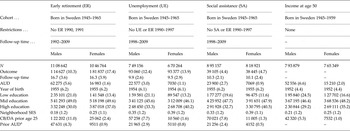
For examining the association between AUD registration and subsequent early retirement, unemployment and social assistance, we studied all eligible individuals born in Sweden from 1945–1965. For income, our cohort ended in 1959. As outlined in Table 1, sample sizes in males and females ranged from 6 70 000 to 1.1 million. Across the cohorts, AUD was three to four times more common in men than women. Note that compared to the unemployment and social assistance cohorts, the early retirement cohort has the least restrictions, the largest sample size and the highest rates of AUD. This is because the restrictions added to the unemployment and social assistance cohorts resulted in reduced rates of AUD. The income cohort is the oldest and has the highest rates of AUD.
Descriptive features of the cohorts used for the examination of the association between AUD and four measures of psychosocial dysfunction: early retirement, unemployment, social assistance, and individual income at age 50

AUD, Alcohol use disorder; SES, socioeconomic status; CB, criminal behavior; DA, drug abuse.
Numbers (%) for outcome, AUD, educational status, CB/DA prior to age 25, and prior AUD and mean (s.d.) for follow-up time, year of birth, neighborhood SES.
a Prior to 1997 for social assistance and unemployment; 1991 for early retirement.
Using individuals included in all four samples, we examined correlations between our four outcomes. Associations of early retirement, unemployment and social assistance were modest and positive in both sexes, largely from +0.10 to +0.25. All three of these outcomes were modestly and negatively associated with income at age 50, with correlations ranging, across sexes, from −0.10 to −0.25.
Results of Cox proportional hazard and regression models
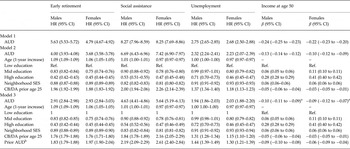
We fitted three models for the prediction of early retirement, unemployment, social assistance, and income (Table 2). In model 1, we examined the raw hazard ratio (HR) (with 95% CIs) for our first three outcomes as predicted from a registration for AUD during the follow-up period. In males, an AUD diagnosis most strongly predicted social assistance (HR 8.27, 95% CI 7.96–8.59), followed by early retirement (HR 5.63, 95% CI 5.53–5.72) and unemployment (HR 2.75, 95% CI 2.65–2.85). The results were similar in females: social assistance (HR 8.25, 95% CI 7.69–8.86); early retirement (HR 4.79, 95% CI 4.67–4.92) and unemployment (HR 2.68, 95% CI 2.50–2.88). For income at age 50, we used standardized regression and a history of AUD from ages 40–50, which was associated with a decrease in income between a quarter and a fifth of a s.d. in both males (HR −0.24, 95% CI −0.25 to −0.23) and females (HR −0.22, 95% CI −0.23 to −0.20).
The results of Cox proportional hazard and regression models describing the association between registration for AUD and subsequent risk for early retirement, unemployment, social assistance, and low individual income at age 50

HR, Hazard ratio; CI, confidence interval; AUD, alcohol use disorder; CB, criminal behavior; DA, drug abuse.
a AUD registration during ages 40–50.
b Prior to 1997 for social assistance and unemployment; 1991 for early retirement; for income at age 50 it represents prior to age 40.
In model 2, we add four covariates to the model: age, parental education, neighborhood social deprivation, and prior externalizing behaviors. These potential confounders had the largest impact on the association between AUD and income, the least on social assistance, and modest effects on early retirement and unemployment.
Model 3 is identical to model 2 with the addition of a dummy variable for prior history of AUD before the follow-up period for early retirement, unemployment and social assistance, and before age 40 for income. The results of this model determine the degree to which the prediction of these psychosocial outcome variables resulted from the actual occurrence of AUD within the follow-up period, v. AUD registrations prior to this time. In each case, the occurrence of AUD during the follow-up was more predictive than a prior history, but prior history of AUD was also independently associated with the psychosocial outcome.
Co-relative analyses
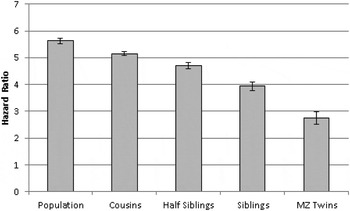
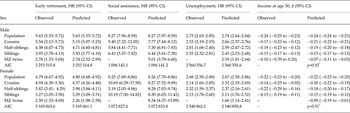
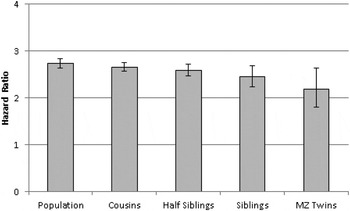
Our co-relative analyses (Table 3) examined the raw HRs, i.e. model 1 above. The association between AUD and early retirement attenuated substantially in both males and females in the expected order, with HRs highest in the general population and declining in discordant cousins, half-siblings, siblings and MZ twins. In both sexes, the observed HR in MZ twins was nearly 50% of that observed in the general population, consistent with strong effects of familial confounders. When we fit our genetic co-relative model to these results, the AIC improved in both sexes and produced predicted results very similar to those observed. We illustrate these effects for males in Fig. 1.
The estimated hazard ratio (± 95% confidence intervals) for early retirement in males as a function of registration for alcohol use disorder in the general population and in discordant cousins, half-siblings, full-siblings and monozygotic (MZ) twins. For the method of estimation, see the methods section. The relatively large decline in the association with increasing closeness of relatives suggests substantial familial confounding of the association.

The Association in the general population and Pairs of discordant relatives between alcohol use disorder and early retirement, unemployment, social assistance, and individual income at age 50 as observed in our data and predicted from our genetic co-relative model social/occupational

HR, Hazard ratio; CI, confidence interval; AIC, Akaike's Information Criterion.
* p value from the extra sum-of-squares F test.
The association between AUD and risk for future social assistance attenuated moderately in males in discordant pairs of relatives with increasing genetic and environmental sharing. The pattern of results was not entirely congruent with genetic expectations in males, and we were unable to obtain sufficient discordant MZ twins to estimate results in either sex. Nonetheless, our genetic model fitted well in males and predicted a HR in MZ twins of about 60% of that observed in the general population. The results in females were difficult to interpret, as the HRs varied widely in the various discordant relative pairs. The genetic model, as expected, fit poorly. While the resulting estimates suggested no familial confounding, it is difficult to be confident in these findings.
The association between AUD and risk for unemployment attenuated modestly in males, although again not entirely in the order predicted from genetic theory. As with social assistance, sample size was too small to obtain stable estimates in discordant MZ twin pairs. Nonetheless, our genetic model fitted well and predicted a HR in MZ twins of 80% of that observed in the general population (Fig. 2). In females, somewhat more attenuation was observed, and only the discordant cousins produced results out of keeping with prediction. The genetic model fit well and predicted a HR in discordant MZ twins of around 60% of that observed in the general population.
The estimated hazard ratio (± 95% confidence intervals) for unemployment in males as a function of registration for alcohol use disorder in the general population and in discordant cousins, half-siblings, full-siblings and monozygotic (MZ) twins. For the method of estimation, see the methods section. The small decline in the association with increasing closeness of relatives suggests only modest familial confounding of the association.

Finally, in examining the association between income and risk for AUD, we again could not obtain stable estimates in MZ pairs. However, in the other groups of relatives in males, we saw evidence for rather substantial attenuation of the association that was relatively orderly across relative classes. Our genetic model fitted well and produced a beta estimate in discordant MZ twins only around 30% of that observed in the general population. The results were broadly similar in females, although the estimates in the different classes of relatives were more variable. Again, the genetic co-relative model fitted well and predicted a beta in discordant MZ twins around 40% of that observed in the general population.
Discussion
The goal of this report was to clarify the magnitude and causes of the downward social ‘drift’ associated with AUD. Using Swedish national registries, we examined the association between AUD and four measures of psychosocial dysfunction: early retirement, unemployment, social assistance, and personal income. We found, using large, longitudinal population-based cohorts, that AUD strongly predicted social assistance and early retirement in both sexes, with HRs ranging from 4.8 to 8.3. The association between AUD and unemployment was more modest (HRs ~2.7). A registration for AUD was associated with between a fifth and a quarter of a s.d. decrease in income at age 50. Our findings are consistent with those of Alm (Reference Alm2015), who documented profound impacts of early drug abuse on mid-life social exclusion – including reduced income, unemployment and receipt of social welfare – in the Stockholm Birth Cohort Study, although we did not see evidence of the gender differences she observed.
We then used two complementary methods to clarify the causes of the relationship between AUD and psychosocial dysfunction: adding confounders to our regression models and using an extended co-relative control design. The addition of putative confounders produced variable results across our four outcomes. The strongest attenuation was seen in the association with income, the least with social assistance (which was assessed on the family level), and intermediate effects on early retirement and unemployment. These results suggest that the distribution of causal and confounding influences on the association with AUD likely differs across our outcomes. This may partly be due to the Swedish social welfare context, in that early retirement and unemployment benefits are targeted to people with long-term conditions such as AUD that reduce their participation in social institutions such as work (Room et al. Reference Room, Palm, Romelsjö, Stenius, Storbjörk and Storbjörk2006). We also found that history of AUD prior to the follow-up period for our study was independently associated with each of these psychosocial outcomes above and beyond the impact of more proximal registrations for AUD, which speaks to the ongoing impact of AUD throughout adulthood on economic integration and social functioning.
Our co-relative analyses also produced variable results. For one of them, social assistance in females, the findings – although suggestive of little to no familial confounding – were very hard to interpret as our genetic model fitted poorly. This was not the case for any of the other models, despite observed results not always fitting perfectly with expectations. Congruent with the multiple regression results, we saw the strongest evidence for familial confounding with income. The risk for early retirement in discordant close relatives, especially MZ twins, were also considerably attenuated. For social assistance and unemployment, the attenuation present for both sexes was more modest in magnitude.
These results argue against two extreme hypotheses – that the association between AUD and subsequent social dysfunction is (i) entirely the result of causal effects or (ii) arises solely from confounding factors. Rather, our findings suggest a more nuanced picture – that the associations observed at the population level arise, to varying extents, from at least two distinct processes. Our results are consistent with the hypothesis that AUD has a causal impact on the risk for early retirement, unemployment, low personal income, and necessity of social assistance, thus providing strong support for the drift hypothesis. Evidence in favor of this hypothesis includes substantial associations between AUD and the social status outcomes after addition of key confounding variables to our multiple regression, including AUD prior to the study period (which also had independent effects on social dysfunction later in life). Even more powerfully, in MZ twins discordant for AUD, the affected twin had significantly higher risks for early retirement, unemployment and social assistance, as well as lower income, than the unaffected twin.
It is notable that these findings emerged even in the Swedish context, with the strong tradition of publicly funded mental health and substance abuse treatment that emphasizes care for socially marginalized groups (Stenius et al. Reference Stenius, Witbrodt, Engdahl and Weisner2010). In the Swedish system, social assistance and other forms of social welfare support are considered a part of treatment for AUD, with many people passing through the medical portion of treatment (which includes detoxification and acute care) into the social welfare sector for the remainder of the ‘rehabilitation’ process, which is dedicated to helping drinkers get back into the workforce and fulfill family and other social roles (Room et al. Reference Room, Palm, Romelsjö, Stenius, Storbjörk and Storbjörk2006). Despite this comprehensive treatment approach, there still were significant differences in long-term income and workforce participation for patients with AUD, which suggest that, in addition to temporary social welfare and income support, additional services are needed to help facilitate the integration of persons with AUD into society after medical treatment (Stenius, Reference Stenius2015). We also note that our income analysis examined earnings at age 50, which suggests interventions targeted to people who develop AUD in early and middle-adulthood may be particularly beneficial for improving social integration. In other policy contexts, such as the United States, ancillary support services (wraparound care) are warranted to address the long-term negative impacts of AUD that are not addressed by traditional inpatient or outpatient treatment for AUD.
Our findings also argue that a portion of the population association between AUD and our measures of social dysfunction is not causal but rather due to confounders. Our evidence for this is a clear diminution in the observed association when (i) key confounders were added to our regression analyses and (ii) when the association was observed in discordant pairs of relatives of increasing genetic and environmental proximity. These findings parallel those of McVicar and colleagues (McVicar et al. Reference McVicar, Moschion and van Ours2015), who observed high levels of confounding of the relationships between substance abuse and homelessness in a longitudinal study of Australians at high risk for homelessness. Thus, our results offer a strong case for the role of both familial/genetic and social factors in the association between AUD and social dysfunction.
Limitations
These results should be interpreted in the context of two potentially important methodological limitations. First, these results are specific to Sweden which has a social system relatively different from that found in the United States and a number of European countries. Furthermore, among European countries, Sweden shares with Finland and Russia a relatively distinctive drinking pattern characterized by intoxication-oriented drinking with large quantities often consumed per occasion (Leifman, Reference Leifman2002). The degree to which our findings would extrapolate to other countries remains to be seen.
Second, we detected subjects with AUD from medical, legal and pharmacy records. This method has the major advantage of not requiring respondent cooperation or accurate recall and reporting. However, it cannot be expected to entirely replicate findings that would emerge from an interview-based epidemiological survey. By that standard, it is certain that our approach would produce both false-negative and false-positive diagnoses. Given that the population prevalence of AUD in this sample is lower than estimates from epidemiologic surveys (Kessler et al. Reference Kessler, McGonagle, Zhao, Nelson, Hughes, Eshleman, Wittchen and Kendler1994; Grant et al. Reference Grant, Goldstein, Saha, Chou, Jung, Zhang, Pickering, Ruan, Smith, Huang and Hasin2015) including one from nearby Norway (which estimated lifetime prevalence for AUD at 13.2% and 5.2% in males and females, respectively) (Kringlen et al. Reference Kringlen, Torgersen and Cramer2001), false-negative diagnoses are likely more common than false-positive ones. Additional survey studies in Sweden also suggest that – as in other countries with voluntary treatment for alcohol and drug use disorders – there is a subgroup of heavy drinkers who may never enter treatment despite significant alcohol-related problems (Storbjork & Room, Reference Storbjork and Room2008). Compared to those identified in epidemiologic surveys, the cases of AUD that we studied are likely to be more severe. The best available validation for our definition of illness is the high rates of concordance for registration observed across our different ascertainment methods (Kendler et al. Reference Kendler, Ji, Edwards, Ohlsson, Sundquist and Sundquist2015).
Conclusions
In a Swedish national sample, AUD registration robustly predicted a range of measures of psychosocial dysfunction. Using the methods of multiple regression with specified confounders and co-relative analyses, our results suggested that the bulk of these associations are likely causal and reflect a negative effect of AUD on social and economic functioning. However, both methods also show that an appreciable proportion of these associations arise from confounding variables which both increase risk for AUD and decrease social and economic competence. Unless these influences are corrected for, investigators are at risk for overestimating the impact of AUD on psychosocial functioning.
Supplementary material
For supplementary material accompanying this paper visit https://doi.org/10.1017/S0033291716003032.
Acknowledgements
This project was supported by grants R01AA023534 from the National Institute of Alcohol Abuse and Alcoholism, the Swedish Research Council (K2012-70X-15428-08-3), the Swedish Research Council for Health, Working Life and Welfare (In Swedish: Forte; Reg. no. 2013-1836), the Swedish Research Council (2012-2378; 2014-10134) and FORTE (2014-0804) as well as ALF funding from Region Skåne awarded.
Declaration of Interest
None.