1. Introduction
Public policies on genetically modified organisms (GMO) differ strongly across countries and regions, resulting in a market fragmentation that currently challenges the international trading regime (Isaac et al., Reference Isaac, Perdikis and Kerr2004). Several authors have pointed out that the stringency of GMO regulations of important agri-food importers like the European Union (EU) and Japan, in contraposition with the ‘soft’ GMO regulations of exporters like the US and Argentina, can represent a serious problem for developing countries’ strategies in deciding GMO production and regulation (e.g. Tothova and Oehmke, Reference Tothova and Oehmke2004; Anderson and Jackson, Reference Anderson and Jackson2004; Anderson, Reference Anderson2010). Indeed, while the potential gains from GMO adoption appear particularly high for several Asian and African countries (Huang et al., Reference Huang, Hu, Van Mejil and Van Tongeren2004; Anderson, Reference Anderson, Just, Alston and Zilberman2005; Smale et al., Reference Smale, Zambrano, Gruère, Falck-Zepeda, Matuschke, Horna, Nagarajan, Yrremaredy and Jones2009; Gruère et al., Reference Gruère, Carter and Farzin2009a), developing countries also face the potential loss of access to rich markets with strong consumer opposition to GMOs.
Formal evidence on the trade effects of GMO regulations is rare and often inconclusive. Empirically investigating this issue is difficult, because there are no comparable measures of GMO standards. Thus, the first aim of this paper is to create such a measure. Specifically, the paper develops a composite index on the stringency of GMO regulations for a sample of sixty countries. We use this index to study how similarity/dissimilarity in GMO regulations affects bilateral trade flows. The composite nature of our index allow us to analyze both the overall trade effect of the GMO regulation, as well as the partial effects induced by each component of the GMO regulation, like the approval process, labeling, and so on.
The paper adds to the existing literature in three ways. First, we study the trade effect of GMO regulations using an ‘objective’ multidimensional index of GMO standards and its components, in order to shed light on the regulatory dimensions that matter most for trade flows. Thus, we depart from the standard approach of using simple dummy variables to capture the trade effect of GMO regulation as, for example, in Disdier and Fontagnè (Reference Disdier and Fontagné2010).Footnote 1 Second, we focus on harmonization or differences in standards instead of on the more traditional question of the trade reduction effect induced by the stringency in GMO regulations. Indeed, we try to answer a slightly different question: how much does similarity/dissimilarity in GMO regulation between exporting and importing countries affect bilateral trade in GMO related products? This question appears to be more relevant in understanding the actual effect of GMO regulations or standards in general.
Our final contribution is an attempt to account for potential bias induced by the endogeneity of GMO standards to trade flows, an issue mostly ignored in existing empirical studies.Footnote 2 Indeed, political economy studies (see Anderson and Jackson, Reference Anderson and Jackson2004; Gruère et al., Reference Gruère, Carter and Farzin2009a; Swinnen and Vandemoortele, Reference Swinnen and Vandemoortele2011) suggest that GMO regulations are endogenous to trade flows.
This paper is related to several other studies. Particularly relevant for our analysis are the studies of Cadot et al. (Reference Cadot, Suwa-Eisenmann and Traça2001), Parcell and Kalaitzandonakes (Reference Parcell and Kalaitzandonakes2004), Disdier and Fontagné (Reference Disdier and Fontagné2010), Tothova and Oehmke (Reference Tothova and Oehmke2004), Veyssiere (Reference Veyssiere2007), and Gruère et al. (Reference Gruère, Carter and Farzin2009a).Footnote 3 Cadot et al. (Reference Cadot, Suwa-Eisenmann and Traça2001) find that the ‘regulatory protectionism’ aspect of the EU GMO regulation has no repercussions on US exports of corn seeds, but has a negative effect on other forms of corn. Downstream traders’ and food retailers’ private decisions not to purchase GM products were more important than cultivation bans. Parcell and Kalaitzandonakes (Reference Parcell and Kalaitzandonakes2004) did not find any relevant effect on future prices after major food companies announced a voluntary ban on purchasing GM crops. More recently, Disdier and Fontagné (Reference Disdier and Fontagné2010) used a gravity equation to estimate the effects of the EU de facto moratorium on GMOs. They show that the EU moratorium, as well as other European GMO standards, has negative trade effects on the exporting countries.
Tothova and Oehmke (Reference Tothova and Oehmke2004) develop a Krugman-style trade model to study the endogenous choice of different countries in setting GMO standards, showing the formation of ‘clubs’ of countries that share similar GMO regulations. These ‘clubs’ act as sub-global preferential trading agreements. Their model suggests the formation of two trading blocs: one in favor, the other against GMOs. In between, there emerges a third group of countries that face a choice between lower production costs (through the adoption of GM crops) and the maintenance of an export market by restricting GMO production. Veyssiere (Reference Veyssiere2007), also studied the dilemma faced by exporting countries, that is whether or not to approve GM products, and found that GM product approval is optimal under a labeling regime, whereas non-approval is optimal in the absence of mandatory labeling. Finally, Gruère et al. (Reference Gruère, Carter and Farzin2009a) adopt a political economy approach to evaluate the importance of socio-economic factors in the selection of GM labeling regulations. They show, both theoretically and empirically, that production and trade interests play an important role in GM labeling choices. In particular, in developing countries, regional influences and trade factors may be more important than domestic consumer preferences or anti-GMO campaigns. Clearly, these studies suggest that GMO regulations are potentially endogenous to trade flows.
Our paper is also related to an emerging literature showing that harmonization of standards is important for international trade. For example, de Frahan and Vancauteren (Reference de Frahan and Vancauteren2006), Moenius (Reference Moenius2006), Czubala et al. (Reference Czubala, Shepherd and Wilson2009), and Shepherd (Reference Shepherd2007) find that international standards have a smaller impact on trade than unilateral standards. Indeed, harmonization may limit costs thanks to the substitution of multiple national or regional standards with a single unified international standard. Moreover, if the domestic standard is similar to the foreign one, producers have already coped with the cost of compliance and export costs are lower.
The organization of the paper is as follows. Section (2) explains how we constructed the GMO regulatory index. Section (3) presents the empirical model and discusses the data and the countries used in the empirical exercise. Section (4) presents and discusses the econometric results. Finally, Section (5) provides conclusions and implications.
2. An index of GMO regulation
2.1 Sample, data, and computational strategyFootnote 4
We create a GMO regulation index for 60 countries for which it was possible to collect information on laws and acts regulating GMO cultivation and commercialization. We collected information on GMO regulations until June 2008. The index thus reflects GMO regulations in place in 2007, or before. However, it is important to keep in mind that, especially for developing countries, there could be significant delays in the enforcement of the regulations, due to political and technical reasons. This may cause a slightly upward bias of the index for some developing countries.
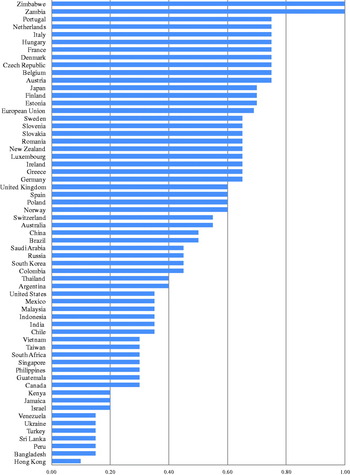
The criteria for the countries selection was the availability of information on laws and acts on GMO cultivation and commercialization. Figure 1 gives the full list of the considered countries. The main information source used to classify the GMO regulations are the Global Agriculture Information Network (GAIN) reports on biotechnology provided by the Foreign Agricultural Service (FAS) of the United States Department of Agriculture (USDA). For missing information, we referred to official national acts and reports.
GMO regulatory index score and ranking

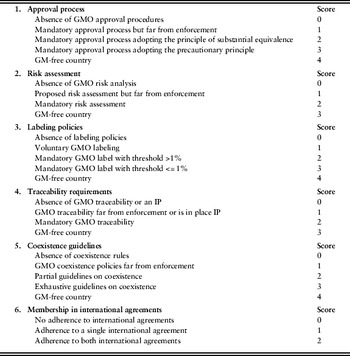
The country sample includes most of the OECD members and non-OECD important exporters of agricultural products The countries in the sample produce more than 80%, 95%, 60%, and 66% of global maize, soybean, rapeseed, and cotton, respectively.Footnote 5 Six different components of the GMO regulation were considered, namely approval process, risk assessment, labeling, traceability, coexistence, and membership in international GMO agreements. Each component was scored with values ranging from 0 (first condition) to the total number of sub-components identified for each category (see Table 1). Higher scores correspond to more restrictive regulations. For those countries that declare themselves ‘GM-free’ (e.g. Zambia and Zimbabwe), meaning that no GM products can be domestically cultivated or introduced, we assigned the highest score. In contrast, the lower score is assigned where no rules have been adopted. For the approval process, the restrictiveness increases with the adoption of the precautionary principle rather than the principle of substantial equivalence. For example, the approval process of the US follows the principle of substantial equivalence, while EU Members adopt the precautionary principle. The restrictiveness of the risk assessment has been evaluated on the degree of its implementation. Only a few countries do not have rules for risk assessment (e.g. Bangladesh and Ukraine), while the countries with risk assessment rules, but not yet enforced, are mainly developing countries (e.g. Kenya, Peru, and Sri Lanka). The labeling restrictiveness captures voluntary versus mandatory, as well as the threshold level. For example, labeling restrictiveness increases from countries such as India and Bangladesh where there are no enforced GMO labels, over countries with voluntary labeling (Argentina, Canada, and US), to countries with mandatory labeling with a threshold higher than 1% (e.g. Japan, Korea, and Russia) or equal or lower than 1% (EU Members). With respect to traceability, the score increases from identity preservation (IP) to traceability, given the greater complexity and the higher compliance costs of the latter. Many exporter countries do not have any GMO traceability requirements (e.g. Argentina, China, Hong Kong, and India) or only IP (e.g. Australia and US). In contrast, GMO traceability is compulsory in many importers (e.g. EU Members and Japan). In our scoring method, the coexistence burden increases with the complexity of the requirements in national guidelines. Most of the countries in the sample do not have coexistence rules (e.g. Brazil, Canada, China), others have partial (Argentina, Finland, New Zealand) or comprehensive (Japan and EU) coexistence guidelines.
Categories, conditions and scores of the GMO regulatory index

Note: See text.
The international regulatory framework starts at World Trade Organization (WTO) level, where GMO standards fall under the Sanitary and Phytosanitary (SPS) agreement that aims to reduce the protectionist bias of food standards in general. Given the specificity of GMO products, two more GMO specific international agreements are considered in the category ‘membership in international GMO agreements’, namely the Cartagena Protocol and the Codex Alimentarius (see the Web-appendix for details). In this category, the score increases with the number of agreements to which the country subscribed. Note that only Hong Kong and Taiwan are not members of either of the agreements, while all the other countries are members of at least one agreement.
Some categories are strongly related to each other. For example, in many regulations an approval process cannot be conducted without a product risk assessment. However, this logic does not systematically apply to the GMO standards context. An analysis of the regulation of the 60 countries suggests many unexpected and ambiguous stages of implementation. For example, there are countries with a voluntary labeling regime but with no required traceability or segregation system (e.g. Canada).
The final GMO index is obtained by the summation of scores of each category and, after normalization, has a value between 0 and 1, where higher values indicate a more restrictive regulation on GMO production, commercialization, and trade.Footnote 6
An overview of the GMO index ranking and score is given in Figure 1. Several interesting patterns emerge. First, as expected, the index documents the well-known polarization between the US and the EU. The former has a GMO regulatory index of 0.35, which contrasts with the EU average of 0.69. Secondly, with the exception of GM-free countries, developing countries tend to be in the low part of the ranking. All the considered EU countries, as well as Asian food importers such as Japan (but not South Korea), display a high GMO index. However, it is interesting to note that also within the EU there exist some differences in the GMO rules.Footnote 7 For example, the highest score of 0.75 was found in Austria and Italy that have imposed a ban on the cultivation of EU approved GMO maize. Spain and Germany have significantly lower scores, equal to 0.60 and 0.65, respectively.
Stringent regulations generally require more costly procedures for exporters, and comprehensive policies can have a greater trade effect. It is assumed that approval procedures are fixed costs, while traceability and labeling are variable costs, influencing present and future GM and non-GM crop exports (see Gruère, Reference Gruère2006).
3. GMO standards and international trade
3.1 Empirical model and estimation strategy
In this section, we present our strategy in assessing the potential trade effect of GMO regulations. The bilateral trade equation is derived from the standard constant elasticity of substitution (CES) monopolistic competition trade model, with increasing returns to scale and iceberg trade costs, introduced by Krugman (Reference Krugman1980). In the empirical version of the model, the bilateral trade flow from j to i in product k (M ijk) can be summarized by the following log-linear bilateral trade equation:

where λ j and χ i are the exporter and importer fixed effects controlling for the size terms as well as for unobserved number of varieties (firms) and price terms of the exporter, and for expenditure and unobserved price terms of the importer, respectively. D ij is the transport cost proxied by distance between i and j, while τ ijk is the ad valorem bilateral tariff on product k. Zij is a vector of any other bilateral trade cost different from distance and tariffs and, finally, u ijk is an error term. The parameters β 1,β 2, and Ω are the coefficients to be estimated.
We augment this basic gravity equation by introducing a variable measuring bilateral differences in GMO regulations in the vector of other trade costs, Zij. We computed two different GMO bilateral variables. The first is obtained by taking the absolute deviation of the GMO index across country pairs, namely GMO ij=|GMO i– GMOj|. An advantage of this bilateral measure, other than its simplicity and its transparency, is that it is easily computable for each regulatory component. The GMO ij bilateral index increases in the level of dissimilarity (or distance) in GMO regulations across country pairs or, put differently, it represents an inverse index of ‘harmonization’ in GMO regulations.
In order to test the robustness of our findings, we also used a second index called GMOw ij, following Anderson (Reference Anderson2009) and Jaffe (Reference Jaffe1986). This second index can be defined as follows:

where f im (f jm) is the ratio between the regulatory component score attributed to country i (j) on the highest score assigned to the component m. This allows a degree of bilateral regulatory ‘closeness’ between two countries, ranging between 0 (completely different) and 1 (identical regulation). Jaffe (Reference Jaffe1989) indicates that the proximity measure is 0 for countries whose vectors are orthogonal and 1 for countries whose position vectors are identical.Footnote 8 Finally, note that, given the definition of our bilateral variables, they should display opposite coefficient signs in the regression results, GMOw ij being a similarity index, while GMO ij is a dissimilarity index. Indeed, the correlation coefficient between them is negative and equal to −0.60.
With regard to the estimation method, as equation (1) is applied to disaggregated trade data (our regressions are always run at the HS 6-digit level) the first problem is the large number of zero bilateral trade flows. One of the most common methods to deal with zero trade is the Heckman (Reference Heckman1979) two stage selection correction: (i) a Probit equation where all trade flows determinants are regressed on the indicator variable, T ij, equal to 1 when j exports to i and 0 otherwise; (ii) an OLS second-stage with the same regressors as the Probit equation, plus the inverse Mills ratio from the first stage, correcting for the bias generated by the sample selection problem. Following the modification suggested in Helpman et al. (Reference Helpman, Melitz and Rubinstein2008) and supported by Martin and Pham (Reference Martin and Pham2008), we omitted an independent variable associated with the fixed trade costs in the second OLS stage.Footnote 9 Furthermore, to check for robustness of the Heckman selection procedure, we used a modified Poisson fixed-effects estimation, namely the zero-inflated negative binomial model (ZINB), which accounts for the possible bias created by the logarithmic transformation (Jensen's inequality) and the failure of the homoskedasticity assumption.Footnote 10
Moreover, as in previous studies (i.e. Disdier and Fontagné, Reference Disdier and Fontagné2010), we face an identification problem, because it is not possible to distinguish between GMO and non-GMO traded products. As a consequence, a reduction in trade flows can only partially be attributed to GMO regulations. In order to deal with this issue, in the specification of the gravity equation we consider also other potential determinants of trade flows different from GMO standards, such as tariffs. The inclusion of bilateral tariffs in the trade cost function is important because, if our bilateral GMO index is positively correlated to bilateral tariffs, then omitting tariffs can result in an overestimation of the GMO effect on trade flows.Footnote 11
Finally, as discussed in the introduction, a relevant concern about the estimation strategy of the gravity equation (1) is related to the possibility that GMO regulations are endogenous to trade flows. For this reason, in the empirical analysis we also check the robustness of our main findings for possible bias due to the endogeneity of GMO standards.
3.2 Data
To study the effect of GMO standards on trade flows we consider the trade data of three major potential GM products: maize, soybean, and rapeseed, for both human and animal consumption. We also include cotton products related to the agri-food channel, in particular seeds, oils, and cake for animal fodder or as feed ingredients. Trade data come from the Commodity Trade database of the United Nations Statistical Division (UN-COMTRADE). We work at the 6-digit level of the 2002 Harmonized System (HS 2002) classification. Because it is not possible to distinguish between GMO and non-GMO products, we consider those products recognized in the literature as potentially genetically modified.
In the empirical analysis, we start considering all the HS 6-digit headings related to the four potential GMO products taken together, in order to assess the overall impact of the GMO standards on trade. Second, we also consider each group of products separately, in order to distinguish specific regulatory effects on maize, soybean, rapeseed, and cotton. The four groups of HS 6-digit headings are called, for simplicity, Maize, Soybean, Rapeseed, and Cotton.Footnote 12
The country sample is selected using the following rules. First, we considered importing and exporting countries covered by our GMO index. Next, in order to ensure the presence of bilateral trade flow, we checked that all the exporting countries are exporters and/or producers of at least one of the four products considered. Production data comes from FAOSTAT.
The time period considered covers the average trade flows over three years: 2005, 2006, and 2007.Footnote 13 Despite the GMO adoption started in the late nineties, it is only in recent years that we have witnessed an acceleration of the diffusion of GMO regulation. This can be attributed not only to the growing amount of GMOs traded, but also to the international trade controversy that has led to the definition of GMO import and export rules.
Finally, regarding the other standard covariates used in the gravity equation, like distance, and dummies for other trade costs (contiguity, language, and colony) they are taken from CEPII (Centre d'Etudes Prospectives et d'Informations Internationales). Differently, bilateral tariffs are obtained from the MAcMap database (Bouët et al., Reference Bouët, Decreux, Fontagné, Jean and Laborde2008) jointly developed by ITC (UNCTAD and WTO, Geneva) and CEPII (Paris). MAcMap includes ad-valorem, as well as specific components of each bilateral tariff line at the HS 6-digit level. Thus no tariff aggregation was needed in the empirical model. Moreover, the original methodology used by the MAcMap database to aggregate tariffs (a weighting scheme based on reference group of countries) limits the extent of the endogeneity bias of tariffs.
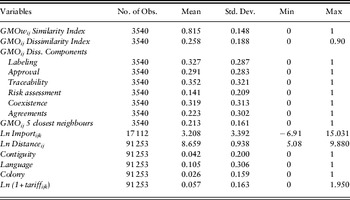
Table 2 provides summary statistics of variables used in the empirical model.
Summary statistics of variables used in the gravity equation

Notes: because the GMO regulatory index does not vary across products, the number of observations refer only to 60*59=3540 bilateral countries observations. Observations related to Ln Import refer only to positive trade. See text for variables explanation.
4. Results
In this section, the results of the econometric estimation of equation (1) are reported and discussed. First we focus on the assumption that the two GMO bilateral variables are exogenous. Then we check the robustness of the results by considering the potential endogeneity.Footnote 14
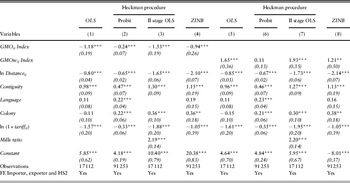
Table 3 reports results pooling the data across the four groups of products and considering four different estimators: a simple OLS on positive trade, the first stage Probit of the Heckman selection procedure and its second OLS stage and, finally, the ZINB estimator. Starting from standard gravity covariates, the distance coefficient is always negative and significant. The common border and colony dummies are positive and significant, with the exception of colony in the OLS specification where it has a negative, but not significant, effect. As expected, bilateral tariffs have a negative and significant effect on bilateral trade flows. If we give a structural interpretation to the tariff coefficient, equal to (1 – σ) with σ >1 representing the elasticity of substitution between varieties, then we have an estimate of such elasticity. Its average value, around 3, is of the same order of magnitude as recent estimates reported by Raimondi and Olper (Reference Raimondi and Olper2011).
GMO regulation and trade: regression results

Notes: In parentheses robust standard errors clustered within importing–exporting countries. ***, ** and * indicate significance level at 1%, 5% and 10%, respectively. Each regression includes fixed effects for importers, exporters and HS 2-digit products. In the ZINB regressions of column (4) and (8), the over-dispersion test (alpha value) is 18.36 and 18.33 respectively, both significant at 1%; differently, for the Vuong Test the z-score is 32.23 and 32.42, respectively.
Moving to the variable of interest, columns 1 to 4 consider the dissimilarity index, GMO ij. Across all estimators, it has a negative and strongly significant coefficient (p-value <0.01).Footnote 15 Because the index measures the distance in GMO regulations across countries, a negative coefficient means that bilateral trade flow is increasing in the similarity of GMO regulation. The (absolute) magnitude of the estimated effect increases from 1.18 to 1.53 on passing from the OLS to the II stage Heckman, suggesting that selection bias can be a problem, a conclusion confirmed by the high significant level of the Mills ratio. It is interesting to note that also the GMO ij coefficient of the first stage Probit regression is significantly negative (see Column 2), suggesting that distance in the GMO regulation negatively affects also the probability of positive trade, namely its extensive margin.
In order to check for robustness in the Heckman procedure for the treatment of zeros, column (4) reports the ZINB estimator, validated by the over-dispersion and Vuong tests.Footnote 16 Once again the effect is negative and strongly significant. However, the estimated coefficient is lower in magnitude.
Columns 5 to 8 run the same specifications but using the similarity index, GMOw ij. The results are very similar, suggesting that the findings are robust to the choice of the bilateral index. The difference, as expected, is the opposite (positive) sign of the estimated coefficient, as now we are measuring similarity in GMO regulation. Yet, it is also worth noting that by using GMOw ij the first stage Probit effect is, as expected, positive, but not significant.
To put the estimates into perspective, and using our preferred specification (Column 3 of Table 3), the magnitude of the estimated coefficient implies that a one standard deviation decrease in the GMO dissimilarity index (=0.188), which means an increase in regulatory closeness, increases exports of about 33%, all else remaining equal. This effect approximately corresponds to a change in GMO ij from the value of France−Chile (=0.40) to that of France−Switzerland (=0.20). Thus the effect is not only statistically significant but appears also relevant from an economic point of view.
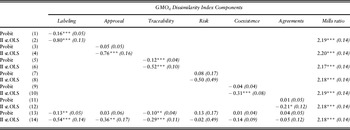
Table 4 investigates which GMO regulatory component matters the most considering both the probability of positive trade (extensive margin) and the volume of trade (intensive margin). In line with the results of Table 3, all GMO components exert a negative effect on the volume of trade, and most of them are statistically significant at the 1% level, with the exclusion of international agreements that are barely significant, and the risk assessment that is not significant. Interestingly, considering the first stage Probit, and thus the probability to trade, only labeling and traceability significantly affect the extensive trade margin. This result may suggest that these components also act by raising fixed trade costs.
GMO regulation and trade: regressions at regulatory components level

Notes: In parentheses robust standard errors clustered within importing–exporting country. ***, **, and * indicate significance level at 1%, 5%, and 10%, respectively. Figures refer to the first (Probit) and second (OLS) stage of the Heckman regression. Each regression includes all the controls of Table 3, plus country fixed effects for importers, exporters, and HS 2-digit products.
Because regulatory components tend to be positively correlated, we also ran a specification that considers them simultaneously, in order to better disentangle their effect. Results are reported at the bottom of Table 4. Not surprisingly, their estimated coefficients decrease in absolute magnitude. However, the (theoretically) most important dimensions, namely labeling, approval process, and traceability, remain strongly significant. Because each component is normalized to vary from 0 to 1, the results suggest that labeling is the dimension most detrimental to trade, followed by the approval process and traceability. Given this ranking, it is not surprising that GMO labeling has been the major field of conflict across countries in terms of trade policies (Carrau, Reference Carrau2009).
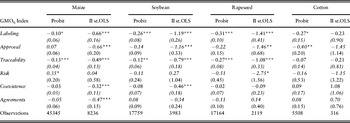
Table 5 investigates the sensitivity of different product groups to the GMO ij index, running regressions for each group separately. The estimated coefficients on the GMO ij are negative for all the groups, but are statistically significant only for corn, soybean, and rapeseed, suggesting that these agricultural commodities are those most affected by GMO regulations. The importance of labeling, approval process, and traceability are also confirmed for these three crops. Coexistence affects only maize and soybean, which are the two most cultivated GM crops worldwide and also the main imported GM products in the EU. Differently, we do not detect significant effects for cotton, possibly because only part of cotton products are considered. Probit regressions at the product level confirm that labeling and traceability are the most important regulatory components affecting the extensive margin of trade.
GMO regulation and trade: regressions at regulatory components and product group level

Notes: In parentheses robust standard errors clustered within importing–exporting country. ***, **, and * indicate significance level at 1%, 5%, and 10%, respectively. Figures refer to the first (Probit) and second (OLS) stage of the Heckman regression. Each regression includes all the controls of Table 3, plus country fixed effects for importer, exporter, and HS 2-digit products.
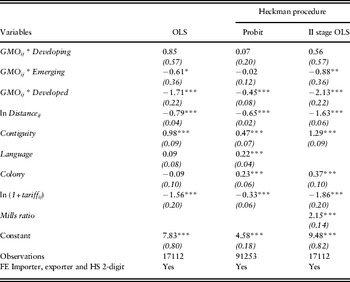
Finally, Table 6 investigates the effects of the GMO regulations for different levels of development, interacting the GMO ij index with three (exporting) dummies for developing, emerging, and developed countries. Results show that the GMO regulations affect especially trade flows from developed countries and, to a lesser extent, from emerging countries. The effect on developing countries’ trade is insignificant. Of course, this is not surprising given the structure of our dataset, where 94% of the exports come from emerging and developed countries.Footnote 17
GMO regulation and trade: different levels of development

Notes: In parentheses robust standard errors clustered within importing–exporting country. ***, **, and * indicate significance level at 1%, 5%, and 10%, respectively. Figures refer to the first (Probit) and second (OLS) stage of the Heckman regression. Each regression includes country fixed effects for importer, exporter, and HS 2-digit products.
In summary, our analysis suggests that cross-country differences in GMO standards significantly affect trade flows. These effects appear largely attributable to labeling, approval, and traceability standards, and are particularly relevant for corn and soybean products. Yet, the trade effect of GMO standards is especially relevant for trade flows from developed and emerging countries, but not from developing countries. The last result, however, should not be interpreted as a general indication that developing countries exports are not affected by GMO regulations. Indeed, developing countries are minor producers and exporters of the main GMO crops considered in this analysis.
4.1 Are GMO regulations endogenous to trade flows?
There are different potential sources of endogeneity in our model. We are especially concerned with endogeneity due to the potential simultaneity bias between GMO regulations and bilateral trade flows, for at least two reasons. First, a growing political economy literature on GMO regulation suggests that GMO standards are affected by the country's trade position and comparative advantage (see Anderson and Jackson, Reference Anderson and Jackson2004; Gruère et al., Reference Gruère, Carter and Farzin2009a; Swinnen and Vandemoortele, Reference Swinnen and Vandemoortele2011; Vigani and Olper, Reference Vigani and Olper2012). Thus, if import and regulation are not modeled to be simultaneously determined, the estimated impact of regulation on imports can be biased downward (see Trefler, Reference Trefler1993). Second, empirical evidence and conceptual models suggest that developing countries have set GMO standards taking into account the trade-off between agronomic advantage and loss of market access in countries where consumers have strong concerns on GMOs (Tothova and Oehmke, Reference Tothova and Oehmke2004; Veyssiere, Reference Veyssiere2007; Gruère et al., Reference Gruère, Carter and Farzin2009a).
Addressing simultaneity in the gravity model is difficult because of the lack of good instruments. In fact, almost all the potential determinants of GMO regulations exert an effect on bilateral trade flows, thus they tend to be weak instruments (see Baier and Bergstrand, Reference Baier and Bergstrand2007). Previous attempts to deal with this kind of endogeneity in gravity models have followed the approach of Lee and Swagel (Reference Lee and Swagel1997) and Trefler (Reference Trefler1993), who used industrial conditions as an instrument for trade policy (see Shepherd, Reference Shepherd2007; Olper and Raimondi, Reference Olper and Raimondi2008). However, when working at the HS 6-digit level, it is impossible to adopt this strategy due to data constraints. An alternative strategy, followed in this paper, is the one proposed by Djankov et al. (Reference Djankov, Freund and Pham2010), who deals with the potential endogeneity of the time to ship goods in a gravity model, using the trade times of neighboring countries as instrument. The intuition is that while trade flows may affect domestic trade times, they are less likely to affect trade times abroad. Following a similar logic, we instrument the GMO index by using the weighted average GMO indices of the five closest neighbors, using the distance between capitals as a weight.
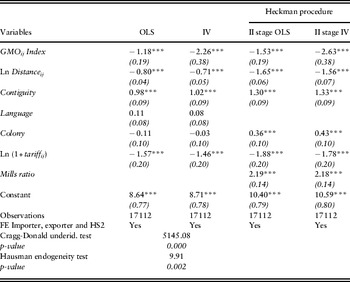
The results of this exercise are shown in Table 7. Columns (1) and (2) report a benchmark OLS and the corresponding IV regression, respectively. We start from these regressions because, as it is well known, an instrumental variable approach can also be used to deal with selection bias problems (see Wooldridge, Reference Wooldridge2002). Interestingly, passing from the OLS to the IV estimator, the coefficient of the GMO ij increases in magnitude from –1.18 to –2.26, and remains strongly significant.Footnote 18 This result means that when the distance in GMO regulations is modeled endogenously, its estimated coefficient is approximately two times larger than the size obtained from treating it exogenously, as the theory of endogenous trade policy predicts.
GMO regulation and trade: IV regressions

Notes: In parentheses robust standard error clustered within importing–exporting country. ***, **, and * indicate significance level at 1%, 5%, and 10%, respectively. In the IV regressions, the GMO ij index is instrumented with the weighted average index of the five closer neighbor countries (see text). The Cragg-Donald under-identification test tests the null hypothesis that the first stage is weakly identified. The critical value for rejection of the hypothesis of weak identification is 16.38 (10% level) as reported in Stock and Yogo (Reference Stock and Yogo2002). The Hausman endogeneity test tests the null hypothesis that the endogenous variable can be treated as exogenous. Each regression includes fixed effects for importers, exporters, and HS 2-digit products.
A formal test for this conclusion is reported at the bottom of the table. The Hausman endogeneity test rejects at the 1% level the hypothesis that the GMO ij index can be treated as exogenous. Moreover, the Cragg-Donald under-identification test is also strongly significant, rejecting the hypothesis of weak identification in the first stage regression (not shown).
Columns 3 and 4 give further support to these results. Indeed, by running an IV second stage Heckman regression, the coefficient of GMO ij once again significantly increases and, as expected, it has an order of magnitude similar to the one obtained without the Heckman selection correction.Footnote 19
Keeping in mind the usual caveats about instruments, these results appear interesting for several reasons. First, they strongly confirm the results of the previous section on the positive effect of GMO standards harmonization on international trade. Second, they confirm that the GMO regulation is endogenous to trade flows, and this is in line with the idea that governments take into account the country trade position in deciding on GMO regulation. Finally, using regression from Column 4 of Table 7, the magnitude of the estimated effect – when GMO regulations are treated endogenously – implies that a one standard deviation decrease in the GMO dissimilarity index (=0.161), increases exports of about 53%, ceteris paribus. This is a relevant effect considering that it is of the same order of magnitude of a full liberalization exercise in the agri-food sector.Footnote 20
5. Summary and conclusion
Motivated by the complex pattern and evolution of GMO regulations in the last decade, this paper quantifies the effect of GMO regulations on bilateral trade flows at the global level. A composite index of such regulations, as well as a score for six GMO regulatory dimensions, was developed for 60 countries. In a second step, we use a gravity model to analyze how bilateral similarity/dissimilarity in GMO regulations affects trade flows for the composite index and its components. There are three main results.
First, countries that have strong differences in their GMO regulations trade significantly less. Thus, what matter for trade flows is the level of harmonization in GMO standards between countries, a result in line with the recent evidence related to other industries (see Czubala et al., Reference Czubala, Shepherd and Wilson2009; Shepherd, Reference Shepherd2007). Second, the regulatory dimension that matters the most is labeling, followed by the approval process and traceability. Not surprisingly, coexistence appears less important from the point of view of trade as it is more related to the field production stage. Third, all these effects are particularly strong for developed and emerging countries. Finally, we found that the endogeneity of GMO regulation to trade flows is potentially important. Taking into account endogeneity, the magnitude of the estimated GMO regulatory effect increases by a factor of 2.
The main policy implication of this study is that a process of global harmonization of GMO standards would have a large positive trade effect, and this is especially true with regard to labeling policies.