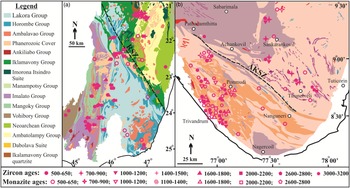
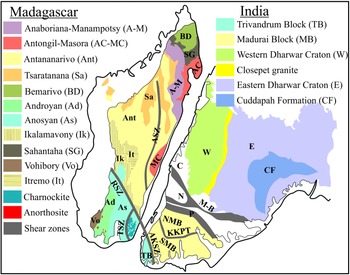
1. Introduction
Granulite-facies rocks provide valuable information about their burial, thermal history, high-grade metamorphism, deep-seated ductile deformation and continental evolution (Bohlen, Reference Bohlen1987; Bohlen & Mezger, Reference Bohlen and Mezger1989; Harley, Reference Harley1989; Brown, Reference Brown1993, Reference Brown2007; Kelsey et al. Reference Kelsey, Clark and Hand2008). These high-grade rocks occur largely at convergent or divergent plate boundaries, especially at subduction–collision or lateral displacement zones (Harley, Reference Harley1989; Brown, Reference Brown1993, Reference Brown2007). Granulite-facies rocks exposed along the southern part of the Indian subcontinent, collectively termed the Southern Granulite Terrane (SGT) (Fig. 1), have been studied extensively over the past decades in order to understand their origin and various processes associated with granulite-facies metamorphism and continental evolution (Santosh et al. Reference Santosh, Yokoyama, Biju-sekhar and Rogers2003; Santosh & Sajeev, Reference Santosh and Sajeev2006; Braun et al. Reference Braun, Cenki-Tok, Paquette and Tiepolo2007; Clark et al. Reference Clark, Collins, Santosh, Taylor and Wade2009, Reference Clark, Healy, Johnson, Collins, Taylor, Santosh and Timms2015; Kooijman et al. Reference Kooijman, Upadhyay, Mezger, Raith, Berndt and Srikantappa2011; Plavsa et al. Reference Plavsa, Collins, Foden, Kropinski, Santosh, Chetty and Clark2012; Collins et al. Reference Collins, Clark and Plavsa2014; Sengupta et al. Reference Sengupta, Raith, Kooijman, Talukdar, Chowdhury, Sanyal, Mezger, Mukhopadhyay, Mazumder and Eriksson2015; Blereau et al. Reference Blereau, Clark, Taylor, Johnson, Fitzsimons and Santosh2016; Li et al. Reference Li, Santosh, Indu, Shaji and Tsunogae2016; Prakash et al. Reference Prakash, Yadav, Tewari, Frimmel, Koglin, Sachan and Yadav2017), yet diverse opinions exist about the crustal evolutionary history of the SGT.
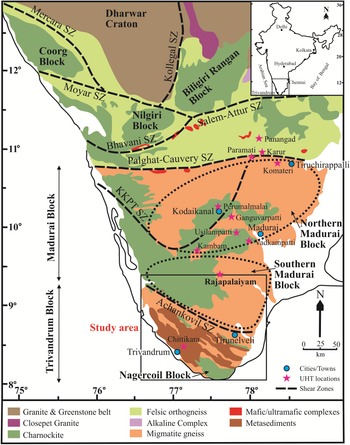
Simplified geological map of Southern Granulite Terrane (SGT) showing different crustal blocks and intervening shear zones (after Praharaj et al. Reference Praharaj, Rekha and Bhattacharya2021). The northern and southern Madurai blocks are demarcated (after Plavsa et al. Reference Plavsa, Collins, Foden, Kropinski, Santosh, Chetty and Clark2012). The inset map (top right) shows the location of the SGT within India. Reported ultrahigh-temperature localities of Trivandrum and Madurai blocks are indicated by filled stars. SZ – Shear zone; KKPT SZ – Karur-Kambarn-Painavu-Trichur shear zone.

The SGT, a collage of several lower crustal blocks separated by numerous shear zones (Fig. 1), preserves the history of generation and break-up of continental crust from Mesoarchean to Cambrian time through subduction–accretion–collision processes across the presently deciphered shear zones (Ellis, Reference Ellis1987; Harley, Reference Harley1989; Brown, Reference Brown1993; Kelsey, Reference Kelsey2008). The southern part of the SGT comprises the Trivandrum Block (TB) to the south and Madurai Block (MB) to the north, separated by the Pan-African Achankovil terrane boundary shear zone (AKSZ) system (Praharaj et al. Reference Praharaj, Rekha and Bhattacharya2021) (Fig. 1). The MB is composed of two distinct geochronological and isotopic domains, namely the northern (NMB) and southern Madurai blocks (SMB) (Plavsa et al. Reference Plavsa, Collins, Foden, Kropinski, Santosh, Chetty and Clark2012; Li et al. Reference Li, Santosh, Indu, Shaji and Tsunogae2016). This study focuses on the more enigmatic SMB and its relationship to the TB across the AKSZ.
Ultra-high temperature (UHT) conditions are well documented from different lithologies of the TB and NMB (Fig. 1) (Nandakumar & Harley, Reference Nandakumar and Harley2000; Sajeev et al. Reference Sajeev, Santosh and Kim2006; Shimizu et al. Reference Shimizu, Tsunogae and Santosh2009; Endo et al. Reference Endo, Toshiaki, Santosh, Shimizu and Shaji2013; Prakash et al. Reference Prakash, Yadav, Tewari, Frimmel, Koglin, Sachan and Yadav2017; Tiwari & Sarkar, Reference Tiwari and Sarkar2020), whereas in the SMB, reports of UHT metamorphism are mostly restricted to a few locations around Rajapalaiyam (Fig. 1) (Tateishi et al. Reference Tateishi, Tsunogae, Santosh and Janardhan2004; Tsunogae & Santosh, Reference Tsunogae and Santosh2006, Reference Tsunogae and Santosh2010; Braun et al. Reference Braun, Cenki-Tok, Paquette and Tiepolo2007; Endo et al. Reference Endo, Tsunogae, Santosh and Shaji2012). The abundant geochronological data available from the TB and SMB reveal the Proterozoic–Cambrian polyphase deformation and tectonothermal activities witnessed by these blocks (Choudhary et al. Reference Choudhary, Harris, Van Calsteren and Hawkesworth1992; Santosh et al. Reference Santosh, Kagami, Yoshida and Nandakumar1992, Reference Santosh, Yokoyama, Biju-sekhar and Rogers2003, Reference Santosh, Tanaka, Yokoyama and Collins2005 b, Reference Santosh, Maruyama and Sato2009; Harris et al. Reference Harris, Santosh and Taylor1994; Jayananda et al. Reference Jayananda, Janardhan, Sivasubramanian and Peucat1995; Bindu, Reference Bindu1997; Bartlett et al. Reference Bartlett, Dougherty-Page, Harris, Hawkesworth and Santosh1998; Braun & Kriegsman, Reference Braun and Kriegsman2003; Braun & Brocker, Reference Braun and Brocker2004; Cenki et al. Reference Cenki, Braun and Brocker2004; Ghosh et al. Reference Ghosh, de Wit and Zartman2004; Collins et al. Reference Collins, Santosh, Braun and Clark2007; Harley & Nandakumar, Reference Harley and Nandakumar2014; Taylor et al. Reference Taylor, Clark, Fitzsimons, Santosh, Hand, Evans and McDonald2014; Whitehouse et al. Reference Whitehouse, Ravindra Kumar and Rimsa2014; Li et al. Reference Li, Santosh, Indu, Shaji and Tsunogae2016; Praharaj et al. Reference Praharaj, Rekha and Bhattacharya2021). However, a comprehensive structural, metamorphic and geochronological integration from the common lithologies such as garnet-biotite gneisses, garnet-biotite ± sillimanite ± cordierite (khondalite) gneisses and charnockites from the studied parts of the TB and SMB is currently lacking. In this study, a detailed analysis of structure, petrography, metamorphic conditions, P-T paths in diverse textures and geochronology from the common felsic gneisses and charnockites of the TB and SMB across the AKSZ was carried out. Here, we establish a possible tectonic model that reconciles the geodynamic conditions of past collisional environments and tectonometamorphic evolution of the TB and SMB. We compare our findings with the available lithologic, structural, metamorphic and chronologic data from south-central Madagascar to evaluate the coherency in tectonic histories between the crustal domains of Madagascar and south India, and emphasize the role of these datasets in an improved reconstruction of Gondwana.
2. Geological settings
2.a. Southern Madurai Block
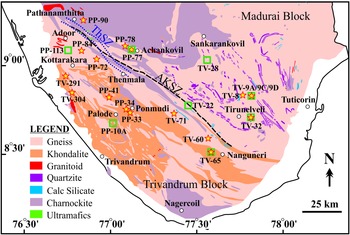
The SMB consists of charnockites (massive/foliated), anatectic garnet-biotite gneisses, garnet-biotite-K-feldspar ± sillimanite (khondalite) gneisses, hornblende-biotite gneisses and quartzites as the major lithological components. Quartzo-feldspatic pegmatites, sapphirine-bearing granulites, calc-silicates and metacarbonates form the other common minor lithology (Figs 1, 2) (Tsunogae & Santosh, Reference Tsunogae and Santosh2006, Reference Tsunogae and Santosh2010; Endo et al. Reference Endo, Tsunogae, Santosh and Shaji2012; Plavsa et al. Reference Plavsa, Collins, Foden, Kropinski, Santosh, Chetty and Clark2012).
Simplified geological map of the study area marked in Figure 1 (after Praharaj et al. Reference Praharaj, Rekha and Bhattacharya2021) showing the Southern Madurai Block, Trivandrum Block and location of the Achankovil Shear Zone (AKSZ) proposed by Praharaj et al. (Reference Praharaj, Rekha and Bhattacharya2021). Location of the Thenmala Shear Zone (ThSZ) (Sacks et al. Reference Sacks, Nambiar and Walters1997) is marked. Squares (green) are the locations of monazite-dated samples and filled stars (yellow) are the locations of samples used in P-T calculations. White filled circles are the important key localities within the study area.

The regional strike of the supracrustal belts in the SMB is NE–SW, and that has been refolded about a N–S-trending axial plane (Drury et al. Reference Drury, Harris, Holt, Reeves-Smith and Wightman1984). According to Rajesh and Chetty (Reference Rajesh and Chetty2006), the SMB has a SE-plunging regional fold structure. Praharaj et al. (Reference Praharaj, Rekha and Bhattacharya2021) suggested that the S2 gneissic layering in the SMB is steeply dipping and describes regional-scale steeply (westerly) plunging F3 folds. The S2 fabric is sigmoidally curved into the WNW-striking AKSZ as the shear zone is approached (Praharaj et al. Reference Praharaj, Rekha and Bhattacharya2021). At some parts of the SMB, gentle to open N- and S-closing folds are observed in the S1–S2 composite layering subparallel to the shear zone fabric, and these folds are progressively tighter to isoclinal near to the NNW- and NNE-striking melt-hosted (D3) shears (Praharaj et al. Reference Praharaj, Rekha and Bhattacharya2021). Both the NNW as well as NNE-striking melt-hosted shears exhibit dextral and sinistral kinematics but no cross-cutting relations were noticed between the two sets of shears (Praharaj et al. Reference Praharaj, Rekha and Bhattacharya2021). The syn-D3 generation of leucosomes along the shears was inferred from the tightening of folds in the S1–S2 composite layering adjacent to the melt-filled shears and the gradual disappearance radially away from the tip of the melt-filled shears (Praharaj et al. Reference Praharaj, Rekha and Bhattacharya2021).
Enderbites, charnockites and alkali granites from the SMB show compositional variations from dioritic to granitic (Santosh et al. Reference Santosh, Hua, He, Li, Tsunogae, Shaji and Indu2017), whereas hornblende-biotite gneisses vary from granodioritic to tonalitic in composition (Chetty, Reference Chetty2017). The rocks are mostly peraluminous and magnesian in composition. The rock compositions vary from calc-alkaline series to shoshonite series and commonly show signatures of volcanic-arc evolution (Chacko et al. Reference Chacko, Ravindra Kumar, Meen and Rogers1992; Santosh et al. Reference Santosh, Hua, He, Li, Tsunogae, Shaji and Indu2017). Geothermobarometric calculations on charnockites suggest upper granulite-facies metamorphic conditions in the SMB with metamorphic P-T conditions ranging over 700–820°C and 5–7.5 kbar (Endo et al. Reference Endo, Tsunogae, Santosh and Shaji2012). However, other studies have reported UHT (> 900°C) metamorphism with high pressure (8–10 kbar) conditions along the northeastern parts (near Rajapalaiyam) of the SMB (Fig. 1) (Tateishi et al. Reference Tateishi, Tsunogae, Santosh and Janardhan2004; Braun et al. Reference Braun, Cenki-Tok, Paquette and Tiepolo2007; Tsunogae & Santosh, Reference Tsunogae and Santosh2010). Initial isobaric cooling followed by a near-isothermal decompression is suggested by Tateishi et al. (Reference Tateishi, Tsunogae, Santosh and Janardhan2004) for the sapphirine-bearing granulites of the SMB from Rajapalaiyam. Braun et al. (Reference Braun, Cenki-Tok, Paquette and Tiepolo2007) documented a clockwise P-T evolution divided into three parts: heating, cooling and decompression from the same sapphirine-bearing granulites. Tsunogae & Santosh (Reference Tsunogae and Santosh2006, Reference Tsunogae and Santosh2010) proposed an anticlockwise P-T trajectory with near-isobaric cooling for the stability fields of sapphirine + spinel + quartz assemblages of granulites from Rajapalaiyam.
Geochronological studies from the SMB revealed a polyphase Proterozoic metamorphic evolution with a widespread and major imprint of a Pan-African tectonothermal event and high-grade metamorphism (Santosh et al. Reference Santosh, Kagami, Yoshida and Nandakumar1992, Reference Santosh, Yokoyama, Biju-sekhar and Rogers2003, Reference Santosh, Tanaka, Yokoyama and Collins2005 b; Harris et al. Reference Harris, Santosh and Taylor1994; Bartlett et al. Reference Bartlett, Harris, Hawkesworth and Santosh1995, Reference Bartlett, Dougherty-Page, Harris, Hawkesworth and Santosh1998; Jayananda et al. Reference Jayananda, Janardhan, Sivasubramanian and Peucat1995; Bindu, Reference Bindu1997; Braun & Brocker, Reference Braun and Brocker2004; Ghosh et al. Reference Ghosh, de Wit and Zartman2004; Li et al. Reference Li, Santosh, Indu, Shaji and Tsunogae2016; Praharaj et al. Reference Praharaj, Rekha and Bhattacharya2021).
2.b. Trivandrum Block
The TB is mainly a garnet-biotite gneissic terrane with a large area covered by the khondalites (Figs 1, 2). The dominant lithologies in the TB are anatectic garnet-biotite ± graphite gneisses, garnet-bearing leptynitic gneisses, garnet-biotite-sillimanite ± cordierite (khondalite) gneisses, granitic and tonalitic orthogneisses, and non-garnetiferous and garnetiferous charnockites (quartzo-feldspathic gneisses with orthopyroxenes), together with minor amounts of quartzites and calc-silicates (Chacko et al. Reference Chacko, Ravindra Kumar and Newton1987; Santosh et al. Reference Santosh, Jackson and Harris1993, Reference Santosh, Morimoto and Tsutsumi2006; Bindu, Reference Bindu1997; Nandakumar & Harley, Reference Nandakumar and Harley2000; Satishkumar et al. Reference Satish-Kumar, Wada and Santosh2002; Shabeer et al. Reference Shabeer, Sajeev, Okudaira and Santosh2002; Endo et al. Reference Endo, Toshiaki, Santosh, Shimizu and Shaji2013; Sreejith & Ravindra Kumar, Reference Sreejith and Ravindra Kumar2013; Ravindra Kumar & Sreejith, Reference Ravindra Kumar and Sreejith2016). Khondalites, leptynites, calc-silicates and quartzites form the metapelitic suite, whereas charnockites, garnet-biotite gneisses and mafic granulites are mostly orthogneisses (Braun, Reference Braun2006; Tadokoro et al. Reference Tadokoro, Tsunogae and Santosh2008; Kröner et al. Reference Kröner, Santosh and Wong2012; Endo et al. Reference Endo, Toshiaki, Santosh, Shimizu and Shaji2013; Sreejith & Ravindra Kumar, Reference Sreejith and Ravindra Kumar2013; Harley & Nandakumar, Reference Harley and Nandakumar2014; Taylor et al. Reference Taylor, Clark, Fitzsimons, Santosh, Hand, Evans and McDonald2014; Kadowaki et al. Reference Kadowaki, Tsunogae, He, Santosh, Takamura, Shaji and Tsutsumi2019). The garnet-biotite gneisses commonly show arrested charnockitization (Ravindra Kumar et al. Reference Ravindra Kumar, Srikantappa and Hansen1985; Hansen et al. Reference Hansen, Janardhan, Newton, Prame and Ravindra Kumar1987; Raith & Srikantappa, Reference Raith and Srikantappa1993).
The gneissic rocks of the TB are characterized by NW–SE-trending, gently SW-dipping open upright folds that, on approach to the AKSZ, show increasing dip, and the dip direction changes to south (Drury et al. Reference Drury, Harris, Holt, Reeves-Smith and Wightman1984; Sacks et al. Reference Sacks, Nambiar and Walters1997; Rajesh et al. Reference Rajesh, Santosh and Yoshida1998; Cenki & Kriegsman, Reference Cenki and Kriegsman2005). The S2 fabric in the TB dips at varying amounts, sub-horizontal to moderately inclined to the SW in the southern part, and steeply inclined towards the NE and SW as the NW–SE-striking sub-vertical AKSZ is approached (Praharaj et al. Reference Praharaj, Rekha and Bhattacharya2021). The poles of S2 fabric falls on a well defined girdle showing NW–SE-trending upright asymmetric folds with sub-horizontal axes (Praharaj et al. Reference Praharaj, Rekha and Bhattacharya2021). The S3-developed open folds become progressively tighter in close proximity to D3 shear zones (Praharaj et al. Reference Praharaj, Rekha and Bhattacharya2021). As well as the AKSZ, numerous subordinate NW–SE-striking shear zones with both dextral and sinistral kinematics are present within a distance/zone of tens of kilometres in the TB (Praharaj et al. Reference Praharaj, Rekha and Bhattacharya2021). Two sets of melt-bearing, locally developed D3 shears with sinistral NNE-striking shears and constant dextral NNW-striking shears are reported by Praharaj et al. (Reference Praharaj, Rekha and Bhattacharya2021), and it has been suggested that these leucosomes are coeval and conjugate in nature and formed along an extensional shear. In section view, a reverse sense of movement is observed with south-to-the-top translation (Praharaj et al. Reference Praharaj, Rekha and Bhattacharya2021), which indicates that the TB is overriding the SMB.
The orthogneisses of the TB are metaluminous to peraluminous in composition and of two types: (1) granitic and mostly following an evolved ferroan character; and (2) tonalitic with a typically magnesian character (Chacko et al. Reference Chacko, Ravindra Kumar, Meen and Rogers1992; Braun, Reference Braun2006; Ravindra Kumar & Sreejith, Reference Ravindra Kumar and Sreejith2016; Nandakumar & Harley, Reference Nandakumar and Harley2018). Granitic gneisses and leucogranites are alkali-calcic to calc-alkalic and potassium-rich, whereas tonalitic varieties are mostly calcic in nature. The gneissic rocks (garnet-biotite gneiss and khondalite) yield mostly volcanic-arc signatures, and some are of island-arc affinities (Chacko et al. Reference Chacko, Ravindra Kumar, Meen and Rogers1992; Braun, Reference Braun2006; Ravindra Kumar & Sreejith, Reference Ravindra Kumar and Sreejith2016; Nandakumar & Harley, Reference Nandakumar and Harley2018). The earlier thermobarometric estimates suggested a temperature of between 650 and 750°C and a pressure of between 4.5 and 5.0 kbar for the TB (Chacko et al. Reference Chacko, Ravindra Kumar and Newton1987; Santosh et al. Reference Santosh, Jackson and Harris1993; Bindu, Reference Bindu1997). However, later studies also documented the UHT conditions (900–1000 °C) of metamorphism at parts of the TB (Fig. 1) (Nandakumar & Harley, Reference Nandakumar and Harley2000; Shimizu et al. Reference Shimizu, Tsunogae and Santosh2009; Endo et al. Reference Endo, Toshiaki, Santosh, Shimizu and Shaji2013). Overall, the pressure and temperature variations indicate upper amphibolite- to granulite-facies metamorphic conditions (Chacko et al. Reference Chacko, Ravindra Kumar and Newton1987; Braun et al. Reference Braun, Raith and Ravindra Kumar1996; Nandakumar & Harley, Reference Nandakumar and Harley2000). Although there is a slight difference in the pressure and temperature estimations in various studies from different rock types of the TB, a clockwise P-T path is generally accepted by different authors (Chacko et al. Reference Chacko, Ravindra Kumar and Newton1987; Morimoto et al. Reference Morimoto, Santosh, Tsunogae and Yoshimura2004; Tadokoro et al. Reference Tadokoro, Tsunogae and Santosh2008; Shimizu et al. Reference Shimizu, Tsunogae and Santosh2009; Blereau et al. Reference Blereau, Clark, Taylor, Johnson, Fitzsimons and Santosh2016; Kadowaki et al. Reference Kadowaki, Tsunogae, He, Santosh, Takamura, Shaji and Tsutsumi2019; Sorcar et al. Reference Sorcar, Joshi, Oliveira, Tomson and Nandakumar2020).
The TB was subjected to ductile deformation and metamorphism during the Pan-African orogeny (Choudhary et al. Reference Choudhary, Harris, Van Calsteren and Hawkesworth1992; Bartlett et al. Reference Bartlett, Dougherty-Page, Harris, Hawkesworth and Santosh1998; Braun & Kriegsman, Reference Braun and Kriegsman2003). Monazites from garnet-biotite gneisses, leucogranties and leucotonalites yielded ages ranging between 590 and 520 Ma (Braun & Brocker, Reference Braun and Brocker2004; Santosh et al. Reference Santosh, Maruyama and Sato2009; Taylor et al. Reference Taylor, Clark, Fitzsimons, Santosh, Hand, Evans and McDonald2014; Praharaj et al. Reference Praharaj, Rekha and Bhattacharya2021). Metamorphic zircons from garnet-amphibole patch and metagranite suggested that the granulite-facies metamorphism has occurred at around 587–522 Ma (Taylor et al. Reference Taylor, Clark, Fitzsimons, Santosh, Hand, Evans and McDonald2014; Whitehouse et al. Reference Whitehouse, Ravindra Kumar and Rimsa2014). U–Th–Pb secondary-ion mass spectrometry (SIMS) geochronology revealed that magmatic crystallization in metagranite occurred at 1850 Ma (Whitehouse et al. Reference Whitehouse, Ravindra Kumar and Rimsa2014). U–Pb zircon geochronology and Hf isotope studies of the TB charnockites yielded 2.05–1.98 Ga ages and suggest a significant juvenile magma component in charnockite protoliths (Vijaya Kumar et al. Reference Vijaya Kumar, Rao, Plavsa, Collins, Tomson, Gopal and Babu2017). Granitoid gneisses and charnockites of the TB revealed protolith emplacement ages of 2100–1765 Ma (Kröner et al. Reference Kröner, Santosh and Wong2012, Reference Kröner, Santosh, Hegner, Shaji, Geng, Wong, Xie, Wan, Shang, Liu and Sun2015). Neoarchean–Mesoproterozoic (2.7–1.4 Ga) zircon ages were reported from granulite-facies metapelites and metagranitoids of the TB (Collins et al. Reference Collins, Santosh, Braun and Clark2007; Whitehouse et al. Reference Whitehouse, Ravindra Kumar and Rimsa2014; Kröner et al. Reference Kröner, Santosh, Hegner, Shaji, Geng, Wong, Xie, Wan, Shang, Liu and Sun2015).
2.c. Achankovil Shear Zone system
The AKSZ consists of cordierite-bearing granulites, garnet-biotite gneisses, migmatites, quartzites and charnockites with or without garnets (Santosh, Reference Santosh1987; Bartlett et al. Reference Bartlett, Dougherty-Page, Harris, Hawkesworth and Santosh1998; Rajesh & Chetty, Reference Rajesh and Chetty2006; Chetty, Reference Chetty2017). The rocks present within the high-strain zone are highly deformed and elongated parallel to the AKSZ (Rajesh & Chetty, Reference Rajesh and Chetty2006). Sacks et al. (Reference Sacks, Nambiar and Walters1997) suggested that the Thenmala shear zone (part of the AKSZ) is NW–SE-trending with a moderate to steep SW dip with kinematic indicators showing a predominantly dextral sense of shear with a minor components of reverse shear. In contrary, Rajesh et al. (Reference Rajesh, Santosh and Yoshida1998) interpreted the AKSZ as a WNW–ESE- to NW–SE-trending shear zone with a moderate dip to the SW and kinematic indicators suggesting a predominantly sinistral shear sense. A comprehensive structural analysis across the AKSZ by Praharaj et al. (Reference Praharaj, Rekha and Bhattacharya2021) supports the recent views that the AKSZ represents a high-T terrane boundary suture zone along which the TB and SMB were welded (e.g. Kröner et al. Reference Kröner, Santosh and Wong2012; Sreejith & Ravindra Kumar, Reference Sreejith and Ravindra Kumar2013; Ravindra Kumar & Sreejith, Reference Ravindra Kumar and Sreejith2016). According to Praharaj et al. (Reference Praharaj, Rekha and Bhattacharya2021), the AKSZ is not a single transpressive shear zone but essentially an anastomosing network of shear zones; the kinematics indicate that the main strand of the AKSZ is left lateral, although both dextral and sinistral kinematics are inferred in the subparallel shear zones occurring south of the AKSZ.
Pressure and temperature estimations from the AKSZ range over 5–7 kbar and 700–900 °C, respectively (Santosh, Reference Santosh1987; Chacko et al. Reference Chacko, Lamb and Farquhar1996; Nandakumar & Harley, Reference Nandakumar and Harley2000; Shabeer et al. Reference Shabeer, Satish-Kumar, Armstrong and Buick2005; Shimizu et al. Reference Shimizu, Tsunogae and Santosh2009; Collins et al. Reference Collins, Clark and Plavsa2014; Blereau et al. Reference Blereau, Clark, Taylor, Johnson, Fitzsimons and Santosh2016). A near-isothermal decompression path was deduced for garnet-cordierite gneisses by Santosh (Reference Santosh1987) and Sreejith & Ravindra Kumar (Reference Sreejith and Ravindra Kumar2012). Nandakumar & Harley (Reference Nandakumar and Harley2000) suggested a P-T path of initial isobaric cooling and decompression from 800 °C and 6 kbar to 750 °C and 4 kbar for charnockites and cordierite gneisses. Further, many studies proposed that the AKSZ attests a clockwise P-T evolution (Cenki et al. Reference Cenki, Braun and Brocker2004; Shabeer et al. Reference Shabeer, Satish-Kumar, Armstrong and Buick2005; Collins et al. Reference Collins, Clark and Plavsa2014).
Zircon geochronology indicates that the granulite-facies metamorphism in the AKSZ occurred at c. 513 Ma (Collins et al. Reference Collins, Santosh, Braun and Clark2007; Harley & Nandakumar, Reference Harley and Nandakumar2014). Zircons from cordierite gneisses gave a prominent age peak at 530 Ma (Bartlett et al. Reference Bartlett, Dougherty-Page, Harris, Hawkesworth and Santosh1998). Monazites from the garnet-biotite gneisses provided prominent c. 540 Ma ages (Praharaj et al. Reference Praharaj, Rekha and Bhattacharya2021).
3. Field relationships and petrography
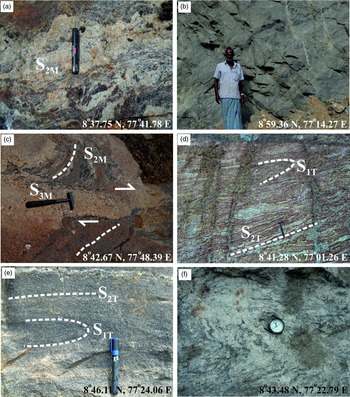
A large part of the SMB consists of garnet-biotite ± hornblende gneisses with quartz-feldspar-rich leucocratic and garnet-biotite ± hornblende-rich melanocratic layers (designated S2M, where M indicates the SMB in Fig. 3a). Charnockites of the SMB are mostly garnetiferous and foliated in places (Fig. 3b). The field relation shows that the large volume of melt generation was pre- to syntectonic with respect to D1M deformation, and these melt layers were folded along with the S2M layers during D3M deformation (Fig. 3c). Khondalites in the TB have a prominent S2T (T indicates TB) gneissic fabric (Fig. 3d) defined by garnet-biotite-sillimanite-cordierite-bearing melanocratic and quartz-plagioclase-K-feldspar-rich leucocratic layers. Charnockites of the TB are mostly non-garnetiferous and occur mainly as thin bands elongated parallel to the AKSZ (Figs 2, 3e). The gneissic layering (S2T) in garnet-biotite gneisses of the TB is defined by a quartz-feldspar-rich leucocratic layer and a garnet-biotite-rich melanocratic layer (Fig. 3f). Irregular patches of incipient charnockites are observed in the garnet-biotite gneisses (Fig. 3f).
Field photographs from the (a–c) Southern Madurai Block and (d–f) Trivandrum Block. Hammer head and the marker pen (15 cm long) point north. (a) Planar view of garnet-biotite gneiss showing S2M (M denotes Southern Madurai Block) gneissic layering defined by the quartz-feldspar-rich leucocratic and biotite-rich melanocratic layers; note the boudinage structure and ptygmatic fold in leucosomes. Garnet occurs as dispersed coarse porphyroblasts or arranged in aggregates within the leucosomes. Garnets also rim the interphase between the mesosome and the leucosome. (b) Section view (looking west) of prominent S2M fabric in charnockites. (c) The dextral shears (S3) folding the S2M gneissic layering in khondalites along which leucosomes have been emplaced. (d) Section view (looking east) showing penetrative gently to moderately dipping S2T (T denotes Trivandrum Block) layers in weathered khondalites; note the locally preserved hinge of interfolial isoclinal folds on former S1T layers. (e) Plan view of rootless fold hinges of S1T layers within the interfolial domain of S2T fabric in charnockites. (f) Plan view of garnet-biotite gneisses with patchy charnockites.

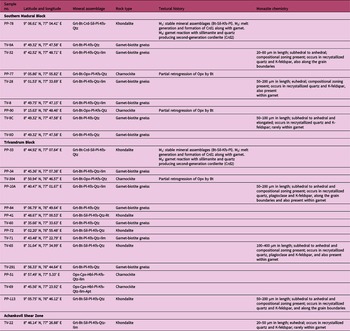
In order to understand the mineral paragenesis and microtextures of different rock types in the study area, six khondalites (sample PP-78 from the SMB and samples PP-33, PP-41, PP-72, TV-65 and PP-113 from the TB), eleven garnet-biotite gneisses (samples TV-9A/9C/9D, TV-32, TV-28 and TV-8 from the SMB and samples PP-34, PP-84, TV-60, TV-71 and TV-291 from the TB) and five charnockites (samples PP-77 and PP-90 from the SMB and samples TV-304, PP-51 and TV-69 from the TB) were studied in detail. Locations of the samples (latitude and longitude) and the detailed mineralogy are summarized in Table 1.
Details of the samples used in petrography, mineral chemistry, P-T estimations, phase equilibria modelling and monazite geochronology. Apt – apatite; Bt – biotite; Crd – cordierite; Grt – garnet; Hbl – hornblende; Ilm – ilmenite; Kfs – K-feldspar; Opx – orthopyroxene; Pl – plagioclase; Qtz – quartz; Rt – rutile; Sil – sillimanite. Mineral abbreviations after Kretz (Reference Kretz1983).

3.a. Southern Madurai Block
3.a.1. Garnet-biotite gneiss
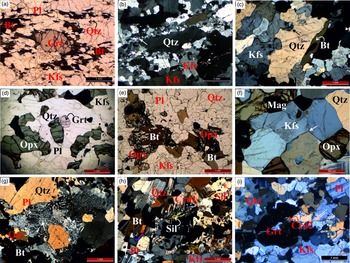
Garnet-biotite gneisses of the SMB are mainly composed of garnet + biotite + quartz + plagioclase + K-feldspar assemblages (Fig. 4a). The tectonic fabric in garnet-biotite gneisses is defined by shape-preferred aggregates of biotite in a polycrystalline and polymineralic mosaic of dynamically recrystallized quartz and feldspar grains (Fig. 4a). Different dynamic recrystallization processes are indicated by sub-grain rotation recrystallization (Fig. 4b) and bulge nucleation as a result of grain boundary migration recrystallization (Fig. 4c). Quartz grains show chessboard twinning, undulose extinctions and vague sub-grain boundaries (Fig. 4b), whereas feldspars show weak undulose extinction (Fig. 4c). High-energy grain/phase boundaries are lined by discrete biotite flakes (Fig. 4c).
Representative microphotographs (a, d and e are plane-polarized images and b, c and f–i are crossed-polar images) from the Southern Madurai Block. (a) Garnet-biotite gneisses showing the S2M fabric defined by the shape-preferred orientation of biotite. (b) Sub-grain rotation recrystallization (white arrow) in quartz, and (c) grain boundary migration between quartz and K-feldspar (black arrow) in garnet-biotite gneisses. (d) Charnockite with garnet, orthopyroxene, plagioclase, K-feldspar and quartz. (e) Orthopyroxenes in charnockite partially replaced by biotites. (f) Granoblastic texture with well equilibrated triple junctions among K-feldspar, quartz and plagioclase (white arrow) and (g) myrmekite texture (white arrow) in charnockites. Khondalite showing biotite and sillimanite enclosed within (h) first-generation cordierite (Crd1) and (i) second-generation cordierites (Crd2) surrounding garnet. Mineral abbreviations are after Kretz (Reference Kretz1983).

3.a.2. Charnockite
The SMB charnockite consists of garnet + orthopyroxene ± clinopyroxene + quartz + K-feldspar + plagioclase ± biotite assemblages (Fig. 4d). Orthopyroxenes are partially or completely retrogressed at the margins or along the cleavage planes to fine-grained biotite (Fig. 4e). Granoblastic textures with well equilibrated triple junctions are common (Fig. 4f). High-T annealing is indicated by the orthopyroxene triple junctions sharing straight grain/phase boundaries (Fig. 4f). Myrmekite textures formed by the intergrowth of vermicular quartz and plagioclase feldspar are observed in charnockites (Fig. 4g).
3.a.3. Khondalite
Khondalites are very rare in the studied parts of the SMB and mostly observed near the AKSZ (Fig. 2). It is composed of garnet + biotite + quartz + plagioclase + K-feldspar + sillimanite ± cordierite assemblages (Fig. 4h). The garnet porphyroblasts are subhedral to anhedral in shape (Fig. 4h, i), biotites are elongated and sillimanites possess a needle-like appearance (Fig. 4h). Three phases of mineral formation were identified in khondalites: in phase one (M1) the stable mineral assemblages were biotite, sillimanite, K-feldspar and plagioclase commonly observed as inclusions in large poikiloblastic (2–3 mm) lamellar twinned cordierite grains (Crd1, phase 2) (Fig. 4h); in phase 2 (M2) melt generation and formation of Crd1 are observed, along with garnet; and in phase 3 (M3) garnet reacting with sillimanite and quartz produced second-generation cordierite (Crd2), distinguished from first-generation cordierites (Crd1) by their smaller size (0.5–1 mm) and textural setting (as rims around garnet) (Fig. 4i).
3.b. Trivandrum Block
3.b.1. Khondalite
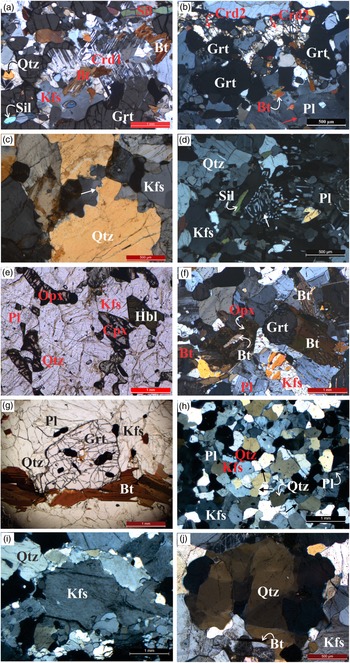
Khondalites of the TB possess alternate garnet + biotite + sillimanite ± cordierite ± spinel-defined melanocratic and quartz + plagioclase + K-feldspar-defined leucocratic layers (Fig. 5a). Similar to the SMB khondalites, the khondalites of the TB also contain two generations of cordierites with a comparable growth history (Fig. 5b). Cordierites are commonly anhedral in shape, of variable sizes and contain numerous inclusion trails, for example, biotite, sillimanite, K-feldspar and plagioclase (Fig. 5a). Sillimanites are needle-like or tabular and aligned parallel to the gneissic fabric (Fig. 5a). Shape-preferred aggregates of early biotite grains are aligned parallel to the gneissic fabric, whereas the later individual biotite flakes lodged at grain and phase boundaries are randomly oriented (Fig. 5a). Subhedral to anhedral garnet porphyroblasts are common and possess inclusions of sillimanite, biotite, K-feldspar, plagioclase and quartz (Fig. 5a). Most of the quartz and K-feldspar grains show undulose extinction and the grain boundaries between them are curved with lobate and cuspate shapes, commonly showing bulge nucleation (Fig. 5c). Myrmekitic textures along the K-feldspar boundary are common in khondalites (Fig. 5d).
Representative microphotographs (e and g are plane-polarized images and remaining are crossed-polar images) from the Trivandrum Block. (a) Khondalite showing biotite and needle-like sillimanite enclosed within first-generation cordierite (Crd1) and (b) second-generation cordierites (Crd2) surrounding garnet. Images from khondalite showing (c) grain-boundary migration with lobate cuspate boundaries (white arrow) and (d) myrmekite texture between quartz and plagioclase (white arrow). (e) Charnockites showing orthopyroxene, clinopyroxene, hornblende, plagioclase, K-feldspar and quartz. (f) Orthopyroxene in charnockite partially replaced by biotite. (g) Garnet-biotite gneiss showing fabric-defining biotite and garnet porphyroblast. Images from garnet-biotite gneisses showing (h) granoblastic texture, (i) sub-grain rotation recrystallization and (j) quartz with undulose extinction. Mineral abbreviations are after Kretz (Reference Kretz1983).

3.b.2. Charnockite
Charnockites of the TB are composed of orthopyroxene + plagioclase + K-feldspar + quartz ± clinopyroxene ± biotite ± garnet ± hornblende (Fig. 5e). The weak foliations in charnockites are defined by the alignment of orthopyroxene and clinopyroxene grains anchored to the dynamically recrystallized aggregates of weakly strained quartz and feldspar grains that share high-energy boundaries. Triple junctions sharing straight grain/phase boundaries among ortho-/clino-pyroxene grains indicate high-T annealing (Fig. 5e). In a few charnockites, orthopyroxenes partially or completely retrogressed at the margins or along the cleavage planes to fine-grained biotite (Fig. 5f).
3.b.3. Garnet-biotite gneiss
Gneissosity in garnet-biotite gneisses is defined by quartz–plagioclase–K-feldspar-rich leucocratic and garnet–biotite-rich melanocratic layers (Fig. 5g). The tectonic fabric is defined by shape-preferred aggregates of flaky biotite in a polymineralic and polycrystalline mosaic of dynamically recrystallized quartz and feldspar grains (Fig. 5g). It shows granoblastic textures with well equilibrated triple junctions (Fig. 5h). Sub-grain rotation recrystallization textures are observed between quartz and feldspars (Fig. 5i). The quartz and K-feldspar grains show weak undulose extinction, and share high-energy grain/phase boundaries that are commonly lined with discrete biotite flakes (Fig. 5j).
3.c. Mineral reactions
The garnet-biotite gneisses, charnockites and khondalites from the SMB and TB show similar reaction textures. Three phases of mineral formation were identified in khondalites and these can be explained by the following possible reactions:
 $\begin{align}{\rm{Phase}}\,2&:\,{\rm{Bt}} + {\rm{Sil}} + {\rm{Pl}} + {\rm{Qtz}} + \left( {{\rm{Kfs}}} \right) \\ & \to {\rm{Grt}} + {\rm{Crd}}1 + {\rm{Melt}}\,({\rm{Spear}}\,\,et{\rm{ }}al.\,\,1999)\end{align}$
 $${\rm{Phase}}\,3:\,{\rm{Grt}} + {\rm{Sil}} + {\rm{Qtz}} \to {\rm{Crd}}2\,({\rm{Sorcar}}\,\,et{\rm{ }}al.\,\,2014)$$
In charnockites, biotite reacted with plagioclase and produced melt along with garnet, orthopyroxene and K-feldspar. It can be described by the following reaction:
 $\begin{align} {\rm{Bt}} + {\rm{Pl}} + {\rm{Qtz}} & \to {\rm{Grt}} + {\rm{Opx}} + {\rm{Kfs}} \\ & \quad \ +\, {\rm{melt}}\,({\rm{Tiwari}}\ \& \ {\rm{Sarkar}}\,\,2020) \end{align}$
The retrogression of orthopyroxene to fine-grained biotite can be described by the reaction:
 $${\rm{Opx}} + {\rm{Kfs}} + {{\rm{H}}_2}{\rm{O}} \to {\rm{Bt}}\,({\rm{Oziegbe}}\,et\,al.\,\,\,2020)$$
From the experimental results, Gardien et al. (Reference Gardien, Thompson and Ulmer2000) suggested that under fluid-absent conditions the melting of a quartz–biotite–plagioclase–K-feldspar assemblage could produce garnet + plagioclase II + melt with an increase in the modal amount of garnet as the pressure increases. This is consistent with our petrographic observations.
4. Mineral chemistry
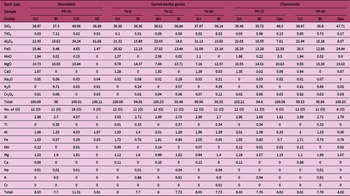
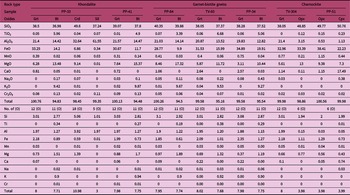
Mineral chemical analyses of rock samples from the SMB and TB were carried out using a CAMECA SX 5 electron probe microanalyser, Central Research Facility, IIT Dhanbad (India). Major-element analyses were performed with beam current regulated at 20 nA and acceleration voltage at 15 kV. The peak measurement time varied between 10 and 20 seconds, with half of the peak measurement time allotted for background measurement. All elements (Na, Mg, Al, Si, P, K, Ca, Ti, Cr, Mn and Fe) were calibrated using natural and synthetic standards. High-resolution X-ray element maps (Mg Ka, Fe Ka, Mn Ka and Ca Ka) of garnet porphyroblasts were acquired with a 50 nA beam current, 50 ms/pixel dwell time and 3–5 μm step size. The detection limits for most of the elements was 100 ppm or lower and the accuracy was 1–2% for major-element concentrations. Sample locations and their mineralogy are given in Table 1. Representative analyses of minerals are provided in Tables 2 and 3, and complete analytical data is provided in online Supplementary Table S1 (available at http://journals.cambridge.org/geo).
Electronprobe microanalytical data and structural formulae of single representative mineral grain analysis from different rocks used for thermobarometry from the Southern Madurai Block. Mineral abbreviations after Kretz (Reference Kretz1983).
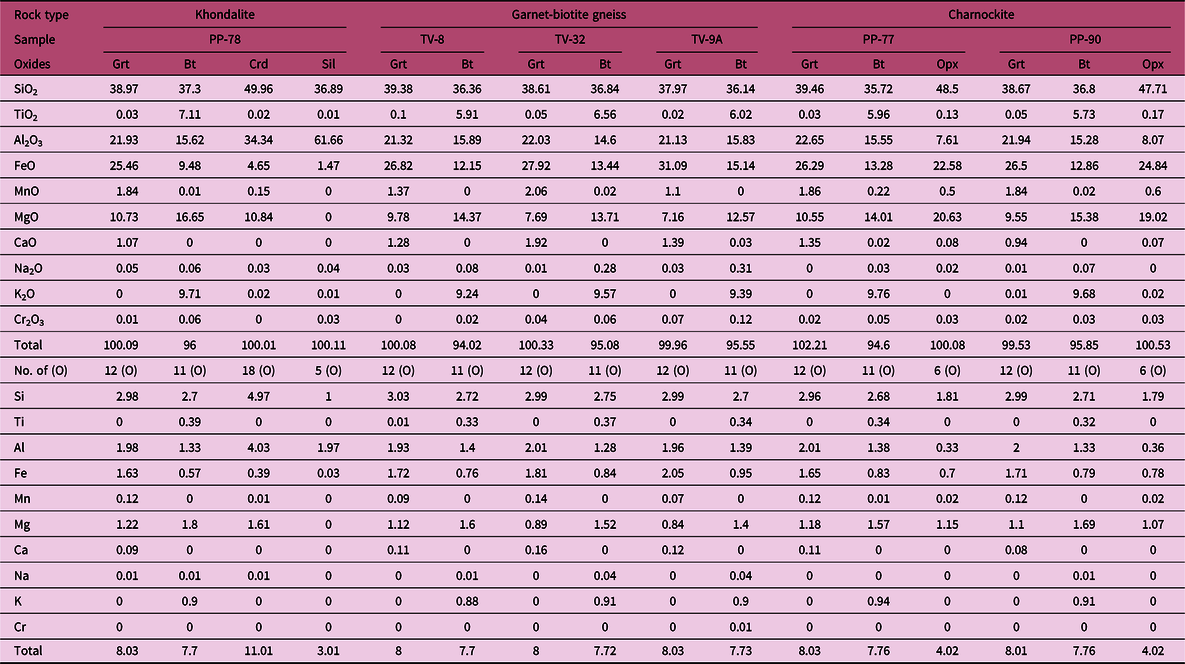
Electronprobe microanalytical data and structural formulae of single representative mineral grain analysis from different rocks used for thermobarometry from the Trivandrum Block. Mineral abbreviations after Kretz (Reference Kretz1983).

4.a. Southern Madurai Block
The rock-forming minerals of the major rock types, that is, four garnet-biotite gneisses (TV-9A, TV-32, TV-8 and TV-9D), one khondalite (PP-78) and two garnetiferrous charnockites (PP-77 and PP-90) were analysed to understand the mineral chemistry.
Garnet present in the SMB is a solid solution between pyrope and almandine, and the overall composition ranges from Alm60–74Prp26–40Grs3–6Sps2–5 in garnet-biotite gneisses and Alm55–68Prp32–45Grs3Sps3–6 in khondalites (online Supplementary Fig. S1a, available at http://journals.cambridge.org/geo). In charnockites, the average composition of garnets ranges from Alm57–75Prp25–43Grs2–4Sps3–6 (online Supplementary Fig. S1a). Irrespective of the rock types, the proportion of Fe, Mg, Ca and Mn in garnet is almost the same. There is no core-to-rim variation of compositions in garnet (online Supplementary Fig. S2, available at http://journals.cambridge.org/geo). The garnet shows a rim-wards depletion of Mg when it is associated with biotite.
The composition of biotite in garnet-biotite gneisses (K0.86–0.92Mg1.31–1.73Fe0.76–0.97Al1.17–1.43Si2.67–2.83O10(OH,F)2) lies between phlogopite and annite, whereas in khondalites (K0.90–0.96Mg1.38–2.02Fe0.54–0.98Al1.29–1.39Si2.66–2.75O10(OH,F)2) and charnockites (K0.90–0.94Mg1.57–1.90Fe0.64–0.87Al1.30–1.38Si2.68–2.74O10(OH,F)2) the biotite grains are mostly phlogopite-rich. In garnet-biotite gneisses the XMg [=Mg/(Fe + Mg)] contents ranges from 0.40–0.68 (online Supplementary Fig. S1b). In khondalites the XMg contents ranges over 0.58–0.79, and in charnockites it ranges over 0.65–0.75 (online Supplementary Fig. S1b). TiO2 content in biotite is variable and ranges over 3.52–7.74 wt% in khondalites and 5.41–7.28 wt% in garnet-biotite gneisses. Biotite in charnockites has a lower TiO2 (5.06–6.09 wt%) content than khondalites and garnet-biotite gneisses.
Chemical variation of orthopyroxene in charnockites ranges over (Mg,Fe)1.82–1.90Si1.77–1.81O6. The XFe [=Fe/(Fe + Mg)] in the range of 0.37–0.42 indicates that the orthopyroxenes in charnockites of the SMB are enstatite-rich (online Supplementary Fig. S1c). Orthopyroxenes present in charnockites have low Al content in the range of 0.33–0.37 and these orthopyroxenes are metamorphic in origin (Rajesh et al. Reference Rajesh, Santosh and Yoshikura2011).
Cordierite composition ranges over Mg1.59–1.63Al3.98–4.05Si4.93–4.98O18 in khondalites. XMg in cordierites ranges over 0.78–0.81. The cordierites present here are mostly anhydrous (online Supplementary Table S1).
In khondalites, charnockites and garnet-biotite gneisses, the plagioclase is typically oligoclase to andesine (Ab59–71An23–37Or1–4) in composition (online Supplementary Fig. S1d). Alkali feldspar in garnet-biotite gneisses (Ab10–22An0–1Or77–89) contain more albitic component compared with those in khondalites (Ab3–10An0–1Or89–96) and charnockites (Ab9-10An0-1Or90-91).
4.b. Trivandrum Block
The dominant rock types such as khondalite (PP-32, PP-41, PP-72 and TV-65), garnet-biotite gneiss (PP-34, PP-84, TV-60, TV-71 and TV-291), garnetiferous charnockite (TV-304) and non-garnetiferous charnockite (PP-51 and TV-69) were studied in detail to understand the mineral chemistry.
Garnet present here is also a solid solution between pyrope and almandine. In garnet-biotite gneisses, the average composition of garnets ranges over Alm84–89Prp11–16Grs7–10Sps1–2. The average composition of garnet in khondalites ranges over Alm67–82Prp18–33Grs2–3Sps1–2. In charnockites, the average composition of garnets ranges over Alm76–84Prp16–24Grs3–4Sps1–2. Garnets are mostly almandine-rich (online Supplementary Fig. S1e). Garnet porphyroblasts in contact with biotite shows a slight rim-wards depletion of Mg as a result of the Fe–Mg exchange between garnet and biotite. The garnet does not show any significant zoning in terms of Fe, Mg, Ca and Mn (online Supplementary Fig. S2).
The composition of biotite varies from phlogopite to annite in garnet-biotite gneisses (K0.86–0.95Mg0.86–1.92Fe0.61–1.52Al1.15–1.32Si2.74–2.93O10(OH,F)2), whereas the biotite grains present in khondalites (K0.87–0.95Mg1.42–1.95Fe0.56–0.97Al1.18–1.31Si2.77–2.86O10(OH,F)2) and charnockites (K0.78–0.91Mg1.24–1.73Fe0.85–1.14Al1.20–1.28Si2.82–2.99O10(OH,F)2) are phlogopite-rich. The XMg value ranges over 0.60–0.78 in khondalites and 0.52–0.67 in charnockites (online Supplementary Fig. S1f). In garnet-biotite gneisses, the XMg value ranges over 0.37–0.76 (online Supplementary Fig. S1f). The TiO2 content of biotite ranges over 3.04–6.01 wt% in khondalites and 3.01–6.71 wt% in garnet-biotite gneisses. The TiO2 content in charnockites are slightly lower (1.11–5.46 wt%) than for khondalites and garnet-biotite gneisses.
The composition of orthopyroxene ranges over (Mg,Fe)1.81–2.32Si1.88–2.04O6 and that of clinopyroxene over (Mg,Fe,Ca,Al)1.91–2.30(Si,Al)2.01–2.06O6 in both garnetiferous and non-garnetiferous charnockites. The XFe value of orthopyroxenes ranges over 0.58–0.85, indicating that ferrosilite-rich orthopyroxenes are present in both types of charnockites, while in a few samples it varies between ferrosilite and pigeonite (online Supplementary Fig. S1g). Clinopyroxenes are mostly present in non-garnetiferous charnockites where the XFe content varies between 0.58 and 0.79, indicating the predominance of augite composition (online Supplementary Fig. S1g). The lesser amount of Al (0.02–0.03 apfu) in orthopyroxene is a characteristic of the charnockites of the SGT, and indicates a metamorphic origin (Rajesh et al. Reference Rajesh, Santosh and Yoshikura2011; Endo et al. Reference Endo, Tsunogae, Santosh and Shaji2012). The Al content (0.14–0.16 apfu) of orthopyroxene in garnetiferous charnockites is slightly higher compared with the non-garnetiferous charnockites.
Chemical composition of cordierite in khondalites ranges over Mg1.32–1.39Al3.89–3.97Si5.03–5.07O18. The XMg composition of cordierites are almost uniform and lie between 0.67 and 0.70. The XMg value in cordierite is slightly lower in the TB than in the SMB. Cordierites present here are hydrous (online Supplementary Table S1a).
Plagioclase feldspars are of oligoclase to andesine in composition in khondalites (Ab62–74An24–36Or1–4), garnet-biotite gneisses (Ab58–77An22–41Or1–2) and charnockites (Ab76–77An19–20Or3–4) (online Supplementary Fig. S1h). Both perthites and antiperthites are present in different lithologies of the TB. Similar to the SMB, the K-feldspar in garnet-biotite gneisses (Ab11–28An1–3Or69–88) are slightly more albitic than in khondalites (Ab3–32An0–4Or64–96) and charnockites (Ab3–31An0–7Or67–96) of the TB.
5. Metamorphic P-T conditions
5.a. Thermobarometry
Four garnet-biotite gneisses (TV-9A, TV-32, TV-8 and TV-9D), one garnet-biotite-sillimanite ± cordierite gneiss (PP-78) and two garnetiferous charnockites (PP-77 and PP-90) were chosen for temperature and pressure estimations from the SMB. Five garnet-biotite gneisses (PP-34, PP-84, TV-60, TV-71 and TV-291), four garnet-biotite-sillimanite ± cordierite gneisses (PP-33, PP-41, PP-72 and TV-65) and one garnetiferous charnockite (TV-304) were selected from the TB. The sample locations are shown in Figure 2 and samples are described in Table 1.
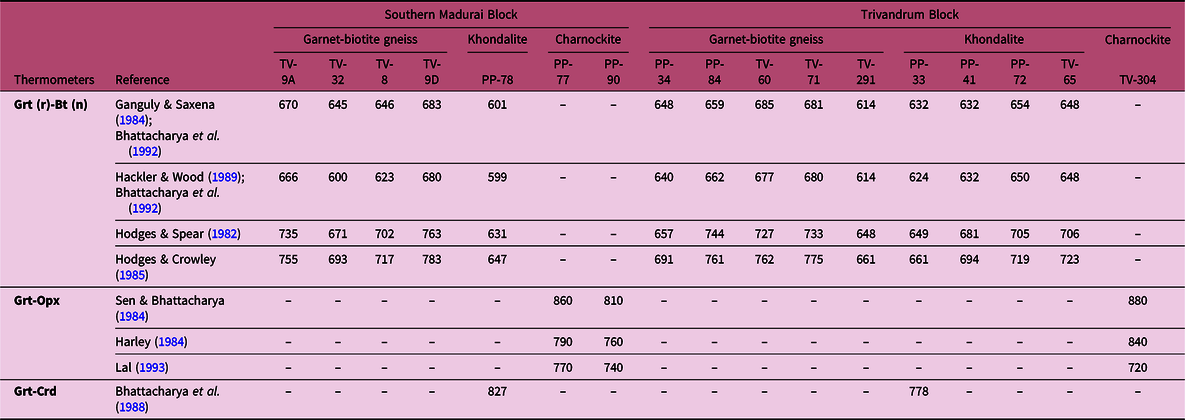
Temperatures were estimated using garnet-biotite Fe–Mg exchange thermometric formulations proposed by Hodges & Spear (Reference Hodges and Spear1982), Hodges & Crowley (Reference Hodges and Crowley1985) and Bhattacharya et al. (Reference Bhattacharya, Mohanty, Maji, Sen and Raith1992). Non-ideal mixing conditions for all minerals are assumed for the calculations based on Hodges & Crowley (Reference Hodges and Crowley1985) and Bhattacharya et al. (Reference Bhattacharya, Mohanty, Maji, Sen and Raith1992), whereas ideal mixing for all minerals, except where Ti forms a major biotite component, is assumed for Hodges & Spear (Reference Hodges and Spear1982) computations. The garnet-cordierite thermometer by Bhattacharya et al. (Reference Bhattacharya, Mazumdar and Sen1988) was used to calculate the temperature from the samples where cordierite and sillimanite were present as extra phases. The garnet-orthopyroxene Fe–Mg exchange thermometer of Sen & Bhattacharya (Reference Sen and Bhattacharya1984), Harley (Reference Harley1984) and Lal (Reference Lal1993) was used to calculate the temperature in garnetiferous charnockites. In the garnet-orthopyroxene thermometer of Sen & Bhattacharya (Reference Sen and Bhattacharya1984), orthopyroxene is taken as ideal mixing and garnet is taken as non-ideal mixing. In Harley (Reference Harley1984), all minerals are considered as ideal mixing, while in Lal (Reference Lal1993) all minerals are considered as non-ideal mixing.
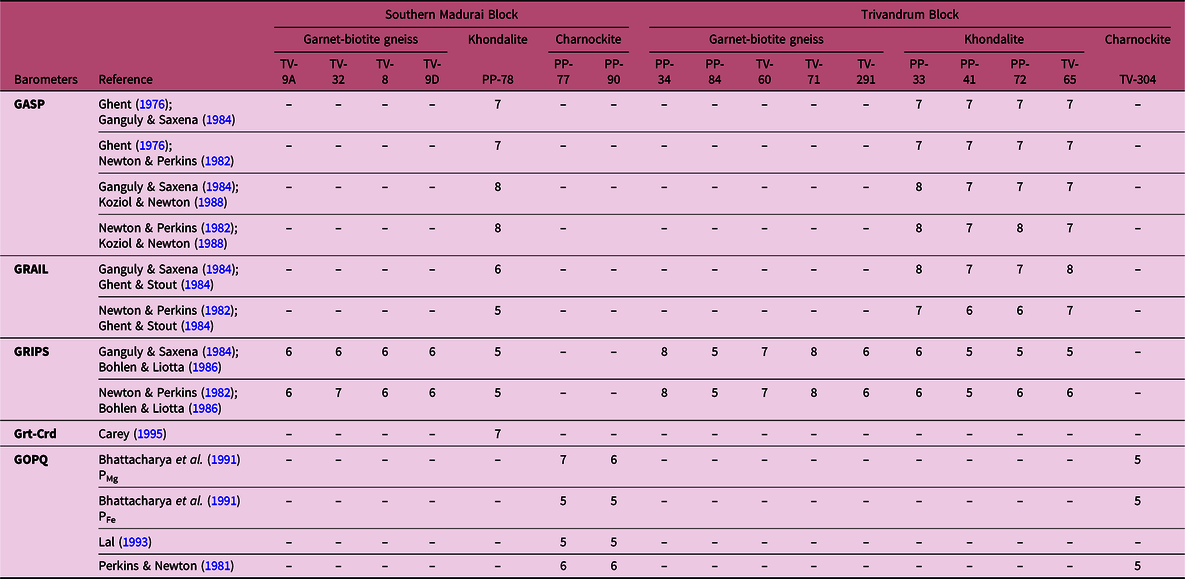
Pressure conditions were determined by using the GRIPS (garnet-rutile-ilmenite-plagioclase-quartz) barometer (Bohlen & Liotta, Reference Bohlen and Liotta1986) in garnet-biotite gneisses. In garnet-bearing charnockites, the GOPQ (garnet-orthopyroxene-plagioclase-quartz) barometer (Perkins & Newton, Reference Perkins and Newton1981; Bhattacharya et al. Reference Bhattacharya, Krishnakumar, Raith and Sen1991; Lal, Reference Lal1993) was used. GASP (garnet-sillimanite-quartz-plagioclase) (Ghent, Reference Ghent1976; Koziol & Newton, Reference Koziol and Newton1988), GRAIL (garnet-rutile-sillimanite-ilmenite) (Ghent & Stout, Reference Ghent and Stout1984) and garnet-cordierite-sillimanite-quartz (Carey, Reference Carey1995) barometers were used for the calculation of pressure in garnet-biotite-sillimanite ± cordierite gneisses. In the GASP barometer the a–X relations proposed by Newton & Perkins (Reference Newton and Perkins1982) and Ganguly & Saxena (Reference Ganguly and Saxena1984) were used for computing the activity of garnet, while the formulation of Newton & Haselton (Reference Newton, Haselton, Newton, Navrotsky and Wood1981) was used for computing the activity of anorthite in plagioclase. The P-T estimates are provided in Tables 4 and 5 where the temperatures are calculated at P = 7 kbar and pressures are estimated at T = 700°C.
Estimated temperature (°C) at P = 7 kbar using mineral thermometry. Sample locations are indicated in Figure 2. n – nearest neighbor mineral in matrix; r – rim of mineral. Mineral abbreviations after Kretz (Reference Kretz1983).

Estimated pressure (kbar) at T = 700°C using mineral barometry. Sample locations are indicated in Figure 2.

GASP – garnet-aluminosilicate-plagioclase-quartz; GRAIL – garnet-rutile-sillimanite-ilmenite-quartz; GRIPS – garnet-rutile-ilmenite-plagioclase-quartz; Grt-Crd – garnet-cordierite; GOPQ – garnet-orthopyroxene-plagioclase-quartz.
5.a.1. Southern Madurai Block
Garnet rim and the biotite in contact with the garnet yielded temperatures ranging over 600–780°C in garnet-biotite gneisses. In garnet-biotite-sillimanite ± cordierite gneisses, the metamorphic temperatures were retrieved from garnet rim and the biotite in contact with the garnet, which ranges over 600–650°C. The garnet-cordierite (Crd1) thermometer yielded a temperature of 830°C. Estimated metamorphic temperatures from the garnet-orthopyroxene thermometer range over 740–860 °C. The GASP and GRAIL barometers provided pressures ranging over 7–8 kbar and 5–6 kbar, respectively, for khondalites. The GRIPS barometer provided a pressure of 6 kbar and 5 kbar for garnet-biotite gneisses and khondalites, respectively. The garnet-cordierite-sillimanite-quartz barometer yielded a pressure of 7 kbar for khondalites. The pressures determined from garnetiferrous charnockites by using the GOPQ barometer ranges over 5–7 kbar. The overall temperature and pressure in the SMB range over 600–860 °C and 5–8 kbar, respectively (Tables 4, 5; online Supplementary Fig. S3a–c, available at http://journals.cambridge.org/geo).
5.a.2. Trivandrum Block
Temperatures estimated from the compositions of garnet rim and the biotite in contact with garnet ranges over 615–770°C in garnet-biotite gneisses. In garnet-biotite-sillimanite ± cordierite gneisses the garnet rim and the biotite in contact with garnet yielded temperatures of 630–720°C. The garnet-cordierite (Crd1) thermometer provided a temperature of 780°C. The garnet-orthopyroxene thermometer yielded slightly higher temperature ranges of 720–880°C. The GASP and GRAIL barometers provided pressures ranging over 6–8 kbar for khondalites. The GRIPS barometer yielded pressure in the range 5–6 kbar in garnet-biotite-sillimanite ± cordierite gneisses and 5–8 kbar in garnet-biotite gneisses. The GOPQ barometer provided a pressure of 5 kbar for garnetiferous charnockites. In the TB, the average temperature ranged over 615–880°C and pressure over 5–8 kbar (Tables 4, 5; online Supplementary Fig. S3d–f).
5.b. P-T path reconstruction
A P-T path can be obtained by integrating the outcomes of P-T pseudosection analysis, measured in zoning profiles in garnet and the different reaction textures involved (Spear, Reference Spear1992; White & Powell, Reference White and Powell2011). Since the garnets of granulite-facies rocks are devoid of zoning due to high-temperature diffusion, the P-T path is constructed by considering different textural relations and reactions among minerals. The phase equilibrium modelling (Holland & Powell, Reference Holland and Powell1998) was carried out using the Perple_X software (version 6.8.7) (Connolly & Petrini, Reference Connolly and Petrini2002; Connolly, Reference Connolly2005, Reference Connolly2009). The bulk-rock composition used for the construction of the P-T pseudosection was obtained using inductively coupled plasma – atomic emission spectroscopy (ICP-AES) at the Sophisticated Analytical Instrument Facility, IIT Mumbai, India (analytical conditions are described in Hrushikesh et al. Reference Hrushikesh, Prabhakar and Bhattacharya2019). The computed pseudosection is contoured with modal volume isopleths of garnet, cordierite and orthopyroxene to constrain the P-T paths. In all pseudosections, plagioclase and quartz are stable in all the fields. Rutile and ilmenite are considered as pure phases. The fluid, considered as pure H2O, was constrained by the loss on ignition (LOI) in the computations.
Most of the existing P-T pseudosections from the SMB constructed on sapphirine-bearing granulites of Rajapalaiyam area (Fig. 1) provided UHT conditions (Tateishi et al. Reference Tateishi, Tsunogae, Santosh and Janardhan2004; Tsunogae & Santosh, Reference Tsunogae and Santosh2006, Reference Tsunogae and Santosh2010). However, the SMB lacks such information from the metapelitic gneisses, charnockites and garnet-biotite gneisses. In Contrast, in the TB the P-T paths are well documented from metapelitic gneisses and charnockites (Satish-Kumar & Harley, Reference Satish-Kumar and Harley1998; Morimoto et al. Reference Morimoto, Santosh, Tsunogae and Yoshimura2004; Tadokoro et al. Reference Tadokoro, Tsunogae and Santosh2008; Shimizu et al. Reference Shimizu, Tsunogae and Santosh2009; Blereau et al. Reference Blereau, Clark, Taylor, Johnson, Fitzsimons and Santosh2016; Wang et al. Reference Wang, Zhai, He, George, Sajeev, Jiao, Liu and Guo2021), whereas no data are available from garnet-biotite gneisses. In this case, an attempt is made to reconstruct the P-T psuedosection from the common lithologies of the SMB and TB. One sample each from the TB and SMB from khondalites (PP-33 and PP-78), garnet-biotite gneisses (TV-291 and TV-9A) and charnockites (TV-304 and PP-77) were used for the P-T psuedosection modelling (Figs 6, 7), as these three rocks form the major lithological components of both blocks.
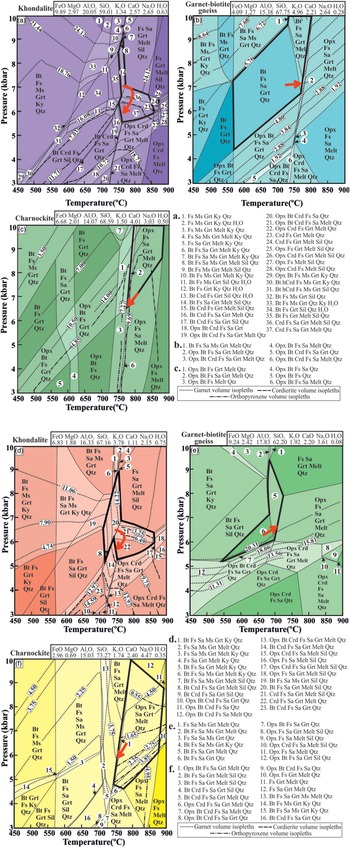
NCKFMASH P-T pseudosections of khondalites (a and d), garnet-biotite gneisses (b and e) and charnockites (c and f). (a–c) Southern Madurai Block; (d–f) Trivandrum Block. The diagrams show stable mineral assemblages in the P-T window of 3–10 kbar and 450–900 °C. The molar proportions of element oxides used in the computations are shown in a box at the top of each diagram. Area marked with black bold line represents the texturally relevant stable phase assemblages used in reconstructing the P-T path. Red arrows show the possible clockwise P-T paths experienced by the rocks. Mineral abbreviations are after Kretz (Reference Kretz1983), except Fs – feldspar.

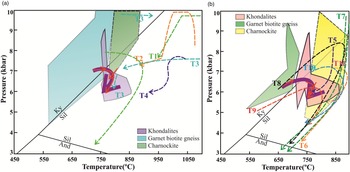
Summary diagram showing P-T path from the (a) Southern Madurai and (b) Trivandrum blocks. The texturally relevant stable phase assemblages from each P-T psuedosection and P-T paths (in red) are combined (shown with black bold line and red arrow in Fig. 6) to construct a common P-T path. Bold purple arrow shows the possible clockwise P-T path experienced by the rocks. P-T paths from previous studies are drawn for reference. T1: Tateishi et al. (Reference Tateishi, Tsunogae, Santosh and Janardhan2004); T2: Tsunogae & Santosh (Reference Tsunogae and Santosh2006); T3: Braun et al. (Reference Braun, Cenki-Tok, Paquette and Tiepolo2007); T4: Tsunogae & Santosh (Reference Tsunogae and Santosh2010); T5: Blereau et al. (Reference Blereau, Clark, Taylor, Johnson, Fitzsimons and Santosh2016); T6: Shabeer et al. (Reference Shabeer, Sajeev, Okudaira and Santosh2002); T7: Tadokoro et al. (Reference Tadokoro, Tsunogae and Santosh2008); T8: Kröner et al. (Reference Kröner, Santosh, Hegner, Shaji, Geng, Wong, Xie, Wan, Shang, Liu and Sun2015); T9: Chacko et al. (Reference Chacko, Ravindra Kumar and Newton1987); T10: Kadowaki et al. (Reference Kadowaki, Tsunogae, He, Santosh, Takamura, Shaji and Tsutsumi2019); T11: Wang et al. (Reference Wang, Zhai, He, George, Sajeev, Jiao, Liu and Guo2021). Relative stability fields of kyanite-sillimanite-andalusite are marked for reference.

The chemical system NCKFMASH (Na2O-CaO-K2O-FeO-MgO-Al2O3-SiO2-H2O) was chosen for P-T psuedosection construction. The calculation involves the following phases and phase components (in square brackets): garnet, Gt [alm, py, gr]; cordierite, hCrd [crd, fcrd, hcrd]; biotite, Bio [ann, phl, east]; mica [mu, pa, cel, ma]; pyroxene, Opx [mgts, en, fs]; spinel, Sp [sp, herc]; melt, Melt [fo8L, fa8L, kspL, h2oL, abL, sil8L, anL, q8L]; feldspar, Pl [abh, an]; K-feldspar, Kfs [san]; sillimanite [sill]; kyanite [ky]; and quartz [q] (mineral abbreviations as per Connolly, Reference Connolly2005). The details of the solution models are available in solution_model.dat; PERPLEX 6.8.7; database: hp62ver.dat. The solution models adopted are Gt(HP), Mica(CHA), Bio(TCC), feldspar, San, hCrd, Opx(HP), Sp (HP) and melt(HP). In the P-T psuedosection, the phase topologies are computed in the P-T window extending over 450–900 °C and 3–10 kbar (Fig. 6).
5.b.1. Southern Madurai Block
The whole-rock composition (in wt%) used for constructing the P-T psuedosections for khondalite (PP-78), garnet-biotite gneiss (TV-9A) and charnockite (PP-77) are provided in Figure 6a–c. MnO concentration in all rock types was very low (0.15 wt% in khondalite, 0.08 wt% garnet-biotite gneiss and 0.12 wt% in charnockite); it is neglected in the phase equilibria modelling because of its negligible effect on phase stability. Moreover, Fe-Ti oxides are rare in the studied samples (PP-78, TV-9A and PP-77) and TiO2 wt% is therefore very low (< 0.1 wt%) in bulk.
In pseudosection modelling, the fields of interest in khondalite, that is, garnet, biotite, sillimanite, cordierite, quartz, plagioclase, K-feldspar and melt-bearing assemblages, are confined to the P-T window, ranging over 730–850 °C and 5.5–9 kbar (Fig. 6a). Sillimanite and cordierite are stable at T > 500 °C, and biotite is stable at T < 750 °C (Fig. 6a). The mineral assemblages in garnet-biotite gneiss, that is, garnet, biotite, plagioclase, K-feldspar and quartz with/without melt, has a stability field at 580–800 °C and 5–10 kbar (Fig. 6b). The stability field of mineral assemblage, that is, garnet, biotite, orthopyroxene, plagioclase, K-feldspar, quartz ± melt in charnockite, ranges over 750–850 °C and 6.5–10 kbar (Fig. 6c). The P-T range of stable mineral assemblages in all psuedosections fall well within the range of mineral thermobarometers. According to the phase diagram (Fig. 6), the melt generation in khondalites, garnet-biotite gneisses and charnockites occurs at T > 700 °C.
Stability fields of equilibrium mineral assemblages in the three rock types from the SMB are different, but there is a region of overlap (Fig. 7a) suggesting peak P-T conditions of metamorphism ranging over 720–780 °C and 6–7 kbar. From the petrographic studies, three stages of mineral growth are clearly identified and, based on sillimanite breakdown and cordierite-forming reactions, the P-T path was constructed for khondalites. The direction of the path was determined by considering volume isopleths of garnet and cordierite, where the cordierite volume increase and garnet volume decrease (Figs 6a, 7a). Along the P-T path for khondalite, the mineral assemblage changes from garnet + biotite + plagioclase + K-feldspar + sillimanite + quartz + melt (Crd-free) to garnet + cordierite + plagioclase + K-feldspar + sillimanite + quartz + melt (cordierite-bearing, biotite absent) to garnet + cordierite + plagioclase + K-feldspar + quartz + melt (cordierite-bearing, biotite and sillimanite absent). Since there are no specific mineral assemblages to signify the P-T path in garnet-biotite gneisses, the path is drawn in the direction of melt formation (Figs 6b, 7a). In charnockites the P-T path follows the direction of orthopyroxene breakdown to biotite (Figs 6c, 7a). Since all the lithologies are very closely spaced in the field, it is assumed that all the rocks underwent the same P-T evolution, so individual P-T paths were combined to produce a final P-T path. Based on textural relationships, mineral chemistry, P-T calculations and phase equilibrium modelling, a clockwise P-T path is deduced from the khondalite, garnet-biotite gneiss and charnockite of the SMB (Fig. 7a). The retrieved P-T path signifies an initial heating and loading followed by decompression and slow cooling at 720–780 °C temperature and 6–7 kbar pressure (Fig. 7a). The prograde part in the estimated P-T path is consistent with the melt generation that occurred during D3 deformation, and the decompression part is consistent with the growth of cordierite and breakdown of sillimanite in khondalites, and replacement of orthopyroxene by biotite in charnockites with reducing pressure (Fig. 7a).
5.b.2. Trivandrum Block
From the TB, one khondalite (PP-33), one garnet-biotite gneiss (TV-291) and one charnockite (TV-304) were used for P-T path reconstruction. The charnockite chosen for the P-T pseudosection modelling is garnet-bearing, which is uncommon in the TB as described in the petrography. The commonly occurring charnockites in the TB are garnet-free and contain clinopyroxene and hornblende. The whole-rock composition (in wt%) is provided in Figure 6d–f. Similar to the case of the SMB samples, the MnO concentration is neglected from the phase equilibria modelling because of its low concentration in all the samples (0.06 wt% in khondalite, 0.10 wt% garnet-biotite gneiss and 0.04 wt% in charnockite). Also similar to the SMB, Fe-Ti oxides are sparse (TiO2 < 0.1 wt% in the bulk) in the studied samples (PP-33, TV-291 and TV-304), and were therefore excluded from the pseudosection modelling.
In khondalite, the stable mineral assemblages were observed over the wide P-T window of 700–860 °C and 5–9 kbar (Fig. 6d). Similar to the SMB, in the khondalite P-T psuedosection from the TB, sillimanite is stable at T > 500 °C, cordierite is stable at T > 700 °C and biotite is stable at T < 750 °C (Fig. 6d). The stable mineral assemblages in garnet-biotite gneiss (with equilibrium mineral assemblages of garnet, biotite, quartz, plagioclase, K-feldspar ± melt) is stable over a P-T range of 550–740 °C and 5.5–9 kbar (Fig. 6e). The distinctive stable mineral assemblages present in charnockites, that is, garnet, biotite, orthopyroxene, plagioclase, K-feldspar and quartz with/without melt, were stable within a P-T window of 720–880 °C and 4.5–10 kbar (Fig. 6f). The P-T range of stable mineral assemblages in all psuedosections matches the data obtained from mineral thermobarometers except for khondalites, where the stable mineral assemblages extend a little towards the higher temperature side. For the construction of P-T path in khondalite, garnet-biotite gneiss and charnockite, similar criteria are adopted as in the SMB and a common metamorphic P-T path was constructed by combining all the P-T paths (Fig. 7b). The clockwise P-T path indicates initial heating and loading followed by decompression and cooling within a P-T of 660–770 °C and 5.5–6.5 kbar (Fig. 7b). Similar to the SMB, the clockwise path obtained in this case indicates an initial prograde path followed by the decompression exhumation.
6. Monazite geochronology
Samples from the SMB and TB were analysed using CAMECA SX-FIVE Electro Probe Micro Analyser (EPMA) in the Department of Earth Sciences, Indian Institute of Technology Mumbai, India (analytical protocols after Suzuki et al. Reference Suzuki, Adachi and Tanaka1991; Montel et al. Reference Montel, Foret, Veschambre, Nicollet and Provost1996; Cocherie et al. Reference Cocherie, Legendre, Peucat and Kouamelan1998; Williams et al. Reference Williams, Jercinovic and Terry1999; Pyle et al. Reference Pyle, Spear, Wark, Daniel and Strom2005). The U–Th–total Pb age determination was carried out with a beam current regulated at 200 nA, acceleration voltage at 20 kV and 1 μm beam diameter. X-ray element mapping was carried out using an accelerating voltage of 20 kV, beam current of 100 nA, 0.3–0.5 μm/pixel step size and a dwell time of 60 ms/pixel. Synthetic standards (LaLa, CeLa, PrLb, NdLb, SmLa, GdLb, DyLa, HoLb, YLa, ThMa, UMb, PbMa and SiKa) as well as natural standards (AlKa, FeKa and CaKa) were used for calibration. The Ma line is considered for Th analysis because of insignificant interferences (Suzuki & Kato, Reference Suzuki and Kato2008). To obtain the maximum number of counts on peak and background positions Pb, U and Th were simultaneously analysed with LPET and PET crystals. The counting time on the LPET crystals is 300 s, and on the PET crystals is 180 s for PbMa, 200 s for ThMa and 120 s for UMb, with half of the peak time given for background measurement. Longer counting times were used for Th, U and Pb to avoid surficial damage of the samples, and a sub-counting option was chosen to obtain an exact measurement of the peak-background counts (Spear et al. Reference Spear, Pyle and Cherniak2009). Beam and spectrometer drifts were checked regularly during the analysis. Detailed analytical protocols for U–Th–total Pb age calculations in monazites are described by Prabhakar (Reference Prabhakar2013), Deshmukh et al. (Reference Deshmukh, Prabhakar, Bhattacharya and Madhavan2017) and Hrushikesh et al. (Reference Hrushikesh, Prabhakar and Bhattacharya2019). The ages were calculated with an error of 2σ (95% confidence). For details of the errors (± 2σ; < 8% of the calculated spot ages) and analysed samples and ages see online Supplementary Table S2 (available at http://journals.cambridge.org/geo). The age data were plotted using Isoplot/Ex program (Ludwig, Reference Ludwig2003).
In general, monazites are produced as a result of the fluid-induced dissolution and re-precipitation process over a wide range of temperatures, especially below the blocking temperature (> 850 °C) of intracrystalline U–Pb diffusion (Cherniak et al. Reference Cherniak, Watson, Grove and Harrison2004; Gardés et al. Reference Gardés, Jaoul, Montel, Seydoux-Guillaume and Wirth2006, Reference Gardés, Montel, Seydoux-Guillaume and Wirth2007). Significant Pb loss can occur during monazite precipitation depending on the fluid composition and temperature, meaning that the newly formed rim can provide the age of that particular deformation representing a core to rim structure (Gardés et al. Reference Gardés, Jaoul, Montel, Seydoux-Guillaume and Wirth2006). Several experimental studies have suggested that monazite can retain Pb through high-grade metamorphic episodes (Bingen and Van Breemen Reference Bingen and Van Breemen1998; Braun et al. Reference Braun, Montel and Nicollet1998; Cocherie et al. Reference Cocherie, Legendre, Peucat and Kouamelan1998; Brugier et al. Reference Brugier, Bosch, Pidgeon, Byrne and Harris1999; Kalt et al. Reference Kalt, Corfu and Wijbrans2000; Bosch et al. Reference Bosch, Hammor, Bruguier, Caby and Luck2002; Cherniak et al. Reference Cherniak, Watson, Grove and Harrison2004). According to Spear & Parrish (Reference Spear and Parrish1996), Pb is relatively immobile under granulite-facies conditions. High-Pb retention in granulite-facies xenoliths from kimberlites that experienced T > 1000 °C were reported by Schmitz & Bowring (Reference Schmitz and Bowring2003). Monazites aligned parallel to the fabrics, overgrowing the fabrics, hosted within garnet and/or located at the grain boundaries of recrystallized minerals are considered to be metamorphic in origin (Fig. 8). The ages obtained from these monazites therefore provide some geologically meaningful metamorphic events. However, because of the coarse-grain nature of the rock and the presence of centimetre-scale-wide gneissic layers in high-grade terranes, it is not easy to interpret the tectonic significance of all the chemical ages. Because of the deficiency of infiltrating fluids, monazites hosted within quartz and feldspar (non-hydrous) can better preserve primary ages than the monazites hosted within biotite (hydrous) aggregates. The concentration of Thorium is commonly high (ThO2: 7–12 wt%) in these monazites. The percentage error [(2σ error in Ma/age in Ma) × 100] increases with decreasing Th content in monazites, that is, there exists an inverse relationship between the Th content and the 2σ error in spot ages (Vlach, Reference Vlach2010).
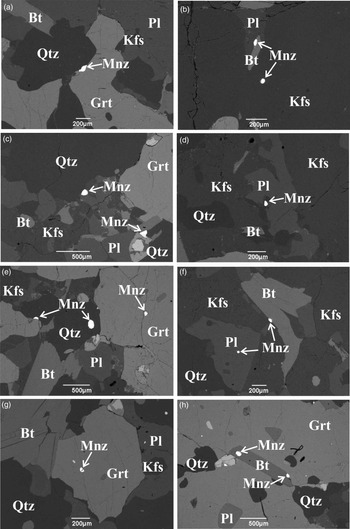
Backscattered electron images showing the textural settings of monazites in various rock types of the (a–d) Southern Madurai Block and (e–h) Trivandrum Block. (a) Monazite at the interface between quartz and garnet in garnet-biotite gneiss. (b) One monazite growing parallel to the fabric-defining biotite and the other hosted within K-feldspar in garnet-biotite gneiss. (c) One monazite (bottom left) overgrowing the fabric-defining biotite and the other monazite (in the middle) occurs at the interface between quartz and recrystallized plagioclase in garnetiferous charnockite. (d) Monazite hosted within the recrystallized quartz-plagioclase matrix in garnetiferous charnockite. (e) Monazites within quartz (middle), garnet (right) and at the interphase between quartz and garnet (left) in khondalite. (f) Monazite within recrystallized plagioclase (bottom left) and growing parallel to the fabric-defining biotite (middle) in khondalite. (g) Monazites within garnet in garnet-biotite gneiss. (h) Monazite included in biotite hosted within garnet in garnet-biotite gneiss.

6.a. Southern Madurai Block
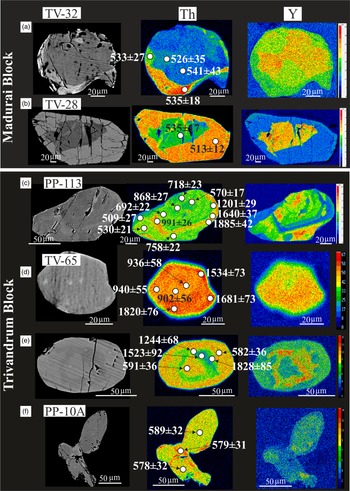
From the SMB, three garnet-biotite gneisses (TV-9C, TV-28 and TV-32) and one garnet-bearing charnockite (PP-77) were analysed (Fig. 2). In the garnet-biotite gneisses the monazite grains are subhedral to anhedral in shape and the length ranges over 80–200 µm (Fig. 8a, b). Compared with garnet-biotite gneiss, the monazite grains in charnockite are sparse and smaller in size with length ranging over 20–100 μm and anhedral in shape (Fig. 8c, d). In garnet-biotite gneisses, monazite grains are hosted within the cores as well as rims of garnet porphyroblasts, aligned parallel to or overgrowing the biotite and lodged at the margins of K-feldspars, plagioclase and quartz (Fig. 8a, b). In garnetiferous charnockite, monazites mostly occur within or at the periphery of K-feldspar, plagioclase and quartz; in rare cases, monazites are hosted within garnet, orthopyroxenes and biotite aggregates (Fig. 8c, d). Monazite grains of the SMB are invariably zoned from core to rim for Th and Y; the core is Y-rich and Th-poor, and the rim is Y-poor and Th-rich (Fig. 9a, b). U and Pb variations are either lacking or else exhibit significantly weaker chemical zoning relative to Th and Y.
Th and Y X-ray element maps and backscattered electron images of representative monazites from the (a, b) Southern Madurai Block, hosted in the matrix of garnet-biotite gneisses, and the (c–f) Trivandrum Block. Hosted within (c, d, f) garnet and (e) matrix of khondalites. White circles and keyed numbers are locations of analysed spots and spot ages (± 2σ error) in Ma, respectively.

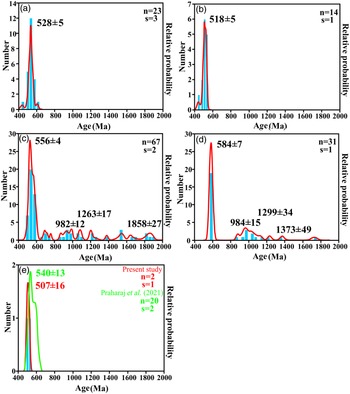
A total of 23 spots were analysed on monazite grains from the garnet-biotite gneisses and 14 spots were analysed from garnet-bearing charnockite. Monazites from garnet-biotite gneisses of the SMB yielded one distinct age peak at 528 ± 5 Ma (Fig. 10a). Similarly, monazites from garnet-bearing charnockite yielded a prominent age peak at 518 ± 5 Ma (Fig. 10b). All the obtained chemical ages from the SMB were consistently late Neoproterozoic – Cambrian, irrespective of chemical zoning and textural association.
Probability density plots of monazite age data from different lithologies of the study area (sample locations in Fig. 2). Data from (a) garnet-biotite gneisses and (b) garnetiferous charnockites from the Southern Madurai Block and from (c) khondalites and (d) garnet-biotite gneisses from the Trivandrum Block. (e) Date from the Achankovil Shear Zone khondalite obtained from the present study (in red) and the monazite age data from garnet-biotite gneisses by Praharaj et al. (Reference Praharaj, Rekha and Bhattacharya2021) (in green) are plotted. Number of samples analysed (s) and number of spot ages (n). Errors are in ± 2σ.

6.b. Trivandrum Block
Three samples (Fig. 2) were selected for monazite analysis from the TB, of which two were khondalites (TV-65 and PP-113) and one was garnet-biotite gneiss (PP-10A). A total of 67 spots were analysed on monazite grains from khondalites and 31 spots were analysed from garnet-biotite gneiss. Monazites from khondalites are euhedral to subhedral in shape, larger in size (length c. 100–200 µm and width c. 50–100 µm), hosted within the cores and rims of garnet porphyroblasts, and occur along the flaky biotite and sillimanite and the margins of cordierite, plagioclase, K-feldspar and quartz (Fig. 8e, f). In the garnet-biotite gneiss, the monazite grains are mostly hosted within the cores and rims of garnets and fractures and cleavages of feldspars and quartz, overgrowing the fabric-defining biotite. They are subhedral to anhedral with long axis ranging over 100–250 µm and short axis ranging over 50–150 µm (Fig. 8g, h). Monazites from the TB were invariably zoned in Th and Y with patchy chemical zones (Fig. 9c–f), but the spot ages did not show any dependence on the chemical zoning (Fig. 9c–f).
Spot chemical ages of monazites from khondalites yielded a prominent age peak at 556 ± 4 Ma (Fig. 10c). Other less-prominent age populations are also present, for example, 1858 ± 27 Ma, 1263 ± 17 Ma and 982 ± 12 Ma (Fig. 10c). The probability density plot for garnet-biotite gneiss yielded one prominent age peak at 584 ± 7 Ma and three unmixed ages at 1373 ± 49 Ma, 1299 ± 34 Ma and 984 ± 15 Ma (Fig. 10d).
6.c. Achankovil Shear Zone system
Monazite grains from khondalites (TV-22) of the AKSZ (sample location in Fig. 2) are euhedral in shape, randomly distributed in garnet porphyroblasts, occur along the grain boundaries of plagioclase, quartz, K-feldspar and cordierites, and are overgrowing, aligned parallel to or included within biotite and sillimanite aggregates. Irrespective of their patchy and nebulous zoning in Th and Y, two monazite spot ages from the AKSZ gave a single prominent age peak at 507 ± 16 Ma (Fig. 10e).
7. Discussion
7.a. Metamorphic P-T evolution
Khondalites, garnet-biotite gneisses and charnockites, the dominant lithologies from the TB and SMB, show evidence of high-T deformation in the form of dynamic recrystallization manifested by aggregates of xenoblastic minerals, triple junctions and granoblastic texture. Triple junctions sharing straight grain/phase boundaries indicate high-T annealing by grain-boundary area reduction (Altenberger, Reference Altenberger1992). Cuspate- and lobate-shaped grains were produced as a result of grain-boundary migration recrystallization with increasing temperature and decreasing flow stress (Passchier & Trouw, Reference Passchier and Trouw2005). These grain-size modifications in quartz and feldspars are mainly due to the deformation at high-grade conditions, possibly the result of solid-state diffusive mass transfer (Passchier & Trouw, Reference Passchier and Trouw2005). The textural relations imply that deformation at high-T induced grain-boundary-slip-accommodated dynamic recrystallization, and consequently randomized the grain shape and orientation. Polygonization or annealing recrystallization was limited in all rocks. Across both the SMB and TB, granulite-facies mineral assemblages retrogressed at a later stage.
There are no significant compositional variations in minerals present in different lithounits of the TB and SMB. Garnets are mostly almandine-rich and biotite compositions vary between phlogopite and annite in garnet-biotite gneisses, khondalites and charnockites of the TB and SMB. Orthopyroxenes in charnockites are ferrosilite-rich in the TB and enstatite-rich in the SMB. Plagioclase feldspars are oligoclase to andesine in composition in all three rock types of the TB and SMB.
In the SMB, the temperature conditions estimated by using garnet-biotite thermometry range over 600–780 °C in garnet-biotite gneisses and 600–650 °C in khondalites. The garnet-biotite thermometers provided slightly lower temperatures for khondalites compared with the garnet-biotite gneisses. The temperature of 830 °C yielded by the garnet-cordierite thermometer from khondalites is comparatively higher than the temperature obtained from garnet-cordierite granulite (650–740 °C) of the SMB (Tsunogae & Santosh, Reference Tsunogae and Santosh2010). The higher temperature indicates melting of phase-1 assemblages and the formation of garnet-cordierite (Crd1) assemblage in khondalites. Temperatures obtained from charnockites using garnet-orthopyroxene thermometry (740–860 °C) are comparable with the temperatures (710–820 °C) obtained by Endo et al. (Reference Endo, Tsunogae, Santosh and Shaji2012). Metamorphic pressures obtained from the SMB (5–8 kbar) by multiple barometers are consistent with earlier studies (7–8 kbar; Tateishi et al. Reference Tateishi, Tsunogae, Santosh and Janardhan2004; Tsunogae & Santosh, Reference Tsunogae and Santosh2010).
In the TB, the temperatures obtained from charnockites (720–880 °C) using the garnet-orthopyroxene thermometer is identical to that obtained in earlier studies (810–870 °C; Endo et al. Reference Endo, Toshiaki, Santosh, Shimizu and Shaji2013; Wang et al. Reference Wang, Zhai, He, George, Sajeev, Jiao, Liu and Guo2021). Temperatures estimated by garnet-biotite thermometry in garnet-biotite gneisses (615–770 °C) and khondalites (630–720 °C) are similar to that reported by Chacko et al. (Reference Chacko, Ravindra Kumar and Newton1987) (650–800 °C) using the same method. The 780 °C temperatures obtained from khondalites using garnet-cordierite (Crd1) thermometry is close to the c. 815 °C reported by Morimoto et al. (Reference Morimoto, Santosh, Tsunogae and Yoshimura2004), while it is slightly lower compared with the 860–960 °C reported by Shabeer et al. (Reference Shabeer, Sajeev, Okudaira and Santosh2002). Pressures estimated using various barometers range over 5–8 kbar and are consistent with the values reported by Shabeer et al. (Reference Shabeer, Sajeev, Okudaira and Santosh2002), Blereau et al. (Reference Blereau, Clark, Taylor, Johnson, Fitzsimons and Santosh2016) and Sorcar et al. (Reference Sorcar, Joshi, Oliveira, Tomson and Nandakumar2020), but higher than the 4.5–5.5 kbar reported by Bindu (Reference Bindu1997). The metamorphic temperatures obtained from different lithologies using various thermometers range over 600–860 °C for the SMB and 615–880 °C for the TB. Similar to temperature, the estimated pressures from both the TB and SMB are of same range (5–8 kbar).
The phase equilibrium modelling from the SMB and TB using khondalites, garnet-biotite gneisses and charnockites provided clockwise P-T paths that are consistent with the field and petrographic observations. With the exception of Braun et al. (Reference Braun, Cenki-Tok, Paquette and Tiepolo2007), all other researchers (Tateishi et al. Reference Tateishi, Tsunogae, Santosh and Janardhan2004; Tsunogae & Santosh, Reference Tsunogae and Santosh2006, Reference Tsunogae and Santosh2010) proposed an anticlockwise P-T trajectory for the sapphirine-bearing granulites from the SMB. The clockwise P-T path estimated by Braun et al. (Reference Braun, Cenki-Tok, Paquette and Tiepolo2007) from sapphirine-bearing granulites has a higher P-T range compared with this study (Fig. 7a). In the TB, all estimated clockwise P-T paths (with the exception of that in Chacko et al. Reference Chacko, Ravindra Kumar and Newton1987) were at a higher P-T range (Nandakumar & Harley, Reference Nandakumar and Harley2000; Shabeer et al. Reference Shabeer, Sajeev, Okudaira and Santosh2002; Cenki et al. Reference Cenki, Braun and Brocker2004; Collins et al. Reference Collins, Clark and Plavsa2014; Clark et al. Reference Clark, Healy, Johnson, Collins, Taylor, Santosh and Timms2015; Johnson et al. Reference Johnson, Clark, Taylor, Santosh and Collins2015; Blereau et al. Reference Blereau, Clark, Taylor, Johnson, Fitzsimons and Santosh2016; Wang et al. Reference Wang, Zhai, He, George, Sajeev, Jiao, Liu and Guo2021) than this study. Blereau et al. (Reference Blereau, Clark, Taylor, Johnson, Fitzsimons and Santosh2016) suggested a clockwise P-T path by combining garnet-biotite gneiss, charnockite and metapelitic gneiss from a single location where the charnockitization was in progress (Fig. 7b). The P-T paths obtained by Shabeer et al. (Reference Shabeer, Sajeev, Okudaira and Santosh2002), Tadokoro et al. (Reference Tadokoro, Tsunogae and Santosh2008), Kröner et al. (Reference Kröner, Santosh, Hegner, Shaji, Geng, Wong, Xie, Wan, Shang, Liu and Sun2015), Kadowaki et al. (Reference Kadowaki, Tsunogae, He, Santosh, Takamura, Shaji and Tsutsumi2019) and Wang et al. (Reference Wang, Zhai, He, George, Sajeev, Jiao, Liu and Guo2021) using different rock types such as Mg-Al metapelites, migmatitic pelitic granulite, charnockite and khondalite, respectively, are almost identical to or at a higher P-T range compared with this study. The similar clockwise P-T paths obtained from the SMB and TB represent the last deformation and metamorphic event shared between the SMB and TB during their accretion along the AKSZ. Most of the earlier metamorphic signatures were overprinted during this high-grade metamorphic event.
7.b. Timing of deformation and metamorphism
Dissolution and reprecipitation of monazites are common processes during deformation (Williams et al. Reference Williams, Jercinovic and Hetherington2007, Reference Williams, Jercinovic, Harlov, Budzyń and Hetherington2011) and most of the monazite grains from the SMB appeared to have been dissolved and reprecipitated during the last deformation that occurred during late Neoproterozoic – Cambrian time. Monazites from all the rock types of the SMB provide robust ages at c. 528 and 518 Ma, and older ages are completely absent. However, the monazites from the TB did not undergo complete reprecipitation except in parts. Monazites from different lithologies of the TB provided prominent peaks at c. 584 and 556 Ma with other less-prominent age populations at c. 1850, 1370, 1275 and 980 Ma. The age data obtained here are in good agreement with the available data (Praharaj et al. Reference Praharaj, Rekha and Bhattacharya2021). The tectonic significance of all the age populations could not be explained in relation to the deformation in the TB because of the coarse-grained nature of the rock and the centimetre-wide gneissic layers. In such coarse-grained rocks with wide gneissic layers, it is difficult to correlate the monazite growth with deformation and the associated metamorphic event.
Published Pb–Pb zircon age data suggest that during 800–700 Ma the SMB experienced widespread igneous activities and metamorphism (Ghosh et al. Reference Ghosh, de Wit and Zartman2004; Braun & Appel Reference Braun and Appel2006; Santosh et al. Reference Santosh, Maruyama and Sato2009, Reference Santosh, Hua, He, Li, Tsunogae, Shaji and Indu2017; Plavsa et al. Reference Plavsa, Collins, Foden, Kropinski, Santosh, Chetty and Clark2012; Li et al. Reference Li, Santosh, Indu, Shaji and Tsunogae2016), whereas these ages are not very common in the TB. In addition, the SMB lacks the prominent Palaeoproterozoic ages (c. 2.1 Ga) present in the TB (Santosh et al. Reference Santosh, Collins, Morimoto and Yokoyama2005 a; Kröner et al. Reference Kröner, Santosh, Hegner, Shaji, Geng, Wong, Xie, Wan, Shang, Liu and Sun2015). However, both terranes record strong imprints of late Neoproterozoic – Cambrian metamorphic ages (Praharaj et al. Reference Praharaj, Rekha and Bhattacharya2021). The difference in chronology also supports the fact that the TB and SMB evolved differently prior to their accretion along the AKSZ during late Neoproterozoic – Cambrian time.
7.c. Tectonic implications
The integrated structural, metamorphic and chronological analysis combined with the existing data allowed the tectonothermal evolution of the TB and SMB across the AKSZ to be determined. The structural studies reveal that the SMB granulite-facies rocks describe steeply plunging reclined F2 tight folds with NNW/NW-trending axial planes, whereas the TB granulites show gently plunging open F2 folds with moderately dipping WNW-trending axial planes in regional scale. The last deformation (D3) shared by the TB and SMB during their accretion along the AKSZ produced NNW/NNE-trending subparallel sinistral and dextral S3 shears on the SMB and TB. The garnet-bearing melt-hosted syn-D3 conjugate shears attest to the prevalence of granulite-facies anatectic conditions during the D3 deformation in both the SMB and TB. The metamorphic P-T conditions obtained from different lithologies of the SMB and TB provide similar temperature and pressure estimates (c. 600–880 °C and 5.0–8.0 kbar) as well as similar clockwise P-T paths with an initial prograde path followed by a later decompression path. The initial heating and loading could be the result of the thrusting, and the later decompression path could be the result of rapid uplift or crustal thinning. Post-collisional extension and associated mafic magmatism from a suite of gabbroic rocks were reported from the TB by Yang et al. (Reference Yang, Ganguly, Shaji, Dong and Nandakumar2019), and the change in the tectonic regime from a compressional to an extensional setting might have caused the rapid uplift and retrogression. The lack of early metamorphic signatures may be the manifestation of high-grade metamorphism and melting during the D3 event. The monazite ages obtained from the TB are slightly older (c. 584 and 556 Ma) than the monazite ages obtained from the SMB (c. 528 and 518 Ma). The c. 584–556 Ma TB ages can be attributed to the initial thickening and high-grade metamorphism of the orogen, whereas the slightly younger ages (c. 528–518 Ma) from the SMB could be the result of the decompression of overthickened orogen. This diachroneity in ages was also well documented in the NMB (Plavsa et al. Reference Plavsa, Collins, Foden and Clark2015). The late Neoproterozoic – Cambrian monazite ages obtained from different lithologies of the TB and SMB are similar to the age population obtained from the AKSZ. These strong late Neoproterozoic – Cambrian imprints on monazites from all lithounits of the TB and SMB suggests that both these blocks were accreted along the AKSZ during the Pan-African Orogeny and most of the monazites reprecipitated during the last deformation (D3) occurred at high-grade conditions associated with the accretion.
The results from our study reveal multiple deformation in the TB and SMB during the late Neoproterozoic – Cambrian period. Along with the structural discordance, the differences in chronology, metamorphic P-T range and geochemistry support the fact that the TB and SMB evolved separately before their accretion along the AKSZ during the Pan-African Orogeny. The data obtained here combined with the structural data from Praharaj et al. (Reference Praharaj, Rekha and Bhattacharya2021) suggest that the northern block (SMB) subducted below the block (Trivandrum and Nagercoil blocks) south of it (Fig. 11). The initial loading and heating and later decompression P-T path obtained from both the SMB and TB also support this. In the TB, the cooling and decompression path might have developed as a result of the post-collisional extension and crustal thinning as suggested by Yang et al. (Reference Yang, Ganguly, Shaji, Dong and Nandakumar2019). Figure 11 depicts a modified tectonic model based on the new structural and metamorphic data. The present observation is in very good agreement with the tectonic model proposed by Rajesh et al. (Reference Rajesh, Arai, Satish-Kumar, Santosh and Tamura2013), except for the orientation of the shear zone, and also with that proposed by Naganjaneyulu & Santosh (Reference Naganjaneyulu and Santosh2011). Rajesh et al. (Reference Rajesh, Arai, Satish-Kumar, Santosh and Tamura2013) suggested S-wards subduction of the SMB based on geochemical studies from spinel dunite present in the accretionary complex, and the occurrence of ultramafic cumulates as dismembered units at several localities. Based on seismic reflection and MT data, Naganjaneyulu & Santosh (Reference Naganjaneyulu and Santosh2011) suggested a tectonic model in which the predominantly S-dipping seismic reflectors beneath the SMB define a prominent S-dipping lithological layering, explained by imbricate structures or mega duplexes developed during the S-wards subduction of an oceanic plate. The present model corroborates the S-wards dipping model and deviates from the previously proposed N-wards subduction model, that is, the SMB is the overriding plate proposed by Santosh et al. (Reference Santosh, Hua, He, Li, Tsunogae, Shaji and Indu2017) and Yang et al. (Reference Yang, Ganguly, Shaji, Dong and Nandakumar2019) based on geochemical data. The arc magmatism signatures along the southern margin of the SMB (Santosh et al. Reference Santosh, Hua, He, Li, Tsunogae, Shaji and Indu2017) and the mafic magmatism associated with post-collisional extension in the TB (Yang et al. Reference Yang, Ganguly, Shaji, Dong and Nandakumar2019) were the main reasons for the N-wards subduction model. The new data from the present study provide an insight into the subduction–accretion–collision tectonics associated with the late Neoproterozoic – Cambrian evolutionary history of this region.
Schematic plate tectonic model across the Achankovil Shear Zone (modified after Rajesh et al. Reference Rajesh, Arai, Satish-Kumar, Santosh and Tamura2013) illustrating Neoproterozoic–Cambrian tectonic evolution of the Southern Madurai and Trivandrum blocks. Structural evidence in support of the S-wards subduction model is incorporated in the diagram (details in Praharaj et al. Reference Praharaj, Rekha and Bhattacharya2021).

8. Correlation with south-central Madagascar
Southern and central Madagascar have similar granulite-facies lithologies (Windley et al. Reference Windley, Razafiniparany, Razakamanana and Ackermand1994; Ito et al. Reference Ito, Suzuki and Yogo1997; de Wit et al. Reference de Wit, Bowring, Ashwal, Randrianasolo, Morel and Rambeloson2001; Horton et al. Reference Horton, Hacker, Kylander-Clark, Holder and Jons2016; Giese et al. Reference Giese, Schreurs, Berger and Herwegh2017). The basement rocks of central Madagascar reveal two deformation events. The D1 deformation is characterized by N–S-striking foliations that dip gently to the west and W- to WSW-plunging lineations, whereas the second (D2) deformation is characterized by steep NNE–SSW-striking foliations and sub-horizontal or gently SSW-plunging lineations (Nédélec et al. Reference Nédélec, Paquette, Bouchez, Olivier and Ralison1994, Reference Nédélec, Ralison, Bouchez and Grégoire2000; Fernandez & Schreurs, Reference Fernandez, Schreurs, Yoshida, Windley and Dasgupta2003; Fernandez et al. Reference Fernandez, Schreurs, Villa, Huber and Rakotondrazafy2003; Armistead et al. Reference Armistead, Collins, Redaa, Jepson, Gillespie, Gilbert, Blades, Foden and Razakamanana2020). Different from central Madagascar, the D1 deformation in southern Madagascar shows flat-lying granulitic foliations with isoclinal folds and E–W-plunging lineations, whereas the D2 deformation developed vertical N–S foliations with refolding of D1 fabrics and lineations on sub-vertical planes gently N- and S-dipping (Nédélec et al. Reference Nédélec, Paquette, Bouchez, Olivier and Ralison1994, Reference Nédélec, Ralison, Bouchez and Grégoire2000; Martelat et al. Reference Martelat, Nicollet, Lardeaux, Vidal and Rakotondrazafy1997, Reference Martelat, Lardeaux, Nicollet and Rakotondrazafy1999, Reference Martelat, Lardeaux, Nicollet and Rakotondrazafy2000; Lardeaux et al. Reference Lardeaux, Martelat, Nicollet, Pili, Rakotondrazafy and Cardon1999; Fernandez & Schreurs, Reference Fernandez, Schreurs, Yoshida, Windley and Dasgupta2003; Fernandez et al. Reference Fernandez, Schreurs, Villa, Huber and Rakotondrazafy2003; Armistead et al. Reference Armistead, Collins, Redaa, Jepson, Gillespie, Gilbert, Blades, Foden and Razakamanana2020). Steeper lineations are rarely found (Martelat et al. Reference Martelat, Nicollet, Lardeaux, Vidal and Rakotondrazafy1997, Reference Martelat, Lardeaux, Nicollet and Rakotondrazafy1999, Reference Martelat, Lardeaux, Nicollet and Rakotondrazafy2000; Lardeaux et al. Reference Lardeaux, Martelat, Nicollet, Pili, Rakotondrazafy and Cardon1999). Melt-filled D3 shears with both dextral and sinistral shear sense are reported from both southern and central Madagascar (Martelat et al. Reference Martelat, Nicollet, Lardeaux, Vidal and Rakotondrazafy1997; Nédélec et al. Reference Nédélec, Ralison, Bouchez and Grégoire2000). Similar to the SMB and TB, southern and central Madagascar also shows structural discordances. The D2 deformation in central Madagascar developed NNE-striking foliations and sub-horizontal to gently SSW-plunging lineations, whereas in southern Madagascar the D2 deformation developed vertical N–S-striking foliations and gently N- and S-dipping lineations (Nédélec et al. Reference Nédélec, Paquette, Bouchez, Olivier and Ralison1994, Reference Nédélec, Ralison, Bouchez and Grégoire2000; Martelat et al. Reference Martelat, Nicollet, Lardeaux, Vidal and Rakotondrazafy1997, Reference Martelat, Lardeaux, Nicollet and Rakotondrazafy1999, Reference Martelat, Lardeaux, Nicollet and Rakotondrazafy2000; Lardeaux et al. Reference Lardeaux, Martelat, Nicollet, Pili, Rakotondrazafy and Cardon1999; Armistead et al. Reference Armistead, Collins, Redaa, Jepson, Gillespie, Gilbert, Blades, Foden and Razakamanana2020). The melt-filled dextral and sinistral D3 shears reported from southern and central Madagascar are similar to the D3 shears present in the SMB and TB. These melt-bearing shears demonstrate the prevalence of granulite-facies anatectic conditions during the D3 deformation in both south-central Madagascar and the SMB and TB.
The granulite-facies conditions recorded in southern and central Madagascar show metamorphic P-T ranges over 700–900 °C and 4–11 kbar (Ackermand et al. Reference Ackermand, Windley and Razafiniparany1989; Nicollet, Reference Nicollet, Vielzeuf and Vidal1990; Martelat et al. Reference Martelat, Nicollet, Lardeaux, Vidal and Rakotondrazafy1997; Lardeaux et al. Reference Lardeaux, Martelat, Nicollet, Pili, Rakotondrazafy and Cardon1999; Nédélec et al. Reference Nédélec, Ralison, Bouchez and Grégoire2000; Jöns & Schenk, Reference Jöns and Schenk2008; Cenki-Tok et al. Reference Cenki-Tok, Berger and Gueydan2016; Endo et al. Reference Endo, Tsunogae, Santosh, Shaji and Rambeloson2017) and UHT conditions are reported from parts of southern and central Madagascar (Nicollet, Reference Nicollet, Vielzeuf and Vidal1990; Ackermand et al. Reference Ackermand, Windley and Razafiniparany1991; Martelat et al. Reference Martelat, Lardeaux, Nicollet and Rakotondrazafy1999, Reference Martelat, Malamoud, Cordier, Randrianasolo, Schulmann and Lardeaux2012; Markl Reference Markl2000; Kelsey, Reference Kelsey2008; Rakotonandrasana et al. Reference Rakotonandrasana, Arima, Miyawaki and Rambeloson2010; Jöns & Schenk, Reference Jöns and Schenk2011; Boger et al. Reference Boger, White and Schulte2012; Horton et al. Reference Horton, Hacker, Kylander-Clark, Holder and Jons2016; Holder et al. Reference Holder, Hacker, Horton and Rakotondrazafy2018). A clockwise P-T path with a post-peak decompression and isobaric cooling was reported from these terranes (Ackermand et al. Reference Ackermand, Windley and Razafiniparany1989; Nicollet, Reference Nicollet, Vielzeuf and Vidal1990; Waters, Reference Waters1991; Markl Reference Markl2000; Jöns & Schenk, Reference Jöns and Schenk2011). The P-T conditions and clockwise P-T path obtained from southern and central Madagascar are similar to the data obtained from the SMB and TB (Chacko et al. Reference Chacko, Ravindra Kumar and Newton1987; Braun et al. Reference Braun, Cenki-Tok, Paquette and Tiepolo2007), and attest to the fact that these crustal domains must have been together before their break-up.
Chronological data ranging over 3000–500 Ma are reported from different parts of southern and central Madagascar (Fig. 12a) (Handke et al. Reference Handke, Tucker and Ashwal1999; Tucker et al. Reference Tucker, Ashwal, Handke, Hamilton, Le Grange and Rambeloson1999, Reference Tucker, Roig, Macey, Delor, Amelin, Armstrong, Rabarimanana and Ralison2011; Kröner et al. Reference Kröner, Hegner, Collins, Windley, Brewer, Razakamanana and Pidgeon2000; Berger et al. Reference Berger, Gnos, Schreurs, Fernández and Rakotondrazafy2006; Giese et al. Reference Giese, Berger, Schreurs and Gnos2011; Jöns & Schenk, Reference Jöns and Schenk2011; Collins et al. Reference Collins, Kinny and Razakamanana2012; Boger et al. Reference Boger, Hirdes, Ferreira, Schulte, Jenett and Fanning2014; Archibald et al. Reference Archibald, Collins, Foden, Payne, Taylor, Holden, Razakamanana and Clark2015, Reference Archibald, Collins, Foden, Payne, Holden, Razakamanana, De Waele, Thomas and Pitfield2016; Yang et al. Reference Yang, Santosh, Pradeepkumar, Shaji, Prasanth and Dhanil Dev2015; Zhou et al. Reference Zhou, Shao, Luo, Shao, Wu and Rasoamalala2015, Reference Zhou, Li, Tang, Liu and Tucker2018; Cenki-Tok et al. Reference Cenki-Tok, Berger and Gueydan2016; Horton et al. Reference Horton, Hacker, Kylander-Clark, Holder and Jons2016; Holder et al. Reference Holder, Hacker, Horton and Rakotondrazafy2018). The significance of all the ages is still unknown. Existing chronological data from southern Madagascar (Anosyan and Androyan domains) shows prominent 600–500 Ma ages from both monazite and zircon. However, in central Madagascar (Antananarivo and Itremo blocks) the Pb–Pb zircon data yield prominent 850–750 Ma ages and a less prominent age of c. 550 Ma, whereas monazites ages are c. 530 Ma (Fig. 12a). The > 2200 Ma ages are common in southern Madagascar but are rare in central Madagascar. The strong imprint of middle Neoproterozoic ages (850–750 Ma) and the less prominent late Neoproterozoic – Cambrian ages (600–500 Ma) in the SMB (Fig. 12b) (Ghosh et al. Reference Ghosh, de Wit and Zartman2004; Braun & Appel Reference Braun and Appel2006; Plavsa et al. Reference Plavsa, Collins, Foden, Kropinski, Santosh, Chetty and Clark2012; Li et al. Reference Li, Santosh, Indu, Shaji and Tsunogae2016; Santosh et al. Reference Santosh, Hua, He, Li, Tsunogae, Shaji and Indu2017; Praharaj et al. Reference Praharaj, Rekha and Bhattacharya2021) correlate remarkably with those in central Madagascar (Fig. 12a) (Handke et al. Reference Handke, Tucker and Ashwal1999; Tucker et al. Reference Tucker, Ashwal, Handke, Hamilton, Le Grange and Rambeloson1999; Kröner et al. Reference Kröner, Hegner, Collins, Windley, Brewer, Razakamanana and Pidgeon2000; Archibald et al. Reference Archibald, Collins, Foden, Payne, Taylor, Holden, Razakamanana and Clark2015, Reference Archibald, Collins, Foden, Payne, Holden, Razakamanana, De Waele, Thomas and Pitfield2016; Yang et al. Reference Yang, Santosh, Pradeepkumar, Shaji, Prasanth and Dhanil Dev2015; Zhou et al. Reference Zhou, Shao, Luo, Shao, Wu and Rasoamalala2015, Reference Zhou, Li, Tang, Liu and Tucker2018; Cenki-Tok et al. Reference Cenki-Tok, Berger and Gueydan2016). By contrast, the prominent late Neoproterozoic – Cambrian ages from the TB, the lack of 850–750 Ma ages, and the presence of ages > 2200 Ma (Fig. 12b) (Praharaj et al. Reference Praharaj, Rekha and Bhattacharya2021) correlate well with those in southern Madagascar (Fig. 12a) (Giese et al. Reference Giese, Berger, Schreurs and Gnos2011; Jöns & Schenk, Reference Jöns and Schenk2011; Boger et al. Reference Boger, Hirdes, Ferreira, Schulte, Jenett and Fanning2014; Horton et al. Reference Horton, Hacker, Kylander-Clark, Holder and Jons2016; Holder et al. Reference Holder, Hacker, Horton and Rakotondrazafy2018), suggesting that two blocks have a common history.
Compilation of existing Pb–Pb zircon and U–Th–total Pb monazite ages from (a) south-central Madagascar (data sources: Berger et al. Reference Berger, Gnos, Schreurs, Fernández and Rakotondrazafy2006; Giese et al. Reference Giese, Berger, Schreurs and Gnos2011; Jöns & Schenk, Reference Jöns and Schenk2011; Tucker et al. Reference Tucker, Roig, Macey, Delor, Amelin, Armstrong, Rabarimanana and Ralison2011; Collins et al. Reference Collins, Kinny and Razakamanana2012; Archibald et al. Reference Archibald, Collins, Foden, Payne, Taylor, Holden, Razakamanana and Clark2015, Reference Archibald, Collins, Foden, Payne, Holden, Razakamanana, De Waele, Thomas and Pitfield2016; Holder et al. Reference Holder, Hacker, Horton and Rakotondrazafy2018) and (b) Trivandrum and Southern Madurai blocks of the Southern Granulite Terrane (data sources: Braun et al. Reference Braun, Montel and Nicollet1998; Braun & Brocker, Reference Braun and Brocker2004; Santosh et al. Reference Santosh, Collins, Morimoto and Yokoyama2005 a, Reference Santosh and Sajeev2006, Reference Santosh, Maruyama and Sato2009, Reference Santosh, Hua, He, Li, Tsunogae, Shaji and Indu2017; Braun & Appel, Reference Braun and Appel2006; Collins et al. Reference Collins, Santosh, Braun and Clark2007; Plavsa et al. Reference Plavsa, Collins, Foden, Kropinski, Santosh, Chetty and Clark2012; Harley & Nandakumar, Reference Harley and Nandakumar2014; Taylor et al. Reference Taylor, Clark, Fitzsimons, Santosh, Hand, Evans and McDonald2014; Kröner et al. Reference Kröner, Santosh, Hegner, Shaji, Geng, Wong, Xie, Wan, Shang, Liu and Sun2015; Li et al. Reference Li, Santosh, Indu, Shaji and Tsunogae2016; Kadowaki et al. Reference Kadowaki, Tsunogae, He, Santosh, Takamura, Shaji and Tsutsumi2019; Praharaj et al. Reference Praharaj, Rekha and Bhattacharya2021). Major domains in south-cental Madagascar (simplified after Tucker et al. Reference Tucker, Roig, Macey, Delor, Amelin, Armstrong, Rabarimanana and Ralison2011) are shown. The lithologies in (b) are as for Figure 2.

From structural discordance and similar metamorphic P-T conditions and chronology, it is evident that the blocks north of the Achankovil Shear Zone (India) and Ranostara Shear Zone (Madagascar), that is, the SMB and central Madagascar, have a common history, with the same being the case for the blocks to the south (i.e. the TB and southern Madagascar). The sinistral steep-dipping AKSZ, the accretion boundary between the TB and SMB, continues into Madagascar as the Ranotsara Shear Zone, separating southern and central Madagascar (Fig. 13).
Diagram showing the proposed palaeoposition of Madagascar and India as part of East Gondwana (modified after Praharaj et al. Reference Praharaj, Rekha and Bhattacharya2021). The Trivandrum Block is approximately equivalent to southern Madagascar, the Southern Madurai Block to central Madagascar, and the Achankovil Shear Zone (AKSZ) to the Ranotsara Shear Zone (RSZ). SMB – Southern Madurai Block; NMB – Northern Madurai Block; C – Coorg Block; N – Nilgiri Block; M-B – Moyar-Bhavani Shear Zone; P – Palghat-Cauvery Shear Zone; KKPT – Karur-Kamban-Painavu-Trichur Shear Zone; TSZ – Tranomaro Shear Zone.

9. Conclusions
1. Both the SMB and TB are dominated by granulite-facies lithologies such as khondalite gneisses, garnet-biotite gneisses and charnockites. The detailed structural studies from the SMB and TB across the AKSZ show distinct differences in the geometry of the superposed fold structures between the two blocks prior to their late Neoproterozoic –Cambrian accretion along the AKSZ. This study provides further evidence in support of the status of the AKSZ as a high-T terrane boundary shear zone as suggested by several authors (Windley et al. Reference Windley, Razafiniparany, Razakamanana and Ackermand1994; Markl et al. Reference Markl2000; Cenki et al. Reference Cenki, Braun and Brocker2004; Manimaran, Reference Manimaran2014; Praharaj et al. Reference Praharaj, Rekha and Bhattacharya2021).
2. The metamorphic temperatures and pressures obtained from different lithologies of the SMB and TB using various thermobarometers are approximately within same range (600–880 °C and 5–8 kbar). The clockwise P-T path retrieved by the phase equilibrium modelling of common lithologies from the SMB is a new addition to the literature, and the path obtained from the TB is in good agreement with that reported in the existing literature. The similar P-T paths obtained from the SMB and TB are consistent with the field and petrographical observations, and represent the last deformation metamorphism shared between the SMB and TB during their accretion along the AKSZ; this high-grade metamorphic event erased most of the earlier metamorphic signatures.
3. The chronological contrasts between the SMB and TB based on the new monazite chemical ages and the available Pb–Pb zircon ages – the prominent middle Neoproterozoic (800–700 Ma) ages observed in the SMB that are absent from the TB, and the Palaeoproterozoic (> 2200 Ma) ages of the TB that are absent from the SMB – also support the distinct evolutionary history of both the blocks. The strong imprints of the final deformation and metamorphic event in the TB and SMB attest to the accretion of the blocks along the AKSZ during the Pan-African Orogeny. The structural discordances along with the differences in metamorphic P-T conditions, P-T paths and distinctive chronological contrasts suggests that the TB and SMB have distinct tectonometamorphic evolutionary histories prior to their accretion along the AKSZ.
4 The compilation of structure, metamorphic P-T conditions and chronology from south and central Madagascar confirms that southern Madagascar, which includes Androyan and Anosyan domains, is equivalent to the TB and that central Madagascar, consisting of Antananarivo and Itremo-Ikalamavony blocks, is tectonically equivalent to the SMB. The sinistral steeply dipping Ranotsara Shear Zone separating southern and central Madagascar continues into India as the AKSZ, the accretion boundary between the TB and SMB.
Supplementary material
For supplementary material accompanying this paper visit https://doi.org/10.1017/S0016756822000413
Acknowledgements
This work forms part of the doctoral dissertation of PP. SR acknowledges the financial support provided by DST-SERB (Project code: SR/FTP/ES-78/2014). PP is supported by NITR research fellowship. We thank Dr Diana Zivak and another anonymous reviewer for their careful review and constructive comments, which have helped to substantially improve the article. We also thank the editor Dr Tim Jhonson for editorial handling and helpful comments.
Conflict of interest
None.