Introduction
The genus Tolypelepis was monotypic over for 120 years, the only species included being T. undulata. The original description by Pander (Reference Pander1856) was based on a small shield fragment from the Ohesaare Cliff (Estonia), which was Pridoli in age. Schmidt (1893) introduced the new name Tolypaspis for a well-preserved dorsal shield of the same species. A more detailed description of Tolypaspis undulata, published by Rohon (Reference Rohon1893) was based on the material from the same locality (Saarema Island, Ohesaare Cliff). All the above mentioned material belongs to the same genus Tolypelepis, now considered valid due to clarification by many subsequent authors (Rohon, Reference Rohon1893; Hoppe, Reference Hoppe1931; Kiaer, Reference Kiaer1932). Other materials assigned to Tolypelepis undulata by these authors have mainly been obtained from the same locality and strata (Ohesaare Cliff, Pridoli Series, upper Silurian, Mark-Kurik, Reference Mark-Kurik1969; Mark-Kurik and Noppel, Reference Mark-Kurik and Noppel1970). Märss (Reference Märss1977) described all the material of Tolypelepis undulata. The new material that she described and figured came from the same strata of Ohesaare Cliff and Ruhnu drill core in Estonia. Dineley and Loeffler (Reference Dineley and Loeffler1976) reported a new species of Tolypelepis, T. lenzi, from the upper Silurian of northern Canada (Mackenzie Mountains). They also established a new genus, Asketaspis, related to Tolypelepis (Dineley and Loeffler, Reference Dineley and Loeffler1976), from the same upper Silurian strata. This decision supports the monophyletic suprageneric taxon, Tolypelepidinae, first used by Denison (Reference Denison1964), nested in Heterostraci. Tolypelepis material was also described by Loeffler and Jones (Reference Loeffler and Jones1977) from Arctic Canada (Somerset Island), and assigned to a new species Tolypelepis leopoldensis and to T. cf. leopoldensis. Recently, a complete, articulated specimen of a putative tolypelepidid, Athenaegis chatterton, has been described from Wenlock, lower Silurian beds, Mackenzie Mountains (Soehn and Wilson, Reference Soehn and Wilson1990).
Material and geological setting
Two associated specimens (ZPAL Ag–II/1–2), described herein, were collected by Henryk Tomczyk (Institute of Geology, Warsaw) from one core sample from a borehole at Mielnik eastern Poland (Fig. 1). The deep boring was designed by the Polish Geological Institute and drilled in 1959. It penetrated the Late Silurian (Pridoli) succession and reached a depth of 1813.10 m in Precambrian rocks (Urbanek, Reference Urbanek1997). The Precambrian basement is overlain by Ordovician and Silurian deposits, which are uncomformably covered by Permian clastics. There is no precise analysis to ascertain how deep the Permian erosion was or how big was the stratigraphical gap that comprises the Devonian and Carboniferous, but also potentially includes the uppermost part of the Silurian strata.
Map showing the location of Mielnik with simplified lithological section and graptolite zone subdivision in the upper Silurian of the Mielnik IG-1 borehole (Urbanek, Reference Urbanek1997).

The Mielnik IG-1 drill core was almost complete, with a core diameter of 10–12 cm (Urbanek, Reference Urbanek1997). The specimens ZPAL Ag–II/1–2 were collected from one bore-core sample from the Late Silurian (Pridoli) succession at a depth of 602.3–606.8 m (Fig. 1). According to Kozłowski and Sobień (Reference Kozłowski and Sobień2012), the succession represents a periplatform setting of a neritic carbonate platform. The considerable thickness, along with the low-energy sedimentary environment and completeness of graptolite succession, suggest a continuous and nearly constant rate of sedimentation. The sample is accurately dated based on graptolites (Urbanek, Reference Urbanek1997). The graptolites are numerous and well preserved, varying from flattened specimens to 3D preservation. The degree of graptolite compression is correlated with the clay content in the matrix because flattening most probably depends on the compaction of the initially loose silty sediments (Urbanek, Reference Urbanek1997). A combination of 3D and flattened specimens are present within one sample. The agnathan remains were found about 30 m above the last occurrence of the graptolite Neocolonograptus lochkovensis lochkovensis, at a depth of 634.15 m (Urbanek, Reference Urbanek1997), which defines the lochkovensis graptolite Zone.
The measurements of the shield of T. mielnikensis n. sp. from Mielnik follow those used by Denison (Reference Denison1964).
Systematic palaeontology
Class Pteraspidomorphi Goodrich, Reference Goodrich1909
Subclass Heterostraci Lankester, Reference Lankester1868
Order Cyathaspidiformes Berg, Reference Berg1937
Family Tolypelepididae Denison, Reference Denison1964
Occurrence
Both Tolypelepis undulata and T. mielnikensis come from the youngest, upper Silurian (Pridoli) sediments of the Paleobaltic shelf (Fig. 2). Older or equal in age (Ludlow or Pridoli; Loeffler and Jones, Reference Loeffler and Jones1977) are rocks from Somerset Island, Arctic Canada, where Tolypelepis leopoldensis was collected. Other Silurian tolypelepidids, such as Asketaspis interstincta or Tolypelepis lenzi are known from Laurentian epicontinental sediments (Mackenzie Mountains), but their exact dating is uncertain (Dineley and Loeffler, Reference Dineley and Loeffler1976). Only some Tolypelepis sp. remains from the same area of Laurentia are well dated and referred to the early Silurian (Wenlock; Soehn and Wilson, 1991). The early Silurian (early Wenlock) agnathan fish, Athenaegis, currently considered as a possible sister taxon of the “higher Heterostraci” (Janvier, Reference Janvier1996), comes also from this part of Laurentia. Its suggested basal position, stratigraphic age and geographic province are suggestive of a Laurentian origin of the whole heterostracan clade, but this is very uncertain at this time.
Paleogeographical (Silurian map modified from Scotese, Reference Scotese2001) distribution of tolypelepidids in the stratigrapic context with location of described material.
Remarks
Two genera are included in Tolypelepididae: Tolypelepis Pander, Reference Pander1856 and Asketaspis Dineley and Loeffler, Reference Dineley and Loeffler1976. Given the range of taxonomic characters applied herein, Asketaspis should be included within the genus Tolypelepis, which would result in monotypy of Tolypelepididae and reduction of its diagnosis to that of the genus. However, Asketaspis, a monotypic genus with a A. interstincta represented by only a single specimen which has not been available for study, and thus is left as valid. The present ranking of the “tolypelepidids” is here considered tentative until new material will clarify the situation.
Genus Tolypelepis Pander, Reference Pander1856
Diagnosis
Dorsal shield broad and the preorbital length rather short (orbital ratio 0.14), subdivided into epitega. On the central epitegum and postrostral field the dentine ridges short and in most grouped into scale-like areas, with narrower, lower ridges arranged around a coarser, higher central ridge (after Denison, Reference Denison1964).
Tolypelepis mielnikensis new species
1977 Tolypelepis undulata (Pander); Märss, pl. 1, fig. 3; fig. 2D.
Diagnosis
Rostral region constricted at orbital level with orbital notches deep. Dorsal shield of moderate dimensions (width ratio 0.62), with uniform width. Postbranchial lobes of dorsal shield not evident. Pineal macula distinct. Ornamentation of central epitegum of short dentine ridges of low relief. Ridges in anterior part of epitegum generally uniform in height, but difference between median and adjacent ridges increasing posteriad, the units becoming scale-like.
Description
The dorsal shield is complete, but the middle right side of the specimen is slightly collapsed. Nevertheless, the left part of the dorsal shield and rostral region are perfectly preserved except a small scratch of the left side of the specimen that does not affect the general shape of this part. Therefore, the natural shape of the shield can be restored. The shield length is 37 mm and width 23 mm. It is oval and of rather uniform width, and slightly arched dorsally. The anterior border is smoothly rounded and lacks the median rostral process. The width of the dorsal shield is reduced in front of the deep orbital notches (both sides of this part are symmetrical); the preorbital process is well developed. The lateral edges are almost straight except anteriorly and posteriorly where they are lightly curved. In lateral view, the edge is also straight. The branchial notch and post-branchial lobes are not developed. The posterior margin is zigzag and concave. The epitega are distinct; the post-rostral field can be distinguished from the central epitegum. Boundaries between epitega are clearly designated by sutures and by the pattern of dentine ridges.
The ornamentation of the dorsal shield comprises non-uniform dentine ridges of low relief, with scalloped edges. Ridges (5 per mm) on the rostral epitegum are uniform in height, broad, and arranged mostly transversely in the anterior part of the epitegum. Posteriorly on the epitegum, they are shorter and form small denticles. The most posterior ridges are shorter. They are orientated diagonally, some of them grouped into units. The ridges (5 per mm) on the lateral epitega are almost uniform in height. They are narrow and long, generally arranged parallel to the margin of the epitegum. In the middle of the lateral epitegum there are several singular ridges with higher relief and oriented diagonally. In the orbital region, ridges (4 per mm) are curved around the orbital notch. On the central epitegum the ridges are variable in height, and the average density is 4 per mm. On the anterior half of the shield the median ridge of each unit has the same height or is subtly higher than adjacent ones, the difference increasing posteriad. In the posterior half of the epitegum the ornamentation looks like imbricated, fused scales. The typical size of each unit is 1.8 mm long (±0.3 mm) and 1 mm (±0.2 mm) wide. Such scale-like units are absent from the postrostral field of the epitegum. Only one ridge group resembles such a unit. The ridges have uniform height and largely diagonal arrangement. The pineal macula is clearly visible on both specimens. Its central region is elevated and surrounded by encircling ridges.
The lateral line system is conspicuous over the entire specimen. It consists of pores in the superficial layer arranged in two pairs of longitudinal canals and four transverse commissures, perpendicular to the longitudinal ones (Fig. 4.1).
Etymology
Named after the type locality, Mielnik village.
Material
Dorsal shield, ZPAL Ag–II/1 (holotype); incomplete dorsal shield, ZPAL Ag–II/2.
Occurrence
Mielnik IG–1 drill core, depth 602.3–606.8 m, upper Silurian (Pridoli).
Remarks
The following character states of the dorsal shield are to be considered in a comparative analysis of the armor: the pattern of superficial ornamentation, dimensions and proportions of the dorsal shield, outline of the shield (uniform or variable width associated with lateral margin straight or slightly convex, posterior edge convex or concave), and pore canal system.
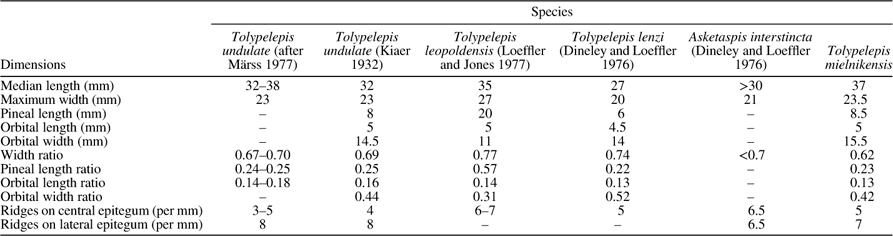
Eight tolypelepidid specimens of six species are considered here (Table 1). The length of the dorsal shield ranges from 27 to 38 mm. The Mielnik specimen matches this variability range, and so does Asketapis interstincta.
Measurements and ratios of well–preserved specimens of the Tolypelepididae.
Regarding the overall proportions of the shield, expressed by width ratio, T. mielnikensis (width ratio 0.62), the longest among the tolypelepidids, is the slimmest of all, whereas the range for species of Tolypelepis is 0.67–0.77. If not ontogenetic (which is unclear as yet), this difference may be a taxonomically useful feature at a generic or specific level. Morphometric characters, other than the width ratio, do not significantly differ from those of T. undulata (Table 1).
More readily discriminated from other tolypelepidids is Tolypelepis leopoldensis. With the length (35 mm) comparable with the Mielnik specimen (37 mm), it is slightly broader (width ratio 0.77) than other Tolypelepis representatives (0.67–0.74), thus displaying a different combination of morphometric characters. It also differs in orbital width ratio (0.31), which is lower than in other tolypelepids (0.44–0.52), and in a very high pineal length ratio (0.57), which is dramatically different from that of all other tolypelepidids (0.22–0.28). In other words, the pineal macula is placed much more posteriorly in T. leopoldensis. These data show the amount of variability within the genus Tolypelepis, and, combined with other characters, these differences are here considered specific (see below).
Another alleged tolypelepidid, Asketaspis, seems not to differ in morphometric terms from Tolypelepis at the generic level (Table 1), but some other characters (e.g., presence of inter-epitegal tubercles) may suggest the opposite (see below).
Apart from overall proportions, the shape of the shield depends on the degree of tapering, which is expressed by having either straighter or more convex sides. Tolypelepis mielnikensis is uniform in width. In this regard it recalls both Asketaspis interstincta (Fig. 4.5; Dineley and Loeffler, Reference Dineley and Loeffler1976:fig. 22, pl. 6, fig. 1), and one specimen of Tolypelepis undulata figured by Märss (Reference Märss1977:fig. 2 D, pl. fig. 3), the lateral margins of these specimens being straight in dorsal view. All three specimens contrast with other representatives of Tolypelepis, where the lateral margin is convex (Rohon, Reference Rohon1893:pl. I, fig. 45; Kiaer, Reference Kiaer1932:l. X; Stensio, Reference Stensiö1958:fig. 169B; Loeffler and Jones, Reference Loeffler and Jones1977:fig. 3, pl. 80, figs. 3, 5). This unique character may suggest that all three specimens are congeneric (or conspecific if belonging to Tolypelepis), and belong to Asketaspis, but other characters (e.g., presence of interepitegal tubercles, do not support this view (see below)).
The Mielnik specimen is unique in that the rostral region is constricted anterior to the orbits. The specimen Pi 5003/GIT 168-4 figured by Märss (Reference Märss1977:fig. 2D) shows a similar rostral shape. In contrast, Asketaspis and other representatives of Tolypelepis (Fig. 4.3–4.7) lack such narrowing, the tapering of the anterior part of the shield being gradual and smooth beginning from the orbital region to the anterior tip of the rostral margin (Märss, Reference Märss1977:fig. 3, fig. 11 A–B; Denison and Loeffler, 1976:fig. 21–22, pl. 6, figs. 1, 3; Loeffler and Jones, Reference Loeffler and Jones1977:fig. 3, pl. 80, figs. 3, 5). Rostral region narrowing in front of orbits is known in Poraspis (Denison, Reference Denison1964; Loeffler and Jones, Reference Loeffler and Jones1977; Elliott and Petriello, 2011) so this feature concerns the generic rather than specific level, which precludes the inclusion of the Mielnik specimen in Asketaspis. Moreover, the Mielnik specimen differs from Asketaspis in the degree of delimitation of the orbital epitegum, which is not distinct in the former (similar to Tolypelepis), while being distinct in the latter (Dineley and Loeffler, Reference Dineley and Loeffler1976:fig. 22, pl. 6, fig. 1).
Complete articulated skeletons, of tolypelepidid-like agnathan fish, are only known for one species, Athenaegis chattertoni, recorded from the early Wenlock (early Silurian) of the Mackenzie Mountains, and originally considered to be a tolypelepidid (Soehn and Wilson, Reference Soehn and Wilson1990). More than 14 specimens were assigned to A. chattertoni. In terms of dorsal shield proportions and outline, Athenaegis differs from tolypelepidids at a generic level, but it is excluded from the Tolypelepididae on the basis of branchial structure (Janvier, Reference Janvier1996). If so, its strikingly tolypelepidid ornamentation (i.e., grouping of dentine ridges into scale-like units, each with narrow and low ridges arranged around a wider central ridge) is to be considered plesiomorphic. In taxonomic terms, the width of the ridges is important, defined as the number of ridges per millimeter (Denison, Reference Denison1964), their length, orientation, and variation in height and thickness. Tolypelepis shares with Asketaspis transversely aligned ridges, but differs in having diagonally oriented, short ridges, sometimes grouped into units (T. undulata, T. lenzi, or T. mielnikensis).
On the lateral epitegum of T. mielnikensis, ridges are arranged longitudinally and are parallel to the lateral margin (Fig. 3.1, 3.4), which is the pattern shared by all tolypelepidids and by Athenaegis as well, associated with the long and narrow shape of the lateral epitegum. The width of ridges in the lateral epitegum of Tolypelepis undulata is 8 per mm on average (Table 1). Tolypelepis mielnikensis has slightly coarser ridges (7 per mm). The information about Asketaspis (6.5 ridges per mm), given by Dineley and Loeffler (Reference Dineley and Loeffler1976) is not precise regarding the topography of the dorsal shield. There is no information about T. leopoldensis and T. lenzi.
Tolypelepis mielnikensis, n. sp. (1) holotype Ag–II/1, dorsal shield; (2) fragment of dorsal shield Ag–II/2; (3) drawing of left lateral view of holotype Ag–II/1; (4–5) drawing of the dentine ridge pattern of the dorsal shield.
The ornamentation of the central epitegum in T. mielnikensis consists of short dentine ridges of low relief and is similar to that of Asketaspis interstincta, and particularly so in the changing relations of the ridge heights. In the anterior part of the epitegum of both these taxa, the ridges are generally uniform in height, but the difference between the median ridge and adjacent ones increases posteriad. This changing pattern of ornamentation is shared also by the specimen Pi 5003/GIT 168-4 of Tolypelepis undulata (Märss, Reference Märss1977:pl. fig. 3), which stresses the similarity of these three specimens, as suggested by the shield outline. In other Tolypelepis species, the median ridge is higher than the adjacent ones on the whole central epitegum. However, a significant difference does exist between both the Mielnik specimen and Märss’s specimen (1977:fig. 2D) on one hand and Asketaspis on the other. The former lacks an inter-epitegal band of tubercles, characteristic of Asketaspis, and so a generic difference between those taxa is supported. However, the character may be subject to infrageneric variability as demonstrated by the presence of the tubercles in Tolypelepis leopoldensis.
Most posterior units of the Mielnik specimen look like imbricated scales (Fig. 3.1, 3.4) as they do in some other Tolypelepis species, T. lenzi (Dineley and Loeffler, Reference Dineley and Loeffler1976:fig. 22, pl. 6, fig. 1) and specimens of T. undulata described by Rohon (Reference Rohon1893:pl. I, fig. 45) and Kiaer (Reference Kiaer1932:pl. X). The main difference between the taxa is in the relative size of units, which in T. mielnikensis are proportionally smaller than those in other Tolypelepis species, but larger than those in Asketaspis. In this regard, the Mielnik specimen is morphologically intermediate between Tolypelepis and Asketaspis, but the mosaic pattern of similarities within the Tolypelepis group suggests undetermined variability at the generic or specific level.
Comparisons of other characters are inconclusive. The posterior edge of the shield is concave in the specimen from Mielnik (if this is not an artifact of preservation), while convex in Tolypelepis. In Asketaspis the posterior part of the dorsal margin is not preserved.
In Tolypelepis, the construction of the branchial region is unclear, as it is in Tolypelepis mielnikensis. However, a fragment of Tolypelepis branchial plate (Märss, Reference Märss1977:fig. 6B) reveals a branchial notch, and, posterior to it, an expanded dorsal lobe of the branchial plate. Asketaspis displays also a branchial notch and moderately well-developed postbranchial lobe (Dineley and Loeffler, Reference Dineley and Loeffler1976). This structure is probably more or less typical for the early cyathaspidiforms, tolypelepidids included, which thus recalls the morphology of the cyathaspidid genus Nahanniaspis (Dineley and Loeffler, Reference Dineley and Loeffler1976:figs. 33–34). Presumably, the overall branchial structure was similar (branchial notch mostly created by the incised branchial plate). The situation is different in Asketaspis which displays a branchial notch and postbranchial lobe, both moderately well developed. The dorsal shield of T. mielnikensis apears straight in lateral view (Fig. 3.3), as it does in Athenaegis, thus suggesting that the postbranchial lobe is absent. Whether these minor differences are properly understood and taxonomically valid for low level taxonomy cannot currently be estimated.
The sensory line canal system of the Mielnik specimen is typical for cyathaspidiforms, with two pairs of longitudinal canals and at least three transverse commissures on the dorsal shield (Fig. 4.1). The pineal branches of the supraorbital canals do not join each other, similar to the other Cyathaspidiformes, and in contrast to Pteraspidiformes where the canals join and make a V-shaped pineal canal.
Diversity of dorsal shield outlines in the Tolypelepididae. (1–2) Tolypelepis mielnikensis, n. sp.; (3–4) Tolypelepis undulata; (5) Asketaspis interstincta; (6) Tolypelepis lenzi; (7) Tolypelepis leopoldensis. (2) after Märss, Reference Märss1977; (3) after Rohon, Reference Rohon1893 and Märss, Reference Märss1977; (4) after Kiaer, Reference Kiaer1932 and Märss, Reference Märss1977; (5–6) after Dineley and Loeffler, Reference Dineley and Loeffler1976; (7) after Loeffler and Jones, Reference Loeffler and Jones1977. Abbreviations: cd1–cd4, dorsal transverse commissures; cep, central epitegum; ifc, pores of infraorbital canal; ldl, pores of lateral dorsal canal; lep, lateral epitegum; mdl, pores of medial dorsal canal; rep, rostral epitegum; soc, pores of supraorbital canal.
Phylogeny
Heterostracan ingroup relationships are still debated, but two major groups, regarded as monophyletic, the Cyathaspidiformes and Pteraspidiformes (Fig. 5), have been proposed (Blieck et al., Reference Blieck, Elliott and Gagnier1991; Janvier, Reference Janvier1996; Elliott and Blieck, Reference Elliott and Blieck2010; Elliott and Swift, Reference Elliott and Swift2010). The most significant character of Heterostraci is a common branchial opening (Janvier, Reference Janvier1996) that does not pierce but incises the single branchial or branchiocornual plate. According to Janvier (Reference Janvier1996), a putative early Silurian (Wenlock) tolypelepid, Athenaegis (Soehn and Wilson, Reference Soehn and Wilson1990), should be excluded from Cyathaspidiformes, or even from the Heterostraci (Fig. 5), because it lacks this feature. The presence of three rows of small branchial plates (Fig. 5.1) on each side further discriminates Athenaegis from the “higher heterostracans” (sensu Janvier, Reference Janvier1996). Soehn and Wilson (Reference Soehn and Wilson1990) suggested that a single pair of branchial openings may have opened posterior to most or all of the branchial scales and platelets in Athenaegis, but none has been documented. The branchial system of Athenaegis appears unique, until it is better understood, which supports its exclusion from the “higher Heterostraci”. Athenaegis is currently considered a possible sister taxon of the “higher Heterostraci”, because it shares their single dorsal shield and the diamond-shaped flank scales of higher Heterostraci (Janvier, Reference Janvier1996).
Outline of interrelationships within Heterostraci based on Janvier (Reference Janvier1996). Node A, Heterostraci, a single external branchial opening; node B, a less inclusive heterostracan group (“higher heterostracans” plus Athenaegis), single dorsal shield, loss of oak leaf-shaped tubercles. Node C, “higher heterostracans”, branchial or branchio-cornual plate not pierced by branchial opening. Node D, Cyathaspidiformes, ornamentation of longitudinaly arranged dentine ridges with finely crenulated margins. Node E, Pteraspidiformes, ornamentation of concentric dentine ridges with serrated margins, dorsal spinal plate. Node F, Tolypelepididae, dorsal shield composed in part of scale-like units, especially posteriorly, dentine ridges mostly short; node G, Cyathaspidiformes without Tolypelepididae, ornamentation of longitudinal dentine ridges, more or less parallel; node H, Amphiaspidida, derived pattern of armor. Terminal taxa: (1) Athenaegis, three series of branchial plates, no trace of branchial opening(s); (2) Tolypelepis mielnikensis, branchial opening placed dorsally, incising branchial plate (after Märss, Reference Märss1977); (3) Nahanniaspis, branchial opening placed dorsally, incising branchial plate; (4) Anglaspis, typically cyathaspidiform branchial opening placed postero-dorsally, incising branchial plate; (5) Amphiaspidida, Kureykiaspis, branchial opening placed dorsally in fused head armor plate; (6) Errivaspis, typically pteraspidiform branchial opening between branchial and cornular plates.
Tolypelepidids (Fig. 5, node F, taxon 2) share the following cyathaspidiform (synonymous with the cyathaspids and amphiaspids in Blieck et al., Reference Blieck, Elliott and Gagnier1991) features: (1) the armor consists of one dorsal and one ventral median plate, separated by one branchial plate on each side; (2) the sensory canal system of the dorsal shield consists of two pairs of longitudinal canals and at least three transverse commissures, perpendicular to the longitudinal ones; (3) supraorbital canals do not join each other to make a V-shaped pineal canal; (4) the dentine ridges of the superficial layer of the dorsal shield are mainly longitudinally arranged, each ridge having an unornamented central part and finely crenulated edges. Which of these characters are synapomorphies is still unknown, but their whole complex is characteristic for Cyathaspidiformes. However, tolypelepidids (Fig. 5, node F) do not share the longitudinal and more or less parallel ridges of other Cyathaspidiformes, but, instead, display an ornamentation of many scale-like units, with short ridges surrounding the central one. This type of ornamentation, suggestive of many separate growth centers, is currently considered primitive. Therefore, tolypelepidids are located as a basal group within Cyathaspidiformes. Greeniaus and Wilson (Reference Greeniaus and Wilson2003) showed that plate growth reconstruction based on the ornamentation can lead to erroneous conclusions. Their description of juvenile cyathaspidids (Greeniaus and Wilson, Reference Greeniaus and Wilson2003) included ontogenetic observation. It showed rapid cyclomorial development of the dermal skeleton, despite previous interpretation (Denison, Reference Denison1964; Dineley and Loeffler, Reference Dineley and Loeffler1976) of simultaneous plate growth. Therefore, these features should be treated with caution.
Comparison of the dorsal shield within the Tolypelepididae revealed a mosaic structure in certain taxa. Different aspects of shield outline might due to be individual variation unless associated with differences in degree of distinctness of the epitega (orbital epitegum, postbranchial lobes, pineal macula), details of ornamentation, presence versuss absence of rostral constriction and presence versuss absence of inter-epitegal tubercles. These mosaic character complexes are considered as representing true taxonomic variability of infrafamilial rank. The present author tentatively considers them as specific while accepting generic difference between Tolypelepis and Asketaspis (Dineley and Loeffler, Reference Dineley and Loeffler1976; Soehn and Wilson, Reference Soehn and Wilson1990) until the revision of the last genus is possible.
Conclusions
A set of character states present in a tolypelepidid dorsal shield from a bore-core sample of the Late Silurian (Pridoli) succession in Mielnik, Poland, has been considered sufficient for the erection of a new species Tolypelepis mielnikensis. The unique character of the new species is a constriction of the rostral region in front of the orbit level with orbital notches significantly deeper than in other Tolypelepis species or in Asketaspis. This character is shared by the specimen Pi 5003/GIT 168-4 (Märss, Reference Märss1977; fig. 2D) from Ohesaare Cliff which is thus considered conspecific with Tolypelepis mielnikensis and included in this species.
Ohesaare Cliff and the Mielnik beds both represent upper Pridoli (Mark-Kurik, Reference Mark-Kurik1969; Märss, Reference Märss1997; Nestor, 1990; Urbanek, Reference Urbanek1997) carbonate facies of the Paleobaltic shelf.
The paleogeographic distribution of the tolypelepidids demonstrates that at the beginning of the early Silurian the representatives of the family were distributed in epicratonic seas of Baltica and north-west Laurentia terranes (Fig. 2). It demonstrates that the clade was subjected to adaptative radiation on the whole territory of Baltica and Laurentia, but the scarcity of records and gaps in stratigraphic dating preclude any conclusions as to interrelationships of particular tolypelepidid genera and species.
Acknowledgments
I am grateful to M. Borsuk-Białynicka (Institute of Paleobiology, Polish Academy of Sciences,) for comments and suggestions on several drafts of this manuscript that greatly helped to improve the final version. I thank Tiuu Märss for helpful comments on the manuscript. I thank David Kenneth Elliott and Mark V. H. Wilson for their constructive reviews of the manuscript.