Significant outcomes
• Transcranial Pulsating ElectroMagnetic Fields augmentation resulted in high remission rates (∼70%) in patients with therapy resistant depression over a treatment trial of 8 weeks.
• The side effects of antidepressant medication were reduced and the psychological well-being of the patients significantly increased.
Limitations
• A sham (placebo) Transcranial Pulsating ElectroMagnetic Fields arm was not included, but the dose-remission principle was in a double-blind, controlled approach.
Introduction
In ∼30% of patients with a major depressive episode, antidepressants are ineffective, even after several attempts with well-delivered antidepressant therapy (optimal dose and duration) when remission is defined by a Hamilton Depression Scale (HAM-D17) score of 7 or less (Reference Greden, Riba and McInnis1,Reference Schäpfer and Kayser2). When augmenting with Transcranial Magnetic Stimulation (TMS) (Reference Bretlau, Lunde, Lindberg, Unden, Dissing and Bech3) or with Transcranial Pulsating ElectroMagnetic Fields (T-PEMF) (Reference Martiny, Lunde and Bech4) in these treatment-resistant depressive (TRD) patients we found extremely low rates of placebo-remission (HAM-D17<8), namely <5% after 5 weeks of therapy. In the active T-PEMF group of patients we obtained a statistically significant higher remission rate (34%) after 5 weeks of therapy (Reference Martiny, Lunde and Bech4). The extremely low placebo remission in TRD is in agreement with other studies (e.g. (Reference Heresco-Levy, Gelfin and Bloch5)). In the monographs on TRD (Reference Greden, Riba and McInnis1,Reference Amsterdam, Hornig and Nierenberg6), the extremely low placebo-remission rate is insufficiently discussed.
When planning the present dose-remission study with a self-treatment set up of the T-PEMF device to be administered by the patients themselves in their own homes, we decided, on ethical considerations, to exclude sham T-PEMF. Originally, we discussed conducting this dose-remission study as a multi-centre trial within the Danish University Antidepressant Group (DUAG), analogue to our previous study on dose-effect of clomipramine in patients with therapy-resistant depression (7). During our discussion it was actually suggested to include low placebo response to antidepressants as a criterion of the diagnosis of therapy-resistant depression. It was decided to consider the study to be reported here as a pilot trial for such a multi-centre DUAG study.
It was our hypothesis that patients receiving active T-PEMF both morning and afternoon would have a higher remission rate on the HAM-D17 than patients only receiving active T-PEMF in the morning. According to our protocol the main research question to be answered was to what extent a twice daily T-PEMF dose was superior to once daily, using the HAM-D17<8 at endpoint as the primary criterion for remission after 8 weeks of therapy.
Materials and methods
Ethics
The study was carried out in accordance with the Declarations of Helsinki and the European Union directive of Good Clinical Practice (8). The study was monitored by an external contract company (Norma, Hørsholm, Denmark). The study was approved by the Danish Health and Medicines Authority (2013030959) and the Committee on Biomedical Research Ethics (H-1-2010-031) and was reported to the Danish Data Protection Agency (PSV-2010-2). The trial was registered at ClinicalTrials.gov (ID NCT01353092). Patients were given information as requested by the Biomedical Research Ethics, and all patients signed an informed consent.
Patient allocation and inclusions
Patients were all treated at our research unit at Psychiatric Centre North Zealand, University of Copenhagen. Inclusion criteria were: older than 18 years of age, patients with TRD as manifested by a score of >3 on the Sackheim Scale (Reference Sackeim9), major depression according to DSM-IV, a score of 13 or more on the HAM-D17, and unchanged antidepressant medication during the previous 4 weeks. Exclusion criteria were suicidal thoughts (a score of >2 on the HAM-D17 item of suicidal ideations), alcohol or drug abuse, previous treatment with T-PEMF, pregnancy, lactating or insufficient contraception, antisocial, borderline, schizotypic, and psychotic disorders, dementia, and inability to comply with the planned treatment sessions and assessments. The randomisation procedure was the same as in our first T-PEMF study (Reference Martiny, Lunde and Bech4).
Psychometrics
Diagnostic categories
The Mini-International Neuropsychiatric Interview (MINI) version 5.0 (Reference Sheehan, Lecrubier and Sheehan10) was used to obtain ICD-10 diagnoses of depression (11).
Outcome scales
The HAM-D17 was used as the primary outcome scale (Reference Bech, Kastrup and Rafaelsen12–Reference Bech14). We used the HAM-D17 in combination with the Bech-Rafaelsen Melancholia Scale (MES) as conventionally applied in DUAG studies (Reference Bech, Gram, Kragh-Sorensen and Reisby13). Within the HAM-D17 we especially focused on the HAM-D6 which includes the core symptoms of depressive states (depressed mood, guilt, work and interests, psychomotor retardation, psychic anxiety, and gen somatics). This HAM-D6 subscale has sufficient transferability, that is the ability to validly measure change in trials of antidepressants (Reference Bech14). The MES contains both the HAM-D6 and an apathia subscale (fatigability, concentration or memory problems, and sleep disturbances) (Reference Bech, Lauritzen and Lunde15). We focused on the ability of this apathia subscale to predict a dose-remission T-PEMF relation using the baseline scores. In another study we have shown that an apathia scale covering the items of concentration or memory problems, and sleep or fatigability items from the MINI had predictive validity when following the ability of depressed patients to return to work. This apathia scale was also considered for predicting a dose-remission pattern of T-PEMF.
In the analysis to be reported here, with focus on dose-remission relationship, the remission criterion on the HAM-D17 was the primary outcome, that is a score at endpoint of 7 or less. In this respect we also focused on the HAM-D6 in which the remission criterion is a score of 4 or less (Reference Bech14). Other outcome scales for antidepresssive effect such as the Major Depression Inventory (MDI*, (Reference Bech, Rasmussen, Olsen, Noerholm and Abildgaard16) or the self-rated version of the HAM-D6 (Reference Bech14) will be reported elsewhere.
To evaluate side effects we have focused on the clinician administered Udvalget for Kliniske Undersøgelser (UKU) scale (Reference Lingjaerde, Ahlfors, Bech, Dencker and Elgen17) and the self-reported Patient Reported Inventory of Side Effects (PRISE) in the version modified by Bech (Reference Bech14).
Finally, the WHO-5 well-being scale (Reference Bech14) was used to assess the patients’ own self-reported balance between clinical antidepresssive effect and side effects. A score of 20 on the WHO-5 is seen in moderate to severe depression, and a score of 50 in doubtful depression, whereas a score of ∼70 is equal to that of the Danish gen population (Reference Bech14).
The MINI as well as clinician assessments on the Hamilton Scale, the MES, and the UKU Side Effects Scale were all performed by experienced raters (B.S., L.L., M.L.) who have participated in the DUAG trials.
T-PEMF therapy
Coil applicators introduced pulsating electrical fields (50 Hz) of a very low magnitude (0.1–4 mV/cm) into brain tissue. The pulses were constructed to mimic the pulsating electrical fields (E-fields) measured outside excitable tissue. The E-fields induced into neural tissue by the coils were five orders of magnitude (10−5) smaller than the E-field across a biological membrane with a Vm of −70 mV. Thus, this device distinguishes itself in this regard from rTMS and ECT. Seven coils were applied. The treatment helmet incorporates one pair of coils in the anterior and one pair in the posterior temporal region on both sides, one pair in the upper parietal region and one coil in the centre of the lower occipital region. All patients were treated for 30 min in a session.
The pulse generator has a card that is inserted into the device once treatment is initiated. All patients received 8×2 chipcards to cover the entire study period. Each card was provided with week number (1–8) and either ‘morgen’ (morning) or ‘aften’ (evening). This text was clearly stated on the cards, and at each visit the patients received two new cards and returned the two used ones.
The device and cards were constructed in such a way that all patients used the device morning and evening but the card that controls the pulses was programmed in such a way that current was running in coils for treatment in morning and evening (treatment twice a day) and only mornings for those treated once a day (placebo evenings). The patient was not able to identify whether or not current was running in a treatment session. The investigators did not have access to the card programmes (double blinding). Only the Good Clinical Practice Unit (GCP) had access to the information on the cards in order to check whether the treatment had been taken as planned. After study completion the codes were broken so as to determine which treatment group the patient had been allocated to.
Statistical analyses
Sample size was calculated using % remission (HAM-D17<8) after 8 weeks of T-PEMF by last observation carried forward. It was assumed that the twice daily dose of T-PEMF (morning and afternoon) would result in a remission rate of 60% whereas only one active dose of T-PEMF daily would result in a remission rate of ∼25%. With a power of 80% and an α of 5% it was calculated necessary to have at least 31 patients in each treatment arm.
When determining significance levels in between group analyses non-parametric statistics were used (Reference Siegel18); for categorical data the Fisher exact test was used, and for continuous data the Mann–Witney test or the Wilcoxon test were used. The intention-to-treat approach was used [Last Observation Carried Forward (LOCF)].
Results
In total 65 patients were included in the study from April 2011 to June 2013 (Fig. 1 shows the consort diagram of patient flow). All 65 patients were entered into the intention-to-treat analysis. Of these patients, 34 received T-PEMF as a morning dose only, and 31 patients received T-PEMF both morning and afternoon.
Consort diagram of patient flow.

The mean age of the group of patients treated once daily was 46.4 (13.6) years and the mean age of the group of patients treated twice daily was 49.9 (11.5), p = 0.27. In the group treated once daily 22 were females and 12 males. In the group treated twice daily 20 were females and 11 males (p = 1.00).
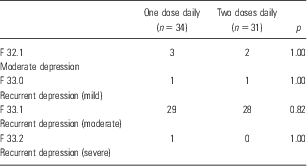
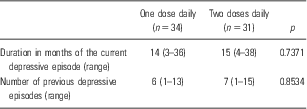
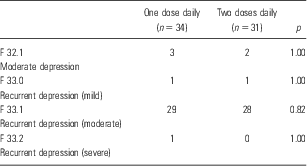
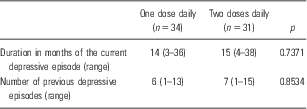
The distribution of ICD-10 diagnoses in the two groups of patients is shown in Table 1A. Again no statistically significant difference between the two groups of patients was seen. Table 1B shows the multivariate description of the severity of the TRD in terms of number of previous depressive episodes and the duration of the current episode. No statistical difference was seen between the two groups of patients.
The ICD-10 diagnoses according to the Mini International Neuropsychiatric Interview (MINI)
Multivariate description of therapy-resistant depression
The chip cards registering the date and time of T-PEMF treatment had been taken showed a very satisfying compliance, as 98% of the patients had been >85% compliant. Incorrect administration of the cards (morning therapy on evening card and vice versa) or treatment omitted were errors observed for single days during the 8-week study period. A total of 49 patients (75%) were >90% compliant and the remaining patients made these errors repeatedly, but not evenly distributed.
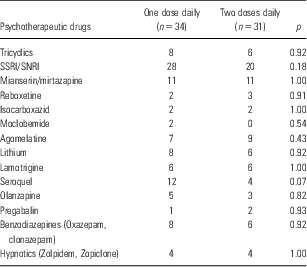
Table 2 shows the number of patients taking different antidepressants. As indicated, no statistically significant difference between the two groups of patients was seen.
The psychotherapeutic drugs prescribed 4 weeks before the T-PEMF augmentation and during the trial
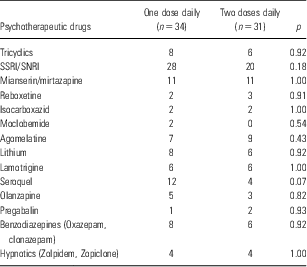
T-PEMF, Transcranial Pulsating ElectroMagnetic Fields.
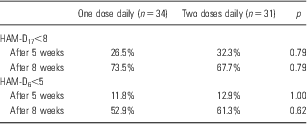
Table 3 shows remission after 8 weeks, last observation carried forward, using the criterion of HAM-D17<8 and the HAM-D6<5. On the HAM-D17 the difference between 73.5% remission in the once daily T-PEMF dose group and 67.7% in the twice daily group after 8 weeks of therapy was not statistically significant (p = 0.79). After 5 weeks of therapy, 26.5% and 32.3% obtained a remission (HAM-D17<8) on one dose and two doses of T-PEMF, respectively.
T-PEMF doses (one vs. two doses daily) in relationship to remission after 5 and 8 weeks of therapy
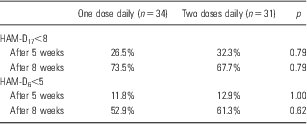
HAM, Hamilton Depression Scale; T-PEMF, Transcranial Pulsating ElectroMagnetic Fields.
On the HAM-D6 (Table 3) the difference in remission rate of 52.9% versus 61.3% after 8 weeks of therapy was not statistically significant (p = 0.62). When using the MES apathia scale at baseline to classify patients with an apathia syndrome (a score of 10 or more) versus patients without an apathia syndrome, we found that among the 38 patients with an apathia syndrome, only 58.8% had a remission (HAM-D17<8) after 8 weeks of therapy against 88.2% in the group of patients without an apathia syndrome for a once daily T-PEMF dose (p = 0.118). For a twice daily T-PEMF dose the remission percentage was 71.4% in the apathia syndrome and 60.0% in the non-apathia syndrome (p = 0.609). However, on the apathia scale the mean (SD) for all 65 patients at baseline was 9.71 (0.96) and the median = 10. This implied that an apathia syndrome was present for a score of 10 or more. In patients with an apathia syndrome who received T-PEMF once daily, 55.6% obtained a remission after 8 weeks of therapy whereas patients without apathia who received T-PEMF once daily obtained a remission rate of 93.8% (p = 0.029.). In the twice daily T-PEMF group the remission rate was 66.7% in the group of patients with apathia and 69.2% in the group without apathia (p = 1.00).
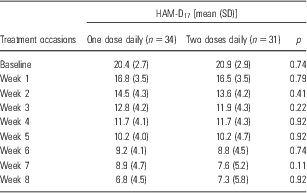
Table 4 shows the HAM-D17 baseline scores (mean and SD) as well as the weekly scores for one versus two daily doses of T-PEMF, last observation carried forward. No statistically significant differences were obtained.
HAM-D17 baseline scores and weekly scores (mean and SD) for one vs. two daily doses of T-PEMF
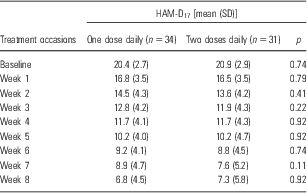
HAM, Hamilton Depression Scale; T-PEMF, Transcranial Pulsating ElectroMagnetic Fields.
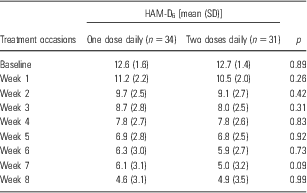
Table 5 shows the HAM-D6. No statistically significant differences between one versus two daily doses of T-PEMF doses were obtained.
HAM-D6 baseline scores and weekly scores (mean and SD) for one vs. two daily doses of T-PEMF
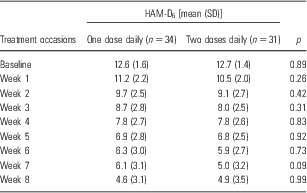
HAM, Hamilton Depression Scale; T-PEMF, Transcranial Pulsating ElectroMagnetic Fields.
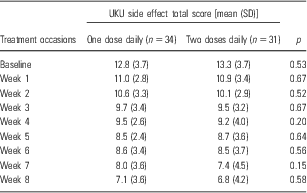
Table 6 shows the UKU side effect total score from baseline over the weekly ratings, last observation carried forward. No statistically significant differences between one versus two daily doses of T-PEMF doses were obtained. This result was supported by the self-reported side effect scale PRISE.
UKU side effect scale baseline total scores and weekly total scores (mean and SD) for one vs. two daily doses of T-PEMF
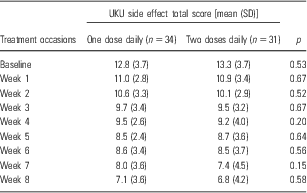
T-PEMF, Transcranial Pulsating ElectroMagnetic Fields; UKU, Udvalget for Kliniske Undersøgelser.
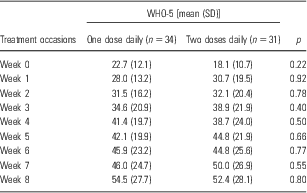
Table 7 shows the weekly scores on the WHO-5 patient-reported well-being index. At endpoint (week 8) the WHO-5 was 54.5 (27.7) in the group of patients treated with a once daily dose and 52.4 (28.1) in the group treated with two daily doses (p = 0.80).
WHO-5 baseline scores and weekly scores (mean and SD) for one vs. two daily doses of T-PEMF
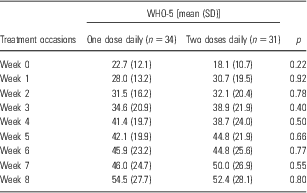
T-PEMF, Transcranial Pulsating ElectroMagnetic Fields.
Discussion
The answer to our primary research question: ‘In patients with treatment-resistant depression will augmentation with T-PEMF twice daily be superior to one daily dose in obtaining remission after 8 weeks of therapy?’ is no. However, the rate of remission in the group of patients receiving one daily dose was much higher (73%) than the expected rate of 25% that was based on our results from our first T-PEMF study (Reference Martiny, Lunde and Bech4), which was completed after 5 weeks of therapy. A major outcome of our present study is therefore that the extension of the trial from 5 to 8 weeks has doubled the remission rate.
When using the weekly mean HAM-D6 scores we found the same pattern, namely a 50% reduction of the baseline scores after 5 weeks of therapy (from 12 to 6, Table 5) and a doubling of the rate of remission (HAM-D6<5) from week 5 to week 8.
In the present study we have on ethical grounds not included a placebo or sham T-PEMF arm. Both in our first T-PEMF study and in our rTMS study (Reference Bretlau, Lunde, Lindberg, Unden, Dissing and Bech3) the remission rate in the sham arm after 5 weeks of therapy was below 5% when using the HAM-D17<8 criterion of remission. After 8 weeks of therapy the Bretlau et al. rTMS study (Reference Bretlau, Lunde, Lindberg, Unden, Dissing and Bech3) had a remission rate of 8%. In a randomised placebo-controlled trial with vagus nerve stimulation in TRD the remission rate on placebo after 10 weeks of therapy was 3.6% (Reference Rush, Marangell and Sackeim19).
In major depression the improvement seen in placebo-controlled trials of antidepressants is that of an early steep drop in the HAM-D mean scores, typically in the first 2 weeks. This is the background for the pattern analysis suggested by Quitkin et al. (Reference Quitkin, Rabkin, Ross and Stewart20) in which the true drug response to antidepressants is considered after 3 weeks of therapy. The weekly HAM-D17 as well as HAM-D6 mean scores in our study followed a rather straight line from baseline to week 8. In our previous T-PEMF analysis (Reference Martiny, Lunde and Bech4) the weekly HAM-D17/HAM-D6 scores in the active T-PEMF arm followed an improvement line over the 5 weeks of therapy. However, we certainly need a fully blinded study to verify these findings. We are actually planning a randomized, double-blind sham (placebo) controlled multi-centre study in the DUAG.
The weekly mean scores on the UKU side effects scale showed that the baseline level of ∼12 decreased by nearly 50% over the 8 weeks of therapy, with no difference between the T-PEMF doses of one versus two daily.
The WHO-5 well-being scale, which might be considered as the patients’ own self-reported outcome, taking both wanted (HAM-D) and unwanted (UKU) side effects into account, showed a mean score steady increase from ∼20 to 50 over the 8 weeks of therapy with no difference between the two T-PEMF doses. However, to obtain an optimal effect, the WHO-5 mean scores should reach the level in the Danish gen population of 69. Trials of 12 weeks or more are often needed to obtain this goal of therapy (Reference Bech14).
We have recently shown in a trial with depressed patients (submission process on-going) that an apathia syndrome scale (containing such items as concentration or memory problems, fatigability, and sleep problems) had predictive validity in identifying, at baseline, those patients who were later on unable to return to work. In patients with an apathia syndrome at baseline (a score of 10 or more) the remission rate after 8 weeks of therapy was 56% whereas in patients without an apathia syndrome the remission rate was 93% in the group of patients receiving one daily T-PEMF dose (p < 0.05). The respective remission rates in the group of patients receiving T-PEMF twice daily were 69% versus 68% (p = 1.000).
The antidepresssive medication prescribed during the T-PEMF study covered serotonin or noradrenaline reuptake inhibitors (unspecific as TCA's or specific as SSRIs or SNRIs or reboxetine) most predominating, as only two patients in each group of patients received isocarboxazid (an irreversible mono-amino-oxidase inhibitor). The serotonin receptor 2 inhibitors (the unspecific mianserin/mirtazapine and the specific agomelatine) were typically prescribed in combination with the serotonin/noradrenaline reuptake inhibitors. The patients included in the T-PEMF study were all resistant to these drugs but were considered to have obtained a sufficient partial response to justify a continuation, often because the side effects to the antidepressants were found acceptable by the patients, that is were tolerated.
It has now become evident that reuptake inhibitors that act as antidepressants have additional effects such as upregulating mRNA for brain-derived neurotrophic factor (BDNF) and also its receptor TrkB. BDNF was thus reported to play a role in the long-term effects of antidepressants, and it has been shown that acute as well as chronic antidepressant administration activates neurotrophin signalling in a BDNF-dependent manner in prefrontal cortex (Reference Saarelainen, Hendolin and Lucas21). In animal studies increased BDNF mRNA levels were found after chronic antidepressant administration (Reference Nibuya, Morinobu and Duman22) and BDNF signalling thus appear to be required for the typical behavioural effects produced by these drugs in experimental animals studies. There is now wide consensus that SSRI classes of drugs may act at least partially by activating endogenous BDNF signalling.
We have found that (Reference Rahbek, Tritsaris and Dissing23) that T-PEMF upregulates the cytoplasmatic tyrosin kinase Src in human endothelial cells. Moreover it has been found (Reference Dissing, Tritsaris and Hansen24) that T-PEMF upregulates mRNA for BDNF. In human-derived endothelial cells both the SSRI antidepressant sertraline and T-PEMF upregulate mRNA in such a pattern that T-PEMF has a clear additive effect on the sertraline results. We therefore propose that the additive effect of T-PEMF demonstrated in patients with only a very partial response to antidepressants such as sertraline is an induced cellular signalling leading to an upregulation on mRNA for BDNF and to its secretion from endothelial cells and neural tissue.
In conclusion, a twice daily T-PEMF dose was not superior to once daily, using the HAM-D17<8 at endpoint as the primary criterion for remission after 8 weeks of therapy. In future studies it therefore seems appropriate to use T-PEMF once daily. The high remission rates found in this study of T-PEMF as augmentation in patients with TRD were thus not explained by a dose effect (one versus twice daily applications), but rather by the extension of the treatment time from 5 to 8 weeks. During this trial the baseline side effects of the antidepressant medication, which remained unchanged over the 8 weeks, were reduced by ∼50%. This outcome of high remission rates and reduced side effects was reflected by the patients’ self-reported WHO-5 well-being scale scores which increased significantly during the trial.
Acknowledgements
The authors are very grateful to the patients and to their significant others who carefully assisted when needed in the T-PEMF administration.
Author Contributions
Birgit Straasø and Lise Lauritzen: Involvement in planning the study, methodological design and performing patient ratings. Marianne Lunde: Active in performing the patient ratings. Maj Vinberg and Erik Roj Larsen: Active in clarification of the theoretical part of the study and the recruitment of patients. Lone Lindberg: Supervision of use of T-PEMF device, including helping the patients in this respect throughout the study. Steen Dissing: Formulation of the scientific problem and the theoretical background of T-PEMF treatment and actual device. Per Bech: Involvement in planning the study, methodological design as well as selection of rating instruments and supervision of rating procedures. Responsible for the statistical analysis.
Financial Support
The T-PEMF-II study was financially supported by a grant from the Lundbeck Foundation (Grant R54-A5567).
Conflicts of Interest
Birgit Straasø, Lise Lauritzen, Marianne Lunde, Lone Lindberg, Erik Roj Larsen, and Per Bech: none to declare. Maj Vinberg: has been consultant for Eli Lilly, Lundbeck A/S, AstraZeneca and Servier. Steen Dissing: first author on two patents describing the technology and the physiological implications of the T-PEMF method. The patents are owned by the company Re5. Steen Dissing's percentage of ownership in the above company is 0.5.
Ethical Standards
The authors assert that all procedures contributing to this work comply with the ethical standards of the relevant national and institutional committees on human experimentation and with the Helsinki Declaration of 1975 as revised in 2008.