Introduction
The “seat maximizing model of electoral change” (Benoit Reference Benoit2004: 373) has been dominating classical and recent accounts of electoral reform (Carstairs Reference Carstairs1980; Boix Reference Boix1999; Andrews and Jackman Reference Andrews and Jackman2005; Blais et al. Reference Blais, Dobrzynska and Indridason2005; Colomer Reference Colomer2005; Rokkan Reference Rokkan2009[1970]; Ergun Reference Ergun2010; Leyenaar and Hazan Reference Leyenaar and Hazan2011; Rahat and Hazan Reference Rahat and Hazan2011; Ahmed Reference Ahmed2013; Matakos and Xefteris Reference Matakos and Xefteris2015; Nunez and Jacobs Reference Nunez and Jacobs2016). It holds that the driving forces behind reforms are parties aimed at fostering their parliamentary seat-shares. Electoral reforms then ensue from agreement among parties, conceived as unitary actors, on a new formula for the translation of votes into seats.
Any electoral reform bill is however subject to approval by members of parliament (MPs). In many contemporary democracies, this may be a mere act of MPs rubberstamping a reform agreed upon by party leaders. Yet, numerous studies tell us that leaders’ control over MPs is a function of the electoral system itself (Riker Reference Riker1962; Weingast Reference Weingast1979; Shepsle and Weingast Reference Shepsle and Weingast1981; Carey and Shugart Reference Carey and Shugart1995). This is particularly obvious if we compare single-member district (SMD) electoral systems where each MP is subject to local-level denial of re-election (Carey Reference Carey2009) to proportional representation (PR) electoral systems where party leaders control re-nomination (Katz and Mair Reference Katz and Mair1993).
Replacing a plurality or majority electoral system with PR is then bound to redistribute power within parties. But this consequence has not been taken into account in explanations on the introduction of PR in many European countries in the early 20th century. This “Switch” has received enduring attention, but predominantly under the “parties as unitary actors” assumption (also see, e.g., Rogowski Reference Rogowski1987; Boix Reference Boix2010; Renwick Reference Renwick2010; Raymond Reference Raymond2016). The few studies that depart from this assumption remain mute on consequences of PR on the intra-party relationship between party leaders and MPs. They either focus on the incentives of leaders in securing representation of locally dispersed groups, but ignore MPs (Cusack et al. Reference Cusack, Iversen and Soskice2007, Reference Cusack, Iversen and Soskice2010; Kreuzer Reference Kreuzer2010). Or they do address incentives of MPs, but ignore party leaders (Leemann and Mares Reference Leemann and Mares2014).
In this article, we argue that an explanation of electoral reform in general and of the Switch in particular must account for the behavior of both MPs and party leaders. We argue that their incentives regarding electoral reform rested with the legislative arena rather than the electoral one, as parliamentary party cohesion was harmed by the repercussions of coordination in the latter. Our intra-party argument also allows us to draw inferences on the particular shape of reforms that are more precise than the rather blunt expectation of “PR” being introduced. This particularly concerns the wide variation in district magnitudes, a crucial determinant of the degree to which proportionality is actually achieved under any PR formula (Kedar et al. Reference Kedar, Harsgor and Sheinerman2016).
We first develop our argument, focusing on parties of early 20th century Europe with an emphasis on in the prototypical German case. We show that cross-party district-level electoral alliances were wide-spread. They led the electoral system in place to work to the advantage of bourgeois parties but were indeed harmful to parliamentary voting cohesion. We then demonstrate that the introduction of PR via parliamentary procedure proceeded with preservation of local control over nomination, which in turn implied small districts and varying district magnitudes. We do so along the three steps towards fully-proportional PR taken in Germany, in the years 1917–20. We finally broaden our findings, accounting for district magnitudes of all European and Anglo-Saxon countries pre- and post-Switch in the period 1900–31.
The intra-party limits of electoral reform
The inter-party perspective on electoral reform assumes parties as unitary actors, striving to maximize seats (Benoit Reference Benoit2004). Yet, electoral reform is subject to assent of a parliamentary majority, i.e. of MPs within their parliamentary party groups. These groups may act “as if they are unitary actors” (Laver and Shepsle Reference Laver and Shepsle1999: 23), but identifying the conditions under which this assumption is appropriate is subject to enduring studies (Weingast Reference Weingast1979; Shepsle and Weingast Reference Shepsle and Weingast1981; Kiewiet and McCubbins Reference Kiewiet and McCubbins1991; Cox Reference Cox2006; Dewan and Spirling Reference Dewan and Spirling2011; Diermeier and Vlaicu Reference Diermeier and Vlaicu2011; Saalfeld and Strøm Reference Saalfeld and Strøm2014).
Kam (Reference Kam2014: 410f.) identifies two sets of variables in this regard: opportunities of MPs to cultivate a personal vote; and the degree to which party leaders hold control over candidate nomination (also see Carey and Shugart Reference Carey and Shugart1995; Martin Reference Martin2011). Electoral reform, especially PR introduction, is bound to affect at least the latter. Electoral reform is then also bound to affect the intra-party distribution of power. Accounts that ignore this are blind to countervailing incentives of MPs and party leaders, tied to the intra-party distribution of power. Two kinds of party organization, pertinent at the time of the Switch, tap this, since they cover the full range of possible leader control over MP behavior, tied to candidate nomination as a means to exert power within a party: mass parties and elite parties (Katz and Mair Reference Katz and Mair1995).
In mass parties, party leaders in the “central office” were MPs’ decisive principals because they, as “the coordinator and controller of the party on the ground,” also controlled the resources required for re-election (Katz and Mair Reference Katz and Mair1993: 604; Saalfeld and Strøm Reference Saalfeld and Strøm2014: 377f.). These MPs hence lived under “enforced party cohesion and discipline” (Katz and Mair Reference Katz and Mair1995: 10). Leaders were also in control of permanent organizations, staffed by party employees. This bureaucracy even provided a career track of its own, perhaps leading into parliament (Saalfeld and Strøm Reference Saalfeld and Strøm2014: 379). The unitary-actor assumption is then useful—MP-behavior is controlled by party leaders and, thus, should be uniform within parties.
In elite parties, however, the resources required for re-election—most importantly: control over candidate nomination—rested with committees of notables or even with individual MPs themselves. Hence, MP behavior was not a mere function of party leader wishes (Duverger Reference Duverger1955; Colomer Reference Colomer2011;). Assuming party unity then means ignoring impediments to collective legislative action tied to incentives for individual MPs.
Crucially, parliamentary majorities in European early-20th-century legislatures rested with bourgeois parties, that is, with elite party MPs. We therefore cannot apply the “party as unitary and seat-maximizing actor” assumption with respect to the Switch as a legislative project. Rather, we must account for individual MPs’ incentives tied to the electoral system in place on the one hand and to PR on the other.
The electoral systems in place, with very few exceptions, consisted of SMDs. Hence, each act of nomination concerned a single individual. Also, each SMD consisted of one or a few smaller municipalities or was itself part of a larger one. So candidate recruitment could be decided on by local committees. This privileged local principals over national leaders (Lachapelle Reference Lachapelle1913; Nipperdey Reference Nipperdey1961; Carey Reference Carey2007).
Introduction of PR however required the introduction of multi-member districts (MMDs) and, hence, party lists. Each act of nomination would now deal with groups of individuals and would affect an area the larger the higher the magnitude. Combining a handful of SMDs into one MMD would still allow as many committees to coordinate on a list without changes in party organization—local committees, even if of several parties, coordinated on joint SMD candidates anyway, as we demonstrate below. MMD introduction would then only replace inter-party negotiation with intra-party coordination. The actors involved would remain largely the same: a small number of notables in a few committees.
But nomination in MMDs of magnitudes in the double digits or higher would require coordination of dozens of committees and, hence, hundreds of notables. This massive broadening of the selectorate per list required the establishment of an organizational structure above the level of committees. It was clear to contemporaries that this would have been a crucial step from elite to mass party, subjugating MPs to party leaders due to the latter attaining control over nomination (Meyer and Jellinek Reference Meyer and Jellinek1901: 646, Duverger Reference Duverger1955: 133f.; Michels Reference Michels1957[1925]: 25f., Ostrogorski Reference Ostrogorski1964[1902]).
Electoral reform that implied a move from SMDs to high-magnitude MMDs thus pitted party leaders against MPs within elite parties, if it also affected control over nomination. Party leaders would profit, due to a shift in the intra-party distribution of power in their favor, MPs and local notables would lose. One important implication follows: we expect the design of particular PR systems to keep the previous mode of nomination in place whenever MP assent was required for electoral reform.
In a “small” country of, say, four million inhabitants, this constraint would not be felt. Sizable magnitudes could then be achieved within geographically small MMDs and nomination could still be conducted by local committees. Calvo’s (Reference Calvo2009) and Cox et al.’s (Reference Cox, Fiva and SmithForthcoming) accounts of PR introduction in Belgium and Norway address this class of cases. MMDs there achieved magnitudes of seven or higher and still only comprised of some 250,000 inhabitants, as for the cities-districts of Antwerp and Oslo.
In “large” countries of, say, 60 million inhabitants, however, even SMDs covered areas of sizeable scope. Each of the 397 German SMDs alone, for instance, comprised of on average 165,000 people. MMDs even at around one million inhabitants would then return magnitudes only in the mid-single digits (Carey and Hix Reference Carey and Hix2011). What is more, the electorate is never distributed uniformly across a country. Consequently, in less densely populated areas, districts would either have to be de-localized or magnitudes would have to remain low. In a large country, the former road cannot be taken under our argument. Hence, we expect variation in district magnitudes post-reform, including even very low magnitudes, whenever PR was introduced under parliamentary procedures. This should be especially pronounced for large countries. These predictions are more precise than the one delivered under the seat-maximizing model. Indeed, accounting for the very existence of more than one nation-wide MMD is beyond its scope.
Still, if party leaders are able to legislate without MP participation, e.g. via emergency decree or before a parliamentary assembly has even been formed, do we expect them to implement the electoral system of their liking, i.e. system that bolsters their control over nomination. Only then do we expect de-localized MMDs or upper tiers with de-localized nomination.
But what about proportionality, the key dependent variable dominating enduring accounts of the Switch? According to the perennial “fragmentation hypothesis,” PR is introduced if the fragmented ruling parties are confronted with an opposition party that is stronger in votes than each of them: “as soon as a new party draws substantial support and the ruling parties are tied in votes, the incentives to embrace PR become irresistible” (Boix Reference Boix1999: 611). In early 20th century Europe, these “ruling parties” are the bourgeois parties, e.g. the Liberals, Conservatives, or Agrarians. The “new party” are the rising parties of the working class. Boix (Reference Boix1999: 614) and variants of the fragmentation hypothesis identify this “Socialist Threat” as having triggered the Switch (Lijphart Reference Lijphart1992: 208; Braunias Reference Braunias1932: 203; Rokkan Reference Rokkan2009[1970]: 157; Boix Reference Boix2010: 410; Leemann and Mares Reference Leemann and Mares2014: 463).
Yet, fragmentation has been measured at the national level, while votes matter at the district level in plurality and majority systems (Cox Reference Cox1997). As concerns local-level fragmentation, the question then is whether local notables did not have any option short of PR introduction for countering the Socialist Threat, as Leemann and Mares (Reference Leemann and Mares2014: 466) argue. We argue that they did—via cross-party district alliances on joint candidates. These alliances would counter fragmentation at the district level, leave fragmentation in place at the national level, and render PR redundant as a means to preserve parliamentary survival. Alliances would even curb Socialist electoral success since the distribution of mandate totals follows the Cube rule under plurality and majority systems (Calvo Reference Calvo2009; Manow Reference Manow2011). Preservation of non-PR electoral systems would then, in complete contradiction to the fragmentation hypothesis, even help to counter the Socialist threat.
But why do we then still observe the Switch in at least some countries? Our answer again follows our intra-party rationale, but pertains to the means with which the Switch had to be accomplished: legislation.
The Rokkanian account holds that the fragmentation of the bourgeois camp mirrored societal cleavages. The capital-labor divide pitted bourgeois parties against Socialists, but other cleavages pitted bourgeois parties against each other, for example the state-church divide as regards Liberals and Clericals. This put MPs elected within an alliance into a bind, whenever legislation on an issue divided the local committees in their support. Acting along their own party line then meant putting support of other parties’ committees at risk. Catering to these other committees meant compromising the legislative unity of their own party. So there was a trade-off in the legislative arena tied to success in the electoral arena: The more efficiently alliances cobbled together various parties in support of candidates the more endangered was the cohesion of their individual parliamentary groups.
Only at this point does PR come in, as a means for fostering parliamentary-party cohesion by privileging intra-party over cross-party electoral coordination. More specifically, within small MMDs, local-level coordination could still proceed under PR—among committees of the same party, rather than of different parties. Even assuming three equally strong Bourgeois parties and a Socialist party as strong as them all together then only requires a magnitude of six to guarantee parliamentary representation to each party. Completely in line with our above expectation on varying and low-magnitude districts, localized MMDs, covering a county or a département, would suffice to achieve that.
To sum up: we argue that district alliances provided an efficient means to counter the Socialist threat. Legislative cohesion rather than proportionality accounts for the motivation of elite-party MPs to accept PR. This implies acknowledging elite-party MP autonomy as opposed to MP subservience to leader authority in mass parties. Relating MP autonomy to district-level committee control over nomination in turn implies variation in MMD magnitudes post-reform. These must be low enough as to facilitate committee coordination without an authoritative nomination mechanism. We thus expect de-localized or even nation-wide MMDs to be in place only in countries where party leaders managed to implement the Switch without parliamentary procedures.
To demonstrate the empirical validity of our claims we start with an analysis of electoral alliances. We next demonstrate their detrimental consequences for legislative cohesion. We then address our predictions on district magnitudes.
Our empirical focus is the case of Germany in the period 1890–1920. With ca. 60 million inhabitants in the early 1900s, it is the “large” country par excellence under our argument. And still, it experienced the Switch. The majority of mandates during all “pre-switch” parliaments rested with bourgeois parties. Five bourgeois parties—the Catholic Zentrum (Z), the National-Liberal NLP, the Left-Liberal DFP, the moderate Conservative DRP, and the orthodox Conservative DKP—each attained considerable shares of votes and mandates. They faced a Socialist party (the SPD) that attracted an ever-growing vote-share, up to 35 percent in the final Non-PR elections of 1912. We thus have a prototypical example of the Socialist threat scenario (Boix Reference Boix1999; Kreuzer Reference Kreuzer2003, Reference Kreuzer2010). Consequently, the fragmentation hypothesis has been applied to the German case both in its aggregate-level and MP-level variants (Boix Reference Boix1999; Leemann and Mares Reference Leemann and Mares2014). All this provides for an ideal setup for testing our argument on non-introduction of PR via parliamentary means in a large country against the converse claim under the fragmentation hypothesis.
Elite party candidates and electoral alliances in the electoral arena
We first establish that district-level electoral alliances among bourgeois parties were an enduring and wide-spread phenomenon in Germany, overcoming fragmentation at this level. We employ information on all alliances forged for Reichstag elections in the period 1890–1918, as documented in Reibel (Reference Reibel2007).
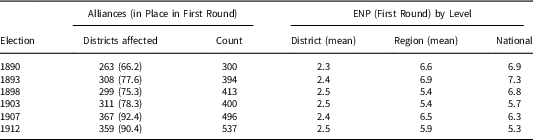
Party representatives formed district-level electoral alliances in support of joint candidates in a majority of districts even in 1890.Footnote 1 By 1907, they were virtually ubiquitous (see Table 1 for the following). These alliances were also coordinated among local-level party committees, but not under the aegis of party leaders or central offices (Nipperdey Reference Nipperdey1961; Alexander Reference Alexander2000; Reibel Reference Reibel2011).
Runoffs, Electoral Alliance and Party System Data for the 397 Reichstag Districts, 1890–1912

Note: Districts affected: number of districts with at least one alliance present (share of such districts among all 397 districts in parentheses); ENP = effective number of parties (Laakso and Taagepera Reference Laakso and Taagepera1979).
Candidates of four of the five main bourgeois parties were also the candidates supported by the brunt of alliances. Though together accounting for vote-shares below 50 percent, more than 80 percent of all alliances were forged in support of a DFP, NLP, DRP or DKP candidate, and by representatives of some or all of these four parties. As opposed to the Zentrum, these candidates did not typically gain their mandates in districts where their party was dominant in the sense of Boix (Reference Boix1999, Reference Boix2010). As opposed to the SPD, they also did not field candidates everywhere (cf. Matthias and Pikart Reference Matthias and Pikart1966).Footnote 2 This led to low levels of party system fragmentation at the district level as compared with the regional and national levels.
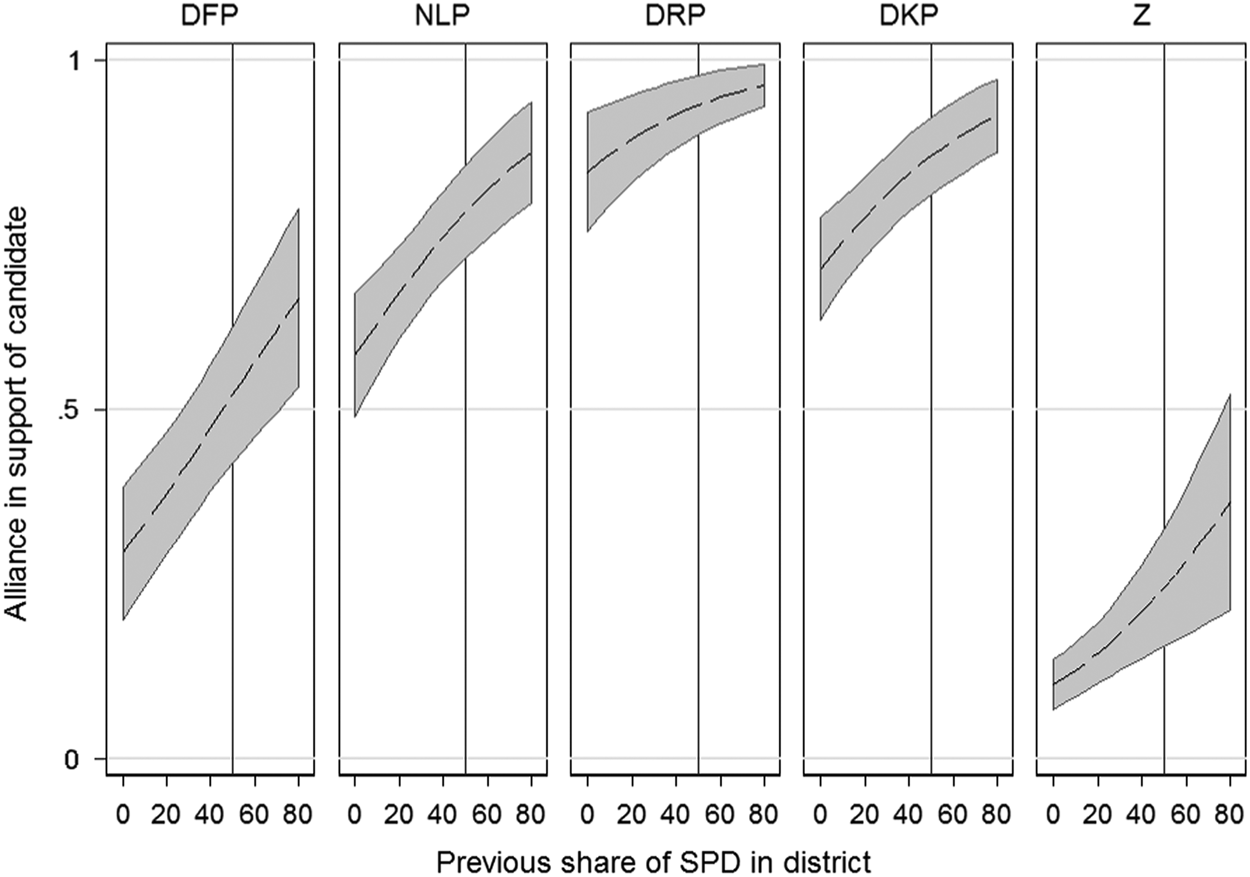
Alliances also served as a means for defending the bourgeois mandate in a district where the SPD had evolved as the main challenger. We document this with a logistic regression on determinants of the existence of electoral alliances in the 397 districts of the six elections 1890–1912 (see Appendix A).
Predictions from this regression show that an increase in the SPD vote-share at the previous election increased the probability of an alliance behind the main non-SPD candidate significantly once the SPD share approximated 40 percent for the liberal parties, i.e. those parties that gained most of their mandates in the urban, SPD-prone districts (see Figure 1). At the same time, there is generally a high probability of the main bourgeois candidate being a joint candidate for the NLP and the two Conservative parties, irrespective of the SPD vote-share.
Predicted probabilities of alliances in support of the strongest non-SPD candidate, by party of candidate 1890–1912

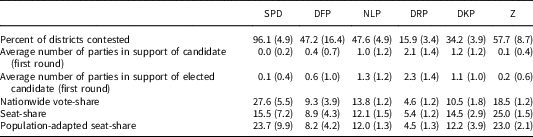
We, thus, see bourgeois party representatives reacting to the Socialist threat—via electoral alliances. Bourgeois candidates also did only run in a selection of districts, and often as joint candidates (see Table 2 for the following). This is particularly pronounced for successful candidates: Bourgeois MPs received, on average, the support of 0.4–2.3 further parties. There was also high variation in the spread of candidacies over time. Pre-electoral alliances were decisive for bolstering bourgeois candidates’ chances at runoff participation against the SPD. We show this with a beta regression on vote-shares of the strongest non-SPD candidate in each district as the dependent variable, in Appendix B. Runoffs have, in turn, been identified as the main reason why the SPD, despite being the strongest party in many districts, often failed to also secure the respective mandates and suffered from a ratio of vote-shares and seat-shares below one (Matthias and Pikart Reference Matthias and Pikart1966: XXXIff.; Fairbairn Reference Fairbairn1997: 176; Ritter Reference Ritter2002: 398; Anderson Reference Anderson2000). SPD candidates, running in at least 95 percent of districts ever since 1893, failed to transform their votes into seats as smoothly as the fragmentation hypothesis would have it: the ratio between the average SPD vote-share (27.6) and its average seat-share (15.5) is 0.56. Even accounting for malapportionment in favor of rural areas with a population-adapted seat-share, this ratio is only at 0.86, considerably lower than the 1:1 ratio under a proportional system.
National-Level Means and Standard Deviations of Electoral Characteristics of Six Major Parties, 1890–1912

Note: Standard deviations in parentheses.
So it was the SPD that was disadvantaged by the electoral system in place, not the fragmented bourgeois camp. Bourgeois MPs even profited from this system, precisely because of its district-level nature allowing for district-specific nomination and electoral alliances. With a view to the electoral arena, there was then just no reason to turn to PR under a fragmentation logic.
Elite party mps and electoral alliances in the legislative arena
We assess the legislative downside of the existing electoral system for the bourgeois camp along voting behavior of MPs in parliament. If a party being organized as an elite or mass party made a difference, we would observe MPs of mass parties voting much more in line with their leaders than MPs of elite parties. For bourgeois parliamentary groups, we thus expect cohesion to vary across votes. At the individual level of MPs, this would look like white noise across votes. Yet, bourgeois MPs often owed their mandate to support by committees of several other bourgeois parties, as we show above. And these committees could also gauge the legislative position of their respective parliamentary party, from observing how their own party’s MPs voted. If fragmentation within the bourgeois camp was due to differences over policy among these parties, we thus expect to observe deviance at the individual level to vary in line with this across votes.
MP voting behavior is documented in the Reichstag parliamentary protocols whenever a roll call vote (RCV) was held. RCVs are also often used as indicators for party cohesion in German parliaments (e.g., Saalfeld Reference Saalfeld1995; Schonhardt-Bailey Reference Schonhardt-Bailey1998; Sieberer Reference Sieberer2006). In the 2421 floor sessions in the period 1890–1914, at a total of 536 RCV were held. We thus first coded how each MP voted in each RCV (see Appendix C for detail on the following). We then identified each MP’s parliamentary party group, using data on party group membership from the lists published in the annexes to the Reichstag protocols at the beginning of each LP and checked for changes in membership during LPs in the Addenda to the official Reichstag handbooks that were published towards the end of each LP.Footnote 3 We then assessed the “party line” of each party group in each vote, as the choice (yes, no or abstention) taken by the majority of its MPs.
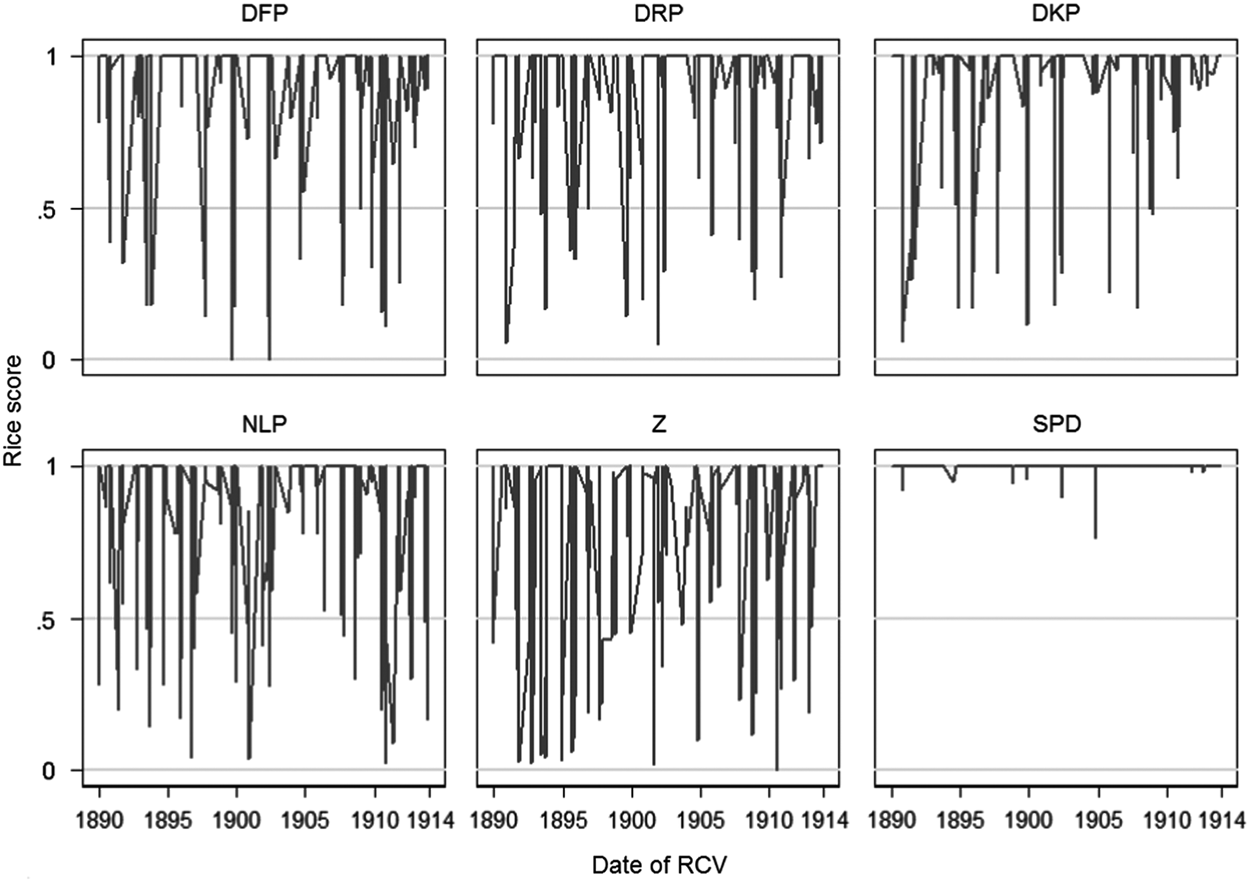
We first calculated Rice scores (see Figure 2, Rice Reference Rice1925). Scores vary from perfect cohesion (scores at 1) to near perfect splits (scores at 0) with no perceivable increase in cohesion over time. Only SPD MPs practically never dissented from the party line.
Rice scores for six major parliamentary groups, 1890–1914.

Figure 2 and results from three logistic regressions (models C.1–C.3) strongly support our contention that the unitary-actor assumption does not hold empirically for the bourgeois parties, and that accomplishing party cohesion presented a manifest challenge to bourgeois MPs in the legislative arena.
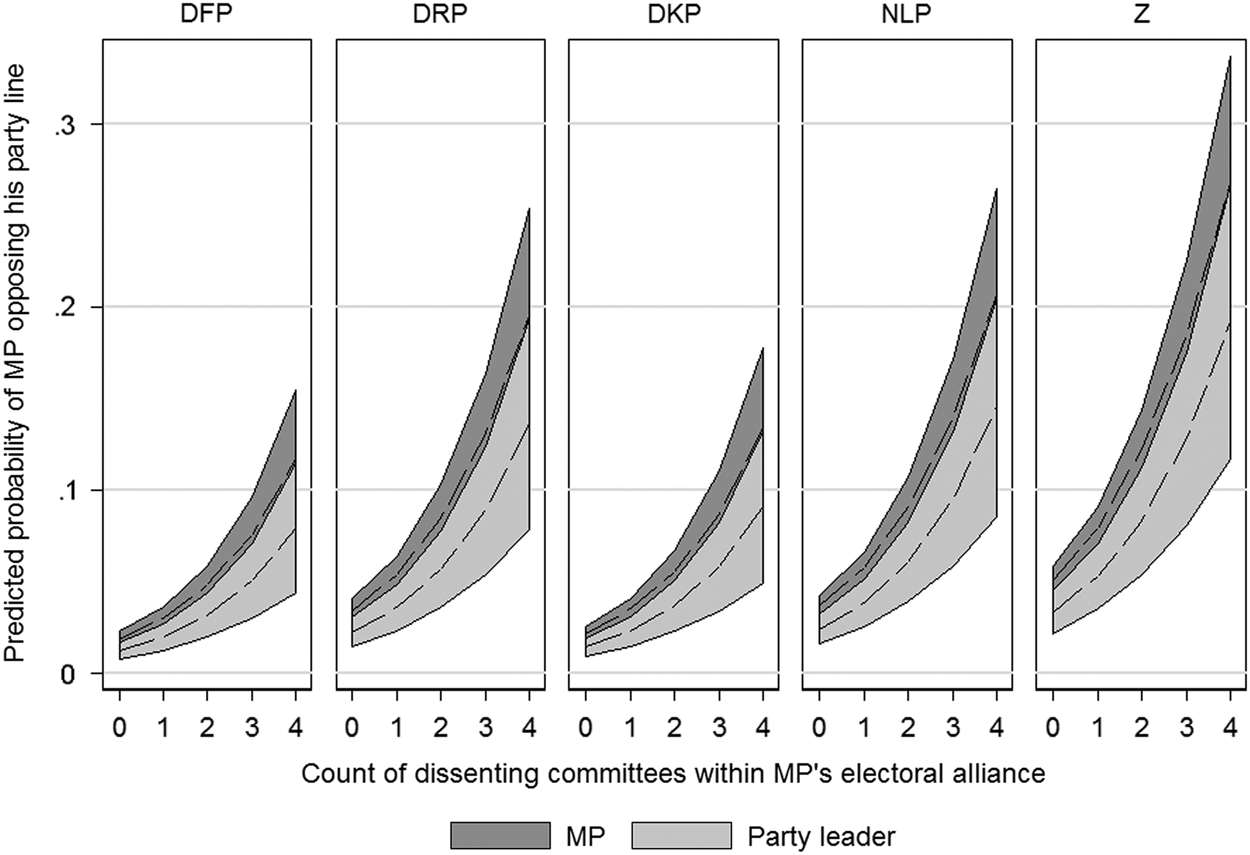
This brings us to our argument on the incentives of both bourgeois MPs and leaders to introduce PR: Getting rid of electoral alliances as an impediment to cohesion in the legislative arena. We suspect that cross-party alliances worked against intra-party cohesion due to differences in legislative goals among alliance partners. These differences are manifest in RCVs where party lines of the respective Reichstag party groups differ, as observable along voting behavior of the other MPs. And it is just these legislative votes where the MPs supported by committees representing several parties would know that they had to choose between sticking to their own party line or to the one of dissenting committees in their electoral support. So we ran a further model, C.4. In this model, we include a variable counting the number of committees in electoral support of each MP whose party line(s) differed from their supported MP’s party line. Figure 3 shows the predicted probabilities of MPs to defect as a function of this count.
Predicted probabilities of MPs voting against their party line

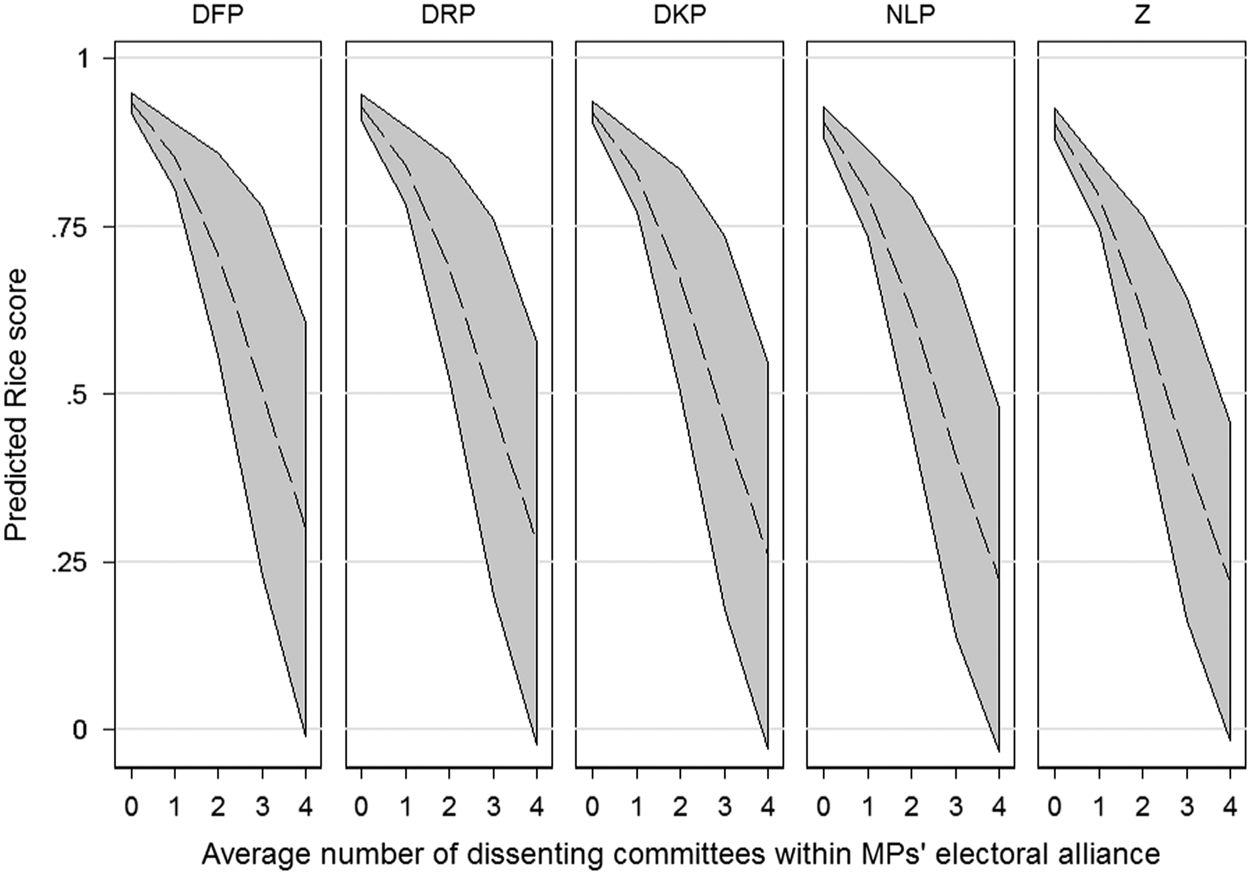
We find an effect of an increase in the number of dissenting committees on the probability of an MP supported by them to also dissent from his party line. The magnitude of this effect seems modest. But it works at the individual level of MPs and dissenting committees. So it is bound to magnify at the aggregate level of party groups. We assessed this with two Beta regressions on determinants of party cohesion as measured with Rice scores (C.6–C.7) and then calculated predicted Rice scores along party-group average numbers of dissenting committees (Figure 4). They demonstrate that sticking to the party line lost out to pleasing dissenting committees. Given bourgeois MPs’ electoral reliance on support of committees from two or more other parties, this means implosion of Rice scores once the party line of a bourgeois party differed from the one of more than one other such party—so Figure 3 essentially is an individual-level account of the aggregate-level data in Figure 2, with our findings in Figure 4 demonstrating the transition from one level to the other. Cross-party divergence very clearly spilled over into intra-party dissidence.
Predicted Rice scores as a function of the average number of dissenting committees

Our suspicion of alliances harming legislative cohesion is, hence, confirmed, supporting in turn our argument on joint MP and party leader incentives to get rid of them. The question remains whether these incentives were strong enough as to prompt the Switch. We turn to that now.
The adoption of pr in germany and in europe
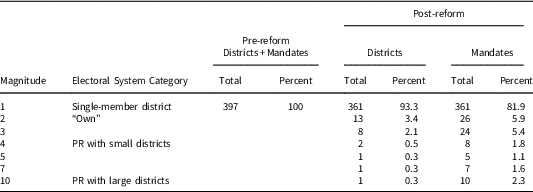
In July 1918, a bill introducing PR “in large districts” was adopted by a majority of the SPD, DFP, Zentrum and NLP Reichstag MPs.Footnote 4 (2014: 463) This reform has recently been interpreted as the step with which “Germany adopted proportional representation” (Leemann and Mares Reference Leemann and Mares2014: 463). This claim does not survive closer scrutiny: the reform was primarily aimed at adapting the distribution of mandates across the country to changes in the distribution of the population.Footnote 5 Hence, 36 under-represented districts were allocated additional mandates in order to bring their share of mandates more in line with their share of the population. These districts were all parts of single cities or counties, some of them of the same city. They were now merged into 26 MMDs along city/county boundaries.
These “large” districts had a median magnitude of 2.5 (Table 3). Mandates were distributed applying the d’Hondt formula to closed lists. The other 361 districts remained SMD. PR, in the sense of Carey and Hix (Reference Carey and Hix2011: 393), thus was adopted only for five districts: 1.3 percent of the 387 post-reform districts. Fusing districts across municipal boundaries, as a straightforward means of implementing proportionality, was generally avoided. In the Ruhr area, for example the reform created seven adjacent MMDs with an average magnitude of 2.7 and altered boundaries of a further eight SMDs to fall in line with municipality boundaries. Ensuing low magnitudes necessarily compromised proportionality. But they meant geographically small districts, so that candidates could always be nominated at the local level. MP Hoff (DFP) nimbly observed that nomination was still “not about setting up a list (…) but about nominating a candidate.” (StB XIII/2 5925). Our results from a series of simulations on the distribution of mandates along post-reform districts for the elections of 1903, 1907 and 1912 corroborate this observation (Appendix D).
Repartition of Districts by Magnitude Before and After the 1918 Reform

Note: Electoral system categories refer to Carey and Hix (Reference Carey and Hix2011: 393–395).
Bourgeois backbenchers were thus not affected by the reform in intra-party terms. They were, however, well aware of the consequences of lists in de-localized districts as a source of leaders’ power, highlighting the party-internal dimension of conflict. MP Kreth (DKP), for example, noted that “leaders can then [under a list system—VS/PM] always secure the mandates of those dearest to them,” succumbing “the individual representative to the all-mighty will of the party leadership” (StB XIII/2: 3514).
It took MPs more than a year to agree on this rather modest reform. The Switch, however, was then adopted swiftly: On 10 November 1918, the revolutionary “Council of People’s Deputies,” composed of SPD and Independent Socialist (USPD) leaders assumed power. On 30 November, it issued a decree, introducing closed-list PR in 37 de-localized districts with a median magnitude of 11, and an average population of 1.7 million (Miller Reference Miller1978: 105f.).
This way of PR introduction is precisely in line with the conditions that must be met for applying the logic of parties as unitary actors aimed at seat-maximization under our intra-party perspective: The SPD and USPD leaders represented the only mass parties of the time, and were even unbound by any backbench interference in a period where law-making rested with the Council alone (Nipperdey Reference Nipperdey1961: 333–4; Matthias Reference Matthias1969: XVII; Miller Reference Miller1978: 38, 108f.). And they were—given the experience of non-socialist electoral alliances—bound to profit from PR. So they chose to introduce large MMDs.
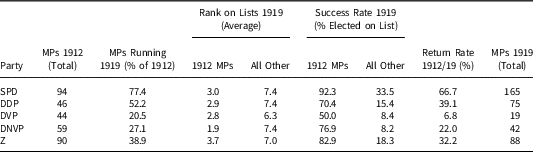
Our intra-party argument also has an implication on the distribution of intra-party power once closed-list PR is in place. Leaders should now obtain and use control over nomination. Specifically, we should observe a shift in these parties’ parliamentary membership. Indeed, bourgeois party leaders quickly set up lists according to their wishes (Liebe Reference Liebe1956: 35; Hartenstein Reference Hartenstein1962: 59ff.). Only a quarter of the 104 conservative and national-liberal MPs of the 1912–18 legislative period were put on the lists of the DNVP and DVP (the successors of DRP, DKP and NLP) in the elections of January 1919, (see Table 4). Those who were, however, populated the top list ranks. On the one hand, this meant return rates of 22 percent or lower for bourgeois MPs, by far the lowest rates ever in the entire period between 1890 and 1919. But rates for those being nominated remained at around 60 percent.
Incumbents and Non-Incumbents in the Successor Parties of Six Pre-1919 Major Parties Who Ran and Won in the 1919 Elections

Note: Success rate: share of elected candidates among candidates running. Return rate: share of MPs in office at the end of LP gaining mandate among all MPs in office at the end of LP.
MP totals refer to MPs according to their Reichstag group affiliation as of 1 November 1918 and by electoral lists (BVP in Bavaria coded as Z).
Sources: Bureau des Reichstags (1912, 1916), Deutscher Reichstag (1912), Verfassunggebende Deutsche Nationalversammlung (1919, 1920), Statistisches Reichsamt (1919); cf. Appendix F.
Our argument implies that party leaders were also interested in bolstering their control over nomination, e.g. in centralizing the electoral system further towards the national level. Just this was achieved with the Electoral law of April 1920. A seat was now allocated to each 60,000 votes gained by a party list at the regional level. Votes not converted into seats at this level were transferred to the newly-created national party lists. For the fragmented set of bourgeois parties, the introduction of national lists meant that up to 20 percent of their mandates were allocated at the national level in the elections of June 1920 (Statistisches Reichsamt 1920: 4).
The introduction of national lists meant, according to Left-liberal MP Brodauf, that “party leaders are enabled to nominate people who are instrumental for our parliamentary work but who, for one reason or another, cannot be nominated in the districts. (…) There also seems to be a consensus on this” (StB NV 1920a: 5339). The respective law was adopted unanimously (StB NV 1920b: 5389).
These three steps towards PR introduction in Germany—very modest reform under parliamentary procedures, swift introduction of de-localized districts by decree when parliament was dissolved, and then bolstering party leader influence over nomination with a nation-wide upper tier—do not fit an account of fragmented bourgeois parties as unitary actors maximizing seat-shares. The first step runs counter to it and the third step is beyond its domain. But they abide by the intra-party logic that we propose in that the second, crucial, step in terms of party leaders achieving control over nomination has been taken at a point in time where they could act on their own.
We now turn to our predictions on how PR would look like after the Switch, with regard to all early-20th-century European and Anglo-Saxon countries. We expect some form of committee control over nomination, whenever MP assent was needed for implementing the Switch. So we expect an “upper bound” in geographical size of districts. This implies varying and often low district magnitudes. Also, we expect upper tiers or nation-wide repartition of mandates across parties, if they even exist, to always foresee assignment of mandates to candidates at the level of local districts. Whenever the Switch was achieved without parliamentary assent, we expect large or even nation-wide districts, and mandates from upper tiers allotted to nation-wide party lists.
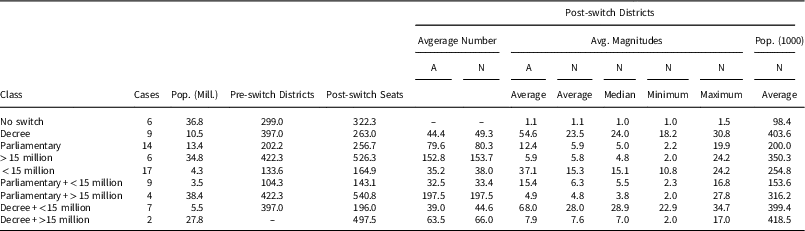
PR was introduced as a formula in 23 countries in Europe in the period 1900–1931. In nine, this was achieved without MP assent. In 14 countries that switched and in the six non-switch countries listed in Boix (Reference Boix1999), parliamentary assent was necessary for electoral reform. So we can tell reforms with and without necessary MP assent apart from each other. In order to separate “large” from “small” countries, we assessed population size, conceiving as “large” of all countries with more than 15 million inhabitants. We then calculated averages for seat totals, district totals and measures of district magnitudes for the ensuing three classes (no switch, switch by decree, switch under parliamentary procedure) and two sizes (small, large) of countries. As for districts, we differentiated between districts relevant for the appropriation of mandates to parties, and districts relevant for the assignment of mandates to candidates. The latter are of primary interest for us since they are relevant for nomination. Table 5 summarizes our findings, focusing on nomination districts, but with differences between nomination districts and appropriation districts being typically very small (see Appendix D for detail).
Average Population, Districts and District Magnitudes of 29 Countries, Pre- and Post-switch

A: Districts relevant for appropriation of mandates to parties; N: Districts relevant for nomination of candidates. Upper tiers are counted as additional districts generally for appropriation, but for nomination only in instances of separate lists for upper tiers. All such lists were set up at the level of the country as a whole.
Throughout cases of parliamentary switches, magnitudes vary from an average minimum of 2.2 to an average maximum of 19.9. For large countries, variation is even more pronounced, from 2.0 to 27.8. Average magnitudes of switchers-by-decree however are generally higher, starting only at 18.2. Medians and averages mirror this: only PR introduction by decree also implied proportionality, with average magnitudes around 24 or higher. Parliamentary introduction went along with average and median magnitudes around five. This gulf gets even wider once we account for population size. In large countries with switches-by-parliament, the average of medians is at 3.8. In small countries switching by decree, these values stood at around 30. As for the size of districts in terms of population, we find those of switchers-by-parliament to be more similar to non-switchers than to decree-switchers. This is most pronounced for small countries. However, the average number of inhabitants even across large countries is then lower still than that for decree-switchers of any size.
Our expectation on variation in district magnitudes and sizes, including very small districts when PR was introduced under parliamentary procedures, is thus met. So are our expectations that this is most pronounced for large countries, but non-existent if leaders were able to act without MP assent. These findings are a crucial complement to findings in enduring studies on the switch that take account of magnitudes, because these studies only address small-country parliamentary switches (Calvo Reference Calvo2009, Cox et al. Reference Cox, Fiva and SmithForthcoming).
Conclusion
In this article, we take an intra-party perspective on electoral reform. Three comprehensive datasets, on candidacies and electoral results, on electoral alliances and on RCVs, covering the 30 years preceding the Switch to PR in Germany, and a case study on actual reform steps allow us to empirically address our theoretical expectations at the level of individual legislators. Our findings with a view to this prototypical case and to all further Switchers across Europe during the “PR wave” corroborate our theoretical expectations, but contradict the fragmentation hypothesis as a core theoretical claim of the enduring seat-maximizing model of electoral reform.
Local-level pre-electoral coordination was a constitutive feature of electoral politics of a fragmented bourgeois camp, securing electoral success of candidates of precisely those parties that the literature has characterized as the proponents of PR. However, we also show that these parties, being organized as elite rather than mass parties, faced challenges to party cohesion. Electoral alliances contributed to this challenge. This, if anything, would provide both MPs and party leaders with an incentive for electoral reform—to the extent that control over nomination in the hands of local committees was not compromised. At the same time, the absence of party leader control over nomination and, thus, backbencher behavior set tight limits to reform under parliamentary procedures, as mirrored in low and varying district magnitudes post-reform, especially in large countries.
We derive two implications for further research, one concerning explanations of electoral reforms and one on the role assigned to “numbers” in research on elections under plurality and majority systems. The first implication stems from our intra-party perspective. As concerns early-20th-century Europe, the party-internal conflict of interest between elites and backbench MPs was not specific to Germany. In France, for example, leaders were faced with weak party organization, the dominance of local affairs over national issues, and a lack of parliamentary voting discipline ever since the introduction of parliamentary democracy (Mezdeg and Nohlen Reference Mezdeg and Nohlen1969: 470ff.; Maier Reference Maier1975: 95; Nohlen Reference Nohlen2010: 644ff.). Republican party leader Leon Gambetta, in the early years of the 3rd Republic, complained that “in the chamber elected by single-member constituencies, France was reflected as in a broken looking-glass” (Campbell Reference Campbell1965: 75). His plan to restore the multi-member constituencies of the 1871 electoral law was however blocked in the Senate, because “senators were among the local notabilities whose influence might be reduced … [or] shared the dislike of many Republican deputies for Gambetta, [who] hoped it would promote the rise of a strong and united party” (ibid.). The introduction of la proporzionale in Italy in 1919 conveys as very similar story (Noiret Reference Noiret1994). Hence, electoral systems should be accounted for not only as mechanisms determining the cross-party distribution of mandates but also as determining the intra-party distribution of power. Accounting for electoral reform then requires accounting for both of them—but it also means accounting for a crucial step in the evolution of (European) parties as organizations.
The second implication concerns the role numbers play. For Germany, we find national-level ENPs to be more than twice as high as the average local-level ENPs, due to wide-spread pre-electoral alliances. These findings caution against interpreting manifest electoral results as indicators of latent electoral party strength. This strongly recommends first assessing electoral system effects on nomination and only then turning to their effects on voting. This also calls for relating theoretical predictions on candidate entry under various electoral systems (that at times also contradict each other, see, e.g., Palfrey Reference Palfrey1984; Callander Reference Callander2005a, Reference Callander2005b; Indridason Reference Indridason2008) to empirical observations at the level where electoral competition actually takes place (see, e.g., Tiemann Reference Tiemann2015). This double step, from national-level measures towards district-level data and from supply to demand, is an arduous one. But our results indicate that it is also a crucial one.
Supplementary materials
To view supplementary material for this article, please visit https://doi.org/10.1017/psrm.2018.58
Acknowledgments
The authors would like to thank Insa Bertram, Marlon Brandt, Phillip Hocks, Friedrich Kersting, David Kutscha, Volker Lindhauer, Nils Oellerich, Stefan Papantonatos, Jan Rothenbacher, Lina Schwarz and Markus Wolf for their zealous and rigorous coding of lists and texts worth several thousands of pages in Gothic font. For comments on earlier drafts, the authors thank participants in presentations held at Universidad Carlos III Madrid, Universität Bremen, Kommission für die Geschichte des Parlamentarismus und der politischen Parteien Berlin, and the Center for European Studies at Harvard University. The authors would also like to thank two anonymous reviewers whose comments have greatly improved this paper, up to its title.